
| REPORT ATTRIBUTE | DETAILS |
|---|---|
| Historical Period | 2020-2023 |
| Base Year | 2024 |
| Forecast Period | 2025-2032 |
| Radar System Market Size 2024 | USD 34286Million |
| Radar System Market, CAGR | 5.5 % |
| Radar System Market Size 2032 | USD 52618.2 Million |
Market Overview:
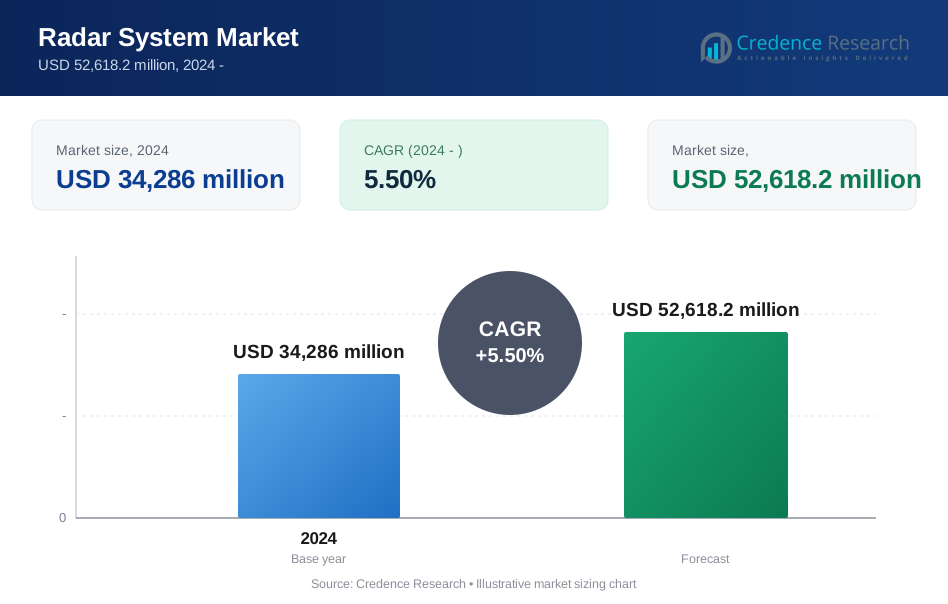
The Radar System Market size was valued at USD 34286 million in 2024 and is anticipated to reach USD 52618.2 million by 2032, at a CAGR of 5.5 % during the forecast period (2024-2032).
Key drivers propelling the radar system market include heightened demand for advanced surveillance, tracking, and navigation solutions in defense and homeland security. Governments are allocating larger budgets for early warning, border protection, and missile defense, stimulating the deployment of next-generation radar platforms with higher accuracy and multi-target tracking capabilities. In the automotive sector, the rapid adoption of advanced driver-assistance systems (ADAS) and autonomous driving features is intensifying the need for compact, high-resolution radar sensors. Technological innovations such as solid-state radar, phased array systems, and integration with AI-based analytics are also enabling broader use in air traffic management, weather monitoring, and maritime navigation, contributing to sustained market growth.
Regionally, North America dominates the radar system market due to substantial defense spending, strong presence of leading manufacturers such as Lockheed Martin Corporation, NXP Semiconductors, RTX, and AIRBUS, and ongoing investments in R&D. The U.S. accounts for the largest share, supported by multiple military and civilian radar upgrade programs. Europe holds significant market share, driven by modernization of military fleets and growing demand for security and surveillance solutions. The Asia Pacific region is witnessing the fastest growth, fueled by rising defense budgets in China, India, and South Korea, along with expanding automotive and infrastructure projects. Latin America, the Middle East, and Africa are experiencing steady adoption, primarily in border security and aviation.
Market Insights:
- The radar system market was valued at USD 34,286 million in 2024 and is projected to reach USD 52,618.2 million by 2032.
- Heightened demand for advanced surveillance, tracking, and navigation in defense and homeland security drives strong market growth.
- Automotive radar adoption is rising rapidly, supporting ADAS and autonomous driving with compact, high-resolution sensors.
- Technological advancements such as solid-state radar, phased array systems, and AI-based analytics expand applications across civil and defense sectors.
- Complex regulatory requirements and spectrum management issues create barriers for new entrants and constrain flexibility.
- North America leads with 36% market share, followed by Asia Pacific at 27% and Europe at 23%, driven by robust defense spending and modernization initiatives.
- High costs and technical complexity limit broader adoption in emerging economies and smaller organizations.
Market Drivers:
Expanding Defense and Homeland Security Applications Propel Market Growth:
The radar system market is driven by the escalating demand for advanced surveillance, threat detection, and tracking technologies in defense and homeland security. Governments are prioritizing investments in early warning systems, missile defense, and border surveillance to strengthen national security. Modern radar solutions offer enhanced detection ranges, accuracy, and the ability to track multiple targets simultaneously. The adoption of network-centric warfare and real-time situational awareness is further accelerating the integration of sophisticated radar platforms. Procurement of airborne, naval, and ground-based radar systems continues to surge worldwide. It is expected that ongoing geopolitical tensions will sustain strong demand across military applications.
- For Instance, Lockheed Martin’s Long Range Discrimination Radar (LRDR) successfully detected, tracked, and discriminated a live ballistic missile threat during a complex operational test (FTX-26a) in June 2025, demonstrating its effectiveness in providing actionable defense data to U.S. homeland security command systems.
Rising Integration of Radar in Automotive and Transportation Sectors:
The growing implementation of radar systems in automotive and transportation is a significant driver for the radar system market. Automakers are equipping vehicles with radar-enabled advanced driver-assistance systems (ADAS), supporting features such as adaptive cruise control, collision avoidance, and autonomous emergency braking. The push towards autonomous vehicles is intensifying the need for reliable, compact, and cost-effective radar sensors capable of operating under diverse environmental conditions. Transportation authorities are deploying radar technologies for intelligent traffic management, speed monitoring, and infrastructure safety. It is likely that evolving regulatory requirements for vehicle safety will accelerate market adoption.
- For instance, Navtech ClearWay 360° radar system is deployed across long stretches of highway, detecting stopped vehicles, wrong-way drivers, and obstructions within seconds in any weather conditions, and a range of up to 1km.
Technological Advancements Enable New Market Opportunities:
Continuous innovation in radar technology, including the development of solid-state radar, phased array systems, and digital signal processing, is unlocking new applications and efficiencies. Integration of artificial intelligence and machine learning enhances radar data interpretation, supporting automated threat identification and predictive analytics. Miniaturization allows deployment in drones, unmanned vehicles, and portable surveillance systems. These advances make radar solutions more versatile, energy efficient, and adaptable for a broader range of industries. It is clear that technology upgrades will drive market expansion in both established and emerging segments.
Rising Investments in Infrastructure and Civil Applications Stimulate Demand:
Increasing infrastructure investments are stimulating the use of radar in civil applications such as air traffic control, weather monitoring, and maritime navigation. Governments and private entities are installing advanced radar systems to improve aviation safety, monitor weather patterns, and support harbor and coastal management. The growing emphasis on disaster preparedness and environmental monitoring is also driving deployments in meteorology and hydrology. These factors create consistent, long-term demand for radar technologies beyond defense. The radar system market is thus benefiting from a diverse portfolio of growth avenues across public and private sectors.
Market Trends:
Adoption of Next-Generation Radar Technologies Reshapes Competitive Landscape:
The radar system market is experiencing a shift toward next-generation technologies, with strong emphasis on solid-state radar, active electronically scanned arrays (AESA), and digital signal processing. These advancements enable faster data acquisition, improved target resolution, and lower maintenance requirements. Manufacturers are investing in compact, lightweight radar modules to support new platforms such as unmanned aerial vehicles and portable ground stations. Integration of artificial intelligence and machine learning is streamlining threat identification and real-time data analytics, providing users with actionable insights. It is expected that this wave of innovation will drive competitive differentiation and expand the radar system market’s applications across both defense and commercial sectors.
- For instance, EWR Radar Systems has deployed over 300 solid-state radar systems globally, pioneering portable weather radar solutions that deliver continuous operation in the world’s harshest environments.
Increasing Role of Radar in Civil, Automotive, and Environmental Applications:
Broader use of radar in non-defense sectors defines another prominent trend in the radar system market. Automakers are incorporating radar sensors to enhance vehicle safety and accelerate progress toward autonomous driving. Civil infrastructure projects are deploying radar for air traffic control, maritime safety, and intelligent transportation systems. Environmental monitoring is gaining importance, with radar being used to track weather patterns, assess flood risks, and monitor coastline changes. It is evident that ongoing digital transformation, combined with regulatory support for safety and efficiency, is driving new adoption across diverse end-user industries.
- For instance, the U.S. Federal Aviation Administration’s ASR-11 Airport Surveillance Radar system has been fully deployed at terminal sites, delivering primary surveillance of aircraft up to 60 nautical miles and providing weather calibration data on six levels of rainfall intensity for enhanced situational awareness.
Market Challenges Analysis:
Complex Regulatory and Spectrum Management Issues Constrain Growth:
The radar system market faces challenges related to regulatory compliance and spectrum allocation. Strict government regulations govern frequency bands, export controls, and interoperability standards, creating entry barriers for new suppliers. Limited availability of spectrum and potential interference with other wireless systems restrict operational flexibility. Manufacturers must continuously adapt to evolving standards and certification requirements, increasing development costs and timelines. It is clear that effective spectrum management and regulatory navigation remain critical concerns for industry participants.
High Costs and Technical Barriers Limit Broader Adoption:
Elevated costs of advanced radar technologies, including phased array and solid-state systems, present a significant obstacle for smaller organizations and developing economies. Technical complexity requires specialized expertise for system integration, calibration, and ongoing maintenance. Vulnerability to cyberattacks and electronic countermeasures raises additional operational risks, especially in military and critical infrastructure applications. The radar system market must address these cost and technical challenges to accelerate adoption in emerging applications and price-sensitive regions.
Market Opportunities:
Emerging Applications in Autonomous Systems and Smart Infrastructure Create New Demand:
The radar system market presents strong opportunities in autonomous vehicles, drones, and smart infrastructure. Automotive manufacturers are expanding the integration of radar sensors to support advanced driver-assistance and fully autonomous driving capabilities. Urban planners and governments are deploying radar in smart city projects for intelligent traffic management, public safety, and real-time environmental monitoring. The increasing adoption of unmanned aerial vehicles in commercial, industrial, and emergency response roles further fuels demand for compact, reliable radar solutions. It is clear that these emerging applications are unlocking new revenue streams for market participants.
Growing Investments in Defense Modernization and Border Security Fuel Expansion:
Rising global defense budgets and security concerns are prompting investments in next-generation radar systems for air, land, and sea domains. Nations are prioritizing upgrades to surveillance, early warning, and missile defense platforms, while modernizing fleets with multi-function radar capabilities. Border protection and counter-drone applications are accelerating radar deployments in sensitive zones. It is expected that partnerships between defense agencies and technology providers will drive sustained innovation and adoption. The radar system market is well positioned to benefit from these expanding opportunities across both established and developing regions.
Market Segmentation Analysis:
By Application:
The radar system market is segmented by application into air and missile defense, surveillance and reconnaissance, air traffic control, weather monitoring, automotive safety, maritime navigation, and industrial automation. Defense remains the largest application segment, driven by military modernization and homeland security needs, while automotive radar is rapidly gaining momentum with the push for autonomous vehicles and advanced driver-assistance systems.
- For instance, Continental produced its 200 millionth automotive radar sensor in 2025, supporting safety features like adaptive cruise control and automated emergency braking worldwide.
By Platform:
By platform, the radar system market is divided into airborne, ground-based, naval, and space-based systems. Airborne radar dominates due to its extensive use in fighter aircraft, drones, and surveillance planes, offering critical situational awareness and targeting capabilities. Naval radar is vital for maritime patrol, anti-submarine warfare, and coastal defense, while ground-based radar supports air defense, border surveillance, and meteorological observation. Space-based radar is gaining interest for earth observation, disaster monitoring, and global communications.
- For instance, Northrop Grumman AN/APG-83 SABR radar, deployed on F-16 aircraft globally, delivers high-resolution synthetic aperture radar (SAR) imaging at up to one-foot resolution for target identification in all-weather conditions.
Component:
The radar system market encompasses antennas, transmitters, receivers, power amplifiers, signal processors, and display units by component. Signal processing and data analytics components are in high demand, supporting real-time detection, tracking, and analysis. The integration of advanced components improves accuracy, range, and multi-target tracking, enhancing the overall performance of radar systems across all platforms and applications.
Segmentations:
By Application:
- Air and Missile Defense
- Surveillance and Reconnaissance
- Air Traffic Control
- Weather Monitoring
- Automotive Safety
- Maritime Navigation
- Industrial Automation
By Platform:
- Airborne
- Ground-Based
- Naval
- Space-Based
By Component:
- Antennas
- Transmitters
- Receivers
- Power Amplifiers
- Signal Processors
- Display Units
By Range:
- Short Range
- Medium Range
- Long Range
By Frequency Band:
- X Band
- S Band
- C Band
- L Band
- Ku Band
- Ka Band
- VHF/UHF Band
By Technology:
- Pulsed Radar
- Continuous Wave (CW) Radar
- Doppler Radar
- Phased Array Radar
- Solid-State Radar
By Region:
- North America
- Europe
- Asia Pacific
- Latin America
- Middle East
- Africa
Regional Analysis:
North America:
North America accounted for 36% of the radar system market in 2024, reflecting the region’s robust defense sector and early adoption of advanced technologies. The United States drives regional growth with ongoing military modernization programs and strong demand for surveillance, air traffic management, and weather monitoring solutions. Canada contributes to expansion through investments in border security and infrastructure upgrades. The presence of leading radar system manufacturers and research institutions supports continuous innovation and product development. It is expected that North America will sustain its leadership position with a focus on R&D and multi-domain radar applications.
Asia Pacific:
Asia Pacific held 27% share of the radar system market in 2024, fueled by increasing defense budgets, infrastructure projects, and expanding automotive production. China, India, Japan, and South Korea account for significant demand, driven by geopolitical tensions, border surveillance needs, and industrial automation. Governments are investing in radar-based solutions for disaster management, traffic control, and smart city initiatives. The presence of both domestic and international suppliers enhances technology transfer and local production capabilities. It is likely that Asia Pacific will see sustained high growth supported by continued public and private investments.
Europe:
Europe captured 23% of the radar system market in 2024, driven by military upgrades, civil aviation improvements, and strict safety standards. Countries including Germany, the United Kingdom, and France prioritize modernization of air defense and navigation systems, while expanding applications in automotive, maritime, and environmental monitoring. The region benefits from strong collaboration between industry players, governments, and research organizations. It is anticipated that ongoing focus on safety, innovation, and cross-sector deployment will reinforce Europe’s position as a key radar system market.
Key Player Analysis:
- Lockheed Martin Corporation
- NXP Semiconductors
- RTX
- AIRBUS
- L3Harris Technologies, Inc.
- Infineon Technologies AG
- Thales Group
- Northrop Grumman
- BAE Systems
- Robert Bosch GmbH
Competitive Analysis:
The radar system market is characterized by intense competition among major players focused on technological innovation and product differentiation. Leading companies such as Lockheed Martin Corporation, NXP Semiconductors, RTX, and AIRBUS set industry benchmarks through extensive R&D investments, strategic alliances, and broad product portfolios. It emphasizes continuous advancements in solid-state radar, phased array technology, and integration of artificial intelligence to enhance detection, tracking, and operational reliability. Firms compete on performance, customization capabilities, and lifecycle support, targeting defense, aerospace, automotive, and civil sectors. Strong government relationships and global supply chains further strengthen their market positions. The radar system market remains dynamic, with new entrants and regional players driving niche innovation, while established companies focus on expanding their global reach and addressing evolving end-user requirements.
Recent Developments:
- In May 2025, Northrop Grumman completed the sale of its Mission Training & Satellite Ground Network Communications Software business to Serco for $327 million.
- In June 2025, BAE Systems announced a new series of M-Code GPS receivers, launching several models for military and allied use.
- In May 2025, L3Harris announced a partnership with Trident Solutions Group and HDT Global to deliver enhanced robotic payloads for military EOD (explosive ordnance disposal) operations.
Market Concentration & Characteristics:
The radar system market exhibits a moderately concentrated structure, with a handful of global players holding significant market shares alongside several regional and niche specialists. Leading companies maintain their competitive edge through technological innovation, extensive patent portfolios, and established relationships with defense and government agencies. The market is characterized by high entry barriers due to strict regulatory requirements, complex integration needs, and substantial R&D investments. It displays a strong focus on customization, reliability, and multi-domain applications, ranging from defense and aerospace to automotive, infrastructure, and environmental monitoring. Continuous innovation and strategic partnerships define the competitive landscape.
Report Coverage:
The research report offers an in-depth analysis based on Application, Platform, Component, Range, Frequency Band, Technology and Region. It details leading Market players, providing an overview of their business, product offerings, investments, revenue streams, and key applications. Additionally, the report includes insights into the competitive environment, SWOT analysis, current Market trends, as well as the primary drivers and constraints. Furthermore, it discusses various factors that have driven Market expansion in recent years. The report also explores Market dynamics, regulatory scenarios, and technological advancements that are shaping the industry. It assesses the impact of external factors and global economic changes on Market growth. Lastly, it provides strategic recommendations for new entrants and established companies to navigate the complexities of the Market.
Future Outlook:
- Industry adoption of solid-state radar will accelerate performance improvements and reduce system maintenance.
- Integration of artificial intelligence with radar will enable faster threat detection across defense and security sectors.
- Miniaturized radar sensors will support broader deployment in drones, unmanned vehicles, and handheld surveillance tools.
- Vehicle manufacturers will embed radar in more platforms to advance driver safety and autonomous capabilities.
- Governments will invest in coastal and border radar systems to address evolving security threats.
- Digital beamforming technology will offer higher resolution imaging and enhanced target discrimination.
- Collaborative research partnerships will drive cost-efficient system development and cross-sector innovation.
- Standardization of radar interfaces will improve interoperability across military and civilian platforms.
- Commercial aviation will adopt upgraded radar systems for improved weather tracking and airspace management.
- Environmental agencies will deploy radar for real-time flood forecasting and ecosystem monitoring.
Request a Free Sample
Fill in your details and we'll send you a free sample report.
- Sample data tables & charts
- Research methodology
Market Dynamics
Expanding Defense and Homeland Security Applications
Governments are increasing investments in advanced radar systems for early warning, missile defense, and border surveillance, driven by rising geopolitical tensions and the need for real-time situational awareness. This is fueling demand for next-generation radar platforms with enhanced detection and multi-target tracking capabilities.
Rising Integration of Radar in Automotive and Transportation
Automakers are rapidly adopting radar sensors to enable advanced driver-assistance systems (ADAS) and autonomous driving features, such as adaptive cruise control and collision avoidance. Regulatory pushes for vehicle safety and the need for reliable sensors in diverse conditions are accelerating market growth in the automotive sector.
Technological Advancements in Radar Systems
Continuous innovation, including solid-state radar, phased array systems, and AI-based analytics, is expanding radar applications across defense, civil, and commercial sectors. These advancements improve accuracy, enable miniaturization, and support new use cases such as drones and portable surveillance.
Growing Investments in Infrastructure and Civil Applications
Governments and private entities are deploying radar systems for air traffic control, weather monitoring, and maritime navigation to enhance safety and disaster preparedness. Infrastructure upgrades and smart city initiatives are driving sustained demand for radar technologies beyond traditional defense uses.
Emergence of Autonomous Systems and Smart Infrastructure
The proliferation of autonomous vehicles, drones, and smart city projects is creating new opportunities for compact, high-performance radar sensors. These applications require reliable, real-time detection and tracking, further expanding the addressable market for radar systems.
Need a Custom Version of This Report?
Tailor the scope, geography, or segments to your exact requirements.
- Custom geography or segment scope
- Direct access to our analyst team
Frequently Asked Questions
What is the current size of the radar system market?
What factors are driving the growth of the radar system market?
What are the key segments within the radar system market?
What are some challenges faced by the radar system market?
Who are the major players in the radar system market?
Table of Content
Chapter 1 Market Segmentation
- 1.1 Segmentation Framework
- 1.1.1 Product and Service Classification
- 1.1.2 Application and End-Use Classification
- 1.1.3 Technology and Solution Classification
- 1.1.4 Customer and Distribution Channel Classification
- 1.1.5 Geographic Segmentation
- 1.1.6 Market Segment Definitions and Boundaries
- 1.2 By Platform
- 1.2.1 Airborne
- 1.2.2 Ground-Based
- 1.2.3 Naval
- 1.2.4 Space-Based
- 1.3 By Component
- 1.3.1 Antennas
- 1.3.2 Transmitters
- 1.3.3 Receivers
- 1.3.4 Power Amplifiers
- 1.3.5 Signal Processors
- 1.3.6 Display Units
- 1.4 By Technology
- 1.4.1 Pulsed Radar
- 1.4.2 Continuous Wave (CW) Radar
- 1.4.3 Doppler Radar
- 1.4.4 Phased Array Radar
- 1.4.5 Solid-State Radar
- 1.5 By Application
- 1.5.1 Air and Missile Defense
- 1.5.2 Surveillance and Reconnaissance
- 1.5.3 Air Traffic Control
- 1.5.4 Weather Monitoring
- 1.5.5 Automotive Safety
- 1.5.6 Maritime Navigation
- 1.5.7 Industrial Automation
Chapter 2 Introduction
- 2.1 Report Objectives and Scope
- 2.2 Product Definition and Industry Terminology
- 2.3 Market Inclusions and Exclusions
- 2.4 Research Process
- 2.4.1 Primary Research and Expert Interviews
- 2.4.2 Secondary Research and Source Review
- 2.4.3 Top-Down and Bottom-Up Estimation
- 2.4.4 Data Triangulation and Verification
- 2.5 Market Size Measurement Basis
- 2.5.1 2024: USD 34,286 million → 2032: USD 52,618.2 million
- 2.6 Historical and Forecast Reference Periods
- 2.6.1 Base Year: 2024
- 2.6.2 Forecast Period: 2024-2032
- 2.7 Research Assumptions and Limitations
Chapter 3 Executive Summary
- 3.1 Market Snapshot and Key Findings
- 3.2 Base-Year Market Size, 2024
- 3.3 Forecast Market Size, 2032
- 3.4 Revenue and Volume Growth Outlook
- 3.5 Key Demand and Supply Indicators
- 3.6 Leading Market Segments
- 3.7 Fastest-Growing Market Opportunities
- 3.8 Regional Performance Highlights
- 3.9 Technology and Industry Transformation
- 3.10 Competitive Landscape Summary
- 3.11 Analyst View and Strategic Implications
Chapter 4 Global Radar System Market Trends and Developments
- 4.1 Historical Industry Development
- 4.2 Recent Market Trends and Developments
- 4.3 Demand and Customer Behavior Trends
- 4.4 Technology and Product Innovation
- 4.5 Artificial Intelligence, Automation and Digitalization
- 4.6 Local Manufacturing and Supply Chain Realignment
- 4.7 Industry Partnerships, Mergers and Acquisitions
- 4.8 Sustainability and Circular Economy Developments
- 4.9 Government and Private Sector Investment Trends
- 4.10 Emerging Business Models and Commercialization
- 4.11 Industry Developments and Announcements
Chapter 5 Global Radar System Market Production, Supply and Demand Analysis
- 5.1 Demand Trend and Consumption Analysis
- 5.2 Demand Forecast, 2024-2032
- 5.3 Production and Output Trend
- 5.4 Production and Output Forecast, 2024-2032
- 5.5 Installed Capacity and Capacity Utilization
- 5.6 Company-Wise Production Plants and Statistics
- 5.6.1 Installed Production Capacity
- 5.6.2 Actual Production
- 5.6.3 Planned Capacity and Expansion Targets
- 5.7 Supply Chain Structure and Procurement Trends
- 5.8 Supply-Demand Gap and Bottlenecks
- 5.9 Import Dependence and Sourcing Structure
- 5.10 Contract Manufacturing and Outsourcing
- 5.11 Regional Supply and Demand Concentration
Chapter 6 Global Radar System Market Pricing Analysis
- 6.1 Pricing Structure and Measurement
- 6.2 Historical Pricing Trends
- 6.3 Pricing Outlook, 2024-2032
- 6.4 Average Selling Price and Unit Economics
- 6.5 Pricing by Product and Market Segment
- 6.6 Geographic Pricing Differences
- 6.7 Key Input, Energy, Labor and Logistics Costs
- 6.8 Contract Pricing and Purchasing Models
- 6.9 Pricing Sensitivity and Competitive Positioning
- 6.10 Price, Margin and Profitability Implications
Chapter 7 Global Radar System Market Dynamics
- 7.1 Market Growth Drivers
- 7.1.1 Demand-Side Drivers
- 7.1.2 Technology and Innovation Drivers
- 7.1.3 Infrastructure and Investment Drivers
- 7.1.4 Regulatory and Policy Drivers
- 7.2 Market Restraints
- 7.2.1 Cost and Affordability Constraints
- 7.2.2 Technology and Adoption Barriers
- 7.2.3 Supply Chain and Operational Constraints
- 7.3 Market Challenges
- 7.3.1 Competitive Pressure and Margin Erosion
- 7.3.2 Skills, Infrastructure and Implementation Gaps
- 7.4 Emerging Market Opportunities
- 7.5 Market Dynamics Impact and Time-Horizon Assessment
Chapter 8 Global Radar System Value Chain Analysis
- 8.1 Industry Value Chain Overview
- 8.2 Upstream Suppliers and Critical Inputs
- 8.3 Technology and Component Providers
- 8.4 Manufacturing or Service Delivery
- 8.5 Distribution, Channel Partners and Integrators
- 8.6 Downstream Applications and End Users
- 8.7 Value Addition and Profit Pools
- 8.8 Vertical Integration and Outsourcing
- 8.9 Supplier Concentration and Risk
- 8.10 Supply Chain Localization and Resilience
Chapter 9 Global Radar System Market Regulations and Policies
- 9.1 Relevant Laws, Standards and Compliance Frameworks
- 9.2 Product, Service, Safety and Quality Requirements
- 9.3 Government Policies, Incentives and Subsidies
- 9.4 Imports, Exports and Trade Barriers
- 9.5 Public Procurement and Local Content Requirements
- 9.6 Environmental and Sustainability Compliance
- 9.7 Data Protection, AI and Cybersecurity Compliance
- 9.8 Upcoming Policy Changes and Market Implications
Chapter 10 Global Radar System Market Hotspots and Opportunities
- 10.1 Market Opportunity Mapping and Growth Hotspots
- 10.2 High-Growth Applications and Customer Groups
- 10.3 Underserved Markets and White-Space Opportunities
- 10.4 Emerging Technology and Product Opportunities
- 10.5 New Capacity and Investment Hotspots
- 10.6 Market Entry and Expansion Opportunities
- 10.7 Distribution and Partnership Opportunities
- 10.8 Near-Term and Long-Term Commercial Potential
- 10.9 Opportunity Attractiveness and Execution Risks
Chapter 11 Global Radar System Market Outlook, 2024-2032
- 11.1 Market Size and Analysis
- 11.1.1 Revenue (Market Measurement: 2024: USD 34,286 million → 2032: USD 52,618.2 million)
- 11.1.2 Market Volume and Quantity Sold
- 11.1.3 Historical Market Size
- 11.1.4 Base-Year Market Size, 2024
- 11.2 Market Forecast, 2024-2032
- 11.2.1 Revenue Forecast to 2032
- 11.2.2 Volume Forecast to 2032
- 11.2.3 CAGR and Year-on-Year Growth
- 11.2.4 Incremental Revenue Opportunity
- 11.3 Forecast Assumptions and Scenario Analysis
- 11.3.1 Base-Case Forecast
- 11.3.2 Optimistic and Conservative Scenarios
- 11.3.3 Technology, Pricing and Policy Sensitivities
- 11.4 Market Attractiveness and Growth Outlook
Chapter 12 Global Radar System Market Segmentation and Outlook
- 12.1 Segmentation Summary and Market Shares, 2024
- 12.2 Largest and Fastest-Growing Segments
- 12.3 By Platform - Market Size and Forecast, 2024-2032
- 12.3.1 Segment Definition and Scope
- 12.3.2 Historical Market Size
- 12.3.3 Revenue Forecast, 2024-2032
- 12.3.4 Volume Forecast, 2024-2032
- 12.3.5 Base-Year Market Share, 2024
- 12.3.6 Segment CAGR and Growth Drivers
- 12.3.7 Subsegment Market Size and Forecast
- 12.3.7.1 Airborne
- 12.3.7.2 Ground-Based
- 12.3.7.3 Naval
- 12.3.7.4 Space-Based
- 12.3.8 Subsegment Pricing and Adoption Trends
- 12.3.9 Leading Suppliers and Competition
- 12.3.10 Regional Demand and Opportunities
- 12.4 By Component - Market Size and Forecast, 2024-2032
- 12.4.1 Segment Definition and Scope
- 12.4.2 Historical Market Size
- 12.4.3 Revenue Forecast, 2024-2032
- 12.4.4 Volume Forecast, 2024-2032
- 12.4.5 Base-Year Market Share, 2024
- 12.4.6 Segment CAGR and Growth Drivers
- 12.4.7 Subsegment Market Size and Forecast
- 12.4.7.1 Antennas
- 12.4.7.2 Transmitters
- 12.4.7.3 Receivers
- 12.4.7.4 Power Amplifiers
- 12.4.7.5 Signal Processors
- 12.4.7.6 Display Units
- 12.4.8 Subsegment Pricing and Adoption Trends
- 12.4.9 Leading Suppliers and Competition
- 12.4.10 Regional Demand and Opportunities
- 12.5 By Technology - Market Size and Forecast, 2024-2032
- 12.5.1 Segment Definition and Scope
- 12.5.2 Historical Market Size
- 12.5.3 Revenue Forecast, 2024-2032
- 12.5.4 Volume Forecast, 2024-2032
- 12.5.5 Base-Year Market Share, 2024
- 12.5.6 Segment CAGR and Growth Drivers
- 12.5.7 Subsegment Market Size and Forecast
- 12.5.7.1 Pulsed Radar
- 12.5.7.2 Continuous Wave (CW) Radar
- 12.5.7.3 Doppler Radar
- 12.5.7.4 Phased Array Radar
- 12.5.7.5 Solid-State Radar
- 12.5.8 Subsegment Pricing and Adoption Trends
- 12.5.9 Leading Suppliers and Competition
- 12.5.10 Regional Demand and Opportunities
- 12.6 By Application - Market Size and Forecast, 2024-2032
- 12.6.1 Segment Definition and Scope
- 12.6.2 Historical Market Size
- 12.6.3 Revenue Forecast, 2024-2032
- 12.6.4 Volume Forecast, 2024-2032
- 12.6.5 Base-Year Market Share, 2024
- 12.6.6 Segment CAGR and Growth Drivers
- 12.6.7 Subsegment Market Size and Forecast
- 12.6.7.1 Air and Missile Defense
- 12.6.7.2 Surveillance and Reconnaissance
- 12.6.7.3 Air Traffic Control
- 12.6.7.4 Weather Monitoring
- 12.6.7.5 Automotive Safety
- 12.6.7.6 Maritime Navigation
- 12.6.7.7 Industrial Automation
- 12.6.8 Subsegment Pricing and Adoption Trends
- 12.6.9 Leading Suppliers and Competition
- 12.6.10 Regional Demand and Opportunities
- 12.7 Segment Growth Comparison
- 12.8 Segment Attractiveness and Priority Matrix
Chapter 13 Global Radar System End-Use and Application Market Outlook
- 13.1 End-Use Industry and Customer Demand Structure
- 13.2 Leading Applications and Customer Groups
- 13.3 End-Use Market Size, Share and Forecast
- 13.4 Major End-Use Industry Deep Dives
- 13.4.1 Customer Requirements and Use Cases
- 13.4.2 Demand and Replacement Cycles
- 13.4.3 Technical and Regulatory Considerations
- 13.4.4 Purchasing and Procurement Models
- 13.4.5 Leading Vendors and Distribution Channels
- 13.4.6 Forecast and Commercial Opportunities
- 13.5 Emerging Applications and Cross-Segment Demand
- 13.6 End-Use Industry Investment Priorities
Chapter 14 Global Radar System Geographic Market Outlook, 2024-2032
- 14.1 Regional Market Size and Share, 2024
- 14.2 Regional Market Forecast, 2024-2032
- 14.3 Regional Pricing, Production and Demand Differences
- 14.4 North America
- 14.4.1 United States
- 14.4.2 Canada
- 14.4.3 Mexico
- 14.5 Europe
- 14.5.1 Germany
- 14.5.2 France
- 14.5.3 Italy
- 14.5.4 United Kingdom
- 14.5.5 Spain
- 14.5.6 Poland
- 14.5.7 Russia
- 14.5.8 Netherlands
- 14.5.9 Belgium
- 14.5.10 Sweden
- 14.5.11 Denmark
- 14.5.12 Norway
- 14.5.13 Rest of Europe
- 14.6 Asia Pacific
- 14.6.1 China
- 14.6.2 India
- 14.6.3 Japan
- 14.6.4 South Korea
- 14.6.5 Thailand
- 14.6.6 Indonesia
- 14.6.7 Vietnam
- 14.6.8 Malaysia
- 14.6.9 Australia
- 14.6.10 Rest of Asia Pacific
- 14.7 Latin America
- 14.7.1 Brazil
- 14.7.2 Argentina
- 14.7.3 Colombia
- 14.7.4 Chile
- 14.7.5 Rest of Latin America
- 14.8 Middle East
- 14.8.1 Saudi Arabia
- 14.8.2 United Arab Emirates
- 14.8.3 Turkey
- 14.8.4 Israel
- 14.8.5 Iran
- 14.8.6 Rest of the Middle East
- 14.9 Africa
- 14.9.1 South Africa
- 14.9.2 Egypt
- 14.9.3 Nigeria
- 14.9.4 Morocco
- 14.9.5 Rest of Africa
- 14.10 Regional Investment, Policy and Supply Chain Differences
- 14.11 Regional Competitive Landscape
- 14.12 Geographic Growth Hotspots
Chapter 15 Global Radar System Technology, Innovation and Sustainability Outlook
- 15.1 Technology Landscape and Maturity
- 15.2 Product, Process and Service Innovation
- 15.3 AI, Automation and Digital Tools in the Industry
- 15.4 Technology Adoption and Performance Benchmarking
- 15.5 Innovation Pipeline and R&D Investment
- 15.6 Patent and Intellectual Property Trends
- 15.7 Energy Efficiency and Resource Management
- 15.8 Sustainability, Recycling and Circularity
- 15.9 Technology Roadmap, 2024-2032
- 15.10 Risks of Obsolescence and Technology Substitution
Chapter 16 Global Radar System Market Key Strategic Imperatives
- 16.1 Growth and Market Entry Priorities
- 16.2 High-Return Products and Segments
- 16.3 Pricing, Profitability and Cost Optimization
- 16.4 Technology Investment and Product Differentiation
- 16.5 Supply Chain Localization and Resilience
- 16.6 Distribution and Customer Acquisition
- 16.7 Partnership, Acquisition and Capacity Strategy
- 16.8 Regional Expansion Priorities
- 16.9 Short-, Medium- and Long-Term Actions
Chapter 17 Competition Outlook
- 17.1 Industry Competition Characteristics
- 17.2 Market Structure and Concentration
- 17.3 Market Share and Competitive Positioning, 2024
- 17.4 Company-Wise Revenue and Product Benchmarking
- 17.5 Production and Service Capacity Benchmarking
- 17.6 Technology, Pricing and Differentiation
- 17.7 Regional Footprint and Distribution Strength
- 17.8 Mergers, Acquisitions and Strategic Alliances
- 17.9 New Entrants and Competitive Threats
- 17.10 Porter's Five Forces and Industry Attractiveness
- 17.11 Competitive Outlook, 2024-2032
Chapter 18 Company Profiles
- 18.1 Company Coverage and Selection Criteria
- 18.2 Lockheed Martin Corporation
- 18.2.1 Business Description
- 18.2.2 Company Ownership and Geographic Presence
- 18.2.3 Product and Service Portfolio
- 18.2.4 Manufacturing and Operating Footprint
- 18.2.5 Production Capacity and Expansion Plans
- 18.2.6 Financial Performance and Investment
- 18.2.7 Market Share and Competitive Position
- 18.2.8 Technology and Innovation Capabilities
- 18.2.9 Strategic Alliances or Partnerships
- 18.2.10 Recent Developments
- 18.2.11 Growth Strategy and Outlook
- 18.3 NXP Semiconductors
- 18.4 RTX
- 18.5 AIRBUS
- 18.6 L3Harris Technologies, Inc.
- 18.7 Infineon Technologies AG
- 18.8 Thales Group
- 18.9 Northrop Grumman
- 18.10 BAE Systems
- 18.11 Robert Bosch GmbH
- 18.12 Other Relevant Market Participants
Note: Every listed company is profiled on the structure shown under the first company. The company list is preliminary and may change based on research findings, market developments, data availability and client requirements.
Chapter 19 Disclaimer
- 19.1 Research and Forecast Disclaimer
- 19.2 Data Source and Estimation Limitations
Note: The depth of individual sections depends on data availability for this market. Volume, capacity, trade and other unit-based metrics are included where applicable.

