Asthma and COPD keep inhaled therapy at the center
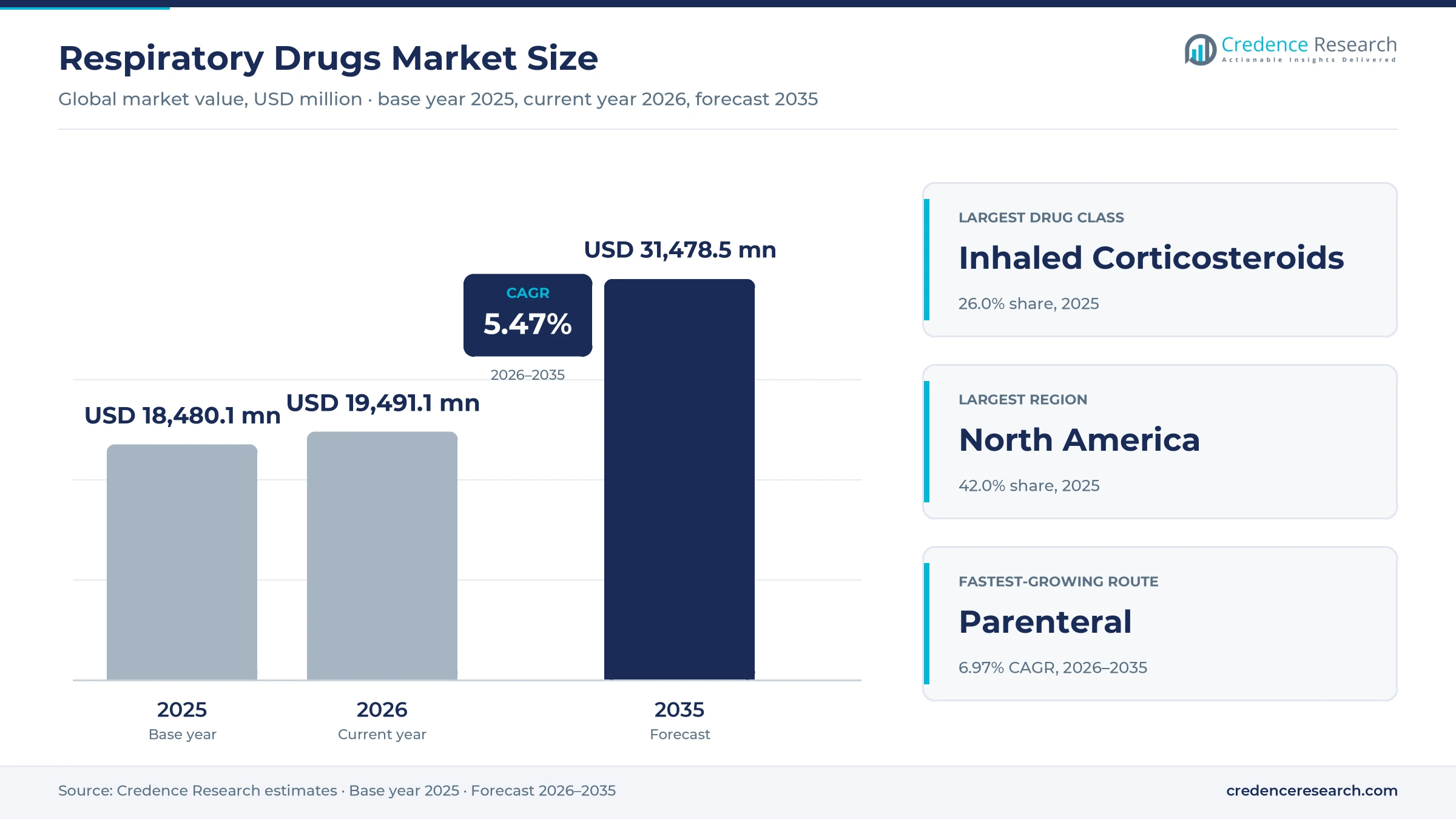
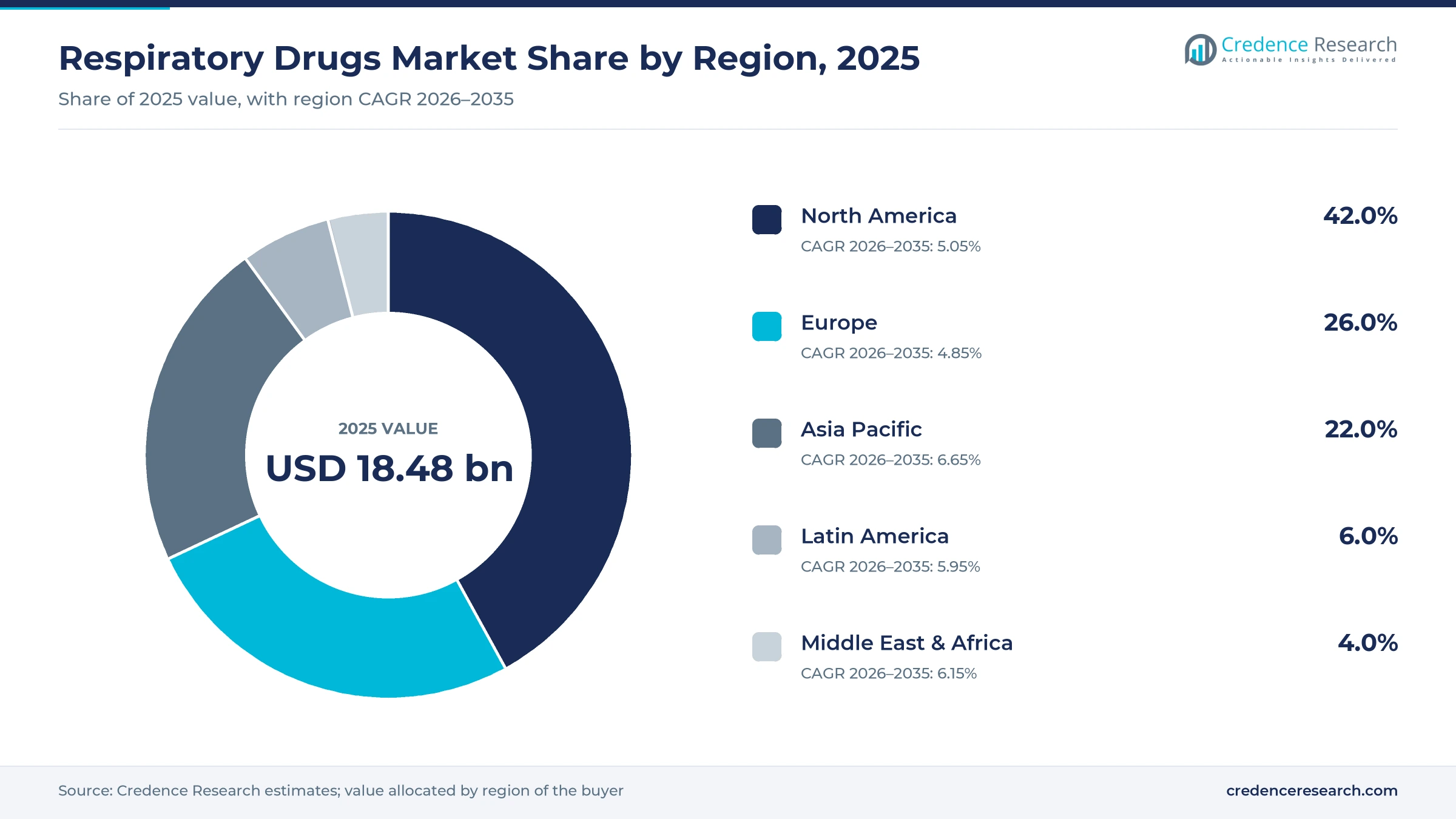
The global respiratory drugs market was valued at USD 18.48 billion in 2025 and is projected to increase from USD 19.49 billion in 2026 to USD 31.48 billion by 2035, registering a CAGR of 5.47% during 2026–2035. Demand comes from hundreds of millions of people with asthma and chronic obstructive pulmonary disease who use inhalers every day, together with new biologic medicines for patients whose disease stays uncontrolled. North America held the largest regional share, 42.0% in 2025, because the United States pays high prices for branded inhalers and biologics. Asia Pacific is the fastest-growing region at 6.65% a year, as China and India diagnose more patients and widen insurance coverage. The treatment picture changed in September 2024, when U.S. regulators approved the first biologic for COPD. As a result, injectable therapy now reaches a disease that relied almost entirely on inhaled medicines.
Which lung disease medicines does this analysis cover?
The analysis counts short-acting and long-acting beta2-agonists, inhaled corticosteroids, anticholinergics, antihistamines and other medicines, including biologics and PDE inhibitors, used to treat asthma, chronic bronchitis, COPD and pleural effusion. Values are based on manufacturer selling prices across inhaled, oral and injectable forms.
Inhaler hardware sold without a medicine, vaccines, oxygen and hospital services sit outside the scope of this analysis. The value chain runs from active ingredient and device component makers through branded and generic manufacturers and wholesalers to hospital, retail and online pharmacies that dispense medicines to patients.
Respiratory Drugs Market Insights
- The respiratory drugs market grows from USD 18.48 billion in 2025 to USD 31.48 billion by 2035, a 5.47% CAGR, as biologics and new COPD medicines add value.
- North America held 42.0% of global respiratory drugs value in 2025, supported by high U.S. prices for branded inhalers and biologics.
- Inhaled corticosteroids led drug class spending with 26.0% of 2025 value, while parenteral medicines grow fastest at 6.97% a year.
- In May 2025, the U.K. regulator approved the first inhaled medicine using a propellant with near-zero global warming potential, starting a broad inhaler transition.
- In October 2025, Merck completed its acquisition of Verona Pharma for about $10 billion, adding a first-in-class COPD maintenance medicine.
Inhaled corticosteroids lead while biologics gain ground
Why do inhaled corticosteroids lead drug class spending?
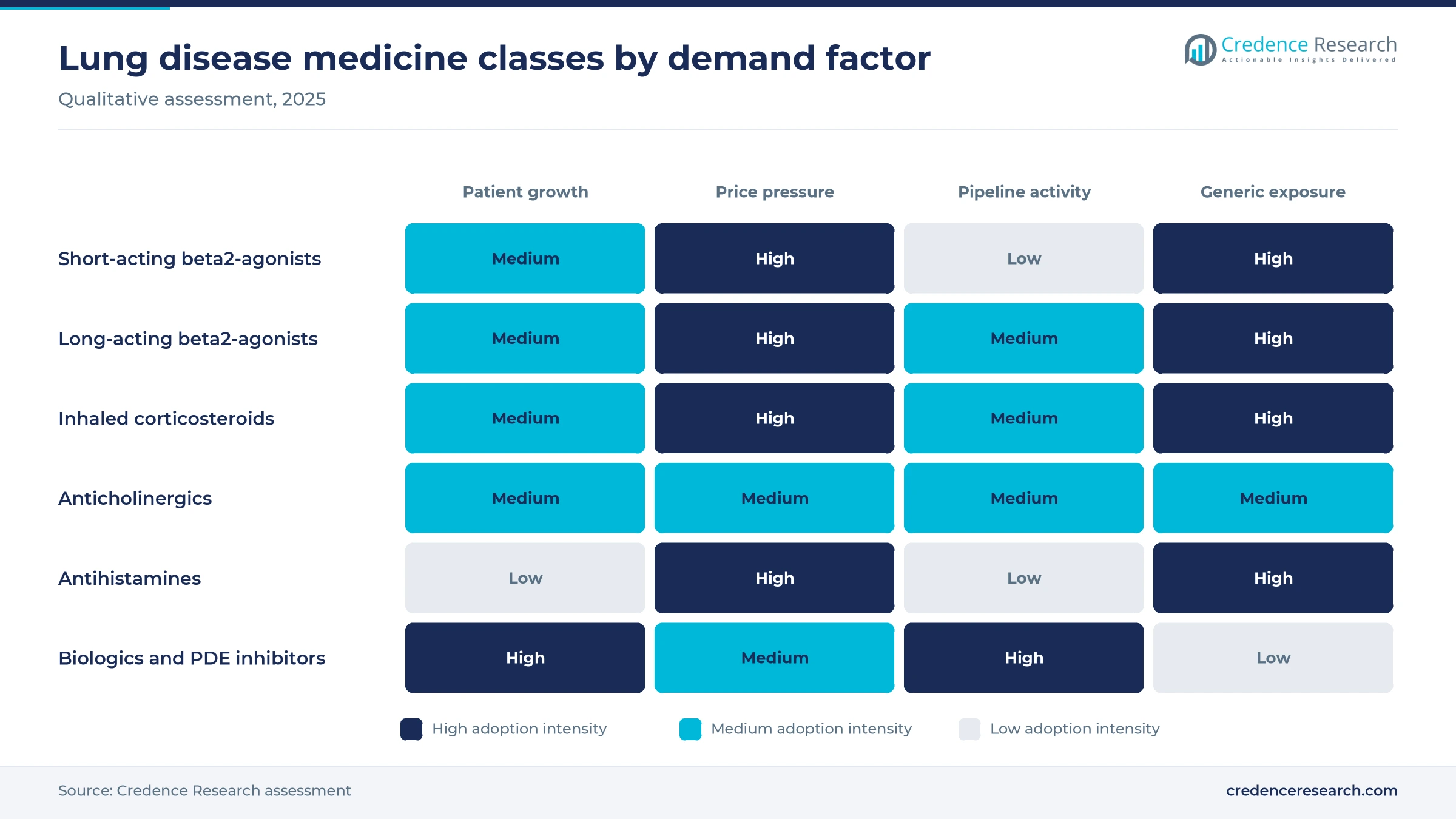
Based on drug class, the market is categorized into short-acting beta2-agonists, long-acting beta2-agonists, inhaled corticosteroids, anticholinergics, antihistamines and others. Inhaled Corticosteroids led with a 26.0% share of 2025 value, because guidelines place them at the base of daily asthma control. Others, which include biologics and PDE inhibitors, grow fastest at 6.98% a year, as new approvals reach patients with severe disease.
Which disease accounts for most treatment value?
Based on disease type, the market is categorized into asthma, chronic bronchitis, chronic obstructive pulmonary disease and pleural effusion. Asthma led with a 44.0% share of 2025 value, because it affects children and adults who often need daily controller inhalers. Chronic Obstructive Pulmonary Disease grows fastest at 5.94% a year, as new biologics and a first-in-class maintenance medicine widen options for patients.
Why does inhalation remain the main route?
Based on route of administration, the market is categorized into inhalation, oral and parenteral. Inhalation led with a 68.0% share of 2025 value, because inhalers and nebulized medicines deliver treatment directly to the lungs. Parenteral medicines grow fastest at 6.97% a year, as injectable biologics for severe asthma and COPD reach more patients through specialist clinics and home injection programs.
Where do patients fill most prescriptions?
Based on distribution channel, the market is categorized into hospital pharmacies, retail pharmacies and online pharmacies. Retail Pharmacies led with a 52.0% share of 2025 value, because most controller and rescue inhalers are refilled monthly near home. Online Pharmacies grow fastest at 7.05% a year, as mail delivery, digital prescriptions and automatic refill programs spread among patients who need controller inhalers every month.
| Segment Group | Leading Sub-segment | Share, 2025 | Fastest-growing Sub-segment | CAGR, 2026–2035 |
|---|---|---|---|---|
| By Drug Class | Inhaled Corticosteroids | 26.0% | Others | 6.98% |
| By Disease Type | Asthma | 44.0% | Chronic Obstructive Pulmonary Disease | 5.94% |
| By Route of Administration | Inhalation | 68.0% | Parenteral | 6.97% |
| By Distribution Channel | Retail Pharmacies | 52.0% | Online Pharmacies | 7.05% |
Request a Free Sample
Fill in your details and we'll send you a free sample report.
- Sample data tables & charts
- Research methodology
Asthma burden and new COPD biologics lift treatment value
How does the global asthma burden sustain demand?
The global asthma burden sustains demand, because most patients need controller or rescue medicine for many years. The World Health Organization estimates that asthma affected 363 million people in 2023 and caused 442,000 deaths. The same source notes that most asthma deaths occur in low- and lower-middle-income countries, where under-diagnosis and under-treatment remain common. Inhalers are the most common treatment, and many people use them every day. As a result, asthma held 44.0% of 2025 disease value, the largest share. In turn, wider diagnosis in poorer countries adds new long-term users of inhaled medicines, since each newly diagnosed child or adult may need treatment for decades.
Why do new COPD biologics raise spending per patient?
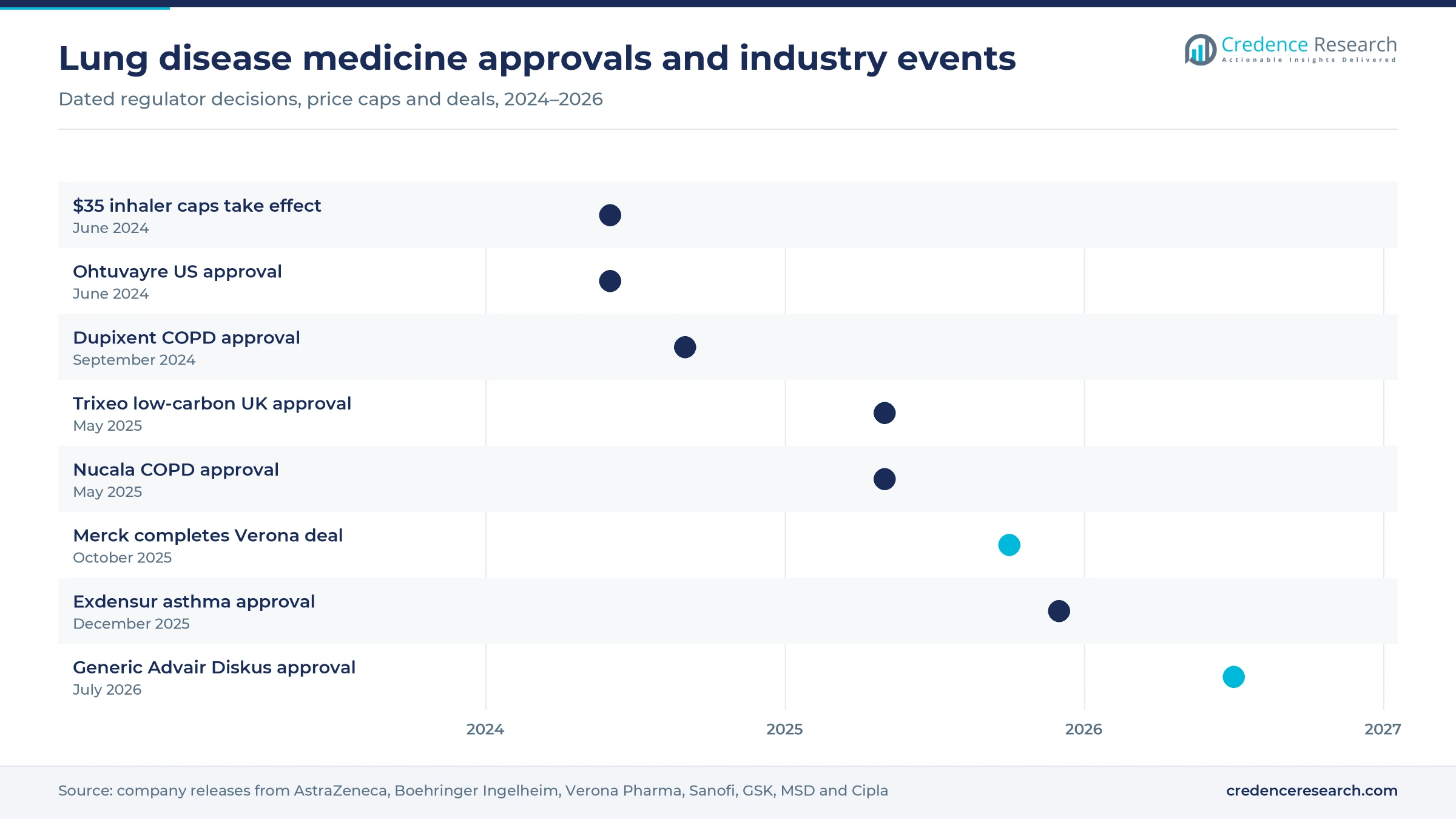
New COPD biologics raise spending per patient, because they treat people whose disease stays uncontrolled on inhalers. In September 2024, Sanofi announced U.S. approval of Dupixent as the first biologic for adults with inadequately controlled COPD and an eosinophilic phenotype. The company estimated that about 300,000 U.S. adults fit this profile and that about half of COPD patients still have flare-ups despite triple inhaled therapy. In May 2025, GSK received U.S. approval of Nucala for a similar COPD population. As a result, COPD grows at 5.94% a year, the fastest disease type, and specialist lung clinics are adding capacity to start and monitor biologic treatment.
How do longer-acting biologics expand severe asthma care?
Longer-acting biologics expand severe asthma care, because fewer injections make treatment easier for patients and clinics. In December 2025, GSK received U.S. approval of Exdensur, an add-on treatment for severe eosinophilic asthma in people aged 12 and older given twice a year. GSK also stated in May 2025 that nearly 70% of U.S. COPD patients poorly controlled on triple therapy have blood eosinophil counts of at least 150 cells per microliter. This large pool of eligible patients widens the use of eosinophil-targeted medicines in both asthma and COPD clinics. As a result, parenteral medicines grow at 6.97% a year, faster than inhaled or oral routes.
Why do price caps support steady inhaler use?
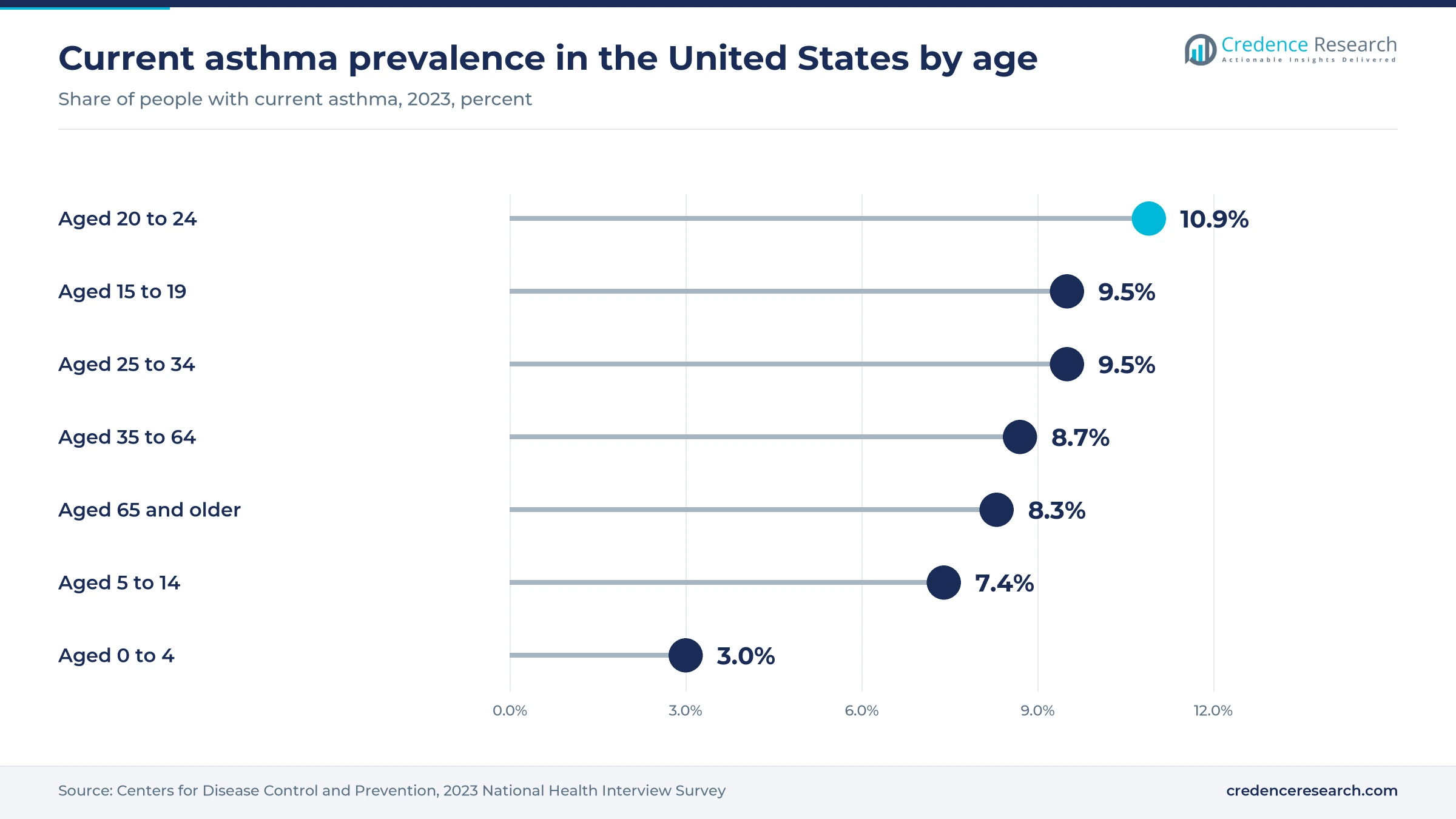
Price caps support steady inhaler use, because patients who pay less are more likely to refill controller medicines each month. Boehringer Ingelheim and AstraZeneca capped out-of-pocket costs for eligible U.S. patients at $35 a month from June 1, 2024, and GSK committed to a similar cap by January 2025. The Centers for Disease Control and Prevention reports that 27.8 million Americans, or 8.4% of the population, had current asthma in 2023. As a result, retail pharmacies held 52.0% of 2025 channel value, the largest share, because most capped inhalers are refilled close to home every month at community pharmacy counters.
Greener propellants, deals and generics reshape supply
How is the shift to low-carbon propellants reshaping inhalers?
The shift to low-carbon propellants is reshaping inhalers, because current metered-dose inhalers use gases with high global warming potential. In May 2025, AstraZeneca announced U.K. approval of Trixeo Aerosphere with the HFO-1234ze(E) propellant, which has 99.9% lower global warming potential than current propellants. The company said applications were under review in Europe, China and other countries. AstraZeneca also aims to move its wider pressurized inhaler portfolio to the new propellant by 2030. As a result, other inhaler makers face pressure to reformulate products before regulators tighten limits on older gases, which could raise development and testing costs across the industry.
Why are large companies rising as buyers of COPD innovation?
Large companies are rising as buyers of COPD innovation, because few new maintenance mechanisms reached the market in recent decades. In June 2024, Verona Pharma announced U.S. approval of Ohtuvayre, a first-in-class dual inhibitor of PDE3 and PDE4 delivered through a standard jet nebulizer. In October 2025, Merck completed its acquisition of Verona Pharma for $107 per American depositary share, a deal worth about $10 billion. Verona had cited more than 390 million people living with COPD worldwide. As a result, large companies now compete for nebulized and inhaled COPD assets, and smaller developers with late-stage lung medicines attract strong buyer interest.
Can generic inhalers open wider access in the United States?
Generic makers have a clear opening in complex inhalers, because many branded dry powder products have lost patent protection. In July 2026, Cipla received U.S. approval for a generic version of Advair Diskus in three strengths, 100/50, 250/50 and 500/50 micrograms, for asthma and COPD. It was the first dry powder inhaler approval from the company's U.S. manufacturing network in New York. Lower-priced copies widen access for uninsured patients and reduce costs for public and private payers. As a result, online pharmacies, which grow at 7.05% a year, can offer generic asthma treatment at lower cost to patients who pay cash.
Where can new mechanisms beyond inhalers add value?
New mechanisms beyond inhalers give companies room to add value, because several lung diseases still lack effective oral medicines. In October 2025, U.S. regulators approved Boehringer Ingelheim's Jascayd for idiopathic pulmonary fibrosis, the first novel therapy for the disease in more than 10 years. In its main trial, lung capacity fell by 106 milliliters at the higher dose over 52 weeks, compared with 170 milliliters on placebo. As a result, other drug classes, which include biologics and PDE inhibitors, grow at 6.98% a year, the fastest pace of any class, as companies extend research from asthma and COPD into fibrosis and other rare lung diseases.
Price erosion, inhaler technique and access gaps weigh
How does generic entry erode branded inhaler value?
Generic entry erodes branded inhaler value, because payers switch patients to lower-priced copies once they become available. Approvals of generic dry powder and metered-dose inhalers reduce prices for older combination products. Branded makers then lose volume in retail pharmacies, where most refills happen, and often cut list prices to keep formulary positions. As a result, originators shift investment toward biologics, new mechanisms and smart inhalers that can justify higher prices.
Why does poor inhaler technique limit treatment results?
Poor inhaler technique limits treatment results, because medicine that does not reach the lungs cannot control symptoms. The World Health Organization notes that using an inhaler can be difficult, especially for children and during emergencies. Many patients then rely on rescue inhalers instead of daily controllers. In turn, clinicians recommend spacers, nebulizers and regular training at each visit, which raises the cost of care for clinics and health systems with limited staff time.
How do access gaps keep patients undertreated?
Access gaps keep patients undertreated, because inhaled medicines remain costly or unavailable in many poorer countries. Most asthma deaths occur in low- and lower-middle-income countries, where diagnosis and treatment are often missed. Patients there often receive oral medicines or short-acting relievers rather than controller inhalers. As a result, value growth in these markets trails the growth in diagnosed patients, even as public programs expand essential medicine lists to include more inhalers.
Why do biologic prices face payer controls?
Biologic prices face payer controls, because each patient may cost much more a year than inhaled therapy alone. Insurers require blood eosinophil tests, records of past flare-ups and failed inhaler treatment before they cover a biologic. These steps delay treatment for some eligible patients by several weeks or months, and some patients give up on approval. In turn, companies invest in evidence that shows fewer hospital visits for COPD treatment with biologics.
North America leads as Asia Pacific expands fastest
| Region | Value, 2025 (USD billion) | Share, 2025 | CAGR, 2026–2035 |
|---|---|---|---|
| North America | 7.76 | 42.0% | 5.05% |
| Europe | 4.80 | 26.0% | 4.85% |
| Asia Pacific | 4.07 | 22.0% | 6.65% |
| Latin America | 1.11 | 6.0% | 5.95% |
| Middle East & Africa | 0.74 | 4.0% | 6.15% |
Why does North America hold the largest regional share?
North America held a 42.0% share of 2025 value and grows at 5.05% a year through 2035. The United States drives this position, because branded inhalers and biologics sell at high prices and insurance covers most patients. U.S. approvals of Dupixent and Nucala for COPD and Exdensur for asthma add new spending. Generic inhaler entry and $35 monthly caps, however, hold down price growth for older inhalers.
Why do China and India drive Asia Pacific growth?
Asia Pacific held a 22.0% share of 2025 value and is the fastest-growing region at 6.65% a year. China and India have large populations exposed to tobacco smoke and air pollution, and both countries are diagnosing more patients. Local generic makers such as Cipla Ltd supply low-cost inhalers across the region. AstraZeneca has also filed its low-carbon inhaler in China, which points to future product changes.
What shapes demand across Europe?
Europe held a 26.0% share of 2025 value and grows at 4.85% a year, the slowest pace of the five regions. Germany, France, Italy and the United Kingdom account for much of the spending, and national health systems negotiate prices firmly. The region is also leading the move to low-carbon inhaler propellants. However, generic competition keeps value growth below the global average.
Where is Latin America adding demand?
Latin America held a 6.0% share of 2025 value and grows at 5.95% a year through 2035. Brazil and Mexico lead regional spending, because asthma is common and public health systems are widening inhaler access. However, biologic use remains limited by cost and by the small number of specialist clinics.
What limits growth in the Middle East and Africa?
The Middle East and Africa held a 4.0% share of 2025 value and grows at 6.15% a year through 2035. Gulf states fund branded inhalers and biologics, while much of Africa still lacks steady supplies of controller medicines.
Biologic approvals and inhaler deals since 2024
| Development | Status and market relevance |
|---|---|
| In June 2024, Verona Pharma announced U.S. approval of Ohtuvayre, a first-in-class PDE3 and PDE4 inhibitor for COPD maintenance. | Approved; delivered through a standard jet nebulizer |
| In September 2024, Sanofi and Regeneron received U.S. approval of Dupixent as the first biologic for COPD with an eosinophilic phenotype. | Approved; about 300,000 U.S. adults eligible |
| In May 2025, AstraZeneca received U.K. approval of Trixeo Aerosphere using a next-generation propellant with near-zero global warming potential. | Approved; reviews under way in Europe and China |
| In October 2025, Merck completed its acquisition of Verona Pharma for about $10 billion. | Completed; adds Ohtuvayre to the Merck portfolio |
| In July 2026, Cipla received U.S. approval for a generic version of Advair Diskus in three strengths. | Approved; made at the company's New York facility |
Biologics, PDE inhibitors and low-carbon inhalers advance
- Eosinophil-targeted biologics block inflammation pathways in severe asthma and COPD, which reduces flare-ups in patients that inhalers fail to control.
- Ultra-long-acting biologics need only two doses a year, which lowers the treatment burden for patients and clinics.
- Dual PDE3 and PDE4 inhibitors combine airway opening and anti-inflammatory effects in one nebulized medicine, which helps patients who struggle with handheld inhalers.
- Low-carbon propellants cut the climate effect of metered-dose inhalers by more than 99%, which helps inhalers meet tighter rules on fluorinated gases.
- Complex generic inhalers match branded dry powder products in dose and delivery, which widens access at lower cost.
Need a Custom Version of This Report?
Tailor the scope, geography, or segments to your exact requirements.
- Custom geography or segment scope
- Direct access to our analyst team
Inhaler leaders and biologic makers compete for patients
Competition splits between large inhaler franchises, biologic makers and generic suppliers. GlaxoSmithKline Plc, AstraZeneca Plc and Boehringer Ingelheim International GmbH hold broad inhaled portfolios, and all three adopted $35 monthly caps for eligible U.S. patients in 2024 and 2025. GSK added COPD and asthma biologic approvals in 2025, while Sanofi gained the first COPD biologic approval with Regeneron in 2024. Merck & Co., Inc. entered COPD maintenance through its 2025 Verona Pharma acquisition. Novartis AG, Roche, Pfizer Inc., AbbVie Inc. and Vertex Pharmaceuticals Incorporated compete in allergy, immunology, anti-infective and cystic fibrosis care. Teva Pharmaceutical Industries Ltd. and Cipla Ltd lead in generic inhalers. As a result, buyers weigh clinical evidence, device ease and price.
Companies profiled and their roles in this market
| Company | Type | Role in the market |
|---|---|---|
| GlaxoSmithKline Plc | Originator | Inhaled therapies and the Nucala and Exdensur biologics |
| AstraZeneca Plc | Originator | Inhaled combinations and low-carbon Trixeo Aerosphere |
| Boehringer Ingelheim International GmbH | Originator | Inhaled bronchodilators and Jascayd for pulmonary fibrosis |
| Sanofi | Originator | Dupixent for asthma and COPD with Regeneron |
| Merck & Co., Inc. | Originator | Ohtuvayre for COPD after the Verona Pharma acquisition |
| Novartis AG | Originator | Allergy and asthma medicines |
| F. Hoffmann-La Roche Ltd. | Originator | Allergy and lung disease medicines |
| Pfizer Inc. | Diversified | Anti-infective and other medicines used in lung disease |
| AbbVie Inc. | Diversified | Immunology and anti-infective portfolio |
| Vertex Pharmaceuticals Incorporated | Specialist | Cystic fibrosis lung therapies |
| Teva Pharmaceutical Industries Ltd. | Generic | Generic and branded inhalers |
| Cipla Ltd | Generic | Generic inhalers, including a generic Advair Diskus approved in 2026 |
Biologics and COPD care set the growth pace
Credence Research's view is that biologics and new COPD medicines will set the pace of growth through 2035, because they reach patients that inhalers alone fail to control. The overall market grows at 5.47% a year, supported by a large asthma burden, rising COPD diagnosis and wider insurance coverage in Asia. Parenteral and online channels grow faster than inhaled retail sales. Companies that combine strong clinical data, easy devices and low-carbon inhalers will gain the most share, while generic entry will keep pressure on older brands.
How Credence Research sized lung disease medicines
The report uses 2025 as the base year and 2026 to 2035 as the forecast period. Market values come from the Credence Research model, which builds spending by drug class, disease type, route of administration, distribution channel and region. Regional and segment splits are Credence Research estimates informed by World Health Organization data, U.S. public health statistics, regulator decisions and company press releases. No primary interviews or surveys were used in preparing this edition.
Asthma and COPD medicine outlook to 2035
By 2035, the respiratory drugs market is projected to reach USD 31.48 billion, with growth led by biologics, new COPD maintenance medicines and low-carbon inhalers. Inhaled corticosteroids will remain the largest drug class, as daily controller use continues for asthma. North America keeps the highest spending, while Asia Pacific adds the most new patients. Generic inhalers will widen access but lower prices for older brands. As a result, advantage will depend on clinical evidence, device ease and access programs that keep patients on treatment.
Frequently Asked Questions
How big is the global respiratory drugs market?
Which drug class leads respiratory drugs spending?
Which region leads spending on lung disease medicines?
Which disease accounts for most treatment value?
What new COPD medicines were approved in the United States?
Why are inhaler propellants changing?
Who are the leading respiratory drugs companies?
What restrains growth in lung disease medicines?
Table of Content
Chapter 1 Market Segmentation
- 1.1 Segmentation Framework
- 1.1.1 Product and Service Classification
- 1.1.2 Application and End-Use Classification
- 1.1.3 Technology and Solution Classification
- 1.1.4 Customer and Distribution Channel Classification
- 1.1.5 Geographic Segmentation
- 1.1.6 Market Segment Definitions and Boundaries
- 1.2 By Drug Class
- 1.2.1 Short-Acting Beta2-Agonists
- 1.2.2 Long-Acting Beta2-Agonists
- 1.2.3 Inhaled Corticosteroids
- 1.2.4 Anticholinergics
- 1.2.5 Antihistamines
- 1.2.6 Others
- 1.3 By Disease Type
- 1.3.1 Asthma
- 1.3.2 Chronic Bronchitis
- 1.3.3 Chronic Obstructive Pulmonary Disease
- 1.3.4 Pleural Effusion
- 1.4 By Route of Administration
- 1.4.1 Inhalation
- 1.4.2 Oral
- 1.4.3 Parenteral
Chapter 2 Introduction
- 2.1 Report Objectives and Scope
- 2.2 Product Definition and Industry Terminology
- 2.3 Market Inclusions and Exclusions
- 2.4 Research Process
- 2.4.1 Primary Research and Expert Interviews
- 2.4.2 Secondary Research and Source Review
- 2.4.3 Top-Down and Bottom-Up Estimation
- 2.4.4 Data Triangulation and Verification
- 2.5 Market Size Measurement Basis
- 2.5.1 2025: USD 18.48 billion → 2035: USD 31.48 billion
- 2.6 Historical and Forecast Reference Periods
- 2.6.1 Historical Period: 2018-2025
- 2.6.2 Base Year: 2025
- 2.6.3 Forecast Period: 2025-2035
- 2.7 Research Assumptions and Limitations
Chapter 3 Executive Summary
- 3.1 Market Snapshot and Key Findings
- 3.2 Base-Year Market Size, 2025
- 3.3 Forecast Market Size, 2035
- 3.4 Revenue and Volume Growth Outlook
- 3.5 Key Demand and Supply Indicators
- 3.6 Leading Market Segments
- 3.7 Fastest-Growing Market Opportunities
- 3.8 Regional Performance Highlights
- 3.9 Technology and Industry Transformation
- 3.10 Competitive Landscape Summary
- 3.11 Analyst View and Strategic Implications
Chapter 4 Global Respiratory Drugs Market Trends and Developments
- 4.1 Historical Industry Development, 2018-2025
- 4.2 Recent Market Trends and Developments
- 4.3 Demand and Customer Behavior Trends
- 4.4 Technology and Product Innovation
- 4.5 Artificial Intelligence, Automation and Digitalization
- 4.6 Local Manufacturing and Supply Chain Realignment
- 4.7 Industry Partnerships, Mergers and Acquisitions
- 4.8 Sustainability and Circular Economy Developments
- 4.9 Government and Private Sector Investment Trends
- 4.10 Emerging Business Models and Commercialization
- 4.11 Industry Developments and Announcements
Chapter 5 Global Respiratory Drugs Market Production, Supply and Demand Analysis
- 5.1 Demand Trend and Consumption Analysis, 2018-2025
- 5.2 Demand Forecast, 2025-2035
- 5.3 Production and Output Trend, 2018-2025
- 5.4 Production and Output Forecast, 2025-2035
- 5.5 Installed Capacity and Capacity Utilization
- 5.6 Company-Wise Production Plants and Statistics
- 5.6.1 Installed Production Capacity
- 5.6.2 Actual Production
- 5.6.3 Planned Capacity and Expansion Targets
- 5.7 Supply Chain Structure and Procurement Trends
- 5.8 Supply-Demand Gap and Bottlenecks
- 5.9 Import Dependence and Sourcing Structure
- 5.10 Contract Manufacturing and Outsourcing
- 5.11 Regional Supply and Demand Concentration
Chapter 6 Global Respiratory Drugs Market Pricing Analysis
- 6.1 Pricing Structure and Measurement
- 6.2 Historical Pricing Trends, 2018-2025
- 6.3 Pricing Outlook, 2025-2035
- 6.4 Average Selling Price and Unit Economics
- 6.5 Pricing by Product and Market Segment
- 6.6 Geographic Pricing Differences
- 6.7 Key Input, Energy, Labor and Logistics Costs
- 6.8 Contract Pricing and Purchasing Models
- 6.9 Pricing Sensitivity and Competitive Positioning
- 6.10 Price, Margin and Profitability Implications
Chapter 7 Global Respiratory Drugs Market Dynamics
- 7.1 Market Growth Drivers
- 7.1.1 Demand-Side Drivers
- 7.1.2 Technology and Innovation Drivers
- 7.1.3 Infrastructure and Investment Drivers
- 7.1.4 Regulatory and Policy Drivers
- 7.2 Market Restraints
- 7.2.1 Cost and Affordability Constraints
- 7.2.2 Technology and Adoption Barriers
- 7.2.3 Supply Chain and Operational Constraints
- 7.3 Market Challenges
- 7.3.1 Competitive Pressure and Margin Erosion
- 7.3.2 Skills, Infrastructure and Implementation Gaps
- 7.4 Emerging Market Opportunities
- 7.5 Market Dynamics Impact and Time-Horizon Assessment
Chapter 8 Global Respiratory Drugs Value Chain Analysis
- 8.1 Industry Value Chain Overview
- 8.2 Upstream Suppliers and Critical Inputs
- 8.3 Technology and Component Providers
- 8.4 Manufacturing or Service Delivery
- 8.5 Distribution, Channel Partners and Integrators
- 8.6 Downstream Applications and End Users
- 8.7 Value Addition and Profit Pools
- 8.8 Vertical Integration and Outsourcing
- 8.9 Supplier Concentration and Risk
- 8.10 Supply Chain Localization and Resilience
Chapter 9 Global Respiratory Drugs Market Regulations and Policies
- 9.1 Relevant Laws, Standards and Compliance Frameworks
- 9.2 Product, Service, Safety and Quality Requirements
- 9.3 Government Policies, Incentives and Subsidies
- 9.4 Imports, Exports and Trade Barriers
- 9.5 Public Procurement and Local Content Requirements
- 9.6 Environmental and Sustainability Compliance
- 9.7 Upcoming Policy Changes and Market Implications
Chapter 10 Global Respiratory Drugs Market Hotspots and Opportunities
- 10.1 Market Opportunity Mapping and Growth Hotspots
- 10.2 High-Growth Applications and Customer Groups
- 10.3 Underserved Markets and White-Space Opportunities
- 10.4 Emerging Technology and Product Opportunities
- 10.5 New Capacity and Investment Hotspots
- 10.6 Market Entry and Expansion Opportunities
- 10.7 Distribution and Partnership Opportunities
- 10.8 Near-Term and Long-Term Commercial Potential
- 10.9 Opportunity Attractiveness and Execution Risks
Chapter 11 Global Respiratory Drugs Market Outlook, 2025-2035
- 11.1 Market Size and Analysis
- 11.1.1 Revenue (Market Measurement: 2025: USD 18.48 billion → 2035: USD 31.48 billion)
- 11.1.2 Market Volume and Quantity Sold
- 11.1.3 Historical Market Size, 2018-2025
- 11.1.4 Base-Year Market Size, 2025
- 11.2 Market Forecast, 2025-2035
- 11.2.1 Revenue Forecast to 2035
- 11.2.2 Volume Forecast to 2035
- 11.2.3 CAGR and Year-on-Year Growth
- 11.2.4 Incremental Revenue Opportunity
- 11.3 Forecast Assumptions and Scenario Analysis
- 11.3.1 Base-Case Forecast
- 11.3.2 Optimistic and Conservative Scenarios
- 11.3.3 Technology, Pricing and Policy Sensitivities
- 11.4 Market Attractiveness and Growth Outlook
Chapter 12 Global Respiratory Drugs Market Segmentation and Outlook
- 12.1 Segmentation Summary and Market Shares, 2025
- 12.2 Largest and Fastest-Growing Segments
- 12.3 By Drug Class - Market Size and Forecast, 2025-2035
- 12.3.1 Segment Definition and Scope
- 12.3.2 Historical Market Size, 2018-2025
- 12.3.3 Revenue Forecast, 2025-2035
- 12.3.4 Volume Forecast, 2025-2035
- 12.3.5 Base-Year Market Share, 2025
- 12.3.6 Segment CAGR and Growth Drivers
- 12.3.7 Subsegment Market Size and Forecast
- 12.3.7.1 Short-Acting Beta2-Agonists
- 12.3.7.2 Long-Acting Beta2-Agonists
- 12.3.7.3 Inhaled Corticosteroids
- 12.3.7.4 Anticholinergics
- 12.3.7.5 Antihistamines
- 12.3.7.6 Others
- 12.3.8 Subsegment Pricing and Adoption Trends
- 12.3.9 Leading Suppliers and Competition
- 12.3.10 Regional Demand and Opportunities
- 12.4 By Disease Type - Market Size and Forecast, 2025-2035
- 12.4.1 Segment Definition and Scope
- 12.4.2 Historical Market Size, 2018-2025
- 12.4.3 Revenue Forecast, 2025-2035
- 12.4.4 Volume Forecast, 2025-2035
- 12.4.5 Base-Year Market Share, 2025
- 12.4.6 Segment CAGR and Growth Drivers
- 12.4.7 Subsegment Market Size and Forecast
- 12.4.7.1 Asthma
- 12.4.7.2 Chronic Bronchitis
- 12.4.7.3 Chronic Obstructive Pulmonary Disease
- 12.4.7.4 Pleural Effusion
- 12.4.8 Subsegment Pricing and Adoption Trends
- 12.4.9 Leading Suppliers and Competition
- 12.4.10 Regional Demand and Opportunities
- 12.5 By Route of Administration - Market Size and Forecast, 2025-2035
- 12.5.1 Segment Definition and Scope
- 12.5.2 Historical Market Size, 2018-2025
- 12.5.3 Revenue Forecast, 2025-2035
- 12.5.4 Volume Forecast, 2025-2035
- 12.5.5 Base-Year Market Share, 2025
- 12.5.6 Segment CAGR and Growth Drivers
- 12.5.7 Subsegment Market Size and Forecast
- 12.5.7.1 Inhalation
- 12.5.7.2 Oral
- 12.5.7.3 Parenteral
- 12.5.8 Subsegment Pricing and Adoption Trends
- 12.5.9 Leading Suppliers and Competition
- 12.5.10 Regional Demand and Opportunities
- 12.6 Segment Growth Comparison
- 12.7 Segment Attractiveness and Priority Matrix
Chapter 13 Global Respiratory Drugs Geographic Market Outlook, 2025-2035
- 13.1 Regional Market Size and Share, 2025
- 13.2 Regional Market Forecast, 2025-2035
- 13.3 Regional Pricing, Production and Demand Differences
- 13.4 North America
- 13.4.1 United States
- 13.4.2 Canada
- 13.4.3 Mexico
- 13.5 Europe
- 13.5.1 Germany
- 13.5.2 France
- 13.5.3 Italy
- 13.5.4 United Kingdom
- 13.5.5 Spain
- 13.5.6 Poland
- 13.5.7 Russia
- 13.5.8 Netherlands
- 13.5.9 Belgium
- 13.5.10 Sweden
- 13.5.11 Denmark
- 13.5.12 Norway
- 13.5.13 Rest of Europe
- 13.6 Asia Pacific
- 13.6.1 China
- 13.6.2 India
- 13.6.3 Japan
- 13.6.4 South Korea
- 13.6.5 Thailand
- 13.6.6 Indonesia
- 13.6.7 Vietnam
- 13.6.8 Malaysia
- 13.6.9 Australia
- 13.6.10 Rest of Asia Pacific
- 13.7 Latin America
- 13.7.1 Brazil
- 13.7.2 Argentina
- 13.7.3 Colombia
- 13.7.4 Chile
- 13.7.5 Rest of Latin America
- 13.8 Middle East
- 13.8.1 Saudi Arabia
- 13.8.2 United Arab Emirates
- 13.8.3 Turkey
- 13.8.4 Israel
- 13.8.5 Iran
- 13.8.6 Rest of the Middle East
- 13.9 Africa
- 13.9.1 South Africa
- 13.9.2 Egypt
- 13.9.3 Nigeria
- 13.9.4 Morocco
- 13.9.5 Rest of Africa
- 13.10 Regional Investment, Policy and Supply Chain Differences
- 13.11 Regional Competitive Landscape
- 13.12 Geographic Growth Hotspots
Chapter 14 Global Respiratory Drugs Technology, Innovation and Sustainability Outlook
- 14.1 Technology Landscape and Maturity
- 14.2 Product, Process and Service Innovation
- 14.3 AI, Automation and Digital Tools in the Industry
- 14.4 Technology Adoption and Performance Benchmarking
- 14.5 Innovation Pipeline and R&D Investment
- 14.6 Patent and Intellectual Property Trends
- 14.7 Energy Efficiency and Resource Management
- 14.8 Sustainability, Recycling and Circularity
- 14.9 Technology Roadmap, 2025-2035
- 14.10 Risks of Obsolescence and Technology Substitution
Chapter 15 Global Respiratory Drugs Market Key Strategic Imperatives
- 15.1 Growth and Market Entry Priorities
- 15.2 High-Return Products and Segments
- 15.3 Pricing, Profitability and Cost Optimization
- 15.4 Technology Investment and Product Differentiation
- 15.5 Supply Chain Localization and Resilience
- 15.6 Distribution and Customer Acquisition
- 15.7 Partnership, Acquisition and Capacity Strategy
- 15.8 Regional Expansion Priorities
- 15.9 Short-, Medium- and Long-Term Actions
Chapter 16 Competition Outlook
- 16.1 Industry Competition Characteristics
- 16.2 Market Structure and Concentration
- 16.3 Market Share and Competitive Positioning, 2025
- 16.4 Company-Wise Revenue and Product Benchmarking
- 16.5 Production and Service Capacity Benchmarking
- 16.6 Technology, Pricing and Differentiation
- 16.7 Regional Footprint and Distribution Strength
- 16.8 Mergers, Acquisitions and Strategic Alliances
- 16.9 New Entrants and Competitive Threats
- 16.10 Porter's Five Forces and Industry Attractiveness
- 16.11 Competitive Outlook, 2025-2035
Chapter 17 Company Profiles
- 17.1 Company Coverage and Selection Criteria
- 17.2 GlaxoSmithKline Plc
- 17.2.1 Business Description
- 17.2.2 Company Ownership and Geographic Presence
- 17.2.3 Product and Service Portfolio
- 17.2.4 Manufacturing and Operating Footprint
- 17.2.5 Production Capacity and Expansion Plans
- 17.2.6 Financial Performance and Investment
- 17.2.7 Market Share and Competitive Position
- 17.2.8 Technology and Innovation Capabilities
- 17.2.9 Strategic Alliances or Partnerships
- 17.2.10 Recent Developments
- 17.2.11 Growth Strategy and Outlook
- 17.3 AstraZeneca Plc
- 17.4 Boehringer Ingelheim International GmbH
- 17.5 Merck & Co., Inc.
- 17.6 Novartis AG
- 17.7 F. Hoffmann-La Roche Ltd.
- 17.8 Teva Pharmaceutical Industries Ltd.
- 17.9 Sanofi
- 17.10 Pfizer Inc.
- 17.11 AbbVie Inc.
- 17.12 Vertex Pharmaceuticals Incorporated
- 17.13 Cipla Ltd
- 17.14 Other Relevant Market Participants
Note: Every listed company is profiled on the structure shown under the first company. The company list is preliminary and may change based on research findings, market developments, data availability and client requirements.
Chapter 18 Disclaimer
- 18.1 Research and Forecast Disclaimer
- 18.2 Data Source and Estimation Limitations
Note: The depth of individual sections depends on data availability for this market. Volume, capacity, trade and other unit-based metrics are included where applicable.