
Quit demand and WHO guidance lift prescription treatment
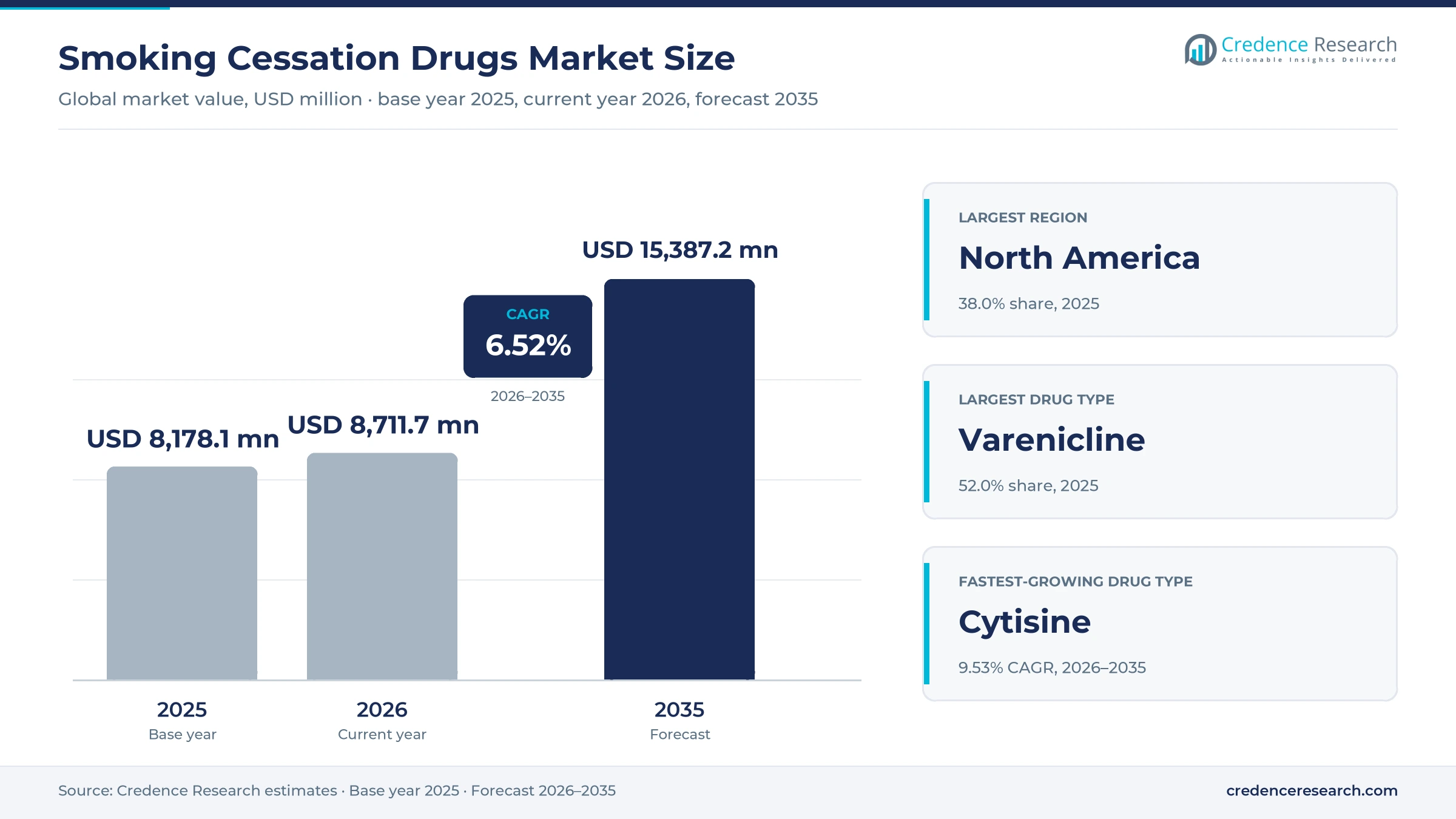
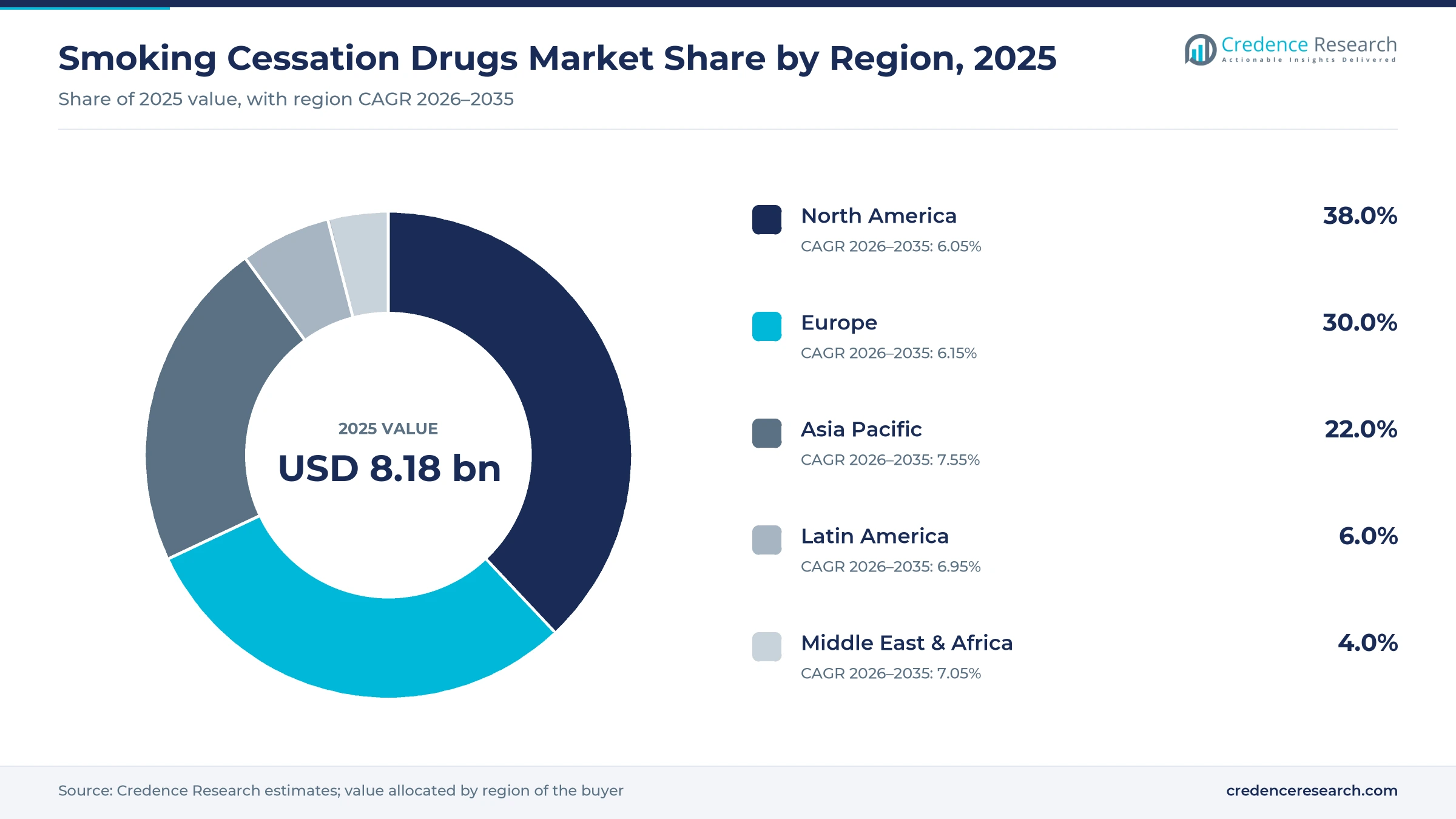
The global smoking cessation drugs market was valued at USD 8.18 billion in 2025 and is projected to increase from USD 8.71 billion in 2026 to USD 15.39 billion by 2035, registering a CAGR of 6.52% during 2026–2035. Demand rises because most tobacco users want to quit, while health systems now fund prescription treatment through stop-smoking services and primary care. North America held the largest regional share, 38.0% in 2025, because the United States has high branded prices and broad insurance coverage for quit medicines. Asia Pacific is the fastest-growing region at 7.55% a year, as China, Japan, India and Southeast Asia carry the largest smoker populations and expand cessation clinics. The regulatory picture also changed in July 2024, when the World Health Organization issued its first clinical guideline recommending varenicline, bupropion, cytisine and nicotine replacement for adults. As a result, low-cost cytisine and generic varenicline are reaching more smokers in public programs.
Which quit medicines and channels does this analysis count?
The analysis counts prescription and pharmacy-dispensed medicines used to treat nicotine dependence in adults, covering varenicline, bupropion, cytisine and combination regimens that pair a medicine with nicotine replacement. Hospitals, retail pharmacies, online pharmacies and public stop-smoking services dispense these products to patients.
Standalone nicotine gums, patches and lozenges sold as consumer products, along with e-cigarettes and heated tobacco, sit outside the value counted here. The value chain runs from ingredient synthesis and finished dosage manufacturing through wholesale distribution to dispensing, with public payers, insurers and patients paying for each course.
Smoking Cessation Drugs Market Insights
- The smoking cessation drugs market grows from USD 8.18 billion in 2025 to USD 15.39 billion by 2035, a 6.52% CAGR as more smokers receive prescribed treatment.
- North America held 38.0% of global value in 2025, because U.S. insurers cover quit medicines and branded prices remain high.
- Varenicline led drug types with 52.0% of 2025 value, while cytisine grows fastest at 9.53% a year through 2035.
- The WHO added cytisine to its Model List of Essential Medicines in September 2025, a step that supports low-cost supply in many countries.
- Dr. Reddy's took over Haleon's nicotine replacement brands outside the United States in September 2024, gaining sales in more than 30 countries.
Varenicline leads while cytisine grows fastest
Which quit medicines account for most spending?
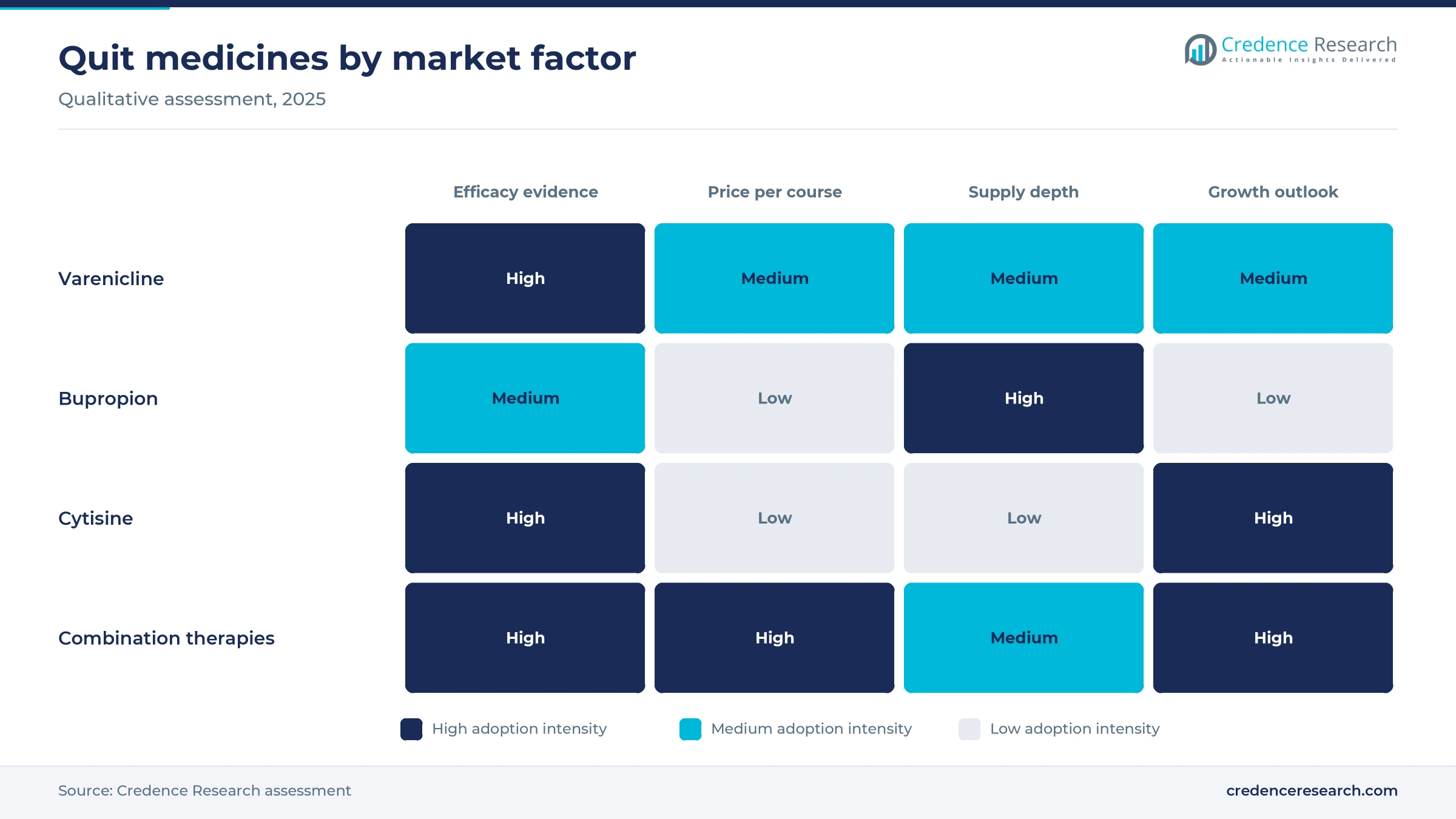
Based on drug type, the market is categorized into varenicline, bupropion, cytisine and combination therapies. Varenicline led with 52.0% of 2025 value, because guidelines rank it among the most effective single medicines for quitting. Cytisine grows fastest at 9.53% a year, as essential medicine listing and national guidance widen low-cost use. Combination therapies pair a medicine with nicotine replacement for heavier smokers.
Where do smokers obtain quit medicines?
Based on distribution channel, the market is categorized into hospital pharmacy, retail pharmacy, online pharmacy and others. Retail Pharmacy led with 56.0% of 2025 value, because most quit attempts start with a primary care prescription filled at a community counter. Online Pharmacy grows fastest at 8.51% a year, as telehealth prescribers and home delivery reach smokers outside clinics. The others group includes public stop-smoking services, quit lines and workplace health programs.
| Segment Group | Leading Sub-segment | Share, 2025 | Fastest-growing Sub-segment | CAGR, 2026–2035 |
|---|---|---|---|---|
| By Drug Type | Varenicline | 52.0% | Cytisine | 9.53% |
| By Distribution Channel | Retail Pharmacy | 56.0% | Online Pharmacy | 8.51% |
Request a Free Sample
Fill in your details and we'll send you a free sample report.
- Sample data tables & charts
- Research methodology
Unmet quit demand and public programs expand treated smokers
How does unmet quit demand raise treatment volume?
Unmet quit demand is the broadest driver, because only a small share of smokers who try to stop use an effective medicine today. The World Health Organization reports that more than 60% of the world's 1.25 billion tobacco users want to quit, which equals more than 750 million people. About 70% of those people lack access to effective cessation services, according to the same July 2024 release. The WHO trends report of October 2025 counted 1.2 billion tobacco users in 2024, so the treatable pool remains very large. As a result, each gain in service coverage adds new courses of varenicline, bupropion and cytisine to public and private budgets.
Why does WHO guidance push health systems to fund medicines?
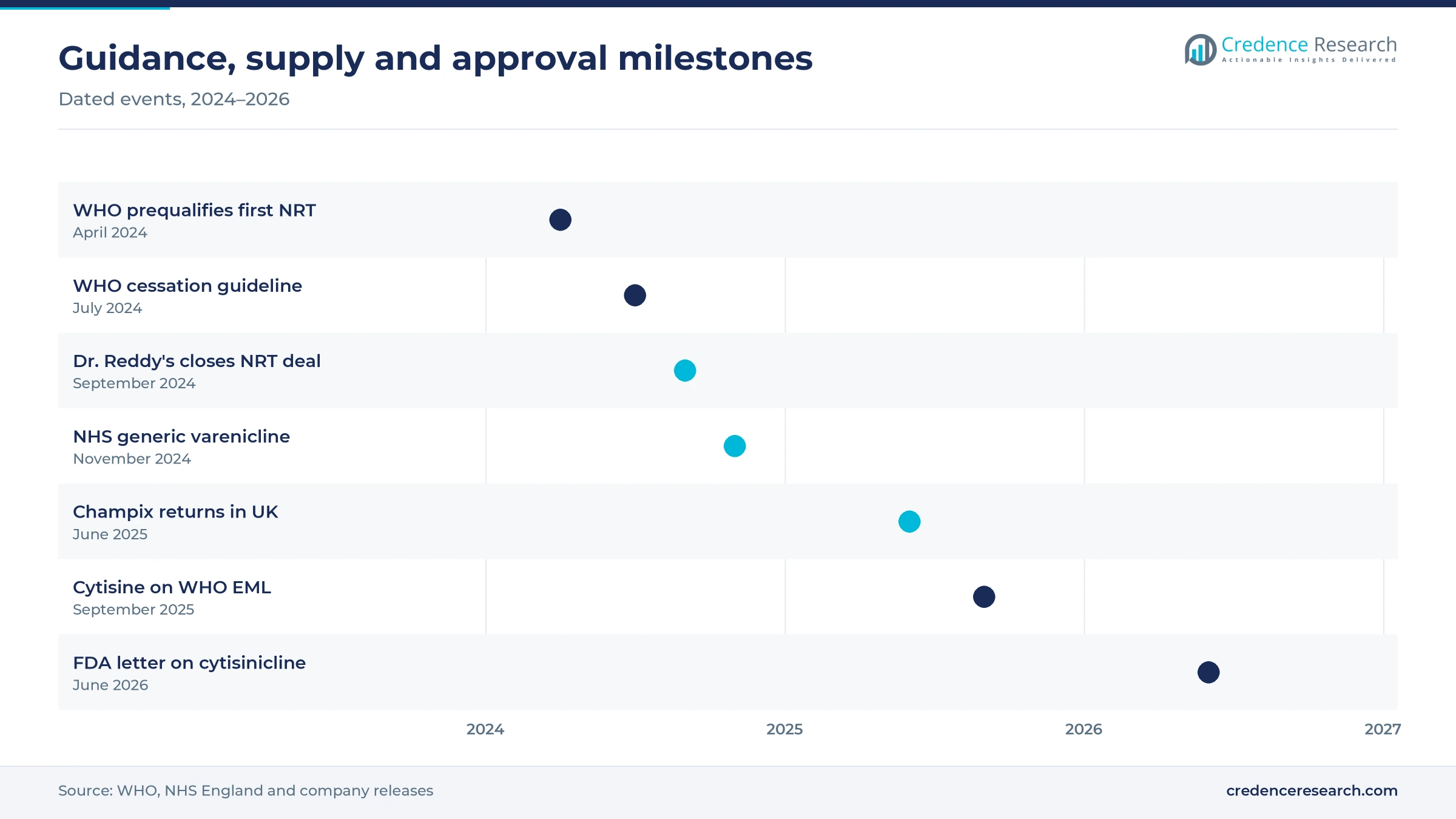
WHO guidance pushes health systems to fund medicines, because national programs often follow its recommendations when they set budgets and reimbursement lists. In July 2024, the WHO issued its first clinical treatment guideline for tobacco cessation in adults, recommending varenicline, nicotine replacement, bupropion and cytisine. The guideline asks countries to supply these treatments at no or reduced cost, especially in low- and middle-income countries. In April 2024, Kenvue's nicotine gum and patch became the first WHO-prequalified quit products, which eases procurement by donors and tenders. Asia Pacific, with 22.0% of 2025 value, stands to gain most as more countries adopt the guidance. In turn, prescription medicines and nicotine replacement therapy gain funded volume in public programs.
How are national stop-smoking services adding prescriptions?
National stop-smoking services add prescriptions, because they offer free medicines together with counseling, which raises quit success rates. In November 2024, NHS England said generic varenicline would return through pharmacy and council-led services under a supply deal with Teva U.K. NHS England estimated that the program could help more than 85,000 people stop smoking each year. It also projected up to 9,500 smoking-related deaths prevented over five years. NICE has moved to add cytisine to its stop-smoking guideline, after the medicine became available in the U.K. in January 2024. As a result, Europe held 30.0% of 2025 value, the second-largest regional share.
Why does the size of the U.S. smoker pool sustain demand?
The U.S. smoker pool sustains demand, because insurers and Medicaid programs cover quit medicines for millions of adults. The Centers for Disease Control and Prevention reports that 11.5% of U.S. adults, about 28.3 million people, smoked cigarettes in 2021. Achieve Life Sciences cited roughly 29 million U.S. adults who smoke combustible cigarettes when the FDA accepted its cytisinicline application in September 2025. Its clinical program enrolled more than 2,000 trial participants across two pivotal studies and supporting work. North America grows at 6.05% a year from a high base, as primary care screening and telehealth widen treatment. In turn, varenicline and bupropion keep steady refill volume across U.S. retail pharmacies.
Cytisine uptake, varenicline resupply and online refills
How is the rise of cytisine changing treatment choice?
The rise of cytisine is changing treatment choice, because it offers efficacy close to varenicline at a lower price per course. In September 2025, the WHO added cytisine to its Model List of Essential Medicines as an aid to stop smoking and tobacco use. The WHO expert committee said that multiple cessation treatments could support competition, reduce costs and improve access. Central and Eastern European countries have used the medicine since the mid-1960s, so safety experience is long. As a result, cytisine grows fastest among drug types at 9.53% a year through 2035, well ahead of bupropion, as public buyers in Asia Pacific and Latin America test cheaper courses.
Is varenicline resupply shifting share back to branded products?
Varenicline resupply is shifting share in several markets, because the 2021 nitrosamine recall had left many smokers without their preferred medicine. Pfizer recalled Champix in the U.K. in October 2021 and announced its return for prescription on June 30, 2025. Generic varenicline from Teva had already reached NHS services in England in November 2024, so branded and generic supply now compete. The U.K. price of a full Champix course was about £230 before withdrawal, which shapes NHS purchasing decisions today. In turn, varenicline keeps the leading drug-type share at 52.0% of 2025 value, while generic entry holds down unit prices.
Where can a U.S. cytisinicline launch open new demand?
A U.S. cytisinicline launch is a clear opening, because U.S. smokers have had few new prescription options and cytisine is already used in other regions. The FDA accepted Achieve Life Sciences' new drug application in September 2025, with a target action date of June 20, 2026. In June 2026, Achieve received a complete response letter that cited manufacturing observations at a former contract facility, not efficacy or safety. The company plans to resubmit in the fourth quarter of 2026 and expects a possible approval in the first half of 2027. As a result, North America could add a lower-cost option for smokers and for people trying to stop vaping.
Can online prescribing reach smokers outside clinics?
Online prescribing offers a growth opening, because many smokers never raise quitting during routine clinic visits. Online pharmacy grows fastest among channels at 8.51% a year, as telehealth prescribers issue varenicline and bupropion after short virtual consultations. The WHO recommends brief counseling of 30 seconds to three minutes, which suits digital intake forms and remote follow-up. NHS England already lets smokers self-refer through its Better Health website for free medicines and support, without first booking a doctor appointment. In turn, e-pharmacy operators can bundle refills, reminders and coaching for a 12-week course, which supports adherence and repeat orders.
Supply gaps, side effect concerns and low treatment use
How do supply disruptions affect treatment continuity?
Supply disruptions affect treatment continuity, because smokers who lose access mid-course often relapse quickly. The 2021 varenicline recall removed the leading medicine from the U.K. for nearly three years before generic supply returned. Achieve's 2026 setback also came from manufacturing findings at a third-party site, not from clinical data. As a result, buyers now favor multi-source contracts and nitrosamine-compliant suppliers when they plan national tenders.
Why do side effect concerns limit prescribing?
Side effect concerns limit prescribing, because some smokers and clinicians still associate quit medicines with sleep problems, nausea and mood changes. These perceptions reduce the share of quit attempts that use any medicine at all. Bupropion also carries seizure precautions that rule out some patients. Clinicians therefore need clear counseling and follow-up plans, which take time in busy primary care clinics with short appointments.
Why does low treatment use persist in poorer countries?
Low treatment use persists in poorer countries, because cessation services and funded medicines remain scarce outside high-income health systems. The WHO estimates that about 70% of people who want to quit lack access to effective services. Many national essential medicine lists still omit varenicline and cytisine. As a result, much of the tobacco burden sits in regions where spending on quit medicines stays small despite large smoker numbers.
How do consumer nicotine products compete with medicines?
Consumer nicotine products compete with medicines, because many smokers switch to e-cigarettes or nicotine pouches instead of seeking a prescription. The WHO counted more than 100 million e-cigarette users worldwide in its October 2025 report. These products sit outside regulated medicine channels and outside this valuation. As a result, drug makers must show clinicians and payers that medicines end nicotine use, not just smoking.
North America leads value as Asia Pacific grows fastest
| Region | Value, 2025 (USD billion) | Share, 2025 | CAGR, 2026–2035 |
|---|---|---|---|
| North America | 3.11 | 38.0% | 6.05% |
| Europe | 2.45 | 30.0% | 6.15% |
| Asia Pacific | 1.80 | 22.0% | 7.55% |
| Latin America | 0.49 | 6.0% | 6.95% |
| Middle East & Africa | 0.33 | 4.0% | 7.05% |
Why does North America hold the largest regional share?
North America held a 38.0% share of 2025 value and grows at 6.05% a year through 2035. U.S. insurers and Medicaid programs cover approved quit medicines, and branded prices remain higher than in other regions. Varenicline and bupropion are dispensed mainly through retail pharmacies, with telehealth prescribing rising. A possible cytisinicline approval in 2027 would add a new prescription option for adult smokers.
What keeps Europe the second-largest region?
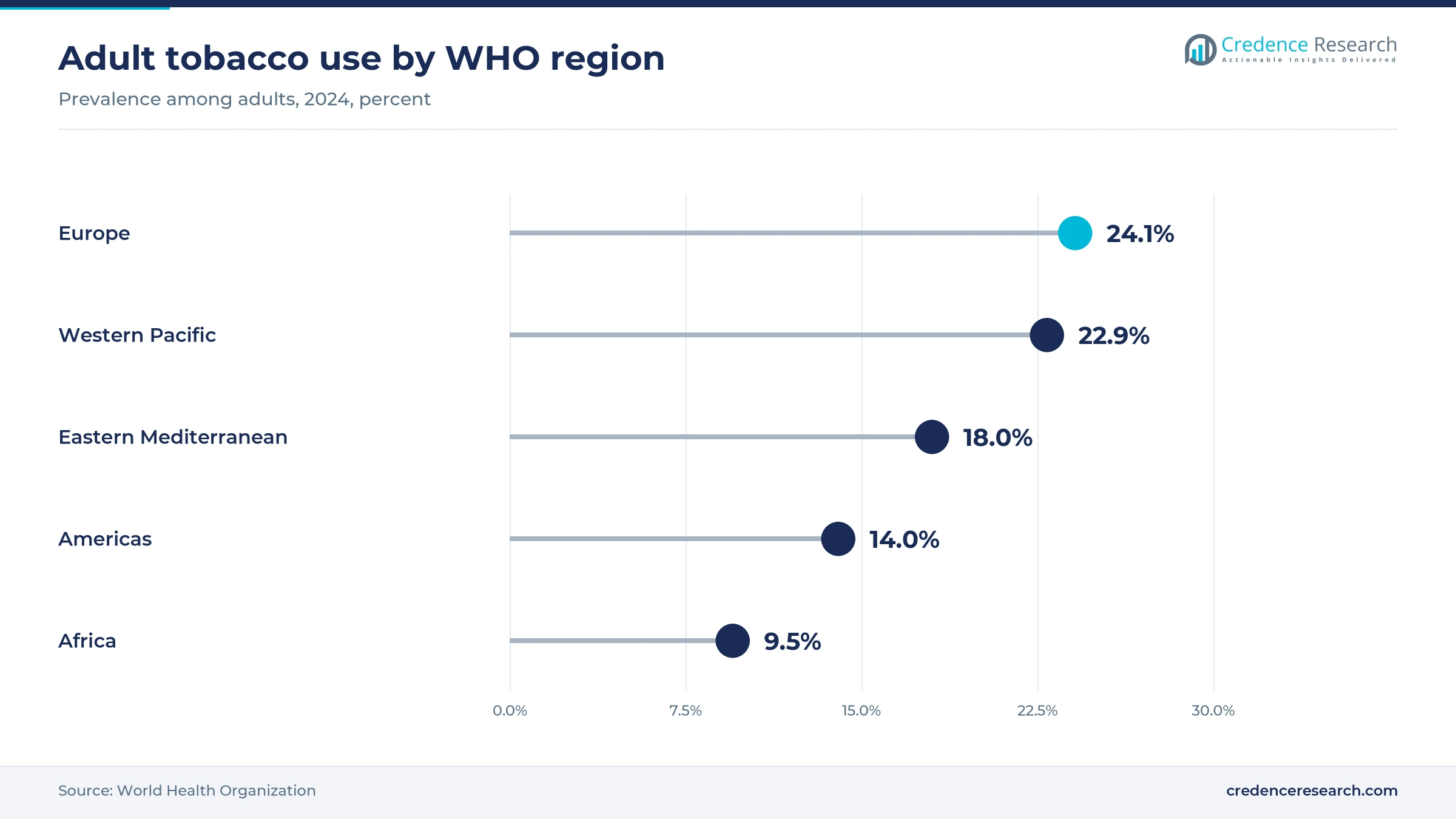
Europe held a 30.0% share of 2025 value and grows at 6.15% a year through 2035. The WHO European Region had the highest adult tobacco use of all regions in 2024, at 24.1%. England funds generic varenicline through stop-smoking services, and cytisine has long been used across Central and Eastern Europe. However, national pricing rules keep unit values below U.S. levels.
How fast is Asia Pacific expanding quit treatment?
Asia Pacific held a 22.0% share of 2025 value and is the fastest-growing region at 7.55% a year. Adult tobacco use in the WHO Western Pacific Region stood at 22.9% in 2024, and China has the world's largest smoker population. Hospital cessation clinics, quit lines and rising insurance coverage add treated smokers each year. Japan and Australia also fund prescription medicines through national insurance.
Where is Latin America adding demand?
Latin America held a 6.0% share of 2025 value and grows at 6.95% a year through 2035. The WHO Region of the Americas recorded 14% adult tobacco use in 2024, and Brazil and Mexico lead regional spending through public health programs and private pharmacies.
What limits growth in the Middle East and Africa?
The Middle East and Africa held a 4.0% share of 2025 value and grows at 7.05% a year through 2035. The Eastern Mediterranean Region recorded 18% adult tobacco use in 2024, yet few countries fund prescription quit medicines today.
Guidelines, resupply and approval milestones since 2024
| Development | Status and market relevance |
|---|---|
| In July 2024, the WHO released its first clinical treatment guideline for tobacco cessation in adults. | Published; recommends varenicline, bupropion, cytisine and nicotine replacement |
| In September 2024, Dr. Reddy's completed its acquisition of Haleon's nicotine replacement brands outside the United States. | Completed; adds Nicotinell and local brands in more than 30 countries |
| In November 2024, NHS England announced generic varenicline supply from Teva U.K. through stop-smoking services. | In use; aims to help more than 85,000 people quit each year |
| In June 2025, Pfizer announced that Champix was available again for prescription in the U.K. | Relaunched; branded varenicline returns after the 2021 recall |
| In June 2026, Achieve Life Sciences received an FDA complete response letter for cytisinicline. | Resubmission planned for late 2026; no efficacy or safety deficiencies cited |
Formulations and care models shaping quit treatment
- Nitrosamine-compliant varenicline restored supply after the 2021 recall, which lets health systems again offer the most widely recommended single medicine.
- Cytisine and cytisinicline formulations offer a plant-derived partial agonist at a lower course price, which suits public programs with tight budgets.
- Combination regimens pair varenicline or bupropion with nicotine replacement, which helps heavier smokers manage cravings during the first weeks.
- Telehealth prescribing shortens the path from intent to treatment, which raises online pharmacy volume for 12-week courses.
- Brief counseling protocols of 30 seconds to three minutes let pharmacists and nurses start treatment without specialist referral.
Need a Custom Version of This Report?
Tailor the scope, geography, or segments to your exact requirements.
- Custom geography or segment scope
- Direct access to our analyst team
Drug makers and nicotine product firms compete for quitters
Competition in the market splits between pharmaceutical makers of prescription quit medicines and nicotine product companies that sell alternatives to smokers. Pfizer remains the originator of varenicline and relaunched Champix in the U.K. in 2025, while GlaxoSmithKline and Novartis compete through broad medicine portfolios. Generic makers such as Teva, Perrigo Company and The Harvard Drug Group compete on price and supply reliability through retail and hospital channels. Dr. Reddy's Laboratories expanded into quit products with the Haleon nicotine replacement brands in 2024. Imperial Tobacco, Reynolds American, NJOY, Fontem Ventures and Kimree Technology compete for the same smokers with e-cigarettes and other nicotine products. However, medicine makers hold the advantage in funded health system programs, where clinical evidence decides procurement.
Companies profiled and their roles in this market
| Company | Type | Role in the market |
|---|---|---|
| Pfizer Inc | Originator | Varenicline (Champix and Chantix), relaunched in the U.K. in 2025 |
| GlaxoSmithKline Plc | Originator | Respiratory, vaccine and specialty medicines portfolio |
| Dr. Reddy's Laboratories | Generic and consumer health | Generic medicines and Nicotinell nicotine replacement brands |
| Perrigo Company | Consumer health | Store-brand self-care and over-the-counter products |
| The Harvard Drug Group | Generic distributor | Generic medicines supplied to retail and institutional pharmacies |
| Novartis | Pharmaceutical | Innovative medicines portfolio across major therapy areas |
| Imperial Tobacco | Nicotine products | Tobacco and next-generation nicotine products |
| Reynolds American | Nicotine products | Tobacco and vapor products in the United States |
| NJOY | Nicotine products | E-cigarette products in the United States |
| Fontem Ventures | Nicotine products | E-cigarette brands and vapor technology |
| Kimree Technology | Device maker | E-cigarette design and manufacturing |
Access programs matter more than price through 2035
Credence Research's view is that funded access, rather than price, will carry most growth through 2035. The market grows at 6.52% a year as WHO guidance, national stop-smoking services and telehealth bring more smokers to prescribed treatment. Generic varenicline and low-cost cytisine lower the cost per course, which lets public budgets treat more people. The strongest openings sit in cytisine, online dispensing and Asia Pacific programs, while supply reliability remains the main risk for buyers and suppliers alike, after recalls and manufacturing findings disrupted access in recent years.
How Credence Research built the quit medicine model
The report uses 2025 as the base year and 2026 to 2035 as the forecast period. Market values come from the Credence Research model, which builds spending by drug type and distribution channel. Regional and segment splits are Credence Research estimates informed by World Health Organization reports, CDC statistics, NHS announcements, regulatory filings and company releases. No primary interviews or surveys were used in preparing this edition of the report.
Varenicline, cytisine and bupropion outlook to 2035
By 2035, the smoking cessation drugs market is projected to reach USD 15.39 billion, with growth led by Asia Pacific, cytisine and online dispensing. Varenicline will remain the largest medicine as generic supply stabilizes across major markets. A U.S. cytisinicline decision would add competition in the largest regional market from 2027. Public programs that follow WHO guidance will decide how quickly treatment reaches the hundreds of millions of tobacco users who want to quit, especially in Asia Pacific, where smoker numbers remain highest.
Frequently Asked Questions
How big is the global smoking cessation drugs market?
Which region leads smoking cessation drugs spending?
Which drug type leads the market?
What did the WHO recommend for tobacco cessation?
Is cytisinicline approved in the United States?
Which channel grows fastest for quit medicines?
Who are the leading smoking cessation drugs companies?
Is varenicline available again in the U.K.?
Table of Content
Chapter 1 Market Segmentation
- 1.1 Segmentation Framework
- 1.1.1 Product and Service Classification
- 1.1.2 Application and End-Use Classification
- 1.1.3 Technology and Solution Classification
- 1.1.4 Customer and Distribution Channel Classification
- 1.1.5 Geographic Segmentation
- 1.1.6 Market Segment Definitions and Boundaries
- 1.2 By Drug Type
- 1.2.1 Varenicline
- 1.2.2 Bupropion
- 1.2.3 Cytisine
- 1.2.4 Combination Therapies
Chapter 2 Introduction
- 2.1 Report Objectives and Scope
- 2.2 Product Definition and Industry Terminology
- 2.3 Market Inclusions and Exclusions
- 2.4 Research Process
- 2.4.1 Primary Research and Expert Interviews
- 2.4.2 Secondary Research and Source Review
- 2.4.3 Top-Down and Bottom-Up Estimation
- 2.4.4 Data Triangulation and Verification
- 2.5 Market Size Measurement Basis
- 2.5.1 2025: USD 8.18 billion → 2035: USD 15.39 billion
- 2.6 Historical and Forecast Reference Periods
- 2.6.1 Historical Period: 2018-2025
- 2.6.2 Base Year: 2025
- 2.6.3 Forecast Period: 2025-2035
- 2.7 Research Assumptions and Limitations
Chapter 3 Executive Summary
- 3.1 Market Snapshot and Key Findings
- 3.2 Base-Year Market Size, 2025
- 3.3 Forecast Market Size, 2035
- 3.4 Revenue and Volume Growth Outlook
- 3.5 Key Demand and Supply Indicators
- 3.6 Leading Market Segments
- 3.7 Fastest-Growing Market Opportunities
- 3.8 Regional Performance Highlights
- 3.9 Technology and Industry Transformation
- 3.10 Competitive Landscape Summary
- 3.11 Analyst View and Strategic Implications
Chapter 4 Global Smoking Cessation Drugs Market Trends and Developments
- 4.1 Historical Industry Development, 2018-2025
- 4.2 Recent Market Trends and Developments
- 4.3 Demand and Customer Behavior Trends
- 4.4 Technology and Product Innovation
- 4.5 Artificial Intelligence, Automation and Digitalization
- 4.6 Local Manufacturing and Supply Chain Realignment
- 4.7 Industry Partnerships, Mergers and Acquisitions
- 4.8 Sustainability and Circular Economy Developments
- 4.9 Government and Private Sector Investment Trends
- 4.10 Emerging Business Models and Commercialization
- 4.11 Industry Developments and Announcements
Chapter 5 Global Smoking Cessation Drugs Market Production, Supply and Demand Analysis
- 5.1 Demand Trend and Consumption Analysis, 2018-2025
- 5.2 Demand Forecast, 2025-2035
- 5.3 Production and Output Trend, 2018-2025
- 5.4 Production and Output Forecast, 2025-2035
- 5.5 Installed Capacity and Capacity Utilization
- 5.6 Company-Wise Production Plants and Statistics
- 5.6.1 Installed Production Capacity
- 5.6.2 Actual Production
- 5.6.3 Planned Capacity and Expansion Targets
- 5.7 Supply Chain Structure and Procurement Trends
- 5.8 Supply-Demand Gap and Bottlenecks
- 5.9 Import Dependence and Sourcing Structure
- 5.10 Contract Manufacturing and Outsourcing
- 5.11 Regional Supply and Demand Concentration
Chapter 6 Global Smoking Cessation Drugs Market Pricing Analysis
- 6.1 Pricing Structure and Measurement
- 6.2 Historical Pricing Trends, 2018-2025
- 6.3 Pricing Outlook, 2025-2035
- 6.4 Average Selling Price and Unit Economics
- 6.5 Pricing by Product and Market Segment
- 6.6 Geographic Pricing Differences
- 6.7 Key Input, Energy, Labor and Logistics Costs
- 6.8 Contract Pricing and Purchasing Models
- 6.9 Pricing Sensitivity and Competitive Positioning
- 6.10 Price, Margin and Profitability Implications
Chapter 7 Global Smoking Cessation Drugs Market Dynamics
- 7.1 Market Growth Drivers
- 7.1.1 Demand-Side Drivers
- 7.1.2 Technology and Innovation Drivers
- 7.1.3 Infrastructure and Investment Drivers
- 7.1.4 Regulatory and Policy Drivers
- 7.2 Market Restraints
- 7.2.1 Cost and Affordability Constraints
- 7.2.2 Technology and Adoption Barriers
- 7.2.3 Supply Chain and Operational Constraints
- 7.3 Market Challenges
- 7.3.1 Competitive Pressure and Margin Erosion
- 7.3.2 Skills, Infrastructure and Implementation Gaps
- 7.4 Emerging Market Opportunities
- 7.5 Market Dynamics Impact and Time-Horizon Assessment
Chapter 8 Global Smoking Cessation Drugs Value Chain Analysis
- 8.1 Industry Value Chain Overview
- 8.2 Upstream Suppliers and Critical Inputs
- 8.3 Technology and Component Providers
- 8.4 Manufacturing or Service Delivery
- 8.5 Distribution, Channel Partners and Integrators
- 8.6 Downstream Applications and End Users
- 8.7 Value Addition and Profit Pools
- 8.8 Vertical Integration and Outsourcing
- 8.9 Supplier Concentration and Risk
- 8.10 Supply Chain Localization and Resilience
Chapter 9 Global Smoking Cessation Drugs Market Regulations and Policies
- 9.1 Relevant Laws, Standards and Compliance Frameworks
- 9.2 Product, Service, Safety and Quality Requirements
- 9.3 Government Policies, Incentives and Subsidies
- 9.4 Imports, Exports and Trade Barriers
- 9.5 Public Procurement and Local Content Requirements
- 9.6 Environmental and Sustainability Compliance
- 9.7 Upcoming Policy Changes and Market Implications
Chapter 10 Global Smoking Cessation Drugs Market Hotspots and Opportunities
- 10.1 Market Opportunity Mapping and Growth Hotspots
- 10.2 High-Growth Applications and Customer Groups
- 10.3 Underserved Markets and White-Space Opportunities
- 10.4 Emerging Technology and Product Opportunities
- 10.5 New Capacity and Investment Hotspots
- 10.6 Market Entry and Expansion Opportunities
- 10.7 Distribution and Partnership Opportunities
- 10.8 Near-Term and Long-Term Commercial Potential
- 10.9 Opportunity Attractiveness and Execution Risks
Chapter 11 Global Smoking Cessation Drugs Market Outlook, 2025-2035
- 11.1 Market Size and Analysis
- 11.1.1 Revenue (Market Measurement: 2025: USD 8.18 billion → 2035: USD 15.39 billion)
- 11.1.2 Market Volume and Quantity Sold
- 11.1.3 Historical Market Size, 2018-2025
- 11.1.4 Base-Year Market Size, 2025
- 11.2 Market Forecast, 2025-2035
- 11.2.1 Revenue Forecast to 2035
- 11.2.2 Volume Forecast to 2035
- 11.2.3 CAGR and Year-on-Year Growth
- 11.2.4 Incremental Revenue Opportunity
- 11.3 Forecast Assumptions and Scenario Analysis
- 11.3.1 Base-Case Forecast
- 11.3.2 Optimistic and Conservative Scenarios
- 11.3.3 Technology, Pricing and Policy Sensitivities
- 11.4 Market Attractiveness and Growth Outlook
Chapter 12 Global Smoking Cessation Drugs Market Segmentation and Outlook
- 12.1 Segmentation Summary and Market Shares, 2025
- 12.2 Largest and Fastest-Growing Segments
- 12.3 By Drug Type - Market Size and Forecast, 2025-2035
- 12.3.1 Segment Definition and Scope
- 12.3.2 Historical Market Size, 2018-2025
- 12.3.3 Revenue Forecast, 2025-2035
- 12.3.4 Volume Forecast, 2025-2035
- 12.3.5 Base-Year Market Share, 2025
- 12.3.6 Segment CAGR and Growth Drivers
- 12.3.7 Subsegment Market Size and Forecast
- 12.3.7.1 Varenicline
- 12.3.7.2 Bupropion
- 12.3.7.3 Cytisine
- 12.3.7.4 Combination Therapies
- 12.3.8 Subsegment Pricing and Adoption Trends
- 12.3.9 Leading Suppliers and Competition
- 12.3.10 Regional Demand and Opportunities
- 12.4 Segment Growth Comparison
- 12.5 Segment Attractiveness and Priority Matrix
Chapter 13 Global Smoking Cessation Drugs Geographic Market Outlook, 2025-2035
- 13.1 Regional Market Size and Share, 2025
- 13.2 Regional Market Forecast, 2025-2035
- 13.3 Regional Pricing, Production and Demand Differences
- 13.4 North America
- 13.4.1 United States
- 13.4.2 Canada
- 13.4.3 Mexico
- 13.5 Europe
- 13.5.1 Germany
- 13.5.2 France
- 13.5.3 Italy
- 13.5.4 United Kingdom
- 13.5.5 Spain
- 13.5.6 Poland
- 13.5.7 Russia
- 13.5.8 Netherlands
- 13.5.9 Belgium
- 13.5.10 Sweden
- 13.5.11 Denmark
- 13.5.12 Norway
- 13.5.13 Rest of Europe
- 13.6 Asia Pacific
- 13.6.1 China
- 13.6.2 India
- 13.6.3 Japan
- 13.6.4 South Korea
- 13.6.5 Thailand
- 13.6.6 Indonesia
- 13.6.7 Vietnam
- 13.6.8 Malaysia
- 13.6.9 Australia
- 13.6.10 Rest of Asia Pacific
- 13.7 Latin America
- 13.7.1 Brazil
- 13.7.2 Argentina
- 13.7.3 Colombia
- 13.7.4 Chile
- 13.7.5 Rest of Latin America
- 13.8 Middle East
- 13.8.1 Saudi Arabia
- 13.8.2 United Arab Emirates
- 13.8.3 Turkey
- 13.8.4 Israel
- 13.8.5 Iran
- 13.8.6 Rest of the Middle East
- 13.9 Africa
- 13.9.1 South Africa
- 13.9.2 Egypt
- 13.9.3 Nigeria
- 13.9.4 Morocco
- 13.9.5 Rest of Africa
- 13.10 Regional Investment, Policy and Supply Chain Differences
- 13.11 Regional Competitive Landscape
- 13.12 Geographic Growth Hotspots
Chapter 14 Global Smoking Cessation Drugs Technology, Innovation and Sustainability Outlook
- 14.1 Technology Landscape and Maturity
- 14.2 Product, Process and Service Innovation
- 14.3 AI, Automation and Digital Tools in the Industry
- 14.4 Technology Adoption and Performance Benchmarking
- 14.5 Innovation Pipeline and R&D Investment
- 14.6 Patent and Intellectual Property Trends
- 14.7 Energy Efficiency and Resource Management
- 14.8 Sustainability, Recycling and Circularity
- 14.9 Technology Roadmap, 2025-2035
- 14.10 Risks of Obsolescence and Technology Substitution
Chapter 15 Global Smoking Cessation Drugs Market Key Strategic Imperatives
- 15.1 Growth and Market Entry Priorities
- 15.2 High-Return Products and Segments
- 15.3 Pricing, Profitability and Cost Optimization
- 15.4 Technology Investment and Product Differentiation
- 15.5 Supply Chain Localization and Resilience
- 15.6 Distribution and Customer Acquisition
- 15.7 Partnership, Acquisition and Capacity Strategy
- 15.8 Regional Expansion Priorities
- 15.9 Short-, Medium- and Long-Term Actions
Chapter 16 Competition Outlook
- 16.1 Industry Competition Characteristics
- 16.2 Market Structure and Concentration
- 16.3 Market Share and Competitive Positioning, 2025
- 16.4 Company-Wise Revenue and Product Benchmarking
- 16.5 Production and Service Capacity Benchmarking
- 16.6 Technology, Pricing and Differentiation
- 16.7 Regional Footprint and Distribution Strength
- 16.8 Mergers, Acquisitions and Strategic Alliances
- 16.9 New Entrants and Competitive Threats
- 16.10 Porter's Five Forces and Industry Attractiveness
- 16.11 Competitive Outlook, 2025-2035
Chapter 17 Company Profiles
- 17.1 Company Coverage and Selection Criteria
- 17.2 Imperial Tobacco
- 17.2.1 Business Description
- 17.2.2 Company Ownership and Geographic Presence
- 17.2.3 Product and Service Portfolio
- 17.2.4 Manufacturing and Operating Footprint
- 17.2.5 Production Capacity and Expansion Plans
- 17.2.6 Financial Performance and Investment
- 17.2.7 Market Share and Competitive Position
- 17.2.8 Technology and Innovation Capabilities
- 17.2.9 Strategic Alliances or Partnerships
- 17.2.10 Recent Developments
- 17.2.11 Growth Strategy and Outlook
- 17.3 GlaxoSmithKline Plc
- 17.4 NJOY
- 17.5 Novartis
- 17.6 Pfizer Inc
- 17.7 Dr. Reddy's Laboratories
- 17.8 The Harvard Drug Group
- 17.9 Fontem Ventures
- 17.10 Reynolds American
- 17.11 Kimree Technology
- 17.12 Perrigo Company
- 17.13 Other Relevant Market Participants
Note: Every listed company is profiled on the structure shown under the first company. The company list is preliminary and may change based on research findings, market developments, data availability and client requirements.
Chapter 18 Disclaimer
- 18.1 Research and Forecast Disclaimer
- 18.2 Data Source and Estimation Limitations
Note: The depth of individual sections depends on data availability for this market. Volume, capacity, trade and other unit-based metrics are included where applicable.

