
Sleep loss and anxiety keep prescriptions rising
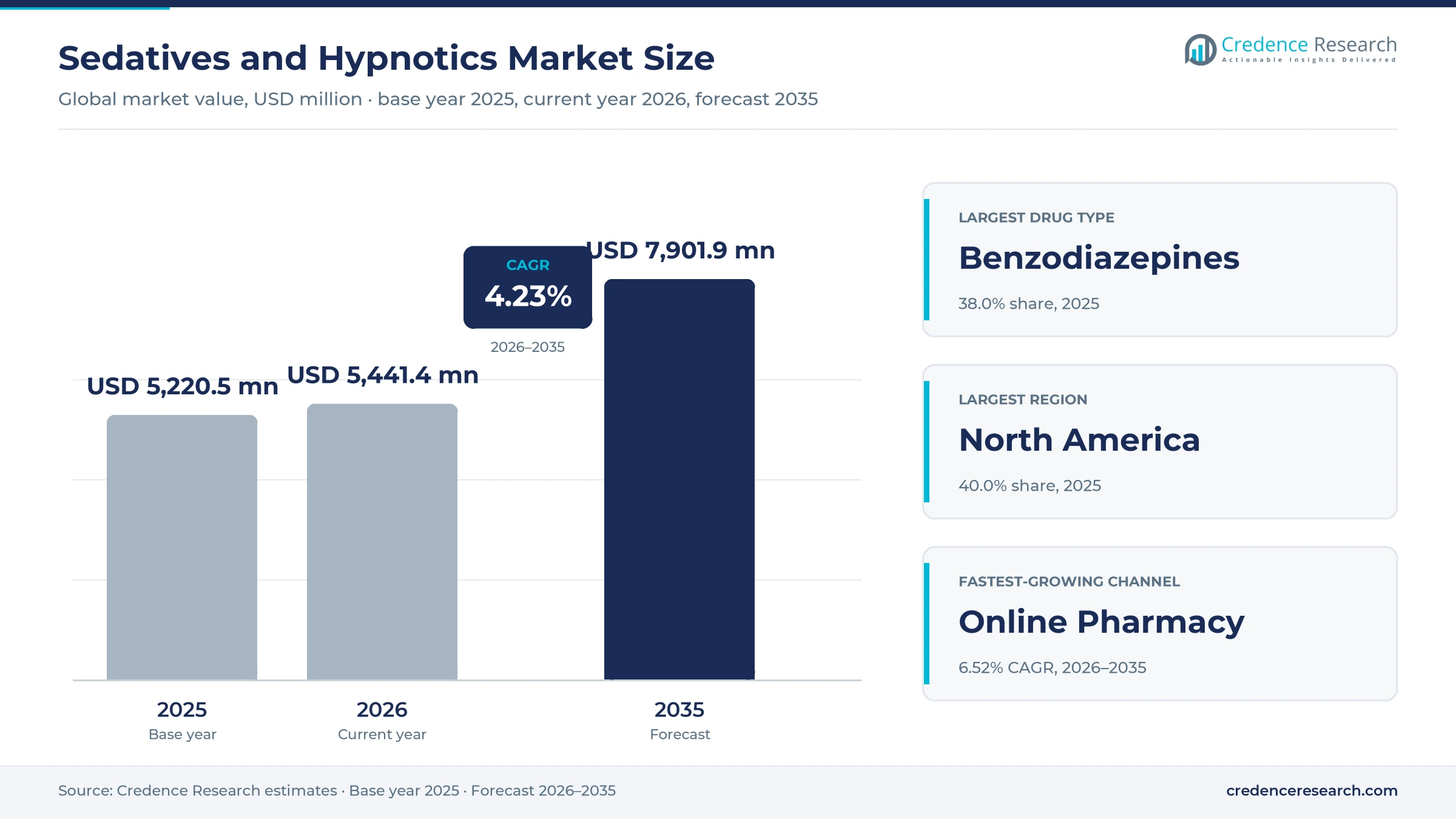
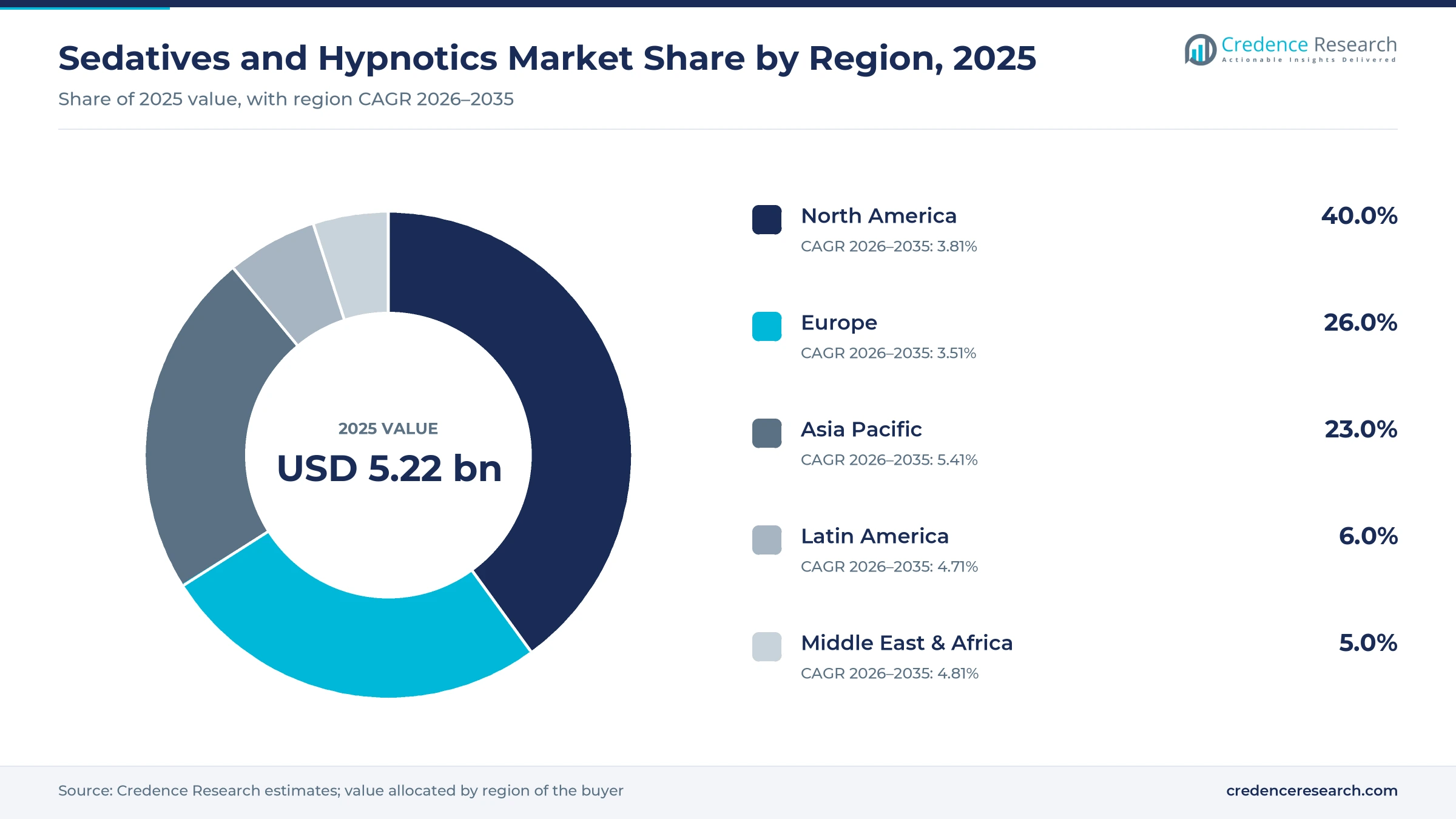
The global sedatives and hypnotics market was valued at USD 5.22 billion in 2025 and is projected to increase from USD 5.44 billion in 2026 to USD 7.90 billion by 2035, registering a CAGR of 4.23% during 2026–2035. Demand rises because hundreds of millions of people live with anxiety, depression and chronic sleep difficulty, while hospitals need reliable sedation for surgery, intensive care and endoscopy. North America held the largest regional share, 40.0% in 2025, because the United States dispenses large volumes of benzodiazepines and newer sleep medicines through retail and mail-order pharmacies. Asia Pacific is the fastest-growing region at 5.41% a year, as Japan and China add orexin receptor antagonists to insomnia care. Regulation also shifted in August 2026, when U.S. drug enforcement authorities proposed moving dual orexin receptor antagonists to the lowest controlled schedule. As a result, prescribers gain more room to choose newer mechanisms over older habit-forming classes.
Which sleep and sedation medicines does this analysis count?
The analysis counts prescription benzodiazepines, non-benzodiazepine sleep aids, barbiturates, melatonin receptor agonists and other agents such as orexin receptor antagonists and hospital sedation injectables. Hospital pharmacies, retail pharmacies and online pharmacies dispense these medicines to patients with sleep, anxiety and severe mental health disorders.
Over-the-counter melatonin supplements, herbal sleep remedies and general anesthetic gases sit outside the value counted here. The value chain runs from active ingredient synthesis and finished dose manufacturing through wholesale distribution and pharmacy dispensing to reimbursement by public and private payers.
Sedatives and Hypnotics Market Insights
- The sedatives and hypnotics market grows from USD 5.22 billion in 2025 to USD 7.90 billion by 2035, a 4.23% CAGR as sleep and anxiety treatment widens.
- North America held 40.0% of global value in 2025, because U.S. pharmacies dispense the largest volume of sleep and anxiety medicines.
- Benzodiazepines led drug types with 38.0% of 2025 value, while orexin-based and other newer agents grow fastest at 6.41% a year.
- In May 2025, Eisai received approval in China for Dayvigo, where the company estimates that 15% of adults live with insomnia.
- Online pharmacies grow fastest among channels at 6.52% a year, helped by telemedicine prescribing rules extended through Dec. 31, 2026.
Benzodiazepines lead as orexin therapies grow fastest
Which drug classes hold most of the value?
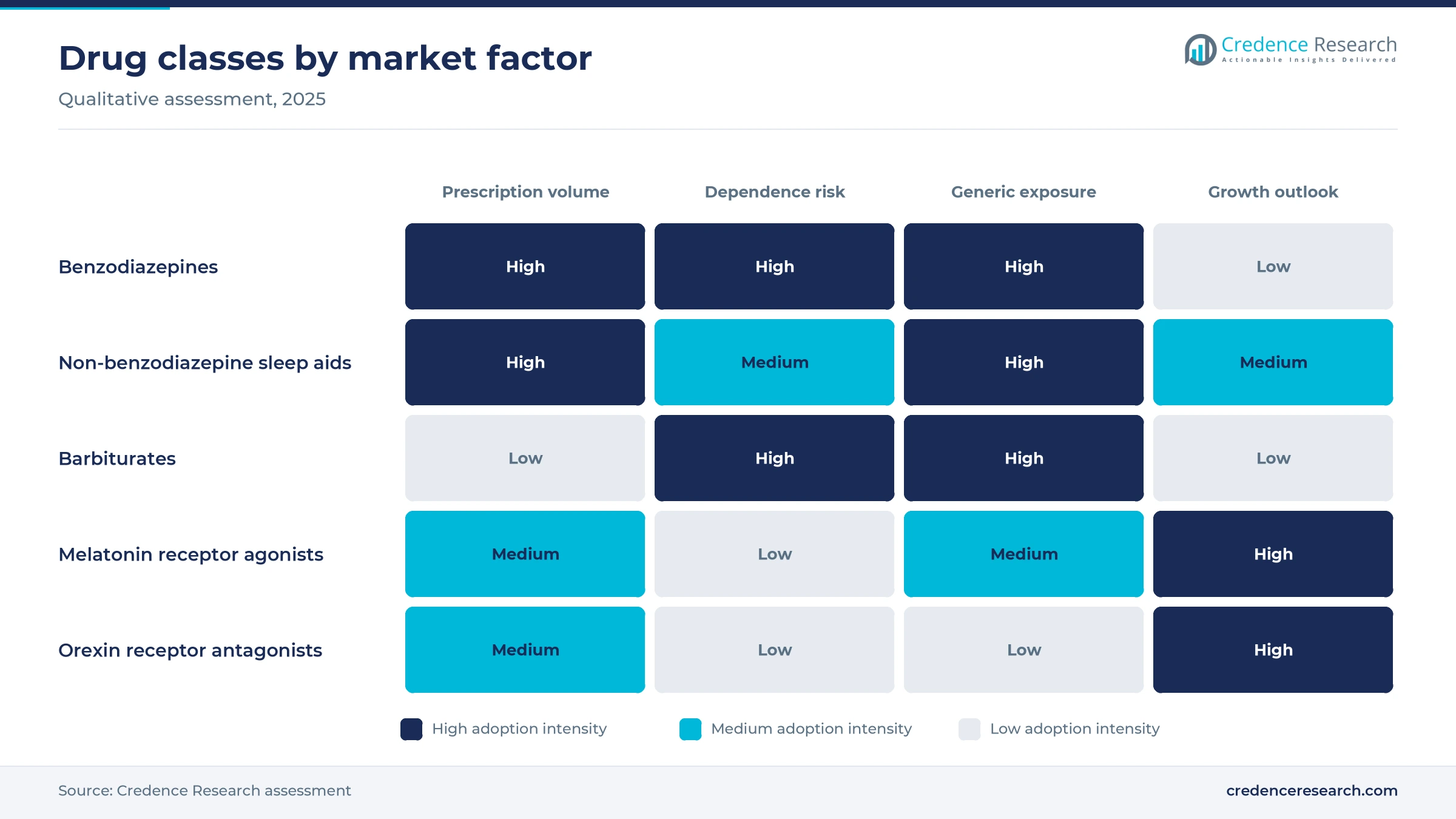
Based on drug type, the market is categorized into benzodiazepines, non-benzodiazepine sleep aids, barbiturates, melatonin receptor agonists and other agents. Benzodiazepines led with 38.0% of 2025 value, because doctors still prescribe them widely for anxiety, seizures and procedural sedation. The other agents group grows fastest at 6.41% a year, as orexin receptor antagonists gain approvals in Japan and China. Barbiturates keep a small and shrinking role in modern practice.
Which conditions drive prescriptions?
Based on application, the market is categorized into sleep disorders, anxiety disorders and severe mental health disorders. Sleep Disorders led with 52.0% of 2025 value, because chronic insomnia affects a large share of adults in every region. Sleep Disorders also grow fastest at 4.50% a year, as newer sleep medicines replace older options. Anxiety care relies heavily on low-cost generic benzodiazepines, which keeps its value growth slower.
Where do patients obtain these medicines?
Based on distribution channel, the market is categorized into hospital pharmacy, retail pharmacy, online pharmacy and others. Retail Pharmacy led with 51.0% of 2025 value, because most sleep and anxiety refills happen at community counters. Online Pharmacy grows fastest at 6.52% a year, as remote prescribing and home delivery expand. Hospital pharmacies supply injectable sedatives for surgery, endoscopy and intensive care units.
| Segment Group | Leading Sub-segment | Share, 2025 | Fastest-growing Sub-segment | CAGR, 2026–2035 |
|---|---|---|---|---|
| By Drug Type | Benzodiazepines | 38.0% | Other Sedative-Hypnotics | 6.41% |
| By Application | Sleep Disorders | 52.0% | Sleep Disorders | 4.50% |
| By Distribution Channel | Retail Pharmacy | 51.0% | Online Pharmacy | 6.52% |
Request a Free Sample
Fill in your details and we'll send you a free sample report.
- Sample data tables & charts
- Research methodology
Mental illness, poor sleep and hospital sedation lift demand
How does the burden of mental illness lift demand?
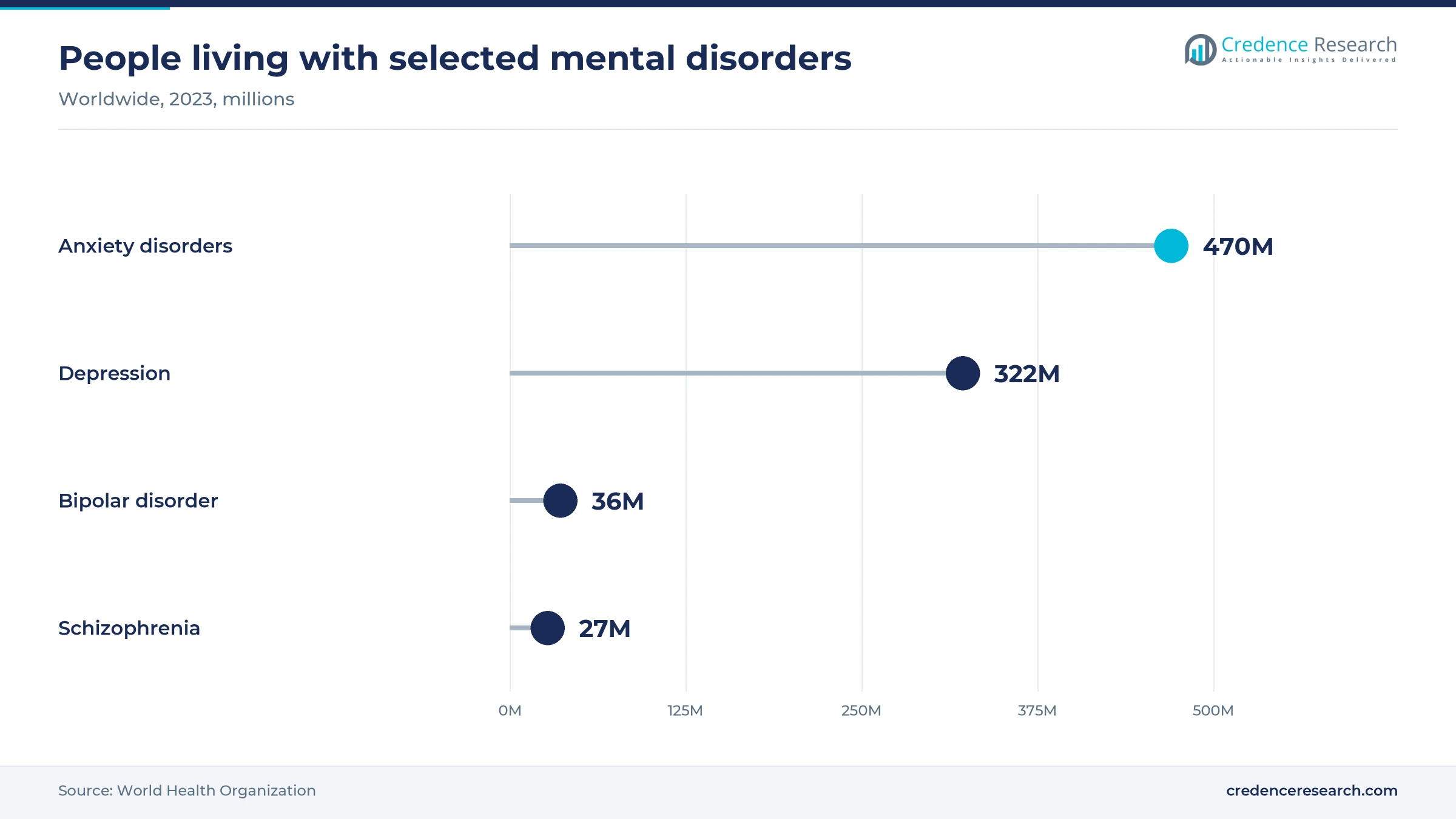
The burden of mental illness is the broadest demand driver, because anxiety and mood disorders often need short courses of calming or sleep-promoting medicine. The World Health Organization reports that 470 million people lived with an anxiety disorder in 2023, including 146 million children and adolescents. The same source counts 322 million people with depression and about 27 million with schizophrenia in that year. These conditions frequently disturb sleep, so psychiatrists combine antidepressants or antipsychotics with sedating agents during acute episodes. As a result, demand for generalized anxiety disorder treatment keeps widening as diagnosis improves in middle-income countries.
Why does widespread poor sleep keep prescriptions high?
Widespread poor sleep keeps prescriptions high, because many adults report trouble falling or staying asleep on most nights. A national survey from the CDC found that 30.5% of U.S. adults slept less than seven hours on average in 2024. The same survey found that 15.4% had trouble falling asleep and 18.1% had trouble staying asleep on most days. In Japan, health authorities estimate that insomnia affects about 20% of adults, according to Nxera Pharma. Eisai also estimates adult insomnia prevalence in China at 15%, or about 172.5 million people. In turn, demand for insomnia medicines stays strong, and sleep disorders grow at 4.50% a year.
How do new orexin approvals widen treatment choice?
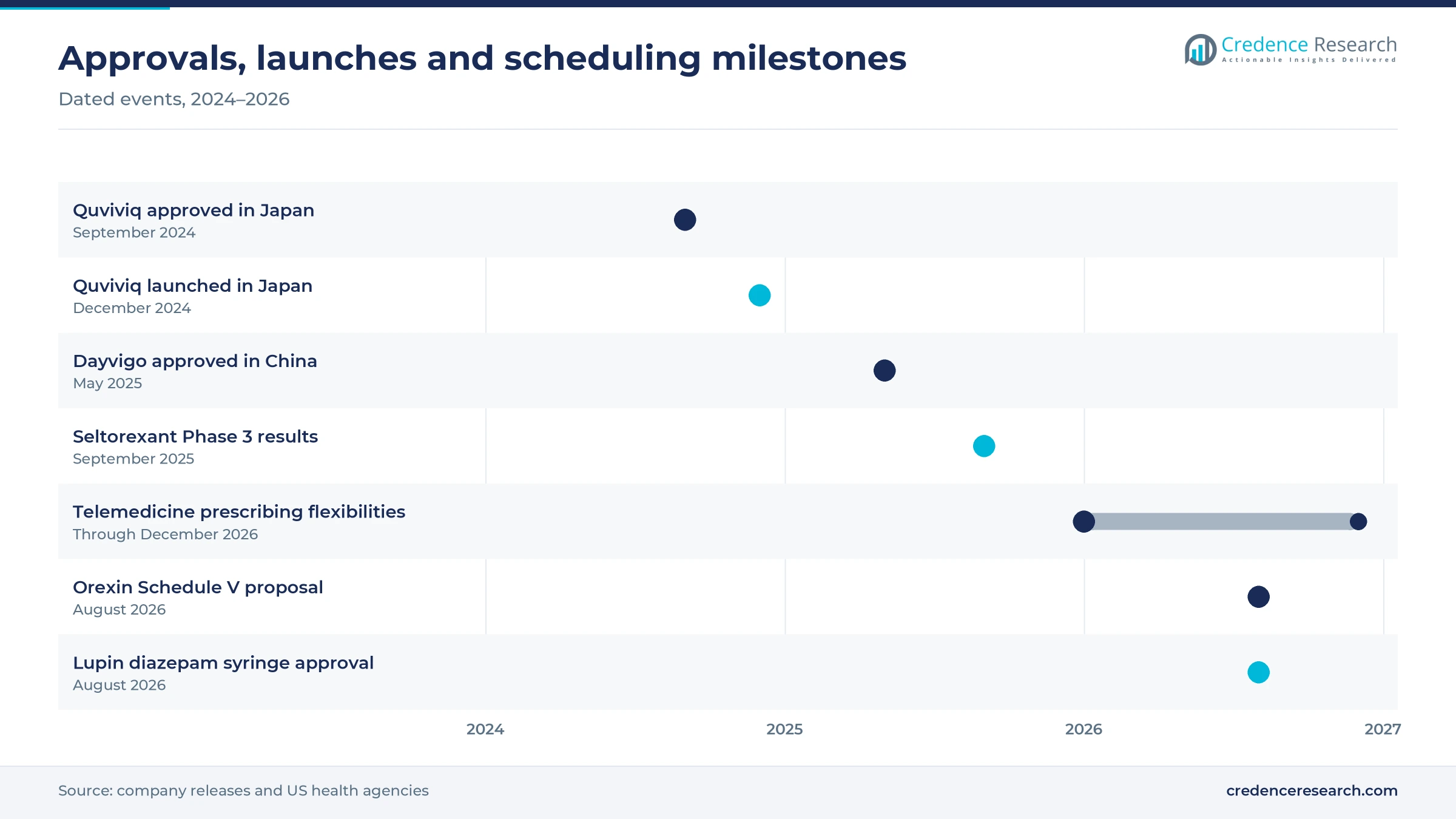
New orexin approvals widen treatment choice, because these medicines block wake-promoting signals instead of sedating the whole brain. In September 2024, Nxera Pharma received Japanese approval for Quviviq, and it launched the medicine with Shionogi in December 2024. In May 2025, Eisai announced approval of Dayvigo in China, adding a second large Asian market for the orexin class. Dayvigo was already approved for insomnia in 22 countries and regions, including Japan, the United States, Canada and Australia. These launches widen insomnia therapeutics with an option that has a different dependence profile from benzodiazepines. As a result, the other agents group, which includes orexin receptor antagonists, grows at 6.41% a year.
Why does hospital sedation add steady volume?
Hospital sedation adds steady volume, because surgery, endoscopy and intensive care all require fast and predictable calming of patients. Hospital pharmacies held a large share of 2025 value, supplying injectable benzodiazepines and other agents for these procedures. In August 2026, Lupin reported FDA approval of generic diazepam injection in single-dose prefilled syringes, referencing Roche's Valium Injection. The product is approved for anxiety disorders and the short-term relief of anxiety symptoms in acute settings. Prefilled syringes cut preparation time and dosing errors for nurses and anesthesia teams. Each syringe holds 10 mg of diazepam in 2 mL, a strength of 5 mg per mL that suits emergency use. In turn, North America keeps the highest spending on ready-to-use hospital formats.
Orexin science, rescheduling and remote prescribing
How is the shift toward orexin-based therapy changing practice?
A shift toward orexin-based therapy is changing practice, because doctors want sleep medicines that carry less risk of tolerance and next-day impairment. In August 2026, U.S. drug enforcement authorities proposed moving dual orexin receptor antagonists from Schedule IV to Schedule V, following a health department recommendation. Idorsia called the proposal an important first step and said it believes the evidence supports full descheduling. Schedule V status would ease prescription limits and pharmacy storage rules for the class. Asian approvals of Quviviq and Dayvigo in 2024 and 2025 add further patients outside the United States. By contrast, the FDA estimated that U.S. pharmacies dispensed 92 million benzodiazepine prescriptions in 2019, all now under a class-wide boxed warning. As a result, orexin agents gain ground as the fastest-growing drug type.
Is the rise of remote prescribing moving refills online?
A rise in remote prescribing is moving refills online, because patients with chronic insomnia or anxiety value video visits and home delivery. Federal telehealth guidance states that registered practitioners can prescribe schedule II to V controlled substances by telemedicine through Dec. 31, 2026. That rule covers benzodiazepines and orexin antagonists, which otherwise could require an in-person evaluation. Online pharmacies grow fastest among channels at 6.52% a year through 2035. Retail counters still held 51.0% of 2025 value, so modest shifts move large sums. In turn, e-pharmacy operators are building repeat refill programs for sleep and anxiety patients.
Where can depression with insomnia open a new segment?
Depression with insomnia offers a clear opening, because many patients stay sleepless even after standard antidepressants. Johnson & Johnson reported Phase 3 results for seltorexant, a selective orexin-2 receptor antagonist, in September 2025. The company says about 60% of patients with major depressive disorder have insomnia symptoms despite treatment with standard antidepressants. In the 26-week study, 57.4% of seltorexant patients responded, compared with 53.4% on quetiapine extended release. Somnolence affected 6% of seltorexant patients, compared with 24% on quetiapine. As a result, severe mental health disorders could gain a new adjunctive option that treats mood and sleep problems together.
Can melatonin-based therapy capture more first-line use?
Melatonin-based therapy offers an opening, because prescribers seek non-scheduled options for older adults and people with circadian rhythm problems. Melatonin receptor agonists do not carry the controlled-substance status of benzodiazepines or zolpidem, which simplifies prescribing and pharmacy handling. The FDA added a boxed warning in April 2019 to eszopiclone, zaleplon and zolpidem after rare but serious injuries from sleepwalking and sleep driving. That warning pushed some doctors toward alternatives with different safety profiles. Consumer familiarity with melatonin sleep supplements also eases patient acceptance of prescription agonists. In turn, Asia Pacific, which held 23.0% of 2025 value, offers room for first-line growth.
Dependence risk, safety warnings and generic pricing
How does dependence risk restrain benzodiazepine use?
Dependence risk restrains benzodiazepine use, because long courses can lead to misuse, addiction and withdrawal reactions. In September 2020, the FDA required an updated boxed warning across the whole benzodiazepine class to address these risks. The agency estimated that U.S. pharmacies dispensed 92 million benzodiazepine prescriptions in 2019. As a result, guidelines now favor short courses and tapering plans, which limits volume growth in the leading drug type.
Why do complex sleep behaviors worry prescribers?
Complex sleep behaviors worry prescribers, because some patients sleepwalk, drive or cook without being fully awake. The FDA added a boxed warning to eszopiclone, zaleplon and zolpidem in April 2019 after rare but serious injuries and deaths. Patients who experience these episodes must stop taking the medicine at once. In turn, doctors screen patients more carefully, and some move to orexin or melatonin-based options with different safety profiles.
How does generic pricing limit value growth?
Generic pricing limits value growth, because most benzodiazepines and Z-drugs lost patent protection many years ago. Alprazolam, clonazepam and lorazepam made up 82% of U.S. benzodiazepine prescriptions in 2019, according to the FDA. Indian manufacturers such as Lupin, Torrent, Aurobindo, Cipla and Dr. Reddy's compete on cost for these molecules. As a result, rising patient volume translates into modest value gains for the older classes.
Why does controlled-substance regulation slow access?
Controlled-substance regulation slows access, because most sedatives and hypnotics sit in Schedule IV in the United States and face similar controls elsewhere. Pharmacies must keep detailed records, and prescribers face refill limits. Remote prescribing depends on temporary federal flexibilities that currently run through Dec. 31, 2026. However, a permanent telemedicine rule and the proposed orexin rescheduling could ease some of these barriers. Until then, pharmacies and clinics must plan for possible rule changes each year.
North America leads value as Asia Pacific adds patients
| Region | Value, 2025 (USD billion) | Share, 2025 | CAGR, 2026–2035 |
|---|---|---|---|
| North America | 2.09 | 40.0% | 3.81% |
| Europe | 1.36 | 26.0% | 3.51% |
| Asia Pacific | 1.20 | 23.0% | 5.41% |
| Latin America | 0.31 | 6.0% | 4.71% |
| Middle East & Africa | 0.26 | 5.0% | 4.81% |
Why does North America hold the largest regional share?
North America held a 40.0% share of 2025 value and grows at 3.81% a year through 2035. The United States dispenses large volumes of benzodiazepines and Z-drugs, and it was the first major market for orexin receptor antagonists. Federal telemedicine flexibilities through 2026 support remote refills, while the proposed Schedule V move for orexin medicines could widen their use. Canada follows similar prescribing trends under its provincial public drug plans.
How fast is Asia Pacific adding patients?
Asia Pacific held a 23.0% share of 2025 value and is the fastest-growing region at 5.41% a year. Japan approved Quviviq in 2024, and Nxera and Shionogi launched it there in December 2024. China approved Dayvigo in May 2025, opening access to a large adult insomnia population. India supplies low-cost generic benzodiazepines and Z-drugs to its own patients and to export markets.
What shapes demand across Europe?
Europe held a 26.0% share of 2025 value and grows at 3.51% a year, the slowest pace of the five regions. National guidelines in many countries limit benzodiazepine courses to a few weeks and encourage cognitive behavioral therapy for insomnia first. Quviviq is marketed in Europe by Idorsia, adding an orexin option. However, generic prices and strict prescribing controls keep regional value growth modest.
Where is Latin America adding demand?
Latin America held a 6.0% share of 2025 value and grows at 4.71% a year through 2035. Brazil and Mexico lead regional demand, with public systems buying generic benzodiazepines and private patients paying for branded sleep medicines in retail pharmacies.
What limits growth in the Middle East and Africa?
The Middle East and Africa held a 5.0% share of 2025 value and grows at 4.81% a year through 2035. Gulf hospitals adopt modern sedation agents quickly, while many African countries face shortages of mental health specialists and essential psychiatric medicines.
Approvals, launches and scheduling moves since 2024
| Development | Status and market relevance |
|---|---|
| In December 2024, Nxera Pharma and Shionogi launched Quviviq in Japan for adults with insomnia. | Launched; expands orexin therapy in Asia |
| In May 2025, Eisai announced approval of Dayvigo in China for adults with insomnia. | Approved; launch planned in fiscal 2025 |
| In September 2025, Johnson & Johnson reported Phase 3 results for seltorexant in depression with insomnia symptoms. | Investigational; adjunctive orexin-2 antagonist |
| In August 2026, U.S. drug enforcement authorities proposed moving dual orexin receptor antagonists to Schedule V. | Proposed rule; 30-day comment period |
| In August 2026, Lupin reported FDA approval of generic diazepam injection in prefilled syringes. | Approved; ready-to-use hospital format |
Mechanisms and formats changing sleep and sedation care
- Dual orexin receptor antagonists block wake-promoting signals in the brain, which supports sleep onset and maintenance without broad sedation.
- Selective orexin-2 receptor antagonists such as seltorexant target sleep problems in depression, which could add an adjunctive option for psychiatrists.
- Melatonin receptor agonists act on the body clock rather than on calming pathways, which suits older adults and circadian rhythm problems.
- Prefilled sedation syringes deliver measured doses of injectable agents such as diazepam, which cuts preparation time in emergency and intensive care settings.
- Telemedicine prescribing platforms let registered clinicians manage controlled sleep and anxiety medicines remotely, which supports online pharmacy refills.
Need a Custom Version of This Report?
Tailor the scope, geography, or segments to your exact requirements.
- Custom geography or segment scope
- Direct access to our analyst team
Originators and generic makers compete on safety and cost
Competition in the market splits between originators with newer mechanisms and generic makers that supply older classes at low cost. Merck, Johnson & Johnson, Pfizer, Sanofi, Roche, Novartis, AstraZeneca, GSK and Eli Lilly hold broad central nervous system portfolios, and Johnson & Johnson is developing seltorexant for depression with insomnia symptoms. Partners such as Eisai, Idorsia, Nxera and Shionogi drive the orexin class across the United States, Europe, Japan and China. Teva, Mylan, Sun Pharma, Cipla, Lupin, Torrent, Dr. Reddy's and Aurobindo compete on generic benzodiazepines and Z-drugs, often through pharmacy and public tender contracts. Fresenius Kabi, Endo and Abbott supply hospital injectables and branded generics in many countries. Lupin added a prefilled diazepam syringe for hospitals in 2026. However, safety warnings and scheduling rules shape which medicines prescribers choose, so evidence on dependence and next-day function now carries as much weight as price.
Companies profiled and their roles in this market
| Company | Type | Role in the market |
|---|---|---|
| Merck & Co., Inc. | Originator | Branded central nervous system medicines |
| Johnson & Johnson | Originator | Neuroscience pipeline, including investigational seltorexant |
| F. Hoffmann-La Roche Ltd. | Originator | Reference brand holder for Valium Injection |
| Pfizer Inc. | Originator | Diversified portfolio with central nervous system medicines |
| Sanofi | Originator | Branded medicines across neurology and primary care |
| Teva Pharmaceutical Industries Ltd. | Generic and specialty | Generic benzodiazepines and neuroscience brands |
| Mylan N.V. | Generic | Low-cost sleep and anxiety medicines |
| Sun Pharmaceutical Industries Ltd. | Generic and specialty | Generic central nervous system medicines |
| Lupin | Generic | Sleep aids and diazepam prefilled syringes |
| Dr. Reddy's Laboratories Ltd. | Generic | Sleep and anxiety medicines for the U.S. market |
| Aurobindo Pharma | Generic | High-volume generic oral medicines |
| Fresenius Kabi AG | Hospital injectables | Injectable medicines for anesthesia and intensive care |
Safer mechanisms win share through 2035
Credence Research's view is that safer mechanisms, rather than higher prices, will carry most value growth through 2035. The market grows at 4.23% a year as anxiety, depression and chronic poor sleep add treated patients worldwide. Benzodiazepines keep the largest share, yet safety warnings and tapering guidance limit their volume. The strongest openings sit in orexin receptor antagonists, depression with insomnia and online refill services, while generic makers gain volume on older classes but face thin margins.
How Credence Research built the sleep medicine model
The report uses 2025 as the base year and 2026 to 2035 as the forecast period. Market values come from the Credence Research model, which builds spending by drug type, application and distribution channel. Regional and segment splits are Credence Research estimates informed by World Health Organization and CDC statistics, FDA safety communications, federal telehealth guidance and company releases. No primary interviews or surveys were used in preparing this edition of the report.
Insomnia, anxiety and sedation medicine outlook to 2035
By 2035, the sedatives and hypnotics market is projected to reach USD 7.90 billion, with growth led by Asia Pacific, orexin-based agents and online dispensing. Sleep disorders will remain the largest application as surveys continue to show widespread poor sleep. Generic benzodiazepines and Z-drugs will keep high volumes but face tighter prescribing guidance. North America keeps the highest spending per patient, while Japan and China add the most new users of orexin medicines over the decade.
Frequently Asked Questions
How big is the global sedatives and hypnotics market?
Which region leads the sedatives and hypnotics market?
Which drug type leads the market?
Which application holds the largest share?
How fast are online pharmacies growing in this market?
What safety issues affect sedatives and hypnotics?
Who are the leading companies in the market?
How could orexin rescheduling affect the market?
Table of Content
Chapter 1 Market Segmentation
- 1.1 Segmentation Framework
- 1.1.1 Product and Service Classification
- 1.1.2 Application and End-Use Classification
- 1.1.3 Technology and Solution Classification
- 1.1.4 Customer and Distribution Channel Classification
- 1.1.5 Geographic Segmentation
- 1.1.6 Market Segment Definitions and Boundaries
- 1.2 By Drug Type
- 1.2.1 Benzodiazepines
- 1.2.2 Non-Benzodiazepine Sleep Aids
- 1.2.3 Barbiturates
- 1.2.4 Melatonin Receptor Agonists
- 1.2.5 Other Sedative-Hypnotics
- 1.3 By Application
- 1.3.1 Sleep Disorders
- 1.3.2 Anxiety Disorders
- 1.3.3 Severe Mental Health Disorders
Chapter 2 Introduction
- 2.1 Report Objectives and Scope
- 2.2 Product Definition and Industry Terminology
- 2.3 Market Inclusions and Exclusions
- 2.4 Research Process
- 2.4.1 Primary Research and Expert Interviews
- 2.4.2 Secondary Research and Source Review
- 2.4.3 Top-Down and Bottom-Up Estimation
- 2.4.4 Data Triangulation and Verification
- 2.5 Market Size Measurement Basis
- 2.5.1 2025: USD 5.22 billion → 2035: USD 7.90 billion
- 2.6 Historical and Forecast Reference Periods
- 2.6.1 Historical Period: 2018-2025
- 2.6.2 Base Year: 2025
- 2.6.3 Forecast Period: 2025-2035
- 2.7 Research Assumptions and Limitations
Chapter 3 Executive Summary
- 3.1 Market Snapshot and Key Findings
- 3.2 Base-Year Market Size, 2025
- 3.3 Forecast Market Size, 2035
- 3.4 Revenue and Volume Growth Outlook
- 3.5 Key Demand and Supply Indicators
- 3.6 Leading Market Segments
- 3.7 Fastest-Growing Market Opportunities
- 3.8 Regional Performance Highlights
- 3.9 Technology and Industry Transformation
- 3.10 Competitive Landscape Summary
- 3.11 Analyst View and Strategic Implications
Chapter 4 Global Sedatives and Hypnotics Market Trends and Developments
- 4.1 Historical Industry Development, 2018-2025
- 4.2 Recent Market Trends and Developments
- 4.3 Demand and Customer Behavior Trends
- 4.4 Technology and Product Innovation
- 4.5 Artificial Intelligence, Automation and Digitalization
- 4.6 Local Manufacturing and Supply Chain Realignment
- 4.7 Industry Partnerships, Mergers and Acquisitions
- 4.8 Sustainability and Circular Economy Developments
- 4.9 Government and Private Sector Investment Trends
- 4.10 Emerging Business Models and Commercialization
- 4.11 Industry Developments and Announcements
Chapter 5 Global Sedatives and Hypnotics Market Production, Supply and Demand Analysis
- 5.1 Demand Trend and Consumption Analysis, 2018-2025
- 5.2 Demand Forecast, 2025-2035
- 5.3 Production and Output Trend, 2018-2025
- 5.4 Production and Output Forecast, 2025-2035
- 5.5 Installed Capacity and Capacity Utilization
- 5.6 Company-Wise Production Plants and Statistics
- 5.6.1 Installed Production Capacity
- 5.6.2 Actual Production
- 5.6.3 Planned Capacity and Expansion Targets
- 5.7 Supply Chain Structure and Procurement Trends
- 5.8 Supply-Demand Gap and Bottlenecks
- 5.9 Import Dependence and Sourcing Structure
- 5.10 Contract Manufacturing and Outsourcing
- 5.11 Regional Supply and Demand Concentration
Chapter 6 Global Sedatives and Hypnotics Market Pricing Analysis
- 6.1 Pricing Structure and Measurement
- 6.2 Historical Pricing Trends, 2018-2025
- 6.3 Pricing Outlook, 2025-2035
- 6.4 Average Selling Price and Unit Economics
- 6.5 Pricing by Product and Market Segment
- 6.6 Geographic Pricing Differences
- 6.7 Key Input, Energy, Labor and Logistics Costs
- 6.8 Contract Pricing and Purchasing Models
- 6.9 Pricing Sensitivity and Competitive Positioning
- 6.10 Price, Margin and Profitability Implications
Chapter 7 Global Sedatives and Hypnotics Market Dynamics
- 7.1 Market Growth Drivers
- 7.1.1 Demand-Side Drivers
- 7.1.2 Technology and Innovation Drivers
- 7.1.3 Infrastructure and Investment Drivers
- 7.1.4 Regulatory and Policy Drivers
- 7.2 Market Restraints
- 7.2.1 Cost and Affordability Constraints
- 7.2.2 Technology and Adoption Barriers
- 7.2.3 Supply Chain and Operational Constraints
- 7.3 Market Challenges
- 7.3.1 Competitive Pressure and Margin Erosion
- 7.3.2 Skills, Infrastructure and Implementation Gaps
- 7.4 Emerging Market Opportunities
- 7.5 Market Dynamics Impact and Time-Horizon Assessment
Chapter 8 Global Sedatives and Hypnotics Value Chain Analysis
- 8.1 Industry Value Chain Overview
- 8.2 Upstream Suppliers and Critical Inputs
- 8.3 Technology and Component Providers
- 8.4 Manufacturing or Service Delivery
- 8.5 Distribution, Channel Partners and Integrators
- 8.6 Downstream Applications and End Users
- 8.7 Value Addition and Profit Pools
- 8.8 Vertical Integration and Outsourcing
- 8.9 Supplier Concentration and Risk
- 8.10 Supply Chain Localization and Resilience
Chapter 9 Global Sedatives and Hypnotics Market Regulations and Policies
- 9.1 Relevant Laws, Standards and Compliance Frameworks
- 9.2 Product, Service, Safety and Quality Requirements
- 9.3 Government Policies, Incentives and Subsidies
- 9.4 Imports, Exports and Trade Barriers
- 9.5 Public Procurement and Local Content Requirements
- 9.6 Environmental and Sustainability Compliance
- 9.7 Upcoming Policy Changes and Market Implications
Chapter 10 Global Sedatives and Hypnotics Market Hotspots and Opportunities
- 10.1 Market Opportunity Mapping and Growth Hotspots
- 10.2 High-Growth Applications and Customer Groups
- 10.3 Underserved Markets and White-Space Opportunities
- 10.4 Emerging Technology and Product Opportunities
- 10.5 New Capacity and Investment Hotspots
- 10.6 Market Entry and Expansion Opportunities
- 10.7 Distribution and Partnership Opportunities
- 10.8 Near-Term and Long-Term Commercial Potential
- 10.9 Opportunity Attractiveness and Execution Risks
Chapter 11 Global Sedatives and Hypnotics Market Outlook, 2025-2035
- 11.1 Market Size and Analysis
- 11.1.1 Revenue (Market Measurement: 2025: USD 5.22 billion → 2035: USD 7.90 billion)
- 11.1.2 Market Volume and Quantity Sold
- 11.1.3 Historical Market Size, 2018-2025
- 11.1.4 Base-Year Market Size, 2025
- 11.2 Market Forecast, 2025-2035
- 11.2.1 Revenue Forecast to 2035
- 11.2.2 Volume Forecast to 2035
- 11.2.3 CAGR and Year-on-Year Growth
- 11.2.4 Incremental Revenue Opportunity
- 11.3 Forecast Assumptions and Scenario Analysis
- 11.3.1 Base-Case Forecast
- 11.3.2 Optimistic and Conservative Scenarios
- 11.3.3 Technology, Pricing and Policy Sensitivities
- 11.4 Market Attractiveness and Growth Outlook
Chapter 12 Global Sedatives and Hypnotics Market Segmentation and Outlook
- 12.1 Segmentation Summary and Market Shares, 2025
- 12.2 Largest and Fastest-Growing Segments
- 12.3 By Drug Type - Market Size and Forecast, 2025-2035
- 12.3.1 Segment Definition and Scope
- 12.3.2 Historical Market Size, 2018-2025
- 12.3.3 Revenue Forecast, 2025-2035
- 12.3.4 Volume Forecast, 2025-2035
- 12.3.5 Base-Year Market Share, 2025
- 12.3.6 Segment CAGR and Growth Drivers
- 12.3.7 Subsegment Market Size and Forecast
- 12.3.7.1 Benzodiazepines
- 12.3.7.2 Non-Benzodiazepine Sleep Aids
- 12.3.7.3 Barbiturates
- 12.3.7.4 Melatonin Receptor Agonists
- 12.3.7.5 Other Sedative-Hypnotics
- 12.3.8 Subsegment Pricing and Adoption Trends
- 12.3.9 Leading Suppliers and Competition
- 12.3.10 Regional Demand and Opportunities
- 12.4 By Application - Market Size and Forecast, 2025-2035
- 12.4.1 Segment Definition and Scope
- 12.4.2 Historical Market Size, 2018-2025
- 12.4.3 Revenue Forecast, 2025-2035
- 12.4.4 Volume Forecast, 2025-2035
- 12.4.5 Base-Year Market Share, 2025
- 12.4.6 Segment CAGR and Growth Drivers
- 12.4.7 Subsegment Market Size and Forecast
- 12.4.7.1 Sleep Disorders
- 12.4.7.2 Anxiety Disorders
- 12.4.7.3 Severe Mental Health Disorders
- 12.4.8 Subsegment Pricing and Adoption Trends
- 12.4.9 Leading Suppliers and Competition
- 12.4.10 Regional Demand and Opportunities
- 12.5 Segment Growth Comparison
- 12.6 Segment Attractiveness and Priority Matrix
Chapter 13 Global Sedatives and Hypnotics End-Use and Application Market Outlook
- 13.1 End-Use Industry and Customer Demand Structure
- 13.2 Leading Applications and Customer Groups
- 13.3 End-Use Market Size, Share and Forecast
- 13.4 Major End-Use Industry Deep Dives
- 13.4.1 Customer Requirements and Use Cases
- 13.4.2 Demand and Replacement Cycles
- 13.4.3 Technical and Regulatory Considerations
- 13.4.4 Purchasing and Procurement Models
- 13.4.5 Leading Vendors and Distribution Channels
- 13.4.6 Forecast and Commercial Opportunities
- 13.5 Emerging Applications and Cross-Segment Demand
- 13.6 End-Use Industry Investment Priorities
Chapter 14 Global Sedatives and Hypnotics Geographic Market Outlook, 2025-2035
- 14.1 Regional Market Size and Share, 2025
- 14.2 Regional Market Forecast, 2025-2035
- 14.3 Regional Pricing, Production and Demand Differences
- 14.4 North America
- 14.4.1 United States
- 14.4.2 Canada
- 14.4.3 Mexico
- 14.5 Europe
- 14.5.1 Germany
- 14.5.2 France
- 14.5.3 Italy
- 14.5.4 United Kingdom
- 14.5.5 Spain
- 14.5.6 Poland
- 14.5.7 Russia
- 14.5.8 Netherlands
- 14.5.9 Belgium
- 14.5.10 Sweden
- 14.5.11 Denmark
- 14.5.12 Norway
- 14.5.13 Rest of Europe
- 14.6 Asia Pacific
- 14.6.1 China
- 14.6.2 India
- 14.6.3 Japan
- 14.6.4 South Korea
- 14.6.5 Thailand
- 14.6.6 Indonesia
- 14.6.7 Vietnam
- 14.6.8 Malaysia
- 14.6.9 Australia
- 14.6.10 Rest of Asia Pacific
- 14.7 Latin America
- 14.7.1 Brazil
- 14.7.2 Argentina
- 14.7.3 Colombia
- 14.7.4 Chile
- 14.7.5 Rest of Latin America
- 14.8 Middle East
- 14.8.1 Saudi Arabia
- 14.8.2 United Arab Emirates
- 14.8.3 Turkey
- 14.8.4 Israel
- 14.8.5 Iran
- 14.8.6 Rest of the Middle East
- 14.9 Africa
- 14.9.1 South Africa
- 14.9.2 Egypt
- 14.9.3 Nigeria
- 14.9.4 Morocco
- 14.9.5 Rest of Africa
- 14.10 Regional Investment, Policy and Supply Chain Differences
- 14.11 Regional Competitive Landscape
- 14.12 Geographic Growth Hotspots
Chapter 15 Global Sedatives and Hypnotics Technology, Innovation and Sustainability Outlook
- 15.1 Technology Landscape and Maturity
- 15.2 Product, Process and Service Innovation
- 15.3 AI, Automation and Digital Tools in the Industry
- 15.4 Technology Adoption and Performance Benchmarking
- 15.5 Innovation Pipeline and R&D Investment
- 15.6 Patent and Intellectual Property Trends
- 15.7 Energy Efficiency and Resource Management
- 15.8 Sustainability, Recycling and Circularity
- 15.9 Technology Roadmap, 2025-2035
- 15.10 Risks of Obsolescence and Technology Substitution
Chapter 16 Global Sedatives and Hypnotics Market Key Strategic Imperatives
- 16.1 Growth and Market Entry Priorities
- 16.2 High-Return Products and Segments
- 16.3 Pricing, Profitability and Cost Optimization
- 16.4 Technology Investment and Product Differentiation
- 16.5 Supply Chain Localization and Resilience
- 16.6 Distribution and Customer Acquisition
- 16.7 Partnership, Acquisition and Capacity Strategy
- 16.8 Regional Expansion Priorities
- 16.9 Short-, Medium- and Long-Term Actions
Chapter 17 Competition Outlook
- 17.1 Industry Competition Characteristics
- 17.2 Market Structure and Concentration
- 17.3 Market Share and Competitive Positioning, 2025
- 17.4 Company-Wise Revenue and Product Benchmarking
- 17.5 Production and Service Capacity Benchmarking
- 17.6 Technology, Pricing and Differentiation
- 17.7 Regional Footprint and Distribution Strength
- 17.8 Mergers, Acquisitions and Strategic Alliances
- 17.9 New Entrants and Competitive Threats
- 17.10 Porter's Five Forces and Industry Attractiveness
- 17.11 Competitive Outlook, 2025-2035
Chapter 18 Company Profiles
- 18.1 Company Coverage and Selection Criteria
- 18.2 F. Hoffmann-La Roche Ltd.
- 18.2.1 Business Description
- 18.2.2 Company Ownership and Geographic Presence
- 18.2.3 Product and Service Portfolio
- 18.2.4 Manufacturing and Operating Footprint
- 18.2.5 Production Capacity and Expansion Plans
- 18.2.6 Financial Performance and Investment
- 18.2.7 Market Share and Competitive Position
- 18.2.8 Technology and Innovation Capabilities
- 18.2.9 Strategic Alliances or Partnerships
- 18.2.10 Recent Developments
- 18.2.11 Growth Strategy and Outlook
- 18.3 Mylan N.V.
- 18.4 Teva Pharmaceutical Industries Ltd.
- 18.5 Sanofi
- 18.6 Pfizer Inc.
- 18.7 GlaxoSmithKline plc
- 18.8 Novartis AG
- 18.9 AstraZeneca
- 18.10 Johnson & Johnson
- 18.11 Sun Pharmaceutical Industries Ltd.
- 18.12 Merck & Co., Inc.
- 18.13 Eli Lilly and Company
- 18.14 Cipla Inc.
- 18.15 Endo International plc
- 18.16 Torrent Pharmaceuticals Ltd.
- 18.17 Dr. Reddy's Laboratories Ltd.
- 18.18 Aurobindo Pharma
- 18.19 Lupin
- 18.20 Fresenius Kabi AG
- 18.21 Abbott
- 18.22 Other Relevant Market Participants
Note: Every listed company is profiled on the structure shown under the first company. The company list is preliminary and may change based on research findings, market developments, data availability and client requirements.
Chapter 19 Disclaimer
- 19.1 Research and Forecast Disclaimer
- 19.2 Data Source and Estimation Limitations
Note: The depth of individual sections depends on data availability for this market. Volume, capacity, trade and other unit-based metrics are included where applicable.

