RNA Targeting Small Molecule Drug Discovery Market Overview:
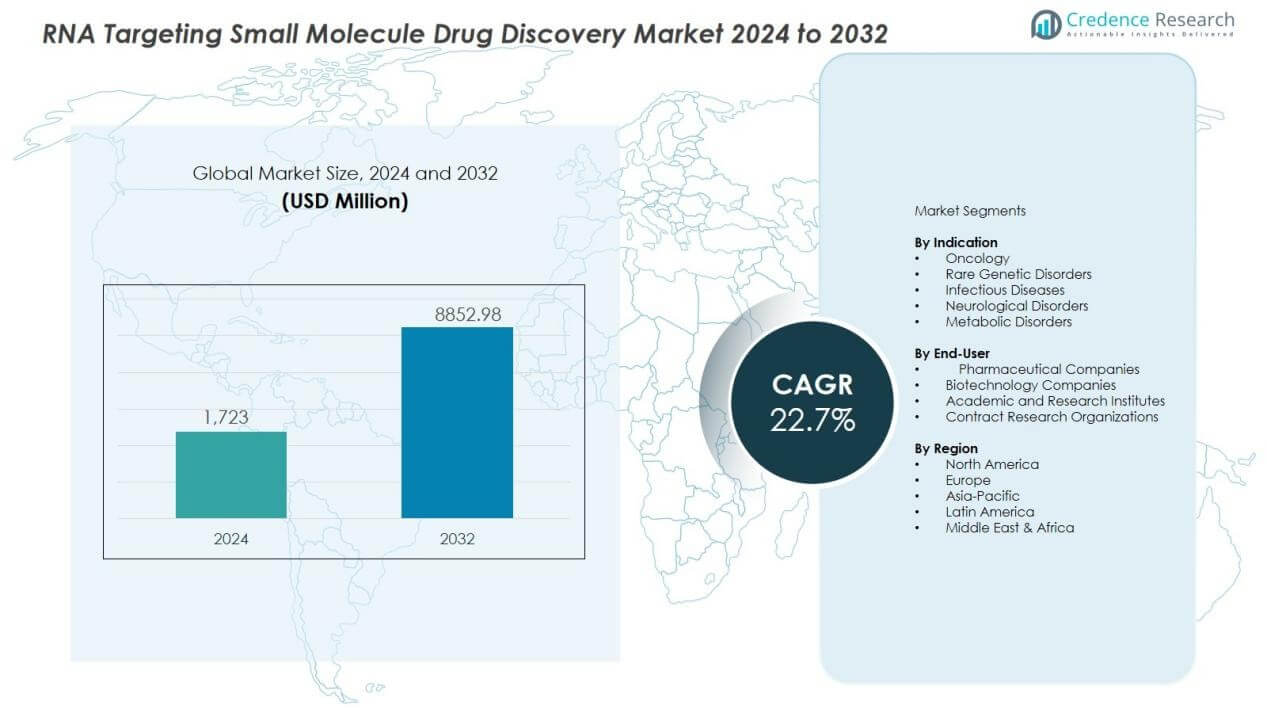
The RNA Targeting Small Molecule Drug Discovery Market size was valued at USD 1,723 million in 2024 and is anticipated to reach USD 8852.98 million by 2032, at a CAGR of 22.7 % during the forecast period.
| REPORT ATTRIBUTE | DETAILS |
|---|---|
| Historical Period | 2020-2024 |
| Base Year | 2025 |
| Forecast Period | 2026-2032 |
| RNA Targeting Small Molecule Drug Discovery Market Size 2024 | USD 1,723 million |
| RNA Targeting Small Molecule Drug Discovery Market, CAGR | 22.7% |
| RNA Targeting Small Molecule Drug Discovery Market Size 2032 | USD 8852.98 million |
RNA Targeting Small Molecule Drug Discovery Market Insights:
- North America accounts for 42.6% share, Europe holds 28.4%, and Asia-Pacific represents 22.1% of the market, supported by advanced biopharmaceutical infrastructure, strong public–private research funding, early technology adoption, and deep expertise in RNA biology and medicinal chemistry.
- Asia-Pacific is the fastest-growing region with a 22.1% share, supported by accelerating biotechnology investments, government funding in genomics, expanding discovery platforms, and increasing participation from China, Japan, and South Korea in advanced RNA drug research.
- By indication, oncology dominates with 46.8% share, driven by RNA dysregulation in cancer pathways, strong biomarker availability, and high clinical trial activity focused on resistant and refractory tumors.
- By end-user, pharmaceutical companies hold 52.3% share, supported by strong capital resources, integrated discovery-to-commercialization capabilities, and growing adoption of RNA-focused platforms to diversify therapeutic pipelines.
RNA Targeting Small Molecule Drug Discovery Market Drivers:
Expanding Recognition of RNA as a Drug-Relevant Therapeutic Target Beyond Proteins
The RNA Targeting Small Molecule Drug Discovery Market gains momentum from expanding scientific recognition of RNA as a viable therapeutic target. Many diseases remain insufficiently addressed by protein-centric drugs, creating demand for alternative molecular intervention strategies. RNA structures regulate gene expression, splicing, and translation, which positions them as high-value control points in disease pathways. It benefits from growing experimental evidence that small molecules can bind RNA with functional selectivity. This validation strengthens confidence among drug developers and investors.
- For instance, PTC Therapeutics developed risdiplam, which modulates SMN2 splicing in spinal muscular atrophy by targeting RNA structures. This achieved up to 7-fold increase in full-length SMN protein production in preclinical models.
Advancements in RNA Structural Biology and Molecular Characterization Technologies
Rapid progress in RNA structural biology supports market expansion by enabling rational drug design. High-resolution imaging, cryo-electron microscopy, and advanced spectroscopy improve understanding of RNA folding and binding pockets. These tools reduce discovery risk by guiding structure-based screening and lead optimization. It gains efficiency from better target validation and mechanistic clarity. Improved predictability shortens development timelines and supports scalable discovery programs.
- For instance, SLAC and Stanford researchers utilized cryogenic electron microscopy to image large protein-free RNA complexes, revealing multi-strand assemblies previously unknown without protein support.
Rising Investment in Precision Medicine and Hard-to-Treat Disease Areas
Pharmaceutical and biotechnology companies increase investment to address cancers, rare genetic disorders, and infectious diseases with unmet therapeutic needs. RNA-focused small molecules offer precision modulation without permanent genetic alteration. It aligns with precision medicine strategies that prioritize target specificity and controlled pharmacology. Growing venture capital funding supports early-stage platforms and translational research. Strong pipeline activity reinforces long-term commercial potential.
Strengthening Collaborative Ecosystems Between Industry and Academic Research Centers
Collaborations between academia, biotech firms, and pharmaceutical companies accelerate innovation across discovery pipelines. Academic laboratories provide foundational RNA biology insights that inform industrial drug design efforts. It benefits from shared data, specialized expertise, and access to proprietary screening platforms. Strategic partnerships reduce development risk and resource duplication. This ecosystem approach sustains steady advancement from discovery to clinical validation.
RNA Targeting Small Molecule Drug Discovery Market Trends:
Integration of Artificial Intelligence and Structure-Based Design in RNA-Focused Drug Discovery Pipelines
The RNA Targeting Small Molecule Drug Discovery Market reflects a clear shift toward artificial intelligence–enabled discovery platforms. Drug developers deploy machine learning to predict RNA folding, ligand affinity, and off-target interactions with higher precision. It benefits from AI-driven virtual screening that reduces experimental burden and improves hit identification rates. Structure-based design frameworks support selective binding to complex RNA motifs that were previously inaccessible. Companies pair computational chemistry with biophysical validation to strengthen lead quality. This trend improves reproducibility and scalability across early discovery programs.
- For instance, Serna Bio employs AI-driven platforms to define precise RNA-small molecule interactions, achieving hit rates improved by over 5-fold compared to traditional screening in their oncology programs.
Expansion of Clinical Translation and Modality Convergence Across Therapeutic Areas
The RNA Targeting Small Molecule Drug Discovery Market shows growing emphasis on advancing candidates from discovery into clinical evaluation. Developers focus on optimizing pharmacokinetics, oral bioavailability, and tissue penetration to enhance therapeutic viability. It increasingly converges with other RNA-focused modalities such as antisense and RNA interference through combination strategies. Oncology and rare disease pipelines dominate translational activity due to strong biomarker alignment. Regulatory agencies provide clearer guidance on RNA-based therapeutics, which supports development confidence. This shift reinforces commercial readiness and long-term adoption across therapeutic portfolios.
- For Instance, Skyhawk Therapeutics advanced SKY-0515 into a Phase 1 clinical trial for the treatment of Huntington’s disease.
RNA Targeting Small Molecule Drug Discovery Market Challenges Analysis:
Structural Complexity and Selectivity Constraints in RNA–Small Molecule Interactions
The RNA Targeting Small Molecule Drug Discovery Market faces significant challenges due to the structural flexibility and dynamic nature of RNA. Many RNA targets adopt multiple conformations, which complicates reliable binding prediction. It struggles with achieving high selectivity because similar structural motifs appear across different RNA species. Limited understanding of long-range RNA folding reduces confidence in target validation. Off-target interactions raise safety concerns and increase development risk. These factors slow lead optimization and increase attrition during early discovery phases.
Translational Uncertainty and Regulatory Pathway Ambiguity Across Development Stages
The RNA Targeting Small Molecule Drug Discovery Market encounters hurdles during translation from discovery to clinical application. Preclinical models often fail to fully reflect human RNA biology and disease relevance. It faces uncertainty in dose optimization and biomarker selection due to limited clinical precedent. Regulatory frameworks for RNA-targeted small molecules continue to evolve, which creates approval complexity. Extended validation timelines elevate development costs. These challenges constrain pipeline acceleration and commercial scalability.
RNA Targeting Small Molecule Drug Discovery Market Opportunities:
Unlocking Therapeutic Potential Across Undrugged and Genetically Driven Disease Targets
The RNA Targeting Small Molecule Drug Discovery Market presents strong opportunity through access to disease pathways that remain unreachable by protein-based therapies. Many genetic disorders, cancers, and viral diseases depend on RNA-mediated regulation. It enables reversible and selective modulation without permanent genomic alteration. Growing availability of RNA target databases improves prioritization and discovery success. Pharmaceutical pipelines seek differentiated assets with novel mechanisms of action. This shift supports sustained demand for RNA-focused small molecule programs.
Platform Expansion and Strategic Commercial Partnerships to Accelerate Scale
The RNA Targeting Small Molecule Drug Discovery Market benefits from platform-based discovery models that support multi-target scalability. Biotech companies develop proprietary libraries and screening systems tailored to RNA structures. It attracts partnerships with large pharmaceutical firms that seek external innovation. Licensing and co-development agreements reduce capital burden and enhance market reach. Expanding precision medicine strategies favor adaptable discovery platforms. These factors create long-term growth pathways and commercial expansion potential.
RNA Targeting Small Molecule Drug Discovery Market Segmentation Analysis:
By Indication: Oncology, Rare Genetic Disorders, Infectious Diseases, Neurological Disorders
The RNA Targeting Small Molecule Drug Discovery Market shows strong differentiation across indication-based segments due to varied disease biology and unmet needs. Oncology leads this segment, supported by the critical role of RNA dysregulation in tumor growth, resistance pathways, and gene expression control. It benefits from strong biomarker availability and higher R&D funding intensity. Rare genetic disorders represent a high-growth segment because RNA modulation enables precision correction of disease-causing transcripts. Infectious diseases gain traction through RNA-directed inhibition of viral replication, while neurological disorders progress steadily with improved central nervous system penetration strategies.
- For Instance, Novartis advanced branaplam (LMI070), a small molecule targeting SMN2 splicing RNA in spinal muscular atrophy (SMA) models, achieving a significant increase (e.g., several-fold or dose-dependent) in full-length SMN protein production in preclinical SMA mouse models and patient-derived cells.
By End-User: Pharmaceutical Companies, Biotechnology Companies, Academic and Research Institutes
The RNA Targeting Small Molecule Drug Discovery Market demonstrates clear segmentation across end-user categories based on discovery capability and commercialization focus. Pharmaceutical companies dominate adoption due to strong financial resources, late-stage development expertise, and global regulatory experience. It supports pipeline diversification through internal RNA-focused programs and external licensing. Biotechnology companies drive early innovation by developing specialized RNA discovery platforms and novel screening libraries. Academic and research institutes play a critical role in target discovery and mechanistic validation, which strengthens translational pipelines and supports long-term market expansion.
- For instance, Skyhawk Therapeutics partnered with Ipsen in April 2024 to discover and develop novel RNA-targeting small molecules for rare neurological diseases.
Segmentations:
By Indication
- Oncology
- Rare Genetic Disorders
- Infectious Diseases
- Neurological Disorders
- Metabolic Disorders
By End-User
- Pharmaceutical Companies
- Biotechnology Companies
- Academic and Research Institutes
- Contract Research Organizations
By Region
- North America
- U.S.
- Canada
- Mexico
- Europe
- Germany
- France
- U.K.
- Italy
- Spain
- Rest of Europe
- Asia Pacific
- China
- Japan
- India
- South Korea
- South-east Asia
- Rest of Asia Pacific
- Latin America
- Brazil
- Argentina
- Rest of Latin America
- Middle East & Africa
- GCC Countries
- South Africa
- Rest of the Middle East and Africa
Regional Analysis:
North America Leadership Supported by Advanced Research Infrastructure and Capital Availability
The RNA Targeting Small Molecule Drug Discovery Market holds its strongest position in North America due to a mature biopharmaceutical ecosystem. The region benefits from deep expertise in RNA biology, medicinal chemistry, and translational science. It attracts substantial venture capital and public funding that support early discovery and clinical advancement. Strong presence of large pharmaceutical companies accelerates platform validation and commercialization. Regulatory agencies provide structured guidance for novel RNA-based therapeutics. High collaboration intensity between academia and industry sustains innovation velocity.
Europe Expansion Driven by Public–Private Research Programs and Regulatory Alignment
The RNA Targeting Small Molecule Drug Discovery Market demonstrates steady growth across Europe through coordinated research initiatives. Government-backed funding programs support RNA-focused drug discovery and rare disease research. It benefits from harmonized regulatory standards that reduce development complexity across countries. Strong academic institutions contribute foundational RNA science and target validation. Pharmaceutical hubs in Germany, the United Kingdom, and France strengthen translational output. Cross-border partnerships improve resource efficiency and knowledge exchange.
Asia-Pacific Growth Accelerated by Biotechnology Investment and Genomics Initiatives
The RNA Targeting Small Molecule Drug Discovery Market records the fastest growth rate in the Asia-Pacific region. Rising government investment in genomics and precision medicine strengthens discovery infrastructure. It gains momentum from expanding biotech clusters in China, Japan, South Korea, and India. Local companies increase participation in early-stage RNA research and licensing activity. Improving regulatory clarity supports clinical trial initiation. This regional expansion enhances global pipeline diversity and long-term market scale.
Key Player Analysis:
- ACCENT THERAPEUTICS
- Anima Biotech Inc.
- Arrakis Therapeutics
- AstraZeneca
- Epics Therapeutics
- Expansion Therapeutics
- Hoffmann-La Roche Ltd
- PTC Therapeutics, Inc.
- Ribometrix
- LES LABORATOIRES SERVIER
- Skyhawk Therapeutics
Competitive Analysis:
The RNA Targeting Small Molecule Drug Discovery Market features a concentrated yet rapidly evolving competitive landscape driven by scientific differentiation and platform depth. Established pharmaceutical companies compete through internal RNA discovery programs, strong medicinal chemistry capabilities, and late-stage development expertise. It favors players that demonstrate validated RNA-binding libraries, robust target selection strategies, and translational proof of concept. Biotechnology firms strengthen competition by advancing proprietary RNA-focused platforms and first-in-class mechanisms of action. Strategic partnerships and licensing agreements remain central to competitive positioning, enabling access to capital, clinical infrastructure, and global commercialization channels. Companies emphasize intellectual property protection around RNA motifs, screening technologies, and structure-based design methods. Competitive advantage increasingly depends on clinical progression speed, portfolio breadth across indications, and the ability to reduce off-target risk while maintaining therapeutic selectivity.
Recent Developments:
- In April 2025, F. Hoffmann-La Roche Ltd announced a USD 50 billion investment in the United States over five years, including new R&D sites, manufacturing facilities, and over 12,000 jobs.
- In October 2025, F. Hoffmann-La Roche Ltd reported strong nine-month sales growth of 7% (CER), raised full-year earnings outlook, and highlighted pipeline progress with ten transformative medicines entering final development phases.
Report Coverage:
The research report offers an in-depth analysis based on Indication, End-User, and Region. It details leading Market players, providing an overview of their business, product offerings, investments, revenue streams, and key applications. Additionally, the report includes insights into the competitive environment, SWOT analysis, current Market trends, as well as the primary drivers and constraints. Furthermore, it discusses various factors that have driven Market expansion in recent years. The report also explores Market dynamics, regulatory scenarios, and technological advancements that are shaping the industry. It assesses the impact of external factors and global economic changes on Market growth. Lastly, it provides strategic recommendations for new entrants and established companies to navigate the complexities of the Market.
Future Outlook:
- The RNA Targeting Small Molecule Drug Discovery Market will progress from exploratory research toward validated clinical pipelines across multiple therapeutic areas.
- Drug developers will prioritize RNA targets linked to high unmet medical needs, particularly in oncology and rare genetic disorders.
- Advances in RNA structure elucidation will improve target confidence and support more selective small molecule design.
- Artificial intelligence tools will become standard across discovery workflows, enhancing hit identification and lead optimization efficiency.
- Pharmaceutical companies will expand internal RNA-focused platforms to diversify pipelines beyond protein-centric approaches.
- Biotechnology firms will strengthen their role as innovation drivers through specialized RNA libraries and discovery technologies.
- Strategic partnerships will increase, supporting shared risk models and faster translation into clinical development.
- Regulatory agencies will refine guidance frameworks for RNA-targeted small molecules, improving development clarity.
- Improved delivery and pharmacokinetic profiles will enhance tissue specificity and therapeutic durability.
- Long-term adoption will depend on clinical success, safety validation, and differentiation from existing RNA-based modalities.

Request a Free Sample
Fill in your details and we'll send you a free sample report.
- Sample data tables & charts
- Research methodology
Market Dynamics
Expanding Recognition of RNA as a Drug-Relevant Therapeutic Target
Growing scientific validation that RNA structures can be selectively targeted by small molecules is driving investment and innovation, especially for diseases not adequately addressed by protein-centric drugs. This expands the therapeutic landscape and attracts both drug developers and investors.
Advancements in RNA Structural Biology and Characterization Technologies
Breakthroughs in high-resolution imaging, cryo-electron microscopy, and spectroscopy are enabling rational drug design by revealing RNA folding and binding pockets. These advances reduce discovery risk and accelerate the development of selective RNA-targeting small molecules.
Rising Investment in Precision Medicine and Hard-to-Treat Diseases
Pharmaceutical and biotech companies are increasing funding to address cancers, rare genetic disorders, and infectious diseases with unmet needs. RNA-targeted small molecules offer precision modulation, aligning with the trend toward personalized medicine and supporting robust pipeline growth.
Integration of Artificial Intelligence in Drug Discovery
The adoption of AI and machine learning in RNA-focused drug discovery is improving hit identification, predicting RNA-ligand interactions, and optimizing lead compounds. This enhances efficiency, reduces experimental burden, and accelerates early-stage discovery programs.
Strengthening Collaborative Ecosystems
Strategic partnerships between academia, biotech firms, and pharmaceutical companies are fostering innovation by combining foundational RNA biology insights with industrial drug design capabilities. These collaborations reduce risk, share resources, and speed up the translation from discovery to clinical validation.
Need a Custom Version of This Report?
Tailor the scope, geography, or segments to your exact requirements.
- Custom geography or segment scope
- Direct access to our analyst team
Frequently Asked Questions
What is the current market size of the RNA Targeting Small Molecule Drug Discovery Market, and what is its projected size by 2032?
At what Compound Annual Growth Rate (CAGR) is the market expected to grow between 2024 and 2032?
Which segment held the largest share of the market in 2024?
What are the key factors driving the growth of the RNA Targeting Small Molecule Drug Discovery Market?
Who are the leading companies operating in the RNA Targeting Small Molecule Drug Discovery Market?
Which region held the largest share of the market in 2024?
Table of Content
Chapter 1 Market Segmentation
- 1.1 Segmentation Framework
- 1.1.1 Product and Service Classification
- 1.1.2 Application and End-Use Classification
- 1.1.3 Technology and Solution Classification
- 1.1.4 Customer and Distribution Channel Classification
- 1.1.5 Geographic Segmentation
- 1.1.6 Market Segment Definitions and Boundaries
- 1.2 By End-User
- 1.2.1 Pharmaceutical Companies
- 1.2.2 Biotechnology Companies
- 1.2.3 Academic and Research Institutes
- 1.2.4 Contract Research Organizations
- 1.3 By Indication
- 1.3.1 Oncology
- 1.3.2 Rare Genetic Disorders
- 1.3.3 Infectious Diseases
- 1.3.4 Neurological Disorders
- 1.3.5 Metabolic Disorders
Chapter 2 Introduction
- 2.1 Report Objectives and Scope
- 2.2 Product Definition and Industry Terminology
- 2.3 Market Inclusions and Exclusions
- 2.4 Research Process
- 2.4.1 Primary Research and Expert Interviews
- 2.4.2 Secondary Research and Source Review
- 2.4.3 Top-Down and Bottom-Up Estimation
- 2.4.4 Data Triangulation and Verification
- 2.5 Market Size Measurement Basis
- 2.5.1 2024: USD 1,723 million → 2032: USD 8,852.98 million
- 2.6 Historical and Forecast Reference Periods
- 2.6.1 Base Year: 2024
- 2.6.2 Forecast Period: 2024-2032
- 2.7 Research Assumptions and Limitations
Chapter 3 Executive Summary
- 3.1 Market Snapshot and Key Findings
- 3.2 Base-Year Market Size, 2024
- 3.3 Forecast Market Size, 2032
- 3.4 Revenue and Volume Growth Outlook
- 3.5 Key Demand and Supply Indicators
- 3.6 Leading Market Segments
- 3.7 Fastest-Growing Market Opportunities
- 3.8 Regional Performance Highlights
- 3.9 Technology and Industry Transformation
- 3.10 Competitive Landscape Summary
- 3.11 Analyst View and Strategic Implications
Chapter 4 Global RNA Targeting Small Molecule Drug Discovery Market Trends and Developments
- 4.1 Historical Industry Development
- 4.2 Recent Market Trends and Developments
- 4.3 Demand and Customer Behavior Trends
- 4.4 Technology and Product Innovation
- 4.5 Artificial Intelligence, Automation and Digitalization
- 4.6 Local Manufacturing and Supply Chain Realignment
- 4.7 Industry Partnerships, Mergers and Acquisitions
- 4.8 Sustainability and Circular Economy Developments
- 4.9 Government and Private Sector Investment Trends
- 4.10 Emerging Business Models and Commercialization
- 4.11 Industry Developments and Announcements
Chapter 5 Global RNA Targeting Small Molecule Drug Discovery Market Production, Supply and Demand Analysis
- 5.1 Demand Trend and Consumption Analysis
- 5.2 Demand Forecast, 2024-2032
- 5.3 Production and Output Trend
- 5.4 Production and Output Forecast, 2024-2032
- 5.5 Installed Capacity and Capacity Utilization
- 5.6 Company-Wise Production Plants and Statistics
- 5.6.1 Installed Production Capacity
- 5.6.2 Actual Production
- 5.6.3 Planned Capacity and Expansion Targets
- 5.7 Supply Chain Structure and Procurement Trends
- 5.8 Supply-Demand Gap and Bottlenecks
- 5.9 Import Dependence and Sourcing Structure
- 5.10 Contract Manufacturing and Outsourcing
- 5.11 Regional Supply and Demand Concentration
Chapter 6 Global RNA Targeting Small Molecule Drug Discovery Market Pricing Analysis
- 6.1 Pricing Structure and Measurement
- 6.2 Historical Pricing Trends
- 6.3 Pricing Outlook, 2024-2032
- 6.4 Average Selling Price and Unit Economics
- 6.5 Pricing by Product and Market Segment
- 6.6 Geographic Pricing Differences
- 6.7 Key Input, Energy, Labor and Logistics Costs
- 6.8 Contract Pricing and Purchasing Models
- 6.9 Pricing Sensitivity and Competitive Positioning
- 6.10 Price, Margin and Profitability Implications
Chapter 7 Global RNA Targeting Small Molecule Drug Discovery Market Dynamics
- 7.1 Market Growth Drivers
- 7.1.1 Demand-Side Drivers
- 7.1.2 Technology and Innovation Drivers
- 7.1.3 Infrastructure and Investment Drivers
- 7.1.4 Regulatory and Policy Drivers
- 7.2 Market Restraints
- 7.2.1 Cost and Affordability Constraints
- 7.2.2 Technology and Adoption Barriers
- 7.2.3 Supply Chain and Operational Constraints
- 7.3 Market Challenges
- 7.3.1 Competitive Pressure and Margin Erosion
- 7.3.2 Skills, Infrastructure and Implementation Gaps
- 7.4 Emerging Market Opportunities
- 7.5 Market Dynamics Impact and Time-Horizon Assessment
Chapter 8 Global RNA Targeting Small Molecule Drug Discovery Value Chain Analysis
- 8.1 Industry Value Chain Overview
- 8.2 Upstream Suppliers and Critical Inputs
- 8.3 Technology and Component Providers
- 8.4 Manufacturing or Service Delivery
- 8.5 Distribution, Channel Partners and Integrators
- 8.6 Downstream Applications and End Users
- 8.7 Value Addition and Profit Pools
- 8.8 Vertical Integration and Outsourcing
- 8.9 Supplier Concentration and Risk
- 8.10 Supply Chain Localization and Resilience
Chapter 9 Global RNA Targeting Small Molecule Drug Discovery Market Regulations and Policies
- 9.1 Relevant Laws, Standards and Compliance Frameworks
- 9.2 Product, Service, Safety and Quality Requirements
- 9.3 Government Policies, Incentives and Subsidies
- 9.4 Imports, Exports and Trade Barriers
- 9.5 Public Procurement and Local Content Requirements
- 9.6 Environmental and Sustainability Compliance
- 9.7 Upcoming Policy Changes and Market Implications
Chapter 10 Global RNA Targeting Small Molecule Drug Discovery Market Hotspots and Opportunities
- 10.1 Market Opportunity Mapping and Growth Hotspots
- 10.2 High-Growth Applications and Customer Groups
- 10.3 Underserved Markets and White-Space Opportunities
- 10.4 Emerging Technology and Product Opportunities
- 10.5 New Capacity and Investment Hotspots
- 10.6 Market Entry and Expansion Opportunities
- 10.7 Distribution and Partnership Opportunities
- 10.8 Near-Term and Long-Term Commercial Potential
- 10.9 Opportunity Attractiveness and Execution Risks
Chapter 11 Global RNA Targeting Small Molecule Drug Discovery Market Outlook, 2024-2032
- 11.1 Market Size and Analysis
- 11.1.1 Revenue (Market Measurement: 2024: USD 1,723 million → 2032: USD 8,852.98 million)
- 11.1.2 Market Volume and Quantity Sold
- 11.1.3 Historical Market Size
- 11.1.4 Base-Year Market Size, 2024
- 11.2 Market Forecast, 2024-2032
- 11.2.1 Revenue Forecast to 2032
- 11.2.2 Volume Forecast to 2032
- 11.2.3 CAGR and Year-on-Year Growth
- 11.2.4 Incremental Revenue Opportunity
- 11.3 Forecast Assumptions and Scenario Analysis
- 11.3.1 Base-Case Forecast
- 11.3.2 Optimistic and Conservative Scenarios
- 11.3.3 Technology, Pricing and Policy Sensitivities
- 11.4 Market Attractiveness and Growth Outlook
Chapter 12 Global RNA Targeting Small Molecule Drug Discovery Market Segmentation and Outlook
- 12.1 Segmentation Summary and Market Shares, 2024
- 12.2 Largest and Fastest-Growing Segments
- 12.3 By End-User - Market Size and Forecast, 2024-2032
- 12.3.1 Segment Definition and Scope
- 12.3.2 Historical Market Size
- 12.3.3 Revenue Forecast, 2024-2032
- 12.3.4 Volume Forecast, 2024-2032
- 12.3.5 Base-Year Market Share, 2024
- 12.3.6 Segment CAGR and Growth Drivers
- 12.3.7 Subsegment Market Size and Forecast
- 12.3.7.1 Pharmaceutical Companies
- 12.3.7.2 Biotechnology Companies
- 12.3.7.3 Academic and Research Institutes
- 12.3.7.4 Contract Research Organizations
- 12.3.8 Subsegment Pricing and Adoption Trends
- 12.3.9 Leading Suppliers and Competition
- 12.3.10 Regional Demand and Opportunities
- 12.4 By Indication - Market Size and Forecast, 2024-2032
- 12.4.1 Segment Definition and Scope
- 12.4.2 Historical Market Size
- 12.4.3 Revenue Forecast, 2024-2032
- 12.4.4 Volume Forecast, 2024-2032
- 12.4.5 Base-Year Market Share, 2024
- 12.4.6 Segment CAGR and Growth Drivers
- 12.4.7 Subsegment Market Size and Forecast
- 12.4.7.1 Oncology
- 12.4.7.2 Rare Genetic Disorders
- 12.4.7.3 Infectious Diseases
- 12.4.7.4 Neurological Disorders
- 12.4.7.5 Metabolic Disorders
- 12.4.8 Subsegment Pricing and Adoption Trends
- 12.4.9 Leading Suppliers and Competition
- 12.4.10 Regional Demand and Opportunities
- 12.5 Segment Growth Comparison
- 12.6 Segment Attractiveness and Priority Matrix
Chapter 13 Global RNA Targeting Small Molecule Drug Discovery End-Use and Application Market Outlook
- 13.1 End-Use Industry and Customer Demand Structure
- 13.2 Leading Applications and Customer Groups
- 13.3 End-Use Market Size, Share and Forecast
- 13.4 Major End-Use Industry Deep Dives
- 13.4.1 Customer Requirements and Use Cases
- 13.4.2 Demand and Replacement Cycles
- 13.4.3 Technical and Regulatory Considerations
- 13.4.4 Purchasing and Procurement Models
- 13.4.5 Leading Vendors and Distribution Channels
- 13.4.6 Forecast and Commercial Opportunities
- 13.5 Emerging Applications and Cross-Segment Demand
- 13.6 End-Use Industry Investment Priorities
Chapter 14 Global RNA Targeting Small Molecule Drug Discovery Geographic Market Outlook, 2024-2032
- 14.1 Regional Market Size and Share, 2024
- 14.2 Regional Market Forecast, 2024-2032
- 14.3 Regional Pricing, Production and Demand Differences
- 14.4 North America
- 14.4.1 United States
- 14.4.2 Canada
- 14.4.3 Mexico
- 14.5 Europe
- 14.5.1 Germany
- 14.5.2 France
- 14.5.3 Italy
- 14.5.4 United Kingdom
- 14.5.5 Spain
- 14.5.6 Poland
- 14.5.7 Russia
- 14.5.8 Netherlands
- 14.5.9 Belgium
- 14.5.10 Sweden
- 14.5.11 Denmark
- 14.5.12 Norway
- 14.5.13 Rest of Europe
- 14.6 Asia Pacific
- 14.6.1 China
- 14.6.2 India
- 14.6.3 Japan
- 14.6.4 South Korea
- 14.6.5 Thailand
- 14.6.6 Indonesia
- 14.6.7 Vietnam
- 14.6.8 Malaysia
- 14.6.9 Australia
- 14.6.10 Rest of Asia Pacific
- 14.7 Latin America
- 14.7.1 Brazil
- 14.7.2 Argentina
- 14.7.3 Colombia
- 14.7.4 Chile
- 14.7.5 Rest of Latin America
- 14.8 Middle East
- 14.8.1 Saudi Arabia
- 14.8.2 United Arab Emirates
- 14.8.3 Turkey
- 14.8.4 Israel
- 14.8.5 Iran
- 14.8.6 Rest of the Middle East
- 14.9 Africa
- 14.9.1 South Africa
- 14.9.2 Egypt
- 14.9.3 Nigeria
- 14.9.4 Morocco
- 14.9.5 Rest of Africa
- 14.10 Regional Investment, Policy and Supply Chain Differences
- 14.11 Regional Competitive Landscape
- 14.12 Geographic Growth Hotspots
Chapter 15 Global RNA Targeting Small Molecule Drug Discovery Technology, Innovation and Sustainability Outlook
- 15.1 Technology Landscape and Maturity
- 15.2 Product, Process and Service Innovation
- 15.3 AI, Automation and Digital Tools in the Industry
- 15.4 Technology Adoption and Performance Benchmarking
- 15.5 Innovation Pipeline and R&D Investment
- 15.6 Patent and Intellectual Property Trends
- 15.7 Energy Efficiency and Resource Management
- 15.8 Sustainability, Recycling and Circularity
- 15.9 Technology Roadmap, 2024-2032
- 15.10 Risks of Obsolescence and Technology Substitution
Chapter 16 Global RNA Targeting Small Molecule Drug Discovery Market Key Strategic Imperatives
- 16.1 Growth and Market Entry Priorities
- 16.2 High-Return Products and Segments
- 16.3 Pricing, Profitability and Cost Optimization
- 16.4 Technology Investment and Product Differentiation
- 16.5 Supply Chain Localization and Resilience
- 16.6 Distribution and Customer Acquisition
- 16.7 Partnership, Acquisition and Capacity Strategy
- 16.8 Regional Expansion Priorities
- 16.9 Short-, Medium- and Long-Term Actions
Chapter 17 Competition Outlook
- 17.1 Industry Competition Characteristics
- 17.2 Market Structure and Concentration
- 17.3 Market Share and Competitive Positioning, 2024
- 17.4 Company-Wise Revenue and Product Benchmarking
- 17.5 Production and Service Capacity Benchmarking
- 17.6 Technology, Pricing and Differentiation
- 17.7 Regional Footprint and Distribution Strength
- 17.8 Mergers, Acquisitions and Strategic Alliances
- 17.9 New Entrants and Competitive Threats
- 17.10 Porter's Five Forces and Industry Attractiveness
- 17.11 Competitive Outlook, 2024-2032
Chapter 18 Company Profiles
- 18.1 Company Coverage and Selection Criteria
- 18.2 ACCENT THERAPEUTICS
- 18.2.1 Business Description
- 18.2.2 Company Ownership and Geographic Presence
- 18.2.3 Product and Service Portfolio
- 18.2.4 Manufacturing and Operating Footprint
- 18.2.5 Production Capacity and Expansion Plans
- 18.2.6 Financial Performance and Investment
- 18.2.7 Market Share and Competitive Position
- 18.2.8 Technology and Innovation Capabilities
- 18.2.9 Strategic Alliances or Partnerships
- 18.2.10 Recent Developments
- 18.2.11 Growth Strategy and Outlook
- 18.3 Anima Biotech Inc.
- 18.4 Arrakis Therapeutics
- 18.5 AstraZeneca
- 18.6 Epics Therapeutics
- 18.7 Expansion Therapeutics
- 18.8 Hoffmann-La Roche Ltd
- 18.9 PTC Therapeutics, Inc.
- 18.10 Ribometrix
- 18.11 Skyhawk Therapeutics
- 18.12 Other Relevant Market Participants
Note: Every listed company is profiled on the structure shown under the first company. The company list is preliminary and may change based on research findings, market developments, data availability and client requirements.
Chapter 19 Disclaimer
- 19.1 Research and Forecast Disclaimer
- 19.2 Data Source and Estimation Limitations
Note: The depth of individual sections depends on data availability for this market. Volume, capacity, trade and other unit-based metrics are included where applicable.