Treatment intensity, not statin volume, drives value
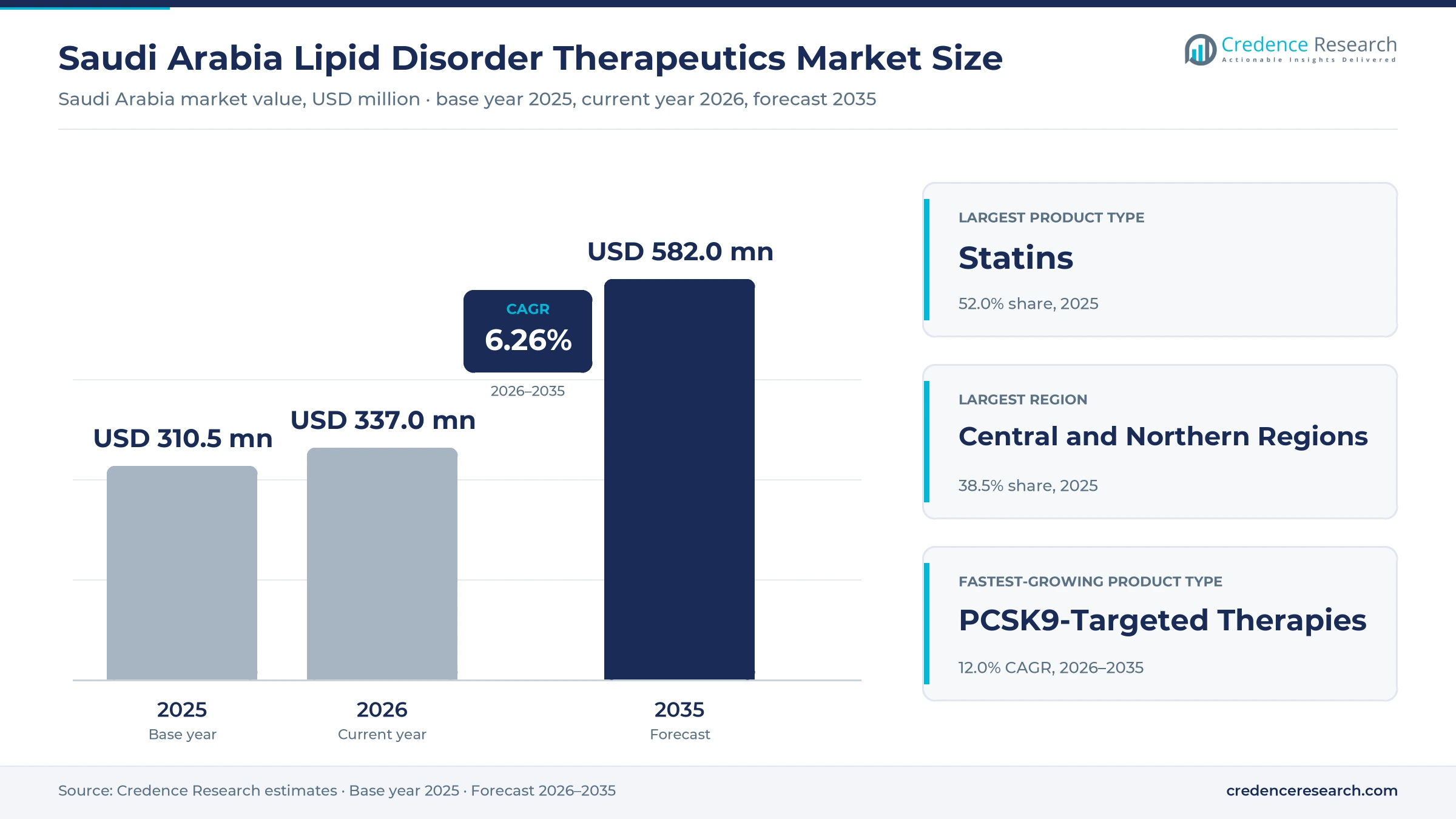
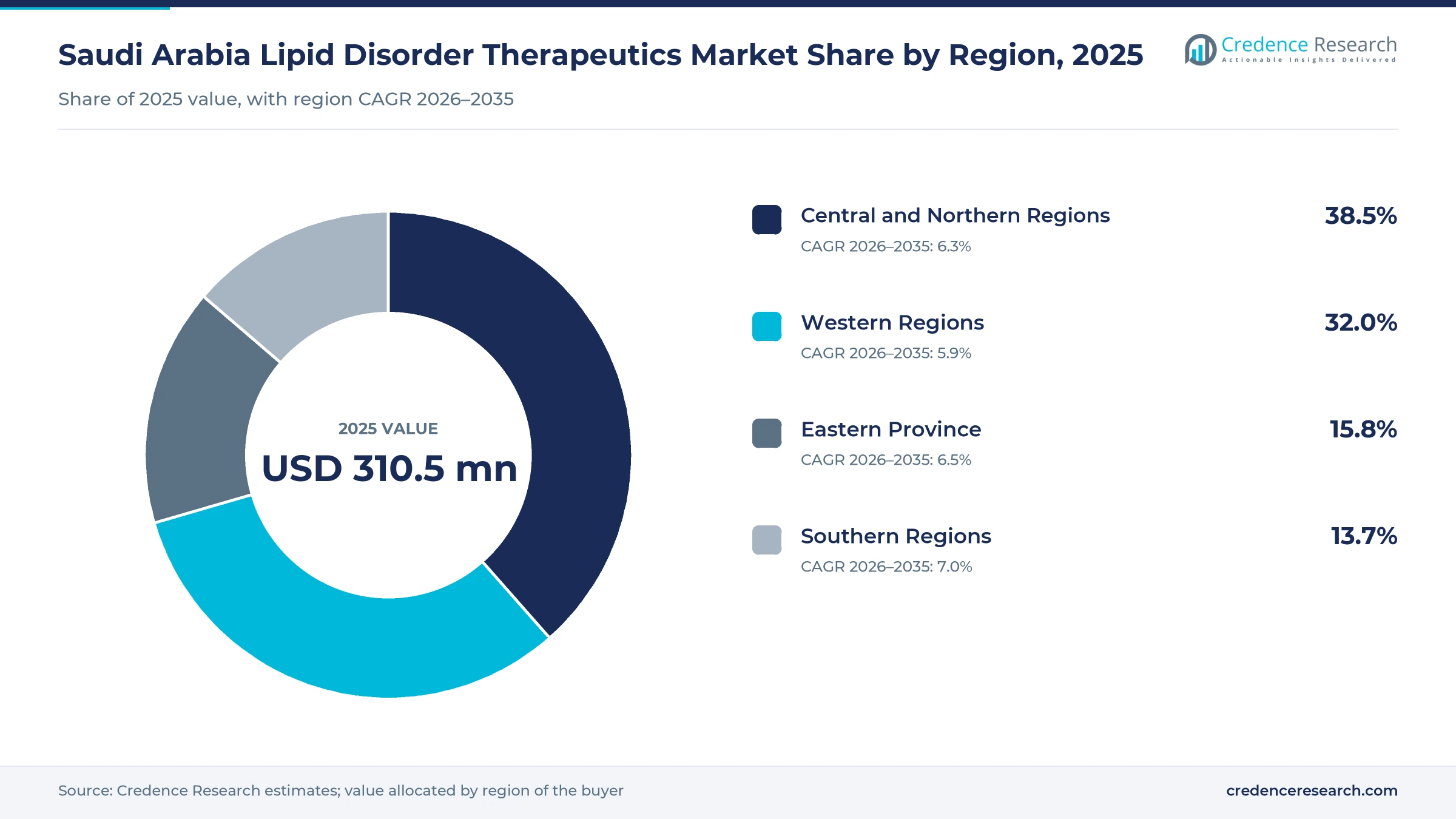
The Saudi Arabia lipid disorder therapeutics market was valued at USD 310.5 million in 2025 and is projected to increase from USD 337.0 million in 2026 to USD 582.0 million by 2035, registering a CAGR of 6.26% during 2026–2035. Spending is anchored in generic statins dispensed through government hospitals and primary care, while the fastest value growth comes from add-on and injectable therapies for patients who stay above their LDL cholesterol targets. The Central and Northern Regions held the largest share, 38.5% in 2025, led by Riyadh and its national referral hospitals. The Southern Regions are the fastest-growing zone at 7.0% a year, because measured cholesterol burden there is among the highest in the Kingdom while treatment still lags. The main commercial change is in procurement, since national tenders run by NUPCO now list PCSK9 antibodies and inclisiran next to statins, moving advanced therapy from one-off hospital purchases into scheduled public demand.
Which medicines and buyers does this market cover?
The market covers prescription medicines that lower LDL cholesterol or triglycerides in Saudi Arabia, namely statins, ezetimibe alone or in fixed-dose combinations, PCSK9-targeted antibodies and siRNA, and fibrates, omega-3 products and other legacy agents. Value is measured at manufacturer selling prices across public tenders, private hospital purchasing and community pharmacy sales, including medicines that government patients collect from private pharmacies.
Lipid testing, apheresis services and over-the-counter supplements such as red yeast rice are excluded from the estimate. The value chain runs from multinational originators and local generic makers, through licensed agents and distributors, to NUPCO and private buyers, with the SFDA setting the ceiling price that applies at every step of the chain.
Saudi Arabia Lipid Disorder Therapeutics Market Insights
- The Saudi Arabia lipid disorder therapeutics market grows from USD 310.5 million in 2025 to USD 582.0 million by 2035, a 6.26% CAGR, as treatment intensifies beyond first-line statins.
- The Central and Northern Regions held 38.5% of national lipid therapy value in 2025, while the Southern Regions grow fastest at 7.0% a year.
- Statins accounted for 52.0% of 2025 value, yet PCSK9-targeted therapies grow fastest at 12.0% a year as national tenders add injectable options.
- NUPCO tender NPT 0027/25, with preliminary results posted on March 2, 2026, listed inclisiran, evolocumab and alirocumab alongside generic statins and ezetimibe.
- Only 45.7% of ischemic heart disease patients in a 2025 Saudi multicenter study reached their LDL goal, which leaves wide room for ezetimibe and injectables.
Statins lead volume while injectables lead value growth
Why do statins still anchor spending on lipid therapy?
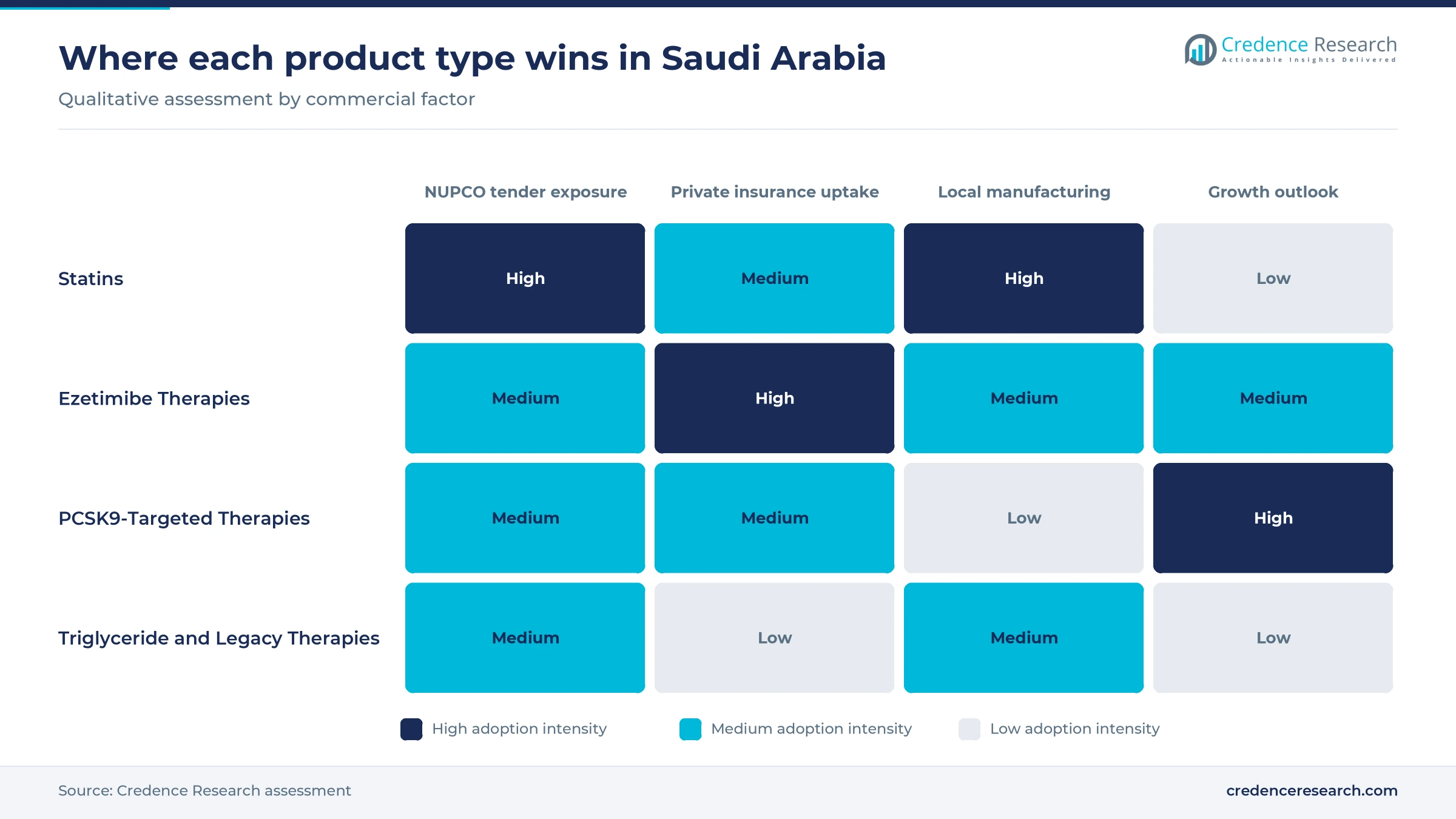
Based on product type, the market is categorized into statins, ezetimibe therapies, PCSK9-targeted therapies and triglyceride and legacy therapies. Statins led with 52.0% of 2025 value because they are the default first prescription and the cheapest to sustain, and the 2026 NUPCO tender drew four or five bidders on most atorvastatin and rosuvastatin strengths. PCSK9-Targeted Therapies grow fastest at 12.0% a year as each patient carries a far larger bill, with evolocumab listed at SAR 1,758.45 for a two-pen monthly pack. Triglyceride and legacy therapies lose share, because fibrates and omega-3 products face the same generic price tiers without a growing pool of new patients.
How does inherited disease shape demand for advanced therapy?
Based on disease area, the market is categorized into familial hypercholesterolemia, nonfamilial hypercholesterolemia, nonfamilial mixed dyslipidemia and nonfamilial hypertriglyceridemia. Nonfamilial Hypercholesterolemia led with 50.0% of 2025 value because it is the most common lipid diagnosis in adult primary care, and a 2013 Ministry of Health survey found self-reported dyslipidemia in 8.5% of the population. Familial Hypercholesterolemia grows fastest at 9.0% a year as the Gulf FH registry found definite or probable FH in 1 in 232 adults, while a 1995 survey found 57.7% of Saudi couples consanguineous, according to a 2021 Advances in Therapy review. These patients need combination or injectable therapy for life, which makes FH the anchor indication for PCSK9 tenders.
Who pays for lipid-lowering treatment in the Kingdom?
Based on customer type, the market is categorized into government-funded patients, privately insured patients and self-paying patients. Government-Funded Patients led with 57.5% of 2025 value because Saudi citizens receive free treatment in Ministry of Health, military and university hospitals, where tender-supplied generics dominate dispensing. Privately Insured Patients grow fastest at 7.2% a year as private health insurance covers more than 13 million beneficiaries, about 8.6 million of them non-Saudi, according to the Council of Health Insurance as reported by Argaam in 2025. Insured expatriate workers are mostly of working age, so their claims tilt toward primary prevention, where generic brands compete for places on insurer formularies.
Where do lipid medicines reach patients?
Based on sales channel, the market is categorized into public institutional procurement, private institutional procurement and community pharmacy procurement. Public Institutional Procurement led with 53.0% of 2025 value because NUPCO buys centrally for government hospitals and primary care centers, and SPIMACO reported that the government channel supplied 24.6% of its 2025 sales. Community Pharmacy Procurement grows fastest at 7.1% a year as insured outpatients refill at pharmacy chains, where Whites lists originator Crestor 20 mg at SAR 130.65 for 28 tablets against SAR 93.50 for a generic 30-tablet pack on Nahdi Online. That spread lets pharmacists steer substitution, which matters more to suppliers in this channel than tender volume.
| Segment Group | Leading Sub-segment | Share, 2025 | Fastest-growing Sub-segment | CAGR, 2026–2035 |
|---|---|---|---|---|
| By Product Type | Statins | 52.0% | PCSK9-Targeted Therapies | 12.0% |
| By Disease Area | Nonfamilial Hypercholesterolemia | 50.0% | Familial Hypercholesterolemia | 9.0% |
| By Customer Type | Government-Funded Patients | 57.5% | Privately Insured Patients | 7.2% |
| By Sales Channel | Public Institutional Procurement | 53.0% | Community Pharmacy Procurement | 7.1% |
SFDA price ceilings open a wide gap between pills and pens
Prices here are set by regulation rather than by competition at the counter. The SFDA fixes a ceiling for every registered pack using a 16-country reference basket, prices the first generic 25% below the originator and later generics up to 40% below, according to the 2024 PPRI country profile, and that ceiling also caps public tender bids. A year of generic atorvastatin costs about SAR 520 at retail, while a year of evolocumab costs more than SAR 21,000. One patient moved to an injectable carries the value of roughly 40 statin patients, so eligibility rules matter more to market value than price cuts. Inclisiran has no Saudi retail listing, so its price is set only in hospital and NUPCO tenders.
| Product and pack | Typical price or fee | Basis |
|---|---|---|
| Generic atorvastatin 20 mg, 30 tablets | SAR 43.45 (about USD 11.6) | Nahdi Online list price for Atorva and Torvacol, Nov. 2026 |
| Generic rosuvastatin 20 mg, 30 tablets | SAR 93.50 (about USD 24.9) | Nahdi Online list price for Crevast, Nov. 2026 |
| Originator rosuvastatin (Crestor 20 mg), 28 tablets | SAR 130.65 (about USD 34.8) | Whites Pharmacy list price, Nov. 2026 |
| Generic ezetimibe 10 mg, 30 tablets | SAR 131.65 (about USD 35.1) | Lemon Pharmacy list price for Ezechol, Nov. 2026 |
| Atorvastatin and ezetimibe combination (Atozet), 30 tablets | SAR 135.10 (about USD 36.0) | Al-Dawaa list price, Nov. 2026 |
| Evolocumab (Repatha 140 mg), two pens, about one month | SAR 1,758.45 (about USD 469) | Nahdi Online list price, Nov. 2026 |
Request a Free Sample
Fill in your details and we'll send you a free sample report.
- Sample data tables & charts
- Research methodology
Untreated risk and tender reform drive demand
Metabolic-risk treatment expansion widens the treated pool
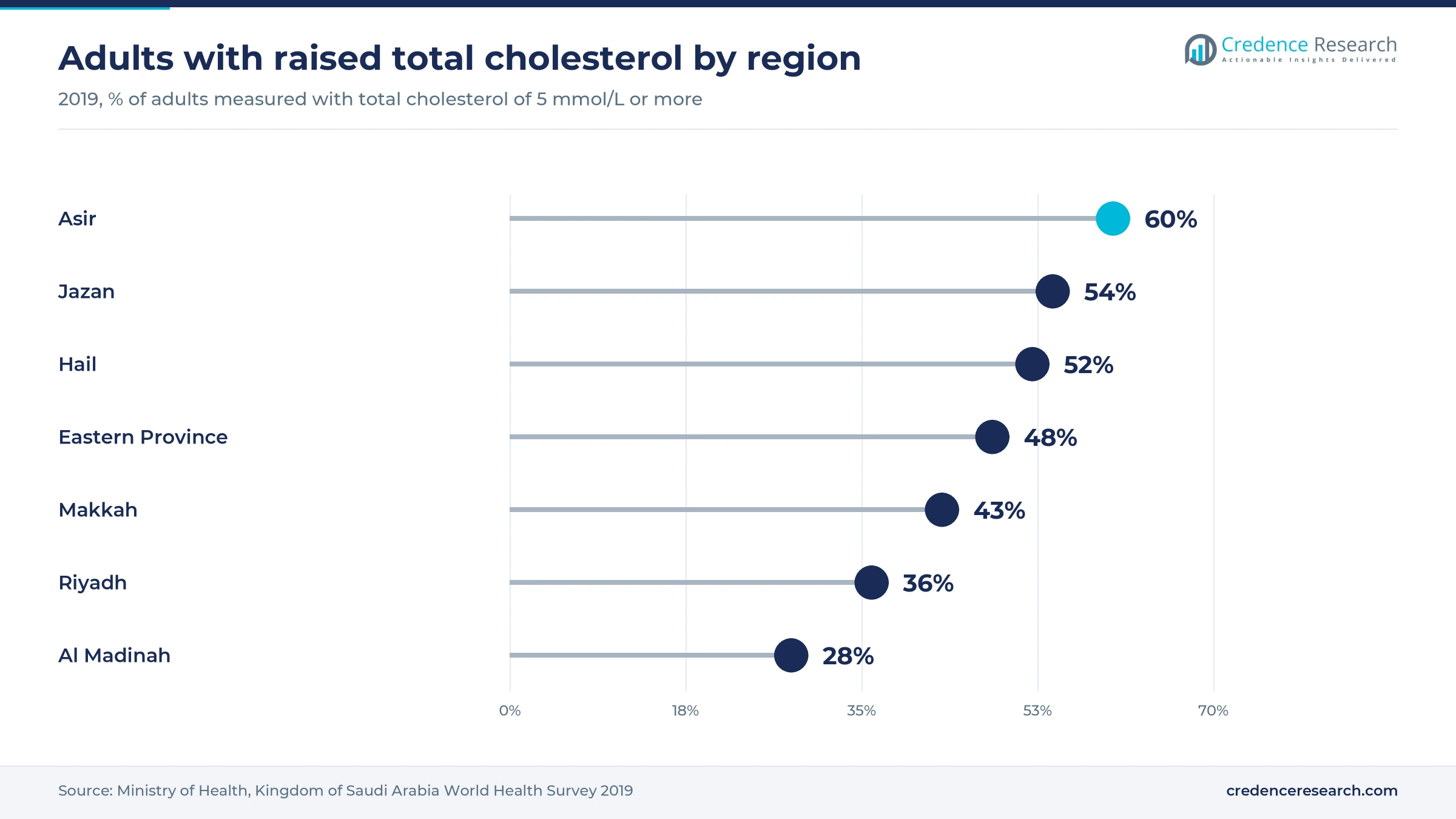
The largest source of new volume is the pool of adults with measured but untreated lipid abnormalities. The 2019 Kingdom of Saudi Arabia World Health Survey found raised total cholesterol, at 5 mmol/L or more, in 43% of adults measured, far above the self-reported diagnosis rate noted in the disease-area analysis. Diabetes compounds the risk, since the IDF Diabetes Atlas puts adult prevalence at 23.1% in 2024, or 5.34 million people, of whom 43.6% are undiagnosed. That overlap moves most of these adults into higher risk groups, so every screening campaign converts directly into prescriptions. For generic makers, this pool sustains tablet volume even as price cuts erode value per pack, and it explains why statins still hold the majority of national lipid therapy spending.
Risk-based intensification lifts ezetimibe and injectables
Treatment intensity, not patient count, is the faster value lever in the Kingdom. In a multicenter study of ischemic heart disease patients in Jeddah and Riyadh, published in the Journal of Clinical Medicine on Jan. 30, 2025, only 45.7% reached their LDL cholesterol goal, although high-intensity statins were nearly universal among adherent patients. Ezetimibe was used by 22.7% of the cohort and PCSK9 inhibitors by just 1.9%. The distance between those two figures is the commercial opening, because escalation normally adds ezetimibe before an injectable. Each step multiplies the annual cost of therapy, and PCSK9-Targeted Therapies grow at 12.0% a year even though they reach only a small minority of patients.
Domestic supply and procurement integration favor local makers
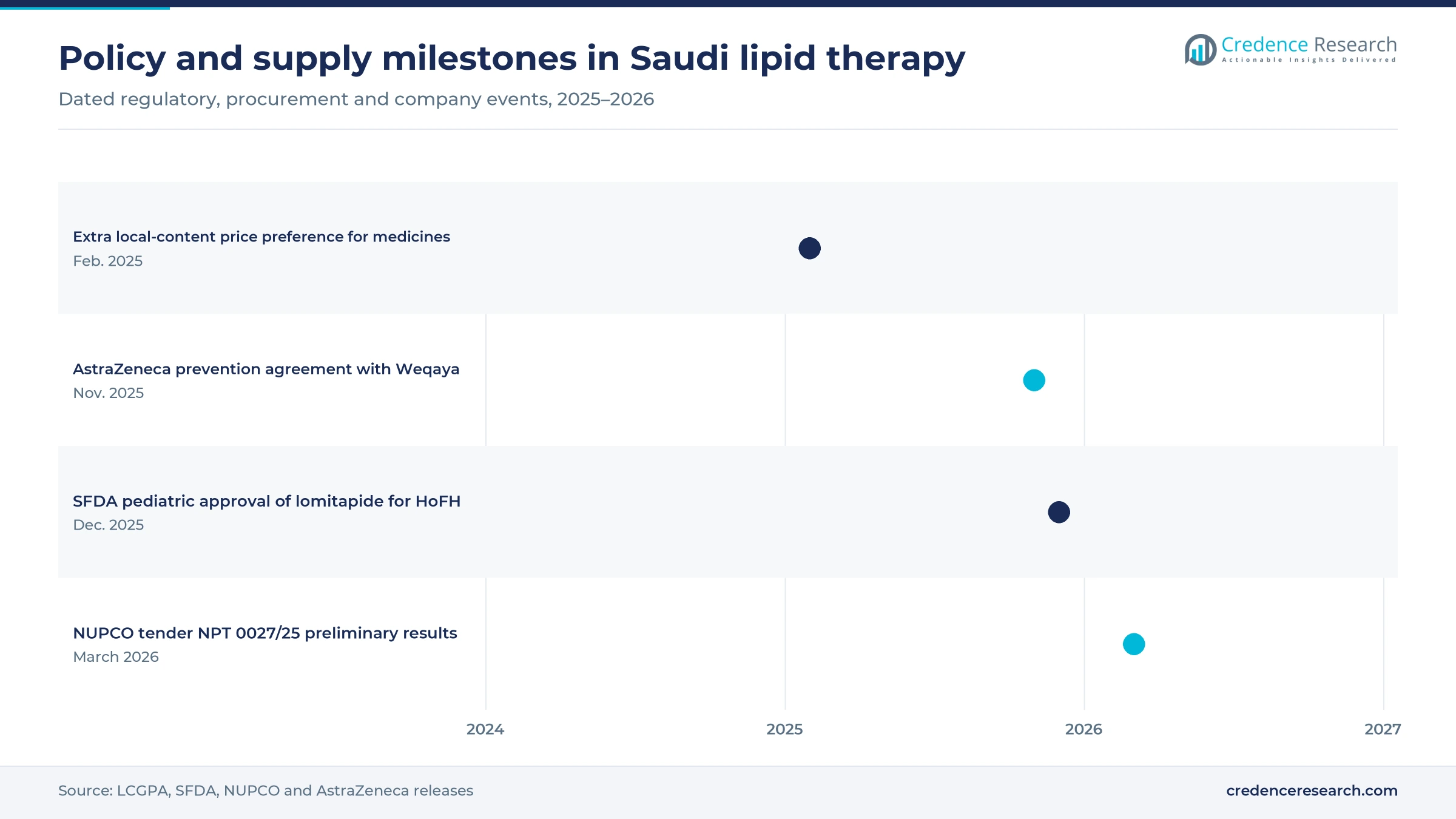
Public buying is being redesigned to reward local production, and that reshapes who wins statin volume. NUPCO's internal medicine and chronic disease tender NPT 0027/25, with preliminary results posted on March 2, 2026, drew bids from SPIMACO and Tabuk Pharmaceuticals on rosuvastatin lines, from SPIMACO on atorvastatin and from Tabuk on ezetimibe, the add-on step that prescribers reach first. Since Feb. 6, 2025, the Local Content and Government Procurement Authority has offered an additional price preference of up to 20% on top of the standing 10% for 17 listed pharmaceutical and medical products, Argaam reported. Where a product is on that list, a local maker can win while quoting above an importer. Multinationals keep the injectables but steadily lose ground in tablets.
A larger, older and insured population adds patients
Population growth adds treatable patients faster than in most mature markets. Saudi Arabia's population reached 35.3 million in mid-2024, up from about 33.7 million a year earlier, according to the General Authority for Statistics, and 44.4% of residents are non-Saudi. Ageing is slower but steady, since residents aged 65 and over rose from 2.6% of the population in 2021 to 3.1% in 2025 in World Bank data. Both trends matter for lipid therapy because expatriate workers carry mandatory private insurance, while older citizens form the core of secondary prevention in public hospitals. That mix explains why Privately Insured Patients grow at 7.2% a year, ahead of the government-funded base.
Combination tablets and genetic care reshape prescribing
Shift to fixed-dose statin and ezetimibe combinations
Prescribers are moving from separate pills to single-tablet combinations, and local firms are leading that move. The SFDA approved Tabuk Pharmaceuticals' Roneza, a rosuvastatin and ezetimibe tablet manufactured by Elpen Pharmaceuticals, on Sept. 13, 2022, in four strengths from 5/10 mg to 40/10 mg, according to the SFDA summary report. In the pricing table, Al-Dawaa lists Atozet, which combines ezetimibe with atorvastatin, within a few riyals of generic ezetimibe sold alone. A combination priced near a single agent removes the cost argument against adding ezetimibe. Ezetimibe therapies therefore grow faster than statins, and the combination format is where brand value in tablets is moving.
Rise of precision care for inherited cholesterol disorders
Specialist centers are starting to treat familial disease as a genetic diagnosis rather than a lipid reading, and the regulator is moving with them. On Dec. 1, 2025, the SFDA became the first regulator worldwide to approve Chiesi's lomitapide, sold as Lojuxta, for children aged five and older with homozygous FH, according to the company. The need is local, since a single LDLR founder mutation accounts for about 40% of Saudi FH cases, and the review cited above derives a homozygous rate of about 4.6 per million people from the registry, above the global estimate of roughly 1 in 300,000. Genetic confirmation makes patients eligible for high-cost therapy and supports Familial Hypercholesterolemia growth at 9.0% a year.
Prevention partnerships open a screening-led growth path
Population screening is the cheapest way to enlarge the treated pool, and the state is building it into primary care. The Health Ministry's Taakad preventive program, described in January 2026, includes a lipid disorder pathway booked through the Sehhaty app, and Health Minister Fahad AlJalajel began its nationwide rollout in February 2026 with 10 preventive screenings through primary care centers, Arab News reported. AstraZeneca signed an agreement with the Public Health Authority, Weqaya, in November 2025 covering prevention, early detection and AI-enabled screening, although the deal does not single out cholesterol. Adults flagged by these programs usually start on a generic statin, so suppliers that pair cholesterol testing with treatment pathways in primary care can reach patients at first diagnosis, when the first brand is chosen.
Localization deals offer price stability for complex products
The most valuable opening for multinationals is to trade local production for pricing certainty. SFDA rules allow a price to be fixed for up to seven years when a product is tied to technology transfer and full localization, according to the PPRI profile, an unusual guarantee where other prices are cut at each scheduled review. Local partners can absorb such deals, since Tabuk filed a record 211 product dossiers in 2025, against 188 a year earlier, and in-licensed bempedoic acid to add a new lipid-lowering class, according to its parent Astra Industrial Group. A partner that files quickly and qualifies for local-content preference can turn an imported molecule into a tender winner, and injectables now supplied only through import agents are the obvious candidates.
Adherence and tender pricing limit captured value
Poor adherence caps the value of prescribed therapy
Adherence, not access, is the first leak in the treatment chain. In the same Journal of Clinical Medicine cohort, 190 of 1,011 patients were non-adherent, and only 30.5% of them reached their LDL goal against 49.2% of adherent patients. Non-adherent patients also had more than twice the rate of non-fatal heart attacks. Lost adherence removes repeat statin volume and weakens the case for escalation, so pharmacy refill programs and single-tablet combinations are the practical fixes.
Thin competition on injectable tender lines
Advanced therapies still depend on a handful of import agents, which limits the buyer's leverage. In the 2026 NUPCO chronic disease tender, the 140 mg evolocumab pen drew a single bidder, the 420 mg presentation drew none, and each alirocumab and inclisiran line drew one agent. With no second source, NUPCO cannot use competitive bidding to push injectable prices down, and supply rests on one importer's cold chain. Biosimilar or second-brand entry would ease this, but none appears in the tender yet.
Five-year price cuts squeeze generic statin margins
Generic makers face steady erosion from regulated repricing rather than from open competition. Under SFDA rules, each product's price is reviewed on a 5-year cycle, with cuts of up to 30% of the original price allowed in each cycle, according to the same PPRI profile. Generic statin packs already sit at the bottom of the pricing table above. At that level, local makers depend on plant utilization and tender volume, so a lost NUPCO award can make a product line uneconomic.
Local content rules raise the bar for importers
Importers must now prove local content to stay eligible for public tenders. The Local Content and Government Procurement Authority told pharmaceutical manufacturers on Aug. 16, 2022, to complete their local content baseline or risk exclusion from NUPCO tenders, Asharq Al-Awsat reported. A multinational supplying only imported packs scores poorly on that baseline, even when its molecule is clinically preferred. The usual response is contract manufacturing or licensing with local firms, which shifts margin toward Saudi partners.
High measured burden makes the south the fastest zone
| Region | Value, 2025 (USD million) | Share, 2025 | CAGR, 2026–2035 |
|---|---|---|---|
| Central and Northern Regions | 119.5 | 38.5% | 6.3% |
| Western Regions | 99.4 | 32.0% | 5.9% |
| Eastern Province | 49.1 | 15.8% | 6.5% |
| Southern Regions | 42.5 | 13.7% | 7.0% |
Central and Northern Regions lead on value per patient
The Central and Northern Regions held 38.5% of 2025 value and grow at 6.3% a year. Riyadh hosts King Faisal Specialist Hospital and Research Center and most national referral hospitals, so most PCSK9 and inclisiran starts happen here. Measured burden in the capital sits below the national average, with raised cholesterol in 36% of Riyadh adults in the 2019 survey against 52% in Hail. The zone leads on value per patient rather than on prevalence, and its referral centers set prescribing habits that spread through the health clusters.
Western Regions grow slowest from a mature base
The Western Regions held 32.0% of 2025 value and grow at 5.9% a year, the slowest rate of the four zones. Makkah's raised cholesterol rate of 43% matches the national average, while Al Madinah recorded 28%, among the lowest in the 2019 survey. Private hospital groups in Jeddah keep value per patient high, yet a mature statin base and heavy generic substitution limit growth. Suppliers here compete for private hospital formularies more than for newly diagnosed patients.
Eastern Province pairs high burden with insured workforces
The Eastern Province held 15.8% of 2025 value and grows at 6.5% a year, slightly ahead of the national rate. Raised cholesterol reached 48% of adults measured there in 2019, above the national level, and large industrial employers insure both expatriate and citizen workforces. That combination supports volume and branded prescribing at the same time, which makes the province a priority for pharmacy-channel launches of combination tablets.
Southern Regions grow fastest as screening closes the gap
The Southern Regions held 13.7% of 2025 value but are the fastest-growing zone at 7.0% a year. Asir recorded raised cholesterol in 60% of adults in the 2019 survey, behind only the small Northern Borders sample, and Jazan followed at 54%. The gap between high measured burden and a small share of spending points to under-treatment, so screening converts into growth faster here than in the capital. Generic statins and fixed-dose tablets dominate, and injectables remain rare outside referral centers.
Tender, approval and localization moves since 2025
| Development | Status and market relevance |
|---|---|
| In February 2025, the Local Content and Government Procurement Authority added a price preference of up to 20% for 17 listed pharmaceutical and medical products. | In force; favors SFDA-registered local products in government tenders and excludes products that are only packed locally. |
| In November 2025, AstraZeneca reported agreements with the Public Health Authority, King Faisal Specialist Hospital and Research Center and the Ministry of Health Central Lab. | Signed; prevention and early detection work can enlarge the diagnosed lipid population in primary care. |
| In December 2025, the SFDA approved Chiesi's Lojuxta (lomitapide) for children aged five and older with homozygous familial hypercholesterolemia. | Approved; the first pediatric authorization worldwide widens options for the rarest and costliest patients. |
| In March 2026, NUPCO posted preliminary results for tender NPT 0027/25, covering statins, ezetimibe, fenofibrate, evolocumab, alirocumab and inclisiran. | Preliminary; sets public demand for lipid therapy and shows which suppliers compete on each line. |
Four drug platforms define the treatment ladder
- Small-molecule statins and ezetimibe remain the volume base, supplied by local makers such as SPIMACO and Tabuk Pharmaceuticals and increasingly sold as fixed-dose tablets.
- Monoclonal antibodies such as evolocumab and alirocumab lower LDL cholesterol with injections every two to four weeks and need cold-chain distribution.
- siRNA medicines such as inclisiran need only two maintenance doses a year after loading, which suits clinic-administered care for patients who struggle with daily pills.
- Oral non-statin agents such as bempedoic acid, which Tabuk has in-licensed, offer an oral next step for statin-intolerant patients before an injectable.
Need a Custom Version of This Report?
Tailor the scope, geography, or segments to your exact requirements.
- Custom geography or segment scope
- Direct access to our analyst team
Local makers win tablets as originators hold injectables
Competition in the Kingdom splits along the steps of the treatment ladder. In tablets, local manufacturers and regional generic firms compete on tender price and local content, and the tender bids described among the growth drivers put SPIMACO and Tabuk beside agents of imported brands. Originators such as AstraZeneca, with Crestor, keep a premium in pharmacies but lose public volume as each generic tier enters. In injectables, Amgen's evolocumab, Sanofi's alirocumab and Novartis' inclisiran compete for the same high-risk patients through import agents, and formulary listing in large hospital groups decides share more than price does. Fixed-dose combinations are the battleground between the two worlds, since local firms such as Tabuk license them in and register them quickly. Hikma competes across therapy areas with a broad local portfolio. Companies win by holding SFDA registrations early, qualifying for local-content preference and earning cardiologist support in referral centers.
How concentrated is lipid therapy supply in Saudi Arabia?
Supply is fragmented in tablet medicines and highly concentrated in injectables. No single firm dominates the Kingdom's wider pharmaceutical sector, where Hikma reports 6.86% of total sales and Tabuk and SPIMACO each report about 6% of the private market, according to company disclosures. Cardiovascular retail is more concentrated, and Tabuk's parent says it ranks first there with 14.3% of the segment. Entry barriers in tablets are low once a bioequivalence file is registered, so margins sit with the lowest-cost plant. In antibodies and siRNA, patents and cold chains keep one originator per molecule, and margins stay with the brand owner and its agent.
Companies profiled and their roles in this market
| Company | Type | Role in the market |
|---|---|---|
| AstraZeneca | Multinational originator | Markets Crestor (rosuvastatin), listed in Saudi pharmacies; signed prevention and research agreements with Saudi health bodies in 2025 |
| Amgen | Multinational originator | Evolocumab (Repatha) sold in Saudi pharmacies and bid into NUPCO tender NPT 0027/25 through an import agent |
| Sanofi | Multinational originator | Alirocumab (Praluent) pens listed in the NUPCO chronic disease tender through a local agent |
| Novartis | Multinational originator | Inclisiran (Leqvio), the twice-yearly siRNA, listed in the NUPCO chronic disease tender |
| SPIMACO | Local manufacturer | Bids on atorvastatin and rosuvastatin lines in NUPCO tenders; the government channel is about a quarter of its sales |
| Tabuk Pharmaceuticals | Local manufacturer and licensee | Ranks first in retail cardiovascular medicines per its parent; holds the Roneza combination tablet and in-licensed bempedoic acid |
| Hikma Pharmaceuticals | Regional generic maker with Saudi plants | Three Saudi plants and more than 214 medicines across 15 therapy areas, including cardiovascular |
Escalation of therapy will decide market value
Credence Research's view is that the value of the Saudi lipid disorder therapeutics market will be decided less by how many residents take a statin than by how many high-risk patients climb the treatment ladder. Tablet volume is secure but deflating, as regulated repricing and local-content preference move margin to Saudi manufacturers. The real swing factor is public funding of injectables, now visible in national tender lines for antibodies and inclisiran. Suppliers should watch three signals, namely NUPCO award volumes for injectables, the spread of genetic testing for familial disease, and how quickly private insurers list combination tablets.
Treated patients, therapy mix and SFDA prices set the base
The report uses 2025 as the base year and forecasts to 2035. Market values come from the Credence Research model, built from treated patient estimates, therapy mix and SFDA-regulated prices, and checked against public company disclosures. Regional, segment, customer and channel splits are Credence Research estimates from these inputs. Sources used include Ministry of Health survey reports, SFDA summary reports, NUPCO tender documents, the PPRI country profile, IDF and World Bank data, General Authority for Statistics releases, peer-reviewed Saudi clinical studies, company investor material and pharmacy list prices. No interviews or surveys were conducted by Credence Research for this edition.
Injectables and the south gain share through 2035
By 2035 the Saudi lipid disorder therapeutics market reaches USD 582.0 million, and its composition changes more than its patient count. Statins remain the treatment most patients take, but their share of value shrinks as fixed-dose combinations and injectables take a larger part of each treated patient's cost. Public tenders become the main route for injectable volume, while private insurance carries much of the growth in combination tablets. The Southern Regions narrow the gap with the capital as screening identifies more patients, and local manufacturers extend from statins into licensed combinations and, through localization deals, into complex products.
What separates the downside and upside cases to 2035?
The range of outcomes turns on two payer decisions rather than on prevalence, which is already high. The first is how widely NUPCO and the large hospital groups fund PCSK9 antibodies and inclisiran beyond familial and very high-risk patients. The second is how fast tablet prices fall as local-content preference and five-year repricing push generic statins toward their floor. A tight injectable policy combined with fast generic erosion produces the downside, while broad injectable funding with stable tablet prices produces the upside.
| Scenario | CAGR, 2026–2035 | Value, 2035 | What has to hold |
|---|---|---|---|
| Downside | 4.8% | USD 512.1 million | Injectables stay limited to familial and post-event patients while tablet prices fall at every repricing cycle |
| Base | 6.3% | USD 582.0 million | Tender volumes for injectables grow steadily and generic tiers erode statin value at the regulated pace |
| Upside | 7.8% | USD 660.3 million | NUPCO and insurers fund injectables for high-risk patients missing LDL targets, and screening widens diagnosis |
Frequently Asked Questions
How big is the Saudi Arabia lipid disorder therapeutics market?
Which product type leads the market?
Which product type grows fastest?
Which region leads and which grows fastest?
How does NUPCO shape the market?
How are lipid drug prices set in Saudi Arabia?
Why does familial hypercholesterolemia matter in Saudi Arabia?
Which companies compete in the market?
Table of Content
Chapter 1 Market Segmentation
- 1.1 Segmentation Framework
- 1.1.1 Product and Service Classification
- 1.1.2 Application and End-Use Classification
- 1.1.3 Technology and Solution Classification
- 1.1.4 Customer and Distribution Channel Classification
- 1.1.5 Geographic Segmentation
- 1.1.6 Market Segment Definitions and Boundaries
- 1.2 By Product Type
- 1.2.1 Statins
- 1.2.2 Ezetimibe Therapies
- 1.2.3 PCSK9-Targeted Therapies
- 1.2.4 Triglyceride and Legacy Therapies
- 1.3 By Disease Area
- 1.3.1 Nonfamilial Hypercholesterolemia
- 1.3.2 Nonfamilial Mixed Dyslipidemia
- 1.3.3 Familial Hypercholesterolemia
- 1.3.4 Nonfamilial Hypertriglyceridemia
- 1.4 By Customer Type
- 1.4.1 Government-Funded Patients
- 1.4.2 Privately Insured Patients
- 1.4.3 Self-Paying Patients
- 1.5 By Sales Channel
- 1.5.1 Public Institutional Procurement
- 1.5.2 Private Institutional Procurement
- 1.5.3 Community Pharmacy Procurement
Chapter 2 Introduction
- 2.1 Report Objectives and Scope
- 2.2 Product Definition and Industry Terminology
- 2.3 Market Inclusions and Exclusions
- 2.4 Research Process
- 2.4.1 Primary Research and Expert Interviews
- 2.4.2 Secondary Research and Source Review
- 2.4.3 Top-Down and Bottom-Up Estimation
- 2.4.4 Data Triangulation and Verification
- 2.5 Market Size Measurement Basis
- 2.5.1 2025: USD 310.5 million → 2035: USD 582.0 million
- 2.6 Historical and Forecast Reference Periods
- 2.6.1 Historical Period: 2018-2025
- 2.6.2 Base Year: 2025
- 2.6.3 Forecast Period: 2025-2035
- 2.7 Research Assumptions and Limitations
Chapter 3 Executive Summary
- 3.1 Market Snapshot and Key Findings
- 3.2 Base-Year Market Size, 2025
- 3.3 Forecast Market Size, 2035
- 3.4 Revenue and Volume Growth Outlook
- 3.5 Key Demand and Supply Indicators
- 3.6 Leading Market Segments
- 3.7 Fastest-Growing Market Opportunities
- 3.8 Regional Performance Highlights
- 3.9 Technology and Industry Transformation
- 3.10 Competitive Landscape Summary
- 3.11 Analyst View and Strategic Implications
Chapter 4 Saudi Arabia Lipid Disorder Therapeutics Market Trends and Developments
- 4.1 Historical Industry Development, 2018-2025
- 4.2 Recent Market Trends and Developments
- 4.3 Demand and Customer Behavior Trends
- 4.4 Technology and Product Innovation
- 4.5 Artificial Intelligence, Automation and Digitalization
- 4.6 Local Manufacturing and Supply Chain Realignment
- 4.7 Industry Partnerships, Mergers and Acquisitions
- 4.8 Sustainability and Circular Economy Developments
- 4.9 Government and Private Sector Investment Trends
- 4.10 Emerging Business Models and Commercialization
- 4.11 Industry Developments and Announcements
Chapter 5 Saudi Arabia Lipid Disorder Therapeutics Market Production, Supply and Demand Analysis
- 5.1 Demand Trend and Consumption Analysis, 2018-2025
- 5.2 Demand Forecast, 2025-2035
- 5.3 Production and Output Trend, 2018-2025
- 5.4 Production and Output Forecast, 2025-2035
- 5.5 Installed Capacity and Capacity Utilization
- 5.6 Company-Wise Production Plants and Statistics
- 5.6.1 Installed Production Capacity
- 5.6.2 Actual Production
- 5.6.3 Planned Capacity and Expansion Targets
- 5.7 Supply Chain Structure and Procurement Trends
- 5.8 Supply-Demand Gap and Bottlenecks
- 5.9 Import Dependence and Sourcing Structure
- 5.10 Contract Manufacturing and Outsourcing
- 5.11 Regional Supply and Demand Concentration
Chapter 6 Saudi Arabia Lipid Disorder Therapeutics Market Pricing Analysis
- 6.1 Pricing Structure and Measurement
- 6.2 Historical Pricing Trends, 2018-2025
- 6.3 Pricing Outlook, 2025-2035
- 6.4 Average Selling Price and Unit Economics
- 6.5 Pricing by Product and Market Segment
- 6.6 Geographic Pricing Differences
- 6.7 Key Input, Energy, Labor and Logistics Costs
- 6.8 Contract Pricing and Purchasing Models
- 6.9 Pricing Sensitivity and Competitive Positioning
- 6.10 Price, Margin and Profitability Implications
Chapter 7 Saudi Arabia Lipid Disorder Therapeutics Market Dynamics
- 7.1 Market Growth Drivers
- 7.1.1 Demand-Side Drivers
- 7.1.2 Technology and Innovation Drivers
- 7.1.3 Infrastructure and Investment Drivers
- 7.1.4 Regulatory and Policy Drivers
- 7.2 Market Restraints
- 7.2.1 Cost and Affordability Constraints
- 7.2.2 Technology and Adoption Barriers
- 7.2.3 Supply Chain and Operational Constraints
- 7.3 Market Challenges
- 7.3.1 Competitive Pressure and Margin Erosion
- 7.3.2 Skills, Infrastructure and Implementation Gaps
- 7.4 Emerging Market Opportunities
- 7.5 Market Dynamics Impact and Time-Horizon Assessment
Chapter 8 Saudi Arabia Lipid Disorder Therapeutics Value Chain Analysis
- 8.1 Industry Value Chain Overview
- 8.2 Upstream Suppliers and Critical Inputs
- 8.3 Technology and Component Providers
- 8.4 Manufacturing or Service Delivery
- 8.5 Distribution, Channel Partners and Integrators
- 8.6 Downstream Applications and End Users
- 8.7 Value Addition and Profit Pools
- 8.8 Vertical Integration and Outsourcing
- 8.9 Supplier Concentration and Risk
- 8.10 Supply Chain Localization and Resilience
Chapter 9 Saudi Arabia Lipid Disorder Therapeutics Market Regulations and Policies
- 9.1 Relevant Laws, Standards and Compliance Frameworks
- 9.2 Product, Service, Safety and Quality Requirements
- 9.3 Government Policies, Incentives and Subsidies
- 9.4 Imports, Exports and Trade Barriers
- 9.5 Public Procurement and Local Content Requirements
- 9.6 Environmental and Sustainability Compliance
- 9.7 Upcoming Policy Changes and Market Implications
Chapter 10 Saudi Arabia Lipid Disorder Therapeutics Market Hotspots and Opportunities
- 10.1 Market Opportunity Mapping and Growth Hotspots
- 10.2 High-Growth Applications and Customer Groups
- 10.3 Underserved Markets and White-Space Opportunities
- 10.4 Emerging Technology and Product Opportunities
- 10.5 New Capacity and Investment Hotspots
- 10.6 Market Entry and Expansion Opportunities
- 10.7 Distribution and Partnership Opportunities
- 10.8 Near-Term and Long-Term Commercial Potential
- 10.9 Opportunity Attractiveness and Execution Risks
Chapter 11 Saudi Arabia Lipid Disorder Therapeutics Market Outlook, 2025-2035
- 11.1 Market Size and Analysis
- 11.1.1 Revenue (Market Measurement: 2025: USD 310.5 million → 2035: USD 582.0 million)
- 11.1.2 Market Volume and Quantity Sold
- 11.1.3 Historical Market Size, 2018-2025
- 11.1.4 Base-Year Market Size, 2025
- 11.2 Market Forecast, 2025-2035
- 11.2.1 Revenue Forecast to 2035
- 11.2.2 Volume Forecast to 2035
- 11.2.3 CAGR and Year-on-Year Growth
- 11.2.4 Incremental Revenue Opportunity
- 11.3 Forecast Assumptions and Scenario Analysis
- 11.3.1 Base-Case Forecast
- 11.3.2 Optimistic and Conservative Scenarios
- 11.3.3 Technology, Pricing and Policy Sensitivities
- 11.4 Market Attractiveness and Growth Outlook
Chapter 12 Saudi Arabia Lipid Disorder Therapeutics Market Segmentation and Outlook
- 12.1 Segmentation Summary and Market Shares, 2025
- 12.2 Largest and Fastest-Growing Segments
- 12.3 By Product Type - Market Size and Forecast, 2025-2035
- 12.3.1 Segment Definition and Scope
- 12.3.2 Historical Market Size, 2018-2025
- 12.3.3 Revenue Forecast, 2025-2035
- 12.3.4 Volume Forecast, 2025-2035
- 12.3.5 Base-Year Market Share, 2025
- 12.3.6 Segment CAGR and Growth Drivers
- 12.3.7 Subsegment Market Size and Forecast
- 12.3.7.1 Statins
- 12.3.7.2 Ezetimibe Therapies
- 12.3.7.3 PCSK9-Targeted Therapies
- 12.3.7.4 Triglyceride and Legacy Therapies
- 12.3.8 Subsegment Pricing and Adoption Trends
- 12.3.9 Leading Suppliers and Competition
- 12.3.10 Regional Demand and Opportunities
- 12.4 By Disease Area - Market Size and Forecast, 2025-2035
- 12.4.1 Segment Definition and Scope
- 12.4.2 Historical Market Size, 2018-2025
- 12.4.3 Revenue Forecast, 2025-2035
- 12.4.4 Volume Forecast, 2025-2035
- 12.4.5 Base-Year Market Share, 2025
- 12.4.6 Segment CAGR and Growth Drivers
- 12.4.7 Subsegment Market Size and Forecast
- 12.4.7.1 Nonfamilial Hypercholesterolemia
- 12.4.7.2 Nonfamilial Mixed Dyslipidemia
- 12.4.7.3 Familial Hypercholesterolemia
- 12.4.7.4 Nonfamilial Hypertriglyceridemia
- 12.4.8 Subsegment Pricing and Adoption Trends
- 12.4.9 Leading Suppliers and Competition
- 12.4.10 Regional Demand and Opportunities
- 12.5 By Customer Type - Market Size and Forecast, 2025-2035
- 12.5.1 Segment Definition and Scope
- 12.5.2 Historical Market Size, 2018-2025
- 12.5.3 Revenue Forecast, 2025-2035
- 12.5.4 Volume Forecast, 2025-2035
- 12.5.5 Base-Year Market Share, 2025
- 12.5.6 Segment CAGR and Growth Drivers
- 12.5.7 Subsegment Market Size and Forecast
- 12.5.7.1 Government-Funded Patients
- 12.5.7.2 Privately Insured Patients
- 12.5.7.3 Self-Paying Patients
- 12.5.8 Subsegment Pricing and Adoption Trends
- 12.5.9 Leading Suppliers and Competition
- 12.5.10 Regional Demand and Opportunities
- 12.6 By Sales Channel - Market Size and Forecast, 2025-2035
- 12.6.1 Segment Definition and Scope
- 12.6.2 Historical Market Size, 2018-2025
- 12.6.3 Revenue Forecast, 2025-2035
- 12.6.4 Volume Forecast, 2025-2035
- 12.6.5 Base-Year Market Share, 2025
- 12.6.6 Segment CAGR and Growth Drivers
- 12.6.7 Subsegment Market Size and Forecast
- 12.6.7.1 Public Institutional Procurement
- 12.6.7.2 Private Institutional Procurement
- 12.6.7.3 Community Pharmacy Procurement
- 12.6.8 Subsegment Pricing and Adoption Trends
- 12.6.9 Leading Suppliers and Competition
- 12.6.10 Regional Demand and Opportunities
- 12.7 Segment Growth Comparison
- 12.8 Segment Attractiveness and Priority Matrix
Chapter 13 Saudi Arabia Lipid Disorder Therapeutics End-Use and Application Market Outlook
- 13.1 End-Use Industry and Customer Demand Structure
- 13.2 Leading Applications and Customer Groups
- 13.3 End-Use Market Size, Share and Forecast
- 13.4 Major End-Use Industry Deep Dives
- 13.4.1 Customer Requirements and Use Cases
- 13.4.2 Demand and Replacement Cycles
- 13.4.3 Technical and Regulatory Considerations
- 13.4.4 Purchasing and Procurement Models
- 13.4.5 Leading Vendors and Distribution Channels
- 13.4.6 Forecast and Commercial Opportunities
- 13.5 Emerging Applications and Cross-Segment Demand
- 13.6 End-Use Industry Investment Priorities
Chapter 14 Saudi Arabia Lipid Disorder Therapeutics Geographic Market Outlook, 2025-2035
- 14.1 Domestic Market Distribution and Demand Clusters
- 14.2 State- or Province-Wise Market Size and Forecast, 2025-2035
- 14.3 City and Metropolitan Market Outlook
- 14.4 Industrial, Manufacturing and Commercial Clusters
- 14.5 Geographic Concentration of Key End Users
- 14.6 Local Pricing and Purchasing Differences
- 14.7 Domestic Production Facilities and Capacity Map
- 14.8 Local Infrastructure and Project Pipeline
- 14.9 State-Level Policy and Incentive Differences
- 14.10 Subnational Investment Hotspots and Opportunities
- 14.11 Distribution and Logistics Networks
- 14.12 Domestic Competitive Footprint
Chapter 15 Saudi Arabia Lipid Disorder Therapeutics Technology, Innovation and Sustainability Outlook
- 15.1 Technology Landscape and Maturity
- 15.2 Product, Process and Service Innovation
- 15.3 AI, Automation and Digital Tools in the Industry
- 15.4 Technology Adoption and Performance Benchmarking
- 15.5 Innovation Pipeline and R&D Investment
- 15.6 Patent and Intellectual Property Trends
- 15.7 Energy Efficiency and Resource Management
- 15.8 Sustainability, Recycling and Circularity
- 15.9 Technology Roadmap, 2025-2035
- 15.10 Risks of Obsolescence and Technology Substitution
Chapter 16 Saudi Arabia Lipid Disorder Therapeutics Market Key Strategic Imperatives
- 16.1 Growth and Market Entry Priorities
- 16.2 High-Return Products and Segments
- 16.3 Pricing, Profitability and Cost Optimization
- 16.4 Technology Investment and Product Differentiation
- 16.5 Supply Chain Localization and Resilience
- 16.6 Distribution and Customer Acquisition
- 16.7 Partnership, Acquisition and Capacity Strategy
- 16.8 Regional Expansion Priorities
- 16.9 Short-, Medium- and Long-Term Actions
Chapter 17 Competition Outlook
- 17.1 Industry Competition Characteristics
- 17.2 Market Structure and Concentration
- 17.3 Market Share and Competitive Positioning, 2025
- 17.4 Company-Wise Revenue and Product Benchmarking
- 17.5 Production and Service Capacity Benchmarking
- 17.6 Technology, Pricing and Differentiation
- 17.7 Regional Footprint and Distribution Strength
- 17.8 Mergers, Acquisitions and Strategic Alliances
- 17.9 New Entrants and Competitive Threats
- 17.10 Porter's Five Forces and Industry Attractiveness
- 17.11 Competitive Outlook, 2025-2035
Chapter 18 Company Profiles
- 18.1 Company Coverage and Selection Criteria
- 18.2 AstraZeneca
- 18.2.1 Business Description
- 18.2.2 Company Ownership and Geographic Presence
- 18.2.3 Product and Service Portfolio
- 18.2.4 Manufacturing and Operating Footprint
- 18.2.5 Production Capacity and Expansion Plans
- 18.2.6 Financial Performance and Investment
- 18.2.7 Market Share and Competitive Position
- 18.2.8 Technology and Innovation Capabilities
- 18.2.9 Strategic Alliances or Partnerships
- 18.2.10 Recent Developments
- 18.2.11 Growth Strategy and Outlook
- 18.3 Viatris
- 18.4 Amgen
- 18.5 Sanofi
- 18.6 Novartis
- 18.7 MSD
- 18.8 Abbott
- 18.9 SPIMACO
- 18.10 Hikma Pharmaceuticals
- 18.11 Tabuk Pharmaceuticals
- 18.12 Other Relevant Market Participants
Note: Every listed company is profiled on the structure shown under the first company. The company list is preliminary and may change based on research findings, market developments, data availability and client requirements.
Chapter 19 Disclaimer
- 19.1 Research and Forecast Disclaimer
- 19.2 Data Source and Estimation Limitations
Note: The depth of individual sections depends on data availability for this market. Volume, capacity, trade and other unit-based metrics are included where applicable.