
Insured prescriptions and online orders lift sales
The Saudi Arabia retail pharmacy market was valued at USD 8.04 billion in 2025 and is projected to increase from USD 8.80 billion in 2026 to USD 18.46 billion by 2035, registering a CAGR of 8.58% during 2026–2035. Demand comes from insured residents collecting prescriptions, self-pay shoppers buying over-the-counter and wellness products, chronic-care patients on repeat medicines and millions of visitors to the holy cities. Riyadh Region held the largest single-region share, 26.3% in 2025, because the capital has the biggest population and the densest chain networks. Riyadh Region is also the fastest-growing region at 8.94% a year, as new districts and offices add residents. In October 2025, Nahdi made Wasfaty e-prescription services available across all its pharmacies. As a result, more prescriptions move from hospital counters to community stores, while online ordering lifts the share of sales handled through apps and websites.
What does the Saudi retail pharmacy estimate count?
The estimate counts sales of prescription medicines, over-the-counter medicines, wellness products, personal care, beauty and home-health supplies through community pharmacies in Saudi Arabia. It covers chain stores, independent pharmacies, hospital-linked retail outlets and pharmacy websites and apps. Value is measured at retail prices, including insurer reimbursements and patient payments.
The estimate excludes medicines dispensed inside hospital wards and government clinics for inpatient use. It also excludes wholesale sales between distributors and pharmacies, because those are counted at the next stage of the chain. The value chain runs from manufacturers and importers through distributors and procurement agencies to pharmacies, insurers and patients.
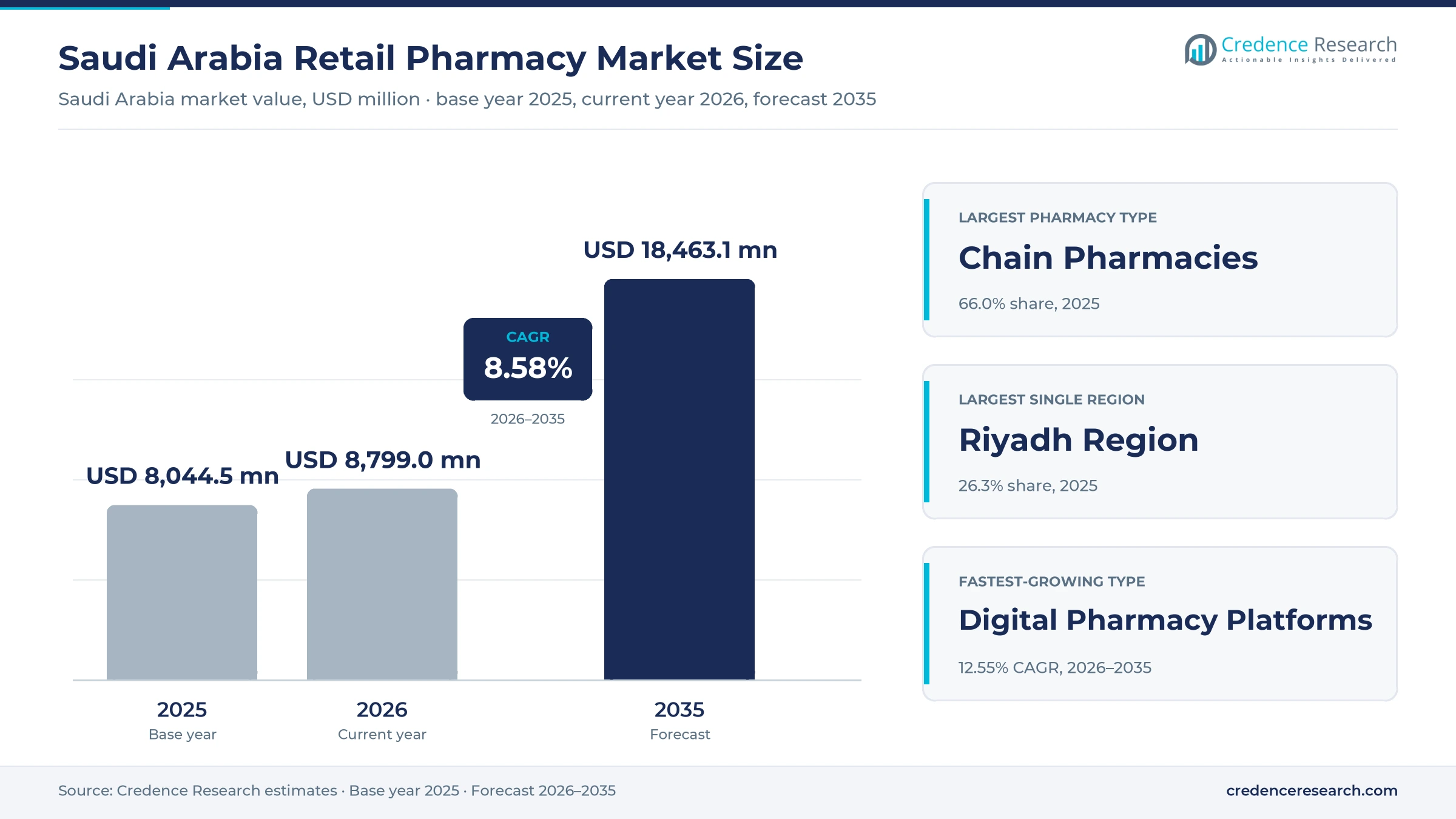
Saudi Arabia Retail Pharmacy Market Insights
- The market was valued at USD 8.04 billion in 2025 and is projected to reach USD 18.46 billion by 2035, registering a CAGR of 8.58% during 2026–2035.
- Riyadh Region held 26.3% of Saudi value in 2025, because the capital has the largest resident population and chain store base.
- Chain pharmacies led with 66.0% of 2025 value, as large operators run more than a thousand stores in hundreds of locations.
- Nahdi made Wasfaty e-prescription services available across all its pharmacies from Oct. 1, 2025, after a NUPCO agreement in July 2025.
- United Pharmacies agreed to buy Kunooz Pharmacies in February 2026 in a deal valued at more than SAR 100 million.
Chains lead while digital platforms grow fastest
Why do chain pharmacies hold the largest share?
Based on pharmacy type, the market is categorized into chain pharmacies, independent pharmacies, digital pharmacy platforms and hospital-linked retail pharmacies. Chain Pharmacies led with 66.0% of 2025 value, because large chains secure insurer contracts and supplier terms that small stores cannot match. Digital Pharmacy Platforms grow fastest at 12.55% a year, as shoppers order refills and wellness items through apps.
Which products drive Saudi pharmacy baskets?
Based on product category, the market is categorized into prescription medicines, over-the-counter drugs, health and wellness products, personal care and beauty and home-health supplies. Prescription Medicines led with 52.0% of 2025 value, because insured patients collect chronic and acute treatments at community stores. Health and Wellness Products grow fastest at 9.16% a year, as shoppers spend more on vitamins and preventive care.
Who buys most from Saudi pharmacies?
Based on customer type, the market is categorized into insured residents, self-pay residents, chronic-care patients and visitors and pilgrims. Insured Residents led with 48.0% of 2025 value, because private cover pays for repeat prescriptions for millions of members. Chronic-Care Patients grow fastest at 9.20% a year, as diabetes, heart and respiratory patients need regular refills.
How fast are pharmacy apps and websites growing?
Based on sales channel, the market is categorized into physical pharmacy stores, pharmacy websites and apps, healthcare referral channels and marketplace aggregators. Physical Pharmacy Stores led with 76.0% of 2025 value, because most prescriptions still need a pharmacist check at the counter. Pharmacy Websites and Apps grow fastest at 11.39% a year, as delivery and click-and-collect services spread.
| Segment Group | Leading Sub-segment | Share, 2025 | Fastest-growing Sub-segment | CAGR, 2026–2035 |
|---|---|---|---|---|
| By Pharmacy Type | Chain Pharmacies | 66.0% | Digital Pharmacy Platforms | 12.55% |
| By Product Category | Prescription Medicines | 52.0% | Health and Wellness Products | 9.16% |
| By Customer Type | Insured Residents | 48.0% | Chronic-Care Patients | 9.20% |
| By Sales Channel | Physical Pharmacy Stores | 76.0% | Pharmacy Websites and Apps | 11.39% |
Request a Free Sample
Fill in your details and we'll send you a free sample report.
- Sample data tables & charts
- Research methodology
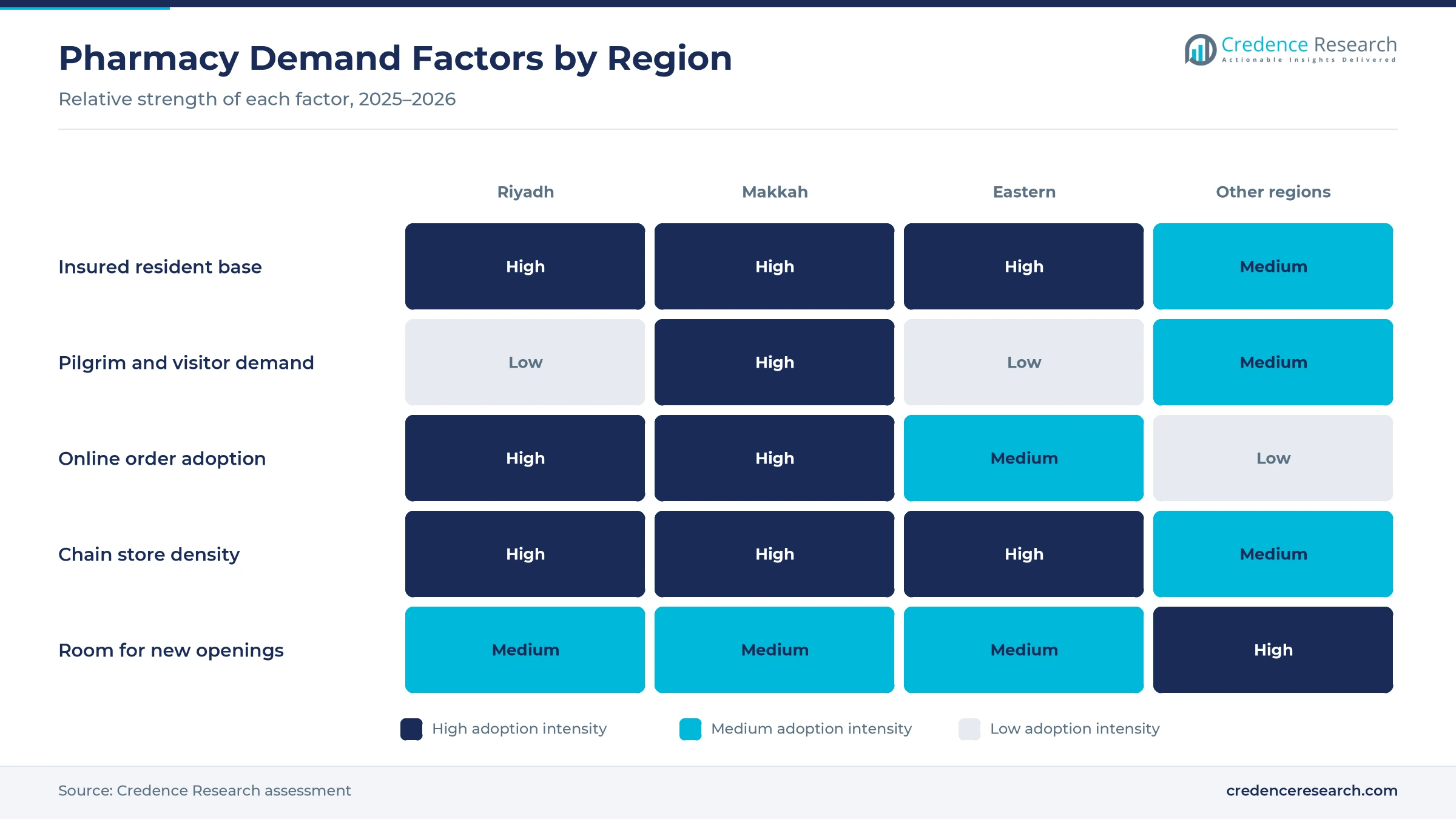
Insurance, omnichannel buying and population drive demand
How does insured prescription demand lift sales?
Expansion of insured prescription demand is the first driver, because insurers pay for repeat medicines that members collect at community stores. Private health insurance covered just over 13 million beneficiaries in 2025, including 7.2 million non-Saudi primary members and 1.4 million dependents, according to the Council of Health Insurance. Nahdi made Wasfaty e-prescription services available across all its pharmacies from Oct. 1, 2025, as reported by Argaam. The rollout followed an agreement with the National Unified Procurement Co. signed on July 10, 2025. Out-of-pocket payments made up 14.1% of current health spending in 2023, so most medicine costs flow through insured and public channels. As a result, insured residents led customer types with 48.0% of 2025 value.
Why is omnichannel buying changing pharmacy sales?
Omnichannel pharmacy adoption is the second driver, because shoppers now order medicines and wellness products online and collect or receive them within hours. Online channels reached 25.8% of Nahdi sales in 2025, an all-time high, up from 22% in 2024, according to the company's 2025 results. Its Nuhdeek loyalty program added more than 2 million members in 2025 after adding more than 800,000 in 2024. The chain said its 1,222 pharmacies reach 97% of the Saudi population within five minutes, which supports fast collection of web orders. These moves widen demand for online medicine sales across the country. Therefore, pharmacy websites and apps grow at 11.39% a year.
How do population scale and staffing raise productivity?
Population scale and higher pharmacy productivity form the third driver, because more residents and better-staffed stores lift daily prescription volumes. The population reached about 37.0 million in 2025, and 84.6% of residents lived in urban areas, based on World Bank data. Private-sector pharmacists rose from 22,155 in 2017 to 36,949 in 2024, according to Ministry of Health yearbook figures compiled by GLMM. Saudi pharmacists in the private sector climbed from 1,130 to 12,988 over the same period, which adds trained local staff for counseling. Current health spending also reached $1,825 per person in 2023. Consequently, chain pharmacies led with 66.0% of 2025 value, because large chains add services to each store.
Why do pilgrims and visitors add seasonal demand?
Pilgrim and visitor traffic adds a fourth driver, because Hajj and Umrah crowds need acute-care medicines, sun protection and travel health items. The 2025 Hajj drew 1,673,230 pilgrims, including 1,506,576 from abroad, according to GASTAT. Domestic pilgrims numbered 166,654, and most visitors move between Makkah, Mina, Arafat and Madinah within a few weeks. The Makkah Region also had 8,021,463 residents in the 2022 census, the second-largest regional population. Nahdi runs polyclinics in Makkah, Jeddah, Madinah and Taif among its 14 clinics in nine cities. As a result, the Makkah Region held 25.4% of 2025 value, with sharp peaks during Ramadan and the Hajj season.
Clinics, consolidation and wellness reshape the shelf
Why is clinic-linked pharmacy care rising?
Clinic-linked pharmacy care is rising, because chains want to capture prescriptions at the point of diagnosis. Nahdi ran 14 NahdiCare polyclinics in nine cities at the end of 2025, offering care across more than 20 specialties. The company opened four polyclinics in 2024, two years ahead of its 2026 target, and its Omnihealth system served about 1.4 million guests that year. It also set a long-term goal of 40 polyclinics by 2030, which would place doctors and pharmacies under one brand. These clinics add diagnostic tests and preventive services that send patients to nearby stores. Therefore, chronic-care patients grow at 9.20% a year, as clinics manage refills for long-term conditions.
How is chain consolidation reshaping the market?
Chain consolidation is an emerging shift, because scale improves buying terms, insurer access and delivery coverage. United Pharmacies agreed to buy Kunooz Pharmacies in February 2026 in a deal valued at more than SAR 100 million. It also plans to open 100 new pharmacies in 2026, bringing its own network to 600 stores before the Kunooz branches are rebranded. Al-Dawaa, which began operations in the Eastern Province in 1993, runs more than 900 pharmacies in over 100 cities. Al-Dawaa shares started trading on the main market on March 14, 2022. As a result, independent pharmacies lose ground to larger groups with stronger supplier and insurer terms.
Can wellness and private-label ranges open new revenue?
Wellness and private-label ranges are an opening, because shoppers buy vitamins, skin care and preventive products without a prescription. Nahdi said private-label and differentiated brands reached 13% of its sales in 2024. The chain added more than 21,000 SKUs in 2024 and handled about 90 million guest transactions that year, which gives it data to tune ranges by store. Demand for dietary supplements also rises during Ramadan and Eid, when shoppers buy fasting and immunity products. The population aged 65 and over reached 3.1% in 2025, up from 2.7% in 2022, which adds buyers of home-health supplies. Consequently, health and wellness products grow at 9.16% a year.
Will adherence services open chronic-care demand?
Adherence services are a second opening, because many patients with diabetes and heart disease miss doses or stop treatment. Nahdi delivered more than 60,000 ez-pill units to chronic patients in 2024, which improved medication adherence by 100 basis points. The Wasfaty rollout from October 2025 also lets pharmacies receive e-prescriptions directly, which simplifies monthly refills. Saudi nationals made up 22,283 of 46,856 pharmacists across all sectors in 2024, which supports Arabic-language counseling for older patients. In turn, compliance packs and refill reminders keep patients loyal to one store. Therefore, digital pharmacy platforms grow at 12.55% a year, as refill subscriptions move online.
Price rules, staffing costs and dense networks weigh
How do price controls squeeze pharmacy margins?
Regulated medicine prices limit how much pharmacies can earn on each prescription, because margins are set rather than negotiated freely. When regulators cut prices for older brands or approve cheaper generics, pharmacy revenue per pack falls. As a result, chains shift effort toward wellness, beauty and private-label products that carry higher margins. Smaller independents have fewer such options and feel the squeeze most. Over time, this pressure pushes some single-store owners to sell to larger groups.
Why do staffing rules raise operating costs?
Localization rules for pharmacists raise wage costs, because Saudi pharmacists command higher salaries than many expatriate staff. Chains also need more trained staff to run clinics, deliveries and digital consultations. Consequently, operating costs rise faster than sales in some stores, which pressures profit margins. Training programs, shared staffing models and dispensing robots help operators manage the burden. Larger chains spread these costs across many stores, which widens their lead over independents.
Does dense store coverage limit new openings?
Dense store coverage in large cities limits returns on new openings, because many districts already have several chain outlets within walking distance. New stores can draw sales from existing ones instead of adding fresh demand. Therefore, operators must choose sites carefully and close weak locations. Growth in smaller cities and new residential districts offers better returns but needs reliable delivery and staffing. Data on footfall, insurance members and clinic locations now guides most site choices for large chains.
How do supply gaps and cold handling affect stores?
Supply gaps for some imported medicines and the need for temperature-controlled handling create operating risks for pharmacies. Insulin, vaccines and biologics need refrigerated storage and careful delivery, which adds cost for online orders. As a result, stockouts or temperature breaches can damage customer trust and insurer relationships. Local manufacturing, better forecasting and validated delivery packaging help reduce these risks. Chains with central warehouses and cold rooms handle these products more reliably than small independents.
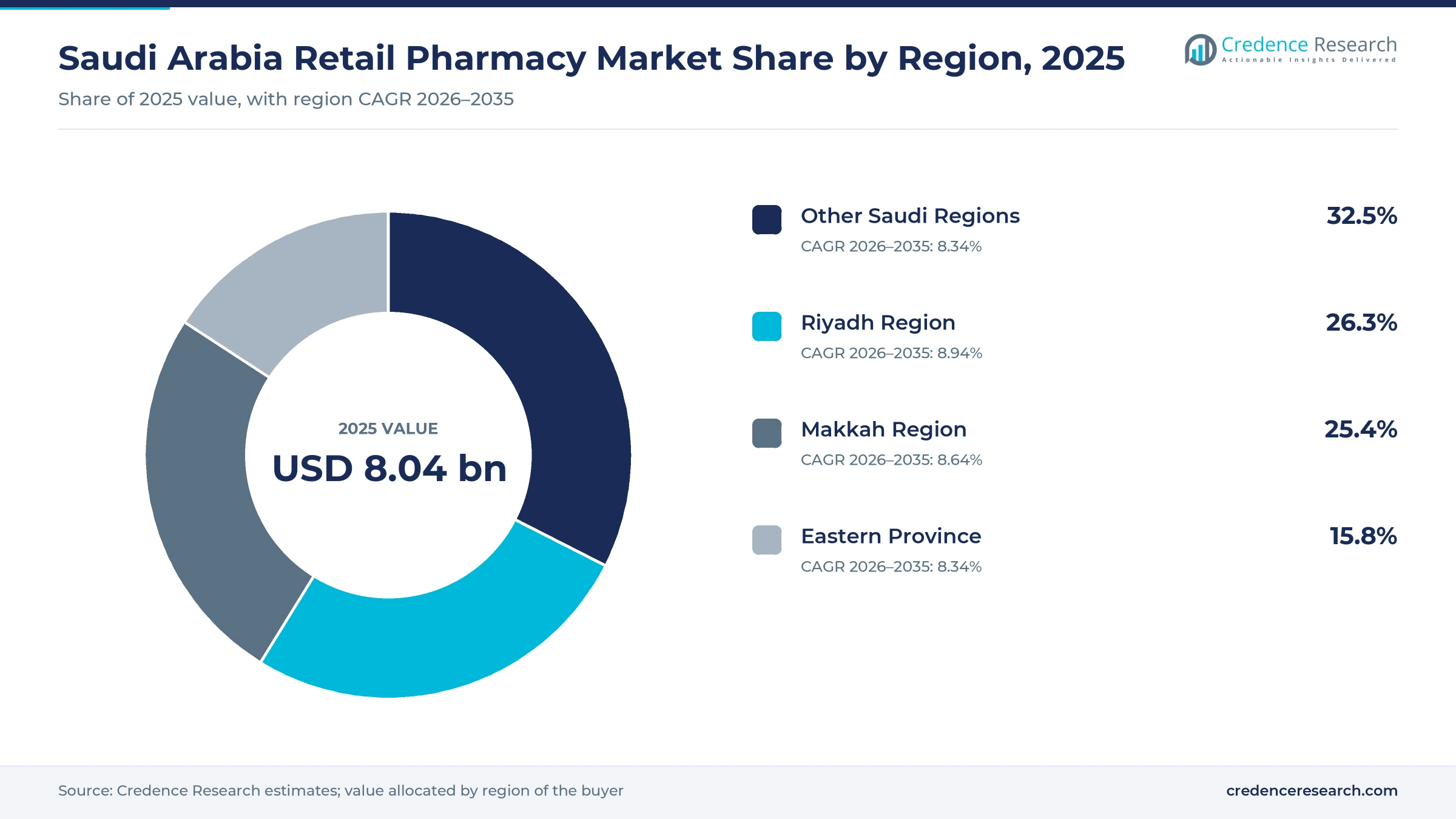
Riyadh and Makkah hold the largest single shares
| Region | Value, 2025 (USD billion) | Share, 2025 | CAGR, 2026–2035 |
|---|---|---|---|
| Other Saudi Regions | 2.61 | 32.5% | 8.34% |
| Riyadh Region | 2.12 | 26.3% | 8.94% |
| Makkah Region | 2.04 | 25.4% | 8.64% |
| Eastern Province | 1.27 | 15.8% | 8.34% |
Why does Riyadh region lead single-region demand?
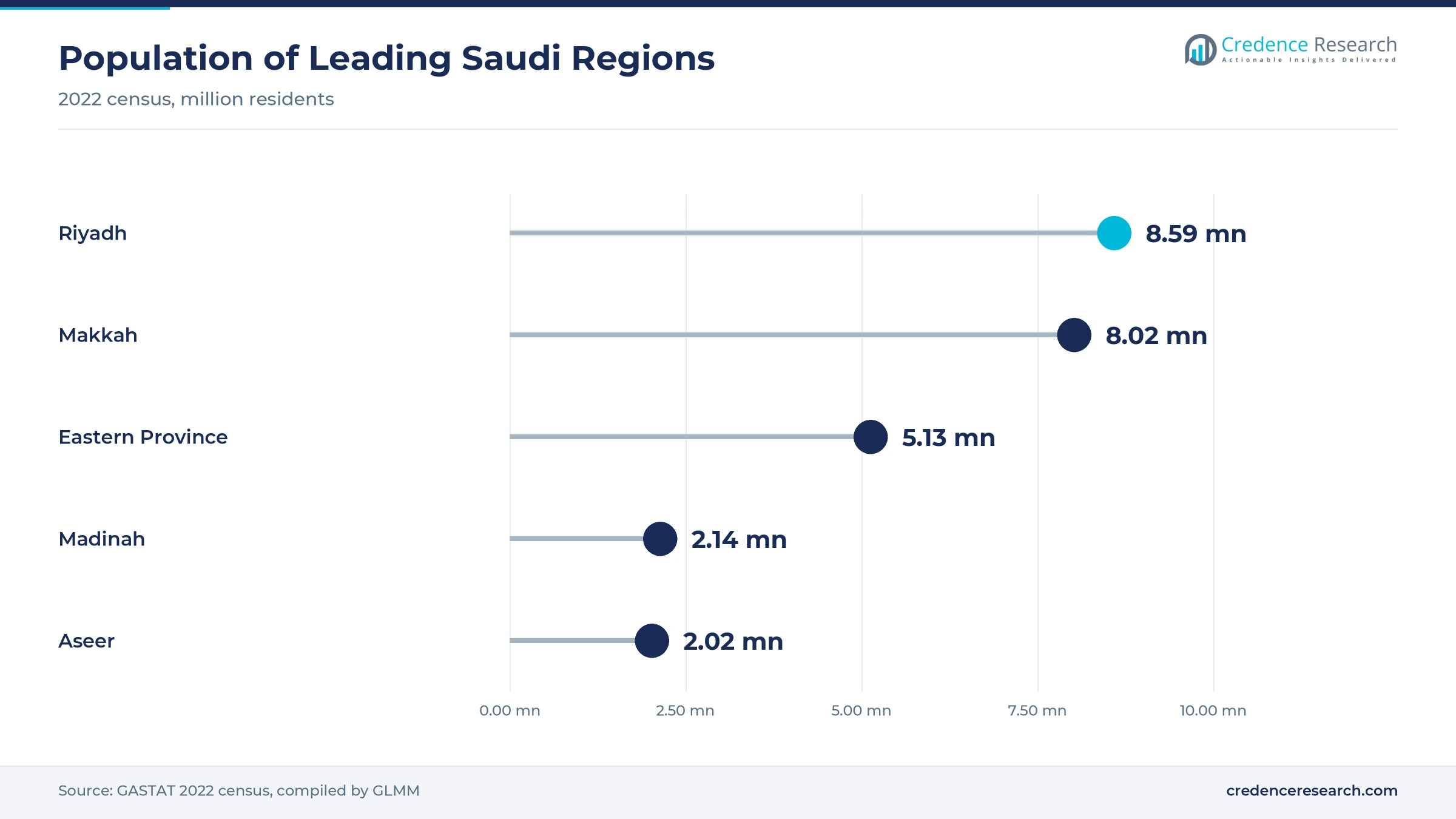
Riyadh Region held 26.3% of 2025 value and grows at 8.94% a year, the fastest of the four zones. The region had 8,591,748 residents in the 2022 census, the largest regional population in the country. The capital also hosts head offices, large hospitals and many insured employees with family cover. Nahdi added Riyadh to its polyclinic cities by the end of 2025, which links clinic visits with nearby pharmacy counters.
How do residents and pilgrims shape Makkah Region sales?
Makkah Region held 25.4% of 2025 value and grows at 8.64% a year. The region includes Jeddah, Makkah and Taif and had 8,021,463 residents in the 2022 census. Pilgrims add sharp seasonal peaks, with 1,673,230 people performing Hajj in 2025. Nahdi, which is based in Jeddah, runs polyclinics in Jeddah, Makkah and Taif, so the region has the deepest mix of clinic and pharmacy services.
What supports demand in the Eastern Province?
The Eastern Province held 15.8% of 2025 value and grows at 8.34% a year. The province had 5,125,254 residents in the 2022 census, with large populations in Dammam, Khobar and Al-Ahsa. Al-Dawaa began operations in the province in 1993 and still runs a dense network of stores there. Energy and industrial employers also provide insured cover for many workers and families.
How do other Saudi regions add growth?
Other Saudi Regions held 32.5% of 2025 value and grow at 8.34% a year. This group includes Madinah with 2,137,983 residents and Aseer with 2,024,285 residents in the 2022 census, plus Jazan, Qassim and Tabuk. Nahdi runs polyclinics in Madinah, Yanbu, Najran, Khamis Mushait and Abha. Smaller cities rely more on independent stores, which makes them a target for chain expansion and delivery services.
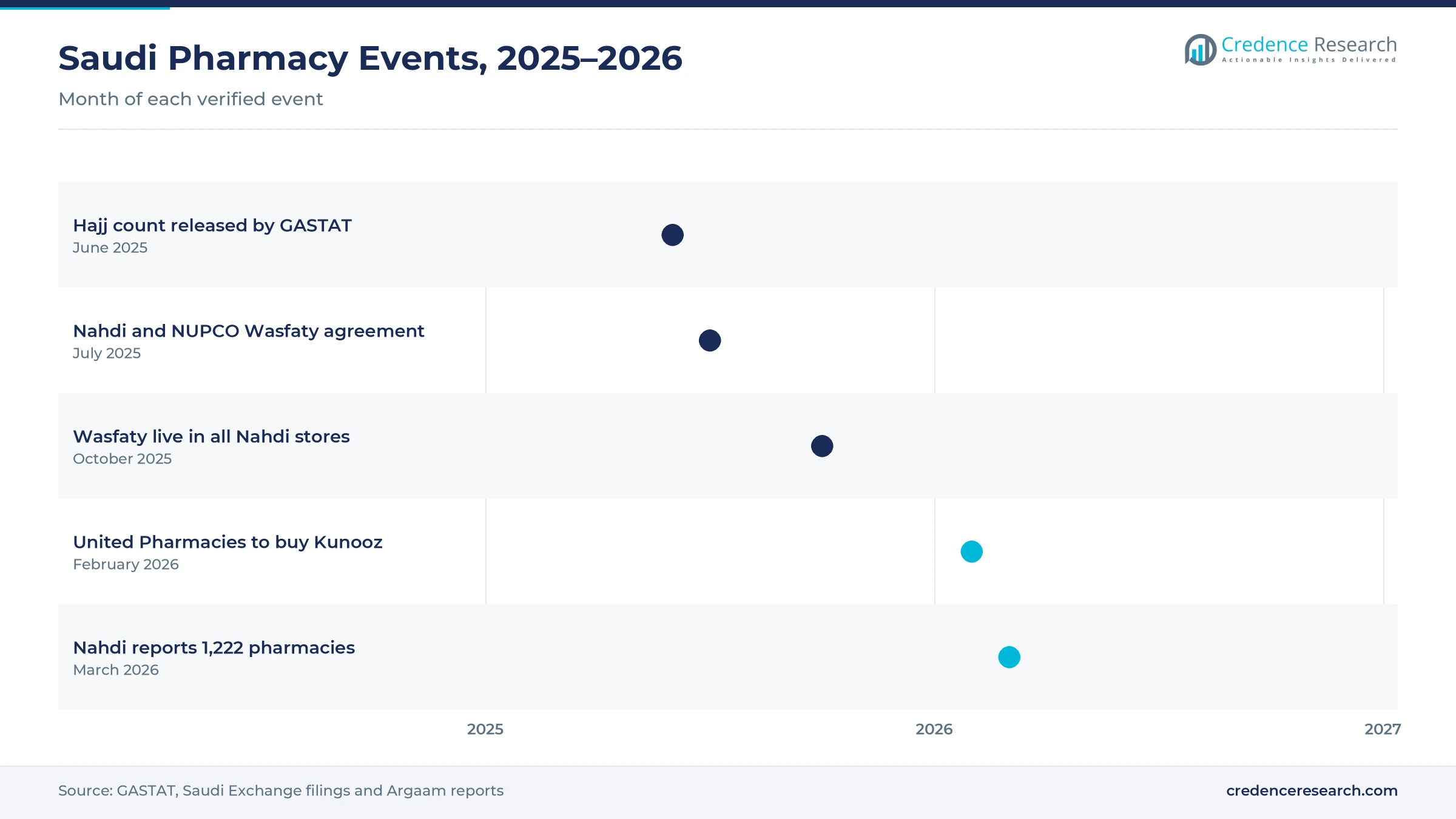
E-prescription rollout and deals from 2025 to 2026
| Development | Status and market relevance |
|---|---|
| In June 2025, GASTAT reported that 1,673,230 pilgrims performed Hajj, including 1,506,576 from abroad. | Seasonal peak for acute-care and travel health purchases |
| In July 2025, Nahdi signed an agreement with the National Unified Procurement Co. for Wasfaty services. | Prepared the e-prescription rollout across its network |
| In October 2025, Nahdi made Wasfaty e-prescription services available across all its pharmacies. | Moves more public prescriptions to community stores |
| In February 2026, United Pharmacies agreed to buy Kunooz Pharmacies in a deal valued at more than SAR 100 million. | Plans 100 new stores in 2026 and a 600-store network |
| In March 2026, Nahdi reported 1,222 pharmacies and 14 polyclinics at the end of 2025. | Online channels reached 25.8% of its sales |
E-prescriptions and adherence packs gain ground
- E-prescription links send prescriptions from doctors to pharmacies through Wasfaty, which removes paper scripts and speeds refills for public and insured patients.
- Pharmacy apps and websites let shoppers order medicines and wellness products for delivery or pickup, which keeps customers loyal between store visits.
- Adherence packs sort chronic medicines into daily doses, which helps diabetes and heart patients take treatment on time and refill regularly.
- Loyalty data platforms track purchases across stores and apps, which helps chains tailor promotions, private-label ranges and refill reminders.
Need a Custom Version of This Report?
Tailor the scope, geography, or segments to your exact requirements.
- Custom geography or segment scope
- Direct access to our analyst team
Large chains compete on reach and digital service
Competition is led by large listed chains, with regional groups and independents filling local gaps. Nahdi Medical Company runs 1,222 pharmacies and 14 polyclinics and leads in online sales. Al-Dawaa Medical Services Company operates more than 900 pharmacies in over 100 cities. United Pharmacies is expanding through new openings and its agreed purchase of Kunooz Pharmacies. The company list also covers Zahrat Al Rawdah Pharmacies, Saudi Tadawi Healthcare, Al Mujtama Al Raida Medical, Lemon Medical, Adam Medical, Adel Pharmacies Group and WHITES Pharmacy. Operators compete on store location, insurer contracts, delivery speed, clinic links, private-label ranges and loyalty programs, while suppliers of the wider pharmaceutical sector compete for shelf space and promotions.
Companies profiled and their roles in this market
| Company | Type | Role in the market |
|---|---|---|
| Nahdi Medical Company | Chain pharmacy operator | 1,222 pharmacies, 14 polyclinics and 25.8% online sales share in 2025 |
| Al-Dawaa Medical Services Company | Chain pharmacy operator | More than 900 pharmacies in over 100 cities, founded in 1993 |
| United Pharmacies | Chain pharmacy operator | Agreed to buy Kunooz Pharmacies and plans a 600-store network |
Credence Research view on Saudi pharmacy growth
Credence Research's view is that the Saudi Arabia retail pharmacy market will grow through more prescriptions per store and a larger online share rather than through new stores alone. E-prescription links and private insurance move routine refills to community counters, while apps keep patients loyal between visits. However, price controls and staffing costs will keep pressure on margins. Chains that combine clinics, adherence services, wellness ranges and fast delivery are best placed to gain share from independents through 2035.
Insurance, census and filing data behind the estimate
The report uses 2025 as the base year on a calendar basis, with values in USD million at current prices. Market values come from the Credence Research model, which links population, insured members, prescription volumes and average basket values to pharmacy sales. Regional shares for 2025 come from the client data, while regional growth rates and segment splits are Credence Research estimates. Sources used are GASTAT, World Bank data, Ministry of Health yearbook figures, Council of Health Insurance statements and company filings, and no interviews or surveys were used.
Digital orders and chronic care shape growth to 2035
Spending is expected to reach USD 18.46 billion by 2035, an 8.58% CAGR during 2026–2035, as insured residents, chronic-care patients and visitors buy more medicines and wellness products. Growth should be strongest in the late 2020s, as e-prescriptions spread and chains add clinics and delivery capacity. After that, adherence services, private-label ranges and online refills will shape where operators invest. Price controls and staffing costs may slow margins, but a growing and urban population keeps the long-term outlook positive.
Frequently Asked Questions
How big is the Saudi Arabia retail pharmacy market?
Which region leads Saudi pharmacy sales?
Which pharmacy type holds the largest share?
What is the Wasfaty e-prescription rollout?
How large is online pharmacy buying in Saudi Arabia?
How do pilgrims affect pharmacy demand?
Which companies compete in this market?
How many pharmacists work in the private sector?
Table of Content
Chapter 1 Market Segmentation
- 1.1 Segmentation Framework
- 1.1.1 Product and Service Classification
- 1.1.2 Application and End-Use Classification
- 1.1.3 Technology and Solution Classification
- 1.1.4 Customer and Distribution Channel Classification
- 1.1.5 Geographic Segmentation
- 1.1.6 Market Segment Definitions and Boundaries
- 1.2 By Pharmacy Type
- 1.2.1 Chain Pharmacies
- 1.2.2 Independent Pharmacies
- 1.2.3 Digital Pharmacy Platforms
- 1.2.4 Hospital-Linked Retail Pharmacies
- 1.3 By Product Category
- 1.3.1 Prescription Medicines
- 1.3.2 OTC Medicines
- 1.3.3 Health and Wellness Products
- 1.3.4 Personal Care
- 1.3.5 Beauty and Home-Health Supplies
- 1.4 By Customer Type
- 1.4.1 Insured Residents
- 1.4.2 Self-Pay Residents
- 1.4.3 Chronic-Care Patients
- 1.4.4 Visitors and Pilgrims
- 1.5 By Sales Channel
- 1.5.1 Physical Pharmacy Stores
- 1.5.2 Pharmacy Websites and Apps
- 1.5.3 Healthcare Referral Channels
- 1.5.4 Marketplace Aggregators
Chapter 2 Introduction
- 2.1 Report Objectives and Scope
- 2.2 Product Definition and Industry Terminology
- 2.3 Market Inclusions and Exclusions
- 2.4 Research Process
- 2.4.1 Primary Research and Expert Interviews
- 2.4.2 Secondary Research and Source Review
- 2.4.3 Top-Down and Bottom-Up Estimation
- 2.4.4 Data Triangulation and Verification
- 2.5 Market Size Measurement Basis
- 2.5.1 2025: USD 8.04 billion → 2035: USD 18.46 billion
- 2.6 Historical and Forecast Reference Periods
- 2.6.1 Historical Period: 2018-2025
- 2.6.2 Base Year: 2025
- 2.6.3 Forecast Period: 2025-2035
- 2.7 Research Assumptions and Limitations
Chapter 3 Executive Summary
- 3.1 Market Snapshot and Key Findings
- 3.2 Base-Year Market Size, 2025
- 3.3 Forecast Market Size, 2035
- 3.4 Revenue and Volume Growth Outlook
- 3.5 Key Demand and Supply Indicators
- 3.6 Leading Market Segments
- 3.7 Fastest-Growing Market Opportunities
- 3.8 Regional Performance Highlights
- 3.9 Technology and Industry Transformation
- 3.10 Competitive Landscape Summary
- 3.11 Analyst View and Strategic Implications
Chapter 4 Saudi Arabia Retail Pharmacy Market Trends and Developments
- 4.1 Historical Industry Development, 2018-2025
- 4.2 Recent Market Trends and Developments
- 4.3 Demand and Customer Behavior Trends
- 4.4 Technology and Product Innovation
- 4.5 Artificial Intelligence, Automation and Digitalization
- 4.6 Local Manufacturing and Supply Chain Realignment
- 4.7 Industry Partnerships, Mergers and Acquisitions
- 4.8 Sustainability and Circular Economy Developments
- 4.9 Government and Private Sector Investment Trends
- 4.10 Emerging Business Models and Commercialization
- 4.11 Industry Developments and Announcements
Chapter 5 Saudi Arabia Retail Pharmacy Market Production, Supply and Demand Analysis
- 5.1 Demand Trend and Consumption Analysis, 2018-2025
- 5.2 Demand Forecast, 2025-2035
- 5.3 Production and Output Trend, 2018-2025
- 5.4 Production and Output Forecast, 2025-2035
- 5.5 Installed Capacity and Capacity Utilization
- 5.6 Company-Wise Production Plants and Statistics
- 5.6.1 Installed Production Capacity
- 5.6.2 Actual Production
- 5.6.3 Planned Capacity and Expansion Targets
- 5.7 Supply Chain Structure and Procurement Trends
- 5.8 Supply-Demand Gap and Bottlenecks
- 5.9 Import Dependence and Sourcing Structure
- 5.10 Contract Manufacturing and Outsourcing
- 5.11 Regional Supply and Demand Concentration
Chapter 6 Saudi Arabia Retail Pharmacy Market Pricing Analysis
- 6.1 Pricing Structure and Measurement
- 6.2 Historical Pricing Trends, 2018-2025
- 6.3 Pricing Outlook, 2025-2035
- 6.4 Average Selling Price and Unit Economics
- 6.5 Pricing by Product and Market Segment
- 6.6 Geographic Pricing Differences
- 6.7 Key Input, Energy, Labor and Logistics Costs
- 6.8 Contract Pricing and Purchasing Models
- 6.9 Pricing Sensitivity and Competitive Positioning
- 6.10 Price, Margin and Profitability Implications
Chapter 7 Saudi Arabia Retail Pharmacy Market Dynamics
- 7.1 Market Growth Drivers
- 7.1.1 Demand-Side Drivers
- 7.1.2 Technology and Innovation Drivers
- 7.1.3 Infrastructure and Investment Drivers
- 7.1.4 Regulatory and Policy Drivers
- 7.2 Market Restraints
- 7.2.1 Cost and Affordability Constraints
- 7.2.2 Technology and Adoption Barriers
- 7.2.3 Supply Chain and Operational Constraints
- 7.3 Market Challenges
- 7.3.1 Competitive Pressure and Margin Erosion
- 7.3.2 Skills, Infrastructure and Implementation Gaps
- 7.4 Emerging Market Opportunities
- 7.5 Market Dynamics Impact and Time-Horizon Assessment
Chapter 8 Saudi Arabia Retail Pharmacy Value Chain Analysis
- 8.1 Industry Value Chain Overview
- 8.2 Upstream Suppliers and Critical Inputs
- 8.3 Technology and Component Providers
- 8.4 Manufacturing or Service Delivery
- 8.5 Distribution, Channel Partners and Integrators
- 8.6 Downstream Applications and End Users
- 8.7 Value Addition and Profit Pools
- 8.8 Vertical Integration and Outsourcing
- 8.9 Supplier Concentration and Risk
- 8.10 Supply Chain Localization and Resilience
Chapter 9 Saudi Arabia Retail Pharmacy Market Regulations and Policies
- 9.1 Relevant Laws, Standards and Compliance Frameworks
- 9.2 Product, Service, Safety and Quality Requirements
- 9.3 Government Policies, Incentives and Subsidies
- 9.4 Imports, Exports and Trade Barriers
- 9.5 Public Procurement and Local Content Requirements
- 9.6 Environmental and Sustainability Compliance
- 9.7 Upcoming Policy Changes and Market Implications
Chapter 10 Saudi Arabia Retail Pharmacy Market Hotspots and Opportunities
- 10.1 Market Opportunity Mapping and Growth Hotspots
- 10.2 High-Growth Applications and Customer Groups
- 10.3 Underserved Markets and White-Space Opportunities
- 10.4 Emerging Technology and Product Opportunities
- 10.5 New Capacity and Investment Hotspots
- 10.6 Market Entry and Expansion Opportunities
- 10.7 Distribution and Partnership Opportunities
- 10.8 Near-Term and Long-Term Commercial Potential
- 10.9 Opportunity Attractiveness and Execution Risks
Chapter 11 Saudi Arabia Retail Pharmacy Market Outlook, 2025-2035
- 11.1 Market Size and Analysis
- 11.1.1 Revenue (Market Measurement: 2025: USD 8.04 billion → 2035: USD 18.46 billion)
- 11.1.2 Market Volume and Quantity Sold
- 11.1.3 Historical Market Size, 2018-2025
- 11.1.4 Base-Year Market Size, 2025
- 11.2 Market Forecast, 2025-2035
- 11.2.1 Revenue Forecast to 2035
- 11.2.2 Volume Forecast to 2035
- 11.2.3 CAGR and Year-on-Year Growth
- 11.2.4 Incremental Revenue Opportunity
- 11.3 Forecast Assumptions and Scenario Analysis
- 11.3.1 Base-Case Forecast
- 11.3.2 Optimistic and Conservative Scenarios
- 11.3.3 Technology, Pricing and Policy Sensitivities
- 11.4 Market Attractiveness and Growth Outlook
Chapter 12 Saudi Arabia Retail Pharmacy Market Segmentation and Outlook
- 12.1 Segmentation Summary and Market Shares, 2025
- 12.2 Largest and Fastest-Growing Segments
- 12.3 By Pharmacy Type - Market Size and Forecast, 2025-2035
- 12.3.1 Segment Definition and Scope
- 12.3.2 Historical Market Size, 2018-2025
- 12.3.3 Revenue Forecast, 2025-2035
- 12.3.4 Volume Forecast, 2025-2035
- 12.3.5 Base-Year Market Share, 2025
- 12.3.6 Segment CAGR and Growth Drivers
- 12.3.7 Subsegment Market Size and Forecast
- 12.3.7.1 Chain Pharmacies
- 12.3.7.2 Independent Pharmacies
- 12.3.7.3 Digital Pharmacy Platforms
- 12.3.7.4 Hospital-Linked Retail Pharmacies
- 12.3.8 Subsegment Pricing and Adoption Trends
- 12.3.9 Leading Suppliers and Competition
- 12.3.10 Regional Demand and Opportunities
- 12.4 By Product Category - Market Size and Forecast, 2025-2035
- 12.4.1 Segment Definition and Scope
- 12.4.2 Historical Market Size, 2018-2025
- 12.4.3 Revenue Forecast, 2025-2035
- 12.4.4 Volume Forecast, 2025-2035
- 12.4.5 Base-Year Market Share, 2025
- 12.4.6 Segment CAGR and Growth Drivers
- 12.4.7 Subsegment Market Size and Forecast
- 12.4.7.1 Prescription Medicines
- 12.4.7.2 OTC Medicines
- 12.4.7.3 Health and Wellness Products
- 12.4.7.4 Personal Care
- 12.4.7.5 Beauty and Home-Health Supplies
- 12.4.8 Subsegment Pricing and Adoption Trends
- 12.4.9 Leading Suppliers and Competition
- 12.4.10 Regional Demand and Opportunities
- 12.5 By Customer Type - Market Size and Forecast, 2025-2035
- 12.5.1 Segment Definition and Scope
- 12.5.2 Historical Market Size, 2018-2025
- 12.5.3 Revenue Forecast, 2025-2035
- 12.5.4 Volume Forecast, 2025-2035
- 12.5.5 Base-Year Market Share, 2025
- 12.5.6 Segment CAGR and Growth Drivers
- 12.5.7 Subsegment Market Size and Forecast
- 12.5.7.1 Insured Residents
- 12.5.7.2 Self-Pay Residents
- 12.5.7.3 Chronic-Care Patients
- 12.5.7.4 Visitors and Pilgrims
- 12.5.8 Subsegment Pricing and Adoption Trends
- 12.5.9 Leading Suppliers and Competition
- 12.5.10 Regional Demand and Opportunities
- 12.6 By Sales Channel - Market Size and Forecast, 2025-2035
- 12.6.1 Segment Definition and Scope
- 12.6.2 Historical Market Size, 2018-2025
- 12.6.3 Revenue Forecast, 2025-2035
- 12.6.4 Volume Forecast, 2025-2035
- 12.6.5 Base-Year Market Share, 2025
- 12.6.6 Segment CAGR and Growth Drivers
- 12.6.7 Subsegment Market Size and Forecast
- 12.6.7.1 Physical Pharmacy Stores
- 12.6.7.2 Pharmacy Websites and Apps
- 12.6.7.3 Healthcare Referral Channels
- 12.6.7.4 Marketplace Aggregators
- 12.6.8 Subsegment Pricing and Adoption Trends
- 12.6.9 Leading Suppliers and Competition
- 12.6.10 Regional Demand and Opportunities
- 12.7 Segment Growth Comparison
- 12.8 Segment Attractiveness and Priority Matrix
Chapter 13 Saudi Arabia Retail Pharmacy End-Use and Application Market Outlook
- 13.1 End-Use Industry and Customer Demand Structure
- 13.2 Leading Applications and Customer Groups
- 13.3 End-Use Market Size, Share and Forecast
- 13.4 Major End-Use Industry Deep Dives
- 13.4.1 Customer Requirements and Use Cases
- 13.4.2 Demand and Replacement Cycles
- 13.4.3 Technical and Regulatory Considerations
- 13.4.4 Purchasing and Procurement Models
- 13.4.5 Leading Vendors and Distribution Channels
- 13.4.6 Forecast and Commercial Opportunities
- 13.5 Emerging Applications and Cross-Segment Demand
- 13.6 End-Use Industry Investment Priorities
Chapter 14 Saudi Arabia Retail Pharmacy Geographic Market Outlook, 2025-2035
- 14.1 Regional Market Size and Country-Level Shares, 2025
- 14.2 Country Market Size Comparison, 2025
- 14.3 Country Market Forecasts, 2025-2035
- 14.4 Subregional Industrial and Demand Clusters
- 14.5 Intra-Regional Pricing and Cost Differences
- 14.6 Cross-Border Trade and Supply Networks
- 14.7 Regional Supply and Demand Balances
- 14.8 Country Opportunity Comparison and Prioritization
Note: Every listed country is covered on the structure shown under the first country.
Chapter 15 Saudi Arabia Retail Pharmacy Technology, Innovation and Sustainability Outlook
- 15.1 Technology Landscape and Maturity
- 15.2 Product, Process and Service Innovation
- 15.3 AI, Automation and Digital Tools in the Industry
- 15.4 Technology Adoption and Performance Benchmarking
- 15.5 Innovation Pipeline and R&D Investment
- 15.6 Patent and Intellectual Property Trends
- 15.7 Energy Efficiency and Resource Management
- 15.8 Sustainability, Recycling and Circularity
- 15.9 Technology Roadmap, 2025-2035
- 15.10 Risks of Obsolescence and Technology Substitution
Chapter 16 Saudi Arabia Retail Pharmacy Market Key Strategic Imperatives
- 16.1 Growth and Market Entry Priorities
- 16.2 High-Return Products and Segments
- 16.3 Pricing, Profitability and Cost Optimization
- 16.4 Technology Investment and Product Differentiation
- 16.5 Supply Chain Localization and Resilience
- 16.6 Distribution and Customer Acquisition
- 16.7 Partnership, Acquisition and Capacity Strategy
- 16.8 Regional Expansion Priorities
- 16.9 Short-, Medium- and Long-Term Actions
Chapter 17 Competition Outlook
- 17.1 Industry Competition Characteristics
- 17.2 Market Structure and Concentration
- 17.3 Market Share and Competitive Positioning, 2025
- 17.4 Company-Wise Revenue and Product Benchmarking
- 17.5 Production and Service Capacity Benchmarking
- 17.6 Technology, Pricing and Differentiation
- 17.7 Regional Footprint and Distribution Strength
- 17.8 Mergers, Acquisitions and Strategic Alliances
- 17.9 New Entrants and Competitive Threats
- 17.10 Porter's Five Forces and Industry Attractiveness
- 17.11 Competitive Outlook, 2025-2035
Chapter 18 Company Profiles
- 18.1 Company Coverage and Selection Criteria
- 18.2 Nahdi Medical Company
- 18.2.1 Business Description
- 18.2.2 Company Ownership and Geographic Presence
- 18.2.3 Product and Service Portfolio
- 18.2.4 Manufacturing and Operating Footprint
- 18.2.5 Production Capacity and Expansion Plans
- 18.2.6 Financial Performance and Investment
- 18.2.7 Market Share and Competitive Position
- 18.2.8 Technology and Innovation Capabilities
- 18.2.9 Strategic Alliances or Partnerships
- 18.2.10 Recent Developments
- 18.2.11 Growth Strategy and Outlook
- 18.3 Al-Dawaa Medical Services Company
- 18.4 United Pharmacies
- 18.5 Zahrat Al Rawdah Pharmacies Company
- 18.6 Saudi Tadawi Healthcare Company
- 18.7 Al Mujtama Al Raida Medical Company
- 18.8 Lemon Medical Company
- 18.9 Adam Medical Company
- 18.10 Adel Pharmacies Group
- 18.11 WHITES Pharmacy
- 18.12 Other Relevant Market Participants
Note: Every listed company is profiled on the structure shown under the first company. The company list is preliminary and may change based on research findings, market developments, data availability and client requirements.
Chapter 19 Disclaimer
- 19.1 Research and Forecast Disclaimer
- 19.2 Data Source and Estimation Limitations
Note: The depth of individual sections depends on data availability for this market. Volume, capacity, trade and other unit-based metrics are included where applicable.

