
| REPORT ATTRIBUTE | DETAILS |
|---|---|
| Historical Period | 2020-2023 |
| Base Year | 2024 |
| Forecast Period | 2025-2032 |
| Scleral Lens Market Size 2024 | USD 302 million |
| Scleral Lens Market, CAGR | 11.8% |
| Scleral Lens Market Size 2032 | USD 737.1 million |
Market Overview:
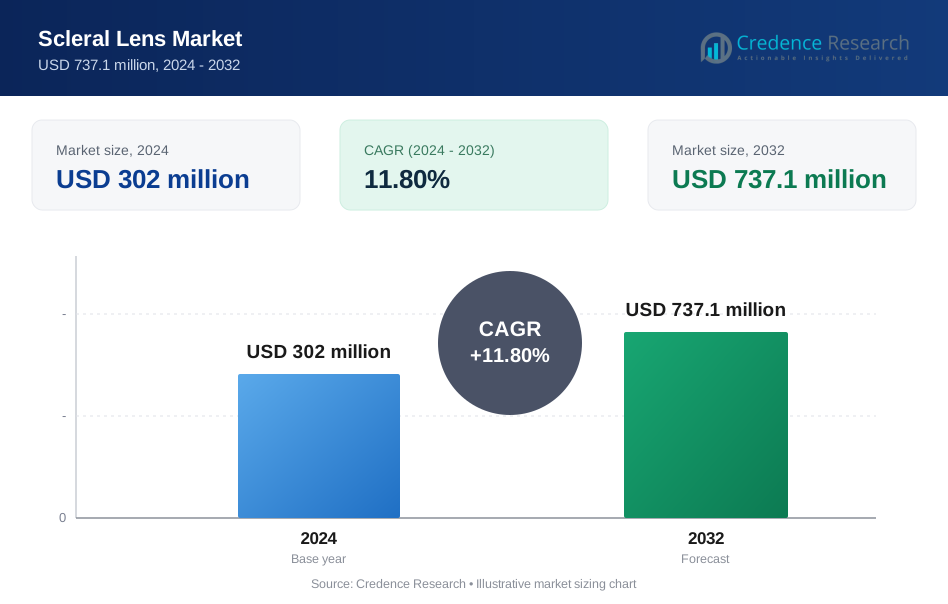
The Scleral Lens Market size was valued at USD 302 million in 2024 and is anticipated to reach USD 737.1 million by 2032, at a CAGR of 11.8% during the forecast period (2024-2032).
The key market drivers include a growing prevalence of corneal disorders, expanding awareness of specialty lens options, and a rise in the geriatric population prone to age-related ocular surface diseases. Additionally, the development of advanced materials and oxygen-permeable lenses has enhanced wearer comfort and long-term ocular health, positioning scleral lenses as a preferred choice for patients unresponsive to conventional contact lenses. Collaborations between lens manufacturers and optometrists, as well as increased investments in R&D for personalized lens design, have fueled innovation and accessibility within the market. The adoption of digital imaging and 3D mapping technologies for precise scleral lens fitting has also improved clinical outcomes, further boosting demand. The growing acceptance of scleral lenses for managing complex ocular conditions such as keratoconus and severe dry eye has broadened the potential patient base. Favorable reimbursement policies in several developed markets are also encouraging both practitioners and patients to opt for advanced specialty lenses.
Regionally, North America dominates the Scleral Lens Market, accounting for the largest share due to high rates of diagnosis, robust healthcare infrastructure, and strong presence of leading manufacturers. The United States is the primary contributor, supported by advanced clinical practices and a high level of patient awareness. Europe follows, driven by increasing adoption of specialty lenses and growing support from healthcare providers. Meanwhile, Asia Pacific is expected to register the fastest growth, propelled by rising disposable income, improving access to eye care, and a growing focus on vision correction technologies. Latin America and the Middle East & Africa are also witnessing increased adoption, aided by expanding optometry networks and educational initiatives. Regulatory approvals and market entry of new lens designs are further shaping the competitive landscape in emerging regions.
Market Insights:
- The Scleral Lens Market is valued at USD 302 million and is projected to reach USD 737.1 million, registering a CAGR of 11.8%.
- North America holds 46% of the market share, driven by robust healthcare infrastructure, high diagnosis rates, and a strong presence of leading manufacturers.
- Europe accounts for 31% of the market, with Germany, the United Kingdom, and France leading regional adoption through public health initiatives and expanded reimbursement policies.
- Asia Pacific represents 17% of the market, emerging as the fastest-growing region due to rising disposable income, increased eye care access, and greater awareness of vision correction technologies.
- Market growth is fueled by the rising prevalence of corneal disorders, adoption of advanced materials, and digital imaging for precise lens fitting.
- Challenges include high costs, limited insurance coverage, and the need for specialized practitioner training, which restrict wider market access.
- Collaborations, increasing R&D investments, and favorable regulatory developments in emerging regions are expanding market reach and product innovation.
Market Drivers:
Rising Incidence of Corneal Disorders and Ocular Surface Diseases Fuels Demand
The Scleral Lens Market is experiencing robust growth, largely driven by the increasing prevalence of corneal disorders and ocular surface diseases. Conditions such as keratoconus, dry eye syndrome, and post-surgical complications often require specialized vision correction solutions. Scleral lenses offer enhanced therapeutic benefits for these patients, outperforming conventional contact lenses. Ophthalmologists and optometrists are increasingly recommending scleral lenses for patients with complex corneal irregularities, given their ability to provide superior comfort and stable vision. The growing awareness among both practitioners and patients about the advantages of scleral lenses further supports market expansion. The market benefits from rising diagnosis rates, especially in regions with advanced healthcare infrastructure.
Advancements in Lens Materials and Customization Technologies Enhance Market Adoption
Technological innovation within the Scleral Lens Market has significantly improved wearer experience and clinical outcomes. The introduction of advanced, oxygen-permeable materials allows for longer and safer lens wear, minimizing the risk of corneal hypoxia. Customization technologies, including digital imaging and 3D mapping, enable precise lens fitting tailored to individual ocular profiles. It has become possible to address highly specific patient needs, driving practitioner confidence in prescribing these lenses. Manufacturers continue to invest in research and development, which accelerates the introduction of next-generation products. These advancements ensure that scleral lenses remain a preferred option for patients with previously untreatable conditions.
- For instance, Visionary Optics’ sMap3D technology enabled the Latitude lens to achieve 20/20 vision in both eyes for a patient with dense cataracts and irregular astigmatism, demonstrating its effectiveness in complex cases.
Collaborations and Training Initiatives Expand Practitioner Capabilities
Strategic collaborations between lens manufacturers and eye care professionals are strengthening the capabilities within the Scleral Lens Market. Manufacturers frequently conduct specialized training programs to educate practitioners about fitting techniques and troubleshooting complex cases. These initiatives have resulted in a broader base of skilled optometrists capable of delivering positive patient outcomes. It also enables a wider adoption of scleral lenses in both clinical and retail environments. Collaborative efforts have led to the development of patient education campaigns, enhancing market penetration. The ongoing partnership model fosters continuous feedback, which supports ongoing product improvement.
- For instance, Bausch + Lomb’s GP Lens Training Programme offers interactive presentations and peer discussion sessions, with a minimum of 4 practitioners per session to maximize effectiveness and engagement in scleral lens education.
Increasing R&D Investments Drive Product Innovation and Accessibility
Investment in research and development remains a critical growth driver for the Scleral Lens Market. Companies are allocating significant resources toward developing advanced lens designs and novel fitting methodologies. These investments help address unmet clinical needs, bringing new solutions to market faster. Enhanced product accessibility, supported by expanded distribution networks, makes it easier for patients to obtain scleral lenses. It continues to attract attention from investors and industry stakeholders, creating a competitive environment focused on innovation. The trend toward personalized medicine in ophthalmology further accelerates R&D activity within the sector.
Market Trends:
Adoption of Digital Imaging and Advanced Manufacturing Transforms Fitting Precision
The Scleral Lens Market is witnessing a rapid shift toward digital imaging and advanced manufacturing techniques, which have revolutionized lens fitting and customization. Eye care professionals now utilize high-resolution corneal topography, optical coherence tomography (OCT), and 3D mapping technologies to capture highly detailed ocular measurements. It has enabled the creation of custom scleral lenses that precisely match the contours of each patient’s eye, significantly improving comfort and visual acuity. Advanced computer-aided design (CAD) and computer-aided manufacturing (CAM) processes have reduced production times while maintaining stringent quality standards. This trend also facilitates the development of innovative lens geometries for patients with complex or irregular corneas. Growing availability of these technologies in clinics and specialty practices continues to drive the adoption of scleral lenses in the market.
- For instance, the ZEISS CIRRUS 6000 OCT system achieves a scan speed of 100,000 scans per second, allowing clinicians to obtain exceptionally detailed ocular images for accurate lens customization and faster patient workflow.
Rising Focus on Personalization, Specialty Indications, and Patient Education Broadens Market Reach
The Scleral Lens Market is evolving to meet the diverse needs of patients through increased focus on personalized solutions and expanded clinical indications. Recent product innovations target not only severe corneal disorders but also patients seeking improved vision quality and comfort for conditions like dry eye syndrome or post-surgical recovery. It has broadened the appeal of scleral lenses beyond traditional therapeutic uses. Companies invest in educational initiatives for both practitioners and patients, promoting awareness of lens benefits and best practices for care. The emergence of patient support programs and online resources further encourages long-term adoption. These evolving trends underscore the market’s commitment to improving both access and outcomes for a wide spectrum of eye care needs.
- For instance, Visionary Optics’ Latitude® lens has been fitted using data from more than 40,000 sMap3D™ examinations.
Market Challenges Analysis:
High Costs and Limited Insurance Coverage Restrict Widespread Access
The Scleral Lens Market faces persistent challenges related to high product and fitting costs, which restrict access for many patients. Custom manufacturing processes and advanced diagnostic equipment contribute to higher price points compared to standard contact lenses. Limited insurance coverage in several regions leaves patients to bear substantial out-of-pocket expenses, creating a financial barrier for those who could benefit most. It remains a significant issue in markets with less comprehensive healthcare systems. Many patients defer or forgo treatment due to cost concerns, impeding broader market adoption. This trend also affects practitioner willingness to recommend scleral lenses for non-critical cases.
Complex Fitting Process and Practitioner Training Needs Impede Adoption
The Scleral Lens Market also encounters obstacles related to the complexity of fitting and the need for specialized practitioner training. Achieving optimal outcomes requires detailed ocular assessments, precise measurements, and expert knowledge of advanced fitting techniques. It creates a steep learning curve for practitioners new to scleral lenses, limiting their adoption in general optometry practices. The scarcity of experienced professionals in some regions can lead to inconsistent patient experiences and outcomes. Addressing these training gaps requires ongoing investment from both manufacturers and healthcare providers. These challenges may slow the pace of market growth, especially outside major urban centers.
Market Opportunities:
Expanding Clinical Indications and Aging Population Open New Growth Avenues
The Scleral Lens Market holds significant opportunities through expanding clinical indications and the increasing global geriatric population. New research highlights the effectiveness of scleral lenses in managing a broad spectrum of conditions, from severe dry eye to ocular surface diseases and complex corneal irregularities. It positions scleral lenses as a vital tool in advanced eye care, appealing to both specialists and general practitioners. The aging population worldwide faces higher rates of corneal disorders and vision complications, creating sustained demand for innovative vision correction options. Companies that tailor products and education to meet the needs of older adults can capture emerging market segments. This trend supports ongoing market expansion and long-term growth prospects.
Technological Integration and Geographic Expansion Enhance Accessibility
The Scleral Lens Market benefits from advances in digital health, telemedicine, and supply chain integration, which improve patient access and service delivery. Remote fitting consultations, digital ordering platforms, and global distribution networks reduce barriers for patients in underserved or rural regions. It enables companies to enter new markets and reach diverse patient populations more efficiently. Investment in practitioner training and virtual support tools further accelerates market penetration. Enhanced data collection and analytics also create opportunities for continuous product improvement and personalized care. These factors contribute to a more inclusive and dynamic market environment.
Market Segmentation Analysis:
By Product Type
The Scleral Lens Market is structured by product type into semi-scleral lenses, mini-scleral lenses, and full scleral lenses. Full scleral lenses hold the largest share, favored for their ability to vault the entire corneal surface and deliver enhanced comfort and stability to patients with severe ocular surface disease. Mini-scleral and semi-scleral lenses appeal to patients needing less extensive coverage or managing milder conditions. It shows a strong trend toward personalized eye care, with manufacturers expanding product portfolios to include a range of sizes and designs. This variety enables eye care professionals to match lenses more precisely to individual anatomical and clinical needs. Expanding options support broader market adoption across patient demographics.
- For instance, a cross-sectional survey at Visser Contact Lens Practice reported a median comfort score of 75 out of 100 for full scleral lens wearers, demonstrating high patient satisfaction and comfort.
By Indication
By indication, the Scleral Lens Market includes keratoconus, corneal ectasia, dry eye syndrome, post-surgical complications, and others. Keratoconus dominates the indication segment, reflecting the high prevalence and the clinical effectiveness of scleral lenses in correcting irregular astigmatism and improving visual acuity. The dry eye syndrome segment is rapidly expanding, supported by rising awareness of scleral lenses’ hydrating and protective capabilities for refractory cases. Post-surgical complications and corneal ectasia are also important segments, as clinicians increasingly use scleral lenses for challenging corneal rehabilitation. It demonstrates the market’s commitment to addressing a wide spectrum of ocular surface and vision care needs.
- For instance, a study of Jupiter SCLs (Essilor) in post-penetrating keratoplasty patients found that 44 out of 48 eyes achieved a Snellen visual acuity of 20/40 or better after lens fitting.
Segmentations:
By Product Type
- Semi-scleral Lenses
- Mini-scleral Lenses
- Full Scleral Lenses
By Indication
- Keratoconus
- Corneal Ectasia
- Dry Eye Syndrome
- Post-surgical Complications
- Others
By Region
- North America
- S.
- Canada
- Mexico
- Europe
- UK
- France
- Germany
- Italy
- Spain
- Russia
- Rest of Europe
- Asia Pacific
- China
- Japan
- South Korea
- India
- Australia
- Southeast Asia
- Rest of Asia Pacific
- Latin America
- Brazil
- Argentina
- Rest of Latin America
- Middle East
- GCC Countries
- Israel
- Turkey
- Rest of Middle East
- Africa
- South Africa
- Egypt
- Rest of Africa
Regional Analysis:
North America Leads Market Growth with Strong Infrastructure and Clinical Expertise
North America accounts for 46% share of the Scleral Lens Market, making it the largest regional contributor. The United States serves as the primary driver, supported by advanced healthcare infrastructure and widespread clinical adoption. The region benefits from well-established optometry networks and strong patient awareness regarding specialty lens options. Major manufacturers maintain significant operations in this market, supporting rapid product innovation and distribution. It benefits from active collaboration between eye care professionals, research institutions, and lens developers, which accelerates clinical adoption and best practice dissemination. Insurance coverage for specialty contact lenses has improved in select areas, although out-of-pocket costs remain a barrier for some patients. Ongoing investments in practitioner training further strengthen the region’s leadership position.
Europe Demonstrates Steady Expansion Supported by Public Health Initiatives
Europe holds 31% share of the Scleral Lens Market, establishing itself as the second-largest segment globally. Countries such as Germany, the United Kingdom, and France lead regional demand, driven by recognition of specialty lenses and expanded reimbursement policies. The region sees strong adoption in markets where healthcare systems integrate specialty contact lenses into vision care pathways. It benefits from robust public health initiatives aimed at early diagnosis and intervention for ocular surface diseases. Local manufacturers and distributors collaborate with eye hospitals and clinics to streamline supply chains and reduce lead times. Educational campaigns target both professionals and patients, supporting a broader understanding of the therapeutic value of scleral lenses.
Asia Pacific Emerges as Fastest-Growing Market with Expanding Access to Eye Care
Asia Pacific commands 17% share of the Scleral Lens Market, reflecting rapid growth in patient demand and regional investment. China, India, and Japan are key markets, driven by rising awareness of advanced vision correction solutions and expanding access to specialized care. The region attracts significant investment from local and global manufacturers looking to expand their presence and serve a larger patient base. Partnerships with hospitals and specialized clinics facilitate knowledge transfer and practitioner development. It benefits from evolving regulatory frameworks and improved consumer education on eye health. Ongoing improvements in supply chains and distribution networks support broader access to scleral lenses across urban and rural markets.
Key Player Analysis:
- AccuLens
- Tru‑Form Optics
- Menicon
- BostonSight
- ABB Optical Group
- Bausch + Lomb
- EssilorLuxottica
- Art Optical
- SynergEyes
- Valley Contax
- Visionary Optics
- CooperVision
Competitive Analysis:
The Scleral Lens Market features intense competition among global and regional players focused on innovation, quality, and service differentiation. Leading companies such as Bausch + Lomb, EssilorLuxottica, ABB Optical Group, and CooperVision invest heavily in research and development to introduce advanced lens materials, designs, and customization options. Strategic collaborations with optometrists and healthcare institutions help firms expand market reach and enhance practitioner expertise. It benefits from ongoing training programs, technical support, and robust distribution networks, enabling rapid adoption of new products. Smaller manufacturers like Visionary Optics and TruForm Optics build market presence by offering niche solutions and tailored customer service. The market witnesses frequent product launches, regulatory approvals, and expansion into emerging regions, intensifying competition. Companies focus on building strong relationships with eye care professionals and maintaining high clinical standards to reinforce brand loyalty and capture a broader patient base.
Recent Developments:
- In February 2025, ABB Optical Group launched the DELTA Scleral, a next-generation scleral contact lens designed to simplify and enhance the fitting process for practitioners.
- In June 2025, EssilorLuxottica, in partnership with Meta, announced the launch of Oakley Meta, a new category of Performance AI glasses for athletes and fans.
- In July 2024, CooperVision announced the launch of clariti® 1 day multifocal contact lenses with Binocular Progressive System™ in the United States, with global rollout beginning later in 2024 and 2025.
- In August 2024, CooperVision launched its 2024 consumer myopia control advocacy initiative, “MiSight® Today.
Market Concentration & Characteristics:
The Scleral Lens Market exhibits a moderate to high degree of market concentration, with several established global players accounting for a significant share of total sales. It is characterized by a mix of large multinational corporations and specialized regional manufacturers, each striving to differentiate through innovation, product quality, and customized fitting solutions. The market demands advanced manufacturing processes and clinical expertise, driving companies to invest in research and development and practitioner training. Product innovation cycles remain short, with frequent introductions of new lens materials and designs tailored to complex clinical needs. Regulatory compliance, high service standards, and robust distribution networks further define market dynamics, while the need for personalized solutions and strong practitioner relationships shapes competitive strategies.
Report Coverage:
The research report offers an in-depth analysis based on Product Type, Indication and Region. It details leading market players, providing an overview of their business, product offerings, investments, revenue streams, and key applications. Additionally, the report includes insights into the competitive environment, SWOT analysis, current market trends, as well as the primary drivers and constraints. Furthermore, it discusses various factors that have driven market expansion in recent years. The report also explores market dynamics, regulatory scenarios, and technological advancements that are shaping the industry. It assesses the impact of external factors and global economic changes on market growth. Lastly, it provides strategic recommendations for new entrants and established companies to navigate the complexities of the market.
Future Outlook:
- Growing prevalence of complex corneal disorders will sustain demand for scleral lenses.
- Shift toward personalized lens designs will enhance patient-specific outcomes and satisfaction.
- Integration of digital imaging and 3D mapping technologies will streamline fitting processes and reduce chair time.
- Development of high-oxygen-permeable materials will improve long-term ocular health and wearer comfort.
- Expansion of telehealth and remote fitting services will increase access in underserved and rural areas.
- Strategic partnerships between manufacturers and eye care professionals will strengthen training and clinical adoption.
- Regulatory approvals for new lens geometries and technologies will open pathways to emerging markets.
- Focus on practitioner education programs will reduce fitting complexity and accelerate market penetration.
- Rising investments in R&D will produce innovative solutions targeting post-surgical and dry eye indications.
- Improved reimbursement policies in key markets will lower financial barriers for patients and practitioners.
Request a Free Sample
Fill in your details and we'll send you a free sample report.
- Sample data tables & charts
- Research methodology
Need a Custom Version of This Report?
Tailor the scope, geography, or segments to your exact requirements.
- Custom geography or segment scope
- Direct access to our analyst team
Frequently Asked Questions
What is the current size of the Scleral Lens Market?
What factors are driving the growth of the Scleral Lens Market?
What are the key segments within the Scleral Lens Market?
What are some challenges faced by the Scleral Lens Market?
Table of Content
Chapter 1. Report Introduction
- 1.1 Report Description & Purpose
- 1.1.1 Report Title & Market Definition
- 1.1.2 Unique Selling Propositions (USP) & Key Differentiators
- 1.1.3 Value Proposition for Stakeholders
- 1.2 Research Objectives
- 1.2.1 Market Sizing Objectives (Volume & Revenue) (Volume Where Applicable)
- 1.2.2 Segmentation Objectives
- 1.2.3 Competitive Intelligence Objectives
- 1.2.4 Forecast & Scenario Objectives
- 1.3 Report Scope
- 1.3.1 Scleral Lens Scope – Segments & Subsegments Covered
- 1.3.2 Geographic Scope – Regions & Countries Covered
- 1.3.3 Historical Period, Base Year & Forecast Period (2024; forecast to 2032)
- 1.3.4 Inclusions & Exclusions
- 1.4 Industry Classification & Applicable Codes
- 1.5 Currency, Measurement Units & Valuation Basis
- 1.6 Target Stakeholders
- 1.7 Limitations & Assumptions
Chapter 2. Executive Summary
- 2.1 Global Scleral Lens Market Snapshot
- 2.1.1 Market Size – Historical (2024) & Forecast (2024-2032) (2024: USD 302 million → 2032: USD 737.1 million)
- 2.1.2 Volume & Revenue – Global Totals (Volume Where Applicable)
- 2.1.3 Key Market Highlights – Top Five Facts
- 2.2 Scleral Lens Market Segmentation Snapshot
- 2.2.1 Market Split by Region – 2024 vs. 2032
- 2.3 Competitive Snapshot
- 2.3.1 Top 10 Players by Revenue Share – 2024
- 2.3.2 Top 10 Players by Volume Share – 2024 (Volume Where Applicable)
- 2.3.3 Recent Strategic Developments (18-Month Summary)
- 2.4 Key Investment Highlights & Strategic Conclusions
Chapter 3. Scleral Lens Market Dynamics & Industry Analysis
- 3.1 Market Overview & Context
- 3.1.1 Scleral Lens Market Position in the Broader Industry Value Chain
- 3.1.2 Demand Structure & Purchasing Dynamics
- 3.1.3 Market Maturity & Development Stage by Region
- 3.2 Scleral Lens Market Drivers
- 3.3 Scleral Lens Market Restraints & Challenges
- 3.4 Scleral Lens Market Opportunities
- 3.5 Porter's Five Forces Analysis
- 3.5.1 Threat of New Entrants
- 3.5.2 Bargaining Power of Suppliers
- 3.5.3 Bargaining Power of Buyers
- 3.5.4 Threat of Substitutes
- 3.5.5 Competitive Rivalry – Intensity Assessment
- 3.6 Scleral Lens Value Chain Analysis
- 3.6.1 Upstream – Key Inputs, Resources & Suppliers
- 3.6.1.1 Key Input/Resource 1
- 3.6.1.2 Key Input/Resource 2
- 3.6.1.3 Key Input/Resource 3
- 3.6.2 Midstream – Core Operations & Value Creation
- 3.6.2.1 Operating Model & Process Overview
- 3.6.2.2 Key Operating Locations & Capabilities by Company
- 3.6.3 Downstream – Market Channels & End Users
- 3.6.3.1 Direct Sales & Customer Engagement Channels
- 3.6.3.2 Indirect Sales, Intermediaries & Partner Channels
- 3.6.4 Value Chain Profitability Analysis
- 3.6.1 Upstream – Key Inputs, Resources & Suppliers
- 3.7 PESTEL Analysis
- 3.7.1 Political Factors
- 3.7.2 Economic Factors
- 3.7.3 Social Factors
- 3.7.4 Technological Factors
- 3.7.5 Environmental Factors
- 3.7.6 Legal Factors
- 3.8 Scleral Lens Supply Chain Analysis
- 3.8.1 Critical Input & Resource Availability Risk Assessment
- 3.8.2 Supplier & Operational Concentration Risk (Geographic Exposure)
- 3.8.3 Supply & Service Disruption Impact Analysis
- 3.9 Regulatory & Policy Landscape
Note: The regulatory and policy landscape section covers regulations based on their applicability to the market, Scleral Lens category, geography, and scope of the study. Only regulatory frameworks with a material impact on operations, compliance, trade, sustainability, or market access are analyzed in detail.
Chapter 4. Key Investment Pockets & Opportunity Analysis
- 4.1 Scleral Lens Market Attractiveness Analysis
- 4.1.1 By Region – Investment Attractiveness Matrix (Market Size × CAGR)
- 4.2 Absolute Revenue Growth Opportunity
- 4.2.1 By Region – Absolute Revenue Growth Through 2032
- 4.3 Incremental Demand Opportunity
- 4.3.1 By Region – Incremental Demand Through 2032
- 4.3.2 Segment – Incremental Demand
- 4.4 Emerging Submarket Opportunity Deep Dive (Subject to Applicability)
- 4.5 Priority Market Opportunity Scorecards
- 4.5.1 United States
- 4.5.2 Europe
- 4.5.3 Asia
- 4.5.4 Middle East & Africa
Note: Priority market opportunity scorecards reflect the geographic scope and strategic relevance of the study. Listed markets are indicative and may be adapted to the industry.
Chapter 5. Scleral Lens Cross-Border Trade & Market Access Analysis
- 5.1 International Trade & Cross-Border Activity Overview
- 5.1.1 Global Export Value by Country (2024)
- 5.1.2 Global Export Volume by Country (2024) (Volume Where Applicable)
- 5.1.3 Global Import Value by Country (2024)
- 5.1.4 Global Import Volume by Country (2024) (Volume Where Applicable)
- 5.1.5 Net Trade Balance by Country (2024)
- 5.2 Export Analysis – Segment
- 5.2.1 Category 1 (Applicable Classification Code)
- 5.2.2 Category 2 (Applicable Classification Code)
- 5.2.3 Category 3 (Applicable Classification Code)
- 5.2.4 Category 4 (Applicable Classification Code)
- 5.2.5 Category 5 (Applicable Classification Code)
- 5.3 Import Analysis – Segment
- 5.3.1 Category 1 (Applicable Classification Code)
- 5.3.2 Category 2 (Applicable Classification Code)
- 5.3.3 Category 3 (Applicable Classification Code)
- 5.3.4 Category 4 (Applicable Classification Code)
- 5.3.5 Category 5 (Applicable Classification Code)
- 5.4 Cross-Border Pricing & Transaction Benchmarks
- 5.4.1 Export Pricing – Segment & Country
- 5.4.2 Import Pricing – Segment & Source Country
- 5.4.3 Price Trends (2024)
- 5.5 Key Cross-Border Trade & Delivery Routes
- 5.5.1 Cross-Border Trade/Delivery Route 1
- 5.5.2 Cross-Border Trade/Delivery Route 2
- 5.5.3 Cross-Border Trade/Delivery Route 3
- 5.5.4 Cross-Border Trade/Delivery Route 4
- 5.5.5 Cross-Border Trade/Delivery Route 5
- 5.6 Trade Policy & Market Access Impact Assessment
- 5.6.1 Tariff & Non-Tariff Barriers
- 5.6.2 Regional Trade & Economic Integration Frameworks
- 5.6.3 Bilateral & Multilateral Trade Agreements
- 5.6.4 Cross-Border Operating, Licensing & Localization Requirements
Note: This chapter applies where cross-border trade or delivery is relevant to Scleral Lens. Goods, services, and digital offerings are assessed using applicable classifications and transaction measures. Import-export volumes, trade balances, and route analyses are included only where meaningful to the market.
Chapter 6. Competitive Landscape & Company Benchmarking
- 6.1 Scleral Lens Market Concentration & Structure
- 6.1.1 Herfindahl-Hirschman Index (HHI) – vs. 2024
- 6.1.2 Leading, Mid-Sized & Emerging Player Structure
- 6.1.3 Global, Regional & Local Player Dynamics
- 6.2 Scleral Lens Market Share Analysis – 2024
- 6.2.1 Global Revenue Share by Company
- 6.2.2 Global Volume Share by Company (Volume Where Applicable)
- 6.2.3 Regional Revenue Share
- 6.2.4 Market Share Evolution ( vs. 2024)
- 6.2.5 Company Market Share by Key Segment
- 6.2.6 Company Market Share by Customer Group
- 6.3 Operating Scale, Capacity & Infrastructure Analysis
- 6.3.1 Global Operating Scale & Supply Capacity
- 6.3.2 Resource Utilization & Operating Efficiency
- 6.3.3 Output, Service Delivery & Activity Metrics
- 6.3.4 Operating Footprint & Infrastructure Map
- 6.3.5 Planned Operational & Capacity Expansion
- 6.4 Scleral Lens Competitive Benchmarking Matrix
- 6.4.1 Revenue, Growth, Profitability & Operating Metric Comparison
- 6.4.2 Channel Revenue Mix
- 6.4.3 Geographic Revenue Exposure
- 6.4.4 R&D Intensity
- 6.4.5 Sustainability Maturity
- 6.5 Strategic Developments in Scleral Lens (Last 24 Months)
- 6.5.1 Mergers, Acquisitions & Divestments
- 6.5.2 New Products, Services & Solutions in Scleral Lens
- 6.5.3 Operational & Infrastructure Expansions
- 6.5.4 Strategic Alliances, Joint Ventures & Partnerships
- 6.5.5 Distribution Expansion & Market Entry
- 6.5.6 Sustainability & ESG Initiatives
- 6.6 Competitive Strategy Mapping
- 6.6.1 Leader, Challenger, Follower & Niche Classification
- 6.6.2 Pricing Strategy Comparison
- 6.6.3 Channel Strategy Matrix
Note: Strategic developments are included based on their materiality and the availability of reliable information.
Chapter 7. Global Scleral Lens Market – By Sales & Delivery Channel
- 7.1 Segment Overview
- 7.1.1 Volume & Revenue Split by Channel (2024 & 2032) (Volume Where Applicable)
- 7.1.2 Channel Mix Evolution (2024-2032)
Chapter 8. Regional Market Analysis – Global Overview
- 8.1 Global Regional Overview
- 8.1.1 Regional Volume Share (Volume Where Applicable)
- 8.1.2 Regional Revenue Share
- 8.1.3 Regional Volume by Region (Volume Where Applicable)
- 8.1.4 Regional Revenue by Region
- 8.1.5 Regional Forecast Through 2032
- 8.2 Cross-Regional Segment Analysis
- 8.2.1 By Sales & Delivery Channel
- 8.2.2 By Competitive Positioning & Price Tier
Chapter 9. North America Scleral Lens Market
- 9.1 United States
- 9.2 Canada
- 9.3 Mexico
Chapter 10. Europe Scleral Lens Market
- 10.1 Germany
- 10.2 France
- 10.3 Italy
- 10.4 United Kingdom
- 10.5 Spain
- 10.6 Poland
- 10.7 Russia
- 10.8 Netherlands
- 10.9 Belgium
- 10.10 Sweden
- 10.11 Denmark
- 10.12 Norway
- 10.13 Rest of Europe
Chapter 11. Asia Pacific Scleral Lens Market
- 11.1 China
- 11.2 India
- 11.3 Japan
- 11.4 South Korea
- 11.5 Thailand
- 11.6 Indonesia
- 11.7 Vietnam
- 11.8 Malaysia
- 11.9 Australia
- 11.10 Rest of Asia Pacific
Chapter 12. Latin America Scleral Lens Market
- 12.1 Brazil
- 12.2 Argentina
- 12.3 Colombia
- 12.4 Chile
- 12.5 Rest of Latin America
Chapter 13. Middle East Scleral Lens Market
- 13.1 Saudi Arabia
- 13.2 United Arab Emirates
- 13.3 Turkey
- 13.4 Israel
- 13.5 Iran
- 13.6 Rest of the Middle East
Chapter 14. Africa Scleral Lens Market
- 14.1 South Africa
- 14.2 Egypt
- 14.3 Nigeria
- 14.4 Morocco
- 14.5 Rest of Africa
Chapter 15. Scleral Lens Company Profiles
- 15.1 [Company 01]
- 15.1.1 Company Overview
- 15.1.2 Key Management Personnel
- 15.1.3 Products & Services Portfolio
- 15.1.4 Financial Performance
- 15.1.5 Key Market Focus & Geographic Presence
- 15.1.6 Recent Developments & Strategic Initiatives
Note: The company profile list is preliminary and may change based on research findings, market developments, data availability, and client requirements.
Chapter 16. Appendices
- Appendix A – List of Abbreviations & Acronyms
- Appendix B – Industry Classification Code Reference – Full Series
- Appendix C – Supply, Output & Operating Capacity Data Tables
- Appendix D – End-Use & Demand Base Tables
- Appendix E – Demand, Adoption & Usage Assumptions
- Appendix F – Pricing & Revenue Metric Reference Tables
- Appendix G – Company Operations & Infrastructure Database
- Appendix H – Cross-Border Trade & Activity Data Tables (Where Applicable)
- Appendix I – Regulatory Summary Tables
- Appendix J – Primary Research Participant List (Anonymized)
- Appendix K – Primary Research Questionnaire Framework
- Appendix L – Data Sources & Bibliography
- Appendix M – Market Size Divergence & Source Comparison
Chapter 17. Research Methodology
- 17.1 Research Framework & Philosophy
- 17.2 Secondary Research – Sources, Hierarchy & Data Extraction
- 17.3 Data Modeling – Bottom-Up & Top-Down Market Sizing
- 17.4 Primary Research – Stakeholder Framework, LOI & Sample Sizes
- 17.5 Forecast Methodology – Regression, Scenario & Sensitivity Analysis
- 17.6 Quality Control – Four-Layer Validation Framework
- 17.7 Limitations & Standard Assumptions
- 17.8 Disclaimer
