
City glazing codes turned bird safety into a specification
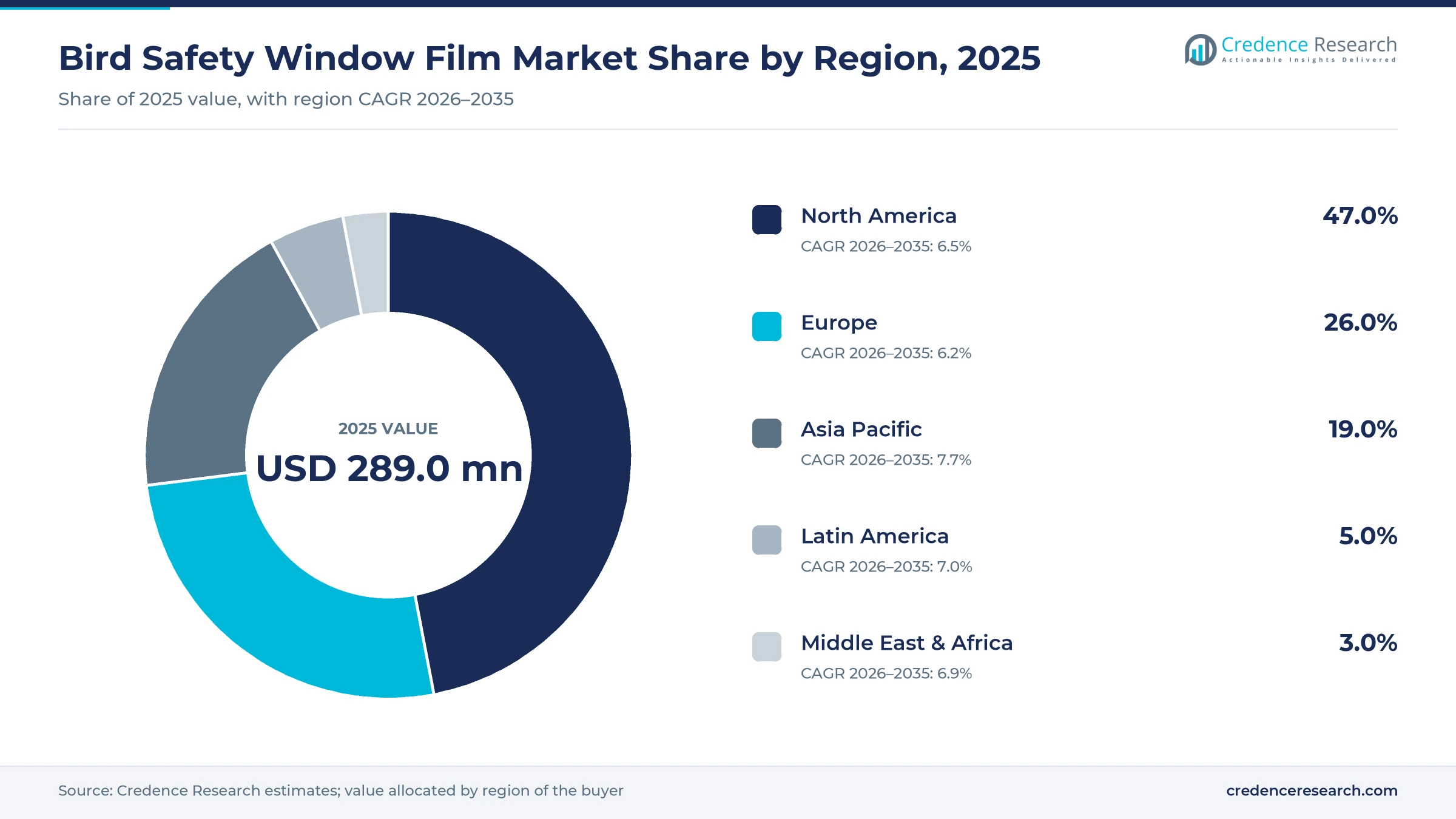
The global bird safety window film market was valued at USD 289.0 million in 2025 and is projected to increase from USD 308.5 million in 2026 to USD 554.3 million by 2035, registering a CAGR of 6.73% during 2026–2035. Demand comes from owners, architects and glaziers who must meet municipal bird-friendly glazing rules on new construction and major facade work, and from facility managers who retrofit existing glass after visible collision events. North America held the largest regional share, 47.0% in 2025, because New York, Washington, Toronto and a growing list of smaller jurisdictions now set tested performance limits for exterior glass. Asia Pacific is the fastest-growing region at 7.7% a year, as South Korea requires public institutions to mark transparent structures. Glass makers have moved bird-safe products from custom runs onto standard coating lines, which lowers the cost gap with ordinary glass. The main restraint is slow product testing, because the American Bird Conservancy rates new patterns in only two North American flight tunnels.
What counts as a bird safety product and how buyers choose one
The estimate counts bird safety window films, applied to the outside or inside of existing glass, and bird safety glass, in which a UV-reflective coating, ceramic frit, acid etch or patterned interlayer is built into the lite. Both work by breaking up reflections with markers that birds read as a barrier, and buyers usually choose them by their tested collision rating. Treated glass is counted with films because the same Threat Factor ratings and city rules qualify both, and films make up about a quarter of 2025 value, with treated glass the rest.
Cords, netting, screens, decals and lighting controls sit outside the estimate, although they address the same problem. Films reach buyers through dealer and installer networks, while bird safety glass is specified by architects and supplied through fabricators and curtain wall contractors on project schedules.

Bird Safety Window Film Market Insights
- The market is valued at USD 289.0 million in 2025 and is projected to reach USD 554.3 million by 2035, growing at a 6.73% CAGR as tested bird-friendly glazing becomes a code item.
- North America led with 47.0% of 2025 value, because New York City, Washington and Toronto set measurable limits for exterior glass.
- Bird Safety Glass held 74.0% of 2025 value, because ordinances covering new construction steer architects toward treated lites rather than applied products.
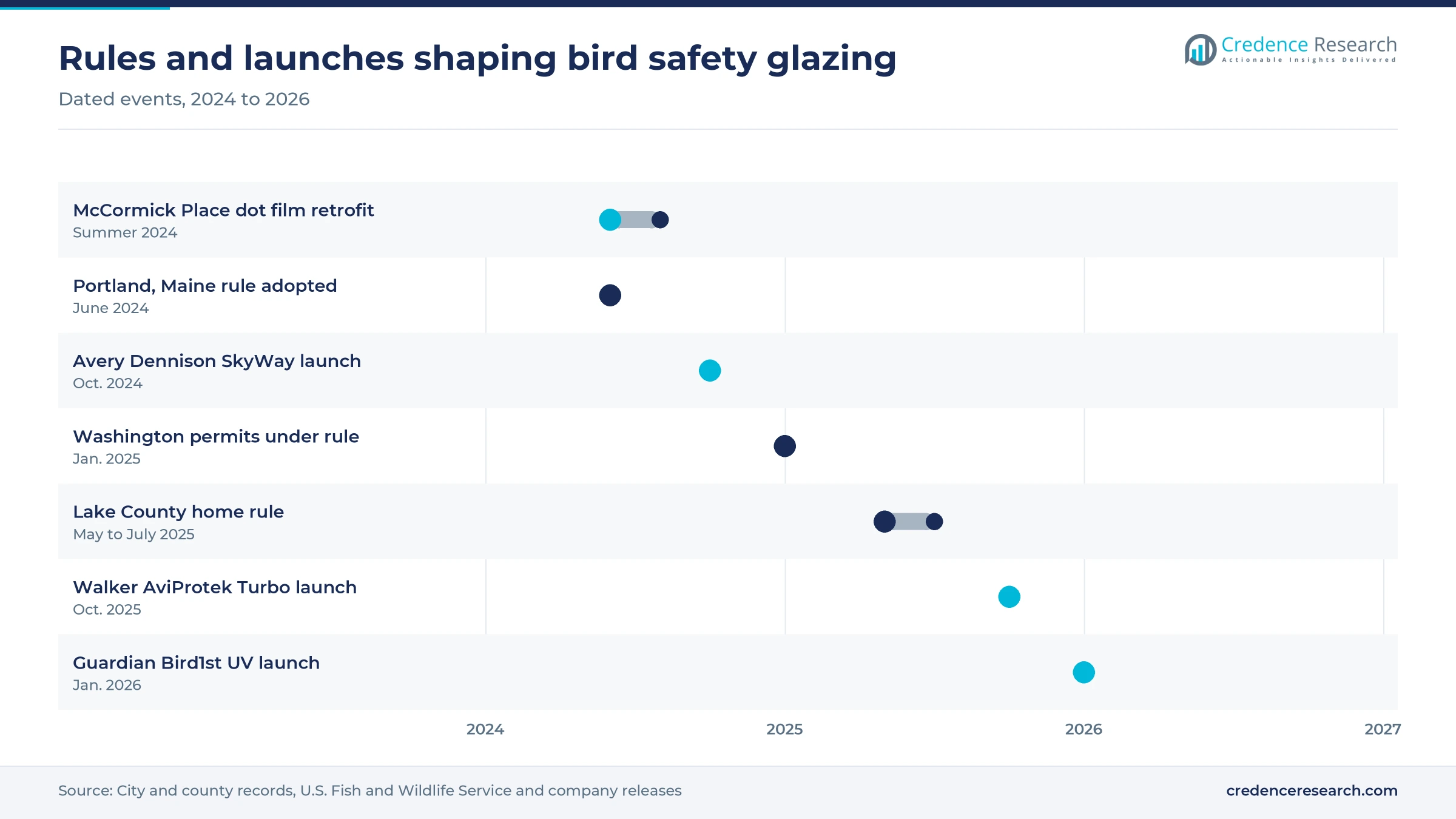
- Lake County, Illinois, approved the first U.S. rule covering new single-family homes on May 12, 2025, which opens a residential retrofit outlet.
- Guardian Glass and Walker Glass moved bird-safe glass onto jumbo sheets and stock programs in 2025 and 2026, narrowing its cost premium.
Treated glass leads while retrofit films grow faster
Why does treated glass lead while films grow faster?
Based on product type, the market is categorized into bird safety window films and bird safety glass. Bird Safety Glass led with 74.0% of 2025 value because ordinances on new construction steer specifiers to factory-made lites, and Walker Glass says it sold and installed over 500,000 square feet of its AviProtek Turbo program after its 2025 launch. Bird Safety Window Films grow fastest at 8.0% a year as owners treat existing glass without replacing it, and Avery Dennison launched SkyWay Bird Film in October 2024 for commercial and residential retrofits.
Why do commercial offices lead and homes grow fastest?
Based on application, the market is categorized into commercial offices, government buildings, museums, schools, residential buildings and others. Commercial Offices led with 34.0% of 2025 value because city rules target large glazed facades, and Washington's law covers new commercial buildings and replacement of at least 75% of exterior glazing on permits filed from Jan. 1, 2025. Residential Buildings grow fastest at 8.3% a year as houses and low-rise buildings account for most collisions, as the federal figures cited in the trends show, and as Lake County, Illinois, extended its rule to new single-family homes in July 2025.
| Segment Group | Leading Sub-segment | Share, 2025 | Fastest-growing Sub-segment | CAGR, 2026–2035 |
|---|---|---|---|---|
| By Product Type | Bird Safety Glass | 74.0% | Bird Safety Window Films | 8.0% |
| By Application | Commercial Offices | 34.0% | Residential Buildings | 8.3% |
Installed area and marker type set the price ladder
Bird safety products are priced per square foot of treated glass, and installation often costs as much as the material for retrofit films. The U.S. Fish and Wildlife Service lists external films at USD 4 to 6 per square foot, or about double with labor, and dot patterns at USD 8. Large retrofits show the scale of a single order, since Chicago's convention center paid over USD 1 million for glass about the size of two football fields, according to NPR. Bird safety glass prices are not published, so its row is a Credence Research estimate. Installers earn much of the retrofit margin, while glass makers compete on coating line cost.
| Product or reference | Typical price or fee | Basis |
|---|---|---|
| External films and coverings, material | USD 4 to 6 per sq ft, about double installed | U.S. Fish and Wildlife Service guidance |
| Dot pattern treatment | About USD 8 per sq ft | U.S. Fish and Wildlife Service guidance |
| Large retrofit, McCormick Place, Chicago | Over USD 1 million for about 120,000 sq ft | NPR, October 2025; U.S. Fish and Wildlife Service, January 2025 |
| Commercial cord curtains, Acopian BirdSavers | About USD 0.58 to 3.41 per sq ft | BirdSavers list prices, November 2026 |
| Bird safety glass premium over standard lite | About USD 8 to 12 per sq ft | Credence Research estimate from coating and frit cost |
Request a Free Sample
Fill in your details and we'll send you a free sample report.
- Sample data tables & charts
- Research methodology
Threat Factor codes and green ratings create demand
Municipal glazing codes set tested performance limits
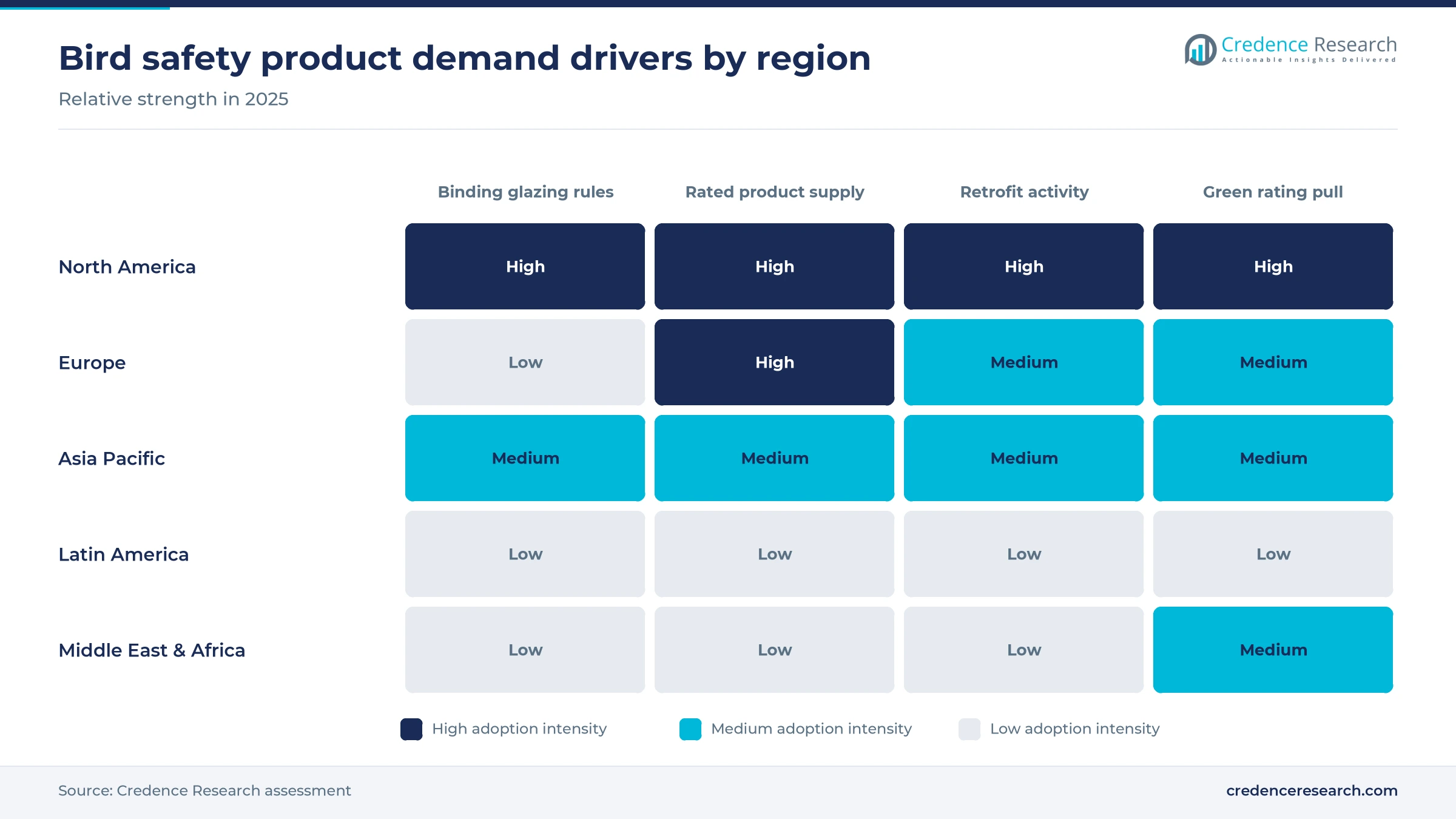
City codes turn bird safety from a voluntary choice into a permit condition, which is the strongest source of demand in this market. New York City guidance requires compliant bird-friendly materials with a Threat Factor of 25 or less, under legislation that took effect on Jan. 10, 2021. Washington applies its rule to permits filed from Jan. 1, 2025, and requires bird-friendly materials up to 100 feet above grade on each facade. Portland, Maine, adopted a rule in June 2024 for new developments over 10,000 square feet, with a maximum Threat Factor of 30. Suppliers with rated products win specification work, while untested patterns lose access to these projects, because a rule written around a test score excludes any product that has not been rated.
Collision mortality data keep owners and cities under pressure
Measured collision losses give regulators and building owners a concrete reason to treat glass. The American Bird Conservancy said in August 2024 that a new PLOS ONE study puts U.S. building-collision deaths well over one billion birds a year, above the earlier range of 365 million to 988 million. In Canada, Environment and Climate Change Canada estimates that windows kill 16 million to 42 million birds a year. A single night in October 2023 killed nearly 1,000 migrants at Chicago's McCormick Place. Such events turn into retrofit orders quickly, because a publicized die-off exposes an owner to public criticism that a treatment program can answer within one season.
Green building ratings reward rated bird-friendly glass
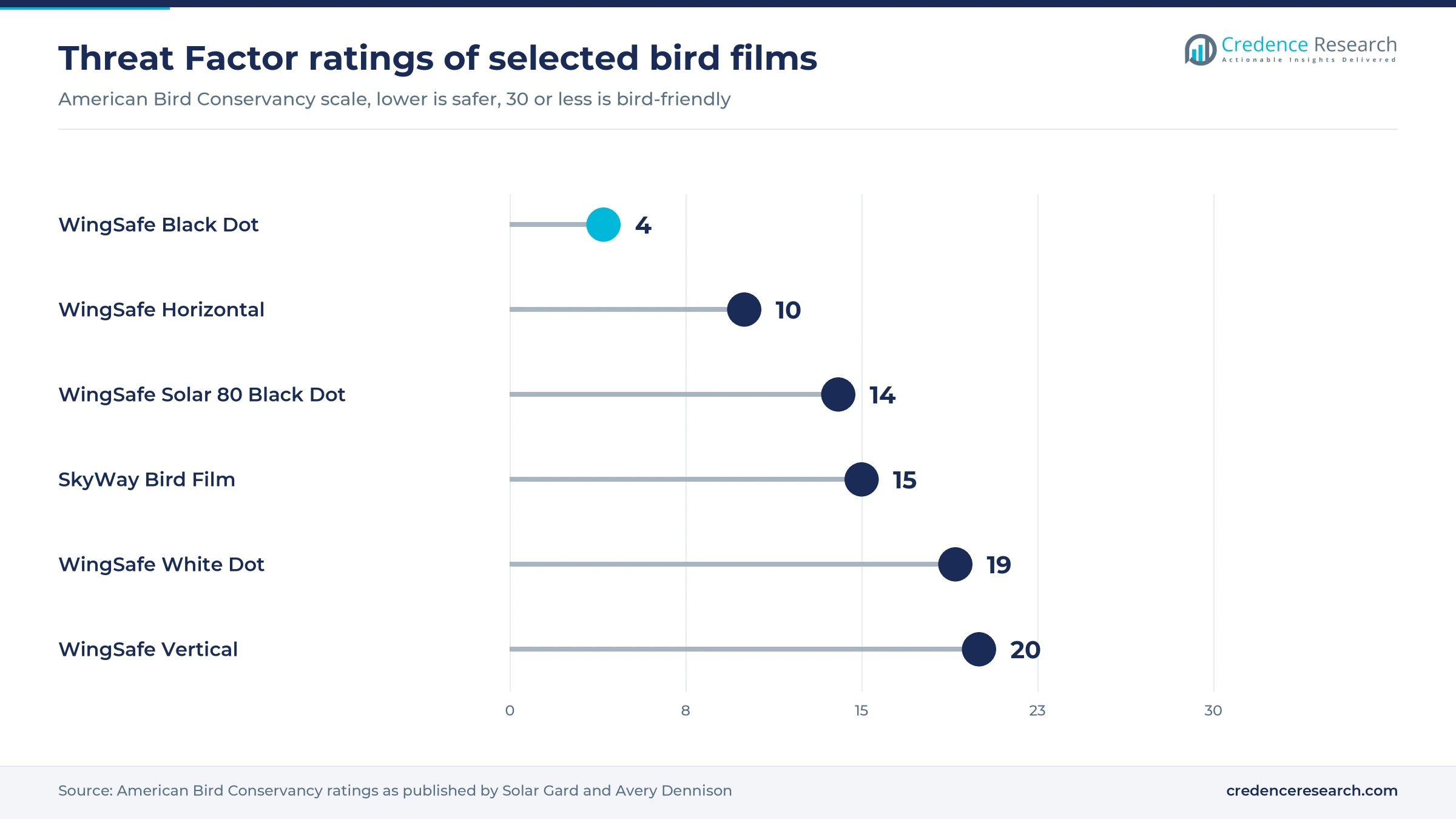
Green building ratings widen demand beyond cities with ordinances, because developers pursue the credits on projects anywhere. The Canada Green Building Council said in April 2026 that the new LEED v5 rating system includes a bird-friendly glass option with a maximum Threat Factor of 30, while Canadian projects can comply through CSA A460:19, reaffirmed in 2024. The City of Toronto has required bird-friendly glass treatment on new development since 2010. Avery Dennison launched SkyWay Bird Film on Oct. 22, 2024, citing GSA, CSA A460 and the LEED v4.1 innovation credit in its release. Products that carry both a Threat Factor rating and CSA compliance can be sold across the United States and Canada on one data sheet, which favors larger suppliers.
Measured retrofit results make treatment easier to justify
Documented results lower the risk for owners who must justify spending on existing buildings. NPR reported in October 2025 that the dot film fitted at Chicago's convention center cut collisions by 95%, after the retrofit priced in the table above. The Field Museum's preliminary monitoring during fall 2024 migration also found the measures worked well, according to the U.S. Fish and Wildlife Service. Avery Dennison reports a Threat Factor of 15 for SkyWay, against the American Bird Conservancy threshold of 30 for a bird-friendly product. Owners of convention centers, campuses and public buildings can now cite measured results when they seek budgets, a case that favors retrofit film suppliers over full glass replacement.
Clearer UV glass and longer-life exterior films emerge
Glass makers shift toward UV patterns that stay nearly clear
Glass makers are shifting toward UV-reflective patterns, applied on the same sputtering lines used for low-e and smart glass coatings, to address architects' resistance to visible markers, creating openings for bird safety glass across offices and museums with large views. Guardian Glass launched Bird1st UV in January 2026, with a patterned exterior coating that reflects up to 75% of UV light and a Threat Factor of 25 or less. Pilkington applies a UV-enhanced pattern to the outer surface of its AviSafe units, and Arnold Glas sells ORNILUX with a patterned UV coating. Fraunhofer ISE showed sputtered reflective dots at glasstec 2024, with only 4% of birds flying into the glass in Austrian tunnel tests. Makers with in-house coating lines gain, because these products need sputtering capacity.
Film suppliers move to durable exterior and solar-control films
Film suppliers are shifting toward longer-lasting exterior products and combined solar-control films, so owners pay for one treatment instead of repeated replacements. Feather Friendly launched Evolution on May 16, 2025, a second-generation material it says is built to last through 40 migrations. Solar Gard, a Saint-Gobain brand, lists a WingSafe Solar 80 Black Dot film with a Threat Factor of 14, which pairs heat control with collision protection. Solyx, sold by Decorative Films, markets a solar bird safety film alongside dot and bar patterns that it says cut strikes by 94% or more. This shift moves the film segment toward higher-value products that facility managers can fund from energy budgets.
Home window rules open a residential retrofit opening
Residential rules create the largest untapped opening, because houses and low-rise buildings take most collisions but were long outside every ordinance. The U.S. Fish and Wildlife Service attributes 44% of glass collision deaths to urban and rural residences and 56% to low-rise buildings of one to four stories. Lake County, Illinois approved a rule for new homes on May 12, 2025, requiring an approved retrofit product or shading on windows without full external screens. Installers and online film sellers that offer kits sized for single windows can reach this segment, which grows at 8.3%, through home builders and window replacement firms.
Public infrastructure in South Korea opens a new buyer group
South Korea creates an opening for markers on public buildings and transparent noise walls, a buyer group that barely exists elsewhere. The country's revised wildlife law requires national agencies, local governments and public institutions to apply line or dot patterns of a set minimum size, and the Ministry of Environment estimates that about 8 million wild birds die each year in collisions with structures. Transparent noise barriers alone account for about 230,000 collisions a year. KCC Glass signed a bird-protection agreement with the National Institute of Ecology in May 2025. Suppliers that can treat acrylic and glass panels on roadside walls can reach procurement budgets beyond buildings, a channel that most film and glass suppliers have not yet built.
Test capacity, stalled rules and retrofit cost hold back
Limited flight tunnel capacity slows product approvals
Testing capacity limits how fast new products reach code markets. The Canada Green Building Council said in April 2026 that the American Bird Conservancy runs tunnels at two North American sites, each testing about 20 to 30 windows a year. Small film and glass makers are most exposed, because a pattern without a Threat Factor cannot be used under the New York or LEED rules. Prescriptive standards such as CSA A460, which set marker size and spacing instead of testing, ease the bottleneck only in Canada.
Stalled and uneven rules leave demand patchy
Regulation is spreading city by city, so demand is uneven and slow outside a few markets. NPR reported in October 2025 that Washington is one of only a few major U.S. cities requiring bird-friendly materials in new construction or major renovations. Glass for Europe noted in May 2024 that Europe has no coherent legislation, and Helsinki's guideline stays non-binding until 2027. Suppliers that built capacity for mandated projects face idle lines where rules stall.
Retrofit costs deter owners without a mandate
Retrofit budgets are the main barrier on existing buildings that no ordinance covers. External film costs USD 4 to 6 per square foot before labor, which roughly doubles the bill, so retrofit demand stays sensitive to building budgets. Owners of older offices and multifamily buildings are most exposed, because they gain no permit benefit from treating glass. Lower-cost options such as cords and tape compete for these buyers, and that competition holds film prices down.
Exterior durability and warranty limits add repeat costs
Exterior films face weathering and cleaning wear that raise lifetime cost compared with treated glass. Decorative Films cites a 3-year warranty on exterior applications of its Solyx bird safety films, far shorter than the service life of a glazing unit. Feather Friendly built its May 2025 Evolution launch around a claimed life of 40 migrations, which shows that durability is now a selling point. Facility managers who choose films therefore face repeat reapplication costs. Suppliers that cannot document longer outdoor life lose specification work to glass on new projects and to longer-life films on retrofits.
North America leads on municipal glazing ordinances
| Region | Value, 2025 (USD million) | Share, 2025 | CAGR, 2026–2035 |
|---|---|---|---|
| North America | 135.8 | 47.0% | 6.5% |
| Europe | 75.1 | 26.0% | 6.2% |
| Asia Pacific | 54.9 | 19.0% | 7.7% |
| Latin America | 14.5 | 5.0% | 7.0% |
| Middle East & Africa | 8.7 | 3.0% | 6.9% |
North America leads on municipal glazing ordinances
North America held 47.0% of 2025 value and grows at 6.5% a year, because it has the densest set of enforceable glazing rules. New York, Washington, Madison, Portland in Maine and Lake County in Illinois require treated glass on covered projects, while Toronto has required treatment since 2010. Walker Glass, Guardian Glass and Pilkington make bird-safe glass for the region, and Avery Dennison, Feather Friendly and Solar Gard sell films through local installers. Demand also benefits from glazing fabricators that handle glass curtain wall projects.
Europe tests products well but lacks binding rules
Europe held 26.0% of 2025 value and grows at 6.2% a year, slower than the market, because buyers rely on nature protection assessments rather than glazing codes. Germany's nature conservation law asks authorities to assess the risk of killing animals before construction, without a fixed threshold, according to Glass for Europe. Austria's Hohenau-Ringelsdorf tunnel gives the region a common test, which supports exports of rated products. Arnold Glas and Pilkington supply UV and patterned glass, and Solar Gard sells WingSafe films in the United Kingdom. Helsinki plans to fold its guideline into construction requirements in 2027, which would add Nordic demand.
Asia Pacific grows on South Korea's public sector rules
Asia Pacific held 19.0% of 2025 value and grows fastest at 7.7% a year, because South Korea obliges public bodies to treat transparent buildings and noise walls. KCC Glass runs a bird-friendly building certification and had certified at least three Seoul public libraries by November 2025 using collision stickers. China, Japan, India and Australia have no comparable national rule, so the regional estimate leans heavily on Korean public procurement and on premium projects that pursue green ratings.
Latin America buys imported films for premium projects
Latin America held 5.0% of 2025 value and grows at 7.0% a year, because demand rests on imported films and glass for corporate, hotel and museum projects rather than on rules. Brazil, Mexico and the rest of the region have no bird-friendly glazing requirement, and rated products are imported. The share is therefore a Credence Research estimate with a wide error range, tied to certified green buildings that use green building materials.
Middle East & Africa remains a small project market
Middle East & Africa held 3.0% of 2025 value and grows at 6.9% a year, because demand comes from a small number of glazed towers, airports and museums that adopt international green ratings. The region has no bird-friendly glazing rule or local producer of rated products, although the Gulf and East Africa lie on major migration routes. The estimate rests on project patterns and carries a wide error range until rules or tender data appear.
Launches and rules marked 2024 to 2026
| Development | Status and market relevance |
|---|---|
| In October 2024, Avery Dennison launched SkyWay Bird Film, a dot-pattern retrofit film rated at a Threat Factor of 15. | Commercial launch; it adds a large film converter with a code-compliant product for commercial and residential retrofits. |
| In May 2025, Lake County, Illinois, approved a bird-friendly rule for new homes, effective July 12, 2025. | Approved and in force; it is the first U.S. rule to require treated or screened windows on new single-family homes. |
| In May 2025, Feather Friendly launched Evolution, a second-generation material it says lasts through 40 migrations. | Product launch; durability claims are the company's own and have not been independently verified. |
| In October 2025, Walker Glass launched its AviProtek Turbo program for high-volume projects and showed it at GlassBuild America. | Operational launch; the company reported over 500,000 square feet sold and a low-e option added in February 2026. |
| In January 2026, Guardian Glass launched Bird1st UV on jumbo sheets with a Threat Factor of 25 or less. | Commercial launch from its Carleton, Michigan coater; it brings UV bird-safe glass to standard low-e production. |
Visual markers decide which products pass the tests
- Dot and line films place opaque or translucent markers on the outer surface, and the Canadian federal guidance calls for gaps no wider than 5 cm.
- UV-reflective coatings reflect ultraviolet light in a pattern birds can see, while people see nearly clear glass, as in Bird1st UV and ORNILUX.
- Ceramic frit and acid etch fuse or etch a permanent pattern into the glass, which suits new facades that need a long service life.
- Patterned interlayers and sputtered dots carry the marker inside laminated glass or as reflective metal dots, the approach Fraunhofer ISE showed in 2024.
Need a Custom Version of This Report?
Tailor the scope, geography, or segments to your exact requirements.
- Custom geography or segment scope
- Direct access to our analyst team
Glass majors and film converters share one test gate
Competition in this market turns on tested ratings, coating capacity and access to architects and installers rather than on list price alone. Guardian Glass, Pilkington and Arnold Glas compete with UV-patterned glass for projects where clear views matter. Walker Glass competes on acid-etched and dot patterns from stock programs with short lead times. In films, Avery Dennison, Solar Gard and Feather Friendly compete on rated patterns and installer reach, while Decorative Films sells Solyx films directly to homeowners and dealers online. Glass makers win most new facades because specifiers write treated lites into curtain wall packages, while film suppliers depend on installer networks that can survey, cut and fit markers on occupied buildings within one migration season. The eight companies profiled below sell rated bird safety films or glass.
How is the supply side organized and where do margins sit?
The supply side of this market is split between two groups that meet at the same test gate. Float glass majors such as Guardian Glass and NSG's Pilkington, and specialty processors such as Walker Glass and Arnold Glas, build markers into the lite and sell through fabricators on project contracts. Film converters such as Avery Dennison, Solar Gard, Decorative Films and Feather Friendly sell through dealer and installer networks, where installation carries much of the margin. Entry barriers sit in Threat Factor ratings, coating capacity and architect specification relationships.
Companies profiled and their roles in this market
| Company | Type | Role in the market |
|---|---|---|
| Avery Dennison Corporation | Film converter | Sells SkyWay Bird Film, a dot-pattern retrofit film rated at a Threat Factor of 15 |
| Saint-Gobain (Solar Gard) | Film converter | Sells WingSafe dot, line and solar-control bird films rated by the American Bird Conservancy |
| Feather Friendly (Convenience Group) | Specialty supplier | Supplies dot-pattern bird collision films for large commercial and public retrofits |
| Decorative Films, LLC (Solyx) | Film converter | Sells Solyx dot, bar and solar bird safety films to dealers and homeowners |
| Walker Glass | Glass processor | Makes AviProtek acid-etched and dot-pattern bird-friendly glass, including the Turbo program |
| Guardian Glass | Float glass maker | Makes Bird1st UV patterned glass on jumbo sheets with SunGuard low-e coatings |
| NSG Group (Pilkington) | Float glass maker | Makes Pilkington AviSafe UV-patterned glass for insulating glass units |
| Arnold Glas | Glass processor | Makes ORNILUX glass with a UV-reflective pattern for insulated and laminated units |
Code-compliant glass and home retrofits set the pace
Credence Research's view is that code-compliant glass for new facades and low-cost retrofits for homes will set the pace of this market. Rules written around Threat Factor scores reward suppliers that hold ratings and coating capacity, so large glass makers are gaining ground on projects. Films keep the retrofit side, where owners need results within one season. Buyers should ask for a Threat Factor of 30 or less, the level LEED v5 and most city rules use to qualify demand, or a CSA A460 statement, and suppliers should expand testing and installer networks before more cities adopt rules.
Earlier estimate rolled forward and checked on area
The report uses 2025 as the base year and forecasts to 2035. The earlier Credence Research estimate for 2024 was rolled forward one year at its own growth rate and tested against an estimate of treated glass and film area multiplied by published per-square-foot prices. Regional and segment shares are Credence Research estimates based on bird-friendly building rules, rated product availability and project evidence. Sources include U.S. and Canadian federal agencies, city building codes, county ordinances, company releases and trade press. No interviews or surveys were conducted for this update of the estimate.
Ordinance spread decides growth through 2035
Growth to 2035 depends on how fast cities and counties turn bird-friendly glazing into permit conditions and whether homes follow commercial buildings into those rules. The base case assumes steady adoption across North American cities, Korean public procurement and LEED projects worldwide. UV-patterned and stock-program glass should keep the larger share on new facades, while films grow faster on retrofits. Testing capacity and installer coverage will decide how quickly smaller suppliers can follow. Outside North America, Korean public procurement for buildings and noise walls should add demand fastest, while Europe waits on binding rules such as Helsinki's planned 2027 requirement.
The pace of new ordinances decides the range of outcomes
The spread of outcomes depends mainly on how many large cities adopt enforceable glazing rules and whether homes join commercial buildings in those rules. Faster testing capacity would bring more rated products to market and lower prices, while stalled ordinances in large cities would leave growth dependent on voluntary green building credits and on retrofits that follow visible die-offs.
| Scenario | CAGR, 2026–2035 | Value, 2035 | What has to hold |
|---|---|---|---|
| Downside | 5.1% | USD 483.9 million | Few new city rules pass and owners defer retrofits on cost grounds |
| Base | 6.73% | USD 554.3 million | Rules keep spreading across North American cities and Korean public buildings |
| Upside | 8.1% | USD 623.3 million | Large cities and residential codes adopt Threat Factor limits and testing capacity grows |
Frequently Asked Questions
How big is the bird safety window film market?
Are bird safety window films effective?
What restrains the bird safety window film market?
What is the Solyx bird safety film?
Does the estimate include bird-friendly glass?
Which region leads the market?
Does South Korea require bird collision protection?
Who are the main bird safety window film suppliers?
Table of Content
Chapter 1 Market Segmentation
- 1.1 Segmentation Framework
- 1.1.1 Product and Service Classification
- 1.1.2 Application and End-Use Classification
- 1.1.3 Technology and Solution Classification
- 1.1.4 Customer and Distribution Channel Classification
- 1.1.5 Geographic Segmentation
- 1.1.6 Market Segment Definitions and Boundaries
- 1.2 By Product Type
- 1.2.1 Bird Safety Glass
- 1.2.2 Bird Safety Window Films
- 1.3 By Application
- 1.3.1 Commercial Offices
- 1.3.2 Government Buildings
- 1.3.3 Museums
- 1.3.4 Schools
- 1.3.5 Residential Buildings
- 1.3.6 Others
Chapter 2 Introduction
- 2.1 Report Objectives and Scope
- 2.2 Product Definition and Industry Terminology
- 2.3 Market Inclusions and Exclusions
- 2.4 Research Process
- 2.4.1 Primary Research and Expert Interviews
- 2.4.2 Secondary Research and Source Review
- 2.4.3 Top-Down and Bottom-Up Estimation
- 2.4.4 Data Triangulation and Verification
- 2.5 Market Size Measurement Basis
- 2.5.1 2025: USD 289.0 million → 2035: USD 554.3 million
- 2.6 Historical and Forecast Reference Periods
- 2.6.1 Historical Period: 2018-2025
- 2.6.2 Base Year: 2025
- 2.6.3 Forecast Period: 2025-2035
- 2.7 Research Assumptions and Limitations
Chapter 3 Executive Summary
- 3.1 Market Snapshot and Key Findings
- 3.2 Base-Year Market Size, 2025
- 3.3 Forecast Market Size, 2035
- 3.4 Revenue and Volume Growth Outlook
- 3.5 Key Demand and Supply Indicators
- 3.6 Leading Market Segments
- 3.7 Fastest-Growing Market Opportunities
- 3.8 Regional Performance Highlights
- 3.9 Technology and Industry Transformation
- 3.10 Competitive Landscape Summary
- 3.11 Analyst View and Strategic Implications
Chapter 4 Global Bird Safety Window Film Market Trends and Developments
- 4.1 Historical Industry Development, 2018-2025
- 4.2 Recent Market Trends and Developments
- 4.3 Demand and Customer Behavior Trends
- 4.4 Technology and Product Innovation
- 4.5 Artificial Intelligence, Automation and Digitalization
- 4.6 Local Manufacturing and Supply Chain Realignment
- 4.7 Industry Partnerships, Mergers and Acquisitions
- 4.8 Sustainability and Circular Economy Developments
- 4.9 Government and Private Sector Investment Trends
- 4.10 Emerging Business Models and Commercialization
- 4.11 Industry Developments and Announcements
Chapter 5 Global Bird Safety Window Film Market Production, Supply and Demand Analysis
- 5.1 Demand Trend and Consumption Analysis, 2018-2025
- 5.2 Demand Forecast, 2025-2035
- 5.3 Production and Output Trend, 2018-2025
- 5.4 Production and Output Forecast, 2025-2035
- 5.5 Installed Capacity and Capacity Utilization
- 5.6 Company-Wise Production Plants and Statistics
- 5.6.1 Installed Production Capacity
- 5.6.2 Actual Production
- 5.6.3 Planned Capacity and Expansion Targets
- 5.7 Supply Chain Structure and Procurement Trends
- 5.8 Supply-Demand Gap and Bottlenecks
- 5.9 Import Dependence and Sourcing Structure
- 5.10 Contract Manufacturing and Outsourcing
- 5.11 Regional Supply and Demand Concentration
Chapter 6 Global Bird Safety Window Film Market Pricing Analysis
- 6.1 Pricing Structure and Measurement
- 6.2 Historical Pricing Trends, 2018-2025
- 6.3 Pricing Outlook, 2025-2035
- 6.4 Average Selling Price and Unit Economics
- 6.5 Pricing by Product and Market Segment
- 6.6 Geographic Pricing Differences
- 6.7 Key Input, Energy, Labor and Logistics Costs
- 6.8 Contract Pricing and Purchasing Models
- 6.9 Pricing Sensitivity and Competitive Positioning
- 6.10 Price, Margin and Profitability Implications
Chapter 7 Global Bird Safety Window Film Market Dynamics
- 7.1 Market Growth Drivers
- 7.1.1 Demand-Side Drivers
- 7.1.2 Technology and Innovation Drivers
- 7.1.3 Infrastructure and Investment Drivers
- 7.1.4 Regulatory and Policy Drivers
- 7.2 Market Restraints
- 7.2.1 Cost and Affordability Constraints
- 7.2.2 Technology and Adoption Barriers
- 7.2.3 Supply Chain and Operational Constraints
- 7.3 Market Challenges
- 7.3.1 Competitive Pressure and Margin Erosion
- 7.3.2 Skills, Infrastructure and Implementation Gaps
- 7.4 Emerging Market Opportunities
- 7.5 Market Dynamics Impact and Time-Horizon Assessment
Chapter 8 Global Bird Safety Window Film Value Chain Analysis
- 8.1 Industry Value Chain Overview
- 8.2 Upstream Suppliers and Critical Inputs
- 8.3 Technology and Component Providers
- 8.4 Manufacturing or Service Delivery
- 8.5 Distribution, Channel Partners and Integrators
- 8.6 Downstream Applications and End Users
- 8.7 Value Addition and Profit Pools
- 8.8 Vertical Integration and Outsourcing
- 8.9 Supplier Concentration and Risk
- 8.10 Supply Chain Localization and Resilience
Chapter 9 Global Bird Safety Window Film Market Regulations and Policies
- 9.1 Relevant Laws, Standards and Compliance Frameworks
- 9.2 Product, Service, Safety and Quality Requirements
- 9.3 Government Policies, Incentives and Subsidies
- 9.4 Imports, Exports and Trade Barriers
- 9.5 Public Procurement and Local Content Requirements
- 9.6 Environmental and Sustainability Compliance
- 9.7 Upcoming Policy Changes and Market Implications
Chapter 10 Global Bird Safety Window Film Market Hotspots and Opportunities
- 10.1 Market Opportunity Mapping and Growth Hotspots
- 10.2 High-Growth Applications and Customer Groups
- 10.3 Underserved Markets and White-Space Opportunities
- 10.4 Emerging Technology and Product Opportunities
- 10.5 New Capacity and Investment Hotspots
- 10.6 Market Entry and Expansion Opportunities
- 10.7 Distribution and Partnership Opportunities
- 10.8 Near-Term and Long-Term Commercial Potential
- 10.9 Opportunity Attractiveness and Execution Risks
Chapter 11 Global Bird Safety Window Film Market Outlook, 2025-2035
- 11.1 Market Size and Analysis
- 11.1.1 Revenue (Market Measurement: 2025: USD 289.0 million → 2035: USD 554.3 million)
- 11.1.2 Market Volume and Quantity Sold
- 11.1.3 Historical Market Size, 2018-2025
- 11.1.4 Base-Year Market Size, 2025
- 11.2 Market Forecast, 2025-2035
- 11.2.1 Revenue Forecast to 2035
- 11.2.2 Volume Forecast to 2035
- 11.2.3 CAGR and Year-on-Year Growth
- 11.2.4 Incremental Revenue Opportunity
- 11.3 Forecast Assumptions and Scenario Analysis
- 11.3.1 Base-Case Forecast
- 11.3.2 Optimistic and Conservative Scenarios
- 11.3.3 Technology, Pricing and Policy Sensitivities
- 11.4 Market Attractiveness and Growth Outlook
Chapter 12 Global Bird Safety Window Film Market Segmentation and Outlook
- 12.1 Segmentation Summary and Market Shares, 2025
- 12.2 Largest and Fastest-Growing Segments
- 12.3 By Product Type - Market Size and Forecast, 2025-2035
- 12.3.1 Segment Definition and Scope
- 12.3.2 Historical Market Size, 2018-2025
- 12.3.3 Revenue Forecast, 2025-2035
- 12.3.4 Volume Forecast, 2025-2035
- 12.3.5 Base-Year Market Share, 2025
- 12.3.6 Segment CAGR and Growth Drivers
- 12.3.7 Subsegment Market Size and Forecast
- 12.3.7.1 Bird Safety Glass
- 12.3.7.2 Bird Safety Window Films
- 12.3.8 Subsegment Pricing and Adoption Trends
- 12.3.9 Leading Suppliers and Competition
- 12.3.10 Regional Demand and Opportunities
- 12.4 By Application - Market Size and Forecast, 2025-2035
- 12.4.1 Segment Definition and Scope
- 12.4.2 Historical Market Size, 2018-2025
- 12.4.3 Revenue Forecast, 2025-2035
- 12.4.4 Volume Forecast, 2025-2035
- 12.4.5 Base-Year Market Share, 2025
- 12.4.6 Segment CAGR and Growth Drivers
- 12.4.7 Subsegment Market Size and Forecast
- 12.4.7.1 Commercial Offices
- 12.4.7.2 Government Buildings
- 12.4.7.3 Museums
- 12.4.7.4 Schools
- 12.4.7.5 Residential Buildings
- 12.4.7.6 Others
- 12.4.8 Subsegment Pricing and Adoption Trends
- 12.4.9 Leading Suppliers and Competition
- 12.4.10 Regional Demand and Opportunities
- 12.5 Segment Growth Comparison
- 12.6 Segment Attractiveness and Priority Matrix
Chapter 13 Global Bird Safety Window Film End-Use and Application Market Outlook
- 13.1 End-Use Industry and Customer Demand Structure
- 13.2 Leading Applications and Customer Groups
- 13.3 End-Use Market Size, Share and Forecast
- 13.4 Major End-Use Industry Deep Dives
- 13.4.1 Customer Requirements and Use Cases
- 13.4.2 Demand and Replacement Cycles
- 13.4.3 Technical and Regulatory Considerations
- 13.4.4 Purchasing and Procurement Models
- 13.4.5 Leading Vendors and Distribution Channels
- 13.4.6 Forecast and Commercial Opportunities
- 13.5 Emerging Applications and Cross-Segment Demand
- 13.6 End-Use Industry Investment Priorities
Chapter 14 Global Bird Safety Window Film Geographic Market Outlook, 2025-2035
- 14.1 Regional Market Size and Share, 2025
- 14.2 Regional Market Forecast, 2025-2035
- 14.3 Regional Pricing, Production and Demand Differences
- 14.4 North America
- 14.4.1 United States
- 14.4.2 Canada
- 14.4.3 Mexico
- 14.5 Europe
- 14.5.1 Germany
- 14.5.2 France
- 14.5.3 Italy
- 14.5.4 United Kingdom
- 14.5.5 Spain
- 14.5.6 Poland
- 14.5.7 Russia
- 14.5.8 Netherlands
- 14.5.9 Belgium
- 14.5.10 Sweden
- 14.5.11 Denmark
- 14.5.12 Norway
- 14.5.13 Rest of Europe
- 14.6 Asia Pacific
- 14.6.1 China
- 14.6.2 India
- 14.6.3 Japan
- 14.6.4 South Korea
- 14.6.5 Thailand
- 14.6.6 Indonesia
- 14.6.7 Vietnam
- 14.6.8 Malaysia
- 14.6.9 Australia
- 14.6.10 Rest of Asia Pacific
- 14.7 Latin America
- 14.7.1 Brazil
- 14.7.2 Argentina
- 14.7.3 Colombia
- 14.7.4 Chile
- 14.7.5 Rest of Latin America
- 14.8 Middle East
- 14.8.1 Saudi Arabia
- 14.8.2 United Arab Emirates
- 14.8.3 Turkey
- 14.8.4 Israel
- 14.8.5 Iran
- 14.8.6 Rest of the Middle East
- 14.9 Africa
- 14.9.1 South Africa
- 14.9.2 Egypt
- 14.9.3 Nigeria
- 14.9.4 Morocco
- 14.9.5 Rest of Africa
- 14.10 Regional Investment, Policy and Supply Chain Differences
- 14.11 Regional Competitive Landscape
- 14.12 Geographic Growth Hotspots
Chapter 15 Global Bird Safety Window Film Technology, Innovation and Sustainability Outlook
- 15.1 Technology Landscape and Maturity
- 15.2 Product, Process and Service Innovation
- 15.3 AI, Automation and Digital Tools in the Industry
- 15.4 Technology Adoption and Performance Benchmarking
- 15.5 Innovation Pipeline and R&D Investment
- 15.6 Patent and Intellectual Property Trends
- 15.7 Energy Efficiency and Resource Management
- 15.8 Sustainability, Recycling and Circularity
- 15.9 Technology Roadmap, 2025-2035
- 15.10 Risks of Obsolescence and Technology Substitution
Chapter 16 Global Bird Safety Window Film Market Key Strategic Imperatives
- 16.1 Growth and Market Entry Priorities
- 16.2 High-Return Products and Segments
- 16.3 Pricing, Profitability and Cost Optimization
- 16.4 Technology Investment and Product Differentiation
- 16.5 Supply Chain Localization and Resilience
- 16.6 Distribution and Customer Acquisition
- 16.7 Partnership, Acquisition and Capacity Strategy
- 16.8 Regional Expansion Priorities
- 16.9 Short-, Medium- and Long-Term Actions
Chapter 17 Competition Outlook
- 17.1 Industry Competition Characteristics
- 17.2 Market Structure and Concentration
- 17.3 Market Share and Competitive Positioning, 2025
- 17.4 Company-Wise Revenue and Product Benchmarking
- 17.5 Production and Service Capacity Benchmarking
- 17.6 Technology, Pricing and Differentiation
- 17.7 Regional Footprint and Distribution Strength
- 17.8 Mergers, Acquisitions and Strategic Alliances
- 17.9 New Entrants and Competitive Threats
- 17.10 Porter's Five Forces and Industry Attractiveness
- 17.11 Competitive Outlook, 2025-2035
Chapter 18 Company Profiles
- 18.1 Company Coverage and Selection Criteria
- 18.2 Avery Dennison Corporation
- 18.2.1 Business Description
- 18.2.2 Company Ownership and Geographic Presence
- 18.2.3 Product and Service Portfolio
- 18.2.4 Manufacturing and Operating Footprint
- 18.2.5 Production Capacity and Expansion Plans
- 18.2.6 Financial Performance and Investment
- 18.2.7 Market Share and Competitive Position
- 18.2.8 Technology and Innovation Capabilities
- 18.2.9 Strategic Alliances or Partnerships
- 18.2.10 Recent Developments
- 18.2.11 Growth Strategy and Outlook
- 18.3 Saint-Gobain (Solar Gard)
- 18.4 Feather Friendly (Convenience Group)
- 18.5 Decorative Films, LLC (Solyx)
- 18.6 Walker Glass
- 18.7 Guardian Glass
- 18.8 NSG Group (Pilkington)
- 18.9 Arnold Glas
- 18.10 Other Relevant Market Participants
Note: Every listed company is profiled on the structure shown under the first company. The company list is preliminary and may change based on research findings, market developments, data availability and client requirements.
Chapter 19 Disclaimer
- 19.1 Research and Forecast Disclaimer
- 19.2 Data Source and Estimation Limitations
Note: The depth of individual sections depends on data availability for this market. Volume, capacity, trade and other unit-based metrics are included where applicable.

