Market overview
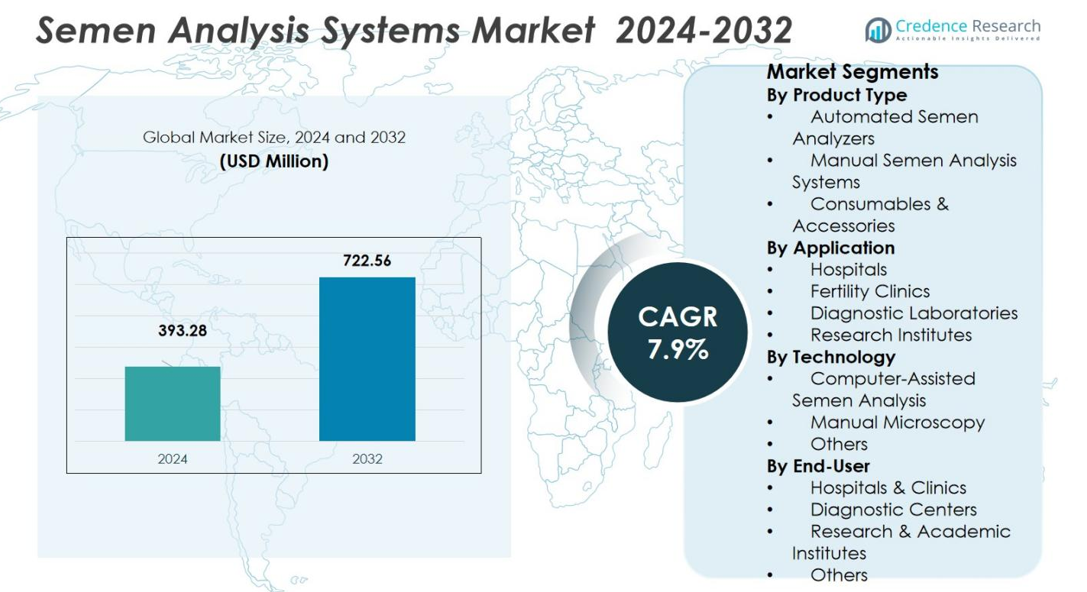
The Semen Analysis Systems Market was valued at USD 393.28 Million in 2024 and is anticipated to reach USD 722.56 Million by 2032, growing at a CAGR of 7.9% during the forecast period.
| REPORT ATTRIBUTE | DETAILS |
|---|---|
| Historical Period | 2020-2023 |
| Base Year | 2024 |
| Forecast Period | 2025-2032 |
| Semen Analysis Systems Market Size 2024 | USD 393.28 Million |
| Semen Analysis Systems Market, CAGR | 7.9% |
| Semen Analysis Systems Market Size 2032 | USD 722.56 Million |
The Semen Analysis Systems Market is anchored by leading players such as Hamilton Thorne, Inc., CooperSurgical, Inc., Microptic S.L., Merck KGaA, Medical Electronic Systems (MES), GenePro, Inc., IMV Technologies, Proiser R+D S.L., Bioline Technologies and DiagnoSwiss Sàrl. North America leads the global market with a share of 40%, supported by advanced healthcare infrastructure and widespread adoption of fertility diagnostics. Europe commands 30%, bolstered by high‑penetration fertility clinics and strong regulatory frameworks. Asia‑Pacific accounts for 20%, driven by expanding healthcare access, growing infertility awareness and rising ART volumes. The combined leadership of these players and regions underpins market growth, innovation adoption and geographic expansion.
Market Insights
- The Semen Analysis Systems Market was valued at USD 393.28 Million in 2024 and is anticipated to reach USD 722.56 Million by 2032, growing at a CAGR of 7.9% during the forecast period.
- Increasing male infertility rates and growing awareness of male reproductive health are key drivers of market growth, pushing demand for accurate semen analysis systems.
- Technological advancements, such as computer-assisted semen analysis (CASA) and automation, are shaping market trends, improving diagnostic efficiency, and reducing human error in laboratories and fertility clinics.
- Key players like Hamilton Thorne, CooperSurgical, and Microptic dominate the market, focusing on innovation, AI integration, and expanding consumables offerings to capture demand across fertility clinics, diagnostic labs, and research institutes.
- North America leads with 40% of the market share, followed by Europe with 30%. Asia-Pacific shows the highest growth potential, with a market share of 20%, driven by increasing ART adoption and healthcare infrastructure development.
Market Segmentation Analysis:
By Product Type
In the semen analysis systems market, the consumables & accessories segment leads with a market share of 50%. This dominance is driven by the continuous demand for disposable items such as slides, reagents, and sample preparation kits. These products generate recurring revenue through repeat purchases, providing steady growth for the segment. The rise in automation and increased testing volumes in laboratories and fertility clinics further boost the demand for consumables, making them the primary driver in the market.
- For instance, ChemoMetec’s NucleoCounter SP-100 automated sperm cell counter requires dedicated SP1-Cassette sampling devices, S100 lysis buffer reagents, and phosphate-buffered saline solutions for routine measurements, creating ongoing consumables usage with each semen analysis run.
By Application
The fertility clinics segment is the dominant player in the semen analysis systems market, holding a share of 40%. The growing number of assisted reproductive technologies (ART) procedures, such as IVF and ICSI, significantly contribute to the segment’s strong position. Fertility clinics increasingly rely on advanced semen analysis systems for accurate diagnostics and improved patient outcomes. This trend, coupled with the rise in male infertility diagnoses, continues to drive the segment’s growth.
- For instance, fertility networks like Australia’s Monash IVF employ automated semen assessment tools to ensure faster, objective results for male infertility evaluations.
By Technology
In terms of technology, computer-assisted semen analysis (CASA) leads with a market share of 55%. CASA’s popularity is attributed to its ability to automate semen analysis, offering higher accuracy, reproducibility, and efficiency compared to manual microscopy. As fertility clinics and diagnostic laboratories adopt more advanced technologies to meet growing demand and improve diagnostic precision, CASA remains the primary choice for semen analysis, contributing significantly to the market's expansion.
Key Growth Drivers
Increasing Male Infertility Cases
The rising prevalence of male infertility is a major driver of the semen analysis systems market. As more men face fertility challenges due to factors such as lifestyle changes, environmental pollution, and delayed parenthood, the demand for accurate semen analysis systems has surged. Infertility treatments like in vitro fertilization (IVF) and intra-cytoplasmic sperm injection (ICSI) heavily rely on precise sperm analysis, creating a consistent need for advanced semen testing solutions. This growing focus on male fertility drives market expansion, particularly in fertility clinics and hospitals.
- For instance, Proiser, part of the ARQUIMEA Group, offers advanced CASA systems capable of analyzing over 80,000 sperm cells per analysis with simultaneous assessment of motility, concentration, and morphology, serving both clinical and research labs.
Technological Advancements in Semen Analysis Systems
Innovations in computer-assisted semen analysis (CASA) and automation technologies are accelerating the growth of the semen analysis systems market. The integration of AI, machine learning, and digital imaging into semen testing systems improves accuracy, efficiency, and reproducibility. These advancements enable faster results with minimal operator error, enhancing the overall patient experience in clinical settings. Additionally, the introduction of automated systems reduces the dependency on skilled technicians, making semen analysis more accessible and cost-effective, further boosting adoption across various healthcare facilities.
- For instance, Mojo AISA leverages artificial intelligence and deep learning algorithms to deliver semen analysis results 50% faster than manual methods while enhancing accuracy and consistency across different labs.
Rising Awareness of Male Fertility Testing
There is an increasing awareness of male fertility, with more men opting for testing and treatment. This awareness is fueled by educational campaigns, fertility clinics, and social media, leading to greater acceptance of male fertility testing as a routine part of reproductive health. As societal norms evolve and the stigma surrounding male infertility decreases, more couples are seeking professional help for fertility issues. This growing openness is contributing to a steady rise in the use of semen analysis systems, thus driving market growth.
Key Trends & Opportunities
Shift Toward Point-of-Care Testing
Point-of-care (POC) testing is becoming an increasingly popular trend in the semen analysis systems market. With rising demand for faster and more accessible fertility diagnostics, POC testing allows patients to receive accurate results in real-time without the need for extensive lab visits. Mobile, portable devices equipped with advanced semen analysis technology are enabling clinics and healthcare providers to offer instant testing and on-the-spot fertility assessments. This shift is expected to provide significant opportunities for manufacturers of compact, easy-to-use semen analysis systems, especially in emerging markets.
- For instance, Ember Fertility operates its own in-house lab for semen analysis, delivering same-day or 24-hour turnaround results, which significantly speeds up the diagnosis and treatment planning process for male infertility.
Integration of Artificial Intelligence and Automation
The integration of artificial intelligence (AI) and machine learning (ML) into semen analysis systems presents a major opportunity for market growth. AI-powered systems are improving the precision and speed of semen analysis, allowing for more detailed sperm morphology and motility assessments. Automated systems that utilize AI algorithms for sperm counting and analysis are revolutionizing the fertility industry by reducing human error and enhancing consistency. This trend is expected to foster innovation in semen analysis systems, expanding market reach and providing opportunities for companies to lead with cutting-edge solutions.
- For instance, Bonraybio’s LENSHooke X1 Pro, an AI-enhanced automated semen analysis system that provides comprehensive evaluation of sperm parameters such as morphology, concentration, and motility with improved consistency compared to conventional techniques.
Key Challenges
High Initial Investment Costs
One of the key challenges in the semen analysis systems market is the high initial investment required for advanced automated and computer-assisted systems. While these systems provide substantial benefits in terms of accuracy, efficiency, and scalability, the high cost of equipment can be a barrier for smaller fertility clinics and diagnostic laboratories. The upfront costs for purchasing and maintaining these sophisticated systems, coupled with the need for skilled personnel to operate them, may deter some healthcare providers from adopting advanced semen analysis solutions, limiting market penetration in cost-sensitive regions.
Regulatory and Standardization Barriers
The semen analysis systems market faces challenges in terms of regulatory hurdles and the lack of standardization. While the technology is advancing rapidly, regulatory bodies in different regions may have varying approval processes, which can delay product launches and market expansion. Furthermore, discrepancies in semen analysis protocols and a lack of standardized testing methods make it difficult for healthcare providers to ensure consistent results across different systems. This challenge can impede the adoption of new technologies and complicate global market expansion for key players in the industry.
Regional Analysis
North America
North America holds a dominant position in the semen analysis systems market, accounting for 40% of the global market share in 2024. The strong market presence is primarily driven by high healthcare standards, advanced fertility treatments, and widespread awareness of male infertility. The region also benefits from a well-established network of fertility clinics and diagnostic laboratories, which are increasingly adopting automated and AI-driven semen analysis technologies. Additionally, government support for healthcare innovations and high per capita healthcare expenditure further fuel market growth in North America, particularly in the U.S.
Europe
Europe represents a significant share of the global semen analysis systems market, capturing 30% of the market in 2024. The region’s growth is driven by increasing male infertility awareness, the rising number of assisted reproductive technologies (ART) procedures, and stringent regulations supporting the healthcare sector. Key players in Europe are adopting cutting-edge semen analysis technologies, integrating AI and automation to enhance diagnostic accuracy. Additionally, high healthcare expenditure and the expansion of fertility clinics in countries like Germany, the UK, and France are major contributors to the market's growth within the region.
Asia-Pacific
Asia-Pacific is the fastest-growing region in the semen analysis systems market, contributing 20% to the global market in 2024. This rapid growth is attributed to the rising prevalence of male infertility, increasing awareness of reproductive health, and the expansion of healthcare infrastructure in countries like China, India, and Japan. The demand for affordable fertility treatments, coupled with the increasing number of ART procedures, has spurred the adoption of semen analysis systems in the region. Additionally, growing middle-class populations and rising disposable income are driving market expansion across Asia-Pacific.
Latin America
Latin America holds a moderate share of 5% in the semen analysis systems market, with steady growth driven by increasing awareness of male fertility and the expansion of fertility clinics. In countries like Brazil and Mexico, there is a growing focus on improving reproductive health services, and government initiatives are helping to raise awareness about male infertility. Although the market is smaller compared to North America and Europe, the rising demand for ART procedures and the availability of cost-effective testing solutions are expected to accelerate the adoption of semen analysis systems in the region.
Middle East & Africa
The Middle East & Africa region accounts for 5% of the global semen analysis systems market, with the market growing due to the rising prevalence of male infertility and the expanding healthcare infrastructure. Countries such as Saudi Arabia, the UAE, and South Africa are investing heavily in advanced healthcare technologies, including fertility diagnostics. Increasing awareness of male reproductive health and the availability of high-quality healthcare services are driving the demand for semen analysis systems. However, challenges like economic disparities and regulatory constraints may impact the region's overall market growth.
Market Segmentations:
By Product Type
- Automated Semen Analyzers
- Manual Semen Analysis Systems
- Consumables & Accessories
By Application
- Hospitals
- Fertility Clinics
- Diagnostic Laboratories
- Research Institutes
By Technology
- Computer-Assisted Semen Analysis
- Manual Microscopy
- Others
By End-User
- Hospitals & Clinics
- Diagnostic Centers
- Research & Academic Institutes
- Others
By Geography
- North America
- U.S.
- Canada
- Mexico
- Europe
- Germany
- France
- U.K.
- Italy
- Spain
- Rest of Europe
- Asia Pacific
- China
- Japan
- India
- South Korea
- South-east Asia
- Rest of Asia Pacific
- Latin America
- Brazil
- Argentina
- Rest of Latin America
- Middle East & Africa
- GCC Countries
- South Africa
- Rest of the Middle East and Africa
Competitive Landscape
Major key players, such as Hamilton Thorne, Inc., CooperSurgical, Inc., Microptic S.L., Merck KGaA, Medical Electronic Systems (MES), GenePro, Inc., IMV Technologies, Proiser R+D S.L., Bioline Technologies, and DiagnoSwiss Sàrl-are actively shaping the global semen analysis systems market. These companies compete through technological innovation, product portfolio expansion, and strategic partnerships. They increasingly focus on automating semen analysis, particularly through computer-assisted systems, and expanding their global distribution networks. Additionally, they emphasize the growth of consumables and accessories to capture rising demand across fertility clinics, diagnostic laboratories, and research institutes. The competitive environment remains intense as both established players and new entrants strive to secure market share in regions with increasing awareness of male infertility and the expansion of assisted reproductive technology (ART) services. This has led to frequent new product launches, acquisitions, and strategic moves to enhance cost-efficiency and regional market penetration.
Key Player Analysis
- Hamilton Thorne, Inc.
- CooperSurgical, Inc.
- Microptic S.L.
- Merck KGaA
- Medical Electronic Systems (MES)
- GenePro, Inc.
- IMV Technologies
- Proiser R+D S.L.
- Bioline Technologies
- DiagnoSwiss Sàrl
Recent Developments
- In September 2025, Femasys Inc. partnered with Medical Electronic Systems LLC to launch the FemSperm™ Analysis Kit for use with FemaSeed® intratubal insemination.
- In June 2025, Bonraybio Co., Ltd. received U.S. FDA 510(k) clearance for its LensHooke X12 PRO semen analysis system incorporating sperm DNA‑fragmentation testing.
- In January 2025, Hamilton Thorne Ltd. entered into an agreement to acquire FUJIFILM Irvine Scientific’s ART and cytogenetics product offerings.
Report Coverage
The research report offers an in-depth analysis based on Product Type, Application, Technology, End User and Geography. It details leading market players, providing an overview of their business, product offerings, investments, revenue streams, and key applications. Additionally, the report includes insights into the competitive environment, SWOT analysis, current market trends, as well as the primary drivers and constraints. Furthermore, it discusses various factors that have driven market expansion in recent years. The report also explores market dynamics, regulatory scenarios, and technological advancements that are shaping the industry. It assesses the impact of external factors and global economic changes on market growth. Lastly, it provides strategic recommendations for new entrants and established companies to navigate the complexities of the market.
Future Outlook
- Adoption of advanced automation and AI-powered platforms will drive higher throughput and improve diagnostic precision in semen‑analysis systems.
- Expansion of fertility services in emerging markets will create new demand for semen‑analysis systems and related consumables.
- Growing awareness of male reproductive health among men and couples will lead to increased routine semen testing and monitoring.
- Integration of mobile and point‑of‑care devices will enable convenient at‑home semen analysis, opening new channels for growth.
- Rising investment in healthcare infrastructure and assisted reproductive technologies (ART) will expand installation of semen‑analysis systems in clinics and labs.
- Strategic partnerships between device manufacturers and fertility networks will accelerate market penetration and boost recurring consumables sales.
- The shift toward personalized fertility treatments and precision diagnostics will increase demand for detailed semen‑analysis metrics and new system features.
- Enhanced regulatory focus and standardisation of semen‑analysis protocols will improve market clarity and drive adoption of validated instruments.
- Emerging veterinary and animal‑breeding applications will complement the human‑fertility segment and broaden system usage.
- Growing replacement cycles for legacy manual microscopy systems will prompt upgrades to modern computer‑assisted semen‑analysis platforms.

Request a Free Sample
Fill in your details and we'll send you a free sample report.
- Sample data tables & charts
- Research methodology
Market Dynamics
Increasing Male Infertility Cases
The rising prevalence of male infertility due to lifestyle changes, environmental factors, and delayed parenthood is driving demand for accurate semen analysis systems, especially as ART procedures like IVF and ICSI rely on precise sperm diagnostics.
Technological Advancements in Semen Analysis
Innovations such as computer-assisted semen analysis (CASA), automation, and AI integration are improving diagnostic accuracy, efficiency, and reproducibility, making advanced semen analysis systems more attractive to clinics and laboratories.
Rising Awareness of Male Fertility Testing
Educational campaigns, social media, and evolving societal norms are increasing awareness and acceptance of male fertility testing, leading to higher rates of routine semen analysis and boosting market growth.
Shift Toward Point-of-Care and At-Home Testing
The demand for faster, more accessible fertility diagnostics is driving the adoption of mobile and point-of-care semen analysis devices, enabling real-time results and expanding the market to new user segments.
Expansion of Fertility Services in Emerging Markets
Growing healthcare infrastructure, rising disposable incomes, and increased ART adoption in Asia-Pacific and other emerging regions are creating new opportunities for semen analysis system installations and consumables sales.
Need a Custom Version of This Report?
Tailor the scope, geography, or segments to your exact requirements.
- Custom geography or segment scope
- Direct access to our analyst team
Frequently Asked Questions
What is the current market size for Semen Analysis Systems Market, and what is its projected size in 2032?
At what Compound Annual Growth Rate is the Semen Analysis Systems Market projected to grow between 2025 and 2032?
In terms of the type of semen analysis system, which market category is in the lead?
Which segment is leading the market in terms of parameters analyzed?
In which region is the market for semen analysis systems expanding?
Who are the key participants in the market for semen analysis systems globally?
What are the main market factors driving the semen analysis systems sector?
What are the main market opportunities for the semen analysis systems sector?
Who are the leading companies in the Semen Analysis Systems Market
Table of Content
Chapter 1 Market Segmentation
- 1.1 Segmentation Framework
- 1.1.1 Product and Service Classification
- 1.1.2 Application and End-Use Classification
- 1.1.3 Technology and Solution Classification
- 1.1.4 Customer and Distribution Channel Classification
- 1.1.5 Geographic Segmentation
- 1.1.6 Market Segment Definitions and Boundaries
- 1.2 By End-User
- 1.2.1 Hospitals & Clinics
- 1.2.2 Diagnostic Centers
- 1.2.3 Research & Academic Institutes
- 1.2.4 Others
- 1.3 By Technology
- 1.3.1 Computer-Assisted Semen Analysis
- 1.3.2 Manual Microscopy
- 1.3.3 Others
- 1.4 By Application
- 1.4.1 Hospitals
- 1.4.2 Fertility Clinics
- 1.4.3 Diagnostic Laboratories
- 1.4.4 Research Institutes
- 1.5 By Product Type
- 1.5.1 Automated Semen Analyzers
- 1.5.2 Manual Semen Analysis Systems
- 1.5.3 Consumables & Accessories
Chapter 2 Introduction
- 2.1 Report Objectives and Scope
- 2.2 Product Definition and Industry Terminology
- 2.3 Market Inclusions and Exclusions
- 2.4 Research Process
- 2.4.1 Primary Research and Expert Interviews
- 2.4.2 Secondary Research and Source Review
- 2.4.3 Top-Down and Bottom-Up Estimation
- 2.4.4 Data Triangulation and Verification
- 2.5 Market Size Measurement Basis
- 2.5.1 2024: USD 393.28 Million → 2032: USD 722.56 Million
- 2.6 Historical and Forecast Reference Periods
- 2.6.1 Base Year: 2024
- 2.6.2 Forecast Period: 2024-2032
- 2.7 Research Assumptions and Limitations
Chapter 3 Executive Summary
- 3.1 Market Snapshot and Key Findings
- 3.2 Base-Year Market Size, 2024
- 3.3 Forecast Market Size, 2032
- 3.4 Revenue and Volume Growth Outlook
- 3.5 Key Demand and Supply Indicators
- 3.6 Leading Market Segments
- 3.7 Fastest-Growing Market Opportunities
- 3.8 Regional Performance Highlights
- 3.9 Technology and Industry Transformation
- 3.10 Competitive Landscape Summary
- 3.11 Analyst View and Strategic Implications
Chapter 4 Global Semen Analysis Systems Market Trends and Developments
- 4.1 Historical Industry Development
- 4.2 Recent Market Trends and Developments
- 4.3 Demand and Customer Behavior Trends
- 4.4 Technology and Product Innovation
- 4.5 Artificial Intelligence, Automation and Digitalization
- 4.6 Local Manufacturing and Supply Chain Realignment
- 4.7 Industry Partnerships, Mergers and Acquisitions
- 4.8 Sustainability and Circular Economy Developments
- 4.9 Government and Private Sector Investment Trends
- 4.10 Emerging Business Models and Commercialization
- 4.11 Industry Developments and Announcements
Chapter 5 Global Semen Analysis Systems Market Production, Supply and Demand Analysis
- 5.1 Demand Trend and Consumption Analysis
- 5.2 Demand Forecast, 2024-2032
- 5.3 Production and Output Trend
- 5.4 Production and Output Forecast, 2024-2032
- 5.5 Installed Capacity and Capacity Utilization
- 5.6 Company-Wise Production Plants and Statistics
- 5.6.1 Installed Production Capacity
- 5.6.2 Actual Production
- 5.6.3 Planned Capacity and Expansion Targets
- 5.7 Supply Chain Structure and Procurement Trends
- 5.8 Supply-Demand Gap and Bottlenecks
- 5.9 Import Dependence and Sourcing Structure
- 5.10 Contract Manufacturing and Outsourcing
- 5.11 Regional Supply and Demand Concentration
Chapter 6 Global Semen Analysis Systems Market Pricing Analysis
- 6.1 Pricing Structure and Measurement
- 6.2 Historical Pricing Trends
- 6.3 Pricing Outlook, 2024-2032
- 6.4 Average Selling Price and Unit Economics
- 6.5 Pricing by Product and Market Segment
- 6.6 Geographic Pricing Differences
- 6.7 Key Input, Energy, Labor and Logistics Costs
- 6.8 Contract Pricing and Purchasing Models
- 6.9 Pricing Sensitivity and Competitive Positioning
- 6.10 Price, Margin and Profitability Implications
Chapter 7 Global Semen Analysis Systems Market Dynamics
- 7.1 Market Growth Drivers
- 7.1.1 Demand-Side Drivers
- 7.1.2 Technology and Innovation Drivers
- 7.1.3 Infrastructure and Investment Drivers
- 7.1.4 Regulatory and Policy Drivers
- 7.2 Market Restraints
- 7.2.1 Cost and Affordability Constraints
- 7.2.2 Technology and Adoption Barriers
- 7.2.3 Supply Chain and Operational Constraints
- 7.3 Market Challenges
- 7.3.1 Competitive Pressure and Margin Erosion
- 7.3.2 Skills, Infrastructure and Implementation Gaps
- 7.4 Emerging Market Opportunities
- 7.5 Market Dynamics Impact and Time-Horizon Assessment
Chapter 8 Global Semen Analysis Systems Value Chain Analysis
- 8.1 Industry Value Chain Overview
- 8.2 Upstream Suppliers and Critical Inputs
- 8.3 Technology and Component Providers
- 8.4 Manufacturing or Service Delivery
- 8.5 Distribution, Channel Partners and Integrators
- 8.6 Downstream Applications and End Users
- 8.7 Value Addition and Profit Pools
- 8.8 Vertical Integration and Outsourcing
- 8.9 Supplier Concentration and Risk
- 8.10 Supply Chain Localization and Resilience
Chapter 9 Global Semen Analysis Systems Market Regulations and Policies
- 9.1 Relevant Laws, Standards and Compliance Frameworks
- 9.2 Product, Service, Safety and Quality Requirements
- 9.3 Government Policies, Incentives and Subsidies
- 9.4 Imports, Exports and Trade Barriers
- 9.5 Public Procurement and Local Content Requirements
- 9.6 Environmental and Sustainability Compliance
- 9.7 Upcoming Policy Changes and Market Implications
Chapter 10 Global Semen Analysis Systems Market Hotspots and Opportunities
- 10.1 Market Opportunity Mapping and Growth Hotspots
- 10.2 High-Growth Applications and Customer Groups
- 10.3 Underserved Markets and White-Space Opportunities
- 10.4 Emerging Technology and Product Opportunities
- 10.5 New Capacity and Investment Hotspots
- 10.6 Market Entry and Expansion Opportunities
- 10.7 Distribution and Partnership Opportunities
- 10.8 Near-Term and Long-Term Commercial Potential
- 10.9 Opportunity Attractiveness and Execution Risks
Chapter 11 Global Semen Analysis Systems Market Outlook, 2024-2032
- 11.1 Market Size and Analysis
- 11.1.1 Revenue (Market Measurement: 2024: USD 393.28 Million → 2032: USD 722.56 Million)
- 11.1.2 Market Volume and Quantity Sold
- 11.1.3 Historical Market Size
- 11.1.4 Base-Year Market Size, 2024
- 11.2 Market Forecast, 2024-2032
- 11.2.1 Revenue Forecast to 2032
- 11.2.2 Volume Forecast to 2032
- 11.2.3 CAGR and Year-on-Year Growth
- 11.2.4 Incremental Revenue Opportunity
- 11.3 Forecast Assumptions and Scenario Analysis
- 11.3.1 Base-Case Forecast
- 11.3.2 Optimistic and Conservative Scenarios
- 11.3.3 Technology, Pricing and Policy Sensitivities
- 11.4 Market Attractiveness and Growth Outlook
Chapter 12 Global Semen Analysis Systems Market Segmentation and Outlook
- 12.1 Segmentation Summary and Market Shares, 2024
- 12.2 Largest and Fastest-Growing Segments
- 12.3 By End-User - Market Size and Forecast, 2024-2032
- 12.3.1 Segment Definition and Scope
- 12.3.2 Historical Market Size
- 12.3.3 Revenue Forecast, 2024-2032
- 12.3.4 Volume Forecast, 2024-2032
- 12.3.5 Base-Year Market Share, 2024
- 12.3.6 Segment CAGR and Growth Drivers
- 12.3.7 Subsegment Market Size and Forecast
- 12.3.7.1 Hospitals & Clinics
- 12.3.7.2 Diagnostic Centers
- 12.3.7.3 Research & Academic Institutes
- 12.3.7.4 Others
- 12.3.8 Subsegment Pricing and Adoption Trends
- 12.3.9 Leading Suppliers and Competition
- 12.3.10 Regional Demand and Opportunities
- 12.4 By Technology - Market Size and Forecast, 2024-2032
- 12.4.1 Segment Definition and Scope
- 12.4.2 Historical Market Size
- 12.4.3 Revenue Forecast, 2024-2032
- 12.4.4 Volume Forecast, 2024-2032
- 12.4.5 Base-Year Market Share, 2024
- 12.4.6 Segment CAGR and Growth Drivers
- 12.4.7 Subsegment Market Size and Forecast
- 12.4.7.1 Computer-Assisted Semen Analysis
- 12.4.7.2 Manual Microscopy
- 12.4.7.3 Others
- 12.4.8 Subsegment Pricing and Adoption Trends
- 12.4.9 Leading Suppliers and Competition
- 12.4.10 Regional Demand and Opportunities
- 12.5 By Application - Market Size and Forecast, 2024-2032
- 12.5.1 Segment Definition and Scope
- 12.5.2 Historical Market Size
- 12.5.3 Revenue Forecast, 2024-2032
- 12.5.4 Volume Forecast, 2024-2032
- 12.5.5 Base-Year Market Share, 2024
- 12.5.6 Segment CAGR and Growth Drivers
- 12.5.7 Subsegment Market Size and Forecast
- 12.5.7.1 Hospitals
- 12.5.7.2 Fertility Clinics
- 12.5.7.3 Diagnostic Laboratories
- 12.5.7.4 Research Institutes
- 12.5.8 Subsegment Pricing and Adoption Trends
- 12.5.9 Leading Suppliers and Competition
- 12.5.10 Regional Demand and Opportunities
- 12.6 By Product Type - Market Size and Forecast, 2024-2032
- 12.6.1 Segment Definition and Scope
- 12.6.2 Historical Market Size
- 12.6.3 Revenue Forecast, 2024-2032
- 12.6.4 Volume Forecast, 2024-2032
- 12.6.5 Base-Year Market Share, 2024
- 12.6.6 Segment CAGR and Growth Drivers
- 12.6.7 Subsegment Market Size and Forecast
- 12.6.7.1 Automated Semen Analyzers
- 12.6.7.2 Manual Semen Analysis Systems
- 12.6.7.3 Consumables & Accessories
- 12.6.8 Subsegment Pricing and Adoption Trends
- 12.6.9 Leading Suppliers and Competition
- 12.6.10 Regional Demand and Opportunities
- 12.7 Segment Growth Comparison
- 12.8 Segment Attractiveness and Priority Matrix
Chapter 13 Global Semen Analysis Systems End-Use and Application Market Outlook
- 13.1 End-Use Industry and Customer Demand Structure
- 13.2 Leading Applications and Customer Groups
- 13.3 End-Use Market Size, Share and Forecast
- 13.4 Major End-Use Industry Deep Dives
- 13.4.1 Customer Requirements and Use Cases
- 13.4.2 Demand and Replacement Cycles
- 13.4.3 Technical and Regulatory Considerations
- 13.4.4 Purchasing and Procurement Models
- 13.4.5 Leading Vendors and Distribution Channels
- 13.4.6 Forecast and Commercial Opportunities
- 13.5 Emerging Applications and Cross-Segment Demand
- 13.6 End-Use Industry Investment Priorities
Chapter 14 Global Semen Analysis Systems Geographic Market Outlook, 2024-2032
- 14.1 Regional Market Size and Share, 2024
- 14.2 Regional Market Forecast, 2024-2032
- 14.3 Regional Pricing, Production and Demand Differences
- 14.4 North America
- 14.4.1 United States
- 14.4.2 Canada
- 14.4.3 Mexico
- 14.5 Europe
- 14.5.1 Germany
- 14.5.2 France
- 14.5.3 Italy
- 14.5.4 United Kingdom
- 14.5.5 Spain
- 14.5.6 Poland
- 14.5.7 Russia
- 14.5.8 Netherlands
- 14.5.9 Belgium
- 14.5.10 Sweden
- 14.5.11 Denmark
- 14.5.12 Norway
- 14.5.13 Rest of Europe
- 14.6 Asia Pacific
- 14.6.1 China
- 14.6.2 India
- 14.6.3 Japan
- 14.6.4 South Korea
- 14.6.5 Thailand
- 14.6.6 Indonesia
- 14.6.7 Vietnam
- 14.6.8 Malaysia
- 14.6.9 Australia
- 14.6.10 Rest of Asia Pacific
- 14.7 Latin America
- 14.7.1 Brazil
- 14.7.2 Argentina
- 14.7.3 Colombia
- 14.7.4 Chile
- 14.7.5 Rest of Latin America
- 14.8 Middle East
- 14.8.1 Saudi Arabia
- 14.8.2 United Arab Emirates
- 14.8.3 Turkey
- 14.8.4 Israel
- 14.8.5 Iran
- 14.8.6 Rest of the Middle East
- 14.9 Africa
- 14.9.1 South Africa
- 14.9.2 Egypt
- 14.9.3 Nigeria
- 14.9.4 Morocco
- 14.9.5 Rest of Africa
- 14.10 Regional Investment, Policy and Supply Chain Differences
- 14.11 Regional Competitive Landscape
- 14.12 Geographic Growth Hotspots
Chapter 15 Global Semen Analysis Systems Technology, Innovation and Sustainability Outlook
- 15.1 Technology Landscape and Maturity
- 15.2 Product, Process and Service Innovation
- 15.3 AI, Automation and Digital Tools in the Industry
- 15.4 Technology Adoption and Performance Benchmarking
- 15.5 Innovation Pipeline and R&D Investment
- 15.6 Patent and Intellectual Property Trends
- 15.7 Energy Efficiency and Resource Management
- 15.8 Sustainability, Recycling and Circularity
- 15.9 Technology Roadmap, 2024-2032
- 15.10 Risks of Obsolescence and Technology Substitution
Chapter 16 Global Semen Analysis Systems Market Key Strategic Imperatives
- 16.1 Growth and Market Entry Priorities
- 16.2 High-Return Products and Segments
- 16.3 Pricing, Profitability and Cost Optimization
- 16.4 Technology Investment and Product Differentiation
- 16.5 Supply Chain Localization and Resilience
- 16.6 Distribution and Customer Acquisition
- 16.7 Partnership, Acquisition and Capacity Strategy
- 16.8 Regional Expansion Priorities
- 16.9 Short-, Medium- and Long-Term Actions
Chapter 17 Competition Outlook
- 17.1 Industry Competition Characteristics
- 17.2 Market Structure and Concentration
- 17.3 Market Share and Competitive Positioning, 2024
- 17.4 Company-Wise Revenue and Product Benchmarking
- 17.5 Production and Service Capacity Benchmarking
- 17.6 Technology, Pricing and Differentiation
- 17.7 Regional Footprint and Distribution Strength
- 17.8 Mergers, Acquisitions and Strategic Alliances
- 17.9 New Entrants and Competitive Threats
- 17.10 Porter's Five Forces and Industry Attractiveness
- 17.11 Competitive Outlook, 2024-2032
Chapter 18 Company Profiles
- 18.1 Company Coverage and Selection Criteria
- 18.2 Hamilton Thorne, Inc.
- 18.2.1 Business Description
- 18.2.2 Company Ownership and Geographic Presence
- 18.2.3 Product and Service Portfolio
- 18.2.4 Manufacturing and Operating Footprint
- 18.2.5 Production Capacity and Expansion Plans
- 18.2.6 Financial Performance and Investment
- 18.2.7 Market Share and Competitive Position
- 18.2.8 Technology and Innovation Capabilities
- 18.2.9 Strategic Alliances or Partnerships
- 18.2.10 Recent Developments
- 18.2.11 Growth Strategy and Outlook
- 18.3 CooperSurgical, Inc.
- 18.4 Microptic S.L.
- 18.5 Merck KGaA
- 18.6 Medical Electronic Systems (MES)
- 18.7 GenePro, Inc.
- 18.8 IMV Technologies
- 18.9 Proiser R+D S.L.
- 18.10 Bioline Technologies
- 18.11 DiagnoSwiss Sàrl
- 18.12 Other Relevant Market Participants
Note: Every listed company is profiled on the structure shown under the first company. The company list is preliminary and may change based on research findings, market developments, data availability and client requirements.
Chapter 19 Disclaimer
- 19.1 Research and Forecast Disclaimer
- 19.2 Data Source and Estimation Limitations
Note: The depth of individual sections depends on data availability for this market. Volume, capacity, trade and other unit-based metrics are included where applicable.