
Assisted Reproductive Technology (ART) Market Overview:
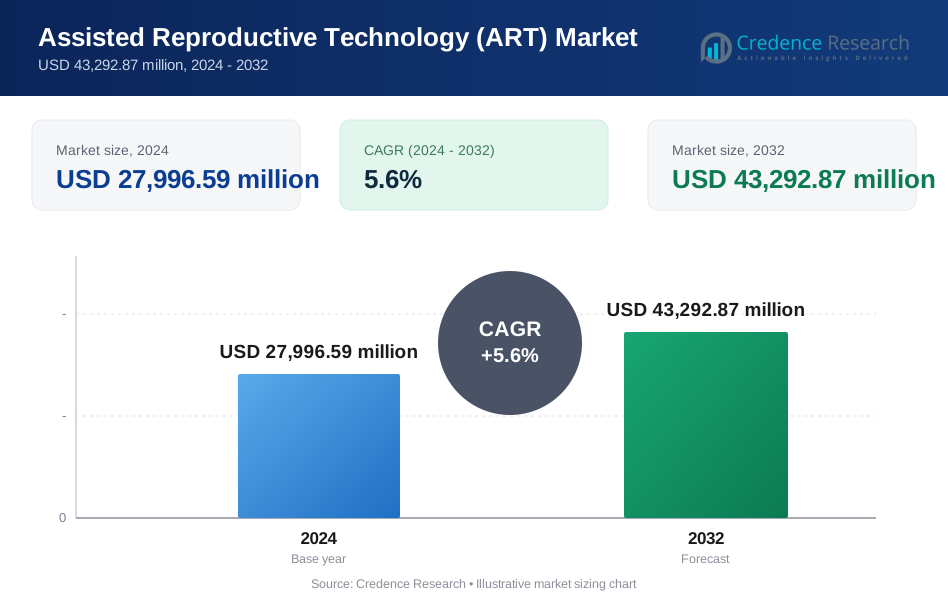
The Assisted Reproductive Technology (ART) Market is projected to grow from USD 27,996.59 million in 2024 to an estimated USD 43,292.87 million by 2032, with a CAGR of 5.6% from 2024 to 2032.
| REPORT ATTRIBUTE | DETAILS |
|---|---|
| Historical Period | 2020-2023 |
| Base Year | 2024 |
| Forecast Period | 2025-2032 |
| Assisted Reproductive Technology (ART) Market Size 2024 | USD 27,996.59 Million |
| Assisted Reproductive Technology (ART) Market, CAGR | 5.6% |
| Assisted Reproductive Technology (ART) Market Size 2032 | USD 43,292.87 Million |
Assisted Reproductive Technology (ART) Market Insights:
- Rising maternal age, increased demand for IVF cycles, and broader adoption of genetic screening tools continue to strengthen overall market momentum.
- High treatment costs, uneven insurance coverage, and regulatory variations across countries limit accessibility for many patient groups.
- North America leads due to advanced clinical infrastructure, while Europe maintains strong adoption supported by established fertility networks.
- Asia Pacific shows the fastest growth as private clinics expand capacity and medical tourism accelerates treatment uptake across emerging economies.
Assisted Reproductive Technology (ART) Market Drivers
Growing Demand Due To Shifting Demographic Patterns
Rising maternal age continues to influence fertility rates across major regions due to lifestyle shifts. More couples delay parenthood due to careers, education, and financial planning. The Assisted Reproductive Technology Art Market benefits from this pattern due to rising clinical demand. It supports couples facing challenges linked to reduced ovarian reserve. Broader awareness of treatment choices increases willingness to seek help early. Clinics expand service offerings to meet greater expectations for success rates. Many nations also experience lower birth rates, which encourage investment in reproductive care. Technological advances help strengthen patient confidence in available procedures.
Expanding Adoption Of Genomic And Embryo Selection Tools
Advanced screening platforms support higher success rates and reduce uncertainty during treatment cycles. Time-lapse imaging enables improved assessment of embryo health in controlled environments. Genetic testing reduces the chance of inherited disorders within selected embryos. The Assisted Reproductive Technology Art Market gains strong traction due to these capabilities. It delivers higher efficiency for clinics under pressure to improve outcomes. Physicians adopt more digital tools to streamline laboratory workflows. Automated systems improve accuracy in embryo handling. These improvements help reduce cycle failures and support broader consumer trust.
- For instance, Vitrolife’s EmbryoScope+ time-lapse incubator utilizes the iDAScore AI algorithm, which was trained on a dataset of over 115,000 embryos to provide an automated viability score; clinical studies show this system helps clinics achieve a 12% increase in clinical pregnancy rates compared to traditional morphology-based selection.
Rapid Growth In Fertility Preservation Services
Rising interest in elective egg and sperm freezing reflects shifting career priorities among young adults. Many individuals prefer preserving reproductive potential before health factors decline. The Assisted Reproductive Technology Art Market supports this trend through better cryopreservation outcomes. It allows patients to secure future family planning choices. Employers in some sectors offer fertility support benefits to attract talent. Clinics invest in advanced freezing media to strengthen cell viability. Broader public awareness increases comfort with long-term storage. Higher survival rates after thawing encourage more patients to consider preservation.
- For instance, Kitazatodeveloped the Cryotop® Method for ultra-rapid vitrification, which achieves a cooling rate of 23,000°C per minute; this technology has been clinically documented to produce a 99% survival rate for oocytes and a 90% pregnancy rate in donor egg programs, setting a global benchmark for cell viability.
Increased Availability Of Specialized Fertility Centers
New fertility clinics enter emerging economies due to strong patient demand. Many centers integrate advanced imaging, AI tools, and genetic screening. The Assisted Reproductive Technology Art Market grows steadily in regions expanding clinical capacity. It gains support from public and private healthcare reforms. Training programs help strengthen clinician skills in newer procedures. Cross-border fertility travel rises due to cost differences and treatment accessibility. Nations with clear regulations attract more international patients. Wider availability of personalized treatment plans improves patient satisfaction.
Assisted Reproductive Technology (ART) Market Trends
Rising Integration Of Artificial Intelligence In Laboratory Workflows
AI tools help embryologists simplify complex assessments during embryo development. Algorithms support more consistent grading based on cell structure and division patterns. Automated systems reduce human error during critical lab steps. The Assisted Reproductive Technology Art Market aligns with this trend to enhance precision. It strengthens clinic efficiency by reducing manual workload. Data platforms improve prediction models for implantation potential. More fertility centers adopt AI due to rising pressure for reliable outcomes. Global vendors introduce specialized software for seamless laboratory integration.
Growing Shift Toward Outpatient And Minimal-Stimulation Protocols
Patients prefer reduced medication exposure to limit discomfort and cost. Low-stimulation protocols support gentler treatment cycles without compromising safety. Clinics expand options to target younger individuals and those with mild infertility. The Assisted Reproductive Technology Art Market evolves with this shift to support diverse patient needs. It promotes flexible treatment planning across regions. Shorter recovery time increases patient preference for outpatient care. This approach reduces the burden on clinical resources. Many patients appreciate lower hormonal impact during cycles.
Increasing Popularity Of Donor Programs And Third-Party Reproduction
Demand grows for donor eggs, donor sperm, and gestational carriers. Social and medical factors drive interest in these programs across many countries. Same-sex couples also contribute to wider acceptance. The Assisted Reproductive Technology Art Market supports growth with structured donor registries. It creates standardized processes to enhance safety and transparency. Digital platforms make donor matching faster and more reliable. Many clinics build international networks to access larger donor pools. More patients seek customized reproductive pathways due to personal preferences.
- For instance, California Cryobank (a Generate Life Sciences company) maintains a rigorous screening process where only 1% of all donor applicants are accepted into their program after undergoing a comprehensive 10-step vetting process including genetic screening for over 260 carrier conditions.
Expansion Of Cross-Border Fertility Tourism Networks
Countries with specialized services attract patients seeking cost-effective treatment. Differences in regulation encourage movement toward markets with supportive legal frameworks. Clinics partner with travel providers to create integrated care packages. The Assisted Reproductive Technology Art Market gains visibility through medical tourism hubs. It creates opportunities for global collaboration among clinics. Reputation of success rates influences patient mobility. Some regions invest in advanced labs to compete internationally. Transparent procedures encourage trust among foreign patients.
- For instance, the Instituto Bernabeu in Spain has established a specialized International Patient Department that manages patients from over 137 countries, offering a "Pregnancy Guarantee" program that provides a 100% refund if a successful birth is not achieved after three donor egg cycles.
Assisted Reproductive Technology (ART) Market Challenges Analysis
High Treatment Costs And Uneven Insurance Coverage
Many patients face financial limitations due to high procedural fees. Limited insurance support in several countries restricts access to treatment choices. The Assisted Reproductive Technology Art Market experiences slower adoption in cost-sensitive regions. It struggles to reach populations with lower income levels. Expensive medications add more pressure on patient budgets. Clinics face rising operating costs due to advanced laboratory equipment. Price variations across markets create patient confusion. Demand weakens in areas where public health support remains low.
Regulatory Barriers And Ethical Complexity Across Regions
Regulatory frameworks differ widely, which complicates service expansion. Some nations enforce strict rules on donor programs and embryo handling. The Assisted Reproductive Technology Art Market encounters delays due to licensing issues. It needs compliance with evolving national policies. Ethical debates influence public acceptance of specific procedures. Restrictions on genetic testing reduce availability in certain regions. Navigating approval pathways increases the burden on clinics. Global vendors face challenges when aligning product standards with regional requirements.
Assisted Reproductive Technology (ART) Market Opportunities
Rising Government Support And Healthcare Policy Reform
Several countries adopt supportive policies to counter declining birth rates. Governments explore subsidies, tax benefits, and insurance expansion to encourage treatment access. The Assisted Reproductive Technology Art Market gains strong growth potential under these initiatives. It benefits from public funding directed toward fertility infrastructure. Clinics upgrade equipment to meet new performance benchmarks. National campaigns increase public awareness of reproductive health. Progressive policy reforms attract more private investors. Emerging markets use supportive regulations to build competitive fertility clusters.
Growing Demand For Advanced Personalization And Genomic Innovation
Patients seek tailored treatment plans based on biological and genetic profiles. Personalized hormone regimens increase comfort during procedures. The Assisted Reproductive Technology Art Market supports deeper innovation in genomic analytics. It strengthens embryo selection accuracy through targeted assessments. Clinics explore AI-driven personalization to raise success rates. Global research programs focus on culture media optimization. New diagnostic platforms unlock better insights into reproductive issues. Opportunities expand in regions investing heavily in precision reproductive medicine.
Assisted Reproductive Technology (ART) Market Segmentation Analysis:
By Procedure
Fresh donor and fresh nondonor cycles continue to support strong demand due to higher implantation potential in many clinical settings. Frozen donor and frozen nondonor cycles gain momentum due to better cryopreservation outcomes and flexible scheduling options. The Assisted Reproductive Technology Art Market strengthens its position with a rising shift toward frozen cycles due to improved survival of thawed embryos. Embryo and egg banking expands quickly among individuals planning delayed parenthood. It helps clinics manage treatment timing with greater precision. Many centers invest in advanced freezing protocols to raise clinical confidence. Patients value reduced medical burden during thaw cycles. These trends reinforce broader adoption across global fertility networks.
- For instance, Vitrolife AB’s RapidVit™ and RapidWarm™ systems have enabled clinics to achieve post-thaw survival rates exceeding 98% for blastocysts, significantly reducing the risk of cycle loss compared to older slow-freezing methods.
By Technology
In-Vitro Fertilization remains the dominant technology due to high success rates and broad clinical applicability. It supports treatment for both male and female infertility factors while integrating advanced genetic screening options. Artificial Insemination or IUI provides a simpler and lower-cost pathway for couples with mild conditions. The Assisted Reproductive Technology Art Market balances both approaches due to diverse patient needs. It supports strong uptake for IVF in regions with favorable reimbursement. Many clinics upgrade lab systems to improve fertilization precision. IUI retains relevance due to streamlined protocols and shorter cycle durations. Technology adoption varies based on patient affordability and clinical maturity.
By Product Type
Women younger than age 35 form the most responsive group due to higher natural fertility and stronger embryo quality. Many clinics report higher live birth rates in this age group. Women older than age 35 represent a fast-growing segment driven by delayed family planning. The Assisted Reproductive Technology Art Market supports both groups through targeted stimulation protocols. It helps older patients manage declining ovarian reserve with donor programs and advanced monitoring tools. Success rates vary due to biological differences, which encourage more personalization. Clinics design specialized pathways for both segments. Age-based segmentation guides investment in new diagnostic tools.
- For instance, Merck KGaA’s Gonal-f® pre-filled pens allow for precise dosing increments of 12.5 IU, which clinical studies show can increase the number of oocytes retrieved by an average of 2.1 per cycle in patients over age 35 compared to conventional fixed-dose protocols.
By End-Use
Fertility clinics remain the primary care setting due to specialized equipment and trained embryologists. These centers deliver the highest procedure volume and lead innovation adoption. Hospitals support complex cases requiring broader medical oversight. The Assisted Reproductive Technology Art Market benefits from strong collaboration between clinics and hospitals in advanced regions. It helps streamline patient access to integrated services. Other end-use settings include small practices and research centers that support niche needs. Many regions witness rapid clinic expansion due to rising demand. Patient preference for specialized environments drives strong growth in dedicated fertility networks.
Segmentation:
By Procedure
- Fresh Donor
- Fresh Nondonor
- Frozen Donor
- Frozen Nondonor
- Embryo/Egg Banking
By Technology
- In-Vitro Fertilization (IVF)
- Artificial Insemination / Intrauterine Insemination (AI-IUI)
By Product Type
- Women Younger Than Age 35
- Women Older Than Age 35
By End-Use
- Fertility Clinics
- Hospitals
- Others
By Region
- North America
- U.S.
- Canada
- Mexico
- Europe
- Germany
- France
- U.K.
- Italy
- Spain
- Rest of Europe
- Asia Pacific
- China
- Japan
- India
- South Korea
- South-east Asia
- Rest of Asia Pacific
- Latin America
- Brazil
- Argentina
- Rest of Latin America
- Middle East & Africa
- GCC Countries
- South Africa
- Rest of the Middle East and Africa
Regional Analysis:
North America holds the largest share of the Assisted Reproductive Technology Art Market with an estimated 35% of global revenue. Strong healthcare infrastructure and widespread adoption of IVF support high demand across the region. Many clinics integrate advanced genetic testing and AI-supported embryo selection to improve outcomes. The Assisted Reproductive Technology Art Market benefits from favorable insurance coverage in select states and rising acceptance of elective preservation. It expands rapidly due to higher maternal age and lifestyle patterns. Leading companies strengthen regional dominance through mergers and advanced lab technologies.
Europe accounts for roughly 30% of the market and maintains a strong leadership position in cross-border fertility care. Many countries support structured reimbursement, which improves access to IVF and donor programs. Strict regulatory oversight enhances safety standards across clinics in major economies. The Assisted Reproductive Technology Art Market gains stability due to established clinical networks and strong research capabilities. It sees wider adoption of frozen cycles due to improvements in cryopreservation. Several nations attract global patients due to cost advantages and clear legal frameworks.
Asia Pacific represents about 25% of the market and stands out as the fastest-growing region. Rising medical tourism, expanding private fertility centers, and large population demand support strong momentum. Many countries invest in modern embryology labs to compete with Western markets. The Assisted Reproductive Technology Art Market benefits from wider acceptance of fertility preservation among younger demographics. It gains scale through competitive pricing and improved accessibility. Growing awareness and supportive policy reforms reinforce long-term growth across developing economies.
Key Player Analysis:
- CooperSurgical Inc.
- Vitrolife Group
- Irvine Scientific
- Cook Medical
- Thermo Fisher Scientific Inc.
- EMD Serono Inc.
- Progyny Inc.
- Ferring Pharmaceuticals
- Merck KGaA
- The Baker Company, Inc.
Competitive Analysis:
The Assisted Reproductive Technology Art Market features strong competition among global device providers, pharmaceutical companies, and specialized fertility service platforms. It encourages companies to invest in advanced culture media, embryo monitoring tools, and automation systems to improve success rates. Leading players expand portfolios through acquisitions that strengthen laboratory workflow capabilities. Many firms target emerging regions where clinic expansion drives new revenue opportunities. Innovation centers on genetic testing tools, AI-driven embryo selection software, and high-efficiency cryopreservation systems. Companies strengthen market presence through partnerships with fertility clinics and digital health platforms. Strong competition pushes continuous upgrades in product performance and service delivery, creating a dynamic environment for global growth.
Recent Developments:
- In June 2025, KKR-backed IVI RMA Global agreed to acquire ART Fertility Clinics for $400-450 million, expanding infertility treatment services globally.
- In May 2025, Vitrolife led a syndicated investment round in AutoIVF, supporting automation in the IVF process and expanding its end-to-end platform for fertility care.
- In December 2024, Astorg completed the take-private acquisition of Hamilton Thorne alongside the concurrent purchase of Cook Medical's Reproductive Health business, creating a global pure-play ART leader serving over 115 countries with innovative IVF products.
- In June 2024, CooperSurgical acquired ZyMōt Fertility, adding the company's innovative sperm separation technology to its assisted reproductive technology portfolio to improve pregnancy success rates.
Report Coverage:
The research report offers an in-depth analysis based on Procedure, Technology, Product Type, and End-Use. It details leading market players, providing an overview of their business, product offerings, investments, revenue streams, and key applications. Additionally, the report includes insights into the competitive environment, SWOT analysis, current market trends, as well as the primary drivers and constraints. Furthermore, it discusses various factors that have driven market expansion in recent years. The report also explores market dynamics, regulatory scenarios, and technological advancements that are shaping the industry. It assesses the impact of external factors and global economic changes on market growth. Lastly, it provides strategic recommendations for new entrants and established companies to navigate the complexities of the market.
Future Outlook:
- Rising demand for fertility care will strengthen the global outlook as more individuals seek clinical support for family planning.
- Wider acceptance of elective preservation will create long-term opportunities across major healthcare systems.
- AI-driven decision tools will reshape embryo selection and improve predictability in treatment cycles.
- Growth in donor programs will diversify service offerings across clinics in regulated regions.
- Investments in next-generation cryopreservation media will support better survival outcomes.
- Genetic screening tools will gain stronger adoption for improved reproductive safety.
- Cross-border fertility travel will expand across competitive hubs due to advanced lab capabilities.
- Digital platforms will enhance patient coordination and streamline treatment pathways.
- Specialized fertility centers will expand rapidly in emerging economies with rising healthcare investments.
- Strong collaboration among biotech firms and clinics will accelerate innovation across the Assisted Reproductive Technology Art Market.
Request a Free Sample
Fill in your details and we'll send you a free sample report.
- Sample data tables & charts
- Research methodology
Need a Custom Version of This Report?
Tailor the scope, geography, or segments to your exact requirements.
- Custom geography or segment scope
- Direct access to our analyst team
Frequently Asked Questions
What is the current market size for the Assisted Reproductive Technology Art Market, and what is its projected size in 2032?
At what Compound Annual Growth Rate is the Assisted Reproductive Technology Art Market projected to grow between 2024 and 2032?
Which Assisted Reproductive Technology Art Market segment held the largest share in 2024?
What are the primary factors fueling the growth of the Assisted Reproductive Technology Art Market?
Who are the leading companies in the Assisted Reproductive Technology Art Market?
Which region commanded the largest share of the Assisted Reproductive Technology Art Market in 2024?
Table of Content
Chapter 1. Report Introduction
- 1.1 Report Description & Purpose
- 1.1.1 Report Title & Market Definition
- 1.1.2 Unique Selling Propositions (USP) & Key Differentiators
- 1.1.3 Value Proposition for Stakeholders
- 1.2 Research Objectives
- 1.2.1 Market Sizing Objectives (Volume & Revenue)
- 1.2.2 Segmentation Objectives
- 1.2.3 Competitive Intelligence Objectives
- 1.2.4 Forecast & Scenario Objectives
- 1.3 Report Scope
- 1.3.1 Assisted Reproductive Technology (ART) Scope – Types & Subtypes Covered
- 1.3.2 Geographic Scope – Regions & Countries Covered
- 1.3.3 Historical Period, Base Year & Forecast Period (2024; forecast to 2032)
- 1.3.4 Inclusions & Exclusions
- 1.4 HS Code & Classification Framework
- 1.5 Currency, Units & Pricing Basis
- 1.6 Target Stakeholders
- 1.7 Limitations & Assumptions
Chapter 2. Executive Summary
- 2.1 Global Assisted Reproductive Technology (ART) Market Snapshot
- 2.1.1 Market Size – Historical (2024) & Forecast (2024-2032) (2024: USD 27,996.59 million → 2032: USD 43,292.87 million)
- 2.1.2 Volume & Revenue – Global Totals
- 2.1.3 Key Market Highlights – Top Five Facts
- 2.2 Assisted Reproductive Technology (ART) Market Segmentation Snapshot
- 2.2.1 Market Split by Region – 2024 vs. 2032
- 2.3 Competitive Snapshot
- 2.3.1 Top 10 Players by Revenue Share – 2024
- 2.3.2 Top 10 Players by Volume Share – 2024
- 2.3.3 Recent Strategic Developments (18-Month Summary)
- 2.4 Key Investment Highlights & Strategic Conclusions
Chapter 3. Assisted Reproductive Technology (ART) Market Dynamics & Industry Analysis
- 3.1 Market Overview & Context
- 3.1.1 Assisted Reproductive Technology (ART) Market Position in the Broader Automotive Value Chain
- 3.1.2 OEM vs. Replacement Market Dynamics
- 3.1.3 Market Maturity & Development Stage by Region
- 3.2 Assisted Reproductive Technology (ART) Market Drivers
- 3.3 Assisted Reproductive Technology (ART) Market Restraints & Challenges
- 3.4 Assisted Reproductive Technology (ART) Market Opportunities
- 3.5 Porter's Five Forces Analysis
- 3.5.1 Threat of New Entrants
- 3.5.2 Bargaining Power of Suppliers
- 3.5.3 Bargaining Power of Buyers
- 3.5.4 Threat of Substitutes
- 3.5.5 Competitive Rivalry – Intensity Assessment
- 3.6 Assisted Reproductive Technology (ART) Value Chain Analysis
- 3.6.1 Upstream – Raw Material/Input Suppliers
- 3.6.1.1 Raw Material/Input 1
- 3.6.1.2 Raw Material/Input 2
- 3.6.1.3 Raw Material/Input 3
- 3.6.2 Midstream – Production/Manufacturing/Service Delivery
- 3.6.2.1 Production/Process Overview
- 3.6.2.2 Key Facility Locations & Capacity by Manufacturer
- 3.6.3 Downstream – Distribution & End Consumer
- 3.6.3.1 Primary Channel – B2B/OEM
- 3.6.3.2 Secondary Channels – Dealer, Retail, Online, Direct
- 3.6.4 Value Chain Profitability Analysis
- 3.6.1 Upstream – Raw Material/Input Suppliers
- 3.7 PESTEL Analysis
- 3.7.1 Political Factors
- 3.7.2 Economic Factors
- 3.7.3 Social Factors
- 3.7.4 Technological Factors
- 3.7.5 Environmental Factors
- 3.7.6 Legal Factors
- 3.8 Assisted Reproductive Technology (ART) Supply Chain Analysis
- 3.8.1 Raw Material/Input Supply Risk Assessment
- 3.8.2 Manufacturing Concentration Risk (Geographic Exposure)
- 3.8.3 Trade Disruption Impact Analysis
- 3.9 Regulatory & Policy Landscape
Note: The regulatory and policy landscape section covers regulations based on their applicability to the market, Assisted Reproductive Technology (ART) category, geography, and scope of the study. Only regulatory frameworks with a material impact on operations, compliance, trade, sustainability, or market access are analyzed in detail.
Chapter 4. Key Investment Pockets & Opportunity Analysis
- 4.1 Assisted Reproductive Technology (ART) Market Attractiveness Analysis
- 4.1.1 By Region – Investment Attractiveness Matrix (Volume × CAGR)
- 4.2 Absolute Revenue Growth Opportunity
- 4.2.1 By Region – Absolute USD Growth Through 2032
- 4.3 Incremental Volume Opportunity
- 4.3.1 By Region – Incremental Volume Through 2032
- 4.3.2 Segment – Incremental Volume
- 4.4 Emerging Submarket Opportunity Deep Dive (Subject to Applicability)
- 4.5 Emerging Market Opportunity Scorecards
- 4.5.1 United States
- 4.5.2 Europe
- 4.5.3 Asia
- 4.5.4 Middle East & Africa
Note: Emerging Market Opportunity Scorecards will be included based on relevance and strategic importance. Regions listed are indicative and may vary depending on data availability and market dynamics.
Chapter 5. Assisted Reproductive Technology (ART) Import-Export Analysis & Trade Flows
- 5.1 Global Trade Overview
- 5.1.1 Global Export Value by Country (2024)
- 5.1.2 Global Export Volume by Country (2024)
- 5.1.3 Global Import Value by Country (2024)
- 5.1.4 Global Import Volume by Country (2024)
- 5.1.5 Net Trade Balance by Country (2024)
- 5.2 Export Analysis – Segment
- 5.2.1 Type 1 (HS Code)
- 5.2.2 Type 2 (HS Code)
- 5.2.3 Type 3 (HS Code)
- 5.2.4 Type 4 (HS Code)
- 5.2.5 Type 5 (HS Code)
- 5.3 Import Analysis – Segment
- 5.3.1 Type 1 (HS Code)
- 5.3.2 Type 2 (HS Code)
- 5.3.3 Type 3 (HS Code)
- 5.3.4 Type 4 (HS Code)
- 5.3.5 Type 5 (HS Code)
- 5.4 Average Unit Trade Prices
- 5.4.1 Average Export Price – Segment & Country
- 5.4.2 Average Import Price – Segment & Source Country
- 5.4.3 Price Trends (2024)
- 5.5 Key Trade Route Analysis
- 5.5.1 Trade Route 1
- 5.5.2 Trade Route 2
- 5.5.3 Trade Route 3
- 5.5.4 Trade Route 4
- 5.5.5 Trade Route 5
- 5.6 Trade Policy Impact Assessment
- 5.6.1 US Anti-Dumping & Section 301 Tariffs
- 5.6.2 EU Customs Union Impact
- 5.6.3 Major Free Trade Agreements
- 5.6.4 USMCA Rules of Origin
Note: Trade policy analysis will be included only where relevant to the Assisted Reproductive Technology (ART) market.
Chapter 6. Competitive Landscape & Company Benchmarking
- 6.1 Assisted Reproductive Technology (ART) Market Concentration & Structure
- 6.1.1 Herfindahl-Hirschman Index (HHI) – vs. 2024
- 6.1.2 Tier 1, Tier 2 & Tier 3 Market Structure
- 6.1.3 Global, Regional & Local Player Dynamics
- 6.2 Assisted Reproductive Technology (ART) Market Share Analysis – 2024
- 6.2.1 Global Revenue Share by Company
- 6.2.2 Global Volume Share by Company
- 6.2.3 Regional Revenue Share
- 6.2.4 Market Share Evolution ( vs. 2024)
- 6.2.5 OEM Segment Share by Company
- 6.2.6 Replacement Segment Share by Company
- 6.3 Production/Delivery Capacity & Facility Analysis
- 6.3.1 Global Installed Capacity
- 6.3.2 Capacity Utilization Rates
- 6.3.3 Production/Output Volume
- 6.3.4 Facility Locations & Capacity Map
- 6.3.5 Planned Capacity Additions
- 6.4 Assisted Reproductive Technology (ART) Competitive Benchmarking Matrix
- 6.4.1 Revenue, Volume, CAGR & Profitability Comparison
- 6.4.2 Channel Revenue Mix
- 6.4.3 Geographic Revenue Exposure
- 6.4.4 R&D Intensity
- 6.4.5 Sustainability Maturity
- 6.5 Strategic Developments in Assisted Reproductive Technology (ART) (Last 24 Months)
- 6.5.1 Mergers, Acquisitions & Divestments
- 6.5.2 New Assisted Reproductive Technology (ART) Launches
- 6.5.3 Facility Expansions
- 6.5.4 Strategic Alliances, Joint Ventures & Partnerships
- 6.5.5 Distribution Expansion & Market Entry
- 6.5.6 Sustainability & ESG Initiatives
- 6.6 Competitive Strategy Mapping
- 6.6.1 Leader, Challenger, Follower & Niche Classification
- 6.6.2 Pricing Strategy Comparison
- 6.6.3 Channel Strategy Matrix
Note: Strategic developments are included based on their materiality and the availability of reliable information.
Chapter 7. Global Assisted Reproductive Technology (ART) Market – By Distribution Channel
- 7.1 Segment Overview
- 7.1.1 Volume & Revenue Split by Channel (2024 & 2032)
- 7.1.2 Channel Mix Evolution (2024-2032)
Chapter 8. Regional Market Analysis – Global Overview
- 8.1 Global Regional Overview
- 8.1.1 Regional Volume Share
- 8.1.2 Regional Revenue Share
- 8.1.3 Regional Volume by Region
- 8.1.4 Regional Revenue by Region
- 8.1.5 Regional Forecast Through 2032
- 8.2 Cross-Regional Segment Analysis
- 8.2.1 By Distribution Channel
- 8.2.2 By Brand/Price Tier
Chapter 9. North America Assisted Reproductive Technology (ART) Market
- 9.1 United States
- 9.2 Canada
- 9.3 Mexico
Chapter 10. Europe Assisted Reproductive Technology (ART) Market
- 10.1 Germany
- 10.2 France
- 10.3 Italy
- 10.4 United Kingdom
- 10.5 Spain
- 10.6 Poland
- 10.7 Russia
- 10.8 Netherlands
- 10.9 Belgium
- 10.10 Sweden
- 10.11 Denmark
- 10.12 Norway
- 10.13 Rest of Europe
Chapter 11. Asia Pacific Assisted Reproductive Technology (ART) Market
- 11.1 China
- 11.2 India
- 11.3 Japan
- 11.4 South Korea
- 11.5 Thailand
- 11.6 Indonesia
- 11.7 Vietnam
- 11.8 Malaysia
- 11.9 Australia
- 11.10 Rest of Asia Pacific
Chapter 12. Latin America Assisted Reproductive Technology (ART) Market
- 12.1 Brazil
- 12.2 Argentina
- 12.3 Colombia
- 12.4 Chile
- 12.5 Rest of Latin America
Chapter 13. Middle East Assisted Reproductive Technology (ART) Market
- 13.1 Saudi Arabia
- 13.2 United Arab Emirates
- 13.3 Turkey
- 13.4 Israel
- 13.5 Iran
- 13.6 Rest of the Middle East
Chapter 14. Africa Assisted Reproductive Technology (ART) Market
- 14.1 South Africa
- 14.2 Egypt
- 14.3 Nigeria
- 14.4 Morocco
- 14.5 Rest of Africa
Chapter 15. Assisted Reproductive Technology (ART) Company Profiles
- 15.1 [Company 01]
- 15.1.1 Company Overview
- 15.1.2 Key Management Personnel
- 15.1.3 Products & Services Portfolio
- 15.1.4 Financial Performance
- 15.1.5 Key Market Focus & Geographic Presence
- 15.1.6 Recent Developments & Strategic Initiatives
Note: The company profile list is preliminary and may change based on research findings, market developments, data availability, and client requirements.
Chapter 16. Appendices
- Appendix A – List of Abbreviations & Acronyms
- Appendix B – Industry Classification Code Reference – Full Series
- Appendix C – Production & Capacity Data Tables
- Appendix D – End-Use & Demand Base Tables
- Appendix E – Consumption & Replacement Rate Assumptions
- Appendix F – ASP Reference Tables
- Appendix G – Manufacturing & Facility Database
- Appendix H – Import-Export Data Tables
- Appendix I – Regulatory Summary Tables
- Appendix J – Primary Research Participant List (Anonymized)
- Appendix K – Primary Research Questionnaire Framework
- Appendix L – Data Sources & Bibliography
- Appendix M – Market Size Divergence & Source Comparison
Chapter 17. Research Methodology
- 17.1 Research Framework & Philosophy
- 17.2 Secondary Research – Sources, Hierarchy & Data Extraction
- 17.3 Data Modeling – Bottom-Up & Top-Down Market Sizing
- 17.4 Primary Research – Stakeholder Framework, LOI & Sample Sizes
- 17.5 Forecast Methodology – Regression, Scenario & Sensitivity Analysis
- 17.6 Quality Control – Four-Layer Validation Framework
- 17.7 Limitations & Standard Assumptions
- 17.8 Disclaimer
