
Market Overview
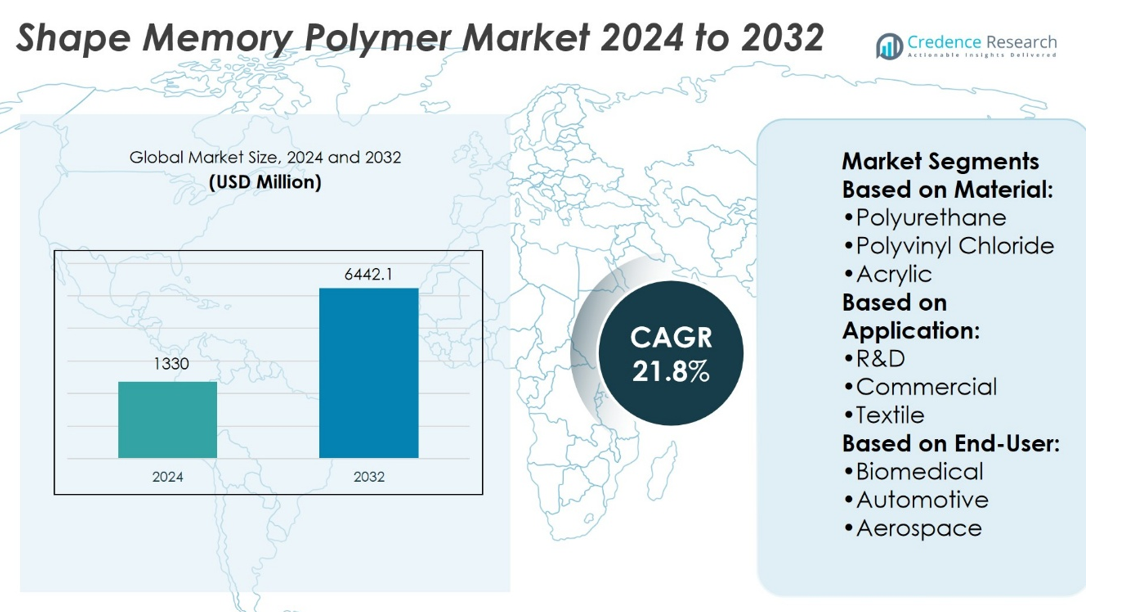
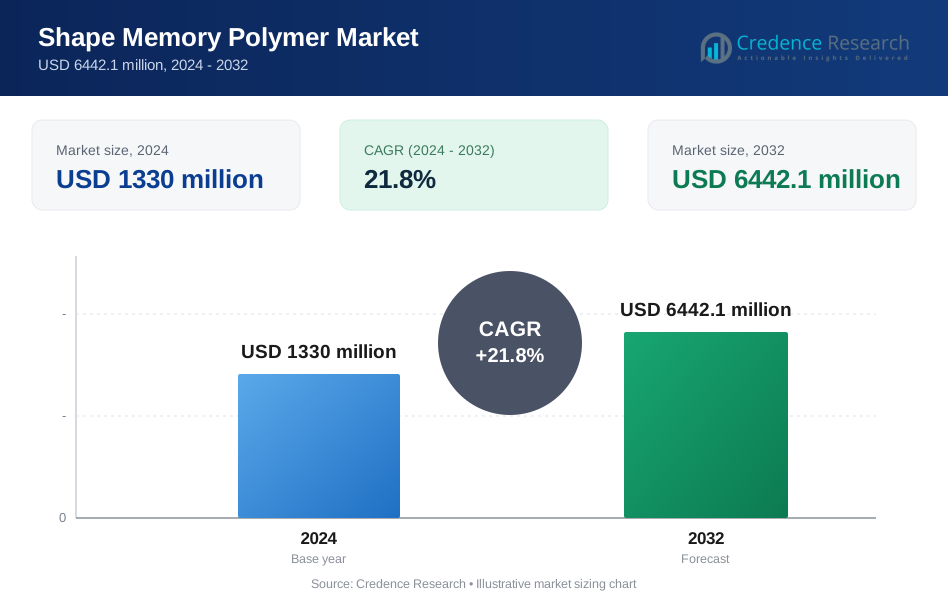
Shape Memory Polymer Market size was valued at USD 1330 million in 2024 and is anticipated to reach USD 6442.1 million by 2032, at a CAGR of 21.8% during the forecast period.
| REPORT ATTRIBUTE | DETAILS |
|---|---|
| Historical Period | 2020-2023 |
| Base Year | 2024 |
| Forecast Period | 2025-2032 |
| Shape Memory Polymer Market Size 2024 | USD 1330 million |
| Shape Memory Polymer Market, CAGR | 21.8% |
| Shape Memory Polymer Market Size 2032 | USD 6442.1 million |
The Shape Memory Polymer Market grows through strong drivers and evolving trends across industries. Rising demand in biomedical devices supports adoption for stents, scaffolds, and minimally invasive tools. Aerospace and automotive sectors use polymers for lightweight, adaptive components that improve efficiency and safety. It benefits from research into biodegradable and eco-friendly materials aligned with sustainability goals. Consumer electronics expand applications through flexible displays and smart actuators. Infrastructure projects explore self-healing polymers to reduce maintenance needs. Growing collaboration between research institutions and industry strengthens innovation, ensuring continuous advancement and broader commercialization of shape memory polymer technologies worldwide.
The Shape Memory Polymer Market shows strong geographical presence across North America, Europe, Asia Pacific, Latin America, and the Middle East & Africa. North America leads with advanced biomedical and aerospace adoption, while Europe emphasizes sustainability and automotive integration. Asia Pacific records rapid growth through healthcare and electronics expansion. Latin America and Middle East & Africa show gradual uptake in medical and infrastructure projects. Key players focus on innovation, scalable production, and strategic partnerships to strengthen global competitiveness.
Market Insights
- Shape Memory Polymer Market size was valued at USD 1330 million in 2024 and is projected to reach USD 6442.1 million by 2032, growing at a CAGR of 21.8%.
- Rising demand in biomedical devices drives adoption for stents, scaffolds, and minimally invasive tools.
- Aerospace and automotive sectors adopt polymers for lightweight and adaptive components that improve efficiency and safety.
- Competition is shaped by global players focusing on innovation, scalable production, and strategic partnerships.
- High production costs and limited mechanical strength compared to metals restrain wider adoption.
- North America leads with advanced healthcare and aerospace use, Europe emphasizes sustainability and automotive integration, and Asia Pacific grows rapidly through healthcare and electronics expansion.
- Latin America and the Middle East & Africa show gradual adoption, supported by medical and infrastructure projects, while research collaborations worldwide continue to fuel innovation and commercialization.
Market Drivers
Rising Adoption in Biomedical Applications
The Shape Memory Polymer Market grows with strong use in biomedical devices. Stents, scaffolds, and drug delivery systems benefit from lightweight, biocompatible materials. These polymers enable minimally invasive procedures and improve recovery outcomes. It offers design flexibility for custom implants that adapt to body conditions. Hospitals and research centers increase investments in advanced materials to support patient needs. Ongoing medical innovation ensures steady demand for shape memory polymers.
- For instance, the Desmopan® 2795A SMP offers an ultimate tensile strength of 40 MPa and can stretch to 600 % strain before breaking, with a hardness of 94 Shore A at 23 °C and 7 MPa stress at 100 % strain.
Expanding Role in Aerospace and Defense Engineering
The Shape Memory Polymer Market strengthens through adoption in aerospace and defense projects. Lightweight structures reduce fuel use while maintaining performance in extreme conditions. It supports morphing wings, vibration damping, and deployable structures. Defense agencies value polymers for reliability under variable thermal and mechanical stress. The push for advanced aircraft materials drives procurement of adaptive systems. Strong focus on safety and efficiency continues to create new opportunities.
- For instance, Covestro even developed a second-generation thermoplastic polyurethane SMP that softens from 92 Shore A at room temperature to 72 Shore A at 60 °C, enabling adaptive flexibility in response to temperature while preserving abrasion resistance and elasticity.
Growing Demand in Consumer Electronics and Smart Devices
The Shape Memory Polymer Market advances with integration into consumer electronics. Manufacturers apply polymers in sensors, flexible displays, and smart actuators. It enables compact product design and responsive performance. Demand rises from wearables, smartphones, and connected home devices seeking functional materials. Technology brands invest in adaptive polymers to enhance user experience. Expanding digital ecosystems increase the relevance of these solutions.
Rising Application in Sustainable and Smart Infrastructure
The Shape Memory Polymer Market gains traction in construction and infrastructure projects. Polymers serve in self-healing materials, adaptive joints, and structural reinforcement. It reduces maintenance needs and extends the life cycle of assets. Engineers explore polymers for energy-efficient building components. Growing infrastructure upgrades in emerging regions create adoption pathways. Government support for sustainability and smart materials reinforces the market’s long-term role.
Market Trends
Increasing Focus on Biodegradable and Eco-Friendly Polymers
The Shape Memory Polymer Market reflects a clear trend toward sustainable solutions. Researchers develop biodegradable polymers that meet medical and industrial standards. It reduces environmental concerns linked to conventional synthetic materials. Companies highlight eco-friendly options to align with global sustainability goals. Hospitals and healthcare firms adopt greener materials for implants and disposable devices. This focus ensures wider acceptance across regulated industries.
- For instance, Lubrizol’s patented Apisolex™ polymer excipient enhances solubility of certain active pharmaceutical ingredients by up to 50,000‑fold, and a drug formulation using it has entered Phase 1 clinical trials as of June 9, 2025.
Integration into Advanced Aerospace and Automotive Designs
The Shape Memory Polymer Market shows rising use in aerospace and automotive engineering. Lightweight components replace metals while maintaining strength and adaptability. It supports deployable structures, actuators, and morphing panels in next-generation vehicles. Airlines and automakers seek materials that lower energy consumption without sacrificing safety. Industry leaders expand testing of adaptive polymers under variable conditions. Ongoing research drives consistent innovation in structural performance.
- For instance, one type of thermoset polyurethane-based shape memory polymer has a glassy state elastic modulus (E′?) of 1,250 MPa, a rubbery state elastic modulus (E′r) of 12.1 MPa, and a ratio (E′?/ E′r) of 103. This large modulus ratio enables strong shape retention below its glass transition temperature and high elastic recovery above it, allowing for shape changes triggered by temperature variations.
Growing Use in Smart Wearables and Connected Devices
The Shape Memory Polymer Market expands through applications in wearables and consumer electronics. Polymers enable compact, flexible designs suited for modern devices. It enhances responsiveness in sensors, displays, and medical monitoring systems. Brands invest in adaptive materials to improve comfort and user interaction. Connected ecosystems create demand for responsive components in smart homes and mobile devices. These factors sustain momentum across the electronics sector.
Rising Research in Self-Healing and Smart Infrastructure
The Shape Memory Polymer Market advances with interest in self-healing structures and infrastructure. Polymers repair cracks and extend durability in construction projects. It lowers maintenance costs while improving safety of bridges, roads, and buildings. Researchers explore blends that withstand thermal and mechanical stress. Urban developers consider smart polymers for adaptive building elements. The trend strengthens adoption within public and private infrastructure upgrades.
Market Challenges Analysis
High Production Costs and Limited Commercial Scalability
The Shape Memory Polymer Market faces challenges linked to manufacturing complexity and cost. Production requires specialized equipment and raw materials that remain expensive. It restricts large-scale adoption in industries where cost efficiency is critical. Companies struggle to scale research innovations into mass production without raising expenses. Healthcare and aerospace adopt polymers selectively due to high price points. Achieving wider commercial viability demands breakthroughs in cost reduction and streamlined processes.
Technical Limitations and Performance Constraints Across Applications
The Shape Memory Polymer Market also encounters technical barriers that limit growth. It delivers lower mechanical strength and thermal stability compared to metallic alternatives. Engineers question durability in applications exposed to extreme environments. Performance variations in repeated cycles create reliability concerns in aerospace and automotive systems. Medical uses require strict compliance with safety standards, which delays approvals. These factors highlight the need for continuous research to overcome functional constraints.
Market Opportunities
Expanding Applications in Biomedical and Personalized Healthcare
The Shape Memory Polymer Market presents opportunities through rapid growth in biomedical fields. It supports personalized implants, scaffolds, and minimally invasive surgical devices. Hospitals and clinics require adaptive materials that conform to patient-specific conditions. Researchers focus on drug delivery systems that activate under controlled temperatures or stimuli. The demand for advanced biomaterials creates room for strategic partnerships between manufacturers and healthcare providers. Investment in clinical research enhances confidence in wider medical use.
Rising Potential in Smart Infrastructure and Next-Generation Electronics
The Shape Memory Polymer Market also benefits from increasing adoption in smart infrastructure and electronics. It provides self-healing materials that extend the lifespan of bridges, roads, and buildings. Urban developers explore adaptive polymers to improve sustainability and safety. Consumer electronics companies integrate responsive polymers into flexible displays, sensors, and smart devices. Growth of connected ecosystems fuels opportunities in wearables and home automation. Research into multifunctional blends strengthens the role of polymers in advanced engineering projects.
Market Segmentation Analysis:
By Material
The Shape Memory Polymer Market divides into polyurethane, polyvinyl chloride, acrylic, epoxy, and others. Polyurethane dominates due to high elasticity, biocompatibility, and broad processing options. It supports medical devices and smart actuators that demand flexibility. Polyvinyl chloride gains adoption in industrial and consumer uses because of cost efficiency and availability. Acrylic-based polymers show strength in optical and electronic applications where clarity and responsiveness are required. Epoxy resins find roles in aerospace structures because of mechanical strength and thermal stability. The “others” category includes advanced blends tailored for specialized functions, creating potential in niche applications.
- For instance, their SMP resin (potting) with stock number NS6130‑09‑911 features a glass transition temperature of 65 °C, melting temperature at 200 °C, specific gravity of 1.25, tensile strength of approximately 13 MPa in the rubber region, and elongation exceeding 600 %, along with bending modulus of 1,900 MPa and bending strength of 50 MPa in the glassy region.
By Application
The Shape Memory Polymer Market splits into R&D and commercial uses. R&D remains essential as research centers and universities test new polymer formulations. It supports exploration of biodegradable, self-healing, and multifunctional designs. Commercial applications expand with products reaching biomedical, automotive, and electronics markets. It strengthens demand for scalable, cost-effective materials that perform consistently under stress. Continuous collaboration between academic research and industrial commercialization drives momentum in both segments.
- For instance, Asahi Kasei’s proprietary high ionic conductive electrolyte achieved proof‑of‑concept demonstrating double cycle life at 60 °C and superior power output at −40 °C in cylindrical lithium‑ion battery cells, compared to those using conventional electrolytes; commercialization is planned for 2025.
By End-user
The Shape Memory Polymer Market includes biomedical, automotive, and aerospace industries. Biomedical leads with implants, scaffolds, and surgical devices requiring adaptability and safety. It supports minimally invasive procedures and patient-specific treatment solutions. Automotive manufacturers adopt polymers in adaptive components, safety systems, and lightweight structures to improve performance and efficiency. Aerospace firms apply these materials in morphing structures, deployable parts, and vibration control under extreme conditions. Each sector emphasizes reliability, creating long-term opportunities for advanced polymers.
Segments:
Based on Material:
- Polyurethane
- Polyvinyl Chloride
- Acrylic
Based on Application:
- R&D
- Commercial
- Textile
Based on End-User:
- Biomedical
- Automotive
- Aerospace
Based on the Geography:
- North America
- U.S.
- Canada
- Mexico
- Europe
- UK
- France
- Germany
- Italy
- Spain
- Russia
- Belgium
- Netherlands
- Austria
- Sweden
- Poland
- Denmark
- Switzerland
- Rest of Europe
- Asia Pacific
- China
- Japan
- South Korea
- India
- Australia
- Thailand
- Indonesia
- Vietnam
- Malaysia
- Philippines
- Taiwan
- Rest of Asia Pacific
- Latin America
- Brazil
- Argentina
- Peru
- Chile
- Colombia
- Rest of Latin America
- Middle East
- UAE
- KSA
- Israel
- Turkey
- Iran
- Rest of Middle East
- Africa
- Egypt
- Nigeria
- Algeria
- Morocco
- Rest of Africa
Regional Analysis
North America
North America holds the largest share of the Shape Memory Polymer Market at 36%. Strong adoption across biomedical, aerospace, and automotive sectors drives regional growth. Research institutions and universities actively collaborate with manufacturers to develop innovative polymer applications. It benefits from advanced healthcare infrastructure that supports demand for minimally invasive medical devices. Aerospace companies in the United States and Canada integrate shape memory polymers in adaptive structures and vibration control systems. Automotive manufacturers explore polymers for lightweight and fuel-efficient components. Continuous investment in R&D keeps North America at the forefront of market leadership.
Europe
Europe accounts for 28% of the Shape Memory Polymer Market. The region shows strong emphasis on sustainability and eco-friendly materials. It benefits from advanced automotive manufacturing hubs in Germany, France, and Italy that test adaptive polymers in vehicle systems. Aerospace industries in France and the United Kingdom expand applications of polymers in aircraft components requiring weight reduction and safety assurance. Healthcare systems across the European Union adopt shape memory polymers in implants and surgical tools. It also invests in sustainable infrastructure, where polymers are applied in adaptive and self-healing building materials. The region’s regulatory framework promotes quality and safety, enhancing adoption rates.
Asia Pacific
Asia Pacific represents 24% of the Shape Memory Polymer Market. Rising demand in China, Japan, South Korea, and India fuels strong regional growth. It benefits from expanding healthcare investments that promote adoption of advanced biomedical devices. Automotive production in Japan and South Korea integrates shape memory polymers for efficiency improvements in adaptive systems. China focuses on R&D collaborations with universities to explore cost-effective and scalable polymer formulations. Aerospace projects in Japan and India evaluate polymers for vibration control and structural adaptability. The rapid expansion of consumer electronics across Asia also increases demand for responsive materials. Growing industrial capacity secures the region’s rising position in the global market.
Latin America
Latin America holds 7% of the Shape Memory Polymer Market. Brazil and Mexico lead adoption with a focus on medical devices and automotive applications. It benefits from growing healthcare modernization programs that support the use of advanced biomaterials. Automotive plants in Mexico experiment with lightweight polymer-based systems for safety and efficiency. Research centers across Brazil increase exploration into biodegradable polymers. Aerospace adoption remains limited but shows potential in regional defense programs. Market expansion depends on international partnerships and technology transfer.
Middle East and Africa
The Middle East and Africa account for 5% of the Shape Memory Polymer Market. Regional growth is slower but shows steady momentum in healthcare and construction. Hospitals in Gulf countries adopt biomedical devices that utilize shape memory polymers. It benefits from infrastructure development projects where self-healing polymers provide long-term durability. South Africa invests in medical research that explores adaptive polymer solutions. Aerospace adoption is limited but supported by government-backed technology programs in the Gulf states. The region’s smaller share reflects limited production capacity but growing demand ensures steady improvement.
Key Player Analysis
- MedShape, Inc.
- Covestro AG
- EndoShape
- Cornerstone Research Group (CRG)
- Lubrizol
- SMP Technologies Inc.
- Nanoshel LLC
- Shape Memory Medical Inc.
- Composite Technology Development, Inc.
- DowDuPont Inc.
- Asahi Kasei Corporation
Competitive Analysis
The Shape Memory Polymer Market features such as MedShape, Inc., Covestro AG, EndoShape, Cornerstone Research Group (CRG), Lubrizol, SMP Technologies Inc., Nanoshel LLC, Shape Memory Medical Inc., Composite Technology Development, Inc., DowDuPont Inc., and Asahi Kasei Corporation. The Shape Memory Polymer Market is defined by a balance between niche innovators and large diversified material suppliers. Smaller firms contribute specialized expertise in biomedical devices and aerospace solutions, focusing on polymers with high adaptability and biocompatibility. Larger companies bring scale, advanced research facilities, and established distribution networks that accelerate commercialization across global markets. Competition centers on improving material strength, durability, and responsiveness while reducing production costs. Continuous investment in research ensures progress in areas such as biodegradable polymers, self-healing systems, and smart infrastructure applications. The market’s competitive environment fosters collaboration between research institutions and industry, driving sustained innovation and global expansion.
Recent Developments
- In August 2025, Samsung Electronics reported commencing mass production of next-generation HBM chips tailored for vigorous AI and gaming GPUs with a promised increase of two-fold increase in memory bandwidth and data speeds. These advancements are likely to greatly increase Samsung’s share in the global market of high-speed memories and initiate further development in the semiconductor industry.
- In June 2025, Micron Technology introduced a new integrated HBM module aimed at the data center sector, featuring a 50% boost in throughput and lower latency. This development strengthens Micron's expanding role in the high bandwidth memory market and indicates a significant future demand for faster and more efficient memory solutions.
- In September 2023, Shape Memory Medical announced that the FDA granted it investigational device exemption (IDE) to begin a prospective, multicenter, randomized, open-label trial to determine the safety and effectiveness of the IMPEDE-FX RapidFill Device to improve abdominal aortic aneurysm sac behavior when used with elective endovascular aneurysm repair.
- In August 2023, SK HYNIX INC. announced that it had started supplying a 24GB LPDDR5X DRAM mobile DRAM package, the industry’s first such solution with a 24 Gb capacity. The new product provides enhanced performance while consuming low power. The company aimed to meet its customers’ needs with this product.
Report Coverage
The research report offers an in-depth analysis based on Material, Application, End-User and Geography. It details leading market players, providing an overview of their business, product offerings, investments, revenue streams, and key applications. Additionally, the report includes insights into the competitive environment, SWOT analysis, current market trends, as well as the primary drivers and constraints. Furthermore, it discusses various factors that have driven market expansion in recent years. The report also explores market dynamics, regulatory scenarios, and technological advancements that are shaping the industry. It assesses the impact of external factors and global economic changes on market growth. Lastly, it provides strategic recommendations for new entrants and established companies to navigate the complexities of the market.
Future Outlook
- Demand in biomedical applications will expand with growth in minimally invasive procedures.
- Aerospace projects will adopt polymers for lightweight and adaptive structural components.
- Automotive manufacturers will integrate polymers in safety systems and adaptive designs.
- Research will focus on biodegradable and eco-friendly polymer formulations.
- Consumer electronics will use polymers for flexible displays and smart actuators.
- Infrastructure projects will explore self-healing polymers for durability and reduced maintenance.
- Advances in nanotechnology will enhance polymer strength and responsiveness.
- Strategic partnerships between universities and industry will accelerate innovation.
- Regulatory support will encourage adoption in healthcare and sustainable construction.
- Global competition will drive cost reduction and scalable production methods.
Request a Free Sample
Fill in your details and we'll send you a free sample report.
- Sample data tables & charts
- Research methodology
Need a Custom Version of This Report?
Tailor the scope, geography, or segments to your exact requirements.
- Custom geography or segment scope
- Direct access to our analyst team
Frequently Asked Questions
What is the current market size for Shape Memory Polymer Market, and what is its projected size in 2032?
At what Compound Annual Growth Rate is the Shape Memory Polymer Market projected to grow between 2025 and 2032?
Which Shape Memory Polymer Market segment held the largest share in 2024?
Who are the leading companies in the Shape Memory Polymer Market?
Table of Content
Chapter 1. Report Introduction
- 1.1 Report Description & Purpose
- 1.1.1 Report Title & Market Definition
- 1.1.2 Unique Selling Propositions (USP) & Key Differentiators
- 1.1.3 Value Proposition for Stakeholders
- 1.2 Research Objectives
- 1.2.1 Market Sizing Objectives (Volume & Revenue)
- 1.2.2 Segmentation Objectives
- 1.2.3 Competitive Intelligence Objectives
- 1.2.4 Forecast & Scenario Objectives
- 1.3 Report Scope
- 1.3.1 Shape Memory Polymer Scope – Types & Subtypes Covered
- 1.3.2 Geographic Scope – Regions & Countries Covered
- 1.3.3 Historical Period, Base Year & Forecast Period (2024; forecast to 2032)
- 1.3.4 Inclusions & Exclusions
- 1.4 HS Code & Classification Framework
- 1.5 Currency, Units & Pricing Basis
- 1.6 Target Stakeholders
- 1.7 Limitations & Assumptions
Chapter 2. Executive Summary
- 2.1 Global Shape Memory Polymer Market Snapshot
- 2.1.1 Market Size – Historical (2024) & Forecast (2024-2032) (2024: USD 1330 million → 2032: USD 6442.1 million)
- 2.1.2 Volume & Revenue – Global Totals
- 2.1.3 Key Market Highlights – Top Five Facts
- 2.2 Shape Memory Polymer Market Segmentation Snapshot
- 2.2.1 Market Split by Region – 2024 vs. 2032
- 2.3 Competitive Snapshot
- 2.3.1 Top 10 Players by Revenue Share – 2024
- 2.3.2 Top 10 Players by Volume Share – 2024
- 2.3.3 Recent Strategic Developments (18-Month Summary)
- 2.4 Key Investment Highlights & Strategic Conclusions
Chapter 3. Shape Memory Polymer Market Dynamics & Industry Analysis
- 3.1 Market Overview & Context
- 3.1.1 Shape Memory Polymer Market Position in the Broader Automotive Value Chain
- 3.1.2 OEM vs. Replacement Market Dynamics
- 3.1.3 Market Maturity & Development Stage by Region
- 3.2 Shape Memory Polymer Market Drivers
- 3.3 Shape Memory Polymer Market Restraints & Challenges
- 3.4 Shape Memory Polymer Market Opportunities
- 3.5 Porter's Five Forces Analysis
- 3.5.1 Threat of New Entrants
- 3.5.2 Bargaining Power of Suppliers
- 3.5.3 Bargaining Power of Buyers
- 3.5.4 Threat of Substitutes
- 3.5.5 Competitive Rivalry – Intensity Assessment
- 3.6 Shape Memory Polymer Value Chain Analysis
- 3.6.1 Upstream – Raw Material/Input Suppliers
- 3.6.1.1 Raw Material/Input 1
- 3.6.1.2 Raw Material/Input 2
- 3.6.1.3 Raw Material/Input 3
- 3.6.2 Midstream – Production/Manufacturing/Service Delivery
- 3.6.2.1 Production/Process Overview
- 3.6.2.2 Key Facility Locations & Capacity by Manufacturer
- 3.6.3 Downstream – Distribution & End Consumer
- 3.6.3.1 Primary Channel – B2B/OEM
- 3.6.3.2 Secondary Channels – Dealer, Retail, Online, Direct
- 3.6.4 Value Chain Profitability Analysis
- 3.6.1 Upstream – Raw Material/Input Suppliers
- 3.7 PESTEL Analysis
- 3.7.1 Political Factors
- 3.7.2 Economic Factors
- 3.7.3 Social Factors
- 3.7.4 Technological Factors
- 3.7.5 Environmental Factors
- 3.7.6 Legal Factors
- 3.8 Shape Memory Polymer Supply Chain Analysis
- 3.8.1 Raw Material/Input Supply Risk Assessment
- 3.8.2 Manufacturing Concentration Risk (Geographic Exposure)
- 3.8.3 Trade Disruption Impact Analysis
- 3.9 Regulatory & Policy Landscape
Note: The regulatory and policy landscape section covers regulations based on their applicability to the market, Shape Memory Polymer category, geography, and scope of the study. Only regulatory frameworks with a material impact on operations, compliance, trade, sustainability, or market access are analyzed in detail.
Chapter 4. Key Investment Pockets & Opportunity Analysis
- 4.1 Shape Memory Polymer Market Attractiveness Analysis
- 4.1.1 By Region – Investment Attractiveness Matrix (Volume × CAGR)
- 4.2 Absolute Revenue Growth Opportunity
- 4.2.1 By Region – Absolute USD Growth Through 2032
- 4.3 Incremental Volume Opportunity
- 4.3.1 By Region – Incremental Volume Through 2032
- 4.3.2 Segment – Incremental Volume
- 4.4 Emerging Submarket Opportunity Deep Dive (Subject to Applicability)
- 4.5 Emerging Market Opportunity Scorecards
- 4.5.1 United States
- 4.5.2 Europe
- 4.5.3 Asia
- 4.5.4 Middle East & Africa
Note: Emerging Market Opportunity Scorecards will be included based on relevance and strategic importance. Regions listed are indicative and may vary depending on data availability and market dynamics.
Chapter 5. Shape Memory Polymer Import-Export Analysis & Trade Flows
- 5.1 Global Trade Overview
- 5.1.1 Global Export Value by Country (2024)
- 5.1.2 Global Export Volume by Country (2024)
- 5.1.3 Global Import Value by Country (2024)
- 5.1.4 Global Import Volume by Country (2024)
- 5.1.5 Net Trade Balance by Country (2024)
- 5.2 Export Analysis – Segment
- 5.2.1 Type 1 (HS Code)
- 5.2.2 Type 2 (HS Code)
- 5.2.3 Type 3 (HS Code)
- 5.2.4 Type 4 (HS Code)
- 5.2.5 Type 5 (HS Code)
- 5.3 Import Analysis – Segment
- 5.3.1 Type 1 (HS Code)
- 5.3.2 Type 2 (HS Code)
- 5.3.3 Type 3 (HS Code)
- 5.3.4 Type 4 (HS Code)
- 5.3.5 Type 5 (HS Code)
- 5.4 Average Unit Trade Prices
- 5.4.1 Average Export Price – Segment & Country
- 5.4.2 Average Import Price – Segment & Source Country
- 5.4.3 Price Trends (2024)
- 5.5 Key Trade Route Analysis
- 5.5.1 Trade Route 1
- 5.5.2 Trade Route 2
- 5.5.3 Trade Route 3
- 5.5.4 Trade Route 4
- 5.5.5 Trade Route 5
- 5.6 Trade Policy Impact Assessment
- 5.6.1 US Anti-Dumping & Section 301 Tariffs
- 5.6.2 EU Customs Union Impact
- 5.6.3 Major Free Trade Agreements
- 5.6.4 USMCA Rules of Origin
Note: Trade policy analysis will be included only where relevant to the Shape Memory Polymer market.
Chapter 6. Competitive Landscape & Company Benchmarking
- 6.1 Shape Memory Polymer Market Concentration & Structure
- 6.1.1 Herfindahl-Hirschman Index (HHI) – vs. 2024
- 6.1.2 Tier 1, Tier 2 & Tier 3 Market Structure
- 6.1.3 Global, Regional & Local Player Dynamics
- 6.2 Shape Memory Polymer Market Share Analysis – 2024
- 6.2.1 Global Revenue Share by Company
- 6.2.2 Global Volume Share by Company
- 6.2.3 Regional Revenue Share
- 6.2.4 Market Share Evolution ( vs. 2024)
- 6.2.5 OEM Segment Share by Company
- 6.2.6 Replacement Segment Share by Company
- 6.3 Production/Delivery Capacity & Facility Analysis
- 6.3.1 Global Installed Capacity
- 6.3.2 Capacity Utilization Rates
- 6.3.3 Production/Output Volume
- 6.3.4 Facility Locations & Capacity Map
- 6.3.5 Planned Capacity Additions
- 6.4 Shape Memory Polymer Competitive Benchmarking Matrix
- 6.4.1 Revenue, Volume, CAGR & Profitability Comparison
- 6.4.2 Channel Revenue Mix
- 6.4.3 Geographic Revenue Exposure
- 6.4.4 R&D Intensity
- 6.4.5 Sustainability Maturity
- 6.5 Strategic Developments in Shape Memory Polymer (Last 24 Months)
- 6.5.1 Mergers, Acquisitions & Divestments
- 6.5.2 New Shape Memory Polymer Launches
- 6.5.3 Facility Expansions
- 6.5.4 Strategic Alliances, Joint Ventures & Partnerships
- 6.5.5 Distribution Expansion & Market Entry
- 6.5.6 Sustainability & ESG Initiatives
- 6.6 Competitive Strategy Mapping
- 6.6.1 Leader, Challenger, Follower & Niche Classification
- 6.6.2 Pricing Strategy Comparison
- 6.6.3 Channel Strategy Matrix
Note: Strategic developments are included based on their materiality and the availability of reliable information.
Chapter 7. Global Shape Memory Polymer Market – By Distribution Channel
- 7.1 Segment Overview
- 7.1.1 Volume & Revenue Split by Channel (2024 & 2032)
- 7.1.2 Channel Mix Evolution (2024-2032)
Chapter 8. Regional Market Analysis – Global Overview
- 8.1 Global Regional Overview
- 8.1.1 Regional Volume Share
- 8.1.2 Regional Revenue Share
- 8.1.3 Regional Volume by Region
- 8.1.4 Regional Revenue by Region
- 8.1.5 Regional Forecast Through 2032
- 8.2 Cross-Regional Segment Analysis
- 8.2.1 By Distribution Channel
- 8.2.2 By Brand/Price Tier
Chapter 9. North America Shape Memory Polymer Market
- 9.1 United States
- 9.2 Canada
- 9.3 Mexico
Chapter 10. Europe Shape Memory Polymer Market
- 10.1 Germany
- 10.2 France
- 10.3 Italy
- 10.4 United Kingdom
- 10.5 Spain
- 10.6 Poland
- 10.7 Russia
- 10.8 Netherlands
- 10.9 Belgium
- 10.10 Sweden
- 10.11 Denmark
- 10.12 Norway
- 10.13 Rest of Europe
Chapter 11. Asia Pacific Shape Memory Polymer Market
- 11.1 China
- 11.2 India
- 11.3 Japan
- 11.4 South Korea
- 11.5 Thailand
- 11.6 Indonesia
- 11.7 Vietnam
- 11.8 Malaysia
- 11.9 Australia
- 11.10 Rest of Asia Pacific
Chapter 12. Latin America Shape Memory Polymer Market
- 12.1 Brazil
- 12.2 Argentina
- 12.3 Colombia
- 12.4 Chile
- 12.5 Rest of Latin America
Chapter 13. Middle East Shape Memory Polymer Market
- 13.1 Saudi Arabia
- 13.2 United Arab Emirates
- 13.3 Turkey
- 13.4 Israel
- 13.5 Iran
- 13.6 Rest of the Middle East
Chapter 14. Africa Shape Memory Polymer Market
- 14.1 South Africa
- 14.2 Egypt
- 14.3 Nigeria
- 14.4 Morocco
- 14.5 Rest of Africa
Chapter 15. Shape Memory Polymer Company Profiles
- 15.1 [Company 01]
- 15.1.1 Company Overview
- 15.1.2 Key Management Personnel
- 15.1.3 Products & Services Portfolio
- 15.1.4 Financial Performance
- 15.1.5 Key Market Focus & Geographic Presence
- 15.1.6 Recent Developments & Strategic Initiatives
Note: The company profile list is preliminary and may change based on research findings, market developments, data availability, and client requirements.
Chapter 16. Appendices
- Appendix A – List of Abbreviations & Acronyms
- Appendix B – Industry Classification Code Reference – Full Series
- Appendix C – Production & Capacity Data Tables
- Appendix D – End-Use & Demand Base Tables
- Appendix E – Consumption & Replacement Rate Assumptions
- Appendix F – ASP Reference Tables
- Appendix G – Manufacturing & Facility Database
- Appendix H – Import-Export Data Tables
- Appendix I – Regulatory Summary Tables
- Appendix J – Primary Research Participant List (Anonymized)
- Appendix K – Primary Research Questionnaire Framework
- Appendix L – Data Sources & Bibliography
- Appendix M – Market Size Divergence & Source Comparison
Chapter 17. Research Methodology
- 17.1 Research Framework & Philosophy
- 17.2 Secondary Research – Sources, Hierarchy & Data Extraction
- 17.3 Data Modeling – Bottom-Up & Top-Down Market Sizing
- 17.4 Primary Research – Stakeholder Framework, LOI & Sample Sizes
- 17.5 Forecast Methodology – Regression, Scenario & Sensitivity Analysis
- 17.6 Quality Control – Four-Layer Validation Framework
- 17.7 Limitations & Standard Assumptions
- 17.8 Disclaimer
