
| REPORT ATTRIBUTE | DETAILS |
|---|---|
| Historical Period | 2020-2023 |
| Base Year | 2024 |
| Forecast Period | 2025-2032 |
| Short Video Platforms Market Size 2024 | USD 45342 Million |
| Short Video Platforms Market, CAGR | 30.13% |
| Short Video Platforms Market Size 2032 | USD 372837 Million |
Market Overview:
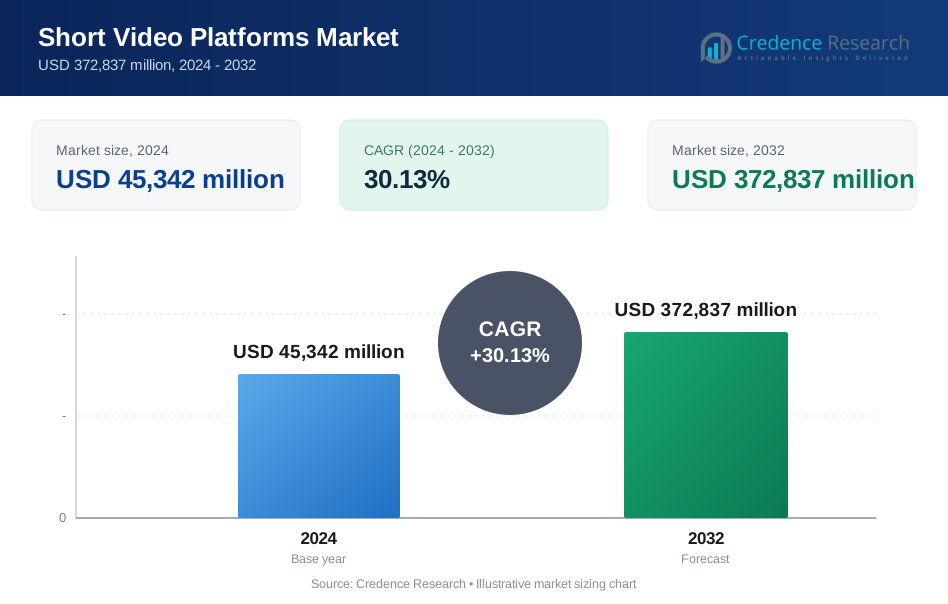
Short Video Platforms Market size was valued at USD 45342 million in 2024 and is anticipated to reach USD 372837 million by 2032, at a CAGR of 30.13% during the forecast period (2024-2032).
Key drivers of the market include the rapid surge in user-generated content, particularly among younger demographics, which has led to the proliferation of platforms offering short, engaging video content. This trend is amplified by the integration of artificial intelligence and machine learning, which help personalize content recommendations, thereby increasing user engagement. The increasing use of social media for entertainment, information sharing, and marketing has driven consumer engagement, while advancements in mobile technology, including 5G, have facilitated faster video streaming and uploads, enhancing user experiences. Additionally, the growing trend of businesses leveraging short video content for digital marketing, influencer collaborations, and brand promotions is fueling the market's expansion, as more brands recognize the power of short videos in reaching targeted audiences effectively.
Regionally, North America holds the largest market share, driven by the high adoption of social media platforms such as TikTok, Instagram, and YouTube Shorts. The U.S. market, in particular, benefits from strong internet infrastructure, high disposable income, and a large consumer base active on digital platforms. The demand for short video content is also supported by the significant presence of tech companies that continuously innovate in the digital space. The Asia Pacific region is expected to witness the highest growth rate, primarily due to the rapid digitalization, growing smartphone penetration, and increasing popularity of short video content in countries like China, India, and Southeast Asian nations. The rise in mobile internet usage in these regions contributes to the high growth potential of short video platforms. Latin America and Europe also exhibit promising growth, with increasing investments in digital content creation and consumption driving the adoption of short video platforms in these regions, particularly through targeted advertising and content collaborations.
Market Insights:
- The Short Video Platforms Market is anticipated to grow significantly, reaching USD 372,837 million by 2032, driven by increased user engagement and technological advancements.
- Key drivers include the rapid rise in user-generated content, particularly from younger demographics, which fuels the popularity of short, engaging videos across platforms.
- Advancements in AI and machine learning enable personalized content recommendations, boosting user engagement and satisfaction on platforms like TikTok and Instagram Reels.
- The growing use of 5G and mobile internet has improved video streaming and upload speeds, facilitating seamless user experiences and driving market expansion.
- North America leads the market, benefiting from advanced digital infrastructure, high disposable income, and widespread social media adoption.
- Asia Pacific shows the highest growth potential, driven by increasing smartphone penetration and the growing popularity of short video content in countries like China, India, and Southeast Asia.
- Platforms are diversifying content offerings and collaborating with influencers and brands to reach new demographics and strengthen market position globally.
Market Drivers:
Widespread Smartphone Adoption and Expanding Internet Access Drive Market Growth
The Short Video Platforms Market is experiencing significant growth, largely propelled by the increasing adoption of smartphones and broader internet access. The number of smartphone users worldwide continues to rise, making it easier for people to access short video content on the go. Enhanced connectivity through advanced mobile networks, such as 4G and 5G, supports seamless video streaming and quick uploads, which boosts user engagement. Affordable data plans and improved network infrastructure have made mobile internet more accessible, especially in developing regions. This shift in technology usage patterns has made short video platforms the preferred choice for digital entertainment. The expanding user base creates new opportunities for content creators and advertisers. The Short Video Platforms Market benefits directly from these technological and demographic trends.
Shifting Consumer Preferences Toward Brief and Engaging Content
Evolving consumer preferences are a key driver for the Short Video Platforms Market, with audiences increasingly seeking concise and captivating content. Modern viewers, especially younger generations, favor short videos that fit into their busy lifestyles and shorter attention spans. The popularity of user-generated content has fueled creativity and community engagement across platforms. Brands and marketers recognize the value of these platforms for reaching target audiences through influencer collaborations and viral campaigns. The demand for quick, shareable videos supports higher engagement rates and frequent platform visits. Content formats that deliver entertainment, information, or trends in seconds align with current consumption habits. The Short Video Platforms Market continues to adapt to these changing preferences to maintain relevance and growth.
- For instance, Instagram Reels now reaches 726.8 million users in 2025, demonstrating the platform’s ability to capture a massive, engaged audience with its short video format.
Technological Advancements and Monetization Models Enhance Platform Value
The integration of advanced technologies is transforming the Short Video PlatformsMarket, with artificial intelligence and machine learning playing central roles. AI-powered recommendation systems personalize content feeds, increasing user satisfaction and retention. Platforms are also introducing features like augmented reality effects and interactive tools to boost user interaction and creativity. New monetization models, such as in-app purchases, brand partnerships, and integrated e-commerce, generate additional revenue streams for both platforms and content creators. These innovations encourage users to spend more time and money within the ecosystem. The ability to quickly implement new technologies gives leading platforms a competitive edge. The Short Video PlatformsMarket remains dynamic due to these ongoing advancements.
- For instance, TikTok’s global revenue is expected to reach $33.1 billion in 2025, reflecting the platform’s success in monetizing its technological advancements and maintaining a leading position in the market.
Geographic Expansion and Diversification of Content Support Market Resilience
The Short Video PlatformsMarket is expanding rapidly into new regions, particularly where digital infrastructure is improving. Platforms are diversifying their content offerings to appeal to a wider range of interests, including education, entertainment, and commerce. Collaborations with influencers, brands, and local creators help platforms reach new demographics and foster a sense of community. The increasing number of online video viewers worldwide drives demand for varied and accessible content. By continuously innovating and expanding their reach, short video platforms strengthen their market position. The Short Video PlatformsMarket leverages these strategies to capture new growth opportunities and ensure long-term resilience.
Market Trends:
Surge in User-Generated Content and Rise of Influencer-Driven Ecosystems
The Short Video Platforms Market is witnessing a surge in user-generated content, which has become the backbone of platform engagement and growth. Individuals and micro-influencers now play a significant role in shaping content trends, driving viral challenges, and fostering interactive communities. Brands increasingly leverage these influencers to reach niche audiences and create authentic marketing campaigns. It has become common for platforms to introduce features that support collaboration, such as duet videos and live streaming, which further amplify user participation. The democratization of content creation empowers users to experiment with new formats and styles, fueling a dynamic and constantly evolving content landscape. This trend strengthens platform loyalty and encourages daily active use among diverse demographic groups.
- For instance, Blue land activated 211 micro-influencers in a coordinated campaign, resulting in 247,932 impressions and a jump in their Amazon seller ranking from #36,544 to #5,808 within three months.
Integration of Advanced Technologies and Expansion of Monetization Opportunities
Emerging technologies are redefining the user experience in the Short Video Platforms Market, with artificial intelligence and augmented reality features enhancing content discovery and personalization. AI-powered algorithms curate tailored feeds that match individual preferences, increasing user retention and satisfaction. It enables platforms to introduce innovative monetization models, including integrated e-commerce, virtual gifting, and branded content partnerships. The seamless blend of entertainment and commerce transforms short video platforms into multifunctional hubs for both creators and consumers. Platforms now invest heavily in security and content moderation tools, ensuring a safe and positive environment for users. The ongoing evolution of technology and monetization strategies positions the Short Video Platforms Market for sustained growth and diversification.
- For instance, Byte Dance, TikTok’s parent company, set a revenue target of $186 billion for 2025, underscoring the platform’s successful integration of advanced technology and monetization strategies.
Market Challenges Analysis:
Intensifying Regulatory Scrutiny and Data Privacy Concerns Impact Market Stability
The Short Video Platforms Market faces mounting regulatory scrutiny and data privacy concerns that challenge its operational stability. Governments worldwide enforce stricter data protection laws and content regulations, compelling platforms to invest in compliance and content moderation systems. It must balance user privacy with the need for personalized experiences, which often requires complex technical solutions. Regulatory changes can disrupt business models and limit market expansion, especially in regions with evolving digital policies. The risk of data breaches and misuse of personal information remains high, potentially eroding user trust. Platforms must prioritize transparency and security to maintain credibility and user loyalty.
- For instance, TikTok launched a revamped Transparency Center in 2021, providing users with a centralized hub for information on data protection and content safety, including interactive charts and up-to-date reports on content removal and privacy practices.
Content Authenticity Issues and Monetization Pressures Threaten Long-Term Growth
Content authenticity and monetization pressures present significant challenges for the Short Video Platforms Market. The proliferation of misinformation, deepfakes, and copyright violations undermines platform integrity and user confidence. It must deploy advanced detection tools and enforce strict guidelines to address these issues effectively. Monetization remains difficult, with creators and platforms seeking sustainable revenue streams amid intense competition and shifting user preferences. The need to balance ad loads with user experience complicates monetization strategies. Platforms that fail to innovate risk losing both creators and audiences, threatening long-term growth and relevance.
Market Opportunities:
Expansion into Untapped Demographics and Emerging Markets Drives Growth Potential
The Short Video Platforms Market holds significant opportunities by expanding into untapped demographics and emerging markets. Rural areas and older age groups represent new user segments with growing digital access and interest in short-form content. It can tailor features and content to local languages and cultural preferences, increasing adoption rates. Strategic partnerships with telecom providers and local influencers can further accelerate user acquisition in these regions. The rising penetration of affordable smartphones and mobile internet supports this expansion. Platforms that adapt quickly to regional trends and user needs can secure a competitive advantage and drive sustained growth.
Integration of E-Commerce and Advanced Personalization Unlocks New Revenue Streams
The integration of e-commerce features and advanced personalization creates lucrative opportunities for the Short Video Platforms Market. It can embed shopping links, product placements, and virtual storefronts directly within short videos, streamlining the consumer journey from discovery to purchase. AI-driven personalization enhances user engagement by delivering relevant content and targeted advertisements. Brands and creators benefit from new monetization models, while users enjoy a seamless entertainment and shopping experience. The ability to offer interactive and shoppable content positions platforms as essential partners for digital marketing. These innovations open new revenue streams and strengthen user loyalty.
Market Segmentation Analysis:
By Type Short Video Platforms Market segments by type into live video and video posts. Live video attracts users who seek interactive, real-time experiences, while video posts remain popular for their ease of creation and wide sharing potential. Both types address the growing preference for short, engaging content that suits fast-paced digital consumption.
- For instance, YouTube’s live streaming feature was used for over 30 unique live event formats in a single creator’s campaign, offering real-time Q&A and audience participation.
By Deployment It divides by deployment into application-based and website-based platforms. Application-based deployment leads, supported by widespread smartphone use and the convenience of mobile apps for both viewing and creating content. Website-based options appeal to users who prefer larger screens and advanced editing features, often favored by professional creators.
- For instance, Peer Tube, a website-based open-source platform, launched in January 2021 and is now available in 28 languages, providing a customizable and ad-free experience for creators and viewers.
By Platform The market segments by platform into Android, iOS, and Windows. Android and iOS dominate due to their extensive global reach and intuitive interfaces, making them the preferred choice for most users. Mobile platforms drive higher engagement and retention, while web platforms remain important for creators who need robust editing tools and integration with other software.
Segmentations:
By Type
- Live Video
- Video Posts
By Deployment
- Application-Based
- Website-Based
By Platform
- Android
- iOS
- Windows
By End-Use
- Education
- Media & Entertainment
- Live Commerce
- Others
By Region
- North America
- U.S.
- Canada
- Mexico
- Europe
- Germany
- France
- U.K.
- Italy
- Spain
- Rest of Europe
- Asia Pacific
- China
- Japan
- India
- South Korea
- South-east Asia
- Rest of Asia Pacific
- Latin America
- Brazil
- Argentina
- Rest of Latin America
- Middle East & Africa
- GCC Countries
- South Africa
- Rest of the Middle East and Africa
Regional Analysis:
North America Leads Innovation and Monetization in Mature Digital Ecosystem
North America accounts for 35% of the global Short Video Platforms Market. The region’s advanced digital infrastructure and high smartphone penetration drive this substantial share. The tech-savvy population quickly adopts new content formats and interactive features, making the market highly competitive. Leading platforms invest in artificial intelligence, content moderation, and advanced monetization tools to maintain user engagement and attract advertisers. It continues to see strong collaboration between creators, brands, and influencers, fueling diverse content and high user retention. Regulatory compliance and data privacy remain top priorities, shaping platform strategies and user trust. The established advertising ecosystem and consumer willingness to spend on digital experiences further support market growth.
Asia-Pacific Emerges as a High-Growth Region with Expanding User Base
Asia-Pacific holds a 45% share of the global Short Video Platforms Market, making it the largest regional contributor. Rapid urbanization, rising disposable incomes, and widespread mobile internet access underpin this growth. Countries such as China, India, and Indonesia drive user expansion, with local platforms competing alongside global players. It benefits from a young, mobile-first audience that embraces short-form video for entertainment, education, and commerce. Localized content, language diversity, and influencer-driven campaigns resonate strongly with regional audiences. Strategic partnerships with telecom operators and integration of e-commerce features accelerate adoption and monetization. The region’s dynamic digital landscape offers significant opportunities for further expansion and innovation.
Europe Focuses on Regulatory Compliance and Diverse Content Offerings
Europe represents 15% of the global Short Video Platforms Market, reflecting a steady but cautious growth trajectory. Strict data privacy regulations and a demand for culturally relevant content define the regional landscape. The region’s platforms must navigate complex legal frameworks, including GDPR, while delivering engaging and compliant user experiences. It places a premium on content authenticity, quality, and multilingual support to address the continent’s diverse population. Collaboration with local creators and brands helps platforms tailor offerings to specific markets and cultural preferences. Digital literacy and high connectivity rates support steady user growth and engagement. The European market values transparency and responsible content management, shaping platform strategies and long-term sustainability.
Key Player Analysis:
- Doupai
- Beijing Wei Ran Internet Technology
- ByteDance Ltd. (Toutiao)
- Tencent Holdings Ltd. (Weishi)
- Vimeo, Inc.
- Facebook (Instagram)
- Kuaishou Technology
- Meipai
- Snap Inc. (Snapchat)
- Snow Corp. ( B612)
- Yixia Technology (Miaopai)
Competitive Analysis:
The Short Video Platforms Market is highly competitive, with major players such as TikTok, Instagram, YouTube Shorts, and Snapchat dominating the landscape. TikTok leads the market, driving innovation through its algorithm and user-generated content. Instagram, backed by Facebook's extensive reach, continues to expand its short-form video offerings, attracting a large user base with its Reels feature. YouTube Shorts benefits from YouTube’s established infrastructure and strong content creator community, allowing it to capture a significant share of the market. Snapchat’s Discover and Spotlight features target younger demographics, further intensifying competition. Emerging platforms like Triller and Dub smash also contribute to the market's competitive environment, often offering unique features to attract niche audiences. These platforms leverage advanced algorithms, AI-driven recommendations, and marketing collaborations to maintain user engagement and grow their market presence, driving constant innovation within the industry.
Recent Developments:
- In April 2025, BMW announced a deepened partnership with Byte Dance’s Volcano Engine to explore AI applications in marketing and services, enhancing user experience and optimizing dealer operations through AI-powered tools.
- In June 2025, ByteDance purchased over 100,000 units of Rubicon Carbon's flagship product, the Rubicon Carbon Tonne, as part of its strategy to achieve carbon neutrality by 2030.
- In April 2025, Kuaishou launched Kling AI 2.0 globally, a significant upgrade to its large video generation model, introducing multi-modal editing and the Multi-modal Visual Language (MVL) concept.
Market Concentration & Characteristics:
The Short Video Platforms Market exhibits moderate concentration, with a few dominant players commanding significant market share. TikTok leads the market, benefiting from its innovative features and vast user engagement. Instagram, YouTube Shorts, and Snapchat also hold substantial shares, each leveraging their parent companies’ infrastructure and user bases to expand their offerings. Despite this concentration, the market remains dynamic, with emerging platforms like Triller and Dubsmash carving out niche segments. These platforms emphasize user personalization, content variety, and influencer partnerships to drive growth. The market’s characteristics include rapid technological advancements, particularly in AI-driven recommendations, and a strong focus on mobile-first experiences. Consumer preference for quick, engaging content continues to shape platform strategies, while monetization through ads, brand collaborations, and in-app purchases remains a key growth driver for these platforms.
Report Coverage:
The research report offers an in-depth analysis based on Type, Deployment, Platform, End-Use and Region. It details leading market players, providing an overview of their business, product offerings, investments, revenue streams, and key applications. Additionally, the report includes insights into the competitive environment, SWOT analysis, current market trends, as well as the primary drivers and constraints. Furthermore, it discusses various factors that have driven market expansion in recent years. The report also explores market dynamics, regulatory scenarios, and technological advancements that are shaping the industry. It assesses the impact of external factors and global economic changes on market growth. Lastly, it provides strategic recommendations for new entrants and established companies to navigate the complexities of the market.
Future Outlook:
- Short-form video content is projected to account for 82% of global internet traffic by the end of 2025, highlighting its dominance in digital media consumption.
- Platforms like TikTok, Instagram Reels, and YouTube Shorts are expected to reach over 2 billion monthly active users each by 2025, reflecting their growing influence.
- The short video advertising market is anticipated to surpass $10 billion in revenue by 2025, driven by increased brand investments in digital marketing.
- Advancements in AI and machine learning are enhancing content personalization, leading to higher user engagement and retention rates.
- The integration of augmented reality (AR) and virtual reality (VR) features is enriching user experiences and providing new avenues for content interaction.
- Educational institutions are increasingly adopting short-form videos for microlearning, capitalizing on their effectiveness in delivering concise information.
- E-commerce platforms are incorporating short videos for product demonstrations and influencer collaborations, boosting online sales and customer engagement.
- The proliferation of 5G networks is facilitating faster video uploads and streaming, enhancing the quality of mobile video consumption.
- Short-form video content is becoming a primary source of entertainment for younger demographics, influencing content creation trends across various platforms.
- The competitive landscape is intensifying, with traditional media companies exploring short-form video formats to capture audience attention and advertising revenue.
Request a Free Sample
Fill in your details and we'll send you a free sample report.
- Sample data tables & charts
- Research methodology
Market Dynamics
Widespread Smartphone Adoption and Expanding Internet Access
The increasing global penetration of smartphones and affordable mobile internet, especially with the rollout of 4G and 5G networks, enables more users to access and create short video content, driving rapid market growth.
Shifting Consumer Preferences Toward Brief and Engaging Content
Younger demographics and modern consumers favor short, easily consumable video formats that fit into busy lifestyles and shorter attention spans, fueling the popularity and frequent use of short video platforms.
Advancements in AI and Machine Learning for Personalization
Platforms leverage AI-driven recommendation engines to deliver highly personalized content feeds, increasing user engagement, retention, and satisfaction, which in turn accelerates platform growth.
Integration of E-Commerce and New Monetization Models
Short video platforms are embedding e-commerce features and innovative monetization options such as in-app purchases, virtual gifting, and brand partnerships, creating new revenue streams and attracting both creators and advertisers.
Geographic Expansion and Localized Content Strategies
Expansion into emerging markets and the development of regionally tailored content and partnerships with local influencers enable platforms to capture new user segments and sustain high growth rates, particularly in Asia Pacific.
Need a Custom Version of This Report?
Tailor the scope, geography, or segments to your exact requirements.
- Custom geography or segment scope
- Direct access to our analyst team
Frequently Asked Questions
What is the current size of the Short Video Platforms Market?
What factors are driving the growth of the Short Video Platforms Market?
What are the key segments within the Short Video Platforms Market?
What are some challenges faced by the Short Video Platforms Market?
ho are the major players in the Short Video Platforms Market?
Table of Content
Chapter 1 Market Segmentation
- 1.1 Segmentation Framework
- 1.1.1 Product and Service Classification
- 1.1.2 Application and End-Use Classification
- 1.1.3 Technology and Solution Classification
- 1.1.4 Customer and Distribution Channel Classification
- 1.1.5 Geographic Segmentation
- 1.1.6 Market Segment Definitions and Boundaries
- 1.2 By Type
- 1.2.1 Live Video
- 1.2.2 Video Posts
- 1.3 By End-Use
- 1.3.1 Education
- 1.3.2 Media & Entertainment
- 1.3.3 Live Commerce
- 1.3.4 Others
- 1.4 By Platform
- 1.4.1 Android
- 1.4.2 iOS
- 1.4.3 Windows
- 1.5 By Deployment
- 1.5.1 Application-Based
- 1.5.2 Website-Based
Chapter 2 Introduction
- 2.1 Report Objectives and Scope
- 2.2 Product Definition and Industry Terminology
- 2.3 Market Inclusions and Exclusions
- 2.4 Research Process
- 2.4.1 Primary Research and Expert Interviews
- 2.4.2 Secondary Research and Source Review
- 2.4.3 Top-Down and Bottom-Up Estimation
- 2.4.4 Data Triangulation and Verification
- 2.5 Market Size Measurement Basis
- 2.5.1 2024: USD 45,342 million → 2032: USD 372,837 million
- 2.6 Historical and Forecast Reference Periods
- 2.6.1 Base Year: 2024
- 2.6.2 Forecast Period: 2024-2032
- 2.7 Research Assumptions and Limitations
Chapter 3 Executive Summary
- 3.1 Market Snapshot and Key Findings
- 3.2 Base-Year Market Size, 2024
- 3.3 Forecast Market Size, 2032
- 3.4 Revenue and Volume Growth Outlook
- 3.5 Key Demand and Supply Indicators
- 3.6 Leading Market Segments
- 3.7 Fastest-Growing Market Opportunities
- 3.8 Regional Performance Highlights
- 3.9 Technology and Industry Transformation
- 3.10 Competitive Landscape Summary
- 3.11 Analyst View and Strategic Implications
Chapter 4 Global Short Video Platforms Market Trends and Developments
- 4.1 Historical Industry Development
- 4.2 Recent Market Trends and Developments
- 4.3 Demand and Customer Behavior Trends
- 4.4 Technology and Product Innovation
- 4.5 Artificial Intelligence, Automation and Digitalization
- 4.6 Local Manufacturing and Supply Chain Realignment
- 4.7 Industry Partnerships, Mergers and Acquisitions
- 4.8 Sustainability and Circular Economy Developments
- 4.9 Government and Private Sector Investment Trends
- 4.10 Emerging Business Models and Commercialization
- 4.11 Industry Developments and Announcements
Chapter 5 Global Short Video Platforms Market Production, Supply and Demand Analysis
- 5.1 Demand Trend and Consumption Analysis
- 5.2 Demand Forecast, 2024-2032
- 5.3 Production and Output Trend
- 5.4 Production and Output Forecast, 2024-2032
- 5.5 Installed Capacity and Capacity Utilization
- 5.6 Company-Wise Production Plants and Statistics
- 5.6.1 Installed Production Capacity
- 5.6.2 Actual Production
- 5.6.3 Planned Capacity and Expansion Targets
- 5.7 Supply Chain Structure and Procurement Trends
- 5.8 Supply-Demand Gap and Bottlenecks
- 5.9 Import Dependence and Sourcing Structure
- 5.10 Contract Manufacturing and Outsourcing
- 5.11 Regional Supply and Demand Concentration
Chapter 6 Global Short Video Platforms Market Pricing Analysis
- 6.1 Pricing Structure and Measurement
- 6.2 Historical Pricing Trends
- 6.3 Pricing Outlook, 2024-2032
- 6.4 Average Selling Price and Unit Economics
- 6.5 Pricing by Product and Market Segment
- 6.6 Geographic Pricing Differences
- 6.7 Key Input, Energy, Labor and Logistics Costs
- 6.8 Contract Pricing and Purchasing Models
- 6.9 Pricing Sensitivity and Competitive Positioning
- 6.10 Price, Margin and Profitability Implications
Chapter 7 Global Short Video Platforms Market Dynamics
- 7.1 Market Growth Drivers
- 7.1.1 Demand-Side Drivers
- 7.1.2 Technology and Innovation Drivers
- 7.1.3 Infrastructure and Investment Drivers
- 7.1.4 Regulatory and Policy Drivers
- 7.2 Market Restraints
- 7.2.1 Cost and Affordability Constraints
- 7.2.2 Technology and Adoption Barriers
- 7.2.3 Supply Chain and Operational Constraints
- 7.3 Market Challenges
- 7.3.1 Competitive Pressure and Margin Erosion
- 7.3.2 Skills, Infrastructure and Implementation Gaps
- 7.4 Emerging Market Opportunities
- 7.5 Market Dynamics Impact and Time-Horizon Assessment
Chapter 8 Global Short Video Platforms Value Chain Analysis
- 8.1 Industry Value Chain Overview
- 8.2 Upstream Suppliers and Critical Inputs
- 8.3 Technology and Component Providers
- 8.4 Manufacturing or Service Delivery
- 8.5 Distribution, Channel Partners and Integrators
- 8.6 Downstream Applications and End Users
- 8.7 Value Addition and Profit Pools
- 8.8 Vertical Integration and Outsourcing
- 8.9 Supplier Concentration and Risk
- 8.10 Supply Chain Localization and Resilience
Chapter 9 Global Short Video Platforms Market Regulations and Policies
- 9.1 Relevant Laws, Standards and Compliance Frameworks
- 9.2 Product, Service, Safety and Quality Requirements
- 9.3 Government Policies, Incentives and Subsidies
- 9.4 Imports, Exports and Trade Barriers
- 9.5 Public Procurement and Local Content Requirements
- 9.6 Environmental and Sustainability Compliance
- 9.7 Data Protection, AI and Cybersecurity Compliance
- 9.8 Upcoming Policy Changes and Market Implications
Chapter 10 Global Short Video Platforms Market Hotspots and Opportunities
- 10.1 Market Opportunity Mapping and Growth Hotspots
- 10.2 High-Growth Applications and Customer Groups
- 10.3 Underserved Markets and White-Space Opportunities
- 10.4 Emerging Technology and Product Opportunities
- 10.5 New Capacity and Investment Hotspots
- 10.6 Market Entry and Expansion Opportunities
- 10.7 Distribution and Partnership Opportunities
- 10.8 Near-Term and Long-Term Commercial Potential
- 10.9 Opportunity Attractiveness and Execution Risks
Chapter 11 Global Short Video Platforms Market Outlook, 2024-2032
- 11.1 Market Size and Analysis
- 11.1.1 Revenue (Market Measurement: 2024: USD 45,342 million → 2032: USD 372,837 million)
- 11.1.2 Market Volume and Quantity Sold
- 11.1.3 Historical Market Size
- 11.1.4 Base-Year Market Size, 2024
- 11.2 Market Forecast, 2024-2032
- 11.2.1 Revenue Forecast to 2032
- 11.2.2 Volume Forecast to 2032
- 11.2.3 CAGR and Year-on-Year Growth
- 11.2.4 Incremental Revenue Opportunity
- 11.3 Forecast Assumptions and Scenario Analysis
- 11.3.1 Base-Case Forecast
- 11.3.2 Optimistic and Conservative Scenarios
- 11.3.3 Technology, Pricing and Policy Sensitivities
- 11.4 Market Attractiveness and Growth Outlook
Chapter 12 Global Short Video Platforms Market Segmentation and Outlook
- 12.1 Segmentation Summary and Market Shares, 2024
- 12.2 Largest and Fastest-Growing Segments
- 12.3 By Type - Market Size and Forecast, 2024-2032
- 12.3.1 Segment Definition and Scope
- 12.3.2 Historical Market Size
- 12.3.3 Revenue Forecast, 2024-2032
- 12.3.4 Volume Forecast, 2024-2032
- 12.3.5 Base-Year Market Share, 2024
- 12.3.6 Segment CAGR and Growth Drivers
- 12.3.7 Subsegment Market Size and Forecast
- 12.3.7.1 Live Video
- 12.3.7.2 Video Posts
- 12.3.8 Subsegment Pricing and Adoption Trends
- 12.3.9 Leading Suppliers and Competition
- 12.3.10 Regional Demand and Opportunities
- 12.4 By End-Use - Market Size and Forecast, 2024-2032
- 12.4.1 Segment Definition and Scope
- 12.4.2 Historical Market Size
- 12.4.3 Revenue Forecast, 2024-2032
- 12.4.4 Volume Forecast, 2024-2032
- 12.4.5 Base-Year Market Share, 2024
- 12.4.6 Segment CAGR and Growth Drivers
- 12.4.7 Subsegment Market Size and Forecast
- 12.4.7.1 Education
- 12.4.7.2 Media & Entertainment
- 12.4.7.3 Live Commerce
- 12.4.7.4 Others
- 12.4.8 Subsegment Pricing and Adoption Trends
- 12.4.9 Leading Suppliers and Competition
- 12.4.10 Regional Demand and Opportunities
- 12.5 By Platform - Market Size and Forecast, 2024-2032
- 12.5.1 Segment Definition and Scope
- 12.5.2 Historical Market Size
- 12.5.3 Revenue Forecast, 2024-2032
- 12.5.4 Volume Forecast, 2024-2032
- 12.5.5 Base-Year Market Share, 2024
- 12.5.6 Segment CAGR and Growth Drivers
- 12.5.7 Subsegment Market Size and Forecast
- 12.5.7.1 Android
- 12.5.7.2 iOS
- 12.5.7.3 Windows
- 12.5.8 Subsegment Pricing and Adoption Trends
- 12.5.9 Leading Suppliers and Competition
- 12.5.10 Regional Demand and Opportunities
- 12.6 By Deployment - Market Size and Forecast, 2024-2032
- 12.6.1 Segment Definition and Scope
- 12.6.2 Historical Market Size
- 12.6.3 Revenue Forecast, 2024-2032
- 12.6.4 Volume Forecast, 2024-2032
- 12.6.5 Base-Year Market Share, 2024
- 12.6.6 Segment CAGR and Growth Drivers
- 12.6.7 Subsegment Market Size and Forecast
- 12.6.7.1 Application-Based
- 12.6.7.2 Website-Based
- 12.6.8 Subsegment Pricing and Adoption Trends
- 12.6.9 Leading Suppliers and Competition
- 12.6.10 Regional Demand and Opportunities
- 12.7 Segment Growth Comparison
- 12.8 Segment Attractiveness and Priority Matrix
Chapter 13 Global Short Video Platforms End-Use and Application Market Outlook
- 13.1 End-Use Industry and Customer Demand Structure
- 13.2 Leading Applications and Customer Groups
- 13.3 End-Use Market Size, Share and Forecast
- 13.4 Major End-Use Industry Deep Dives
- 13.4.1 Customer Requirements and Use Cases
- 13.4.2 Demand and Replacement Cycles
- 13.4.3 Technical and Regulatory Considerations
- 13.4.4 Purchasing and Procurement Models
- 13.4.5 Leading Vendors and Distribution Channels
- 13.4.6 Forecast and Commercial Opportunities
- 13.5 Emerging Applications and Cross-Segment Demand
- 13.6 End-Use Industry Investment Priorities
Chapter 14 Global Short Video Platforms Geographic Market Outlook, 2024-2032
- 14.1 Regional Market Size and Share, 2024
- 14.2 Regional Market Forecast, 2024-2032
- 14.3 Regional Pricing, Production and Demand Differences
- 14.4 North America
- 14.4.1 United States
- 14.4.2 Canada
- 14.4.3 Mexico
- 14.5 Europe
- 14.5.1 Germany
- 14.5.2 France
- 14.5.3 Italy
- 14.5.4 United Kingdom
- 14.5.5 Spain
- 14.5.6 Poland
- 14.5.7 Russia
- 14.5.8 Netherlands
- 14.5.9 Belgium
- 14.5.10 Sweden
- 14.5.11 Denmark
- 14.5.12 Norway
- 14.5.13 Rest of Europe
- 14.6 Asia Pacific
- 14.6.1 China
- 14.6.2 India
- 14.6.3 Japan
- 14.6.4 South Korea
- 14.6.5 Thailand
- 14.6.6 Indonesia
- 14.6.7 Vietnam
- 14.6.8 Malaysia
- 14.6.9 Australia
- 14.6.10 Rest of Asia Pacific
- 14.7 Latin America
- 14.7.1 Brazil
- 14.7.2 Argentina
- 14.7.3 Colombia
- 14.7.4 Chile
- 14.7.5 Rest of Latin America
- 14.8 Middle East
- 14.8.1 Saudi Arabia
- 14.8.2 United Arab Emirates
- 14.8.3 Turkey
- 14.8.4 Israel
- 14.8.5 Iran
- 14.8.6 Rest of the Middle East
- 14.9 Africa
- 14.9.1 South Africa
- 14.9.2 Egypt
- 14.9.3 Nigeria
- 14.9.4 Morocco
- 14.9.5 Rest of Africa
- 14.10 Regional Investment, Policy and Supply Chain Differences
- 14.11 Regional Competitive Landscape
- 14.12 Geographic Growth Hotspots
Chapter 15 Global Short Video Platforms Technology, Innovation and Sustainability Outlook
- 15.1 Technology Landscape and Maturity
- 15.2 Product, Process and Service Innovation
- 15.3 AI, Automation and Digital Tools in the Industry
- 15.4 Technology Adoption and Performance Benchmarking
- 15.5 Innovation Pipeline and R&D Investment
- 15.6 Patent and Intellectual Property Trends
- 15.7 Energy Efficiency and Resource Management
- 15.8 Sustainability, Recycling and Circularity
- 15.9 Technology Roadmap, 2024-2032
- 15.10 Risks of Obsolescence and Technology Substitution
Chapter 16 Global Short Video Platforms Market Key Strategic Imperatives
- 16.1 Growth and Market Entry Priorities
- 16.2 High-Return Products and Segments
- 16.3 Pricing, Profitability and Cost Optimization
- 16.4 Technology Investment and Product Differentiation
- 16.5 Supply Chain Localization and Resilience
- 16.6 Distribution and Customer Acquisition
- 16.7 Partnership, Acquisition and Capacity Strategy
- 16.8 Regional Expansion Priorities
- 16.9 Short-, Medium- and Long-Term Actions
Chapter 17 Competition Outlook
- 17.1 Industry Competition Characteristics
- 17.2 Market Structure and Concentration
- 17.3 Market Share and Competitive Positioning, 2024
- 17.4 Company-Wise Revenue and Product Benchmarking
- 17.5 Production and Service Capacity Benchmarking
- 17.6 Technology, Pricing and Differentiation
- 17.7 Regional Footprint and Distribution Strength
- 17.8 Mergers, Acquisitions and Strategic Alliances
- 17.9 New Entrants and Competitive Threats
- 17.10 Porter's Five Forces and Industry Attractiveness
- 17.11 Competitive Outlook, 2024-2032
Chapter 18 Company Profiles
- 18.1 Company Coverage and Selection Criteria
- 18.2 ByteDance Ltd. (TikTok)
- 18.2.1 Business Description
- 18.2.2 Company Ownership and Geographic Presence
- 18.2.3 Product and Service Portfolio
- 18.2.4 Manufacturing and Operating Footprint
- 18.2.5 Production Capacity and Expansion Plans
- 18.2.6 Financial Performance and Investment
- 18.2.7 Market Share and Competitive Position
- 18.2.8 Technology and Innovation Capabilities
- 18.2.9 Strategic Alliances or Partnerships
- 18.2.10 Recent Developments
- 18.2.11 Growth Strategy and Outlook
- 18.3 Meta Platforms, Inc. (Instagram Reels)
- 18.4 Google LLC (YouTube Shorts)
- 18.5 Snap Inc. (Snapchat)
- 18.6 Kuaishou Technology
- 18.7 Tencent Holdings Ltd. (Weishi)
- 18.8 Vimeo, Inc.
- 18.9 Yixia Technology (Miaopai)
- 18.10 Snow Corp. (B612)
- 18.11 Doupai
- 18.12 Other Relevant Market Participants
Note: Every listed company is profiled on the structure shown under the first company. The company list is preliminary and may change based on research findings, market developments, data availability and client requirements.
Chapter 19 Disclaimer
- 19.1 Research and Forecast Disclaimer
- 19.2 Data Source and Estimation Limitations
Note: The depth of individual sections depends on data availability for this market. Volume, capacity, trade and other unit-based metrics are included where applicable.

