
Market Overview
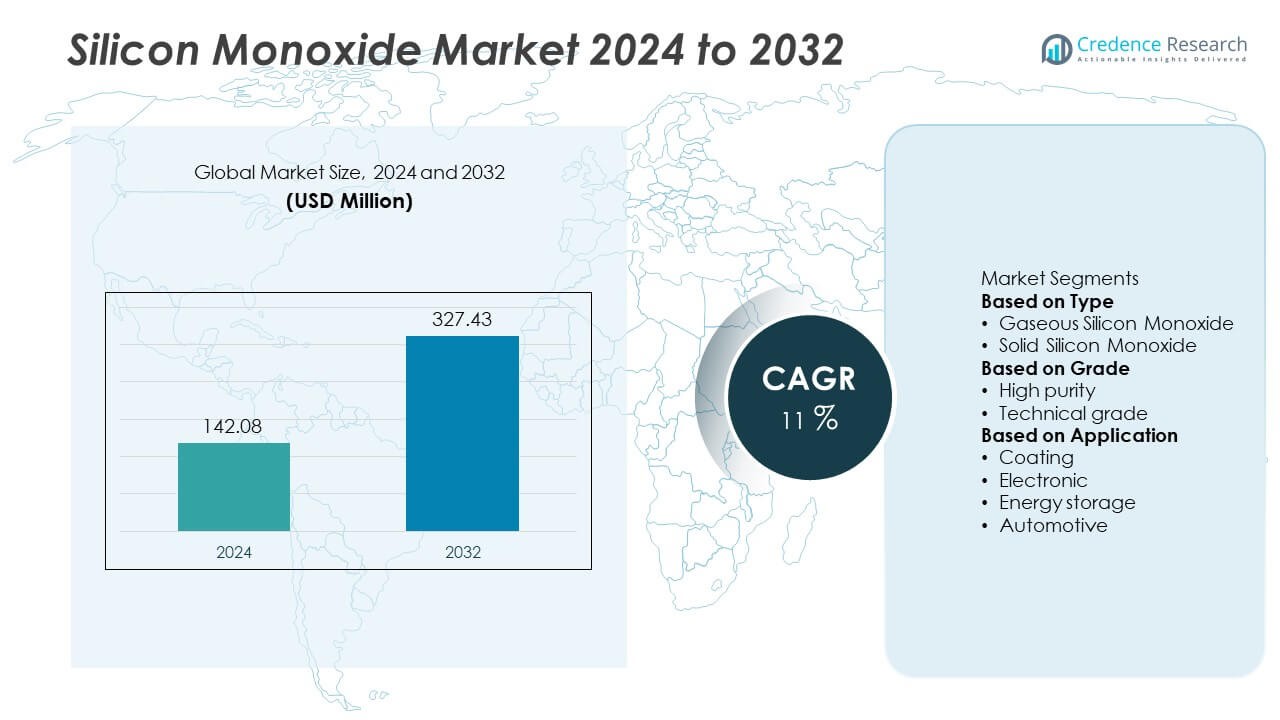
The Silicon Monoxide market was valued at USD 142.08 million in 2024 and is projected to reach USD 327.43 million by 2032, growing at a CAGR of 11% during the forecast period.
| REPORT ATTRIBUTE | DETAILS |
|---|---|
| Historical Period | 2020-2023 |
| Base Year | 2024 |
| Forecast Period | 2025-2032 |
| Silicon Monoxide Market Size 2024 | USD 142.08 Million |
| Silicon Monoxide Market, CAGR | 11% |
| Silicon Monoxide Market Size 2032 | USD 327.43 Million |
The silicon monoxide market is driven by major players such as Lorad Chemical Corporation, Nanoshel LLC, Fujifilm Wako Pure Chemical Corporation, ACS Material, Merck, Materion, OSAKA Titanium Technologies Co Ltd, Nanochemazone, American Elements, and Jayu Optical Material Co., Ltd. These companies focus on developing high-purity silicon monoxide for electronics, coatings, and energy storage applications. Regionally, Asia-Pacific led with 30% share in 2024, supported by strong semiconductor and battery manufacturing industries. North America followed with 33% share, driven by demand in advanced coatings and research. Europe held 27% share, benefitting from automotive and green energy transitions, while other regions showed gradual adoption.
Market Insights
- The silicon monoxide market was valued at USD 142.08 million in 2024 and is projected to reach USD 327.43 million by 2032, growing at a CAGR of 11% during the forecast period.
- Rising demand from electronics and semiconductor industries is a key driver, with the solid type segment holding 65% share in 2024 due to its stability and suitability in thin-film and coating applications.
- High-purity silicon monoxide is a major trend, commanding 70% share in 2024, supported by growing use in advanced coatings, semiconductors, and energy storage solutions.
- The competitive landscape features leading players such as Lorad Chemical Corporation, Nanoshel LLC, Fujifilm Wako Pure Chemical Corporation, ACS Material, Merck, Materion, OSAKA Titanium Technologies Co Ltd, Nanochemazone, American Elements, and Jayu Optical Material Co., Ltd, focusing on purity improvements and global expansion.
- Regionally, North America led with 33% share, followed by Asia-Pacific at 30% as the fastest-growing market, while Europe held 27%, supported by automotive, coatings, and renewable energy initiatives.
Market Segmentation Analysis:
By Type
The solid silicon monoxide segment dominated the market in 2024 with over 65% share, driven by its widespread use in electronic components, thin-film deposition, and protective coatings. Solid SiO offers high stability, making it suitable for precision applications in semiconductors and optical devices. Its compatibility with vacuum evaporation processes further supports adoption in advanced electronics manufacturing. While gaseous silicon monoxide is used in niche applications such as chemical synthesis and research, its demand remains limited compared to the solid form, which continues to lead due to reliability and scalability in industrial applications.
- For instance, Materion produces high-purity solid silicon monoxide for critical semiconductor coating applications, meeting strict industry requirements for quality and consistency.
By Grade
High-purity silicon monoxide held a commanding 70% share of the market in 2024, reflecting strong demand from electronics, coatings, and energy storage industries where purity levels are critical for performance. Semiconductor manufacturers prefer high-purity SiO for producing defect-free thin films and optical coatings with enhanced durability. The technical grade segment, while cost-effective, caters mainly to less sensitive industrial applications where performance specifications are not as stringent. The dominance of high-purity products underscores the growing emphasis on advanced technologies requiring superior material properties and consistency.
- For instance, Merck (EMD Electronics) is a major supplier of materials for semiconductor manufacturing and reported strong growth in this area in 2024, driven by high-value materials for advanced nodes and demand for AI chip systems.
By Application
The coating application segment accounted for more than 40% share of the silicon monoxide market in 2024, establishing itself as the leading sub-segment. Its strong position stems from the extensive use of SiO in optical coatings, barrier layers, and thin films across electronics and packaging industries. Demand is reinforced by its ability to improve scratch resistance, enhance durability, and provide protective layers for high-value devices. Electronic and energy storage applications are expanding rapidly, particularly in batteries and semiconductors, but coatings remain the largest consumer segment due to established industrial use and wide functional applicability.
Key Growth Drivers
Expanding Electronics and Semiconductor Industry
The rapid growth of the electronics and semiconductor industry is a major driver for the silicon monoxide market. Solid SiO is widely used in thin-film deposition, optical coatings, and protective layers in semiconductors, smartphones, and display devices. Rising consumer demand for high-performance electronics and miniaturized components further accelerates adoption. With global investments in advanced fabrication facilities and microelectronics, silicon monoxide remains a critical material for ensuring durability, efficiency, and performance of modern devices, strengthening its role in the electronics supply chain.
- For instance, Osaka Titanium Technologies Co Ltd expanded its production capacity for titanium sponge, in previous years. The company does produce solid silicon monoxide for the electronics industry with high purity.
Rising Demand in Energy Storage Applications
Energy storage is emerging as a strong growth driver, with silicon monoxide being integrated into lithium-ion and next-generation batteries. SiO enhances energy density and cycle life, addressing limitations of traditional graphite anodes. The surge in demand for electric vehicles, portable electronics, and renewable energy storage systems significantly boosts SiO usage. Manufacturers are investing in research to optimize SiO-based anode materials, improving performance and scalability. This rising adoption positions silicon monoxide as a vital material in the global transition toward clean energy and sustainable mobility.
- For instance, in laboratory studies of nanostructured silicon and silicon monoxide composites, researchers have demonstrated reversible specific capacities exceeding 1000 mAh/g under cycling conditions.
Increasing Adoption in Coatings Industry
The coatings industry represents another important growth area for silicon monoxide. SiO is widely applied in protective, optical, and barrier coatings, especially in packaging, automotive, and display technologies. Its properties improve scratch resistance, moisture protection, and durability of high-value products. Growing demand for advanced packaging solutions and high-performance displays drives strong consumption of SiO coatings. With industries seeking longer-lasting and higher-quality surfaces, the coatings application of silicon monoxide continues to expand, contributing significantly to overall market growth across developed and emerging regions.
Key Trends & Opportunities
Adoption of High-Purity Silicon Monoxide
A major trend shaping the market is the increasing adoption of high-purity silicon monoxide, which held 70% share in 2024. Electronics and semiconductor manufacturers prefer high-purity grades for defect-free coatings and consistent performance. Growing investments in high-tech manufacturing, particularly in Asia-Pacific, are creating new opportunities for suppliers of high-purity SiO. Companies focusing on improved refining techniques and production efficiency are well-positioned to capitalize on this trend, as demand for purity-driven materials continues to rise across high-value applications.
- For instance, American Elements announced a significant expansion in December 2024 of its production facilities for several high-demand materials, including gallium, germanium, and antimony.
Integration into Next-Generation Battery Technologies
The integration of silicon monoxide into next-generation battery technologies presents a major opportunity. As EV adoption accelerates, manufacturers are actively developing SiO-based anodes that offer higher energy density and faster charging compared to conventional materials. Collaborations between material producers and battery makers are intensifying, aiming to bring scalable solutions to market. This trend not only enhances the performance of consumer electronics but also supports global energy transition goals. Silicon monoxide’s growing role in advanced batteries positions it as a critical enabler of future energy storage solutions.
- For instance, Nanochemazone provides high-purity silicon monoxide powder primarily for research and development into advanced lithium-ion battery anodes. The company offers materials with customizable size ranges.
Key Challenges
High Production Costs and Processing Complexity
One of the key challenges in the silicon monoxide market is its high production cost and complex processing requirements. Manufacturing SiO with consistent purity and stability demands advanced equipment and energy-intensive processes, which increase overall expenses. This limits adoption in cost-sensitive applications and poses challenges for smaller producers. Without scalable and cost-effective production technologies, broader market penetration may face constraints, particularly in developing regions with limited investment capacity.
Limited Awareness and Application Constraints
Another challenge is the limited awareness of silicon monoxide’s potential outside specialized industries. While its use in coatings, electronics, and energy storage is established, many sectors still rely on conventional materials due to familiarity and lower cost. Application constraints, such as handling difficulties and material stability under certain conditions, also restrict usage. To overcome this, manufacturers need to invest in awareness programs and application research, demonstrating SiO’s benefits in diverse sectors. Expanding knowledge and practical applicability will be critical for unlocking its full market potential.
Regional Analysis
North America
North America held 33% share of the silicon monoxide market in 2024, supported by strong demand from electronics, semiconductors, and coatings industries. The United States leads regional consumption due to its advanced semiconductor manufacturing base and high adoption of silicon monoxide in thin-film applications. Growth is also driven by research and development investments in energy storage materials, particularly for electric vehicles. Canada and Mexico contribute through expanding industrial and automotive sectors. Robust technological infrastructure, strong research networks, and increasing use of SiO in protective coatings continue to strengthen North America’s dominance in the global market.
Europe
Europe accounted for 27% share of the silicon monoxide market in 2024, driven by established automotive, packaging, and electronics industries. Germany, France, and the U.K. are key consumers due to their strong semiconductor and coatings sectors. The region’s push toward sustainable materials and eco-friendly coatings has further boosted demand for high-purity SiO. Europe also benefits from rising use in energy storage, as the region accelerates electric vehicle production under its green transition policies. Collaborative projects between research institutes and material producers support innovation, ensuring steady growth and positioning Europe as a key market hub.
Asia-Pacific
Asia-Pacific captured 30% share of the silicon monoxide market in 2024, emerging as the fastest-growing regional market. China, Japan, and South Korea dominate consumption due to their large semiconductor, electronics, and display manufacturing industries. Strong demand from lithium-ion battery production for electric vehicles and consumer electronics significantly contributes to market expansion. Government support for renewable energy storage solutions and rising local production capacities further drive growth. Asia-Pacific’s expanding industrial base, coupled with cost-efficient manufacturing, positions it as a critical center for global silicon monoxide supply and application development across multiple high-tech sectors.
Latin America
Latin America represented 6% share of the silicon monoxide market in 2024, with Brazil and Mexico leading regional demand. Growth is supported by expanding automotive production and rising investments in coatings and packaging sectors. The electronics industry remains limited compared to other regions, but increasing imports of advanced devices indirectly drive demand for SiO in thin-film applications. Government initiatives to strengthen renewable energy and storage capacity create additional opportunities. Despite challenges related to limited manufacturing infrastructure, gradual improvements in industrial activity are expected to support steady market growth in Latin America during the forecast period.
Middle East & Africa
The Middle East & Africa region held 4% share of the silicon monoxide market in 2024, reflecting modest but growing adoption. Demand is concentrated in countries such as the UAE, Saudi Arabia, and South Africa, where industrial development and electronics consumption are rising. Coatings and packaging industries contribute significantly to usage, while energy storage adoption is gradually increasing with renewable energy projects. However, limited production capacity and dependence on imports restrict wider penetration. Ongoing investments in industrial infrastructure and collaborations with international material suppliers are expected to improve accessibility and support steady market growth in the region.
Market Segmentations:
By Type
- Gaseous Silicon Monoxide
- Solid Silicon Monoxide
By Grade
- High purity
- Technical grade
By Application
- Coating
- Electronic
- Energy storage
- Automotive
By Geography
- North America
- Europe
- Asia Pacific
- Latin America
- Middle East
- Africa
Competitive Landscape
The competitive landscape of the silicon monoxide market is shaped by key players including Lorad Chemical Corporation, Nanoshel LLC, Fujifilm Wako Pure Chemical Corporation, ACS Material, Merck, Materion, OSAKA Titanium Technologies Co Ltd, Nanochemazone, American Elements, and Jayu Optical Material Co., Ltd. These companies compete through innovations in high-purity production, advanced thin-film applications, and energy storage solutions. Strong focus is placed on supplying materials for semiconductors, coatings, and next-generation lithium-ion batteries. Leading firms are expanding production capacity, improving refining technologies, and forming strategic partnerships with electronics and battery manufacturers to secure long-term demand. The market is also witnessing rising investments in nanotechnology and custom material development to meet specialized industry requirements. Players are targeting Asia-Pacific and Europe for expansion, capitalizing on strong electronics manufacturing bases and green energy initiatives. Sustainability, material purity, and performance optimization remain central strategies for strengthening market presence in a competitive global environment.
Key Player Analysis
- Lorad Chemical Corporation
- Nanoshel LLC
- Fujifilm Wako Pure Chemical Corporation
- ACS Material
- Merck
- Materion
- OSAKA Titanium Technologies Co Ltd
- Nanochemazone
- American Elements
- Jayu Optical Material Co., Ltd
Recent Developments
- In April 2024, Shin-Etsu Chemical Co., Ltd stated that it will develop a new plant in Isesaki City, Gunma Prefecture, Japan, to expand its semiconductor lithography materials business. The new factory will be Shin-Etsu's fourth production base in this business.
- In January 2024, Das Solar achieved a world-record open-circuit voltage of 742 mV for an n-type TOPCon solar cell, confirmed by China’s National PV Industry Measurement and Testing Center.
- In October 2023, Ionblox debuted its extremely fast-charging lithium-silicon cells for EVs, achieving 60% charge in 5 minutes and extending range by 30-50%. The cells-maintained performance over 1,000 cycles with minimal degradation.
Report Coverage
The research report offers an in-depth analysis based on Type, Grade, Application and Geography. It details leading market players, providing an overview of their business, product offerings, investments, revenue streams, and key applications. Additionally, the report includes insights into the competitive environment, SWOT analysis, current market trends, as well as the primary drivers and constraints. Furthermore, it discusses various factors that have driven market expansion in recent years. The report also explores market dynamics, regulatory scenarios, and technological advancements that are shaping the industry. It assesses the impact of external factors and global economic changes on market growth. Lastly, it provides strategic recommendations for new entrants and established companies to navigate the complexities of the market.
Future Outlook
- The market will grow steadily with rising use in semiconductors and electronics.
- Solid silicon monoxide will maintain dominance due to reliability in thin-film applications.
- High-purity grades will see increasing demand across coatings and advanced electronics.
- Energy storage applications will expand with wider adoption in lithium-ion batteries.
- Automotive sector demand will rise as electric vehicle production accelerates globally.
- Asia-Pacific will remain the fastest-growing region with strong manufacturing bases.
- North America and Europe will sustain growth through research and green energy initiatives.
- Sustainability efforts will drive innovation in eco-friendly production processes.
- Strategic partnerships between material suppliers and battery makers will intensify.
- Competition will strengthen as global players expand capacities and enter new markets.

Request a Free Sample
Fill in your details and we'll send you a free sample report.
- Sample data tables & charts
- Research methodology
Market Dynamics
Expanding Electronics and Semiconductor Industry
The rapid growth of the electronics and semiconductor industry is driving demand for silicon monoxide, especially in thin-film deposition, optical coatings, and protective layers for semiconductors and display devices. Investments in advanced fabrication facilities and miniaturized electronics further boost SiO adoption.
Rising Demand in Energy Storage Applications
Silicon monoxide is increasingly used in lithium-ion and next-generation batteries, where it enhances energy density and cycle life. The surge in electric vehicle production and renewable energy storage systems is significantly increasing SiO consumption in battery anodes.
Increasing Adoption in Coatings Industry
SiO is widely used in protective, optical, and barrier coatings for packaging, automotive, and display technologies. Its ability to improve scratch resistance and durability makes it a preferred material, supporting strong demand from industries seeking high-performance coatings.
Shift Toward High-Purity Silicon Monoxide
There is a growing trend toward high-purity SiO, which is essential for defect-free coatings and advanced electronics. Manufacturers are investing in refining techniques to meet the stringent requirements of semiconductor and high-tech applications, driving market growth.
Growth in Asia-Pacific Manufacturing Base
Asia-Pacific is emerging as the fastest-growing region due to its large semiconductor, electronics, and battery manufacturing industries. Government support for renewable energy and local production capacities are accelerating SiO adoption across multiple high-tech sectors.
Need a Custom Version of This Report?
Tailor the scope, geography, or segments to your exact requirements.
- Custom geography or segment scope
- Direct access to our analyst team
Frequently Asked Questions
What is the current market size for Silicon Monoxide market, and what is its projected size in 2032?
At what Compound Annual Growth Rate is the Silicon Monoxide market projected to grow between 2025 and 2032?
Which Silicon Monoxide market segment held the largest share in 2024?
What are the primary factors fueling the growth of the Silicon Monoxide market?
Who are the leading companies in the Silicon Monoxide market?
Which region commanded the largest share of the Silicon Monoxide market in 2024?
Table of Content
Chapter 1 Market Segmentation
- 1.1 Segmentation Framework
- 1.1.1 Product and Service Classification
- 1.1.2 Application and End-Use Classification
- 1.1.3 Technology and Solution Classification
- 1.1.4 Customer and Distribution Channel Classification
- 1.1.5 Geographic Segmentation
- 1.1.6 Market Segment Definitions and Boundaries
- 1.2 By Type
- 1.2.1 Solid Silicon Monoxide
- 1.2.2 Gaseous Silicon Monoxide
- 1.3 By Grade
- 1.3.1 High purity
- 1.3.2 Technical grade
- 1.4 By Application
- 1.4.1 Coating
- 1.4.2 Electronic
- 1.4.3 Energy storage
- 1.4.4 Automotive
Chapter 2 Introduction
- 2.1 Report Objectives and Scope
- 2.2 Product Definition and Industry Terminology
- 2.3 Market Inclusions and Exclusions
- 2.4 Research Process
- 2.4.1 Primary Research and Expert Interviews
- 2.4.2 Secondary Research and Source Review
- 2.4.3 Top-Down and Bottom-Up Estimation
- 2.4.4 Data Triangulation and Verification
- 2.5 Market Size Measurement Basis
- 2.5.1 2024: USD 142.08 million → 2032: USD 327.43 million
- 2.6 Historical and Forecast Reference Periods
- 2.6.1 Base Year: 2024
- 2.6.2 Forecast Period: 2024-2032
- 2.7 Research Assumptions and Limitations
Chapter 3 Executive Summary
- 3.1 Market Snapshot and Key Findings
- 3.2 Base-Year Market Size, 2024
- 3.3 Forecast Market Size, 2032
- 3.4 Revenue and Volume Growth Outlook
- 3.5 Key Demand and Supply Indicators
- 3.6 Leading Market Segments
- 3.7 Fastest-Growing Market Opportunities
- 3.8 Regional Performance Highlights
- 3.9 Technology and Industry Transformation
- 3.10 Competitive Landscape Summary
- 3.11 Analyst View and Strategic Implications
Chapter 4 Global Silicon Monoxide Market Trends and Developments
- 4.1 Historical Industry Development
- 4.2 Recent Market Trends and Developments
- 4.3 Demand and Customer Behavior Trends
- 4.4 Technology and Product Innovation
- 4.5 Artificial Intelligence, Automation and Digitalization
- 4.6 Local Manufacturing and Supply Chain Realignment
- 4.7 Industry Partnerships, Mergers and Acquisitions
- 4.8 Sustainability and Circular Economy Developments
- 4.9 Government and Private Sector Investment Trends
- 4.10 Emerging Business Models and Commercialization
- 4.11 Industry Developments and Announcements
Chapter 5 Global Silicon Monoxide Market Production, Supply and Demand Analysis
- 5.1 Demand Trend and Consumption Analysis
- 5.2 Demand Forecast, 2024-2032
- 5.3 Production and Output Trend
- 5.4 Production and Output Forecast, 2024-2032
- 5.5 Installed Capacity and Capacity Utilization
- 5.6 Company-Wise Production Plants and Statistics
- 5.6.1 Installed Production Capacity
- 5.6.2 Actual Production
- 5.6.3 Planned Capacity and Expansion Targets
- 5.7 Supply Chain Structure and Procurement Trends
- 5.8 Supply-Demand Gap and Bottlenecks
- 5.9 Import Dependence and Sourcing Structure
- 5.10 Contract Manufacturing and Outsourcing
- 5.11 Regional Supply and Demand Concentration
Chapter 6 Global Silicon Monoxide Market Pricing Analysis
- 6.1 Pricing Structure and Measurement
- 6.2 Historical Pricing Trends
- 6.3 Pricing Outlook, 2024-2032
- 6.4 Average Selling Price and Unit Economics
- 6.5 Pricing by Product and Market Segment
- 6.6 Geographic Pricing Differences
- 6.7 Key Input, Energy, Labor and Logistics Costs
- 6.8 Contract Pricing and Purchasing Models
- 6.9 Pricing Sensitivity and Competitive Positioning
- 6.10 Price, Margin and Profitability Implications
Chapter 7 Global Silicon Monoxide Market Dynamics
- 7.1 Market Growth Drivers
- 7.1.1 Demand-Side Drivers
- 7.1.2 Technology and Innovation Drivers
- 7.1.3 Infrastructure and Investment Drivers
- 7.1.4 Regulatory and Policy Drivers
- 7.2 Market Restraints
- 7.2.1 Cost and Affordability Constraints
- 7.2.2 Technology and Adoption Barriers
- 7.2.3 Supply Chain and Operational Constraints
- 7.3 Market Challenges
- 7.3.1 Competitive Pressure and Margin Erosion
- 7.3.2 Skills, Infrastructure and Implementation Gaps
- 7.4 Emerging Market Opportunities
- 7.5 Market Dynamics Impact and Time-Horizon Assessment
Chapter 8 Global Silicon Monoxide Value Chain Analysis
- 8.1 Industry Value Chain Overview
- 8.2 Upstream Suppliers and Critical Inputs
- 8.3 Technology and Component Providers
- 8.4 Manufacturing or Service Delivery
- 8.5 Distribution, Channel Partners and Integrators
- 8.6 Downstream Applications and End Users
- 8.7 Value Addition and Profit Pools
- 8.8 Vertical Integration and Outsourcing
- 8.9 Supplier Concentration and Risk
- 8.10 Supply Chain Localization and Resilience
Chapter 9 Global Silicon Monoxide Market Regulations and Policies
- 9.1 Relevant Laws, Standards and Compliance Frameworks
- 9.2 Product, Service, Safety and Quality Requirements
- 9.3 Government Policies, Incentives and Subsidies
- 9.4 Imports, Exports and Trade Barriers
- 9.5 Public Procurement and Local Content Requirements
- 9.6 Environmental and Sustainability Compliance
- 9.7 Upcoming Policy Changes and Market Implications
Chapter 10 Global Silicon Monoxide Market Hotspots and Opportunities
- 10.1 Market Opportunity Mapping and Growth Hotspots
- 10.2 High-Growth Applications and Customer Groups
- 10.3 Underserved Markets and White-Space Opportunities
- 10.4 Emerging Technology and Product Opportunities
- 10.5 New Capacity and Investment Hotspots
- 10.6 Market Entry and Expansion Opportunities
- 10.7 Distribution and Partnership Opportunities
- 10.8 Near-Term and Long-Term Commercial Potential
- 10.9 Opportunity Attractiveness and Execution Risks
Chapter 11 Global Silicon Monoxide Market Outlook, 2024-2032
- 11.1 Market Size and Analysis
- 11.1.1 Revenue (Market Measurement: 2024: USD 142.08 million → 2032: USD 327.43 million)
- 11.1.2 Market Volume and Quantity Sold
- 11.1.3 Historical Market Size
- 11.1.4 Base-Year Market Size, 2024
- 11.2 Market Forecast, 2024-2032
- 11.2.1 Revenue Forecast to 2032
- 11.2.2 Volume Forecast to 2032
- 11.2.3 CAGR and Year-on-Year Growth
- 11.2.4 Incremental Revenue Opportunity
- 11.3 Forecast Assumptions and Scenario Analysis
- 11.3.1 Base-Case Forecast
- 11.3.2 Optimistic and Conservative Scenarios
- 11.3.3 Technology, Pricing and Policy Sensitivities
- 11.4 Market Attractiveness and Growth Outlook
Chapter 12 Global Silicon Monoxide Market Segmentation and Outlook
- 12.1 Segmentation Summary and Market Shares, 2024
- 12.2 Largest and Fastest-Growing Segments
- 12.3 By Type - Market Size and Forecast, 2024-2032
- 12.3.1 Segment Definition and Scope
- 12.3.2 Historical Market Size
- 12.3.3 Revenue Forecast, 2024-2032
- 12.3.4 Volume Forecast, 2024-2032
- 12.3.5 Base-Year Market Share, 2024
- 12.3.6 Segment CAGR and Growth Drivers
- 12.3.7 Subsegment Market Size and Forecast
- 12.3.7.1 Solid Silicon Monoxide
- 12.3.7.2 Gaseous Silicon Monoxide
- 12.3.8 Subsegment Pricing and Adoption Trends
- 12.3.9 Leading Suppliers and Competition
- 12.3.10 Regional Demand and Opportunities
- 12.4 By Grade - Market Size and Forecast, 2024-2032
- 12.4.1 Segment Definition and Scope
- 12.4.2 Historical Market Size
- 12.4.3 Revenue Forecast, 2024-2032
- 12.4.4 Volume Forecast, 2024-2032
- 12.4.5 Base-Year Market Share, 2024
- 12.4.6 Segment CAGR and Growth Drivers
- 12.4.7 Subsegment Market Size and Forecast
- 12.4.7.1 High purity
- 12.4.7.2 Technical grade
- 12.4.8 Subsegment Pricing and Adoption Trends
- 12.4.9 Leading Suppliers and Competition
- 12.4.10 Regional Demand and Opportunities
- 12.5 By Application - Market Size and Forecast, 2024-2032
- 12.5.1 Segment Definition and Scope
- 12.5.2 Historical Market Size
- 12.5.3 Revenue Forecast, 2024-2032
- 12.5.4 Volume Forecast, 2024-2032
- 12.5.5 Base-Year Market Share, 2024
- 12.5.6 Segment CAGR and Growth Drivers
- 12.5.7 Subsegment Market Size and Forecast
- 12.5.7.1 Coating
- 12.5.7.2 Electronic
- 12.5.7.3 Energy storage
- 12.5.7.4 Automotive
- 12.5.8 Subsegment Pricing and Adoption Trends
- 12.5.9 Leading Suppliers and Competition
- 12.5.10 Regional Demand and Opportunities
- 12.6 Segment Growth Comparison
- 12.7 Segment Attractiveness and Priority Matrix
Chapter 13 Global Silicon Monoxide End-Use and Application Market Outlook
- 13.1 End-Use Industry and Customer Demand Structure
- 13.2 Leading Applications and Customer Groups
- 13.3 End-Use Market Size, Share and Forecast
- 13.4 Major End-Use Industry Deep Dives
- 13.4.1 Customer Requirements and Use Cases
- 13.4.2 Demand and Replacement Cycles
- 13.4.3 Technical and Regulatory Considerations
- 13.4.4 Purchasing and Procurement Models
- 13.4.5 Leading Vendors and Distribution Channels
- 13.4.6 Forecast and Commercial Opportunities
- 13.5 Emerging Applications and Cross-Segment Demand
- 13.6 End-Use Industry Investment Priorities
Chapter 14 Global Silicon Monoxide Geographic Market Outlook, 2024-2032
- 14.1 Regional Market Size and Share, 2024
- 14.2 Regional Market Forecast, 2024-2032
- 14.3 Regional Pricing, Production and Demand Differences
- 14.4 North America
- 14.4.1 United States
- 14.4.2 Canada
- 14.4.3 Mexico
- 14.5 Europe
- 14.5.1 Germany
- 14.5.2 France
- 14.5.3 Italy
- 14.5.4 United Kingdom
- 14.5.5 Spain
- 14.5.6 Poland
- 14.5.7 Russia
- 14.5.8 Netherlands
- 14.5.9 Belgium
- 14.5.10 Sweden
- 14.5.11 Denmark
- 14.5.12 Norway
- 14.5.13 Rest of Europe
- 14.6 Asia Pacific
- 14.6.1 China
- 14.6.2 India
- 14.6.3 Japan
- 14.6.4 South Korea
- 14.6.5 Thailand
- 14.6.6 Indonesia
- 14.6.7 Vietnam
- 14.6.8 Malaysia
- 14.6.9 Australia
- 14.6.10 Rest of Asia Pacific
- 14.7 Latin America
- 14.7.1 Brazil
- 14.7.2 Argentina
- 14.7.3 Colombia
- 14.7.4 Chile
- 14.7.5 Rest of Latin America
- 14.8 Middle East
- 14.8.1 Saudi Arabia
- 14.8.2 United Arab Emirates
- 14.8.3 Turkey
- 14.8.4 Israel
- 14.8.5 Iran
- 14.8.6 Rest of the Middle East
- 14.9 Africa
- 14.9.1 South Africa
- 14.9.2 Egypt
- 14.9.3 Nigeria
- 14.9.4 Morocco
- 14.9.5 Rest of Africa
- 14.10 Regional Investment, Policy and Supply Chain Differences
- 14.11 Regional Competitive Landscape
- 14.12 Geographic Growth Hotspots
Chapter 15 Global Silicon Monoxide Technology, Innovation and Sustainability Outlook
- 15.1 Technology Landscape and Maturity
- 15.2 Product, Process and Service Innovation
- 15.3 AI, Automation and Digital Tools in the Industry
- 15.4 Technology Adoption and Performance Benchmarking
- 15.5 Innovation Pipeline and R&D Investment
- 15.6 Patent and Intellectual Property Trends
- 15.7 Energy Efficiency and Resource Management
- 15.8 Sustainability, Recycling and Circularity
- 15.9 Technology Roadmap, 2024-2032
- 15.10 Risks of Obsolescence and Technology Substitution
Chapter 16 Global Silicon Monoxide Market Key Strategic Imperatives
- 16.1 Growth and Market Entry Priorities
- 16.2 High-Return Products and Segments
- 16.3 Pricing, Profitability and Cost Optimization
- 16.4 Technology Investment and Product Differentiation
- 16.5 Supply Chain Localization and Resilience
- 16.6 Distribution and Customer Acquisition
- 16.7 Partnership, Acquisition and Capacity Strategy
- 16.8 Regional Expansion Priorities
- 16.9 Short-, Medium- and Long-Term Actions
Chapter 17 Competition Outlook
- 17.1 Industry Competition Characteristics
- 17.2 Market Structure and Concentration
- 17.3 Market Share and Competitive Positioning, 2024
- 17.4 Company-Wise Revenue and Product Benchmarking
- 17.5 Production and Service Capacity Benchmarking
- 17.6 Technology, Pricing and Differentiation
- 17.7 Regional Footprint and Distribution Strength
- 17.8 Mergers, Acquisitions and Strategic Alliances
- 17.9 New Entrants and Competitive Threats
- 17.10 Porter's Five Forces and Industry Attractiveness
- 17.11 Competitive Outlook, 2024-2032
Chapter 18 Company Profiles
- 18.1 Company Coverage and Selection Criteria
- 18.2 Lorad Chemical Corporation
- 18.2.1 Business Description
- 18.2.2 Company Ownership and Geographic Presence
- 18.2.3 Product and Service Portfolio
- 18.2.4 Manufacturing and Operating Footprint
- 18.2.5 Production Capacity and Expansion Plans
- 18.2.6 Financial Performance and Investment
- 18.2.7 Market Share and Competitive Position
- 18.2.8 Technology and Innovation Capabilities
- 18.2.9 Strategic Alliances or Partnerships
- 18.2.10 Recent Developments
- 18.2.11 Growth Strategy and Outlook
- 18.3 Nanoshel LLC
- 18.4 Fujifilm Wako Pure Chemical Corporation
- 18.5 ACS Material
- 18.6 Merck
- 18.7 Materion
- 18.8 OSAKA Titanium Technologies Co Ltd
- 18.9 Nanochemazone
- 18.10 American Elements
- 18.11 Jayu Optical Material Co., Ltd
- 18.12 Other Relevant Market Participants
Note: Every listed company is profiled on the structure shown under the first company. The company list is preliminary and may change based on research findings, market developments, data availability and client requirements.
Chapter 19 Disclaimer
- 19.1 Research and Forecast Disclaimer
- 19.2 Data Source and Estimation Limitations
Note: The depth of individual sections depends on data availability for this market. Volume, capacity, trade and other unit-based metrics are included where applicable.

