
| REPORT ATTRIBUTE | DETAILS |
|---|---|
| Historical Period | 2020-2023 |
| Base Year | 2024 |
| Forecast Period | 2025-2032 |
| Smart Home Hub Market Size 2024 | USD 12522 Million |
| Smart Home Hub Market, CAGR | 12.28% |
| Smart Home Hub Market Size 2032 | USD 31629.5 Million |
Market Overview:
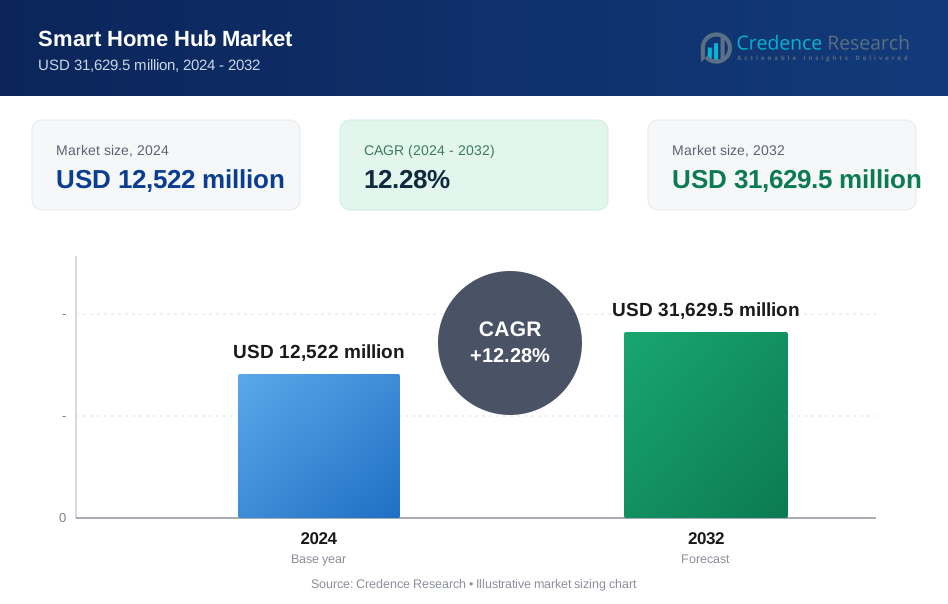
The Smart Home Hub Market size was valued at USD 12522 million in 2024 and is anticipated to reach USD 31629.5 million by 2032, at a CAGR of 12.28% during the forecast period (2024-2032).
Key drivers of the Smart Home Hub Market include the growing consumer demand for home automation, improved energy efficiency, and enhanced security. As consumers seek seamless control over their home environment, the need for reliable, easy-to-use hubs has escalated. This demand is further fueled by the desire for remote monitoring and control of appliances, lighting, heating, and security systems. Additionally, the integration of smart home hubs with popular virtual assistants like Amazon Alexa, Google Assistant, and Apple Siri has expanded their appeal, offering users greater convenience and voice control. The increasing focus on sustainable living and energy-efficient solutions also encourages consumers to adopt smart home technologies, further stimulating the market.
Regionally, North America dominates the Smart Home Hub Market, holding a significant share due to the high adoption rate of smart home technologies and a well-established infrastructure. The United States, in particular, stands out as a key contributor, with growing investments in smart cities and smart home solutions. The presence of major technology players and increasing consumer awareness in the region continue to drive market growth. Europe follows closely, driven by increasing consumer awareness and regulatory support for energy-efficient devices. The growing emphasis on reducing carbon footprints and energy consumption is expected to propel the market forward in this region. The Asia-Pacific region is expected to experience the highest growth, fueled by rising disposable income, urbanization, and the growing trend of smart home adoption in countries like China, Japan, and South Korea. The region's expanding middle class and technological advancements are further accelerating the adoption of smart home hubs.
Market Insights:
- The Smart Home Hub Market was valued at USD 12,522 million in 2024 and is anticipated to reach USD 31,629.5 million by 2032, growing at a CAGR of 12.28% during the forecast period (2024-2032).
- The Smart Home Hub Market is driven by increasing consumer demand for home automation, enabling centralized control of functions such as lighting, heating, and security.
- Energy efficiency and cost savings are key factors driving market growth, with smart home hubs helping reduce energy consumption and optimize household systems.
- Enhanced security features, including remote monitoring and integration with security cameras and alarms, are contributing to the widespread adoption of smart home hubs.
- Integration with virtual assistants like Amazon Alexa, Google Assistant, and Apple Siri expands the appeal of smart home hubs, offering users greater convenience and voice control.
- North America dominates the market due to high adoption rates of smart home technologies, strong infrastructure, and growing investments in smart city solutions.
- The Asia-Pacific region is expected to experience the highest growth, driven by rising disposable income, urbanization, and the growing trend of smart home adoption in countries like China, Japan, and South Korea.
Market Drivers:
Growing Consumer Demand for Home Automation and Convenience
The Smart Home Hub Market benefits from the increasing consumer preference for home automation. Consumers seek seamless control over their homes, driving the demand for hubs that centralize functions such as lighting, heating, and security. This demand is intensified by the desire for greater convenience and the growing availability of affordable, easy-to-use smart home solutions. The integration of various devices into one central system simplifies management and enhances user experience. Home automation also appeals to consumers seeking to improve lifestyle efficiency, making it a crucial factor in the market's growth.
Energy Efficiency and Cost Savings
A significant driver of the Smart Home Hub Market is the growing focus on energy efficiency and sustainability. Many smart home devices offer features that help consumers reduce energy consumption, such as programmable thermostats and energy-efficient lighting. Homeowners increasingly recognize the potential for long-term cost savings through these energy-efficient solutions, prompting them to adopt smart home technologies. By optimizing energy usage, these hubs contribute to reducing household carbon footprints, aligning with global sustainability trends.
- For instance, the Ecobee Smart Thermostat Lite enables users to save up to $250 each year on heating and cooling costs, as calculated by Ecobee based on typical installation and usage data.
Enhanced Security and Safety Features
Smart home hubs play a vital role in enhancing home security, which is a leading factor in their growing adoption. They provide remote monitoring, automated alerts, and integration with security cameras, alarms, and door locks. This level of control offers homeowners peace of mind, especially when away from home. Security systems with smart hubs also offer customization, enabling users to set specific rules for their safety needs. The growing concerns over security risks in residential areas continue to encourage the adoption of these hubs.
- For instance, the Ring Alarm system provides battery backup for its Base Station, delivering up to 24 hours of uninterrupted security coverage in the event of a power outage.
Integration with Virtual Assistants and Smart Technologies
The integration of popular virtual assistants, such as Amazon Alexa, Google Assistant, and Apple Siri, has significantly expanded the appeal of Smart Home Hubs. These virtual assistants enable voice control, making it easier for consumers to manage their home systems. The convenience and hands-free control offered by voice-enabled hubs enhance their functionality, leading to higher user satisfaction. This integration boosts the accessibility of smart home hubs, making them more attractive to a wider audience. The compatibility of these hubs with a wide range of IoT devices also drives market growth.
Market Trends:
Increasing Adoption of Voice-Controlled Smart Home Hubs
A significant trend in the Smart Home Hub Market is the rise of voice-controlled hubs. The integration of virtual assistants such as Amazon Alexa, Google Assistant, and Apple Siri into these hubs has revolutionized user interaction. Consumers increasingly prefer voice commands to manage various smart devices, as it offers greater convenience and hands-free control. This trend reflects the growing reliance on voice technology to streamline home automation, enabling users to control lighting, temperature, security, and other devices effortlessly. The ability to operate multiple smart devices using just voice commands is driving wider acceptance and adoption, particularly among tech-savvy homeowners.
- For instance, as of 2025, Apple HomeKit is confirmed to support 816 verified smart home devices that can be controlled hands-free by Siri through the Home app.
Shift Towards Enhanced Connectivity and Interoperability
The Smart Home Hub Market is witnessing a shift towards greater connectivity and interoperability between devices. Consumers demand seamless integration across various smart devices, which drives manufacturers to enhance hub functionality to support a broader range of IoT products. These hubs are increasingly designed to work with multiple platforms, ensuring compatibility with various smart devices from different manufacturers. This trend addresses the issue of fragmentation in the smart home ecosystem, allowing users to manage all their devices under one unified platform. The continuous improvement in wireless communication technologies such as Zigbee, Z-Wave, and Wi-Fi is further fueling this demand for more interconnected and compatible smart home solutions.
- For instance, the Aeotec Smart Home Hub supports over 5,000 different smart devices and sensors from more than 100 brands, integrating technologies like Zigbee 3.0, Z-Wave Plus, Thread, and Wi-Fi for unified app and voice control.
Market Challenges Analysis:
Device Compatibility and Interoperability Issues
A key challenge faced by the Smart Home Hub Market is the lack of compatibility and interoperability among different smart home devices. Many consumers encounter difficulties when trying to connect products from different manufacturers, as not all devices use the same protocols or standards. This fragmentation can lead to frustration and limit the overall effectiveness of the hubs. Manufacturers are under pressure to create solutions that support a wide range of devices and offer smooth integration across different ecosystems. The complexity of ensuring that hubs work seamlessly with various smart home devices remains a major hurdle in market growth.
Security and Privacy Concerns
Security and privacy concerns represent a significant challenge for the Smart Home Hub Market. With more devices connected to the internet, the risk of cyberattacks and data breaches increases, raising concerns about the safety of personal information. Smart home hubs store sensitive data, and vulnerabilities in their systems could potentially expose consumers to hacking or unauthorized access. These concerns are heightened as consumers remain wary of how their data is being used and protected. As the market expands, manufacturers must focus on robust security features and transparency in data usage to build consumer trust and ensure market sustainability.
Market Opportunities:
Expansion of Smart Home Integration in Emerging Markets
The Smart Home Hub Market presents significant opportunities for growth in emerging markets. As disposable income rises and urbanization accelerates in regions like Asia-Pacific and Latin America, the demand for smart home technologies is increasing. Consumers in these regions are becoming more inclined to adopt smart home solutions for convenience, security, and energy efficiency. Manufacturers can capitalize on this demand by offering affordable, easy-to-use smart home hubs tailored to the needs of these markets. The growing interest in home automation, coupled with expanding internet connectivity, presents an untapped market with substantial potential for growth.
Advancements in AI and Machine Learning for Smart Home Hubs
Advancements in artificial intelligence (AI) and machine learning offer significant opportunities for the Smart Home Hub Market. By incorporating AI-driven features, hubs can become more intelligent and adaptive, offering users more personalized and efficient experiences. Smart home hubs can analyze user behavior and adjust settings automatically for optimal comfort and energy savings. The integration of AI could also enable predictive maintenance, security alerts, and more advanced automation features. As AI technologies evolve, they provide a competitive edge for manufacturers seeking to offer cutting-edge products that appeal to a tech-savvy consumer base.
Market Segmentation Analysis:
By Device Type
The device type segment of the Smart Home Hub Market is dominated by voice-controlled hubs, which hold the largest market share due to consumer demand for convenience and hands-free control. These devices integrate with virtual assistants like Amazon Alexa, Google Assistant, and Apple Siri, making them highly attractive to tech-savvy consumers. Other devices in the segment include smart speakers, smart thermostats, and security systems, which collectively drive market growth by enhancing the overall smart home experience.
- For instance, the Google Assistant ecosystem stands out with integration across more than 50,000 smart home devices from over 10,000 brands, establishing it as a leader in seamless home automation connectivity.
By Technology
The market is segmented by technology into wireless and wired hubs. Wireless technology, which includes Wi-Fi, Zigbee, and Bluetooth, dominates the market due to its ease of installation and flexibility. Wireless hubs provide seamless integration with various smart devices, enhancing user experience. Wired hubs, while less common, are preferred for environments requiring high security and more stable connectivity. Wireless hubs are expected to continue leading, driven by their growing adoption in residential and commercial smart home systems.
- For instance, KNX wired smart home systems can connect up to 64 devices per line across 1,000 meters of total bus cable, providing robust reliability and secure control in commercial or high-end residential projects.
By End-User
The Smart Home Hub Market caters to both residential and commercial end-users. The residential segment holds the largest share as homeowners increasingly invest in smart home technologies for convenience, energy efficiency, and security. The commercial segment is also growing, especially in offices and retail spaces, where smart devices optimize operations, reduce costs, and improve security. Both segments are driving market expansion, with residential demand showing the fastest growth due to increasing consumer interest in home automation.
Segmentations:
By Device Type
- Voice-Controlled Hubs
- Smart Speakers
- Smart Thermostats
- Security Systems
- Smart Lighting
By Technology
- Wireless (Wi-Fi, Zigbee, Bluetooth)
- Wired
By End-User
- Residential
- Commercial
By Application
- Home Automation
- Energy Management
- Security & Surveillance
- Entertainment
- Healthcare
By Compatibility
- Android
- iOS
- Multi-Platform
By Region
- North America
- Europe
- Asia-Pacific
- Latin America
- Middle East & Africa
Regional Analysis:
North America: Market Leadership in Smart Home Hubs
North America holds 40% of the global Smart Home Hub Market share, led by the United States and Canada. The region benefits from advanced infrastructure, widespread internet connectivity, and strong consumer demand for home automation solutions. North American consumers are increasingly investing in smart home devices, including voice-controlled hubs, for enhanced convenience and security. Key players in the market, such as Amazon, Google, and Apple, have a significant presence, driving innovation and competition. The region's favorable economic conditions and growing awareness of energy-efficient solutions further support market growth, making it a critical hub for smart home technology advancements.
Europe: Adoption Driven by Sustainability Focus
Europe commands 30% of the global Smart Home Hub Market share, with strong growth driven by the demand for energy-efficient solutions. European countries, particularly in Western Europe, show a high demand for smart home devices as part of their commitment to reducing energy consumption and carbon footprints. Regulatory support for green technologies, along with consumer preferences for eco-friendly solutions, drives the adoption of smart home hubs. Germany, the UK, and France lead the market in terms of both adoption and innovation. The region's strong focus on environmental sustainability creates a significant opportunity for manufacturers offering energy-efficient smart home products.
Asia-Pacific: Rapid Growth and Emerging Market Opportunities
Asia-Pacific captures 25% of the global Smart Home Hub Market share, driven by rising disposable incomes and urbanization. Countries like China, Japan, and South Korea are witnessing a surge in smart home adoption due to advancements in technology and an expanding middle class. The demand for affordable, easy-to-use smart home solutions is growing, particularly in China’s urban centers. Technological advancements and the increasing popularity of IoT devices further enhance the market's potential in the region. With these factors, the Asia-Pacific market is expected to experience the highest growth during the forecast period.
Key Player Analysis:
- Microsoft
- Xiaomi
- LG Electronics
- Logitech
- Samsung
- SmartThings
- Insteon
- LG Electronics
- Control4
- Vivint
- Zipato
- Cozify
- Crestron Electronics
- Vera Control
Competitive Analysis:
The Smart Home Hub Market is highly competitive, with leading players like Amazon, Google, and Apple dominating through their established ecosystems and strong brand recognition. Amazon's Alexa, Google Assistant, and Apple Siri lead the voice-controlled hub segment, offering seamless integration with various smart devices. These companies continue enhancing their products with AI-driven features and energy-efficient solutions. Smaller competitors, including Samsung, Logitech, and Xiaomi, also capture market share by providing cost-effective alternatives with unique features, such as multi-platform compatibility and advanced security. As consumer interest in smart home technology grows, these players are investing heavily in R&D to expand product offerings and meet the evolving needs of the market.
Recent Developments:
- In July 2025, LG Electronicsannounced the global rollout of the LG StanbyME 2 portable screen, featuring a detachable design and enhanced flexibility, starting launches in Hong Kong and Türkiye, followed by North America, Vietnam, Singapore, and European markets.
- In May 2025, Samsung launched its 2025 TV, projector, and soundbar lineup and became the Official Screen Partner of BAFTA, marking a significant collaboration with the UK creative industries.
- In July 2025, Samsung announced the expansion of its Tizen OS Licensing Program following the launch of Tizen OS 8.0, enlarging its smart TV ecosystem to cover more brands and markets in regions including Europe, North America, Latin America, and Australia.
Market Concentration & Characteristics:
The Smart Home Hub Market exhibits moderate to high concentration, with major players like Amazon, Google, and Apple holding significant market shares. These companies dominate through their established ecosystems, brand recognition, and advanced technology integration. The market is characterized by rapid innovation, with a focus on enhancing AI capabilities, voice control, and interoperability across devices. Smaller players, such as Samsung and Xiaomi, contribute to market diversity by offering cost-effective solutions and targeting specific consumer needs. Competitive dynamics are shaped by technological advancements, customer preferences for convenience and security, and the expansion of the Internet of Things (IoT). The market is highly dynamic, with players continually evolving their product offerings to maintain competitive advantage.
Report Coverage:
The research report offers an in-depth analysis based on Device Type, Technology, End-User, Application, Compatibility and Region. It details leading market players, providing an overview of their business, product offerings, investments, revenue streams, and key applications. Additionally, the report includes insights into the competitive environment, SWOT analysis, current market trends, as well as the primary drivers and constraints. Furthermore, it discusses various factors that have driven market expansion in recent years. The report also explores market dynamics, regulatory scenarios, and technological advancements that are shaping the industry. It assesses the impact of external factors and global economic changes on market growth. Lastly, it provides strategic recommendations for new entrants and established companies to navigate the complexities of the market.
Future Outlook:
- Continued growth in consumer adoption of smart home technology will drive the demand for advanced Smart Home Hubs.
- Integration of artificial intelligence (AI) and machine learning will enhance the functionality of hubs, offering personalized experiences for users.
- Increasing emphasis on energy efficiency and sustainability will lead to more eco-friendly smart home hubs.
- The rise of 5G networks will further enable seamless connectivity, improving the performance of smart home hubs.
- Enhanced security features will become a key focus, addressing privacy concerns and boosting consumer confidence.
- The demand for voice-controlled hubs will continue to rise, as consumers seek convenience and hands-free control.
- Multi-platform compatibility will be critical, with hubs supporting a wider range of devices and operating systems.
- The expansion of smart cities will foster greater integration of smart home hubs into urban infrastructure.
- Market penetration in emerging markets, such as Asia-Pacific, will increase, driven by rising disposable income and urbanization.
- Strategic partnerships between tech giants and homebuilders will lead to more integrated smart home solutions, further driving market growth.
Request a Free Sample
Fill in your details and we'll send you a free sample report.
- Sample data tables & charts
- Research methodology
Need a Custom Version of This Report?
Tailor the scope, geography, or segments to your exact requirements.
- Custom geography or segment scope
- Direct access to our analyst team
Frequently Asked Questions
What is the current size of the Smart Home Hub Market?
What factors are driving the growth of the Smart Home Hub Market?
What are the key segments within the Smart Home Hub Market?
What are some challenges faced by the Smart Home Hub Market?
Who are the major players in the Smart Home Hub Market?
Which segment is leading the market share?
Table of Content
Chapter 1. Report Introduction
- 1.1 Report Description & Purpose
- 1.1.1 Report Title & Market Definition
- 1.1.2 Unique Selling Propositions (USP) & Key Differentiators
- 1.1.3 Value Proposition for Stakeholders
- 1.2 Research Objectives
- 1.2.1 Market Sizing Objectives (Volume & Revenue)
- 1.2.2 Segmentation Objectives
- 1.2.3 Competitive Intelligence Objectives
- 1.2.4 Forecast & Scenario Objectives
- 1.3 Report Scope
- 1.3.1 Smart Home Hub Scope – Types & Subtypes Covered
- 1.3.2 Geographic Scope – Regions & Countries Covered
- 1.3.3 Historical Period, Base Year & Forecast Period (2024; forecast to 2032)
- 1.3.4 Inclusions & Exclusions
- 1.4 HS Code & Classification Framework
- 1.5 Currency, Units & Pricing Basis
- 1.6 Target Stakeholders
- 1.7 Limitations & Assumptions
Chapter 2. Executive Summary
- 2.1 Global Smart Home Hub Market Snapshot
- 2.1.1 Market Size – Historical (2024) & Forecast (2024-2032) (2024: USD 12,522 million → 2032: USD 31,629.5 million)
- 2.1.2 Volume & Revenue – Global Totals
- 2.1.3 Key Market Highlights – Top Five Facts
- 2.2 Smart Home Hub Market Segmentation Snapshot
- 2.2.1 Market Split by Region – 2024 vs. 2032
- 2.3 Competitive Snapshot
- 2.3.1 Top 10 Players by Revenue Share – 2024
- 2.3.2 Top 10 Players by Volume Share – 2024
- 2.3.3 Recent Strategic Developments (18-Month Summary)
- 2.4 Key Investment Highlights & Strategic Conclusions
Chapter 3. Smart Home Hub Market Dynamics & Industry Analysis
- 3.1 Market Overview & Context
- 3.1.1 Smart Home Hub Market Position in the Broader Automotive Value Chain
- 3.1.2 OEM vs. Replacement Market Dynamics
- 3.1.3 Market Maturity & Development Stage by Region
- 3.2 Smart Home Hub Market Drivers
- 3.3 Smart Home Hub Market Restraints & Challenges
- 3.4 Smart Home Hub Market Opportunities
- 3.5 Porter's Five Forces Analysis
- 3.5.1 Threat of New Entrants
- 3.5.2 Bargaining Power of Suppliers
- 3.5.3 Bargaining Power of Buyers
- 3.5.4 Threat of Substitutes
- 3.5.5 Competitive Rivalry – Intensity Assessment
- 3.6 Smart Home Hub Value Chain Analysis
- 3.6.1 Upstream – Raw Material/Input Suppliers
- 3.6.1.1 Raw Material/Input 1
- 3.6.1.2 Raw Material/Input 2
- 3.6.1.3 Raw Material/Input 3
- 3.6.2 Midstream – Production/Manufacturing/Service Delivery
- 3.6.2.1 Production/Process Overview
- 3.6.2.2 Key Facility Locations & Capacity by Manufacturer
- 3.6.3 Downstream – Distribution & End Consumer
- 3.6.3.1 Primary Channel – B2B/OEM
- 3.6.3.2 Secondary Channels – Dealer, Retail, Online, Direct
- 3.6.4 Value Chain Profitability Analysis
- 3.6.1 Upstream – Raw Material/Input Suppliers
- 3.7 PESTEL Analysis
- 3.7.1 Political Factors
- 3.7.2 Economic Factors
- 3.7.3 Social Factors
- 3.7.4 Technological Factors
- 3.7.5 Environmental Factors
- 3.7.6 Legal Factors
- 3.8 Smart Home Hub Supply Chain Analysis
- 3.8.1 Raw Material/Input Supply Risk Assessment
- 3.8.2 Manufacturing Concentration Risk (Geographic Exposure)
- 3.8.3 Trade Disruption Impact Analysis
- 3.9 Regulatory & Policy Landscape
Note: The regulatory and policy landscape section covers regulations based on their applicability to the market, Smart Home Hub category, geography, and scope of the study. Only regulatory frameworks with a material impact on operations, compliance, trade, sustainability, or market access are analyzed in detail.
Chapter 4. Key Investment Pockets & Opportunity Analysis
- 4.1 Smart Home Hub Market Attractiveness Analysis
- 4.1.1 By Region – Investment Attractiveness Matrix (Volume × CAGR)
- 4.2 Absolute Revenue Growth Opportunity
- 4.2.1 By Region – Absolute USD Growth Through 2032
- 4.3 Incremental Volume Opportunity
- 4.3.1 By Region – Incremental Volume Through 2032
- 4.3.2 Segment – Incremental Volume
- 4.4 Emerging Submarket Opportunity Deep Dive (Subject to Applicability)
- 4.5 Emerging Market Opportunity Scorecards
- 4.5.1 United States
- 4.5.2 Europe
- 4.5.3 Asia
- 4.5.4 Middle East & Africa
Note: Emerging Market Opportunity Scorecards will be included based on relevance and strategic importance. Regions listed are indicative and may vary depending on data availability and market dynamics.
Chapter 5. Smart Home Hub Import-Export Analysis & Trade Flows
- 5.1 Global Trade Overview
- 5.1.1 Global Export Value by Country (2024)
- 5.1.2 Global Export Volume by Country (2024)
- 5.1.3 Global Import Value by Country (2024)
- 5.1.4 Global Import Volume by Country (2024)
- 5.1.5 Net Trade Balance by Country (2024)
- 5.2 Export Analysis – Segment
- 5.2.1 Type 1 (HS Code)
- 5.2.2 Type 2 (HS Code)
- 5.2.3 Type 3 (HS Code)
- 5.2.4 Type 4 (HS Code)
- 5.2.5 Type 5 (HS Code)
- 5.3 Import Analysis – Segment
- 5.3.1 Type 1 (HS Code)
- 5.3.2 Type 2 (HS Code)
- 5.3.3 Type 3 (HS Code)
- 5.3.4 Type 4 (HS Code)
- 5.3.5 Type 5 (HS Code)
- 5.4 Average Unit Trade Prices
- 5.4.1 Average Export Price – Segment & Country
- 5.4.2 Average Import Price – Segment & Source Country
- 5.4.3 Price Trends (2024)
- 5.5 Key Trade Route Analysis
- 5.5.1 Trade Route 1
- 5.5.2 Trade Route 2
- 5.5.3 Trade Route 3
- 5.5.4 Trade Route 4
- 5.5.5 Trade Route 5
- 5.6 Trade Policy Impact Assessment
- 5.6.1 US Anti-Dumping & Section 301 Tariffs
- 5.6.2 EU Customs Union Impact
- 5.6.3 Major Free Trade Agreements
- 5.6.4 USMCA Rules of Origin
Note: Trade policy analysis will be included only where relevant to the Smart Home Hub market.
Chapter 6. Competitive Landscape & Company Benchmarking
- 6.1 Smart Home Hub Market Concentration & Structure
- 6.1.1 Herfindahl-Hirschman Index (HHI) – vs. 2024
- 6.1.2 Tier 1, Tier 2 & Tier 3 Market Structure
- 6.1.3 Global, Regional & Local Player Dynamics
- 6.2 Smart Home Hub Market Share Analysis – 2024
- 6.2.1 Global Revenue Share by Company
- 6.2.2 Global Volume Share by Company
- 6.2.3 Regional Revenue Share
- 6.2.4 Market Share Evolution ( vs. 2024)
- 6.2.5 OEM Segment Share by Company
- 6.2.6 Replacement Segment Share by Company
- 6.3 Production/Delivery Capacity & Facility Analysis
- 6.3.1 Global Installed Capacity
- 6.3.2 Capacity Utilization Rates
- 6.3.3 Production/Output Volume
- 6.3.4 Facility Locations & Capacity Map
- 6.3.5 Planned Capacity Additions
- 6.4 Smart Home Hub Competitive Benchmarking Matrix
- 6.4.1 Revenue, Volume, CAGR & Profitability Comparison
- 6.4.2 Channel Revenue Mix
- 6.4.3 Geographic Revenue Exposure
- 6.4.4 R&D Intensity
- 6.4.5 Sustainability Maturity
- 6.5 Strategic Developments in Smart Home Hub (Last 24 Months)
- 6.5.1 Mergers, Acquisitions & Divestments
- 6.5.2 New Smart Home Hub Launches
- 6.5.3 Facility Expansions
- 6.5.4 Strategic Alliances, Joint Ventures & Partnerships
- 6.5.5 Distribution Expansion & Market Entry
- 6.5.6 Sustainability & ESG Initiatives
- 6.6 Competitive Strategy Mapping
- 6.6.1 Leader, Challenger, Follower & Niche Classification
- 6.6.2 Pricing Strategy Comparison
- 6.6.3 Channel Strategy Matrix
Note: Strategic developments are included based on their materiality and the availability of reliable information.
Chapter 7. Global Smart Home Hub Market – By Distribution Channel
- 7.1 Segment Overview
- 7.1.1 Volume & Revenue Split by Channel (2024 & 2032)
- 7.1.2 Channel Mix Evolution (2024-2032)
Chapter 8. Regional Market Analysis – Global Overview
- 8.1 Global Regional Overview
- 8.1.1 Regional Volume Share
- 8.1.2 Regional Revenue Share
- 8.1.3 Regional Volume by Region
- 8.1.4 Regional Revenue by Region
- 8.1.5 Regional Forecast Through 2032
- 8.2 Cross-Regional Segment Analysis
- 8.2.1 By Distribution Channel
- 8.2.2 By Brand/Price Tier
Chapter 9. North America Smart Home Hub Market
- 9.1 United States
- 9.2 Canada
- 9.3 Mexico
Chapter 10. Europe Smart Home Hub Market
- 10.1 Germany
- 10.2 France
- 10.3 Italy
- 10.4 United Kingdom
- 10.5 Spain
- 10.6 Poland
- 10.7 Russia
- 10.8 Netherlands
- 10.9 Belgium
- 10.10 Sweden
- 10.11 Denmark
- 10.12 Norway
- 10.13 Rest of Europe
Chapter 11. Asia Pacific Smart Home Hub Market
- 11.1 China
- 11.2 India
- 11.3 Japan
- 11.4 South Korea
- 11.5 Thailand
- 11.6 Indonesia
- 11.7 Vietnam
- 11.8 Malaysia
- 11.9 Australia
- 11.10 Rest of Asia Pacific
Chapter 12. Latin America Smart Home Hub Market
- 12.1 Brazil
- 12.2 Argentina
- 12.3 Colombia
- 12.4 Chile
- 12.5 Rest of Latin America
Chapter 13. Middle East Smart Home Hub Market
- 13.1 Saudi Arabia
- 13.2 United Arab Emirates
- 13.3 Turkey
- 13.4 Israel
- 13.5 Iran
- 13.6 Rest of the Middle East
Chapter 14. Africa Smart Home Hub Market
- 14.1 South Africa
- 14.2 Egypt
- 14.3 Nigeria
- 14.4 Morocco
- 14.5 Rest of Africa
Chapter 15. Smart Home Hub Company Profiles
- 15.1 [Company 01]
- 15.1.1 Company Overview
- 15.1.2 Key Management Personnel
- 15.1.3 Products & Services Portfolio
- 15.1.4 Financial Performance
- 15.1.5 Key Market Focus & Geographic Presence
- 15.1.6 Recent Developments & Strategic Initiatives
Note: The company profile list is preliminary and may change based on research findings, market developments, data availability, and client requirements.
Chapter 16. Appendices
- Appendix A – List of Abbreviations & Acronyms
- Appendix B – Industry Classification Code Reference – Full Series
- Appendix C – Production & Capacity Data Tables
- Appendix D – End-Use & Demand Base Tables
- Appendix E – Consumption & Replacement Rate Assumptions
- Appendix F – ASP Reference Tables
- Appendix G – Manufacturing & Facility Database
- Appendix H – Import-Export Data Tables
- Appendix I – Regulatory Summary Tables
- Appendix J – Primary Research Participant List (Anonymized)
- Appendix K – Primary Research Questionnaire Framework
- Appendix L – Data Sources & Bibliography
- Appendix M – Market Size Divergence & Source Comparison
Chapter 17. Research Methodology
- 17.1 Research Framework & Philosophy
- 17.2 Secondary Research – Sources, Hierarchy & Data Extraction
- 17.3 Data Modeling – Bottom-Up & Top-Down Market Sizing
- 17.4 Primary Research – Stakeholder Framework, LOI & Sample Sizes
- 17.5 Forecast Methodology – Regression, Scenario & Sensitivity Analysis
- 17.6 Quality Control – Four-Layer Validation Framework
- 17.7 Limitations & Standard Assumptions
- 17.8 Disclaimer
