
Soft Gel Encapsulation Machine Market Overview:
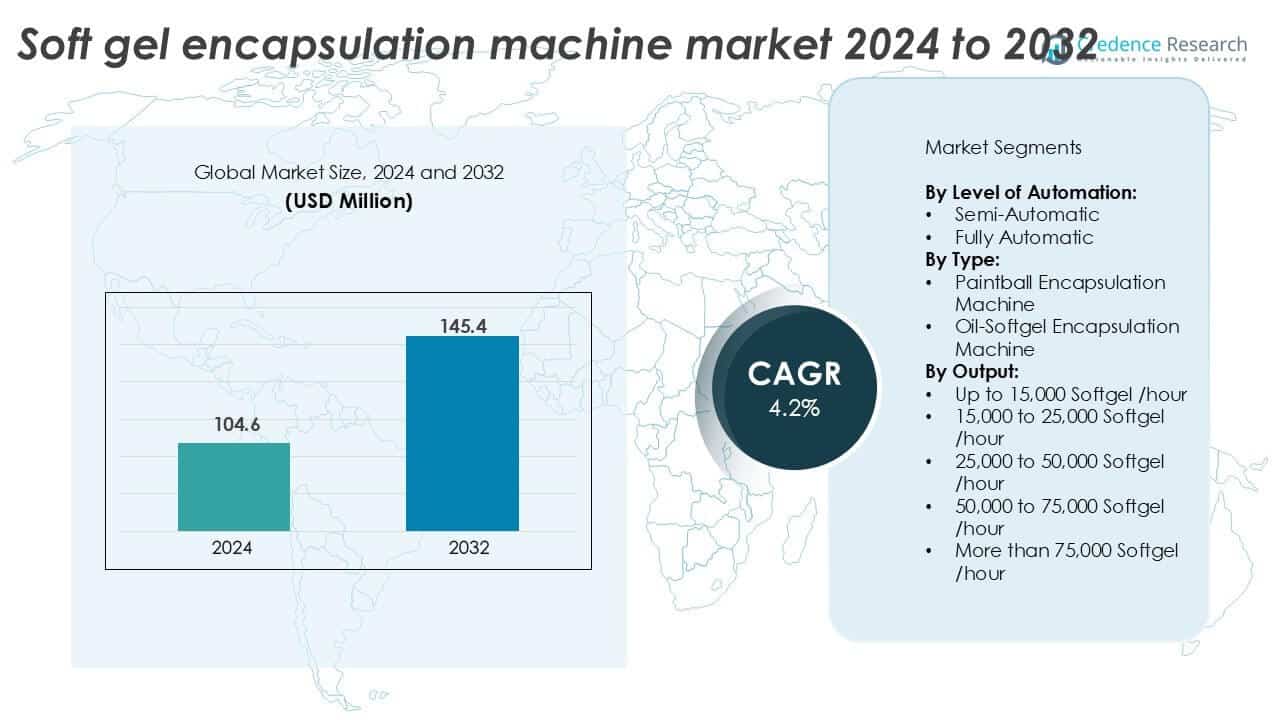
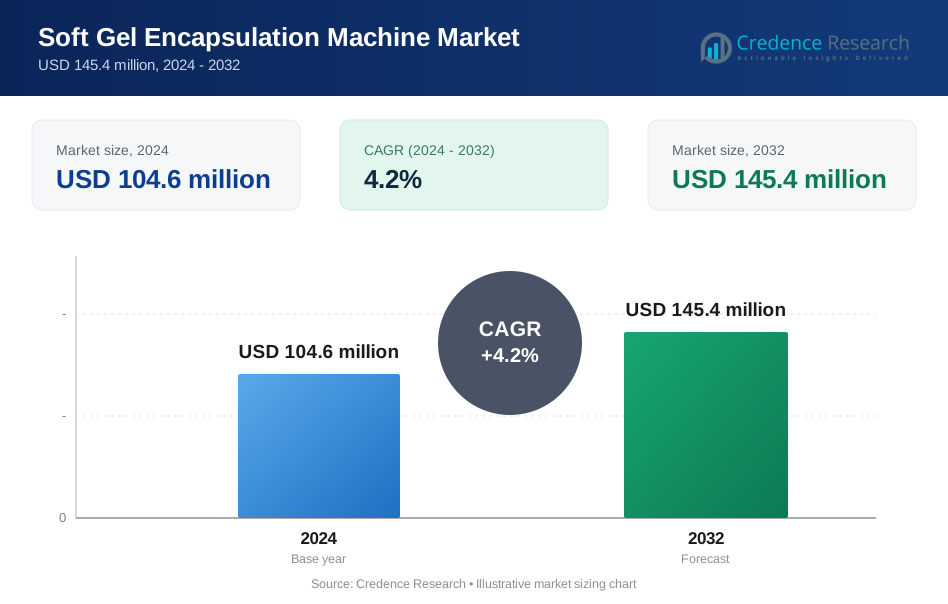
The Soft Gel Encapsulation Machine market size was valued at USD 104.6 million in 2024 and is anticipated to reach USD 145.4 million by 2032, at a CAGR of 4.2% during the forecast period.
| REPORT ATTRIBUTE | DETAILS |
|---|---|
| Historical Period | 2020-2023 |
| Base Year | 2024 |
| Forecast Period | 2025-2032 |
| Soft Gel Encapsulation Machine Market Size 2024 | USD 104.6 million |
| Soft Gel Encapsulation Machine Market, CAGR | 4.2% |
| Soft Gel Encapsulation Machine Market Size 2032 | USD 145.4 million |
The soft gel encapsulation machine market is led by key players such as ACG World, Changsung Softgel System Ltd., CapPlus Technologies, Qualicaps, ACIC Pharmaceuticals Inc., and United Pharmatek. These companies hold significant market share due to their advanced technology offerings, global distribution networks, and compliance with pharmaceutical manufacturing standards. ACG World and Changsung are particularly strong in high-output, fully automatic systems favored by large-scale manufacturers. North America dominates the global market, accounting for 35% of total revenue in 2024, driven by its robust pharmaceutical sector and early adoption of automation. Europe follows with 28% share, supported by strong equipment exports and strict regulatory frameworks. Asia Pacific, though currently holding 22%, shows the fastest growth potential due to rising supplement consumption and contract manufacturing activity. Leading players continue expanding into emerging regions with localized support and tailored solutions to maintain competitive advantage.
Soft Gel Encapsulation Machine Market Insights
- The Soft Gel Encapsulation Machine market was valued at USD 104.6 million in 2024 and is projected to reach USD 145.4 million by 2032, growing at a CAGR of 4.2% during the forecast period.
- Growing demand for dietary supplements and nutraceuticals, especially in softgel formats, is a key driver accelerating equipment adoption among pharmaceutical and wellness manufacturers.
- High-output machines above 75,000 softgels/hour are gaining traction for bulk production, while demand for plant-based capsule compatibility is shaping product innovation.
- Leading players like ACG World, Changsung Softgel System Ltd., and CapPlus Technologies dominate the landscape, focusing on automation, GMP compliance, and regional expansion strategies.
- North America leads with a 35% market share, followed by Europe at 28%, while Asia Pacific holds 22% with the fastest growth rate. Fully automatic machines dominate with over 65% share, and oil-softgel machines account for more than 70% of total machine installations globally.
Soft Gel Encapsulation Machine Market Segmentation Analysis:
By Level of Automation
The fully automatic segment dominates the Soft Gel Encapsulation Machine market, accounting for over 65% share in 2024. High production efficiency, reduced manual intervention, and precise dosing drive its widespread adoption in large-scale pharmaceutical and nutraceutical manufacturing units. These machines support continuous operation and improved product consistency, which makes them ideal for high-volume production. In contrast, semi-automatic machines cater to smaller-scale operations where cost sensitivity and limited batch production are common. However, rising labor costs and growing demand for output uniformity are accelerating the shift toward fully automated systems across developing regions.
- For instance, the RJN65 Fully Automatic Soft Capsule Filling Machine can produce 8900 capsules per hour, supporting continuous high‑volume production.
By Type
Oil-softgel encapsulation machines hold the largest share, exceeding 70% of the market in 2024. These machines are widely used for encapsulating nutritional oils, vitamins, and dietary supplements, particularly omega-3 and CBD-based products. The growth of health-conscious consumers and rising supplement consumption in North America and Asia-Pacific support this dominance. Paintball encapsulation machines, while niche, serve a specific recreational market and are mostly utilized in the U.S. and select European countries. However, innovation in edible capsules and functional recreation may spur moderate growth in this segment over the forecast period.
- For instance, softgel equipment widely manufactures omega‑3 fish oil and multivitamin softgels used globally.
By Output
Machines with output capacity of more than 75,000 softgels/hour lead the market, capturing nearly 40% share in 2024. Large pharmaceutical firms prefer these high-capacity machines to meet rising global demand and maintain cost efficiency at scale. Their ability to ensure minimal downtime and high-speed performance supports bulk production. Meanwhile, machines producing 15,000 to 25,000 softgels/hour represent a strong mid-capacity segment, popular among mid-sized manufacturers. Demand across this category is rising in emerging markets due to affordability and operational flexibility for medium-scale production environments.
Soft Gel Encapsulation Machine Market Key Growth Drivers
Rising Demand for Nutraceuticals and Dietary Supplements
Global health awareness is boosting the intake of dietary supplements, especially softgel capsules. Consumers prefer softgels due to ease of swallowing, higher bioavailability, and longer shelf life. Manufacturers in the nutraceutical sector are increasing output to meet demand, driving investments in high-efficiency encapsulation machinery. For instance, the U.S. dietary supplements market has seen over 6% annual unit growth, reflecting the rising production requirement. Large and mid-sized supplement manufacturers are automating processes to meet stringent cGMP and FDA compliance. These dynamics push demand for automated softgel encapsulation machines across developed and emerging markets.
- For instance, U.S. demand for softgel supplements remains robust as consumers choose formats with better absorption and ease of use over tablets and powders, though tablets and powders typically have a longer shelf life.
Expansion of Pharmaceutical Manufacturing in Emerging Markets
Countries like India, China, Brazil, and Vietnam are ramping up pharmaceutical production due to cost advantages and rising domestic demand. Government incentives and contract manufacturing trends have encouraged companies to set up new production lines with modern machinery. Softgel dosage forms are widely used for pain relief, anti-inflammatory, and vitamin therapies, boosting machine procurement. In India, pharmaceutical exports reached over USD 27 billion in 2023, indicating a strong manufacturing pipeline. As companies scale up, there’s growing investment in fully automatic encapsulation systems for consistent, high-volume output with minimal human intervention.
- For instance, India’s pharma sector exports to over 200 countries, highlighting its broad global manufacturing footprint.
Technological Advancements in Encapsulation Machinery
The shift toward advanced encapsulation systems with real-time monitoring, servo motors, PLC control, and integrated drying tunnels enhances output quality and reduces human error. These innovations help manufacturers achieve greater process control, reduce wastage, and improve ROI. Companies such as Technophar and SKY Softgel & Pack have introduced machines that can deliver over 90,000 capsules per hour with optimized gelatin ribbon control. Automation and innovation in material handling, cleaning, and gelatin preparation are also reducing downtime. These features attract buyers from pharmaceuticals and nutraceuticals looking for precision, speed, and long-term cost savings.
Soft Gel Encapsulation Machine Market Key Trends & Opportunities
Growing Adoption of High-Speed Machines for Large Batch Production
High-speed encapsulation machines producing over 75,000 softgels/hour are gaining popularity among large manufacturers. This trend is driven by the need to reduce production cycles and improve scalability. These machines integrate advanced controls for weight variation control and output uniformity, crucial for pharma-grade production. With batch sizes increasing globally, especially in vitamin D, fish oil, and CBD segments, the demand for scalable, automated systems continues to rise. Players investing in digital monitoring systems and multi-cavity tooling are further setting themselves apart in this competitive landscape.
- For instance, SKY SOFTGEL machines can produce up to 275,000 round softgels per hour on high‑speed rotary die systems, supporting rapid large‑batch output.
Increasing Customization Demand for Specialty Formulations
As demand for customized softgel products grows especially for plant-based capsules, oil suspensions, and dual-fill capsules manufacturers are seeking machines that offer flexibility in fill material, capsule shape, and size. The rise in vegan and halal softgels is prompting machinery firms to provide solutions compatible with plant-derived gelatin and temperature-sensitive ingredients. This trend offers equipment makers an opportunity to develop modular, multi-format machines that cater to niche and therapeutic softgel innovations. Companies focused on R&D-based machine upgrades are well-positioned to capture demand from the expanding personalized medicine sector.
Soft Gel Encapsulation Machine Market Key Challenges
High Capital Investment and Maintenance Costs
Softgel encapsulation machines, especially fully automatic high-speed variants, involve significant upfront costs. Small and mid-size manufacturers often face hurdles in financing such equipment. Maintenance costs further add to long-term expenditures, particularly when machines require skilled operators and regular calibration. In many low-income markets, return on investment remains a concern due to limited batch volumes. This barrier slows adoption despite the operational benefits of automation. Companies unable to access financing options may continue with semi-automatic or imported used machinery, hindering market penetration of new-generation machines.
Technical Complexity and Skilled Labor Shortage
Operating modern encapsulation machines demands expertise in gelatin preparation, temperature control, and troubleshooting. Many regions face a shortage of trained technicians capable of managing these precision systems. Errors in setup or operation can lead to product rejection, downtime, and material wastage. Additionally, lack of technical support in remote or underdeveloped markets creates hesitation among buyers. To address this, manufacturers are investing in user-friendly interfaces, remote diagnostics, and training modules. However, until labor skills catch up, adoption may remain concentrated in Tier I markets with robust industrial talent pools.
Soft Gel Encapsulation Machine Market Regional Analysis
North America
North America holds the largest share in the soft gel encapsulation machine market, accounting for over 35% of global revenue in 2024. The U.S. leads the region due to its strong pharmaceutical and nutraceutical manufacturing base, high consumer demand for softgel supplements, and early adoption of automation. Major companies invest in high-speed encapsulation systems for large-scale production. FDA-compliant manufacturing practices and demand for specialty capsules like CBD and omega-3 softgels further support regional equipment upgrades. Strong after-sales support and technical training infrastructure contribute to market stability and growth.
Europe
Europe captures nearly 28% share of the global market in 2024, driven by strict regulatory standards and high demand for premium-grade pharmaceutical and dietary products. Germany, Italy, and the U.K. are the major contributors due to their advanced pharma machinery manufacturing sectors. European manufacturers focus on cleanroom-compatible machines with traceability features. Rising elderly population and demand for preventive healthcare fuel softgel capsule consumption. EU policies supporting clean-label and vegan formulations are encouraging equipment upgrades for plant-based gelatin use. The region is also a hub for machine exports to emerging markets.
Asia Pacific
Asia Pacific represents around 22% of the global market in 2024 and is the fastest-growing region during the forecast period. China and India are central to this growth, driven by expanding contract manufacturing, low-cost production capabilities, and rising consumption of dietary supplements. Government support for pharma infrastructure, especially under schemes like India’s PLI, boosts investment in modern encapsulation systems. Regional players increasingly adopt fully automatic machines to meet domestic and export demand. Rising health awareness and increasing middle-class spending in Southeast Asia also contribute to equipment market expansion.
Latin America
Latin America holds approximately 8% of the market in 2024, with Brazil and Mexico being the key contributors. The region sees growing demand for softgel-based vitamins, pain relief, and supplement products. Domestic manufacturers are gradually upgrading to semi- and fully automatic encapsulation systems to improve efficiency and reduce production loss. However, high equipment costs and limited access to skilled technicians slow market penetration. Imports from U.S. and Europe dominate machine availability, with limited local production. Despite infrastructure gaps, rising urbanization and healthcare investment drive moderate growth prospects.
Middle East & Africa (MEA)
MEA accounts for about 7% market share in 2024. The market remains in a developmental phase, with key activity centered in the UAE, Saudi Arabia, and South Africa. Pharmaceutical demand is rising due to expanding healthcare systems and growing chronic disease burden. Multinational firms are investing in local facilities, which creates demand for encapsulation machinery. However, infrastructure constraints and limited trained workforce restrict full automation adoption. Imports dominate the equipment market, and maintenance support remains a concern. Over time, regional demand for OTC supplements and halal-certified softgels is expected to support gradual adoption.
Soft Gel Encapsulation Machine Market Segmentations:
By Level of Automation
- Semi-Automatic
- Fully Automatic
By Type
- Paintball Encapsulation Machine
- Oil-Softgel Encapsulation Machine
By Output
- Up to 15,000 Softgel /hour
- 15,000 to 25,000 Softgel /hour
- 25,000 to 50,000 Softgel /hour
- 50,000 to 75,000 Softgel /hour
- More than 75,000 Softgel /hour
By Geography
- North America
- U.S.
- Canada
- Mexico
- Europe
- Germany
- France
- U.K.
- Italy
- Spain
- Rest of Europe
- Asia Pacific
- China
- Japan
- India
- South Korea
- South-east Asia
- Rest of Asia Pacific
- Latin America
- Brazil
- Argentina
- Rest of Latin America
- Middle East & Africa
- GCC Countries
- South Africa
- Rest of the Middle East and Africa
Competitive Landscape
The soft gel encapsulation machine market is moderately consolidated, with key players competing on technology, production capacity, and global reach. Companies such as ACG World, Changsung Softgel System Ltd., Qualicaps, and CapPlus Technologies dominate due to their strong portfolios and customer base in pharmaceuticals and nutraceuticals. These firms focus on high-speed machines with advanced automation and compliance with GMP standards. Emerging players like Joysun Mech-Tech and Volks Vita are gaining ground by offering cost-effective machines tailored for mid-sized manufacturers. Strategic partnerships, product upgrades, and geographic expansion remain key strategies. For instance, ACIC Pharmaceuticals Inc. and United Pharmatek are expanding service networks in Asia and Latin America to improve support and market penetration. Competition is intensifying as demand for plant-based, dual-fill, and customized capsule machines grows. Players offering integrated systems with drying tunnels, real-time monitoring, and quick format changeover gain an edge in highly regulated and high-output environments.
Key Player Analysis
- Joysun Mech-Tech
- Kamata Machine Co., Ltd.
- CapPlus Technologies
- ACG World
- Changsung Softgel System Ltd.
- United Pharmatek
- Beijing Xin Hang Cheng Technology Development Co., Ltd.
- Qualicaps
- USA Pharmaceutical Equipment
- ACIC Pharmaceuticals Inc.
- Volks Vita
Recent Developments
- In May 2024, CVC introduced its latest innovations the Softgel Encapsulation System and the CVC High-Speed Counting Line with CVC625-at the 2024 CVC New Product Launch event. This unveiling marked a significant advancement in pharmaceutical and nutraceutical manufacturing, highlighting CVC’s commitment to efficiency and precision.
- In March 2023, CVC Technologies announced the acquisition of Changsung Softgel System, strengthening its position as a leading global provider of packaging and encapsulation machinery. This strategic acquisition aligns with CVC Technologies’ long-term business objectives by integrating Changsung’s expertise in softgel encapsulation with CVC’s advanced packaging solutions.
Report Coverage
The research report offers an in-depth analysis based on Level of Automation, Type, Output and Geography. It details leading market players, providing an overview of their business, product offerings, investments, revenue streams, and key applications. Additionally, the report includes insights into the competitive environment, SWOT analysis, current market trends, as well as the primary drivers and constraints. Furthermore, it discusses various factors that have driven market expansion in recent years. The report also explores market dynamics, regulatory scenarios, and technological advancements that are shaping the industry. It assesses the impact of external factors and global economic changes on market growth. Lastly, it provides strategic recommendations for new entrants and established companies to navigate the complexities of the market.
Future Outlook
- Demand for fully automatic encapsulation machines will continue rising across large-scale pharmaceutical production.
- Manufacturers will increasingly adopt high-output machines to meet growing supplement demand.
- Technological integration such as real-time monitoring and automated controls will drive product upgrades.
- Customization features will become essential to support plant-based and specialty softgel formats.
- Asia Pacific will emerge as a major production hub due to cost advantages and expanding pharma infrastructure.
- North America will maintain leadership, backed by advanced manufacturing and regulatory compliance.
- Companies will invest in modular machine designs to offer flexibility for various capsule sizes.
- Market players will expand after-sales services and technical support in developing countries.
- High capital costs and lack of skilled labor may limit adoption in small-scale operations.
- Sustainability features like energy efficiency and gelatin optimization will shape future machine development
Request a Free Sample
Fill in your details and we'll send you a free sample report.
- Sample data tables & charts
- Research methodology
Need a Custom Version of This Report?
Tailor the scope, geography, or segments to your exact requirements.
- Custom geography or segment scope
- Direct access to our analyst team
Frequently Asked Questions
What is the current market size for the Soft gel encapsulation machine market, and what is its projected size in 2032?
At what Compound Annual Growth Rate is the Soft gel encapsulation machine market projected to grow between 2024 and 2032?
Which Soft gel encapsulation machine market segment held the largest share in 2024?
What are the primary factors fueling the growth of the Soft gel encapsulation machine market?
Who are the leading companies in the Soft gel encapsulation machine market?
Which region commanded the largest share of the Soft gel encapsulation machine market in 2024?
Table of Content
Chapter 1. Report Introduction
- 1.1 Report Description & Purpose
- 1.1.1 Report Title & Market Definition
- 1.1.2 Unique Selling Propositions (USP) & Key Differentiators
- 1.1.3 Value Proposition for Stakeholders
- 1.2 Research Objectives
- 1.2.1 Market Sizing Objectives (Volume & Revenue)
- 1.2.2 Segmentation Objectives
- 1.2.3 Competitive Intelligence Objectives
- 1.2.4 Forecast & Scenario Objectives
- 1.3 Report Scope
- 1.3.1 Soft Gel Encapsulation Machine Scope – Types & Subtypes Covered
- 1.3.2 Geographic Scope – Regions & Countries Covered
- 1.3.3 Historical Period, Base Year & Forecast Period (2024; forecast to 2032)
- 1.3.4 Inclusions & Exclusions
- 1.4 HS Code & Classification Framework
- 1.5 Currency, Units & Pricing Basis
- 1.6 Target Stakeholders
- 1.7 Limitations & Assumptions
Chapter 2. Executive Summary
- 2.1 Global Soft Gel Encapsulation Machine Market Snapshot
- 2.1.1 Market Size – Historical (2024) & Forecast (2024-2032) (2024: USD 104.6 million → 2032: USD 145.4 million)
- 2.1.2 Volume & Revenue – Global Totals
- 2.1.3 Key Market Highlights – Top Five Facts
- 2.2 Soft Gel Encapsulation Machine Market Segmentation Snapshot
- 2.2.1 Market Split by Region – 2024 vs. 2032
- 2.3 Competitive Snapshot
- 2.3.1 Top 10 Players by Revenue Share – 2024
- 2.3.2 Top 10 Players by Volume Share – 2024
- 2.3.3 Recent Strategic Developments (18-Month Summary)
- 2.4 Key Investment Highlights & Strategic Conclusions
Chapter 3. Soft Gel Encapsulation Machine Market Dynamics & Industry Analysis
- 3.1 Market Overview & Context
- 3.1.1 Soft Gel Encapsulation Machine Market Position in the Broader Automotive Value Chain
- 3.1.2 OEM vs. Replacement Market Dynamics
- 3.1.3 Market Maturity & Development Stage by Region
- 3.2 Soft Gel Encapsulation Machine Market Drivers
- 3.3 Soft Gel Encapsulation Machine Market Restraints & Challenges
- 3.4 Soft Gel Encapsulation Machine Market Opportunities
- 3.5 Porter's Five Forces Analysis
- 3.5.1 Threat of New Entrants
- 3.5.2 Bargaining Power of Suppliers
- 3.5.3 Bargaining Power of Buyers
- 3.5.4 Threat of Substitutes
- 3.5.5 Competitive Rivalry – Intensity Assessment
- 3.6 Soft Gel Encapsulation Machine Value Chain Analysis
- 3.6.1 Upstream – Raw Material/Input Suppliers
- 3.6.1.1 Raw Material/Input 1
- 3.6.1.2 Raw Material/Input 2
- 3.6.1.3 Raw Material/Input 3
- 3.6.2 Midstream – Production/Manufacturing/Service Delivery
- 3.6.2.1 Production/Process Overview
- 3.6.2.2 Key Facility Locations & Capacity by Manufacturer
- 3.6.3 Downstream – Distribution & End Consumer
- 3.6.3.1 Primary Channel – B2B/OEM
- 3.6.3.2 Secondary Channels – Dealer, Retail, Online, Direct
- 3.6.4 Value Chain Profitability Analysis
- 3.6.1 Upstream – Raw Material/Input Suppliers
- 3.7 PESTEL Analysis
- 3.7.1 Political Factors
- 3.7.2 Economic Factors
- 3.7.3 Social Factors
- 3.7.4 Technological Factors
- 3.7.5 Environmental Factors
- 3.7.6 Legal Factors
- 3.8 Soft Gel Encapsulation Machine Supply Chain Analysis
- 3.8.1 Raw Material/Input Supply Risk Assessment
- 3.8.2 Manufacturing Concentration Risk (Geographic Exposure)
- 3.8.3 Trade Disruption Impact Analysis
- 3.9 Regulatory & Policy Landscape
Note: The regulatory and policy landscape section covers regulations based on their applicability to the market, Soft Gel Encapsulation Machine category, geography, and scope of the study. Only regulatory frameworks with a material impact on operations, compliance, trade, sustainability, or market access are analyzed in detail.
Chapter 4. Key Investment Pockets & Opportunity Analysis
- 4.1 Soft Gel Encapsulation Machine Market Attractiveness Analysis
- 4.1.1 By Region – Investment Attractiveness Matrix (Volume × CAGR)
- 4.2 Absolute Revenue Growth Opportunity
- 4.2.1 By Region – Absolute USD Growth Through 2032
- 4.3 Incremental Volume Opportunity
- 4.3.1 By Region – Incremental Volume Through 2032
- 4.3.2 Segment – Incremental Volume
- 4.4 Emerging Submarket Opportunity Deep Dive (Subject to Applicability)
- 4.5 Emerging Market Opportunity Scorecards
- 4.5.1 United States
- 4.5.2 Europe
- 4.5.3 Asia
- 4.5.4 Middle East & Africa
Note: Emerging Market Opportunity Scorecards will be included based on relevance and strategic importance. Regions listed are indicative and may vary depending on data availability and market dynamics.
Chapter 5. Soft Gel Encapsulation Machine Import-Export Analysis & Trade Flows
- 5.1 Global Trade Overview
- 5.1.1 Global Export Value by Country (2024)
- 5.1.2 Global Export Volume by Country (2024)
- 5.1.3 Global Import Value by Country (2024)
- 5.1.4 Global Import Volume by Country (2024)
- 5.1.5 Net Trade Balance by Country (2024)
- 5.2 Export Analysis – Segment
- 5.2.1 Type 1 (HS Code)
- 5.2.2 Type 2 (HS Code)
- 5.2.3 Type 3 (HS Code)
- 5.2.4 Type 4 (HS Code)
- 5.2.5 Type 5 (HS Code)
- 5.3 Import Analysis – Segment
- 5.3.1 Type 1 (HS Code)
- 5.3.2 Type 2 (HS Code)
- 5.3.3 Type 3 (HS Code)
- 5.3.4 Type 4 (HS Code)
- 5.3.5 Type 5 (HS Code)
- 5.4 Average Unit Trade Prices
- 5.4.1 Average Export Price – Segment & Country
- 5.4.2 Average Import Price – Segment & Source Country
- 5.4.3 Price Trends (2024)
- 5.5 Key Trade Route Analysis
- 5.5.1 Trade Route 1
- 5.5.2 Trade Route 2
- 5.5.3 Trade Route 3
- 5.5.4 Trade Route 4
- 5.5.5 Trade Route 5
- 5.6 Trade Policy Impact Assessment
- 5.6.1 US Anti-Dumping & Section 301 Tariffs
- 5.6.2 EU Customs Union Impact
- 5.6.3 Major Free Trade Agreements
- 5.6.4 USMCA Rules of Origin
Note: Trade policy analysis will be included only where relevant to the Soft Gel Encapsulation Machine market.
Chapter 6. Competitive Landscape & Company Benchmarking
- 6.1 Soft Gel Encapsulation Machine Market Concentration & Structure
- 6.1.1 Herfindahl-Hirschman Index (HHI) – vs. 2024
- 6.1.2 Tier 1, Tier 2 & Tier 3 Market Structure
- 6.1.3 Global, Regional & Local Player Dynamics
- 6.2 Soft Gel Encapsulation Machine Market Share Analysis – 2024
- 6.2.1 Global Revenue Share by Company
- 6.2.2 Global Volume Share by Company
- 6.2.3 Regional Revenue Share
- 6.2.4 Market Share Evolution ( vs. 2024)
- 6.2.5 OEM Segment Share by Company
- 6.2.6 Replacement Segment Share by Company
- 6.3 Production/Delivery Capacity & Facility Analysis
- 6.3.1 Global Installed Capacity
- 6.3.2 Capacity Utilization Rates
- 6.3.3 Production/Output Volume
- 6.3.4 Facility Locations & Capacity Map
- 6.3.5 Planned Capacity Additions
- 6.4 Soft Gel Encapsulation Machine Competitive Benchmarking Matrix
- 6.4.1 Revenue, Volume, CAGR & Profitability Comparison
- 6.4.2 Channel Revenue Mix
- 6.4.3 Geographic Revenue Exposure
- 6.4.4 R&D Intensity
- 6.4.5 Sustainability Maturity
- 6.5 Strategic Developments in Soft Gel Encapsulation Machine (Last 24 Months)
- 6.5.1 Mergers, Acquisitions & Divestments
- 6.5.2 New Soft Gel Encapsulation Machine Launches
- 6.5.3 Facility Expansions
- 6.5.4 Strategic Alliances, Joint Ventures & Partnerships
- 6.5.5 Distribution Expansion & Market Entry
- 6.5.6 Sustainability & ESG Initiatives
- 6.6 Competitive Strategy Mapping
- 6.6.1 Leader, Challenger, Follower & Niche Classification
- 6.6.2 Pricing Strategy Comparison
- 6.6.3 Channel Strategy Matrix
Note: Strategic developments are included based on their materiality and the availability of reliable information.
Chapter 7. Global Soft Gel Encapsulation Machine Market – By Distribution Channel
- 7.1 Segment Overview
- 7.1.1 Volume & Revenue Split by Channel (2024 & 2032)
- 7.1.2 Channel Mix Evolution (2024-2032)
Chapter 8. Regional Market Analysis – Global Overview
- 8.1 Global Regional Overview
- 8.1.1 Regional Volume Share
- 8.1.2 Regional Revenue Share
- 8.1.3 Regional Volume by Region
- 8.1.4 Regional Revenue by Region
- 8.1.5 Regional Forecast Through 2032
- 8.2 Cross-Regional Segment Analysis
- 8.2.1 By Distribution Channel
- 8.2.2 By Brand/Price Tier
Chapter 9. North America Soft Gel Encapsulation Machine Market
- 9.1 United States
- 9.2 Canada
- 9.3 Mexico
Chapter 10. Europe Soft Gel Encapsulation Machine Market
- 10.1 Germany
- 10.2 France
- 10.3 Italy
- 10.4 United Kingdom
- 10.5 Spain
- 10.6 Poland
- 10.7 Russia
- 10.8 Netherlands
- 10.9 Belgium
- 10.10 Sweden
- 10.11 Denmark
- 10.12 Norway
- 10.13 Rest of Europe
Chapter 11. Asia Pacific Soft Gel Encapsulation Machine Market
- 11.1 China
- 11.2 India
- 11.3 Japan
- 11.4 South Korea
- 11.5 Thailand
- 11.6 Indonesia
- 11.7 Vietnam
- 11.8 Malaysia
- 11.9 Australia
- 11.10 Rest of Asia Pacific
Chapter 12. Latin America Soft Gel Encapsulation Machine Market
- 12.1 Brazil
- 12.2 Argentina
- 12.3 Colombia
- 12.4 Chile
- 12.5 Rest of Latin America
Chapter 13. Middle East Soft Gel Encapsulation Machine Market
- 13.1 Saudi Arabia
- 13.2 United Arab Emirates
- 13.3 Turkey
- 13.4 Israel
- 13.5 Iran
- 13.6 Rest of the Middle East
Chapter 14. Africa Soft Gel Encapsulation Machine Market
- 14.1 South Africa
- 14.2 Egypt
- 14.3 Nigeria
- 14.4 Morocco
- 14.5 Rest of Africa
Chapter 15. Soft Gel Encapsulation Machine Company Profiles
- 15.1 [Company 01]
- 15.1.1 Company Overview
- 15.1.2 Key Management Personnel
- 15.1.3 Products & Services Portfolio
- 15.1.4 Financial Performance
- 15.1.5 Key Market Focus & Geographic Presence
- 15.1.6 Recent Developments & Strategic Initiatives
Note: The company profile list is preliminary and may change based on research findings, market developments, data availability, and client requirements.
Chapter 16. Appendices
- Appendix A – List of Abbreviations & Acronyms
- Appendix B – Industry Classification Code Reference – Full Series
- Appendix C – Production & Capacity Data Tables
- Appendix D – End-Use & Demand Base Tables
- Appendix E – Consumption & Replacement Rate Assumptions
- Appendix F – ASP Reference Tables
- Appendix G – Manufacturing & Facility Database
- Appendix H – Import-Export Data Tables
- Appendix I – Regulatory Summary Tables
- Appendix J – Primary Research Participant List (Anonymized)
- Appendix K – Primary Research Questionnaire Framework
- Appendix L – Data Sources & Bibliography
- Appendix M – Market Size Divergence & Source Comparison
Chapter 17. Research Methodology
- 17.1 Research Framework & Philosophy
- 17.2 Secondary Research – Sources, Hierarchy & Data Extraction
- 17.3 Data Modeling – Bottom-Up & Top-Down Market Sizing
- 17.4 Primary Research – Stakeholder Framework, LOI & Sample Sizes
- 17.5 Forecast Methodology – Regression, Scenario & Sensitivity Analysis
- 17.6 Quality Control – Four-Layer Validation Framework
- 17.7 Limitations & Standard Assumptions
- 17.8 Disclaimer
