
Thailand Crop Protection Chemicals Pesticides Market Overview:
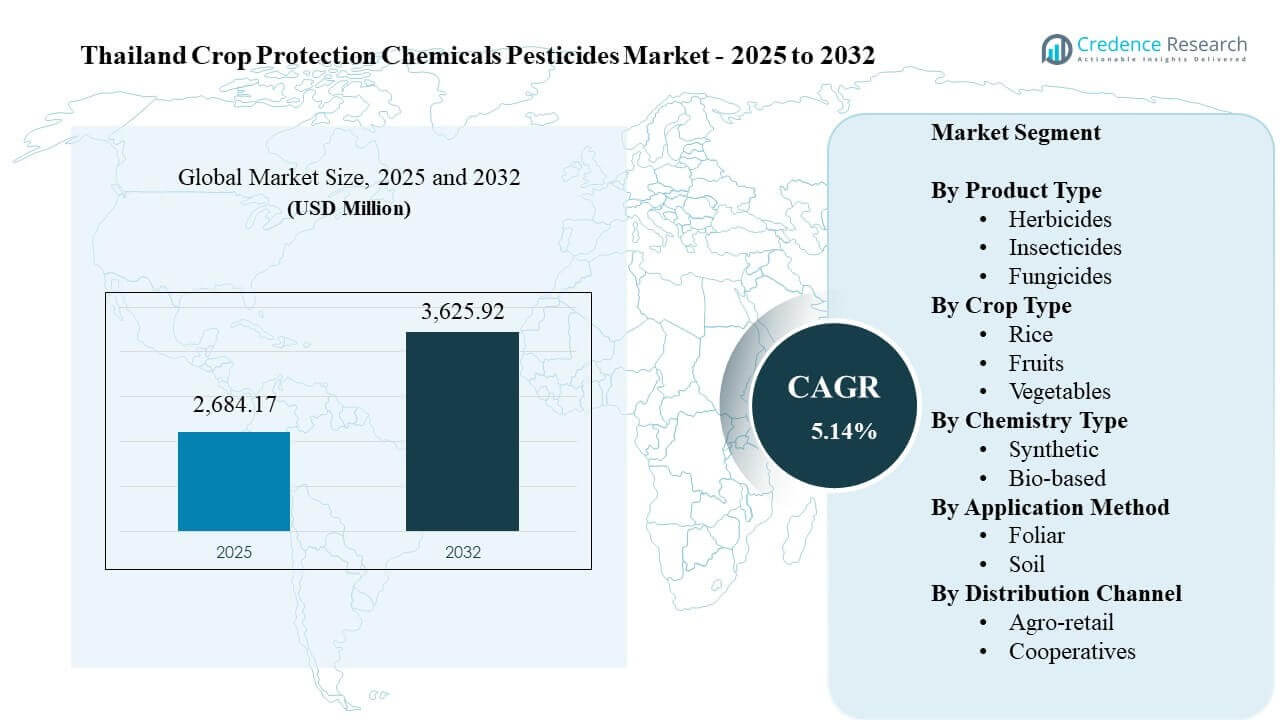
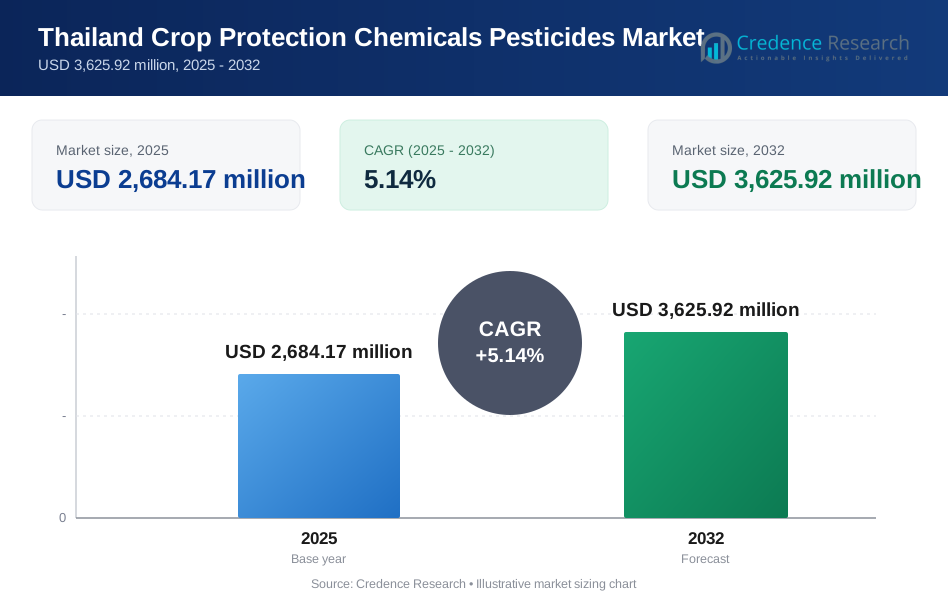
The Thailand Crop Protection Chemicals Pesticides Market size was estimated at USD 2,684.17 million in 2025 and is expected to reach USD 3,625.92 million by 2032, growing at a CAGR of 5.14% from 2025 to 2032. Demand is being driven most strongly by the need to protect rice and expanding horticulture output from yield losses caused by persistent weed, insect, and disease pressure, which keeps growers focused on reliable, repeatable control programs. Thailand’s tightening residue expectations in export-linked supply chains and broader adoption of integrated crop management practices are also influencing product choice, application discipline, and supplier stewardship support.
| REPORT ATTRIBUTE | DETAILS |
|---|---|
| Historical Period | 2020-2024 |
| Base Year | 2025 |
| Forecast Period | 2026-2032 |
| Thailand Crop Protection Chemicals Pesticides Market Size 2025 | USD 2,684.17 million |
| Thailand Crop Protection Chemicals Pesticides Market, CAGR | 5.14% |
| Thailand Crop Protection Chemicals Pesticides Market Size 2032 | USD 3,625.92 million |
Key Market Trends & Insights
- The Thailand Crop Protection Chemicals Pesticides Market is projected to expand from USD 2,684.17 million in 2025 to USD 3,625.92 million by 2032 at a 5.14% CAGR (2025–2032).
- Herbicides accounted for the largest share of 41.8% in 2025, reflecting sustained weed-control intensity across staple and commercial cropping systems.
- Rice accounted for the largest share of 37.6% in 2025, supported by high planting frequency and recurring pest-management needs across key growing areas.
- Synthetic chemistry accounted for the largest share of 80.9% in 2025, reflecting farmer preference for predictable efficacy and established usage practices.
- Foliar application accounted for the largest share of 51.9% in 2025, supported by widespread sprayer availability and canopy-stage intervention practices.
Segment Analysis
Thailand Crop Protection Chemicals Pesticides Market demand reflects a balance between broad-acre staple cropping requirements and higher-value horticulture programs that place stronger emphasis on product performance and residue compliance. Weed pressure and labor constraints keep herbicide programs central to many cropping systems, and pest cycles linked to humidity and seasonal variability reinforce repeat applications. Product choice is influenced by retailer and adviser recommendations, stewardship support, and resistance-management discipline in locations facing repeated exposure to the same active ingredients.
Portfolio strategies increasingly pair conventional products with bio-based options in integrated programs, particularly where buyers prioritize export access, residue management, and safer handling profiles. Foliar spraying remains dominant due to ease of use and service availability, and soil-applied approaches are used selectively based on crop system, timing, and agronomic practice. Procurement remains channel-led, with agro-retail networks shaping program adoption through bundling, field demonstrations, and agronomic guidance.
By Product Type Insights
Herbicides accounted for the largest share of 41.8% in 2025. Herbicide leadership is reinforced by persistent weed competition that directly reduces yield and quality in staple crops, especially in systems where multiple cycles per year elevate weed pressure. Grower reliance on timely control encourages repeat purchases across seasons, and mechanization trends increase preference for chemical weed management versus manual labor. Stewardship initiatives that emphasize rotation and resistance management also influence upgrade cycles toward differentiated formulations.
By Crop Type Insights
Rice accounted for the largest share of 37.6% in 2025. Rice dominance is sustained by large planted area and recurring pest and disease exposure across growing windows that require consistent protection programs. Production practices that prioritize yield stability create predictable usage of herbicides and targeted insect and disease controls. Input decisions are also shaped by price sensitivity and the need to protect harvest outcomes under variable weather and water conditions. Supplier field support and retailer guidance can accelerate adoption of optimized program timing and product sequencing.
By Chemistry Type Insights
Synthetic accounted for the largest share of 80.9% in 2025. Synthetic chemistry remains the default choice for many growers because performance is well understood and outcomes are more predictable under heavy pest loads. Broad product availability and established application routines support repeat purchasing behavior across staple and commercial crops. Registration breadth and label familiarity also reduce switching friction during critical crop stages. Bio-based adoption is increasing where residue compliance, sustainability positioning, and integrated pest management programs influence program design.
By Application Method Insights
Foliar accounted for the largest share of 51.9% in 2025. Foliar leadership is supported by practical accessibility, since sprayers and service providers are widely available across farm sizes and geographies. Many insect and disease interventions are triggered by canopy-stage scouting and visible symptoms, which naturally aligns with foliar use. Retailer-led recommendations and stewardship training often center on spray timing and coverage quality, reinforcing this method’s dominance. Soil applications remain more system-dependent and are used selectively based on crop, timing, and agronomy.
By Distribution Channel Insights
Thailand Crop Protection Chemicals Pesticides Market distribution is led by agro-retail networks that combine product availability with advisory support, credit facilitation, and field demonstrations that build farmer confidence. Cooperatives remain important for improving access and affordability for smallholders through bulk procurement and seasonal support mechanisms. Channel influence is increasingly tied to stewardship, training, and compliance guidance that helps growers align program selection with residue expectations and safe-use requirements. Digital ordering can supplement traditional routes where logistics and last-mile delivery continue to improve.
Thailand Crop Protection Chemicals Pesticides Market Drivers
Intensifying pest pressure across staple and high-value crops
Thailand Crop Protection Chemicals Pesticides Market growth is supported by recurring weed, insect, and disease pressure that directly threatens yield stability and farm economics. Tropical humidity and seasonal variability can expand pest windows and raise outbreak frequency, increasing the need for timely intervention. Rice systems require repeat management across growth stages, reinforcing consistent demand for herbicides and targeted insect and disease controls. Horticulture expansion adds complexity, increasing the need for specialized programs and disciplined spray scheduling.
- For instance, Corteva Agriscience stated that its fall armyworm response program in Thailand, developed with the Department of Agriculture and other partners, helped reduce national corn crop losses to 3–4% from 25–40% in 2019 and supported more than 36,000 smallholder farmers, highlighting how acute pest pressure accelerates adoption of high-performance insect-control solutions.
Labor constraints and yield protection priorities
Thailand Crop Protection Chemicals Pesticides Market demand is reinforced by labor constraints that reduce the feasibility of manual weed control and increase reliance on chemical programs. Farm economics prioritize predictable yields and quality outcomes, which favors solutions with proven field performance. Mechanization and contracted services also make chemical application more scalable, especially for foliar programs. This dynamic keeps input programs central to crop planning, particularly during high-risk seasonal periods.
Evolving residue compliance and buyer requirements
Thailand Crop Protection Chemicals Pesticides Market adoption is influenced by buyer expectations tied to food safety, export access, and residue compliance. Growers supplying higher-value markets face stronger pressure to follow disciplined programs that align with pre-harvest intervals and safe-use guidance. This supports demand for stewardship, training, and product rotation strategies that reduce rejection risk and strengthen supply-chain confidence. Suppliers that combine product access with compliance support can gain stronger channel pull-through.
Channel influence, advisory services, and stewardship support
Thailand Crop Protection Chemicals Pesticides Market growth benefits from advisory-led selling where agro-retailers and field agronomists shape product choice and program sequencing. Demonstration plots and localized recommendations reduce perceived risk for switching or upgrading products. Stewardship support improves correct dosing, timing, and rotation discipline, helping maintain efficacy in areas facing resistance pressure. These services strengthen repeat purchasing and support portfolio expansion across both chemical and bio-based offerings.
- For instance, Bayer Thai’s Better Farms, Better Lives 2.0 program was designed to benefit 26,000 smallholder farmers across 11 provinces, supported about 30 demonstration rice fields, and trained 30–40 farmers as peer trainers, illustrating how demo-led advisory platforms and stewardship-led education can materially influence adoption and repeat use in crop protection programs.
Thailand Crop Protection Chemicals Pesticides Market Challenges
Thailand Crop Protection Chemicals Pesticides Market faces challenges linked to regulatory scrutiny, safe-use expectations, and the need to manage resistance risk. Registration updates and restrictions can raise reformulation needs and increase compliance workload for suppliers and distributors. Misuse risk can trigger stewardship burdens across the channel, requiring training and monitoring to protect long-term program viability. Resistance pressure can also reduce efficacy and increase costs as growers shift to more complex rotation and integrated approaches.
Thailand Crop Protection Chemicals Pesticides Market also contends with affordability sensitivity and uneven advisory coverage across farm sizes and regions. Smallholders may delay adoption of newer products if immediate economic returns are unclear or if credit access is constrained. Weather variability can complicate timing, increasing the risk of suboptimal application and lower perceived performance. Supply reliability for certain active ingredients can also influence switching behavior and elevate price volatility across seasons.
- For instance, Syngenta’s Grow Well, Eat Well program in Thailand engaged more than 500 local smallholder farmers in its first year and helped secure nearly 300 GAP certifications over two years, showing how supplier-led agronomic support and structured farm-improvement systems can strengthen adoption where technical guidance is uneven.
Thailand Crop Protection Chemicals Pesticides Market Trends and Opportunities
Thailand Crop Protection Chemicals Pesticides Market is seeing expanding interest in integrated pest management programs that combine conventional chemistry with bio-based solutions in crop-specific protocols. Portfolio pairing strategies and improved field evidence can increase confidence in biological performance, particularly in horticulture where residue compliance and safer-use positioning matter. Digitized advisory tools and improved scouting practices support more targeted applications, reducing unnecessary spraying and improving perceived value. These shifts create opportunities for differentiated suppliers that invest in technical support.
- For instance, Bayer reported in its 2025 FarmRise impact study in India that 73% of users said the app enabled a better way of farming, 79% reported improved confidence in investing in their farms, and 72% strongly agreed that the platform put their needs first, showing how digital agronomy support can strengthen trust in more precise crop protection decisions.
Thailand Crop Protection Chemicals Pesticides Market opportunities also emerge from precision application practices and channel modernization. Retailers that provide agronomic services, application guidance, and compliance support can strengthen farmer loyalty and improve program adherence. Product differentiation tied to resistance management, formulation performance, and application convenience can improve adoption. Export-linked supply chains can further encourage disciplined product selection, creating growth pathways for suppliers that align programs with quality and compliance requirements.
Regional Insights
Central Thailand
Central Thailand represents the most intensive demand zone for Thailand Crop Protection Chemicals Pesticides Market because of dense cropping activity, irrigated production systems, and strong dealer coverage around major agricultural hubs. Frequent planting cycles and high weed pressure sustain steady herbicide use, supported by widespread sprayer access and contractor services. Retail advisory networks are typically more established, which helps drive program standardization and repeat purchasing. Compliance-led programs are also more common where supply chains link to larger processors and organized buyers.
Northeastern Thailand
Northeastern Thailand demand is supported by large agricultural land coverage and broad smallholder participation, which keeps volume consumption steady across staple crops. Pest pressure and weather variability can elevate the need for insecticides and fungicides during high-risk periods, shaping seasonal procurement patterns. Adoption tends to be strongly influenced by local agro-retail reach, credit access, and product availability, with cooperatives playing a meaningful role in some areas. Training and stewardship can be uneven, so supplier field support and retailer education often affect product selection and correct-use practices.
Northern Thailand
Northern Thailand demand is shaped by mixed cropping systems, including horticulture in selected provinces, which can increase the need for more disciplined spray programs and residue-aware product choices. Disease pressure during humid windows supports fungicide usage, particularly where fruit and vegetable production is more commercialized. Terrain and farm fragmentation can raise distribution complexity, increasing the importance of local dealers and last-mile logistics. Growers supplying higher-value channels often prioritize consistent efficacy and application timing to protect quality outcomes.
Southern Thailand
Southern Thailand demand is influenced by plantation and perennial crop systems in addition to food crops, creating distinct pest-management requirements and program timing. High humidity and rainfall can intensify disease pressure, supporting recurring fungicide applications in susceptible crops and seasons. Distribution strength and technical advisory support are critical because crop mixes vary and localized recommendations improve performance outcomes. Procurement can be more sensitive to logistics and availability in certain areas, which makes supply reliability and retailer reach important competitive factors.
Competitive Landscape
Thailand Crop Protection Chemicals Pesticides Market competition is shaped by portfolio breadth, channel reach, and the ability to support growers with agronomic guidance and stewardship. Suppliers differentiate through formulation performance, crop-specific programs, and training that improves application quality and compliance. Distribution strength remains a key advantage, since retailer recommendations influence product selection and seasonal planning. Integrated offerings that combine conventional chemistry with bio-based options can strengthen positioning in export-linked and premium crop segments.
Bayer’s positioning in Thailand Crop Protection Chemicals Pesticides Market is typically supported by broad crop protection portfolios, technical advisory programs, and brand trust built through field engagement. Bayer’s approach often emphasizes product performance, stewardship, and program design suited to local agronomic conditions. Strategic alignment with high-value crop supply chains can reinforce adoption where residue compliance and quality consistency are prioritized. Continued investment in grower education and channel partnerships can support long-term portfolio pull-through.
The industry research and growth report includes detailed analyses of the competitive landscape of the market and information about key companies, including:
Qualitative and quantitative analysis of companies has been conducted to help clients understand the wider business environment as well as the strengths and weaknesses of key industry players. Data is qualitatively analyzed to categorize companies as pure play, category-focused, industry-focused, and diversified; it is quantitatively analyzed to categorize companies as dominant, leading, strong, tentative, and weak.
Recent Developments
- In September 2025, UPL Global, the UK-based step-down subsidiary of UPL Limited, signed a share subscription agreement to acquire a 49% stake in Thailand’s Grow Chemical, with a cash infusion of $0.76 million into fresh equity capital. The deal is aimed at strengthening UPL’s presence in Thailand’s agri-input segment, and the companies said the tie-up will focus on joint R&D, distribution, marketing, product portfolio expansion, and regulatory approvals for sustainable agriculture solutions in the country.
- In September 2024, Syngenta Biologicals partnered with Provivi to develop and commercialize new pheromone-based biological crop protection solutions for Asia, including a Fall Armyworm control product specifically for Thailand. Syngenta said the collaboration will bring FAW Eco-Granules for Thailand, with farmer availability planned from 2026, expanding more sustainable pest-management options for Thai growers.
Report Scope
| Report Attribute | Details |
| Market size value in 2025 | USD 2,684.17 million |
| Revenue forecast in 2032 | USD 3,625.92 million |
| Growth rate (CAGR) | 5.14% (2025–2032) |
| Base year | 2025 |
| Forecast period | 2026-2032 |
| Quantitative units | USD million |
| Segments covered | By Product Type; By Crop Type; By Chemistry Type; By Application Method; By Distribution Channel |
| Regional scope | |
| Key companies profiled | Bayer; Syngenta; BASF; Corteva; UPL; Nufarm; Sumitomo Chemical; ADAMA; Sotus International; Thai Agro |
| No. of Pages | 328 |
Segmentation
By Product Type
- Herbicides
- Insecticides
- Fungicides
By Crop Type
- Rice
- Fruits
- Vegetables
By Chemistry Type
- Synthetic
- Bio-based
By Application Method
- Foliar
- Soil
By Distribution Channel
- Agro-retail
- Cooperatives
Request a Free Sample
Fill in your details and we'll send you a free sample report.
- Sample data tables & charts
- Research methodology
Need a Custom Version of This Report?
Tailor the scope, geography, or segments to your exact requirements.
- Custom geography or segment scope
- Direct access to our analyst team
Frequently Asked Questions
What is the market size and forecast for Thailand Crop Protection Chemicals Pesticides Market?
What is the CAGR for Thailand Crop Protection Chemicals Pesticides Market?
What is the largest segment in Thailand Crop Protection Chemicals Pesticides Market?
What factors are driving growth in Thailand Crop Protection Chemicals Pesticides Market?
Who are the leading companies in Thailand Crop Protection Chemicals Pesticides Market?
Which region leads Thailand Crop Protection Chemicals Pesticides Market?
Table of Content
Chapter 1. Report Introduction
- 1.1 Report Description & Purpose
- 1.1.1 Report Title & Market Definition
- 1.1.2 Unique Selling Propositions (USP) & Key Differentiators
- 1.1.3 Value Proposition for Stakeholders
- 1.2 Research Objectives
- 1.2.1 Market Sizing Objectives (Volume & Revenue)
- 1.2.2 Segmentation Objectives
- 1.2.3 Competitive Intelligence Objectives
- 1.2.4 Forecast & Scenario Objectives
- 1.3 Report Scope
- 1.3.1 Thailand Crop Protection Chemicals Pesticides Scope – Types & Subtypes Covered
- 1.3.2 Geographic Scope – Regions & Countries Covered
- 1.3.3 Historical Period, Base Year & Forecast Period (2025; forecast to 2032)
- 1.3.4 Inclusions & Exclusions
- 1.4 HS Code & Classification Framework
- 1.5 Currency, Units & Pricing Basis
- 1.6 Target Stakeholders
- 1.7 Limitations & Assumptions
Chapter 2. Executive Summary
- 2.1 Global Thailand Crop Protection Chemicals Pesticides Market Snapshot
- 2.1.1 Market Size – Historical (2025) & Forecast (2025-2032) (2025: USD 2,684.17 million → 2032: USD 3,625.92 million)
- 2.1.2 Volume & Revenue – Global Totals
- 2.1.3 Key Market Highlights – Top Five Facts
- 2.2 Thailand Crop Protection Chemicals Pesticides Market Segmentation Snapshot
- 2.2.1 Market Split by Region – 2025 vs. 2032
- 2.3 Competitive Snapshot
- 2.3.1 Top 10 Players by Revenue Share – 2025
- 2.3.2 Top 10 Players by Volume Share – 2025
- 2.3.3 Recent Strategic Developments (18-Month Summary)
- 2.4 Key Investment Highlights & Strategic Conclusions
Chapter 3. Thailand Crop Protection Chemicals Pesticides Market Dynamics & Industry Analysis
- 3.1 Market Overview & Context
- 3.1.1 Thailand Crop Protection Chemicals Pesticides Market Position in the Broader Automotive Value Chain
- 3.1.2 OEM vs. Replacement Market Dynamics
- 3.1.3 Market Maturity & Development Stage by Region
- 3.2 Thailand Crop Protection Chemicals Pesticides Market Drivers
- 3.3 Thailand Crop Protection Chemicals Pesticides Market Restraints & Challenges
- 3.4 Thailand Crop Protection Chemicals Pesticides Market Opportunities
- 3.5 Porter's Five Forces Analysis
- 3.5.1 Threat of New Entrants
- 3.5.2 Bargaining Power of Suppliers
- 3.5.3 Bargaining Power of Buyers
- 3.5.4 Threat of Substitutes
- 3.5.5 Competitive Rivalry – Intensity Assessment
- 3.6 Thailand Crop Protection Chemicals Pesticides Value Chain Analysis
- 3.6.1 Upstream – Raw Material/Input Suppliers
- 3.6.1.1 Raw Material/Input 1
- 3.6.1.2 Raw Material/Input 2
- 3.6.1.3 Raw Material/Input 3
- 3.6.2 Midstream – Production/Manufacturing/Service Delivery
- 3.6.2.1 Production/Process Overview
- 3.6.2.2 Key Facility Locations & Capacity by Manufacturer
- 3.6.3 Downstream – Distribution & End Consumer
- 3.6.3.1 Primary Channel – B2B/OEM
- 3.6.3.2 Secondary Channels – Dealer, Retail, Online, Direct
- 3.6.4 Value Chain Profitability Analysis
- 3.6.1 Upstream – Raw Material/Input Suppliers
- 3.7 PESTEL Analysis
- 3.7.1 Political Factors
- 3.7.2 Economic Factors
- 3.7.3 Social Factors
- 3.7.4 Technological Factors
- 3.7.5 Environmental Factors
- 3.7.6 Legal Factors
- 3.8 Thailand Crop Protection Chemicals Pesticides Supply Chain Analysis
- 3.8.1 Raw Material/Input Supply Risk Assessment
- 3.8.2 Manufacturing Concentration Risk (Geographic Exposure)
- 3.8.3 Trade Disruption Impact Analysis
- 3.9 Regulatory & Policy Landscape
Note: The regulatory and policy landscape section covers regulations based on their applicability to the market, Thailand Crop Protection Chemicals Pesticides category, geography, and scope of the study. Only regulatory frameworks with a material impact on operations, compliance, trade, sustainability, or market access are analyzed in detail.
Chapter 4. Key Investment Pockets & Opportunity Analysis
- 4.1 Thailand Crop Protection Chemicals Pesticides Market Attractiveness Analysis
- 4.1.1 By Region – Investment Attractiveness Matrix (Volume × CAGR)
- 4.2 Absolute Revenue Growth Opportunity
- 4.2.1 By Region – Absolute USD Growth Through 2032
- 4.3 Incremental Volume Opportunity
- 4.3.1 By Region – Incremental Volume Through 2032
- 4.3.2 Segment – Incremental Volume
- 4.4 Emerging Submarket Opportunity Deep Dive (Subject to Applicability)
- 4.5 Emerging Market Opportunity Scorecards
- 4.5.1 United States
- 4.5.2 Europe
- 4.5.3 Asia
- 4.5.4 Middle East & Africa
Note: Emerging Market Opportunity Scorecards will be included based on relevance and strategic importance. Regions listed are indicative and may vary depending on data availability and market dynamics.
Chapter 5. Thailand Crop Protection Chemicals Pesticides Import-Export Analysis & Trade Flows
- 5.1 Global Trade Overview
- 5.1.1 Global Export Value by Country (2025)
- 5.1.2 Global Export Volume by Country (2025)
- 5.1.3 Global Import Value by Country (2025)
- 5.1.4 Global Import Volume by Country (2025)
- 5.1.5 Net Trade Balance by Country (2025)
- 5.2 Export Analysis – Segment
- 5.2.1 Type 1 (HS Code)
- 5.2.2 Type 2 (HS Code)
- 5.2.3 Type 3 (HS Code)
- 5.2.4 Type 4 (HS Code)
- 5.2.5 Type 5 (HS Code)
- 5.3 Import Analysis – Segment
- 5.3.1 Type 1 (HS Code)
- 5.3.2 Type 2 (HS Code)
- 5.3.3 Type 3 (HS Code)
- 5.3.4 Type 4 (HS Code)
- 5.3.5 Type 5 (HS Code)
- 5.4 Average Unit Trade Prices
- 5.4.1 Average Export Price – Segment & Country
- 5.4.2 Average Import Price – Segment & Source Country
- 5.4.3 Price Trends (2025)
- 5.5 Key Trade Route Analysis
- 5.5.1 Trade Route 1
- 5.5.2 Trade Route 2
- 5.5.3 Trade Route 3
- 5.5.4 Trade Route 4
- 5.5.5 Trade Route 5
- 5.6 Trade Policy Impact Assessment
- 5.6.1 US Anti-Dumping & Section 301 Tariffs
- 5.6.2 EU Customs Union Impact
- 5.6.3 Major Free Trade Agreements
- 5.6.4 USMCA Rules of Origin
Note: Trade policy analysis will be included only where relevant to the Thailand Crop Protection Chemicals Pesticides market.
Chapter 6. Competitive Landscape & Company Benchmarking
- 6.1 Thailand Crop Protection Chemicals Pesticides Market Concentration & Structure
- 6.1.1 Herfindahl-Hirschman Index (HHI) – vs. 2025
- 6.1.2 Tier 1, Tier 2 & Tier 3 Market Structure
- 6.1.3 Global, Regional & Local Player Dynamics
- 6.2 Thailand Crop Protection Chemicals Pesticides Market Share Analysis – 2025
- 6.2.1 Global Revenue Share by Company
- 6.2.2 Global Volume Share by Company
- 6.2.3 Regional Revenue Share
- 6.2.4 Market Share Evolution ( vs. 2025)
- 6.2.5 OEM Segment Share by Company
- 6.2.6 Replacement Segment Share by Company
- 6.3 Production/Delivery Capacity & Facility Analysis
- 6.3.1 Global Installed Capacity
- 6.3.2 Capacity Utilization Rates
- 6.3.3 Production/Output Volume
- 6.3.4 Facility Locations & Capacity Map
- 6.3.5 Planned Capacity Additions
- 6.4 Thailand Crop Protection Chemicals Pesticides Competitive Benchmarking Matrix
- 6.4.1 Revenue, Volume, CAGR & Profitability Comparison
- 6.4.2 Channel Revenue Mix
- 6.4.3 Geographic Revenue Exposure
- 6.4.4 R&D Intensity
- 6.4.5 Sustainability Maturity
- 6.5 Strategic Developments in Thailand Crop Protection Chemicals Pesticides (Last 24 Months)
- 6.5.1 Mergers, Acquisitions & Divestments
- 6.5.2 New Thailand Crop Protection Chemicals Pesticides Launches
- 6.5.3 Facility Expansions
- 6.5.4 Strategic Alliances, Joint Ventures & Partnerships
- 6.5.5 Distribution Expansion & Market Entry
- 6.5.6 Sustainability & ESG Initiatives
- 6.6 Competitive Strategy Mapping
- 6.6.1 Leader, Challenger, Follower & Niche Classification
- 6.6.2 Pricing Strategy Comparison
- 6.6.3 Channel Strategy Matrix
Note: Strategic developments are included based on their materiality and the availability of reliable information.
Chapter 7. Global Thailand Crop Protection Chemicals Pesticides Market – By Distribution Channel
- 7.1 Segment Overview
- 7.1.1 Volume & Revenue Split by Channel (2025 & 2032)
- 7.1.2 Channel Mix Evolution (2025-2032)
Chapter 8. Regional Market Analysis – Global Overview
- 8.1 Global Regional Overview
- 8.1.1 Regional Volume Share
- 8.1.2 Regional Revenue Share
- 8.1.3 Regional Volume by Region
- 8.1.4 Regional Revenue by Region
- 8.1.5 Regional Forecast Through 2032
- 8.2 Cross-Regional Segment Analysis
- 8.2.1 By Distribution Channel
- 8.2.2 By Brand/Price Tier
Chapter 9. North America Thailand Crop Protection Chemicals Pesticides Market
- 9.1 United States
- 9.2 Canada
- 9.3 Mexico
Chapter 10. Europe Thailand Crop Protection Chemicals Pesticides Market
- 10.1 Germany
- 10.2 France
- 10.3 Italy
- 10.4 United Kingdom
- 10.5 Spain
- 10.6 Poland
- 10.7 Russia
- 10.8 Netherlands
- 10.9 Belgium
- 10.10 Sweden
- 10.11 Denmark
- 10.12 Norway
- 10.13 Rest of Europe
Chapter 11. Asia Pacific Thailand Crop Protection Chemicals Pesticides Market
- 11.1 China
- 11.2 India
- 11.3 Japan
- 11.4 South Korea
- 11.5 Thailand
- 11.6 Indonesia
- 11.7 Vietnam
- 11.8 Malaysia
- 11.9 Australia
- 11.10 Rest of Asia Pacific
Chapter 12. Latin America Thailand Crop Protection Chemicals Pesticides Market
- 12.1 Brazil
- 12.2 Argentina
- 12.3 Colombia
- 12.4 Chile
- 12.5 Rest of Latin America
Chapter 13. Middle East Thailand Crop Protection Chemicals Pesticides Market
- 13.1 Saudi Arabia
- 13.2 United Arab Emirates
- 13.3 Turkey
- 13.4 Israel
- 13.5 Iran
- 13.6 Rest of the Middle East
Chapter 14. Africa Thailand Crop Protection Chemicals Pesticides Market
- 14.1 South Africa
- 14.2 Egypt
- 14.3 Nigeria
- 14.4 Morocco
- 14.5 Rest of Africa
Chapter 15. Thailand Crop Protection Chemicals Pesticides Company Profiles
- 15.1 [Company 01]
- 15.1.1 Company Overview
- 15.1.2 Key Management Personnel
- 15.1.3 Products & Services Portfolio
- 15.1.4 Financial Performance
- 15.1.5 Key Market Focus & Geographic Presence
- 15.1.6 Recent Developments & Strategic Initiatives
Note: The company profile list is preliminary and may change based on research findings, market developments, data availability, and client requirements.
Chapter 16. Appendices
- Appendix A – List of Abbreviations & Acronyms
- Appendix B – Industry Classification Code Reference – Full Series
- Appendix C – Production & Capacity Data Tables
- Appendix D – End-Use & Demand Base Tables
- Appendix E – Consumption & Replacement Rate Assumptions
- Appendix F – ASP Reference Tables
- Appendix G – Manufacturing & Facility Database
- Appendix H – Import-Export Data Tables
- Appendix I – Regulatory Summary Tables
- Appendix J – Primary Research Participant List (Anonymized)
- Appendix K – Primary Research Questionnaire Framework
- Appendix L – Data Sources & Bibliography
- Appendix M – Market Size Divergence & Source Comparison
Chapter 17. Research Methodology
- 17.1 Research Framework & Philosophy
- 17.2 Secondary Research – Sources, Hierarchy & Data Extraction
- 17.3 Data Modeling – Bottom-Up & Top-Down Market Sizing
- 17.4 Primary Research – Stakeholder Framework, LOI & Sample Sizes
- 17.5 Forecast Methodology – Regression, Scenario & Sensitivity Analysis
- 17.6 Quality Control – Four-Layer Validation Framework
- 17.7 Limitations & Standard Assumptions
- 17.8 Disclaimer
