
| REPORT ATTRIBUTE | DETAILS |
|---|---|
| Historical Period | 2020-2023 |
| Base Year | 2024 |
| Forecast Period | 2025-2032 |
| Sports Underwear Market Size 2024 | USD 17000.17 million |
| Sports Underwear Market, CAGR | 8.8% |
| Sports Underwear Market Size 2032 | USD 33379.8 million |
Market Overview:
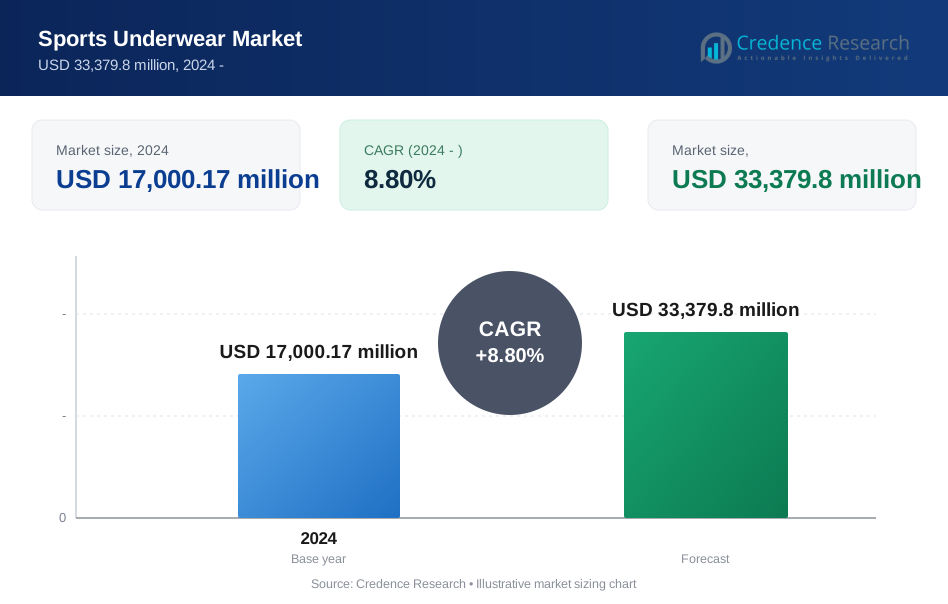
Sports Underwear Market size was valued at USD 17000.17 million in 2024 and is anticipated to reach USD 33379.8 million by 2032, at a CAGR of 8.8% during the forecast period (2024-2032).
Key drivers of the market include rising awareness of fitness and health, which has led to a greater emphasis on athletic apparel designed for performance. Consumers are seeking sports underwear made from advanced materials such as moisture-wicking fabrics, anti-bacterial finishes, and compression technology, which offer enhanced comfort, breathability, and support during intense physical activities. As the demand for high-performance wear continues to grow, brands are innovating with technologies that enhance the durability and functionality of sports underwear. Moreover, the growing trend of athleisure wear has also fueled the demand for sports underwear as part of everyday wardrobe essentials, further propelling market growth. The shift in consumer preferences towards eco-friendly and sustainable fabrics is also expected to drive the market, as brands are increasingly incorporating eco-conscious materials into their product lines. This trend reflects a broader societal shift toward sustainability, with consumers seeking products that align with their values.
Regionally, North America holds the largest market share, driven by high consumer spending on sportswear and a growing focus on health and fitness. The United States is a key contributor to the region's growth due to the widespread adoption of activewear in daily life, with consumers increasingly prioritizing comfort and functionality in their clothing choices. Additionally, the market in North America benefits from the strong presence of established brands that continuously introduce innovative sportswear solutions. The Asia Pacific region is anticipated to witness the highest growth rate during the forecast period, driven by increasing disposable incomes, the rising popularity of fitness and wellness activities, and the growing demand for performance-oriented sports apparel in emerging economies such as China and India. As fitness trends become more mainstream in these countries, the demand for sports underwear continues to rise. Europe also holds a significant market share, with high demand driven by health-conscious consumers and a strong presence of leading sportswear brands. The region’s established market is further supported by an increasing interest in fitness and wellness trends.
Market Insights:
- The sports underwear market is valued at USD 17,000.17 million in 2024 and is expected to reach USD 33,379.8 million by 2032, growing at a CAGR of 8.8% during the forecast period.
- Rising awareness of health and fitness has led to increased demand for high-performance sports underwear designed for comfort, breathability, and support during physical activities.
- Technological advancements in fabrics, such as moisture-wicking, anti-bacterial, and compression materials, are driving the market by enhancing comfort and functionality for athletes and fitness enthusiasts.
- The growth of athleisure wear is fueling the sports underwear market as consumers seek stylish, comfortable, and versatile clothing for both workouts and daily wear.
- The shift toward sustainable and eco-friendly products is growing as consumers increasingly prioritize environmentally conscious materials in their purchasing decisions.
- Intense competition and market saturation pose challenges, forcing brands to innovate and differentiate through marketing, product quality, and unique features.
- North America holds the largest market share at 35%, driven by high consumer spending on sportswear and a growing focus on fitness, with the U.S. being a key contributor to market growth.
Market Drivers:
Rising Awareness of Health and Fitness:
The increasing global focus on health and fitness is a significant driver of the sports underwear market. As more people adopt active lifestyles, the demand for specialized athletic apparel, including sports underwear, has grown. Consumers are more conscious of their physical well-being and are seeking products that enhance performance, comfort, and support during physical activities. Sports underwear made from advanced fabrics such as moisture-wicking materials and compression textiles is becoming essential to consumers looking to optimize their workouts and athletic performance. As fitness trends continue to evolve, this growing awareness drives a steady rise in demand for innovative, high-performance sportswear.
Technological Advancements in Fabrics:
Another critical factor driving the sports underwear market is the continuous development of advanced materials and technology. The use of moisture-wicking fabrics, anti-bacterial finishes, and breathable designs has enhanced the functionality of sports underwear, improving comfort and support during exercise. For instance, Nike’s Dri-FIT technology utilizes microfiber polyester fabric to wick moisture away from the skin, keeping athletes dry and comfortable during intense workouts. As sports underwear brands incorporate features like compression technology and seamless construction, they offer superior comfort, which is essential for athletes and fitness enthusiasts. These technological innovations help regulate body temperature, improve blood circulation, and reduce discomfort, contributing to the growing popularity of sports underwear among both professional athletes and casual fitness enthusiasts.
Growth of Athleisure Wear:
The rise of athleisure wear is another key driver propelling the sports underwear market. Athleisure, a trend that blends athletic wear with casual clothing, has become a dominant fashion statement. As consumers seek stylish, comfortable, and versatile clothing that can transition seamlessly from workout to everyday wear, sports underwear has become an integral part of the modern wardrobe. For instance, Lululemon’s Align collection has gained immense popularity for its buttery-soft fabric that provides both comfort and flexibility, making it ideal for both yoga sessions and casual outings. This shift in consumer preferences towards functional, performance-driven clothing, including sports underwear, further fuels the growth of the market. With a growing emphasis on convenience and comfort, athleisure wear continues to drive demand for sports underwear in both the fitness and fashion sectors.
Shift Toward Sustainable and Eco-Friendly Products:
The growing consumer demand for sustainable and eco-friendly products is significantly influencing the sports underwear market. Consumers are increasingly making purchasing decisions based on the environmental impact of the products they buy. In response, brands are incorporating eco-conscious materials, such as organic cotton, recycled fabrics, and biodegradable components, into their product lines. The shift toward sustainable fashion not only appeals to environmentally aware consumers but also creates opportunities for brands to differentiate themselves in a competitive market. As sustainability becomes more important to consumers, it is expected to continue driving growth in the sports underwear market.
Market Trends:
Rising Awareness of Health and Fitness:
The increasing global focus on health and fitness is a significant driver of the sports underwear market. As more people adopt active lifestyles, the demand for specialized athletic apparel, including sports underwear, has grown. Consumers are more conscious of their physical well-being and are seeking products that enhance performance, comfort, and support during physical activities. Sports underwear made from advanced fabrics such as moisture-wicking materials and compression textiles is becoming essential to consumers looking to optimize their workouts and athletic performance. As fitness trends continue to evolve, this growing awareness drives a steady rise in demand for innovative, high-performance sportswear.
Technological Advancements in Fabrics:
Another critical factor driving the sports underwear market is the continuous development of advanced materials and technology. For instance, New Balance has integrated the bioLogic Second Skin material, developed by MIT’s Tangible Media Group, into its athletic textiles; this fabric uses the bacterium Bacillus subtilis natto to automatically adjust pore size based on the wearer’s sweat level, enhancing breathability and comfort during exercise. The use of moisture-wicking fabrics, anti-bacterial finishes, and breathable designs has enhanced the functionality of sports underwear, improving comfort and support during exercise. As sports underwear brands incorporate features like compression technology and seamless construction, they offer superior comfort, which is essential for athletes and fitness enthusiasts. These technological innovations help regulate body temperature, improve blood circulation, and reduce discomfort, contributing to the growing popularity of sports underwear among both professional athletes and casual fitness enthusiasts.
Growth of Athleisure Wear:
The rise of athleisure wear is another key driver propelling the sports underwear market. For instance, Lululemon pioneered the athleisure category by launching products like the Boogie Pants and continues to innovate with technical fabrics such as Nulux, Everlux, and Nulu, which are lightweight, quick-drying, and designed for both athletic performance and everyday comfort. Athleisure, a trend that blends athletic wear with casual clothing, has become a dominant fashion statement. As consumers seek stylish, comfortable, and versatile clothing that can transition seamlessly from workout to everyday wear, sports underwear has become an integral part of the modern wardrobe. This shift in consumer preferences towards functional, performance-driven clothing, including sports underwear, further fuels the growth of the market. With a growing emphasis on convenience and comfort, athleisure wear continues to drive demand for sports underwear in both the fitness and fashion sectors.
Shift Toward Sustainable and Eco-Friendly Products:
The growing consumer demand for sustainable and eco-friendly products is significantly influencing the sports underwear market. Consumers are increasingly making purchasing decisions based on the environmental impact of the products they buy. In response, brands are incorporating eco-conscious materials, such as organic cotton, recycled fabrics, and biodegradable components, into their product lines. The shift toward sustainable fashion not only appeals to environmentally aware consumers but also creates opportunities for brands to differentiate themselves in a competitive market. As sustainability becomes more important to consumers, it is expected to continue driving growth in the sports underwear market.
Market Challenges Analysis:
High Competition and Market Saturation:
One of the key challenges facing the sports underwear market is the intense competition and market saturation. The growing popularity of sports and active lifestyles has attracted numerous brands, leading to a crowded market. Both established sportswear giants and new entrants offer a wide range of products, making it difficult for companies to differentiate themselves. For example, Under Armour and Lululemon Athletica are recognized for prioritizing movement and flexibility through advanced materials and technology, which appeals to a broad range of consumers seeking quality activewear. This high level of competition forces brands to invest heavily in marketing, innovation, and product differentiation to capture consumer attention. As the market becomes more saturated, it becomes increasingly challenging for smaller and emerging brands to secure a significant market share without substantial financial backing and innovative product offerings. Additionally, the need for constant innovation to meet changing consumer preferences further heightens the challenge for brands to stay relevant.
Rising Raw Material Costs and Supply Chain Disruptions:
Another significant challenge faced by the sports underwear market is the rising cost of raw materials and disruptions in global supply chains. Many sports underwear products rely on specialized fabrics such as moisture-wicking textiles and advanced compression materials, which can be costly to source and manufacture. The volatility in the prices of these materials can impact the overall cost structure for brands, forcing them to either absorb the additional costs or pass them on to consumers. Furthermore, supply chain disruptions, exacerbated by global events such as the COVID-19 pandemic, have led to delays and increased production costs. Companies must navigate these challenges carefully to maintain profit margins while ensuring timely delivery of high-quality products to the market. Moreover, fluctuations in shipping and transportation costs contribute to further complexity in managing the supply chain effectively.
Market Opportunities:
The sports underwear market presents several opportunities for growth, driven by evolving consumer preferences and increasing demand for high-performance products. As more consumers embrace fitness and wellness activities, there is a growing need for specialized athletic apparel designed to enhance performance and comfort. This trend provides opportunities for brands to innovate by introducing products with advanced technologies such as moisture-wicking fabrics, anti-bacterial finishes, and compression materials. Moreover, the rise of athleisure wear presents a significant opportunity, as consumers seek versatile clothing that can be worn for both physical activities and casual settings. Brands that can blend performance with style stand to capture a larger share of the market by appealing to a broad consumer base.
Furthermore, sustainability is becoming a key focus for consumers, creating a growing opportunity for brands to introduce eco-friendly and sustainable sports underwear options. With increasing consumer awareness about environmental impact, there is a rising demand for products made from organic, recycled, or biodegradable materials. Companies that incorporate these materials into their product offerings can differentiate themselves in a competitive market and appeal to environmentally conscious consumers. Additionally, emerging markets, particularly in Asia Pacific and Latin America, offer substantial growth opportunities due to rising disposable incomes, expanding fitness trends, and increasing awareness of health and wellness. These regions present untapped potential for both established and emerging brands to expand their market presence.
Market Segmentation Analysis:
By Product Type
The sports underwear market is segmented by product type, including briefs, boxers, and trunks. Briefs are the most popular category due to their comfort and support during physical activities. Boxers are also widely favored, especially for casual wear, providing more freedom of movement. Trunks, a hybrid between briefs and boxers, are gaining popularity for their modern design and enhanced fit, appealing to consumers seeking versatility and comfort.
By Material
Materials play a crucial role in the performance of sports underwear. Key materials used include cotton, polyester, spandex, and nylon. Cotton remains a popular choice due to its breathability and comfort, while synthetic materials such as polyester and nylon offer moisture-wicking properties, essential for performance during intense physical activities. Spandex is commonly used for its elasticity and support, providing a snug fit that enhances comfort during movement. The growing demand for eco-friendly fabrics is also leading to an increase in the use of sustainable materials like organic cotton and recycled fabrics.
By Gender
The market is also segmented by gender, with separate categories for men, women, and unisex products. Men’s sports underwear typically focuses on comfort, support, and performance features such as compression, while women’s sports underwear emphasizes fit, flexibility, and enhanced breathability. Unisex products are gaining popularity for their versatility and inclusive design, appealing to a broader consumer base.
Segmentations:
By Product Type
- Briefs
- Boxers
- Trunks
By Material
- Cotton
- Polyester
- Spandex
- Nylon
- Organic Cotton
- Recycled Fabrics
By Gender
- Men
- Women
- Unisex
By Activity Type
- Running
- Gym/Workout
- Yoga
- Cycling
- Hiking
- Swimming
Consumer Age Group
- Children
- Teenagers
- Adults
- Elderly
By Region
- North America
- U.S.
- Canada
- Mexico
- Europe
- UK
- France
- Germany
- Italy
- Spain
- Russia
- Belgium
- Netherlands
- Austria
- Sweden
- Poland
- Denmark
- Switzerland
- Rest of Europe
- Asia Pacific
- China
- Japan
- South Korea
- India
- Australia
- Thailand
- Indonesia
- Vietnam
- Malaysia
- Philippines
- Taiwan
- Rest of Asia Pacific
- Latin America
- Brazil
- Argentina
- Peru
- Chile
- Colombia
- Rest of Latin America
- Middle East
- UAE
- KSA
- Israel
- Turkey
- Iran
- Rest of Middle East
- Africa
- Egypt
- Nigeria
- Algeria
- Morocco
- Rest of Africa
Regional Analysis:
North America
North America holds the largest market share at 35% due to high consumer spending on sports and activewear. The region's strong emphasis on fitness, health, and wellness has fueled the demand for specialized sports apparel, including sports underwear. The United States is a key driver in this market, with increasing consumer awareness of the importance of performance-driven clothing. The growing popularity of athleisure wear further contributes to market expansion, as consumers seek comfortable yet functional underwear for daily wear and exercise. Major brands in North America are investing in advanced materials and technologies to offer enhanced comfort, breathability, and support, thus maintaining their strong market position. The region also benefits from the presence of established sportswear brands that continue to innovate and lead the market.
Europe
Europe accounts for 28% of the global sports underwear market share, driven by a robust fitness culture and health-conscious consumer base. The demand for high-quality, performance-oriented sportswear is particularly strong in countries like Germany, the UK, and France. As in North America, athleisure wear is a key factor in Europe’s growth, with consumers increasingly adopting sportswear as part of their everyday wardrobe. European consumers also place a significant emphasis on sustainability, leading to a rise in the demand for eco-friendly and sustainable sports underwear products. The presence of established sportswear brands in the region continues to drive innovation and market growth, while rising disposable incomes and a growing focus on fitness fuel further demand. Additionally, European countries are integrating more fitness activities into their daily lives, further driving the consumption of sportswear.
Asia Pacific
Asia Pacific, with a market share of 25%, is expected to witness the highest growth rate during the forecast period. The region's expanding middle class, increasing disposable incomes, and growing focus on health and wellness are key drivers of this growth. Countries like China, India, and Japan are witnessing a surge in fitness activities, leading to a greater demand for sports underwear that offers comfort and performance. Additionally, the rising popularity of athleisure wear and increased awareness of physical well-being is contributing to market expansion in the region. The increasing adoption of sports and fitness activities among younger consumers is particularly prominent in China and India, driving demand for both performance and casual sports underwear products. With the region's untapped potential, Asia Pacific is poised for strong market growth in the coming years, making it a crucial market for global brands.
Key Player Analysis:
- Nike
- Adidas
- Under Armour
- Puma
- Reebok
- SAXX Underwear
- 2XU
- Lululemon
- Jockey
Competitive Analysis:
The sports underwear market is highly competitive, with several established brands leading the charge in innovation, performance, and consumer loyalty. Major players such as Nike, Adidas, Under Armour, and Puma dominate the market, leveraging their strong brand recognition, extensive distribution networks, and cutting-edge technologies. These companies continuously invest in R&D to introduce advanced fabrics such as moisture-wicking, anti-bacterial, and compression materials that enhance comfort and performance during physical activities.
Smaller, specialized brands like SAXX Underwear and 2XU have also carved out significant market niches by focusing on specific consumer needs, such as support and flexibility for active individuals. Moreover, brands like Lululemon and Calvin Klein capitalize on the growing athleisure trend by offering stylish and functional sports underwear suitable for both workouts and daily wear. As the market grows, there is increasing competition from eco-friendly and sustainable brands that appeal to environmentally-conscious consumers, further intensifying market dynamics.
Recent Developments:
- In May 2023, Puma and Modibodi launched the third drop of their active period underwear range, combining Modibodi’s patented leak-proof technology with Puma’s performance apparel expertise.
- In October 2024, Puma partnered with fitness influencer Pamela Reif to launch a new athleisure collection, featuring supportive materials and technologies such as Cloudspun and Shapeluxe, enhancing comfort and performance in sports underwear.
- In November 2023, Under Armour unveiled its 2024 product focus, emphasizing new baselayer technologies-Heatgear, Coldgear, Iso-Chill, and Authentics-designed for temperature regulation and support, relevant to sports underwear innovation.
Market Concentration & Characteristics:
The sports underwear market exhibits moderate concentration, with a few dominant players such as Nike, Adidas, Under Armour, and Puma commanding significant market share. These companies leverage strong brand equity, large-scale production, and advanced technological innovations to maintain competitive advantage. At the same time, the market also features a diverse mix of smaller, specialized brands like SAXX Underwear and 2XU, which cater to specific consumer needs such as enhanced support and comfort for athletes. The market is characterized by continuous product innovation, particularly in fabric technology, with a growing emphasis on moisture-wicking, breathability, and eco-friendly materials. Additionally, the trend toward athleisure has led to a blurring of lines between athletic wear and casual apparel, pushing established brands to adapt and offer multifunctional products. With increasing demand for sustainability, the market is also seeing a shift toward environmentally conscious manufacturing practices, influencing product offerings and brand strategies.
Report Coverage:
The research report offers an in-depth analysis based on Product Type, Material, Gender, Activity Type, Consumer Age Group and Region. It details leading market players, providing an overview of their business, product offerings, investments, revenue streams, and key applications. Additionally, the report includes insights into the competitive environment, SWOT analysis, current market trends, as well as the primary drivers and constraints. Furthermore, it discusses various factors that have driven market expansion in recent years. The report also explores market dynamics, regulatory scenarios, and technological advancements that are shaping the industry. It assesses the impact of external factors and global economic changes on market growth. Lastly, it provides strategic recommendations for new entrants and established companies to navigate the complexities of the market.
Future Outlook:
- The sports underwear market is expanding as consumers increasingly prioritize comfort and performance in their athletic apparel choices.
- Technological advancements in fabric, such as moisture-wicking, anti-bacterial, and breathable materials, are enhancing product functionality.
- The rise of athleisure has led to a convergence of sportswear and casual fashion, boosting demand for versatile sports underwear.
- Sustainability is becoming a significant factor, with brands adopting eco-friendly materials to appeal to environmentally conscious consumers.
- Customization and personalization options are gaining popularity, allowing consumers to select products that meet their specific needs and preferences.
- The market is witnessing increased participation from niche players offering specialized products tailored to specific activities or demographics.
- E-commerce platforms are playing a crucial role in market expansion, providing consumers with convenient access to a wide range of products.
- Collaborations between sportswear brands and fitness influencers are driving brand visibility and consumer engagement.
- The integration of wearable technology in sports underwear is emerging, offering features like health monitoring and performance tracking.
- Global expansion into emerging markets presents new growth opportunities for sports underwear brands.
- Consumer education on the benefits of specialized sports underwear is increasing, leading to more informed purchasing decisions.
- The market is expected to continue evolving with trends focusing on innovation, sustainability, and consumer-centric offerings.
Request a Free Sample
Fill in your details and we'll send you a free sample report.
- Sample data tables & charts
- Research methodology
Market Dynamics
Rising Awareness of Health and Fitness
As more consumers adopt active lifestyles and prioritize physical well-being, there is increased demand for sports underwear that offers enhanced comfort, support, and performance during exercise and sports activities.
Technological Advancements in Fabrics
Innovations such as moisture-wicking, anti-bacterial, and compression materials are improving the functionality and comfort of sports underwear, making them more appealing to athletes and fitness enthusiasts seeking high-performance apparel.
Growth of Athleisure Wear
The trend of blending athletic and casual wear has made sports underwear a staple in everyday wardrobes, driving demand for products that are both stylish and functional for use beyond just sports or workouts.
Shift Toward Sustainable and Eco-Friendly Products
Consumers are increasingly seeking sports underwear made from organic, recycled, or biodegradable materials, prompting brands to innovate with eco-conscious product lines and appeal to environmentally aware buyers.
Expansion in Emerging Markets
Rising disposable incomes and growing fitness trends in regions like Asia Pacific and Latin America are creating new opportunities for market growth as more consumers in these areas seek performance-oriented sports underwear.
Need a Custom Version of This Report?
Tailor the scope, geography, or segments to your exact requirements.
- Custom geography or segment scope
- Direct access to our analyst team
Frequently Asked Questions
What is the current size of the Sports Underwear Market?
What factors are driving the growth of the Sports Underwear Market?
What are the key segments within the Sports Underwear Market?
Who are the major players in the Sports Underwear Market?
Table of Content
Chapter 1 Market Segmentation
- 1.1 Segmentation Framework
- 1.1.1 Product and Service Classification
- 1.1.2 Application and End-Use Classification
- 1.1.3 Technology and Solution Classification
- 1.1.4 Customer and Distribution Channel Classification
- 1.1.5 Geographic Segmentation
- 1.1.6 Market Segment Definitions and Boundaries
- 1.2 By Gender
- 1.2.1 Men
- 1.2.2 Women
- 1.2.3 Unisex
- 1.3 By Material
- 1.3.1 Cotton
- 1.3.2 Polyester
- 1.3.3 Spandex
- 1.3.4 Nylon
- 1.3.5 Organic Cotton
- 1.3.6 Recycled Fabrics
- 1.4 By Product Type
- 1.4.1 Briefs
- 1.4.2 Boxers
- 1.4.3 Trunks
- 1.5 By Activity Type
- 1.5.1 Running
- 1.5.2 Gym/Workout
- 1.5.3 Yoga
- 1.5.4 Cycling
- 1.5.5 Swimming
Chapter 2 Introduction
- 2.1 Report Objectives and Scope
- 2.2 Product Definition and Industry Terminology
- 2.3 Market Inclusions and Exclusions
- 2.4 Research Process
- 2.4.1 Primary Research and Expert Interviews
- 2.4.2 Secondary Research and Source Review
- 2.4.3 Top-Down and Bottom-Up Estimation
- 2.4.4 Data Triangulation and Verification
- 2.5 Market Size Measurement Basis
- 2.5.1 2024: USD 17,000.17 million → 2032: USD 33,379.8 million
- 2.6 Historical and Forecast Reference Periods
- 2.6.1 Base Year: 2024
- 2.6.2 Forecast Period: 2024-2032
- 2.7 Research Assumptions and Limitations
Chapter 3 Executive Summary
- 3.1 Market Snapshot and Key Findings
- 3.2 Base-Year Market Size, 2024
- 3.3 Forecast Market Size, 2032
- 3.4 Revenue and Volume Growth Outlook
- 3.5 Key Demand and Supply Indicators
- 3.6 Leading Market Segments
- 3.7 Fastest-Growing Market Opportunities
- 3.8 Regional Performance Highlights
- 3.9 Technology and Industry Transformation
- 3.10 Competitive Landscape Summary
- 3.11 Analyst View and Strategic Implications
Chapter 4 Global Sports Underwear Market Trends and Developments
- 4.1 Historical Industry Development
- 4.2 Recent Market Trends and Developments
- 4.3 Demand and Customer Behavior Trends
- 4.4 Technology and Product Innovation
- 4.5 Artificial Intelligence, Automation and Digitalization
- 4.6 Local Manufacturing and Supply Chain Realignment
- 4.7 Industry Partnerships, Mergers and Acquisitions
- 4.8 Sustainability and Circular Economy Developments
- 4.9 Government and Private Sector Investment Trends
- 4.10 Emerging Business Models and Commercialization
- 4.11 Industry Developments and Announcements
Chapter 5 Global Sports Underwear Market Production, Supply and Demand Analysis
- 5.1 Demand Trend and Consumption Analysis
- 5.2 Demand Forecast, 2024-2032
- 5.3 Production and Output Trend
- 5.4 Production and Output Forecast, 2024-2032
- 5.5 Installed Capacity and Capacity Utilization
- 5.6 Company-Wise Production Plants and Statistics
- 5.6.1 Installed Production Capacity
- 5.6.2 Actual Production
- 5.6.3 Planned Capacity and Expansion Targets
- 5.7 Supply Chain Structure and Procurement Trends
- 5.8 Supply-Demand Gap and Bottlenecks
- 5.9 Import Dependence and Sourcing Structure
- 5.10 Contract Manufacturing and Outsourcing
- 5.11 Regional Supply and Demand Concentration
Chapter 6 Global Sports Underwear Market Pricing Analysis
- 6.1 Pricing Structure and Measurement
- 6.2 Historical Pricing Trends
- 6.3 Pricing Outlook, 2024-2032
- 6.4 Average Selling Price and Unit Economics
- 6.5 Pricing by Product and Market Segment
- 6.6 Geographic Pricing Differences
- 6.7 Key Input, Energy, Labor and Logistics Costs
- 6.8 Contract Pricing and Purchasing Models
- 6.9 Pricing Sensitivity and Competitive Positioning
- 6.10 Price, Margin and Profitability Implications
Chapter 7 Global Sports Underwear Market Dynamics
- 7.1 Market Growth Drivers
- 7.1.1 Demand-Side Drivers
- 7.1.2 Technology and Innovation Drivers
- 7.1.3 Infrastructure and Investment Drivers
- 7.1.4 Regulatory and Policy Drivers
- 7.2 Market Restraints
- 7.2.1 Cost and Affordability Constraints
- 7.2.2 Technology and Adoption Barriers
- 7.2.3 Supply Chain and Operational Constraints
- 7.3 Market Challenges
- 7.3.1 Competitive Pressure and Margin Erosion
- 7.3.2 Skills, Infrastructure and Implementation Gaps
- 7.4 Emerging Market Opportunities
- 7.5 Market Dynamics Impact and Time-Horizon Assessment
Chapter 8 Global Sports Underwear Value Chain Analysis
- 8.1 Industry Value Chain Overview
- 8.2 Upstream Suppliers and Critical Inputs
- 8.3 Technology and Component Providers
- 8.4 Manufacturing or Service Delivery
- 8.5 Distribution, Channel Partners and Integrators
- 8.6 Downstream Applications and End Users
- 8.7 Value Addition and Profit Pools
- 8.8 Vertical Integration and Outsourcing
- 8.9 Supplier Concentration and Risk
- 8.10 Supply Chain Localization and Resilience
Chapter 9 Global Sports Underwear Market Regulations and Policies
- 9.1 Relevant Laws, Standards and Compliance Frameworks
- 9.2 Product, Service, Safety and Quality Requirements
- 9.3 Government Policies, Incentives and Subsidies
- 9.4 Imports, Exports and Trade Barriers
- 9.5 Public Procurement and Local Content Requirements
- 9.6 Environmental and Sustainability Compliance
- 9.7 Upcoming Policy Changes and Market Implications
Chapter 10 Global Sports Underwear Market Hotspots and Opportunities
- 10.1 Market Opportunity Mapping and Growth Hotspots
- 10.2 High-Growth Applications and Customer Groups
- 10.3 Underserved Markets and White-Space Opportunities
- 10.4 Emerging Technology and Product Opportunities
- 10.5 New Capacity and Investment Hotspots
- 10.6 Market Entry and Expansion Opportunities
- 10.7 Distribution and Partnership Opportunities
- 10.8 Near-Term and Long-Term Commercial Potential
- 10.9 Opportunity Attractiveness and Execution Risks
Chapter 11 Global Sports Underwear Market Outlook, 2024-2032
- 11.1 Market Size and Analysis
- 11.1.1 Revenue (Market Measurement: 2024: USD 17,000.17 million → 2032: USD 33,379.8 million)
- 11.1.2 Market Volume and Quantity Sold
- 11.1.3 Historical Market Size
- 11.1.4 Base-Year Market Size, 2024
- 11.2 Market Forecast, 2024-2032
- 11.2.1 Revenue Forecast to 2032
- 11.2.2 Volume Forecast to 2032
- 11.2.3 CAGR and Year-on-Year Growth
- 11.2.4 Incremental Revenue Opportunity
- 11.3 Forecast Assumptions and Scenario Analysis
- 11.3.1 Base-Case Forecast
- 11.3.2 Optimistic and Conservative Scenarios
- 11.3.3 Technology, Pricing and Policy Sensitivities
- 11.4 Market Attractiveness and Growth Outlook
Chapter 12 Global Sports Underwear Market Segmentation and Outlook
- 12.1 Segmentation Summary and Market Shares, 2024
- 12.2 Largest and Fastest-Growing Segments
- 12.3 By Gender - Market Size and Forecast, 2024-2032
- 12.3.1 Segment Definition and Scope
- 12.3.2 Historical Market Size
- 12.3.3 Revenue Forecast, 2024-2032
- 12.3.4 Volume Forecast, 2024-2032
- 12.3.5 Base-Year Market Share, 2024
- 12.3.6 Segment CAGR and Growth Drivers
- 12.3.7 Subsegment Market Size and Forecast
- 12.3.7.1 Men
- 12.3.7.2 Women
- 12.3.7.3 Unisex
- 12.3.8 Subsegment Pricing and Adoption Trends
- 12.3.9 Leading Suppliers and Competition
- 12.3.10 Regional Demand and Opportunities
- 12.4 By Material - Market Size and Forecast, 2024-2032
- 12.4.1 Segment Definition and Scope
- 12.4.2 Historical Market Size
- 12.4.3 Revenue Forecast, 2024-2032
- 12.4.4 Volume Forecast, 2024-2032
- 12.4.5 Base-Year Market Share, 2024
- 12.4.6 Segment CAGR and Growth Drivers
- 12.4.7 Subsegment Market Size and Forecast
- 12.4.7.1 Cotton
- 12.4.7.2 Polyester
- 12.4.7.3 Spandex
- 12.4.7.4 Nylon
- 12.4.7.5 Organic Cotton
- 12.4.7.6 Recycled Fabrics
- 12.4.8 Subsegment Pricing and Adoption Trends
- 12.4.9 Leading Suppliers and Competition
- 12.4.10 Regional Demand and Opportunities
- 12.5 By Product Type - Market Size and Forecast, 2024-2032
- 12.5.1 Segment Definition and Scope
- 12.5.2 Historical Market Size
- 12.5.3 Revenue Forecast, 2024-2032
- 12.5.4 Volume Forecast, 2024-2032
- 12.5.5 Base-Year Market Share, 2024
- 12.5.6 Segment CAGR and Growth Drivers
- 12.5.7 Subsegment Market Size and Forecast
- 12.5.7.1 Briefs
- 12.5.7.2 Boxers
- 12.5.7.3 Trunks
- 12.5.8 Subsegment Pricing and Adoption Trends
- 12.5.9 Leading Suppliers and Competition
- 12.5.10 Regional Demand and Opportunities
- 12.6 By Activity Type - Market Size and Forecast, 2024-2032
- 12.6.1 Segment Definition and Scope
- 12.6.2 Historical Market Size
- 12.6.3 Revenue Forecast, 2024-2032
- 12.6.4 Volume Forecast, 2024-2032
- 12.6.5 Base-Year Market Share, 2024
- 12.6.6 Segment CAGR and Growth Drivers
- 12.6.7 Subsegment Market Size and Forecast
- 12.6.7.1 Running
- 12.6.7.2 Gym/Workout
- 12.6.7.3 Yoga
- 12.6.7.4 Cycling
- 12.6.7.5 Swimming
- 12.6.8 Subsegment Pricing and Adoption Trends
- 12.6.9 Leading Suppliers and Competition
- 12.6.10 Regional Demand and Opportunities
- 12.7 Segment Growth Comparison
- 12.8 Segment Attractiveness and Priority Matrix
Chapter 13 Global Sports Underwear Geographic Market Outlook, 2024-2032
- 13.1 Regional Market Size and Share, 2024
- 13.2 Regional Market Forecast, 2024-2032
- 13.3 Regional Pricing, Production and Demand Differences
- 13.4 North America
- 13.4.1 United States
- 13.4.2 Canada
- 13.4.3 Mexico
- 13.5 Europe
- 13.5.1 Germany
- 13.5.2 France
- 13.5.3 Italy
- 13.5.4 United Kingdom
- 13.5.5 Spain
- 13.5.6 Poland
- 13.5.7 Russia
- 13.5.8 Netherlands
- 13.5.9 Belgium
- 13.5.10 Sweden
- 13.5.11 Denmark
- 13.5.12 Norway
- 13.5.13 Rest of Europe
- 13.6 Asia Pacific
- 13.6.1 China
- 13.6.2 India
- 13.6.3 Japan
- 13.6.4 South Korea
- 13.6.5 Thailand
- 13.6.6 Indonesia
- 13.6.7 Vietnam
- 13.6.8 Malaysia
- 13.6.9 Australia
- 13.6.10 Rest of Asia Pacific
- 13.7 Latin America
- 13.7.1 Brazil
- 13.7.2 Argentina
- 13.7.3 Colombia
- 13.7.4 Chile
- 13.7.5 Rest of Latin America
- 13.8 Middle East
- 13.8.1 Saudi Arabia
- 13.8.2 United Arab Emirates
- 13.8.3 Turkey
- 13.8.4 Israel
- 13.8.5 Iran
- 13.8.6 Rest of the Middle East
- 13.9 Africa
- 13.9.1 South Africa
- 13.9.2 Egypt
- 13.9.3 Nigeria
- 13.9.4 Morocco
- 13.9.5 Rest of Africa
- 13.10 Regional Investment, Policy and Supply Chain Differences
- 13.11 Regional Competitive Landscape
- 13.12 Geographic Growth Hotspots
Chapter 14 Global Sports Underwear Technology, Innovation and Sustainability Outlook
- 14.1 Technology Landscape and Maturity
- 14.2 Product, Process and Service Innovation
- 14.3 AI, Automation and Digital Tools in the Industry
- 14.4 Technology Adoption and Performance Benchmarking
- 14.5 Innovation Pipeline and R&D Investment
- 14.6 Patent and Intellectual Property Trends
- 14.7 Energy Efficiency and Resource Management
- 14.8 Sustainability, Recycling and Circularity
- 14.9 Technology Roadmap, 2024-2032
- 14.10 Risks of Obsolescence and Technology Substitution
Chapter 15 Global Sports Underwear Market Key Strategic Imperatives
- 15.1 Growth and Market Entry Priorities
- 15.2 High-Return Products and Segments
- 15.3 Pricing, Profitability and Cost Optimization
- 15.4 Technology Investment and Product Differentiation
- 15.5 Supply Chain Localization and Resilience
- 15.6 Distribution and Customer Acquisition
- 15.7 Partnership, Acquisition and Capacity Strategy
- 15.8 Regional Expansion Priorities
- 15.9 Short-, Medium- and Long-Term Actions
Chapter 16 Competition Outlook
- 16.1 Industry Competition Characteristics
- 16.2 Market Structure and Concentration
- 16.3 Market Share and Competitive Positioning, 2024
- 16.4 Company-Wise Revenue and Product Benchmarking
- 16.5 Production and Service Capacity Benchmarking
- 16.6 Technology, Pricing and Differentiation
- 16.7 Regional Footprint and Distribution Strength
- 16.8 Mergers, Acquisitions and Strategic Alliances
- 16.9 New Entrants and Competitive Threats
- 16.10 Porter's Five Forces and Industry Attractiveness
- 16.11 Competitive Outlook, 2024-2032
Chapter 17 Company Profiles
- 17.1 Company Coverage and Selection Criteria
- 17.2 Nike
- 17.2.1 Business Description
- 17.2.2 Company Ownership and Geographic Presence
- 17.2.3 Product and Service Portfolio
- 17.2.4 Manufacturing and Operating Footprint
- 17.2.5 Production Capacity and Expansion Plans
- 17.2.6 Financial Performance and Investment
- 17.2.7 Market Share and Competitive Position
- 17.2.8 Technology and Innovation Capabilities
- 17.2.9 Strategic Alliances or Partnerships
- 17.2.10 Recent Developments
- 17.2.11 Growth Strategy and Outlook
- 17.3 Adidas
- 17.4 Under Armour
- 17.5 Puma
- 17.6 Reebok
- 17.7 SAXX Underwear
- 17.8 2XU
- 17.9 Lululemon
- 17.10 Jockey
- 17.11 Other Relevant Market Participants
Note: Every listed company is profiled on the structure shown under the first company. The company list is preliminary and may change based on research findings, market developments, data availability and client requirements.
Chapter 18 Disclaimer
- 18.1 Research and Forecast Disclaimer
- 18.2 Data Source and Estimation Limitations
Note: The depth of individual sections depends on data availability for this market. Volume, capacity, trade and other unit-based metrics are included where applicable.

