
Market Overview
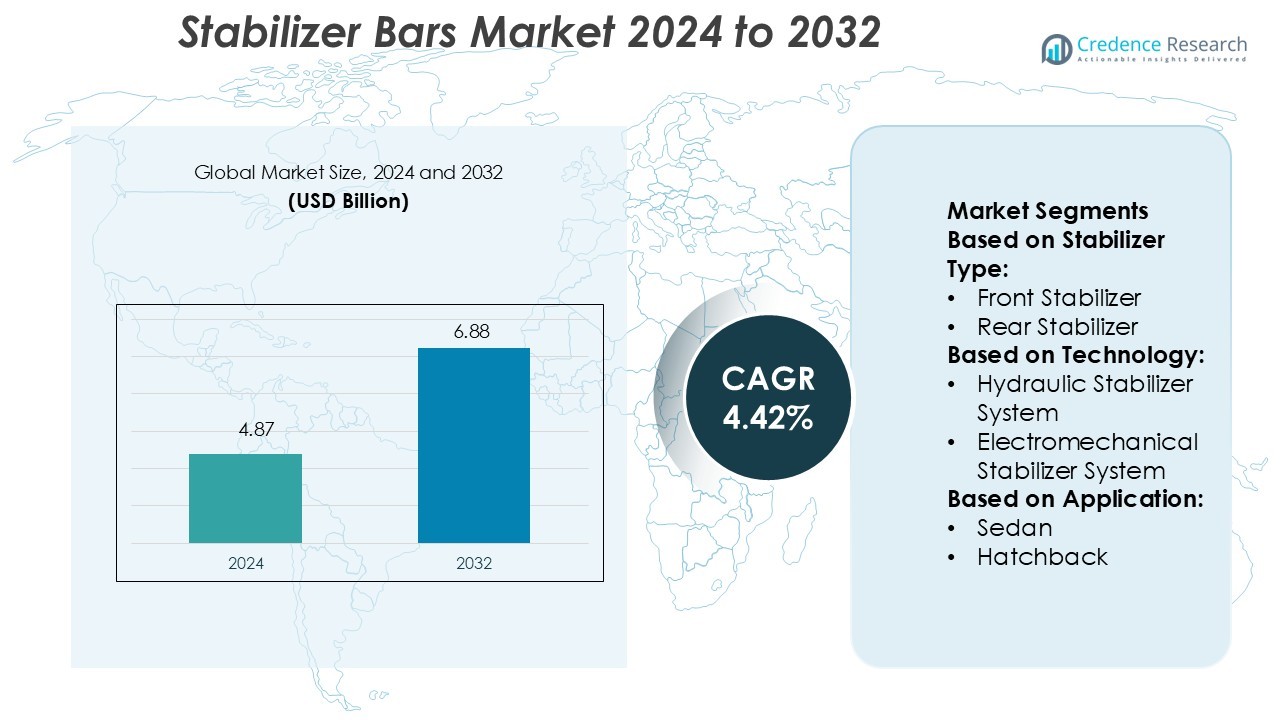
Stabilizer Bars Market size was valued USD 4.87 billion in 2024 and is anticipated to reach USD 6.88 billion by 2032, at a CAGR of 4.42% during the forecast period.
| REPORT ATTRIBUTE | DETAILS |
|---|---|
| Historical Period | 2020-2023 |
| Base Year | 2024 |
| Forecast Period | 2025-2032 |
| Stabilizer Bars Market Size 2024 | USD 4.87 Billion |
| Stabilizer Bars Market, CAGR | 4.42% |
| Stabilizer Bars Market Size 2032 | USD 6.88 Billion |
The stabilizer bars market is driven by major players such as ZF, Thyssenkrupp, Hendrickson, Mubea, NHK International, Sogefi Group, Kongsberg Automotive, DAEWON, Dongfeng, and SwayTec. These companies focus on technological innovation, lightweight materials, and active suspension systems to enhance vehicle handling and comfort. ZF and Thyssenkrupp lead in developing electronically controlled stabilizer technologies, while Mubea and NHK International specialize in high-strength steel solutions for improved performance. Asia-Pacific dominates the global market with a 34.2% share in 2024, supported by rapid automotive production, rising SUV demand, and expanding electric vehicle manufacturing across China, Japan, and South Korea.
Market Insights
- The Stabilizer Bars Market was valued at USD 4.87 billion in 2024 and is projected to reach USD 6.88 billion by 2032, growing at a CAGR of 4.42% during the forecast period.
- Growing demand for vehicle safety and stability is a key driver, supported by advanced suspension technologies and the rising production of SUVs and electric vehicles.
- Market trends highlight increasing adoption of lightweight materials and electronically controlled stabilizer systems to improve energy efficiency and handling precision.
- Competitive dynamics remain strong, with leading companies like ZF, Thyssenkrupp, and Mubea investing in R&D for active stabilizer innovations, while others focus on cost-effective mechanical systems.
- Asia-Pacific leads the global market with a 34.2% share, driven by strong automotive output in China, Japan, and South Korea, while the front stabilizer segment dominates with a 57.8% share due to its critical role in vehicle balance and performance.
Market Segmentation Analysis:
By Stabilizer Type
The front stabilizer segment dominated the market with a 57.8% share in 2024. This dominance stems from its essential role in reducing body roll and enhancing vehicle handling during cornering. Front stabilizers are standard in most passenger cars and SUVs, ensuring better stability and steering response. Growing demand for improved ride comfort and safety in modern vehicles supports this segment. The rise in high-performance and luxury vehicle production further drives the adoption of advanced front stabilizer systems across global automotive manufacturing lines.
- For instance, ZF Friedrichshafen AG’s electromechanical roll-control (ERC) system achieves a stabilization torque of up to 1,400 Nm in the front axle during cornering, enabling the vehicle to actively counteract body roll and maintain chassis stability.
By Technology
The electronically controlled stabilizer bar segment led the market with a 41.2% share in 2024. This segment benefits from growing adoption in premium and electric vehicles for dynamic ride control. These systems use sensors and actuators to adjust stiffness in real time, improving comfort and cornering precision. Increasing integration of electronic control units (ECUs) and vehicle dynamics management systems enhances performance efficiency. Automakers’ shift toward adaptive suspension technologies strengthens demand for electronically controlled stabilizer bars in both passenger and utility vehicle categories.
- For instance, Mubea developed a transversal blade spring that replaces multi‑link axles, removing 20 kg of weight and freeing battery installation space in BEVs It enhances passenger safety while ensuring better stability at higher speeds.
By Application
The SUV segment held the largest market share of 45.6% in 2024, driven by rising consumer preference for off-road and multi-terrain vehicles. SUVs require high-strength stabilizer bars to maintain balance and minimize body roll during high-speed turns or uneven road conditions. Automakers are equipping SUVs with active and semi-active stabilizer systems for superior ride control and safety. Growing sales of electric and hybrid SUVs further contribute to segment expansion. This trend reflects consumer demand for comfort, stability, and durability in larger vehicle formats.
Key Growth Drivers
Rising Demand for Vehicle Stability and Safety
The increasing emphasis on vehicle stability and passenger safety is a major driver for stabilizer bars. Automakers are integrating advanced suspension systems to minimize body roll and enhance cornering stability. Regulatory mandates on safety performance also encourage wider adoption in passenger and commercial vehicles. As road safety awareness increases globally, manufacturers are developing stabilizer systems with lightweight materials and improved torsional strength. This growing focus on safety standards continues to elevate demand for stabilizer bars across multiple vehicle categories.
- For instance, Dongfeng’s Aeolus Haohan PHEV uses the world’s first 4‑speed power‑split plus series‑parallel hybrid system, delivering a combined output of 265 kW and 615 Nm of torque, and achieves a claimed range of 1,300 km.
Expansion of SUV and Off-Road Vehicle Production
The rapid rise in SUV and off-road vehicle sales significantly drives stabilizer bar demand. SUVs require strong stabilizers to manage higher centers of gravity and provide balanced handling on rough terrains. Manufacturers are adopting active stabilizer systems that adapt to dynamic driving conditions, improving comfort and performance. Growing consumer preference for adventure and family vehicles strengthens this trend. The increasing number of electric SUVs also contributes to market expansion, as stability enhancement remains a priority in heavier vehicle models.
- For instance, Kongsberg Automotive developed a rear axle stabilizer that uses high‑strength forged link arms and advanced tube forming. This design achieves a weight reduction of over 30% compared to traditional solid‑rod stabilizers.
Technological Advancements in Suspension Systems
Technological innovation in suspension and chassis systems boosts stabilizer bar integration. Developments in electronically controlled and electromechanical stabilizer systems enable real-time performance adjustments based on driving conditions. These systems enhance comfort and energy efficiency, supporting adoption in electric and premium vehicles. The rise of smart sensors and control modules further improves system precision and reliability. Automotive manufacturers are investing in active stabilizer systems to meet evolving consumer expectations for performance and driving comfort.
Key Trends & Opportunities
Adoption of Lightweight and Composite Materials
The shift toward lightweight vehicle construction has encouraged the use of composite stabilizer bars. Manufacturers are developing stabilizers using materials like carbon fiber and high-strength steel to reduce weight while maintaining rigidity. Lightweight stabilizers enhance fuel efficiency and reduce carbon emissions, aligning with sustainability goals. This trend presents opportunities for material suppliers and component manufacturers focusing on advanced composites and hybrid material technologies for next-generation vehicle suspension systems.
- For instance, Thyssenkrupp’s VarioShape® tubular stabilizer bar achieves a weight reduction of up to 50 % compared to conventional solid stabilizers while maintaining mechanical strength. It enhances passenger safety while ensuring better stability at higher speeds.
Integration of Advanced Electronic Control Systems
Automotive manufacturers are increasingly integrating electronic control units with stabilizer systems for enhanced performance. Electronically controlled stabilizer bars offer adaptive handling and comfort by adjusting stiffness dynamically. This integration is gaining traction in electric, hybrid, and luxury vehicles where ride quality and efficiency are critical. The ongoing trend toward vehicle electrification creates new opportunities for suppliers specializing in intelligent, electronically managed suspension systems that complement autonomous and connected vehicle designs.
- For instance, Hendrickson’s STEERTEK NXT steer axle introduced in mid-2025 offers 25 pounds of additional weight savings in school buses compared to its prior axle generation.
Growth in Aftermarket Customization
The aftermarket segment is witnessing rising interest in performance upgrades and customization. Vehicle enthusiasts and fleet operators are opting for adjustable stabilizer bars to improve handling characteristics. The growing popularity of motorsports and off-road modifications fuels demand for performance-oriented stabilizers. Companies offering tailored solutions and durable materials are capturing strong aftermarket growth opportunities, especially in emerging markets with expanding car modification cultures.
Key Challenges
High Manufacturing and Integration Costs
The development and integration of advanced stabilizer systems involve high production costs, limiting adoption in budget vehicle categories. Electronically controlled systems require precision engineering, costly sensors, and advanced control units, raising vehicle prices. These cost pressures challenge manufacturers to balance affordability with innovation. Smaller automakers face difficulty competing with established brands investing heavily in active suspension technologies. Managing these expenses remains a key barrier to market penetration, particularly in price-sensitive regions.
Complex Maintenance and Durability Concerns
Active and electronic stabilizer systems, while offering superior performance, often face challenges related to long-term durability and maintenance complexity. Components exposed to varying environmental conditions may experience wear and calibration issues over time. Repair and replacement require skilled technicians, increasing maintenance costs for end users. These challenges can limit adoption in developing markets with limited technical infrastructure. Enhancing durability and reducing maintenance frequency remain priorities for manufacturers to sustain consumer trust and market growth.
Regional Analysis
North America
North America accounted for a 31.6% share of the stabilizer bars market in 2024, driven by high vehicle production and advanced automotive technologies. The U.S. leads regional demand due to widespread adoption of SUVs and premium vehicles equipped with active suspension systems. Automakers such as Ford, General Motors, and Tesla emphasize ride comfort and safety through electronically controlled stabilizer systems. The region also benefits from strong aftermarket activity and consumer interest in performance upgrades. Increasing R&D investments in lightweight materials further strengthen North America’s competitive position in the global market.
Europe
Europe held a 28.4% share of the stabilizer bars market in 2024, supported by strong manufacturing bases in Germany, France, and the UK. The region focuses on vehicle safety and handling efficiency, aligning with stringent EU performance standards. Major automakers such as BMW, Volkswagen, and Mercedes-Benz integrate adaptive and electromechanical stabilizer systems in luxury and electric models. Growing emphasis on sustainability and emission reduction drives adoption of lightweight and recyclable materials. Technological innovation and collaboration between OEMs and component suppliers sustain Europe’s leadership in advanced stabilizer solutions.
Asia-Pacific
Asia-Pacific dominated the global stabilizer bars market with a 34.2% share in 2024, fueled by rapid automotive expansion in China, Japan, India, and South Korea. The region’s growing middle-class population and rising SUV demand contribute significantly to market growth. Leading manufacturers, including Toyota, Hyundai, and Honda, are investing in lightweight and electronically controlled stabilizer systems to enhance performance. Increasing vehicle exports and local manufacturing initiatives strengthen regional competitiveness. Asia-Pacific also serves as a major production hub for raw materials and components, ensuring cost efficiency and supply chain resilience.
Latin America
Latin America captured a 3.7% share of the stabilizer bars market in 2024, supported by increasing vehicle production in Brazil, Mexico, and Argentina. Rising disposable incomes and expanding automotive assembly facilities contribute to steady growth. The market benefits from demand for mid-range passenger cars and light commercial vehicles requiring efficient stabilizer systems. However, limited access to high-end electronic technologies constrains wider adoption. Ongoing infrastructure projects and foreign investments by global automakers are expected to enhance stabilizer bar production capabilities and drive gradual technological advancement in the region.
Middle East & Africa
The Middle East & Africa region accounted for a 2.1% share of the stabilizer bars market in 2024. Growth is driven by rising vehicle imports, expanding urban mobility, and infrastructure development. Countries such as the UAE, Saudi Arabia, and South Africa show increasing demand for SUVs and commercial vehicles suited to rough terrains. The preference for durable, corrosion-resistant stabilizer bars is strengthening due to extreme climatic conditions. While adoption of advanced technologies remains limited, government incentives for industrial diversification are expected to attract component manufacturers and boost regional production capacity.
Market Segmentations:
By Stabilizer Type:
- Front Stabilizer
- Rear Stabilizer
By Technology:
- Hydraulic Stabilizer System
- Electromechanical Stabilizer System
By Application:
- Sedan
- Hatchback
By Geography
- North America
- U.S.
- Canada
- Mexico
- Europe
- Germany
- France
- U.K.
- Italy
- Spain
- Rest of Europe
- Asia Pacific
- China
- Japan
- India
- South Korea
- South-east Asia
- Rest of Asia Pacific
- Latin America
- Brazil
- Argentina
- Rest of Latin America
- Middle East & Africa
- GCC Countries
- South Africa
- Rest of the Middle East and Africa
Competitive Landscape
The stabilizer bars market is highly competitive, with key players including ZF, Hendrickson, NHK International, Sogefi Group, DAEWON, Mubea, Kongsberg Automotive, Thyssenkrupp, Dongfeng, and SwayTec. The stabilizer bars market features intense competition, driven by continuous innovation and evolving automotive technologies. Companies are focusing on lightweight materials, active suspension systems, and electronic control technologies to enhance driving comfort and fuel efficiency. Increasing demand for adaptive stabilizers in electric and hybrid vehicles is accelerating R&D investments across the industry. Manufacturers are also emphasizing sustainability by adopting recyclable materials and energy-efficient production methods. Strategic collaborations between automakers and component suppliers are helping optimize cost and performance. This dynamic environment encourages technological advancement, ensuring competitive differentiation and long-term growth in global markets.
Key Player Analysis
- ZF
- Hendrickson
- NHK International
- Sogefi Group
- DAEWON
- Mubea
- Kongsberg Automotive
- Thyssenkrupp
- Dongfeng
- SwayTec
Recent Developments
- In April 2025, General Motors supplemented their safety recall of 17 Cadillac Lyriq electric SUVs in North America for front stabilizer bar bracket bolts that were inaccurately torqued in assembly. The error was due to an issue in the production software logic utilized for bolt fastening.
- In January 2025, CES in Las Vegas, American Axle & Manufacturing (AAM) introduced their SmartBar which is a disconnecting stabilizer bar designed for use on off-road vehicles. The SmartBar system uses an electronically controlled module to disengage the stabilizer bar, enabling maximum wheel articulation over tough terrain to improve traction and ride comfort.
- In January 2025, SONGWON Industrial partnered with Altek International FZE to distribute PVC stabilizers across the Middle East and North Africa, expanding regional reach in construction and packaging segments.
- In September of 2024, Stumpp Schuele & Somappa Springs (SSS), which is part of the MG Brothers Group announced a joint venture with Chuhatsu of Japan to form SSS Chuhatsu Precision Springs Pvt. Ltd. The joint venture is the first domestic manufacturer of powerbackdoor springs in India. PBD springs are an important component of automated tailgate systems that have previously been imported entirely.
Report Coverage
The research report offers an in-depth analysis based on Stabilizer Type, Technology, Application and Geography. It details leading market players, providing an overview of their business, product offerings, investments, revenue streams, and key applications. Additionally, the report includes insights into the competitive environment, SWOT analysis, current market trends, as well as the primary drivers and constraints. Furthermore, it discusses various factors that have driven market expansion in recent years. The report also explores market dynamics, regulatory scenarios, and technological advancements that are shaping the industry. It assesses the impact of external factors and global economic changes on market growth. Lastly, it provides strategic recommendations for new entrants and established companies to navigate the complexities of the market.
Future Outlook
- Demand for electronically controlled stabilizer bars will continue to rise in premium and electric vehicles.
- Lightweight composite materials will gain wider adoption to improve fuel efficiency and reduce emissions.
- Integration of active suspension systems will become standard across mid and high-end vehicle segments.
- Growing SUV and off-road vehicle production will sustain long-term demand for heavy-duty stabilizer systems.
- Automakers will increase R&D investments in adaptive and intelligent chassis technologies.
- Expansion of EV manufacturing will drive innovation in compact and energy-efficient stabilizer designs.
- Asia-Pacific will remain the leading production hub due to strong automotive output and cost efficiency.
- Strategic partnerships between OEMs and component suppliers will accelerate product innovation and regional expansion.
- Advanced sensor technologies will enhance real-time control and system reliability.
- Aftermarket demand for customizable stabilizer systems will increase with growing vehicle personalization trends.

Request a Free Sample
Fill in your details and we'll send you a free sample report.
- Sample data tables & charts
- Research methodology
Need a Custom Version of This Report?
Tailor the scope, geography, or segments to your exact requirements.
- Custom geography or segment scope
- Direct access to our analyst team
Frequently Asked Questions
What is the current market size for the Stabilizer Bars Market, and what is its projected size in 2032?
At what Compound Annual Growth Rate is the Stabilizer Bars Market projected to grow between 2025 and 2032?
Which Stabilizer Bars Market segment held the largest share in 2024?
What are the primary factors fueling the growth of the Stabilizer Bars Market?
Who are the leading companies in the Stabilizer Bars Market?
Which region commanded the largest share of the Stabilizer Bars Market in 2024?
Table of Content
Chapter 1 Market Segmentation
- 1.1 Segmentation Framework
- 1.1.1 Product and Service Classification
- 1.1.2 Application and End-Use Classification
- 1.1.3 Technology and Solution Classification
- 1.1.4 Customer and Distribution Channel Classification
- 1.1.5 Geographic Segmentation
- 1.1.6 Market Segment Definitions and Boundaries
Chapter 2 Introduction
- 2.1 Report Objectives and Scope
- 2.2 Product Definition and Industry Terminology
- 2.3 Market Inclusions and Exclusions
- 2.4 Research Process
- 2.4.1 Primary Research and Expert Interviews
- 2.4.2 Secondary Research and Source Review
- 2.4.3 Top-Down and Bottom-Up Estimation
- 2.4.4 Data Triangulation and Verification
- 2.5 Market Size Measurement Basis
- 2.5.1 2024: USD 4.87 billion → 2032: USD 6.88 billion
- 2.6 Historical and Forecast Reference Periods
- 2.6.1 Base Year: 2024
- 2.6.2 Forecast Period: 2024-2032
- 2.7 Research Assumptions and Limitations
Chapter 3 Executive Summary
- 3.1 Market Snapshot and Key Findings
- 3.2 Base-Year Market Size, 2024
- 3.3 Forecast Market Size, 2032
- 3.4 Revenue and Volume Growth Outlook
- 3.5 Key Demand and Supply Indicators
- 3.6 Leading Market Segments
- 3.7 Fastest-Growing Market Opportunities
- 3.8 Regional Performance Highlights
- 3.9 Technology and Industry Transformation
- 3.10 Competitive Landscape Summary
- 3.11 Analyst View and Strategic Implications
Chapter 4 Global Stabilizer Bars Market Trends and Developments
- 4.1 Historical Industry Development
- 4.2 Recent Market Trends and Developments
- 4.3 Demand and Customer Behavior Trends
- 4.4 Technology and Product Innovation
- 4.5 Artificial Intelligence, Automation and Digitalization
- 4.6 Local Manufacturing and Supply Chain Realignment
- 4.7 Industry Partnerships, Mergers and Acquisitions
- 4.8 Sustainability and Circular Economy Developments
- 4.9 Government and Private Sector Investment Trends
- 4.10 Emerging Business Models and Commercialization
- 4.11 Industry Developments and Announcements
Chapter 5 Global Stabilizer Bars Market Production, Supply and Demand Analysis
- 5.1 Demand Trend and Consumption Analysis
- 5.2 Demand Forecast, 2024-2032
- 5.3 Production and Output Trend
- 5.4 Production and Output Forecast, 2024-2032
- 5.5 Installed Capacity and Capacity Utilization
- 5.6 Company-Wise Production Plants and Statistics
- 5.6.1 Installed Production Capacity
- 5.6.2 Actual Production
- 5.6.3 Planned Capacity and Expansion Targets
- 5.7 Supply Chain Structure and Procurement Trends
- 5.8 Supply-Demand Gap and Bottlenecks
- 5.9 Import Dependence and Sourcing Structure
- 5.10 Contract Manufacturing and Outsourcing
- 5.11 Regional Supply and Demand Concentration
Chapter 6 Global Stabilizer Bars Market Pricing Analysis
- 6.1 Pricing Structure and Measurement
- 6.2 Historical Pricing Trends
- 6.3 Pricing Outlook, 2024-2032
- 6.4 Average Selling Price and Unit Economics
- 6.5 Pricing by Product and Market Segment
- 6.6 Geographic Pricing Differences
- 6.7 Key Input, Energy, Labor and Logistics Costs
- 6.8 Contract Pricing and Purchasing Models
- 6.9 Pricing Sensitivity and Competitive Positioning
- 6.10 Price, Margin and Profitability Implications
Chapter 7 Global Stabilizer Bars Market Dynamics
- 7.1 Market Growth Drivers
- 7.1.1 Demand-Side Drivers
- 7.1.2 Technology and Innovation Drivers
- 7.1.3 Infrastructure and Investment Drivers
- 7.1.4 Regulatory and Policy Drivers
- 7.2 Market Restraints
- 7.2.1 Cost and Affordability Constraints
- 7.2.2 Technology and Adoption Barriers
- 7.2.3 Supply Chain and Operational Constraints
- 7.3 Market Challenges
- 7.3.1 Competitive Pressure and Margin Erosion
- 7.3.2 Skills, Infrastructure and Implementation Gaps
- 7.4 Emerging Market Opportunities
- 7.5 Market Dynamics Impact and Time-Horizon Assessment
Chapter 8 Global Stabilizer Bars Value Chain Analysis
- 8.1 Industry Value Chain Overview
- 8.2 Upstream Suppliers and Critical Inputs
- 8.3 Technology and Component Providers
- 8.4 Manufacturing or Service Delivery
- 8.5 Distribution, Channel Partners and Integrators
- 8.6 Downstream Applications and End Users
- 8.7 Value Addition and Profit Pools
- 8.8 Vertical Integration and Outsourcing
- 8.9 Supplier Concentration and Risk
- 8.10 Supply Chain Localization and Resilience
Chapter 9 Global Stabilizer Bars Market Regulations and Policies
- 9.1 Relevant Laws, Standards and Compliance Frameworks
- 9.2 Product, Service, Safety and Quality Requirements
- 9.3 Government Policies, Incentives and Subsidies
- 9.4 Imports, Exports and Trade Barriers
- 9.5 Public Procurement and Local Content Requirements
- 9.6 Environmental and Sustainability Compliance
- 9.7 Upcoming Policy Changes and Market Implications
Chapter 10 Global Stabilizer Bars Market Hotspots and Opportunities
- 10.1 Market Opportunity Mapping and Growth Hotspots
- 10.2 High-Growth Applications and Customer Groups
- 10.3 Underserved Markets and White-Space Opportunities
- 10.4 Emerging Technology and Product Opportunities
- 10.5 New Capacity and Investment Hotspots
- 10.6 Market Entry and Expansion Opportunities
- 10.7 Distribution and Partnership Opportunities
- 10.8 Near-Term and Long-Term Commercial Potential
- 10.9 Opportunity Attractiveness and Execution Risks
Chapter 11 Global Stabilizer Bars Market Outlook, 2024-2032
- 11.1 Market Size and Analysis
- 11.1.1 Revenue (Market Measurement: 2024: USD 4.87 billion → 2032: USD 6.88 billion)
- 11.1.2 Market Volume and Quantity Sold
- 11.1.3 Historical Market Size
- 11.1.4 Base-Year Market Size, 2024
- 11.2 Market Forecast, 2024-2032
- 11.2.1 Revenue Forecast to 2032
- 11.2.2 Volume Forecast to 2032
- 11.2.3 CAGR and Year-on-Year Growth
- 11.2.4 Incremental Revenue Opportunity
- 11.3 Forecast Assumptions and Scenario Analysis
- 11.3.1 Base-Case Forecast
- 11.3.2 Optimistic and Conservative Scenarios
- 11.3.3 Technology, Pricing and Policy Sensitivities
- 11.4 Market Attractiveness and Growth Outlook
Chapter 12 Global Stabilizer Bars Market Segmentation and Outlook
- 12.1 Segmentation Summary and Market Shares, 2024
- 12.2 Largest and Fastest-Growing Segments
- 12.3 Segment Growth Comparison
- 12.4 Segment Attractiveness and Priority Matrix
Chapter 13 Global Stabilizer Bars Geographic Market Outlook, 2024-2032
- 13.1 Regional Market Size and Share, 2024
- 13.2 Regional Market Forecast, 2024-2032
- 13.3 Regional Pricing, Production and Demand Differences
- 13.4 North America
- 13.4.1 United States
- 13.4.2 Canada
- 13.4.3 Mexico
- 13.5 Europe
- 13.5.1 Germany
- 13.5.2 France
- 13.5.3 Italy
- 13.5.4 United Kingdom
- 13.5.5 Spain
- 13.5.6 Poland
- 13.5.7 Russia
- 13.5.8 Netherlands
- 13.5.9 Belgium
- 13.5.10 Sweden
- 13.5.11 Denmark
- 13.5.12 Norway
- 13.5.13 Rest of Europe
- 13.6 Asia Pacific
- 13.6.1 China
- 13.6.2 India
- 13.6.3 Japan
- 13.6.4 South Korea
- 13.6.5 Thailand
- 13.6.6 Indonesia
- 13.6.7 Vietnam
- 13.6.8 Malaysia
- 13.6.9 Australia
- 13.6.10 Rest of Asia Pacific
- 13.7 Latin America
- 13.7.1 Brazil
- 13.7.2 Argentina
- 13.7.3 Colombia
- 13.7.4 Chile
- 13.7.5 Rest of Latin America
- 13.8 Middle East
- 13.8.1 Saudi Arabia
- 13.8.2 United Arab Emirates
- 13.8.3 Turkey
- 13.8.4 Israel
- 13.8.5 Iran
- 13.8.6 Rest of the Middle East
- 13.9 Africa
- 13.9.1 South Africa
- 13.9.2 Egypt
- 13.9.3 Nigeria
- 13.9.4 Morocco
- 13.9.5 Rest of Africa
- 13.10 Regional Investment, Policy and Supply Chain Differences
- 13.11 Regional Competitive Landscape
- 13.12 Geographic Growth Hotspots
Chapter 14 Global Stabilizer Bars Technology, Innovation and Sustainability Outlook
- 14.1 Technology Landscape and Maturity
- 14.2 Product, Process and Service Innovation
- 14.3 AI, Automation and Digital Tools in the Industry
- 14.4 Technology Adoption and Performance Benchmarking
- 14.5 Innovation Pipeline and R&D Investment
- 14.6 Patent and Intellectual Property Trends
- 14.7 Energy Efficiency and Resource Management
- 14.8 Sustainability, Recycling and Circularity
- 14.9 Technology Roadmap, 2024-2032
- 14.10 Risks of Obsolescence and Technology Substitution
Chapter 15 Global Stabilizer Bars Market Key Strategic Imperatives
- 15.1 Growth and Market Entry Priorities
- 15.2 High-Return Products and Segments
- 15.3 Pricing, Profitability and Cost Optimization
- 15.4 Technology Investment and Product Differentiation
- 15.5 Supply Chain Localization and Resilience
- 15.6 Distribution and Customer Acquisition
- 15.7 Partnership, Acquisition and Capacity Strategy
- 15.8 Regional Expansion Priorities
- 15.9 Short-, Medium- and Long-Term Actions
Chapter 16 Competition Outlook
- 16.1 Industry Competition Characteristics
- 16.2 Market Structure and Concentration
- 16.3 Market Share and Competitive Positioning, 2024
- 16.4 Company-Wise Revenue and Product Benchmarking
- 16.5 Production and Service Capacity Benchmarking
- 16.6 Technology, Pricing and Differentiation
- 16.7 Regional Footprint and Distribution Strength
- 16.8 Mergers, Acquisitions and Strategic Alliances
- 16.9 New Entrants and Competitive Threats
- 16.10 Porter's Five Forces and Industry Attractiveness
- 16.11 Competitive Outlook, 2024-2032
Chapter 17 Company Profiles
- 17.1 Company Coverage and Selection Criteria
- 17.2 Leading Market Participants – Standard Profile Structure
- 17.2.1 Business Description
- 17.2.2 Company Ownership and Geographic Presence
- 17.2.3 Product and Service Portfolio
- 17.2.4 Manufacturing and Operating Footprint
- 17.2.5 Production Capacity and Expansion Plans
- 17.2.6 Financial Performance and Investment
- 17.2.7 Market Share and Competitive Position
- 17.2.8 Technology and Innovation Capabilities
- 17.2.9 Strategic Alliances or Partnerships
- 17.2.10 Recent Developments
- 17.2.11 Growth Strategy and Outlook
- 17.3 Other Relevant Market Participants
Note: Every listed company is profiled on the structure shown under the first company. The company list is preliminary and may change based on research findings, market developments, data availability and client requirements.
Chapter 18 Disclaimer
- 18.1 Research and Forecast Disclaimer
- 18.2 Data Source and Estimation Limitations
Note: The depth of individual sections depends on data availability for this market. Volume, capacity, trade and other unit-based metrics are included where applicable.

