Market Overview:
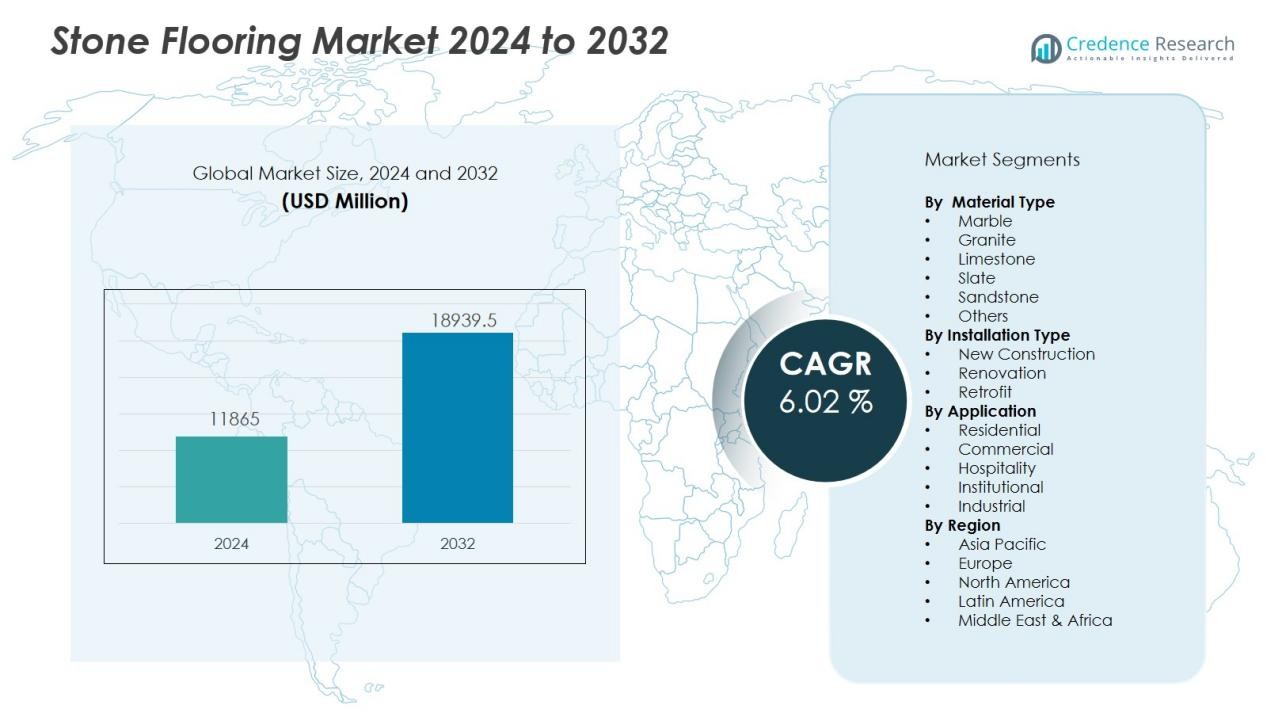
The Stone flooring market size was valued at USD 11865 million in 2024 and is anticipated to reach USD 18939.5 million by 2032, at a CAGR of 6.02 % during the forecast period (2024-2032).
| REPORT ATTRIBUTE | DETAILS |
|---|---|
| Historical Period | 2020-2024 |
| Base Year | 2024 |
| Forecast Period | 2025-2032 |
| Stone Flooring Market Size 2024 | USD 11865 Million |
| Stone Flooring Market, CAGR | 6.02% |
| Stone Flooring Market Size 2032 | USD 18939.5 Million |
Key drivers fueling market expansion include rising investments in luxury residential projects, ongoing urbanization, and growing awareness of the durability and minimal maintenance needs of natural stone flooring. Architects and developers favor stone for high-traffic areas and premium spaces, given its resistance to wear, heat, and moisture. Advances in quarrying, cutting, and surface finishing technologies have further improved product quality and design flexibility, making stone flooring accessible across diverse applications and price points.
Regionally, Asia-Pacific dominates the stone flooring market, driven by rapid infrastructure development, a surge in real estate investments, and expanding middle-class populations in countries such as China and India. Europe and North America also maintain significant market shares, fueled by stable construction activity and strong demand for renovation projects. The Middle East registers robust growth, supported by large-scale commercial and hospitality developments.
Market Insights:
- The Stone Flooring Market reached USD 11,865 million in 2024 and is projected to grow to USD 18,939.5 million by 2032, driven by a CAGR of 6.02% over the forecast period.
- Rising investments in luxury residential and commercial projects, along with growing urbanization, continue to fuel demand for premium stone flooring.
- Natural stone remains preferred for its durability, resistance to wear, heat, and moisture, supporting its use in high-traffic and premium spaces.
- Advances in quarrying, cutting, and surface finishing technologies expand design flexibility, enabling manufacturers to offer a broad range of colors and finishes.
- Asia-Pacific leads the market with 38% share, driven by infrastructure growth and strong real estate activity in China and India, supported by a well-established supply chain.
- Europe holds a 27% share, supported by established construction practices, heritage building restoration, and strong demand for bespoke interior solutions in countries such as Italy, Spain, and France
- North America represents 22% of the market, driven by renovation culture, digital design trends, and increased adoption of sustainable and ethically sourced flooring solutions.
Market Drivers:
Surge in Luxury Construction Projects Spurs Market Growth:
The stone flooring market benefits from the global increase in luxury residential and commercial construction. Developers and homeowners prefer natural stone for its premium look, enhancing property values and delivering superior durability. The trend toward high-end design in hotels, retail, and office spaces continues to drive adoption. It supports long-term investment in quality flooring solutions, which appeals to discerning buyers and project owners.
- For instance, the Waldorf Astoria Beverly Hills utilized extensive Portuguese limestone cladding for its exterior and incorporated marble, granite, travertine, and onyx throughout its interior spaces in its $200 million renovation project.
Rising Demand for Sustainable and Low-Maintenance Materials:
Stone flooring appeals to consumers and builders prioritizing sustainability and low maintenance. It offers an environmentally responsible choice due to its natural origin, long lifespan, and ability to reduce replacement needs. Property managers and homeowners value stone’s resistance to stains, scratches, and moisture, minimizing upkeep. The market responds to a growing preference for eco-friendly products that deliver functional and aesthetic advantages.
- For instance, natural stone flooring materials like granite, marble, and slate can last up to 100 years according to the National Association of Home Builders, with proper maintenance extending their lifespan to centuries.
Technological Advancements Enhance Product Versatility:
Advances in extraction, cutting, and surface treatment technologies improve the quality and versatility of stone flooring. Manufacturers can now offer a broader range of colors, textures, and finishes, meeting diverse architectural and interior design requirements. It enables the use of stone in both modern and traditional settings, supporting the market’s adaptability to evolving trends. These innovations lower waste and improve cost efficiency throughout the value chain.
Urbanization and Real Estate Expansion in Emerging Markets:
Rapid urbanization and robust real estate growth in emerging economies play a significant role in driving the stone flooring market. Population growth, rising incomes, and government investment in infrastructure lead to more residential and commercial projects. It strengthens demand for premium, durable building materials, positioning stone flooring as a preferred option for new developments. The market benefits from expanding middle-class aspirations for higher-quality living environments.
Market Trends:
Emphasis on Customization and Aesthetic Innovation Drives Product Differentiation:
The stone flooring market is experiencing a shift toward customization and unique design solutions. Architects, designers, and homeowners increasingly seek personalized flooring options that showcase rare patterns, customized finishes, and tailored color palettes. Manufacturers are introducing advanced digital printing and cutting techniques to achieve intricate designs and layouts, meeting diverse aesthetic preferences. It allows for the creation of seamless transitions, inlays, and feature zones within both residential and commercial spaces. The popularity of large-format tiles and mixed-material installations continues to grow, reflecting consumer demand for contemporary yet distinctive interiors. The market supports these trends by offering a wider selection of textures, sizes, and bespoke design services.
- For instance, Daltile now incorporates over 99% recycled or reclaimed materials across its tile collections and recovers more than 300 million pounds of recycled material annually in North America, emphasizing both environmental responsibility and continued innovation in design flexibility.
Sustainable Sourcing and Green Certifications Influence Purchasing Decisions:
Sustainability remains a key trend in the stone flooring market, with buyers placing greater emphasis on ethically sourced materials and environmentally responsible production practices. Companies are investing in transparent supply chains, ensuring compliance with international environmental standards and certifications such as LEED and GREENGUARD. It responds to rising consumer awareness and regulatory pressures surrounding the environmental impact of construction materials. Manufacturers prioritize water-efficient processing, energy-saving machinery, and recycling initiatives throughout production. The trend toward green building design has boosted demand for natural stone products that align with eco-friendly values, supporting broader adoption in both new builds and renovations. Sustainability-driven product innovation continues to shape the competitive landscape.
- For instance, Polycor’s Massangis limestone quarry in France became the first site outside North America to be certified under the ANSI/NSI 373 sustainability standard, marking Polycor’s 12th such certification and strengthening global green sourcing credibility.
Market Challenges Analysis:
High Material and Installation Costs Limit Wider Adoption:
The stone flooring market faces persistent challenges from the high cost of natural materials and skilled installation. Stone products require specialized handling, cutting, and transportation, which elevate project expenses compared to alternative flooring options. Many residential and small commercial buyers reconsider their choice due to budget constraints, turning to more affordable substitutes such as ceramic, vinyl, or laminate. It places pressure on manufacturers and suppliers to streamline operations and offer competitive pricing. The premium image of stone remains strong, but cost-sensitive segments continue to limit broader market penetration.
Environmental Regulations and Resource Scarcity Affect Supply Chains:
Stringent environmental regulations and declining availability of high-quality natural stone impact the stone flooring market’s supply stability. Quarrying operations must comply with evolving legal frameworks and environmental standards, raising operational complexity and costs. Resource depletion in traditional quarrying regions leads to increased sourcing challenges and longer lead times. It forces companies to diversify suppliers or invest in sustainable extraction methods, which may not always be feasible for smaller players. Regulatory uncertainty and raw material shortages can hinder consistent product availability and delay large-scale construction projects.
Market Opportunities:
Expansion into Emerging Markets Unlocks New Growth Avenues:
The stone flooring market has significant opportunities to expand in rapidly developing regions such as Asia-Pacific, the Middle East, and Africa. Rising urbanization, infrastructure investments, and an expanding middle class drive demand for high-quality, durable flooring in residential and commercial projects. Governments in these regions invest heavily in real estate and public works, creating robust opportunities for market entrants and established suppliers alike. It enables companies to introduce diverse stone varieties and design options tailored to local tastes. Establishing efficient distribution channels and strategic partnerships will further support market penetration. The market’s long-term prospects remain strong in geographies undergoing accelerated modernization.
Product Innovation and Value-Added Services Enhance Market Appeal:
Ongoing innovation in product design, finishes, and installation methods creates fresh opportunities for differentiation in the stone flooring market. Companies can leverage advances in digital fabrication, modular systems, and sustainable production techniques to deliver premium value propositions. It allows suppliers to address evolving consumer preferences for eco-friendly, customized, and low-maintenance solutions. Expanding service offerings, such as design consultation and after-sales support, can strengthen customer loyalty and boost brand reputation. The ability to deliver both functional and aesthetic benefits positions the market for continued growth among discerning buyers seeking long-term value.
Market Segmentation Analysis:
By Material Type:
The stone flooring market features a diverse range of materials, with marble, granite, limestone, and slate leading segment growth. Marble and granite hold the largest shares due to their visual appeal, strength, and suitability for high-traffic areas. Limestone attracts buyers seeking softer aesthetics, while slate appeals to consumers prioritizing durability and unique textures. Each material addresses different design preferences and functional requirements, supporting robust competition within the market.
By Application:
Applications span both residential and commercial sectors, with commercial spaces such as hotels, offices, and retail outlets accounting for a significant portion of total demand. The market sees consistent interest from luxury residential projects, where natural stone elevates property value and delivers long-lasting performance. It remains a preferred choice in high-traffic public spaces, healthcare, and institutional buildings. Each application segment emphasizes durability, ease of maintenance, and timeless design.
- For instance, the University Arms Hotel in Cambridge utilized 500 tonnes of Clipsham limestone for its £80 million renovation project, with each limestone block weighing between 5-10 tonnes to create load-bearing carved decorative columns measuring 3.5 meters high and 800mm in diameter.
By Installation Type:
Installation types include new construction and renovation or retrofit projects. New installations dominate in regions experiencing rapid urbanization and real estate growth, particularly in Asia-Pacific and the Middle East. Renovation and restoration activities in Europe and North America also contribute significantly to demand, focusing on modernizing existing spaces and preserving heritage properties. It demonstrates strong alignment with global construction and remodeling trends.
- For instance, China State Construction Engineering Corporation (CSCEC) developed the first 5G intelligent construction site in China, combining AI, BIM, blockchain, and cloud computing technologies with 10 innovative applications for comprehensive building management.
Segmentations:
By Material Type:
- Marble
- Granite
- Limestone
- Slate
- Sandstone
- Others
By Application:
- Residential
- Commercial
- Hospitality
- Institutional
- Industrial
By Installation Type:
- New Construction
- Renovation
- Retrofit
By Region:
- North America
- U.S.
- Canada
- Mexico
- Europe
- Germany
- France
- U.K.
- Italy
- Spain
- Rest of Europe
- Asia Pacific
- China
- Japan
- India
- South Korea
- South-east Asia
- Rest of Asia Pacific
- Latin America
- Brazil
- Argentina
- Rest of Latin America
- Middle East & Africa
- GCC Countries
- South Africa
- Rest of the Middle East and Africa
Regional Analysis:
Asia-Pacific :
Asia-Pacific accounts for 38% of the global stone flooring market, driven by large-scale infrastructure projects and a booming real estate sector. China and India serve as key contributors due to their expanding urban populations, rising income levels, and strong government investments in housing and commercial developments. The region’s robust demand for premium, durable materials supports steady market growth. It benefits from local stone resources and a well-established supply chain network. Developers and homeowners in Asia-Pacific value the aesthetic and functional qualities of stone flooring, making it a preferred choice in both luxury and mainstream projects. Regional players continue to expand their offerings to meet evolving consumer tastes.
Europe :
Europe holds a 27% share of the stone flooring market, anchored by established construction practices, heritage building restoration, and high demand for bespoke interior solutions. Countries such as Italy, Spain, and France leverage long-standing traditions in natural stone quarrying and craftsmanship, reinforcing the region’s reputation for quality. The renovation of historic structures and a sustained preference for natural materials contribute to consistent demand. It also reflects ongoing trends in sustainable design and premium living spaces. European consumers and architects value environmentally certified products and innovative finishes. Local producers focus on niche markets and custom applications to retain their competitive edge.
North America:
North America represents 22% of the stone flooring market, fueled by steady construction activity and a strong renovation culture in the United States and Canada. The region embraces advanced installation methods, digital design tools, and an expanding palette of stone varieties. It benefits from a diverse customer base seeking both traditional and contemporary aesthetics. Urban revitalization projects and luxury real estate investments drive higher adoption rates in metropolitan areas. Sustainability remains a growing priority, encouraging suppliers to offer ethically sourced and energy-efficient solutions. The competitive landscape features both domestic and international suppliers responding to shifting consumer expectations.
Key Player Analysis:
- Daltile
- Shaw Industries
- Ceramiche Refin
- Armstrong World Industries
- Rocca Sanitario
- Porcelanosa
- Stone Source
- Mohawk Industries
- American Olean
- Conglomerate Stone
- Interface Inc
Competitive Analysis:
The stone flooring market features a competitive landscape shaped by leading companies such as Daltile, Shaw Industries, Ceramiche Refin, Armstrong World Industries, Rocca Sanitario, Porcelanosa, and Stone Source. These players focus on product innovation, diverse material offerings, and high-quality surface finishes to strengthen their market presence. The market rewards companies that invest in digital design technologies and sustainable sourcing. Strategic partnerships with architects, developers, and construction firms help secure large-scale contracts. It remains dynamic, with established brands continuously expanding their distribution networks and service capabilities. Local and regional manufacturers compete by targeting niche segments, offering customization, and responding quickly to design trends. Continuous improvement in logistics, customer service, and after-sales support plays a crucial role in maintaining long-term customer relationships.
Recent Developments:
- In December 2024, Armstrong World Industries acquired A. Zahner Company, enhancing its capabilities in exterior architectural metal solutions.
- In July 2025, Roca Sanitario acquired a majority stake in Antonio Lupi through its subsidiary Laufen, moving into the luxury bathroom design segment.
- In February 2025, Porcelanosa launched new ceramic collections-London, Taranto, and Verona-emphasizing natural wood and stone aesthetics at its 31st International Exhibition.
Market Concentration & Characteristics:
The stone flooring market exhibits moderate concentration, with several major players holding significant market shares alongside a diverse range of regional and local manufacturers. It features high entry barriers due to the capital-intensive nature of quarrying, specialized processing requirements, and the need for established distribution channels. Product differentiation centers on material variety, surface finishes, and customization capabilities, enabling suppliers to target specific consumer preferences and project requirements. The market values long-term durability, aesthetic appeal, and sustainable sourcing practices, which influence purchasing decisions across both residential and commercial applications. Strong relationships with architects, designers, and contractors help leading firms maintain their competitive edge and expand their project portfolios.
Report Coverage:
The research report offers an in-depth analysis based on Material Type, Application, Installation Type and Region. It details leading Market players, providing an overview of their business, product offerings, investments, revenue streams, and key applications. Additionally, the report includes insights into the competitive environment, SWOT analysis, current Market trends, as well as the primary drivers and constraints. Furthermore, it discusses various factors that have driven Market expansion in recent years. The report also explores Market dynamics, regulatory scenarios, and technological advancements that are shaping the industry. It assesses the impact of external factors and global economic changes on Market growth. Lastly, it provides strategic recommendations for new entrants and established companies to navigate the complexities of the Market.
Future Outlook:
- Demand for premium natural stone flooring will increase in both residential and commercial sectors, driven by evolving design trends and rising consumer expectations.
- Innovation in cutting, finishing, and surface treatment technologies will improve product durability and expand design possibilities.
- Sustainable sourcing and green certification requirements will shape procurement practices and influence purchasing decisions.
- Emerging markets in Asia-Pacific, the Middle East, and Africa will create new growth avenues for suppliers and distributors.
- The renovation and restoration segment will maintain stable demand, especially in Europe and North America, as property owners invest in long-term value.
- Customization options and bespoke finishes will become key differentiators, attracting architects, designers, and high-end consumers.
- Integration of digital tools and modular installation systems will streamline project timelines and reduce labor costs.
- Strategic partnerships with real estate developers and contractors will help manufacturers secure large-scale projects and strengthen market positioning.
- Heightened awareness of indoor air quality and health benefits will drive preference for natural stone over synthetic flooring materials.
- Continued volatility in raw material supply and regulatory changes will require agile supply chain management and proactive risk mitigation strategies.

Request a Free Sample
Fill in your details and we'll send you a free sample report.
- Sample data tables & charts
- Research methodology
Market Dynamics
Surge in Luxury Construction Projects
Global investments in luxury residential and commercial developments are increasing demand for premium stone flooring, as developers and homeowners seek materials that enhance property value and deliver superior durability and aesthetics.
Urbanization and Real Estate Expansion in Emerging Markets
Rapid urbanization and robust real estate growth in regions like Asia-Pacific and the Middle East are fueling demand for high-quality, durable flooring solutions, positioning stone flooring as a preferred choice for new infrastructure and housing projects.
Technological Advancements in Quarrying and Finishing
Innovations in extraction, cutting, and surface finishing technologies have improved the quality, design flexibility, and cost efficiency of stone flooring, making it accessible to a broader range of applications and price points.
Rising Demand for Sustainable and Low-Maintenance Materials
Stone flooring appeals to environmentally conscious consumers and builders due to its natural origin, long lifespan, and minimal maintenance requirements, aligning with the growing preference for sustainable and eco-friendly building materials.
Emphasis on Customization and Aesthetic Innovation
Architects, designers, and homeowners increasingly seek unique, customized stone flooring options, driving manufacturers to offer a wider variety of colors, finishes, and digital design solutions to meet diverse aesthetic and functional requirements.
Need a Custom Version of This Report?
Tailor the scope, geography, or segments to your exact requirements.
- Custom geography or segment scope
- Direct access to our analyst team
Frequently Asked Questions
What is the current market size for the Stone Flooring Market, and what is its projected size in 2032?
At what Compound Annual Growth Rate is the Stone Flooring Market projected to grow between 2024 and 2032?
Which Stone Flooring Market segment held the largest share in 2024?
What are the primary factors fueling the growth of the Stone Flooring Market?
Who are the leading companies in the Stone Flooring Market?
Which region commanded the largest share of the Stone Flooring Market in 2024?
Table of Content
Chapter 1 Market Segmentation
- 1.1 Segmentation Framework
- 1.1.1 Product and Service Classification
- 1.1.2 Application and End-Use Classification
- 1.1.3 Technology and Solution Classification
- 1.1.4 Customer and Distribution Channel Classification
- 1.1.5 Geographic Segmentation
- 1.1.6 Market Segment Definitions and Boundaries
- 1.2 By Application
- 1.2.1 Residential
- 1.2.2 Commercial
- 1.2.3 Hospitality
- 1.2.4 Institutional
- 1.2.5 Industrial
- 1.3 By Material Type
- 1.3.1 Marble
- 1.3.2 Granite
- 1.3.3 Limestone
- 1.3.4 Slate
- 1.3.5 Sandstone
- 1.3.6 Others
- 1.4 By Installation Type
- 1.4.1 New Construction
- 1.4.2 Renovation
- 1.4.3 Retrofit
Chapter 2 Introduction
- 2.1 Report Objectives and Scope
- 2.2 Product Definition and Industry Terminology
- 2.3 Market Inclusions and Exclusions
- 2.4 Research Process
- 2.4.1 Primary Research and Expert Interviews
- 2.4.2 Secondary Research and Source Review
- 2.4.3 Top-Down and Bottom-Up Estimation
- 2.4.4 Data Triangulation and Verification
- 2.5 Market Size Measurement Basis
- 2.5.1 2024: USD 11,865 million → 2032: USD 18,939.5 million
- 2.6 Historical and Forecast Reference Periods
- 2.6.1 Base Year: 2024
- 2.6.2 Forecast Period: 2024-2032
- 2.7 Research Assumptions and Limitations
Chapter 3 Executive Summary
- 3.1 Market Snapshot and Key Findings
- 3.2 Base-Year Market Size, 2024
- 3.3 Forecast Market Size, 2032
- 3.4 Revenue and Volume Growth Outlook
- 3.5 Key Demand and Supply Indicators
- 3.6 Leading Market Segments
- 3.7 Fastest-Growing Market Opportunities
- 3.8 Regional Performance Highlights
- 3.9 Technology and Industry Transformation
- 3.10 Competitive Landscape Summary
- 3.11 Analyst View and Strategic Implications
Chapter 4 Global Stone Flooring Market Trends and Developments
- 4.1 Historical Industry Development
- 4.2 Recent Market Trends and Developments
- 4.3 Demand and Customer Behavior Trends
- 4.4 Technology and Product Innovation
- 4.5 Artificial Intelligence, Automation and Digitalization
- 4.6 Local Manufacturing and Supply Chain Realignment
- 4.7 Industry Partnerships, Mergers and Acquisitions
- 4.8 Sustainability and Circular Economy Developments
- 4.9 Government and Private Sector Investment Trends
- 4.10 Emerging Business Models and Commercialization
- 4.11 Industry Developments and Announcements
Chapter 5 Global Stone Flooring Market Production, Supply and Demand Analysis
- 5.1 Demand Trend and Consumption Analysis
- 5.2 Demand Forecast, 2024-2032
- 5.3 Production and Output Trend
- 5.4 Production and Output Forecast, 2024-2032
- 5.5 Installed Capacity and Capacity Utilization
- 5.6 Company-Wise Production Plants and Statistics
- 5.6.1 Installed Production Capacity
- 5.6.2 Actual Production
- 5.6.3 Planned Capacity and Expansion Targets
- 5.7 Supply Chain Structure and Procurement Trends
- 5.8 Supply-Demand Gap and Bottlenecks
- 5.9 Import Dependence and Sourcing Structure
- 5.10 Contract Manufacturing and Outsourcing
- 5.11 Regional Supply and Demand Concentration
Chapter 6 Global Stone Flooring Market Pricing Analysis
- 6.1 Pricing Structure and Measurement
- 6.2 Historical Pricing Trends
- 6.3 Pricing Outlook, 2024-2032
- 6.4 Average Selling Price and Unit Economics
- 6.5 Pricing by Product and Market Segment
- 6.6 Geographic Pricing Differences
- 6.7 Key Input, Energy, Labor and Logistics Costs
- 6.8 Contract Pricing and Purchasing Models
- 6.9 Pricing Sensitivity and Competitive Positioning
- 6.10 Price, Margin and Profitability Implications
Chapter 7 Global Stone Flooring Market Dynamics
- 7.1 Market Growth Drivers
- 7.1.1 Demand-Side Drivers
- 7.1.2 Technology and Innovation Drivers
- 7.1.3 Infrastructure and Investment Drivers
- 7.1.4 Regulatory and Policy Drivers
- 7.2 Market Restraints
- 7.2.1 Cost and Affordability Constraints
- 7.2.2 Technology and Adoption Barriers
- 7.2.3 Supply Chain and Operational Constraints
- 7.3 Market Challenges
- 7.3.1 Competitive Pressure and Margin Erosion
- 7.3.2 Skills, Infrastructure and Implementation Gaps
- 7.4 Emerging Market Opportunities
- 7.5 Market Dynamics Impact and Time-Horizon Assessment
Chapter 8 Global Stone Flooring Value Chain Analysis
- 8.1 Industry Value Chain Overview
- 8.2 Upstream Suppliers and Critical Inputs
- 8.3 Technology and Component Providers
- 8.4 Manufacturing or Service Delivery
- 8.5 Distribution, Channel Partners and Integrators
- 8.6 Downstream Applications and End Users
- 8.7 Value Addition and Profit Pools
- 8.8 Vertical Integration and Outsourcing
- 8.9 Supplier Concentration and Risk
- 8.10 Supply Chain Localization and Resilience
Chapter 9 Global Stone Flooring Market Regulations and Policies
- 9.1 Relevant Laws, Standards and Compliance Frameworks
- 9.2 Product, Service, Safety and Quality Requirements
- 9.3 Government Policies, Incentives and Subsidies
- 9.4 Imports, Exports and Trade Barriers
- 9.5 Public Procurement and Local Content Requirements
- 9.6 Environmental and Sustainability Compliance
- 9.7 Upcoming Policy Changes and Market Implications
Chapter 10 Global Stone Flooring Market Hotspots and Opportunities
- 10.1 Market Opportunity Mapping and Growth Hotspots
- 10.2 High-Growth Applications and Customer Groups
- 10.3 Underserved Markets and White-Space Opportunities
- 10.4 Emerging Technology and Product Opportunities
- 10.5 New Capacity and Investment Hotspots
- 10.6 Market Entry and Expansion Opportunities
- 10.7 Distribution and Partnership Opportunities
- 10.8 Near-Term and Long-Term Commercial Potential
- 10.9 Opportunity Attractiveness and Execution Risks
Chapter 11 Global Stone Flooring Market Outlook, 2024-2032
- 11.1 Market Size and Analysis
- 11.1.1 Revenue (Market Measurement: 2024: USD 11,865 million → 2032: USD 18,939.5 million)
- 11.1.2 Market Volume and Quantity Sold
- 11.1.3 Historical Market Size
- 11.1.4 Base-Year Market Size, 2024
- 11.2 Market Forecast, 2024-2032
- 11.2.1 Revenue Forecast to 2032
- 11.2.2 Volume Forecast to 2032
- 11.2.3 CAGR and Year-on-Year Growth
- 11.2.4 Incremental Revenue Opportunity
- 11.3 Forecast Assumptions and Scenario Analysis
- 11.3.1 Base-Case Forecast
- 11.3.2 Optimistic and Conservative Scenarios
- 11.3.3 Technology, Pricing and Policy Sensitivities
- 11.4 Market Attractiveness and Growth Outlook
Chapter 12 Global Stone Flooring Market Segmentation and Outlook
- 12.1 Segmentation Summary and Market Shares, 2024
- 12.2 Largest and Fastest-Growing Segments
- 12.3 By Application - Market Size and Forecast, 2024-2032
- 12.3.1 Segment Definition and Scope
- 12.3.2 Historical Market Size
- 12.3.3 Revenue Forecast, 2024-2032
- 12.3.4 Volume Forecast, 2024-2032
- 12.3.5 Base-Year Market Share, 2024
- 12.3.6 Segment CAGR and Growth Drivers
- 12.3.7 Subsegment Market Size and Forecast
- 12.3.7.1 Residential
- 12.3.7.2 Commercial
- 12.3.7.3 Hospitality
- 12.3.7.4 Institutional
- 12.3.7.5 Industrial
- 12.3.8 Subsegment Pricing and Adoption Trends
- 12.3.9 Leading Suppliers and Competition
- 12.3.10 Regional Demand and Opportunities
- 12.4 By Material Type - Market Size and Forecast, 2024-2032
- 12.4.1 Segment Definition and Scope
- 12.4.2 Historical Market Size
- 12.4.3 Revenue Forecast, 2024-2032
- 12.4.4 Volume Forecast, 2024-2032
- 12.4.5 Base-Year Market Share, 2024
- 12.4.6 Segment CAGR and Growth Drivers
- 12.4.7 Subsegment Market Size and Forecast
- 12.4.7.1 Marble
- 12.4.7.2 Granite
- 12.4.7.3 Limestone
- 12.4.7.4 Slate
- 12.4.7.5 Sandstone
- 12.4.7.6 Others
- 12.4.8 Subsegment Pricing and Adoption Trends
- 12.4.9 Leading Suppliers and Competition
- 12.4.10 Regional Demand and Opportunities
- 12.5 By Installation Type - Market Size and Forecast, 2024-2032
- 12.5.1 Segment Definition and Scope
- 12.5.2 Historical Market Size
- 12.5.3 Revenue Forecast, 2024-2032
- 12.5.4 Volume Forecast, 2024-2032
- 12.5.5 Base-Year Market Share, 2024
- 12.5.6 Segment CAGR and Growth Drivers
- 12.5.7 Subsegment Market Size and Forecast
- 12.5.7.1 New Construction
- 12.5.7.2 Renovation
- 12.5.7.3 Retrofit
- 12.5.8 Subsegment Pricing and Adoption Trends
- 12.5.9 Leading Suppliers and Competition
- 12.5.10 Regional Demand and Opportunities
- 12.6 Segment Growth Comparison
- 12.7 Segment Attractiveness and Priority Matrix
Chapter 13 Global Stone Flooring End-Use and Application Market Outlook
- 13.1 End-Use Industry and Customer Demand Structure
- 13.2 Leading Applications and Customer Groups
- 13.3 End-Use Market Size, Share and Forecast
- 13.4 Major End-Use Industry Deep Dives
- 13.4.1 Customer Requirements and Use Cases
- 13.4.2 Demand and Replacement Cycles
- 13.4.3 Technical and Regulatory Considerations
- 13.4.4 Purchasing and Procurement Models
- 13.4.5 Leading Vendors and Distribution Channels
- 13.4.6 Forecast and Commercial Opportunities
- 13.5 Emerging Applications and Cross-Segment Demand
- 13.6 End-Use Industry Investment Priorities
Chapter 14 Global Stone Flooring Geographic Market Outlook, 2024-2032
- 14.1 Regional Market Size and Share, 2024
- 14.2 Regional Market Forecast, 2024-2032
- 14.3 Regional Pricing, Production and Demand Differences
- 14.4 North America
- 14.4.1 United States
- 14.4.2 Canada
- 14.4.3 Mexico
- 14.5 Europe
- 14.5.1 Germany
- 14.5.2 France
- 14.5.3 Italy
- 14.5.4 United Kingdom
- 14.5.5 Spain
- 14.5.6 Poland
- 14.5.7 Russia
- 14.5.8 Netherlands
- 14.5.9 Belgium
- 14.5.10 Sweden
- 14.5.11 Denmark
- 14.5.12 Norway
- 14.5.13 Rest of Europe
- 14.6 Asia Pacific
- 14.6.1 China
- 14.6.2 India
- 14.6.3 Japan
- 14.6.4 South Korea
- 14.6.5 Thailand
- 14.6.6 Indonesia
- 14.6.7 Vietnam
- 14.6.8 Malaysia
- 14.6.9 Australia
- 14.6.10 Rest of Asia Pacific
- 14.7 Latin America
- 14.7.1 Brazil
- 14.7.2 Argentina
- 14.7.3 Colombia
- 14.7.4 Chile
- 14.7.5 Rest of Latin America
- 14.8 Middle East
- 14.8.1 Saudi Arabia
- 14.8.2 United Arab Emirates
- 14.8.3 Turkey
- 14.8.4 Israel
- 14.8.5 Iran
- 14.8.6 Rest of the Middle East
- 14.9 Africa
- 14.9.1 South Africa
- 14.9.2 Egypt
- 14.9.3 Nigeria
- 14.9.4 Morocco
- 14.9.5 Rest of Africa
- 14.10 Regional Investment, Policy and Supply Chain Differences
- 14.11 Regional Competitive Landscape
- 14.12 Geographic Growth Hotspots
Chapter 15 Global Stone Flooring Technology, Innovation and Sustainability Outlook
- 15.1 Technology Landscape and Maturity
- 15.2 Product, Process and Service Innovation
- 15.3 AI, Automation and Digital Tools in the Industry
- 15.4 Technology Adoption and Performance Benchmarking
- 15.5 Innovation Pipeline and R&D Investment
- 15.6 Patent and Intellectual Property Trends
- 15.7 Energy Efficiency and Resource Management
- 15.8 Sustainability, Recycling and Circularity
- 15.9 Technology Roadmap, 2024-2032
- 15.10 Risks of Obsolescence and Technology Substitution
Chapter 16 Global Stone Flooring Market Key Strategic Imperatives
- 16.1 Growth and Market Entry Priorities
- 16.2 High-Return Products and Segments
- 16.3 Pricing, Profitability and Cost Optimization
- 16.4 Technology Investment and Product Differentiation
- 16.5 Supply Chain Localization and Resilience
- 16.6 Distribution and Customer Acquisition
- 16.7 Partnership, Acquisition and Capacity Strategy
- 16.8 Regional Expansion Priorities
- 16.9 Short-, Medium- and Long-Term Actions
Chapter 17 Competition Outlook
- 17.1 Industry Competition Characteristics
- 17.2 Market Structure and Concentration
- 17.3 Market Share and Competitive Positioning, 2024
- 17.4 Company-Wise Revenue and Product Benchmarking
- 17.5 Production and Service Capacity Benchmarking
- 17.6 Technology, Pricing and Differentiation
- 17.7 Regional Footprint and Distribution Strength
- 17.8 Mergers, Acquisitions and Strategic Alliances
- 17.9 New Entrants and Competitive Threats
- 17.10 Porter's Five Forces and Industry Attractiveness
- 17.11 Competitive Outlook, 2024-2032
Chapter 18 Company Profiles
- 18.1 Company Coverage and Selection Criteria
- 18.2 Daltile
- 18.2.1 Business Description
- 18.2.2 Company Ownership and Geographic Presence
- 18.2.3 Product and Service Portfolio
- 18.2.4 Manufacturing and Operating Footprint
- 18.2.5 Production Capacity and Expansion Plans
- 18.2.6 Financial Performance and Investment
- 18.2.7 Market Share and Competitive Position
- 18.2.8 Technology and Innovation Capabilities
- 18.2.9 Strategic Alliances or Partnerships
- 18.2.10 Recent Developments
- 18.2.11 Growth Strategy and Outlook
- 18.3 Shaw Industries
- 18.4 Ceramiche Refin
- 18.5 Armstrong World Industries
- 18.6 Roca Sanitario
- 18.7 Porcelanosa
- 18.8 Stone Source
- 18.9 Mohawk Industries
- 18.10 American Olean
- 18.11 Interface Inc
- 18.12 Other Relevant Market Participants
Note: Every listed company is profiled on the structure shown under the first company. The company list is preliminary and may change based on research findings, market developments, data availability and client requirements.
Chapter 19 Disclaimer
- 19.1 Research and Forecast Disclaimer
- 19.2 Data Source and Estimation Limitations
Note: The depth of individual sections depends on data availability for this market. Volume, capacity, trade and other unit-based metrics are included where applicable.