
Market Overview
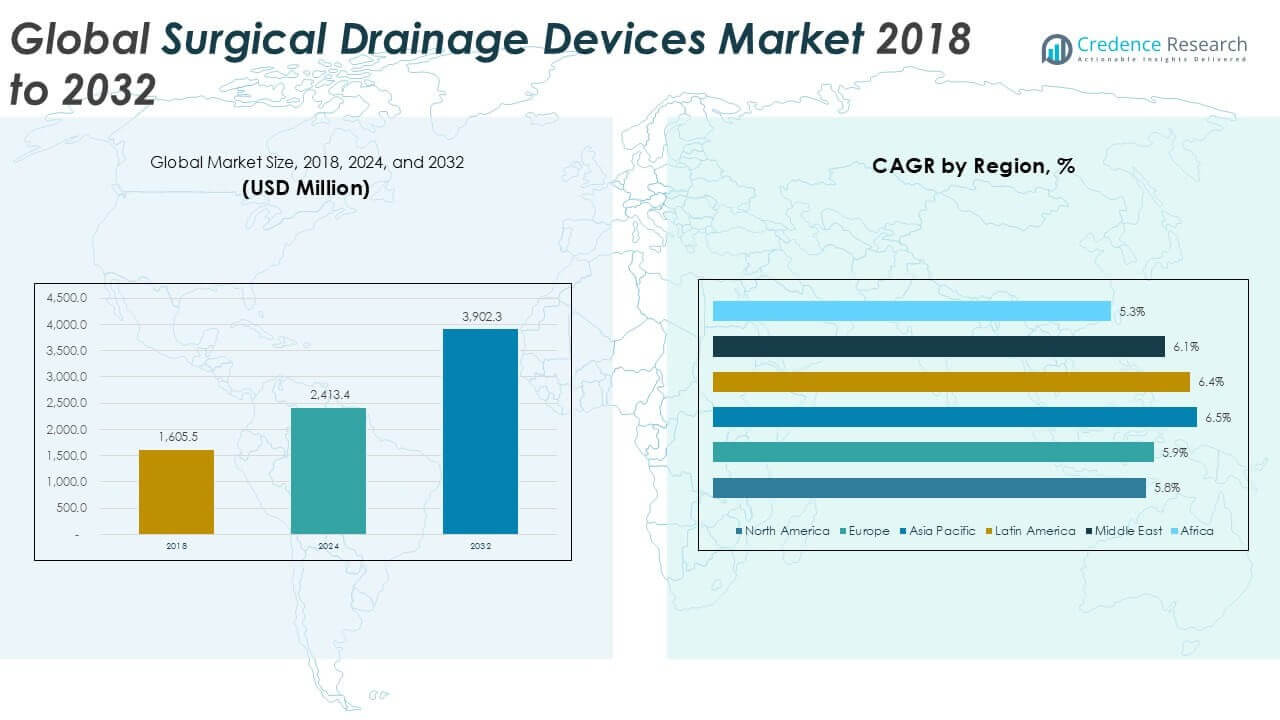
The Global Surgical Drainage Devices Market is projected to grow from USD 2,413.4 million in 2024 to an estimated USD 3,902.3 million by 2032, with a compound annual growth rate (CAGR) of 6.16% from 2025 to 2032.
| REPORT ATTRIBUTE | DETAILS |
|---|---|
| Historical Period | 2019-2022 |
| Base Year | 2023 |
| Forecast Period | 2024-2032 |
| Surgical Drainage Devices Market Size 2024 | USD 2,413.4 million |
| Surgical Drainage Devices Market, CAGR | 6.16% |
| Surgical Drainage Devices Market Size 2032 | USD 3,902.3 million |
Market growth is primarily driven by the rising incidence of chronic diseases, an increasing number of surgical procedures, and the growing elderly population prone to post-operative complications. Additionally, advancements in minimally invasive surgeries and the development of innovative drainage systems with enhanced efficiency are key trends supporting market expansion. The growing preference for closed drainage systems due to their reduced infection risks and improved patient outcomes further boosts market demand. However, complications associated with drainage devices and strict regulatory requirements may slightly restrain market growth.
Geographically, North America holds a significant share of the global market, driven by advanced healthcare infrastructure, high surgical volumes, and the strong presence of leading medical device manufacturers. Europe follows closely, supported by increasing healthcare investments and rising awareness of surgical site management. The Asia Pacific region is expected to witness the fastest growth during the forecast period due to expanding healthcare facilities, rising medical tourism, and increasing healthcare expenditure. Key players in the market include B. Braun Melsungen AG, Cardinal Health, ConvaTec Inc., Medtronic plc, and Redax S.p.A.
Market Insights
- The Global Surgical Drainage Devices Market is projected to grow from USD 2,413.4 million in 2024 to USD 3,902.3 million by 2032, at a CAGR of 6.16%.
- Rising surgical volumes and increasing incidence of chronic diseases significantly drive demand for surgical drainage devices worldwide.
- Growing preference for minimally invasive surgeries and advanced closed drainage systems supports market growth.
- Technological advancements, including smart drainage systems and biocompatible materials, further strengthen market expansion.
- Stringent regulatory approvals and complications such as infection risks and device malfunction challenge market penetration.
- North America holds a major market share due to advanced healthcare infrastructure, while Asia Pacific is the fastest-growing region.
- Emerging markets in Latin America, the Middle East, and Africa present growth opportunities driven by improving surgical access and healthcare investments.
Market Drivers
Increasing Number of Surgical Procedures Boosting Demand for Drainage Devices
The Global Surgical Drainage Devices Market is witnessing strong growth due to the rising number of surgical procedures worldwide. The growing prevalence of chronic diseases such as cancer, cardiovascular disorders, and orthopedic conditions is driving the need for both major and minor surgeries. Hospitals and surgical centers are experiencing higher patient inflow, which increases the demand for efficient drainage solutions. Surgical drainage devices help manage post-operative fluids and prevent complications, making them essential in various surgical settings. The increasing availability of advanced surgical techniques encourages patients to opt for timely interventions. The market continues to benefit from the critical role these devices play in ensuring faster recovery and better post-surgical care.
- For instance, according to the American Hospital Association, over 21 million surgical procedures were performed in U.S. hospitals in 2024, with more than 4 million drainage devices supplied to meet post-operative care requirements.
Technological Advancements Enhancing Device Efficiency and Patient Safety
The Global Surgical Drainage Devices Market is supported by continuous technological improvements that focus on safety, precision, and ease of use. Manufacturers are developing smart drainage systems with automated monitoring to reduce manual errors. The introduction of minimally invasive surgeries requires compact and highly efficient drainage devices that can support smaller incisions and faster recovery. Innovations in biocompatible materials improve patient comfort and reduce the risk of adverse reactions. New closed drainage systems offer better infection control and minimize exposure to external contaminants. These technological advancements are helping healthcare providers deliver improved patient outcomes.
- For instance, in 2024, Medtronic and other leading manufacturers launched 35 new smart surgical drainage device models globally, featuring automated fluid monitoring and advanced biocompatible materials for enhanced patient safety.
Rising Geriatric Population Increasing Post-Operative Care Needs
The Global Surgical Drainage Devices Market is expanding due to the growing elderly population, which presents a higher risk of surgical interventions and post-operative complications. Older patients often require prolonged drainage and close monitoring to prevent fluid retention and infections. Healthcare providers rely on advanced drainage systems to meet the complex needs of this age group. The aging demographic increases the overall surgical burden, creating steady demand for efficient drainage devices. It supports market growth by addressing the unique recovery challenges faced by geriatric patients. The market is aligning product development to offer solutions that meet these specific healthcare requirements.
Growing Focus on Infection Prevention Driving Preference for Closed Systems
The Global Surgical Drainage Devices Market is driven by the increasing focus on infection prevention and hospital-acquired condition reduction. Healthcare facilities are adopting closed drainage systems that limit the exposure of surgical sites to external pathogens. These systems provide better fluid containment and are easier to manage in clinical settings. Rising awareness among healthcare providers about the benefits of closed systems is encouraging their widespread adoption. It helps reduce the incidence of surgical site infections and supports safer post-operative care. The market is seeing strong growth in demand for products that offer enhanced protection and improved safety standards.
Market Trends
Increasing Adoption of Minimally Invasive Surgeries Supporting Market Growth
The Global Surgical Drainage Devices Market is gaining momentum due to the rising adoption of minimally invasive surgeries. These procedures require advanced drainage solutions that fit smaller surgical sites and promote faster healing. Minimally invasive techniques reduce hospital stays and post-operative complications, which increases the demand for compact, efficient drainage systems. The shift towards these surgical methods is reshaping product development strategies across the industry. It encourages manufacturers to introduce user-friendly and less invasive drainage devices that offer precision and reliability. The market is responding to the growing preference for procedures that provide quicker recovery and reduced patient discomfort.
- For instance, in 2024, more than 7 million minimally invasive surgeries were performed in the United States, with over 4 million surgical drainage devices supplied specifically for these procedures by leading medical device companies.
Strong Shift Toward Disposable and Single-Use Surgical Drainage Devices
The Global Surgical Drainage Devices Market is moving toward disposable and single-use devices that offer enhanced safety and convenience. Healthcare providers are choosing these products to limit cross-contamination and improve infection control measures. Single-use drainage devices require less maintenance and eliminate the need for sterilization, which helps streamline surgical workflows. Hospitals are showing strong interest in these solutions to maintain high hygiene standards. It supports market expansion by meeting the increasing demand for products that simplify post-operative care. The trend toward disposable systems is reshaping procurement strategies and driving innovation in material selection.
- For instance, in 2023, a government healthcare survey in Germany reported that public hospitals procured 1.2 million single-use surgical drainage devices for use in general and specialty surgical departments
Rising Preference for Portable and Patient-Friendly Drainage Solutions
The Global Surgical Drainage Devices Market is experiencing a steady rise in demand for portable and patient-friendly drainage systems. Patients are seeking devices that allow greater mobility during the recovery period. Portable drainage solutions help improve patient comfort and support at-home post-surgical care. Healthcare providers are recommending these systems to reduce the need for prolonged hospital stays. It is helping patients achieve better quality of life while recovering from surgery. The market is focusing on developing lightweight, easy-to-use drainage devices that meet these patient-centric needs.
Integration of Digital Monitoring Technologies Gaining Industry Attention
The Global Surgical Drainage Devices Market is witnessing increased attention towards integrating digital monitoring technologies. Smart drainage systems that track fluid levels and provide real-time data are becoming more popular in advanced healthcare settings. These digital features help clinicians make timely decisions and improve post-surgical management. Hospitals and surgical centers are investing in connected drainage solutions to enhance patient safety and operational efficiency. It is driving manufacturers to develop products that combine traditional drainage functions with modern monitoring capabilities. The market is evolving to support the growing need for precision and digital integration in surgical care.
Market Challenges
Regulatory Hurdles and Product Approval Delays Restricting Market Growth
The Global Surgical Drainage Devices Market faces significant challenges due to strict regulatory frameworks and lengthy product approval processes. Regulatory agencies require extensive clinical testing to ensure safety and efficacy, which extends the time to market for new devices. It places a financial burden on manufacturers who must invest heavily in research and compliance. Frequent changes in approval guidelines across different countries further complicate global product launches. Smaller companies often struggle to meet these regulatory demands, limiting their ability to compete. The slow approval timeline restricts the introduction of innovative drainage solutions and affects market competitiveness.
- For instance, according to a 2024 survey by the U.S. Food and Drug Administration (FDA), the average cost for clinical trials and regulatory submissions for a new surgical drainage device exceeded $2,300,000, and the approval process typically took more than 28 months from initial application to market clearance.
Device-Related Complications and Limited Awareness Impacting Adoption Rates
The Global Surgical Drainage Devices Market is also constrained by complications associated with device usage, such as blockages, accidental dislodgement, and infection risks. These issues raise concerns among healthcare providers and patients about the safety of surgical drainage systems. It creates hesitation in adopting advanced or less familiar products. Limited awareness and training about proper device handling contribute to incorrect usage and higher complication rates. Some healthcare settings, especially in emerging markets, lack adequate resources to ensure proper post-operative drainage management. The presence of these challenges slows market penetration and reduces overall confidence in the use of surgical drainage devices.
Market Opportunities
Expanding Healthcare Infrastructure in Emerging Markets Offering New Growth Avenues
The Global Surgical Drainage Devices Market holds strong growth opportunities in emerging economies where healthcare infrastructure is rapidly improving. Countries in Asia Pacific, Latin America, and the Middle East are increasing investments in hospitals, surgical centers, and advanced medical equipment. It creates new demand for surgical drainage devices across a wider range of healthcare facilities. Rising healthcare awareness and improving access to surgical treatments in these regions support broader market adoption. Governments and private players are working to strengthen healthcare systems, which increases the potential for device manufacturers to expand their reach. The market is well-positioned to benefit from these structural healthcare improvements and rising patient volumes.
Advancements in Smart and Customizable Drainage Devices Creating Future Potential
The Global Surgical Drainage Devices Market is poised to grow through opportunities in smart and customizable drainage solutions. New product designs that incorporate digital monitoring, automated alerts, and personalized settings are gaining interest from healthcare providers. It helps improve surgical outcomes by offering more precise drainage control and real-time patient management. The increasing demand for user-friendly, patient-specific devices presents opportunities for manufacturers to develop differentiated products. Hospitals are seeking drainage systems that can integrate with electronic health records and remote monitoring tools. The market is likely to benefit from rising investments in connected and intelligent surgical care technologies.
Market Segmentation Analysis
By Product
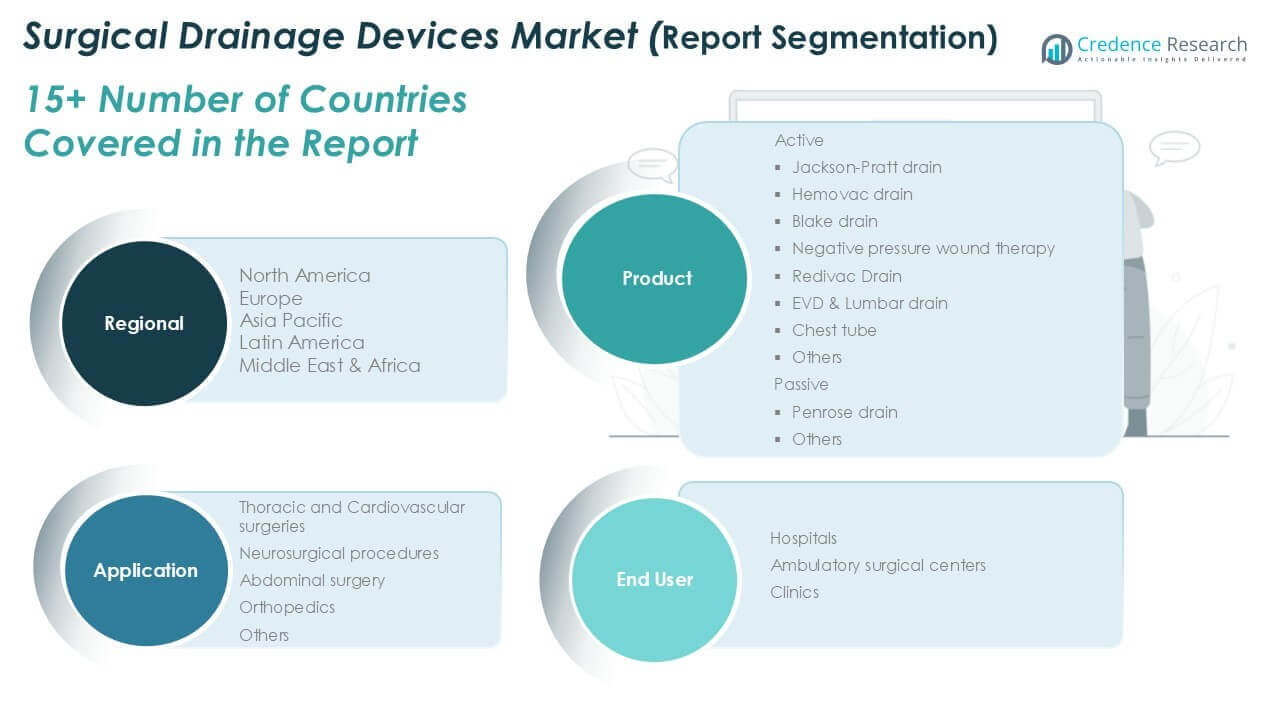
The Surgical Drainage Devices Market divides into active and passive drainage device segments. Active devices dominate the market due to their efficiency in fluid removal and infection control. Key active products include Jackson-Pratt drains, Hemovac drains, Blake drains, negative pressure wound therapy systems, Redivac drains, EVD & lumbar drains, and chest tubes. These devices offer controlled suction and are preferred in complex surgeries for their ability to manage fluids effectively. Passive devices, primarily Penrose drains and others, rely on gravity or capillary action and maintain a smaller market share due to limited control over drainage and higher infection risks. The demand for advanced active drainage devices rises with the increasing volume of surgical procedures and preference for closed drainage systems.
- For instance, according to a 2024 MedTech industry report, hospitals in the United States purchased 1.7 million active surgical drainage devices and 430,000 passive drainage devices for use in surgical procedures.
By Application
The Surgical Drainage Devices Market categorizes applications into thoracic and cardiovascular surgeries, neurosurgical procedures, abdominal surgeries, orthopedics, and others. Thoracic and cardiovascular surgeries represent a significant share due to the frequent need for fluid management in cardiac and lung procedures. Neurosurgical procedures also require specialized drainage devices such as EVD and lumbar drains to manage cerebrospinal fluid. Abdominal and orthopedic surgeries contribute substantially, driven by postoperative care requirements in these fields. The diversity of applications supports the broad adoption of surgical drainage devices across multiple surgical disciplines.
- For instance, a 2024 survey by the American Hospital Association reported that 520,000 surgical drainage devices were used in thoracic and cardiovascular surgeries, 210,000 in neurosurgical procedures, and 390,000 in abdominal surgeries across U.S. hospitals.
By End User
The Surgical Drainage Devices Market segments by end users into hospitals, ambulatory surgical centers, and clinics. Hospitals remain the largest end user segment due to high surgical volumes and the availability of specialized postoperative care units. Ambulatory surgical centers show growing adoption of drainage devices linked to the rise in outpatient surgeries. Clinics account for a smaller portion but contribute to market growth by catering to minor surgical procedures and wound care. The expanding healthcare infrastructure globally boosts demand across all end user segments.
Segments
Based on Product
- Active
- Jackson-Pratt drain
- Hemovac drain
- Blake drain
- Negative pressure wound therapy
- Redivac Drain
- EVD & Lumbar drain
- Chest tube
- Others
- Passive
- Penrose drain
- Others
Based on Application
- Thoracic and Cardiovascular surgeries
- Neurosurgical procedures
- Abdominal surgery
- Orthopedics
- Others
Based on End User
- Hospitals
- Ambulatory surgical centers
- Clinics
Based on Region
- North America
- U.S.
- Canada
- Mexico
- Europe
- UK
- France
- Germany
- Italy
- Spain
- Russia
- Belgium
- Netherlands
- Austria
- Sweden
- Poland
- Denmark
- Switzerland
- Rest of Europe
- Asia Pacific
- China
- Japan
- South Korea
- India
- Australia
- Thailand
- Indonesia
- Vietnam
- Malaysia
- Philippines
- Taiwan
- Rest of Asia Pacific
- Latin America
- Brazil
- Argentina
- Peru
- Chile
- Colombia
- Rest of Latin America
- Middle East
- UAE
- KSA
- Israel
- Turkey
- Iran
- Rest of Middle East
- Africa
- Egypt
- Nigeria
- Algeria
- Morocco
- Rest of Africa
Regional Analysis
North America Surgical Drainage Devices Market
The North America Surgical Drainage Devices Market is projected to grow from USD 415.44 million in 2024 to USD 654.81 million by 2032, registering a CAGR of 5.8% during the forecast period. It accounts for approximately 17.2% of the global market share in 2024. The strong presence of leading medical device manufacturers and high surgical volumes support steady market growth in this region. Hospitals and ambulatory surgical centers across the United States and Canada consistently adopt advanced drainage devices to ensure effective post-surgical care. It benefits from well-established healthcare systems and significant healthcare expenditure. The rising geriatric population in North America further drives the demand for surgical drainage devices.
Europe Surgical Drainage Devices Market
The Europe Surgical Drainage Devices Market is expected to increase from USD 518.81 million in 2024 to USD 824.17 million by 2032, growing at a CAGR of 5.9%. It represents around 21.5% of the global market share in 2024. The region’s growth is supported by expanding surgical procedures, particularly in Germany, France, and the United Kingdom. It gains strength from rising investments in infection prevention and post-surgical care advancements. Europe continues to adopt closed and smart drainage systems to improve patient outcomes and reduce hospital-acquired infections. It maintains a strong competitive landscape with the active presence of global and regional manufacturers.
Asia Pacific Surgical Drainage Devices Market
The Asia Pacific Surgical Drainage Devices Market is set to grow from USD 889.05 million in 2024 to USD 1,475.47 million by 2032, with the highest CAGR of 6.5% among all regions. It holds approximately 36.8% of the global market share in 2024, making it the largest regional market. Rapid healthcare infrastructure development in countries such as China, India, and Japan is fueling demand. It benefits from rising surgical volumes, medical tourism, and increasing healthcare investments. Expanding patient access to advanced surgical treatments supports further market growth. It remains a key focus area for both international and domestic medical device manufacturers.
Latin America Surgical Drainage Devices Market
The Latin America Surgical Drainage Devices Market is projected to grow from USD 307.67 million in 2024 to USD 507.30 million by 2032, at a CAGR of 6.4%. It contributes approximately 12.7% of the global market share in 2024. Countries such as Brazil, Mexico, and Argentina are witnessing higher demand for surgical drainage devices due to growing healthcare awareness and improving surgical capabilities. It benefits from the expansion of both public and private healthcare facilities. Rising efforts to reduce post-surgical complications are encouraging hospitals to adopt advanced drainage systems. It continues to attract medical device manufacturers aiming to tap into the expanding regional demand.
Middle East Surgical Drainage Devices Market
The Middle East Surgical Drainage Devices Market is expected to rise from USD 129.70 million in 2024 to USD 208.38 million by 2032, growing at a CAGR of 6.1%. It accounts for approximately 5.4% of the global market share in 2024. Increasing investments in healthcare infrastructure across the United Arab Emirates and Saudi Arabia are supporting market expansion. It gains momentum from the rising number of surgical procedures and greater focus on improving patient care standards. The demand for surgical drainage devices is growing in modern hospitals equipped with advanced technologies. It benefits from strong government initiatives to enhance regional healthcare services.
Africa Surgical Drainage Devices Market
The Africa Surgical Drainage Devices Market is forecasted to grow from USD 152.70 million in 2024 to USD 232.19 million by 2032, registering a CAGR of 5.3%. It holds approximately 3.8% of the global market share in 2024. The market in Africa is expanding steadily with growing healthcare access in countries such as South Africa, Egypt, and Nigeria. It is supported by efforts to improve surgical capacity and healthcare infrastructure. Rising focus on post-operative care and increasing awareness of surgical site management are driving demand for drainage devices. It presents growth opportunities for medical device manufacturers seeking to establish a presence in emerging markets.
Key players
- Acelity L.P Inc.
- Teleflex Incorporated
- Cardinal Health
- Medtronic
- Cook
- Stryker Corporation
- Braun S.A.
- Johnson & Johnson Services Inc.
- Medela A G
Competitive Analysis
The Surgical Drainage Devices Market is highly competitive with a mix of global and regional players striving to expand their market presence. Companies focus on product innovation, strategic partnerships, and geographic expansion to strengthen their position. Leading players like Medtronic, Johnson & Johnson Services Inc., and Cardinal Health hold significant market shares due to their broad product portfolios and strong distribution networks. It shows active competition driven by continuous technological advancement and increasing demand for safer, more efficient drainage solutions. Key companies invest in research and development to introduce advanced systems with better patient outcomes and infection control. Emerging players aim to capture growth in developing regions by offering cost-effective solutions. The market remains dynamic, with companies focusing on enhancing product performance and improving user convenience to maintain a competitive edge.
Recent Developments
- In January 2025, Teleflex secured a contract with Vizient for the supply of their Arrowg+ard Blue Plus CVCs and arterial catheters. The agreement, effective January 1, 2025, includes Teleflex's central venous access catheters and arterial catheters. This contract provides Vizient member hospitals access to Teleflex's vascular access products, including the Arrowg+ard Blue Plus™ CVCs and Arrow ErgoPack Complete Systems.
- In May 2024, Medela A.G. launched the Thopaz+ digital chest drainage system, a tool designed to improve postoperative care by providing efficient mediastinal and pleural drainage. This system offers continuous, objective measurement of air leak and fluid drainage, enabling enhanced patient assessment and standardization of chest drainage management.
Market Concentration and Characteristics
The Surgical Drainage Devices Market shows moderate concentration with a few dominant players controlling significant market shares. It features a competitive landscape where established companies lead with advanced product portfolios and strong global distribution. The market demonstrates steady growth driven by increasing surgical volumes and rising demand for post-operative care solutions. It is characterized by continuous product innovation, growing preference for closed drainage systems, and a shift toward disposable and patient-friendly devices. Regional players contribute to price competition and support the supply of cost-effective options, especially in emerging markets. It maintains a focus on improving infection control, patient safety, and ease of use across all product segments.
Report Coverage
The research report offers an in-depth analysis based on Product, Application, End User and Region. It details leading market players, providing an overview of their business, product offerings, investments, revenue streams, and key applications. Additionally, the report includes insights into the competitive environment, SWOT analysis, current market trends, as well as the primary drivers and constraints. Furthermore, it discusses various factors that have driven market expansion in recent years. The report also explores market dynamics, regulatory scenarios, and technological advancements that are shaping the industry. It assesses the impact of external factors and global economic changes on market growth. Lastly, it provides strategic recommendations for new entrants and established companies to navigate the complexities of the market.
Future Outlook
- The market will witness growing demand for compact and efficient drainage devices compatible with minimally invasive surgical procedures to promote faster recovery and reduced hospital stays.
- Manufacturers are expected to focus on smart drainage systems with real-time fluid tracking and automated alerts to improve patient management and clinical decision-making.
- There will be an increased preference for disposable and single-use drainage devices to support infection control measures and reduce the risks associated with cross-contamination.
- Expanding healthcare infrastructure and improving surgical access in Asia Pacific, Latin America, and Africa will create new opportunities for manufacturers in the coming years.
- The market will see rising demand for portable and easy-to-use drainage devices that support home-based post-surgical care and enable greater patient mobility.
- Product innovations will focus on using advanced, biocompatible materials that improve patient comfort, reduce allergic reactions, and minimize post-operative complications.
- Hospitals and surgical centers will seek customizable drainage solutions tailored to specific surgical needs, improving procedural efficiency and patient outcomes.
- The preference for closed drainage systems will continue to grow due to their ability to reduce infection risks and simplify fluid management in clinical settings.
- Leading companies will pursue strategic partnerships and acquisitions to expand their product portfolios, enter new markets, and strengthen competitive positioning.
- The market will remain influenced by evolving regulatory standards, driving manufacturers to prioritize safety, compliance, and robust clinical validation in product development.

Request a Free Sample
Fill in your details and we'll send you a free sample report.
- Sample data tables & charts
- Research methodology
Market Dynamics
Increasing Number of Surgical Procedures
The rising prevalence of chronic diseases and an aging population are leading to a higher volume of surgeries globally, directly increasing the demand for surgical drainage devices to manage post-operative fluids and prevent complications.
Technological Advancements in Drainage Systems
Continuous innovation, such as the development of smart drainage systems with automated monitoring and the use of biocompatible materials, is enhancing device efficiency, patient safety, and clinical outcomes, thereby driving market growth.
Growing Preference for Minimally Invasive and Closed Drainage Systems
The shift toward minimally invasive surgeries and closed drainage systems, which offer reduced infection risks and improved patient outcomes, is fueling demand for advanced, compact, and efficient drainage devices.
Expanding Healthcare Infrastructure in Emerging Markets
Rapid improvements in healthcare infrastructure and increased investments in surgical facilities across Asia Pacific, Latin America, and Africa are broadening access to surgical care and creating new opportunities for market expansion.
Rising Focus on Infection Prevention and Disposable Devices
Heightened awareness of hospital-acquired infections is prompting healthcare providers to adopt disposable and single-use drainage devices, supporting infection control measures and boosting market adoption.
Need a Custom Version of This Report?
Tailor the scope, geography, or segments to your exact requirements.
- Custom geography or segment scope
- Direct access to our analyst team
Frequently Asked Questions
What is the market size of the Global Surgical Drainage Devices Market in 2023 and 2032, and what is its CAGR?
What are the key factors driving the growth of the Surgical Drainage Devices Market?
Why is there a growing preference for closed surgical drainage systems?
Which regions are expected to lead the Surgical Drainage Devices Market growth?
Who are the major players in the Global Surgical Drainage Devices Market?
Table of Content
Chapter 1 Market Segmentation
- 1.1 Segmentation Framework
- 1.1.1 Product and Service Classification
- 1.1.2 Application and End-Use Classification
- 1.1.3 Technology and Solution Classification
- 1.1.4 Customer and Distribution Channel Classification
- 1.1.5 Geographic Segmentation
- 1.1.6 Market Segment Definitions and Boundaries
- 1.2 By Product
- 1.2.1 Active (Jackson-Pratt drain, Hemovac drain, Blake drain, Negative pressure wound therapy, Redivac Drain, EVD & Lumbar drain, Chest tube, Others)
- 1.2.2 Passive (Penrose drain, Others)
- 1.3 By End User
- 1.3.1 Hospitals
- 1.3.2 Ambulatory surgical centers
- 1.3.3 Clinics
- 1.4 By Application
- 1.4.1 Thoracic and Cardiovascular surgeries
- 1.4.2 Neurosurgical procedures
- 1.4.3 Abdominal surgery
- 1.4.4 Orthopedics
- 1.4.5 Others
Chapter 2 Introduction
- 2.1 Report Objectives and Scope
- 2.2 Product Definition and Industry Terminology
- 2.3 Market Inclusions and Exclusions
- 2.4 Research Process
- 2.4.1 Primary Research and Expert Interviews
- 2.4.2 Secondary Research and Source Review
- 2.4.3 Top-Down and Bottom-Up Estimation
- 2.4.4 Data Triangulation and Verification
- 2.5 Market Size Measurement Basis
- 2.5.1 2023: USD 2,273 million → 2032: USD 3,902.3 million
- 2.6 Historical and Forecast Reference Periods
- 2.6.1 Base Year: 2023
- 2.6.2 Forecast Period: 2023-2032
- 2.7 Research Assumptions and Limitations
Chapter 3 Executive Summary
- 3.1 Market Snapshot and Key Findings
- 3.2 Base-Year Market Size, 2023
- 3.3 Forecast Market Size, 2032
- 3.4 Revenue and Volume Growth Outlook
- 3.5 Key Demand and Supply Indicators
- 3.6 Leading Market Segments
- 3.7 Fastest-Growing Market Opportunities
- 3.8 Regional Performance Highlights
- 3.9 Technology and Industry Transformation
- 3.10 Competitive Landscape Summary
- 3.11 Analyst View and Strategic Implications
Chapter 4 Global Surgical Drainage Devices Market Trends and Developments
- 4.1 Historical Industry Development
- 4.2 Recent Market Trends and Developments
- 4.3 Demand and Customer Behavior Trends
- 4.4 Technology and Product Innovation
- 4.5 Artificial Intelligence, Automation and Digitalization
- 4.6 Local Manufacturing and Supply Chain Realignment
- 4.7 Industry Partnerships, Mergers and Acquisitions
- 4.8 Sustainability and Circular Economy Developments
- 4.9 Government and Private Sector Investment Trends
- 4.10 Emerging Business Models and Commercialization
- 4.11 Industry Developments and Announcements
Chapter 5 Global Surgical Drainage Devices Market Production, Supply and Demand Analysis
- 5.1 Demand Trend and Consumption Analysis
- 5.2 Demand Forecast, 2023-2032
- 5.3 Production and Output Trend
- 5.4 Production and Output Forecast, 2023-2032
- 5.5 Installed Capacity and Capacity Utilization
- 5.6 Company-Wise Production Plants and Statistics
- 5.6.1 Installed Production Capacity
- 5.6.2 Actual Production
- 5.6.3 Planned Capacity and Expansion Targets
- 5.7 Supply Chain Structure and Procurement Trends
- 5.8 Supply-Demand Gap and Bottlenecks
- 5.9 Import Dependence and Sourcing Structure
- 5.10 Contract Manufacturing and Outsourcing
- 5.11 Regional Supply and Demand Concentration
Chapter 6 Global Surgical Drainage Devices Market Pricing Analysis
- 6.1 Pricing Structure and Measurement
- 6.2 Historical Pricing Trends
- 6.3 Pricing Outlook, 2023-2032
- 6.4 Average Selling Price and Unit Economics
- 6.5 Pricing by Product and Market Segment
- 6.6 Geographic Pricing Differences
- 6.7 Key Input, Energy, Labor and Logistics Costs
- 6.8 Contract Pricing and Purchasing Models
- 6.9 Pricing Sensitivity and Competitive Positioning
- 6.10 Price, Margin and Profitability Implications
Chapter 7 Global Surgical Drainage Devices Market Dynamics
- 7.1 Market Growth Drivers
- 7.1.1 Demand-Side Drivers
- 7.1.2 Technology and Innovation Drivers
- 7.1.3 Infrastructure and Investment Drivers
- 7.1.4 Regulatory and Policy Drivers
- 7.2 Market Restraints
- 7.2.1 Cost and Affordability Constraints
- 7.2.2 Technology and Adoption Barriers
- 7.2.3 Supply Chain and Operational Constraints
- 7.3 Market Challenges
- 7.3.1 Competitive Pressure and Margin Erosion
- 7.3.2 Skills, Infrastructure and Implementation Gaps
- 7.4 Emerging Market Opportunities
- 7.5 Market Dynamics Impact and Time-Horizon Assessment
Chapter 8 Global Surgical Drainage Devices Value Chain Analysis
- 8.1 Industry Value Chain Overview
- 8.2 Upstream Suppliers and Critical Inputs
- 8.3 Technology and Component Providers
- 8.4 Manufacturing or Service Delivery
- 8.5 Distribution, Channel Partners and Integrators
- 8.6 Downstream Applications and End Users
- 8.7 Value Addition and Profit Pools
- 8.8 Vertical Integration and Outsourcing
- 8.9 Supplier Concentration and Risk
- 8.10 Supply Chain Localization and Resilience
Chapter 9 Global Surgical Drainage Devices Market Regulations and Policies
- 9.1 Relevant Laws, Standards and Compliance Frameworks
- 9.2 Product, Service, Safety and Quality Requirements
- 9.3 Government Policies, Incentives and Subsidies
- 9.4 Imports, Exports and Trade Barriers
- 9.5 Public Procurement and Local Content Requirements
- 9.6 Environmental and Sustainability Compliance
- 9.7 Upcoming Policy Changes and Market Implications
Chapter 10 Global Surgical Drainage Devices Market Hotspots and Opportunities
- 10.1 Market Opportunity Mapping and Growth Hotspots
- 10.2 High-Growth Applications and Customer Groups
- 10.3 Underserved Markets and White-Space Opportunities
- 10.4 Emerging Technology and Product Opportunities
- 10.5 New Capacity and Investment Hotspots
- 10.6 Market Entry and Expansion Opportunities
- 10.7 Distribution and Partnership Opportunities
- 10.8 Near-Term and Long-Term Commercial Potential
- 10.9 Opportunity Attractiveness and Execution Risks
Chapter 11 Global Surgical Drainage Devices Market Outlook, 2023-2032
- 11.1 Market Size and Analysis
- 11.1.1 Revenue (Market Measurement: 2023: USD 2,273 million → 2032: USD 3,902.3 million)
- 11.1.2 Market Volume and Quantity Sold
- 11.1.3 Historical Market Size
- 11.1.4 Base-Year Market Size, 2023
- 11.2 Market Forecast, 2023-2032
- 11.2.1 Revenue Forecast to 2032
- 11.2.2 Volume Forecast to 2032
- 11.2.3 CAGR and Year-on-Year Growth
- 11.2.4 Incremental Revenue Opportunity
- 11.3 Forecast Assumptions and Scenario Analysis
- 11.3.1 Base-Case Forecast
- 11.3.2 Optimistic and Conservative Scenarios
- 11.3.3 Technology, Pricing and Policy Sensitivities
- 11.4 Market Attractiveness and Growth Outlook
Chapter 12 Global Surgical Drainage Devices Market Segmentation and Outlook
- 12.1 Segmentation Summary and Market Shares, 2023
- 12.2 Largest and Fastest-Growing Segments
- 12.3 By Product - Market Size and Forecast, 2023-2032
- 12.3.1 Segment Definition and Scope
- 12.3.2 Historical Market Size
- 12.3.3 Revenue Forecast, 2023-2032
- 12.3.4 Volume Forecast, 2023-2032
- 12.3.5 Base-Year Market Share, 2023
- 12.3.6 Segment CAGR and Growth Drivers
- 12.3.7 Subsegment Market Size and Forecast
- 12.3.7.1 Active (Jackson-Pratt drain, Hemovac drain, Blake drain, Negative pressure wound therapy, Redivac Drain, EVD & Lumbar drain, Chest tube, Others)
- 12.3.7.2 Passive (Penrose drain, Others)
- 12.3.8 Subsegment Pricing and Adoption Trends
- 12.3.9 Leading Suppliers and Competition
- 12.3.10 Regional Demand and Opportunities
- 12.4 By End User - Market Size and Forecast, 2023-2032
- 12.4.1 Segment Definition and Scope
- 12.4.2 Historical Market Size
- 12.4.3 Revenue Forecast, 2023-2032
- 12.4.4 Volume Forecast, 2023-2032
- 12.4.5 Base-Year Market Share, 2023
- 12.4.6 Segment CAGR and Growth Drivers
- 12.4.7 Subsegment Market Size and Forecast
- 12.4.7.1 Hospitals
- 12.4.7.2 Ambulatory surgical centers
- 12.4.7.3 Clinics
- 12.4.8 Subsegment Pricing and Adoption Trends
- 12.4.9 Leading Suppliers and Competition
- 12.4.10 Regional Demand and Opportunities
- 12.5 By Application - Market Size and Forecast, 2023-2032
- 12.5.1 Segment Definition and Scope
- 12.5.2 Historical Market Size
- 12.5.3 Revenue Forecast, 2023-2032
- 12.5.4 Volume Forecast, 2023-2032
- 12.5.5 Base-Year Market Share, 2023
- 12.5.6 Segment CAGR and Growth Drivers
- 12.5.7 Subsegment Market Size and Forecast
- 12.5.7.1 Thoracic and Cardiovascular surgeries
- 12.5.7.2 Neurosurgical procedures
- 12.5.7.3 Abdominal surgery
- 12.5.7.4 Orthopedics
- 12.5.7.5 Others
- 12.5.8 Subsegment Pricing and Adoption Trends
- 12.5.9 Leading Suppliers and Competition
- 12.5.10 Regional Demand and Opportunities
- 12.6 Segment Growth Comparison
- 12.7 Segment Attractiveness and Priority Matrix
Chapter 13 Global Surgical Drainage Devices End-Use and Application Market Outlook
- 13.1 End-Use Industry and Customer Demand Structure
- 13.2 Leading Applications and Customer Groups
- 13.3 End-Use Market Size, Share and Forecast
- 13.4 Major End-Use Industry Deep Dives
- 13.4.1 Customer Requirements and Use Cases
- 13.4.2 Demand and Replacement Cycles
- 13.4.3 Technical and Regulatory Considerations
- 13.4.4 Purchasing and Procurement Models
- 13.4.5 Leading Vendors and Distribution Channels
- 13.4.6 Forecast and Commercial Opportunities
- 13.5 Emerging Applications and Cross-Segment Demand
- 13.6 End-Use Industry Investment Priorities
Chapter 14 Global Surgical Drainage Devices Geographic Market Outlook, 2023-2032
- 14.1 Regional Market Size and Share, 2023
- 14.2 Regional Market Forecast, 2023-2032
- 14.3 Regional Pricing, Production and Demand Differences
- 14.4 North America
- 14.4.1 United States
- 14.4.2 Canada
- 14.4.3 Mexico
- 14.5 Europe
- 14.5.1 Germany
- 14.5.2 France
- 14.5.3 Italy
- 14.5.4 United Kingdom
- 14.5.5 Spain
- 14.5.6 Poland
- 14.5.7 Russia
- 14.5.8 Netherlands
- 14.5.9 Belgium
- 14.5.10 Sweden
- 14.5.11 Denmark
- 14.5.12 Norway
- 14.5.13 Rest of Europe
- 14.6 Asia Pacific
- 14.6.1 China
- 14.6.2 India
- 14.6.3 Japan
- 14.6.4 South Korea
- 14.6.5 Thailand
- 14.6.6 Indonesia
- 14.6.7 Vietnam
- 14.6.8 Malaysia
- 14.6.9 Australia
- 14.6.10 Rest of Asia Pacific
- 14.7 Latin America
- 14.7.1 Brazil
- 14.7.2 Argentina
- 14.7.3 Colombia
- 14.7.4 Chile
- 14.7.5 Rest of Latin America
- 14.8 Middle East
- 14.8.1 Saudi Arabia
- 14.8.2 United Arab Emirates
- 14.8.3 Turkey
- 14.8.4 Israel
- 14.8.5 Iran
- 14.8.6 Rest of the Middle East
- 14.9 Africa
- 14.9.1 South Africa
- 14.9.2 Egypt
- 14.9.3 Nigeria
- 14.9.4 Morocco
- 14.9.5 Rest of Africa
- 14.10 Regional Investment, Policy and Supply Chain Differences
- 14.11 Regional Competitive Landscape
- 14.12 Geographic Growth Hotspots
Chapter 15 Global Surgical Drainage Devices Technology, Innovation and Sustainability Outlook
- 15.1 Technology Landscape and Maturity
- 15.2 Product, Process and Service Innovation
- 15.3 AI, Automation and Digital Tools in the Industry
- 15.4 Technology Adoption and Performance Benchmarking
- 15.5 Innovation Pipeline and R&D Investment
- 15.6 Patent and Intellectual Property Trends
- 15.7 Energy Efficiency and Resource Management
- 15.8 Sustainability, Recycling and Circularity
- 15.9 Technology Roadmap, 2023-2032
- 15.10 Risks of Obsolescence and Technology Substitution
Chapter 16 Global Surgical Drainage Devices Market Key Strategic Imperatives
- 16.1 Growth and Market Entry Priorities
- 16.2 High-Return Products and Segments
- 16.3 Pricing, Profitability and Cost Optimization
- 16.4 Technology Investment and Product Differentiation
- 16.5 Supply Chain Localization and Resilience
- 16.6 Distribution and Customer Acquisition
- 16.7 Partnership, Acquisition and Capacity Strategy
- 16.8 Regional Expansion Priorities
- 16.9 Short-, Medium- and Long-Term Actions
Chapter 17 Competition Outlook
- 17.1 Industry Competition Characteristics
- 17.2 Market Structure and Concentration
- 17.3 Market Share and Competitive Positioning, 2023
- 17.4 Company-Wise Revenue and Product Benchmarking
- 17.5 Production and Service Capacity Benchmarking
- 17.6 Technology, Pricing and Differentiation
- 17.7 Regional Footprint and Distribution Strength
- 17.8 Mergers, Acquisitions and Strategic Alliances
- 17.9 New Entrants and Competitive Threats
- 17.10 Porter's Five Forces and Industry Attractiveness
- 17.11 Competitive Outlook, 2023-2032
Chapter 18 Company Profiles
- 18.1 Company Coverage and Selection Criteria
- 18.2 Medtronic
- 18.2.1 Business Description
- 18.2.2 Company Ownership and Geographic Presence
- 18.2.3 Product and Service Portfolio
- 18.2.4 Manufacturing and Operating Footprint
- 18.2.5 Production Capacity and Expansion Plans
- 18.2.6 Financial Performance and Investment
- 18.2.7 Market Share and Competitive Position
- 18.2.8 Technology and Innovation Capabilities
- 18.2.9 Strategic Alliances or Partnerships
- 18.2.10 Recent Developments
- 18.2.11 Growth Strategy and Outlook
- 18.3 Cardinal Health
- 18.4 Johnson & Johnson Services Inc.
- 18.5 B. Braun Melsungen AG
- 18.6 Teleflex Incorporated
- 18.7 Stryker Corporation
- 18.8 ConvaTec Inc.
- 18.9 Cook Medical
- 18.10 Medela AG
- 18.11 Redax S.p.A.
- 18.12 Other Relevant Market Participants
Note: Every listed company is profiled on the structure shown under the first company. The company list is preliminary and may change based on research findings, market developments, data availability and client requirements.
Chapter 19 Disclaimer
- 19.1 Research and Forecast Disclaimer
- 19.2 Data Source and Estimation Limitations
Note: The depth of individual sections depends on data availability for this market. Volume, capacity, trade and other unit-based metrics are included where applicable.

