
| REPORT ATTRIBUTE | DETAILS |
|---|---|
| Historical Period | 2019-2022 |
| Base Year | 2023 |
| Forecast Period | 2024-2032 |
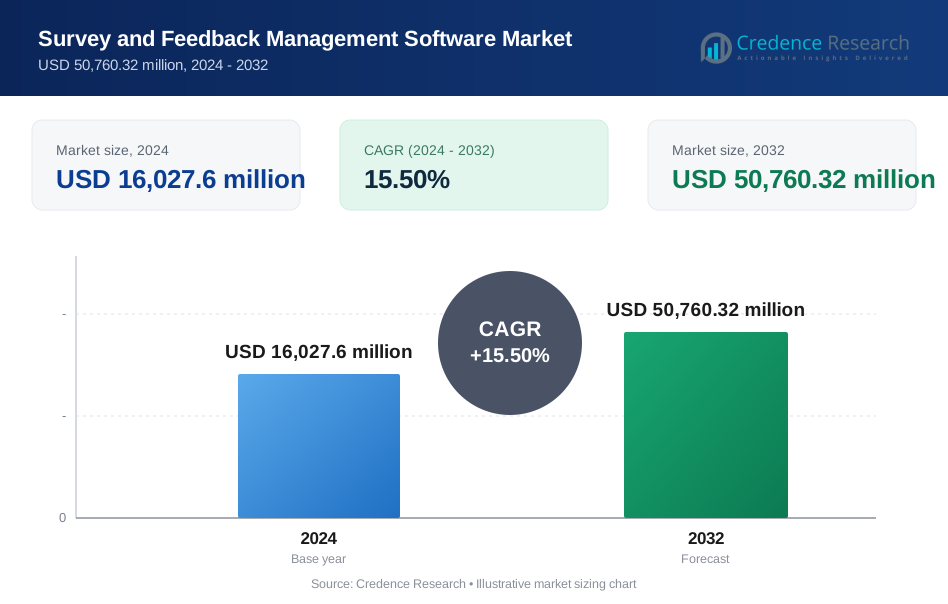
| Survey and Feedback Management Software Market Size 2024 | USD 16,027.6 million |
| Survey and Feedback Management Software Market, CAGR | 15.50% |
| Survey and Feedback Management Software Market Size 2032 | USD 50,760.32 million |
Market Overview
The Survey and Feedback Management Software market is projected to grow from USD 16,027.6 million in 2024 to USD 50,760.32 million by 2032, reflecting a compound annual growth rate (CAGR) of 15.50%.
The Survey and Feedback Management Software market is propelled by businesses' increasing focus on enhancing customer experience and engagement. As organizations strive for deeper insights into customer preferences and behaviors, the demand for advanced survey tools that offer real-time feedback and analytics is surging. Additionally, the integration of artificial intelligence and machine learning technologies is revolutionizing how surveys are conducted and analyzed, providing more precise and actionable data. The trend towards personalized customer interactions and the growing importance of customer satisfaction metrics in strategic decision-making are further driving market expansion.
In the Survey and Feedback Management Software market, geographical analysis highlights significant market activity in North America, Europe, and Asia-Pacific. North America is a leading region due to the presence of major players like Qualtrics, SurveyMonkey, and Alchemer (formerly SurveyGizmo), which dominate the market with advanced, versatile survey solutions. Europe follows, with companies like Confirmit contributing to regional growth through robust software offerings. In Asia-Pacific, rapid digital transformation and increased adoption of customer experience tools are driving market expansion. Key players such as Zoho Survey are capitalizing on this growth by offering localized and scalable solutions to cater to diverse regional needs.
Market Drivers
Enhancing Customer Experience Management
In today's competitive market, enhancing customer experience (CX) has become a pivotal focus for businesses. For instance, 85% of companies that excel at customer experience management report higher revenue growth compared to their competitors. Survey and feedback management software plays a crucial role in this domain by enabling organizations to gather essential insights directly from customers. This software aids in identifying areas needing improvement and enhances overall customer satisfaction by analyzing responses to tailor services and products more effectively. As companies recognize the substantial impact of CX on brand loyalty and revenue, the adoption of these tools is rapidly increasing, driving the market forward.
Adapting to the Digital Marketplace
The expansion of e-commerce and digital interactions has necessitated robust mechanisms for capturing customer feedback across multiple digital touchpoints. Adapting to the digital marketplace, 70% of businesses have integrated survey tools to capture customer feedback across digital platforms, leading to a 15% increase in customer satisfaction scores. E-commerce, which accounts for 14% of global retail sales, has seen a 20% increase in the use of feedback management software to enhance user experience. Survey and feedback management software provides an efficient platform to collect insights from website interactions, app usability, and social media engagements. This capability is crucial for businesses aiming to enhance user experience and adjust their strategies based on direct consumer feedback, thus making digital platforms more responsive and aligned with customer expectations.
Leveraging Data for Strategic Decisions
With a shift towards data-driven decision-making, businesses increasingly rely on survey software to inform their strategies. In leveraging data for strategic decisions, 60% of businesses now prioritize data analysis in their decision-making processes. The use of survey software has resulted in a 25% improvement in product development speed and a 30% increase in marketing campaign effectiveness. These statistics underscore the critical role of customer feedback in shaping business strategies and driving growth in today’s market. These insights drive product development, tailor marketing approaches, and influence critical business decisions, ensuring that companies are responsive to consumer needs and market trends.
Focus on Workplace Culture and Technological Integration
Survey and feedback management software is also instrumental in fostering employee engagement. By collecting and analyzing feedback from employees, companies can measure satisfaction, streamline communication, and identify opportunities to enhance workplace culture and engagement. Additionally, technological advancements such as AI for sentiment analysis, mobile optimization, and sophisticated data visualization are making these tools more effective and user-friendly. These innovations not only improve the efficiency of gathering and analyzing data but also ensure that businesses can maintain compliance with industry-specific regulations and standards.
Market Trends
Comprehensive Experience Management and AI Integration
The landscape of survey and feedback management software is shifting from simple tools to comprehensive Experience Management (XM) platforms. For instance, 92% of businesses using comprehensive Experience Management (XM) platforms report a significant increase in customer satisfaction, with a 30% improvement in customer loyalty metrics. The integration of AI and ML in survey tools has led to a 40% enhancement in the accuracy of sentiment analysis, and the use of AI-driven chatbots has resulted in a 25% increase in real-time feedback collection. These platforms integrate feedback from diverse sources such as social media, customer service interactions, and direct website behavior, offering businesses a more holistic view of the customer experience. By consolidating various data points, XM platforms enable organizations to capture a full spectrum of customer interactions, enhancing the ability to make informed decisions that drive customer satisfaction and loyalty. Artificial Intelligence (AI) and Machine Learning (ML) are transforming the functionality of survey tools, incorporating advanced features like sentiment analysis to interpret the emotional tone of feedback, and automated data analysis to distill key themes and trends. Additionally, the integration of AI-driven chatbots facilitates real-time feedback collection, allowing businesses to respond more dynamically to customer needs. These technological advancements not only refine data collection processes but also enhance the accuracy and efficiency of data interpretation, propelling the market toward more sophisticated analytical capabilities.
Mobile Accessibility and Integrated Business Tools
With the increasing prevalence of mobile devices, there is a growing demand for mobile-friendly survey tools. This trend enables organizations to collect feedback on-the-go and engage a broader audience through seamless mobile app integration. Mobile accessibility is crucial, as 80% of consumers use mobile devices to provide feedback. This has led to a 35% increase in mobile survey responses, making it easier for businesses to engage with customers. The integration of survey software with CRM systems has improved customer relationship management efficiency by 20%, and the adoption of advanced analytical tools has boosted operational effectiveness by 15%. Concurrently, there is a significant emphasis on transforming raw data into actionable insights. Modern survey software now includes advanced analytical tools that help organizations prioritize improvements, track changes over time, and make strategic decisions based on customer feedback, thereby enhancing operational effectiveness and customer engagement. Survey and feedback management software is increasingly being integrated with other essential business tools such as CRM systems, marketing automation platforms, and customer service software. This integration fosters a unified approach to managing customer relationships, streamlining data flows, and enhancing the coordination of customer strategies across various departments. Moreover, as data privacy and security become paramount with the collection of extensive customer insights, providers are rigorously implementing robust security protocols and complying with stringent data privacy regulations like GDPR and CCPA to protect sensitive information and build trust with users.
Market Challenges Analysis
Navigating Data Challenges and Survey Fatigue
Survey fatigue is becoming an increasing challenge in the Survey and Feedback Management Software market as customers are continually bombarded with requests for feedback from various businesses. This overwhelming flow of surveys can lead to lower response rates and decreased engagement, complicating the task of collecting reliable and substantial data. Additionally, the quality of the data collected is often jeopardized by poor survey design, which may include unclear or leading questions that confuse respondents and skew results. These issues with data quality and survey fatigue pose significant obstacles for businesses striving to gain accurate insights from their feedback mechanisms, thereby hindering effective decision-making and strategy formulation.
Overcoming Integration and Security Barriers
Many companies face difficulties in translating the vast amounts of feedback collected into actionable insights, primarily due to a lack of analytical expertise or appropriate resources. This 'Actionable Insights Gap' can prevent businesses from implementing effective changes that could enhance customer experience and operational efficiency. Furthermore, integrating survey and feedback management software with existing systems such as CRM or marketing platforms presents technical challenges that can obstruct a unified view of customer interactions and feedback. These integration issues can impede the effective utilization of customer feedback across different departments within an organization. Security concerns also loom large, as the increasing accumulation of sensitive data heightens the risk of breaches. Maintaining robust security measures and compliance with data protection regulations is crucial to protect customer information and sustain trust. Lastly, the market saturation with numerous software options, coupled with feature overload, complicates the selection process for businesses, especially smaller ones that might be constrained by budget and may not require overly complex functionalities. This situation necessitates a careful assessment to find a solution that offers the right balance between comprehensive features, cost, and ease of use, ensuring that businesses can effectively manage customer feedback without overwhelming their operations or budget.
Market Segmentation Analysis:
By Solution:
The Survey and Feedback Management Software market is segmented into two main solutions: Survey and Feedback Management Software, available in both cloud-based and on-premises formats, and Services, which include Professional Services and Managed Services. The cloud-based segment is particularly gaining traction due to its scalability, ease of integration, and cost-effectiveness, allowing businesses of all sizes to implement sophisticated feedback systems without significant upfront investment. On-premises solutions, while decreasing in popularity, continue to be relevant for organizations with stringent data control and security requirements. Additionally, the services segment is crucial as it supports the deployment, maintenance, and optimization of these platforms, with professional services providing bespoke solutions and managed services offering ongoing support and management of feedback systems, ensuring they remain efficient and aligned with business goals.
By Platform:
Survey and Feedback Management Software is increasingly diversified across various platforms, enhancing accessibility and user engagement. Key platforms include Websites, which are fundamental for capturing visitor feedback; Emails, for direct and personalized outreach; Voice Assistants, which are emerging as a novel channel for real-time feedback; and Mobile Apps, crucial for engaging the mobile-first audience. Each platform serves different strategic purposes, from gaining in-depth insights via email surveys to tapping into on-the-go feedback through mobile apps. This segmentation allows businesses to tailor their feedback collection strategies to the specific behaviors and preferences of their target audience, ensuring a wider reach and more accurate data collection.
Segments:
Based on Solution:
- Survey and Feedback Management Software (Cloud-based and On-premises)
- Services (Professional Services and Managed Services)
Based on Platform:
- Website
- Voice Assistants
- Mobile App
- Others
Based on Industry:
- Retail
- BFSI (Banking, Financial Services, and Insurance)
- Healthcare
- Media and Entertainment
- Government Sector
- Others
Based on the Geography:
- North America
- US
- Canada
- Europe
- Germany
- UK
- France
- Italy
- Spain
- Rest of Europe
- Asia Pacific
- China
- Japan
- India
- Australia
- South Korea
- Rest of Asia Pacific
- Latin America
- Brazil
- Mexico
- Argentina
- Rest of Latin America
- Middle East & Africa
- Saudi Arabia
- South Africa
- UAE
- Rest of the Middle East and Africa
Regional Analysis
North America
North America leads the market with a dominant 45% share, driven by the region's early adoption of digital technologies and a strong culture of customer-centric business practices. The United States, in particular, stands at the forefront of innovation in this sector, with a high concentration of software vendors and a robust ecosystem of enterprise clients. Companies across various industries in North America are increasingly leveraging sophisticated survey and feedback tools to gain actionable insights into customer preferences and employee satisfaction. The region's market is characterized by a demand for advanced analytics features, AI-driven sentiment analysis, and seamless integration capabilities with existing business intelligence platforms. Cloud-based solutions have gained significant traction, offering scalability and flexibility to organizations of all sizes.
Europe
Europe holds the second-largest market share at 30%, with the United Kingdom, Germany, and France leading in adoption rates. The European market is distinguished by its strong focus on data privacy and compliance, particularly in light of GDPR regulations. This has led to the development of highly secure, localized survey and feedback management solutions tailored to meet stringent European data protection standards. The Asia-Pacific region is emerging as the fastest-growing market, currently accounting for 20% of the global share. Countries like Japan, South Korea, and Singapore are at the forefront of adoption in this region, driven by their technologically advanced economies and increasing focus on customer experience management. China, with its vast market and rapidly digitalizing business landscape, presents significant growth opportunities for survey and feedback software providers.
Key Player Analysis
- Qualtrics
- SurveyMonkey
- Medallia
- Confirmit
- InMoment
- QuestionPro
- Zoho Survey
- SurveyGizmo (Alchemer)
- Typeform
- SurveySparrow
Competitive Analysis
The competitive landscape of the Survey and Feedback Management Software market is intensely dynamic, featuring a mix of established companies and emerging players. Leading firms like Qualtrics and Medallia offer comprehensive platforms that integrate advanced analytics and artificial intelligence to deliver deeper insights into customer behavior and sentiment. SurveyMonkey remains a frontrunner due to its user-friendly interface and extensive survey toolset, catering to a wide range of industries from SMEs to large corporations. Newer entrants like Typeform and SurveySparrow differentiate themselves with unique user experiences and aesthetic, interactive survey designs that enhance respondent engagement. Additionally, companies like Zoho Survey appeal to cost-conscious businesses with their affordable yet robust offerings. Competitive strategies among these players include continuous innovation, strategic partnerships, and global expansion to capture a larger share of the market, all while enhancing functionality and improving integration capabilities with other business systems to offer seamless user experiences.
Recent Developments
In May 2024, Sprinklr, the unified customer experience management (Unified-CXM) platform for modern enterprises, launched Sprinklr Surveys. It is an AI-powered survey offering that is integrated with unsolicited feedback resources to help customers derive actionable and complete insights.
Market Concentration & Characteristics
The Survey and Feedback Management Software market exhibits a moderate to high market concentration, dominated by key players such as Qualtrics, SurveyMonkey, and Medallia, which have established substantial market presence through continuous innovation and extensive service offerings. These leaders set market trends through advanced analytics and user-friendly interfaces, significantly influencing market dynamics and standards. The market is characterized by rapid technological advancements, particularly in areas of artificial intelligence, machine learning, and mobile optimization, which drive the development of more sophisticated and integrated solutions. New entrants and smaller players are focusing on niche markets by offering specialized, cost-effective solutions tailored to specific industry needs, increasing the competitive pressure within the market. Overall, the landscape is competitive, with companies actively expanding their product portfolios and enhancing their global reach to meet the growing demand for insightful and actionable customer feedback across various industries.
Report Coverage
The research report offers an in-depth analysis based on Solution, Platform, Industry and Geography. It details leading market players, providing an overview of their business, product offerings, investments, revenue streams, and key applications. Additionally, the report includes insights into the competitive environment, SWOT analysis, current market trends, as well as the primary drivers and constraints. Furthermore, it discusses various factors that have driven market expansion in recent years. The report also explores market dynamics, regulatory scenarios, and technological advancements that are shaping the industry. It assesses the impact of external factors and global economic changes on market growth. Lastly, it provides strategic recommendations for new entrants and established companies to navigate the complexities of the market.
Future Outlook
- Continued growth in cloud-based solutions will dominate the market, offering scalability and flexibility for businesses of all sizes.
- Integration of AI and ML will deepen, enhancing the automation and accuracy of data analysis and insights generation.
- Expansion in mobile platform capabilities will cater to the growing demand for on-the-go feedback collection and analysis.
- Increased emphasis on multi-channel feedback collection will provide businesses a holistic view of customer experiences across all touchpoints.
- Adoption of experience management platforms will rise, as companies seek to consolidate various types of feedback into a single view.
- Greater focus on real-time feedback will enable businesses to respond more swiftly and effectively to customer needs and market changes.
- Privacy and security measures will be strengthened in response to growing data sensitivity and regulatory requirements.
- Market penetration into emerging economies will increase as digital transformation accelerates globally.
- Personalization of survey experiences will enhance response rates and quality of feedback by making surveys more engaging for respondents.
- Strategic partnerships and acquisitions will continue as companies aim to enhance their offerings and expand market reach.
Request a Free Sample
Fill in your details and we'll send you a free sample report.
- Sample data tables & charts
- Research methodology
Market Dynamics
Enhancing Customer Experience Management
Businesses are increasingly prioritizing customer experience as a key differentiator, using survey and feedback management software to gather actionable insights and improve satisfaction, which in turn drives loyalty and revenue growth.
Adapting to the Digital Marketplace
The proliferation of e-commerce and digital interactions has made it essential for companies to capture feedback across multiple digital touchpoints, leading to higher adoption of advanced survey tools that can integrate with websites, apps, and social media.
Leveraging Data for Strategic Decisions
Organizations are shifting towards data-driven decision-making, relying on survey software to inform product development, marketing strategies, and operational improvements, resulting in faster innovation and more effective campaigns.
Focus on Workplace Culture and Technological Integration
Companies are using feedback management tools to enhance employee engagement and workplace culture, while technological advancements such as AI, mobile optimization, and data visualization are making these tools more powerful and user-friendly.
Comprehensive Experience Management and AI Integration
The evolution from basic survey tools to integrated experience management platforms, powered by AI and machine learning, is enabling businesses to collect, analyze, and act on feedback in real time, improving both customer and employee experiences.
Need a Custom Version of This Report?
Tailor the scope, geography, or segments to your exact requirements.
- Custom geography or segment scope
- Direct access to our analyst team
Frequently Asked Questions
What is the current size of the Survey and Feedback Management Software Market?
What factors are driving the growth of the Survey and Feedback Management Software Market?
What are the key segments within the Survey and Feedback Management Software Market?
What are some challenges faced by the Survey and Feedback Management Software Market?
Who are the major players in the Survey and Feedback Management Software Market?
Which segment is leading the market share?
Table of Content
Chapter 1 Market Segmentation
- 1.1 Segmentation Framework
- 1.1.1 Product and Service Classification
- 1.1.2 Application and End-Use Classification
- 1.1.3 Technology and Solution Classification
- 1.1.4 Customer and Distribution Channel Classification
- 1.1.5 Geographic Segmentation
- 1.1.6 Market Segment Definitions and Boundaries
- 1.2 By Industry
- 1.2.1 Retail
- 1.2.2 BFSI (Banking, Financial Services, and Insurance)
- 1.2.3 Healthcare
- 1.2.4 Media and Entertainment
- 1.2.5 Government Sector
- 1.2.6 Others
- 1.3 By Platform
- 1.3.1 Website
- 1.3.2 Email
- 1.3.3 Voice Assistants
- 1.3.4 Mobile App
- 1.3.5 Others
- 1.4 By Solution
- 1.4.1 Survey and Feedback Management Software (Cloud-based)
- 1.4.2 Survey and Feedback Management Software (On-premises)
- 1.4.3 Services (Professional Services)
- 1.4.4 Services (Managed Services)
Chapter 2 Introduction
- 2.1 Report Objectives and Scope
- 2.2 Product Definition and Industry Terminology
- 2.3 Market Inclusions and Exclusions
- 2.4 Research Process
- 2.4.1 Primary Research and Expert Interviews
- 2.4.2 Secondary Research and Source Review
- 2.4.3 Top-Down and Bottom-Up Estimation
- 2.4.4 Data Triangulation and Verification
- 2.5 Market Size Measurement Basis
- 2.5.1 2024: USD 16,027.6 million → 2032: USD 50,760.32 million
- 2.6 Historical and Forecast Reference Periods
- 2.6.1 Base Year: 2024
- 2.6.2 Forecast Period: 2024-2032
- 2.7 Research Assumptions and Limitations
Chapter 3 Executive Summary
- 3.1 Market Snapshot and Key Findings
- 3.2 Base-Year Market Size, 2024
- 3.3 Forecast Market Size, 2032
- 3.4 Revenue and Volume Growth Outlook
- 3.5 Key Demand and Supply Indicators
- 3.6 Leading Market Segments
- 3.7 Fastest-Growing Market Opportunities
- 3.8 Regional Performance Highlights
- 3.9 Technology and Industry Transformation
- 3.10 Competitive Landscape Summary
- 3.11 Analyst View and Strategic Implications
Chapter 4 Global Survey and Feedback Management Software Market Trends and Developments
- 4.1 Historical Industry Development
- 4.2 Recent Market Trends and Developments
- 4.3 Demand and Customer Behavior Trends
- 4.4 Technology and Product Innovation
- 4.5 Artificial Intelligence, Automation and Digitalization
- 4.6 Local Manufacturing and Supply Chain Realignment
- 4.7 Industry Partnerships, Mergers and Acquisitions
- 4.8 Sustainability and Circular Economy Developments
- 4.9 Government and Private Sector Investment Trends
- 4.10 Emerging Business Models and Commercialization
- 4.11 Industry Developments and Announcements
Chapter 5 Global Survey and Feedback Management Software Market Supply and Demand Analysis
- 5.1 Demand Trend and Consumption Analysis
- 5.2 Demand Forecast, 2024-2032
- 5.3 Supply Chain Structure and Procurement Trends
- 5.4 Supply-Demand Gap and Bottlenecks
- 5.5 Import Dependence and Sourcing Structure
- 5.6 Regional Supply and Demand Concentration
Chapter 6 Global Survey and Feedback Management Software Market Pricing Analysis
- 6.1 Pricing Structure and Measurement
- 6.2 Historical Pricing Trends
- 6.3 Pricing Outlook, 2024-2032
- 6.4 Pricing by Product and Market Segment
- 6.5 Geographic Pricing Differences
- 6.6 Key Input, Energy, Labor and Logistics Costs
- 6.7 Contract Pricing and Purchasing Models
- 6.8 Pricing Sensitivity and Competitive Positioning
- 6.9 Price, Margin and Profitability Implications
Chapter 7 Global Survey and Feedback Management Software Market Dynamics
- 7.1 Market Growth Drivers
- 7.1.1 Demand-Side Drivers
- 7.1.2 Technology and Innovation Drivers
- 7.1.3 Infrastructure and Investment Drivers
- 7.1.4 Regulatory and Policy Drivers
- 7.2 Market Restraints
- 7.2.1 Cost and Affordability Constraints
- 7.2.2 Technology and Adoption Barriers
- 7.2.3 Supply Chain and Operational Constraints
- 7.3 Market Challenges
- 7.3.1 Competitive Pressure and Margin Erosion
- 7.3.2 Skills, Infrastructure and Implementation Gaps
- 7.4 Emerging Market Opportunities
- 7.5 Market Dynamics Impact and Time-Horizon Assessment
Chapter 8 Global Survey and Feedback Management Software Value Chain Analysis
- 8.1 Industry Value Chain Overview
- 8.2 Upstream Suppliers and Critical Inputs
- 8.3 Technology and Component Providers
- 8.4 Manufacturing or Service Delivery
- 8.5 Distribution, Channel Partners and Integrators
- 8.6 Downstream Applications and End Users
- 8.7 Value Addition and Profit Pools
- 8.8 Vertical Integration and Outsourcing
- 8.9 Supplier Concentration and Risk
- 8.10 Supply Chain Localization and Resilience
Chapter 9 Global Survey and Feedback Management Software Market Regulations and Policies
- 9.1 Relevant Laws, Standards and Compliance Frameworks
- 9.2 Product, Service, Safety and Quality Requirements
- 9.3 Government Policies, Incentives and Subsidies
- 9.4 Imports, Exports and Trade Barriers
- 9.5 Public Procurement and Local Content Requirements
- 9.6 Data Protection, AI and Cybersecurity Compliance
- 9.7 Upcoming Policy Changes and Market Implications
Chapter 10 Global Survey and Feedback Management Software Market Hotspots and Opportunities
- 10.1 Market Opportunity Mapping and Growth Hotspots
- 10.2 High-Growth Applications and Customer Groups
- 10.3 Underserved Markets and White-Space Opportunities
- 10.4 Emerging Technology and Product Opportunities
- 10.5 New Capacity and Investment Hotspots
- 10.6 Market Entry and Expansion Opportunities
- 10.7 Distribution and Partnership Opportunities
- 10.8 Near-Term and Long-Term Commercial Potential
- 10.9 Opportunity Attractiveness and Execution Risks
Chapter 11 Global Survey and Feedback Management Software Market Outlook, 2024-2032
- 11.1 Market Size and Analysis
- 11.1.1 Revenue (Market Measurement: 2024: USD 16,027.6 million → 2032: USD 50,760.32 million)
- 11.1.2 Historical Market Size
- 11.1.3 Base-Year Market Size, 2024
- 11.2 Market Forecast, 2024-2032
- 11.2.1 Revenue Forecast to 2032
- 11.2.2 CAGR and Year-on-Year Growth
- 11.2.3 Incremental Revenue Opportunity
- 11.3 Forecast Assumptions and Scenario Analysis
- 11.3.1 Base-Case Forecast
- 11.3.2 Optimistic and Conservative Scenarios
- 11.3.3 Technology, Pricing and Policy Sensitivities
- 11.4 Market Attractiveness and Growth Outlook
Chapter 12 Global Survey and Feedback Management Software Market Segmentation and Outlook
- 12.1 Segmentation Summary and Market Shares, 2024
- 12.2 Largest and Fastest-Growing Segments
- 12.3 By Industry - Market Size and Forecast, 2024-2032
- 12.3.1 Segment Definition and Scope
- 12.3.2 Historical Market Size
- 12.3.3 Revenue Forecast, 2024-2032
- 12.3.4 Base-Year Market Share, 2024
- 12.3.5 Segment CAGR and Growth Drivers
- 12.3.6 Subsegment Market Size and Forecast
- 12.3.6.1 Retail
- 12.3.6.2 BFSI (Banking, Financial Services, and Insurance)
- 12.3.6.3 Healthcare
- 12.3.6.4 Media and Entertainment
- 12.3.6.5 Government Sector
- 12.3.6.6 Others
- 12.3.7 Subsegment Pricing and Adoption Trends
- 12.3.8 Leading Suppliers and Competition
- 12.3.9 Regional Demand and Opportunities
- 12.4 By Platform - Market Size and Forecast, 2024-2032
- 12.4.1 Segment Definition and Scope
- 12.4.2 Historical Market Size
- 12.4.3 Revenue Forecast, 2024-2032
- 12.4.4 Base-Year Market Share, 2024
- 12.4.5 Segment CAGR and Growth Drivers
- 12.4.6 Subsegment Market Size and Forecast
- 12.4.6.1 Website
- 12.4.6.2 Email
- 12.4.6.3 Voice Assistants
- 12.4.6.4 Mobile App
- 12.4.6.5 Others
- 12.4.7 Subsegment Pricing and Adoption Trends
- 12.4.8 Leading Suppliers and Competition
- 12.4.9 Regional Demand and Opportunities
- 12.5 By Solution - Market Size and Forecast, 2024-2032
- 12.5.1 Segment Definition and Scope
- 12.5.2 Historical Market Size
- 12.5.3 Revenue Forecast, 2024-2032
- 12.5.4 Base-Year Market Share, 2024
- 12.5.5 Segment CAGR and Growth Drivers
- 12.5.6 Subsegment Market Size and Forecast
- 12.5.6.1 Survey and Feedback Management Software (Cloud-based)
- 12.5.6.2 Survey and Feedback Management Software (On-premises)
- 12.5.6.3 Services (Professional Services)
- 12.5.6.4 Services (Managed Services)
- 12.5.7 Subsegment Pricing and Adoption Trends
- 12.5.8 Leading Suppliers and Competition
- 12.5.9 Regional Demand and Opportunities
- 12.6 Segment Growth Comparison
- 12.7 Segment Attractiveness and Priority Matrix
Chapter 13 Global Survey and Feedback Management Software End-Use and Application Market Outlook
- 13.1 End-Use Industry and Customer Demand Structure
- 13.2 Leading Applications and Customer Groups
- 13.3 End-Use Market Size, Share and Forecast
- 13.4 Major End-Use Industry Deep Dives
- 13.4.1 Customer Requirements and Use Cases
- 13.4.2 Demand and Replacement Cycles
- 13.4.3 Technical and Regulatory Considerations
- 13.4.4 Purchasing and Procurement Models
- 13.4.5 Leading Vendors and Distribution Channels
- 13.4.6 Forecast and Commercial Opportunities
- 13.5 Emerging Applications and Cross-Segment Demand
- 13.6 End-Use Industry Investment Priorities
Chapter 14 Global Survey and Feedback Management Software Geographic Market Outlook, 2024-2032
- 14.1 Regional Market Size and Share, 2024
- 14.2 Regional Market Forecast, 2024-2032
- 14.3 Regional Pricing, Production and Demand Differences
- 14.4 North America
- 14.4.1 United States
- 14.4.2 Canada
- 14.4.3 Mexico
- 14.5 Europe
- 14.5.1 Germany
- 14.5.2 France
- 14.5.3 Italy
- 14.5.4 United Kingdom
- 14.5.5 Spain
- 14.5.6 Poland
- 14.5.7 Russia
- 14.5.8 Netherlands
- 14.5.9 Belgium
- 14.5.10 Sweden
- 14.5.11 Denmark
- 14.5.12 Norway
- 14.5.13 Rest of Europe
- 14.6 Asia Pacific
- 14.6.1 China
- 14.6.2 India
- 14.6.3 Japan
- 14.6.4 South Korea
- 14.6.5 Thailand
- 14.6.6 Indonesia
- 14.6.7 Vietnam
- 14.6.8 Malaysia
- 14.6.9 Australia
- 14.6.10 Rest of Asia Pacific
- 14.7 Latin America
- 14.7.1 Brazil
- 14.7.2 Argentina
- 14.7.3 Colombia
- 14.7.4 Chile
- 14.7.5 Rest of Latin America
- 14.8 Middle East
- 14.8.1 Saudi Arabia
- 14.8.2 United Arab Emirates
- 14.8.3 Turkey
- 14.8.4 Israel
- 14.8.5 Iran
- 14.8.6 Rest of the Middle East
- 14.9 Africa
- 14.9.1 South Africa
- 14.9.2 Egypt
- 14.9.3 Nigeria
- 14.9.4 Morocco
- 14.9.5 Rest of Africa
- 14.10 Regional Investment, Policy and Supply Chain Differences
- 14.11 Regional Competitive Landscape
- 14.12 Geographic Growth Hotspots
Chapter 15 Global Survey and Feedback Management Software Technology, Innovation and Sustainability Outlook
- 15.1 Technology Landscape and Maturity
- 15.2 Product, Process and Service Innovation
- 15.3 AI, Automation and Digital Tools in the Industry
- 15.4 Technology Adoption and Performance Benchmarking
- 15.5 Innovation Pipeline and R&D Investment
- 15.6 Patent and Intellectual Property Trends
- 15.7 Energy Efficiency and Resource Management
- 15.8 Sustainability, Recycling and Circularity
- 15.9 Technology Roadmap, 2024-2032
- 15.10 Risks of Obsolescence and Technology Substitution
Chapter 16 Global Survey and Feedback Management Software Market Key Strategic Imperatives
- 16.1 Growth and Market Entry Priorities
- 16.2 High-Return Products and Segments
- 16.3 Pricing, Profitability and Cost Optimization
- 16.4 Technology Investment and Product Differentiation
- 16.5 Supply Chain Localization and Resilience
- 16.6 Distribution and Customer Acquisition
- 16.7 Partnership, Acquisition and Capacity Strategy
- 16.8 Regional Expansion Priorities
- 16.9 Short-, Medium- and Long-Term Actions
Chapter 17 Competition Outlook
- 17.1 Industry Competition Characteristics
- 17.2 Market Structure and Concentration
- 17.3 Market Share and Competitive Positioning, 2024
- 17.4 Company-Wise Revenue and Product Benchmarking
- 17.5 Production and Service Capacity Benchmarking
- 17.6 Technology, Pricing and Differentiation
- 17.7 Regional Footprint and Distribution Strength
- 17.8 Mergers, Acquisitions and Strategic Alliances
- 17.9 New Entrants and Competitive Threats
- 17.10 Porter's Five Forces and Industry Attractiveness
- 17.11 Competitive Outlook, 2024-2032
Chapter 18 Company Profiles
- 18.1 Company Coverage and Selection Criteria
- 18.2 Qualtrics
- 18.2.1 Business Description
- 18.2.2 Company Ownership and Geographic Presence
- 18.2.3 Product and Service Portfolio
- 18.2.4 Manufacturing and Operating Footprint
- 18.2.5 Financial Performance and Investment
- 18.2.6 Market Share and Competitive Position
- 18.2.7 Technology and Innovation Capabilities
- 18.2.8 Strategic Alliances or Partnerships
- 18.2.9 Recent Developments
- 18.2.10 Growth Strategy and Outlook
- 18.3 SurveyMonkey
- 18.4 Medallia
- 18.5 Confirmit
- 18.6 InMoment
- 18.7 QuestionPro
- 18.8 Zoho Survey
- 18.9 Alchemer (SurveyGizmo)
- 18.10 Typeform
- 18.11 SurveySparrow
- 18.12 Other Relevant Market Participants
Note: Every listed company is profiled on the structure shown under the first company. The company list is preliminary and may change based on research findings, market developments, data availability and client requirements.
Chapter 19 Disclaimer
- 19.1 Research and Forecast Disclaimer
- 19.2 Data Source and Estimation Limitations
Note: The depth of individual sections depends on data availability for this market. Volume, capacity, trade and other unit-based metrics are included where applicable.

