
| REPORT ATTRIBUTE | DETAILS |
|---|---|
| Historical Period | 2019-2022 |
| Base Year | 2023 |
| Forecast Period | 2024-2032 |
| Customer Experience Management Market Size 2024 | USD 19,345 Million |
| Customer Experience Management Market, CAGR | 17.4% |
| Customer Experience Management Market Size 2032 | USD 69,809.3 Million |
Market Overview
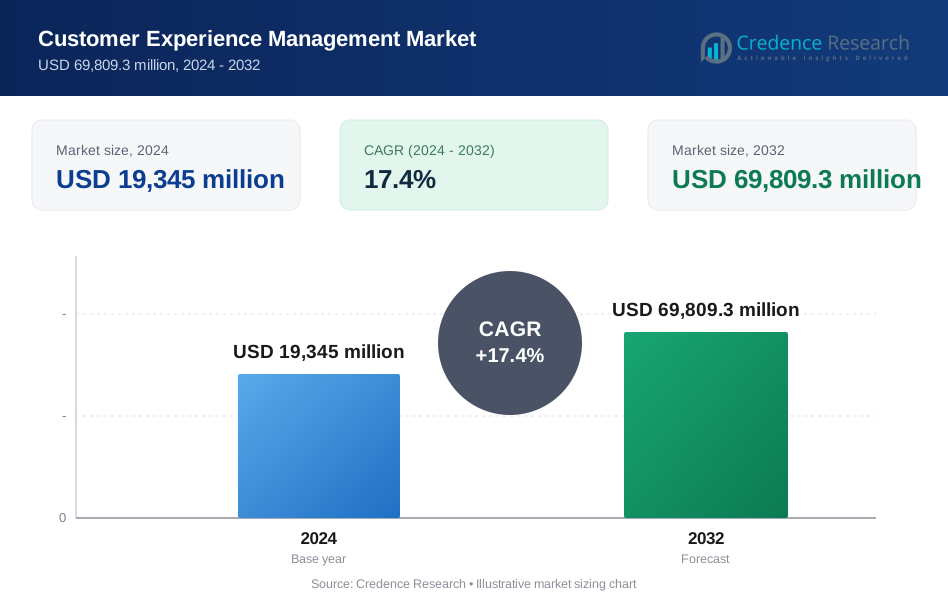
The Customer Experience Management Market is projected to grow from USD 19,345 million in 2024 to USD 69,809.3 million by 2032, at a compound annual growth rate (CAGR) of 17.4%.
The growth of the Customer Experience Management (CXM) market is driven by the increasing demand for personalized customer interactions, the rise in digital transformation initiatives, and advancements in AI and data analytics. Businesses are prioritizing enhanced customer engagement to improve brand loyalty and satisfaction. Additionally, the growing use of omnichannel platforms and real-time feedback systems is reshaping CXM strategies. The shift towards cloud-based solutions and the need for efficient customer support services further contribute to market growth, as organizations aim to streamline operations and offer seamless, consistent experiences across multiple touchpoints.
The Customer Experience Management (CEM) market is growing rapidly across various regions, driven by increasing demand for personalized customer interactions and seamless service. Key players in the market include major companies like Oracle Corporation, Adobe Inc., Salesforce.com, Inc., Microsoft Corporation, Zendesk Inc., and Genesys, who are innovating to offer comprehensive solutions. North America leads the market due to its advanced technological infrastructure, while Europe and Asia-Pacific are also witnessing significant growth, driven by digital transformation initiatives and the adoption of AI and cloud-based solutions. These regions continue to see strong competition and investment in CEM technologies.
Market Drivers
Rising Customer Expectations
Customers today expect personalized experiences at every touchpoint, whether online or in-store. For instance, a survey by Salesforce found that 75% of business buyers expect companies to provide personalized experiences and anticipate their individual needs. Personalization is key to building lasting relationships and enhancing customer satisfaction. In addition, omnichannel consistency is essential, as customers seek seamless interactions across web, mobile, and physical stores. Businesses must also prioritize prompt resolution, ensuring timely and effective responses to inquiries and issues, which further strengthens customer loyalty and satisfaction.
Data-Driven Insights
Customer analytics have become vital for businesses aiming to understand consumer behavior, preferences, and pain points. Predictive analytics helps organizations anticipate customer needs, allowing them to address issues before they arise. For instance, companies like Netflix use predictive analytics to identify subscribers at risk of canceling their service and proactively offer personalized recommendations or promotions. Additionally, real-time feedback is essential for continuously improving customer experiences, ensuring that businesses stay aligned with customer expectations and can adapt quickly to evolving demands.
Digital Transformation
The growth of e-commerce has heightened the importance of digital customer experiences, pushing businesses to adopt more efficient online strategies. Social media plays a critical role in shaping customer expectations, with platforms amplifying voices and demanding faster responses. Advanced technologies like AI and automation are driving personalized interactions, allowing businesses to meet customer needs more efficiently. These technologies enable faster problem-solving, improving overall customer satisfaction.
Competitive Landscape & Regulatory Compliance
In a competitive market, Customer Experience Management (CEM) plays a significant role in differentiation, helping businesses stand out from competitors. Positive customer experiences drive loyalty and retention, ultimately leading to increased market share. At the same time, adhering to regulatory requirements such as data privacy regulations (GDPR, CCPA) and ensuring accessibility for all customers is crucial. With the rise of remote work, virtual interactions and self-service solutions are becoming essential strategies to maintain effective customer communication and service.
Market Trends
AI, Automation, and Data-Driven Insights
AI and automation are reshaping customer experience management (CEM) with increasingly sophisticated tools. AI-powered chatbots and virtual assistants now handle complex inquiries, offering personalized support and freeing human agents to focus on strategic tasks. For instance, according to a report by Salesforce, a significant number of service decision-makers emphasize the growing importance of AI in customer service. Predictive analytics also plays a key role by analyzing customer data to anticipate needs, proactively addressing potential issues before they arise. Additionally, real-time analytics enable businesses to gain immediate insights into customer behavior and sentiment, facilitating a more agile response. Data-driven strategies, such as customer journey mapping, help businesses identify pain points and opportunities, allowing them to optimize the entire customer experience. These technological advancements empower businesses to deliver more efficient, personalized, and proactive service, ultimately enhancing customer satisfaction and loyalty.
Omnichannel Experience, Personalization, and Emerging Technologies
Customers now expect seamless transitions between various channels, whether on the web, mobile, in-store, or through social media. An omnichannel approach ensures that businesses meet this expectation, delivering consistent experiences no matter how or where customers interact with the brand. For instance, a study by Worldmetrics indicates that a majority of customers prefer brands that offer omnichannel experiences. Personalized interactions based on individual preferences and past behavior are also becoming more crucial in driving customer satisfaction. Alongside this, the rise of hyper-personalization tailors experiences dynamically, adjusting content and offers in real-time based on customer context. Additionally, emerging technologies like voice-activated interactions and visual search are enhancing the customer journey by offering innovative ways to interact with businesses. With the increasing use of IoT devices, businesses are able to gather valuable data to improve the customer experience, while predictive maintenance helps prevent potential issues before they impact the customer. Moreover, blockchain is gaining traction for its ability to provide secure and transparent data sharing, boosting customer trust. Ethical considerations, such as responsible data usage and sustainable practices like eco-friendly packaging and carbon-neutral shipping, are becoming integral parts of the customer experience, reflecting broader consumer preferences for socially responsible brands. As CEM continues to evolve, these trends are central to crafting experiences that are not only personalized and seamless but also secure, ethical, and aligned with customer expectations.
Market Challenges Analysis
Technological, Employee, and Resource Challenges
The integration of various systems and technologies to support customer experience management is a major obstacle for many businesses. The complexity and time-consuming nature of merging different technologies, coupled with data privacy and security concerns, add layers of difficulty. Ensuring customer data is securely handled and compliant with regulations is a constant priority but can strain resources and hinder progress. For instance, integrating CRM systems with other business applications is often cited as a significant challenge. Furthermore, empowering employees to deliver exceptional customer experiences is essential, yet many businesses face skill gaps and challenges in fostering a customer-centric culture. The shift towards this culture is particularly difficult for traditional organizations that have not been accustomed to prioritizing customer experience. Another major challenge is the financial aspect of CEM. Budgetary limitations often restrict the ability to implement comprehensive strategies, while allocating sufficient resources-both in terms of finances and personnel can be difficult. Finally, companies operating in global markets must navigate cross-cultural understanding, addressing language barriers and delivering consistent experiences across different cultural contexts. This requires businesses to adapt their strategies to local preferences and regional expectations, adding further complexity to customer experience management.
Evolving Customer Expectations and Organizational Silos
One of the significant challenges businesses face today is keeping pace with rapidly changing customer preferences. As customer expectations evolve continuously, staying ahead of the curve becomes increasingly difficult, especially for companies catering to diverse customer bases. Personalizing experiences at scale is another challenge. Businesses must balance the demand for tailored interactions with the complexities of large, varied audiences, making it difficult to deliver individualized experiences consistently. Additionally, organizational silos within companies often hinder customer experience management. With different departments working in isolation, inconsistent customer experiences can arise, undermining efforts to provide a seamless journey across touchpoints. Moreover, fragmented data across various departments prevents organizations from gaining a comprehensive view of the customer journey, which impedes the development of cohesive strategies for improving overall customer satisfaction.
Market Segmentation Analysis:
By Component:
The Customer Experience Management (CEM) market is broadly divided into two segments: Solutions and Services. The Solution segment leads the market, driven by advanced technologies such as AI-powered chatbots, predictive analytics, and automation platforms, which help businesses deliver personalized and efficient customer experiences. Solutions provide end-to-end capabilities for businesses to streamline customer interactions, from acquisition to post-sales support. The Services segment, however, is growing rapidly as businesses seek external expertise for professional and managed services. Professional services, which include consulting and integration, help companies implement CEM solutions effectively. Managed services provide ongoing support and maintenance, ensuring optimal performance and continuous improvement of CEM systems. As businesses increasingly recognize the value of a tailored approach to customer experience, the demand for both solutions and services continues to rise.
By Deployment:
Customer Experience Management is also segmented by deployment type: on-premises and cloud-based solutions. The on-premises deployment segment is favored by organizations with strict data security and regulatory compliance requirements, offering them greater control over their systems and infrastructure. However, cloud-based deployment is gaining significant traction due to its scalability, flexibility, and cost-effectiveness. Cloud CEM solutions allow businesses to rapidly scale their operations, integrate advanced AI tools, and provide a more dynamic approach to managing customer interactions across multiple touchpoints. Cloud-based platforms also offer seamless updates and the ability to integrate with other business systems, providing a comprehensive solution to improve customer experiences. As more companies migrate to the cloud, this deployment model is expected to dominate the market, making cloud solutions a critical driver of growth in the CEM industry.
Segments:
Based on Component
- Solution
- Services
- Professional
- Managed
Based on Deployment
- On-premises
- Cloud
Based on Enterprise Size
- Large Enterprises
- SMEs
Based on Touchpoint
- Call Center
- Website
- Mobile Applications
- Social Media
- Others (Virtual Assistants, Loyalty Programs, and Others)
Based on End-user
- Banking, Financial Services, and Insurance (BFSI)
- Retail and Consumer Goods
- IT and Telecom
- Healthcare
- Automotive
- Media and Entertainment
- Government
- Others (Oil and Gas, Education, and Others)
Based on the Geography:
- North America
- U.S.
- Canada
- Mexico
- Europe
- Germany
- France
- U.K.
- Italy
- Spain
- Rest of Europe
- Asia Pacific
- China
- Japan
- India
- South Korea
- South-east Asia
- Rest of Asia Pacific
- Latin America
- Brazil
- Argentina
- Rest of Latin America
- Middle East & Africa
- GCC Countries
- South Africa
- Rest of the Middle East and Africa
Regional Analysis
North America
North America holds a dominant position in the Customer Experience Management (CEM) market, accounting for a significant share of the global market. The region is projected to maintain its leadership with a market share of approximately 40%. This dominance is driven by the high adoption rate of advanced technologies, such as AI, machine learning, and cloud-based solutions, which are integral to enhancing customer experience. Companies across various sectors, including retail, BFSI (banking, financial services, and insurance), and healthcare, are increasingly investing in CEM solutions to stay competitive in a fast-evolving market. Additionally, the presence of leading technology providers such as Salesforce, Oracle, and Adobe in North America accelerates innovation and the deployment of cutting-edge CEM tools. The region's focus on digital transformation, customer-centric strategies, and the growing emphasis on personalization further bolster its strong position in the global CEM landscape. As businesses continue to prioritize customer experience as a differentiating factor, North America's market share is expected to remain robust in the coming years.
Asia-Pacific
Asia Pacific is experiencing rapid growth in the Customer Experience Management market, driven by increasing digitization, the rise of e-commerce, and a growing focus on improving customer interactions across industries. The region is expected to capture approximately 25% of the global market share, making it one of the fastest-growing regions in CEM adoption. In particular, countries like China, India, and Japan are witnessing significant demand for CEM solutions as businesses strive to provide personalized and seamless customer experiences across various digital touchpoints. With a young, tech-savvy consumer base and a burgeoning middle class, there is an increasing expectation for businesses to enhance their customer service. The rapid growth of social media and mobile applications in the region is also pushing companies to adopt CEM tools that enable real-time customer feedback, predictive analytics, and proactive engagement. As organizations in Asia Pacific focus on digital transformation and customer retention, the region's CEM market share is set to continue expanding, driven by advancements in cloud computing, AI, and automation technologies.
Key Player Analysis
- Oracle Corporation (U.S.)
- Adobe Inc. (U.S.)
- com, Inc. (U.S.)
- Microsoft Corporation (U.S.)
- Zendesk Inc. (U.S.)
- Medallia Inc. (U.S.)
- Freshworks Inc. (U.S.)
- Genesys (U.S.)
- OpenText Corporation (Canada)
- SAP SE (Germany)
Competitive Analysis
The competitive landscape of the Customer Experience Management (CEM) market is marked by intense innovation and strategic initiatives by leading players such as Oracle Corporation, Adobe Inc., Salesforce.com, Inc., Microsoft Corporation, Zendesk Inc., Genesys, Medallia Inc., Freshworks Inc., SAP SE, and OpenText Corporation. These companies focus on enhancing their offerings through advanced technologies like AI, machine learning, and real-time analytics to deliver personalized and seamless customer interactions. Key strategies include mergers and acquisitions, product launches, and expanding cloud-based services to meet the dynamic needs of diverse industries. Additionally, players are investing heavily in R&D to stay ahead in this highly competitive space while catering to the increasing demand for omnichannel and data-driven solutions. Their ability to adapt to evolving customer expectations and technological advancements significantly drives their leadership in the market.
Recent Developments
- In November 2023, Zendesk launched CRM and customer service no-code tools for customer service agents. The tools include object triggers for Zendesk’s custom object to automate the task.
- In June 2023, Adobe introduced Adobe Product Analytics for its enterprise customers to provide a personalized experience across various touchpoints and maximize operational efficiency.
- In March 2023, General Motors adopted Adobe Experience Cloud enterprise application to deliver highly personalized marketing services and real-time customer engagement journeys.
- In March 2023, Q-nomy, a company specializing in customer journey management solutions, launched Cubu. Cubu combines customer flow management, appointment scheduling, and customer interaction management in one integrated solution.
- In October, 2022, ResultsCX, a Customer Experience Management service provider, expanded its geographic presence in the U.K. and Europe. The company completed this expansion by acquiring a Bulgarian CXM provider and establishing its European headquarters in London.
Market Concentration & Characteristics
The Customer Experience Management (CEM) market is moderately concentrated, with a mix of global leaders and niche players shaping its dynamics. Key players such as Adobe Inc., Salesforce.com, Inc., Oracle Corporation, and Zendesk Inc. dominate the market with robust portfolios that leverage advanced technologies like artificial intelligence, predictive analytics, and automation. These companies exhibit strong capabilities in delivering personalized, omnichannel experiences across diverse industries. The market is characterized by rapid technological innovation, growing adoption of cloud-based solutions, and an increasing emphasis on real-time customer insights. Barriers to entry include high initial investments and the complexity of integrating diverse customer touchpoints, which favor established players. However, niche firms are gaining traction by offering tailored solutions for specific industries or regions. Overall, the CEM market reflects a dynamic blend of competition and collaboration, driven by the constant evolution of customer expectations and digital transformation initiatives.
Report Coverage
The research report offers an in-depth analysis based on Component, Deployment, Enterprise Size, Touchpoint, End-user and Geography. It details leading market players, providing an overview of their business, product offerings, investments, revenue streams, and key applications. Additionally, the report includes insights into the competitive environment, SWOT analysis, current market trends, as well as the primary drivers and constraints. Furthermore, it discusses various factors that have driven market expansion in recent years. The report also explores market dynamics, regulatory scenarios, and technological advancements that are shaping the industry. It assesses the impact of external factors and global economic changes on market growth. Lastly, it provides strategic recommendations for new entrants and established companies to navigate the complexities of the market.
Future Outlook
- The adoption of artificial intelligence and machine learning will continue to enhance personalization and predictive analytics in customer experience management.
- Cloud-based solutions will dominate the market, providing scalability and flexibility for businesses of all sizes.
- The integration of advanced analytics tools will help organizations gain deeper insights into customer behavior and preferences.
- Omnichannel experiences will become increasingly important as customers demand seamless interactions across platforms.
- The growing influence of social media will drive companies to focus on real-time engagement and reputation management.
- Automation of routine customer service tasks will free up resources for more complex problem-solving.
- Enhanced data privacy and compliance measures will become a priority to build customer trust and meet regulatory requirements.
- Emerging technologies like IoT and blockchain will further transform customer interactions and operational transparency.
- Small and medium enterprises will increasingly adopt CEM solutions to compete with larger businesses.
- Sustainability and ethical business practices will play a significant role in shaping customer experiences and brand loyalty.
Request a Free Sample
Fill in your details and we'll send you a free sample report.
- Sample data tables & charts
- Research methodology
Need a Custom Version of This Report?
Tailor the scope, geography, or segments to your exact requirements.
- Custom geography or segment scope
- Direct access to our analyst team
Frequently Asked Questions
What is the current size of the Customer Experience Management Market?
What factors are driving the growth of the Customer Experience Management Market?
What are the key segments within the Customer Experience Management Market?
What are some challenges faced by the Customer Experience Management Market?
Who are the major players in the Customer Experience Management Market?
Table of Content
Chapter 1. Report Introduction
- 1.1 Report Description & Purpose
- 1.1.1 Report Title & Market Definition
- 1.1.2 Unique Selling Propositions (USP) & Key Differentiators
- 1.1.3 Value Proposition for Stakeholders
- 1.2 Research Objectives
- 1.2.1 Market Sizing Objectives (Volume & Revenue) (Volume Where Applicable)
- 1.2.2 Segmentation Objectives
- 1.2.3 Competitive Intelligence Objectives
- 1.2.4 Forecast & Scenario Objectives
- 1.3 Report Scope
- 1.3.1 Customer Experience Management Scope – Segments & Subsegments Covered
- 1.3.2 Geographic Scope – Regions & Countries Covered
- 1.3.3 Historical Period, Base Year & Forecast Period (2024; forecast to 2032)
- 1.3.4 Inclusions & Exclusions
- 1.4 Industry Classification & Applicable Codes
- 1.5 Currency, Measurement Units & Valuation Basis
- 1.6 Target Stakeholders
- 1.7 Limitations & Assumptions
Chapter 2. Executive Summary
- 2.1 Global Customer Experience Management Market Snapshot
- 2.1.1 Market Size – Historical (2024) & Forecast (2024-2032) (2024: USD 19,345 million → 2032: USD 69,809.3 million)
- 2.1.2 Volume & Revenue – Global Totals (Volume Where Applicable)
- 2.1.3 Key Market Highlights – Top Five Facts
- 2.2 Customer Experience Management Market Segmentation Snapshot
- 2.2.1 Market Split by Region – 2024 vs. 2032
- 2.3 Competitive Snapshot
- 2.3.1 Top 10 Players by Revenue Share – 2024
- 2.3.2 Top 10 Players by Volume Share – 2024 (Volume Where Applicable)
- 2.3.3 Recent Strategic Developments (18-Month Summary)
- 2.4 Key Investment Highlights & Strategic Conclusions
Chapter 3. Customer Experience Management Market Dynamics & Industry Analysis
- 3.1 Market Overview & Context
- 3.1.1 Customer Experience Management Market Position in the Broader Industry Value Chain
- 3.1.2 Demand Structure & Purchasing Dynamics
- 3.1.3 Market Maturity & Development Stage by Region
- 3.2 Customer Experience Management Market Drivers
- 3.3 Customer Experience Management Market Restraints & Challenges
- 3.4 Customer Experience Management Market Opportunities
- 3.5 Porter's Five Forces Analysis
- 3.5.1 Threat of New Entrants
- 3.5.2 Bargaining Power of Suppliers
- 3.5.3 Bargaining Power of Buyers
- 3.5.4 Threat of Substitutes
- 3.5.5 Competitive Rivalry – Intensity Assessment
- 3.6 Customer Experience Management Value Chain Analysis
- 3.6.1 Upstream – Key Inputs, Resources & Suppliers
- 3.6.1.1 Key Input/Resource 1
- 3.6.1.2 Key Input/Resource 2
- 3.6.1.3 Key Input/Resource 3
- 3.6.2 Midstream – Core Operations & Value Creation
- 3.6.2.1 Operating Model & Process Overview
- 3.6.2.2 Key Operating Locations & Capabilities by Company
- 3.6.3 Downstream – Market Channels & End Users
- 3.6.3.1 Direct Sales & Customer Engagement Channels
- 3.6.3.2 Indirect Sales, Intermediaries & Partner Channels
- 3.6.4 Value Chain Profitability Analysis
- 3.6.1 Upstream – Key Inputs, Resources & Suppliers
- 3.7 PESTEL Analysis
- 3.7.1 Political Factors
- 3.7.2 Economic Factors
- 3.7.3 Social Factors
- 3.7.4 Technological Factors
- 3.7.5 Environmental Factors
- 3.7.6 Legal Factors
- 3.8 Customer Experience Management Supply Chain Analysis
- 3.8.1 Critical Input & Resource Availability Risk Assessment
- 3.8.2 Supplier & Operational Concentration Risk (Geographic Exposure)
- 3.8.3 Supply & Service Disruption Impact Analysis
- 3.9 Regulatory & Policy Landscape
Note: The regulatory and policy landscape section covers regulations based on their applicability to the market, Customer Experience Management category, geography, and scope of the study. Only regulatory frameworks with a material impact on operations, compliance, trade, sustainability, or market access are analyzed in detail.
Chapter 4. Key Investment Pockets & Opportunity Analysis
- 4.1 Customer Experience Management Market Attractiveness Analysis
- 4.1.1 By Region – Investment Attractiveness Matrix (Market Size × CAGR)
- 4.2 Absolute Revenue Growth Opportunity
- 4.2.1 By Region – Absolute Revenue Growth Through 2032
- 4.3 Incremental Demand Opportunity
- 4.3.1 By Region – Incremental Demand Through 2032
- 4.3.2 Segment – Incremental Demand
- 4.4 Emerging Submarket Opportunity Deep Dive (Subject to Applicability)
- 4.5 Priority Market Opportunity Scorecards
- 4.5.1 United States
- 4.5.2 Europe
- 4.5.3 Asia
- 4.5.4 Middle East & Africa
Note: Priority market opportunity scorecards reflect the geographic scope and strategic relevance of the study. Listed markets are indicative and may be adapted to the industry.
Chapter 5. Customer Experience Management Cross-Border Trade & Market Access Analysis
- 5.1 International Trade & Cross-Border Activity Overview
- 5.1.1 Global Export Value by Country (2024)
- 5.1.2 Global Export Volume by Country (2024) (Volume Where Applicable)
- 5.1.3 Global Import Value by Country (2024)
- 5.1.4 Global Import Volume by Country (2024) (Volume Where Applicable)
- 5.1.5 Net Trade Balance by Country (2024)
- 5.2 Export Analysis – Segment
- 5.2.1 Category 1 (Applicable Classification Code)
- 5.2.2 Category 2 (Applicable Classification Code)
- 5.2.3 Category 3 (Applicable Classification Code)
- 5.2.4 Category 4 (Applicable Classification Code)
- 5.2.5 Category 5 (Applicable Classification Code)
- 5.3 Import Analysis – Segment
- 5.3.1 Category 1 (Applicable Classification Code)
- 5.3.2 Category 2 (Applicable Classification Code)
- 5.3.3 Category 3 (Applicable Classification Code)
- 5.3.4 Category 4 (Applicable Classification Code)
- 5.3.5 Category 5 (Applicable Classification Code)
- 5.4 Cross-Border Pricing & Transaction Benchmarks
- 5.4.1 Export Pricing – Segment & Country
- 5.4.2 Import Pricing – Segment & Source Country
- 5.4.3 Price Trends (2024)
- 5.5 Key Cross-Border Trade & Delivery Routes
- 5.5.1 Cross-Border Trade/Delivery Route 1
- 5.5.2 Cross-Border Trade/Delivery Route 2
- 5.5.3 Cross-Border Trade/Delivery Route 3
- 5.5.4 Cross-Border Trade/Delivery Route 4
- 5.5.5 Cross-Border Trade/Delivery Route 5
- 5.6 Trade Policy & Market Access Impact Assessment
- 5.6.1 Tariff & Non-Tariff Barriers
- 5.6.2 Regional Trade & Economic Integration Frameworks
- 5.6.3 Bilateral & Multilateral Trade Agreements
- 5.6.4 Cross-Border Operating, Licensing & Localization Requirements
Note: This chapter applies where cross-border trade or delivery is relevant to Customer Experience Management. Goods, services, and digital offerings are assessed using applicable classifications and transaction measures. Import-export volumes, trade balances, and route analyses are included only where meaningful to the market.
Chapter 6. Competitive Landscape & Company Benchmarking
- 6.1 Customer Experience Management Market Concentration & Structure
- 6.1.1 Herfindahl-Hirschman Index (HHI) – vs. 2024
- 6.1.2 Leading, Mid-Sized & Emerging Player Structure
- 6.1.3 Global, Regional & Local Player Dynamics
- 6.2 Customer Experience Management Market Share Analysis – 2024
- 6.2.1 Global Revenue Share by Company
- 6.2.2 Global Volume Share by Company (Volume Where Applicable)
- 6.2.3 Regional Revenue Share
- 6.2.4 Market Share Evolution ( vs. 2024)
- 6.2.5 Company Market Share by Key Segment
- 6.2.6 Company Market Share by Customer Group
- 6.3 Operating Scale, Capacity & Infrastructure Analysis
- 6.3.1 Global Operating Scale & Supply Capacity
- 6.3.2 Resource Utilization & Operating Efficiency
- 6.3.3 Output, Service Delivery & Activity Metrics
- 6.3.4 Operating Footprint & Infrastructure Map
- 6.3.5 Planned Operational & Capacity Expansion
- 6.4 Customer Experience Management Competitive Benchmarking Matrix
- 6.4.1 Revenue, Growth, Profitability & Operating Metric Comparison
- 6.4.2 Channel Revenue Mix
- 6.4.3 Geographic Revenue Exposure
- 6.4.4 R&D Intensity
- 6.4.5 Sustainability Maturity
- 6.5 Strategic Developments in Customer Experience Management (Last 24 Months)
- 6.5.1 Mergers, Acquisitions & Divestments
- 6.5.2 New Products, Services & Solutions in Customer Experience Management
- 6.5.3 Operational & Infrastructure Expansions
- 6.5.4 Strategic Alliances, Joint Ventures & Partnerships
- 6.5.5 Distribution Expansion & Market Entry
- 6.5.6 Sustainability & ESG Initiatives
- 6.6 Competitive Strategy Mapping
- 6.6.1 Leader, Challenger, Follower & Niche Classification
- 6.6.2 Pricing Strategy Comparison
- 6.6.3 Channel Strategy Matrix
Note: Strategic developments are included based on their materiality and the availability of reliable information.
Chapter 7. Global Customer Experience Management Market – By Sales & Delivery Channel
- 7.1 Segment Overview
- 7.1.1 Volume & Revenue Split by Channel (2024 & 2032) (Volume Where Applicable)
- 7.1.2 Channel Mix Evolution (2024-2032)
Chapter 8. Regional Market Analysis – Global Overview
- 8.1 Global Regional Overview
- 8.1.1 Regional Volume Share (Volume Where Applicable)
- 8.1.2 Regional Revenue Share
- 8.1.3 Regional Volume by Region (Volume Where Applicable)
- 8.1.4 Regional Revenue by Region
- 8.1.5 Regional Forecast Through 2032
- 8.2 Cross-Regional Segment Analysis
- 8.2.1 By Sales & Delivery Channel
- 8.2.2 By Competitive Positioning & Price Tier
Chapter 9. North America Customer Experience Management Market
- 9.1 United States
- 9.2 Canada
- 9.3 Mexico
Chapter 10. Europe Customer Experience Management Market
- 10.1 Germany
- 10.2 France
- 10.3 Italy
- 10.4 United Kingdom
- 10.5 Spain
- 10.6 Poland
- 10.7 Russia
- 10.8 Netherlands
- 10.9 Belgium
- 10.10 Sweden
- 10.11 Denmark
- 10.12 Norway
- 10.13 Rest of Europe
Chapter 11. Asia Pacific Customer Experience Management Market
- 11.1 China
- 11.2 India
- 11.3 Japan
- 11.4 South Korea
- 11.5 Thailand
- 11.6 Indonesia
- 11.7 Vietnam
- 11.8 Malaysia
- 11.9 Australia
- 11.10 Rest of Asia Pacific
Chapter 12. Latin America Customer Experience Management Market
- 12.1 Brazil
- 12.2 Argentina
- 12.3 Colombia
- 12.4 Chile
- 12.5 Rest of Latin America
Chapter 13. Middle East Customer Experience Management Market
- 13.1 Saudi Arabia
- 13.2 United Arab Emirates
- 13.3 Turkey
- 13.4 Israel
- 13.5 Iran
- 13.6 Rest of the Middle East
Chapter 14. Africa Customer Experience Management Market
- 14.1 South Africa
- 14.2 Egypt
- 14.3 Nigeria
- 14.4 Morocco
- 14.5 Rest of Africa
Chapter 15. Customer Experience Management Company Profiles
- 15.1 [Company 01]
- 15.1.1 Company Overview
- 15.1.2 Key Management Personnel
- 15.1.3 Products & Services Portfolio
- 15.1.4 Financial Performance
- 15.1.5 Key Market Focus & Geographic Presence
- 15.1.6 Recent Developments & Strategic Initiatives
Note: The company profile list is preliminary and may change based on research findings, market developments, data availability, and client requirements.
Chapter 16. Appendices
- Appendix A – List of Abbreviations & Acronyms
- Appendix B – Industry Classification Code Reference – Full Series
- Appendix C – Supply, Output & Operating Capacity Data Tables
- Appendix D – End-Use & Demand Base Tables
- Appendix E – Demand, Adoption & Usage Assumptions
- Appendix F – Pricing & Revenue Metric Reference Tables
- Appendix G – Company Operations & Infrastructure Database
- Appendix H – Cross-Border Trade & Activity Data Tables (Where Applicable)
- Appendix I – Regulatory Summary Tables
- Appendix J – Primary Research Participant List (Anonymized)
- Appendix K – Primary Research Questionnaire Framework
- Appendix L – Data Sources & Bibliography
- Appendix M – Market Size Divergence & Source Comparison
Chapter 17. Research Methodology
- 17.1 Research Framework & Philosophy
- 17.2 Secondary Research – Sources, Hierarchy & Data Extraction
- 17.3 Data Modeling – Bottom-Up & Top-Down Market Sizing
- 17.4 Primary Research – Stakeholder Framework, LOI & Sample Sizes
- 17.5 Forecast Methodology – Regression, Scenario & Sensitivity Analysis
- 17.6 Quality Control – Four-Layer Validation Framework
- 17.7 Limitations & Standard Assumptions
- 17.8 Disclaimer
