
| REPORT ATTRIBUTE | DETAILS |
|---|---|
| Historical Period | 2020-2023 |
| Base Year | 2024 |
| Forecast Period | 2025-2032 |
| Test Preparation Market Size 2024 | USD 130425 Million |
| Test Preparation Market, CAGR | 4.2% |
| Test Preparation Market Size 2032 | USD 181260.2 Million |
Market Overview:
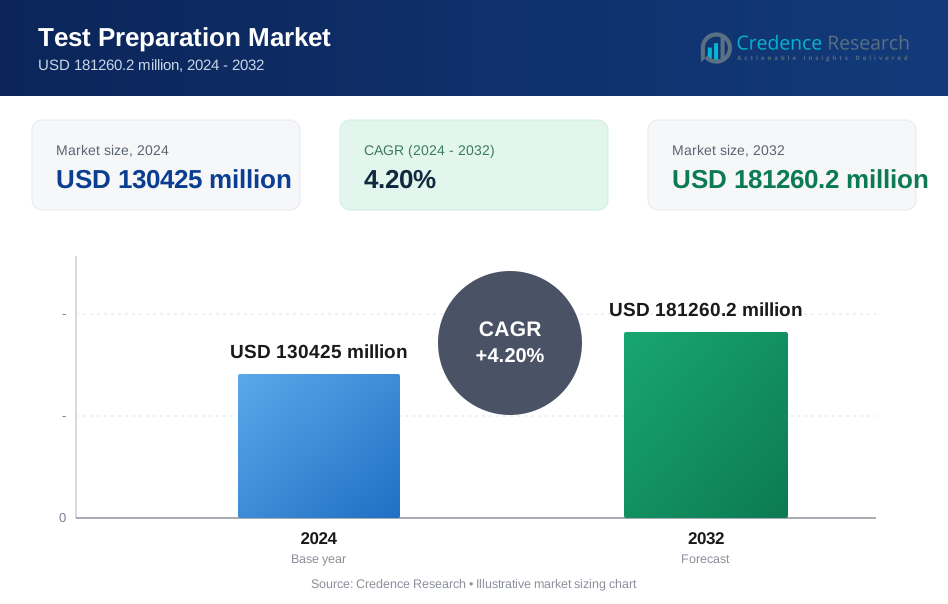
Test Preparation Market size was valued at USD 130425 million in 2024 and is anticipated to reach USD 181260.2 million by 2032, at a CAGR of 4.2% during the forecast period (2024-2032).
Key drivers of the Test Preparation Market include the rising adoption of online learning platforms, advancements in artificial intelligence and machine learning in test prep tools, and the growing preference for flexible and personalized learning methods. The integration of adaptive learning technology and gamification techniques has made test preparation more engaging and efficient, appealing to students and working professionals alike. Furthermore, the growing use of mobile apps for on-the-go learning is providing additional convenience. Additionally, the increasing number of government initiatives and educational reforms in various countries to enhance exam preparation access is expected to contribute significantly to market growth, particularly in emerging economies with large student populations.
Regionally, North America holds the largest share of the Test Preparation Market, attributed to the high prevalence of standardized exams like SAT, GRE, and GMAT. The region's well-established education system and the increasing adoption of digital learning platforms further strengthen its market dominance. Furthermore, the rising number of adult learners seeking professional certifications is also contributing to market growth in North America. However, the Asia Pacific region is anticipated to experience the highest growth rate during the forecast period, driven by the large student population, increasing education spending, and the rising need for test preparation services for competitive exams in countries like India and China. The shift towards online learning and the increasing number of EdTech startups in the region are also expected to accelerate growth. Europe and Latin America are also expected to show steady growth in the coming years, as the demand for test prep solutions rises alongside the growing middle class and education reforms.
Market Insights:
- The Test Preparation Market was valued at USD 130425 million in 2024 and is projected to reach USD 181260.2 million by 2032, growing at a 4.2% CAGR.
- Key drivers include the increasing adoption of online learning platforms, the rise of AI-powered personalized learning, and mobile app usage for on-the-go study solutions.
- Personalized and flexible learning methods are becoming more popular as test prep platforms offer tailored study plans based on individual learning needs and progress.
- Government initiatives and educational reforms are expanding access to digital learning tools, particularly in emerging markets, fostering market growth.
- North America holds 38% of the market share, driven by its established education system and significant investments in digital learning platforms.
- The Asia-Pacific region, accounting for 26% of the market, is expected to experience the highest growth, fueled by a large student population and increasing educational aspirations.
- Competition in the market is intense, with providers needing to differentiate through innovative, high-quality, and affordable test prep solutions to maintain customer loyalty.
Market Drivers:
Increasing Adoption of Online Learning Platforms
The Test Preparation Market is witnessing a significant shift due to the increasing adoption of online learning platforms. These platforms provide flexible, on-demand learning experiences that cater to the evolving needs of students and professionals preparing for various exams. The convenience of accessing test prep materials anytime and anywhere has significantly boosted their popularity. Furthermore, online platforms offer a wide range of resources, including practice tests, video tutorials, and interactive quizzes, which enhance the effectiveness of learning. The rise of mobile-friendly applications has also allowed learners to access content on-the-go, further driving market growth. As digital learning becomes more mainstream, it offers an efficient and scalable solution to meet the global demand for test preparation.
Advancements in Artificial Intelligence and Machine Learning
Advancements in artificial intelligence (AI) and machine learning (ML) are playing a pivotal role in shaping the Test Preparation Market. These technologies enable personalized learning experiences by analyzing a student’s strengths, weaknesses, and learning pace. AI-powered platforms can adapt and tailor the curriculum to suit individual needs, enhancing retention and performance. The increasing integration of AI and ML in test prep tools is making the learning process more efficient and engaging. By providing real-time feedback and targeted practice, these technologies significantly improve test readiness. The growing reliance on data analytics also helps students track their progress, ensuring they are well-prepared for exams.
- For instance, the Personalized Learning System enables users to upload 1 training dataset to fine-tune the Llama3 AI model for their specific exam preparation needs.
Personalized and Flexible Learning Methods
The growing preference for flexible and personalized learning methods is a significant driver for the Test Preparation Market. Many students and professionals prefer customized study plans that cater to their unique learning styles, which can be difficult to achieve with traditional methods. Test preparation platforms are leveraging adaptive learning technology to offer personalized study paths that adjust to the learner’s performance and progress. These platforms provide instant feedback, helping students focus on areas where they need improvement. The demand for such tailored learning experiences has increased, as more learners seek convenience and control over their educational journey.
- For instance, TurinQ allows a teacher to generate a full exam from 1 uploaded document using its AI-powered question generator.
Government Initiatives and Educational Reforms
Government initiatives and educational reforms across various countries are contributing to the expansion of the Test Preparation Market. In many regions, governments are recognizing the need for improved access to education and exam preparation services. This has led to increased funding and support for online learning initiatives, especially in emerging economies. Educational reforms are also promoting the use of digital platforms to ensure that students, regardless of their location, have access to quality test preparation resources. These efforts are making test prep services more accessible and affordable for a larger number of students. As governments invest in education and expand access to learning materials, the market is set to benefit from greater reach and adoption.
Market Trends:
Integration of Gamification and Interactive Features
One of the key trends shaping the Test Preparation Market is the integration of gamification and interactive features in learning platforms. Gamified elements, such as achievement badges, leaderboards, and progress tracking, are being incorporated into test prep tools to make learning more engaging and motivating. These features encourage students to actively participate and stay committed to their study routines. By offering rewards for completing tasks and mastering content, gamification enhances the learning experience and helps maintain learner interest. Interactive quizzes, practice exams, and simulation tools further support students in honing their skills and preparing for real-world testing conditions. The growing preference for such dynamic learning experiences is driving the market's evolution, as it offers a more enjoyable and effective method of test preparation.
- For instance, Duolingo incorporates features such as achievement badges, daily streaks, and leaderboards to encourage consistent language practice.
Rise of Mobile and On-the-Go Learning
The Test Preparation Market is also experiencing a shift towards mobile and on-the-go learning, with an increasing number of students and professionals using smartphones and tablets to access study materials. Mobile learning apps provide flexibility and convenience, allowing learners to prepare for exams while commuting or during short breaks throughout the day. The ability to access interactive lessons, practice tests, and video tutorials from mobile devices enhances the overall learning experience. The demand for mobile-based test prep solutions is particularly high among younger generations, who are more inclined to use digital devices for education. As mobile technology continues to improve, it enables test prep services to reach a broader audience, thus expanding the market. This trend is expected to grow further as the importance of flexible, location-independent learning increases.
- For instance, Superprofs has implemented proprietary video compression technology that streams high-definition classroom lectures at low internet speeds, reaching over 28,000 users for the Exam Kida app within just two months of launch.
Market Challenges Analysis:
High Competition Among Providers
The Test Preparation Market faces significant challenges due to the high level of competition among various test prep providers. With the increasing number of online platforms offering similar services, differentiating from competitors has become more difficult. Many platforms provide free or low-cost content, which further intensifies price competition. The challenge for providers is not only to offer comprehensive and effective test prep solutions but also to ensure their content is of superior quality and value. This competition pressures companies to continuously innovate and adapt to changing market needs, making it challenging to maintain long-term customer loyalty. As the market grows, companies must focus on creating unique value propositions to stay competitive.
Limited Access in Emerging Markets
Despite the growing adoption of digital learning, limited access to the internet and technological resources in emerging markets remains a challenge for the Test Preparation Market. Students in rural or underserved regions often lack the infrastructure required to benefit from online test prep tools. This digital divide creates an obstacle to expanding the market's reach and limits the adoption of online learning platforms. Providers must address these accessibility barriers by offering offline solutions, affordable data plans, or localized content to cater to these regions. Without these measures, the market’s growth potential in developing countries may be hindered.
Market Opportunities:
Expansion in Emerging Markets
The Test Preparation Market presents significant opportunities for growth in emerging markets, particularly in regions like Asia-Pacific, Latin America, and Africa. Rapid urbanization, increasing educational aspirations, and the growing demand for professional certifications are driving the need for test preparation services in these regions. As internet penetration continues to rise and mobile learning becomes more accessible, test prep platforms have the potential to reach untapped audiences in rural and underserved areas. Tailoring content to local languages, cultures, and exam systems could further enhance market penetration. Providers who focus on overcoming infrastructure challenges and offering affordable solutions can capitalize on the growing student populations in these regions.
Leveraging Artificial Intelligence for Personalized Learning
The Test Preparation Market also holds opportunities in integrating artificial intelligence (AI) to further personalize learning experiences. AI-powered tools can assess student performance, identify weaknesses, and adapt study materials to improve test outcomes. This level of personalization is highly attractive to students seeking more efficient and tailored learning methods. The application of AI in test prep can enhance content delivery, providing real-time feedback and targeted practice to meet individual learning needs. As AI technology continues to advance, test prep providers have the chance to innovate by offering smarter, more interactive learning platforms that improve engagement and success rates.
Market Segmentation Analysis:
By Learning Style
The Test Preparation Market is significantly influenced by learning styles, with three primary segments: traditional classroom-based learning, online learning, and hybrid methods. Online learning has gained considerable traction due to its flexibility, allowing students to access study materials at their own convenience. Hybrid models, which combine the benefits of online learning with in-person guidance, are becoming increasingly popular, offering a balanced approach to test preparation.
- For instance, Magoosh’s GRE prep platform provides access to 8 full sections of official ETS content for practice in 2025.
By Test Type
The market is also segmented by test type, focusing on standardized exams, professional certifications, and admission tests. Standardized exams such as the SAT, GRE, and GMAT dominate the market, driven by the high demand from students seeking admission to higher education institutions. The professional certification segment is growing rapidly as more working professionals pursue additional qualifications to advance their careers, further driving market expansion.
- For instance, The Princeton Review’s SAT users had a mean 2024 SAT score of 1,073.
By Student Type
The Test Preparation Market serves various student types, including primary and secondary school students, college-bound students, and working professionals. College-bound students represent the largest segment, propelled by the increasing competition for university spots. Working professionals also constitute an essential segment, as the demand for professional certifications continues to rise. The growing availability of online learning platforms tailored to professionals contributes to this segment’s growth.
Segmentations:
By Learning Style
- Traditional Classroom-based Learning
- Online Learning
- Hybrid Learning
By Test Type
- Standardized Exams
- Professional Certifications
- Admission Tests
By Student Type
- Primary and Secondary School Students
- College-bound Students
- Working Professionals
By Content Type
- Practice Tests
- Study Guides
- Video Tutorials
- Flashcards
- Interactive Quizzes
By Delivery Format
- Online Platforms
- Mobile Apps
- Printed Materials
- Live Classes
By Region
- North America
- U.S.
- Canada
- Mexico
- Europe
- Germany
- France
- U.K.
- Italy
- Spain
- Rest of Europe
- Asia Pacific
- China
- Japan
- India
- South Korea
- South-east Asia
- Rest of Asia Pacific
- Latin America
- Brazil
- Argentina
- Rest of Latin America
- Middle East & Africa
- GCC Countries
- South Africa
- Rest of the Middle East and Africa
Regional Analysis:
North America: Strong Market Leadership Driven by Education Systems and Digital Learning Platforms
North America holds a dominant share of 38% in the Test Preparation Market. The region's well-established education system, combined with significant investment in digital learning platforms, strengthens its market leadership. The growing number of professionals seeking certifications also contributes to market growth. With a robust infrastructure and widespread adoption of online learning, North America continues to lead the global market. Furthermore, the increasing reliance on mobile apps for test prep among students and professionals alike fuels the demand for innovative solutions in this region.
Asia-Pacific: Rapid Expansion Fueled by Large Student Population and Growing Educational Aspirations
Asia-Pacific accounts for 26% of the Test Preparation Market and is expected to experience the highest growth rate during the forecast period. The large student population, coupled with rising educational aspirations, particularly in countries like India, China, and Japan, drives this expansion. The growing preference for higher education and competitive exams has increased the demand for test prep services. As internet penetration rises and mobile-based learning becomes more prevalent, the market has the potential to reach a broader audience. Localized content and affordable solutions are essential to tap into this growing market, offering opportunities for both global and regional players.
Europe and Latin America: Steady Market Growth with Increasing Demand for Flexible Test Prep Solutions
Europe holds 20% of the Test Preparation Market, with steady growth expected in the coming years. Countries like the UK and Germany lead the way due to their strong education systems and widespread use of digital learning platforms. The demand for test prep services in Europe is driven by competitive exams for both higher education and professional certification. Latin America, while accounting for 16% of the market, also shows promise as educational reforms and increasing digitalization open new opportunities for test prep services. As access to the internet improves and mobile learning adoption grows, the market in both regions is expected to expand, driven by demand for accessible, flexible, and cost-effective learning solutions.
Key Player Analysis:
- Pearson PLC
- Kaplan, Inc.
- McGraw-Hill Education
- The Princeton Review
- Magoosh
- Exam Preparation Inc.
- Elite Educational Institute
- Testprep Online
- Manhattan Prep
- Varsity Tutors
Competitive Analysis:
The Test Preparation Market is highly competitive, with several established players dominating the landscape. Key companies like Pearson PLC, Kaplan, Inc., and McGraw-Hill Education lead the market by offering comprehensive test prep materials across various formats, including online platforms, mobile apps, and printed resources. These companies leverage extensive content libraries, proven methodologies, and high brand recognition to maintain their competitive edge. New entrants such as Magoosh and Varsity Tutors focus on personalized, on-demand learning solutions, appealing to students seeking flexible and cost-effective options. The increasing demand for online learning and mobile-based solutions has also fueled competition, with players constantly innovating to enhance user experience through gamification and AI-powered features. As the market evolves, providers must focus on differentiating their offerings with high-quality content, customer support, and tailored learning paths to capture and retain customers in an increasingly digital education environment.
Recent Developments:
- In June 2025, Pearson and Google announced a multi-year strategic partnership to accelerate the development of next-generation AI tools for students and educators, combining Pearson’s K-12 expertise with Google Cloud’s AI technologies to deliver richer, more personalized learning experiences.
- In February 2025, Kaplan partnered with the State of Illinois and the Illinois Student Assistance Commission to provide free test preparation and professional licensure courses to over 200,000 students at all Illinois public universities and select community colleges, powered by Kaplan’s All Access License.
- In August 2024, McGraw-Hill launched two generative AI tools: AI Reader, which helps college students engage with eBooks through interactive explanations and quizzes, and Writing Assistant, which offers real-time feedback for grades 6–12 and will be piloted in select school districts.
Market Concentration & Characteristics:
The Test Preparation Market exhibits moderate concentration, with a few key players such as Pearson PLC, Kaplan, Inc., and McGraw-Hill Education holding a significant share. These companies dominate through comprehensive, multi-channel offerings across both online and offline formats. While large companies lead in market share, smaller, niche players like Magoosh and Varsity Tutors are rapidly gaining ground by focusing on personalized and flexible learning solutions. The market is characterized by continuous innovation, particularly in digital learning tools, such as AI-driven platforms, mobile apps, and interactive content. This trend is shaping the market as students demand more accessible and tailored test prep solutions. Competitive dynamics are influenced by factors such as brand recognition, content quality, and customer engagement, with an increasing shift toward mobile and online learning methods driving the evolution of the Test Preparation Market.
Report Coverage:
The research report offers an in-depth analysis based on Learning Style, Test Type, Student Type, Content Type, Delivery Format and Region. It details leading market players, providing an overview of their business, product offerings, investments, revenue streams, and key applications. Additionally, the report includes insights into the competitive environment, SWOT analysis, current market trends, as well as the primary drivers and constraints. Furthermore, it discusses various factors that have driven market expansion in recent years. The report also explores market dynamics, regulatory scenarios, and technological advancements that are shaping the industry. It assesses the impact of external factors and global economic changes on market growth. Lastly, it provides strategic recommendations for new entrants and established companies to navigate the complexities of the market.
Future Outlook:
- The Test Preparation Market will see continued growth driven by the increasing adoption of digital learning platforms, offering flexibility and accessibility for a global audience.
- Mobile-based learning solutions will become more prevalent, allowing students to prepare for exams on the go, increasing the reach of test preparation tools.
- Artificial intelligence (AI) and machine learning (ML) technologies will play a significant role in personalizing test prep, creating adaptive learning paths tailored to individual needs.
- Online test prep solutions will continue to dominate, with an emphasis on providing interactive and engaging content such as video tutorials, quizzes, and simulations.
- The growing demand for professional certifications will fuel the need for specialized test preparation services targeted at working professionals seeking career advancement.
- Gamification features will become a significant trend in test prep platforms, helping to increase student engagement and retention by making learning more enjoyable.
- Data analytics will be increasingly used to monitor student performance and adjust learning content, ensuring continuous improvement in preparation strategies.
- The Asia-Pacific region, with its large student population and rising educational aspirations, will see significant growth, becoming a key market for test prep services.
- Regulatory support and government initiatives aimed at improving educational access will further contribute to the market's growth, especially in emerging economies.
- Eco-friendly digital delivery methods will reduce reliance on printed materials, aligning with sustainability trends and addressing the growing demand for environmentally responsible solutions.
Request a Free Sample
Fill in your details and we'll send you a free sample report.
- Sample data tables & charts
- Research methodology
Market Dynamics
Increasing Adoption of Online Learning Platforms
The shift to online learning platforms provides flexible, on-demand access to test preparation resources, making it easier for students and professionals to study at their convenience and driving overall market growth.
Advancements in Artificial Intelligence and Machine Learning
AI and ML technologies enable personalized learning experiences by adapting study plans to individual strengths and weaknesses, improving learning outcomes and making test prep more efficient and engaging.
Growing Preference for Personalized and Flexible Learning Methods
Students and professionals increasingly seek tailored study plans and adaptive learning paths, which test prep providers are delivering through technology-driven solutions, boosting market demand.
Government Initiatives and Educational Reforms
Government support for digital education and reforms aimed at expanding access to quality test preparation, especially in emerging markets, are increasing the reach and affordability of test prep services.
Rise of Mobile and On-the-Go Learning
The proliferation of mobile apps allows learners to access test prep materials anytime and anywhere, catering to busy lifestyles and expanding the market to a broader, tech-savvy audience.
Need a Custom Version of This Report?
Tailor the scope, geography, or segments to your exact requirements.
- Custom geography or segment scope
- Direct access to our analyst team
Frequently Asked Questions
What is the current size of the Test Preparation Market?
What factors are driving the growth of the Test Preparation Market?
Which region holds the largest share of the Test Preparation Market?
Which region is expected to experience the highest growth rate?
What is the role of government initiatives in the Test Preparation Market?
Table of Content
Chapter 1 Market Segmentation
- 1.1 Segmentation Framework
- 1.1.1 Product and Service Classification
- 1.1.2 Application and End-Use Classification
- 1.1.3 Technology and Solution Classification
- 1.1.4 Customer and Distribution Channel Classification
- 1.1.5 Geographic Segmentation
- 1.1.6 Market Segment Definitions and Boundaries
- 1.2 By Test Type
- 1.2.1 Standardized Exams
- 1.2.2 Professional Certifications
- 1.2.3 Admission Tests
- 1.3 By Student Type
- 1.3.1 Primary and Secondary School Students
- 1.3.2 College-bound Students
- 1.3.3 Working Professionals
- 1.4 By Learning Style
- 1.4.1 Traditional Classroom-based Learning
- 1.4.2 Online Learning
- 1.4.3 Hybrid Learning
- 1.5 By Delivery Format
- 1.5.1 Online Platforms
- 1.5.2 Mobile Apps
- 1.5.3 Printed Materials
- 1.5.4 Live Classes
Chapter 2 Introduction
- 2.1 Report Objectives and Scope
- 2.2 Product Definition and Industry Terminology
- 2.3 Market Inclusions and Exclusions
- 2.4 Research Process
- 2.4.1 Primary Research and Expert Interviews
- 2.4.2 Secondary Research and Source Review
- 2.4.3 Top-Down and Bottom-Up Estimation
- 2.4.4 Data Triangulation and Verification
- 2.5 Market Size Measurement Basis
- 2.5.1 2024: USD 130425 million → 2032: USD 181260.2 million
- 2.6 Historical and Forecast Reference Periods
- 2.6.1 Base Year: 2024
- 2.6.2 Forecast Period: 2024-2032
- 2.7 Research Assumptions and Limitations
Chapter 3 Executive Summary
- 3.1 Market Snapshot and Key Findings
- 3.2 Base-Year Market Size, 2024
- 3.3 Forecast Market Size, 2032
- 3.4 Revenue and Volume Growth Outlook
- 3.5 Key Demand and Supply Indicators
- 3.6 Leading Market Segments
- 3.7 Fastest-Growing Market Opportunities
- 3.8 Regional Performance Highlights
- 3.9 Technology and Industry Transformation
- 3.10 Competitive Landscape Summary
- 3.11 Analyst View and Strategic Implications
Chapter 4 Global Test Preparation Market Trends and Developments
- 4.1 Historical Industry Development
- 4.2 Recent Market Trends and Developments
- 4.3 Demand and Customer Behavior Trends
- 4.4 Technology and Product Innovation
- 4.5 Artificial Intelligence, Automation and Digitalization
- 4.6 Local Manufacturing and Supply Chain Realignment
- 4.7 Industry Partnerships, Mergers and Acquisitions
- 4.8 Sustainability and Circular Economy Developments
- 4.9 Government and Private Sector Investment Trends
- 4.10 Emerging Business Models and Commercialization
- 4.11 Industry Developments and Announcements
Chapter 5 Global Test Preparation Market Production, Supply and Demand Analysis
- 5.1 Demand Trend and Consumption Analysis
- 5.2 Demand Forecast, 2024-2032
- 5.3 Production and Output Trend
- 5.4 Production and Output Forecast, 2024-2032
- 5.5 Installed Capacity and Capacity Utilization
- 5.6 Company-Wise Production Plants and Statistics
- 5.6.1 Installed Production Capacity
- 5.6.2 Actual Production
- 5.6.3 Planned Capacity and Expansion Targets
- 5.7 Supply Chain Structure and Procurement Trends
- 5.8 Supply-Demand Gap and Bottlenecks
- 5.9 Import Dependence and Sourcing Structure
- 5.10 Contract Manufacturing and Outsourcing
- 5.11 Regional Supply and Demand Concentration
Chapter 6 Global Test Preparation Market Pricing Analysis
- 6.1 Pricing Structure and Measurement
- 6.2 Historical Pricing Trends
- 6.3 Pricing Outlook, 2024-2032
- 6.4 Average Selling Price and Unit Economics
- 6.5 Pricing by Product and Market Segment
- 6.6 Geographic Pricing Differences
- 6.7 Key Input, Energy, Labor and Logistics Costs
- 6.8 Contract Pricing and Purchasing Models
- 6.9 Pricing Sensitivity and Competitive Positioning
- 6.10 Price, Margin and Profitability Implications
Chapter 7 Global Test Preparation Market Dynamics
- 7.1 Market Growth Drivers
- 7.1.1 Demand-Side Drivers
- 7.1.2 Technology and Innovation Drivers
- 7.1.3 Infrastructure and Investment Drivers
- 7.1.4 Regulatory and Policy Drivers
- 7.2 Market Restraints
- 7.2.1 Cost and Affordability Constraints
- 7.2.2 Technology and Adoption Barriers
- 7.2.3 Supply Chain and Operational Constraints
- 7.3 Market Challenges
- 7.3.1 Competitive Pressure and Margin Erosion
- 7.3.2 Skills, Infrastructure and Implementation Gaps
- 7.4 Emerging Market Opportunities
- 7.5 Market Dynamics Impact and Time-Horizon Assessment
Chapter 8 Global Test Preparation Value Chain Analysis
- 8.1 Industry Value Chain Overview
- 8.2 Upstream Suppliers and Critical Inputs
- 8.3 Technology and Component Providers
- 8.4 Manufacturing or Service Delivery
- 8.5 Distribution, Channel Partners and Integrators
- 8.6 Downstream Applications and End Users
- 8.7 Value Addition and Profit Pools
- 8.8 Vertical Integration and Outsourcing
- 8.9 Supplier Concentration and Risk
- 8.10 Supply Chain Localization and Resilience
Chapter 9 Global Test Preparation Market Regulations and Policies
- 9.1 Relevant Laws, Standards and Compliance Frameworks
- 9.2 Product, Service, Safety and Quality Requirements
- 9.3 Government Policies, Incentives and Subsidies
- 9.4 Imports, Exports and Trade Barriers
- 9.5 Public Procurement and Local Content Requirements
- 9.6 Environmental and Sustainability Compliance
- 9.7 Upcoming Policy Changes and Market Implications
Chapter 10 Global Test Preparation Market Hotspots and Opportunities
- 10.1 Market Opportunity Mapping and Growth Hotspots
- 10.2 High-Growth Applications and Customer Groups
- 10.3 Underserved Markets and White-Space Opportunities
- 10.4 Emerging Technology and Product Opportunities
- 10.5 New Capacity and Investment Hotspots
- 10.6 Market Entry and Expansion Opportunities
- 10.7 Distribution and Partnership Opportunities
- 10.8 Near-Term and Long-Term Commercial Potential
- 10.9 Opportunity Attractiveness and Execution Risks
Chapter 11 Global Test Preparation Market Outlook, 2024-2032
- 11.1 Market Size and Analysis
- 11.1.1 Revenue (Market Measurement: 2024: USD 130425 million → 2032: USD 181260.2 million)
- 11.1.2 Market Volume and Quantity Sold
- 11.1.3 Historical Market Size
- 11.1.4 Base-Year Market Size, 2024
- 11.2 Market Forecast, 2024-2032
- 11.2.1 Revenue Forecast to 2032
- 11.2.2 Volume Forecast to 2032
- 11.2.3 CAGR and Year-on-Year Growth
- 11.2.4 Incremental Revenue Opportunity
- 11.3 Forecast Assumptions and Scenario Analysis
- 11.3.1 Base-Case Forecast
- 11.3.2 Optimistic and Conservative Scenarios
- 11.3.3 Technology, Pricing and Policy Sensitivities
- 11.4 Market Attractiveness and Growth Outlook
Chapter 12 Global Test Preparation Market Segmentation and Outlook
- 12.1 Segmentation Summary and Market Shares, 2024
- 12.2 Largest and Fastest-Growing Segments
- 12.3 By Test Type - Market Size and Forecast, 2024-2032
- 12.3.1 Segment Definition and Scope
- 12.3.2 Historical Market Size
- 12.3.3 Revenue Forecast, 2024-2032
- 12.3.4 Volume Forecast, 2024-2032
- 12.3.5 Base-Year Market Share, 2024
- 12.3.6 Segment CAGR and Growth Drivers
- 12.3.7 Subsegment Market Size and Forecast
- 12.3.7.1 Standardized Exams
- 12.3.7.2 Professional Certifications
- 12.3.7.3 Admission Tests
- 12.3.8 Subsegment Pricing and Adoption Trends
- 12.3.9 Leading Suppliers and Competition
- 12.3.10 Regional Demand and Opportunities
- 12.4 By Student Type - Market Size and Forecast, 2024-2032
- 12.4.1 Segment Definition and Scope
- 12.4.2 Historical Market Size
- 12.4.3 Revenue Forecast, 2024-2032
- 12.4.4 Volume Forecast, 2024-2032
- 12.4.5 Base-Year Market Share, 2024
- 12.4.6 Segment CAGR and Growth Drivers
- 12.4.7 Subsegment Market Size and Forecast
- 12.4.7.1 Primary and Secondary School Students
- 12.4.7.2 College-bound Students
- 12.4.7.3 Working Professionals
- 12.4.8 Subsegment Pricing and Adoption Trends
- 12.4.9 Leading Suppliers and Competition
- 12.4.10 Regional Demand and Opportunities
- 12.5 By Learning Style - Market Size and Forecast, 2024-2032
- 12.5.1 Segment Definition and Scope
- 12.5.2 Historical Market Size
- 12.5.3 Revenue Forecast, 2024-2032
- 12.5.4 Volume Forecast, 2024-2032
- 12.5.5 Base-Year Market Share, 2024
- 12.5.6 Segment CAGR and Growth Drivers
- 12.5.7 Subsegment Market Size and Forecast
- 12.5.7.1 Traditional Classroom-based Learning
- 12.5.7.2 Online Learning
- 12.5.7.3 Hybrid Learning
- 12.5.8 Subsegment Pricing and Adoption Trends
- 12.5.9 Leading Suppliers and Competition
- 12.5.10 Regional Demand and Opportunities
- 12.6 By Delivery Format - Market Size and Forecast, 2024-2032
- 12.6.1 Segment Definition and Scope
- 12.6.2 Historical Market Size
- 12.6.3 Revenue Forecast, 2024-2032
- 12.6.4 Volume Forecast, 2024-2032
- 12.6.5 Base-Year Market Share, 2024
- 12.6.6 Segment CAGR and Growth Drivers
- 12.6.7 Subsegment Market Size and Forecast
- 12.6.7.1 Online Platforms
- 12.6.7.2 Mobile Apps
- 12.6.7.3 Printed Materials
- 12.6.7.4 Live Classes
- 12.6.8 Subsegment Pricing and Adoption Trends
- 12.6.9 Leading Suppliers and Competition
- 12.6.10 Regional Demand and Opportunities
- 12.7 Segment Growth Comparison
- 12.8 Segment Attractiveness and Priority Matrix
Chapter 13 Global Test Preparation Geographic Market Outlook, 2024-2032
- 13.1 Regional Market Size and Share, 2024
- 13.2 Regional Market Forecast, 2024-2032
- 13.3 Regional Pricing, Production and Demand Differences
- 13.4 North America
- 13.4.1 United States
- 13.4.2 Canada
- 13.4.3 Mexico
- 13.5 Europe
- 13.5.1 Germany
- 13.5.2 France
- 13.5.3 Italy
- 13.5.4 United Kingdom
- 13.5.5 Spain
- 13.5.6 Poland
- 13.5.7 Russia
- 13.5.8 Netherlands
- 13.5.9 Belgium
- 13.5.10 Sweden
- 13.5.11 Denmark
- 13.5.12 Norway
- 13.5.13 Rest of Europe
- 13.6 Asia Pacific
- 13.6.1 China
- 13.6.2 India
- 13.6.3 Japan
- 13.6.4 South Korea
- 13.6.5 Thailand
- 13.6.6 Indonesia
- 13.6.7 Vietnam
- 13.6.8 Malaysia
- 13.6.9 Australia
- 13.6.10 Rest of Asia Pacific
- 13.7 Latin America
- 13.7.1 Brazil
- 13.7.2 Argentina
- 13.7.3 Colombia
- 13.7.4 Chile
- 13.7.5 Rest of Latin America
- 13.8 Middle East
- 13.8.1 Saudi Arabia
- 13.8.2 United Arab Emirates
- 13.8.3 Turkey
- 13.8.4 Israel
- 13.8.5 Iran
- 13.8.6 Rest of the Middle East
- 13.9 Africa
- 13.9.1 South Africa
- 13.9.2 Egypt
- 13.9.3 Nigeria
- 13.9.4 Morocco
- 13.9.5 Rest of Africa
- 13.10 Regional Investment, Policy and Supply Chain Differences
- 13.11 Regional Competitive Landscape
- 13.12 Geographic Growth Hotspots
Chapter 14 Global Test Preparation Technology, Innovation and Sustainability Outlook
- 14.1 Technology Landscape and Maturity
- 14.2 Product, Process and Service Innovation
- 14.3 AI, Automation and Digital Tools in the Industry
- 14.4 Technology Adoption and Performance Benchmarking
- 14.5 Innovation Pipeline and R&D Investment
- 14.6 Patent and Intellectual Property Trends
- 14.7 Energy Efficiency and Resource Management
- 14.8 Sustainability, Recycling and Circularity
- 14.9 Technology Roadmap, 2024-2032
- 14.10 Risks of Obsolescence and Technology Substitution
Chapter 15 Global Test Preparation Market Key Strategic Imperatives
- 15.1 Growth and Market Entry Priorities
- 15.2 High-Return Products and Segments
- 15.3 Pricing, Profitability and Cost Optimization
- 15.4 Technology Investment and Product Differentiation
- 15.5 Supply Chain Localization and Resilience
- 15.6 Distribution and Customer Acquisition
- 15.7 Partnership, Acquisition and Capacity Strategy
- 15.8 Regional Expansion Priorities
- 15.9 Short-, Medium- and Long-Term Actions
Chapter 16 Competition Outlook
- 16.1 Industry Competition Characteristics
- 16.2 Market Structure and Concentration
- 16.3 Market Share and Competitive Positioning, 2024
- 16.4 Company-Wise Revenue and Product Benchmarking
- 16.5 Production and Service Capacity Benchmarking
- 16.6 Technology, Pricing and Differentiation
- 16.7 Regional Footprint and Distribution Strength
- 16.8 Mergers, Acquisitions and Strategic Alliances
- 16.9 New Entrants and Competitive Threats
- 16.10 Porter's Five Forces and Industry Attractiveness
- 16.11 Competitive Outlook, 2024-2032
Chapter 17 Company Profiles
- 17.1 Company Coverage and Selection Criteria
- 17.2 Pearson PLC
- 17.2.1 Business Description
- 17.2.2 Company Ownership and Geographic Presence
- 17.2.3 Product and Service Portfolio
- 17.2.4 Manufacturing and Operating Footprint
- 17.2.5 Production Capacity and Expansion Plans
- 17.2.6 Financial Performance and Investment
- 17.2.7 Market Share and Competitive Position
- 17.2.8 Technology and Innovation Capabilities
- 17.2.9 Strategic Alliances or Partnerships
- 17.2.10 Recent Developments
- 17.2.11 Growth Strategy and Outlook
- 17.3 Kaplan, Inc.
- 17.4 McGraw-Hill Education
- 17.5 The Princeton Review
- 17.6 Magoosh
- 17.7 Exam Preparation Inc.
- 17.8 Elite Educational Institute
- 17.9 Testprep Online
- 17.10 Manhattan Prep
- 17.11 Varsity Tutors
- 17.12 Other Relevant Market Participants
Note: Every listed company is profiled on the structure shown under the first company. The company list is preliminary and may change based on research findings, market developments, data availability and client requirements.
Chapter 18 Disclaimer
- 18.1 Research and Forecast Disclaimer
- 18.2 Data Source and Estimation Limitations
Note: The depth of individual sections depends on data availability for this market. Volume, capacity, trade and other unit-based metrics are included where applicable.

