
Market Overview:
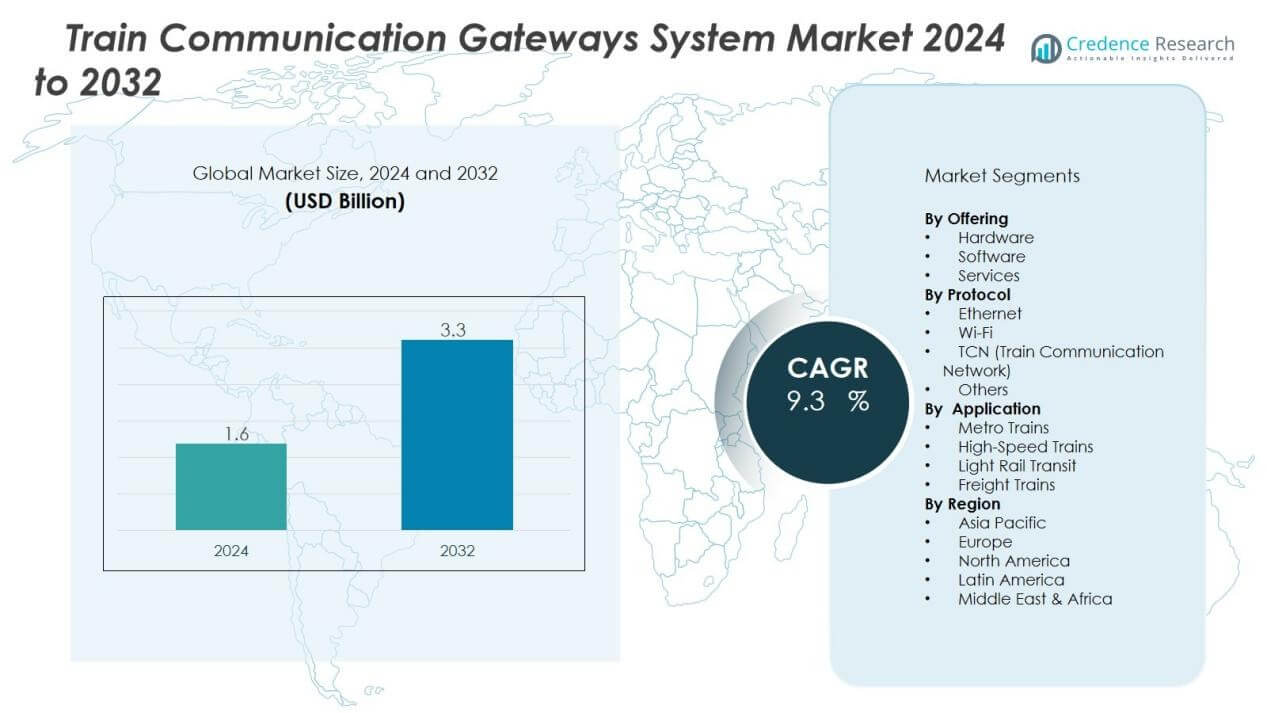
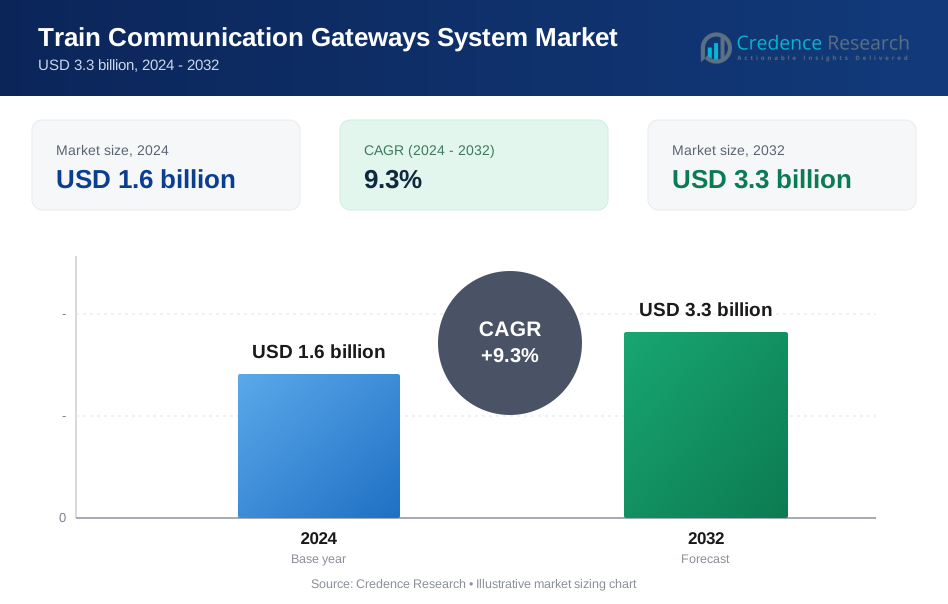
The train communication gateways system market size was valued at USD 1.6 billion in 2024 and is anticipated to reach USD 3.3 billion by 2032, at a CAGR of 9.3 % during the forecast period (2024-2032).
| REPORT ATTRIBUTE | DETAILS |
|---|---|
| Historical Period | 2020-2023 |
| Base Year | 2024 |
| Forecast Period | 2025-2032 |
| Train Communication Gateways System Market Size 2024 | USD 1.6 Billion |
| Train Communication Gateways System Market, CAGR | 9.3% |
| Train Communication Gateways System Market Size 2032 | USD 3.3 Billion |
Strong market drivers include the rising adoption of automation in rail operations, the need for enhanced safety and monitoring systems, and increasing investments in smart rail infrastructure. Growing emphasis on passenger comfort and connectivity, supported by advanced communication solutions, fuels further adoption. In addition, regulatory standards promoting interoperability across diverse train systems encourage wider deployment of gateways.
Regionally, Europe holds a dominant position due to its well-established rail infrastructure and strong adoption of digital rail solutions. North America follows, supported by ongoing rail modernization projects and advanced safety mandates. The Asia-Pacific region is expected to witness the fastest growth, led by rapid urbanization, expansion of high-speed rail, and significant government investments in smart transportation. Meanwhile, Latin America and the Middle East & Africa show emerging potential with rising infrastructure development initiatives.
Market Insights:
- The train communication gateways system market was valued at USD 1.6 billion in 2024 and is projected to reach USD 3.3 billion by 2032, growing at a CAGR of 9.3%.
- Rising demand for efficient onboard communication drives adoption as operators seek reliable systems to connect propulsion, brakes, and passenger information subsystems.
- Growing focus on passenger experience fuels demand for gateways that support Wi-Fi, infotainment, and real-time updates, improving comfort and satisfaction.
- Expansion of smart rail infrastructure and automation creates strong opportunities, with gateways enabling predictive maintenance and seamless integration across modern rail networks.
- Regulatory standards and strict safety compliance requirements push operators to adopt gateways that ensure secure data exchange and interoperability.
- High implementation costs and integration challenges remain barriers, particularly for smaller operators and regions with limited budgets.
- Europe leads with 38% market share due to advanced rail infrastructure, while Asia-Pacific, with 24%, shows the fastest growth from rapid urbanization and high-speed rail investments.
Market Drivers:
Rising Demand for Efficient and Reliable Onboard Communication:
The train communication gateways system market benefits from increasing demand for seamless and efficient onboard communication. Operators seek advanced solutions to connect different subsystems, including propulsion, brakes, doors, and passenger information systems. It ensures interoperability between varied train technologies and enhances coordination. Reliable gateways reduce delays, improve real-time monitoring, and strengthen safety compliance across modern rail networks.
- For instance, Siemens Mobility deployed its Train Communication Network (TCN) gateways across European high-speed rail lines featuring a real-time diagnostics capability processing data from over 100 sensors per train to boost operational efficiency and predictive maintenance.
Growing Focus on Passenger Experience and Connectivity:
Passenger expectations for high-quality services drive adoption of communication gateways. The train communication gateways system market addresses this demand by enabling features such as Wi-Fi, infotainment, and live travel updates. These systems enhance comfort and provide real-time information to passengers. It supports operators in improving customer satisfaction and attracting higher ridership. Strong focus on smart mobility aligns with government and operator objectives to modernize rail systems.
- For instance, Luxoft developed a robust communications solution for a major European express train fleet, achieving network switchover times under 3 seconds and full recovery from failures within 50 seconds, enabling uninterrupted infotainment and Wi-Fi services across multiple train wagons.
Expansion of Smart Rail Infrastructure and Automation:
Rapid expansion of smart rail infrastructure fuels the integration of communication gateways. Automation in signaling, control, and monitoring systems requires reliable gateways to manage data exchange. The train communication gateways system market gains strength from rising investments in high-speed rail and metro projects. It plays a vital role in optimizing operations, reducing downtime, and enabling predictive maintenance. This trend aligns with global goals for efficient and sustainable transport.
Regulatory Standards and Emphasis on Safety Compliance:
Regulatory frameworks and strict safety mandates drive the adoption of communication gateways. The train communication gateways system market ensures compliance with interoperability standards set by regional and international authorities. Gateways provide secure data exchange, support emergency communication, and enable fault diagnostics. It assists operators in meeting safety goals and avoiding operational risks. Rising awareness of passenger safety further accelerates integration across rail systems.
Market Trends:
Integration of Advanced Digital Technologies and IoT in Rail Communication:
The train communication gateways system market is witnessing strong adoption of advanced digital technologies and IoT solutions. Operators integrate gateways with cloud-based platforms to enable real-time data collection, monitoring, and predictive maintenance. It enhances efficiency by allowing seamless communication between train subsystems and external control centers. Growing demand for IP-based communication protocols improves interoperability across diverse fleets. The trend supports automation initiatives and provides a foundation for smart transportation networks. Increasing use of cybersecurity features within gateways also reflects the priority to protect sensitive data and operational continuity.
- For instance, Talgo streams 2,000 sensor signals per second from each train in real time to Google Cloud Platform, enabling predictive maintenance and reducing downtime, while SNCF installs 2 to 4 LoRaWAN gateways per train to ensure 99% communication success rate across 6 to 10 car trains.
Rising Adoption of High-Speed Rail and Smart Mobility Solutions:
Global expansion of high-speed rail projects is a significant trend shaping communication gateway demand. The train communication gateways system market benefits from the need for advanced data handling in faster and more complex rail systems. Gateways support enhanced passenger services, including infotainment, ticketing, and real-time travel information. It plays a crucial role in integrating safety systems, signaling, and remote diagnostics within high-speed operations. Growing focus on smart city development also drives deployment of connected rail solutions. Rail operators are prioritizing energy efficiency, reduced downtime, and improved passenger experiences through these systems. Continuous investments in smart mobility ensure a steady outlook for gateway adoption worldwide.
- For instance, Huawei’s AirEngine 6760-51EI access points achieve an average train-to-ground backhaul bandwidth of 950 Mbps on trains running at 350 km/h, ensuring seamless real-time services and diagnostics.
Market Challenges Analysis:
High Implementation Costs and Complexity of Integration:
The train communication gateways system market faces significant challenges due to high implementation costs and complex integration requirements. Operators often struggle with budget constraints when upgrading legacy systems to advanced digital gateways. It becomes difficult to align diverse train subsystems with modern communication protocols. Integration across multiple platforms requires specialized expertise and increases project timelines. Smaller operators and emerging regions find these costs a barrier to adoption. The challenge of ensuring seamless compatibility across different manufacturers further complicates deployment.
Cybersecurity Risks and Regulatory Compliance Pressures:
Growing reliance on digital and IoT-enabled gateways introduces vulnerabilities to cybersecurity threats. The train communication gateways system market must address risks of data breaches, operational disruptions, and safety hazards. It requires continuous investment in secure architectures and compliance with strict regulatory standards. Evolving requirements from international authorities place pressure on operators to adopt certified solutions. Frequent updates and testing raise costs and operational burdens for rail companies. Ensuring both data security and uninterrupted service remains a persistent challenge in the market.
Market Opportunities:
Expansion of High-Speed Rail Projects and Smart Infrastructure Development:
The train communication gateways system market holds strong opportunities through the rapid expansion of high-speed rail and smart infrastructure projects worldwide. Governments are investing heavily in advanced metro and intercity networks to improve connectivity and reduce congestion. It creates demand for gateways that ensure interoperability, real-time monitoring, and enhanced safety across large-scale systems. Integration of communication solutions with smart city initiatives further widens adoption. Rail modernization programs in emerging economies present untapped growth potential. Rising investments in green mobility and sustainable transport also encourage gateway deployment.
Growing Adoption of IoT and Cloud-Based Rail Solutions:
Increased adoption of IoT and cloud technologies provides a promising growth path for the train communication gateways system market. Operators can leverage connected gateways for predictive maintenance, fleet optimization, and improved passenger services. It supports remote diagnostics, cybersecurity upgrades, and real-time data analytics to boost efficiency. Demand for IP-based protocols strengthens interoperability across global rail networks. Cloud-enabled solutions also reduce infrastructure costs and allow scalable integration. The growing focus on digital transformation in railways enhances opportunities for suppliers to offer innovative gateway systems.
Market Segmentation Analysis:
By Offering:
The train communication gateways system market is segmented into hardware, software, and services. Hardware holds a strong share due to rising demand for gateways that connect propulsion, braking, and passenger systems. Software solutions are gaining traction with growing integration of IoT and cloud platforms. It enables predictive maintenance, real-time monitoring, and interoperability across multiple subsystems. Services support deployment, training, and maintenance, driving long-term adoption among operators.
- For instance, Selectron Systems’ Wire Train Bus Gateway, certified according to IEC 61375, supports three consist communication types (ETH, CAN, and MVB) and operates redundantly to ensure high reliability in connecting multiple vehicle subsystems.
By Protocol:
Market segmentation by protocol includes Ethernet, Wi-Fi, TCN (Train Communication Network), and others. Ethernet leads due to its ability to handle high data volumes with low latency. Wi-Fi adoption is expanding to support passenger connectivity and infotainment services. The TCN protocol remains critical for ensuring communication across train control systems. It offers proven reliability for safety-critical applications. Operators are increasingly adopting hybrid protocols to balance performance and flexibility.
- For instance, Bombardier Transportation, in their regional trains delivered in Germany and the Netherlands, implemented an onboard Ethernet network managing the entire train control data with 400 Westermo REDFOX railway switches deployed, supporting network speeds up to 1 Gbps while reducing costs and increasing functionality compared to traditional TCN systems.
By Application:
Applications include metro trains, high-speed trains, light rail transit, and freight trains. Metro trains dominate with strong adoption in urban mobility projects and smart city initiatives. High-speed trains are a fast-growing segment, driven by investments in advanced rail infrastructure. Light rail transit benefits from urban expansion and government-backed transport initiatives. It also gains support from growing focus on sustainable, energy-efficient transport solutions. Freight trains present steady demand, supported by logistics and cross-border trade modernization.
Segmentations:
By Offering:
- Hardware
- Software
- Services
By Protocol:
- Ethernet
- Wi-Fi
- TCN (Train Communication Network)
- Others
By Application:
- Metro Trains
- High-Speed Trains
- Light Rail Transit
- Freight Trains
By Region:
- North America
- U.S.
- Canada
- Mexico
- Europe
- UK
- France
- Germany
- Italy
- Spain
- Russia
- Belgium
- Netherlands
- Austria
- Sweden
- Poland
- Denmark
- Switzerland
- Rest of Europe
- Asia Pacific
- China
- Japan
- South Korea
- India
- Australia
- Thailand
- Indonesia
- Vietnam
- Malaysia
- Philippines
- Taiwan
- Rest of Asia Pacific
- Latin America
- Brazil
- Argentina
- Peru
- Chile
- Colombia
- Rest of Latin America
- Middle East
- UAE
- KSA
- Israel
- Turkey
- Iran
- Rest of Middle East
- Africa
- Egypt
- Nigeria
- Algeria
- Morocco
- Rest of Africa
Regional Analysis:
Europe:
Europe holds 38% market share in the train communication gateways system market, making it the leading region. It benefits from advanced rail infrastructure, strong regulatory support, and early adoption of digital communication technologies. European Union initiatives promoting rail interoperability and safety standards further accelerate demand. Countries such as Germany, France, and the U.K. invest heavily in high-speed rail and smart transportation networks. Integration of IoT and automation into metro and intercity systems strengthens the region’s leadership. Continuous upgrades of passenger services and real-time monitoring drive further deployment of gateways.
North America:
North America accounts for 27% market share in the train communication gateways system market, positioning it as a key regional contributor. It is supported by modernization projects, advanced signaling systems, and strong adoption of IoT-based communication. The U.S. leads with ongoing investment in commuter and freight rail networks. Implementation of cybersecurity standards and safety compliance drives replacement of outdated systems. Canada also invests in expanding metro and regional connectivity projects. The region emphasizes predictive maintenance and passenger connectivity, fueling steady demand for advanced gateways.
Asia-Pacific:
Asia-Pacific represents 24% market share in the train communication gateways system market, with the fastest growth outlook. It is driven by large-scale investments in metro rail, high-speed rail, and urban transport projects. China, India, and Japan lead with government-backed infrastructure initiatives and rapid urbanization. Expanding smart city programs create strong demand for real-time communication solutions. The region also benefits from rising passenger volumes and focus on safety standards. Increasing deployment of cloud-based and IP-enabled gateways positions Asia-Pacific as a high-potential growth hub.
Key Player Analysis:
- Alstom
- Belden
- AMiT Transportation
- Duagon
- SYS TEC Electronic
- HaslerRail
- Ingeteam
- EKE-Electronics
- Quester Tangent
Competitive Analysis:
The train communication gateways system market features strong competition among established global and regional players. Key companies include Alstom, Belden, AMiT Transportation, Duagon, SYS TEC Electronic, HaslerRail, and Ingeteam, each focusing on expanding product portfolios and technological capabilities. It is driven by the rising need for reliable interoperability, real-time monitoring, and compliance with international safety standards. Companies invest in R&D to introduce gateways that support IoT, IP-based communication, and cybersecurity features. Strategic partnerships with rail operators and infrastructure providers enhance market reach and strengthen long-term contracts. Continuous upgrades in metro, high-speed, and freight rail networks create consistent demand for advanced solutions. The competitive landscape remains dynamic, with innovation and regulatory alignment as the primary differentiators.
Recent Developments:
- In July 2025, Aptean launched the Aptean Fresh Produce ERP, a cloud-native evolution of its Produce Pro Software, featuring AI-powered analytics and integration with Microsoft 365.
- In May 2025, Duagon partnered with Cylus to deliver a fleetwide cybersecurity solution for rolling stock by integrating Duagon's D527 Multi-Ethernet Secure Gateway with Cylus's rail-specific cybersecurity platform CylusOne, providing built-in protection, real-time threat detection, and regulatory compliance for rail operators.
- In March 2025, Alliance Machine Systems International completed the acquisition of SYS TEC Corporation to enhance development and expansion of paperboard and folding carton automation and material handling equipment.
Report Coverage:
The research report offers an in-depth analysis based on Offering, Protocol, Application and Region. It details leading Market players, providing an overview of their business, product offerings, investments, revenue streams, and key applications. Additionally, the report includes insights into the competitive environment, SWOT analysis, current Market trends, as well as the primary drivers and constraints. Furthermore, it discusses various factors that have driven Market expansion in recent years. The report also explores Market dynamics, regulatory scenarios, and technological advancements that are shaping the industry. It assesses the impact of external factors and global economic changes on Market growth. Lastly, it provides strategic recommendations for new entrants and established companies to navigate the complexities of the Market.
Future Outlook:
- The train communication gateways system market will continue to evolve with stronger integration of IoT and cloud platforms, enabling smarter operations and predictive maintenance.
- Operators will adopt IP-based protocols at a faster pace to ensure seamless interoperability across global rail networks.
- Growing demand for high-speed rail and metro projects will generate consistent opportunities for gateway deployment worldwide.
- Cybersecurity solutions will become central to gateway design as rail operators prioritize data protection and safety.
- Passenger-centric features such as infotainment, Wi-Fi, and real-time travel updates will expand, supported by advanced gateways.
- Smart city initiatives and urban mobility programs will drive adoption of connected communication systems in public transport.
- Suppliers will invest in modular and scalable gateway designs to support diverse rail configurations and operator needs.
- Collaboration between technology providers and rail operators will accelerate innovation in digital communication solutions.
- Regulatory compliance and global standards for interoperability will shape product development and market direction.
- Sustainability goals and energy-efficient transport strategies will strengthen demand for modern gateways aligned with green mobility objectives.
Request a Free Sample
Fill in your details and we'll send you a free sample report.
- Sample data tables & charts
- Research methodology
Need a Custom Version of This Report?
Tailor the scope, geography, or segments to your exact requirements.
- Custom geography or segment scope
- Direct access to our analyst team
Frequently Asked Questions
What is the current market size for the train communication gateways system market, and what is its projected size in 2032?
At what Compound Annual Growth Rate is the train communication gateways system market projected to grow between 2024 and 2032?
Which train communication gateways system market segment held the largest share in 2024?
What are the primary factors fueling the growth of the train communication gateways system market?
Who are the leading companies in the train communication gateways system market?
Which region commanded the largest share of the train communication gateways system market in 2024?
Table of Content
Chapter 1. Report Introduction
- 1.1 Report Description & Purpose
- 1.1.1 Report Title & Market Definition
- 1.1.2 Unique Selling Propositions (USP) & Key Differentiators
- 1.1.3 Value Proposition for Stakeholders
- 1.2 Research Objectives
- 1.2.1 Market Sizing Objectives (Volume & Revenue)
- 1.2.2 Segmentation Objectives
- 1.2.3 Competitive Intelligence Objectives
- 1.2.4 Forecast & Scenario Objectives
- 1.3 Report Scope
- 1.3.1 Train Communication Gateways System Scope – Types & Subtypes Covered
- 1.3.2 Geographic Scope – Regions & Countries Covered
- 1.3.3 Historical Period, Base Year & Forecast Period (2024; forecast to 2032)
- 1.3.4 Inclusions & Exclusions
- 1.4 HS Code & Classification Framework
- 1.5 Currency, Units & Pricing Basis
- 1.6 Target Stakeholders
- 1.7 Limitations & Assumptions
Chapter 2. Executive Summary
- 2.1 Global Train Communication Gateways System Market Snapshot
- 2.1.1 Market Size – Historical (2024) & Forecast (2024-2032) (2024: USD 1.6 billion → 2032: USD 3.3 billion)
- 2.1.2 Volume & Revenue – Global Totals
- 2.1.3 Key Market Highlights – Top Five Facts
- 2.2 Train Communication Gateways System Market Segmentation Snapshot
- 2.2.1 Market Split by Region – 2024 vs. 2032
- 2.3 Competitive Snapshot
- 2.3.1 Top 10 Players by Revenue Share – 2024
- 2.3.2 Top 10 Players by Volume Share – 2024
- 2.3.3 Recent Strategic Developments (18-Month Summary)
- 2.4 Key Investment Highlights & Strategic Conclusions
Chapter 3. Train Communication Gateways System Market Dynamics & Industry Analysis
- 3.1 Market Overview & Context
- 3.1.1 Train Communication Gateways System Market Position in the Broader Automotive Value Chain
- 3.1.2 OEM vs. Replacement Market Dynamics
- 3.1.3 Market Maturity & Development Stage by Region
- 3.2 Train Communication Gateways System Market Drivers
- 3.3 Train Communication Gateways System Market Restraints & Challenges
- 3.4 Train Communication Gateways System Market Opportunities
- 3.5 Porter's Five Forces Analysis
- 3.5.1 Threat of New Entrants
- 3.5.2 Bargaining Power of Suppliers
- 3.5.3 Bargaining Power of Buyers
- 3.5.4 Threat of Substitutes
- 3.5.5 Competitive Rivalry – Intensity Assessment
- 3.6 Train Communication Gateways System Value Chain Analysis
- 3.6.1 Upstream – Raw Material/Input Suppliers
- 3.6.1.1 Raw Material/Input 1
- 3.6.1.2 Raw Material/Input 2
- 3.6.1.3 Raw Material/Input 3
- 3.6.2 Midstream – Production/Manufacturing/Service Delivery
- 3.6.2.1 Production/Process Overview
- 3.6.2.2 Key Facility Locations & Capacity by Manufacturer
- 3.6.3 Downstream – Distribution & End Consumer
- 3.6.3.1 Primary Channel – B2B/OEM
- 3.6.3.2 Secondary Channels – Dealer, Retail, Online, Direct
- 3.6.4 Value Chain Profitability Analysis
- 3.6.1 Upstream – Raw Material/Input Suppliers
- 3.7 PESTEL Analysis
- 3.7.1 Political Factors
- 3.7.2 Economic Factors
- 3.7.3 Social Factors
- 3.7.4 Technological Factors
- 3.7.5 Environmental Factors
- 3.7.6 Legal Factors
- 3.8 Train Communication Gateways System Supply Chain Analysis
- 3.8.1 Raw Material/Input Supply Risk Assessment
- 3.8.2 Manufacturing Concentration Risk (Geographic Exposure)
- 3.8.3 Trade Disruption Impact Analysis
- 3.9 Regulatory & Policy Landscape
Note: The regulatory and policy landscape section covers regulations based on their applicability to the market, Train Communication Gateways System category, geography, and scope of the study. Only regulatory frameworks with a material impact on operations, compliance, trade, sustainability, or market access are analyzed in detail.
Chapter 4. Key Investment Pockets & Opportunity Analysis
- 4.1 Train Communication Gateways System Market Attractiveness Analysis
- 4.1.1 By Region – Investment Attractiveness Matrix (Volume × CAGR)
- 4.2 Absolute Revenue Growth Opportunity
- 4.2.1 By Region – Absolute USD Growth Through 2032
- 4.3 Incremental Volume Opportunity
- 4.3.1 By Region – Incremental Volume Through 2032
- 4.3.2 Segment – Incremental Volume
- 4.4 Emerging Submarket Opportunity Deep Dive (Subject to Applicability)
- 4.5 Emerging Market Opportunity Scorecards
- 4.5.1 United States
- 4.5.2 Europe
- 4.5.3 Asia
- 4.5.4 Middle East & Africa
Note: Emerging Market Opportunity Scorecards will be included based on relevance and strategic importance. Regions listed are indicative and may vary depending on data availability and market dynamics.
Chapter 5. Train Communication Gateways System Import-Export Analysis & Trade Flows
- 5.1 Global Trade Overview
- 5.1.1 Global Export Value by Country (2024)
- 5.1.2 Global Export Volume by Country (2024)
- 5.1.3 Global Import Value by Country (2024)
- 5.1.4 Global Import Volume by Country (2024)
- 5.1.5 Net Trade Balance by Country (2024)
- 5.2 Export Analysis – Segment
- 5.2.1 Type 1 (HS Code)
- 5.2.2 Type 2 (HS Code)
- 5.2.3 Type 3 (HS Code)
- 5.2.4 Type 4 (HS Code)
- 5.2.5 Type 5 (HS Code)
- 5.3 Import Analysis – Segment
- 5.3.1 Type 1 (HS Code)
- 5.3.2 Type 2 (HS Code)
- 5.3.3 Type 3 (HS Code)
- 5.3.4 Type 4 (HS Code)
- 5.3.5 Type 5 (HS Code)
- 5.4 Average Unit Trade Prices
- 5.4.1 Average Export Price – Segment & Country
- 5.4.2 Average Import Price – Segment & Source Country
- 5.4.3 Price Trends (2024)
- 5.5 Key Trade Route Analysis
- 5.5.1 Trade Route 1
- 5.5.2 Trade Route 2
- 5.5.3 Trade Route 3
- 5.5.4 Trade Route 4
- 5.5.5 Trade Route 5
- 5.6 Trade Policy Impact Assessment
- 5.6.1 US Anti-Dumping & Section 301 Tariffs
- 5.6.2 EU Customs Union Impact
- 5.6.3 Major Free Trade Agreements
- 5.6.4 USMCA Rules of Origin
Note: Trade policy analysis will be included only where relevant to the Train Communication Gateways System market.
Chapter 6. Competitive Landscape & Company Benchmarking
- 6.1 Train Communication Gateways System Market Concentration & Structure
- 6.1.1 Herfindahl-Hirschman Index (HHI) – vs. 2024
- 6.1.2 Tier 1, Tier 2 & Tier 3 Market Structure
- 6.1.3 Global, Regional & Local Player Dynamics
- 6.2 Train Communication Gateways System Market Share Analysis – 2024
- 6.2.1 Global Revenue Share by Company
- 6.2.2 Global Volume Share by Company
- 6.2.3 Regional Revenue Share
- 6.2.4 Market Share Evolution ( vs. 2024)
- 6.2.5 OEM Segment Share by Company
- 6.2.6 Replacement Segment Share by Company
- 6.3 Production/Delivery Capacity & Facility Analysis
- 6.3.1 Global Installed Capacity
- 6.3.2 Capacity Utilization Rates
- 6.3.3 Production/Output Volume
- 6.3.4 Facility Locations & Capacity Map
- 6.3.5 Planned Capacity Additions
- 6.4 Train Communication Gateways System Competitive Benchmarking Matrix
- 6.4.1 Revenue, Volume, CAGR & Profitability Comparison
- 6.4.2 Channel Revenue Mix
- 6.4.3 Geographic Revenue Exposure
- 6.4.4 R&D Intensity
- 6.4.5 Sustainability Maturity
- 6.5 Strategic Developments in Train Communication Gateways System (Last 24 Months)
- 6.5.1 Mergers, Acquisitions & Divestments
- 6.5.2 New Train Communication Gateways System Launches
- 6.5.3 Facility Expansions
- 6.5.4 Strategic Alliances, Joint Ventures & Partnerships
- 6.5.5 Distribution Expansion & Market Entry
- 6.5.6 Sustainability & ESG Initiatives
- 6.6 Competitive Strategy Mapping
- 6.6.1 Leader, Challenger, Follower & Niche Classification
- 6.6.2 Pricing Strategy Comparison
- 6.6.3 Channel Strategy Matrix
Note: Strategic developments are included based on their materiality and the availability of reliable information.
Chapter 7. Global Train Communication Gateways System Market – By Distribution Channel
- 7.1 Segment Overview
- 7.1.1 Volume & Revenue Split by Channel (2024 & 2032)
- 7.1.2 Channel Mix Evolution (2024-2032)
Chapter 8. Regional Market Analysis – Global Overview
- 8.1 Global Regional Overview
- 8.1.1 Regional Volume Share
- 8.1.2 Regional Revenue Share
- 8.1.3 Regional Volume by Region
- 8.1.4 Regional Revenue by Region
- 8.1.5 Regional Forecast Through 2032
- 8.2 Cross-Regional Segment Analysis
- 8.2.1 By Distribution Channel
- 8.2.2 By Brand/Price Tier
Chapter 9. North America Train Communication Gateways System Market
- 9.1 United States
- 9.2 Canada
- 9.3 Mexico
Chapter 10. Europe Train Communication Gateways System Market
- 10.1 Germany
- 10.2 France
- 10.3 Italy
- 10.4 United Kingdom
- 10.5 Spain
- 10.6 Poland
- 10.7 Russia
- 10.8 Netherlands
- 10.9 Belgium
- 10.10 Sweden
- 10.11 Denmark
- 10.12 Norway
- 10.13 Rest of Europe
Chapter 11. Asia Pacific Train Communication Gateways System Market
- 11.1 China
- 11.2 India
- 11.3 Japan
- 11.4 South Korea
- 11.5 Thailand
- 11.6 Indonesia
- 11.7 Vietnam
- 11.8 Malaysia
- 11.9 Australia
- 11.10 Rest of Asia Pacific
Chapter 12. Latin America Train Communication Gateways System Market
- 12.1 Brazil
- 12.2 Argentina
- 12.3 Colombia
- 12.4 Chile
- 12.5 Rest of Latin America
Chapter 13. Middle East Train Communication Gateways System Market
- 13.1 Saudi Arabia
- 13.2 United Arab Emirates
- 13.3 Turkey
- 13.4 Israel
- 13.5 Iran
- 13.6 Rest of the Middle East
Chapter 14. Africa Train Communication Gateways System Market
- 14.1 South Africa
- 14.2 Egypt
- 14.3 Nigeria
- 14.4 Morocco
- 14.5 Rest of Africa
Chapter 15. Train Communication Gateways System Company Profiles
- 15.1 [Company 01]
- 15.1.1 Company Overview
- 15.1.2 Key Management Personnel
- 15.1.3 Products & Services Portfolio
- 15.1.4 Financial Performance
- 15.1.5 Key Market Focus & Geographic Presence
- 15.1.6 Recent Developments & Strategic Initiatives
Note: The company profile list is preliminary and may change based on research findings, market developments, data availability, and client requirements.
Chapter 16. Appendices
- Appendix A – List of Abbreviations & Acronyms
- Appendix B – Industry Classification Code Reference – Full Series
- Appendix C – Production & Capacity Data Tables
- Appendix D – End-Use & Demand Base Tables
- Appendix E – Consumption & Replacement Rate Assumptions
- Appendix F – ASP Reference Tables
- Appendix G – Manufacturing & Facility Database
- Appendix H – Import-Export Data Tables
- Appendix I – Regulatory Summary Tables
- Appendix J – Primary Research Participant List (Anonymized)
- Appendix K – Primary Research Questionnaire Framework
- Appendix L – Data Sources & Bibliography
- Appendix M – Market Size Divergence & Source Comparison
Chapter 17. Research Methodology
- 17.1 Research Framework & Philosophy
- 17.2 Secondary Research – Sources, Hierarchy & Data Extraction
- 17.3 Data Modeling – Bottom-Up & Top-Down Market Sizing
- 17.4 Primary Research – Stakeholder Framework, LOI & Sample Sizes
- 17.5 Forecast Methodology – Regression, Scenario & Sensitivity Analysis
- 17.6 Quality Control – Four-Layer Validation Framework
- 17.7 Limitations & Standard Assumptions
- 17.8 Disclaimer
