
Phone-linked earbuds anchor regional audio spending
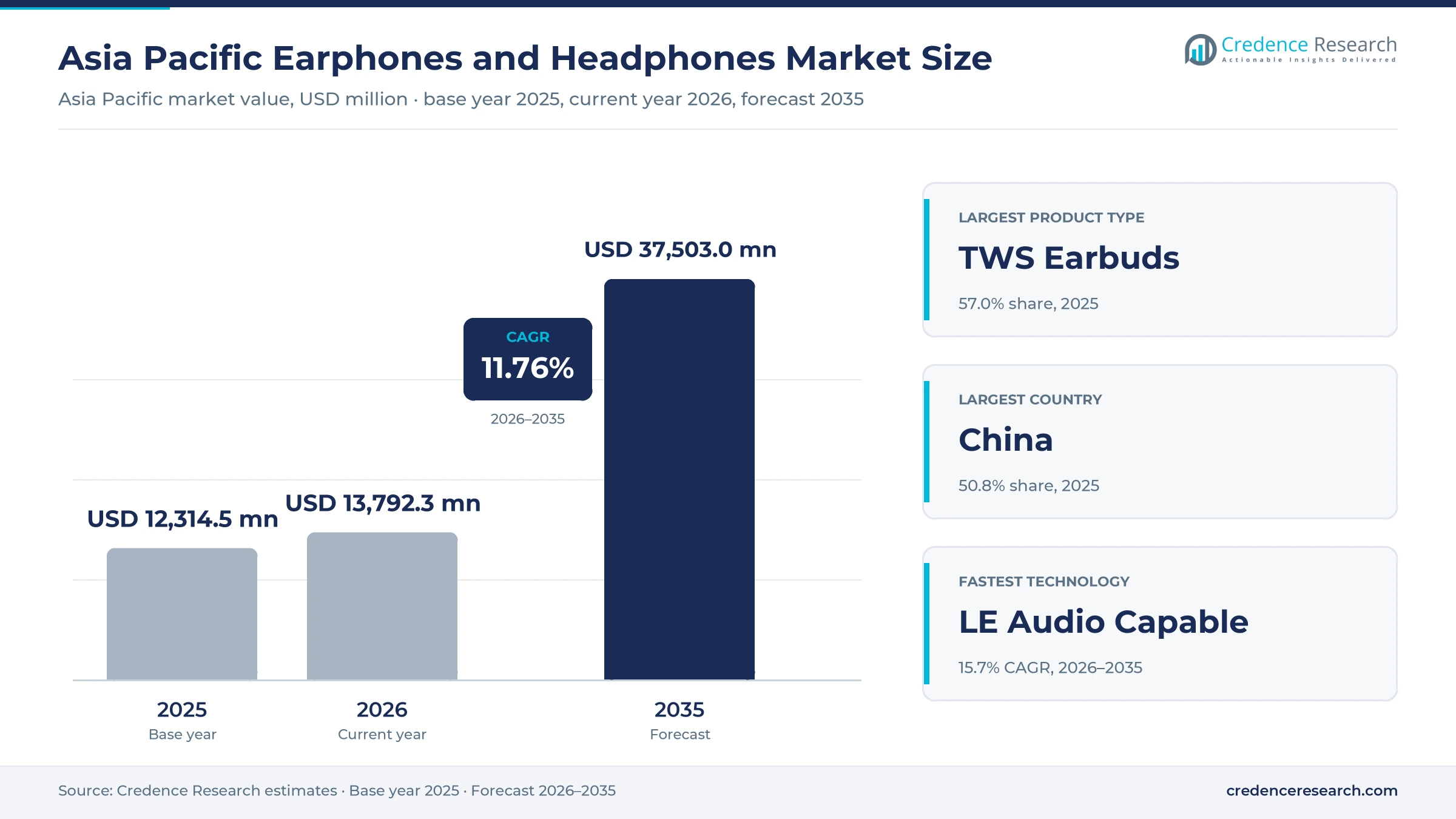
The Asia Pacific earphones and headphones market was valued at USD 12.31 billion in 2025 and is projected to increase from USD 13.79 billion in 2026 to USD 37.50 billion by 2035, registering a CAGR of 11.76% during 2026–2035. Demand comes from smartphone owners who replace bundled or wired sets with true wireless earbuds, from buyers trading up to stronger noise cancelling, and from gamers and studio users who need low latency or accurate monitoring. China held the largest country share, 50.8% in 2025, because it combines the region's largest handset base with domestic brands such as Huawei and Xiaomi that tie earbuds to their own phones. South Asia is the fastest-growing area at 13.2% a year, as the Indian mobile user base widens and local brands sell entry earbuds online. The technology mix is also shifting, since LE Audio support is spreading across Android phones and flagship over-ear models, which lowers power use and allows broadcast sharing.
Which products and buyers does the regional estimate count?
The estimate counts new TWS earbuds, wired earphones, neckband and other connected wireless earphones, and over-ear or on-ear headphones sold to buyers in Asia Pacific. Individual consumers account for most purchases, while companies, schools and studios buy smaller volumes through brand stores, online marketplaces, electronics chains and direct enterprise contracts.
Hearing aids, smart speakers, soundbars and headsets built into helmets or vehicles are excluded, as are repairs and refurbished units. Value is counted at the price paid by the end buyer, so earbuds assembled in China, India or Vietnam for export to other regions do not enter the total.
Asia Pacific Earphones and Headphones Market Insights
- The market rises from USD 12.31 billion in 2025 to USD 37.50 billion by 2035, an 11.76% pace, as earbuds move from accessory to everyday phone companion.
- China held 50.8% of 2025 value, while South Asia grows fastest at 13.2% a year on wider mobile access in India.
- TWS Earbuds held 57.0% of 2025 value, and LE Audio Capable devices grow fastest at 15.7% a year.
- Huawei streams up to 4.6 Mbps over NearLink on the FreeBuds Pro 5, showing how phone makers use private links to hold buyers.
- Apple, Sony, Samsung, Huawei and Xiaomi set premium pricing, while boAt and Anker compete hard on online entry and midrange prices.
TWS Earbuds lead while LE Audio sets the pace
Why do TWS earbuds hold most of the value?
Based on product type, the market is categorized into TWS earbuds, wired earphones, connected wireless earphones and headphones. TWS Earbuds led with 57.0% of 2025 value because they have become the default companion to a smartphone, and supply is deepening inside the region, since Foxconn committed USD 400 million to its Hyderabad plant for AirPods output from April 2025, according to Business Today. Headphones grow fastest at 12.6% a year, as over-ear flagships gain processing power and Bose prices its QuietComfort Ultra Headphones (2nd Gen) at Rs 49,900 in India. Wired and neckband sets keep a budget role, but their combined share falls each year to 2035.
How fast is LE Audio replacing the classic Bluetooth link?
Based on technology, the market is categorized into wired audio, Bluetooth Classic audio, LE Audio capable and proprietary wireless audio. Bluetooth Classic Audio led with 60.0% of 2025 value because most phones and midrange earbuds still pair over the classic profile, and Anker's Soundcore Liberty 5, launched in Singapore in May 2025, streams LDAC over Bluetooth 5.4. LE Audio Capable devices grow fastest at 15.7% a year, as Sony built LE Audio and Auracast into the WH-1000XM6 launched in Hong Kong in May 2025. Proprietary links are a premium niche, led by Huawei NearLink at up to 4.6 Mbps.
Why is gaming the fastest-growing use?
Based on application, the market is categorized into personal listening, gaming and professional audio. Personal Listening led with 79.0% of 2025 value because commuting, streaming and calls fill most listening hours, and India alone had 1,173.88 million wireless subscribers in November 2025, according to TRAI. Gaming grows fastest at 13.3% a year, as China counted 683 million game users in 2025, according to the China Audio-Video and Digital Publishing Association. Professional audio holds a small share of 2025 demand but carries the highest unit prices, from studio monitors to open-back reference models.
Which channels move the most units and value?
Based on distribution channel, the market is categorized into brand direct retail, third-party e-commerce, physical retail intermediaries and enterprise direct sales. Third-Party E-Commerce led with 45.0% of 2025 value because entry and midrange brands launch online first, and Anker sold the Liberty 5 in Singapore through Shopee, Lazada and TikTok in May 2025. Brand Direct Retail grows fastest at 13.0% a year, as Apple opened Apple Hebbal in Bengaluru on Sept. 2, 2025, its third own store in India, with a fourth in Pune that month.
| Segment Group | Leading Sub-segment | Share, 2025 | Fastest-growing Sub-segment | CAGR, 2026–2035 |
|---|---|---|---|---|
| By Product Type | TWS Earbuds | 57.0% | Headphones | 12.6% |
| By Technology | Bluetooth Classic Audio | 60.0% | LE Audio Capable | 15.7% |
| By Application | Personal Listening | 79.0% | Gaming | 13.3% |
| By Distribution Channel | Third-Party E-Commerce | 45.0% | Brand Direct Retail | 13.0% |
Flagship earbuds cost over 20 times entry models
Pricing works in clear tiers set by chips, noise cancelling and brand. Entry earbuds sell online near Rs 899 with basic drivers and long battery claims, midrange models add adaptive noise cancelling and LDAC for about SGD 159 to 179, and flagships from Apple, Huawei, Samsung and Sony sit 20 or more times above the entry price. Launch discounts, festival sales and trade-in bundles move street prices, while exchange rates shift imported premium lines. For suppliers, margin sits in the premium tier and in software features, so midrange brands gain share by copying flagship features faster.
| Offer or segment | Typical price or fee | Basis |
|---|---|---|
| Budget TWS earbuds (India) | Rs 899 list, boAt Airdopes 91 Prime | boAt online store, November 2026 |
| Midrange ANC earbuds (Singapore) | SGD 179 list, SGD 159 launch, Soundcore Liberty 5 | Anker release, May 2025 |
| Upper-midrange earbuds (India) | Rs 19,999, Galaxy Buds3 Pro | Samsung India pricing, July 2024 |
| Premium earbuds (China) | CNY 1,449, FreeBuds Pro 5 | Huawei China store, November 2025 |
| Premium earbuds (Australia, Japan) | A$429 or 39,800 yen, AirPods Pro 3 | Apple newsroom, September 2025 |
| Premium over-ear (Hong Kong) | HK$3,699, WH-1000XM6 | Sony Hong Kong release, May 2025 |
Request a Free Sample
Fill in your details and we'll send you a free sample report.
- Sample data tables & charts
- Research methodology
Phones, premium upgrades and new links lift demand
Smartphone-linked digital consumption widens the buyer base
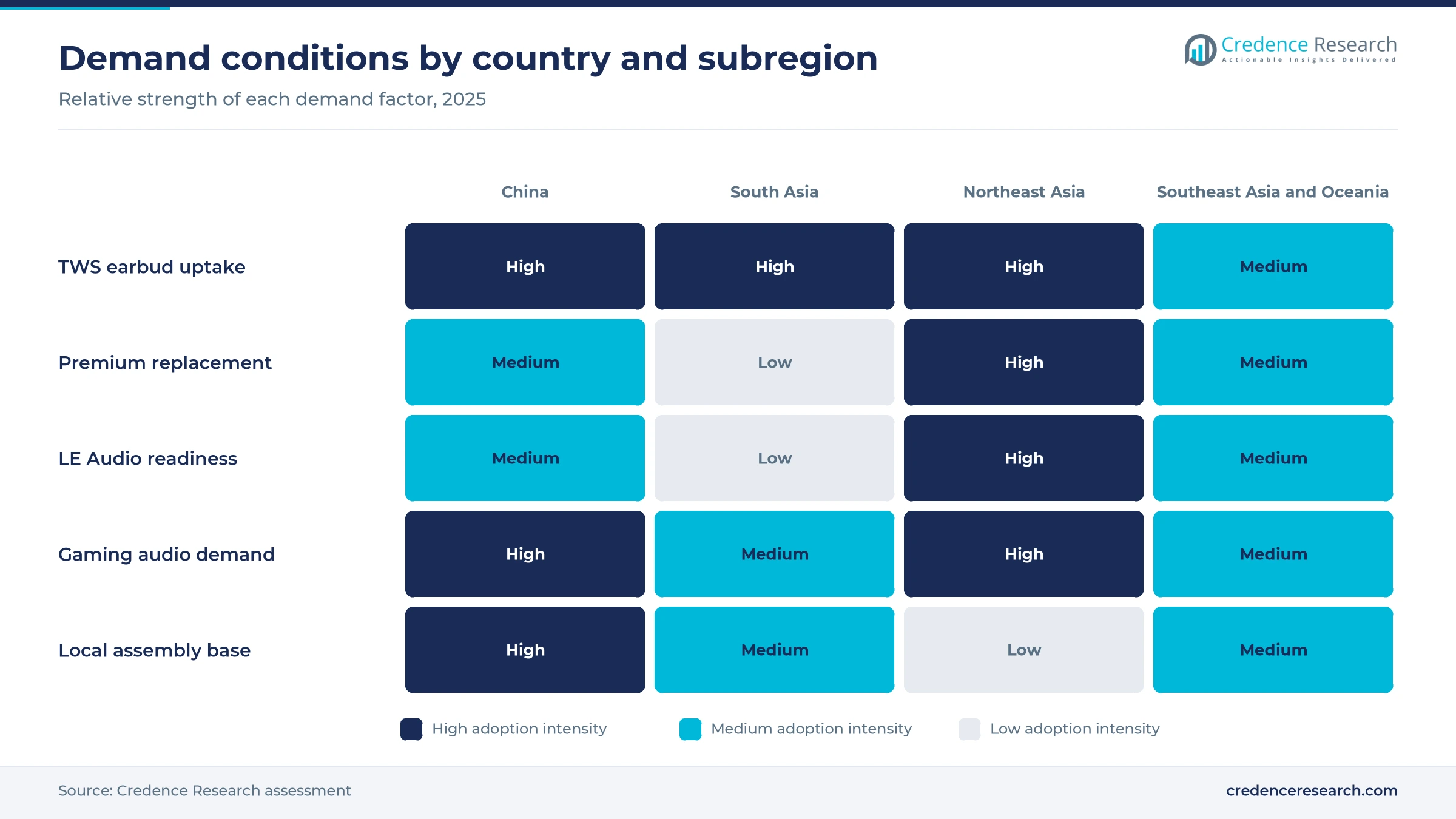
Every new smartphone user is a likely earbud buyer, so audio demand follows phone and data access closely. According to the ITU, 77% of the Asia-Pacific population used the internet in 2025, in line with the global average of 74%, so most adults in the region are already online. China also supported the handset cycle in 2025 with a 15% subsidy on phones, tablets, smartwatches and wristbands priced below 6,000 yuan. Earbuds were not subsidized, yet each subsidized phone created a pairing opportunity. Because regional smartphone shipments remain large, brands that bundle audio offers at the point of phone sale capture repeat buyers, which is why phone-linked demand explains most of the regional market for earphones and headphones.
Performance-led premium replacement shortens upgrade cycles
Owners now replace earbuds and over-ear models for better noise cancelling and battery life, not only when a unit fails. Apple says AirPods Pro 3, introduced on Sept. 10, 2025, remove up to twice as much noise as the previous generation and run up to eight hours with noise cancelling on, a 33% gain. Sony launched the WH-1000XM6 in May 2025 with a QN3 processor that Sony says runs seven times faster than its predecessor and 12 noise-cancelling microphones. Huawei followed in November 2025 with the FreeBuds Pro 5, which uses dual drivers and the Kirin A3 chip. Because each flagship cycle resets the benchmark, premium buyers in Japan, Korea and urban China upgrade sooner than before, and Headphones gain value at 12.6% a year.
Wireless audio interoperability opens new listening uses
Common wireless standards let earbuds work with more phones, televisions and public broadcasts, which widens the reasons to buy a second pair. In September 2025 Google extended LE Audio sharing to Pixel 8 and newer phones, Samsung Galaxy S23 to S25 flagships and Xiaomi 14 and 15 models, while noting that both phone and headphones must support LE Audio. Sony built LE Audio and Auracast into the WH-1000XM6, and its INZONE Buds are rated for up to 24 hours on LE Audio against 12 hours on the standard link. These changes lower power use and enable broadcast sharing at airports, gyms and classrooms. As a result, LE Audio Capable devices grow at 15.7% a year, the fastest rate of any technology group in the forecast.
Regional assembly in India and Vietnam shortens supply chains
Contract makers are moving final assembly closer to fast-growing buyers, which cuts lead times and import exposure for brands that sell in the region. Goertek Electronics Vietnam planned to start a USD 280 million project in Bac Ninh in the second quarter of 2024, according to The Investor. Its sister company Goertek Vina Smart Technology later raised its investment in the Nam Son-Hap Linh plant by USD 130 million to USD 540 million, Vietstock reported in September 2025. Apple's AirPods line in Hyderabad, noted in the product section, adds an India base for premium earbuds. This spread of capacity supports demand growth in South Asia, the fastest region in the forecast, and keeps midrange prices competitive.
Health sensing and Live Translation reshape earbuds
Rise of earbuds as health and fitness sensors
Earbuds are turning into health devices, which lets brands justify higher prices and longer software support. Apple says AirPods Pro 3 carry a custom heart-rate sensor, a first for the line, that tracks more than 50 workout types through the Fitness app on iPhone. This puts earbuds alongside watches and rings among wearable devices that collect daily activity data, which raises the value of each upgrade. The ITU H.870 guideline for safe listening devices also pushes makers to add exposure tracking and volume warnings, separating children from adults. Because these features need sensors, chips and apps, the shift favors TWS Earbuds, which already hold 57.0% of value, and brands that own a phone or watch platform.
Shift toward live translation and AI voice features
Translation and voice tools are becoming a reason to buy in a region with many languages and heavy cross-border travel. Apple announced Live Translation on AirPods Pro 3 on Sept. 10, 2025, in beta for English, French, German, Portuguese and Spanish, with Italian, Japanese, Korean and simplified Chinese due by the end of 2025. Samsung added an Interpreter feature powered by Galaxy AI to the Galaxy Buds3 series, which went on sale in India on July 24, 2024. Both features depend on a recent phone from the same brand, so they deepen ecosystem ties and make switching brands harder for buyers. They therefore lift the midrange and premium tiers first, where buyers in Northeast Asia and urban China concentrate.
Opportunity in low-latency gaming audio
Gaming offers a clear opening for brands that can cut audio delay and improve voice chat. China's domestic game market reached CNY 350.8 billion in 2025, up 7.7%, according to the China Audio-Video and Digital Publishing Association. Sony priced its INZONE Buds at Rs 17,990 in India in January 2024 and paired them with a USB-C dongle on a 2.4 GHz link for low-latency play. Buyers of gaming accessories already accept premium prices for keyboards and controllers, so earbuds and headsets tuned for games can carry similar margins and justify a separate purchase. Gaming grows at 13.3% a year, the fastest use in the forecast, and South Asia mobile gamers add volume.
Opportunity in hi-fi and professional listening
Serious listeners and studio buyers form a small but high-margin pool that rewards engineering depth. Audio-Technica released its ATH-ADX7000 open-back flagship in Singapore on Dec. 4, 2025, at SGD 4,799, made in Japan. HARMAN, a Samsung Electronics unit, completed its purchase of Sound United from Masimo in September 2025, adding Bowers & Wilkins, Denon and Marantz to its premium audio portfolio. Japan, home to Audio-Technica and Sony, is the main buyer base for this tier. Brands that combine studio credibility with wireless convenience can lift average prices well above the midrange, since one ATH-ADX7000 costs more than 20 midrange earbud pairs at Singapore list prices.
Price wars, closed ecosystems and rules weigh on margins
Price compression in the budget tier
Budget competition keeps entry prices low and squeezes margins for every seller below the midrange. boAt lists its Airdopes 91 Prime at Rs 899 on its own store, which leaves little room for marketing or after-sales costs. Its owner cut its planned IPO to Rs 1,500 crore from Rs 2,000 crore in an updated draft prospectus filed in October 2025, Business Standard reported. Brands respond by shifting volume to noise-cancelling models and by sourcing more locally.
Closed ecosystems fragment premium features
Premium features increasingly work only with the same brand's phones, which limits the addressable buyer pool for each product. Xiaomi's Buds 5 Pro Wi-Fi, launched in March 2025, streamed lossless audio at up to 4.2 Mbps but at first worked only with the Xiaomi 15 and 15 Ultra, TechRadar reported. Huawei NearLink and Apple translation tools follow the same pattern. Independent brands must therefore compete on open codecs and battery life rather than exclusive features.
Safety rules and hearing concerns raise compliance costs
Compliance and hearing-safety demands add testing cost and limit how loud and how cheap products can be. India requires wireless headphones and earphones to be registered with the Bureau of Indian Standards against IS 616:2017 before sale. The ITU notes that the WHO sees sound-induced hearing loss risking more than a billion young people worldwide. Importers of unbranded units face the highest relative cost, while established brands absorb testing more easily.
Factory relocation adds cost and execution risk
Moving assembly between countries raises cost and can disrupt supply for brands that depend on one contract maker. The Bac Ninh Industrial Zones Management Authority terminated the project of Goertek Vina Co., Ltd., which had run a multimedia and audio products plant in Que Vo Industrial Park since 2013, in mid-September 2025, Vietstock reported. This closure is separate from the Nam Son-Hap Linh expansion noted above. Such closures force brands to requalify lines, retest products and carry extra inventory during transfers, which raises working capital and can delay launches by a season.
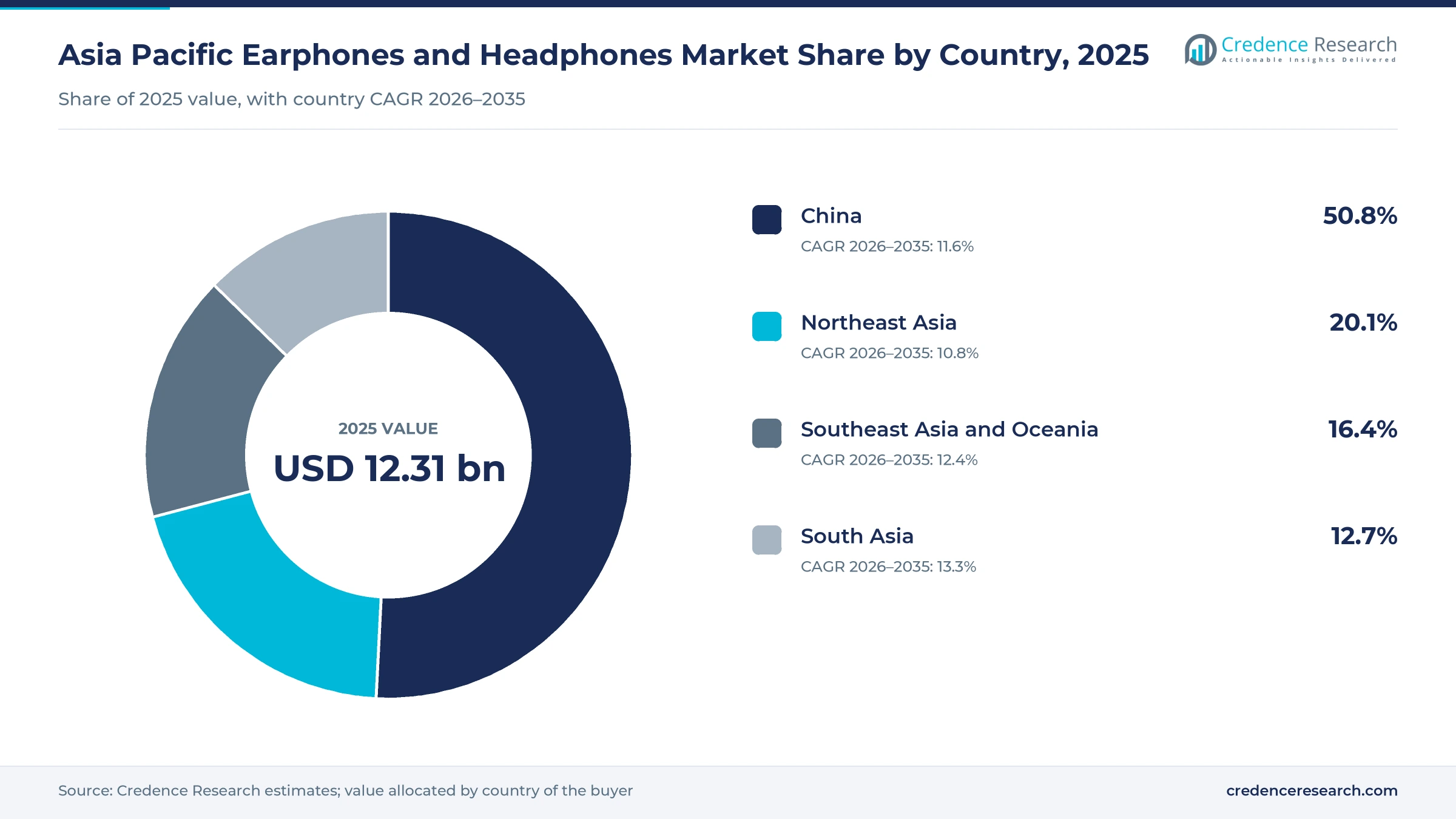
China holds half of value as South Asia grows fastest
| Country | Value, 2025 (USD billion) | Share, 2025 | CAGR, 2026–2035 |
|---|---|---|---|
| China | 6.26 | 50.8% | 11.6% |
| Northeast Asia | 2.48 | 20.1% | 10.8% |
| Southeast Asia and Oceania | 2.02 | 16.4% | 12.3% |
| South Asia | 1.56 | 12.7% | 13.2% |
China leads on scale and domestic brands
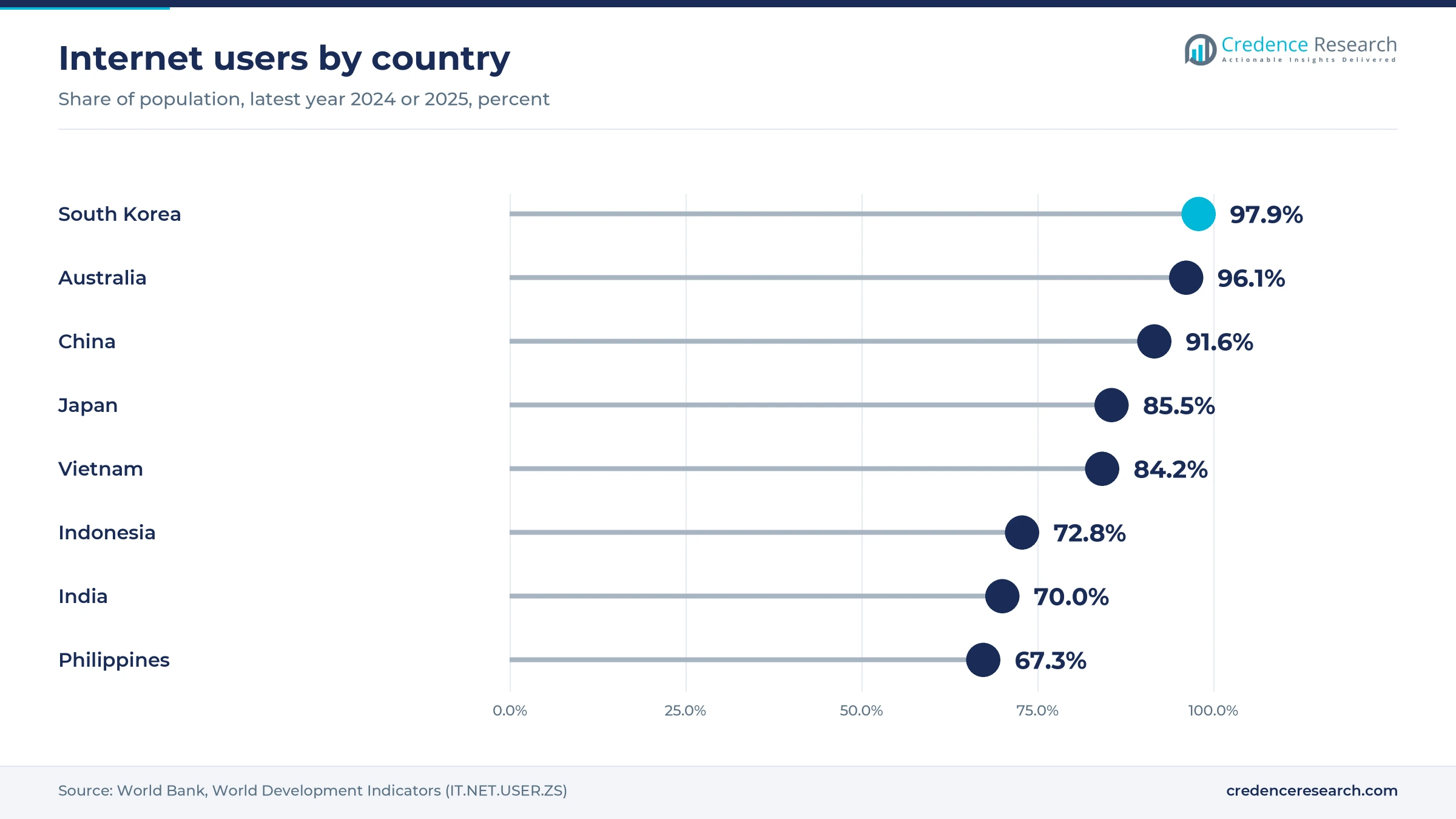
China held 50.8% of 2025 value and grows at 11.6% a year, close to the regional rate. Internet use reached 91.6% of the population in 2025, according to the World Bank, so growth now comes from upgrades rather than first purchases. The 2026 trade-in notice, issued on Dec. 30, 2025, added smart glasses to phones, tablets and smartwatches but again left earbuds out. Huawei and Xiaomi therefore lean on phone bundles and NearLink or Wi-Fi features to hold their 2025 share of buyers.
Northeast Asia is the premium heartland
Northeast Asia, covering Japan, South Korea and Taiwan, held 20.1% of 2025 value but grows at only 10.8% a year, the slowest rate in the region. Internet use stood at 97.9% in South Korea and 85.5% in Japan in 2024, according to the World Bank, which leaves little room for first-time buyers. Home brands Sony and Audio-Technica keep average prices high through flagship and studio lines.
Southeast Asia and Oceania mix volume and premium buyers
Southeast Asia and Oceania held 16.4% of 2025 value and grows at 12.3% a year. Australia, where internet use stood at 96.1% in 2024, is a premium market, while Indonesia at 72.8% and the Philippines at 67.3% in 2024 still add first-time online buyers, according to the World Bank. Marketplace and social commerce launches suit this mix, and Vietnam adds assembly capacity for brands serving the subregion.
South Asia grows fastest from a lower base
South Asia held 12.7% of 2025 value but grows fastest at 13.2% a year. India had 1,003.65 million broadband subscribers in November 2025, according to TRAI, while internet use reached 70.0% of the population in 2025, according to the World Bank. Local brand boAt has been the leading branded personal audio company in India by volume since FY2020, its draft prospectus states. Apple's new stores and local AirPods assembly add a premium layer.
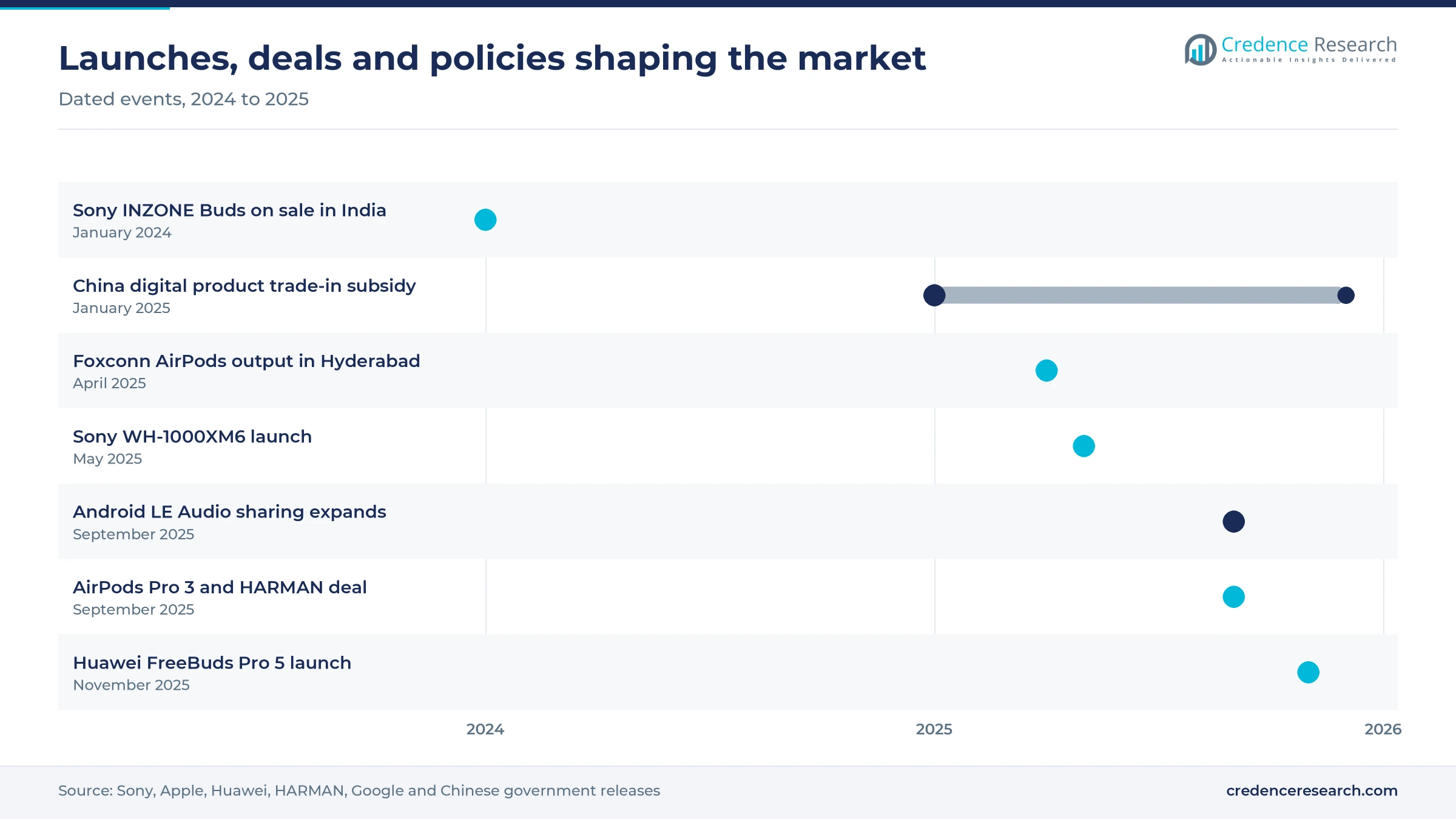
Flagship launches and a premium audio deal, 2024-2025
| Development | Status and market relevance |
|---|---|
| In January 2024, Sony began selling INZONE Buds in India at Rs 17,990, with a 2.4 GHz dongle for low-latency gaming. | Launched; extends gaming audio into true wireless earbuds |
| In May 2025, Sony launched the WH-1000XM6 in Hong Kong at HK$3,699 with the QN3 processor and 12 microphones. | Launched; resets the over-ear noise-cancelling benchmark |
| In September 2025, HARMAN, a Samsung Electronics subsidiary, completed its acquisition of Sound United from Masimo. | Completed; adds Bowers & Wilkins, Denon and Marantz to premium audio |
| In September 2025, Apple introduced AirPods Pro 3 with heart-rate sensing and Live Translation. | Launched; on sale from Sept. 19, 2025 |
| In November 2025, Huawei released the FreeBuds Pro 5 in China at CNY 1,449, with NearLink streaming up to 4.6 Mbps. | Launched; ties lossless audio to Huawei devices |
Codecs, chips and noise processing set product tiers
- LE Audio and Auracast lower power use and allow one source to stream to many earbuds, and they need support in both phone and earbuds.
- Proprietary high-bitrate links such as Huawei NearLink and Xiaomi Wi-Fi audio carry lossless streams but work best with the same brand's phones.
- Noise-cancelling processors with more microphones and faster chips set the premium benchmark and decide upgrade timing for flagship buyers.
- Wireless silicon built on Bluetooth audio transceiver chips sets battery life, latency and codec support, and its falling cost keeps entry earbuds cheap.
Need a Custom Version of This Report?
Tailor the scope, geography, or segments to your exact requirements.
- Custom geography or segment scope
- Direct access to our analyst team
Phone makers and audio specialists split the market
Competition for earphones and headphones in the region splits between phone platform owners and audio specialists. Apple, Samsung Electronics, Huawei and Xiaomi sell earbuds as part of a device ecosystem, using exclusive features such as translation, health sensing and high-bitrate private links to hold buyers. Sony, Bose and Audio-Technica compete on noise cancelling, sound tuning and studio credibility, and Samsung's HARMAN unit adds JBL and, since September 2025, Bowers & Wilkins, Denon and Marantz. Anker sells its Soundcore line through marketplaces in Southeast Asia, while boAt leads the entry tier in India through online channels and offline retail. Price moves are fast and launch cycles short, so brands win by releasing midrange models with last year's flagship features, securing chip supply and keeping retail presence during festival sales. Local assembly in India and Vietnam is becoming a cost advantage.
How is supply organized between phone makers and audio specialists?
Supply is moderately concentrated at the top and fragmented below. Phone makers Apple, Samsung, Huawei and Xiaomi hold the premium and upper-midrange tiers because they control the pairing, codecs and software features. Audio specialists Sony, Bose, Audio-Technica and HARMAN compete on sound quality and noise cancelling, while Anker and boAt lead value online. Most brands outsource assembly to contract makers in China, Vietnam and India, so barriers lie in chip access, acoustic tuning and marketing rather than factories. Margins are highest where hardware ties into a phone ecosystem.
Companies profiled and their roles in this market
| Company | Type | Role in the market |
|---|---|---|
| Apple | Platform owner | Sells AirPods earbuds and Beats products through own stores and resellers in the region |
| Sony Group | Audio specialist | Sells 1000X noise-cancelling headphones, earbuds and INZONE gaming audio across the region |
| Xiaomi | Platform owner | Sells Redmi and Xiaomi Buds earbuds tied to its phones, including Wi-Fi audio models |
| Huawei | Platform owner | Sells FreeBuds earbuds and FreeClip models with NearLink audio, mainly in China |
| Samsung Electronics (HARMAN) | Platform owner and audio group | Sells Galaxy Buds plus JBL, AKG and Bowers & Wilkins audio via HARMAN |
| Anker Innovations | Value and midrange brand | Sells Soundcore earbuds and headphones through marketplaces and retailers |
| Bose | Audio specialist | Sells QuietComfort noise-cancelling headphones and earbuds through retail and online partners |
| Imagine Marketing Limited (boAt) | Local value brand | Sells Airdopes earbuds, neckbands and headphones mainly in India |
| Audio-Technica | Audio specialist | Sells studio, hi-fi and wireless headphones from its Japanese base across the region |
Mid-priced earbuds with flagship features will win
Credence Research's view is that the decisive battleground is the midrange, not the flagship tier. Flagships from Apple, Sony and Huawei set the feature bar, but buyers in India, Southeast Asia and lower-tier Chinese cities pay for adaptive noise cancelling, LE Audio and long battery life at a fraction of flagship prices. Brands that move features down a tier within a year, and that secure local assembly, will gain share. Platform owners keep the premium margin, yet open standards narrow that advantage over time, which favors specialists with strong tuning and retail reach.
Unit volumes, list prices and shares anchor the model
The report uses 2025 as the base year and forecasts to 2035. Market values come from the Credence Research model, which combines unit volumes by product type with typical selling prices by tier and country. Regional, segment and channel splits are Credence Research estimates checked against public data, including ITU and World Bank internet use, TRAI subscriber data, Chinese government trade-in notices, company launch releases and list prices, and published press reports. No interviews or surveys were used for this edition of the estimate.
Wireless standards and South Asia shape growth to 2035
By 2035 the market reaches USD 37.50 billion, with growth shifting toward South Asia and toward LE Audio capable products. China stays the largest market but grows mainly through upgrades, while Northeast Asia remains the premium core with slower volume gains. Earbuds will carry more health, translation and hearing features, which raises software value and shortens replacement cycles. Budget pricing will remain intense in India, yet local assembly and brand-store expansion support a gradual trade-up. Suppliers that combine open standards, regional manufacturing and fast feature transfer are best placed across the forecast.
How wide is the range of outcomes to 2035?
The spread between cases depends on how quickly LE Audio and AI features reach midrange prices and how far South Asia trades up from entry models. Weak consumer spending in China or a longer replacement cycle in Northeast Asia would push results toward the downside. Faster Android adoption of LE Audio, wider brand-store reach in India and strong gaming demand would lift results toward the upside.
| Scenario | CAGR, 2026–2035 | Value, 2035 | What has to hold |
|---|---|---|---|
| Downside | 9.8% | USD 31.89 billion | China upgrade demand stalls and budget price wars deepen in India |
| Base | 11.76% | USD 37.50 billion | Midrange feature spread and steady phone sales continue as expected |
| Upside | 13.6% | USD 43.32 billion | LE Audio adoption accelerates and South Asia buyers trade up faster |
Frequently Asked Questions
How big is the Asia Pacific earphones and headphones market?
Which country or subregion leads the market?
Which area grows fastest?
Which product type holds the largest share?
Why does LE Audio matter for this market?
What do buyers pay across price tiers?
Who are the leading companies?
What are the main challenges?
Table of Content
Chapter 1 Market Segmentation
- 1.1 Segmentation Framework
- 1.1.1 Product and Service Classification
- 1.1.2 Application and End-Use Classification
- 1.1.3 Technology and Solution Classification
- 1.1.4 Customer and Distribution Channel Classification
- 1.1.5 Geographic Segmentation
- 1.1.6 Market Segment Definitions and Boundaries
- 1.2 By Product Type
- 1.2.1 TWS Earbuds
- 1.2.2 Wired Earphones
- 1.2.3 Connected Wireless Earphones
- 1.2.4 Headphones
- 1.3 By Technology
- 1.3.1 Wired Audio
- 1.3.2 Bluetooth Classic Audio
- 1.3.3 LE Audio Capable
- 1.3.4 Proprietary Wireless Audio
- 1.4 By Application
- 1.4.1 Personal Listening
- 1.4.2 Gaming
- 1.4.3 Professional Audio
- 1.5 By Country
- 1.5.1 China
- 1.5.2 South Asia
- 1.5.3 Northeast Asia
- 1.5.4 Southeast Asia and Oceania
Chapter 2 Introduction
- 2.1 Report Objectives and Scope
- 2.2 Product Definition and Industry Terminology
- 2.3 Market Inclusions and Exclusions
- 2.4 Research Process
- 2.4.1 Primary Research and Expert Interviews
- 2.4.2 Secondary Research and Source Review
- 2.4.3 Top-Down and Bottom-Up Estimation
- 2.4.4 Data Triangulation and Verification
- 2.5 Market Size Measurement Basis
- 2.5.1 2025: USD 12.31 billion → 2035: USD 37.50 billion
- 2.6 Historical and Forecast Reference Periods
- 2.6.1 Historical Period: 2018-2025
- 2.6.2 Base Year: 2025
- 2.6.3 Forecast Period: 2025-2035
- 2.7 Research Assumptions and Limitations
Chapter 3 Executive Summary
- 3.1 Market Snapshot and Key Findings
- 3.2 Base-Year Market Size, 2025
- 3.3 Forecast Market Size, 2035
- 3.4 Revenue and Volume Growth Outlook
- 3.5 Key Demand and Supply Indicators
- 3.6 Leading Market Segments
- 3.7 Fastest-Growing Market Opportunities
- 3.8 Regional Performance Highlights
- 3.9 Technology and Industry Transformation
- 3.10 Competitive Landscape Summary
- 3.11 Analyst View and Strategic Implications
Chapter 4 Asia Pacific Earphones and Headphones Market Trends and Developments
- 4.1 Historical Industry Development, 2018-2025
- 4.2 Recent Market Trends and Developments
- 4.3 Demand and Customer Behavior Trends
- 4.4 Technology and Product Innovation
- 4.5 Artificial Intelligence, Automation and Digitalization
- 4.6 Local Manufacturing and Supply Chain Realignment
- 4.7 Industry Partnerships, Mergers and Acquisitions
- 4.8 Sustainability and Circular Economy Developments
- 4.9 Government and Private Sector Investment Trends
- 4.10 Emerging Business Models and Commercialization
- 4.11 Industry Developments and Announcements
Chapter 5 Asia Pacific Earphones and Headphones Market Production, Supply and Demand Analysis
- 5.1 Demand Trend and Consumption Analysis, 2018-2025
- 5.2 Demand Forecast, 2025-2035
- 5.3 Production and Output Trend, 2018-2025
- 5.4 Production and Output Forecast, 2025-2035
- 5.5 Installed Capacity and Capacity Utilization
- 5.6 Company-Wise Production Plants and Statistics
- 5.6.1 Installed Production Capacity
- 5.6.2 Actual Production
- 5.6.3 Planned Capacity and Expansion Targets
- 5.7 Supply Chain Structure and Procurement Trends
- 5.8 Supply-Demand Gap and Bottlenecks
- 5.9 Import Dependence and Sourcing Structure
- 5.10 Contract Manufacturing and Outsourcing
- 5.11 Regional Supply and Demand Concentration
Chapter 6 Asia Pacific Earphones and Headphones Market Pricing Analysis
- 6.1 Pricing Structure and Measurement
- 6.2 Historical Pricing Trends, 2018-2025
- 6.3 Pricing Outlook, 2025-2035
- 6.4 Average Selling Price and Unit Economics
- 6.5 Pricing by Product and Market Segment
- 6.6 Geographic Pricing Differences
- 6.7 Key Input, Energy, Labor and Logistics Costs
- 6.8 Contract Pricing and Purchasing Models
- 6.9 Pricing Sensitivity and Competitive Positioning
- 6.10 Price, Margin and Profitability Implications
Chapter 7 Asia Pacific Earphones and Headphones Market Dynamics
- 7.1 Market Growth Drivers
- 7.1.1 Demand-Side Drivers
- 7.1.2 Technology and Innovation Drivers
- 7.1.3 Infrastructure and Investment Drivers
- 7.1.4 Regulatory and Policy Drivers
- 7.2 Market Restraints
- 7.2.1 Cost and Affordability Constraints
- 7.2.2 Technology and Adoption Barriers
- 7.2.3 Supply Chain and Operational Constraints
- 7.3 Market Challenges
- 7.3.1 Competitive Pressure and Margin Erosion
- 7.3.2 Skills, Infrastructure and Implementation Gaps
- 7.4 Emerging Market Opportunities
- 7.5 Market Dynamics Impact and Time-Horizon Assessment
Chapter 8 Asia Pacific Earphones and Headphones Value Chain Analysis
- 8.1 Industry Value Chain Overview
- 8.2 Upstream Suppliers and Critical Inputs
- 8.3 Technology and Component Providers
- 8.4 Manufacturing or Service Delivery
- 8.5 Distribution, Channel Partners and Integrators
- 8.6 Downstream Applications and End Users
- 8.7 Value Addition and Profit Pools
- 8.8 Vertical Integration and Outsourcing
- 8.9 Supplier Concentration and Risk
- 8.10 Supply Chain Localization and Resilience
Chapter 9 Asia Pacific Earphones and Headphones Market Regulations and Policies
- 9.1 Relevant Laws, Standards and Compliance Frameworks
- 9.2 Product, Service, Safety and Quality Requirements
- 9.3 Government Policies, Incentives and Subsidies
- 9.4 Imports, Exports and Trade Barriers
- 9.5 Public Procurement and Local Content Requirements
- 9.6 Environmental and Sustainability Compliance
- 9.7 Data Protection, AI and Cybersecurity Compliance
- 9.8 Upcoming Policy Changes and Market Implications
Chapter 10 Asia Pacific Earphones and Headphones Market Hotspots and Opportunities
- 10.1 Market Opportunity Mapping and Growth Hotspots
- 10.2 High-Growth Applications and Customer Groups
- 10.3 Underserved Markets and White-Space Opportunities
- 10.4 Emerging Technology and Product Opportunities
- 10.5 New Capacity and Investment Hotspots
- 10.6 Market Entry and Expansion Opportunities
- 10.7 Distribution and Partnership Opportunities
- 10.8 Near-Term and Long-Term Commercial Potential
- 10.9 Opportunity Attractiveness and Execution Risks
Chapter 11 Asia Pacific Earphones and Headphones Market Outlook, 2025-2035
- 11.1 Market Size and Analysis
- 11.1.1 Revenue (Market Measurement: 2025: USD 12.31 billion → 2035: USD 37.50 billion)
- 11.1.2 Market Volume and Quantity Sold
- 11.1.3 Historical Market Size, 2018-2025
- 11.1.4 Base-Year Market Size, 2025
- 11.2 Market Forecast, 2025-2035
- 11.2.1 Revenue Forecast to 2035
- 11.2.2 Volume Forecast to 2035
- 11.2.3 CAGR and Year-on-Year Growth
- 11.2.4 Incremental Revenue Opportunity
- 11.3 Forecast Assumptions and Scenario Analysis
- 11.3.1 Base-Case Forecast
- 11.3.2 Optimistic and Conservative Scenarios
- 11.3.3 Technology, Pricing and Policy Sensitivities
- 11.4 Market Attractiveness and Growth Outlook
Chapter 12 Asia Pacific Earphones and Headphones Market Segmentation and Outlook
- 12.1 Segmentation Summary and Market Shares, 2025
- 12.2 Largest and Fastest-Growing Segments
- 12.3 By Product Type - Market Size and Forecast, 2025-2035
- 12.3.1 Segment Definition and Scope
- 12.3.2 Historical Market Size, 2018-2025
- 12.3.3 Revenue Forecast, 2025-2035
- 12.3.4 Volume Forecast, 2025-2035
- 12.3.5 Base-Year Market Share, 2025
- 12.3.6 Segment CAGR and Growth Drivers
- 12.3.7 Subsegment Market Size and Forecast
- 12.3.7.1 TWS Earbuds
- 12.3.7.2 Wired Earphones
- 12.3.7.3 Connected Wireless Earphones
- 12.3.7.4 Headphones
- 12.3.8 Subsegment Pricing and Adoption Trends
- 12.3.9 Leading Suppliers and Competition
- 12.3.10 Regional Demand and Opportunities
- 12.4 By Technology - Market Size and Forecast, 2025-2035
- 12.4.1 Segment Definition and Scope
- 12.4.2 Historical Market Size, 2018-2025
- 12.4.3 Revenue Forecast, 2025-2035
- 12.4.4 Volume Forecast, 2025-2035
- 12.4.5 Base-Year Market Share, 2025
- 12.4.6 Segment CAGR and Growth Drivers
- 12.4.7 Subsegment Market Size and Forecast
- 12.4.7.1 Wired Audio
- 12.4.7.2 Bluetooth Classic Audio
- 12.4.7.3 LE Audio Capable
- 12.4.7.4 Proprietary Wireless Audio
- 12.4.8 Subsegment Pricing and Adoption Trends
- 12.4.9 Leading Suppliers and Competition
- 12.4.10 Regional Demand and Opportunities
- 12.5 By Application - Market Size and Forecast, 2025-2035
- 12.5.1 Segment Definition and Scope
- 12.5.2 Historical Market Size, 2018-2025
- 12.5.3 Revenue Forecast, 2025-2035
- 12.5.4 Volume Forecast, 2025-2035
- 12.5.5 Base-Year Market Share, 2025
- 12.5.6 Segment CAGR and Growth Drivers
- 12.5.7 Subsegment Market Size and Forecast
- 12.5.7.1 Personal Listening
- 12.5.7.2 Gaming
- 12.5.7.3 Professional Audio
- 12.5.8 Subsegment Pricing and Adoption Trends
- 12.5.9 Leading Suppliers and Competition
- 12.5.10 Regional Demand and Opportunities
- 12.6 By Country - Market Size and Forecast, 2025-2035
- 12.6.1 Segment Definition and Scope
- 12.6.2 Historical Market Size, 2018-2025
- 12.6.3 Revenue Forecast, 2025-2035
- 12.6.4 Volume Forecast, 2025-2035
- 12.6.5 Base-Year Market Share, 2025
- 12.6.6 Segment CAGR and Growth Drivers
- 12.6.7 Subsegment Market Size and Forecast
- 12.6.7.1 China
- 12.6.7.2 South Asia
- 12.6.7.3 Northeast Asia
- 12.6.7.4 Southeast Asia and Oceania
- 12.6.8 Subsegment Pricing and Adoption Trends
- 12.6.9 Leading Suppliers and Competition
- 12.6.10 Regional Demand and Opportunities
- 12.7 Segment Growth Comparison
- 12.8 Segment Attractiveness and Priority Matrix
Chapter 13 Asia Pacific Earphones and Headphones End-Use and Application Market Outlook
- 13.1 End-Use Industry and Customer Demand Structure
- 13.2 Leading Applications and Customer Groups
- 13.3 End-Use Market Size, Share and Forecast
- 13.4 Major End-Use Industry Deep Dives
- 13.4.1 Customer Requirements and Use Cases
- 13.4.2 Demand and Replacement Cycles
- 13.4.3 Technical and Regulatory Considerations
- 13.4.4 Purchasing and Procurement Models
- 13.4.5 Leading Vendors and Distribution Channels
- 13.4.6 Forecast and Commercial Opportunities
- 13.5 Emerging Applications and Cross-Segment Demand
- 13.6 End-Use Industry Investment Priorities
Chapter 14 Asia Pacific Earphones and Headphones Geographic Market Outlook, 2025-2035
- 14.1 Regional Market Size and Country-Level Shares, 2025
- 14.2 Country Market Size Comparison, 2025
- 14.3 Country Market Forecasts, 2025-2035
- 14.4 Subregional Industrial and Demand Clusters
- 14.5 Intra-Regional Pricing and Cost Differences
- 14.6 Cross-Border Trade and Supply Networks
- 14.7 Regional Supply and Demand Balances
- 14.8 Country Opportunity Comparison and Prioritization
Note: Every listed country is covered on the structure shown under the first country.
Chapter 15 Asia Pacific Earphones and Headphones Technology, Innovation and Sustainability Outlook
- 15.1 Technology Landscape and Maturity
- 15.2 Product, Process and Service Innovation
- 15.3 AI, Automation and Digital Tools in the Industry
- 15.4 Technology Adoption and Performance Benchmarking
- 15.5 Innovation Pipeline and R&D Investment
- 15.6 Patent and Intellectual Property Trends
- 15.7 Energy Efficiency and Resource Management
- 15.8 Sustainability, Recycling and Circularity
- 15.9 Technology Roadmap, 2025-2035
- 15.10 Risks of Obsolescence and Technology Substitution
Chapter 16 Asia Pacific Earphones and Headphones Market Key Strategic Imperatives
- 16.1 Growth and Market Entry Priorities
- 16.2 High-Return Products and Segments
- 16.3 Pricing, Profitability and Cost Optimization
- 16.4 Technology Investment and Product Differentiation
- 16.5 Supply Chain Localization and Resilience
- 16.6 Distribution and Customer Acquisition
- 16.7 Partnership, Acquisition and Capacity Strategy
- 16.8 Regional Expansion Priorities
- 16.9 Short-, Medium- and Long-Term Actions
Chapter 17 Competition Outlook
- 17.1 Industry Competition Characteristics
- 17.2 Market Structure and Concentration
- 17.3 Market Share and Competitive Positioning, 2025
- 17.4 Company-Wise Revenue and Product Benchmarking
- 17.5 Production and Service Capacity Benchmarking
- 17.6 Technology, Pricing and Differentiation
- 17.7 Regional Footprint and Distribution Strength
- 17.8 Mergers, Acquisitions and Strategic Alliances
- 17.9 New Entrants and Competitive Threats
- 17.10 Porter's Five Forces and Industry Attractiveness
- 17.11 Competitive Outlook, 2025-2035
Chapter 18 Company Profiles
- 18.1 Company Coverage and Selection Criteria
- 18.2 Apple
- 18.2.1 Business Description
- 18.2.2 Company Ownership and Geographic Presence
- 18.2.3 Product and Service Portfolio
- 18.2.4 Manufacturing and Operating Footprint
- 18.2.5 Production Capacity and Expansion Plans
- 18.2.6 Financial Performance and Investment
- 18.2.7 Market Share and Competitive Position
- 18.2.8 Technology and Innovation Capabilities
- 18.2.9 Strategic Alliances or Partnerships
- 18.2.10 Recent Developments
- 18.2.11 Growth Strategy and Outlook
- 18.3 Sony Group
- 18.4 Xiaomi
- 18.5 Huawei
- 18.6 Samsung Electronics (HARMAN)
- 18.7 Anker Innovations
- 18.8 Bose
- 18.9 Imagine Marketing Limited (boAt)
- 18.10 Audio-Technica
- 18.11 Other Relevant Market Participants
Note: Every listed company is profiled on the structure shown under the first company. The company list is preliminary and may change based on research findings, market developments, data availability and client requirements.
Chapter 19 Disclaimer
- 19.1 Research and Forecast Disclaimer
- 19.2 Data Source and Estimation Limitations
Note: The depth of individual sections depends on data availability for this market. Volume, capacity, trade and other unit-based metrics are included where applicable.

