
Four-year waits for new units push owners to repair
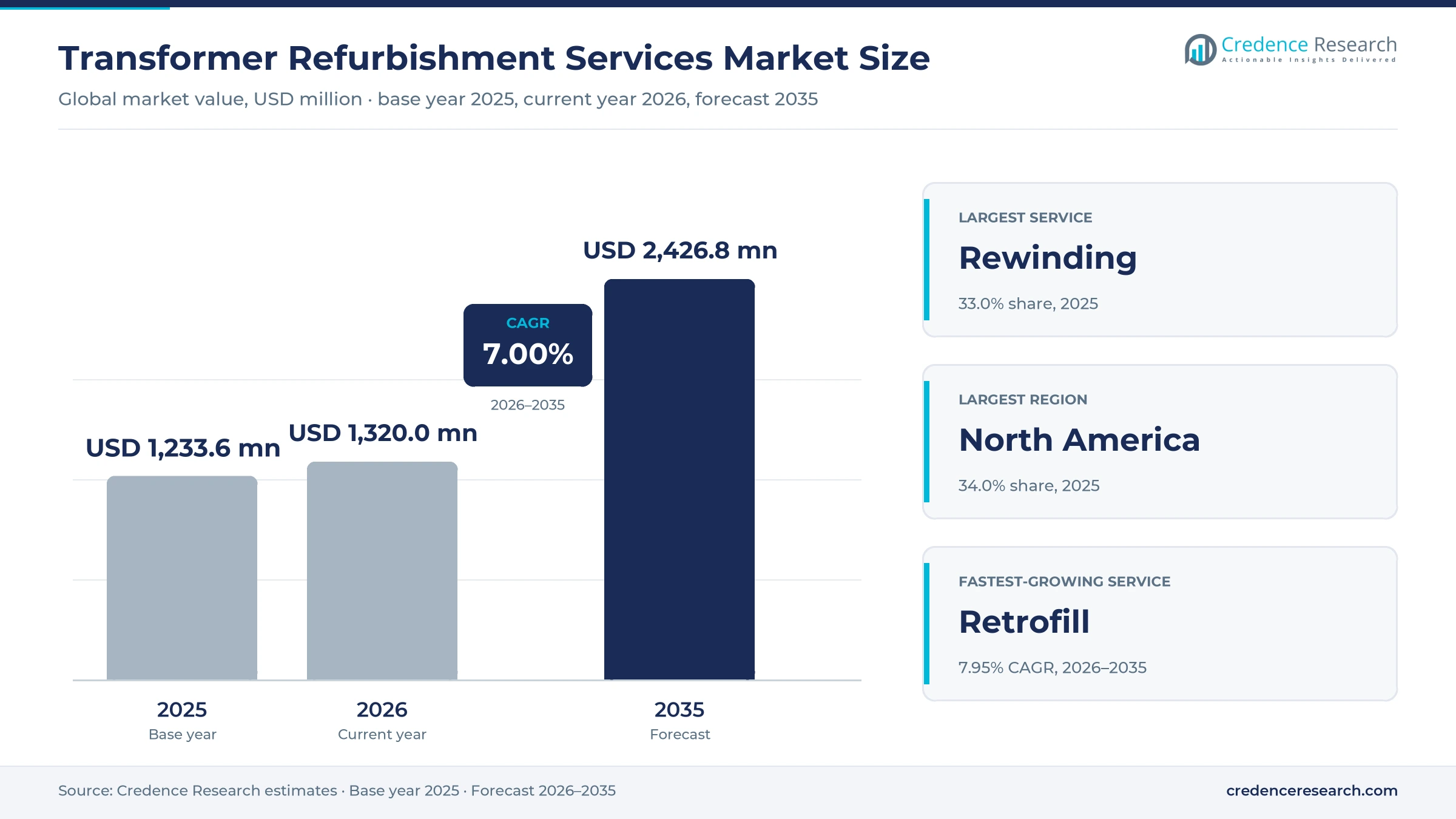
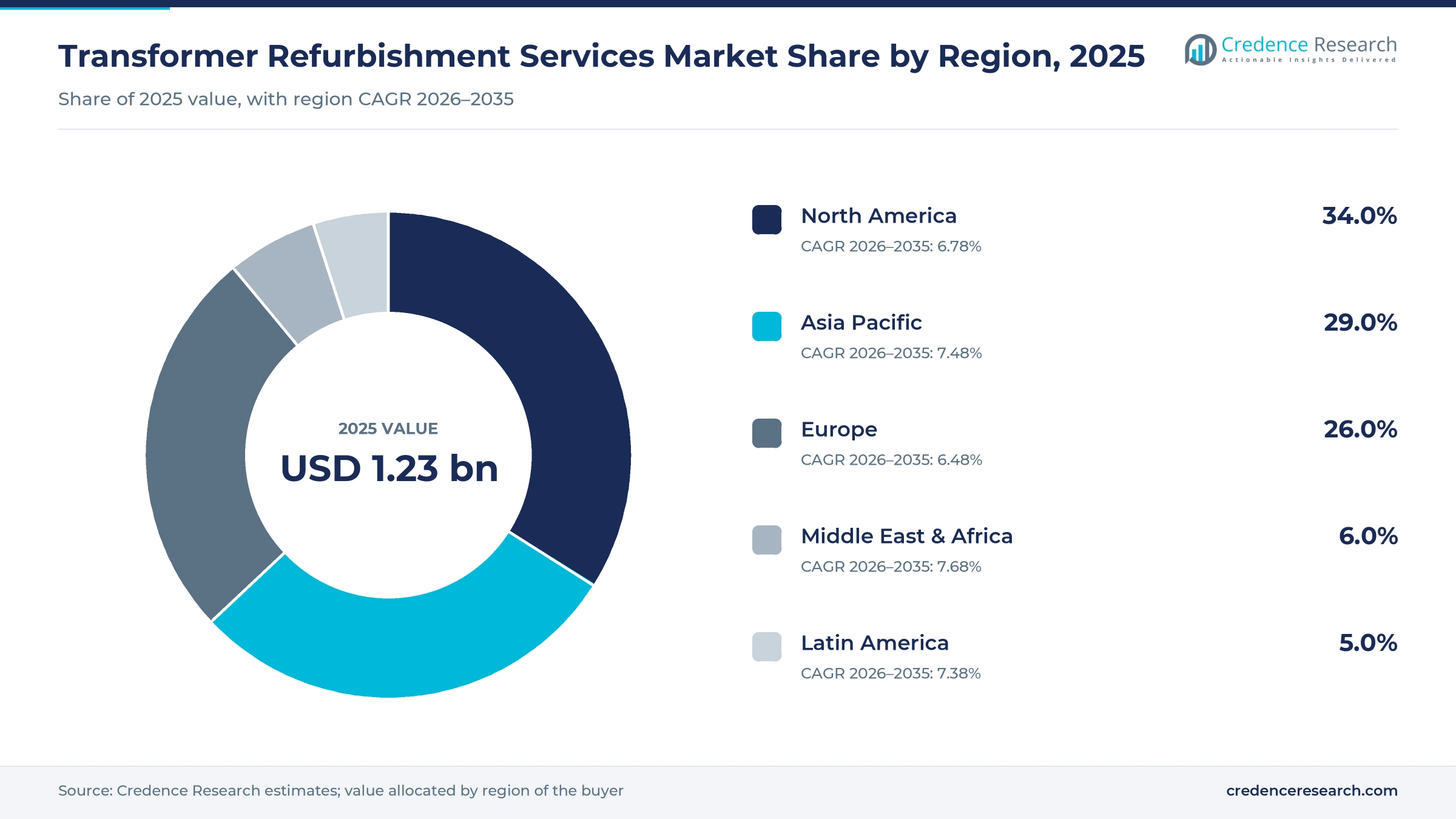
The global transformer refurbishment services market was valued at USD 1.20 billion in 2025 and is projected to increase from USD 1.28 billion in 2026 to USD 2.36 billion by 2035, registering a CAGR of 7.00% during 2026–2035. Spending comes from utilities and industrial plants that pay original equipment makers and independent shops to rewind, retrofill, re-bush and life-extend power and distribution transformers instead of waiting for new units. North America held the largest regional share, 34.0% in 2025, because its fleet is old and new large units now take years to deliver. Middle East & Africa is the fastest-growing region at 7.68% a year as utilities in Saudi Arabia and South Africa add substations and face overload damage. Original equipment makers have also opened, expanded or announced dedicated repair centers in Canada, Norway, Austria and Brazil since late 2024. Owners now compare refurbishment with replacement on cost, downtime and emissions before every major outage.
Which repairs, retrofills and life extension works are counted?
The transformer refurbishment services market covers paid work that restores or extends the life of installed liquid-filled and dry-type power and distribution transformers. This includes winding repair and full rewinds, oil replacement or retrofill with ester fluids, replacement of bushings and on-load tap changers, and life extension packages that combine drying, gasket renewal, cooling upgrades and testing. Buyers pay per project, per unit or under multi-year frame contracts.
The scope excludes the sale of new transformers, routine oil sampling and condition monitoring contracts sold on their own, and the repair of instrument transformers. Value is counted at the service provider level, including shop labor, field crews, transport, replacement components and factory testing billed to the transformer owner.
Transformer Refurbishment Services Market Insights
- The market is valued at USD 1.20 billion in 2025 and should reach USD 2.36 billion by 2035, growing at a 7.00% CAGR as new large units take up to four years.
- North America led with 34.0% of 2025 value, while Middle East & Africa grows fastest at 7.68% a year on substation additions and overload damage.
- Rewinding held 33.0% of 2025 value, and Retrofill is the fastest-growing service at 7.95% a year to 2035.
- Hitachi Energy committed $30 million on Dec. 17, 2025 to refurbishment and field service sites in Stoney Creek and Cambridge, Ontario.
- GE Vernova closed its $5.275 billion purchase of Prolec GE on Feb. 2, 2026, adding a broad transformer services offering in the Americas.
Power units and rewinding lead as retrofill grows fastest
Why do power transformers hold the largest share?
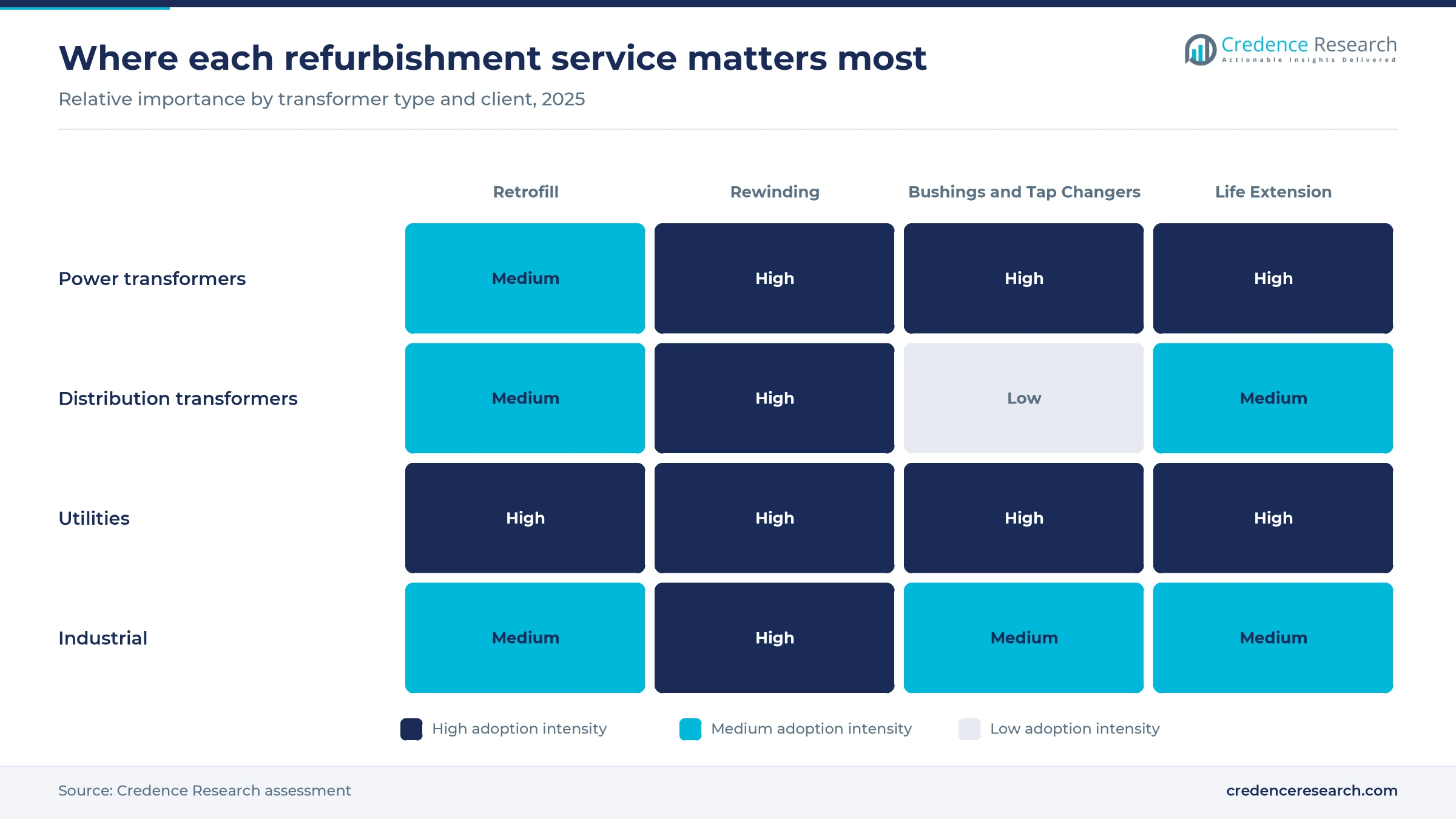
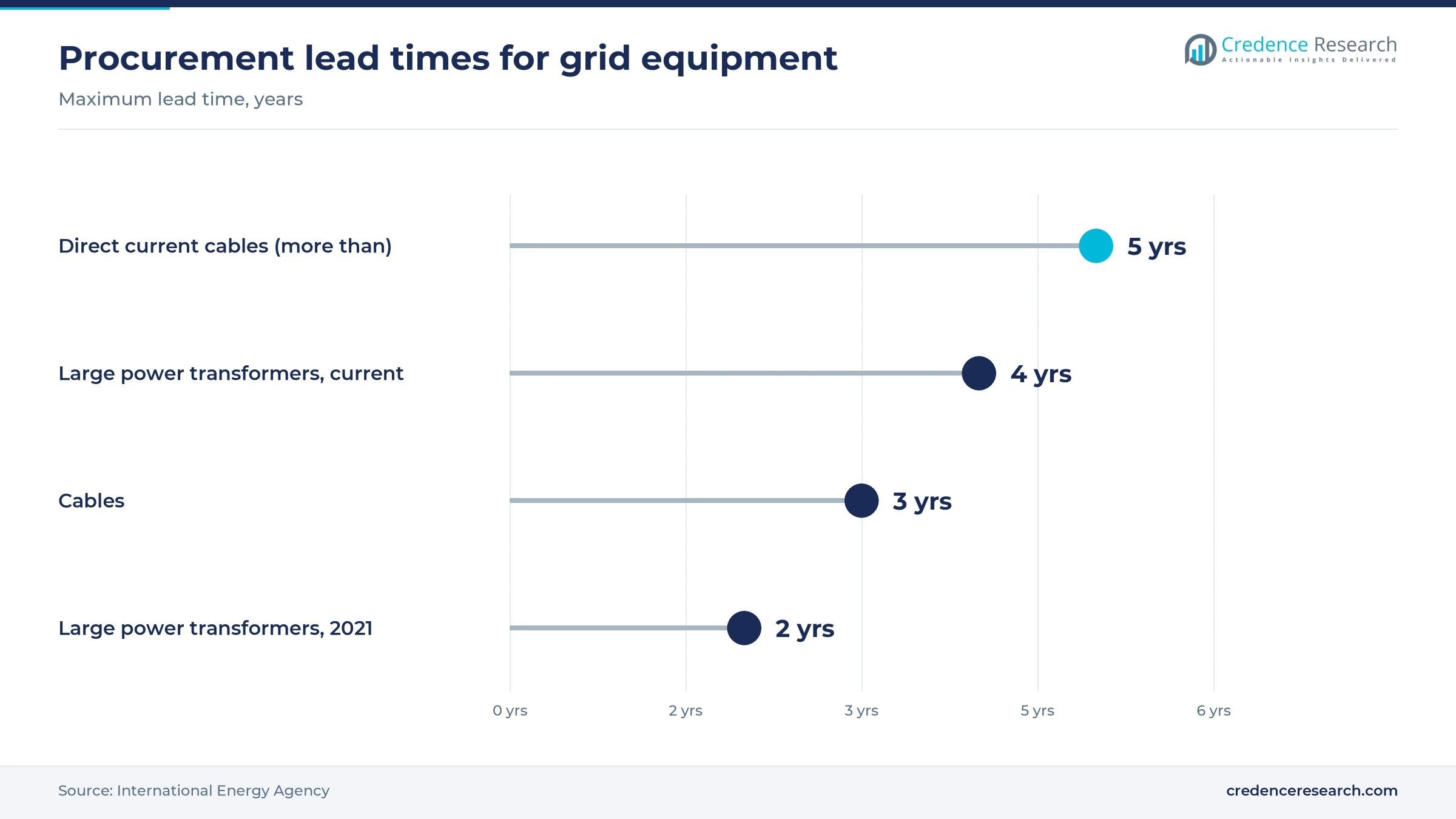
Based on transformer, the market is categorized into power transformers and distribution transformers. Power Transformers led with 61.0% of 2025 value because each large unit is costly and slow to replace. Lead times for large power transformers reached up to four years, twice the 2021 level, according to the International Energy Agency. Powerlink plans a 5.3 million Australian dollar life extension for two 250 MVA units in service for 39 years rather than replacing them. Distribution Transformers grow fastest at 7.60% a year as fleets age. About 55% of U.S. residential units are near the end of their lives, according to Utility Dive in February 2025.
Why does rewinding lead and retrofill grow fastest?
Based on service, the market is categorized into retrofill, rewinding, bushings and tap changers, and life extension. Rewinding led with 33.0% of 2025 value because winding failures need the longest shop time and the most copper and insulation. Siemens Energy's Charlotte expansion, announced on Feb. 15, 2024, plans 12 repair and refurbishment units a year, rising to 24 at full capacity. Retrofill grows fastest at 7.95% a year as owners seek more load from old units. Cargill says its FR3 natural ester extends asset life five to eight times and allows up to 20% more load capacity.
Why do utilities lead and industrial clients grow fastest?
Based on client, the market is categorized into utilities and industrial clients. Utilities led with 70.0% of 2025 value because they own most installed units, and the European Commission estimated in November 2023 that 584 billion euros of grid investment is needed this decade. State Grid Corporation of China alone invested about 650 billion yuan in 2025. Industrial clients grow fastest at 7.69% a year as plants guard against long outages. Hitachi Energy's new Cambridge, Ontario hub, announced in December 2025, will give on-site support to industrial customers and utilities across Canada.
| Segment Group | Leading Sub-segment | Share, 2025 | Fastest-growing Sub-segment | CAGR, 2026–2035 |
|---|---|---|---|---|
| By Transformer | Power Transformers | 61.0% | Distribution Transformers | 7.60% |
| By Service | Rewinding | 33.0% | Retrofill | 7.95% |
| By Client | Utilities | 70.0% | Industrial | 7.69% |
Request a Free Sample
Fill in your details and we'll send you a free sample report.
- Sample data tables & charts
- Research methodology
Aging fleets and long lead times lift repair budgets
Aging grid assets create transformer refurbishment demand
Aging fleets are the main source of repair work because insulation, gaskets and bushings wear out after decades of load. The European Commission said on Nov. 28, 2023 that 40% of European distribution grids are more than 40 years old and that large grid investment is needed this decade. More than 70% of U.S. transformers are over 25 years old, according to a U.S. Department of Energy figure cited by Transformer Technology in October 2025. Powerlink's Middle Ridge units in Queensland have served for 39 years and now need new bushings and cooling controls. In the Credence Research model this driver adds about 2.94 percentage points to annual growth to 2035.
Long equipment lead times favor life extension
Long waits for new equipment make repair the fastest way to keep a substation in service. The International Energy Agency reports that large power transformers can take up to four years to procure, twice the 2021 figure, while their prices rose about 75% in real terms. The National Electrical Manufacturers Association said a new unit could take up to three years against four to six weeks five years earlier, according to Utility Dive. Remanufactured units cost 10% to 40% less than new ones, according to the Remanufacturing Industries Council. In the Credence Research model this driver adds about 1.82 percentage points to annual growth to 2035.
Grid expansion and renewable links raise service needs
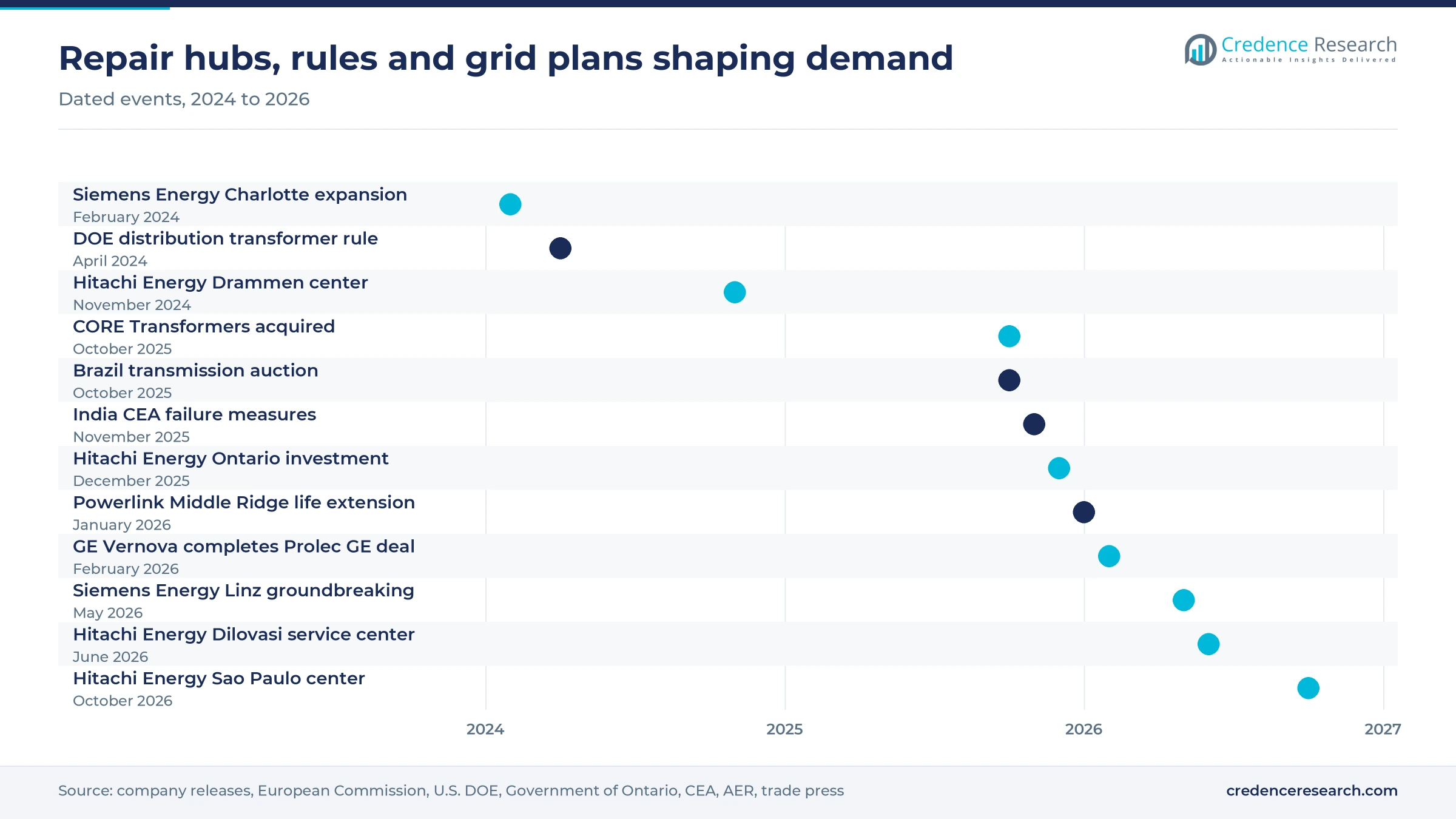
Grid expansion raises the number of units in service and the cost of any outage on a crowded network. The International Energy Agency counts more than 1,600 GW of solar and wind projects in advanced development waiting for grid connections. State Grid Corporation of China invested a record 650 billion yuan in 2025, according to China Daily on Jan. 7, 2026. Brazil's transmission auctions of October 2025 and March 2026 cover 1,839 km of lines and R$11.3 billion of investment, according to the U.S. International Trade Administration. In the Credence Research model this driver adds about 1.19 percentage points to annual growth to 2035.
Fast repair turnaround keeps critical plants running
Owners value repair speed because a failed unit can idle a plant or a substation for months. Siemens Energy repaired, tested and reconnected a 780 MVA unit built in 1977 at the Mehrum power plant within six weeks after a bushing explosion. Maddox says its remanufactured distribution units ship in one to four weeks, against 60 to 80 weeks for new factory units, according to POWER magazine in June 2026. Hitachi Energy's Stoney Creek site in Ontario is the only Canadian facility dedicated to refurbishing medium and large power transformers up to 765 kV. As a result, owners with spare shop slots can restore service far sooner than a new order allows.
OEM repair hubs and ester retrofills reshape the work
Shift toward OEM-owned refurbishment hubs
Original equipment makers are shifting capital into dedicated repair hubs because new factories cannot meet near-term demand. Hitachi Energy opened its expanded Drammen service center in Norway on Nov. 12, 2024 and is extending the life of twelve 38-year-old transformers by 20 to 30 years. The Government of Ontario announced on Dec. 17, 2025 that Hitachi Energy will invest $30 million in Stoney Creek and Cambridge, supporting 185 jobs. Siemens Energy broke ground on a service center in Linz, Austria in May 2026 for units up to 550 kV, 500 MVA and 400 metric tons. These hubs add shop capacity for rewinding and life extension.
Rise of ester retrofill for safety and overload headroom
Retrofilling mineral-oil units with natural ester fluid is rising because it improves fire safety and buys extra load from old transformers. Cargill says its FR3 fluid holds more than 10 times more dissolved water than mineral oil and has recorded zero pool fires in more than 25 years of use. The same fluid lets units run about 20 degrees Celsius hotter, raising load capacity by up to 20%. Moisture ingress causes about 90% of transformer failures, according to Mercom India in November 2025. As a result, retrofill gives owners of older distribution fleets a lower-cost alternative to buying new units during long lead times.
Private capital opens room for regional repair shops
Shortages open an opportunity for independent repair and remanufacturing shops that can turn units around quickly. Emerald Lake Capital, which manages about $1.6 billion of equity, acquired CORE Transformers of Seneca, South Carolina, a refurbisher founded in 2020, according to Transformer Technology on Oct. 1, 2025. Maddox runs five remanufacturing shops across the United States and pays up to five times scrap value for old units. Manufacturers have committed nearly $2 billion to new North American capacity since 2023, but most comes online only in 2027 or 2028, according to POWER magazine. Regional shops can fill that gap with rewinds and remanufactured distribution units.
Emerging-market fleets open new service center openings
Large fleets in emerging markets offer an opening for local repair centers that cut shipping time and cost. India records about 1.3 million distribution transformer failures a year, according to Mercom India on Nov. 28, 2025, and 17 power transformers of 220 kV and above failed in the first half of 2025. Hitachi Energy said on Oct. 27, 2026 that a R$50 million service center in Sao Paulo will open in the first half of 2027 for repairs, upgrades and modernization. Hitachi Energy also opened a factory and service center at Dilovasi, Turkiye in June 2026 for lifecycle services, repairs and asset life extension.
Steel, crews and outage windows limit repair capacity
Core steel supply limits rewinding and rebuilds
Rewinds and core rebuilds depend on grain-oriented electrical steel and copper, which remain tight. The United States has one domestic producer of grain-oriented electrical steel, AK Steel of Cleveland-Cliffs, according to POWER magazine in May 2023. The Department of Energy final rule of April 4, 2024 lets 75% of distribution transformers keep these cores, so demand for the steel stays high. As a result, repair shops wait longer for replacement core material. Providers respond by reusing sound cores and stocking common steel grades.
Skilled crews are scarce for shop and field work
Refurbishment needs winders, testers and field crews, and the grid workforce is already short. About 8 million people work in grid construction, maintenance and operation, and at least 1.5 million more are needed by 2030, according to the International Energy Agency. Maschinenfabrik Reinhausen covered all 50 U.S. states with 65 service technicians from five bases in 2021. As a result, field jobs can wait weeks for a qualified crew. Providers respond with new training centers and mobile oil treatment rigs.
Failure data gaps slow refurbishment planning
Owners struggle to plan refurbishment when failure data is incomplete or not shared across the industry. Many Indian utilities do not share transformer failure data, according to a Central Electricity Authority report cited by Mercom India on Oct. 10, 2025. That report counted 17 power transformer failures of 220 kV and above in the first half of 2025. As a result, repair budgets are often set after failures rather than before them.
Overloading and theft shorten repaired asset life
Overloading and theft can damage units soon after repair, which weakens the case for refurbishment in some networks. Eskom told South Africa's Parliament in a reply to a question of Dec. 24, 2025 that most transformer damage comes from overloading by illegal connections. Eskom also aims to replace damaged low-voltage units within 7.5 hours, so speed favors swaps over shop repair. As a result, utilities protect repaired units with load audits and stronger enclosures.
North America leads as Middle East & Africa grows fastest
| Region | Value, 2025 (USD billion) | Share, 2025 | CAGR, 2026–2035 |
|---|---|---|---|
| North America | 0.41 | 34.0% | 6.78% |
| Asia Pacific | 0.35 | 29.0% | 7.48% |
| Europe | 0.31 | 26.0% | 6.48% |
| Middle East & Africa | 0.07 | 6.0% | 7.68% |
| Latin America | 0.06 | 5.0% | 7.38% |
North America leads on old fleets and new repair capacity
North America held 34.0% of 2025 value and grows at 6.78% a year to 2035. The region leads because its fleet is old and new large units take years to arrive. Siemens Energy's $150 million Charlotte expansion will repair and refurbish up to 24 units a year at full capacity. Hitachi Energy is upgrading Stoney Creek in Ontario for units up to 765 kV, while SGB-SMIT keeps a service site in Louisville, Ohio and Maddox runs five U.S. remanufacturing shops.
Asia Pacific grows on large fleets and frequent failures
Asia Pacific held 29.0% of 2025 value and grows at 7.48% a year to 2035. State Grid Corporation of China invested more than 2.85 trillion yuan from 2021 to 2025, which enlarges the fleet that needs service. India records about 1.3 million distribution transformer failures a year. In Australia, Powerlink plans to life-extend two 250 MVA units at Middle Ridge by 15 years for 5.3 million Australian dollars. Bushings caused about 23% of major failures at TNB, EGAT and PLN from 2001 to 2014, according to INMR.
Europe extends the life of aging distribution grids
Europe held 26.0% of 2025 value and grows at 6.48% a year to 2035. Life extension work is steady because many units installed in the 1980s are still in service, such as the twelve 38-year-old transformers now being refurbished in Norway. Hitachi Energy's Drammen center is one of the largest facilities of its kind in Europe. Siemens Energy's Linz service center will handle units up to 550 kV, and SGB-SMIT runs service from Nijmegen and Regensburg for liquid-filled and cast resin units.
Middle East & Africa grows fastest on grid additions
Middle East & Africa held 6.0% of 2025 value and is the fastest-growing region at 7.68% a year to 2035. Saudi Electricity Co. awarded SAR 785.5 million of distribution substation supply contracts to WESCOSA and Saudi Transformers on Sept. 11, 2025, which adds units that will later need service. Eskom says most transformer damage in South Africa comes from overloading by illegal connections. Reinhausen Middle East, founded in Dubai in 2006, provides tap changer and transformer service in the region.
Latin America adds local service as grids expand
Latin America held 5.0% of 2025 value and grows at 7.38% a year to 2035. Brazil's auction of Oct. 31, 2025 alone covers R$8 billion of investment and 4,400 MW of transformation capacity, according to the U.S. International Trade Administration. Hitachi Energy plans a R$50 million service center in Sao Paulo within a Brazil plan of about R$1.8 billion. As a result, more repair work can stay in the country instead of shipping units abroad.
New repair hubs opened from Norway to Brazil
| Development | Status and market relevance |
|---|---|
| In November 2024, Hitachi Energy inaugurated its expanded transformer service center in Drammen, Norway. | Life extension of twelve 38-year-old units under way |
| In December 2025, Hitachi Energy committed $30 million to refurbishment and field service sites in Ontario. | Stoney Creek refurbishes units up to 765 kV |
| In February 2026, GE Vernova completed its $5.275 billion acquisition of Prolec GE. | Adds a transformer services offering and seven Americas plants |
| In May 2026, Siemens Energy broke ground on a transformer service center in Linz, Austria. | Repair and retrofit of units up to 550 kV |
| In October 2026, Hitachi Energy selected Sao Paulo for a R$50 million service center. | Operations planned for the first half of 2027 |
Ester fluids, new bushings and diagnostics extend life
- Natural ester retrofill replaces mineral oil in service, and Cargill says FR3 fluid can extend asset life five to eight times.
- Bushing replacement swaps aging condenser bushings before they fail, as Powerlink plans for all HV and LV bushings at Middle Ridge within three years.
- On-load tap changer retrofits replace worn diverter switches and controls, a service Maschinenfabrik Reinhausen offers through regional teams.
- Vapor-phase drying and rewinding remove moisture and renew coils in the shop, the core of rebuild work at centers such as Charlotte and Linz.
- Factory and site testing confirm the repaired unit before reconnection, as at Mehrum where testing and reconnection finished within six weeks.
Need a Custom Version of This Report?
Tailor the scope, geography, or segments to your exact requirements.
- Custom geography or segment scope
- Direct access to our analyst team
Shop capacity and voltage range decide competition
Competition in transformer refurbishment centers on shop capacity, voltage range and turnaround time. Hitachi Energy, Siemens Energy, GE Vernova and SGB-SMIT each run repair shops or service offerings, and Siemens Energy's Linz center will also service units from other makers. Maschinenfabrik Reinhausen leads in tap changer service, while independent shops such as Maddox and CORE Transformers win distribution and medium power work on speed. Replacement of electrical bushings is often bundled with a life extension contract. Oil suppliers and processors also compete for retrofill work as owners move away from mineral insulating oil. Large utilities usually sign multi-year frame agreements with one or two providers, which favors makers with nearby shops. As a result, smaller shops tend to win single-unit jobs and emergency repairs rather than fleet programs.
Companies profiled and their roles in this market
| Company | Type | Role in the market |
|---|---|---|
| Hitachi Energy | Original equipment maker | Service centers in Drammen, Stoney Creek, Dilovasi and planned Sao Paulo |
| Siemens Energy | Original equipment maker | Repair workshops in Charlotte and Linz, Mehrum six-week repair |
| GE Vernova | Original equipment maker | Transformer services through Prolec GE, acquired February 2026 |
| SGB-SMIT | Original equipment maker | Service sites in Nijmegen, Regensburg and Louisville |
| Maschinenfabrik Reinhausen | Component specialist | Tap changer service with U.S. and Middle East teams |
| Maddox | Independent remanufacturer | Five U.S. remanufacturing shops |
| CORE Transformers | Independent repair shop | Refurbishment and field repair from Seneca, South Carolina |
Repair capacity will be scarcer than demand to 2030
Credence Research's view is that repair capacity, not demand, will set the pace of this market through 2030. Lead times of up to four years for new large units mean owners will refurbish wherever the core and tank are sound. Providers that add shop slots near large fleets and offer online condition monitoring to time interventions will win fleet programs. Retrofill grows at 7.95% a year, the fastest rate of any service in the Credence Research model, as owners seek extra load from units already in service.
Model-based sizing checked against repair activity
The report uses 2025 as the base year and forecasts values from 2026 to 2035 in U.S. dollars. Market values come from the Credence Research model, and the regional, transformer, service and client splits are Credence Research estimates. Inputs include International Energy Agency and European Commission publications, regulator filings, government statements, company announcements and trade press reports. The 2025 value was checked against public repair capacities and project costs. No interviews or surveys were conducted for this edition of the report.
Aging grids keep refurbishment growing to 2035
The transformer refurbishment services market is expected to grow from USD 1.28 billion in 2026 to USD 2.36 billion by 2035 as fleets age and new units stay scarce. New repair hubs in Linz and Sao Paulo should open by 2027, while North American factory capacity arrives in 2027 and 2028. Growth in substation construction will add units that need service later in the decade. Retrofill and life extension should gain share as owners plan work before failures rather than after them.
Frequently Asked Questions
How big is the transformer refurbishment services market?
Which transformer type holds the largest share?
Which service grows fastest?
Which region leads the market?
Which region grows fastest?
Why do owners refurbish instead of replacing transformers?
Who are the key companies in the market?
What are the main challenges for the market?
Table of Content
Chapter 1 Market Segmentation
- 1.1 Segmentation Framework
- 1.1.1 Product and Service Classification
- 1.1.2 Application and End-Use Classification
- 1.1.3 Technology and Solution Classification
- 1.1.4 Customer and Distribution Channel Classification
- 1.1.5 Geographic Segmentation
- 1.1.6 Market Segment Definitions and Boundaries
- 1.2 By Transformer
- 1.2.1 Power Transformers
- 1.2.2 Distribution Transformers
- 1.3 By Service
- 1.3.1 Rewinding
- 1.3.2 Life Extension
- 1.3.3 Bushings and Tap Changers
- 1.3.4 Retrofill
- 1.4 By Client
- 1.4.1 Utilities
- 1.4.2 Industrial
Chapter 2 Introduction
- 2.1 Report Objectives and Scope
- 2.2 Product Definition and Industry Terminology
- 2.3 Market Inclusions and Exclusions
- 2.4 Research Process
- 2.4.1 Primary Research and Expert Interviews
- 2.4.2 Secondary Research and Source Review
- 2.4.3 Top-Down and Bottom-Up Estimation
- 2.4.4 Data Triangulation and Verification
- 2.5 Market Size Measurement Basis
- 2.5.1 2025: USD 1.20 billion → 2035: USD 2.36 billion
- 2.6 Historical and Forecast Reference Periods
- 2.6.1 Historical Period: 2018-2025
- 2.6.2 Base Year: 2025
- 2.6.3 Forecast Period: 2025-2035
- 2.7 Research Assumptions and Limitations
Chapter 3 Executive Summary
- 3.1 Market Snapshot and Key Findings
- 3.2 Base-Year Market Size, 2025
- 3.3 Forecast Market Size, 2035
- 3.4 Revenue and Volume Growth Outlook
- 3.5 Key Demand and Supply Indicators
- 3.6 Leading Market Segments
- 3.7 Fastest-Growing Market Opportunities
- 3.8 Regional Performance Highlights
- 3.9 Technology and Industry Transformation
- 3.10 Competitive Landscape Summary
- 3.11 Analyst View and Strategic Implications
Chapter 4 Global Transformer Refurbishment Services Market Trends and Developments
- 4.1 Historical Industry Development, 2018-2025
- 4.2 Recent Market Trends and Developments
- 4.3 Demand and Customer Behavior Trends
- 4.4 Technology and Product Innovation
- 4.5 Artificial Intelligence, Automation and Digitalization
- 4.6 Local Manufacturing and Supply Chain Realignment
- 4.7 Industry Partnerships, Mergers and Acquisitions
- 4.8 Sustainability and Circular Economy Developments
- 4.9 Government and Private Sector Investment Trends
- 4.10 Emerging Business Models and Commercialization
- 4.11 Industry Developments and Announcements
Chapter 5 Global Transformer Refurbishment Services Market Supply and Demand Analysis
- 5.1 Demand Trend and Consumption Analysis, 2018-2025
- 5.2 Demand Forecast, 2025-2035
- 5.3 Supply Chain Structure and Procurement Trends
- 5.4 Supply-Demand Gap and Bottlenecks
- 5.5 Import Dependence and Sourcing Structure
- 5.6 Regional Supply and Demand Concentration
Chapter 6 Global Transformer Refurbishment Services Market Pricing Analysis
- 6.1 Pricing Structure and Measurement
- 6.2 Historical Pricing Trends, 2018-2025
- 6.3 Pricing Outlook, 2025-2035
- 6.4 Pricing by Product and Market Segment
- 6.5 Geographic Pricing Differences
- 6.6 Key Input, Energy, Labor and Logistics Costs
- 6.7 Contract Pricing and Purchasing Models
- 6.8 Pricing Sensitivity and Competitive Positioning
- 6.9 Price, Margin and Profitability Implications
Chapter 7 Global Transformer Refurbishment Services Market Dynamics
- 7.1 Market Growth Drivers
- 7.1.1 Demand-Side Drivers
- 7.1.2 Technology and Innovation Drivers
- 7.1.3 Infrastructure and Investment Drivers
- 7.1.4 Regulatory and Policy Drivers
- 7.2 Market Restraints
- 7.2.1 Cost and Affordability Constraints
- 7.2.2 Technology and Adoption Barriers
- 7.2.3 Supply Chain and Operational Constraints
- 7.3 Market Challenges
- 7.3.1 Competitive Pressure and Margin Erosion
- 7.3.2 Skills, Infrastructure and Implementation Gaps
- 7.4 Emerging Market Opportunities
- 7.5 Market Dynamics Impact and Time-Horizon Assessment
Chapter 8 Global Transformer Refurbishment Services Value Chain Analysis
- 8.1 Industry Value Chain Overview
- 8.2 Upstream Suppliers and Critical Inputs
- 8.3 Technology and Component Providers
- 8.4 Manufacturing or Service Delivery
- 8.5 Distribution, Channel Partners and Integrators
- 8.6 Downstream Applications and End Users
- 8.7 Value Addition and Profit Pools
- 8.8 Vertical Integration and Outsourcing
- 8.9 Supplier Concentration and Risk
- 8.10 Supply Chain Localization and Resilience
Chapter 9 Global Transformer Refurbishment Services Market Regulations and Policies
- 9.1 Relevant Laws, Standards and Compliance Frameworks
- 9.2 Product, Service, Safety and Quality Requirements
- 9.3 Government Policies, Incentives and Subsidies
- 9.4 Imports, Exports and Trade Barriers
- 9.5 Public Procurement and Local Content Requirements
- 9.6 Data Protection, AI and Cybersecurity Compliance
- 9.7 Upcoming Policy Changes and Market Implications
Chapter 10 Global Transformer Refurbishment Services Market Hotspots and Opportunities
- 10.1 Market Opportunity Mapping and Growth Hotspots
- 10.2 High-Growth Applications and Customer Groups
- 10.3 Underserved Markets and White-Space Opportunities
- 10.4 Emerging Technology and Product Opportunities
- 10.5 New Capacity and Investment Hotspots
- 10.6 Market Entry and Expansion Opportunities
- 10.7 Distribution and Partnership Opportunities
- 10.8 Near-Term and Long-Term Commercial Potential
- 10.9 Opportunity Attractiveness and Execution Risks
Chapter 11 Global Transformer Refurbishment Services Market Outlook, 2025-2035
- 11.1 Market Size and Analysis
- 11.1.1 Revenue (Market Measurement: 2025: USD 1.20 billion → 2035: USD 2.36 billion)
- 11.1.2 Historical Market Size, 2018-2025
- 11.1.3 Base-Year Market Size, 2025
- 11.2 Market Forecast, 2025-2035
- 11.2.1 Revenue Forecast to 2035
- 11.2.2 CAGR and Year-on-Year Growth
- 11.2.3 Incremental Revenue Opportunity
- 11.3 Forecast Assumptions and Scenario Analysis
- 11.3.1 Base-Case Forecast
- 11.3.2 Optimistic and Conservative Scenarios
- 11.3.3 Technology, Pricing and Policy Sensitivities
- 11.4 Market Attractiveness and Growth Outlook
Chapter 12 Global Transformer Refurbishment Services Market Segmentation and Outlook
- 12.1 Segmentation Summary and Market Shares, 2025
- 12.2 Largest and Fastest-Growing Segments
- 12.3 By Transformer - Market Size and Forecast, 2025-2035
- 12.3.1 Segment Definition and Scope
- 12.3.2 Historical Market Size, 2018-2025
- 12.3.3 Revenue Forecast, 2025-2035
- 12.3.4 Base-Year Market Share, 2025
- 12.3.5 Segment CAGR and Growth Drivers
- 12.3.6 Subsegment Market Size and Forecast
- 12.3.6.1 Power Transformers
- 12.3.6.2 Distribution Transformers
- 12.3.7 Subsegment Pricing and Adoption Trends
- 12.3.8 Leading Suppliers and Competition
- 12.3.9 Regional Demand and Opportunities
- 12.4 By Service - Market Size and Forecast, 2025-2035
- 12.4.1 Segment Definition and Scope
- 12.4.2 Historical Market Size, 2018-2025
- 12.4.3 Revenue Forecast, 2025-2035
- 12.4.4 Base-Year Market Share, 2025
- 12.4.5 Segment CAGR and Growth Drivers
- 12.4.6 Subsegment Market Size and Forecast
- 12.4.6.1 Rewinding
- 12.4.6.2 Life Extension
- 12.4.6.3 Bushings and Tap Changers
- 12.4.6.4 Retrofill
- 12.4.7 Subsegment Pricing and Adoption Trends
- 12.4.8 Leading Suppliers and Competition
- 12.4.9 Regional Demand and Opportunities
- 12.5 By Client - Market Size and Forecast, 2025-2035
- 12.5.1 Segment Definition and Scope
- 12.5.2 Historical Market Size, 2018-2025
- 12.5.3 Revenue Forecast, 2025-2035
- 12.5.4 Base-Year Market Share, 2025
- 12.5.5 Segment CAGR and Growth Drivers
- 12.5.6 Subsegment Market Size and Forecast
- 12.5.6.1 Utilities
- 12.5.6.2 Industrial
- 12.5.7 Subsegment Pricing and Adoption Trends
- 12.5.8 Leading Suppliers and Competition
- 12.5.9 Regional Demand and Opportunities
- 12.6 Segment Growth Comparison
- 12.7 Segment Attractiveness and Priority Matrix
Chapter 13 Global Transformer Refurbishment Services Geographic Market Outlook, 2025-2035
- 13.1 Regional Market Size and Share, 2025
- 13.2 Regional Market Forecast, 2025-2035
- 13.3 Regional Pricing, Production and Demand Differences
- 13.4 North America
- 13.4.1 United States
- 13.4.2 Canada
- 13.4.3 Mexico
- 13.5 Europe
- 13.5.1 Germany
- 13.5.2 France
- 13.5.3 Italy
- 13.5.4 United Kingdom
- 13.5.5 Spain
- 13.5.6 Poland
- 13.5.7 Russia
- 13.5.8 Netherlands
- 13.5.9 Belgium
- 13.5.10 Sweden
- 13.5.11 Denmark
- 13.5.12 Norway
- 13.5.13 Rest of Europe
- 13.6 Asia Pacific
- 13.6.1 China
- 13.6.2 India
- 13.6.3 Japan
- 13.6.4 South Korea
- 13.6.5 Thailand
- 13.6.6 Indonesia
- 13.6.7 Vietnam
- 13.6.8 Malaysia
- 13.6.9 Australia
- 13.6.10 Rest of Asia Pacific
- 13.7 Latin America
- 13.7.1 Brazil
- 13.7.2 Argentina
- 13.7.3 Colombia
- 13.7.4 Chile
- 13.7.5 Rest of Latin America
- 13.8 Middle East
- 13.8.1 Saudi Arabia
- 13.8.2 United Arab Emirates
- 13.8.3 Turkey
- 13.8.4 Israel
- 13.8.5 Iran
- 13.8.6 Rest of the Middle East
- 13.9 Africa
- 13.9.1 South Africa
- 13.9.2 Egypt
- 13.9.3 Nigeria
- 13.9.4 Morocco
- 13.9.5 Rest of Africa
- 13.10 Regional Investment, Policy and Supply Chain Differences
- 13.11 Regional Competitive Landscape
- 13.12 Geographic Growth Hotspots
Chapter 14 Global Transformer Refurbishment Services Technology, Innovation and Sustainability Outlook
- 14.1 Technology Landscape and Maturity
- 14.2 Product, Process and Service Innovation
- 14.3 AI, Automation and Digital Tools in the Industry
- 14.4 Technology Adoption and Performance Benchmarking
- 14.5 Innovation Pipeline and R&D Investment
- 14.6 Energy Efficiency and Resource Management
- 14.7 Sustainability, Recycling and Circularity
- 14.8 Technology Roadmap, 2025-2035
- 14.9 Risks of Obsolescence and Technology Substitution
Chapter 15 Global Transformer Refurbishment Services Market Key Strategic Imperatives
- 15.1 Growth and Market Entry Priorities
- 15.2 High-Return Products and Segments
- 15.3 Pricing, Profitability and Cost Optimization
- 15.4 Technology Investment and Product Differentiation
- 15.5 Supply Chain Localization and Resilience
- 15.6 Distribution and Customer Acquisition
- 15.7 Partnership, Acquisition and Capacity Strategy
- 15.8 Regional Expansion Priorities
- 15.9 Short-, Medium- and Long-Term Actions
Chapter 16 Competition Outlook
- 16.1 Industry Competition Characteristics
- 16.2 Market Structure and Concentration
- 16.3 Market Share and Competitive Positioning, 2025
- 16.4 Company-Wise Revenue and Product Benchmarking
- 16.5 Production and Service Capacity Benchmarking
- 16.6 Technology, Pricing and Differentiation
- 16.7 Regional Footprint and Distribution Strength
- 16.8 Mergers, Acquisitions and Strategic Alliances
- 16.9 New Entrants and Competitive Threats
- 16.10 Porter's Five Forces and Industry Attractiveness
- 16.11 Competitive Outlook, 2025-2035
Chapter 17 Company Profiles
- 17.1 Company Coverage and Selection Criteria
- 17.2 Hitachi Energy
- 17.2.1 Business Description
- 17.2.2 Company Ownership and Geographic Presence
- 17.2.3 Product and Service Portfolio
- 17.2.4 Manufacturing and Operating Footprint
- 17.2.5 Financial Performance and Investment
- 17.2.6 Market Share and Competitive Position
- 17.2.7 Technology and Innovation Capabilities
- 17.2.8 Strategic Alliances or Partnerships
- 17.2.9 Recent Developments
- 17.2.10 Growth Strategy and Outlook
- 17.3 Siemens Energy
- 17.4 GE Vernova
- 17.5 SGB-SMIT
- 17.6 Maschinenfabrik Reinhausen
- 17.7 Maddox
- 17.8 CORE Transformers
- 17.9 Other Relevant Market Participants
Note: Every listed company is profiled on the structure shown under the first company. The company list is preliminary and may change based on research findings, market developments, data availability and client requirements.
Chapter 18 Disclaimer
- 18.1 Research and Forecast Disclaimer
- 18.2 Data Source and Estimation Limitations
Note: The depth of individual sections depends on data availability for this market. Volume, capacity, trade and other unit-based metrics are included where applicable.

