
Young, connected households move baby shopping online
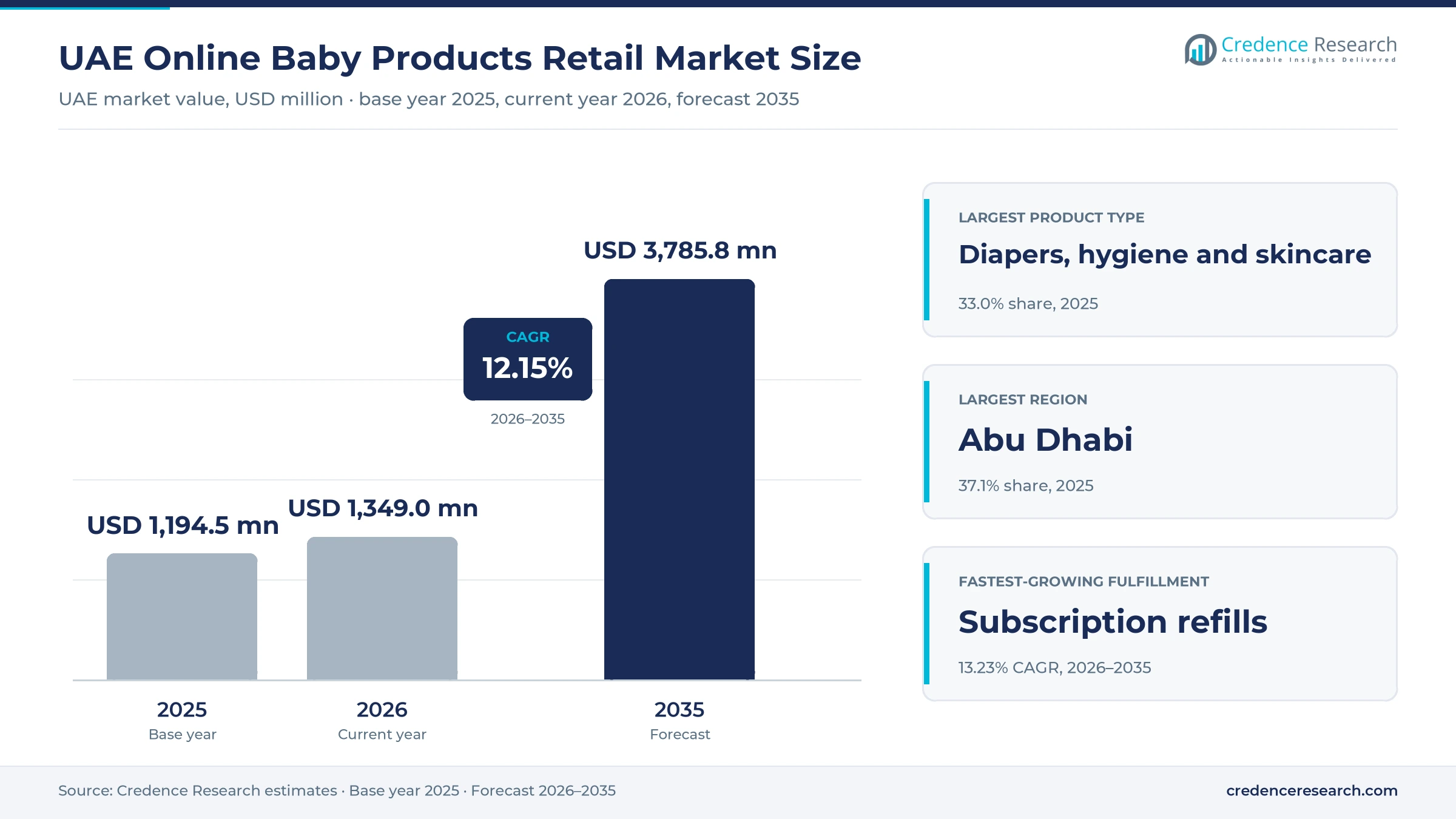
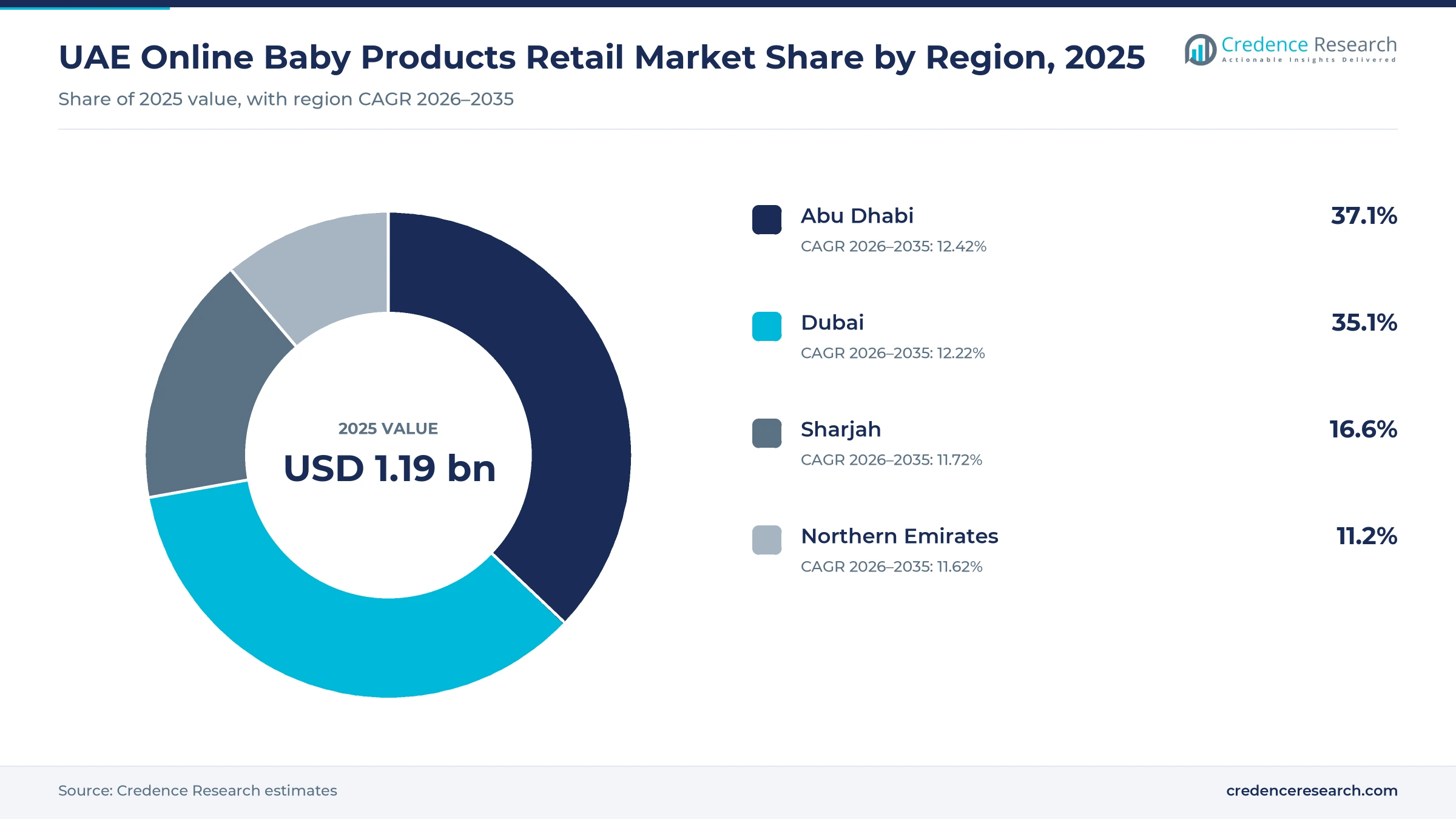
The UAE online baby products retail market was valued at USD 1.19 billion in 2025 and is projected to increase from USD 1.35 billion in 2026 to USD 3.79 billion by 2035, registering a CAGR of 12.15% during 2026–2035. Demand comes from young expatriate and Emirati families who buy diapers, formula, clothing and nursery gear through apps because nearly every household is connected and delivery windows keep shrinking. Abu Dhabi held the largest regional share, 37.1% in 2025, because the emirate combines the largest population with high household incomes and fast population growth. Abu Dhabi is also the fastest-growing emirate at 12.42% a year, while Dubai follows closely as its population passes four million. In turn, Amazon launched a 15-minute delivery service across the country in October 2025, which shows how quickly routine baby essentials are moving to on-demand ordering.
Which baby purchases does the UAE online estimate count?
The estimate measures retail value of baby and young child goods bought online by households in the UAE, including feeding supplies, diapers and skincare, clothing and toys, and strollers, car seats and nursery furniture. It counts orders placed on general marketplaces, specialist baby stores, omnichannel retailer apps and brand websites, whether delivered or collected.
The estimate excludes purchases made inside physical stores, wholesale sales to nurseries and hospitals, and cross-border parcels sent to buyers outside the country. The value chain runs from global and regional brands through importers, marketplaces and e-tailers to delivery partners and the families that order each week.
UAE Online Baby Products Retail Market Insights
- The UAE online baby products retail market was valued at USD 1.19 billion in 2025 and is projected to reach USD 3.79 billion by 2035, registering a CAGR of 12.15% during 2026–2035.
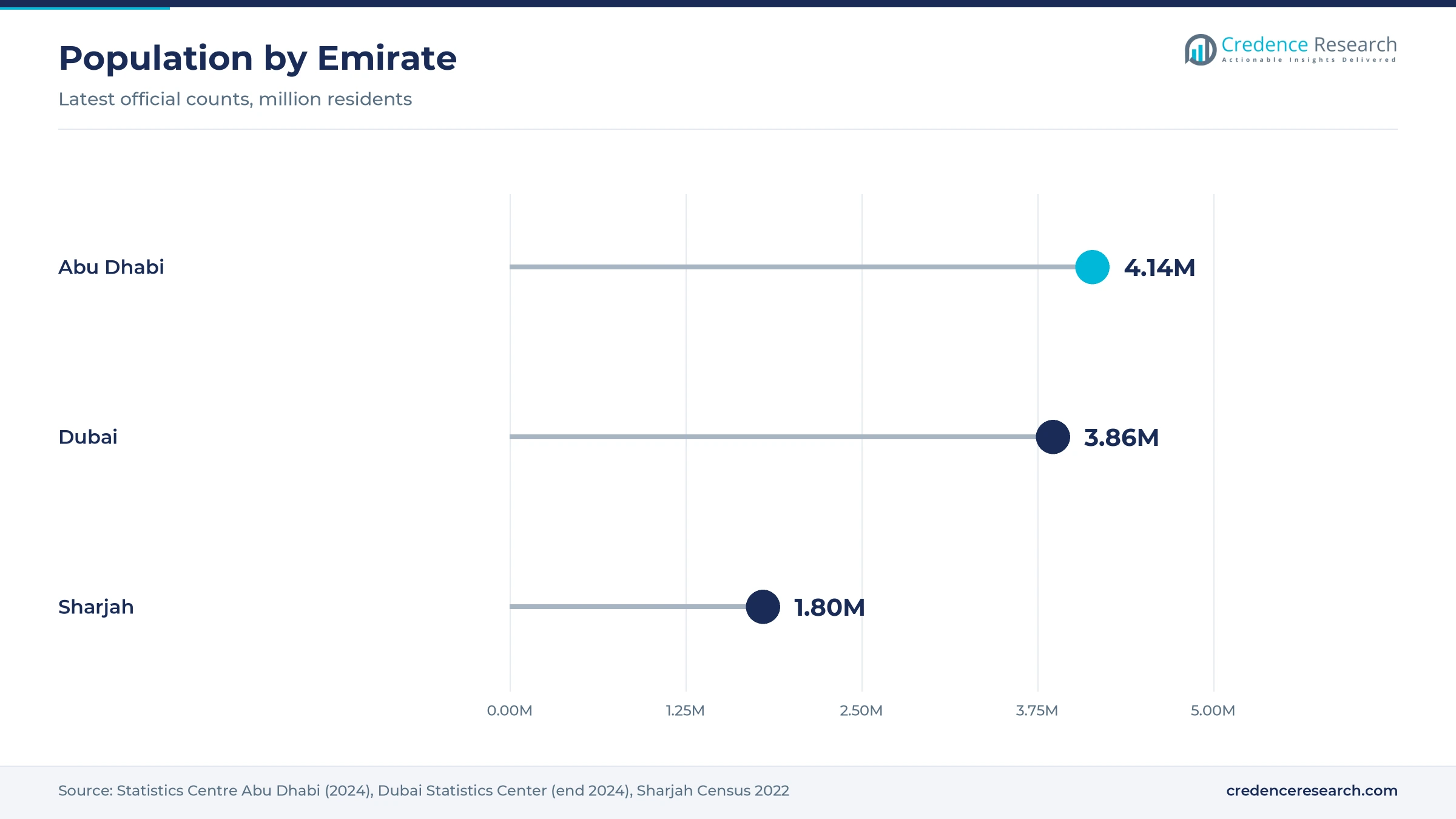
- Abu Dhabi held a 37.1% share of 2025 value, because the emirate had 4.14 million residents in 2024 after 7.5% annual growth.
- Diapers, hygiene and skincare led with a 33.0% share of 2025 value, because these items are bought every week by families with infants.
- Amazon launched its Amazon Now service in October 2025, promising essentials in as little as 15 minutes across Dubai and Abu Dhabi neighborhoods.
- Subscription and auto-replenishment grows fastest at 13.23% a year during 2026–2035, as parents automate repeat orders for diapers, wipes and formula.
Diapers lead while consumables and refills grow fastest
Why do diapers and hygiene items lead order value?
Based on product type, the market is categorized into consumables and feeding; diapers, hygiene and skincare; apparel, footwear and toys; and gear, furniture and safety. Diapers, Hygiene and Skincare led with a 33.0% share of 2025 value, because parents reorder these bulky items every week. Consumables and Feeding grows fastest at 12.71% a year, as quick commerce makes formula and baby food easy to top up.
How do marketplaces and specialist stores split sales?
Based on distribution channel, the market is categorized into general marketplaces, specialist baby e-tailers, omnichannel retailers and brand direct-to-consumer stores. General Marketplaces led with a 46.0% share of 2025 value, because they bundle baby items with groceries and electronics. Brand Direct-to-Consumer grows fastest at 12.86% a year, as brands sell refills and bundles directly to parents.
Which delivery models do parents choose most often?
Based on fulfillment model, the market is categorized into standard delivery, same and next-day delivery, subscription and auto-replenishment, and click-and-collect. Standard Delivery led with a 48.0% share of 2025 value, because large furniture and gear orders still ship on normal schedules. Subscription and Auto-Replenishment grows fastest at 13.23% a year, as parents automate repeat orders for diapers and wipes.
How do newborn and toddler households differ in spending?
Based on customer type, the market is categorized into expectant parents, newborn households, toddler families and gift buyers. Newborn Households led with a 34.0% share of 2025 value, because the first year brings the heaviest spending on diapers, feeding and nursery gear. Gift Buyers grow fastest at 12.54% a year, as relatives order presents for births and celebrations through apps.
| Segment Group | Leading Sub-segment | Share, 2025 | Fastest-growing Sub-segment | CAGR, 2026–2035 |
|---|---|---|---|---|
| By Product Type | Diapers, Hygiene and Skincare | 33.0% | Consumables and Feeding | 12.71% |
| By Distribution Channel | General Marketplaces | 46.0% | Brand Direct-to-Consumer | 12.86% |
| By Fulfillment Model | Standard Delivery | 48.0% | Subscription and Auto-Replenishment | 13.23% |
| By Customer Type | Newborn Households | 34.0% | Gift Buyers | 12.54% |
Request a Free Sample
Fill in your details and we'll send you a free sample report.
- Sample data tables & charts
- Research methodology
Digital habits, rising incomes and fast delivery lift sales
How does digital-first household buying lift baby orders?
Digital-first household purchasing drives demand, because parents in the UAE already run most routine shopping through phones and apps. Individuals using the internet reached 100% of the population in 2024, according to the World Bank, which means almost every new parent can order online. The UAE e-commerce market was valued at AED 27.5 billion in 2023 and is projected to exceed AED 48.8 billion by 2028, according to EZDubai. Amazon.ae also introduced Subscribe and Save in September 2020 with 10% off each item and free delivery for scheduled orders. As a result, general marketplaces hold 46.0% of 2025 value, because families add diapers and formula to baskets they already place every week.
Why does an affluent, growing population raise spending?
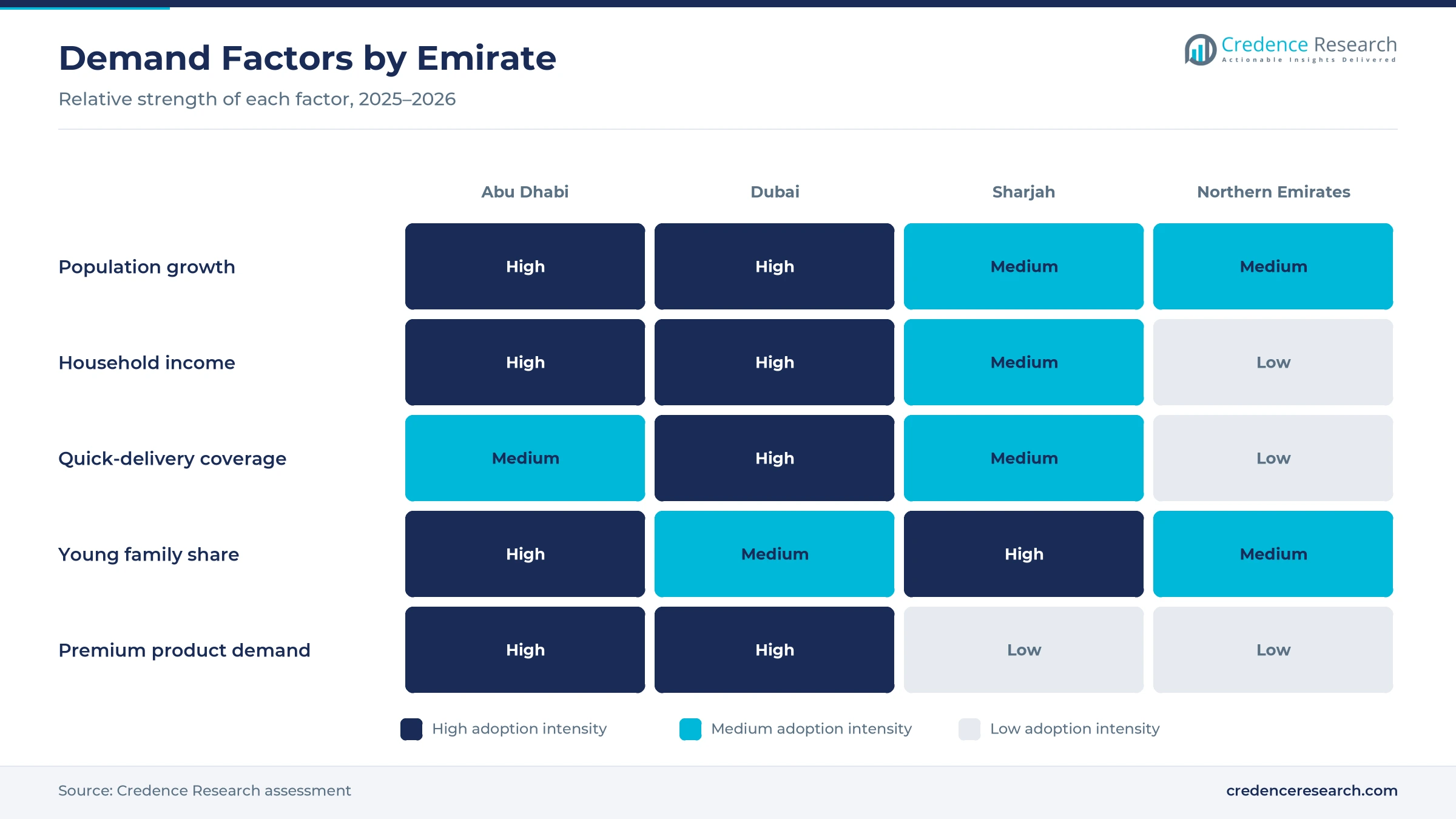
An affluent and expanding consumer base lifts demand, because new families arrive every year with high incomes and strong spending on children. The UAE population reached 11.29 million in 2024, up 5.6% on the year, according to the Federal Competitiveness and Statistics Centre. Abu Dhabi alone grew 7.5% to 4.14 million residents in 2024, and 54% of them were aged 25 to 44, according to Statistics Centre Abu Dhabi. GDP per capita stood at USD 50,274 in 2024, and the crude birth rate was 9.8 births per 1,000 people. In turn, Abu Dhabi leads regional value, as young working-age households buy premium formula, gear, strollers and clothing online.
How do marketplace scale and fast fulfillment expand reach?
Marketplace and fulfillment scale expand reach, because large platforms can stock thousands of baby items close to customers. Amazon launched Amazon Now across the UAE in October 2025, promising essentials in as little as 15 minutes, according to Gulf Business. Its parallel two-hour service covers more than 30 categories, including baby products, with free delivery for Prime members on orders above AED 100. Noon raised USD 500 million in December 2025 to fund growth across e-commerce and its noon Minutes quick-commerce service. Mumzworld also moved fulfillment into an 8,152-square-meter built-to-suit center at Dubai South in 2022. As a result, same and next-day delivery holds a large share of order value.
Why does omnichannel retail investment add online demand?
Omnichannel retail investment adds demand, because store chains now push app orders, home delivery and store pickup together. Landmark Group plans to invest USD 1 billion over three years to open 400 new stores, including nearly 100 in the UAE, according to a December 2024 interview with its chairwoman. The group runs 12 independent e-commerce stores that contribute up to 20% of total sales, and its online business has grown about 20% a year in the GCC. Babyshop, its children's chain, operated more than 230 stores in 13 countries in 2022. Carrefour also offers 60-minute delivery of more than 10,000 products in Dubai. In turn, omnichannel retailers win parents who compare prices online and collect in store.
Minute delivery, robots and refills reshape baby e-commerce
How is the shift to minute-level delivery changing baskets?
The shift to minute-level delivery is changing baskets, because parents now order diapers, wipes and formula only when stocks run low. Amazon said some customers received Amazon Now orders in under six minutes in select areas, and daily orders grew more than 40% month on month after launch. Prime members using the service also doubled their shopping frequency, according to the October 2025 launch report. Carrefour reported that more than 65% of orders on its round-the-clock Dubai service arrive between 10 p.m. and midnight or between 6 a.m. and 8 a.m. As a result, consumables and feeding grow at 12.71% a year, as quick commerce turns infant staples into top-up purchases.
Why is the rise of robot and micro-hub delivery notable?
The rise of robot and micro-hub delivery is notable, because platforms want to cut cost per order in dense residential communities. Noon partnered with Yango Group in December 2025 to deploy autonomous delivery robots for noon Minutes customers in Sobha Hartland in Dubai, according to MENA Startup Digest. Customers choose robot delivery at checkout, track it in real time and open its compartment by smartphone. Amazon is also building micro-fulfillment centers inside neighborhoods across the UAE to shorten delivery distances. In turn, Dubai holds 35.1% of 2025 value, as its compact communities are the first to receive these faster and cheaper delivery formats.
Can subscription refills open steady recurring revenue?
Subscription refills can open steady recurring revenue, because diapers, wipes and formula follow predictable weekly use. Amazon.ae Subscribe and Save offers 10% off each item and free delivery, and subscribers can change frequency or cancel at any time with no fees. The UAE crude birth rate of 9.8 per 1,000 people in 2024 points to a steady inflow of newborn households each year. Abu Dhabi residents aged 25 to 44 made up 54% of the emirate's population in 2024. As a result, subscription and auto-replenishment grows at 13.23% a year, with disposable diapers as the anchor item in most recurring baskets.
Is there room to grow in gear, furniture and assembly services?
Gear, furniture and assembly services offer room to grow, because bulky nursery items need delivery, setup and safety advice that pure marketplaces rarely provide. FirstCry announced an AED 50 million investment in its UAE subsidiary to grow its UAE and Saudi business, according to Inc42 in October 2024. Its unique transacting customers in the international business rose 39% to more than 400,000 in fiscal 2024. Sharjah counted 340,000 households and 399,000 residents aged 19 and under in its 2022 census. In turn, sellers that deliver and install strollers, cribs and car seats can earn higher margins than on consumables.
Discounting, compliance and last-mile costs pressure sellers
How does heavy discounting squeeze margins?
Heavy discounting squeezes margins, because marketplaces, specialists and grocery apps sell the same diaper and formula brands side by side. As a result, parents switch sellers for small price gaps, which keeps gross margins thin on the highest-volume items. Sellers respond with private labels, bundles, loyalty points and subscription discounts that reward repeat orders rather than one-off promotions. In turn, retailers that build loyalty programs can protect margins better than sellers that rely only on price cuts.
Why do product safety and compliance rules raise costs?
Product safety and compliance rules raise costs, because baby food, car seats and cribs must meet labeling and safety standards before sale. The UAE approved Federal Decree-Law No. 14 of 2023 on trade through modern technology, which strengthens protection for online buyers. As a result, sellers must check suppliers, listings and returns more closely, especially for marketplace merchants. Platforms respond with verified brand stores, document checks and faster takedowns, which build trust among cautious parents.
How do last-mile costs limit service outside big cities?
Last-mile costs limit service outside big cities, because delivery routes in the Northern Emirates are longer and order density is lower than in Dubai. In turn, sellers offer fewer same-day slots and higher delivery fees there, which slows adoption among price-conscious families. Operators respond with regional hubs, consolidated routes and click-and-collect points in malls and supermarkets. As a result, coverage in Ras Al Khaimah, Ajman and Fujairah is improving, although delivery speeds still trail the two largest emirates.
Why does a mobile expatriate base raise churn?
A mobile expatriate base raises churn, because many families leave the country after a few years and take their spending with them. As a result, retailers must win new parents continually, which raises marketing and onboarding costs for every seller. Sellers respond with hospital and clinic partnerships, newborn welcome boxes, registries and community content that reach parents before the birth. In turn, sellers that capture expectant parents early can keep them through the toddler years.
Abu Dhabi leads as Dubai and Sharjah add young families
| Region | Value, 2025 (USD billion) | Share, 2025 | CAGR, 2026–2035 |
|---|---|---|---|
| Abu Dhabi | 0.44 | 37.1% | 12.42% |
| Dubai | 0.42 | 35.1% | 12.22% |
| Sharjah | 0.20 | 16.6% | 11.72% |
| Northern Emirates | 0.13 | 11.2% | 11.62% |
Why does Abu Dhabi hold the largest regional share?
Abu Dhabi held a 37.1% share of 2025 value and grows at 12.42% a year, because the emirate had 4,135,985 residents in 2024 after 7.5% growth, according to the Statistics Centre Abu Dhabi. The Abu Dhabi Region alone counts about 2.8 million people, while Al Ain adds nearly 1 million residents. As a result, high-income families in the capital place large orders for formula, nursery furniture and premium clothing.
How does Dubai support fast-delivery baby orders?
Dubai held a 35.1% share of 2025 value and grows at 12.22% a year, because the emirate added more than 208,000 residents in 2024 and passed four million people in September 2025, according to the Dubai Statistics Center. Amazon Now first served areas such as Dubai Marina, Business Bay and Dubai Silicon Oasis. In turn, Dubai parents are the earliest adopters of minute-level delivery for diapers and baby food.
Why is Sharjah a growing family market?
Sharjah held a 16.6% share of 2025 value and grows at 11.72% a year, because many families live there and commute to jobs in Dubai. The emirate counted about 1.8 million residents in its 2022 census, including 399,000 people aged 19 and under and 340,000 households. As a result, value-tier diapers, school-age apparel and toys sell strongly through marketplaces that serve Sharjah homes.
How do the Northern Emirates add demand?
The Northern Emirates accounted for 11.2% of 2025 value and grow at 11.62% a year, because Ajman, Ras Al Khaimah, Umm Al Quwain and Fujairah have smaller populations and longer delivery routes. In turn, families there rely more on standard delivery and click-and-collect points. As a result, growth depends on regional hubs and wider same-day coverage.
Delivery launches, funding and retail expansion plans
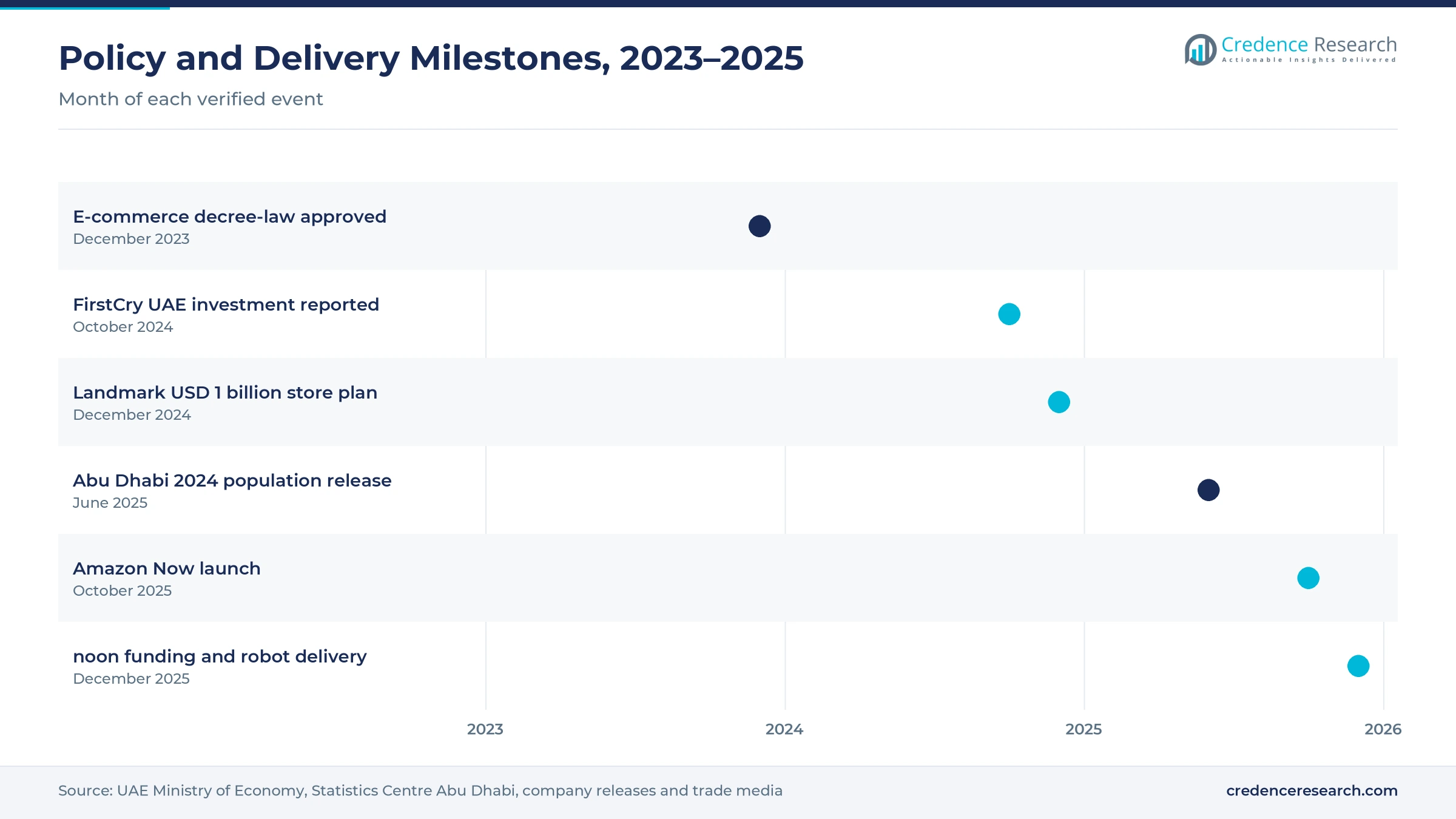
| Development | Status and market relevance |
|---|---|
| In October 2024, FirstCry was reported to be investing AED 50 million in its UAE subsidiary to expand in the UAE and Saudi Arabia. | Adds specialist baby retail capacity |
| In December 2024, Landmark Group said it plans to invest USD 1 billion over three years to open 400 new stores, including nearly 100 in the UAE. | Supports Babyshop and Centrepoint omnichannel reach |
| In June 2025, the Statistics Centre Abu Dhabi reported that the emirate's population grew 7.5% to 4.14 million residents in 2024. | Confirms fast growth in the largest regional buyer base |
| In October 2025, Amazon launched Amazon Now across the UAE, promising essentials in as little as 15 minutes. | Speeds up top-up orders for baby staples |
| In December 2025, noon raised USD 500 million and partnered with Yango Group to launch robot delivery for noon Minutes in Dubai. | Expands quick-commerce delivery options |
Apps, micro-fulfillment and data tools guide baby buying
- Micro-fulfillment centers place fast-moving items inside neighborhoods, which lets platforms deliver diapers and formula within minutes.
- Subscription engines schedule repeat orders and apply discounts automatically, which keeps parents from running out of daily essentials.
- Recommendation tools use a baby's age and past orders to suggest the next size of diapers, clothing or car seat, which raises basket value.
- Autonomous delivery robots carry small orders inside planned communities, which lowers delivery cost per order in dense residential areas.
Need a Custom Version of This Report?
Tailor the scope, geography, or segments to your exact requirements.
- Custom geography or segment scope
- Direct access to our analyst team
Marketplaces and specialists compete on speed and range
Competition is led by large marketplaces that sell baby goods alongside groceries and electronics, followed by specialist baby stores and omnichannel retail chains. Amazon UAE competes on speed and range, with Amazon Now and a two-hour service that includes baby products. Noon competes through its marketplace and noon Minutes, which it is extending with robot delivery in Dubai. Mumzworld competes as a specialist mother and baby store with its own fulfillment center at Dubai South. FirstCry competes with a wide children's range and new investment in its UAE unit. Babyshop competes through Landmark Group's stores and apps, while Carrefour UAE adds diapers and baby food to 60-minute grocery orders. Rivals compete on price, delivery speed, authentic stock, return policies and loyalty programs. Because parents reorder the same items often, sellers that combine low prices with reliable fast delivery usually win repeat business.
Which sellers serve UAE parents online?
| Company | Type | Role in the market |
|---|---|---|
| Amazon UAE | General marketplace | Runs Amazon Now 15-minute delivery and a two-hour service covering baby products |
| noon | General marketplace | Operates noon Minutes quick commerce and robot delivery in Dubai |
| Mumzworld | Specialist baby e-tailer | Runs a built-to-suit fulfillment center at Dubai South |
| FirstCry | Specialist baby e-tailer | Expanding its UAE subsidiary with AED 50 million of new investment |
| Babyshop | Omnichannel retailer | Landmark Group children's chain with stores and online sales |
| Carrefour UAE | Omnichannel retailer | Offers 60-minute delivery of more than 10,000 products in Dubai |
Credence Research view on Emirati baby e-commerce
Credence Research's view is that UAE baby e-commerce will keep growing faster than overall retail, because young families arrive every year and already buy most staples through apps. Diapers and hygiene items remain the largest value pool, while consumables, subscriptions and brand stores add the fastest growth. Minute-level delivery from Amazon and noon will make apps the default channel for top-up orders. Sellers with authentic stock, reliable fast delivery and strong loyalty programs should gain the most, while discounting and expatriate churn keep pressure on smaller stores.
How the UAE baby e-commerce estimate was built
The report uses 2025 as the base year on a calendar basis, and market values come from the Credence Research model. That model combines population and household statistics, internet use data, e-commerce indicators and company releases. Regional shares follow the client data, while segment splits and growth rates are Credence Research estimates. Sources used are official statistics, government agency releases, trade media reports and company releases, and no interviews or surveys were used.
Faster fulfillment and refills carry growth to 2035
The UAE online baby products retail market is expected to reach USD 3.79 billion by 2035, a 12.15% CAGR during 2026–2035, as young families move more routine baby shopping to apps and delivery times keep falling. Growth should be strongest in consumables, subscription refills and brand direct-to-consumer stores, because these areas gain most from repeat ordering. New micro-fulfillment sites and robot delivery will add capacity, while discounting, compliance costs and expatriate churn could slow smaller sellers.
Frequently Asked Questions
How big is the UAE online baby products retail market?
Which product type leads UAE online baby products retail?
Which emirate leads online baby products retail?
How fast is the UAE population growing?
Which fulfillment model is growing fastest?
What new delivery services launched recently?
Who are the leading companies in UAE online baby products retail?
What are the main challenges for online baby retailers?
Table of Content
Chapter 1 Market Segmentation
- 1.1 Segmentation Framework
- 1.1.1 Product and Service Classification
- 1.1.2 Application and End-Use Classification
- 1.1.3 Technology and Solution Classification
- 1.1.4 Customer and Distribution Channel Classification
- 1.1.5 Geographic Segmentation
- 1.1.6 Market Segment Definitions and Boundaries
- 1.2 By Product Type
- 1.2.1 Consumables and Feeding
- 1.2.2 Diapers, Hygiene and Skincare
- 1.2.3 Apparel, Footwear and Toys
- 1.2.4 Gear, Furniture and Safety
- 1.3 By Fulfillment Model
- 1.3.1 Standard Delivery
- 1.3.2 Same and Next-Day Delivery
- 1.3.3 Subscription and Auto-Replenishment
- 1.3.4 Click-and-Collect
- 1.4 By Customer Type
- 1.4.1 Expectant Parents
- 1.4.2 Newborn Households
- 1.4.3 Toddler Families
- 1.4.4 Gift Buyers
Chapter 2 Introduction
- 2.1 Report Objectives and Scope
- 2.2 Product Definition and Industry Terminology
- 2.3 Market Inclusions and Exclusions
- 2.4 Research Process
- 2.4.1 Primary Research and Expert Interviews
- 2.4.2 Secondary Research and Source Review
- 2.4.3 Top-Down and Bottom-Up Estimation
- 2.4.4 Data Triangulation and Verification
- 2.5 Market Size Measurement Basis
- 2.5.1 2025: USD 1.19 billion → 2035: USD 3.79 billion
- 2.6 Historical and Forecast Reference Periods
- 2.6.1 Historical Period: 2018-2025
- 2.6.2 Base Year: 2025
- 2.6.3 Forecast Period: 2025-2035
- 2.7 Research Assumptions and Limitations
Chapter 3 Executive Summary
- 3.1 Market Snapshot and Key Findings
- 3.2 Base-Year Market Size, 2025
- 3.3 Forecast Market Size, 2035
- 3.4 Revenue and Volume Growth Outlook
- 3.5 Key Demand and Supply Indicators
- 3.6 Leading Market Segments
- 3.7 Fastest-Growing Market Opportunities
- 3.8 Regional Performance Highlights
- 3.9 Technology and Industry Transformation
- 3.10 Competitive Landscape Summary
- 3.11 Analyst View and Strategic Implications
Chapter 4 UAE Online Baby Products Retail Market Trends and Developments
- 4.1 Historical Industry Development, 2018-2025
- 4.2 Recent Market Trends and Developments
- 4.3 Demand and Customer Behavior Trends
- 4.4 Technology and Product Innovation
- 4.5 Artificial Intelligence, Automation and Digitalization
- 4.6 Local Manufacturing and Supply Chain Realignment
- 4.7 Industry Partnerships, Mergers and Acquisitions
- 4.8 Sustainability and Circular Economy Developments
- 4.9 Government and Private Sector Investment Trends
- 4.10 Emerging Business Models and Commercialization
- 4.11 Industry Developments and Announcements
Chapter 5 UAE Online Baby Products Retail Market Production, Supply and Demand Analysis
- 5.1 Demand Trend and Consumption Analysis, 2018-2025
- 5.2 Demand Forecast, 2025-2035
- 5.3 Production and Output Trend, 2018-2025
- 5.4 Production and Output Forecast, 2025-2035
- 5.5 Installed Capacity and Capacity Utilization
- 5.6 Company-Wise Production Plants and Statistics
- 5.6.1 Installed Production Capacity
- 5.6.2 Actual Production
- 5.6.3 Planned Capacity and Expansion Targets
- 5.7 Supply Chain Structure and Procurement Trends
- 5.8 Supply-Demand Gap and Bottlenecks
- 5.9 Import Dependence and Sourcing Structure
- 5.10 Contract Manufacturing and Outsourcing
- 5.11 Regional Supply and Demand Concentration
Chapter 6 UAE Online Baby Products Retail Market Pricing Analysis
- 6.1 Pricing Structure and Measurement
- 6.2 Historical Pricing Trends, 2018-2025
- 6.3 Pricing Outlook, 2025-2035
- 6.4 Average Selling Price and Unit Economics
- 6.5 Pricing by Product and Market Segment
- 6.6 Geographic Pricing Differences
- 6.7 Key Input, Energy, Labor and Logistics Costs
- 6.8 Contract Pricing and Purchasing Models
- 6.9 Pricing Sensitivity and Competitive Positioning
- 6.10 Price, Margin and Profitability Implications
Chapter 7 UAE Online Baby Products Retail Market Dynamics
- 7.1 Market Growth Drivers
- 7.1.1 Demand-Side Drivers
- 7.1.2 Technology and Innovation Drivers
- 7.1.3 Infrastructure and Investment Drivers
- 7.1.4 Regulatory and Policy Drivers
- 7.2 Market Restraints
- 7.2.1 Cost and Affordability Constraints
- 7.2.2 Technology and Adoption Barriers
- 7.2.3 Supply Chain and Operational Constraints
- 7.3 Market Challenges
- 7.3.1 Competitive Pressure and Margin Erosion
- 7.3.2 Skills, Infrastructure and Implementation Gaps
- 7.4 Emerging Market Opportunities
- 7.5 Market Dynamics Impact and Time-Horizon Assessment
Chapter 8 UAE Online Baby Products Retail Value Chain Analysis
- 8.1 Industry Value Chain Overview
- 8.2 Upstream Suppliers and Critical Inputs
- 8.3 Technology and Component Providers
- 8.4 Manufacturing or Service Delivery
- 8.5 Distribution, Channel Partners and Integrators
- 8.6 Downstream Applications and End Users
- 8.7 Value Addition and Profit Pools
- 8.8 Vertical Integration and Outsourcing
- 8.9 Supplier Concentration and Risk
- 8.10 Supply Chain Localization and Resilience
Chapter 9 UAE Online Baby Products Retail Market Regulations and Policies
- 9.1 Relevant Laws, Standards and Compliance Frameworks
- 9.2 Product, Service, Safety and Quality Requirements
- 9.3 Government Policies, Incentives and Subsidies
- 9.4 Imports, Exports and Trade Barriers
- 9.5 Public Procurement and Local Content Requirements
- 9.6 Environmental and Sustainability Compliance
- 9.7 Upcoming Policy Changes and Market Implications
Chapter 10 UAE Online Baby Products Retail Market Hotspots and Opportunities
- 10.1 Market Opportunity Mapping and Growth Hotspots
- 10.2 High-Growth Applications and Customer Groups
- 10.3 Underserved Markets and White-Space Opportunities
- 10.4 Emerging Technology and Product Opportunities
- 10.5 New Capacity and Investment Hotspots
- 10.6 Market Entry and Expansion Opportunities
- 10.7 Distribution and Partnership Opportunities
- 10.8 Near-Term and Long-Term Commercial Potential
- 10.9 Opportunity Attractiveness and Execution Risks
Chapter 11 UAE Online Baby Products Retail Market Outlook, 2025-2035
- 11.1 Market Size and Analysis
- 11.1.1 Revenue (Market Measurement: 2025: USD 1.19 billion → 2035: USD 3.79 billion)
- 11.1.2 Market Volume and Quantity Sold
- 11.1.3 Historical Market Size, 2018-2025
- 11.1.4 Base-Year Market Size, 2025
- 11.2 Market Forecast, 2025-2035
- 11.2.1 Revenue Forecast to 2035
- 11.2.2 Volume Forecast to 2035
- 11.2.3 CAGR and Year-on-Year Growth
- 11.2.4 Incremental Revenue Opportunity
- 11.3 Forecast Assumptions and Scenario Analysis
- 11.3.1 Base-Case Forecast
- 11.3.2 Optimistic and Conservative Scenarios
- 11.3.3 Technology, Pricing and Policy Sensitivities
- 11.4 Market Attractiveness and Growth Outlook
Chapter 12 UAE Online Baby Products Retail Market Segmentation and Outlook
- 12.1 Segmentation Summary and Market Shares, 2025
- 12.2 Largest and Fastest-Growing Segments
- 12.3 By Product Type - Market Size and Forecast, 2025-2035
- 12.3.1 Segment Definition and Scope
- 12.3.2 Historical Market Size, 2018-2025
- 12.3.3 Revenue Forecast, 2025-2035
- 12.3.4 Volume Forecast, 2025-2035
- 12.3.5 Base-Year Market Share, 2025
- 12.3.6 Segment CAGR and Growth Drivers
- 12.3.7 Subsegment Market Size and Forecast
- 12.3.7.1 Consumables and Feeding
- 12.3.7.2 Diapers, Hygiene and Skincare
- 12.3.7.3 Apparel, Footwear and Toys
- 12.3.7.4 Gear, Furniture and Safety
- 12.3.8 Subsegment Pricing and Adoption Trends
- 12.3.9 Leading Suppliers and Competition
- 12.3.10 Regional Demand and Opportunities
- 12.4 By Fulfillment Model - Market Size and Forecast, 2025-2035
- 12.4.1 Segment Definition and Scope
- 12.4.2 Historical Market Size, 2018-2025
- 12.4.3 Revenue Forecast, 2025-2035
- 12.4.4 Volume Forecast, 2025-2035
- 12.4.5 Base-Year Market Share, 2025
- 12.4.6 Segment CAGR and Growth Drivers
- 12.4.7 Subsegment Market Size and Forecast
- 12.4.7.1 Standard Delivery
- 12.4.7.2 Same and Next-Day Delivery
- 12.4.7.3 Subscription and Auto-Replenishment
- 12.4.7.4 Click-and-Collect
- 12.4.8 Subsegment Pricing and Adoption Trends
- 12.4.9 Leading Suppliers and Competition
- 12.4.10 Regional Demand and Opportunities
- 12.5 By Customer Type - Market Size and Forecast, 2025-2035
- 12.5.1 Segment Definition and Scope
- 12.5.2 Historical Market Size, 2018-2025
- 12.5.3 Revenue Forecast, 2025-2035
- 12.5.4 Volume Forecast, 2025-2035
- 12.5.5 Base-Year Market Share, 2025
- 12.5.6 Segment CAGR and Growth Drivers
- 12.5.7 Subsegment Market Size and Forecast
- 12.5.7.1 Expectant Parents
- 12.5.7.2 Newborn Households
- 12.5.7.3 Toddler Families
- 12.5.7.4 Gift Buyers
- 12.5.8 Subsegment Pricing and Adoption Trends
- 12.5.9 Leading Suppliers and Competition
- 12.5.10 Regional Demand and Opportunities
- 12.6 Segment Growth Comparison
- 12.7 Segment Attractiveness and Priority Matrix
Chapter 13 UAE Online Baby Products Retail End-Use and Application Market Outlook
- 13.1 End-Use Industry and Customer Demand Structure
- 13.2 Leading Applications and Customer Groups
- 13.3 End-Use Market Size, Share and Forecast
- 13.4 Major End-Use Industry Deep Dives
- 13.4.1 Customer Requirements and Use Cases
- 13.4.2 Demand and Replacement Cycles
- 13.4.3 Technical and Regulatory Considerations
- 13.4.4 Purchasing and Procurement Models
- 13.4.5 Leading Vendors and Distribution Channels
- 13.4.6 Forecast and Commercial Opportunities
- 13.5 Emerging Applications and Cross-Segment Demand
- 13.6 End-Use Industry Investment Priorities
Chapter 14 UAE Online Baby Products Retail Geographic Market Outlook, 2025-2035
- 14.1 Domestic Market Distribution and Demand Clusters
- 14.2 State- or Province-Wise Market Size and Forecast, 2025-2035
- 14.3 City and Metropolitan Market Outlook
- 14.4 Industrial, Manufacturing and Commercial Clusters
- 14.5 Geographic Concentration of Key End Users
- 14.6 Local Pricing and Purchasing Differences
- 14.7 Domestic Production Facilities and Capacity Map
- 14.8 Local Infrastructure and Project Pipeline
- 14.9 State-Level Policy and Incentive Differences
- 14.10 Subnational Investment Hotspots and Opportunities
- 14.11 Distribution and Logistics Networks
- 14.12 Domestic Competitive Footprint
Chapter 15 UAE Online Baby Products Retail Technology, Innovation and Sustainability Outlook
- 15.1 Technology Landscape and Maturity
- 15.2 Product, Process and Service Innovation
- 15.3 AI, Automation and Digital Tools in the Industry
- 15.4 Technology Adoption and Performance Benchmarking
- 15.5 Innovation Pipeline and R&D Investment
- 15.6 Patent and Intellectual Property Trends
- 15.7 Energy Efficiency and Resource Management
- 15.8 Sustainability, Recycling and Circularity
- 15.9 Technology Roadmap, 2025-2035
- 15.10 Risks of Obsolescence and Technology Substitution
Chapter 16 UAE Online Baby Products Retail Market Key Strategic Imperatives
- 16.1 Growth and Market Entry Priorities
- 16.2 High-Return Products and Segments
- 16.3 Pricing, Profitability and Cost Optimization
- 16.4 Technology Investment and Product Differentiation
- 16.5 Supply Chain Localization and Resilience
- 16.6 Distribution and Customer Acquisition
- 16.7 Partnership, Acquisition and Capacity Strategy
- 16.8 Regional Expansion Priorities
- 16.9 Short-, Medium- and Long-Term Actions
Chapter 17 Competition Outlook
- 17.1 Industry Competition Characteristics
- 17.2 Market Structure and Concentration
- 17.3 Market Share and Competitive Positioning, 2025
- 17.4 Company-Wise Revenue and Product Benchmarking
- 17.5 Production and Service Capacity Benchmarking
- 17.6 Technology, Pricing and Differentiation
- 17.7 Regional Footprint and Distribution Strength
- 17.8 Mergers, Acquisitions and Strategic Alliances
- 17.9 New Entrants and Competitive Threats
- 17.10 Porter's Five Forces and Industry Attractiveness
- 17.11 Competitive Outlook, 2025-2035
Chapter 18 Company Profiles
- 18.1 Company Coverage and Selection Criteria
- 18.2 Amazon UAE
- 18.2.1 Business Description
- 18.2.2 Company Ownership and Geographic Presence
- 18.2.3 Product and Service Portfolio
- 18.2.4 Manufacturing and Operating Footprint
- 18.2.5 Production Capacity and Expansion Plans
- 18.2.6 Financial Performance and Investment
- 18.2.7 Market Share and Competitive Position
- 18.2.8 Technology and Innovation Capabilities
- 18.2.9 Strategic Alliances or Partnerships
- 18.2.10 Recent Developments
- 18.2.11 Growth Strategy and Outlook
- 18.3 noon
- 18.4 Mumzworld
- 18.5 FirstCry
- 18.6 Babyshop
- 18.7 Carrefour UAE
- 18.8 Mothercare UAE
- 18.9 Namshi
- 18.10 Centrepoint
- 18.11 Toys "R" Us UAE
- 18.12 Other Relevant Market Participants
Note: Every listed company is profiled on the structure shown under the first company. The company list is preliminary and may change based on research findings, market developments, data availability and client requirements.
Chapter 19 Disclaimer
- 19.1 Research and Forecast Disclaimer
- 19.2 Data Source and Estimation Limitations
Note: The depth of individual sections depends on data availability for this market. Volume, capacity, trade and other unit-based metrics are included where applicable.

