| REPORT ATTRIBUTE | DETAILS |
|---|---|
| Historical Period | 2020-2023 |
| Base Year | 2024 |
| Forecast Period | 2025-2032 |
| Beverage Aluminum Cans Market Size 2024 | USD 36,536.58 million |
| Beverage Aluminum Cans Market, CAGR | 5.79% |
| Beverage Aluminum Cans Market Size 2032 | USD 59,213.23 million |
Market Overview
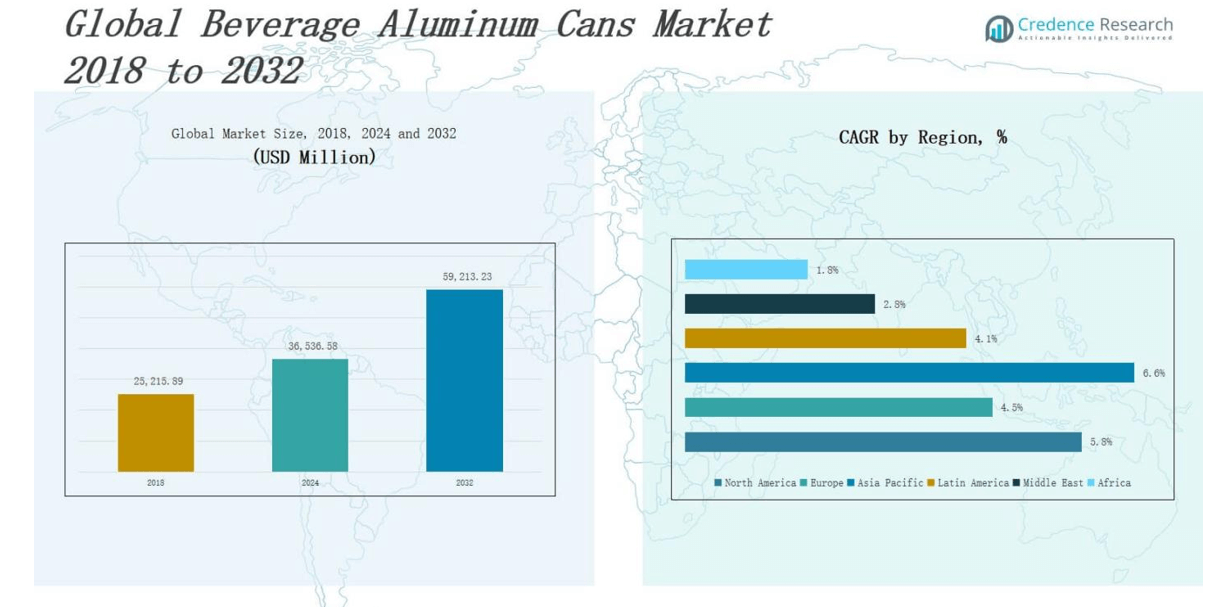
The Beverage Aluminum Cans Market size was valued at USD 25,215.89 million in 2018 to USD 36,536.58 million in 2024 and is anticipated to reach USD 59,213.23 million by 2032, at a CAGR of 5.79% during the forecast period.
The Beverage Aluminum Cans Market is driven by increasing consumer demand for sustainable and recyclable packaging solutions, as aluminum cans offer high recyclability, lightweight properties, and extended shelf life for beverages. The rising consumption of ready-to-drink beverages, including carbonated soft drinks, energy drinks, and alcoholic beverages, further fuels market growth. Manufacturers are shifting toward aluminum cans due to their convenience, aesthetic appeal, and ability to preserve flavor and carbonation. Trends such as the growing preference for single-serve packaging, premium and customized can designs, and the rising adoption of BPA-free linings are shaping the market landscape. Additionally, regulatory support for environmentally friendly packaging and the beverage industry's commitment to reducing plastic waste are accelerating the transition toward aluminum cans. Technological advancements in digital printing and can shaping are enabling enhanced branding and product differentiation. Emerging markets, particularly in Asia-Pacific and Latin America, are witnessing strong demand due to urbanization, rising incomes, and evolving consumer lifestyles.
The Beverage Aluminum Cans Market shows strong geographical presence across North America, Europe, Asia Pacific, Latin America, the Middle East, and Africa. Asia Pacific leads the market in volume and growth, driven by expanding beverage industries in China and India. North America and Europe hold significant shares, supported by advanced recycling infrastructure and high consumption of canned beverages. Latin America sees steady growth from increasing demand in Brazil and Mexico, while the Middle East and Africa are emerging markets with rising urbanization and consumption trends. Key players operating in the Beverage Aluminum Cans Market include Ball Corporation, Crown Holdings, Ardagh Metal Packaging, Toyo Seikan Group Holdings, Canpack Group, CCL Industries, Silgan Holdings, Kian Joo Group, Showa Denko K.K., and Nampak Ltd. These companies compete through innovation, sustainable packaging, and strategic expansion across diverse regional markets.
Market Insights
- The Beverage Aluminum Cans Market was valued at USD 25,215.89 million in 2018, reached USD 36,536.58 million in 2024, and is expected to hit USD 59,213.23 million by 2032, growing at a CAGR of 5.79%.
- Consumer demand for sustainable, recyclable, and lightweight packaging drives the adoption of aluminum cans over plastic and glass formats.
- Ready-to-drink beverages like energy drinks, soft drinks, and craft beers fuel volume growth across major global markets.
- Technological advancements in BPA-free coatings, 360-degree digital printing, and custom can designs boost visual appeal and product differentiation.
- Asia Pacific leads in volume and growth due to rising consumption in China and India, while North America and Europe benefit from mature infrastructure.
- Market players such as Ball Corporation, Crown Holdings, and Ardagh Metal Packaging invest in innovation and expansion to stay competitive.
- Volatile raw material prices and inconsistent recycling infrastructure pose ongoing challenges to sustainability goals in several emerging regions.
Market Drivers
Sustainability and Recyclability Drive Consumer and Industry Preference
The Beverage Aluminum Cans Market benefits significantly from the rising emphasis on sustainable packaging. Consumers and manufacturers increasingly favor aluminum cans due to their infinite recyclability and lower environmental impact compared to plastic and glass. It supports circular economy efforts by maintaining quality even after multiple recycling cycles. Governments and environmental bodies promote aluminum usage to reduce packaging waste. Brands align with these efforts to improve corporate sustainability. Beverage Aluminum Cans Market continues to gain traction through this eco-conscious shift.
- For instance, Novelis, a leading aluminum supplier, is working with industry peers to further increase the recycled content in can alloys and has advanced UBC (Used Beverage Can) recycling and rolling capacities to guarantee low-CO₂ can sheet with the highest recycled content.
Growing Demand for Ready-to-Drink and Convenience Beverages
The Beverage Aluminum Cans Market is expanding due to the global rise in ready-to-drink (RTD) products. Busy lifestyles and urbanization increase the appeal of convenient, portable beverage packaging. It serves various categories, including energy drinks, flavored water, craft beer, and sparkling beverages. Consumers seek packaging that is lightweight, tamper-resistant, and easy to chill. The can’s ability to preserve flavor and carbonation boosts its appeal. RTD consumption patterns strengthen demand in this market segment.
- For instance, Del Monte Foods in India transitioned from traditional tin cans to infinitely recyclable aluminum beverage cans, supported by Ball Corporation, to enhance sustainability and meet changing consumer preferences.
Packaging Innovation and Visual Appeal Support Brand Differentiation
Packaging aesthetics and functionality play a vital role in the Beverage Aluminum Cans Market. Brands use advanced printing technologies to produce visually appealing, customizable cans that attract consumer attention on shelves. It allows for promotional designs, limited editions, and seasonal graphics that enhance brand identity. Enhanced barrier coatings and BPA-free linings add product value. Cans also offer 360-degree branding potential, unlike many alternatives. These innovations improve shelf presence and consumer perception across beverage categories.
Shift from Plastic and Glass Enhances Market Penetration
The Beverage Aluminum Cans Market is witnessing a shift from traditional packaging formats like plastic bottles and glass containers. Rising health and environmental concerns push consumers to seek alternatives with fewer harmful chemicals and better disposal options. It supports retailer and manufacturer initiatives to reduce plastic waste. The logistical advantages of cans, such as stackability and durability, further their adoption. Beverage companies increasingly invest in aluminum formats to align with evolving packaging norms.
Market Trends
Premiumization and Customization Shape Consumer Preferences
Brands in the Beverage Aluminum Cans Market are focusing on premium and customized offerings to meet evolving consumer expectations. Visual appeal, unique textures, and specialty finishes enhance shelf presence and support premium positioning. It allows brands to create a distinct identity through limited-edition designs and collector series. Customization also plays a critical role in promotional campaigns and brand storytelling. Consumers respond positively to packaging that reflects quality and exclusivity. This trend continues to influence packaging decisions and brand strategy.
- For instance, CanTech Industries has launched lightweight, high-recyclability cans with unique textures and finishes, supporting premium positioning for energy drinks and ready-to-drink cocktails.
Expansion of Alcoholic Beverages in Can Format
The growing popularity of canned alcoholic drinks is redefining the Beverage Aluminum Cans Market. Hard seltzers, craft beers, cocktails, and wine in cans are gaining traction across diverse age groups. It enables portability, faster chilling, and portion control, making it ideal for outdoor and on-the-go consumption. Beverage companies are leveraging this trend to diversify product portfolios and enter new demographics. Younger consumers particularly value the casual, modern appeal of canned alcohol. The format expands both volume and reach for alcoholic brands.
- For instance, White Claw, a hard seltzer brand, became a market leader in the U.S. with its ready-to-drink canned beverages, especially popular among millennials and Gen Z for their convenience and variety of flavors.
Technological Advancements Improve Functionality and Sustainability
Innovation in can manufacturing is advancing the capabilities of the Beverage Aluminum Cans Market. Enhanced barrier properties, BPA-free linings, and lightweight structures improve product safety and environmental impact. It supports longer shelf life and better product preservation. Digital printing enables cost-efficient short runs with high-quality graphics. These improvements offer operational advantages and open new avenues for creativity. Manufacturers adopt these technologies to meet changing regulatory standards and consumer expectations for safer, smarter packaging.
E-commerce and Direct-to-Consumer Models Drive Packaging Shifts
The rise of e-commerce is influencing packaging formats in the Beverage Aluminum Cans Market. Online platforms require packaging that is durable, compact, and easy to ship. It makes aluminum cans well-suited for direct-to-consumer delivery. Brands are redesigning can multipacks and labels to enhance appeal for digital shoppers. Subscription models and curated beverage boxes also increase can usage. This trend supports the growing role of digital channels in beverage distribution and marketing strategies.
Market Challenges Analysis
Volatility in Raw Material Prices Increases Cost Pressures
The Beverage Aluminum Cans Market faces persistent challenges due to fluctuating aluminum prices. Global supply chain disruptions, trade policies, and energy costs contribute to unpredictable raw material expenses. It puts pressure on manufacturers to manage margins while maintaining competitive pricing. Smaller producers are more vulnerable to these cost swings, limiting their ability to scale. Buyers often delay contracts or seek alternative packaging solutions during high-price periods. This price volatility impacts long-term planning and investment decisions across the value chain.
Recycling Infrastructure and Collection Inefficiencies Limit Sustainability Goals
Despite aluminum’s recyclability, the Beverage Aluminum Cans Market struggles with inconsistent recycling infrastructure in many regions. Collection rates vary widely, affecting the availability of high-quality recycled aluminum. It forces some producers to rely on virgin aluminum, which undermines sustainability targets and increases environmental impact. Consumer awareness about proper disposal remains uneven, contributing to material loss. Government regulations are evolving, but enforcement and infrastructure investments lag. These challenges slow progress toward a closed-loop supply model for the industry.
Market Opportunities
Rising Demand for Eco-Friendly Packaging Supports Market Expansion
The global shift toward sustainable packaging presents strong growth potential for the Beverage Aluminum Cans Market. Governments, brands, and consumers increasingly prioritize materials with high recyclability and lower environmental footprints. It positions aluminum cans as a preferred solution over plastic and glass. Companies investing in low-carbon aluminum production and closed-loop recycling systems can enhance brand image and meet regulatory targets. Consumer demand for sustainable choices continues to grow, especially among younger demographics. This trend creates opportunities for innovation and market penetration.
Emerging Markets Offer Untapped Growth Potential
Rapid urbanization and rising disposable incomes in emerging economies present significant opportunities for the Beverage Aluminum Cans Market. Expanding beverage consumption in countries across Asia-Pacific, Latin America, and Africa creates strong demand for modern packaging formats. It allows brands to enter new regions with durable, lightweight, and cost-efficient solutions. Retail modernization and cold chain infrastructure improvements further support can adoption. Local manufacturing investments can reduce logistics costs and improve responsiveness to regional preferences. This growth opportunity strengthens global market presence and revenue streams.
Market Segmentation Analysis:
By Product Type
The Beverage Aluminum Cans Market is segmented into 2-piece and 3-piece aluminum cans. 2-piece cans dominate due to their seamless structure, which enhances durability and minimizes leakage. It supports high-speed production and is widely used for carbonated drinks and beer. 3-piece cans are primarily adopted for specialty beverages and limited-edition packaging. They offer flexibility in labeling and design but have a smaller share. The market continues to favor 2-piece formats for efficiency and performance.
- For instance, Crown Holdings introduced 2-piece aluminum cans with advanced barrier coatings, enabling brands like Red Bull to maintain product freshness and extend shelf life for energy drinks and carbonated beverages.
By Capacity
Based on capacity, the Beverage Aluminum Cans Market is categorized into 201–450 ml and others. The 201–450 ml segment holds the largest share, driven by strong demand for single-serve and on-the-go beverages. It is ideal for soft drinks, energy drinks, and alcoholic beverages. The "others" segment includes both smaller trial sizes and larger formats used in clubs or bulk consumption. Changing consumer lifestyles support further growth in the mid-size capacity range.
- For instance, Ball Corporation partnered with Dabur in January 2025 to launch Réal Bites fruit juices in single-serve aluminum cans, targeting urban consumers seeking eco-friendly and convenient packaging.
By Beverage Type
By beverage type, the Beverage Aluminum Cans Market covers carbonated soft drinks, beer, energy drinks, functional beverages, and others. Carbonated soft drinks lead the segment due to their global consumption volume and wide brand portfolios. Beer represents a significant share, with craft and canned formats gaining popularity. Energy and functional beverages are rising steadily, supported by health-conscious trends and athletic lifestyle demand. It creates opportunities for can manufacturers to diversify offerings across beverage categories.
Segments:
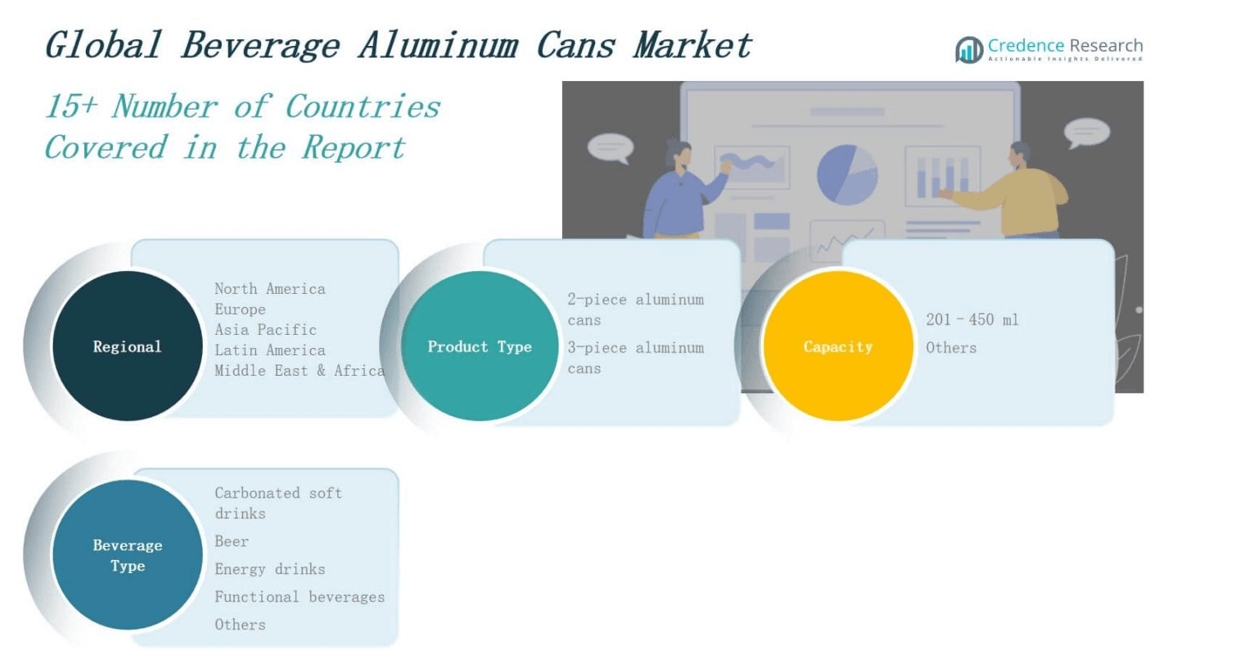
Based on Product Type
- 2-piece aluminum cans
- 3-piece aluminum cans
Based on Capacity
- 201–450 ml
- Others
Based on Beverage Type
- Carbonated soft drinks
- Beer
- Energy drinks
- Functional beverages
- Others
Based on Region
- North America
- U.S.
- Canada
- Mexico
- Europe
- Germany
- France
- U.K.
- Italy
- Spain
- Rest of Europe
- Asia Pacific
- China
- Japan
- India
- South Korea
- South-east Asia
- Rest of Asia Pacific
- Latin America
- Brazil
- Argentina
- Rest of Latin America
- Middle East & Africa
- GCC Countries
- South Africa
- Rest of the Middle East and Africa
Regional Analysis
North America
The North America Benzaldehyde Market size was valued at USD 8,125.32 million in 2018 to USD 11,607.49 million in 2024 and is anticipated to reach USD 18,882.80 million by 2032, at a CAGR of 5.8% during the forecast period. North America holds a significant share of the global Benzaldehyde Market, driven by strong demand from the fragrance, flavor, and pharmaceutical industries. It benefits from advanced manufacturing infrastructure and high consumption of personal care products. The U.S. dominates regional sales, supported by large-scale chemical production and innovation in specialty chemicals. Regulatory emphasis on safe and sustainable ingredients continues to influence sourcing and product development. The region's growing interest in natural and bio-based benzaldehyde is likely to boost long-term demand.
Europe
The Europe Benzaldehyde Market size was valued at USD 4,670.84 million in 2018 to USD 6,394.14 million in 2024 and is anticipated to reach USD 9,415.30 million by 2032, at a CAGR of 4.5% during the forecast period. Europe maintains a steady share in the Benzaldehyde Market due to its mature cosmetics, food, and pharmaceutical sectors. It emphasizes regulatory compliance and sustainable production methods, which impact raw material sourcing. Germany, France, and the UK lead regional demand with consistent use of benzaldehyde in perfumes and food flavoring. The presence of multinational fragrance houses and R&D investments support product diversification. The market is gradually shifting toward green chemistry and eco-friendly ingredients.
Asia Pacific
The Asia Pacific Benzaldehyde Market size was valued at USD 10,397.52 million in 2018 to USD 15,655.01 million in 2024 and is anticipated to reach USD 27,008.04 million by 2032, at a CAGR of 6.6% during the forecast period. Asia Pacific is the largest and fastest-growing region in the Benzaldehyde Market. It benefits from rapid industrialization, rising disposable incomes, and expanding end-user industries such as agriculture, food processing, and pharmaceuticals. China and India are the leading contributors due to their strong manufacturing base and increasing exports. It supports cost-effective production and growing demand for synthetic and natural benzaldehyde. Regulatory changes are beginning to shape quality standards across the region.
Latin America
The Latin America Benzaldehyde Market size was valued at USD 1,168.50 million in 2018 to USD 1,671.65 million in 2024 and is anticipated to reach USD 2,391.79 million by 2032, at a CAGR of 4.1% during the forecast period. Latin America holds a moderate share in the Benzaldehyde Market, supported by growth in the agrochemical and flavoring sectors. Brazil and Mexico lead consumption, driven by demand for aromatic compounds in food and beverages. It benefits from regional expansion of fragrance and pesticide manufacturing. Market growth is supported by local production improvements and increasing foreign investments. However, infrastructure and regulatory challenges remain key barriers.
Middle East
The Middle East Benzaldehyde Market size was valued at USD 557.78 million in 2018 to USD 720.26 million in 2024 and is anticipated to reach USD 930.45 million by 2032, at a CAGR of 2.8% during the forecast period. The Middle East contributes a smaller share to the global Benzaldehyde Market. It is primarily driven by demand in food flavorings and cosmetic applications. Countries like Saudi Arabia and the UAE are expanding their non-oil sectors, which supports downstream chemical industries. Imports continue to meet a significant portion of demand due to limited local production. The market shows gradual growth as industrial diversification increases across the region.
Africa
The Africa Benzaldehyde Market size was valued at USD 295.93 million in 2018 to USD 488.02 million in 2024 and is anticipated to reach USD 584.85 million by 2032, at a CAGR of 1.8% during the forecast period. Africa holds the smallest share in the Benzaldehyde Market, limited by underdeveloped industrial infrastructure and lower consumption levels. It sees steady demand from food processing and pharmaceuticals, particularly in South Africa and Egypt. It depends heavily on imports to meet regional needs. Market expansion is gradually taking shape through improving industrial capabilities and rising awareness of product applications. Investment in local production remains a long-term opportunity.
Key Player Analysis
- Ball Corporation
- Crown Holdings, Inc.
- Ardagh Metal Packaging
- Toyo Seikan Group Holdings, Ltd.
- Canpack Group
- CCL Industries, Inc.
- Silgan Holdings Inc.
- Kian Joo Group
- Showa Denko K.K.
- Nampak Ltd.
Competitive Analysis
The Beverage Aluminum Cans Market is highly competitive, with global and regional players striving to strengthen their market positions through innovation, capacity expansion, and sustainability initiatives. Leading companies such as Ball Corporation, Crown Holdings, and Ardagh Metal Packaging dominate through integrated supply chains, technological advancements, and strong brand partnerships. It is characterized by continuous investment in lightweight materials, recyclable solutions, and advanced printing techniques. Regional players focus on customization and cost efficiency to capture niche markets. Strategic mergers, acquisitions, and long-term contracts with beverage brands help companies secure stable demand and expand geographic reach. The market continues to evolve with rising consumer expectations and stricter environmental regulations. Companies invest in new manufacturing facilities and digital packaging solutions to meet these shifts. The Beverage Aluminum Cans Market demands agility, operational efficiency, and sustainability-driven innovation to remain competitive in a rapidly changing global packaging landscape.
Recent Developments
- On October 31, 2024, Ball Corporation acquired Alucan to expand its aluminum packaging capabilities in Europe.
- On January 10, 2025, TÖST Beverages introduced 250-ml aluminum cans for its non-alcoholic sparkling drinks across the United States.
- On October 5, 2023, TricorBraun announced its acquisition of CanSource to strengthen its position in the North American beverage aluminum cans market.
- In March 2025, Crown Holdings entered into a partnership with Moment, a botanical beverage brand, to package its “Drink Your Meditation” product line in aluminum cans.
Market Concentration & Characteristics
The Beverage Aluminum Cans Market exhibits moderate to high market concentration, with a few dominant global players such as Ball Corporation, Crown Holdings, and Ardagh Metal Packaging controlling a significant share. It is characterized by strong competition, capital-intensive operations, and high entry barriers due to technological, regulatory, and sustainability requirements. Large players maintain competitive advantage through vertical integration, scale efficiencies, and long-term contracts with beverage companies. The market favors manufacturers that offer lightweight, customizable, and recyclable can solutions. It is highly responsive to consumer trends such as convenience, premium packaging, and environmental awareness. Innovation in printing, coating technologies, and sustainable materials plays a critical role in product differentiation. The Beverage Aluminum Cans Market also reflects a growing shift toward regional manufacturing to reduce logistics costs and improve supply chain resilience. Strategic investments in R&D and sustainable practices remain essential for market players to retain competitiveness and meet evolving regulatory standards.
Report Coverage
The research report offers an in-depth analysis based on Product Type, Capacity, Beverage Type and Region. It details leading market players, providing an overview of their business, product offerings, investments, revenue streams, and key applications. Additionally, the report includes insights into the competitive environment, SWOT analysis, current market trends, as well as the primary drivers and constraints. Furthermore, it discusses various factors that have driven market expansion in recent years. The report also explores market dynamics, regulatory scenarios, and technological advancements that are shaping the industry. It assesses the impact of external factors and global economic changes on market growth. Lastly, it provides strategic recommendations for new entrants and established companies to navigate the complexities of the market.
Future Outlook
- Demand for eco-friendly and recyclable packaging will continue to boost the adoption of aluminum cans.
- Beverage brands will increase investments in premium and customized can designs to enhance product appeal.
- Single-serve and on-the-go formats will gain more traction due to changing consumer lifestyles.
- Advanced digital printing and BPA-free linings will become standard features across product lines.
- Manufacturers will focus on lightweight can production to reduce transportation costs and emissions.
- Regional manufacturing hubs will expand to improve supply chain efficiency and reduce lead times.
- Emerging markets in Asia Pacific, Latin America, and Africa will drive future volume growth.
- Beverage companies will increasingly replace plastic and glass packaging with aluminum formats.
- Regulatory focus on sustainability will push producers to strengthen recycling partnerships and circular economy practices.
- Industry players will adopt automation and smart technologies to improve productivity and quality control.

Request a Free Sample
Fill in your details and we'll send you a free sample report.
- Sample data tables & charts
- Research methodology
Market Dynamics
Sustainability and Recyclability
Aluminum cans are highly recyclable and align with global sustainability goals, making them increasingly preferred by both consumers and beverage manufacturers seeking to reduce environmental impact and comply with regulatory pressures to minimize plastic waste.
Growth in Ready-to-Drink and Convenience Beverages
The surge in consumption of ready-to-drink products such as energy drinks, soft drinks, and alcoholic beverages is driving demand for aluminum cans, which offer lightweight, portable, and tamper-resistant packaging ideal for on-the-go lifestyles.
Packaging Innovation and Customization
Advancements in digital printing, BPA-free linings, and custom can designs enable brands to differentiate their products, enhance shelf appeal, and respond to consumer preferences for premium and visually distinctive packaging.
Shift from Plastic and Glass Packaging
Health and environmental concerns, along with regulatory initiatives to reduce plastic waste, are prompting beverage companies to transition from plastic bottles and glass containers to aluminum cans, which offer better recyclability and logistical advantages.
Expansion in Emerging Markets
Rapid urbanization, rising disposable incomes, and evolving consumer lifestyles in Asia Pacific, Latin America, and Africa are fueling increased beverage consumption and driving the adoption of aluminum cans as a modern, efficient packaging solution.
Need a Custom Version of This Report?
Tailor the scope, geography, or segments to your exact requirements.
- Custom geography or segment scope
- Direct access to our analyst team
Frequently Asked Questions
What is the current size of the Beverage Aluminum Cans Market?
What are the key segments within the Beverage Aluminum Cans Market?
What are some challenges faced by the Beverage Aluminum Cans Market?
Who are the major players in the Beverage Aluminum Cans Market?
Table of Content
Chapter 1 Market Segmentation
- 1.1 Segmentation Framework
- 1.1.1 Product and Service Classification
- 1.1.2 Application and End-Use Classification
- 1.1.3 Technology and Solution Classification
- 1.1.4 Customer and Distribution Channel Classification
- 1.1.5 Geographic Segmentation
- 1.1.6 Market Segment Definitions and Boundaries
- 1.2 By Capacity
- 1.2.1 201–450 ml
- 1.2.2 Below 201 ml
- 1.2.3 Above 450 ml
- 1.3 By Product Type
- 1.3.1 2-piece aluminum cans
- 1.3.2 3-piece aluminum cans
- 1.4 By Beverage Type
- 1.4.1 Carbonated soft drinks
- 1.4.2 Beer
- 1.4.3 Energy drinks
- 1.4.4 Functional beverages
- 1.4.5 Others
Chapter 2 Introduction
- 2.1 Report Objectives and Scope
- 2.2 Product Definition and Industry Terminology
- 2.3 Market Inclusions and Exclusions
- 2.4 Research Process
- 2.4.1 Primary Research and Expert Interviews
- 2.4.2 Secondary Research and Source Review
- 2.4.3 Top-Down and Bottom-Up Estimation
- 2.4.4 Data Triangulation and Verification
- 2.5 Market Size Measurement Basis
- 2.5.1 2024: USD 36,536.58 million → 2032: USD 59,213.23 million
- 2.6 Historical and Forecast Reference Periods
- 2.6.1 Base Year: 2024
- 2.6.2 Forecast Period: 2024-2032
- 2.7 Research Assumptions and Limitations
Chapter 3 Executive Summary
- 3.1 Market Snapshot and Key Findings
- 3.2 Base-Year Market Size, 2024
- 3.3 Forecast Market Size, 2032
- 3.4 Revenue and Volume Growth Outlook
- 3.5 Key Demand and Supply Indicators
- 3.6 Leading Market Segments
- 3.7 Fastest-Growing Market Opportunities
- 3.8 Regional Performance Highlights
- 3.9 Technology and Industry Transformation
- 3.10 Competitive Landscape Summary
- 3.11 Analyst View and Strategic Implications
Chapter 4 Global Beverage Aluminum Cans Market Trends and Developments
- 4.1 Historical Industry Development
- 4.2 Recent Market Trends and Developments
- 4.3 Demand and Customer Behavior Trends
- 4.4 Technology and Product Innovation
- 4.5 Artificial Intelligence, Automation and Digitalization
- 4.6 Local Manufacturing and Supply Chain Realignment
- 4.7 Industry Partnerships, Mergers and Acquisitions
- 4.8 Sustainability and Circular Economy Developments
- 4.9 Government and Private Sector Investment Trends
- 4.10 Emerging Business Models and Commercialization
- 4.11 Industry Developments and Announcements
Chapter 5 Global Beverage Aluminum Cans Market Production, Supply and Demand Analysis
- 5.1 Demand Trend and Consumption Analysis
- 5.2 Demand Forecast, 2024-2032
- 5.3 Production and Output Trend
- 5.4 Production and Output Forecast, 2024-2032
- 5.5 Installed Capacity and Capacity Utilization
- 5.6 Company-Wise Production Plants and Statistics
- 5.6.1 Installed Production Capacity
- 5.6.2 Actual Production
- 5.6.3 Planned Capacity and Expansion Targets
- 5.7 Supply Chain Structure and Procurement Trends
- 5.8 Supply-Demand Gap and Bottlenecks
- 5.9 Import Dependence and Sourcing Structure
- 5.10 Contract Manufacturing and Outsourcing
- 5.11 Regional Supply and Demand Concentration
Chapter 6 Global Beverage Aluminum Cans Market Pricing Analysis
- 6.1 Pricing Structure and Measurement
- 6.2 Historical Pricing Trends
- 6.3 Pricing Outlook, 2024-2032
- 6.4 Average Selling Price and Unit Economics
- 6.5 Pricing by Product and Market Segment
- 6.6 Geographic Pricing Differences
- 6.7 Key Input, Energy, Labor and Logistics Costs
- 6.8 Contract Pricing and Purchasing Models
- 6.9 Pricing Sensitivity and Competitive Positioning
- 6.10 Price, Margin and Profitability Implications
Chapter 7 Global Beverage Aluminum Cans Market Dynamics
- 7.1 Market Growth Drivers
- 7.1.1 Demand-Side Drivers
- 7.1.2 Technology and Innovation Drivers
- 7.1.3 Infrastructure and Investment Drivers
- 7.1.4 Regulatory and Policy Drivers
- 7.2 Market Restraints
- 7.2.1 Cost and Affordability Constraints
- 7.2.2 Technology and Adoption Barriers
- 7.2.3 Supply Chain and Operational Constraints
- 7.3 Market Challenges
- 7.3.1 Competitive Pressure and Margin Erosion
- 7.3.2 Skills, Infrastructure and Implementation Gaps
- 7.4 Emerging Market Opportunities
- 7.5 Market Dynamics Impact and Time-Horizon Assessment
Chapter 8 Global Beverage Aluminum Cans Value Chain Analysis
- 8.1 Industry Value Chain Overview
- 8.2 Upstream Suppliers and Critical Inputs
- 8.3 Technology and Component Providers
- 8.4 Manufacturing or Service Delivery
- 8.5 Distribution, Channel Partners and Integrators
- 8.6 Downstream Applications and End Users
- 8.7 Value Addition and Profit Pools
- 8.8 Vertical Integration and Outsourcing
- 8.9 Supplier Concentration and Risk
- 8.10 Supply Chain Localization and Resilience
Chapter 9 Global Beverage Aluminum Cans Market Regulations and Policies
- 9.1 Relevant Laws, Standards and Compliance Frameworks
- 9.2 Product, Service, Safety and Quality Requirements
- 9.3 Government Policies, Incentives and Subsidies
- 9.4 Imports, Exports and Trade Barriers
- 9.5 Public Procurement and Local Content Requirements
- 9.6 Environmental and Sustainability Compliance
- 9.7 Upcoming Policy Changes and Market Implications
Chapter 10 Global Beverage Aluminum Cans Market Hotspots and Opportunities
- 10.1 Market Opportunity Mapping and Growth Hotspots
- 10.2 High-Growth Applications and Customer Groups
- 10.3 Underserved Markets and White-Space Opportunities
- 10.4 Emerging Technology and Product Opportunities
- 10.5 New Capacity and Investment Hotspots
- 10.6 Market Entry and Expansion Opportunities
- 10.7 Distribution and Partnership Opportunities
- 10.8 Near-Term and Long-Term Commercial Potential
- 10.9 Opportunity Attractiveness and Execution Risks
Chapter 11 Global Beverage Aluminum Cans Market Outlook, 2024-2032
- 11.1 Market Size and Analysis
- 11.1.1 Revenue (Market Measurement: 2024: USD 36,536.58 million → 2032: USD 59,213.23 million)
- 11.1.2 Market Volume and Quantity Sold
- 11.1.3 Historical Market Size
- 11.1.4 Base-Year Market Size, 2024
- 11.2 Market Forecast, 2024-2032
- 11.2.1 Revenue Forecast to 2032
- 11.2.2 Volume Forecast to 2032
- 11.2.3 CAGR and Year-on-Year Growth
- 11.2.4 Incremental Revenue Opportunity
- 11.3 Forecast Assumptions and Scenario Analysis
- 11.3.1 Base-Case Forecast
- 11.3.2 Optimistic and Conservative Scenarios
- 11.3.3 Technology, Pricing and Policy Sensitivities
- 11.4 Market Attractiveness and Growth Outlook
Chapter 12 Global Beverage Aluminum Cans Market Segmentation and Outlook
- 12.1 Segmentation Summary and Market Shares, 2024
- 12.2 Largest and Fastest-Growing Segments
- 12.3 By Capacity - Market Size and Forecast, 2024-2032
- 12.3.1 Segment Definition and Scope
- 12.3.2 Historical Market Size
- 12.3.3 Revenue Forecast, 2024-2032
- 12.3.4 Volume Forecast, 2024-2032
- 12.3.5 Base-Year Market Share, 2024
- 12.3.6 Segment CAGR and Growth Drivers
- 12.3.7 Subsegment Market Size and Forecast
- 12.3.7.1 201–450 ml
- 12.3.7.2 Below 201 ml
- 12.3.7.3 Above 450 ml
- 12.3.8 Subsegment Pricing and Adoption Trends
- 12.3.9 Leading Suppliers and Competition
- 12.3.10 Regional Demand and Opportunities
- 12.4 By Product Type - Market Size and Forecast, 2024-2032
- 12.4.1 Segment Definition and Scope
- 12.4.2 Historical Market Size
- 12.4.3 Revenue Forecast, 2024-2032
- 12.4.4 Volume Forecast, 2024-2032
- 12.4.5 Base-Year Market Share, 2024
- 12.4.6 Segment CAGR and Growth Drivers
- 12.4.7 Subsegment Market Size and Forecast
- 12.4.7.1 2-piece aluminum cans
- 12.4.7.2 3-piece aluminum cans
- 12.4.8 Subsegment Pricing and Adoption Trends
- 12.4.9 Leading Suppliers and Competition
- 12.4.10 Regional Demand and Opportunities
- 12.5 By Beverage Type - Market Size and Forecast, 2024-2032
- 12.5.1 Segment Definition and Scope
- 12.5.2 Historical Market Size
- 12.5.3 Revenue Forecast, 2024-2032
- 12.5.4 Volume Forecast, 2024-2032
- 12.5.5 Base-Year Market Share, 2024
- 12.5.6 Segment CAGR and Growth Drivers
- 12.5.7 Subsegment Market Size and Forecast
- 12.5.7.1 Carbonated soft drinks
- 12.5.7.2 Beer
- 12.5.7.3 Energy drinks
- 12.5.7.4 Functional beverages
- 12.5.7.5 Others
- 12.5.8 Subsegment Pricing and Adoption Trends
- 12.5.9 Leading Suppliers and Competition
- 12.5.10 Regional Demand and Opportunities
- 12.6 Segment Growth Comparison
- 12.7 Segment Attractiveness and Priority Matrix
Chapter 13 Global Beverage Aluminum Cans Geographic Market Outlook, 2024-2032
- 13.1 Regional Market Size and Share, 2024
- 13.2 Regional Market Forecast, 2024-2032
- 13.3 Regional Pricing, Production and Demand Differences
- 13.4 North America
- 13.4.1 United States
- 13.4.2 Canada
- 13.4.3 Mexico
- 13.5 Europe
- 13.5.1 Germany
- 13.5.2 France
- 13.5.3 Italy
- 13.5.4 United Kingdom
- 13.5.5 Spain
- 13.5.6 Poland
- 13.5.7 Russia
- 13.5.8 Netherlands
- 13.5.9 Belgium
- 13.5.10 Sweden
- 13.5.11 Denmark
- 13.5.12 Norway
- 13.5.13 Rest of Europe
- 13.6 Asia Pacific
- 13.6.1 China
- 13.6.2 India
- 13.6.3 Japan
- 13.6.4 South Korea
- 13.6.5 Thailand
- 13.6.6 Indonesia
- 13.6.7 Vietnam
- 13.6.8 Malaysia
- 13.6.9 Australia
- 13.6.10 Rest of Asia Pacific
- 13.7 Latin America
- 13.7.1 Brazil
- 13.7.2 Argentina
- 13.7.3 Colombia
- 13.7.4 Chile
- 13.7.5 Rest of Latin America
- 13.8 Middle East
- 13.8.1 Saudi Arabia
- 13.8.2 United Arab Emirates
- 13.8.3 Turkey
- 13.8.4 Israel
- 13.8.5 Iran
- 13.8.6 Rest of the Middle East
- 13.9 Africa
- 13.9.1 South Africa
- 13.9.2 Egypt
- 13.9.3 Nigeria
- 13.9.4 Morocco
- 13.9.5 Rest of Africa
- 13.10 Regional Investment, Policy and Supply Chain Differences
- 13.11 Regional Competitive Landscape
- 13.12 Geographic Growth Hotspots
Chapter 14 Global Beverage Aluminum Cans Technology, Innovation and Sustainability Outlook
- 14.1 Technology Landscape and Maturity
- 14.2 Product, Process and Service Innovation
- 14.3 AI, Automation and Digital Tools in the Industry
- 14.4 Technology Adoption and Performance Benchmarking
- 14.5 Innovation Pipeline and R&D Investment
- 14.6 Patent and Intellectual Property Trends
- 14.7 Energy Efficiency and Resource Management
- 14.8 Sustainability, Recycling and Circularity
- 14.9 Technology Roadmap, 2024-2032
- 14.10 Risks of Obsolescence and Technology Substitution
Chapter 15 Global Beverage Aluminum Cans Market Key Strategic Imperatives
- 15.1 Growth and Market Entry Priorities
- 15.2 High-Return Products and Segments
- 15.3 Pricing, Profitability and Cost Optimization
- 15.4 Technology Investment and Product Differentiation
- 15.5 Supply Chain Localization and Resilience
- 15.6 Distribution and Customer Acquisition
- 15.7 Partnership, Acquisition and Capacity Strategy
- 15.8 Regional Expansion Priorities
- 15.9 Short-, Medium- and Long-Term Actions
Chapter 16 Competition Outlook
- 16.1 Industry Competition Characteristics
- 16.2 Market Structure and Concentration
- 16.3 Market Share and Competitive Positioning, 2024
- 16.4 Company-Wise Revenue and Product Benchmarking
- 16.5 Production and Service Capacity Benchmarking
- 16.6 Technology, Pricing and Differentiation
- 16.7 Regional Footprint and Distribution Strength
- 16.8 Mergers, Acquisitions and Strategic Alliances
- 16.9 New Entrants and Competitive Threats
- 16.10 Porter's Five Forces and Industry Attractiveness
- 16.11 Competitive Outlook, 2024-2032
Chapter 17 Company Profiles
- 17.1 Company Coverage and Selection Criteria
- 17.2 Ball Corporation
- 17.2.1 Business Description
- 17.2.2 Company Ownership and Geographic Presence
- 17.2.3 Product and Service Portfolio
- 17.2.4 Manufacturing and Operating Footprint
- 17.2.5 Production Capacity and Expansion Plans
- 17.2.6 Financial Performance and Investment
- 17.2.7 Market Share and Competitive Position
- 17.2.8 Technology and Innovation Capabilities
- 17.2.9 Strategic Alliances or Partnerships
- 17.2.10 Recent Developments
- 17.2.11 Growth Strategy and Outlook
- 17.3 Crown Holdings, Inc.
- 17.4 Ardagh Metal Packaging
- 17.5 Toyo Seikan Group Holdings, Ltd.
- 17.6 Canpack Group
- 17.7 CCL Industries, Inc.
- 17.8 Silgan Holdings Inc.
- 17.9 Kian Joo Group
- 17.10 Showa Denko K.K.
- 17.11 Nampak Ltd.
- 17.12 Other Relevant Market Participants
Note: Every listed company is profiled on the structure shown under the first company. The company list is preliminary and may change based on research findings, market developments, data availability and client requirements.
Chapter 18 Disclaimer
- 18.1 Research and Forecast Disclaimer
- 18.2 Data Source and Estimation Limitations
Note: The depth of individual sections depends on data availability for this market. Volume, capacity, trade and other unit-based metrics are included where applicable.