
Key Highlights of the report
How are the Urinary Drainage Bags market's key segments performing?
- In 2022, the leg bags segment accounted for the largest share of the market. Most patients prefer urinary leg bags because they allow for freedom of movement and are simple to use, which drives the Urinary Drainage Bags market growth.
- In 2022, the disposable urinary drainage bags segment was anticipated to hold a prominent share in the global Urinary Drainage Bags market as the risk of infection transmission is lower in disposable items, and healthcare practitioners recommend them, which drives the demand for the disposable segment.
- In 2022, 500-1000 ml segment held the largest market share in the Urinary Drainage Bags market. These size bags are most commonly used across applications, especially the leg bags owing to their easy carriage.
- In 2022, the hospital segment dominated the market share in the Urinary Drainage Bags market. Older patients often require urine drainage bags in hospital admissions to minimize frequent movement, likely to boost market growth during the Urinary Drainage Bags market forecast period.
What is the Urinary Drainage Bags Market Size with regard to value?
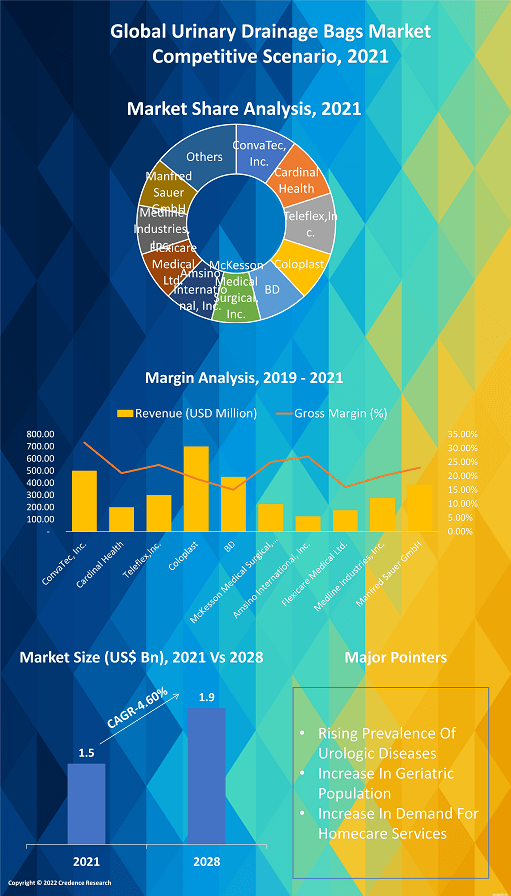
The global Urinary Drainage Bags market is anticipated to grow at a substantial CAGR of 4.6% in the upcoming years. The global Urinary Drainage Bags industry was estimated to be worth USD 1.5 billion in 2021 and was expected to be worth USD 1.96 billion by 2028.
Which region dominated the Urinary Drainage Bags market?
The North American region was expected to occupy a significant proportion of the global Urinary Drainage Bags market in 2022. The increased incidence of targeted diseases such as bladder obstruction, UI, Benign Prostatic Hyperplasia (BPH), urine retention, and bladder cancer is driving the regional market. The American Academy of Family Physicians (AAFP) states that more than 250,000 BPH patients receive surgical procedures yearly. According to the Canadian Cancer Society, approximately 12,200 people will be diagnosed with bladder cancer in 2020, with 2,600 deaths.
How is US Market Performing in the Urinary Drainage Bags market?
The US was expected to have a significant proportion of the North America Urinary Drainage Bags market in 2022. Patients with dementia are rising in the US, which is driving the demand for Urinary drainage bags. As per Population Reference Bureau, The total number of dementia patients in the United States will climb. According to specialists, more than 7 million people aged 65 and more will have dementia by 2020. If current demographic and health trends continue, more than 9 million Americans will have dementia by 2030, and almost 12 million will have dementia by 2040.
How is the economy impacting the global Urinary Drainage Bags growth?
The succession of financial crises in developing and emerging regions will have a substantial impact on the global market for urinary drainage bags. Furthermore, the demand-supply ratios, pricing options, import/export activities, and trade in the global urinary drainage bags market are all impacted by the Ukraine-Russian war.
What is the competitive environment of the Urinary Drainage Bags market?
The urinary bag market is highly consolidated, with several major players active in this field. The primary focus is on research and development activities for urinary retention, incontinence, and urological or gynecological operations. Volymi announced the release of new smart catheter bags for patients with limited mobility in August 2020. The backpack includes an alert system that uses external sensors and may be linked to a smartphone app. Spinal Singularity created a linked catheter device with Trelleborg supply chain support in June 2019, with applications for patients suffering from neurogenic bladders and chronic urine retention in mind. Such improvements by the market's players are creating a competitive environment.
Executive Summary
What are the key Urinary Drainage Bags market trends?
- The expanding senior population, which is more prone to urinary infections, is one of the main causes of the increased need for urine drainage bags.
- Governments and private businesses are constantly attempting to lower healthcare costs since they are a critical issue. Due to the growing baby boomer population and rising disease prevalence, it is anticipated that healthcare spending will rise during the projection period, which will drive the demand for the Urinary Drainage Bags market.
How is the geriatric population driving the demand for Urinary Drainage Bags Market?
One of the main reasons for the increased need for urinary drainage bags is the growing geriatric population, which is prone to urinary infections. Certain changes occur in the lower urinary system as people age. Reduced bladder capacity and feeling of fullness, decreased pelvic floor muscle resistance, decreased pace of detrusor muscle contraction, and increased residual urine volume are all symptoms. According to WHO, the global elderly population is expected to grow from 7.0% in 2000 to 16.0% in 2050, which will drive the market significantly.
Which are the key investments by the Urinary Drainage Bags market players?
Companies are focusing on executing extensive expansion strategies, such as enhancing product differentiation and portfolio diversification, expanding marketing and distribution channels, business expansion, and developing strategic alliances to strengthen their product reach and obtain a competitive advantage. Other techniques used by important players to increase their market position include acquisitions and mergers, alliances, expanding manufacturing facilities, and new product launches. For example, Amsino Medical Group will construct a new production plant in Aurora in July 2021, which will help the company increase its customer base.
ConvaTec, Inc.; Cardinal Health; Teleflex, Inc.; Coloplast; BD; McKesson Medical Surgical, Inc.; Amsino International, Inc.; Flexicare Medical Ltd.; Medline Industries, Inc.; Manfred Sauer GmbH; and Others are some of the key participants in the Urinary Drainage Bags market.
What are the Driving Factors for the Urinary Drainage Bags Market?
Urinary drainage bags collect urine and are connected to a catheter inside the bladder. It is typically used in cases of urine incontinence, urinary retention, a surgery that necessitated the use of a catheter, or other health issues. The rising prevalence and occurrences of urine incontinence have resulted in a significant demand for urinary drainage bags in European countries. According to National Health Service (NHS) predictions published in 2021, around 3.0 to 6.0 million persons in the United Kingdom may have some degree of urine incontinence.
In addition, numerous government and non-government groups are working to eliminate the stigma associated with urine incontinence. According to a 2021 article published by Sage Journals, all urinary catheters and accessories, including urine drainage bags, are classified in the Netherlands under the monitor code 'A1535 catheters' and are subcategorized by distinct ISO codes. This is expected to lead to higher use of these items because it simplifies the reimbursement procedure. Furthermore, favorable reimbursement policies and rising government healthcare expenditure, such as the Urinary Drainage Bags market insight are likely to fuel market expansion.
What are the Major Risks for the Urinary Drainage Bags Market?
Urinary Tract Infection (UTI) is an infection of the urinary tract, which includes the urethra, bladder, ureters, and kidney. The most prevalent type of healthcare-associated infection reported to the National Healthcare Safety Network is urinary tract infections (UTIs) (NHSN). Approximately 75% of UTIs acquired in the hospital are related to a urinary drainage bags. During their hospital stay, 15-25% of hospitalized individuals obtain urinary drainage bags. Prolonged urinary drainage bags use is the most major risk factor for developing a catheter-associated UTI (CAUTI). Urinary drainage bags should thus be used only for approved purposes and withdrawn as soon as they are no longer required. Such factors restrain market growth.
Which is the key end-use in the Urinary Drainage Bags market?
In 2022, the hospital's segment dominated the global market, accounting for more than 40% of overall revenue. The increasing number of surgical procedures performed and the rising instances of end-stage renal illness are the hospitals key driving drivers. There has been an upsurge in hospital admissions as a result of the recent COVID-19 outbreak, particularly among older patients. Hospitals' Usage of urinary bags is expected to increase at the highest CAGR during the market forecast period, as hospitals are favoured for patient care for ulcerative colitis and inflammatory bowel disease (IBD), particularly in the elderly.
How is the Urinary Drainage Bags market performing in regions?
North America controls the majority of the worldwide market. An increase in the frequency of urological procedures, an increase in the prevalence of bladder cancer, high healthcare expenditure, and a favourable reimbursement scenario for surgeries are all factors driving the growth of the urinary drainage bags market in North America. Furthermore, due to the rise in urological illnesses, high prevalence of urinary incontinence, and huge population with high disposable income in the APAC regions, the Asia Pacific is expected to be the fastest-growing market for urinary drainage bags.
What is the regulatory landscape for the Urinary Drainage Bags market?
A urine drainage bag is defined as a "device intended to collect urine" in the FDA rule, 21 CFR 876.5250(a), Urine Collector and Accessories.
What are the players planning for the future of the Urinary Drainage Bags market?
The top players are now focusing on implementing strategies such as adopting new applications, product innovations, mergers and acquisitions, joint ventures, alliances, and partnerships to boost their market position in the worldwide urinary drainage bags market business. For instance, Clinisupplies Ltd. established a relationship with Alliance Healthcare in July 2019 for the distribution and supply of its goods in the United Kingdom.
| REPORT ATTRIBUTE | DETAILS |
|---|---|
| Urinary Drainage Bags Market by Volume | Yes |
| Urinary Drainage Bags Market by Value | Yes |
| Urinary Drainage Bags Market, Tornado Analysis | Yes |
| Urinary Drainage Bags Market, STAR Analysis | Yes |
| Urinary Drainage Bags Market, SRC Analysis | Yes |
| Urinary Drainage Bags Market, Import-Export Data | Yes (On Demand) |
| Urinary Drainage Bags Market Pricing Analysis | Yes (On Demand) |
| Urinary Drainage Bags Market Segment Analysis | By Product (Large Bags and Leg Bags) By Usage (Reusable and Disposable) By Capacity (0-500 ml, 500-1000 ml, and 1000-2000 ml) By End-use (Hospital, Clinics. And Others) |
| Urinary Drainage Bags Market, Regional Analysis | North America (US and Canada) Europe (Germany, UK, France, Italy, Spain, and the Rest of Europe) Asia Pacific (China, India, Japan, South Korea, Southeast Asia, and Rest of Asia Pacific) Latin America (Brazil, Mexico, and Rest of Latin America) Middle East and Africa (GCC Countries, South Africa, and Rest of Middle East and Africa) |
| Urinary Drainage Bags Market Key Companies | ConvaTec, Inc.; Cardinal Health; Teleflex,Inc.; Coloplast; BD; McKesson Medical Surgical, Inc.; Amsino International, Inc.; Flexicare Medical Ltd.; Medline Industries, Inc.; Manfred Sauer GmbH and Others |
| Urinary Drainage Bags Market Competitive Landscape | Urinary Drainage Bags Market Share Analysis Competitive Benchmarking Key Players Market Positioning Geographical Presence Analysis Major Strategies Adopted |
Segmentation of Global Urinary Drainage Bags Market-
Global Urinary Drainage Bags Market – By Product
- Large Bags
- Leg Bags
Global Urinary Drainage Bags Market – By Usage
- Reusable
- Disposable
Global Urinary Drainage Bags Market – By Capacity
- 0-500 ml
- 500-1000 ml
- 1000-2000 ml
Global Urinary Drainage Bags Market – By End Use
- Hospital
- Clinics
- Others
Global Urinary Drainage Bags Market – By Region
- North America
- U.S.
- Canada
- Europe
- Germany
- France
- U.K.
- Italy
- Spain
- Rest of Europe
- Asia Pacific
- China
- Japan
- India
- South Korea
- South-east Asia
- Rest of Asia Pacific
- Latin America
- Brazil
- Mexico
- Rest of Latin America
- Middle East & Africa
- GCC Countries
- South Africa
- Rest of Middle East and Africa

Request a Free Sample
Fill in your details and we'll send you a free sample report.
- Sample data tables & charts
- Research methodology
Market Dynamics
Aging Population and Increased Urinary Disorders
The expanding global geriatric population is more susceptible to urinary incontinence and related disorders, driving higher demand for urinary drainage bags in both hospital and home care settings.
Preference for Disposable Products
Healthcare practitioners increasingly recommend disposable urinary drainage bags due to their lower risk of infection transmission, boosting demand for single-use products in hospitals and clinics.
Rising Surgical Procedures and Hospital Admissions
An increase in surgical interventions and hospital admissions, particularly among elderly patients, is leading to greater utilization of urinary drainage bags for post-operative and long-term care.
Favorable Reimbursement Policies and Healthcare Spending
Supportive reimbursement frameworks and rising healthcare expenditures in developed regions make urinary drainage bags more accessible, encouraging adoption in both public and private healthcare facilities.
Technological Advancements and Product Innovation
Ongoing R&D and product innovations, such as smart catheter bags with monitoring features, are enhancing patient comfort and safety, further stimulating market growth.
Need a Custom Version of This Report?
Tailor the scope, geography, or segments to your exact requirements.
- Custom geography or segment scope
- Direct access to our analyst team
Frequently Asked Questions
How does COVID-19 Impact the global Urinary Drainage Bags market?
Which is the leading region of the market for Urinary Drainage Bags?
What are the key drivers for the growth of the Urinary Drainage Bags market?
Which is the major segment in the Urinary Drainage Bags market by Product?
Which is the major segment in the Urinary Drainage Bags market by Usage?
Which is the major segment in the Urinary Drainage Bags market by Capacity?
Which is the major segment in the Urinary Drainage Bags market by End-Use?
Table of Content
Chapter 1 Market Segmentation
- 1.1 Segmentation Framework
- 1.1.1 Product and Service Classification
- 1.1.2 Application and End-Use Classification
- 1.1.3 Technology and Solution Classification
- 1.1.4 Customer and Distribution Channel Classification
- 1.1.5 Geographic Segmentation
- 1.1.6 Market Segment Definitions and Boundaries
- 1.2 By Usage
- 1.2.1 Reusable
- 1.2.2 Disposable
- 1.3 By End Use
- 1.3.1 Hospital
- 1.3.2 Clinics
- 1.3.3 Others
- 1.4 By Product
- 1.4.1 Large Bags
- 1.4.2 Leg Bags
- 1.5 By Capacity
- 1.5.1 0-500 ml
- 1.5.2 500-1000 ml
- 1.5.3 1000-2000 ml
Chapter 2 Introduction
- 2.1 Report Objectives and Scope
- 2.2 Product Definition and Industry Terminology
- 2.3 Market Inclusions and Exclusions
- 2.4 Research Process
- 2.4.1 Primary Research and Expert Interviews
- 2.4.2 Secondary Research and Source Review
- 2.4.3 Top-Down and Bottom-Up Estimation
- 2.4.4 Data Triangulation and Verification
- 2.5 Research Assumptions and Limitations
Chapter 3 Executive Summary
- 3.1 Market Snapshot and Key Findings
- 3.2 Base-Year Market Size
- 3.3 Forecast Market Size
- 3.4 Revenue and Volume Growth Outlook
- 3.5 Key Demand and Supply Indicators
- 3.6 Leading Market Segments
- 3.7 Fastest-Growing Market Opportunities
- 3.8 Regional Performance Highlights
- 3.9 Technology and Industry Transformation
- 3.10 Competitive Landscape Summary
- 3.11 Analyst View and Strategic Implications
Chapter 4 Global Urinary Drainage Bags Market Trends and Developments
- 4.1 Historical Industry Development
- 4.2 Recent Market Trends and Developments
- 4.3 Demand and Customer Behavior Trends
- 4.4 Technology and Product Innovation
- 4.5 Artificial Intelligence, Automation and Digitalization
- 4.6 Local Manufacturing and Supply Chain Realignment
- 4.7 Industry Partnerships, Mergers and Acquisitions
- 4.8 Sustainability and Circular Economy Developments
- 4.9 Government and Private Sector Investment Trends
- 4.10 Emerging Business Models and Commercialization
- 4.11 Industry Developments and Announcements
Chapter 5 Global Urinary Drainage Bags Market Production, Supply and Demand Analysis
- 5.1 Demand Trend and Consumption Analysis
- 5.2 Demand Forecast
- 5.3 Production and Output Trend
- 5.4 Production and Output Forecast
- 5.5 Installed Capacity and Capacity Utilization
- 5.6 Company-Wise Production Plants and Statistics
- 5.6.1 Installed Production Capacity
- 5.6.2 Actual Production
- 5.6.3 Planned Capacity and Expansion Targets
- 5.7 Supply Chain Structure and Procurement Trends
- 5.8 Supply-Demand Gap and Bottlenecks
- 5.9 Import Dependence and Sourcing Structure
- 5.10 Contract Manufacturing and Outsourcing
- 5.11 Regional Supply and Demand Concentration
Chapter 6 Global Urinary Drainage Bags Market Pricing Analysis
- 6.1 Pricing Structure and Measurement
- 6.2 Historical Pricing Trends
- 6.3 Pricing Outlook
- 6.4 Average Selling Price and Unit Economics
- 6.5 Pricing by Product and Market Segment
- 6.6 Geographic Pricing Differences
- 6.7 Key Input, Energy, Labor and Logistics Costs
- 6.8 Contract Pricing and Purchasing Models
- 6.9 Pricing Sensitivity and Competitive Positioning
- 6.10 Price, Margin and Profitability Implications
Chapter 7 Global Urinary Drainage Bags Market Dynamics
- 7.1 Market Growth Drivers
- 7.1.1 Demand-Side Drivers
- 7.1.2 Technology and Innovation Drivers
- 7.1.3 Infrastructure and Investment Drivers
- 7.1.4 Regulatory and Policy Drivers
- 7.2 Market Restraints
- 7.2.1 Cost and Affordability Constraints
- 7.2.2 Technology and Adoption Barriers
- 7.2.3 Supply Chain and Operational Constraints
- 7.3 Market Challenges
- 7.3.1 Competitive Pressure and Margin Erosion
- 7.3.2 Skills, Infrastructure and Implementation Gaps
- 7.4 Emerging Market Opportunities
- 7.5 Market Dynamics Impact and Time-Horizon Assessment
Chapter 8 Global Urinary Drainage Bags Value Chain Analysis
- 8.1 Industry Value Chain Overview
- 8.2 Upstream Suppliers and Critical Inputs
- 8.3 Technology and Component Providers
- 8.4 Manufacturing or Service Delivery
- 8.5 Distribution, Channel Partners and Integrators
- 8.6 Downstream Applications and End Users
- 8.7 Value Addition and Profit Pools
- 8.8 Vertical Integration and Outsourcing
- 8.9 Supplier Concentration and Risk
- 8.10 Supply Chain Localization and Resilience
Chapter 9 Global Urinary Drainage Bags Market Regulations and Policies
- 9.1 Relevant Laws, Standards and Compliance Frameworks
- 9.2 Product, Service, Safety and Quality Requirements
- 9.3 Government Policies, Incentives and Subsidies
- 9.4 Imports, Exports and Trade Barriers
- 9.5 Public Procurement and Local Content Requirements
- 9.6 Environmental and Sustainability Compliance
- 9.7 Upcoming Policy Changes and Market Implications
Chapter 10 Global Urinary Drainage Bags Market Hotspots and Opportunities
- 10.1 Market Opportunity Mapping and Growth Hotspots
- 10.2 High-Growth Applications and Customer Groups
- 10.3 Underserved Markets and White-Space Opportunities
- 10.4 Emerging Technology and Product Opportunities
- 10.5 New Capacity and Investment Hotspots
- 10.6 Market Entry and Expansion Opportunities
- 10.7 Distribution and Partnership Opportunities
- 10.8 Near-Term and Long-Term Commercial Potential
- 10.9 Opportunity Attractiveness and Execution Risks
Chapter 11 Global Urinary Drainage Bags Market Outlook
- 11.1 Market Size and Analysis
- 11.1.1 Revenue
- 11.1.2 Market Volume and Quantity Sold
- 11.1.3 Historical Market Size
- 11.1.4 Base-Year Market Size
- 11.2 Market Forecast
- 11.2.1 Revenue Forecast
- 11.2.2 Volume Forecast
- 11.2.3 CAGR and Year-on-Year Growth
- 11.2.4 Incremental Revenue Opportunity
- 11.3 Forecast Assumptions and Scenario Analysis
- 11.3.1 Base-Case Forecast
- 11.3.2 Optimistic and Conservative Scenarios
- 11.3.3 Technology, Pricing and Policy Sensitivities
- 11.4 Market Attractiveness and Growth Outlook
Chapter 12 Global Urinary Drainage Bags Market Segmentation and Outlook
- 12.1 Segmentation Summary and Market Shares
- 12.2 Largest and Fastest-Growing Segments
- 12.3 By Usage - Market Size and Forecast
- 12.3.1 Segment Definition and Scope
- 12.3.2 Historical Market Size
- 12.3.3 Revenue Forecast
- 12.3.4 Volume Forecast
- 12.3.5 Base-Year Market Share
- 12.3.6 Segment CAGR and Growth Drivers
- 12.3.7 Subsegment Market Size and Forecast
- 12.3.7.1 Reusable
- 12.3.7.2 Disposable
- 12.3.8 Subsegment Pricing and Adoption Trends
- 12.3.9 Leading Suppliers and Competition
- 12.3.10 Regional Demand and Opportunities
- 12.4 By End Use - Market Size and Forecast
- 12.4.1 Segment Definition and Scope
- 12.4.2 Historical Market Size
- 12.4.3 Revenue Forecast
- 12.4.4 Volume Forecast
- 12.4.5 Base-Year Market Share
- 12.4.6 Segment CAGR and Growth Drivers
- 12.4.7 Subsegment Market Size and Forecast
- 12.4.7.1 Hospital
- 12.4.7.2 Clinics
- 12.4.7.3 Others
- 12.4.8 Subsegment Pricing and Adoption Trends
- 12.4.9 Leading Suppliers and Competition
- 12.4.10 Regional Demand and Opportunities
- 12.5 By Product - Market Size and Forecast
- 12.5.1 Segment Definition and Scope
- 12.5.2 Historical Market Size
- 12.5.3 Revenue Forecast
- 12.5.4 Volume Forecast
- 12.5.5 Base-Year Market Share
- 12.5.6 Segment CAGR and Growth Drivers
- 12.5.7 Subsegment Market Size and Forecast
- 12.5.7.1 Large Bags
- 12.5.7.2 Leg Bags
- 12.5.8 Subsegment Pricing and Adoption Trends
- 12.5.9 Leading Suppliers and Competition
- 12.5.10 Regional Demand and Opportunities
- 12.6 By Capacity - Market Size and Forecast
- 12.6.1 Segment Definition and Scope
- 12.6.2 Historical Market Size
- 12.6.3 Revenue Forecast
- 12.6.4 Volume Forecast
- 12.6.5 Base-Year Market Share
- 12.6.6 Segment CAGR and Growth Drivers
- 12.6.7 Subsegment Market Size and Forecast
- 12.6.7.1 0-500 ml
- 12.6.7.2 500-1000 ml
- 12.6.7.3 1000-2000 ml
- 12.6.8 Subsegment Pricing and Adoption Trends
- 12.6.9 Leading Suppliers and Competition
- 12.6.10 Regional Demand and Opportunities
- 12.7 Segment Growth Comparison
- 12.8 Segment Attractiveness and Priority Matrix
Chapter 13 Global Urinary Drainage Bags End-Use and Application Market Outlook
- 13.1 End-Use Industry and Customer Demand Structure
- 13.2 Leading Applications and Customer Groups
- 13.3 End-Use Market Size, Share and Forecast
- 13.4 Major End-Use Industry Deep Dives
- 13.4.1 Customer Requirements and Use Cases
- 13.4.2 Demand and Replacement Cycles
- 13.4.3 Technical and Regulatory Considerations
- 13.4.4 Purchasing and Procurement Models
- 13.4.5 Leading Vendors and Distribution Channels
- 13.4.6 Forecast and Commercial Opportunities
- 13.5 Emerging Applications and Cross-Segment Demand
- 13.6 End-Use Industry Investment Priorities
Chapter 14 Global Urinary Drainage Bags Geographic Market Outlook
- 14.1 Regional Market Size and Share
- 14.2 Regional Market Forecast
- 14.3 Regional Pricing, Production and Demand Differences
- 14.4 North America
- 14.4.1 United States
- 14.4.2 Canada
- 14.4.3 Mexico
- 14.5 Europe
- 14.5.1 Germany
- 14.5.2 France
- 14.5.3 Italy
- 14.5.4 United Kingdom
- 14.5.5 Spain
- 14.5.6 Poland
- 14.5.7 Russia
- 14.5.8 Netherlands
- 14.5.9 Belgium
- 14.5.10 Sweden
- 14.5.11 Denmark
- 14.5.12 Norway
- 14.5.13 Rest of Europe
- 14.6 Asia Pacific
- 14.6.1 China
- 14.6.2 India
- 14.6.3 Japan
- 14.6.4 South Korea
- 14.6.5 Thailand
- 14.6.6 Indonesia
- 14.6.7 Vietnam
- 14.6.8 Malaysia
- 14.6.9 Australia
- 14.6.10 Rest of Asia Pacific
- 14.7 Latin America
- 14.7.1 Brazil
- 14.7.2 Argentina
- 14.7.3 Colombia
- 14.7.4 Chile
- 14.7.5 Rest of Latin America
- 14.8 Middle East
- 14.8.1 Saudi Arabia
- 14.8.2 United Arab Emirates
- 14.8.3 Turkey
- 14.8.4 Israel
- 14.8.5 Iran
- 14.8.6 Rest of the Middle East
- 14.9 Africa
- 14.9.1 South Africa
- 14.9.2 Egypt
- 14.9.3 Nigeria
- 14.9.4 Morocco
- 14.9.5 Rest of Africa
- 14.10 Regional Investment, Policy and Supply Chain Differences
- 14.11 Regional Competitive Landscape
- 14.12 Geographic Growth Hotspots
Chapter 15 Global Urinary Drainage Bags Technology, Innovation and Sustainability Outlook
- 15.1 Technology Landscape and Maturity
- 15.2 Product, Process and Service Innovation
- 15.3 AI, Automation and Digital Tools in the Industry
- 15.4 Technology Adoption and Performance Benchmarking
- 15.5 Innovation Pipeline and R&D Investment
- 15.6 Patent and Intellectual Property Trends
- 15.7 Energy Efficiency and Resource Management
- 15.8 Sustainability, Recycling and Circularity
- 15.9 Technology Roadmap
- 15.10 Risks of Obsolescence and Technology Substitution
Chapter 16 Global Urinary Drainage Bags Market Key Strategic Imperatives
- 16.1 Growth and Market Entry Priorities
- 16.2 High-Return Products and Segments
- 16.3 Pricing, Profitability and Cost Optimization
- 16.4 Technology Investment and Product Differentiation
- 16.5 Supply Chain Localization and Resilience
- 16.6 Distribution and Customer Acquisition
- 16.7 Partnership, Acquisition and Capacity Strategy
- 16.8 Regional Expansion Priorities
- 16.9 Short-, Medium- and Long-Term Actions
Chapter 17 Competition Outlook
- 17.1 Industry Competition Characteristics
- 17.2 Market Structure and Concentration
- 17.3 Market Share and Competitive Positioning
- 17.4 Company-Wise Revenue and Product Benchmarking
- 17.5 Production and Service Capacity Benchmarking
- 17.6 Technology, Pricing and Differentiation
- 17.7 Regional Footprint and Distribution Strength
- 17.8 Mergers, Acquisitions and Strategic Alliances
- 17.9 New Entrants and Competitive Threats
- 17.10 Porter's Five Forces and Industry Attractiveness
- 17.11 Competitive Outlook
Chapter 18 Company Profiles
- 18.1 Company Coverage and Selection Criteria
- 18.2 ConvaTec, Inc.
- 18.2.1 Business Description
- 18.2.2 Company Ownership and Geographic Presence
- 18.2.3 Product and Service Portfolio
- 18.2.4 Manufacturing and Operating Footprint
- 18.2.5 Production Capacity and Expansion Plans
- 18.2.6 Financial Performance and Investment
- 18.2.7 Market Share and Competitive Position
- 18.2.8 Technology and Innovation Capabilities
- 18.2.9 Strategic Alliances or Partnerships
- 18.2.10 Recent Developments
- 18.2.11 Growth Strategy and Outlook
- 18.3 Cardinal Health
- 18.4 Teleflex, Inc.
- 18.5 Coloplast
- 18.6 BD (Becton, Dickinson and Company)
- 18.7 McKesson Medical Surgical, Inc.
- 18.8 Amsino International, Inc.
- 18.9 Flexicare Medical Ltd.
- 18.10 Medline Industries, Inc.
- 18.11 Manfred Sauer GmbH
- 18.12 Other Relevant Market Participants
Note: Every listed company is profiled on the structure shown under the first company. The company list is preliminary and may change based on research findings, market developments, data availability and client requirements.
Chapter 19 Disclaimer
- 19.1 Research and Forecast Disclaimer
- 19.2 Data Source and Estimation Limitations
Note: The depth of individual sections depends on data availability for this market. Volume, capacity, trade and other unit-based metrics are included where applicable.

