
Cash-pay obesity care shifts after the shortage era ends
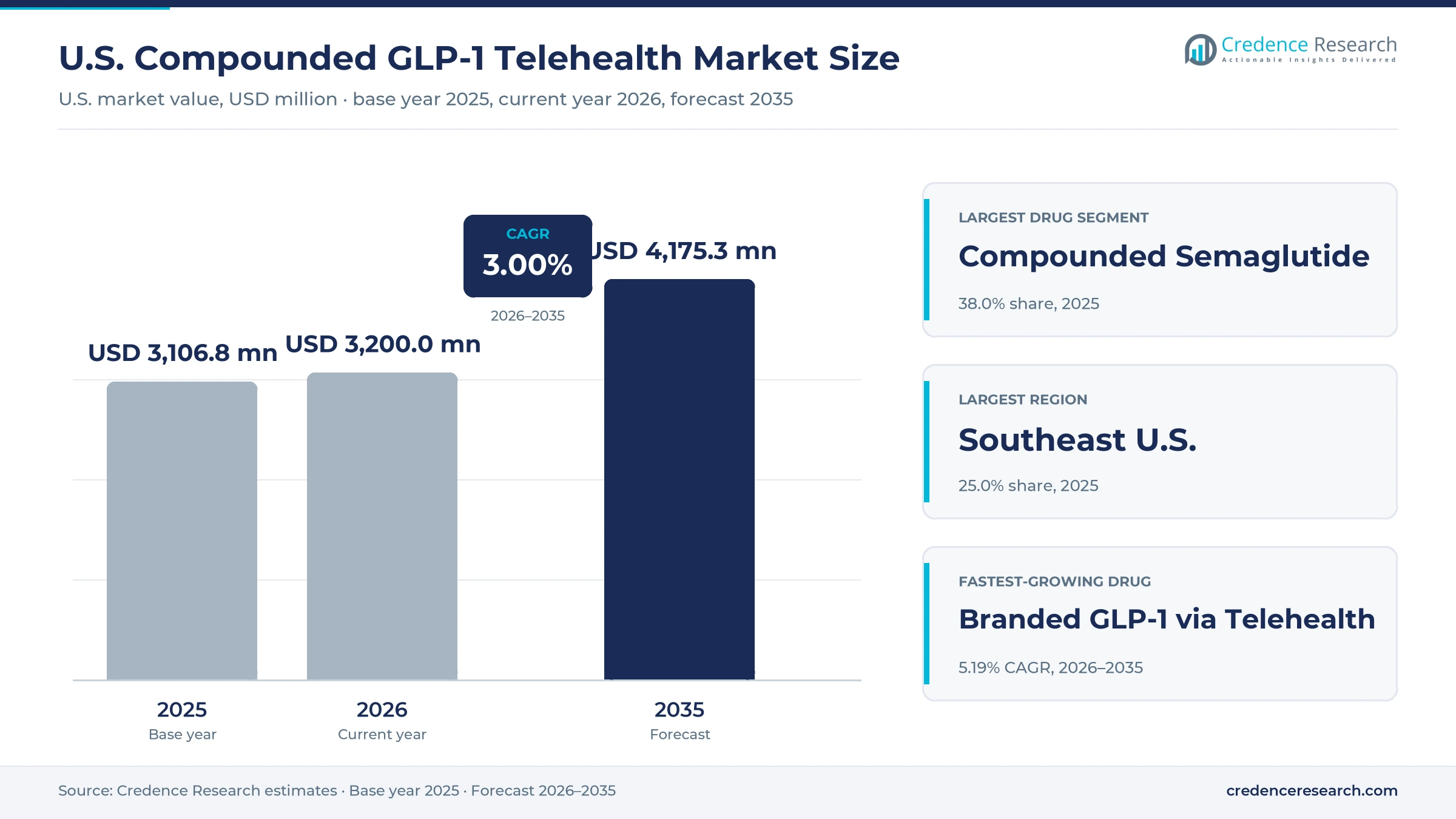
The U.S. compounded GLP-1 telehealth market was valued at USD 3.11 billion in 2025 and is projected to increase from USD 3.20 billion in 2026 to USD 4.18 billion by 2035, registering a CAGR of 3.00% during 2026–2035. Demand comes from adults with obesity who pay cash for remote prescribing, compounded semaglutide or tirzepatide, and branded GLP-1 medicines shipped to the home. The Southeast held the largest regional share, 25.0% in 2025, while the Mountain region grows fastest at 3.59% a year as remote care reaches patients far from obesity clinics. Growth stays modest because the FDA declared the semaglutide and tirzepatide shortages resolved, which ended the broad compounding allowances that built the channel. As a result, platforms are moving patients toward lower-priced branded options, including the Wegovy pill approved in December 2025 at a starting cash price of $149 a month. Compounded products remain available only for patient-specific needs, and they are not FDA-approved drugs.
What does cash-pay GLP-1 care through remote channels include?
The market counts patient spending on GLP-1 medicines prescribed through telehealth platforms and medical spas, including compounded semaglutide, compounded tirzepatide and branded products such as Wegovy, Zepbound and the newer oral pills. Value covers the drug, the clinician consultation and the membership or follow-up fees bundled into each monthly plan.
The estimate excludes GLP-1 prescriptions written in physician offices and filled through insurance at retail pharmacies, which make up most national use. It also excludes diabetes prescriptions, weight-loss coaching sold without a prescription, and supplements marketed as GLP-1 alternatives without any drug content.
U.S. Compounded GLP-1 Telehealth Market Insights
- The market grows from USD 3.11 billion in 2025 to USD 4.18 billion by 2035, a 3.00% CAGR held down by the loss of shortage-era compounding allowances.
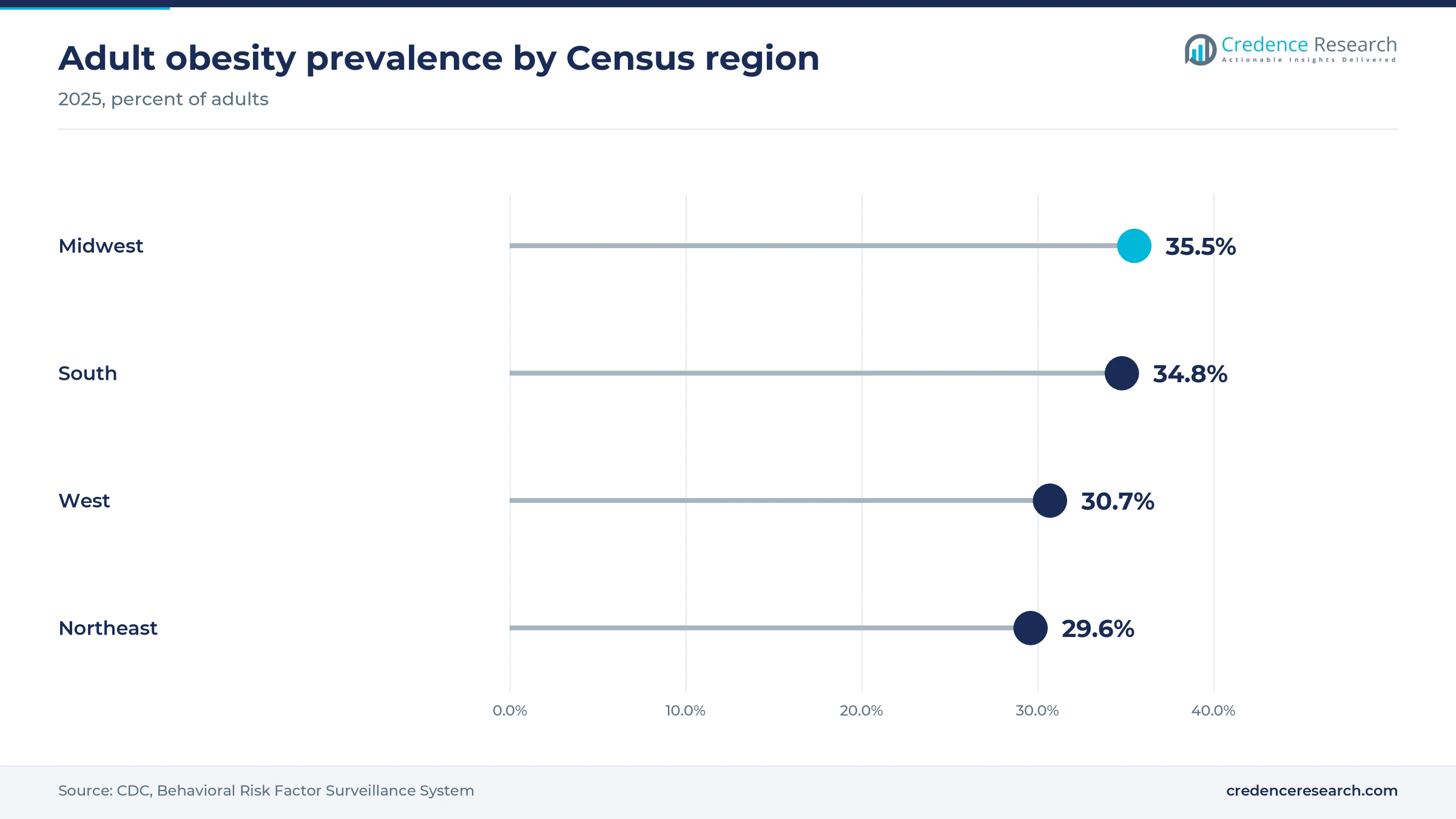
- The Southeast led with 25.0% of 2025 value, as CDC data for 2025 show adult obesity at 34.8% across the South.
- Compounded semaglutide held 38.0% of 2025 value, with Novo Nordisk estimating up to 1.5 million Americans on compounded GLP-1 drugs in January 2026.
- Hims & Hers agreed on March 9, 2026, to offer Novo Nordisk branded semaglutide and stop advertising compounded GLP-1 products on its platform.
- The FDA sent 30 warning letters to telehealth firms on March 3, 2026, over claims that compounded GLP-1 drugs match approved products.
Compounded semaglutide leads as branded fills gain fastest
Why does compounded semaglutide still lead the drug mix?
Based on drug, the market is categorized into compounded semaglutide, compounded tirzepatide and branded GLP-1 via telehealth. Compounded Semaglutide led with 38.0% of 2025 value because it built the largest base before the FDA declared the semaglutide shortage resolved on Feb. 21, 2025, and Novo Nordisk estimated up to 1.5 million compounded users in January 2026. Compounded tirzepatide follows, although its shortage ended in October 2024. Branded GLP-1 via Telehealth grows fastest at 5.19% a year as the Wegovy pill launched on Ro on Jan. 5, 2026, and Hims & Hers agreed in March 2026 to sell Wegovy and Ozempic.
How do subscription and cash-pay models divide spending?
Based on model, the market is categorized into subscription and cash-pay. Subscription led with 64.0% of 2025 value because platforms bundle the drug, clinician access and check-ins into monthly memberships, and Hims & Hers priced compounded semaglutide at $199 a month for patients who paid 12 months upfront, according to eMarketer. Membership retention also lifts the value of each enrolled patient. Cash-Pay grows fastest at 3.57% a year as manufacturer pharmacies sell single fills, with LillyDirect cutting Zepbound vial prices to $299 for 2.5 mg and $399 for 5 mg in December 2025, according to Fierce Healthcare.
Which provider type reaches the most cash-pay patients?
Based on provider, the market is categorized into platforms and med spas. Platforms led with 72.0% of 2025 value because a KFF poll from November 2025 found that 17% of GLP-1 users obtained the drugs from an online provider or website, against 9% from a medical spa. National reach also lets platforms bundle digital obesity care with pharmacy supply at scale. Med spas grow more slowly as The Aesthetic Guide reported in April 2026 that medspa spending on prescription weight-loss treatments fell 3% in 2025, while the Midwest dropped nearly 13%. Platforms therefore gain share through 2035 in the Credence Research model.
| Segment Group | Leading Sub-segment | Share, 2025 | Fastest-growing Sub-segment | CAGR, 2026–2035 |
|---|---|---|---|---|
| By Drug | Compounded Semaglutide | 38.0% | Branded GLP-1 via Telehealth | 5.19% |
| By Model | Subscription | 64.0% | Cash-Pay | 3.57% |
| By Provider | Platforms | 72.0% | Platforms | 3.30% |
Request a Free Sample
Fill in your details and we'll send you a free sample report.
- Sample data tables & charts
- Research methodology
Remote access and lower cash prices keep patients enrolled
Telehealth access widens remote obesity consultations
Remote prescribing reaches adults who lack nearby obesity specialists, which keeps new patients entering the channel. The CDC reported that 21 states had adult obesity prevalence between 35% and 40% in 2025, with the Midwest posting the highest regional rate. A KFF poll fielded from Oct. 27 to Nov. 2, 2025, found that 12% of adults were taking a GLP-1 drug and 17% of users had bought from an online provider. Ro says its platform reaches 99% of primary care deserts, and more than 2 million people have used its insurance checker tool. In the Credence Research model this access driver adds about 1.11 percentage points to annual growth to 2035.
Digital acquisition and subscriptions drive enrollment
Digital marketing and membership pricing turn first consultations into recurring monthly revenue, which supports enrollment even as drug prices fall. Hims & Hers reached nearly 2.9 million subscribers in the second quarter of 2026, up 19% from a year earlier, according to a WSAU business report on Aug. 10, 2026. Noom began offering lower-dose compounded semaglutide on May 20, 2025, starting at $149 for the first month, according to Bloomberg. Found said on Jan. 8, 2025, that it had served more than 250,000 patients since 2019, as it added compounded oral semaglutide tablets at $189 for four weeks. In the Credence Research model this enrollment driver adds about 0.81 percentage points to annual growth to 2035.
Pharmacy fulfillment and follow-up support repeat fills
Home delivery and scheduled check-ins keep patients refilling, which matters because GLP-1 therapy runs for months rather than weeks. Novo Nordisk opened NovoCare Pharmacy in March 2025 to ship all Wegovy doses for $499 a month, with CenterWell Pharmacy dispensing fills ordered by Hims & Hers, Ro and LifeMD, according to Managed Healthcare Executive. Lilly ties its lower Zepbound vial prices for higher doses to refills delivered within 45 days of the previous shipment. Lilly began shipping Foundayo through LillyDirect on April 6, 2026, with free home delivery. In the Credence Research model this fulfillment driver adds about 0.60 percentage points to annual growth to 2035.
Lower branded cash prices pull patients onto platforms
Falling branded prices let platforms replace compounded volume with approved medicines, which preserves patient counts while lowering spending per fill. The federal agreements announced on Nov. 6, 2025, set TrumpRx prices near $350 a month for semaglutide and an average of $346 for Zepbound, according to Pharmacy Times. Novo Nordisk then priced every Wegovy dose at $349 for self-pay patients by mid-November 2025, according to Fierce Healthcare. Affordability remains the binding limit, since 56% of GLP-1 users told KFF in November 2025 that the drugs were difficult to afford. As a result, Branded GLP-1 via Telehealth grows at 5.19% a year while compounded segments contract in share.
Platforms pivot to branded pills while niches stay open
Shift from compounded to branded GLP-1 on platforms
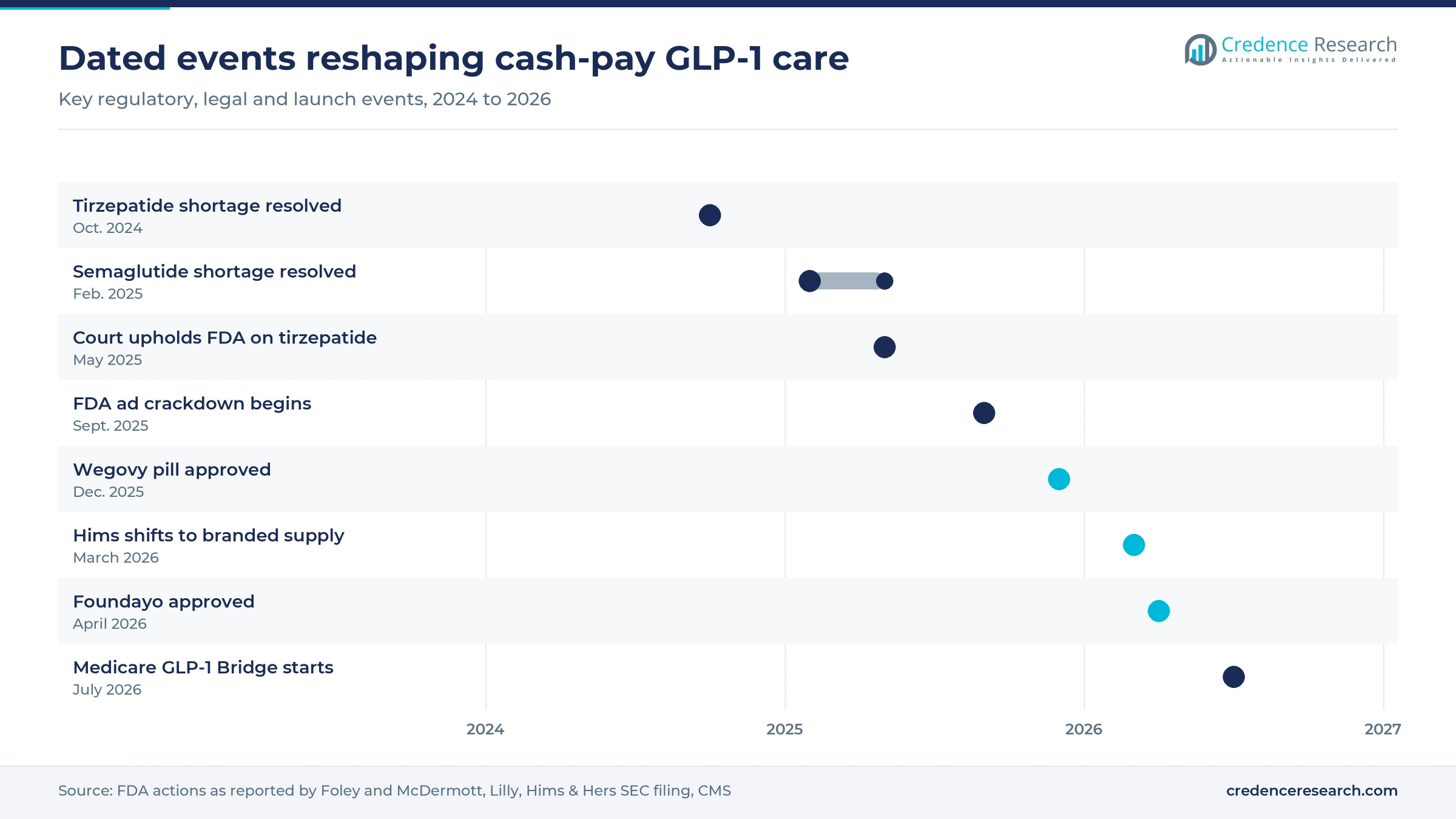
The largest platforms are moving their weight-loss offers from compounded copies to approved brands, which is the defining channel shift of 2026. In a March 9, 2026, release filed with the SEC, Hims & Hers said it would stop advertising compounded GLP-1 products and add Wegovy and Ozempic later that month. Novo Nordisk dismissed its lawsuit against the company without prejudice as part of the agreement. Ro had already launched the Wegovy pill with Novo Nordisk on Jan. 5, 2026, building on a direct integration that began in April 2025. Consequently, Branded GLP-1 via Telehealth reaches the highest growth rate of the drug group in the Credence Research model.
Rise of oral GLP-1 pills in cash-pay telehealth
Daily pills are emerging as a cash-pay form of anti-obesity drugs designed for remote prescribing because they need no injection training or cold-chain shipping. The FDA approved the Wegovy pill on Dec. 22, 2025, and the American Med Spa Association noted that the OASIS 4 trial followed 307 adults for 64 weeks, with about 16.6% average weight loss alongside diet and exercise. HLTH reported a $149 monthly price for the 1.5 mg and 4 mg doses, with 9 mg and 25 mg doses at $299 after April 15, 2026. Lilly then won approval for Foundayo on April 1, 2026, with self-pay pricing starting at $149 a month, which adds a second oral option for platforms.
Opening in personalized dosing under 503A rules
Personalized compounding remains a lawful but narrow opening for platforms that can document clinical need for each patient. Holland & Knight noted in September 2025 that only 503A state-licensed pharmacies may now compound semaglutide and tirzepatide, and only against valid patient-specific prescriptions. Hims & Hers kept compounded semaglutide available on a limited basis in March 2026 for patients whose needs approved products cannot meet. Noom built its May 2025 program on slower titration, starting at half the usual 0.25 mg dose. Providers with strong prescribing records can serve patients with side effects or dosing needs, although the volume available stays far below 2024 levels.
Opening in med spa follow-up and body-composition care
Med spas can turn GLP-1 patients into longer relationships by pairing prescriptions with follow-up and aesthetic care. The Aesthetic Guide reported in April 2026 that more than half of patients starting GLP-1 treatment at aesthetic practices in early 2026 were new to those practices. Patient spending on prescription weight-loss treatments at those practices reached $1.54 billion in 2025, down only 2% from 2024 despite the compounding wind-down. The American Med Spa Association also reported more requests for treatments addressing facial volume loss after GLP-1 weight loss. Practices that offer branded pills alongside these services can hold patients beyond the first prescription.
Enforcement, litigation and price cuts squeeze compounders
How did the end of the shortages limit compounding?
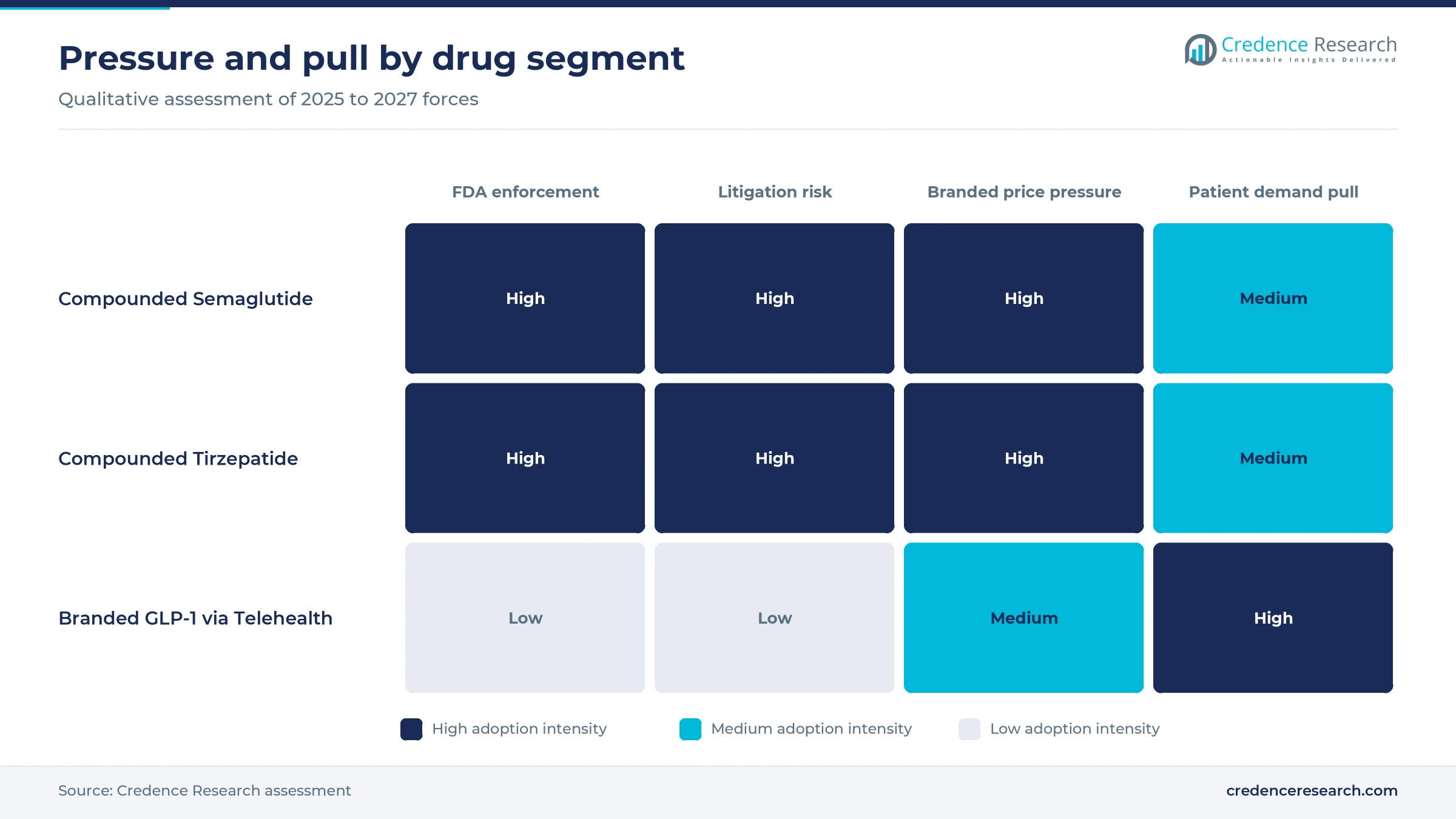
The shortage rulings removed the legal basis for mass compounding of identical copies. According to Foley & Lardner, the FDA declared the semaglutide shortage resolved on Feb. 21, 2025, ending enforcement discretion for 503A pharmacies on April 22 and for 503B facilities on May 22, 2025. A federal court in Texas upheld the tirzepatide decision on May 7, 2025. Compounders lost scale as a result, and platforms must now justify each personalized prescription.
Will FDA marketing enforcement keep tightening?
Federal scrutiny of telehealth advertising has escalated in waves since September 2025. The FDA and HHS announced on Sept. 9, 2025, about 100 cease-and-desist letters over deceptive ads, alongside warning letters to GLP-1 telehealth providers, according to Holland & Knight. The FDA then sent 30 warning letters on March 3, 2026, over claims that compounded drugs match approved products, according to Pharmaceutical Commerce. Platforms must rewrite claims and disclose compounders, which raises compliance costs for smaller operators.
How much legal risk do compounding sellers carry?
Manufacturers are suing telehealth sellers directly, which adds legal costs to every compounded offer. Lilly sued Mochi Health, Henry Meds, Willow Health Services and Fella Health with Delilah in April 2025, alleging deceptive marketing of unapproved tirzepatide products, according to HLTH. Novo Nordisk had also sued 14 companies over compounded semaglutide, according to eMarketer. Smaller platforms without legal budgets face the greatest exposure, and many now prefer branded partnerships to defending compounded lines.
Do branded price cuts erase the compounded price gap?
Branded cash prices now sit close to compounded prices, which removes the main reason many patients chose copies. Novo Nordisk chief executive Mike Doustdar put compounded GLP-1 prices near $199 a month in January 2026, according to Bloomberg, while the Wegovy pill starts at $149. Medicare prices of $245 under the November 2025 agreements also shift older patients toward covered care. Compounding pharmacies lose volume as a result, so platforms must compete on service rather than price.
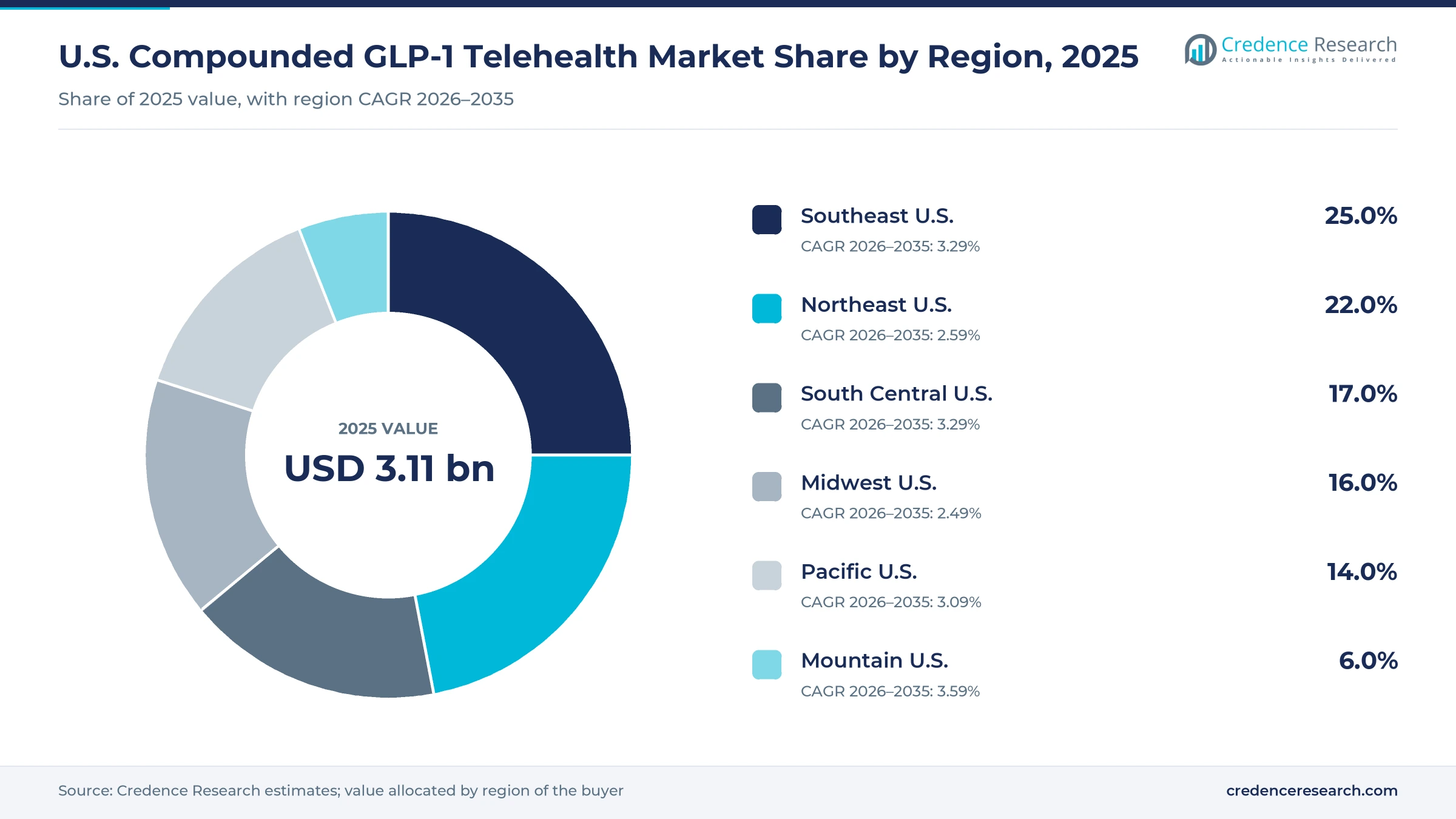
The Southeast carries the largest share of cash-pay demand
| Region | Value, 2025 (USD billion) | Share, 2025 | CAGR, 2026–2035 |
|---|---|---|---|
| Southeast | 0.78 | 25.0% | 3.29% |
| Northeast | 0.68 | 22.0% | 2.59% |
| South Central | 0.53 | 17.0% | 3.29% |
| Midwest | 0.50 | 16.0% | 2.49% |
| Pacific | 0.43 | 14.0% | 3.09% |
| Mountain | 0.19 | 6.0% | 3.59% |
The Southeast leads on obesity burden and cash-pay use
The Southeast held 25.0% of 2025 value and grows at 3.29% a year, the largest regional share in the market. CDC data for 2025 put adult obesity across the South at 34.8%, among the highest of the four Census regions. The Aesthetic Guide reported that prescription weight-loss spending at aesthetic practices in the South fell only 2% in 2025, against a much sharper Midwest drop. This resilience supports both platform and med spa channels across the region through 2035.
The Northeast holds a large share on income and access
The Northeast held 22.0% of 2025 value and grows at 2.59% a year, below the national pace. CDC data show the Northeast had the lowest regional obesity prevalence in 2025, at 29.6%, which limits the eligible pool. Higher household incomes still support cash-pay memberships, and dense specialist networks give patients more insured alternatives. Credence Research therefore expects the region to keep a large share while branded insured care absorbs part of its future growth.
South Central rests on Southern obesity and Texas rulings
The South Central region held 17.0% of 2025 value and grows at 3.29% a year, faster than the national rate. The region falls within the South, where CDC data show one of the two highest regional obesity rates in 2025. It also hosted the main compounding legal fight, as a federal court in the Northern District of Texas upheld the tirzepatide shortage decision on May 7, 2025. Platforms serving Texas and neighboring states now rely more heavily on branded cash-pay fills.
The Midwest has high obesity but weaker clinic spending
The Midwest held 16.0% of 2025 value and grows at 2.49% a year, the slowest pace among the six zones. The CDC recorded the highest regional adult obesity prevalence there in 2025, at 35.5%. However, The Aesthetic Guide reported that Midwest prescription weight-loss spending at aesthetic practices fell nearly 13% in 2025. Indiana Senate Bill 282, tracked by the American Med Spa Association, would require medical spas to register from Jan. 1, 2027, and disclose compounded drugs.
The Pacific region combines large platforms and active litigation
The Pacific region held 14.0% of 2025 value and grows at 3.09% a year, close to the national pace. CDC data put adult obesity across the West at 30.7% in 2025, below the Southern and Midwestern levels. The zone is also a legal center for the channel, as Lilly filed its April 2025 suits against Mochi Health, Henry Meds and other sellers in federal courts in California, according to HLTH. Compliance costs therefore weigh more on smaller West Coast operators.
The Mountain region grows fastest from a small rural base
The Mountain region held 6.0% of 2025 value and grows at 3.59% a year, the fastest pace among the six zones. The region falls within the West, where the CDC measured adult obesity at 30.7% in 2025. Long distances to obesity specialists make remote prescribing especially useful across these states. Ro says its platform reaches 99% of primary care deserts nationwide, which shows how telehealth reaches rural patients who lack nearby clinics and pharmacies offering GLP-1 follow-up.
Rulings, approvals and deals reshape the channel
| Development | Status and market relevance |
|---|---|
| In February 2025, the FDA declared the semaglutide shortage resolved and set April 22 and May 22, 2025, as the end of compounding discretion. | In effect; ends mass compounding of identical semaglutide copies |
| In April 2025, Lilly sued Mochi Health, Henry Meds, Willow Health Services and Fella Health over compounded tirzepatide marketing. | Litigation; raises legal risk for compounding sellers |
| In December 2025, the FDA approved the Wegovy pill, which launched in January 2026 at $149 a month for starting doses. | Launched; gives platforms an approved oral cash-pay option |
| In March 2026, Hims & Hers agreed with Novo Nordisk to offer Wegovy and Ozempic and stop advertising compounded GLP-1 products. | Active; the largest platform shifts to branded supply |
| In April 2026, the FDA approved Lilly's Foundayo, and LillyDirect began shipping it on April 6 at $149 a month for the lowest dose. | Launched; a second oral GLP-1 for remote prescribing |
Pills, pharmacy links and API controls change delivery
- Oral GLP-1 tablets remove injection training and cold-chain shipping, which suits remote prescribing for the Wegovy pill and Foundayo.
- Manufacturer pharmacy integrations connect platforms such as Ro and Hims & Hers to NovoCare Pharmacy, where CenterWell Pharmacy handles dispensing and delivery.
- Benefit check tools help patients compare insured and cash options, and Ro says more than 2 million people have used its insurance checker.
- Ingredient import controls under FDA import alert 66-80 restrict GLP-1 active ingredients with quality concerns, according to Pharmaceutical Commerce.
Need a Custom Version of This Report?
Tailor the scope, geography, or segments to your exact requirements.
- Custom geography or segment scope
- Direct access to our analyst team
Platforms compete on branded access and clinical follow-up
Competition in GLP-1 telehealth centers on branded supply, clinical follow-up and regulatory discipline rather than on the lowest compounded price. Hims & Hers is the largest platform, with nearly 2.9 million subscribers in mid-2026 across its categories, and it now sells Novo Nordisk branded semaglutide. Ro competes through direct integration with Novo Nordisk and launched the Wegovy pill in January 2026. Noom Med built its offer around slower titration, while Found pairs prescriptions with behavioral coaching and added compounded oral tablets in January 2025. Henry Meds and Mochi Health grew on compounded tirzepatide and now carry litigation risk after the April 2025 Lilly suits. Med spas compete locally, linking GLP-1 prescriptions to aesthetic follow-up care. Many buyers also compare these offers with medical weight loss clinics that provide in-person supervision.
How do the leading platforms position their GLP-1 offers?
| Company | Type | Role in the market |
|---|---|---|
| Hims & Hers | Platform | Shifted to Novo Nordisk branded semaglutide in March 2026, with compounded supply on a limited basis |
| Ro | Platform | Integrated with Novo Nordisk in April 2025 and launched the Wegovy pill on Jan. 5, 2026 |
| Noom Med | Platform | Offered lower-dose compounded semaglutide from May 2025, starting at $149 for the first month |
| Henry Meds | Platform | Named in an April 2025 Lilly suit over compounded tirzepatide marketing |
| Mochi Health | Platform | Named in an April 2025 Lilly suit and argues for personalized dosing |
| Found | Platform | Added compounded oral semaglutide tablets at $189 for four weeks in January 2025 |
Compliance and branded supply now decide who scales
Credence Research's view is that compliance and branded supply now decide which GLP-1 telehealth providers scale. The end of the shortage allowances, two waves of FDA warning letters and manufacturer lawsuits have shrunk the space for mass compounding. Branded cash prices near $149 to $349 a month remove most of the price gap that drew patients to copies. Platforms with direct manufacturer integrations and strong clinical follow-up are best placed, while med spas can defend local patients through aesthetic services. Compounded products should persist only where clinicians document specific patient needs.
How cash-pay GLP-1 spending was modeled and checked
The report uses 2025 as the base year and 2035 as the forecast year, with market values taken from the Credence Research model. Drug, model, provider and regional splits are Credence Research estimates informed by public data and are not reported statistics. Sources for the GLP-1 telehealth estimate include FDA actions summarized by law firms, CDC obesity data, KFF polling, company releases and SEC filings, and trade press on pricing and litigation. No interviews or surveys were conducted for this edition, so segment shares should be read as modeled ranges.
Branded cash-pay fills drive modest growth to 2035
From USD 3.20 billion in 2026, the market is expected to reach USD 4.18 billion by 2035 as branded cash-pay fills replace much of the compounded volume. Oral pills from Novo Nordisk and Lilly should widen remote prescribing, while membership models keep follow-up revenue attached to each patient. Compounded semaglutide and tirzepatide will shrink in share as enforcement continues and price gaps close. Medicare coverage through the GLP-1 Bridge program, which started on July 1, 2026, moves some older patients toward insured care. GLP-1 telehealth growth therefore depends on retention and service quality rather than on new compounded supply.
Frequently Asked Questions
How big is the U.S. compounded GLP-1 telehealth market?
Is compounded semaglutide still legal to sell?
Which drug segment holds the largest share?
Which region leads and which grows fastest?
How have branded prices changed for cash-pay patients?
What enforcement actions has the FDA taken?
How many Americans buy GLP-1 drugs online?
Who are the leading companies?
Table of Content
Chapter 1 Market Segmentation
- 1.1 Segmentation Framework
- 1.1.1 Product and Service Classification
- 1.1.2 Application and End-Use Classification
- 1.1.3 Technology and Solution Classification
- 1.1.4 Customer and Distribution Channel Classification
- 1.1.5 Geographic Segmentation
- 1.1.6 Market Segment Definitions and Boundaries
- 1.2 By Drug
- 1.2.1 Compounded Semaglutide
- 1.2.2 Branded GLP-1 via Telehealth
- 1.2.3 Compounded Tirzepatide
- 1.3 By Model
- 1.3.1 Subscription
- 1.3.2 Cash-Pay
- 1.4 By Provider
- 1.4.1 Platforms
- 1.4.2 Med Spas
Chapter 2 Introduction
- 2.1 Report Objectives and Scope
- 2.2 Product Definition and Industry Terminology
- 2.3 Market Inclusions and Exclusions
- 2.4 Research Process
- 2.4.1 Primary Research and Expert Interviews
- 2.4.2 Secondary Research and Source Review
- 2.4.3 Top-Down and Bottom-Up Estimation
- 2.4.4 Data Triangulation and Verification
- 2.5 Market Size Measurement Basis
- 2.5.1 2025: USD 3.11 billion → 2035: USD 4.18 billion
- 2.6 Historical and Forecast Reference Periods
- 2.6.1 Historical Period: 2018-2025
- 2.6.2 Base Year: 2025
- 2.6.3 Forecast Period: 2025-2035
- 2.7 Research Assumptions and Limitations
Chapter 3 Executive Summary
- 3.1 Market Snapshot and Key Findings
- 3.2 Base-Year Market Size, 2025
- 3.3 Forecast Market Size, 2035
- 3.4 Revenue and Volume Growth Outlook
- 3.5 Key Demand and Supply Indicators
- 3.6 Leading Market Segments
- 3.7 Fastest-Growing Market Opportunities
- 3.8 Regional Performance Highlights
- 3.9 Technology and Industry Transformation
- 3.10 Competitive Landscape Summary
- 3.11 Analyst View and Strategic Implications
Chapter 4 U.S. Compounded GLP-1 Telehealth Market Trends and Developments
- 4.1 Historical Industry Development, 2018-2025
- 4.2 Recent Market Trends and Developments
- 4.3 Demand and Customer Behavior Trends
- 4.4 Technology and Product Innovation
- 4.5 Artificial Intelligence, Automation and Digitalization
- 4.6 Local Manufacturing and Supply Chain Realignment
- 4.7 Industry Partnerships, Mergers and Acquisitions
- 4.8 Sustainability and Circular Economy Developments
- 4.9 Government and Private Sector Investment Trends
- 4.10 Emerging Business Models and Commercialization
- 4.11 Industry Developments and Announcements
Chapter 5 U.S. Compounded GLP-1 Telehealth Market Production, Supply and Demand Analysis
- 5.1 Demand Trend and Consumption Analysis, 2018-2025
- 5.2 Demand Forecast, 2025-2035
- 5.3 Production and Output Trend, 2018-2025
- 5.4 Production and Output Forecast, 2025-2035
- 5.5 Installed Capacity and Capacity Utilization
- 5.6 Company-Wise Production Plants and Statistics
- 5.6.1 Installed Production Capacity
- 5.6.2 Actual Production
- 5.6.3 Planned Capacity and Expansion Targets
- 5.7 Supply Chain Structure and Procurement Trends
- 5.8 Supply-Demand Gap and Bottlenecks
- 5.9 Import Dependence and Sourcing Structure
- 5.10 Contract Manufacturing and Outsourcing
- 5.11 Regional Supply and Demand Concentration
Chapter 6 U.S. Compounded GLP-1 Telehealth Market Pricing Analysis
- 6.1 Pricing Structure and Measurement
- 6.2 Historical Pricing Trends, 2018-2025
- 6.3 Pricing Outlook, 2025-2035
- 6.4 Average Selling Price and Unit Economics
- 6.5 Pricing by Product and Market Segment
- 6.6 Geographic Pricing Differences
- 6.7 Key Input, Energy, Labor and Logistics Costs
- 6.8 Contract Pricing and Purchasing Models
- 6.9 Pricing Sensitivity and Competitive Positioning
- 6.10 Price, Margin and Profitability Implications
Chapter 7 U.S. Compounded GLP-1 Telehealth Market Dynamics
- 7.1 Market Growth Drivers
- 7.1.1 Demand-Side Drivers
- 7.1.2 Technology and Innovation Drivers
- 7.1.3 Infrastructure and Investment Drivers
- 7.1.4 Regulatory and Policy Drivers
- 7.2 Market Restraints
- 7.2.1 Cost and Affordability Constraints
- 7.2.2 Technology and Adoption Barriers
- 7.2.3 Supply Chain and Operational Constraints
- 7.3 Market Challenges
- 7.3.1 Competitive Pressure and Margin Erosion
- 7.3.2 Skills, Infrastructure and Implementation Gaps
- 7.4 Emerging Market Opportunities
- 7.5 Market Dynamics Impact and Time-Horizon Assessment
Chapter 8 U.S. Compounded GLP-1 Telehealth Value Chain Analysis
- 8.1 Industry Value Chain Overview
- 8.2 Upstream Suppliers and Critical Inputs
- 8.3 Technology and Component Providers
- 8.4 Manufacturing or Service Delivery
- 8.5 Distribution, Channel Partners and Integrators
- 8.6 Downstream Applications and End Users
- 8.7 Value Addition and Profit Pools
- 8.8 Vertical Integration and Outsourcing
- 8.9 Supplier Concentration and Risk
- 8.10 Supply Chain Localization and Resilience
Chapter 9 U.S. Compounded GLP-1 Telehealth Market Regulations and Policies
- 9.1 Relevant Laws, Standards and Compliance Frameworks
- 9.2 Product, Service, Safety and Quality Requirements
- 9.3 Government Policies, Incentives and Subsidies
- 9.4 Imports, Exports and Trade Barriers
- 9.5 Public Procurement and Local Content Requirements
- 9.6 Environmental and Sustainability Compliance
- 9.7 Upcoming Policy Changes and Market Implications
Chapter 10 U.S. Compounded GLP-1 Telehealth Market Hotspots and Opportunities
- 10.1 Market Opportunity Mapping and Growth Hotspots
- 10.2 High-Growth Applications and Customer Groups
- 10.3 Underserved Markets and White-Space Opportunities
- 10.4 Emerging Technology and Product Opportunities
- 10.5 New Capacity and Investment Hotspots
- 10.6 Market Entry and Expansion Opportunities
- 10.7 Distribution and Partnership Opportunities
- 10.8 Near-Term and Long-Term Commercial Potential
- 10.9 Opportunity Attractiveness and Execution Risks
Chapter 11 U.S. Compounded GLP-1 Telehealth Market Outlook, 2025-2035
- 11.1 Market Size and Analysis
- 11.1.1 Revenue (Market Measurement: 2025: USD 3.11 billion → 2035: USD 4.18 billion)
- 11.1.2 Market Volume and Quantity Sold
- 11.1.3 Historical Market Size, 2018-2025
- 11.1.4 Base-Year Market Size, 2025
- 11.2 Market Forecast, 2025-2035
- 11.2.1 Revenue Forecast to 2035
- 11.2.2 Volume Forecast to 2035
- 11.2.3 CAGR and Year-on-Year Growth
- 11.2.4 Incremental Revenue Opportunity
- 11.3 Forecast Assumptions and Scenario Analysis
- 11.3.1 Base-Case Forecast
- 11.3.2 Optimistic and Conservative Scenarios
- 11.3.3 Technology, Pricing and Policy Sensitivities
- 11.4 Market Attractiveness and Growth Outlook
Chapter 12 U.S. Compounded GLP-1 Telehealth Market Segmentation and Outlook
- 12.1 Segmentation Summary and Market Shares, 2025
- 12.2 Largest and Fastest-Growing Segments
- 12.3 By Drug - Market Size and Forecast, 2025-2035
- 12.3.1 Segment Definition and Scope
- 12.3.2 Historical Market Size, 2018-2025
- 12.3.3 Revenue Forecast, 2025-2035
- 12.3.4 Volume Forecast, 2025-2035
- 12.3.5 Base-Year Market Share, 2025
- 12.3.6 Segment CAGR and Growth Drivers
- 12.3.7 Subsegment Market Size and Forecast
- 12.3.7.1 Compounded Semaglutide
- 12.3.7.2 Branded GLP-1 via Telehealth
- 12.3.7.3 Compounded Tirzepatide
- 12.3.8 Subsegment Pricing and Adoption Trends
- 12.3.9 Leading Suppliers and Competition
- 12.3.10 Regional Demand and Opportunities
- 12.4 By Model - Market Size and Forecast, 2025-2035
- 12.4.1 Segment Definition and Scope
- 12.4.2 Historical Market Size, 2018-2025
- 12.4.3 Revenue Forecast, 2025-2035
- 12.4.4 Volume Forecast, 2025-2035
- 12.4.5 Base-Year Market Share, 2025
- 12.4.6 Segment CAGR and Growth Drivers
- 12.4.7 Subsegment Market Size and Forecast
- 12.4.7.1 Subscription
- 12.4.7.2 Cash-Pay
- 12.4.8 Subsegment Pricing and Adoption Trends
- 12.4.9 Leading Suppliers and Competition
- 12.4.10 Regional Demand and Opportunities
- 12.5 By Provider - Market Size and Forecast, 2025-2035
- 12.5.1 Segment Definition and Scope
- 12.5.2 Historical Market Size, 2018-2025
- 12.5.3 Revenue Forecast, 2025-2035
- 12.5.4 Volume Forecast, 2025-2035
- 12.5.5 Base-Year Market Share, 2025
- 12.5.6 Segment CAGR and Growth Drivers
- 12.5.7 Subsegment Market Size and Forecast
- 12.5.7.1 Platforms
- 12.5.7.2 Med Spas
- 12.5.8 Subsegment Pricing and Adoption Trends
- 12.5.9 Leading Suppliers and Competition
- 12.5.10 Regional Demand and Opportunities
- 12.6 Segment Growth Comparison
- 12.7 Segment Attractiveness and Priority Matrix
Chapter 13 U.S. Compounded GLP-1 Telehealth Geographic Market Outlook, 2025-2035
- 13.1 Domestic Market Distribution and Demand Clusters
- 13.2 State- or Province-Wise Market Size and Forecast, 2025-2035
- 13.3 City and Metropolitan Market Outlook
- 13.4 Industrial, Manufacturing and Commercial Clusters
- 13.5 Geographic Concentration of Key End Users
- 13.6 Local Pricing and Purchasing Differences
- 13.7 Domestic Production Facilities and Capacity Map
- 13.8 Local Infrastructure and Project Pipeline
- 13.9 State-Level Policy and Incentive Differences
- 13.10 Subnational Investment Hotspots and Opportunities
- 13.11 Distribution and Logistics Networks
- 13.12 Domestic Competitive Footprint
Chapter 14 U.S. Compounded GLP-1 Telehealth Technology, Innovation and Sustainability Outlook
- 14.1 Technology Landscape and Maturity
- 14.2 Product, Process and Service Innovation
- 14.3 AI, Automation and Digital Tools in the Industry
- 14.4 Technology Adoption and Performance Benchmarking
- 14.5 Innovation Pipeline and R&D Investment
- 14.6 Patent and Intellectual Property Trends
- 14.7 Energy Efficiency and Resource Management
- 14.8 Sustainability, Recycling and Circularity
- 14.9 Technology Roadmap, 2025-2035
- 14.10 Risks of Obsolescence and Technology Substitution
Chapter 15 U.S. Compounded GLP-1 Telehealth Market Key Strategic Imperatives
- 15.1 Growth and Market Entry Priorities
- 15.2 High-Return Products and Segments
- 15.3 Pricing, Profitability and Cost Optimization
- 15.4 Technology Investment and Product Differentiation
- 15.5 Supply Chain Localization and Resilience
- 15.6 Distribution and Customer Acquisition
- 15.7 Partnership, Acquisition and Capacity Strategy
- 15.8 Regional Expansion Priorities
- 15.9 Short-, Medium- and Long-Term Actions
Chapter 16 Competition Outlook
- 16.1 Industry Competition Characteristics
- 16.2 Market Structure and Concentration
- 16.3 Market Share and Competitive Positioning, 2025
- 16.4 Company-Wise Revenue and Product Benchmarking
- 16.5 Production and Service Capacity Benchmarking
- 16.6 Technology, Pricing and Differentiation
- 16.7 Regional Footprint and Distribution Strength
- 16.8 Mergers, Acquisitions and Strategic Alliances
- 16.9 New Entrants and Competitive Threats
- 16.10 Porter's Five Forces and Industry Attractiveness
- 16.11 Competitive Outlook, 2025-2035
Chapter 17 Company Profiles
- 17.1 Company Coverage and Selection Criteria
- 17.2 Hims & Hers
- 17.2.1 Business Description
- 17.2.2 Company Ownership and Geographic Presence
- 17.2.3 Product and Service Portfolio
- 17.2.4 Manufacturing and Operating Footprint
- 17.2.5 Production Capacity and Expansion Plans
- 17.2.6 Financial Performance and Investment
- 17.2.7 Market Share and Competitive Position
- 17.2.8 Technology and Innovation Capabilities
- 17.2.9 Strategic Alliances or Partnerships
- 17.2.10 Recent Developments
- 17.2.11 Growth Strategy and Outlook
- 17.3 Ro
- 17.4 Noom Med
- 17.5 Henry Meds
- 17.6 Mochi Health
- 17.7 Found
- 17.8 Other Relevant Market Participants
Note: Every listed company is profiled on the structure shown under the first company. The company list is preliminary and may change based on research findings, market developments, data availability and client requirements.
Chapter 18 Disclaimer
- 18.1 Research and Forecast Disclaimer
- 18.2 Data Source and Estimation Limitations
Note: The depth of individual sections depends on data availability for this market. Volume, capacity, trade and other unit-based metrics are included where applicable.

