
Hospitals hand instrument reprocessing to specialist vendors
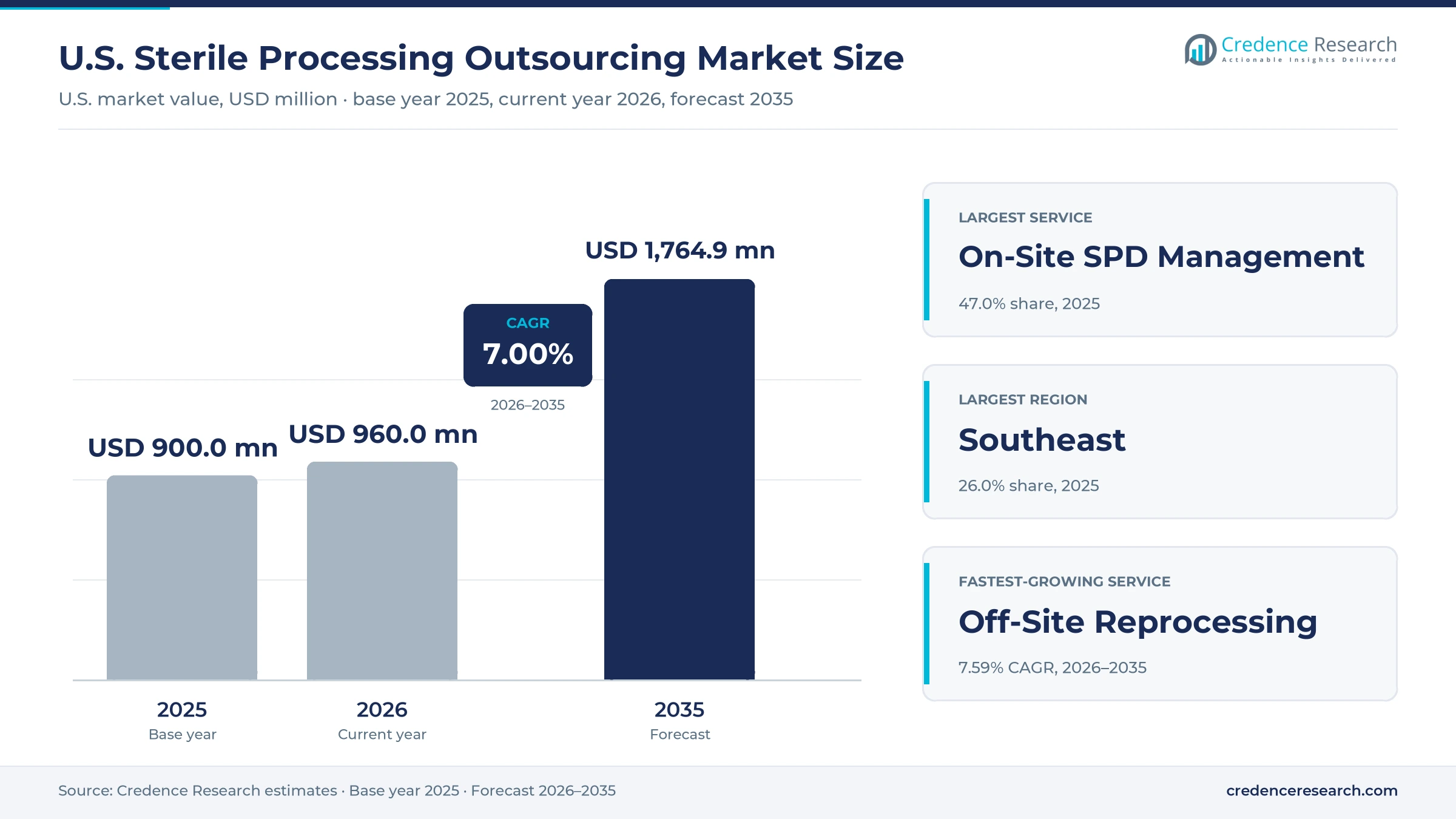
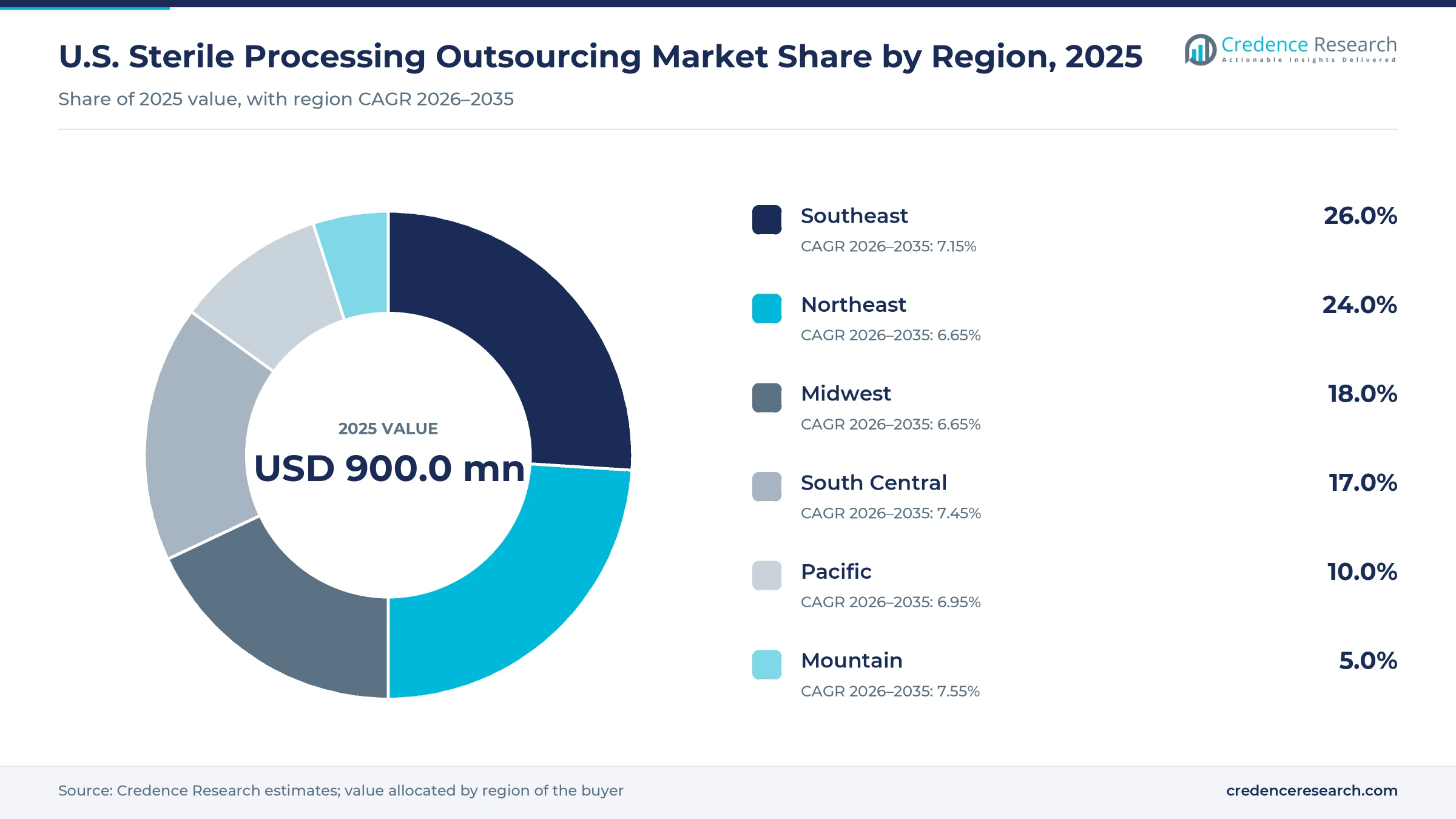
The U.S. sterile processing outsourcing market was valued at USD 900.0 million in 2025 and is projected to increase from USD 960.0 million in 2026 to USD 1.76 billion by 2035, registering a CAGR of 7.00% during 2026–2035. Demand comes from hospitals and ambulatory surgery centers that pay outside firms to run their sterile processing departments, reprocess trays at off-site centers or supply certified technicians. The Southeast held the largest regional share, 26.0% in 2025, while the Mountain region grows fastest at 7.55% a year from a small base of contracted departments. Accreditation surveys keep pressure on hospitals, because instrument disinfection and sterilization remains one of the most cited hospital requirements. On the commercial side, Getinge and SteriPro International agreed on Nov. 25, 2025, to design and run off-site reprocessing centers in North America, which adds capacity for systems that lack space or staff.
What does contracted sterile processing in the U.S. include?
The market counts what hospitals and ambulatory surgery centers pay outside firms to clean, decontaminate, inspect, assemble, package and sterilize reusable surgical instruments and devices. Value covers fully managed departments run on the hospital floor, per-tray fees at off-site reprocessing centers including transport, and contracted technician staffing billed by the hour or by the shift.
The estimate excludes sterilizers, washers and consumables that facilities buy for their own departments, instrument repair sold on its own and contract sterilization that device manufacturers buy for single-use products. Reprocessing of single-use devices for resale is also excluded, because it follows a separate FDA clearance path and a different buyer.
U.S. Sterile Processing Outsourcing Market Insights
- The market grows from USD 900.0 million in 2025 to USD 1.76 billion by 2035, a 7.00% CAGR, as hospitals and surgery centers move instrument reprocessing to specialist vendors.
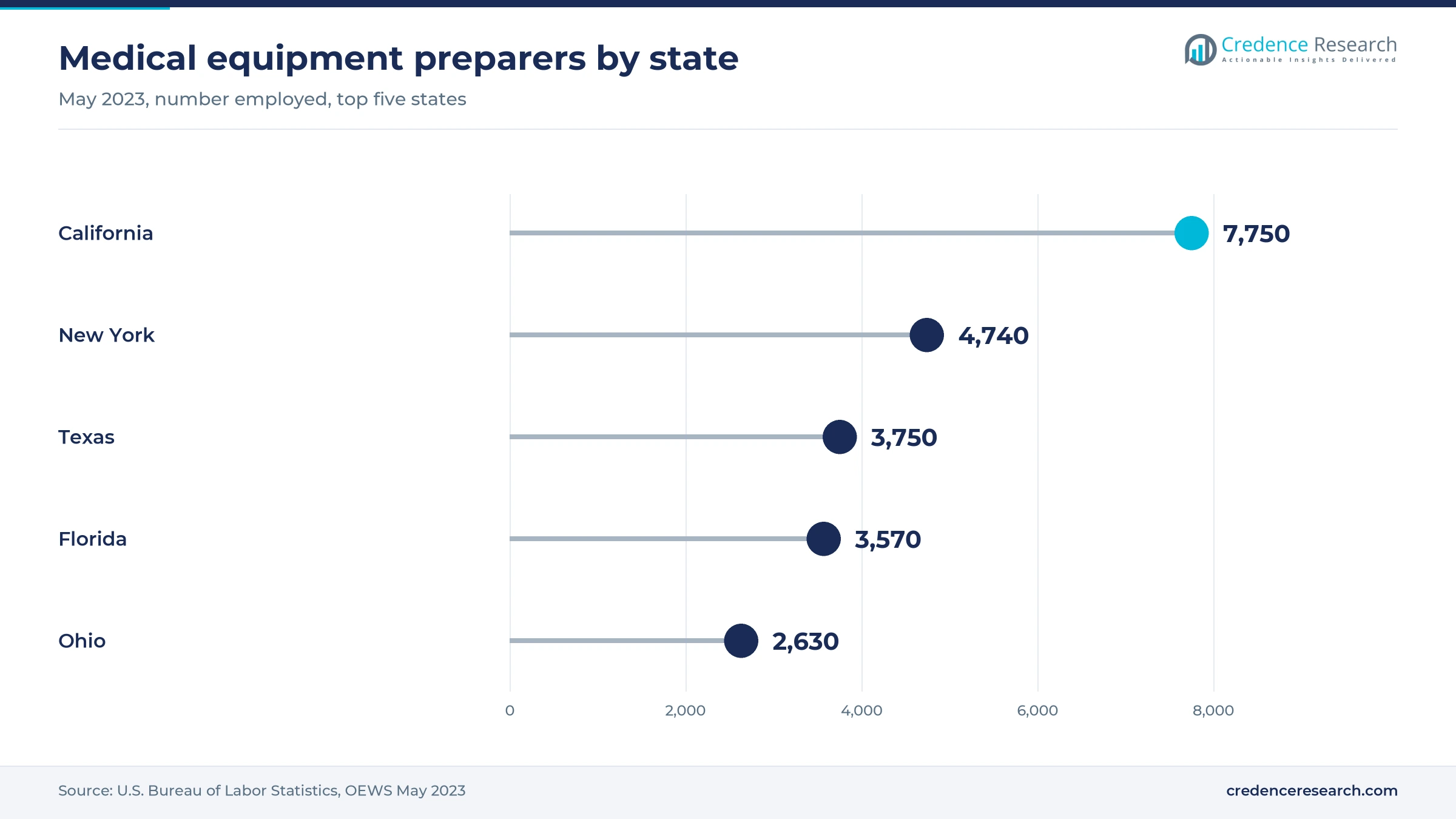
- The Southeast led with 26.0% of 2025 value, and Florida alone employed 3,570 medical equipment preparers in May 2023, according to the BLS.
- On-site SPD management held 47.0% of 2025 value, as STERIS reports outsourced reprocessing contracts that run from several months to 15 years.
- CMS finalized a three-year phase-out of the inpatient-only list on Nov. 21, 2025, moving more surgery into outpatient settings that need tray capacity.
- Getinge and SteriPro International announced an off-site reprocessing partnership on Nov. 25, 2025, pairing equipment supply with center operation in North America.
On-site SPD management leads as off-site hubs grow fastest
Why does on-site department management lead the service mix?
Based on service, the market is categorized into on-site SPD management, off-site reprocessing and staffing. On-Site SPD Management led with 47.0% of 2025 value because hospitals keep decontamination space next to the operating rooms, and STERIS states in its fiscal 2025 annual report that its outsourced reprocessing contracts run from several months to 15 years. Staffing contracts fill short gaps in shifts instead of running whole departments. Off-Site Reprocessing grows fastest at 7.59% a year as vendors add hub capacity, and STERIS says it processes more than 150 million instruments a year for customers through its reprocessing services.
How do hospitals and surgery centers split contracted spending?
Based on facility, the market is categorized into hospitals and ASCs. Hospitals led with 76.0% of 2025 value because their tray volumes are far larger, and the AHA counted 6,100 U.S. hospitals in fiscal 2024, with 5,121 community hospitals running surgical suites around the clock. Surgery centers usually buy smaller per-tray contracts with transport included. ASCs grow fastest at 7.90% a year as MedPAC counted 6,308 Medicare-certified centers in 2023, with 250 openings that year, and new centers often prefer per-tray fees to building a department.
Why do full contracts hold more value than partial ones?
Based on contract, the market is categorized into full and partial contracts. Full contracts led with 58.0% of 2025 value because a vendor that runs the whole department bills management, labor and quality oversight together, as Crothall Healthcare does in hospital departments it manages. Crothall reported audit compliance gains of about 90% for its methods in a May 9, 2024, release with Ascendco Health. Partial contracts grow fastest at 7.40% a year as hospitals buy only night shifts or loaner trays, and Emplify Health by Gundersen used eight contracted workers to cover open posts in April 2026.
| Segment Group | Leading Sub-segment | Share, 2025 | Fastest-growing Sub-segment | CAGR, 2026–2035 |
|---|---|---|---|---|
| By Service | On-Site SPD Management | 47.0% | Off-Site Reprocessing | 7.59% |
| By Facility | Hospitals | 76.0% | ASCs | 7.90% |
| By Contract | Full | 58.0% | Partial | 7.40% |
Request a Free Sample
Fill in your details and we'll send you a free sample report.
- Sample data tables & charts
- Research methodology
Survey findings, labor costs and mergers lift contracts
Sterilization survey findings push specialist contracts
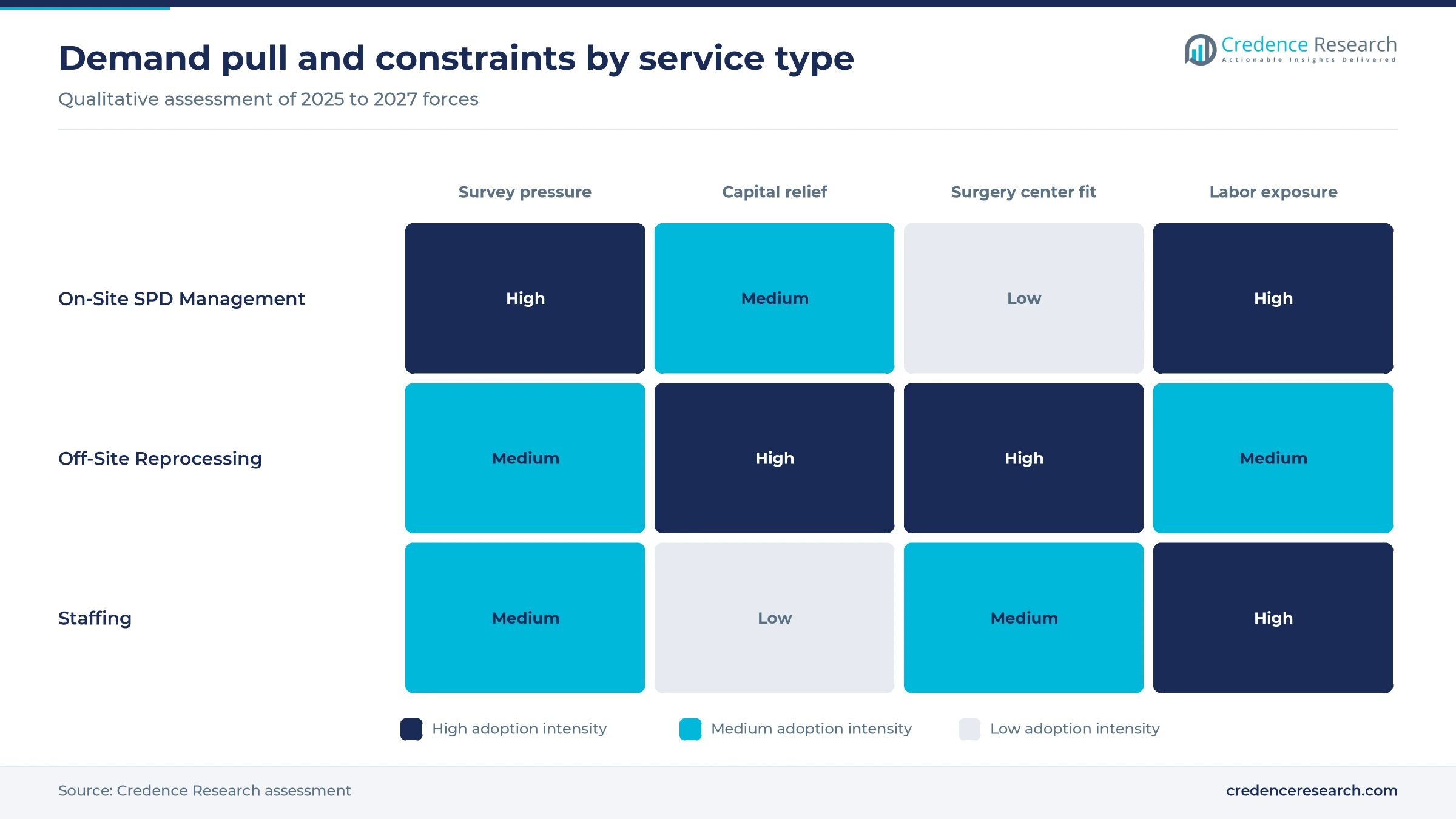
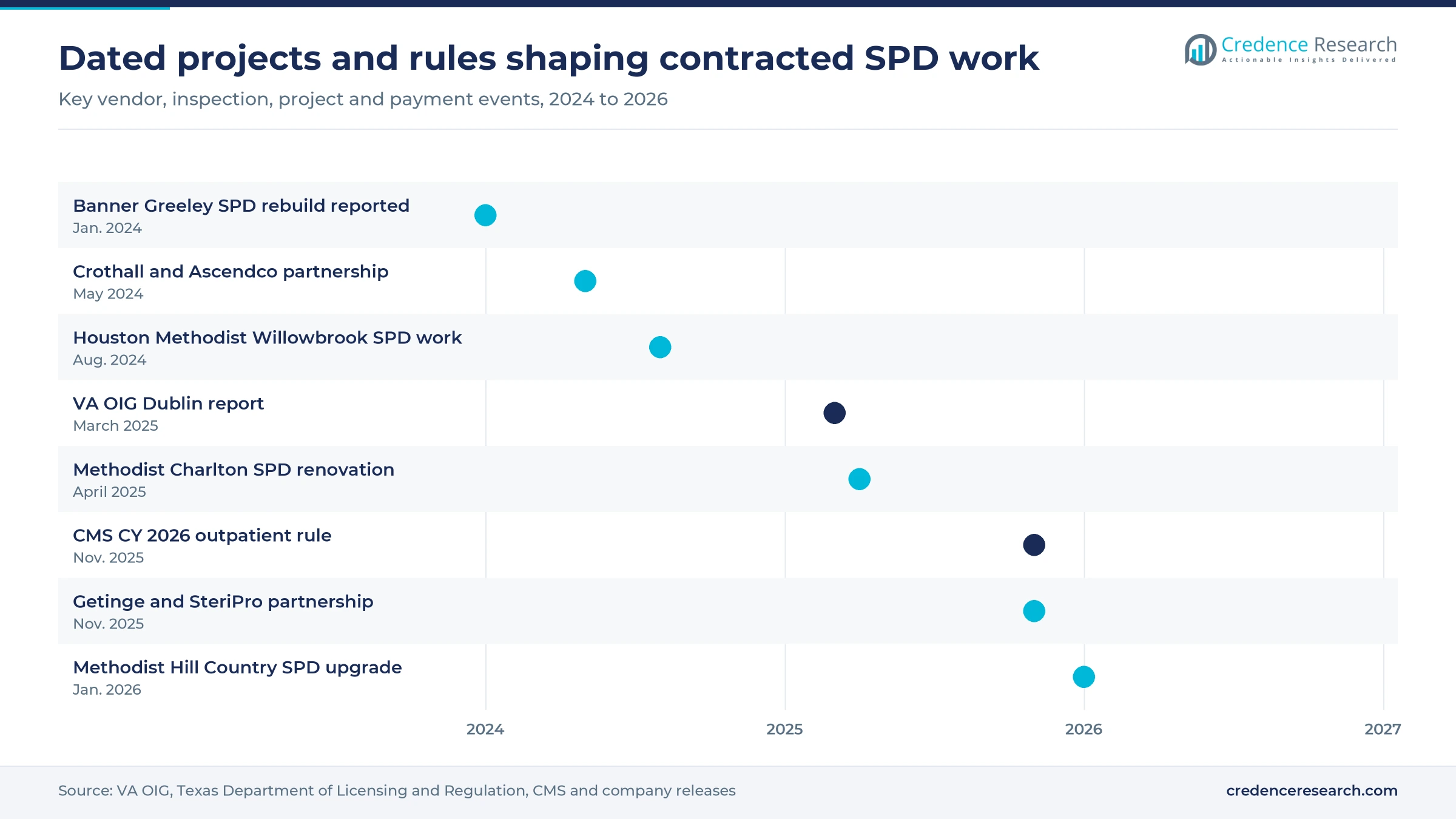
Accreditation and inspection findings are the strongest reason hospitals bring in a specialist vendor, because a failed sterilization survey can halt surgery. The Joint Commission listed intermediate and high-level disinfection and sterilization of equipment as the most challenging hospital requirement for 2023 in its April 3, 2024, newsletter. The VA Office of Inspector General reported in March 2025 that staff at the Carl Vinson VA Medical Center in Dublin, Ga., reprocessed visibly damaged instruments, and more than 800 instruments were later found beyond repair. Crothall Healthcare reports audit compliance gains of about 90% in its managed departments. In the Credence Research model, this driver adds about 2.7 percentage points to annual growth to 2035.
High equipment and labor costs favor shared capacity
Rebuilding a department is costly, so many hospitals prefer to share a vendor hub instead of buying new washers and sterilizers. Methodist Charlton Medical Center in Dallas registered a sterile processing renovation worth $3.72 million with Texas regulators, starting April 1, 2025, to replace equipment and finishes. Banner North Colorado Medical Center spent $2.9 million on its decontamination area, according to North Forty News in January 2024. Labor adds a second fixed cost, as the BLS counted 66,790 medical equipment preparers in May 2023 at a mean annual wage of $47,410. In the Credence Research model, shared capacity adds about 2.0 percentage points to annual growth to 2035.
Health system consolidation supports long service contracts
Larger systems can sign one multi-hospital contract, which makes sterile processing outsourcing easier to justify and lengthens contract terms. The AHA reported that 3,567 of 5,121 community hospitals, or 70%, belonged to a system in fiscal 2024. Kaufman Hall counted 46 announced hospital deals in 2025, including four mega mergers in the fourth quarter, and 43.5% involved a financially distressed party that is likely to review support costs. STERIS states in its fiscal 2025 annual report that outsourced reprocessing contracts run from several months to 15 years. In the Credence Research model, consolidation adds about 1.2 percentage points to annual growth to 2035.
Outpatient surgery growth creates new tray demand
Surgery is moving to outpatient sites, and many new centers lack the space or staff for a full department. MedPAC counted 6,308 Medicare-certified ASCs in 2023, up 2.5% from 2022, after 250 openings and 95 closures or mergers. CMS finalized its CY 2026 outpatient rule on Nov. 21, 2025, with a three-year phase-out of the inpatient-only list and cardiac ablation added to the ASC list, according to the American College of Cardiology. Lifeline Surgical Partners told Infection Control Today in October 2025 that its Pittsburgh North Surgical Center sends trays to a STERIS off-site center and pays per tray. That per-tray pattern helps ASCs grow at 7.90% a year through 2035.
Off-site hubs and tray tracking reshape the service model
Shift toward vendor-run off-site reprocessing hubs
Reprocessing is moving from basement departments into large off-site hubs that serve several hospitals from one site. Getinge and SteriPro International announced a partnership on Nov. 25, 2025 to design and run off-site centers, and SteriPro already provides onsite services to the largest public health system in Chicago. STERIS says it processes more than 150 million instruments a year and offers pickup and delivery in climate-controlled trucks. Health systems built the model first, as Penn Medicine opened a center of nearly 110,000 square feet in 2021, designed for up to 200 surgical cases a day. Shared hubs of this kind help Off-Site Reprocessing grow at 7.59% a year.
Rise of tray tracking data in SPD service contracts
Instrument tracking data is becoming part of the service promise, because buyers want proof of each tray path and each error. Crothall Healthcare and Ascendco Health announced a partnership on May 9, 2024, reporting up to 50% fewer process errors and up to 62% productivity gains with the Sonar tracking system. The VA Office of Inspector General found in March 2025 that the Dublin, Ga., medical center had not finished its CensiTrac tracking actions from a March 2024 report. Banner North Colorado Medical Center reported that new washers cut cleaning time per set by 25% and raised output from six to 18 trays an hour.
Opening in contingency cover during SPD shutdowns
Equipment failures and renovations create a clear opening in sterile processing outsourcing for vendors that can take over reprocessing at short notice. Providence Santa Rosa Memorial Hospital paused some procedures for about three weeks after two machines in its sterile processing department malfunctioned on Oct. 17, 2023, according to Becker's Hospital Review. Houston Methodist Willowbrook registered a $1.05 million department renovation with Texas regulators starting Aug. 19, 2024, and Methodist Hospital Hill Country registered a $450,000 upgrade from Jan. 5, 2026. STERIS markets short- and long-term outsourcing for partial or complete department shutdowns. Each project needs temporary capacity, which a vendor hub can supply.
Opening in surgery center tray and loaner programs
Surgery centers offer a second opening because they run high tray turnover with small teams and limited floor space. Memorial Hermann Surgery Center Memorial Village registered a $900,000 expansion of its 1,720-square-foot department with Texas regulators starting March 11, 2025, which shows the capital cost of building in-house. MedPAC counted 250 new Medicare-certified ASCs in 2023, and Infection Control Today noted in October 2025 that new centers are often financially fragile in their first five years. STERIS also offers reprocessing of vendor loaner trays, which surgery centers borrow for orthopedic and spine cases. Per-tray pricing fits these budgets better than a full department.
Technician gaps, in-house hubs and damage risk slow uptake
Can vendors staff departments amid a technician shortage?
Vendors draw on the same thin labor pool as hospitals, so a staffing contract can only be filled if technicians exist. Emplify Health by Gundersen in La Crosse, Wis., reported eight to 10 open sterile processing positions in April 2026, according to WXOW. The BLS projects about 7,600 new medical equipment preparer jobs over the next decade. Vendors respond with training programs, although a Phoenix department manager told Medline in March 2025 that training a new technician takes one to two years.
Do large systems prefer to build their own hubs?
Large academic systems often build their own centralized hubs, which removes them from the vendor market for decades. Ohio State Wexner Medical Center opened a 62,000-square-foot sterilizing facility in February 2021 at a cost of $45.3 million, sized for more than 48,000 surgical patients a year. Penn Medicine took the same path with a center of nearly 110,000 square feet in 2021. Vendors therefore compete mainly for community hospitals and surgery centers, while large systems buy only staffing or sterilization equipment.
How do certification laws raise labor costs?
State certification rules raise the cost of each technician that a vendor places, because only credentialed staff can work in covered hospitals. New York lawmakers passed a bill on June 20, 2012, requiring central service technicians to be certified and to earn continuing education credits, according to Infection Control Today. New Jersey had been the only state with such a rule at the time. Vendors must fund exam fees and annual education hours, which they pass on in hourly rates.
Who carries the liability for damaged instruments?
Damaged or incomplete trays create liability disputes between hospitals and vendors, which lengthens contract talks. The VA Office of Inspector General reported in March 2025 that more than 800 instruments at the Dublin, Ga., medical center were found beyond repair once a new maintenance contract began. A preventive maintenance program required under a 2016 VA policy started only in May 2024. Vendors now write repair, replacement and inspection duties into contracts, which raises prices for older instrument sets.
The Southeast holds the largest share of contracted SPD work
| Region | Value, 2025 (USD million) | Share, 2025 | CAGR, 2026–2035 |
|---|---|---|---|
| Southeast | 234.0 | 26.0% | 7.15% |
| Northeast | 216.0 | 24.0% | 6.65% |
| Midwest | 162.0 | 18.0% | 6.65% |
| South Central | 153.0 | 17.0% | 7.45% |
| Pacific | 90.0 | 10.0% | 6.95% |
| Mountain | 45.0 | 5.0% | 7.55% |
The Southeast leads on surgery volume and hub building
The Southeast held 26.0% of 2025 value and grows at 7.15% a year, the largest regional share in the market. Florida employed 3,570 medical equipment preparers in May 2023, the fourth-highest state count, according to the BLS. UF Health in Gainesville runs an off-site sterile processing department that had been open for about a year and a half by April 2025, according to Infection Control Today. The VA inspection findings in Dublin, Ga., also keep regional survey pressure high for federal and private hospitals alike.
The Northeast pairs dense hospitals with strict staff rules
The Northeast held 24.0% of 2025 value and grows at 6.65% a year, below the national pace. New York employed 4,740 medical equipment preparers in May 2023, the second-highest state total, according to the BLS. New York and New Jersey both require technician certification, which raises the value of each staffing contract. Penn Medicine built its own center of nearly 110,000 square feet in Philadelphia, while Lifeline Surgical Partners sends trays from its Pittsburgh-area center to a STERIS off-site site.
The Midwest balances in-house hubs with staffing gaps
The Midwest held 18.0% of 2025 value and grows at 6.65% a year, slightly below the national rate. Ohio employed 2,630 medical equipment preparers in May 2023, according to the BLS, the fifth-highest state count. Ohio State Wexner Medical Center chose to build its own $45.3 million sterilizing facility in 2021, which limits vendor scope in that system. Smaller systems still rely on contractors, as Emplify Health by Gundersen used eight contracted workers to fill gaps in April 2026.
South Central grows on Texas department rebuilds
The South Central region held 17.0% of 2025 value and grows at 7.45% a year, above the national pace. Texas employed 3,750 medical equipment preparers in May 2023, according to the BLS. Texas regulators recorded at least four sterile processing renovations between August 2024 and January 2026, from $450,000 at Methodist Hospital Hill Country to $3.72 million at Methodist Charlton Medical Center. Each rebuild creates a window for temporary off-site capacity and for vendors that offer to run the new department.
The Pacific region keeps most reprocessing in house
The Pacific region held 10.0% of 2025 value and grows at 6.95% a year, in line with the national rate. California employed 7,750 medical equipment preparers in May 2023, the highest of any state, according to the BLS, which shows how much of the work large systems still keep on staff. Providence Santa Rosa Memorial Hospital relied on sister hospitals for about three weeks after two machines failed in October 2023. Vendors in the region therefore sell contingency cover more often than full departments.
The Mountain region grows fastest from a small base
The Mountain region held 5.0% of 2025 value and grows at 7.55% a year, the fastest pace among the six zones. Banner North Colorado Medical Center in Greeley reprocessed nearly 73,000 trays and more than 850,000 instruments in a single year, according to North Forty News in January 2024. The hospital then spent $2.9 million to rebuild its decontamination room, which shows the capital burden on mid-sized hospitals that could instead share an off-site hub with nearby sites.
Partnerships, inspections and CMS rules mark 2024 to 2026
| Development | Status and market relevance |
|---|---|
| In May 2024, Crothall Healthcare and Ascendco Health announced a partnership that adds Sonar instrument tracking to Crothall-managed departments. | Active; ties tracking data to managed SPD contracts |
| In March 2025, the VA Office of Inspector General reported that the Carl Vinson VA Medical Center in Dublin, Ga., reused damaged instruments. | Published; more than 800 instruments found beyond repair |
| In October 2025, Lifeline Surgical Partners described sending its Pittsburgh North Surgical Center trays to a STERIS off-site center on per-tray fees. | Active; shows the surgery center contract model |
| In November 2025, CMS finalized the CY 2026 outpatient rule with a three-year phase-out of the inpatient-only list. | Final; moves more surgery to outpatient sites |
| In November 2025, Getinge and SteriPro International announced a partnership to design and run off-site reprocessing centers in North America. | Announced; adds vendor hub capacity |
Tracking software and automated washers change SPD contracts
- Instrument tracking systems record each tray step, and Ascendco Health says its Sonar system cut sterile return rates by up to 25% and return-to-decontamination rates by up to 5%.
- Robotic-cycle washers raise throughput, as Banner North Colorado Medical Center reported 18 trays an hour against six with its older units.
- Climate-controlled transport links hospitals with off-site hubs, as STERIS moves soiled and sterile trays on transfer carts in dedicated trucks.
- Digital workflow platforms from Getinge give off-site centers traceability across the instrument life cycle under its November 2025 SteriPro partnership.
Need a Custom Version of This Report?
Tailor the scope, geography, or segments to your exact requirements.
- Custom geography or segment scope
- Direct access to our analyst team
Device makers and service firms compete for SPD contracts
Competition in sterile processing outsourcing pits equipment makers that also run services against specialist management firms. STERIS covers the widest range, offering on-site department management, off-site reprocessing centers, loaner tray handling and emergency cover during shutdowns. Getinge entered off-site operation through its November 2025 partnership with SteriPro International, which brings 14 years of running a large accredited center in Canada. Crothall Healthcare competes as a support services manager that runs departments inside hospitals and adds tracking analytics through Ascendco Health. Medline supplies trays, pouches and test packs to departments and backs them with education, holding 190 lunch-and-learn sessions in two weeks in March 2025. Regional firms compete mainly on technician staffing and on local transport routes. Buyers compare vendors on survey results, turnaround times and the ability to staff night shifts.
How do the leading SPD service providers position their offer?
| Company | Type | Role in the market |
|---|---|---|
| STERIS | Equipment maker and service operator | Runs on-site departments and off-site centers, with contracts of up to 15 years |
| Getinge | Equipment maker | Partnered with SteriPro in November 2025 to design and run off-site centers |
| SteriPro International | Reprocessing operator | Runs a large accredited center in Canada and onsite services for a Chicago public system |
| Crothall Healthcare | Support services manager | Manages hospital departments and added Ascendco tracking in May 2024 |
| Medline | Supplier | Supplies SPD consumables and Centurion trays with on-site education programs |
| Ascendco Health | Tracking technology | Provides the Sonar tracking system used in Crothall-managed departments |
Survey readiness and labor supply decide vendor growth
Credence Research's view is that survey readiness and labor supply, rather than equipment alone, will decide which vendors gain share in sterile processing outsourcing. The Joint Commission keeps sterilization among its most cited hospital findings, and federal inspectors continue to document damaged instruments. Vendors that can staff night shifts, prove tray paths with tracking data and add off-site capacity near surgery center clusters should win most new contracts. Full department contracts will keep the larger share of value, although partial and per-tray deals will grow faster as smaller buyers test the model.
How contracted sterile processing spending was modeled
The report uses 2025 as the base year and 2035 as the forecast year, with market values taken from the Credence Research model. Service, facility, contract and regional splits are Credence Research estimates informed by public data and are not reported statistics. Sources include BLS occupational statistics, AHA and MedPAC facility counts, CMS payment rules as summarized by the American College of Cardiology, Texas Department of Licensing and Regulation project records, VA Office of Inspector General reports, company filings and releases, and trade press reports.
Outpatient surgery and consolidation carry growth to 2035
From USD 960.0 million in 2026, the market is expected to reach USD 1.76 billion by 2035 as more surgery moves to outpatient sites and system mergers create larger sterile processing outsourcing contracts. Off-site hubs should gain share as equipment makers and service firms add capacity in the Southeast and South Central regions. Staffing contracts will stay important while technician shortages last, although certification rules will keep hourly rates high. Surgery centers will remain the fastest-growing buyers, because per-tray fees avoid the capital cost of building a department.
Frequently Asked Questions
How big is the U.S. sterile processing outsourcing market?
Which service type holds the largest share?
Why do hospitals contract sterile processing work?
Which region leads and which grows fastest?
How fast are surgery centers adopting contracted reprocessing?
How does CMS policy affect demand?
What limits growth in contracted sterile processing?
Who are the leading companies?
Table of Content
Chapter 1 Market Segmentation
- 1.1 Segmentation Framework
- 1.1.1 Product and Service Classification
- 1.1.2 Application and End-Use Classification
- 1.1.3 Technology and Solution Classification
- 1.1.4 Customer and Distribution Channel Classification
- 1.1.5 Geographic Segmentation
- 1.1.6 Market Segment Definitions and Boundaries
- 1.2 By Service
- 1.2.1 On-Site SPD Management
- 1.2.2 Off-Site Reprocessing
- 1.2.3 Staffing
- 1.3 By Facility
- 1.3.1 Hospitals
- 1.3.2 ASCs
- 1.4 By Contract
- 1.4.1 Full
- 1.4.2 Partial
Chapter 2 Introduction
- 2.1 Report Objectives and Scope
- 2.2 Product Definition and Industry Terminology
- 2.3 Market Inclusions and Exclusions
- 2.4 Research Process
- 2.4.1 Primary Research and Expert Interviews
- 2.4.2 Secondary Research and Source Review
- 2.4.3 Top-Down and Bottom-Up Estimation
- 2.4.4 Data Triangulation and Verification
- 2.5 Market Size Measurement Basis
- 2.5.1 2025: USD 900.0 million → 2035: USD 1.76 billion
- 2.6 Historical and Forecast Reference Periods
- 2.6.1 Historical Period: 2018-2025
- 2.6.2 Base Year: 2025
- 2.6.3 Forecast Period: 2025-2035
- 2.7 Research Assumptions and Limitations
Chapter 3 Executive Summary
- 3.1 Market Snapshot and Key Findings
- 3.2 Base-Year Market Size, 2025
- 3.3 Forecast Market Size, 2035
- 3.4 Revenue and Volume Growth Outlook
- 3.5 Key Demand and Supply Indicators
- 3.6 Leading Market Segments
- 3.7 Fastest-Growing Market Opportunities
- 3.8 Regional Performance Highlights
- 3.9 Technology and Industry Transformation
- 3.10 Competitive Landscape Summary
- 3.11 Analyst View and Strategic Implications
Chapter 4 U.S. Sterile Processing Outsourcing Market Trends and Developments
- 4.1 Historical Industry Development, 2018-2025
- 4.2 Recent Market Trends and Developments
- 4.3 Demand and Customer Behavior Trends
- 4.4 Technology and Product Innovation
- 4.5 Artificial Intelligence, Automation and Digitalization
- 4.6 Local Manufacturing and Supply Chain Realignment
- 4.7 Industry Partnerships, Mergers and Acquisitions
- 4.8 Sustainability and Circular Economy Developments
- 4.9 Government and Private Sector Investment Trends
- 4.10 Emerging Business Models and Commercialization
- 4.11 Industry Developments and Announcements
Chapter 5 U.S. Sterile Processing Outsourcing Market Supply and Demand Analysis
- 5.1 Demand Trend and Consumption Analysis, 2018-2025
- 5.2 Demand Forecast, 2025-2035
- 5.3 Supply Chain Structure and Procurement Trends
- 5.4 Supply-Demand Gap and Bottlenecks
- 5.5 Import Dependence and Sourcing Structure
- 5.6 Regional Supply and Demand Concentration
Chapter 6 U.S. Sterile Processing Outsourcing Market Pricing Analysis
- 6.1 Pricing Structure and Measurement
- 6.2 Historical Pricing Trends, 2018-2025
- 6.3 Pricing Outlook, 2025-2035
- 6.4 Pricing by Product and Market Segment
- 6.5 Geographic Pricing Differences
- 6.6 Key Input, Energy, Labor and Logistics Costs
- 6.7 Contract Pricing and Purchasing Models
- 6.8 Pricing Sensitivity and Competitive Positioning
- 6.9 Price, Margin and Profitability Implications
Chapter 7 U.S. Sterile Processing Outsourcing Market Dynamics
- 7.1 Market Growth Drivers
- 7.1.1 Demand-Side Drivers
- 7.1.2 Technology and Innovation Drivers
- 7.1.3 Infrastructure and Investment Drivers
- 7.1.4 Regulatory and Policy Drivers
- 7.2 Market Restraints
- 7.2.1 Cost and Affordability Constraints
- 7.2.2 Technology and Adoption Barriers
- 7.2.3 Supply Chain and Operational Constraints
- 7.3 Market Challenges
- 7.3.1 Competitive Pressure and Margin Erosion
- 7.3.2 Skills, Infrastructure and Implementation Gaps
- 7.4 Emerging Market Opportunities
- 7.5 Market Dynamics Impact and Time-Horizon Assessment
Chapter 8 U.S. Sterile Processing Outsourcing Value Chain Analysis
- 8.1 Industry Value Chain Overview
- 8.2 Upstream Suppliers and Critical Inputs
- 8.3 Technology and Component Providers
- 8.4 Manufacturing or Service Delivery
- 8.5 Distribution, Channel Partners and Integrators
- 8.6 Downstream Applications and End Users
- 8.7 Value Addition and Profit Pools
- 8.8 Vertical Integration and Outsourcing
- 8.9 Supplier Concentration and Risk
- 8.10 Supply Chain Localization and Resilience
Chapter 9 U.S. Sterile Processing Outsourcing Market Regulations and Policies
- 9.1 Relevant Laws, Standards and Compliance Frameworks
- 9.2 Product, Service, Safety and Quality Requirements
- 9.3 Government Policies, Incentives and Subsidies
- 9.4 Imports, Exports and Trade Barriers
- 9.5 Public Procurement and Local Content Requirements
- 9.6 Data Protection, AI and Cybersecurity Compliance
- 9.7 Upcoming Policy Changes and Market Implications
Chapter 10 U.S. Sterile Processing Outsourcing Market Hotspots and Opportunities
- 10.1 Market Opportunity Mapping and Growth Hotspots
- 10.2 High-Growth Applications and Customer Groups
- 10.3 Underserved Markets and White-Space Opportunities
- 10.4 Emerging Technology and Product Opportunities
- 10.5 New Capacity and Investment Hotspots
- 10.6 Market Entry and Expansion Opportunities
- 10.7 Distribution and Partnership Opportunities
- 10.8 Near-Term and Long-Term Commercial Potential
- 10.9 Opportunity Attractiveness and Execution Risks
Chapter 11 U.S. Sterile Processing Outsourcing Market Outlook, 2025-2035
- 11.1 Market Size and Analysis
- 11.1.1 Revenue (Market Measurement: 2025: USD 900.0 million → 2035: USD 1.76 billion)
- 11.1.2 Historical Market Size, 2018-2025
- 11.1.3 Base-Year Market Size, 2025
- 11.2 Market Forecast, 2025-2035
- 11.2.1 Revenue Forecast to 2035
- 11.2.2 CAGR and Year-on-Year Growth
- 11.2.3 Incremental Revenue Opportunity
- 11.3 Forecast Assumptions and Scenario Analysis
- 11.3.1 Base-Case Forecast
- 11.3.2 Optimistic and Conservative Scenarios
- 11.3.3 Technology, Pricing and Policy Sensitivities
- 11.4 Market Attractiveness and Growth Outlook
Chapter 12 U.S. Sterile Processing Outsourcing Market Segmentation and Outlook
- 12.1 Segmentation Summary and Market Shares, 2025
- 12.2 Largest and Fastest-Growing Segments
- 12.3 By Service - Market Size and Forecast, 2025-2035
- 12.3.1 Segment Definition and Scope
- 12.3.2 Historical Market Size, 2018-2025
- 12.3.3 Revenue Forecast, 2025-2035
- 12.3.4 Base-Year Market Share, 2025
- 12.3.5 Segment CAGR and Growth Drivers
- 12.3.6 Subsegment Market Size and Forecast
- 12.3.6.1 On-Site SPD Management
- 12.3.6.2 Off-Site Reprocessing
- 12.3.6.3 Staffing
- 12.3.7 Subsegment Pricing and Adoption Trends
- 12.3.8 Leading Suppliers and Competition
- 12.3.9 Regional Demand and Opportunities
- 12.4 By Facility - Market Size and Forecast, 2025-2035
- 12.4.1 Segment Definition and Scope
- 12.4.2 Historical Market Size, 2018-2025
- 12.4.3 Revenue Forecast, 2025-2035
- 12.4.4 Base-Year Market Share, 2025
- 12.4.5 Segment CAGR and Growth Drivers
- 12.4.6 Subsegment Market Size and Forecast
- 12.4.6.1 Hospitals
- 12.4.6.2 ASCs
- 12.4.7 Subsegment Pricing and Adoption Trends
- 12.4.8 Leading Suppliers and Competition
- 12.4.9 Regional Demand and Opportunities
- 12.5 By Contract - Market Size and Forecast, 2025-2035
- 12.5.1 Segment Definition and Scope
- 12.5.2 Historical Market Size, 2018-2025
- 12.5.3 Revenue Forecast, 2025-2035
- 12.5.4 Base-Year Market Share, 2025
- 12.5.5 Segment CAGR and Growth Drivers
- 12.5.6 Subsegment Market Size and Forecast
- 12.5.6.1 Full
- 12.5.6.2 Partial
- 12.5.7 Subsegment Pricing and Adoption Trends
- 12.5.8 Leading Suppliers and Competition
- 12.5.9 Regional Demand and Opportunities
- 12.6 Segment Growth Comparison
- 12.7 Segment Attractiveness and Priority Matrix
Chapter 13 U.S. Sterile Processing Outsourcing Geographic Market Outlook, 2025-2035
- 13.1 Domestic Market Distribution and Demand Clusters
- 13.2 State- or Province-Wise Market Size and Forecast, 2025-2035
- 13.3 City and Metropolitan Market Outlook
- 13.4 Industrial, Manufacturing and Commercial Clusters
- 13.5 Geographic Concentration of Key End Users
- 13.6 Local Pricing and Purchasing Differences
- 13.7 Domestic Production Facilities and Capacity Map
- 13.8 Local Infrastructure and Project Pipeline
- 13.9 State-Level Policy and Incentive Differences
- 13.10 Subnational Investment Hotspots and Opportunities
- 13.11 Distribution and Logistics Networks
- 13.12 Domestic Competitive Footprint
Chapter 14 U.S. Sterile Processing Outsourcing Technology, Innovation and Sustainability Outlook
- 14.1 Technology Landscape and Maturity
- 14.2 Product, Process and Service Innovation
- 14.3 AI, Automation and Digital Tools in the Industry
- 14.4 Technology Adoption and Performance Benchmarking
- 14.5 Innovation Pipeline and R&D Investment
- 14.6 Energy Efficiency and Resource Management
- 14.7 Sustainability, Recycling and Circularity
- 14.8 Technology Roadmap, 2025-2035
- 14.9 Risks of Obsolescence and Technology Substitution
Chapter 15 U.S. Sterile Processing Outsourcing Market Key Strategic Imperatives
- 15.1 Growth and Market Entry Priorities
- 15.2 High-Return Products and Segments
- 15.3 Pricing, Profitability and Cost Optimization
- 15.4 Technology Investment and Product Differentiation
- 15.5 Supply Chain Localization and Resilience
- 15.6 Distribution and Customer Acquisition
- 15.7 Partnership, Acquisition and Capacity Strategy
- 15.8 Regional Expansion Priorities
- 15.9 Short-, Medium- and Long-Term Actions
Chapter 16 Competition Outlook
- 16.1 Industry Competition Characteristics
- 16.2 Market Structure and Concentration
- 16.3 Market Share and Competitive Positioning, 2025
- 16.4 Company-Wise Revenue and Product Benchmarking
- 16.5 Production and Service Capacity Benchmarking
- 16.6 Technology, Pricing and Differentiation
- 16.7 Regional Footprint and Distribution Strength
- 16.8 Mergers, Acquisitions and Strategic Alliances
- 16.9 New Entrants and Competitive Threats
- 16.10 Porter's Five Forces and Industry Attractiveness
- 16.11 Competitive Outlook, 2025-2035
Chapter 17 Company Profiles
- 17.1 Company Coverage and Selection Criteria
- 17.2 STERIS
- 17.2.1 Business Description
- 17.2.2 Company Ownership and Geographic Presence
- 17.2.3 Product and Service Portfolio
- 17.2.4 Manufacturing and Operating Footprint
- 17.2.5 Financial Performance and Investment
- 17.2.6 Market Share and Competitive Position
- 17.2.7 Technology and Innovation Capabilities
- 17.2.8 Strategic Alliances or Partnerships
- 17.2.9 Recent Developments
- 17.2.10 Growth Strategy and Outlook
- 17.3 Getinge
- 17.4 Medline
- 17.5 Crothall Healthcare
- 17.6 SteriPro International
- 17.7 Ascendco Health
- 17.8 Other Relevant Market Participants
Note: Every listed company is profiled on the structure shown under the first company. The company list is preliminary and may change based on research findings, market developments, data availability and client requirements.
Chapter 18 Disclaimer
- 18.1 Research and Forecast Disclaimer
- 18.2 Data Source and Estimation Limitations
Note: The depth of individual sections depends on data availability for this market. Volume, capacity, trade and other unit-based metrics are included where applicable.

