
Ambient notes move from clinic pilots to enterprise deals
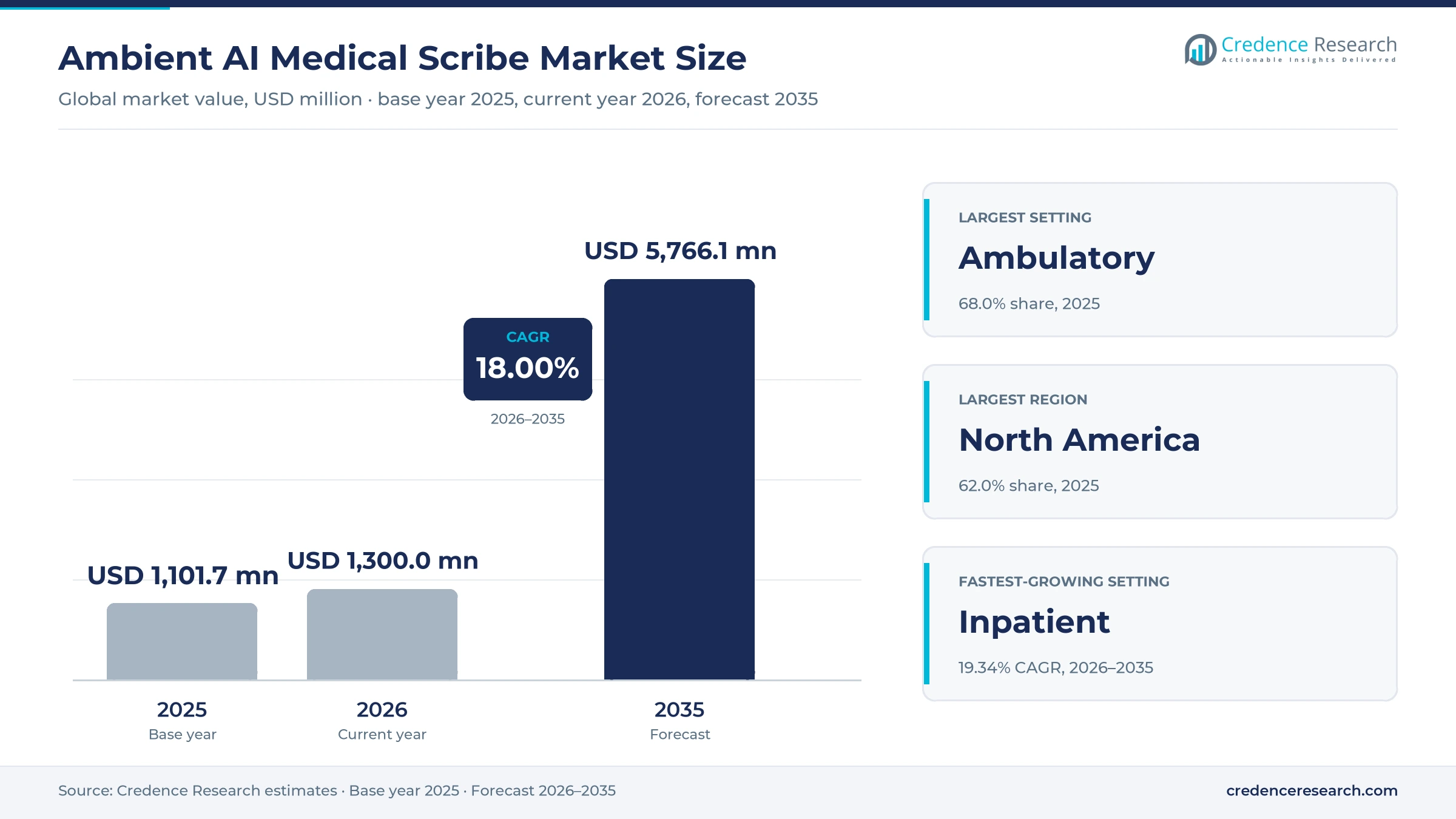
The global ambient AI medical scribe market was valued at USD 1.10 billion in 2025 and is projected to increase from USD 1.30 billion in 2026 to USD 5.77 billion by 2035, registering a CAGR of 18.00% during 2026–2035. Demand comes from health systems and physician groups that use ambient listening to draft visit notes in ambulatory clinics, emergency departments and hospital wards. North America held the largest regional share, 62.0% in 2025, because U.S. health systems sign enterprise contracts and fund most vendors. Asia Pacific is the fastest-growing region at 19.29% a year as Australian vendors expand and regulators set clearer rules for digital scribes. A major commercial change came in February 2026, when Epic released its own AI Charting tool inside its record system. Microsoft, Abridge and Ambience Healthcare are also extending ambient tools from visit notes into orders and coding.
What do ambient AI medical scribes record and produce?
The ambient AI medical scribe market covers software that listens to clinician and patient conversations, with consent and drafts structured clinical notes, orders and summaries for the clinician to review. It includes per-clinician subscriptions, enterprise licenses and the setup work that connects these tools to electronic record systems in clinics, emergency departments and hospital wards.
The scope excludes human medical scribes, offshore transcription services and dictation tools that only convert speech to text without drafting notes. Phone and messaging agents that talk with patients outside the visit are also excluded, because they automate access and scheduling work rather than clinical documentation.
Ambient AI Medical Scribe Market Insights
- The market is valued at USD 1.10 billion in 2025 and is projected to reach USD 5.77 billion by 2035, growing at an 18.00% CAGR as health systems scale ambient notes.
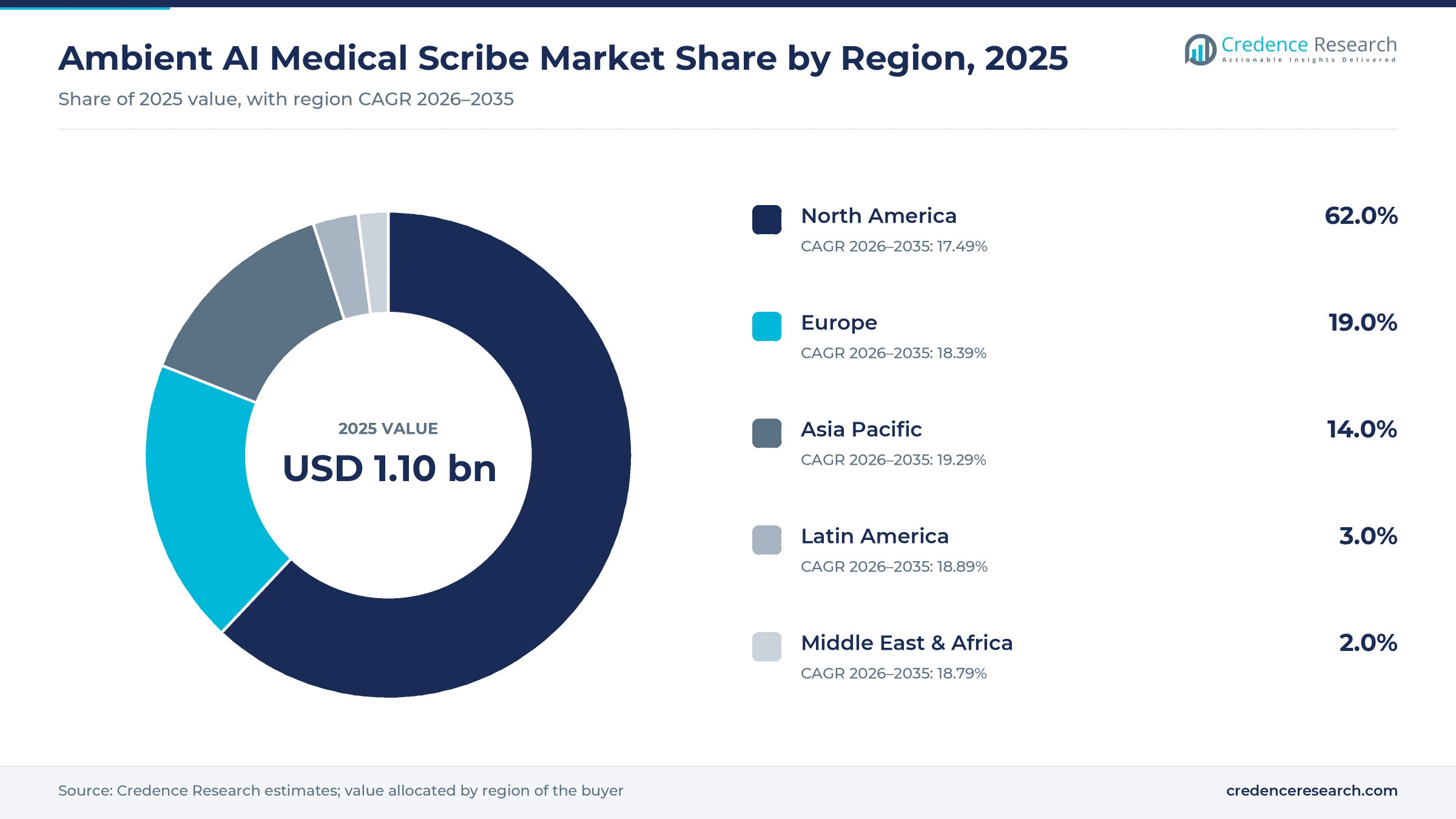
- North America led with 62.0% of 2025 value, while Asia Pacific grows fastest at 19.29% a year as Australian vendors scale.
- Ambulatory care held 68.0% of 2025 value, and Kaiser Permanente physicians used ambient scribes in 2,576,627 encounters over 63 weeks.
- Epic released its native AI Charting tool in February 2026, bringing ambient notes directly into the largest acute hospital record system.
- Abridge raised $300 million at a $5.3 billion valuation in June 2025, and Ambience Healthcare raised $243 million in July 2025.
Ambulatory care leads while inpatient use grows fastest
Why does ambulatory care lead while inpatient use grows fastest?
Based on setting, the market is categorized into ambulatory, emergency department and inpatient care. Ambulatory care led with a 68.0% share of 2025 value because outpatient visits were the first workflow that vendors automated at scale. Kaiser Permanente's 7,260 physicians used ambient scribes in 2,576,627 encounters between October 2023 and December 2024, saving an estimated 15,791 hours, according to the American Medical Association. Inpatient care grows fastest at 19.34% a year as hospital modules reach the record. Abridge launched Inside for Inpatient on June 18, 2025 with history and physical, progress and consult notes, and Sutter Health piloted it.
Why do health systems lead while physician groups grow faster?
Based on buyer, the market is categorized into health systems and physician groups. Health Systems led with a 64.0% share of 2025 value because enterprise contracts cover thousands of clinicians in one purchase. Abridge served more than 150 health systems when it raised $300 million at a $5.3 billion valuation on June 24, 2025, according to Becker's Hospital Review. Physician Groups grow fastest at 18.57% a year as low monthly prices reach small practices. Freed had 20,000 paying clinicians and more than 1,000 small organizations with 1 to 50 clinicians in July 2025, charging $90 a month for individuals, according to VentureBeat.
Why do Epic-embedded tools lead and grow fastest?
Based on integration, the market is categorized into Epic-embedded and standalone tools. Epic-Embedded tools led with a 58.0% share of 2025 value because large health systems want notes drafted inside the record they already use. Epic held 42% of the acute hospital record market and 55% of beds when it released its own AI Charting tool in February 2026, according to STAT. Epic-Embedded tools also grow fastest, at 18.45% a year, as partners add modules. Abridge Inside for Emergency Medicine launched through Epic's Workshop program on Jan. 29, 2025 at Emory Healthcare, Johns Hopkins Medicine and Mayo Clinic.
| Segment Group | Leading Sub-segment | Share, 2025 | Fastest-growing Sub-segment | CAGR, 2026–2035 |
|---|---|---|---|---|
| By Setting | Ambulatory | 68.0% | Inpatient | 19.34% |
| By Buyer | Health Systems | 64.0% | Physician Groups | 18.57% |
| By Integration | Epic-Embedded | 58.0% | Epic-Embedded | 18.45% |
Request a Free Sample
Fill in your details and we'll send you a free sample report.
- Sample data tables & charts
- Research methodology
Charting burden and EHR links drive scribe purchases
Clinicians seek relief from charting burden
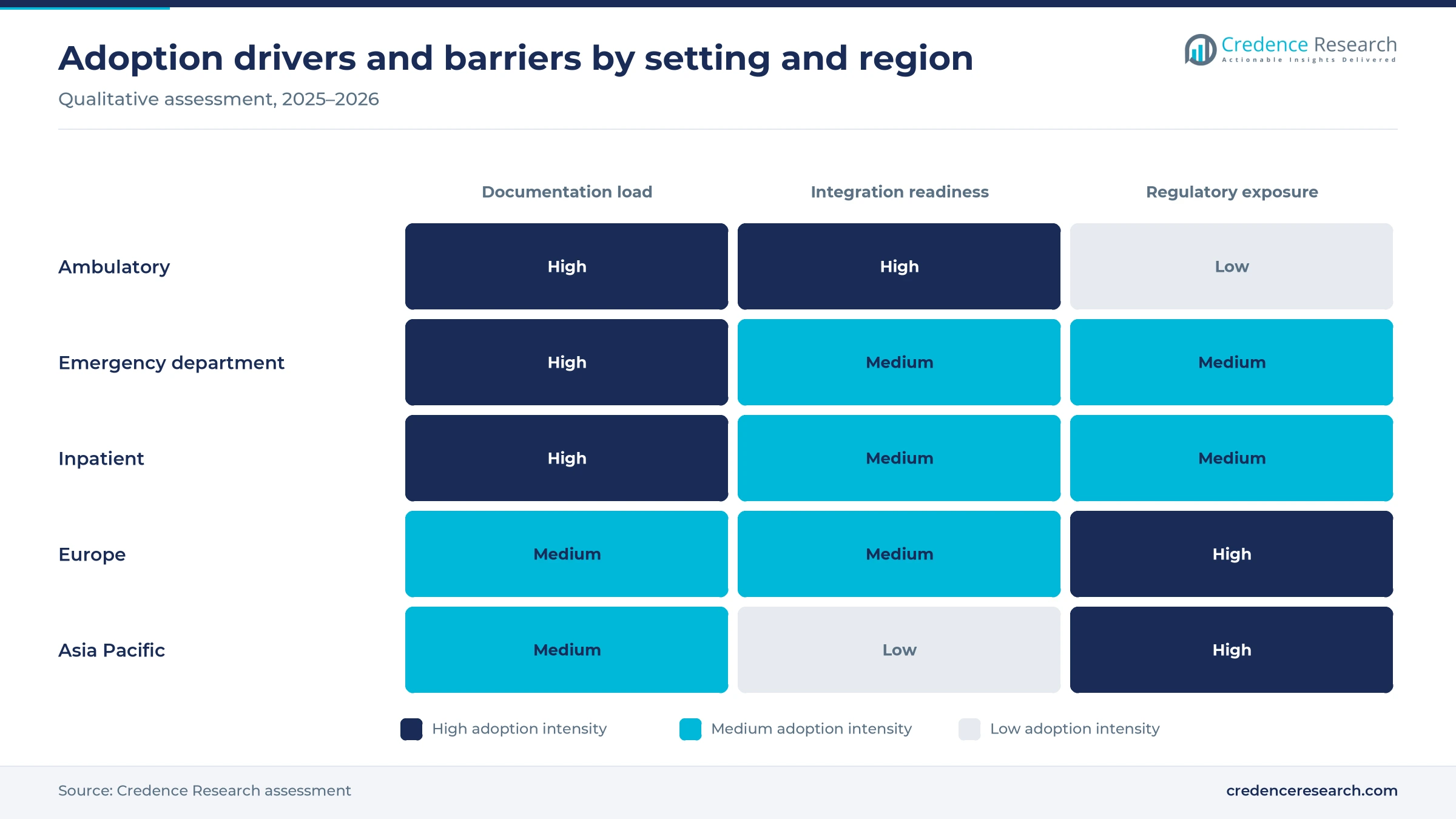
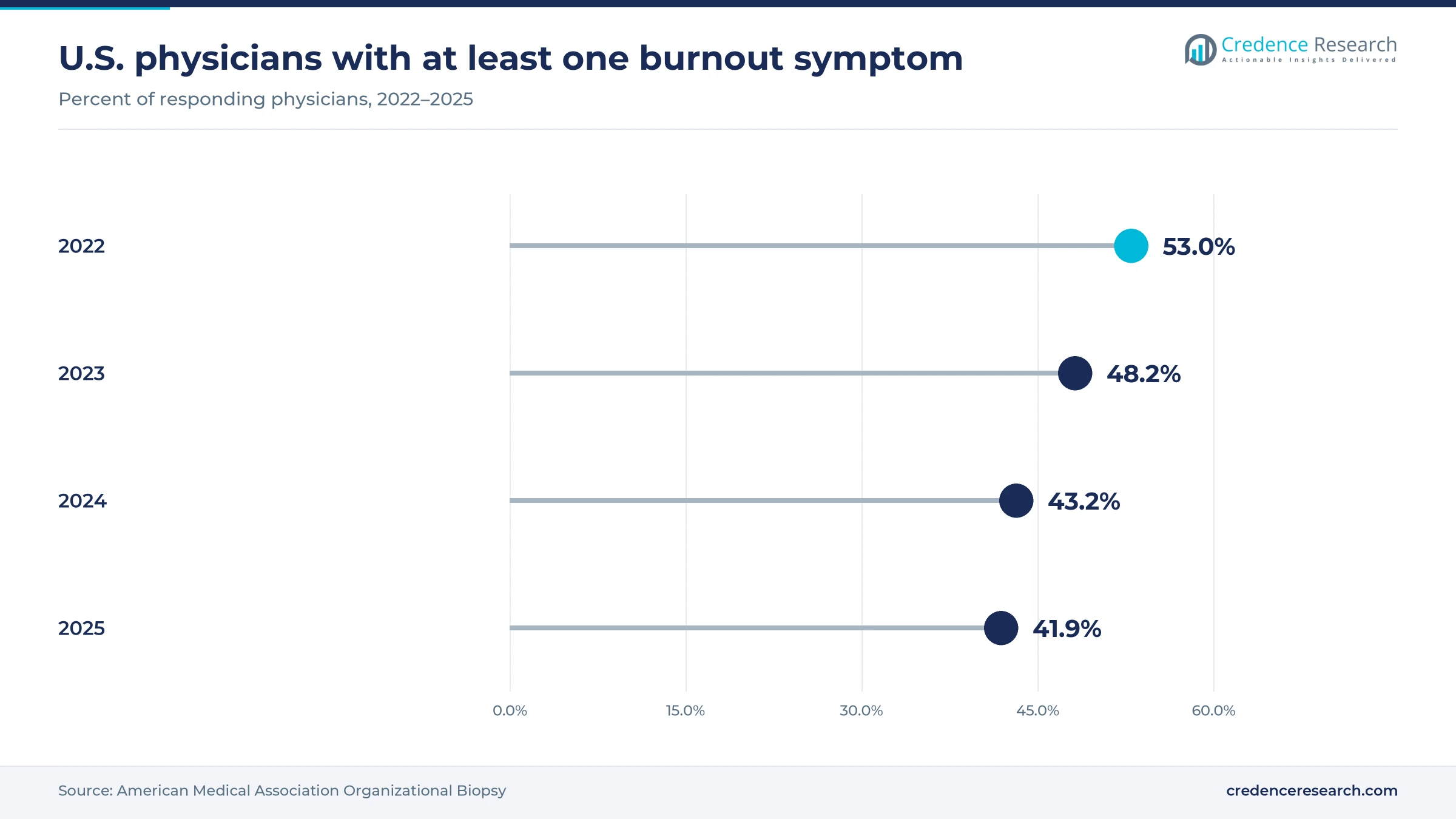
Documentation load remains the main reason health systems buy ambient scribes, because note writing extends the clinical day into evenings. The American Medical Association reported that 43.2% of U.S. physicians had at least one burnout symptom in 2024, down from 53% in 2022, based on nearly 18,000 respondents. Microsoft said in March 2025 that DAX Copilot users saved about five minutes per encounter and that 70% reported lower burnout, based on a survey of 879 clinicians at 340 organizations. Mass General Brigham recorded a 40% relative fall in burnout in a six-week pilot of 223 clinicians, according to Fierce Healthcare's summary of a Peterson Health Technology Institute review. In the Credence Research model this adds about 7.20 percentage points to annual growth to 2035.
Electronic record integrations reduce deployment friction
Deep links into record systems cut the setup work that slowed early pilots, so health systems can switch on ambient notes for whole departments. Abridge integrates with Epic from Haiku to Hyperspace, and its emergency product lets clinicians start a recording from the department Track Board, according to the company. Suki names Epic, Oracle Cerner, athenahealth and MEDITECH as record partners after its $70 million Series D, according to MobiHealthNews. Epic released its own AI Charting in February 2026, which brings ambient notes to the largest acute hospital record vendor, according to STAT. These links build on existing electronic health records investments at large systems. In the Credence Research model this adds about 5.04 percentage points to annual growth to 2035.
Voice accuracy gains widen specialty and enterprise rollouts
Better speech and language models now handle more specialties, languages and multi-speaker visits, which lets buyers move beyond primary care pilots. Abridge covered 55 specialties and 28 languages and supported more than 50 million medical conversations in 2025, according to Becker's Hospital Review. Nabla served more than 85,000 clinicians at over 130 organizations, with 20 million encounters a year in 35 languages, when it raised a $70 million Series C on June 17, 2025. Ambience Healthcare supports more than 100 ambulatory subspecialties as well as emergency and inpatient settings, and named Cleveland Clinic and UCSF Health among its users in July 2025. These gains build on decades of earlier speech recognition work. In the Credence Research model this adds about 3.24 percentage points to annual growth to 2035.
Public health systems scale enterprise contracts
Public health systems are moving from pilots to enterprise contracts, which adds large and stable buyers to the market. The Department of Veterans Affairs set a five-year ceiling of $775.72 million for its multi-award ambient scribe contract and selected Abridge in September 2026, according to Nextgov/FCW. The department had piloted Abridge and Knowtex since October 2025, and Abridge now integrates with VA records at more than 75 medical centers. In England, NHS England first issued guidance on ambient scribing products on April 27, 2025 and released a third version on July 29, 2026, which gives trusts a common basis for buying. Mount Sinai also began a systemwide Dragon Copilot rollout for physicians and nurses in November 2025, according to HLTH.
Orders, coding and EHR-native tools reshape buying
Shift from visit notes to orders and coding
Ambient vendors are shifting from note drafting to orders, coding and revenue cycle work, which raises the value of each license. Abridge began an initial rollout of outpatient orders on June 18, 2025, citing National Center for Health Statistics data that nearly three-quarters of outpatient visits end with at least one prescription order. Ambience Healthcare raised a $243 million Series C on July 29, 2025, co-led by Oak HC/FT and Andreessen Horowitz, and ties its return on investment to coding accuracy. Epic reported that more than 200 organizations use its Penny revenue cycle tool, with a 20% reduction in denials, according to HIT Consultant in February 2026. This shift links ambient tools with clinical documentation improvement programs.
Rise of record-native and platform ambient tools
Record vendors and large platforms are rising as direct competitors, which raises pressure on standalone tools to show clear value. Epic released AI Charting on Feb. 4, 2026, and several health systems were piloting it at launch, according to STAT. Microsoft unveiled Dragon Copilot on March 3, 2025, joining Dragon Medical One dictation with DAX ambient capture, with availability in the United States and Canada from May 2025. DAX had already assisted more than 3 million patient conversations at 600 organizations in a single month, according to Microsoft. Mount Sinai chose Dragon Copilot for systemwide use in November 2025, which shows that large buyers often favor tools tied to existing contracts.
Inpatient and emergency care open new clinician seats
Hospital wards and emergency departments are a clear opening, because most deployments still sit in outpatient clinics. Houston Methodist, which runs nine hospitals, began inpatient use with virtual hospitalists on evening shifts and had about 30 emergency department users after three months, according to Raptor Group's May 2025 report on the rollout. Abridge's emergency product went live at Emory Healthcare, Johns Hopkins Medicine, Mayo Clinic and UChicago Medicine in January 2025, and the company reports 86% less note-writing effort in its Reid Health case study. Mount Sinai's rollout, begun in November 2025, also extends ambient documentation to nurses, which widens the pool of users beyond physicians. As a result, Inpatient care grows fastest at 19.34% a year in the Credence Research model.
Small practices and new regions open more demand
Low-priced subscriptions and local-language tools are an opening among small practices and outside the United States. Freed charges $84 per user a month for teams of two to nine clinicians, according to VentureBeat. In Brazil, Voa Health raised a $3 million seed round led by Prosus Ventures in March 2025, with more than 20,000 registered doctors and 80,000 consultations a month, according to Bloomberg Línea. Australian vendor Heidi Health raised a $65 million Series B at a $465 million valuation in October 2025 and said it had supported clinicians for more than 18 million hours in 18 months. PureHealth also began piloting its Arabic-dialect scribe Nada at SEHA facilities in Abu Dhabi in December 2025.
Unclear returns, accuracy and consent rules add friction
Unclear financial returns slow enterprise renewals
Unclear financial returns slow some enterprise purchases and contract renewals at large systems. The Peterson Health Technology Institute found in March 2025 that ambient scribes likely reduce burnout but that their financial impact on health systems is unclear, according to Healthcare Innovation. Providers in the review reported no increase in patients seen per period, and billing gains appeared at MultiCare and Ochsner Health but not at other systems. Buyers therefore ask for measured productivity and coding results before extending licenses to every clinician.
Note accuracy still needs clinician review
Note errors still require careful clinician review, which limits the time saved. A randomized trial of 238 outpatient physicians across 14 specialties, funded in part by the UCLA Department of Medicine, found a 9.5% cut in time-in-note with Nabla and no significant change with DAX, according to NEJM AI in November 2025. The authors also noted occasional clinically significant inaccuracies in both tools. Health systems therefore keep review steps, train users and track error reports, which slows the move to full departmental use.
Recording consent rules raise legal risk
Recording consent rules expose providers to legal risk when consent steps are weak. A patient filed a proposed class action against Sharp HealthCare in San Diego County Superior Court in late November 2025, alleging that Abridge recorded a July appointment without the consent that California law requires, according to Becker's Hospital Review. Health systems in all-party consent states therefore add spoken and written consent steps, which lengthen visits and complicate large rollouts across clinics.
Medical device rules add review outside the U.S.
Device regulation outside the United States adds review costs for vendors. Australia's Therapeutic Goods Administration reviewed 12 digital scribe products and found that eight had functions likely to meet the definition of a medical device, according to The Medical Republic in October 2026. NHS England guidance also says generative summarizing products likely qualify as medical devices that need MHRA registration, according to HTN. Vendors therefore face registration work, clinical safety files and slower entry into these markets.
North America leads while Asia Pacific grows fastest
| Region | Value, 2025 (USD billion) | Share, 2025 | CAGR, 2026–2035 |
|---|---|---|---|
| North America | 0.68 | 62.0% | 17.49% |
| Europe | 0.21 | 19.0% | 18.39% |
| Asia Pacific | 0.15 | 14.0% | 19.29% |
| Latin America | 0.03 | 3.0% | 18.89% |
| Middle East & Africa | 0.02 | 2.0% | 18.79% |
North America leads on enterprise health system contracts
North America held a 62.0% share of 2025 value and grows at 17.49% a year to 2035. The region leads because U.S. health systems sign enterprise contracts and fund most vendors, with Abridge, Ambience Healthcare, Suki and Nabla selling mainly to U.S. providers. Kaiser Permanente physicians logged more than 2.5 million ambient encounters in 63 weeks, and the VA enterprise contract carries a $775.72 million ceiling. Physician burnout fell to 41.9% in 2025, according to Fierce Healthcare's report on AMA data. Microsoft made Dragon Copilot available in the United States and Canada from May 2025.
Europe grows under NHS guidance and multilingual tools
Europe held a 19.0% share of 2025 value and grows at 18.39% a year. NHS England guidance on ambient scribing products, first issued in April 2025 and updated in July 2026, asks trusts for clinical safety documentation under DCB0160 and a data protection impact assessment. Great Ormond Street Hospital tested TORTUS in 100 outpatient appointments, with plans to reach 5,000 patients, according to HTN. Microsoft planned Dragon Copilot for the U.K., Germany, France and the Netherlands after North America, and Paris-founded Nabla works in 35 languages.
Asia Pacific is the fastest-growing region
Asia Pacific held a 14.0% share of 2025 value and grows fastest at 19.29% a year. Melbourne-based Heidi Health raised a $65 million Series B in October 2025 to scale globally, and it has supported clinicians for more than 18 million hours. Australia's Therapeutic Goods Administration found about 100 digital scribe suppliers in its market scan and has reviewed which of these products count as medical devices. This review should give hospital and general practice buyers clearer rules before larger public contracts are signed.
Latin America starts with Brazilian clinic subscriptions
Latin America held a 3.0% share of 2025 value and grows at 18.89% a year. Brazil leads early use, where Voa Health had more than 600 paying clients on its premium version when it raised a $3 million seed round in March 2025, according to Bloomberg Línea. The company says its assistant cuts the time doctors spend on clinical records by about 80%. Most early buyers in the region are private clinics and doctors paying monthly, so Portuguese and Spanish accuracy matters more than deep hospital integration.
Middle East & Africa builds on Arabic-dialect scribes
Middle East & Africa held a 2.0% share of 2025 value and grows at 18.79% a year. PureHealth announced on Dec. 29, 2025 that its Nada scribe, built and tested across the SEHA hospital network in Abu Dhabi, captures local Arabic dialects and medical terminology. The company projects a cut of more than 50% in physician documentation time from internal pilot tests, which still await independent validation. Arabic language support therefore shapes vendor choice across Gulf hospital groups, while adoption in Africa remains limited.
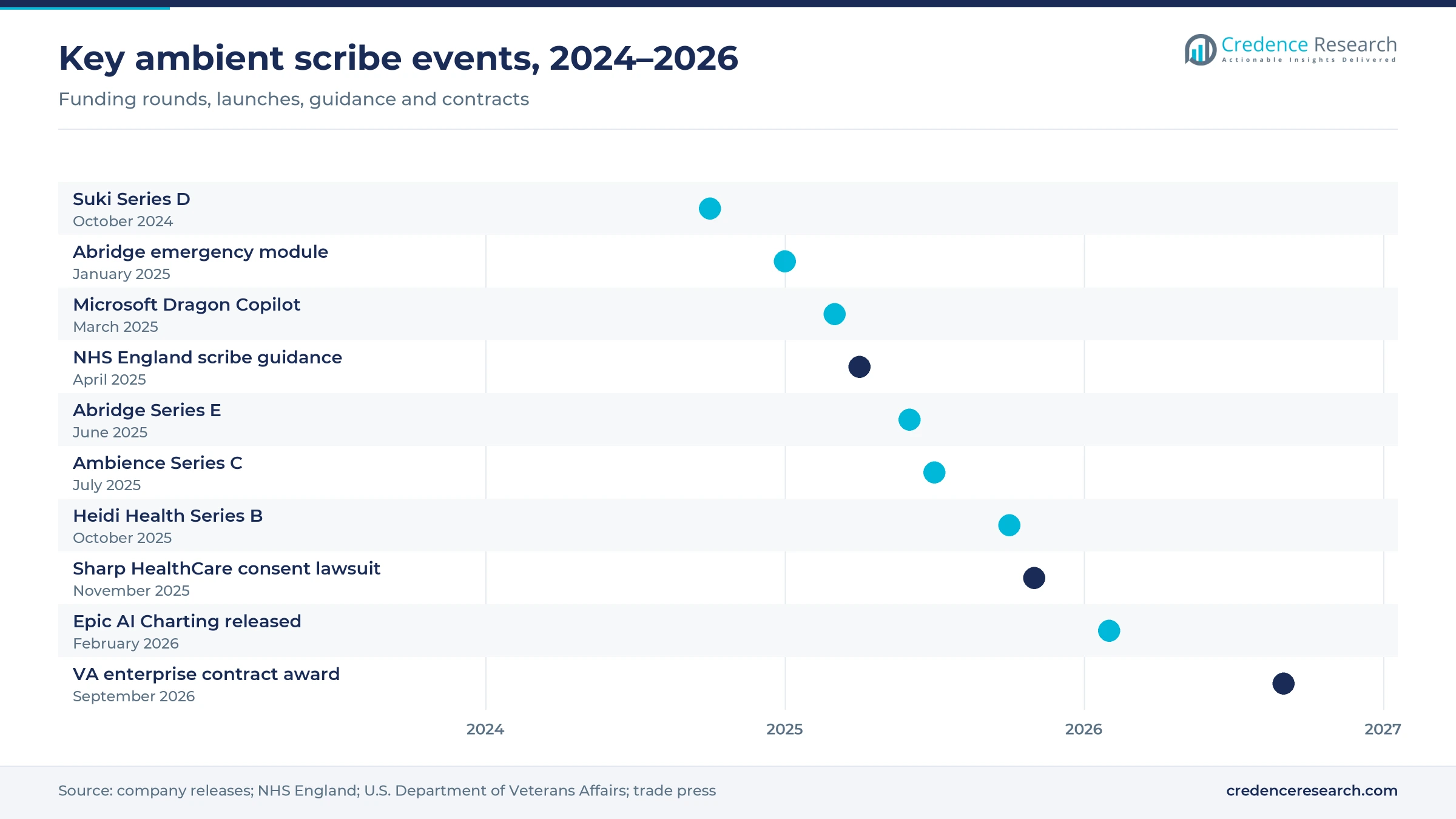
Large funding rounds and public contracts marked 2025-26
| Development | Status and market relevance |
|---|---|
| In March 2025, Microsoft unveiled Dragon Copilot, joining Dragon Medical One dictation with DAX ambient documentation. | Launched; available in the U.S. and Canada from May 2025 |
| In June 2025, Abridge closed a $300 million Series E led by Andreessen Horowitz at a $5.3 billion valuation. | Closed; funds expansion across more than 150 health systems |
| In July 2025, Ambience Healthcare raised a $243 million Series C co-led by Oak HC/FT and Andreessen Horowitz. | Closed; scales outpatient, emergency and inpatient use |
| In February 2026, Epic released AI Charting, its native ambient documentation tool, to record customers. | Released; several health systems piloting at launch |
| In September 2026, the Department of Veterans Affairs selected Abridge under its enterprise ambient scribe contract. | Awarded; five-year contract ceiling of $775.72 million |
Speech models and EHR modules widen ambient note scope
- Multi-speaker speech recognition detects specialty, language and speakers without manual settings, as in Abridge Inside for Emergency Medicine.
- Large language model summarization turns a recorded visit into history, assessment and plan sections that the clinician edits before signing.
- Record-embedded modules place the draft note inside Epic Haiku and Hyperspace, extending earlier transcription software into full note drafting.
- Orders and coding extraction pulls prescriptions, orders and billing codes from the conversation, as Abridge and Ambience Healthcare now offer.
Need a Custom Version of This Report?
Tailor the scope, geography, or segments to your exact requirements.
- Custom geography or segment scope
- Direct access to our analyst team
Vendors compete on EHR depth, specialties and proof
Competition centers on depth of record integration, specialty coverage, note accuracy and proof of financial return. Abridge leads among large health systems, works inside Epic for outpatient, emergency and inpatient notes and won the VA enterprise award in September 2026. Microsoft sells Dragon Copilot to organizations that already use Dragon Medical One and DAX, including Mount Sinai. Ambience Healthcare targets complex specialties, emergency departments and coding accuracy at systems such as Cleveland Clinic and Houston Methodist. Suki works with Epic, Oracle Cerner, athenahealth and MEDITECH, while Nabla competes on language range and speed of rollout. Heidi Health and Freed sell low-cost subscriptions to individual clinicians and small practices. Epic's native AI Charting adds price pressure on all standalone vendors from 2026. Vendors that publish measured time savings and coding results will keep enterprise contracts.
Companies profiled and their roles in this market
| Company | Type | Role in the market |
|---|---|---|
| Abridge | Enterprise specialist | Epic-embedded ambient notes and orders for more than 150 health systems and the VA |
| Microsoft (Dragon Copilot) | Platform vendor | Unified dictation and ambient documentation assistant built on Dragon Medical One and DAX |
| Ambience Healthcare | Enterprise specialist | Ambient notes and coding support across outpatient, emergency and inpatient settings |
| Suki | Multi-EHR assistant | Ambient documentation integrated with Epic, Oracle Cerner, athenahealth and MEDITECH |
| Nabla | Multilingual specialist | Ambient assistant used by more than 85,000 clinicians in 35 languages |
| Heidi Health | Practice-focused vendor | Australian ambient scribe for clinicians and public health partners |
| Freed | Small-practice vendor | Self-serve ambient scribe for solo clinicians and practices with up to 50 clinicians |
Measured returns will decide renewals after 2026
Credence Research's view is that the ambient AI medical scribe market will be decided by measured returns rather than by funding size alone. Early evidence shows lower burnout, as the Mass General Brigham pilot showed with a 40% relative fall, but a randomized trial found only modest time savings and occasional note errors. Epic's native charting tool also adds price pressure on standalone vendors from 2026. Vendors that prove coding gains, extend into hospital wards and manage consent well will hold share through 2035.
Seat-count and pricing model checked against deployments
The report uses 2025 as the base year and forecasts to 2035. Market values come from the Credence Research model, built from estimated counts of clinician seats at health systems and physician groups and public subscription prices. Setting, buyer, integration and regional splits are Credence Research estimates based on vendor disclosures, deployment reports, funding announcements, public contract notices and peer-reviewed studies indexed by the National Library of Medicine. Company releases and trade press coverage were used to date events. No interviews or surveys were conducted for this edition of the report.
Hospital wards and public buyers extend growth to 2035
The market is expected to grow from USD 1.30 billion in 2026 to USD 5.77 billion by 2035 as health systems move ambient notes from clinics into emergency departments and hospital wards. Ambulatory care will remain the largest setting in the ambient AI medical scribe market, while inpatient use gains from hospitalist and nursing modules. North America will keep the largest share, and Asia Pacific will grow fastest as Australian vendors scale and regulators finish device reviews. Unclear financial returns, consent duties and record-native competition will remain the main limits on growth through 2035.
Frequently Asked Questions
How big is the ambient AI medical scribe market?
Which setting leads the market?
Which setting grows fastest?
Which region leads the market?
Which region grows fastest?
Who are the main companies in the market?
Do ambient scribes save clinicians time?
What risks do buyers in the market face?
Table of Content
Chapter 1 Market Segmentation
- 1.1 Segmentation Framework
- 1.1.1 Product and Service Classification
- 1.1.2 Application and End-Use Classification
- 1.1.3 Technology and Solution Classification
- 1.1.4 Customer and Distribution Channel Classification
- 1.1.5 Geographic Segmentation
- 1.1.6 Market Segment Definitions and Boundaries
- 1.2 By Setting
- 1.2.1 Ambulatory
- 1.2.2 Emergency Department
- 1.2.3 Inpatient
- 1.3 By Buyer
- 1.3.1 Health Systems
- 1.3.2 Physician Groups
- 1.4 By Integration
- 1.4.1 Epic-Embedded
- 1.4.2 Standalone
Chapter 2 Introduction
- 2.1 Report Objectives and Scope
- 2.2 Product Definition and Industry Terminology
- 2.3 Market Inclusions and Exclusions
- 2.4 Research Process
- 2.4.1 Primary Research and Expert Interviews
- 2.4.2 Secondary Research and Source Review
- 2.4.3 Top-Down and Bottom-Up Estimation
- 2.4.4 Data Triangulation and Verification
- 2.5 Market Size Measurement Basis
- 2.5.1 2025: USD 1.10 billion → 2035: USD 5.77 billion
- 2.6 Historical and Forecast Reference Periods
- 2.6.1 Historical Period: 2018-2025
- 2.6.2 Base Year: 2025
- 2.6.3 Forecast Period: 2025-2035
- 2.7 Research Assumptions and Limitations
Chapter 3 Executive Summary
- 3.1 Market Snapshot and Key Findings
- 3.2 Base-Year Market Size, 2025
- 3.3 Forecast Market Size, 2035
- 3.4 Revenue and Volume Growth Outlook
- 3.5 Key Demand and Supply Indicators
- 3.6 Leading Market Segments
- 3.7 Fastest-Growing Market Opportunities
- 3.8 Regional Performance Highlights
- 3.9 Technology and Industry Transformation
- 3.10 Competitive Landscape Summary
- 3.11 Analyst View and Strategic Implications
Chapter 4 Global Ambient AI Medical Scribe Market Trends and Developments
- 4.1 Historical Industry Development, 2018-2025
- 4.2 Recent Market Trends and Developments
- 4.3 Demand and Customer Behavior Trends
- 4.4 Technology and Product Innovation
- 4.5 Artificial Intelligence, Automation and Digitalization
- 4.6 Local Manufacturing and Supply Chain Realignment
- 4.7 Industry Partnerships, Mergers and Acquisitions
- 4.8 Sustainability and Circular Economy Developments
- 4.9 Government and Private Sector Investment Trends
- 4.10 Emerging Business Models and Commercialization
- 4.11 Industry Developments and Announcements
Chapter 5 Global Ambient AI Medical Scribe Market Production, Supply and Demand Analysis
- 5.1 Demand Trend and Consumption Analysis, 2018-2025
- 5.2 Demand Forecast, 2025-2035
- 5.3 Production and Output Trend, 2018-2025
- 5.4 Production and Output Forecast, 2025-2035
- 5.5 Installed Capacity and Capacity Utilization
- 5.6 Company-Wise Production Plants and Statistics
- 5.6.1 Installed Production Capacity
- 5.6.2 Actual Production
- 5.6.3 Planned Capacity and Expansion Targets
- 5.7 Supply Chain Structure and Procurement Trends
- 5.8 Supply-Demand Gap and Bottlenecks
- 5.9 Import Dependence and Sourcing Structure
- 5.10 Contract Manufacturing and Outsourcing
- 5.11 Regional Supply and Demand Concentration
Chapter 6 Global Ambient AI Medical Scribe Market Pricing Analysis
- 6.1 Pricing Structure and Measurement
- 6.2 Historical Pricing Trends, 2018-2025
- 6.3 Pricing Outlook, 2025-2035
- 6.4 Average Selling Price and Unit Economics
- 6.5 Pricing by Product and Market Segment
- 6.6 Geographic Pricing Differences
- 6.7 Key Input, Energy, Labor and Logistics Costs
- 6.8 Contract Pricing and Purchasing Models
- 6.9 Pricing Sensitivity and Competitive Positioning
- 6.10 Price, Margin and Profitability Implications
Chapter 7 Global Ambient AI Medical Scribe Market Dynamics
- 7.1 Market Growth Drivers
- 7.1.1 Demand-Side Drivers
- 7.1.2 Technology and Innovation Drivers
- 7.1.3 Infrastructure and Investment Drivers
- 7.1.4 Regulatory and Policy Drivers
- 7.2 Market Restraints
- 7.2.1 Cost and Affordability Constraints
- 7.2.2 Technology and Adoption Barriers
- 7.2.3 Supply Chain and Operational Constraints
- 7.3 Market Challenges
- 7.3.1 Competitive Pressure and Margin Erosion
- 7.3.2 Skills, Infrastructure and Implementation Gaps
- 7.4 Emerging Market Opportunities
- 7.5 Market Dynamics Impact and Time-Horizon Assessment
Chapter 8 Global Ambient AI Medical Scribe Value Chain Analysis
- 8.1 Industry Value Chain Overview
- 8.2 Upstream Suppliers and Critical Inputs
- 8.3 Technology and Component Providers
- 8.4 Manufacturing or Service Delivery
- 8.5 Distribution, Channel Partners and Integrators
- 8.6 Downstream Applications and End Users
- 8.7 Value Addition and Profit Pools
- 8.8 Vertical Integration and Outsourcing
- 8.9 Supplier Concentration and Risk
- 8.10 Supply Chain Localization and Resilience
Chapter 9 Global Ambient AI Medical Scribe Market Regulations and Policies
- 9.1 Relevant Laws, Standards and Compliance Frameworks
- 9.2 Product, Service, Safety and Quality Requirements
- 9.3 Government Policies, Incentives and Subsidies
- 9.4 Imports, Exports and Trade Barriers
- 9.5 Public Procurement and Local Content Requirements
- 9.6 Environmental and Sustainability Compliance
- 9.7 Upcoming Policy Changes and Market Implications
Chapter 10 Global Ambient AI Medical Scribe Market Hotspots and Opportunities
- 10.1 Market Opportunity Mapping and Growth Hotspots
- 10.2 High-Growth Applications and Customer Groups
- 10.3 Underserved Markets and White-Space Opportunities
- 10.4 Emerging Technology and Product Opportunities
- 10.5 New Capacity and Investment Hotspots
- 10.6 Market Entry and Expansion Opportunities
- 10.7 Distribution and Partnership Opportunities
- 10.8 Near-Term and Long-Term Commercial Potential
- 10.9 Opportunity Attractiveness and Execution Risks
Chapter 11 Global Ambient AI Medical Scribe Market Outlook, 2025-2035
- 11.1 Market Size and Analysis
- 11.1.1 Revenue (Market Measurement: 2025: USD 1.10 billion → 2035: USD 5.77 billion)
- 11.1.2 Market Volume and Quantity Sold
- 11.1.3 Historical Market Size, 2018-2025
- 11.1.4 Base-Year Market Size, 2025
- 11.2 Market Forecast, 2025-2035
- 11.2.1 Revenue Forecast to 2035
- 11.2.2 Volume Forecast to 2035
- 11.2.3 CAGR and Year-on-Year Growth
- 11.2.4 Incremental Revenue Opportunity
- 11.3 Forecast Assumptions and Scenario Analysis
- 11.3.1 Base-Case Forecast
- 11.3.2 Optimistic and Conservative Scenarios
- 11.3.3 Technology, Pricing and Policy Sensitivities
- 11.4 Market Attractiveness and Growth Outlook
Chapter 12 Global Ambient AI Medical Scribe Market Segmentation and Outlook
- 12.1 Segmentation Summary and Market Shares, 2025
- 12.2 Largest and Fastest-Growing Segments
- 12.3 By Setting - Market Size and Forecast, 2025-2035
- 12.3.1 Segment Definition and Scope
- 12.3.2 Historical Market Size, 2018-2025
- 12.3.3 Revenue Forecast, 2025-2035
- 12.3.4 Volume Forecast, 2025-2035
- 12.3.5 Base-Year Market Share, 2025
- 12.3.6 Segment CAGR and Growth Drivers
- 12.3.7 Subsegment Market Size and Forecast
- 12.3.7.1 Ambulatory
- 12.3.7.2 Emergency Department
- 12.3.7.3 Inpatient
- 12.3.8 Subsegment Pricing and Adoption Trends
- 12.3.9 Leading Suppliers and Competition
- 12.3.10 Regional Demand and Opportunities
- 12.4 By Buyer - Market Size and Forecast, 2025-2035
- 12.4.1 Segment Definition and Scope
- 12.4.2 Historical Market Size, 2018-2025
- 12.4.3 Revenue Forecast, 2025-2035
- 12.4.4 Volume Forecast, 2025-2035
- 12.4.5 Base-Year Market Share, 2025
- 12.4.6 Segment CAGR and Growth Drivers
- 12.4.7 Subsegment Market Size and Forecast
- 12.4.7.1 Health Systems
- 12.4.7.2 Physician Groups
- 12.4.8 Subsegment Pricing and Adoption Trends
- 12.4.9 Leading Suppliers and Competition
- 12.4.10 Regional Demand and Opportunities
- 12.5 By Integration - Market Size and Forecast, 2025-2035
- 12.5.1 Segment Definition and Scope
- 12.5.2 Historical Market Size, 2018-2025
- 12.5.3 Revenue Forecast, 2025-2035
- 12.5.4 Volume Forecast, 2025-2035
- 12.5.5 Base-Year Market Share, 2025
- 12.5.6 Segment CAGR and Growth Drivers
- 12.5.7 Subsegment Market Size and Forecast
- 12.5.7.1 Epic-Embedded
- 12.5.7.2 Standalone
- 12.5.8 Subsegment Pricing and Adoption Trends
- 12.5.9 Leading Suppliers and Competition
- 12.5.10 Regional Demand and Opportunities
- 12.6 Segment Growth Comparison
- 12.7 Segment Attractiveness and Priority Matrix
Chapter 13 Global Ambient AI Medical Scribe Geographic Market Outlook, 2025-2035
- 13.1 Regional Market Size and Share, 2025
- 13.2 Regional Market Forecast, 2025-2035
- 13.3 Regional Pricing, Production and Demand Differences
- 13.4 North America
- 13.4.1 United States
- 13.4.2 Canada
- 13.4.3 Mexico
- 13.5 Europe
- 13.5.1 Germany
- 13.5.2 France
- 13.5.3 Italy
- 13.5.4 United Kingdom
- 13.5.5 Spain
- 13.5.6 Poland
- 13.5.7 Russia
- 13.5.8 Netherlands
- 13.5.9 Belgium
- 13.5.10 Sweden
- 13.5.11 Denmark
- 13.5.12 Norway
- 13.5.13 Rest of Europe
- 13.6 Asia Pacific
- 13.6.1 China
- 13.6.2 India
- 13.6.3 Japan
- 13.6.4 South Korea
- 13.6.5 Thailand
- 13.6.6 Indonesia
- 13.6.7 Vietnam
- 13.6.8 Malaysia
- 13.6.9 Australia
- 13.6.10 Rest of Asia Pacific
- 13.7 Latin America
- 13.7.1 Brazil
- 13.7.2 Argentina
- 13.7.3 Colombia
- 13.7.4 Chile
- 13.7.5 Rest of Latin America
- 13.8 Middle East
- 13.8.1 Saudi Arabia
- 13.8.2 United Arab Emirates
- 13.8.3 Turkey
- 13.8.4 Israel
- 13.8.5 Iran
- 13.8.6 Rest of the Middle East
- 13.9 Africa
- 13.9.1 South Africa
- 13.9.2 Egypt
- 13.9.3 Nigeria
- 13.9.4 Morocco
- 13.9.5 Rest of Africa
- 13.10 Regional Investment, Policy and Supply Chain Differences
- 13.11 Regional Competitive Landscape
- 13.12 Geographic Growth Hotspots
Chapter 14 Global Ambient AI Medical Scribe Technology, Innovation and Sustainability Outlook
- 14.1 Technology Landscape and Maturity
- 14.2 Product, Process and Service Innovation
- 14.3 AI, Automation and Digital Tools in the Industry
- 14.4 Technology Adoption and Performance Benchmarking
- 14.5 Innovation Pipeline and R&D Investment
- 14.6 Patent and Intellectual Property Trends
- 14.7 Energy Efficiency and Resource Management
- 14.8 Sustainability, Recycling and Circularity
- 14.9 Technology Roadmap, 2025-2035
- 14.10 Risks of Obsolescence and Technology Substitution
Chapter 15 Global Ambient AI Medical Scribe Market Key Strategic Imperatives
- 15.1 Growth and Market Entry Priorities
- 15.2 High-Return Products and Segments
- 15.3 Pricing, Profitability and Cost Optimization
- 15.4 Technology Investment and Product Differentiation
- 15.5 Supply Chain Localization and Resilience
- 15.6 Distribution and Customer Acquisition
- 15.7 Partnership, Acquisition and Capacity Strategy
- 15.8 Regional Expansion Priorities
- 15.9 Short-, Medium- and Long-Term Actions
Chapter 16 Competition Outlook
- 16.1 Industry Competition Characteristics
- 16.2 Market Structure and Concentration
- 16.3 Market Share and Competitive Positioning, 2025
- 16.4 Company-Wise Revenue and Product Benchmarking
- 16.5 Production and Service Capacity Benchmarking
- 16.6 Technology, Pricing and Differentiation
- 16.7 Regional Footprint and Distribution Strength
- 16.8 Mergers, Acquisitions and Strategic Alliances
- 16.9 New Entrants and Competitive Threats
- 16.10 Porter's Five Forces and Industry Attractiveness
- 16.11 Competitive Outlook, 2025-2035
Chapter 17 Company Profiles
- 17.1 Company Coverage and Selection Criteria
- 17.2 Abridge
- 17.2.1 Business Description
- 17.2.2 Company Ownership and Geographic Presence
- 17.2.3 Product and Service Portfolio
- 17.2.4 Manufacturing and Operating Footprint
- 17.2.5 Production Capacity and Expansion Plans
- 17.2.6 Financial Performance and Investment
- 17.2.7 Market Share and Competitive Position
- 17.2.8 Technology and Innovation Capabilities
- 17.2.9 Strategic Alliances or Partnerships
- 17.2.10 Recent Developments
- 17.2.11 Growth Strategy and Outlook
- 17.3 Microsoft (Dragon Copilot)
- 17.4 Ambience Healthcare
- 17.5 Suki
- 17.6 Nabla
- 17.7 Heidi Health
- 17.8 Freed
- 17.9 Other Relevant Market Participants
Note: Every listed company is profiled on the structure shown under the first company. The company list is preliminary and may change based on research findings, market developments, data availability and client requirements.
Chapter 18 Disclaimer
- 18.1 Research and Forecast Disclaimer
- 18.2 Data Source and Estimation Limitations
Note: The depth of individual sections depends on data availability for this market. Volume, capacity, trade and other unit-based metrics are included where applicable.

