
Market Overview:
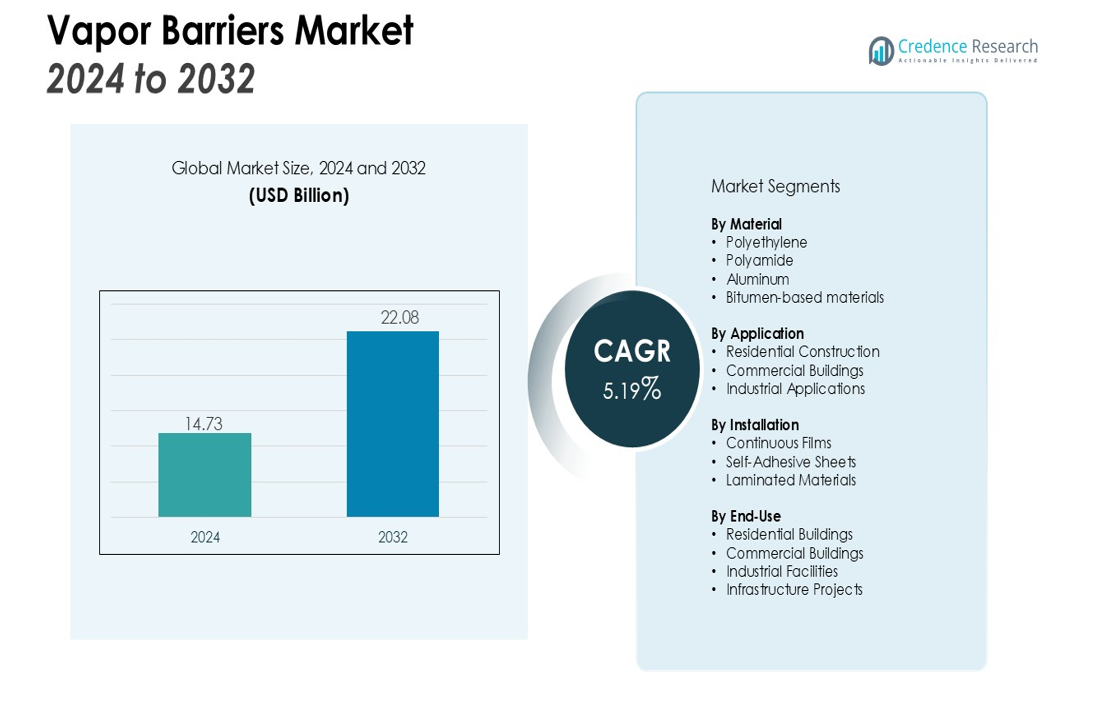
The Vapor Barriers Market size was valued at USD 14.73 billion in 2024 and is anticipated to reach USD 22.08 billion by 2032, at a CAGR of 5.19% during the forecast period (2024-2032).
| REPORT ATTRIBUTE | DETAILS |
|---|---|
| Historical Period | 2020-2023 |
| Base Year | 2024 |
| Forecast Period | 2025-2032 |
| Vapor Barriers Market Size 2024 | USD 14.73 billion |
| Vapor Barriers Market, CAGR | 5.19% |
| Vapor Barriers Market Size 2032 | USD 22.08 billion |
Key drivers of the market include rapid urbanization, stringent building codes, and the growing adoption of green building technologies. The demand for vapor barriers is particularly heightened in regions with fluctuating climates, where controlling moisture can significantly impact energy consumption and building longevity. The increasing construction activities, especially in residential and commercial sectors, are further accelerating the demand for these products. Additionally, innovations in vapor barrier materials, such as the development of eco-friendly and high-performance barriers, are likely to drive future market growth.
Regionally, North America leads the market, accounting for a substantial share due to stringent building regulations and a well-established construction industry. Europe follows closely, with growing demand driven by sustainability trends and energy-efficient construction. The Asia Pacific region is expected to witness the fastest growth, fueled by booming construction activities in countries like China and India.
Market Insights:
- The global vapor barriers market was valued at USD 14.73 billion in 2024 and is expected to reach USD 22.08 billion by 2032, with a CAGR of 5.19% during the forecast period.
- Growing demand for energy-efficient construction materials is a major driver, as vapor barriers help prevent moisture buildup, improving insulation efficiency and reducing heating and cooling energy requirements.
- Stringent building codes and regulations, particularly in regions with fluctuating climates, mandate the use of vapor barriers in construction projects to enhance energy efficiency and building durability.
- Sustainability trends are accelerating the adoption of vapor barriers, as they contribute to eco-friendly, energy-efficient buildings and support green certifications like LEED.
- Rapid urbanization and the expanding construction industry, particularly in emerging economies like China, India, and the Middle East, are increasing the demand for vapor barriers in both residential and commercial sectors.
- The high initial installation costs of vapor barriers, particularly those made from advanced materials, remain a challenge for smaller construction projects, potentially hindering broader market adoption.
- Regional differences in market adoption and regulatory compliance, particularly in areas with milder climates, affect the uniform growth of the market, creating challenges for manufacturers to expand globally.
Market Drivers:
Increasing Demand for Energy-Efficient Construction Materials
The growing demand for energy-efficient construction materials is a significant driver of the vapor barriers market. As energy costs rise and sustainability becomes a priority, there is a stronger focus on improving building insulation and reducing energy loss. Vapor barriers play a crucial role in this by preventing moisture buildup, which can lead to mold and reduce the overall efficiency of insulation. As a result, more buildings are incorporating these barriers to enhance thermal performance and decrease heating and cooling energy requirements.
- For instance, Dow’s DEFENDAIR™ 200 is a one-component, water-based silicone coating that cures to form a flexible, breathable membrane, enhancing the building envelope's energy efficiency.
Strict Building Codes and Regulations
Stringent building codes and regulations are another key driver of the vapor barriers market. Governments across regions are enforcing tighter standards for energy conservation, moisture control, and building durability. Vapor barriers are now often a mandatory inclusion in construction projects to comply with these regulations. This is particularly evident in regions with fluctuating weather conditions, where proper moisture management is critical to maintaining the structural integrity and longevity of buildings.
Rising Focus on Sustainable and Green Building Technologies
Sustainability trends in construction are accelerating the adoption of vapor barriers. The global shift toward eco-friendly and sustainable building practices has increased demand for materials that improve a structure's environmental footprint. Vapor barriers, being integral to energy-efficient construction, align well with the growing emphasis on green buildings. They help in reducing moisture-related damage, promoting better air quality, and improving overall indoor comfort, making them essential for green building certifications such as LEED.
- For instance, DuPont’s Tyvek® CommercialWrap® D provides superior weather protection for sustainable projects and can withstand up to 270 days of UV exposure during construction without damage.
Rapid Urbanization and Expanding Construction Activities
Rapid urbanization and the expanding construction industry in emerging economies are fueling the demand for vapor barriers. Countries in Asia Pacific and the Middle East are witnessing a construction boom, driven by increasing population growth and urban development. Vapor barriers are increasingly used in both residential and commercial sectors to prevent moisture-related damage, particularly in high-humidity regions. As the construction market continues to grow, so does the need for moisture protection and energy-efficient building solutions.Top of Form
Market Trends:
Growing Preference for Eco-Friendly and Sustainable Vapor Barriers
The trend toward eco-friendly and sustainable construction materials is gaining momentum, which is influencing the vapor barriers market. Manufacturers are increasingly developing barriers using recyclable materials, reducing their environmental impact. This trend aligns with the rising demand for green buildings and the growing importance of LEED certifications. Consumers and construction companies are opting for vapor barriers made from low-impact materials like biodegradable plastics and natural fibers, contributing to the overall sustainability of building projects. These products not only offer enhanced performance in terms of moisture control but also meet the growing demand for environmentally responsible materials. As energy-efficient construction practices evolve, the focus on sustainability in vapor barriers is expected to continue shaping the market.
- For instance, Kuraray offers EVAL™ EVOH, a high-performance oxygen barrier where a 1-millimeter layer provides the same gas barrier performance as a 10-meter-thick wall of LDPE, enabling resource-saving packaging structures.
Advancements in Vapor Barrier Technology and Performance
Technological advancements in vapor barrier materials are improving performance and expanding their application in construction. Innovations in vapor barrier films and coatings are enhancing their ability to control moisture and improve energy efficiency. Manufacturers are also focusing on improving the durability and ease of installation of these barriers, making them more effective and cost-efficient. New multi-layered designs and vapor barrier systems are offering better protection against moisture penetration, particularly in challenging climates. The continued development of high-performance vapor barriers is driving the demand for these products, especially in regions with extreme weather conditions. These technological improvements are expected to play a key role in the market’s expansion and meet evolving industry standards.
- For instance, Toyo Seikan Group's MiraNeo® Ultra Moisture Barrier Film provides a significant technological advantage by achieving a water vapor transmission rate (WVTR) as low as 10⁻⁶ g/m² per day, one of the highest levels of moisture barrier performance available.
Market Challenges Analysis:
High Initial Installation Costs and Maintenance
One of the primary challenges facing the vapor barriers market is the high initial cost of installation. These barriers, especially those with advanced materials or multi-layer designs, can significantly increase construction budgets. The need for skilled labor and specialized installation techniques further elevates these costs. Despite long-term energy savings and improved building durability, the upfront investment can be a barrier for many small and mid-sized construction projects. This financial challenge often delays the adoption of vapor barriers in cost-sensitive markets, hindering broader market growth.
Regional Variations in Market Adoption and Regulatory Compliance
Another challenge is the variation in market adoption and regulatory requirements across regions. While some regions have stringent building codes that mandate the use of vapor barriers, others have less rigorous regulations, leading to slower adoption. In areas with milder climates, the perceived need for vapor barriers is lower, which limits their implementation. Furthermore, regional differences in material availability and the cost of specialized products can impact the market’s uniform growth. These disparities can create obstacles for manufacturers aiming to expand their presence in diverse global markets.
Market Opportunities:
Increasing Demand for Energy-Efficient and Green Building Solutions
The growing emphasis on energy-efficient and sustainable building practices presents a significant opportunity for the vapor barriers market. With global construction trends shifting towards green buildings, there is a heightened demand for materials that contribute to energy conservation and improved indoor air quality. Vapor barriers play a crucial role in enhancing the energy efficiency of buildings by preventing moisture accumulation that can damage insulation and increase heating and cooling costs. This rising demand for eco-friendly construction solutions positions vapor barriers as a key component in the development of sustainable, high-performance buildings, particularly in markets focusing on achieving green certifications.
Expansion in Emerging Economies and Urbanization
Emerging economies, particularly in Asia Pacific and the Middle East, represent a substantial growth opportunity for the vapor barriers market. Rapid urbanization and increasing construction activities in these regions are driving the need for efficient moisture control systems in residential and commercial buildings. As infrastructure development accelerates in countries like China, India, and the UAE, the demand for vapor barriers to ensure building durability and energy efficiency is expected to grow. This trend, combined with the increasing adoption of building regulations that prioritize moisture management, will open up new markets and foster innovation in vapor barrier technologies to meet the specific needs of these regions.
Market Segmentation Analysis:
By Material
Vapor barriers are available in various materials, including polyethylene, polyamide, aluminum, and bitumen-based options. Polyethylene dominates the market due to its cost-effectiveness, ease of installation, and reliable moisture resistance. Aluminum vapor barriers are preferred in high-performance applications due to their superior durability and high moisture resistance. Polyamide-based barriers are gaining traction in the market for their lightweight properties and flexibility. The choice of material depends on the specific needs of the construction project, including environmental conditions, insulation requirements, and budget.
- For instance, W. R. MEADOWS' AIR-SHIELD Aluminum Sheet Membrane is a self-adhering barrier that is nominally 40 mils thick and demonstrates excellent durability with a puncture resistance of 88 lbf.
By Application
Vapor barriers are primarily used in residential, commercial, and industrial applications. In residential construction, they are used in walls, roofs, and floors to protect against moisture buildup, which can lead to mold and structural damage. Commercial buildings, especially those in regions with high humidity, rely on vapor barriers to maintain the integrity of insulation and improve energy efficiency. In industrial applications, vapor barriers are crucial for protecting machinery and equipment from moisture that can cause rust and corrosion. The demand for vapor barriers in these applications is driven by the growing emphasis on building durability and energy efficiency.
- For instance, Cortec’s CorroLogic Tube Strips, powered by Nano VpCI, are designed to protect the interior of pipes and tubes from corrosion and are available on a 500-foot roll.
By Installation
Vapor barriers are typically installed in three ways: as continuous films, self-adhesive sheets, or laminated materials. Continuous film barriers are commonly used for larger surface areas, providing seamless protection against moisture. Self-adhesive sheets offer ease of installation and are often used in areas with complex structures. Laminated materials are used for added strength and durability, especially in commercial and industrial applications where high performance is required. The method of installation varies depending on the specific requirements of the building project and the desired level of moisture protection.
Segmentations:
By Material
- Polyethylene
- Polyamide
- Aluminum
- Bitumen-based materials
By Application
- Residential Construction
- Commercial Buildings
- Industrial Applications
By Installation
- Continuous Films
- Self-Adhesive Sheets
- Laminated Materials
By End-Use
- Residential Buildings
- Commercial Buildings
- Industrial Facilities
- Infrastructure Projects
By Region
- North America
- U.S.
- Canada
- Mexico
- Europe
- UK
- France
- Germany
- Italy
- Spain
- Russia
- Belgium
- Netherlands
- Austria
- Sweden
- Poland
- Denmark
- Switzerland
- Rest of Europe
- Asia Pacific
- China
- Japan
- South Korea
- India
- Australia
- Thailand
- Indonesia
- Vietnam
- Malaysia
- Philippines
- Taiwan
- Rest of Asia Pacific
- Latin America
- Brazil
- Argentina
- Peru
- Chile
- Colombia
- Rest of Latin America
- Middle East
- UAE
- KSA
- Israel
- Turkey
- Iran
- Rest of Middle East
- Africa
- Egypt
- Nigeria
- Algeria
- Morocco
- Rest of Africa
Regional Analysis:
North America: Leading Market with Strong Regulatory Support
North America holds the largest share of the vapor barriers market at 35%. Strict building codes and high demand for energy-efficient materials in the U.S. and Canada drive the market’s dominance. The region’s regulations require the use of vapor barriers in both residential and commercial buildings to ensure energy efficiency and moisture control. The focus on green building initiatives, supported by government incentives, further accelerates the demand for vapor barriers. As the demand for sustainable infrastructure rises, vapor barriers play a critical role in meeting both performance and environmental standards.
Europe: Rapid Expansion with Emphasis on Sustainability
Europe holds a significant share of the market at 28%. The region’s commitment to sustainability and energy-efficient construction fuels the demand for vapor barriers. Stringent energy efficiency regulations, along with an increasing focus on eco-friendly building practices, support market growth. Countries like Germany, France, and the UK are adopting green building technologies, and vapor barriers are key to meeting these standards. Innovations in barrier materials, including recyclable and biodegradable options, also contribute to the region’s market expansion, aligning with Europe’s push toward sustainable construction practices.
Asia Pacific and Middle East: Emerging Markets with Rapid Growth
Asia Pacific and the Middle East account for 32% of the vapor barriers market, with rapid urbanization driving demand. Countries like China and India are witnessing significant construction growth, increasing the need for efficient moisture control solutions. The Middle East, with its focus on smart cities and sustainable buildings, also presents a growing market for vapor barriers. As infrastructure projects expand in these regions, vapor barriers are increasingly recognized for their role in enhancing building durability and reducing energy consumption. This growth trend is expected to continue as construction activities accelerate.
Key Player Analysis:
- GCP Applied Technologies
- Sika
- BASF
- Carlisle Companies
- GAF Materials Corporation
- Soprema Group
- CertainTeed Corporation
- Honeywell
- Johns Manville
- Dow Chemical Company
- DuPont de Nemours
- Firestone Building Products
Competitive Analysis:
The vapor barriers market is highly competitive, with several leading players dominating the landscape. Key companies include Dow, 3M, Berry Global, and Covestro, all of which offer a wide range of vapor barrier solutions across various materials and applications. These companies focus on product innovation, sustainability, and expanding their global reach to maintain market leadership. Dow and 3M, for instance, offer advanced polyethylene and aluminum-based vapor barriers known for their durability and moisture resistance. Smaller players are focusing on niche applications, such as eco-friendly and high-performance materials, to differentiate themselves in the market. The increasing demand for energy-efficient and sustainable building materials is pushing competitors to develop cost-effective and high-quality vapor barriers. Market players are also expanding their distribution networks and forging strategic partnerships with construction firms to increase their market share and meet the rising demand for moisture control solutions in the construction sector.
Recent Developments:
- In September 2025, BASF introduced its SYNSPIRE® G1-110 catalyst, a new product designed to increase steam efficiency and lower CO2 emissions during industrial processes.
- In January 2025, CertainTeed'sd's RenuCore™ division entered into a partnership with Mark II Transfer Station LLC, licensing its technology to recycle asphalt shingles into materials for high-performance pavement.
- In September 2025, DuPont announced its intention to acquire a reverse osmosis manufacturing plant in China to grow its FilmTec™ production capabilities in the country.
Report Coverage:
The research report offers an in-depth analysis based on Material, Application, Installation, End-Use and Region. It details leading market players, providing an overview of their business, product offerings, investments, revenue streams, and key applications. Additionally, the report includes insights into the competitive environment, SWOT analysis, current market trends, as well as the primary drivers and constraints. Furthermore, it discusses various factors that have driven market expansion in recent years. The report also explores market dynamics, regulatory scenarios, and technological advancements that are shaping the industry. It assesses the impact of external factors and global economic changes on market growth. Lastly, it provides strategic recommendations for new entrants and established companies to navigate the complexities of the market.
Future Outlook:
- The demand for vapor barriers will continue to rise as energy efficiency and sustainability remain central to global construction trends.
- Innovation in material technology will lead to the development of more eco-friendly and durable vapor barriers, catering to green building standards.
- Increased construction activities in emerging economies, particularly in Asia Pacific and the Middle East, will significantly boost market growth.
- Stringent building codes and regulations across regions will enforce the use of vapor barriers, particularly in regions with fluctuating climates.
- Vapor barriers will become more integral to residential and commercial construction projects focused on improving building longevity and reducing energy consumption.
- The growth of the smart city initiatives will increase the need for high-performance vapor barriers to ensure the structural integrity of buildings.
- Ongoing advancements in manufacturing processes will drive the availability of cost-effective vapor barrier solutions for diverse construction applications.
- The market will see a growing preference for self-adhesive and laminated vapor barriers due to their ease of installation and enhanced performance.
- New market entrants will focus on developing specialized vapor barriers tailored to specific industry needs, further diversifying product offerings.
- Increased awareness of moisture control’s impact on indoor air quality and health will strengthen the demand for vapor barriers in both residential and commercial sectors.

Request a Free Sample
Fill in your details and we'll send you a free sample report.
- Sample data tables & charts
- Research methodology
Market Dynamics
Increasing Demand for Energy-Efficient Construction Materials
As energy costs rise and sustainability becomes a priority, builders are focusing on improving insulation and reducing energy loss. Vapor barriers prevent moisture buildup, which enhances insulation efficiency and reduces heating and cooling energy requirements, making them essential for energy-efficient buildings.
Strict Building Codes and Regulations
Governments in key regions are enforcing stringent standards for moisture control and energy conservation, often mandating the use of vapor barriers in construction. This regulatory push is especially strong in areas with fluctuating climates, driving widespread adoption of vapor barriers.
Rising Focus on Sustainable and Green Building Technologies
The global shift toward eco-friendly construction is accelerating the adoption of vapor barriers, as they contribute to green certifications like LEED by improving energy efficiency and indoor air quality. Innovations in recyclable and biodegradable barrier materials further support this trend.
Rapid Urbanization and Expanding Construction Activities
Emerging economies in Asia Pacific and the Middle East are experiencing a construction boom, increasing the need for moisture control solutions in both residential and commercial sectors. Urban development and infrastructure projects in these regions are significantly boosting demand for vapor barriers.
Advancements in Vapor Barrier Technology
Ongoing innovations in barrier materials, such as multi-layered designs and high-performance films, are improving durability, ease of installation, and moisture resistance. These technological improvements are expanding the application scope of vapor barriers and supporting market growth.
Need a Custom Version of This Report?
Tailor the scope, geography, or segments to your exact requirements.
- Custom geography or segment scope
- Direct access to our analyst team
Frequently Asked Questions
What is the current market size for Vapor Barriers, and what is its projected size in 2032?
At what Compound Annual Growth Rate is the Vapor Barriers projected to grow between 2024 and 2032?
Which Vapor Barriers segment held the largest share in 2024?
What are the primary factors fueling the growth of the Vapor Barriers?
Who are the leading companies in the Vapor Barriers?
Table of Content
Chapter 1 Market Segmentation
- 1.1 Segmentation Framework
- 1.1.1 Product and Service Classification
- 1.1.2 Application and End-Use Classification
- 1.1.3 Technology and Solution Classification
- 1.1.4 Customer and Distribution Channel Classification
- 1.1.5 Geographic Segmentation
- 1.1.6 Market Segment Definitions and Boundaries
- 1.2 By End-Use
- 1.2.1 Residential Buildings
- 1.2.2 Commercial Buildings
- 1.2.3 Industrial Facilities
- 1.2.4 Infrastructure Projects
- 1.3 By Material
- 1.3.1 Polyethylene
- 1.3.2 Polyamide
- 1.3.3 Aluminum
- 1.3.4 Bitumen-based materials
- 1.4 By Application
- 1.4.1 Residential Construction
- 1.4.2 Commercial Buildings
- 1.4.3 Industrial Applications
- 1.5 By Installation
- 1.5.1 Continuous Films
- 1.5.2 Self-Adhesive Sheets
- 1.5.3 Laminated Materials
Chapter 2 Introduction
- 2.1 Report Objectives and Scope
- 2.2 Product Definition and Industry Terminology
- 2.3 Market Inclusions and Exclusions
- 2.4 Research Process
- 2.4.1 Primary Research and Expert Interviews
- 2.4.2 Secondary Research and Source Review
- 2.4.3 Top-Down and Bottom-Up Estimation
- 2.4.4 Data Triangulation and Verification
- 2.5 Market Size Measurement Basis
- 2.5.1 2024: USD 14.73 billion → 2032: USD 22.08 billion
- 2.6 Historical and Forecast Reference Periods
- 2.6.1 Base Year: 2024
- 2.6.2 Forecast Period: 2024-2032
- 2.7 Research Assumptions and Limitations
Chapter 3 Executive Summary
- 3.1 Market Snapshot and Key Findings
- 3.2 Base-Year Market Size, 2024
- 3.3 Forecast Market Size, 2032
- 3.4 Revenue and Volume Growth Outlook
- 3.5 Key Demand and Supply Indicators
- 3.6 Leading Market Segments
- 3.7 Fastest-Growing Market Opportunities
- 3.8 Regional Performance Highlights
- 3.9 Technology and Industry Transformation
- 3.10 Competitive Landscape Summary
- 3.11 Analyst View and Strategic Implications
Chapter 4 Global Vapor Barriers Market Trends and Developments
- 4.1 Historical Industry Development
- 4.2 Recent Market Trends and Developments
- 4.3 Demand and Customer Behavior Trends
- 4.4 Technology and Product Innovation
- 4.5 Artificial Intelligence, Automation and Digitalization
- 4.6 Local Manufacturing and Supply Chain Realignment
- 4.7 Industry Partnerships, Mergers and Acquisitions
- 4.8 Sustainability and Circular Economy Developments
- 4.9 Government and Private Sector Investment Trends
- 4.10 Emerging Business Models and Commercialization
- 4.11 Industry Developments and Announcements
Chapter 5 Global Vapor Barriers Market Production, Supply and Demand Analysis
- 5.1 Demand Trend and Consumption Analysis
- 5.2 Demand Forecast, 2024-2032
- 5.3 Production and Output Trend
- 5.4 Production and Output Forecast, 2024-2032
- 5.5 Installed Capacity and Capacity Utilization
- 5.6 Company-Wise Production Plants and Statistics
- 5.6.1 Installed Production Capacity
- 5.6.2 Actual Production
- 5.6.3 Planned Capacity and Expansion Targets
- 5.7 Supply Chain Structure and Procurement Trends
- 5.8 Supply-Demand Gap and Bottlenecks
- 5.9 Import Dependence and Sourcing Structure
- 5.10 Contract Manufacturing and Outsourcing
- 5.11 Regional Supply and Demand Concentration
Chapter 6 Global Vapor Barriers Market Pricing Analysis
- 6.1 Pricing Structure and Measurement
- 6.2 Historical Pricing Trends
- 6.3 Pricing Outlook, 2024-2032
- 6.4 Average Selling Price and Unit Economics
- 6.5 Pricing by Product and Market Segment
- 6.6 Geographic Pricing Differences
- 6.7 Key Input, Energy, Labor and Logistics Costs
- 6.8 Contract Pricing and Purchasing Models
- 6.9 Pricing Sensitivity and Competitive Positioning
- 6.10 Price, Margin and Profitability Implications
Chapter 7 Global Vapor Barriers Market Dynamics
- 7.1 Market Growth Drivers
- 7.1.1 Demand-Side Drivers
- 7.1.2 Technology and Innovation Drivers
- 7.1.3 Infrastructure and Investment Drivers
- 7.1.4 Regulatory and Policy Drivers
- 7.2 Market Restraints
- 7.2.1 Cost and Affordability Constraints
- 7.2.2 Technology and Adoption Barriers
- 7.2.3 Supply Chain and Operational Constraints
- 7.3 Market Challenges
- 7.3.1 Competitive Pressure and Margin Erosion
- 7.3.2 Skills, Infrastructure and Implementation Gaps
- 7.4 Emerging Market Opportunities
- 7.5 Market Dynamics Impact and Time-Horizon Assessment
Chapter 8 Global Vapor Barriers Value Chain Analysis
- 8.1 Industry Value Chain Overview
- 8.2 Upstream Suppliers and Critical Inputs
- 8.3 Technology and Component Providers
- 8.4 Manufacturing or Service Delivery
- 8.5 Distribution, Channel Partners and Integrators
- 8.6 Downstream Applications and End Users
- 8.7 Value Addition and Profit Pools
- 8.8 Vertical Integration and Outsourcing
- 8.9 Supplier Concentration and Risk
- 8.10 Supply Chain Localization and Resilience
Chapter 9 Global Vapor Barriers Market Regulations and Policies
- 9.1 Relevant Laws, Standards and Compliance Frameworks
- 9.2 Product, Service, Safety and Quality Requirements
- 9.3 Government Policies, Incentives and Subsidies
- 9.4 Imports, Exports and Trade Barriers
- 9.5 Public Procurement and Local Content Requirements
- 9.6 Environmental and Sustainability Compliance
- 9.7 Upcoming Policy Changes and Market Implications
Chapter 10 Global Vapor Barriers Market Hotspots and Opportunities
- 10.1 Market Opportunity Mapping and Growth Hotspots
- 10.2 High-Growth Applications and Customer Groups
- 10.3 Underserved Markets and White-Space Opportunities
- 10.4 Emerging Technology and Product Opportunities
- 10.5 New Capacity and Investment Hotspots
- 10.6 Market Entry and Expansion Opportunities
- 10.7 Distribution and Partnership Opportunities
- 10.8 Near-Term and Long-Term Commercial Potential
- 10.9 Opportunity Attractiveness and Execution Risks
Chapter 11 Global Vapor Barriers Market Outlook, 2024-2032
- 11.1 Market Size and Analysis
- 11.1.1 Revenue (Market Measurement: 2024: USD 14.73 billion → 2032: USD 22.08 billion)
- 11.1.2 Market Volume and Quantity Sold
- 11.1.3 Historical Market Size
- 11.1.4 Base-Year Market Size, 2024
- 11.2 Market Forecast, 2024-2032
- 11.2.1 Revenue Forecast to 2032
- 11.2.2 Volume Forecast to 2032
- 11.2.3 CAGR and Year-on-Year Growth
- 11.2.4 Incremental Revenue Opportunity
- 11.3 Forecast Assumptions and Scenario Analysis
- 11.3.1 Base-Case Forecast
- 11.3.2 Optimistic and Conservative Scenarios
- 11.3.3 Technology, Pricing and Policy Sensitivities
- 11.4 Market Attractiveness and Growth Outlook
Chapter 12 Global Vapor Barriers Market Segmentation and Outlook
- 12.1 Segmentation Summary and Market Shares, 2024
- 12.2 Largest and Fastest-Growing Segments
- 12.3 By End-Use - Market Size and Forecast, 2024-2032
- 12.3.1 Segment Definition and Scope
- 12.3.2 Historical Market Size
- 12.3.3 Revenue Forecast, 2024-2032
- 12.3.4 Volume Forecast, 2024-2032
- 12.3.5 Base-Year Market Share, 2024
- 12.3.6 Segment CAGR and Growth Drivers
- 12.3.7 Subsegment Market Size and Forecast
- 12.3.7.1 Residential Buildings
- 12.3.7.2 Commercial Buildings
- 12.3.7.3 Industrial Facilities
- 12.3.7.4 Infrastructure Projects
- 12.3.8 Subsegment Pricing and Adoption Trends
- 12.3.9 Leading Suppliers and Competition
- 12.3.10 Regional Demand and Opportunities
- 12.4 By Material - Market Size and Forecast, 2024-2032
- 12.4.1 Segment Definition and Scope
- 12.4.2 Historical Market Size
- 12.4.3 Revenue Forecast, 2024-2032
- 12.4.4 Volume Forecast, 2024-2032
- 12.4.5 Base-Year Market Share, 2024
- 12.4.6 Segment CAGR and Growth Drivers
- 12.4.7 Subsegment Market Size and Forecast
- 12.4.7.1 Polyethylene
- 12.4.7.2 Polyamide
- 12.4.7.3 Aluminum
- 12.4.7.4 Bitumen-based materials
- 12.4.8 Subsegment Pricing and Adoption Trends
- 12.4.9 Leading Suppliers and Competition
- 12.4.10 Regional Demand and Opportunities
- 12.5 By Application - Market Size and Forecast, 2024-2032
- 12.5.1 Segment Definition and Scope
- 12.5.2 Historical Market Size
- 12.5.3 Revenue Forecast, 2024-2032
- 12.5.4 Volume Forecast, 2024-2032
- 12.5.5 Base-Year Market Share, 2024
- 12.5.6 Segment CAGR and Growth Drivers
- 12.5.7 Subsegment Market Size and Forecast
- 12.5.7.1 Residential Construction
- 12.5.7.2 Commercial Buildings
- 12.5.7.3 Industrial Applications
- 12.5.8 Subsegment Pricing and Adoption Trends
- 12.5.9 Leading Suppliers and Competition
- 12.5.10 Regional Demand and Opportunities
- 12.6 By Installation - Market Size and Forecast, 2024-2032
- 12.6.1 Segment Definition and Scope
- 12.6.2 Historical Market Size
- 12.6.3 Revenue Forecast, 2024-2032
- 12.6.4 Volume Forecast, 2024-2032
- 12.6.5 Base-Year Market Share, 2024
- 12.6.6 Segment CAGR and Growth Drivers
- 12.6.7 Subsegment Market Size and Forecast
- 12.6.7.1 Continuous Films
- 12.6.7.2 Self-Adhesive Sheets
- 12.6.7.3 Laminated Materials
- 12.6.8 Subsegment Pricing and Adoption Trends
- 12.6.9 Leading Suppliers and Competition
- 12.6.10 Regional Demand and Opportunities
- 12.7 Segment Growth Comparison
- 12.8 Segment Attractiveness and Priority Matrix
Chapter 13 Global Vapor Barriers End-Use and Application Market Outlook
- 13.1 End-Use Industry and Customer Demand Structure
- 13.2 Leading Applications and Customer Groups
- 13.3 End-Use Market Size, Share and Forecast
- 13.4 Major End-Use Industry Deep Dives
- 13.4.1 Customer Requirements and Use Cases
- 13.4.2 Demand and Replacement Cycles
- 13.4.3 Technical and Regulatory Considerations
- 13.4.4 Purchasing and Procurement Models
- 13.4.5 Leading Vendors and Distribution Channels
- 13.4.6 Forecast and Commercial Opportunities
- 13.5 Emerging Applications and Cross-Segment Demand
- 13.6 End-Use Industry Investment Priorities
Chapter 14 Global Vapor Barriers Geographic Market Outlook, 2024-2032
- 14.1 Regional Market Size and Share, 2024
- 14.2 Regional Market Forecast, 2024-2032
- 14.3 Regional Pricing, Production and Demand Differences
- 14.4 North America
- 14.4.1 United States
- 14.4.2 Canada
- 14.4.3 Mexico
- 14.5 Europe
- 14.5.1 Germany
- 14.5.2 France
- 14.5.3 Italy
- 14.5.4 United Kingdom
- 14.5.5 Spain
- 14.5.6 Poland
- 14.5.7 Russia
- 14.5.8 Netherlands
- 14.5.9 Belgium
- 14.5.10 Sweden
- 14.5.11 Denmark
- 14.5.12 Norway
- 14.5.13 Rest of Europe
- 14.6 Asia Pacific
- 14.6.1 China
- 14.6.2 India
- 14.6.3 Japan
- 14.6.4 South Korea
- 14.6.5 Thailand
- 14.6.6 Indonesia
- 14.6.7 Vietnam
- 14.6.8 Malaysia
- 14.6.9 Australia
- 14.6.10 Rest of Asia Pacific
- 14.7 Latin America
- 14.7.1 Brazil
- 14.7.2 Argentina
- 14.7.3 Colombia
- 14.7.4 Chile
- 14.7.5 Rest of Latin America
- 14.8 Middle East
- 14.8.1 Saudi Arabia
- 14.8.2 United Arab Emirates
- 14.8.3 Turkey
- 14.8.4 Israel
- 14.8.5 Iran
- 14.8.6 Rest of the Middle East
- 14.9 Africa
- 14.9.1 South Africa
- 14.9.2 Egypt
- 14.9.3 Nigeria
- 14.9.4 Morocco
- 14.9.5 Rest of Africa
- 14.10 Regional Investment, Policy and Supply Chain Differences
- 14.11 Regional Competitive Landscape
- 14.12 Geographic Growth Hotspots
Chapter 15 Global Vapor Barriers Technology, Innovation and Sustainability Outlook
- 15.1 Technology Landscape and Maturity
- 15.2 Product, Process and Service Innovation
- 15.3 AI, Automation and Digital Tools in the Industry
- 15.4 Technology Adoption and Performance Benchmarking
- 15.5 Innovation Pipeline and R&D Investment
- 15.6 Patent and Intellectual Property Trends
- 15.7 Energy Efficiency and Resource Management
- 15.8 Sustainability, Recycling and Circularity
- 15.9 Technology Roadmap, 2024-2032
- 15.10 Risks of Obsolescence and Technology Substitution
Chapter 16 Global Vapor Barriers Market Key Strategic Imperatives
- 16.1 Growth and Market Entry Priorities
- 16.2 High-Return Products and Segments
- 16.3 Pricing, Profitability and Cost Optimization
- 16.4 Technology Investment and Product Differentiation
- 16.5 Supply Chain Localization and Resilience
- 16.6 Distribution and Customer Acquisition
- 16.7 Partnership, Acquisition and Capacity Strategy
- 16.8 Regional Expansion Priorities
- 16.9 Short-, Medium- and Long-Term Actions
Chapter 17 Competition Outlook
- 17.1 Industry Competition Characteristics
- 17.2 Market Structure and Concentration
- 17.3 Market Share and Competitive Positioning, 2024
- 17.4 Company-Wise Revenue and Product Benchmarking
- 17.5 Production and Service Capacity Benchmarking
- 17.6 Technology, Pricing and Differentiation
- 17.7 Regional Footprint and Distribution Strength
- 17.8 Mergers, Acquisitions and Strategic Alliances
- 17.9 New Entrants and Competitive Threats
- 17.10 Porter's Five Forces and Industry Attractiveness
- 17.11 Competitive Outlook, 2024-2032
Chapter 18 Company Profiles
- 18.1 Company Coverage and Selection Criteria
- 18.2 Dow Chemical Company
- 18.2.1 Business Description
- 18.2.2 Company Ownership and Geographic Presence
- 18.2.3 Product and Service Portfolio
- 18.2.4 Manufacturing and Operating Footprint
- 18.2.5 Production Capacity and Expansion Plans
- 18.2.6 Financial Performance and Investment
- 18.2.7 Market Share and Competitive Position
- 18.2.8 Technology and Innovation Capabilities
- 18.2.9 Strategic Alliances or Partnerships
- 18.2.10 Recent Developments
- 18.2.11 Growth Strategy and Outlook
- 18.3 DuPont de Nemours
- 18.4 Sika
- 18.5 BASF
- 18.6 Carlisle Companies
- 18.7 GCP Applied Technologies
- 18.8 GAF Materials Corporation
- 18.9 Soprema Group
- 18.10 CertainTeed Corporation
- 18.11 Johns Manville
- 18.12 Other Relevant Market Participants
Note: Every listed company is profiled on the structure shown under the first company. The company list is preliminary and may change based on research findings, market developments, data availability and client requirements.
Chapter 19 Disclaimer
- 19.1 Research and Forecast Disclaimer
- 19.2 Data Source and Estimation Limitations
Note: The depth of individual sections depends on data availability for this market. Volume, capacity, trade and other unit-based metrics are included where applicable.

