
Market Overview:
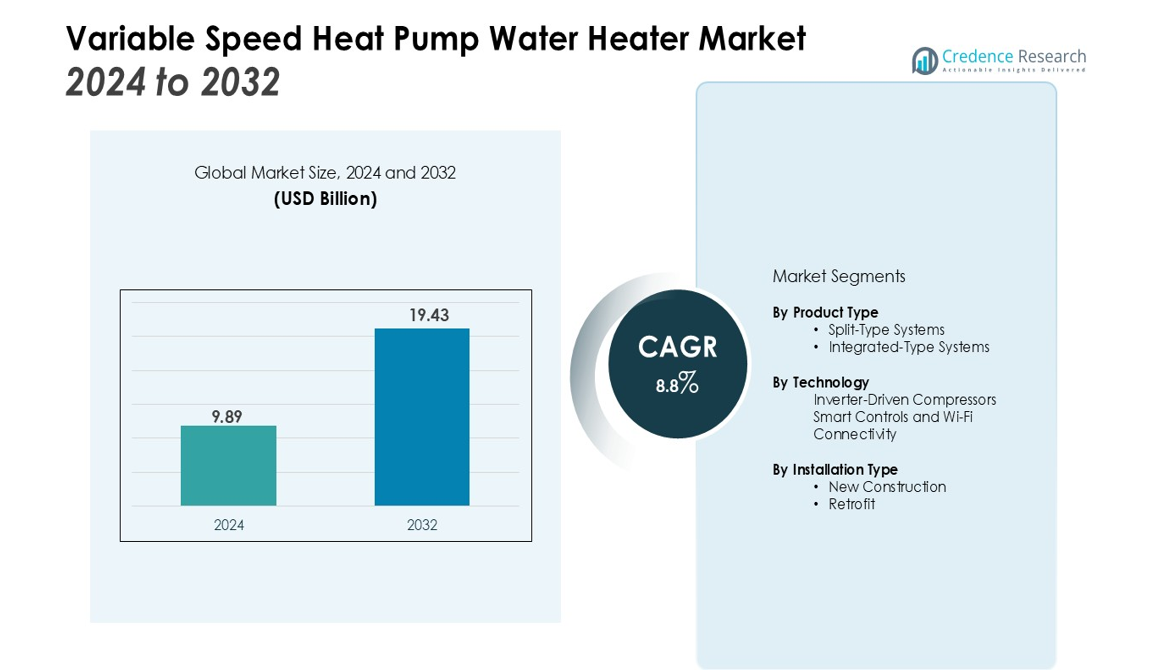
The Variable Speed Heat Pump Water Heater Market size was valued at USD 9.89 billion in 2024 and is anticipated to reach USD 19.43 billion by 2032, at a CAGR of 8.8% during the forecast period (2024-2032).
| REPORT ATTRIBUTE | DETAILS |
|---|---|
| Historical Period | 2020-2023 |
| Base Year | 2024 |
| Forecast Period | 2025-2032 |
| Variable Speed Heat Pump Water Heater Market Size 2025 | USD 9.89 billion |
| Variable Speed Heat Pump Water Heater Market, CAGR | 8.8% |
| Variable Speed Heat Pump Water Heater Market Size 2032 | USD 19.43 billion |
The market is primarily driven by the rising emphasis on energy conservation, as VSPHPWHs significantly reduce electricity consumption compared to traditional water heaters. The growing adoption of green building standards and government incentives for energy-efficient appliances further boost market demand. Additionally, technological advancements in heat pump systems, offering improved performance, reduced noise, and lower operational costs, contribute to the increased popularity of these systems in both new constructions and retrofits.
Regionally, North America holds a dominant position in the VSPHPWH market, driven by robust energy efficiency regulations and widespread adoption of eco-friendly solutions. The Asia Pacific region is expected to witness the highest growth due to rapid urbanization, increasing construction activities, and rising awareness about sustainable heating technologies. Europe also remains a significant market, supported by stringent environmental standards and government subsidies for energy-efficient home appliances.
Market Insights:
- The Variable Speed Heat Pump Water Heater (VSPHPWH) market is valued at USD 9.89 billion in 2024 and is projected to reach USD 19.43 billion by 2032, driven by a growing emphasis on energy efficiency.
- Increasing demand for energy-efficient appliances is a key driver, with VSPHPWHs offering reduced electricity consumption compared to traditional water heaters, aligning with global energy conservation trends.
- Government regulations and incentives are fostering VSPHPWH adoption, with tax credits, rebates, and energy efficiency standards promoting the shift to more sustainable water heating solutions.
- Technological advancements in heat pump systems, such as improved energy conversion rates, advanced compressors, and smart controls, have enhanced the performance, efficiency, and appeal of VSPHPWHs.
- Rising environmental awareness and sustainability initiatives support the demand for VSPHPWHs, as these systems contribute to reducing greenhouse gas emissions by utilizing renewable heat sources.
- North America holds the largest share (35%) of the global market, supported by government incentives, energy efficiency regulations, and increased adoption of eco-friendly technologies across both residential and commercial sectors.
- The Asia Pacific region accounts for 28% of the market share, with rapid urbanization and growing adoption in countries like China, Japan, South Korea, and Australia, further fueled by policy support for energy-efficient solutions.
Market Drivers:
Growing Demand for Energy-Efficient Appliances
The increasing demand for energy-efficient appliances is one of the key drivers for the growth of the Variable Speed Heat Pump Water Heater (VSPHPWH) market. Consumers and businesses are increasingly prioritizing sustainable solutions to reduce energy consumption and lower utility bills. VSPHPWHs provide a more efficient alternative to traditional electric water heaters by utilizing heat from the air or ground, reducing the amount of electricity required for heating water. This efficiency aligns with global trends toward energy conservation, making VSPHPWHs an attractive option for energy-conscious consumers.
- For instance, the GE Profile GEOSPRING™ heat pump water heater is 4.7 times more energy efficient than a standard electric model.
Government Regulations and Incentives for Energy Efficiency
Government regulations and incentives are significantly driving the adoption of Variable Speed Heat Pump Water Heaters. Many countries have implemented stricter energy efficiency standards, compelling consumers to choose energy-efficient appliances. Governments worldwide are offering rebates, tax credits, and other incentives for energy-efficient technologies, further encouraging the shift towards VSPHPWHs. These incentives not only make such systems more affordable but also promote the long-term benefits of reducing environmental impact.
Technological Advancements in Heat Pump Systems
Technological advancements in heat pump systems contribute to the growing popularity of Variable Speed Heat Pump Water Heaters. These systems now feature improved energy conversion rates, advanced compressors, and smart controls that enhance efficiency, performance, and user experience. With reduced noise and increased reliability, VSPHPWHs are becoming more attractive for both residential and commercial applications. These technological improvements make the products more competitive compared to conventional water heaters, boosting market demand.
- For instance, in April 2025, AAON Inc. launched its Alpha Class EXTREME Series of commercial air-source heat pumps, which can operate in ambient temperatures as low as minus 20 degrees Fahrenheit.
Rising Environmental Awareness and Sustainability Initiatives
Rising environmental awareness and global sustainability initiatives are encouraging the adoption of Variable Speed Heat Pump Water Heaters. Consumers are becoming more conscious of their carbon footprints and are actively seeking eco-friendly solutions. The VSPHPWH market benefits from this trend, as these systems help reduce greenhouse gas emissions by using renewable sources of heat. This growing preference for green technologies supports the continued expansion of the market.
Market Trends:
Integration of Smart Technology and Advanced Control Systems
A prominent trend in the Variable Speed Heat Pump Water Heater (VSPHPWH) market is the integration of smart technology and advanced control systems. Modern VSPHPWH units now come equipped with Wi-Fi connectivity and smart controls, allowing users to monitor and control their water heaters remotely through mobile apps. These systems enable enhanced energy management by adjusting heating schedules based on user preferences and environmental factors. This level of automation not only improves convenience but also optimizes energy consumption, making VSPHPWHs more efficient. Manufacturers are focusing on incorporating AI-driven algorithms that adapt to users' behavior, providing more personalized and energy-efficient solutions.
- For instance, the Rheem ProTerra Hybrid Electric Water Heater, equipped with EcoNet WiFi technology, can save a household up to $480 annually on energy costs by optimizing heating schedules and tracking usage.
Shift Towards Residential and Commercial Hybrid Systems
Another key trend is the increasing adoption of hybrid systems, combining Variable Speed Heat Pump Water Heaters with other renewable energy technologies such as solar panels. These hybrid systems offer the advantage of enhanced efficiency by leveraging solar energy to power the heat pump. Such systems are particularly popular in regions with abundant sunlight, where they reduce reliance on grid electricity. As energy costs rise and consumers demand more sustainable solutions, hybrid VSPHPWHs are gaining traction in both residential and commercial markets. This trend reflects a broader shift toward integrating multiple renewable energy sources in heating solutions, providing long-term environmental and financial benefits.
- For instance, Solarker's Hybrid AC/DC Solar Air Source Hot Water Heat Pump achieves a high energy efficiency with a Coefficient of Performance (COP) between 3 and 4, producing 3-4kW of heat for every 1kW of electricity consumed.
Market Challenges Analysis:
High Initial Installation Costs
One of the key challenges in the Variable Speed Heat Pump Water Heater (VSPHPWH) market is the high initial installation costs. These systems typically require a larger upfront investment compared to conventional water heaters, which can be a barrier for some consumers, particularly in price-sensitive markets. Although VSPHPWHs offer long-term savings through reduced energy consumption, the initial cost can deter potential buyers, especially in regions where energy efficiency is not a primary concern. This challenge is compounded by the complexity of installation, as these systems may require additional infrastructure or modifications to existing plumbing and electrical systems.
Limited Consumer Awareness and Understanding
Another challenge facing the VSPHPWH market is limited consumer awareness and understanding of the technology. Many consumers are unfamiliar with the benefits of variable speed technology and how it improves the energy efficiency and performance of water heating systems. Without sufficient knowledge of the long-term savings and environmental benefits, potential buyers may hesitate to adopt these systems. Market education and awareness campaigns are crucial to overcoming this barrier, helping consumers understand the advantages and cost-effectiveness of switching to more efficient water heating solutions.
Market Opportunities:
Increasing Demand for Sustainable Building Solutions
The growing demand for sustainable building solutions presents a significant opportunity for the Variable Speed Heat Pump Water Heater (VSPHPWH) market. As green building standards become more prevalent, especially in developed regions, the adoption of energy-efficient and eco-friendly technologies is on the rise. VSPHPWHs align with these sustainability goals, offering an ideal solution for both residential and commercial projects aiming to reduce their carbon footprint. The integration of such systems in new constructions and retrofitting projects can further accelerate their adoption.
Rising Focus on Smart Homes and IoT Integration
The rise of smart homes and the increasing integration of Internet of Things (IoT) technology present another key opportunity for the VSPHPWH market. As consumers seek more connected and automated home environments, the demand for water heaters that can be controlled remotely through smart devices is growing. VSPHPWHs with IoT compatibility can be seamlessly integrated into these smart home ecosystems, offering convenience, energy optimization, and cost savings. Manufacturers can capitalize on this trend by developing advanced smart features that allow users to monitor and control their heating systems from anywhere, enhancing their appeal in tech-savvy markets.
Market Segmentation Analysis:
By Product Type:
The market includes split-type and integrated-type VSPHPWH systems. Split-type systems, which separate the heat pump unit and the water tank, are popular due to their flexibility in installation and efficiency. Integrated-type systems combine both the heat pump and the tank in a single unit, offering a more compact solution for smaller spaces. Split-type systems hold a larger market share due to their versatility in installation and higher efficiency.
- For instance, Daikin's ductless mini-split heat pump demonstrates exceptional technological advancement in this category, achieving an energy efficiency rating of up to 26.1 SEER.
By Technology:
VSPHPWHs are predominantly powered by inverter-driven compressors, which adjust the compressor’s speed based on heating demand. This technology ensures more consistent performance, reduced noise, and enhanced energy efficiency compared to traditional water heaters. Advanced features like smart controls and Wi-Fi connectivity are increasingly integrated into systems, providing users with remote monitoring and better energy management.
By Installation Type:
The installation type segment includes both new construction and retrofit applications. Retrofit installations are gaining momentum, as homeowners and businesses look to upgrade their existing water heaters to more energy-efficient models. New construction projects also drive the demand for VSPHPWHs as part of green building initiatives. Retrofit installations dominate the market, especially in regions with older infrastructure where efficiency upgrades are prioritized.
- For instance, a key strategy in modern retrofit projects involves upgrading the building envelope with high-performance solutions like Insulated Metal Panels (IMPs), which can deliver a thermal resistance rating of over R-8 per inch to significantly improve energy efficiency.
Segmentations:
- By Product Type:
- Split-Type Systems
- Integrated-Type Systems
- By Technology:
- Inverter-Driven Compressors
- Smart Controls and Wi-Fi Connectivity
- By Installation Type:
- New Construction
- Retrofit
- By Region:
- North America
- U.S.
- Canada
- Mexico
- Europe
- Germany
- France
- U.K.
- Italy
- Spain
- Rest of Europe
- Asia Pacific
- China
- Japan
- India
- South Korea
- South-east Asia
- Rest of Asia Pacific
- Latin America
- Brazil
- Argentina
- Rest of Latin America
- Middle East & Africa
- GCC Countries
- South Africa
- Rest of the Middle East and Africa
- North America
Regional Analysis:
North America: Leadership in Adoption and Policy Support
North America holds 35% of the global Variable Speed Heat Pump Water Heater (VSPHPWH) market share. The region's growth is driven by government incentives and a strong focus on energy efficiency. Various initiatives, including rebates for ENERGY STAR®-certified models, have encouraged widespread adoption across both residential and commercial sectors. Additionally, the growing trend of smart home integration, along with dynamic electricity pricing models, further supports the demand for VSPHPWHs. The region's regulatory framework remains a key driver in fostering increased energy-efficient technology adoption.
Asia Pacific: Rapid Growth Driven by Urbanization and Policy Initiatives
Asia Pacific accounts for 28% of the global VSPHPWH market share, with China leading the market. Rapid urbanization, energy cost increases, and supportive government policies have spurred demand for energy-efficient solutions. Countries such as Japan, South Korea, and Australia have seen a steady rise in adoption, particularly in commercial and residential applications. The combination of policy incentives and growing consumer awareness of sustainability further boosts market growth in the region.
Europe: Regulatory Challenges and Market Fluctuations
Europe holds 22% of the global VSPHPWH market share, though its growth is impacted by fluctuating demand. Sales have experienced setbacks in certain countries due to reduced subsidies and high installation costs. However, some markets, such as the UK, have shown growth, driven by favorable policies and increased support for energy-efficient solutions. Despite these challenges, Europe remains a significant market, with efforts to revitalize demand through new policy measures and government-backed incentives for energy-efficient home appliances.
Key Player Analysis:
- Advantix S.p.A.
- Ariston Holding N.V.
- Glen Dimplex Group
- Guangzhou Sprsun New Energy Technology Development Co., Ltd.
- Panasonic Corporation
- Lochinvar
- Rheem Manufacturing Company
- LG Electronics
- Nihon Itomic Co., Ltd.
- Rinnai Corporation
- Mitsubishi Electric Trane HVAC US LLC
- SUNRAIN
- DAIKIN INDUSTRIES, Ltd.
- SAMSUNG
Competitive Analysis:
The Variable Speed Heat Pump Water Heater (VSPHPWH) market is highly competitive, with leading global manufacturers such as Daikin, Mitsubishi Electric, Panasonic, Rinnai, and Ariston Holding dominating the industry. These companies focus on advanced inverter technologies, smart controls, and energy-efficient solutions to cater to residential, commercial, and industrial applications. Regional leaders like Rheem Manufacturing and A.O. Smith Corporation have strong market positions in North America, while Bosch and Vaillant Group lead in Europe with a focus on premium, sustainable products. In Asia Pacific, manufacturers like Gree and Midea are gaining ground with cost-effective offerings and strategic partnerships. The competitive landscape is shaped by ongoing technological advancements, stringent energy efficiency regulations, and increasing demand for eco-friendly solutions, prompting companies to invest in R&D and strategic collaborations to maintain a strong market presence.
Recent Developments:
- In April 2025, Daikin launched its new Pro-C computer room air handler (CRAH), expanding its portfolio of cooling solutions for data centers.
- In July 2025, LG announced its goal to expand its HVAC business to $14.6 billion in annual sales by 2030 and stated its intention to pursue strategic acquisitions to strengthen its expertise in the sector.
- In June 2025, Panasonic introduced "Mevix," a new sub-brand established for its professional AV lineup, which includes projectors and displays.
Report Coverage:
The research report offers an in-depth analysis based on Product Type, Technology, Installation Type and Region. It details leading market players, providing an overview of their business, product offerings, investments, revenue streams, and key applications. Additionally, the report includes insights into the competitive environment, SWOT analysis, current market trends, as well as the primary drivers and constraints. Furthermore, it discusses various factors that have driven market expansion in recent years. The report also explores market dynamics, regulatory scenarios, and technological advancements that are shaping the industry. It assesses the impact of external factors and global economic changes on market growth. Lastly, it provides strategic recommendations for new entrants and established companies to navigate the complexities of the market.
Future Outlook:
- The demand for Variable Speed Heat Pump Water Heaters (VSPHPWH) will continue to rise due to growing energy efficiency awareness and sustainable solutions.
- Government regulations promoting energy-saving technologies will drive further adoption of VSPHPWHs, particularly in residential and commercial sectors.
- The increasing integration of smart technologies in VSPHPWHs will enhance their appeal by offering more efficient energy management and user control.
- Technological advancements, such as enhanced compressors and improved heat pump systems, will further improve performance and reliability.
- The shift towards hybrid systems that combine VSPHPWHs with solar and other renewable energy technologies will gain traction, providing cost savings and environmental benefits.
- The Asia Pacific region will experience rapid growth, driven by urbanization and supportive government policies for sustainable heating solutions.
- North America will continue to be a key market, bolstered by ongoing incentives and energy efficiency regulations.
- Europe will face challenges due to high installation costs but will likely benefit from new policy support and energy-saving incentives.
- Manufacturers will focus on reducing upfront costs through technological innovations, making VSPHPWHs more affordable for consumers.
- Continued investment in research and development will lead to even more efficient, quieter, and durable systems, enhancing overall consumer adoption.

Request a Free Sample
Fill in your details and we'll send you a free sample report.
- Sample data tables & charts
- Research methodology
Market Dynamics
Growing Demand for Energy-Efficient Appliances
Variable Speed Heat Pump Water Heaters (VSPHPWHs) offer significant reductions in electricity consumption compared to traditional water heaters, aligning with global energy conservation trends and appealing to energy-conscious consumers and businesses.
Government Regulations and Incentives for Energy Efficiency
Stricter energy efficiency standards and government incentives such as rebates and tax credits are making VSPHPWHs more affordable and accelerating their adoption in both residential and commercial sectors.
Technological Advancements in Heat Pump Systems
Innovations such as improved inverter-driven compressors, smart controls, and enhanced energy conversion rates are increasing the efficiency, reliability, and user appeal of VSPHPWHs, making them more competitive against conventional water heaters.
Rising Environmental Awareness and Sustainability Initiatives
Increasing consumer awareness of carbon footprints and the push for sustainable solutions are driving demand for VSPHPWHs, which utilize renewable heat sources and help reduce greenhouse gas emissions.
Integration with Smart Home and IoT Technologies
The growing trend of smart homes and IoT integration is boosting demand for VSPHPWHs equipped with remote monitoring and control features, enabling users to optimize energy use and further reduce operational costs.
Need a Custom Version of This Report?
Tailor the scope, geography, or segments to your exact requirements.
- Custom geography or segment scope
- Direct access to our analyst team
Frequently Asked Questions
What is the current market size for Variable Speed Heat Pump Water Heater, and what is its projected size in 2032?
At what Compound Annual Growth Rate is the Variable Speed Heat Pump Water Heater projected to grow between 2024 and 2032?
Which Variable Speed Heat Pump Water Heater segment held the largest share in 2024?
What are the primary factors fueling the growth of the Variable Speed Heat Pump Water Heater?
Which region commanded the largest share of the Variable Speed Heat Pump Water Heater in 2024?
Table of Content
Chapter 1 Market Segmentation
- 1.1 Segmentation Framework
- 1.1.1 Product and Service Classification
- 1.1.2 Application and End-Use Classification
- 1.1.3 Technology and Solution Classification
- 1.1.4 Customer and Distribution Channel Classification
- 1.1.5 Geographic Segmentation
- 1.1.6 Market Segment Definitions and Boundaries
- 1.2 By Technology
- 1.2.1 Inverter-Driven Compressors
- 1.2.2 Smart Controls and Wi-Fi Connectivity
- 1.3 By Product Type
- 1.3.1 Split-Type Systems
- 1.3.2 Integrated-Type Systems
- 1.4 By Installation Type
- 1.4.1 New Construction
- 1.4.2 Retrofit
Chapter 2 Introduction
- 2.1 Report Objectives and Scope
- 2.2 Product Definition and Industry Terminology
- 2.3 Market Inclusions and Exclusions
- 2.4 Research Process
- 2.4.1 Primary Research and Expert Interviews
- 2.4.2 Secondary Research and Source Review
- 2.4.3 Top-Down and Bottom-Up Estimation
- 2.4.4 Data Triangulation and Verification
- 2.5 Market Size Measurement Basis
- 2.5.1 2024: USD 9.89 billion → 2032: USD 19.43 billion
- 2.6 Historical and Forecast Reference Periods
- 2.6.1 Base Year: 2024
- 2.6.2 Forecast Period: 2024-2032
- 2.7 Research Assumptions and Limitations
Chapter 3 Executive Summary
- 3.1 Market Snapshot and Key Findings
- 3.2 Base-Year Market Size, 2024
- 3.3 Forecast Market Size, 2032
- 3.4 Revenue and Volume Growth Outlook
- 3.5 Key Demand and Supply Indicators
- 3.6 Leading Market Segments
- 3.7 Fastest-Growing Market Opportunities
- 3.8 Regional Performance Highlights
- 3.9 Technology and Industry Transformation
- 3.10 Competitive Landscape Summary
- 3.11 Analyst View and Strategic Implications
Chapter 4 Global Variable Speed Heat Pump Water Heater Market Trends and Developments
- 4.1 Historical Industry Development
- 4.2 Recent Market Trends and Developments
- 4.3 Demand and Customer Behavior Trends
- 4.4 Technology and Product Innovation
- 4.5 Artificial Intelligence, Automation and Digitalization
- 4.6 Local Manufacturing and Supply Chain Realignment
- 4.7 Industry Partnerships, Mergers and Acquisitions
- 4.8 Sustainability and Circular Economy Developments
- 4.9 Government and Private Sector Investment Trends
- 4.10 Emerging Business Models and Commercialization
- 4.11 Industry Developments and Announcements
Chapter 5 Global Variable Speed Heat Pump Water Heater Market Production, Supply and Demand Analysis
- 5.1 Demand Trend and Consumption Analysis
- 5.2 Demand Forecast, 2024-2032
- 5.3 Production and Output Trend
- 5.4 Production and Output Forecast, 2024-2032
- 5.5 Installed Capacity and Capacity Utilization
- 5.6 Company-Wise Production Plants and Statistics
- 5.6.1 Installed Production Capacity
- 5.6.2 Actual Production
- 5.6.3 Planned Capacity and Expansion Targets
- 5.7 Supply Chain Structure and Procurement Trends
- 5.8 Supply-Demand Gap and Bottlenecks
- 5.9 Import Dependence and Sourcing Structure
- 5.10 Contract Manufacturing and Outsourcing
- 5.11 Regional Supply and Demand Concentration
Chapter 6 Global Variable Speed Heat Pump Water Heater Market Pricing Analysis
- 6.1 Pricing Structure and Measurement
- 6.2 Historical Pricing Trends
- 6.3 Pricing Outlook, 2024-2032
- 6.4 Average Selling Price and Unit Economics
- 6.5 Pricing by Product and Market Segment
- 6.6 Geographic Pricing Differences
- 6.7 Key Input, Energy, Labor and Logistics Costs
- 6.8 Contract Pricing and Purchasing Models
- 6.9 Pricing Sensitivity and Competitive Positioning
- 6.10 Price, Margin and Profitability Implications
Chapter 7 Global Variable Speed Heat Pump Water Heater Market Dynamics
- 7.1 Market Growth Drivers
- 7.1.1 Demand-Side Drivers
- 7.1.2 Technology and Innovation Drivers
- 7.1.3 Infrastructure and Investment Drivers
- 7.1.4 Regulatory and Policy Drivers
- 7.2 Market Restraints
- 7.2.1 Cost and Affordability Constraints
- 7.2.2 Technology and Adoption Barriers
- 7.2.3 Supply Chain and Operational Constraints
- 7.3 Market Challenges
- 7.3.1 Competitive Pressure and Margin Erosion
- 7.3.2 Skills, Infrastructure and Implementation Gaps
- 7.4 Emerging Market Opportunities
- 7.5 Market Dynamics Impact and Time-Horizon Assessment
Chapter 8 Global Variable Speed Heat Pump Water Heater Value Chain Analysis
- 8.1 Industry Value Chain Overview
- 8.2 Upstream Suppliers and Critical Inputs
- 8.3 Technology and Component Providers
- 8.4 Manufacturing or Service Delivery
- 8.5 Distribution, Channel Partners and Integrators
- 8.6 Downstream Applications and End Users
- 8.7 Value Addition and Profit Pools
- 8.8 Vertical Integration and Outsourcing
- 8.9 Supplier Concentration and Risk
- 8.10 Supply Chain Localization and Resilience
Chapter 9 Global Variable Speed Heat Pump Water Heater Market Regulations and Policies
- 9.1 Relevant Laws, Standards and Compliance Frameworks
- 9.2 Product, Service, Safety and Quality Requirements
- 9.3 Government Policies, Incentives and Subsidies
- 9.4 Imports, Exports and Trade Barriers
- 9.5 Public Procurement and Local Content Requirements
- 9.6 Environmental and Sustainability Compliance
- 9.7 Upcoming Policy Changes and Market Implications
Chapter 10 Global Variable Speed Heat Pump Water Heater Market Hotspots and Opportunities
- 10.1 Market Opportunity Mapping and Growth Hotspots
- 10.2 High-Growth Applications and Customer Groups
- 10.3 Underserved Markets and White-Space Opportunities
- 10.4 Emerging Technology and Product Opportunities
- 10.5 New Capacity and Investment Hotspots
- 10.6 Market Entry and Expansion Opportunities
- 10.7 Distribution and Partnership Opportunities
- 10.8 Near-Term and Long-Term Commercial Potential
- 10.9 Opportunity Attractiveness and Execution Risks
Chapter 11 Global Variable Speed Heat Pump Water Heater Market Outlook, 2024-2032
- 11.1 Market Size and Analysis
- 11.1.1 Revenue (Market Measurement: 2024: USD 9.89 billion → 2032: USD 19.43 billion)
- 11.1.2 Market Volume and Quantity Sold
- 11.1.3 Historical Market Size
- 11.1.4 Base-Year Market Size, 2024
- 11.2 Market Forecast, 2024-2032
- 11.2.1 Revenue Forecast to 2032
- 11.2.2 Volume Forecast to 2032
- 11.2.3 CAGR and Year-on-Year Growth
- 11.2.4 Incremental Revenue Opportunity
- 11.3 Forecast Assumptions and Scenario Analysis
- 11.3.1 Base-Case Forecast
- 11.3.2 Optimistic and Conservative Scenarios
- 11.3.3 Technology, Pricing and Policy Sensitivities
- 11.4 Market Attractiveness and Growth Outlook
Chapter 12 Global Variable Speed Heat Pump Water Heater Market Segmentation and Outlook
- 12.1 Segmentation Summary and Market Shares, 2024
- 12.2 Largest and Fastest-Growing Segments
- 12.3 By Technology - Market Size and Forecast, 2024-2032
- 12.3.1 Segment Definition and Scope
- 12.3.2 Historical Market Size
- 12.3.3 Revenue Forecast, 2024-2032
- 12.3.4 Volume Forecast, 2024-2032
- 12.3.5 Base-Year Market Share, 2024
- 12.3.6 Segment CAGR and Growth Drivers
- 12.3.7 Subsegment Market Size and Forecast
- 12.3.7.1 Inverter-Driven Compressors
- 12.3.7.2 Smart Controls and Wi-Fi Connectivity
- 12.3.8 Subsegment Pricing and Adoption Trends
- 12.3.9 Leading Suppliers and Competition
- 12.3.10 Regional Demand and Opportunities
- 12.4 By Product Type - Market Size and Forecast, 2024-2032
- 12.4.1 Segment Definition and Scope
- 12.4.2 Historical Market Size
- 12.4.3 Revenue Forecast, 2024-2032
- 12.4.4 Volume Forecast, 2024-2032
- 12.4.5 Base-Year Market Share, 2024
- 12.4.6 Segment CAGR and Growth Drivers
- 12.4.7 Subsegment Market Size and Forecast
- 12.4.7.1 Split-Type Systems
- 12.4.7.2 Integrated-Type Systems
- 12.4.8 Subsegment Pricing and Adoption Trends
- 12.4.9 Leading Suppliers and Competition
- 12.4.10 Regional Demand and Opportunities
- 12.5 By Installation Type - Market Size and Forecast, 2024-2032
- 12.5.1 Segment Definition and Scope
- 12.5.2 Historical Market Size
- 12.5.3 Revenue Forecast, 2024-2032
- 12.5.4 Volume Forecast, 2024-2032
- 12.5.5 Base-Year Market Share, 2024
- 12.5.6 Segment CAGR and Growth Drivers
- 12.5.7 Subsegment Market Size and Forecast
- 12.5.7.1 New Construction
- 12.5.7.2 Retrofit
- 12.5.8 Subsegment Pricing and Adoption Trends
- 12.5.9 Leading Suppliers and Competition
- 12.5.10 Regional Demand and Opportunities
- 12.6 Segment Growth Comparison
- 12.7 Segment Attractiveness and Priority Matrix
Chapter 13 Global Variable Speed Heat Pump Water Heater Geographic Market Outlook, 2024-2032
- 13.1 Regional Market Size and Share, 2024
- 13.2 Regional Market Forecast, 2024-2032
- 13.3 Regional Pricing, Production and Demand Differences
- 13.4 North America
- 13.4.1 United States
- 13.4.2 Canada
- 13.4.3 Mexico
- 13.5 Europe
- 13.5.1 Germany
- 13.5.2 France
- 13.5.3 Italy
- 13.5.4 United Kingdom
- 13.5.5 Spain
- 13.5.6 Poland
- 13.5.7 Russia
- 13.5.8 Netherlands
- 13.5.9 Belgium
- 13.5.10 Sweden
- 13.5.11 Denmark
- 13.5.12 Norway
- 13.5.13 Rest of Europe
- 13.6 Asia Pacific
- 13.6.1 China
- 13.6.2 India
- 13.6.3 Japan
- 13.6.4 South Korea
- 13.6.5 Thailand
- 13.6.6 Indonesia
- 13.6.7 Vietnam
- 13.6.8 Malaysia
- 13.6.9 Australia
- 13.6.10 Rest of Asia Pacific
- 13.7 Latin America
- 13.7.1 Brazil
- 13.7.2 Argentina
- 13.7.3 Colombia
- 13.7.4 Chile
- 13.7.5 Rest of Latin America
- 13.8 Middle East
- 13.8.1 Saudi Arabia
- 13.8.2 United Arab Emirates
- 13.8.3 Turkey
- 13.8.4 Israel
- 13.8.5 Iran
- 13.8.6 Rest of the Middle East
- 13.9 Africa
- 13.9.1 South Africa
- 13.9.2 Egypt
- 13.9.3 Nigeria
- 13.9.4 Morocco
- 13.9.5 Rest of Africa
- 13.10 Regional Investment, Policy and Supply Chain Differences
- 13.11 Regional Competitive Landscape
- 13.12 Geographic Growth Hotspots
Chapter 14 Global Variable Speed Heat Pump Water Heater Technology, Innovation and Sustainability Outlook
- 14.1 Technology Landscape and Maturity
- 14.2 Product, Process and Service Innovation
- 14.3 AI, Automation and Digital Tools in the Industry
- 14.4 Technology Adoption and Performance Benchmarking
- 14.5 Innovation Pipeline and R&D Investment
- 14.6 Patent and Intellectual Property Trends
- 14.7 Energy Efficiency and Resource Management
- 14.8 Sustainability, Recycling and Circularity
- 14.9 Technology Roadmap, 2024-2032
- 14.10 Risks of Obsolescence and Technology Substitution
Chapter 15 Global Variable Speed Heat Pump Water Heater Market Key Strategic Imperatives
- 15.1 Growth and Market Entry Priorities
- 15.2 High-Return Products and Segments
- 15.3 Pricing, Profitability and Cost Optimization
- 15.4 Technology Investment and Product Differentiation
- 15.5 Supply Chain Localization and Resilience
- 15.6 Distribution and Customer Acquisition
- 15.7 Partnership, Acquisition and Capacity Strategy
- 15.8 Regional Expansion Priorities
- 15.9 Short-, Medium- and Long-Term Actions
Chapter 16 Competition Outlook
- 16.1 Industry Competition Characteristics
- 16.2 Market Structure and Concentration
- 16.3 Market Share and Competitive Positioning, 2024
- 16.4 Company-Wise Revenue and Product Benchmarking
- 16.5 Production and Service Capacity Benchmarking
- 16.6 Technology, Pricing and Differentiation
- 16.7 Regional Footprint and Distribution Strength
- 16.8 Mergers, Acquisitions and Strategic Alliances
- 16.9 New Entrants and Competitive Threats
- 16.10 Porter's Five Forces and Industry Attractiveness
- 16.11 Competitive Outlook, 2024-2032
Chapter 17 Company Profiles
- 17.1 Company Coverage and Selection Criteria
- 17.2 Daikin Industries, Ltd.
- 17.2.1 Business Description
- 17.2.2 Company Ownership and Geographic Presence
- 17.2.3 Product and Service Portfolio
- 17.2.4 Manufacturing and Operating Footprint
- 17.2.5 Production Capacity and Expansion Plans
- 17.2.6 Financial Performance and Investment
- 17.2.7 Market Share and Competitive Position
- 17.2.8 Technology and Innovation Capabilities
- 17.2.9 Strategic Alliances or Partnerships
- 17.2.10 Recent Developments
- 17.2.11 Growth Strategy and Outlook
- 17.3 Mitsubishi Electric Trane HVAC US LLC
- 17.4 Panasonic Corporation
- 17.5 Rheem Manufacturing Company
- 17.6 Ariston Holding N.V.
- 17.7 LG Electronics
- 17.8 Rinnai Corporation
- 17.9 Glen Dimplex Group
- 17.10 Advantix S.p.A.
- 17.11 Guangzhou Sprsun New Energy Technology Development Co., Ltd.
- 17.12 Other Relevant Market Participants
Note: Every listed company is profiled on the structure shown under the first company. The company list is preliminary and may change based on research findings, market developments, data availability and client requirements.
Chapter 18 Disclaimer
- 18.1 Research and Forecast Disclaimer
- 18.2 Data Source and Estimation Limitations
Note: The depth of individual sections depends on data availability for this market. Volume, capacity, trade and other unit-based metrics are included where applicable.

