
Ageing families and new rules move care into homes
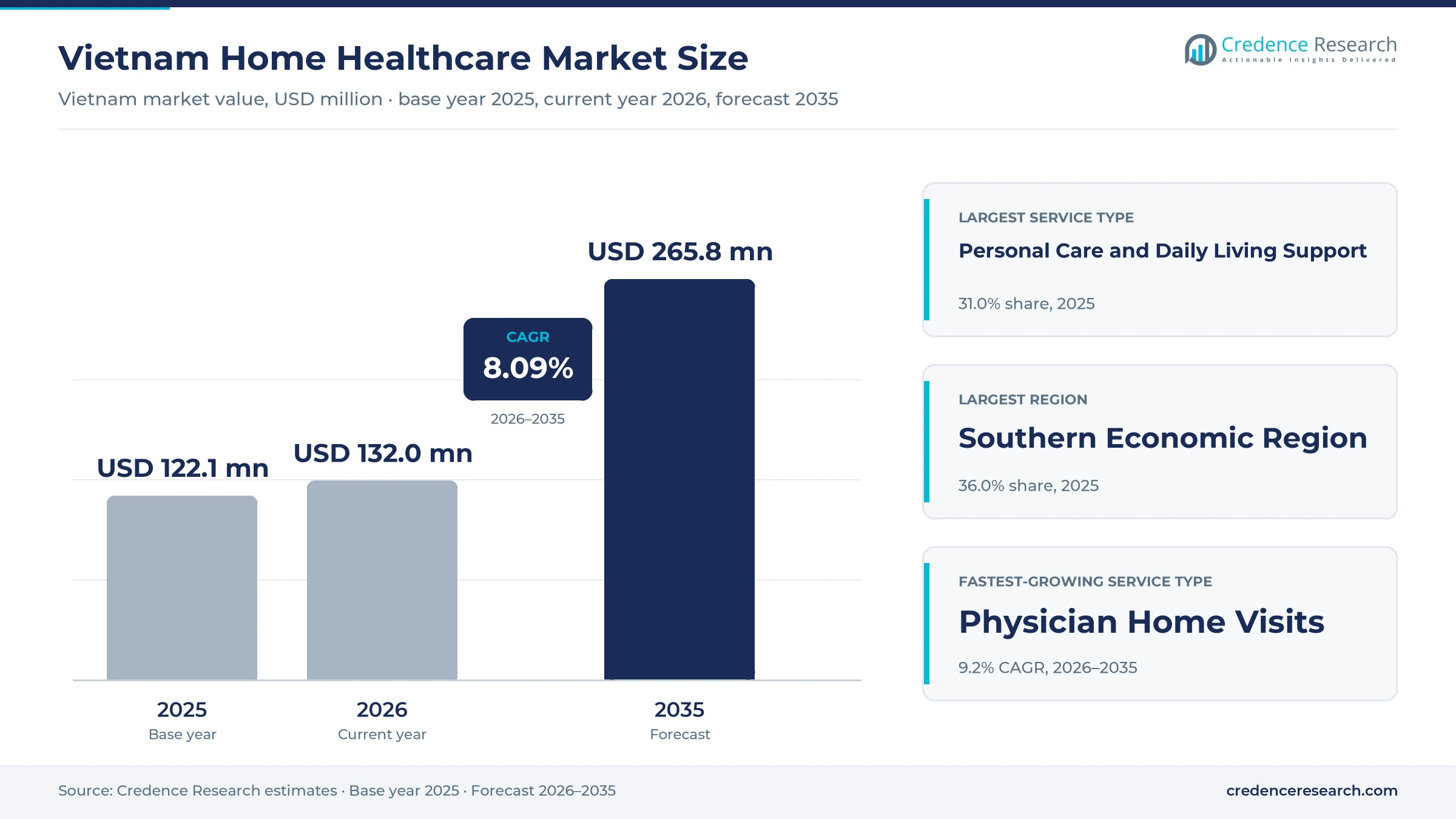
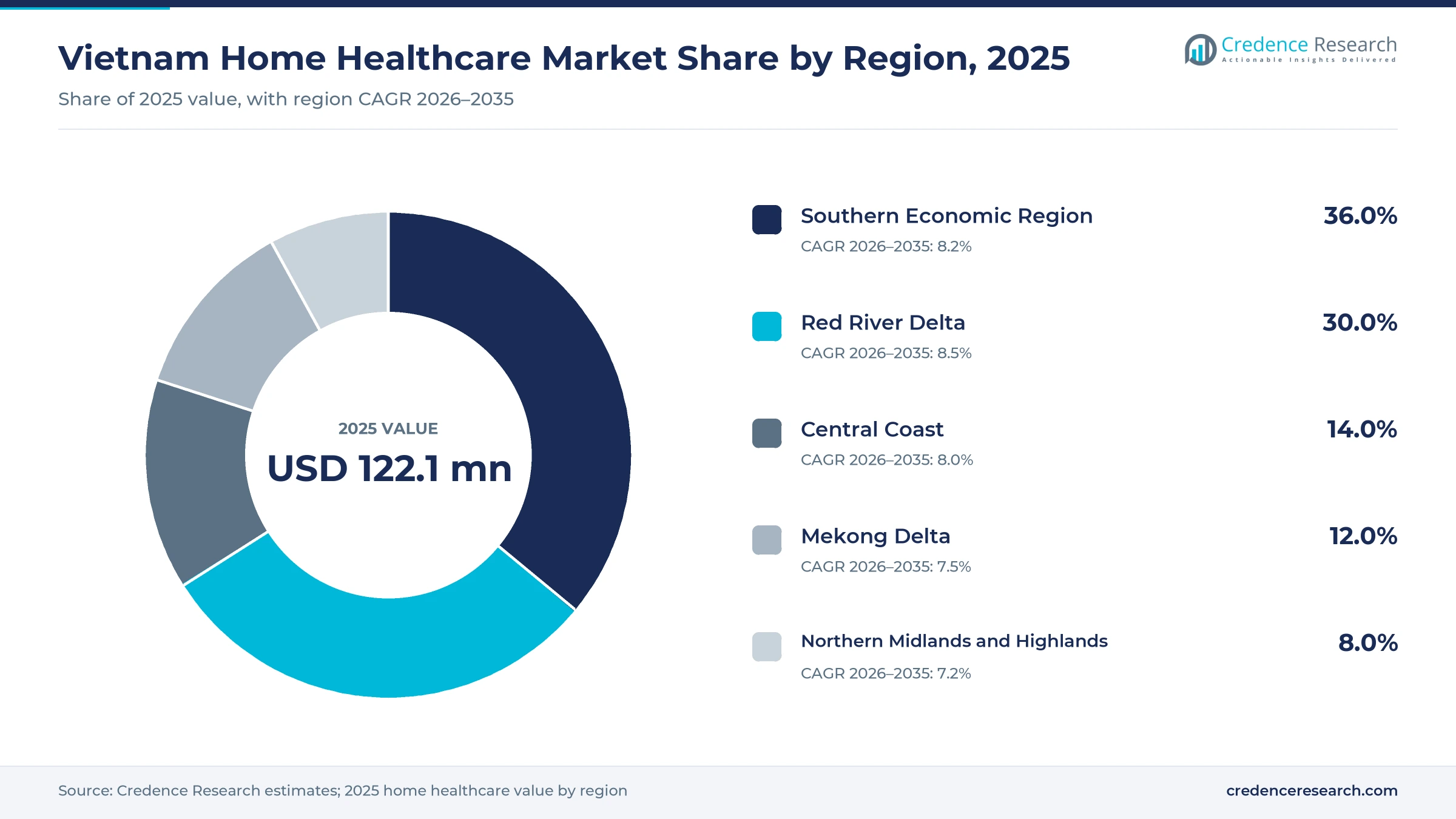
The Vietnam home healthcare market was valued at USD 122.1 million in 2025 and is projected to increase from USD 132.0 million in 2026 to USD 265.8 million by 2035, registering a CAGR of 8.09% during 2026–2035. Demand comes from families looking after older relatives with several chronic conditions, from patients sent home early by crowded hospitals and from insured households that can now use licensed home and remote services. The Southern Economic Region held the largest regional share, 36.0% in 2025, because Ho Chi Minh City and its neighbors combine the most private clinics, the highest incomes and the largest number of paying families. The Red River Delta is the fastest-growing region at 8.5% a year, as Hanoi and the surrounding provinces age faster than any other part of the country. National rules now recognize telehealth and treatment at home as regulated services, and the public insurance law listed home examinations among paid benefits in 2025, which moves part of the market from cash toward insured care.
Paid care at home counts once, at the provider's price
The estimate covers paid health and care services delivered in private residences, assisted living residences, transitional homes after hospital discharge and employer-sponsored home programs. It counts skilled nursing, rehabilitation, physician home visits, personal care and daily living support, and home sample collection and infusion, whether paid by families, private insurers, employers or the public health insurance fund. Each service is counted once, at the price paid to the provider.
The estimate excludes nursing home and hospital inpatient care, medicine sales and the purchase of home medical equipment, which are counted in their own markets. The value chain runs from hospitals, laboratories and clinic groups through caregiver agencies and digital booking platforms to patients and the relatives who usually arrange and pay for care.
Vietnam Home Healthcare Market Insights
- The market was valued at USD 122.1 million in 2025 and is projected to reach USD 265.8 million by 2035, registering a CAGR of 8.09% during 2026–2035.
- The Southern Economic Region held 36.0% of 2025 value, because Ho Chi Minh City concentrates private clinics, caregiver agencies and families able to pay for care.
- Personal care and daily living support led service types with 31.0% of 2025 value, as families buy trained caregivers by the day or by the month.
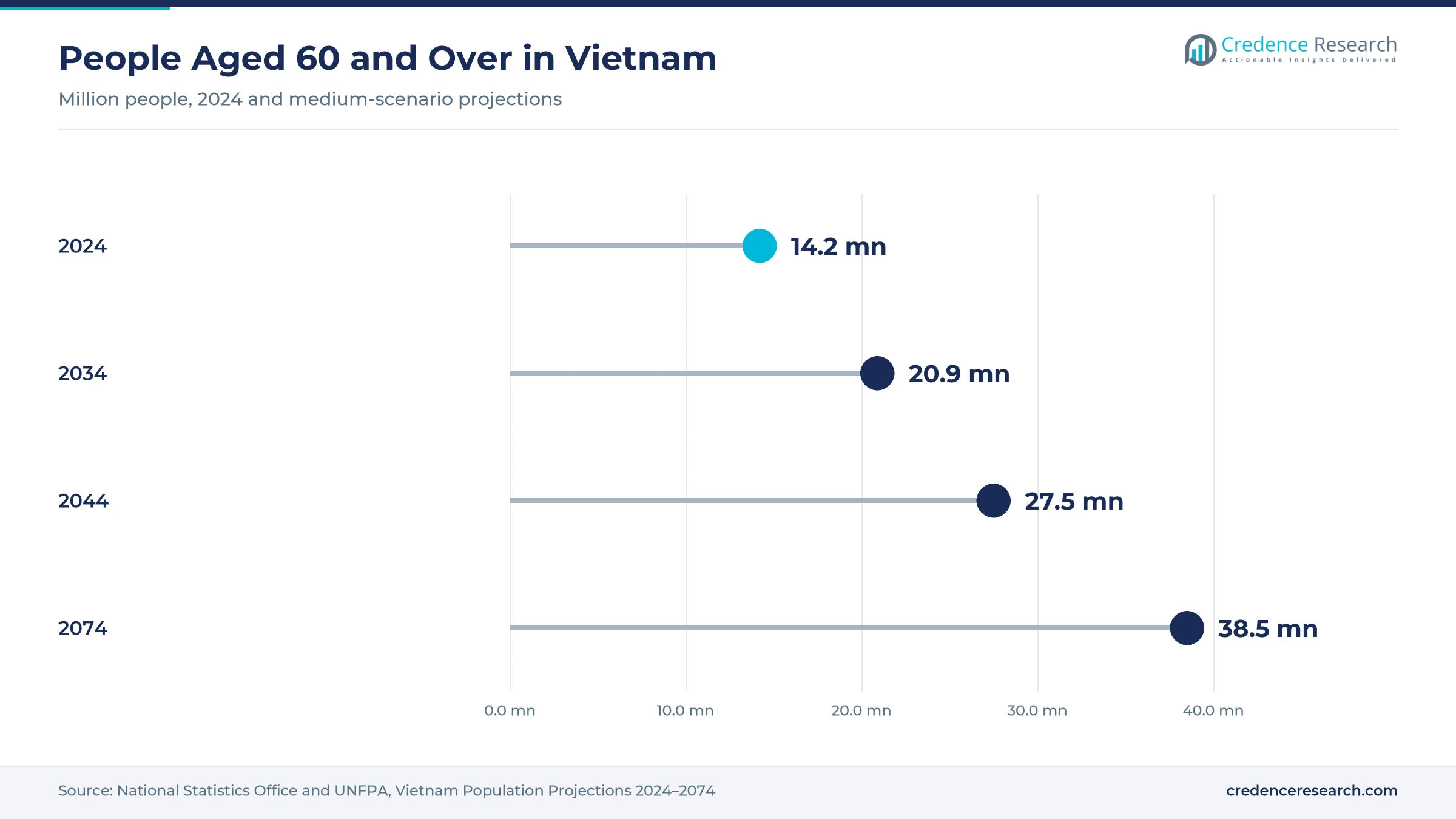
- Vietnam had 14.2 million people aged 60 and over in 2024, a number projected to reach 20.9 million by 2034, which steadily widens the client base for home services.
- Ho Chi Minh City began piloting community home care teams in 20 wards and communes in 2026, a model that private nursing agencies could later supply under contract.
Personal care leads while physician visits grow fastest
Why do personal care services lead spending?
Based on service type, the market is categorized into skilled nursing services, rehabilitation services, physician home visits, personal care and daily living support, and home diagnostics and infusion. Personal Care and Daily Living Support led with a 31.0% share of 2025 value, because families buy caregivers by the day or month for bedridden relatives, and WeCare 247 alone manages about 1,800 to 1,900 caregivers, Viet Nam News reported in April 2026. Physician Home Visits grow fastest at 9.2% a year, as the amended Law on Health Insurance, in force since July 1, 2025, lists examination and treatment at home as a paid benefit. Insured visits turn occasional cash calls into repeat, prescribed rounds.
How much of demand comes from older adults?
Based on end user, the market is categorized into older adults, chronic disease patients, post-surgical patients, maternal and pediatric patients, and disability and mobility support users. Older Adults led with a 46.0% share of 2025 value, because people aged 60 and over make up just over 14% of the population but account for more than half of annual healthcare spending, VietNamNet reported in November 2025. Chronic Disease Patients grow fastest at 8.9% a year, as only 24.7% of adults with hypertension were diagnosed and on medication in the 2021 national STEPS survey. Closing that treatment gap needs regular checks, refills and coaching at home.
Which conditions generate the most home visits?
Based on disease area, the market is categorized into cardiovascular and hypertension, diabetes and kidney disorders, neurological and mental health, respiratory disease and COPD, and cancer and wound care. Cardiovascular and Hypertension led with a 30.0% share of 2025 value, because about 26.2% of adults aged 18 to 69, some 17 million people, had high blood pressure in the 2021 STEPS survey, and cardiovascular disease causes about 200,000 deaths a year, the Health Ministry said in July 2025. Diabetes and Kidney Disorders grow fastest at 8.8% a year, as diabetes prevalence rose from one adult in 24 in 2015 to one in 14 in 2021, WHO reports, adding patients who need frequent glucose checks.
How do families and platforms book home care?
Based on channel, the market is categorized into direct provider booking, hospital referral networks, insurer and employer partnerships, digital health platforms and pharmacy and laboratory referral. Direct Provider Booking led with a 38.0% share of 2025 value, because most home care is still arranged and paid for by relatives who call a clinic, laboratory or agency themselves, and MEDLATEC alone serves more than 5 million customer visits a year nationwide. Digital Health Platforms grow fastest at 9.4% a year, as VNeID-linked electronic health records reached about 30 million people in all 34 provinces and cities by March 2026, Viet Nam News reported.
| Segment Group | Leading Sub-segment | Share, 2025 | Fastest-growing Sub-segment | CAGR, 2026–2035 |
|---|---|---|---|---|
| By Service Type | Personal Care and Daily Living Support | 31.0% | Physician Home Visits | 9.2% |
| By End User | Older Adults | 46.0% | Chronic Disease Patients | 8.9% |
| By Disease Area | Cardiovascular and Hypertension | 30.0% | Diabetes and Kidney Disorders | 8.8% |
| By Channel | Direct Provider Booking | 38.0% | Digital Health Platforms | 9.4% |
Monthly care fees dwarf per-visit diagnostic charges
Prices follow three different models, and the gap between them shapes what families buy. Diagnostics are sold per visit at near-symbolic collection fees, because laboratories earn their margin on the test panel rather than the trip. Personal care is sold by the day or month, and labor is the main cost, so fees track caregiver wages and hours. Day care and rehabilitation sit between the two, with public hospitals setting reference prices that private centers often exceed. Insurance payment for home examinations will put a public tariff on medical visits, pulling cash prices for physician and nursing visits toward that benchmark.
| Service | Typical price or fee | Basis |
|---|---|---|
| Home blood sample collection, MEDLATEC | VND10,000 per collection, unchanged for nearly 30 years | MEDLATEC via Bao Phap Luat, March 2025 |
| Elderly care, national average fee | About VND10 million per month at the end of 2024 | Quan Doi Nhan Dan, 2025 |
| Caregiver for bedridden patients | VND0.5 million to VND1 million per day | VnExpress, Dec. 2022 |
| Rehabilitation day care, HCM City public hospital | VND350,000 to VND520,000 per day before insurance | Viet Nam News, Oct. 2025 |
| Elderly day care, Hanoi | About VND250,000 per day at public centers, above VND10 million a month at private ones | The Star, Sept. 2026 |
Request a Free Sample
Fill in your details and we'll send you a free sample report.
- Sample data tables & charts
- Research methodology
Ageing, chronic disease and new rules drive demand
How does rapid population ageing widen the client base?
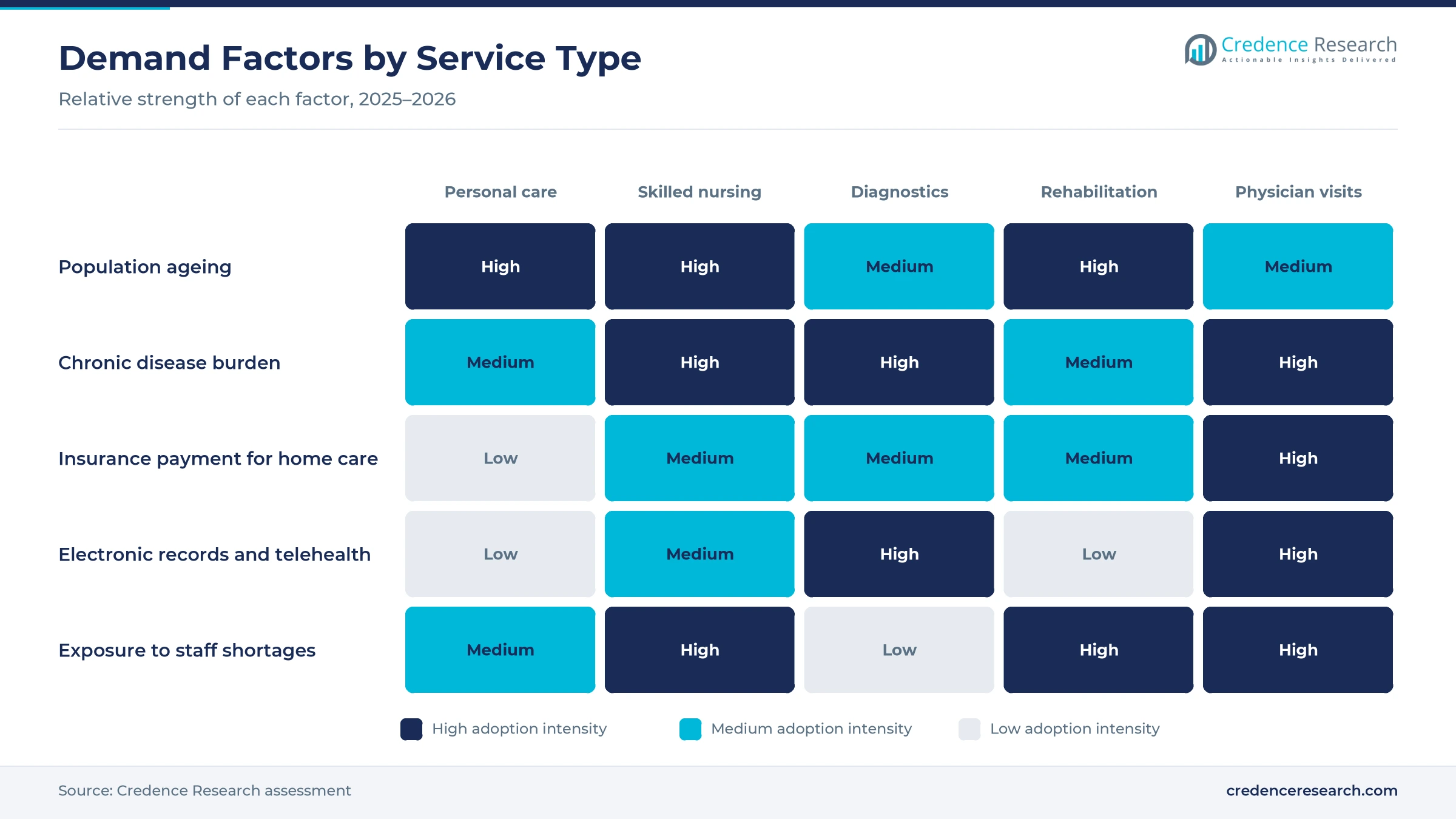
The number of people aged 60 and over reached 14.2 million in 2024 and is projected to reach 20.9 million by 2034, according to population projections by the National Statistics Office and UNFPA published in January 2026. The same projections expect the share aged 65 and over to pass 14% in 2034, the threshold of an aged society. Life expectancy reached 74.7 years in 2024, but healthy life expectancy was only 65.4 years, the Health Ministry reports, which leaves close to a decade of illness for many people. Each added year of frail life raises demand for nursing, personal care and home visits, because older people need help at home for longer than any other group, so Older Adults keep the largest share of spending through 2035.
Why does a high chronic-disease burden favor home care?
Noncommunicable diseases cause about four in five deaths in Viet Nam, and hypertension rose from about one adult in five in 2015 to more than one in four in 2021, according to the World Health Organization. WHO also says up to 80% of people with mild or moderate noncommunicable diseases can be managed close to home at commune health stations. Older patients rarely have one disease, and doctors at the National Geriatric Hospital told VietNamNet that most of their patients live with three to five conditions. Providers that bundle blood pressure monitoring, glucose tests and medicine reviews in one visit win repeat clients, because these conditions need monitoring for years rather than a single hospital admission.
What do the 2024 and 2025 care laws change for providers?
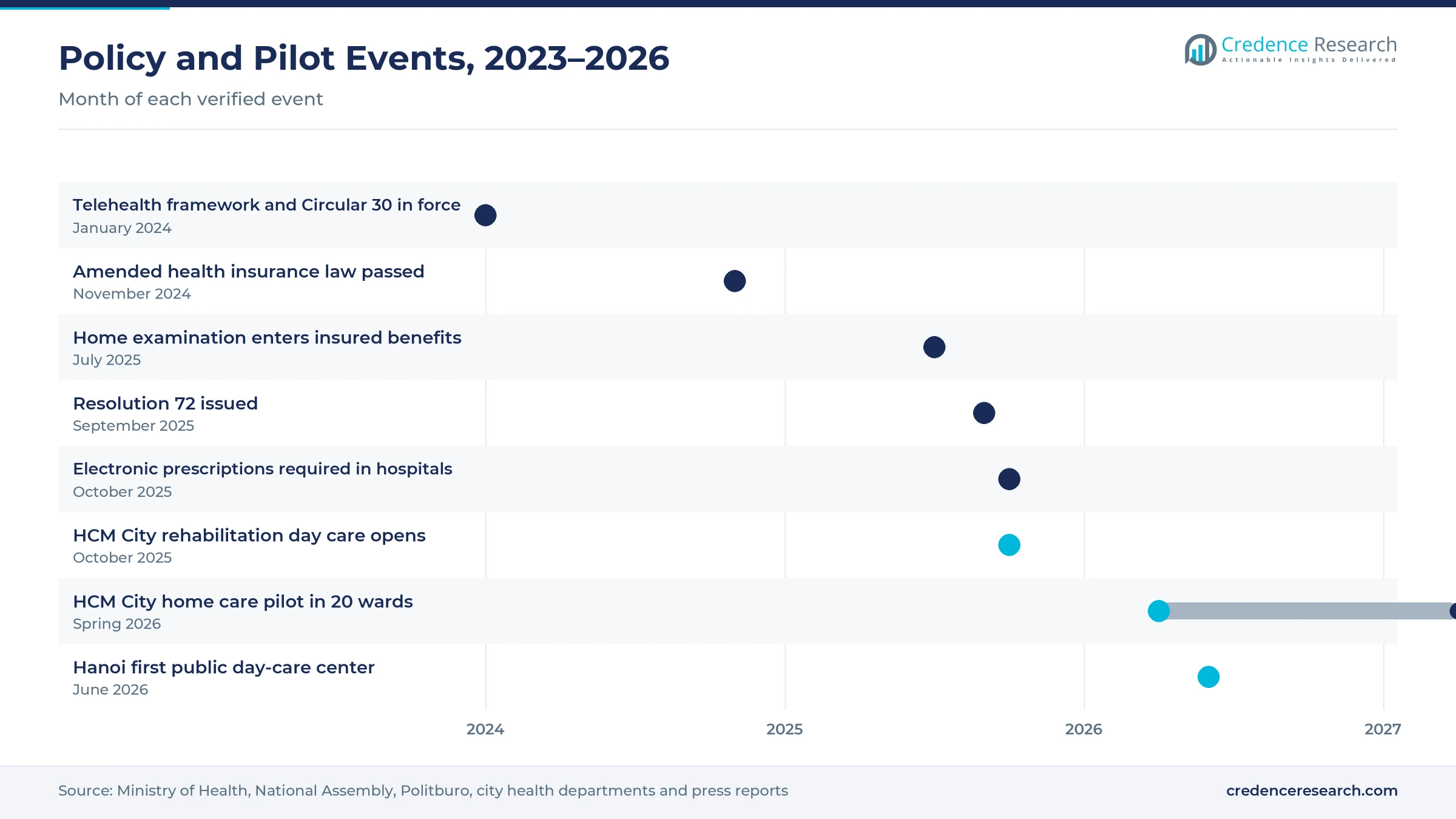
Formal rules for remote and home-based care are turning informal visits into licensed, billable services. The Law on Medical Examination and Treatment and Decree 96/2023/ND-CP created the first legal framework for telemedicine from Jan. 1, 2024, and Circular 30/2023/TT-BYT lists 50 conditions eligible for remote care, including hypertension, diabetes and follow-up after surgery. The amended Law on Health Insurance then added remote examination, family medicine and examination and treatment at home to paid benefits from July 1, 2025. Facilities must notify the local health authority before offering telemedicine, which favors established clinics over unregistered caregivers. Once home and remote visits can be reimbursed, providers that hold licenses and insurer contracts can price below cash-only rivals and still protect their margins.
Will free annual checkups create new home follow-up demand?
Public policy that moves care toward prevention and the grassroots level adds a fourth source of demand. Politburo Resolution 72, issued on Sept. 9, 2025, promises every citizen at least one free health check or screening a year from 2026 and a lifetime electronic health record. The Health Ministry put the state budget cost at about VND6 trillion a year for priority groups and proposed full insurance coverage for people aged 75 and over who receive social pensions, Viet Nam News reported in November 2025. Health Minister Dao Hong Lan also said at least 1,000 doctors a year will be seconded to commune health stations during 2025–2030. Screening finds more chronic cases, and each new diagnosis that a crowded hospital cannot follow becomes a candidate for home monitoring.
Digital records and hospital day care reshape delivery
Shift to electronic records links hospitals with homes
Digital records are starting to connect hospital care with what happens at home, which lets home teams see diagnoses and prescriptions before they visit. The Health Ministry set Sept. 30, 2025, as the deadline for electronic medical records, yet only 881 of 1,645 hospitals had them by Oct. 3, 2025, according to Viet Nam News. Hospitals also had to issue outpatient prescriptions electronically from Oct. 1, 2025, under Circular 26, with other medical facilities following from Jan. 1, 2026. The VNeID personal health records described in the channel analysis are the consumer side of the same system. Home care firms that connect to these records can document visits for insurers and avoid duplicate tests, an advantage that grows as more bookings move to apps.
Rise of hospital-linked day care and home rehabilitation
Public hospitals are building step-down services that link ward care with rehabilitation at home. On Oct. 1, 2025, the HCM City Rehabilitation and Occupational Disease Hospital launched day care for older people with physiotherapy, speech and cognitive therapy and digital tools to monitor progress at home, Viet Nam News reported. After one year, the hospital was caring for 40 older people a day, VietNamNet reported in November 2026. Hanoi opened its first public day-care center in Long Bien Ward in June 2026 and plans to extend the model to all 126 communes and wards, The Star reported in September 2026. These programs create referral paths for private nurses and therapists who continue exercises between center visits, which supports steady growth in rehabilitation services.
Will city health teams subcontract visits to private nurses?
Ho Chi Minh City had run a home care model in 20 wards and communes for about two months by June 2026, with community teams providing home visits, screening, chronic disease management and elderly care, Dan Tri reported. The city will fund costs the insurance fund does not cover, such as visits, logistics and equipment. The Health Ministry's draft elderly care workforce plan of November 2025 also proposes community health teams that check patients at home. Residential capacity cannot absorb the need, as Ho Chi Minh City has only 36 elderly care facilities serving over 3,500 people, Dan Tri reported in December 2025. If these pilots scale, licensed nursing agencies could become subcontractors to public programs and gain volume at a lower cost than consumer marketing.
Can insurers and employers become bulk buyers of home care?
Private insurers and employers can turn home and remote care from an occasional purchase into a benefit bought for thousands of members at once. Doctor Anywhere's agreement with Bao Minh Insurance opened teleconsultation, home care and medicine delivery to more than 7 million of the insurer's customers, MobiHealthNews reported. A later partnership between MB Ageas Life and Doctor Anywhere Vietnam, announced on May 23, 2022, had about 15,000 activated customers. Public insurance offers a far larger pool, with about 97.57 million people, or 95.16% of the population, covered by the end of 2025, Nhan Dan reported. Providers that win benefit contracts gain predictable volume and can plan nurse rosters around it, which lowers their cost per visit.
Pensions, staffing and digital gaps limit uptake
Care fees outrun pensions for many older households
Affordability limits how far paid home care can reach beyond wealthier urban families. The average elderly care fee was about VND10 million a month at the end of 2024, while the average pension was VND6.2 million, Quan Doi Nhan Dan reported. Around 27% of older people live alone or only with other older people, so many households cannot share the cost across working children. Providers respond with shorter visits and hourly packages, which lowers revenue per client and slows the move to full-time professional care.
Shortage of geriatric staff caps skilled capacity
A thin geriatric workforce caps how fast skilled services can grow. The Health Ministry's draft workforce plan of November 2025 estimates that public hospitals need more than 8,000 geriatric doctors and aims for only half of commune clinics to have nurses dedicated to elderly care by 2030, VietNamNet reported. Private agencies recruit from the same small pool of trained nurses as public hospitals. Wage pressure rises as a result, and agencies that train their own caregivers carry higher fixed costs before each new worker can earn fees.
Incomplete digital rollout slows insured home care
Gaps in digital infrastructure slow insured and remote home care, because claims and prescriptions now depend on electronic records. Many hospitals missed the Health Ministry's deadline of Sept. 30, 2025, as the records analysis above shows. Telemedicine is also limited to conditions on the approved list, and conditions outside it need a pilot approval and are not eligible for state health insurance payment, law firm VILAF wrote in April 2024. Providers in provinces with weaker hospital systems therefore still rely on paper referrals and cash payment.
Online drug sale rules narrow home medicine delivery
Rules on online medicine sales narrow what home care platforms can deliver alongside a visit. Only non-prescription drugs may be sold online and delivered to homes, with counseling records kept for at least 24 months, while more than 80% of medicines on the market require a prescription, Viet Nam News reported in 2025. Patients with chronic conditions must still collect most refills from a pharmacy or clinic. Platforms therefore lose a recurring revenue line and must partner with licensed pharmacy chains, which run about 5,000 of the 62,000 pharmacies nationwide.
The south leads while the Red River Delta grows fastest
| Region | Value, 2025 (USD million) | Share, 2025 | CAGR, 2026–2035 |
|---|---|---|---|
| Southern Economic Region | 44.0 | 36.0% | 8.2% |
| Red River Delta | 36.6 | 30.0% | 8.5% |
| Central Coast | 17.1 | 14.0% | 8.0% |
| Mekong Delta | 14.7 | 12.0% | 7.5% |
| Northern Midlands and Highlands | 9.8 | 8.0% | 7.2% |
The Southern Economic Region concentrates paying families
The Southern Economic Region held 36.0% of 2025 value and grows at 8.2% a year, the largest regional market because Ho Chi Minh City concentrates private clinics and paying families. The city had 9.52 million residents in the 2024 midterm census and about 1.57 million people aged 60 and above, the municipal health department says. It is now building a five-tier care network that links home-based health management, home visits and residential nursing with hospital treatment. The Southeast also had the fastest population growth of any region from 2019 to 2024, at 1.46% a year.
The Red River Delta ages fastest and grows fastest
The Red River Delta held 30.0% of 2025 value and grows fastest at 8.5% a year. It is home to 24 million people, 23.7% of the national population, and its ageing index of 76.8 people aged 60 and over per 100 children is the highest of any region, Viet Nam News reported in May 2025. Hanoi has nearly 1.4 million residents aged 60 and above, more than 16% of its population, and expects 1.71 million by 2030. Its central hospitals and new public day care give private providers a dense referral base.
The Central Coast depends on city clinics and telehealth
The Central Coast held 14.0% of 2025 value and grows at 8.0% a year. Demand centers on Da Nang and the coastal cities, where private clinics serve local families, retirees and visitors. Family Medical Practice runs a clinic in Da Nang, and home care app Bluecare listed Da Nang among its first markets outside Ho Chi Minh City in June 2021, Cong Thuong reported. Outside the cities, long distances between communes raise the cost of each visit, so remote links with provincial hospitals carry much of the follow-up care.
The Mekong Delta ages as younger workers leave
The Mekong Delta held 12.0% of 2025 value and grows at 7.5% a year. Its population grew only 0.29% a year from 2019 to 2024, the slowest of any region, as younger people moved to the Southeast for work. Its ageing index of 70.6 is the second highest after the Red River Delta, so many older people have fewer working relatives nearby. National laboratory networks still reach the region, and MEDLATEC says its home blood collection fee stays at VND10,000 even in remote areas, which keeps diagnostics affordable where nursing agencies are scarce.
The Northern Midlands and Highlands rely on remote links
The Northern Midlands and Highlands held 8.0% of 2025 value and grow at 7.2% a year, the smallest regional market. Population density is about 140 people per square kilometer against 1,126 in the Red River Delta, which makes door-to-door visits costly. Remote links fill part of the gap, as the national telehealth program connected more than 1,500 points between lower and higher tier hospitals in its first year and treated over 410 complex cases locally, Vietcetera reported in October 2025. Home services here are likely to remain commune-led and remote-first.
Policy and pilot moves from 2023 to 2026
| Development | Status and market relevance |
|---|---|
| In December 2023, the Ministry of Health issued Circular 30/2023/TT-BYT, listing the conditions eligible for telehealth from Jan. 1, 2024. | In force; sets the scope of remote care |
| In September 2025, the Politburo issued Resolution 72, promising free annual health checks from 2026 and lifetime electronic health records. | Being implemented; widens screening and follow-up |
| In October 2025, the HCM City Rehabilitation and Occupational Disease Hospital launched day care for older people with tools to monitor progress at home. | Operating; hospital-linked rehabilitation |
| In June 2026, Hanoi opened its first public elderly day-care center in Long Bien Ward, with five more wards following. | Pilot; planned for all 126 communes and wards |
| In June 2026, Ho Chi Minh City reported that its community home care model had run in 20 wards and communes for about two months. | Pilot; reviews due at six and 12 months |
Monitoring and coordination tools extend clinic reach
- Remote patient monitoring lets nurses follow blood pressure, glucose and oxygen readings between visits, so a team can act on a worsening patient before an emergency admission, as patient monitoring services elsewhere already show.
- Teleconsultation platforms connect patients with licensed doctors by video, and providers must notify the health authority before offering them, which keeps this channel with registered clinics.
- Connected diagnostic devices such as home glucose meters and digital blood pressure cuffs send readings to apps, which turns a one-off sample collection into continuous testing.
- Care coordination software schedules nurses and caregivers, records each visit and shares notes with the referring hospital, which insurers need before they pay a claim.
- Medication adherence systems remind patients to take medicines and flag missed doses, a direct answer to the low treatment rates seen in hypertension and diabetes.
Need a Custom Version of This Report?
Tailor the scope, geography, or segments to your exact requirements.
- Custom geography or segment scope
- Direct access to our analyst team
Labs, clinics and caregiver apps compete by service line
Competition in the Vietnam home healthcare market splits along service lines rather than among a few full-range providers. MEDLATEC Group leads home diagnostics with a national sample collection network, while Jio Health, Family Medical Practice and the Viet Uc family clinic sell physician visits, nursing and teleconsultations from city clinics. eDoctor and Doctor Anywhere Vietnam compete as digital front doors, and eDoctor works with Viet Uc on a one doctor, one nurse care model. Caregiver platforms such as WeCare 247, the bCare brand of bTaskee and Bluecare compete for families that need daily support, often starting with bedside care in hospital and following the patient home. Price competition is strongest in personal care, where agencies face independent caregivers hired through social media groups. Skilled services compete on licensed staff, hospital referrals and insurer contracts, which matter more as home examinations enter insured benefits.
How fragmented is the supply of home care?
Supply is fragmented between a few laboratory and clinic groups with national reach and many small caregiver agencies and apps. Laboratory networks such as MEDLATEC compete on coverage and test menus, while clinic groups such as Jio Health and Family Medical Practice sell doctor visits and teleconsultations from city clinics. Caregiver platforms compete on staff numbers and hospital links, and WeCare 247 works with more than 34 hospitals, including Cho Ray. Entry is easy in personal care but harder in skilled services, which need a medical license and, for telemedicine, a notification to the health authority. Margins are highest where providers control diagnosis and prescription and lowest in hourly personal care.
Key laboratory, clinic, digital and caregiver providers
| Company | Type | Role in the market |
|---|---|---|
| MEDLATEC Group | Laboratory and clinic group | Nationwide home blood sample collection and testing, about 2,000 test items |
| Jio Health | Clinic and digital health operator | Smart clinics, home doctor visits, telemedicine and e-prescription fulfillment |
| Doctor Anywhere Vietnam | Telehealth platform | Teleconsultation, home care and medicine delivery through insurer partnerships |
| eDoctor | Digital health platform | App bookings for doctors, home testing and a doctor-nurse home care model |
| Family Medical Practice Vietnam | International clinic group | Family medicine clinics in Hanoi, Ho Chi Minh City and Da Nang with teleconsultations |
| Viet Uc Home Care (Vietnam-Australia Family Clinic) | Family clinic and home nursing | Home nursing, wound care, chronic disease care and blood sampling |
| WeCare 247 | Caregiver platform | Trained caregivers for patients at home and in partner hospitals |
| bTaskee (bCare) | Home services platform | bCare elderly care brand with university-linked caregiver training |
| Bluecare | Home care app | Home nursing, elderly, mother and newborn care and rehabilitation |
Credence Research view on insured home medical care
Credence Research's view is that the Vietnam home healthcare market is moving from a cash market for personal care toward a regulated medical service. The demand base is secure, with ageing and chronic disease rising together, so the open question is who pays and who is licensed to deliver. Insured home examinations, electronic records and city pilots favor clinic and laboratory groups that can document care and bill insurers. Caregiver platforms keep the largest pool of spending but face wage pressure and low price points. Buyers and investors should watch reimbursement rules in 2026 and 2027, which will decide how quickly skilled services gain share.
Population, disease and insurance data anchor the estimate
The report uses 2025 as the base year and 2026 to 2035 as the forecast period. Market values come from the Credence Research model, checked against National Statistics Office and UNFPA population projections, Health Ministry disease data, health insurance statistics and published provider prices. Service type, end user, disease area, channel and regional splits are Credence Research estimates. Inputs include laws, decrees and circulars, WHO and national STEPS survey data, company announcements and press reports that name their sources. No interviews or surveys were used in preparing these estimates.
Physician visits and the Red River Delta gain to 2035
The Vietnam home healthcare market is expected to reach USD 265.8 million by 2035, growing at 8.09% a year during 2026–2035. The Southern Economic Region stays the largest market, while the Red River Delta grows fastest as Hanoi and its neighbors age. Personal care and daily living support keep the largest share, but physician home visits gain as insurance pays for examinations at home. Chronic disease patients become the fastest-growing user group as screening under the free checkup program finds more cases. Wider electronic records and remote monitoring would lift this outlook, while a slow caregiver pipeline or narrow reimbursement would hold it back.
Insurance payment decides the range of outcomes
The range of outcomes depends mainly on how quickly insured home visits become routine and whether the caregiver workforce grows. A downside follows if reimbursement for home examination stays narrow, digital records remain incomplete in many provinces and families keep buying informal care. An upside needs insurers to pay for home and remote follow-up of the main chronic conditions, city pilots to scale nationally and training programs to add certified caregivers. The base case assumes gradual reimbursement, steady urban demand and slow growth outside the two largest cities.
| Scenario | CAGR, 2026–2035 | Value, 2035 | What has to hold |
|---|---|---|---|
| Downside | 6.6% | USD 234.4 million | Home examination reimbursement stays narrow and families keep buying informal caregivers |
| Base | 8.09% | USD 265.8 million | Gradual reimbursement, steady city demand and slow uptake in rural provinces continue |
| Upside | 9.6% | USD 301.0 million | Insurers pay for chronic home follow-up and city home-visit pilots scale nationwide |
Frequently Asked Questions
How big is the Vietnam home healthcare market?
Which service type leads home care spending in Vietnam?
Which region accounts for the most home care spending?
Does public health insurance pay for care at home?
Which diseases drive demand for home healthcare?
How fast is the population of Vietnam ageing?
How much does home care cost in Vietnam?
Who are the main companies in the market?
Table of Content
Chapter 1 Market Segmentation
- 1.1 Segmentation Framework
- 1.1.1 Product and Service Classification
- 1.1.2 Application and End-Use Classification
- 1.1.3 Technology and Solution Classification
- 1.1.4 Customer and Distribution Channel Classification
- 1.1.5 Geographic Segmentation
- 1.1.6 Market Segment Definitions and Boundaries
- 1.2 By Service Type
- 1.2.1 Personal Care and Daily Living Support
- 1.2.2 Skilled Nursing Services
- 1.2.3 Home Diagnostics and Infusion
- 1.2.4 Rehabilitation Services
- 1.2.5 Physician Home Visits
- 1.3 By End User
- 1.3.1 Older Adults
- 1.3.2 Chronic Disease Patients
- 1.3.3 Post-Surgical Patients
- 1.3.4 Disability and Mobility Support Users
- 1.3.5 Maternal and Pediatric Patients
- 1.4 By Disease Area
- 1.4.1 Cardiovascular and Hypertension
- 1.4.2 Neurological and Mental Health
- 1.4.3 Diabetes and Kidney Disorders
- 1.4.4 Cancer and Wound Care
- 1.4.5 Respiratory Disease and COPD
- 1.5 By Channel
- 1.5.1 Direct Provider Booking
- 1.5.2 Hospital Referral Networks
- 1.5.3 Digital Health Platforms
- 1.5.4 Insurer and Employer Partnerships
- 1.5.5 Pharmacy and Laboratory Referral
Chapter 2 Introduction
- 2.1 Report Objectives and Scope
- 2.2 Product Definition and Industry Terminology
- 2.3 Market Inclusions and Exclusions
- 2.4 Research Process
- 2.4.1 Primary Research and Expert Interviews
- 2.4.2 Secondary Research and Source Review
- 2.4.3 Top-Down and Bottom-Up Estimation
- 2.4.4 Data Triangulation and Verification
- 2.5 Market Size Measurement Basis
- 2.5.1 2025: USD 122.1 million → 2035: USD 265.8 million
- 2.6 Historical and Forecast Reference Periods
- 2.6.1 Historical Period: 2018-2025
- 2.6.2 Base Year: 2025
- 2.6.3 Forecast Period: 2025-2035
- 2.7 Research Assumptions and Limitations
Chapter 3 Executive Summary
- 3.1 Market Snapshot and Key Findings
- 3.2 Base-Year Market Size, 2025
- 3.3 Forecast Market Size, 2035
- 3.4 Revenue and Volume Growth Outlook
- 3.5 Key Demand and Supply Indicators
- 3.6 Leading Market Segments
- 3.7 Fastest-Growing Market Opportunities
- 3.8 Regional Performance Highlights
- 3.9 Technology and Industry Transformation
- 3.10 Competitive Landscape Summary
- 3.11 Analyst View and Strategic Implications
Chapter 4 Vietnam Home Healthcare Market Trends and Developments
- 4.1 Historical Industry Development, 2018-2025
- 4.2 Recent Market Trends and Developments
- 4.3 Demand and Customer Behavior Trends
- 4.4 Technology and Product Innovation
- 4.5 Artificial Intelligence, Automation and Digitalization
- 4.6 Local Manufacturing and Supply Chain Realignment
- 4.7 Industry Partnerships, Mergers and Acquisitions
- 4.8 Sustainability and Circular Economy Developments
- 4.9 Government and Private Sector Investment Trends
- 4.10 Emerging Business Models and Commercialization
- 4.11 Industry Developments and Announcements
Chapter 5 Vietnam Home Healthcare Market Production, Supply and Demand Analysis
- 5.1 Demand Trend and Consumption Analysis, 2018-2025
- 5.2 Demand Forecast, 2025-2035
- 5.3 Production and Output Trend, 2018-2025
- 5.4 Production and Output Forecast, 2025-2035
- 5.5 Installed Capacity and Capacity Utilization
- 5.6 Company-Wise Production Plants and Statistics
- 5.6.1 Installed Production Capacity
- 5.6.2 Actual Production
- 5.6.3 Planned Capacity and Expansion Targets
- 5.7 Supply Chain Structure and Procurement Trends
- 5.8 Supply-Demand Gap and Bottlenecks
- 5.9 Import Dependence and Sourcing Structure
- 5.10 Contract Manufacturing and Outsourcing
- 5.11 Regional Supply and Demand Concentration
Chapter 6 Vietnam Home Healthcare Market Pricing Analysis
- 6.1 Pricing Structure and Measurement
- 6.2 Historical Pricing Trends, 2018-2025
- 6.3 Pricing Outlook, 2025-2035
- 6.4 Average Selling Price and Unit Economics
- 6.5 Pricing by Product and Market Segment
- 6.6 Geographic Pricing Differences
- 6.7 Key Input, Energy, Labor and Logistics Costs
- 6.8 Contract Pricing and Purchasing Models
- 6.9 Pricing Sensitivity and Competitive Positioning
- 6.10 Price, Margin and Profitability Implications
Chapter 7 Vietnam Home Healthcare Market Dynamics
- 7.1 Market Growth Drivers
- 7.1.1 Demand-Side Drivers
- 7.1.2 Technology and Innovation Drivers
- 7.1.3 Infrastructure and Investment Drivers
- 7.1.4 Regulatory and Policy Drivers
- 7.2 Market Restraints
- 7.2.1 Cost and Affordability Constraints
- 7.2.2 Technology and Adoption Barriers
- 7.2.3 Supply Chain and Operational Constraints
- 7.3 Market Challenges
- 7.3.1 Competitive Pressure and Margin Erosion
- 7.3.2 Skills, Infrastructure and Implementation Gaps
- 7.4 Emerging Market Opportunities
- 7.5 Market Dynamics Impact and Time-Horizon Assessment
Chapter 8 Vietnam Home Healthcare Value Chain Analysis
- 8.1 Industry Value Chain Overview
- 8.2 Upstream Suppliers and Critical Inputs
- 8.3 Technology and Component Providers
- 8.4 Manufacturing or Service Delivery
- 8.5 Distribution, Channel Partners and Integrators
- 8.6 Downstream Applications and End Users
- 8.7 Value Addition and Profit Pools
- 8.8 Vertical Integration and Outsourcing
- 8.9 Supplier Concentration and Risk
- 8.10 Supply Chain Localization and Resilience
Chapter 9 Vietnam Home Healthcare Market Regulations and Policies
- 9.1 Relevant Laws, Standards and Compliance Frameworks
- 9.2 Product, Service, Safety and Quality Requirements
- 9.3 Government Policies, Incentives and Subsidies
- 9.4 Imports, Exports and Trade Barriers
- 9.5 Public Procurement and Local Content Requirements
- 9.6 Environmental and Sustainability Compliance
- 9.7 Upcoming Policy Changes and Market Implications
Chapter 10 Vietnam Home Healthcare Market Hotspots and Opportunities
- 10.1 Market Opportunity Mapping and Growth Hotspots
- 10.2 High-Growth Applications and Customer Groups
- 10.3 Underserved Markets and White-Space Opportunities
- 10.4 Emerging Technology and Product Opportunities
- 10.5 New Capacity and Investment Hotspots
- 10.6 Market Entry and Expansion Opportunities
- 10.7 Distribution and Partnership Opportunities
- 10.8 Near-Term and Long-Term Commercial Potential
- 10.9 Opportunity Attractiveness and Execution Risks
Chapter 11 Vietnam Home Healthcare Market Outlook, 2025-2035
- 11.1 Market Size and Analysis
- 11.1.1 Revenue (Market Measurement: 2025: USD 122.1 million → 2035: USD 265.8 million)
- 11.1.2 Market Volume and Quantity Sold
- 11.1.3 Historical Market Size, 2018-2025
- 11.1.4 Base-Year Market Size, 2025
- 11.2 Market Forecast, 2025-2035
- 11.2.1 Revenue Forecast to 2035
- 11.2.2 Volume Forecast to 2035
- 11.2.3 CAGR and Year-on-Year Growth
- 11.2.4 Incremental Revenue Opportunity
- 11.3 Forecast Assumptions and Scenario Analysis
- 11.3.1 Base-Case Forecast
- 11.3.2 Optimistic and Conservative Scenarios
- 11.3.3 Technology, Pricing and Policy Sensitivities
- 11.4 Market Attractiveness and Growth Outlook
Chapter 12 Vietnam Home Healthcare Market Segmentation and Outlook
- 12.1 Segmentation Summary and Market Shares, 2025
- 12.2 Largest and Fastest-Growing Segments
- 12.3 By Service Type - Market Size and Forecast, 2025-2035
- 12.3.1 Segment Definition and Scope
- 12.3.2 Historical Market Size, 2018-2025
- 12.3.3 Revenue Forecast, 2025-2035
- 12.3.4 Volume Forecast, 2025-2035
- 12.3.5 Base-Year Market Share, 2025
- 12.3.6 Segment CAGR and Growth Drivers
- 12.3.7 Subsegment Market Size and Forecast
- 12.3.7.1 Personal Care and Daily Living Support
- 12.3.7.2 Skilled Nursing Services
- 12.3.7.3 Home Diagnostics and Infusion
- 12.3.7.4 Rehabilitation Services
- 12.3.7.5 Physician Home Visits
- 12.3.8 Subsegment Pricing and Adoption Trends
- 12.3.9 Leading Suppliers and Competition
- 12.3.10 Regional Demand and Opportunities
- 12.4 By End User - Market Size and Forecast, 2025-2035
- 12.4.1 Segment Definition and Scope
- 12.4.2 Historical Market Size, 2018-2025
- 12.4.3 Revenue Forecast, 2025-2035
- 12.4.4 Volume Forecast, 2025-2035
- 12.4.5 Base-Year Market Share, 2025
- 12.4.6 Segment CAGR and Growth Drivers
- 12.4.7 Subsegment Market Size and Forecast
- 12.4.7.1 Older Adults
- 12.4.7.2 Chronic Disease Patients
- 12.4.7.3 Post-Surgical Patients
- 12.4.7.4 Disability and Mobility Support Users
- 12.4.7.5 Maternal and Pediatric Patients
- 12.4.8 Subsegment Pricing and Adoption Trends
- 12.4.9 Leading Suppliers and Competition
- 12.4.10 Regional Demand and Opportunities
- 12.5 By Disease Area - Market Size and Forecast, 2025-2035
- 12.5.1 Segment Definition and Scope
- 12.5.2 Historical Market Size, 2018-2025
- 12.5.3 Revenue Forecast, 2025-2035
- 12.5.4 Volume Forecast, 2025-2035
- 12.5.5 Base-Year Market Share, 2025
- 12.5.6 Segment CAGR and Growth Drivers
- 12.5.7 Subsegment Market Size and Forecast
- 12.5.7.1 Cardiovascular and Hypertension
- 12.5.7.2 Neurological and Mental Health
- 12.5.7.3 Diabetes and Kidney Disorders
- 12.5.7.4 Cancer and Wound Care
- 12.5.7.5 Respiratory Disease and COPD
- 12.5.8 Subsegment Pricing and Adoption Trends
- 12.5.9 Leading Suppliers and Competition
- 12.5.10 Regional Demand and Opportunities
- 12.6 By Channel - Market Size and Forecast, 2025-2035
- 12.6.1 Segment Definition and Scope
- 12.6.2 Historical Market Size, 2018-2025
- 12.6.3 Revenue Forecast, 2025-2035
- 12.6.4 Volume Forecast, 2025-2035
- 12.6.5 Base-Year Market Share, 2025
- 12.6.6 Segment CAGR and Growth Drivers
- 12.6.7 Subsegment Market Size and Forecast
- 12.6.7.1 Direct Provider Booking
- 12.6.7.2 Hospital Referral Networks
- 12.6.7.3 Digital Health Platforms
- 12.6.7.4 Insurer and Employer Partnerships
- 12.6.7.5 Pharmacy and Laboratory Referral
- 12.6.8 Subsegment Pricing and Adoption Trends
- 12.6.9 Leading Suppliers and Competition
- 12.6.10 Regional Demand and Opportunities
- 12.7 Segment Growth Comparison
- 12.8 Segment Attractiveness and Priority Matrix
Chapter 13 Vietnam Home Healthcare End-Use and Application Market Outlook
- 13.1 End-Use Industry and Customer Demand Structure
- 13.2 Leading Applications and Customer Groups
- 13.3 End-Use Market Size, Share and Forecast
- 13.4 Major End-Use Industry Deep Dives
- 13.4.1 Customer Requirements and Use Cases
- 13.4.2 Demand and Replacement Cycles
- 13.4.3 Technical and Regulatory Considerations
- 13.4.4 Purchasing and Procurement Models
- 13.4.5 Leading Vendors and Distribution Channels
- 13.4.6 Forecast and Commercial Opportunities
- 13.5 Emerging Applications and Cross-Segment Demand
- 13.6 End-Use Industry Investment Priorities
Chapter 14 Vietnam Home Healthcare Geographic Market Outlook, 2025-2035
- 14.1 Domestic Market Distribution and Demand Clusters
- 14.2 State- or Province-Wise Market Size and Forecast, 2025-2035
- 14.3 City and Metropolitan Market Outlook
- 14.4 Industrial, Manufacturing and Commercial Clusters
- 14.5 Geographic Concentration of Key End Users
- 14.6 Local Pricing and Purchasing Differences
- 14.7 Domestic Production Facilities and Capacity Map
- 14.8 Local Infrastructure and Project Pipeline
- 14.9 State-Level Policy and Incentive Differences
- 14.10 Subnational Investment Hotspots and Opportunities
- 14.11 Distribution and Logistics Networks
- 14.12 Domestic Competitive Footprint
Chapter 15 Vietnam Home Healthcare Technology, Innovation and Sustainability Outlook
- 15.1 Technology Landscape and Maturity
- 15.2 Product, Process and Service Innovation
- 15.3 AI, Automation and Digital Tools in the Industry
- 15.4 Technology Adoption and Performance Benchmarking
- 15.5 Innovation Pipeline and R&D Investment
- 15.6 Patent and Intellectual Property Trends
- 15.7 Energy Efficiency and Resource Management
- 15.8 Sustainability, Recycling and Circularity
- 15.9 Technology Roadmap, 2025-2035
- 15.10 Risks of Obsolescence and Technology Substitution
Chapter 16 Vietnam Home Healthcare Market Key Strategic Imperatives
- 16.1 Growth and Market Entry Priorities
- 16.2 High-Return Products and Segments
- 16.3 Pricing, Profitability and Cost Optimization
- 16.4 Technology Investment and Product Differentiation
- 16.5 Supply Chain Localization and Resilience
- 16.6 Distribution and Customer Acquisition
- 16.7 Partnership, Acquisition and Capacity Strategy
- 16.8 Regional Expansion Priorities
- 16.9 Short-, Medium- and Long-Term Actions
Chapter 17 Competition Outlook
- 17.1 Industry Competition Characteristics
- 17.2 Market Structure and Concentration
- 17.3 Market Share and Competitive Positioning, 2025
- 17.4 Company-Wise Revenue and Product Benchmarking
- 17.5 Production and Service Capacity Benchmarking
- 17.6 Technology, Pricing and Differentiation
- 17.7 Regional Footprint and Distribution Strength
- 17.8 Mergers, Acquisitions and Strategic Alliances
- 17.9 New Entrants and Competitive Threats
- 17.10 Porter's Five Forces and Industry Attractiveness
- 17.11 Competitive Outlook, 2025-2035
Chapter 18 Company Profiles
- 18.1 Company Coverage and Selection Criteria
- 18.2 MEDLATEC Group
- 18.2.1 Business Description
- 18.2.2 Company Ownership and Geographic Presence
- 18.2.3 Product and Service Portfolio
- 18.2.4 Manufacturing and Operating Footprint
- 18.2.5 Production Capacity and Expansion Plans
- 18.2.6 Financial Performance and Investment
- 18.2.7 Market Share and Competitive Position
- 18.2.8 Technology and Innovation Capabilities
- 18.2.9 Strategic Alliances or Partnerships
- 18.2.10 Recent Developments
- 18.2.11 Growth Strategy and Outlook
- 18.3 Jio Health
- 18.4 Doctor Anywhere Vietnam
- 18.5 eDoctor
- 18.6 Family Medical Practice Vietnam
- 18.7 Viet Uc Home Care (Vietnam-Australia Family Clinic)
- 18.8 WeCare 247
- 18.9 bTaskee (bCare)
- 18.10 Bluecare
- 18.11 Other Relevant Market Participants
Note: Every listed company is profiled on the structure shown under the first company. The company list is preliminary and may change based on research findings, market developments, data availability and client requirements.
Chapter 19 Disclaimer
- 19.1 Research and Forecast Disclaimer
- 19.2 Data Source and Estimation Limitations
Note: The depth of individual sections depends on data availability for this market. Volume, capacity, trade and other unit-based metrics are included where applicable.

