Market Overview
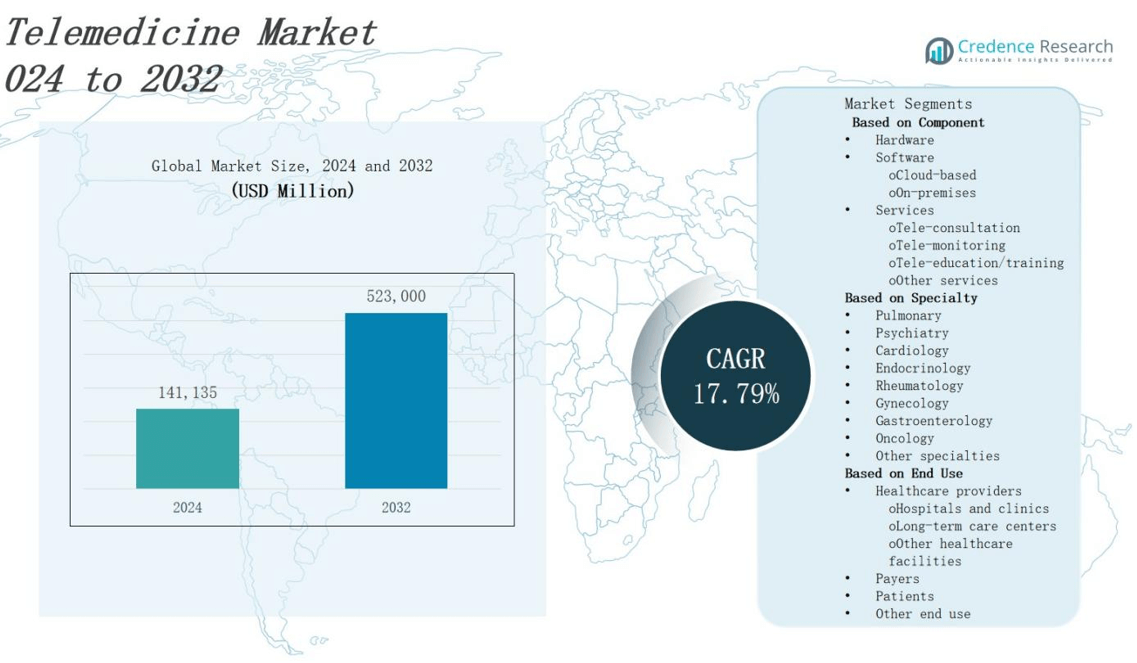
The Telemedicine market is projected to grow from USD 141,135 million in 2024 to USD 523,000 million by 2032, registering a robust CAGR of 17.79%.
| REPORT ATTRIBUTE | DETAILS |
|---|---|
| Historical Period | 2019-2022 |
| Base Year | 2023 |
| Forecast Period | 2024-2032 |
| Telemedicine market Size 2024 | USD 141,135 million |
| Telemedicine market, CAGR | 17.79% |
| Telemedicine market Size 2032 | USD 523,000 million |
The telemedicine market grows rapidly due to increasing demand for remote healthcare services and advancements in telecommunication technologies. Rising prevalence of chronic diseases and aging populations drive the need for continuous patient monitoring and virtual consultations. Healthcare providers prioritize reducing hospital visits to minimize infection risks, further accelerating adoption. Integration of AI and wearable devices enhances diagnostic accuracy and patient engagement. Additionally, expanding internet penetration and supportive government initiatives promote telemedicine infrastructure worldwide. Key trends include the development of mobile health applications, incorporation of advanced diagnostic tools into telemedicine platforms, and growing investments in digital health ecosystems, which collectively strengthen market momentum.
The telemedicine market spans key regions including North America, Europe, Asia-Pacific, and the Rest of the World, with North America leading at 35% market share, followed by Europe at 28%, Asia-Pacific at 22%, and the Rest of the World holding 15%. Leading players such as Teladoc Health Inc., MDlive, American Well Corporation, SOC Telemed Inc., Oracle Corporation, and General Electric Company drive growth through innovation and regional expansions. Emerging companies like ICliniq and ACL Digital further strengthen the market by addressing specific local healthcare needs.
Market Insights
- The telemedicine market will grow from USD 141,135 million in 2024 to USD 523,000 million by 2032, with a CAGR of 17.79%.
- Increasing demand for remote healthcare and rising chronic disease prevalence drive continuous patient monitoring and virtual consultations.
- Integration of AI and wearable devices improves diagnostic accuracy and patient engagement, enhancing telemedicine service quality.
- North America leads with 35% market share, followed by Europe (28%), Asia-Pacific (22%), and the Rest of the World (15%).
- Government support, reimbursement policies, and regulatory frameworks boost telemedicine adoption and infrastructure development globally.
- Technological advances in mobile health apps, high-speed internet, and interoperability with health records expand telemedicine accessibility.
- Challenges include regulatory complexity, reimbursement inconsistencies, digital literacy gaps, and data privacy concerns limiting broader adoption.
Market Drivers
Rising Demand for Remote Healthcare Services
The telemedicine market benefits significantly from growing demand for remote healthcare delivery. Increasing prevalence of chronic diseases and an aging population create a need for continuous patient monitoring without frequent hospital visits. Patients and providers seek convenient, timely access to medical consultations, especially in rural and underserved areas. Telemedicine reduces geographical barriers and expands healthcare reach. It enables real-time communication and diagnosis, improving patient outcomes while lowering healthcare costs. This demand fuels widespread adoption across hospitals, clinics, and home care settings.
- For instance, Turkey's Ministry of Health has implemented a Teleradiology System that enables 24/7 remote radiological examination reporting, helping rural hospitals overcome radiologist shortages and provide faster diagnoses.
Technological Advancements and Digital Infrastructure
Technological progress drives the telemedicine market by enhancing service quality and accessibility. Innovations in high-speed internet, mobile devices, and cloud computing allow seamless virtual consultations. Integration of AI, machine learning, and wearable sensors improves diagnostic accuracy and personalized treatment plans. Platforms increasingly support interoperability with electronic health records, streamlining workflows. Growing investments in digital infrastructure facilitate scalable telemedicine solutions. The market adapts quickly to these innovations, encouraging broader implementation across healthcare systems globally.
- For instance, Microsoft Azure supports interoperability by hosting cloud-based telemedicine solutions that seamlessly integrate with electronic health records, streamlining healthcare workflows and enabling scalable deployment globally.
Government Support and Regulatory Developments
Government initiatives and evolving regulations bolster the telemedicine market by enabling safer, compliant deployment. Many countries introduce reimbursement policies and legal frameworks that legitimize telehealth services. These measures reduce administrative hurdles and encourage healthcare providers to adopt telemedicine technologies. Regulatory clarity fosters patient trust and ensures data privacy and security standards are met. It also drives investments in telemedicine infrastructure and promotes equitable access. Government backing plays a pivotal role in accelerating telemedicine integration within mainstream healthcare delivery.
Shift Toward Patient-Centric Care Models
The telemedicine market thrives amid the healthcare industry's transition to patient-centric care models. Patients increasingly demand convenience, flexibility, and personalized care options. Telemedicine empowers individuals to actively participate in managing their health through remote monitoring and virtual consultations. It supports chronic disease management, mental health services, and preventive care outside traditional clinical settings. Healthcare providers leverage telemedicine to enhance engagement, satisfaction, and treatment adherence. This shift redefines care delivery, making telemedicine a critical component of modern healthcare strategies worldwide.
Market Trends
Expansion of Mobile Health Applications and Platforms
The telemedicine market experiences significant growth driven by the widespread adoption of mobile health applications and platforms. These applications provide patients with convenient access to healthcare services anytime, anywhere, via smartphones and tablets. Patients increasingly prefer app-based consultations, appointment scheduling, and health tracking for greater control over their care. Healthcare providers use mobile solutions to optimize workflows and improve patient communication. Enhanced user interfaces, security protocols, and personalized features increase user engagement. This trend broadens telemedicine reach, especially in rural and underserved regions, improving overall healthcare accessibility.
- For instance, Caspar Health’s digital rehabilitation platform, which provides personalized therapy programs through a mobile app with secure communication tools, allowing patients to track progress and communicate with therapists remotely, effectively extending rehabilitation beyond traditional clinical settings.
Integration of Advanced Diagnostic and Monitoring Technologies
The telemedicine market advances by integrating advanced diagnostic and monitoring technologies that enhance care quality and efficiency. Artificial intelligence and machine learning tools enable precise disease detection, risk assessment, and predictive analytics. Wearable devices and biosensors facilitate continuous, real-time monitoring of vital signs and chronic conditions remotely. These technologies allow providers to offer personalized treatment plans and timely interventions outside traditional clinical settings. Improved data collection supports better clinical decision-making and optimizes resource allocation. This integration transforms telemedicine into a proactive healthcare delivery model that improves patient outcomes.
Growing Emphasis on Interoperability and Data Security Standards
The telemedicine market increasingly focuses on interoperability and stringent data security to ensure smooth and secure healthcare delivery. It promotes seamless integration with electronic health records (EHRs) and hospital information systems to enable comprehensive patient data exchange across platforms. Enhanced cybersecurity protocols protect sensitive medical data from breaches and unauthorized access, complying with global privacy regulations. Providers invest heavily in scalable, secure telemedicine platforms that support multi-vendor environments. This focus builds patient trust, enhances system reliability, and encourages wider acceptance and adoption of telemedicine services across healthcare sectors.
- For instance, Teladoc Health achieves interoperability through its Virtual First™ platform, which serves as a unified entry point delivering comprehensive clinical services while securely integrating with broader healthcare systems for seamless data sharing.
Increased Investment in Telemedicine Infrastructure and Services
The telemedicine market attracts substantial investment from public and private sectors to strengthen infrastructure and expand service offerings. Venture capital firms and technology companies fund innovative telehealth startups and platform improvements. Healthcare organizations allocate resources to develop telemedicine capabilities, upgrade hardware and software, and train clinical staff. Governments introduce grants, subsidies, and favorable policies to support digital health initiatives, especially in underserved and rural areas. These investments enhance network connectivity, software functionality, and service availability, accelerating telemedicine adoption and solidifying its role in global healthcare ecosystems.
Market Challenges Analysis
Regulatory Complexities and Reimbursement Barriers
The telemedicine market faces significant challenges related to regulatory complexities and reimbursement policies. Diverse regulations across regions create difficulties for providers seeking to offer cross-border telehealth services. Variations in licensing requirements and legal frameworks hinder seamless adoption. Reimbursement policies remain inconsistent, with some insurers limiting coverage for telemedicine consultations. This uncertainty discourages healthcare providers from fully investing in telemedicine infrastructure. It also creates confusion among patients regarding costs and coverage. Addressing these regulatory and reimbursement barriers is critical to sustaining telemedicine growth and ensuring broader acceptance.
Technology Adoption and Data Privacy Concerns
The telemedicine market struggles with technology adoption hurdles and concerns over data privacy. Limited digital literacy among patients and providers slows adoption rates, particularly in rural and underserved areas. Infrastructure gaps, such as insufficient internet connectivity, further restrict access to telemedicine services. Data privacy and security issues raise patient apprehension about sharing sensitive health information online. Ensuring compliance with stringent data protection regulations demands continuous investment in cybersecurity measures. These challenges require coordinated efforts from stakeholders to build trust, improve infrastructure, and promote widespread use of telemedicine solutions.
Market Opportunities
Expansion into Emerging Markets and Underserved Regions
The telemedicine market holds substantial opportunities in emerging markets and underserved regions where healthcare access remains limited. Increasing smartphone penetration and improving internet infrastructure create favorable conditions for telehealth adoption in these areas. It can bridge gaps in healthcare delivery by offering remote consultations and diagnostics to populations with scarce medical facilities. Governments and private players show growing interest in expanding digital health services to rural communities. Telemedicine providers can capitalize on these trends by tailoring affordable, localized solutions that address unique healthcare challenges. This expansion promises to drive significant market growth while improving global health equity.
Integration with Advanced Technologies and New Care Models
The telemedicine market benefits from opportunities created by integrating advanced technologies and innovative care models. Incorporating artificial intelligence, machine learning, and wearable health devices enhances diagnostic accuracy and patient monitoring capabilities. It enables personalized care and supports chronic disease management outside traditional clinical settings. Remote patient monitoring and virtual care models reduce hospital readmissions and lower healthcare costs. Collaborations between technology companies and healthcare providers foster development of comprehensive telehealth ecosystems. Leveraging these innovations will strengthen the market’s value proposition and expand its adoption across various healthcare sectors.
Market Segmentation Analysis:
By Component
The telemedicine market segments by component into hardware, software, and services. Hardware includes devices essential for virtual consultations and remote monitoring. Software further divides into cloud-based and on-premises solutions, offering flexibility based on organizational needs. Cloud-based platforms gain traction due to scalability and ease of access, while on-premises systems appeal to organizations prioritizing data control. Services encompass tele-consultation, tele-monitoring, tele-education/training, and other supportive offerings. Tele-consultation dominates, driven by demand for virtual doctor-patient interactions. Tele-monitoring grows steadily, supporting chronic disease management and remote patient care.
- For instance, Philips offers advanced medical devices like digital blood pressure monitors and pulse oximeters that facilitate remote patient monitoring in telemedicine.
By Specialty
The telemedicine market categorizes by medical specialty, including pulmonary, psychiatry, cardiology, endocrinology, rheumatology, gynecology, gastroenterology, oncology, and others. Psychiatry and cardiology segments lead adoption due to high demand for mental health services and cardiovascular care outside clinical settings. Oncology benefits from telemedicine through remote monitoring of patients undergoing treatment. Pulmonary and endocrinology specialties utilize telehealth for chronic condition management. The diversity of specialties reflects telemedicine’s versatility in addressing various healthcare needs, expanding its application across multiple medical disciplines.
By End Use
The telemedicine market segments by end use into healthcare providers, payers, patients, and others. Healthcare providers include hospitals, clinics, long-term care centers, and other facilities that deploy telemedicine solutions to enhance care delivery and operational efficiency. Hospitals and clinics represent the largest share, leveraging telemedicine for outpatient and follow-up care. Payers increasingly incorporate telemedicine to reduce costs and improve patient outcomes. Patients actively engage in telehealth services for convenience and continuous care. The growing adoption across end users underscores telemedicine’s critical role in modern healthcare ecosystems.
- For instance, the UNM Health ACCESS Telemedicine program enabled urgent neurology and neurosurgery care remotely, including an 82-year-old stroke patient who avoided hospital transfer through rapid telestroke consultation close to home, ensuring effective local follow-up care.
Segments:
Based on Component
- Hardware
- Software
- Cloud-based
- On-premises
- Services
-
- Tele-consultation
- Tele-monitoring
- Tele-education/training
- Other services
Based on Specialty
- Pulmonary
- Psychiatry
- Cardiology
- Endocrinology
- Rheumatology
- Gynecology
- Gastroenterology
- Oncology
- Other specialties
Based on End Use
- Healthcare providers
- Hospitals and clinics
- Long-term care centers
- Other healthcare facilities
- Payers
- Patients
- Other end use
Based on the Geography:
- North America
- U.S.
- Canada
- Mexico
- Europe
- Germany
- France
- U.K.
- Italy
- Spain
- Rest of Europe
- Asia Pacific
- China
- Japan
- India
- South Korea
- South-east Asia
- Rest of Asia Pacific
- Latin America
- Brazil
- Argentina
- Rest of Latin America
- Middle East & Africa
- GCC Countries
- South Africa
- Rest of the Middle East and Africa
Regional Analysis
North America
North America leads the telemedicine market with a commanding share of 35%. The region benefits from advanced healthcare infrastructure, widespread internet penetration, and early adoption of digital health technologies. Strong government support and favorable reimbursement policies encourage providers to implement telemedicine solutions extensively. The presence of major telehealth companies and continuous technological innovation further strengthens market growth. Patients increasingly prefer virtual consultations for convenience and timely care. North America remains a trendsetter, influencing global telemedicine standards and practices. It continues to drive investments in telehealth platforms and services.
Europe
Europe holds 28% of the telemedicine market, driven by increasing government initiatives and growing awareness of remote healthcare benefits. Countries invest in digital health strategies to improve healthcare accessibility and reduce system burdens. Regulatory frameworks evolve to support telemedicine adoption while ensuring data security and patient privacy. Healthcare providers across Europe incorporate telehealth to enhance chronic disease management and mental health services. The region experiences steady growth due to expanding digital infrastructure and patient acceptance. It remains focused on interoperability and integration of telemedicine with existing health systems.
Asia-Pacific
Asia-Pacific commands 22% of the telemedicine market, exhibiting rapid growth fueled by rising smartphone penetration and improving internet connectivity. Governments prioritize digital health expansion to address healthcare disparities in rural and underserved areas. Telemedicine adoption accelerates in countries such as China, India, Japan, and Australia. The region benefits from increasing investments in healthcare IT and a large patient population seeking accessible and affordable care. Telehealth platforms adapt to local languages and healthcare requirements, supporting widespread usage. Asia-Pacific holds significant potential for future market expansion.
Rest of the World
The Rest of the World region accounts for 15% of the telemedicine market, including Latin America, the Middle East, and Africa. Market growth stems from increasing healthcare digitization efforts and rising demand for remote medical services. Governments and private sectors focus on enhancing telemedicine infrastructure to overcome geographical barriers and healthcare resource shortages. Challenges such as limited connectivity and regulatory uncertainties persist but gradually improve with strategic investments. Patient awareness grows steadily, driving telehealth adoption in urban and rural settings. The region presents emerging opportunities for telemedicine providers to establish a foothold.
Key Player Analysis
- MDlive, Inc. (USA)
- Oracle Corporation (USA)
- ACL Digital (USA)
- ICliniq (India)
- SOC Telemed Inc. (USA)
- AMC Health (USA)
- The Cigna Group (USA)
- Teladoc Health Inc. (USA)
- General Electric Company (USA)
- Twilio Inc. (USA)
- Vsee (USA)
- American Well Corporation (USA)
Competitive Analysis
The telemedicine market exhibits intense competition driven by rapid technological advancements and rising demand for remote healthcare services. Key players such as Teladoc Health Inc., MDlive, Inc., American Well Corporation, and SOC Telemed Inc. lead through continuous innovation and strategic partnerships. Companies focus on expanding their service portfolios, enhancing platform capabilities, and improving user experience to gain competitive advantage. Oracle Corporation and General Electric Company contribute through technology integration and infrastructure support. Emerging players like ICliniq and ACL Digital differentiate by offering region-specific solutions and specialized telehealth services. The market demands agility and investment in research and development to address regulatory requirements and cybersecurity challenges. Providers emphasize interoperability and scalability to cater to diverse healthcare needs. Overall, it remains a dynamic landscape where innovation, customer-centricity, and strategic collaborations dictate success.
Recent Developments
- In March 2025, ATA Action, the advocacy arm of the American Telemedicine Association (ATA), acquired the Digital Therapeutics Alliance (DTA). This acquisition aims to strengthen policy and advocacy for telehealth and digital therapeutics integration in healthcare systems.
- In July 2025, MDLIVE renewed its partnership with Excellus BlueCross BlueShield, extending their collaboration for medical and behavioral telemedicine services until the end of 2028.
- In May 2025, Oracle Health partnered with Cleveland Clinic and G42 to develop an AI-driven global healthcare delivery platform aimed at enhancing patient care and public health management.
Market Concentration & Characteristics
The telemedicine market demonstrates a moderately concentrated competitive landscape dominated by a few key players such as Teladoc Health Inc., MDlive, American Well Corporation, and SOC Telemed Inc. These companies leverage strong technological capabilities, extensive service portfolios, and strategic partnerships to maintain market leadership. It features a mix of established multinational corporations and emerging regional providers that focus on innovation and localized solutions. The market’s dynamic nature encourages continuous investment in research and development, particularly in AI integration, wearable technology, and platform interoperability. Providers emphasize user experience, data security, and regulatory compliance to differentiate themselves. Market characteristics include rapid technological adoption, evolving regulatory frameworks, and diverse application across multiple healthcare specialties and geographies. It requires agility and scalability to address varying customer needs and regulatory environments, fostering competitive innovation and sustained growth in telemedicine services worldwide.
Report Coverage
The research report offers an in-depth analysis based on Component, Speciality, End-Use and Geography. It details leading market players, providing an overview of their business, product offerings, investments, revenue streams, and key applications. Additionally, the report includes insights into the competitive environment, SWOT analysis, current market trends, as well as the primary drivers and constraints. Furthermore, it discusses various factors that have driven market expansion in recent years. The report also explores market dynamics, regulatory scenarios, and technological advancements that are shaping the industry. It assesses the impact of external factors and global economic changes on market growth. Lastly, it provides strategic recommendations for new entrants and established companies to navigate the complexities of the market.
Future Outlook
- Telemedicine adoption will grow rapidly in both urban hospitals and remote rural healthcare facilities.
- Artificial intelligence will improve diagnostic accuracy and support personalized treatment plans in telehealth.
- Wearable health devices will enable continuous monitoring and real-time data sharing with healthcare providers.
- Governments will introduce favorable policies and invest in infrastructure to expand telemedicine accessibility.
- Telemedicine platforms will enhance interoperability to seamlessly integrate with electronic health record systems.
- Patient-centric models will increase demand for convenient, personalized virtual healthcare services worldwide.
- Advances in 5G and broadband technology will significantly improve telemedicine service quality and reach.
- Regulatory bodies will adapt frameworks to facilitate safe and effective cross-border telemedicine practices.
- Stronger data privacy regulations will ensure secure handling of sensitive patient information online.
- Partnerships between technology companies and healthcare providers will drive telemedicine innovation forward.

Request a Free Sample
Fill in your details and we'll send you a free sample report.
- Sample data tables & charts
- Research methodology
Market Dynamics
Advancements in Telecommunication and Digital Infrastructure
Rapid improvements in high-speed internet, mobile devices, and cloud computing enable seamless virtual consultations and remote monitoring, making telemedicine more accessible and reliable for both providers and patients.
Rising Prevalence of Chronic Diseases and Aging Populations
The increasing burden of chronic illnesses and a growing elderly population necessitate continuous patient monitoring and frequent consultations, which telemedicine efficiently provides without the need for frequent hospital visits.
Government Support and Evolving Regulatory Frameworks
Supportive government policies, reimbursement schemes, and clear regulatory guidelines are accelerating telemedicine adoption by reducing administrative barriers and ensuring data privacy and security.
Integration of AI and Wearable Devices
The adoption of artificial intelligence and wearable health devices enhances diagnostic accuracy, enables real-time patient monitoring, and supports personalized treatment plans, driving greater value and engagement in telemedicine services.
Expansion of Mobile Health Applications
The proliferation of user-friendly mobile health apps allows patients to access healthcare services conveniently from anywhere, increasing patient engagement and broadening the reach of telemedicine, especially in rural and underserved areas.
Need a Custom Version of This Report?
Tailor the scope, geography, or segments to your exact requirements.
- Custom geography or segment scope
- Direct access to our analyst team
Frequently Asked Questions
What is the current market size for telemedicine market, and what is its projected size in 2032?
At what Compound Annual Growth Rate is the telemedicine market projected to grow between 2025 and 2032?
Which telemedicine market segment held the largest share in 2024?
What are the primary factors fueling the growth of the telemedicine market?
Table of Content
Chapter 1 Market Segmentation
- 1.1 Segmentation Framework
- 1.1.1 Product and Service Classification
- 1.1.2 Application and End-Use Classification
- 1.1.3 Technology and Solution Classification
- 1.1.4 Customer and Distribution Channel Classification
- 1.1.5 Geographic Segmentation
- 1.1.6 Market Segment Definitions and Boundaries
- 1.2 By End Use
- 1.2.1 Hospitals and Clinics
- 1.2.2 Long-term Care Centers
- 1.2.3 Other Healthcare Facilities
- 1.2.4 Payers
- 1.2.5 Patients
- 1.3 By Component
- 1.3.1 Hardware
- 1.3.2 Software (Cloud-based)
- 1.3.3 Software (On-premises)
- 1.3.4 Services (Tele-consultation)
- 1.3.5 Services (Tele-monitoring)
- 1.3.6 Services (Tele-education/training)
- 1.3.7 Other Services
- 1.4 By Specialty
- 1.4.1 Psychiatry
- 1.4.2 Cardiology
- 1.4.3 Pulmonary
- 1.4.4 Endocrinology
- 1.4.5 Oncology
- 1.4.6 Other Specialties
Chapter 2 Introduction
- 2.1 Report Objectives and Scope
- 2.2 Product Definition and Industry Terminology
- 2.3 Market Inclusions and Exclusions
- 2.4 Research Process
- 2.4.1 Primary Research and Expert Interviews
- 2.4.2 Secondary Research and Source Review
- 2.4.3 Top-Down and Bottom-Up Estimation
- 2.4.4 Data Triangulation and Verification
- 2.5 Market Size Measurement Basis
- 2.5.1 2024: USD 141,135 million → 2032: USD 523,000 million
- 2.6 Historical and Forecast Reference Periods
- 2.6.1 Base Year: 2024
- 2.6.2 Forecast Period: 2024-2032
- 2.7 Research Assumptions and Limitations
Chapter 3 Executive Summary
- 3.1 Market Snapshot and Key Findings
- 3.2 Base-Year Market Size, 2024
- 3.3 Forecast Market Size, 2032
- 3.4 Revenue and Volume Growth Outlook
- 3.5 Key Demand and Supply Indicators
- 3.6 Leading Market Segments
- 3.7 Fastest-Growing Market Opportunities
- 3.8 Regional Performance Highlights
- 3.9 Technology and Industry Transformation
- 3.10 Competitive Landscape Summary
- 3.11 Analyst View and Strategic Implications
Chapter 4 Global Telemedicine Market Trends and Developments
- 4.1 Historical Industry Development
- 4.2 Recent Market Trends and Developments
- 4.3 Demand and Customer Behavior Trends
- 4.4 Technology and Product Innovation
- 4.5 Artificial Intelligence, Automation and Digitalization
- 4.6 Local Manufacturing and Supply Chain Realignment
- 4.7 Industry Partnerships, Mergers and Acquisitions
- 4.8 Sustainability and Circular Economy Developments
- 4.9 Government and Private Sector Investment Trends
- 4.10 Emerging Business Models and Commercialization
- 4.11 Industry Developments and Announcements
Chapter 5 Global Telemedicine Market Production, Supply and Demand Analysis
- 5.1 Demand Trend and Consumption Analysis
- 5.2 Demand Forecast, 2024-2032
- 5.3 Production and Output Trend
- 5.4 Production and Output Forecast, 2024-2032
- 5.5 Installed Capacity and Capacity Utilization
- 5.6 Company-Wise Production Plants and Statistics
- 5.6.1 Installed Production Capacity
- 5.6.2 Actual Production
- 5.6.3 Planned Capacity and Expansion Targets
- 5.7 Supply Chain Structure and Procurement Trends
- 5.8 Supply-Demand Gap and Bottlenecks
- 5.9 Import Dependence and Sourcing Structure
- 5.10 Contract Manufacturing and Outsourcing
- 5.11 Regional Supply and Demand Concentration
Chapter 6 Global Telemedicine Market Pricing Analysis
- 6.1 Pricing Structure and Measurement
- 6.2 Historical Pricing Trends
- 6.3 Pricing Outlook, 2024-2032
- 6.4 Average Selling Price and Unit Economics
- 6.5 Pricing by Product and Market Segment
- 6.6 Geographic Pricing Differences
- 6.7 Key Input, Energy, Labor and Logistics Costs
- 6.8 Contract Pricing and Purchasing Models
- 6.9 Pricing Sensitivity and Competitive Positioning
- 6.10 Price, Margin and Profitability Implications
Chapter 7 Global Telemedicine Market Dynamics
- 7.1 Market Growth Drivers
- 7.1.1 Demand-Side Drivers
- 7.1.2 Technology and Innovation Drivers
- 7.1.3 Infrastructure and Investment Drivers
- 7.1.4 Regulatory and Policy Drivers
- 7.2 Market Restraints
- 7.2.1 Cost and Affordability Constraints
- 7.2.2 Technology and Adoption Barriers
- 7.2.3 Supply Chain and Operational Constraints
- 7.3 Market Challenges
- 7.3.1 Competitive Pressure and Margin Erosion
- 7.3.2 Skills, Infrastructure and Implementation Gaps
- 7.4 Emerging Market Opportunities
- 7.5 Market Dynamics Impact and Time-Horizon Assessment
Chapter 8 Global Telemedicine Value Chain Analysis
- 8.1 Industry Value Chain Overview
- 8.2 Upstream Suppliers and Critical Inputs
- 8.3 Technology and Component Providers
- 8.4 Manufacturing or Service Delivery
- 8.5 Distribution, Channel Partners and Integrators
- 8.6 Downstream Applications and End Users
- 8.7 Value Addition and Profit Pools
- 8.8 Vertical Integration and Outsourcing
- 8.9 Supplier Concentration and Risk
- 8.10 Supply Chain Localization and Resilience
Chapter 9 Global Telemedicine Market Regulations and Policies
- 9.1 Relevant Laws, Standards and Compliance Frameworks
- 9.2 Product, Service, Safety and Quality Requirements
- 9.3 Government Policies, Incentives and Subsidies
- 9.4 Imports, Exports and Trade Barriers
- 9.5 Public Procurement and Local Content Requirements
- 9.6 Environmental and Sustainability Compliance
- 9.7 Upcoming Policy Changes and Market Implications
Chapter 10 Global Telemedicine Market Hotspots and Opportunities
- 10.1 Market Opportunity Mapping and Growth Hotspots
- 10.2 High-Growth Applications and Customer Groups
- 10.3 Underserved Markets and White-Space Opportunities
- 10.4 Emerging Technology and Product Opportunities
- 10.5 New Capacity and Investment Hotspots
- 10.6 Market Entry and Expansion Opportunities
- 10.7 Distribution and Partnership Opportunities
- 10.8 Near-Term and Long-Term Commercial Potential
- 10.9 Opportunity Attractiveness and Execution Risks
Chapter 11 Global Telemedicine Market Outlook, 2024-2032
- 11.1 Market Size and Analysis
- 11.1.1 Revenue (Market Measurement: 2024: USD 141,135 million → 2032: USD 523,000 million)
- 11.1.2 Market Volume and Quantity Sold
- 11.1.3 Historical Market Size
- 11.1.4 Base-Year Market Size, 2024
- 11.2 Market Forecast, 2024-2032
- 11.2.1 Revenue Forecast to 2032
- 11.2.2 Volume Forecast to 2032
- 11.2.3 CAGR and Year-on-Year Growth
- 11.2.4 Incremental Revenue Opportunity
- 11.3 Forecast Assumptions and Scenario Analysis
- 11.3.1 Base-Case Forecast
- 11.3.2 Optimistic and Conservative Scenarios
- 11.3.3 Technology, Pricing and Policy Sensitivities
- 11.4 Market Attractiveness and Growth Outlook
Chapter 12 Global Telemedicine Market Segmentation and Outlook
- 12.1 Segmentation Summary and Market Shares, 2024
- 12.2 Largest and Fastest-Growing Segments
- 12.3 By End Use - Market Size and Forecast, 2024-2032
- 12.3.1 Segment Definition and Scope
- 12.3.2 Historical Market Size
- 12.3.3 Revenue Forecast, 2024-2032
- 12.3.4 Volume Forecast, 2024-2032
- 12.3.5 Base-Year Market Share, 2024
- 12.3.6 Segment CAGR and Growth Drivers
- 12.3.7 Subsegment Market Size and Forecast
- 12.3.7.1 Hospitals and Clinics
- 12.3.7.2 Long-term Care Centers
- 12.3.7.3 Other Healthcare Facilities
- 12.3.7.4 Payers
- 12.3.7.5 Patients
- 12.3.8 Subsegment Pricing and Adoption Trends
- 12.3.9 Leading Suppliers and Competition
- 12.3.10 Regional Demand and Opportunities
- 12.4 By Component - Market Size and Forecast, 2024-2032
- 12.4.1 Segment Definition and Scope
- 12.4.2 Historical Market Size
- 12.4.3 Revenue Forecast, 2024-2032
- 12.4.4 Volume Forecast, 2024-2032
- 12.4.5 Base-Year Market Share, 2024
- 12.4.6 Segment CAGR and Growth Drivers
- 12.4.7 Subsegment Market Size and Forecast
- 12.4.7.1 Hardware
- 12.4.7.2 Software (Cloud-based)
- 12.4.7.3 Software (On-premises)
- 12.4.7.4 Services (Tele-consultation)
- 12.4.7.5 Services (Tele-monitoring)
- 12.4.7.6 Services (Tele-education/training)
- 12.4.7.7 Other Services
- 12.4.8 Subsegment Pricing and Adoption Trends
- 12.4.9 Leading Suppliers and Competition
- 12.4.10 Regional Demand and Opportunities
- 12.5 By Specialty - Market Size and Forecast, 2024-2032
- 12.5.1 Segment Definition and Scope
- 12.5.2 Historical Market Size
- 12.5.3 Revenue Forecast, 2024-2032
- 12.5.4 Volume Forecast, 2024-2032
- 12.5.5 Base-Year Market Share, 2024
- 12.5.6 Segment CAGR and Growth Drivers
- 12.5.7 Subsegment Market Size and Forecast
- 12.5.7.1 Psychiatry
- 12.5.7.2 Cardiology
- 12.5.7.3 Pulmonary
- 12.5.7.4 Endocrinology
- 12.5.7.5 Oncology
- 12.5.7.6 Other Specialties
- 12.5.8 Subsegment Pricing and Adoption Trends
- 12.5.9 Leading Suppliers and Competition
- 12.5.10 Regional Demand and Opportunities
- 12.6 Segment Growth Comparison
- 12.7 Segment Attractiveness and Priority Matrix
Chapter 13 Global Telemedicine End-Use and Application Market Outlook
- 13.1 End-Use Industry and Customer Demand Structure
- 13.2 Leading Applications and Customer Groups
- 13.3 End-Use Market Size, Share and Forecast
- 13.4 Major End-Use Industry Deep Dives
- 13.4.1 Customer Requirements and Use Cases
- 13.4.2 Demand and Replacement Cycles
- 13.4.3 Technical and Regulatory Considerations
- 13.4.4 Purchasing and Procurement Models
- 13.4.5 Leading Vendors and Distribution Channels
- 13.4.6 Forecast and Commercial Opportunities
- 13.5 Emerging Applications and Cross-Segment Demand
- 13.6 End-Use Industry Investment Priorities
Chapter 14 Global Telemedicine Geographic Market Outlook, 2024-2032
- 14.1 Regional Market Size and Share, 2024
- 14.2 Regional Market Forecast, 2024-2032
- 14.3 Regional Pricing, Production and Demand Differences
- 14.4 North America
- 14.4.1 United States
- 14.4.2 Canada
- 14.4.3 Mexico
- 14.5 Europe
- 14.5.1 Germany
- 14.5.2 France
- 14.5.3 Italy
- 14.5.4 United Kingdom
- 14.5.5 Spain
- 14.5.6 Poland
- 14.5.7 Russia
- 14.5.8 Netherlands
- 14.5.9 Belgium
- 14.5.10 Sweden
- 14.5.11 Denmark
- 14.5.12 Norway
- 14.5.13 Rest of Europe
- 14.6 Asia Pacific
- 14.6.1 China
- 14.6.2 India
- 14.6.3 Japan
- 14.6.4 South Korea
- 14.6.5 Thailand
- 14.6.6 Indonesia
- 14.6.7 Vietnam
- 14.6.8 Malaysia
- 14.6.9 Australia
- 14.6.10 Rest of Asia Pacific
- 14.7 Latin America
- 14.7.1 Brazil
- 14.7.2 Argentina
- 14.7.3 Colombia
- 14.7.4 Chile
- 14.7.5 Rest of Latin America
- 14.8 Middle East
- 14.8.1 Saudi Arabia
- 14.8.2 United Arab Emirates
- 14.8.3 Turkey
- 14.8.4 Israel
- 14.8.5 Iran
- 14.8.6 Rest of the Middle East
- 14.9 Africa
- 14.9.1 South Africa
- 14.9.2 Egypt
- 14.9.3 Nigeria
- 14.9.4 Morocco
- 14.9.5 Rest of Africa
- 14.10 Regional Investment, Policy and Supply Chain Differences
- 14.11 Regional Competitive Landscape
- 14.12 Geographic Growth Hotspots
Chapter 15 Global Telemedicine Technology, Innovation and Sustainability Outlook
- 15.1 Technology Landscape and Maturity
- 15.2 Product, Process and Service Innovation
- 15.3 AI, Automation and Digital Tools in the Industry
- 15.4 Technology Adoption and Performance Benchmarking
- 15.5 Innovation Pipeline and R&D Investment
- 15.6 Patent and Intellectual Property Trends
- 15.7 Energy Efficiency and Resource Management
- 15.8 Sustainability, Recycling and Circularity
- 15.9 Technology Roadmap, 2024-2032
- 15.10 Risks of Obsolescence and Technology Substitution
Chapter 16 Global Telemedicine Market Key Strategic Imperatives
- 16.1 Growth and Market Entry Priorities
- 16.2 High-Return Products and Segments
- 16.3 Pricing, Profitability and Cost Optimization
- 16.4 Technology Investment and Product Differentiation
- 16.5 Supply Chain Localization and Resilience
- 16.6 Distribution and Customer Acquisition
- 16.7 Partnership, Acquisition and Capacity Strategy
- 16.8 Regional Expansion Priorities
- 16.9 Short-, Medium- and Long-Term Actions
Chapter 17 Competition Outlook
- 17.1 Industry Competition Characteristics
- 17.2 Market Structure and Concentration
- 17.3 Market Share and Competitive Positioning, 2024
- 17.4 Company-Wise Revenue and Product Benchmarking
- 17.5 Production and Service Capacity Benchmarking
- 17.6 Technology, Pricing and Differentiation
- 17.7 Regional Footprint and Distribution Strength
- 17.8 Mergers, Acquisitions and Strategic Alliances
- 17.9 New Entrants and Competitive Threats
- 17.10 Porter's Five Forces and Industry Attractiveness
- 17.11 Competitive Outlook, 2024-2032
Chapter 18 Company Profiles
- 18.1 Company Coverage and Selection Criteria
- 18.2 Teladoc Health Inc.
- 18.2.1 Business Description
- 18.2.2 Company Ownership and Geographic Presence
- 18.2.3 Product and Service Portfolio
- 18.2.4 Manufacturing and Operating Footprint
- 18.2.5 Production Capacity and Expansion Plans
- 18.2.6 Financial Performance and Investment
- 18.2.7 Market Share and Competitive Position
- 18.2.8 Technology and Innovation Capabilities
- 18.2.9 Strategic Alliances or Partnerships
- 18.2.10 Recent Developments
- 18.2.11 Growth Strategy and Outlook
- 18.3 MDlive, Inc.
- 18.4 American Well Corporation
- 18.5 SOC Telemed Inc.
- 18.6 Oracle Corporation
- 18.7 General Electric Company
- 18.8 ICliniq
- 18.9 ACL Digital
- 18.10 AMC Health
- 18.11 The Cigna Group
- 18.12 Other Relevant Market Participants
Note: Every listed company is profiled on the structure shown under the first company. The company list is preliminary and may change based on research findings, market developments, data availability and client requirements.
Chapter 19 Disclaimer
- 19.1 Research and Forecast Disclaimer
- 19.2 Data Source and Estimation Limitations
Note: The depth of individual sections depends on data availability for this market. Volume, capacity, trade and other unit-based metrics are included where applicable.