
Phone-first care and a doctor shortage shape Egyptian demand
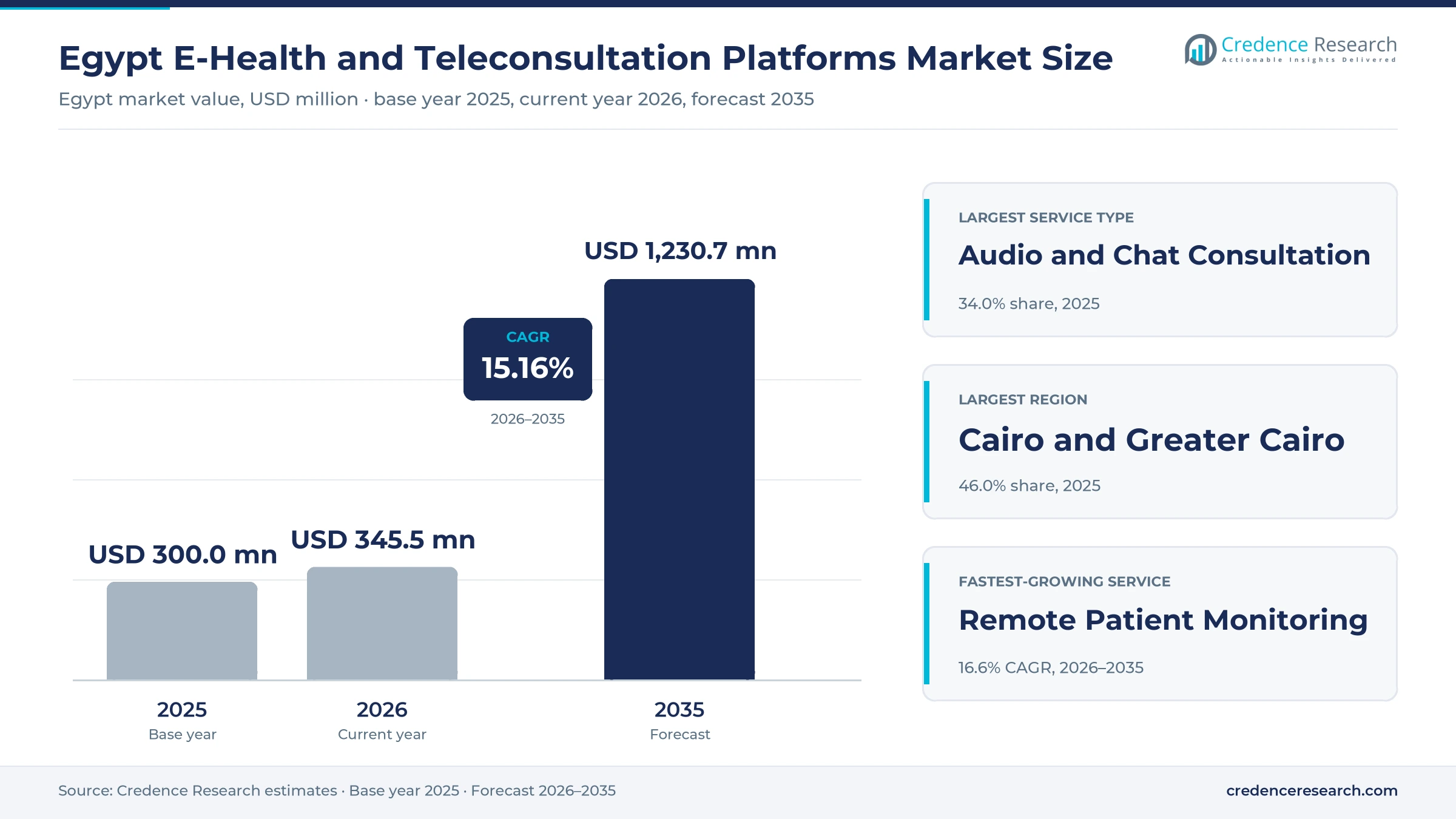
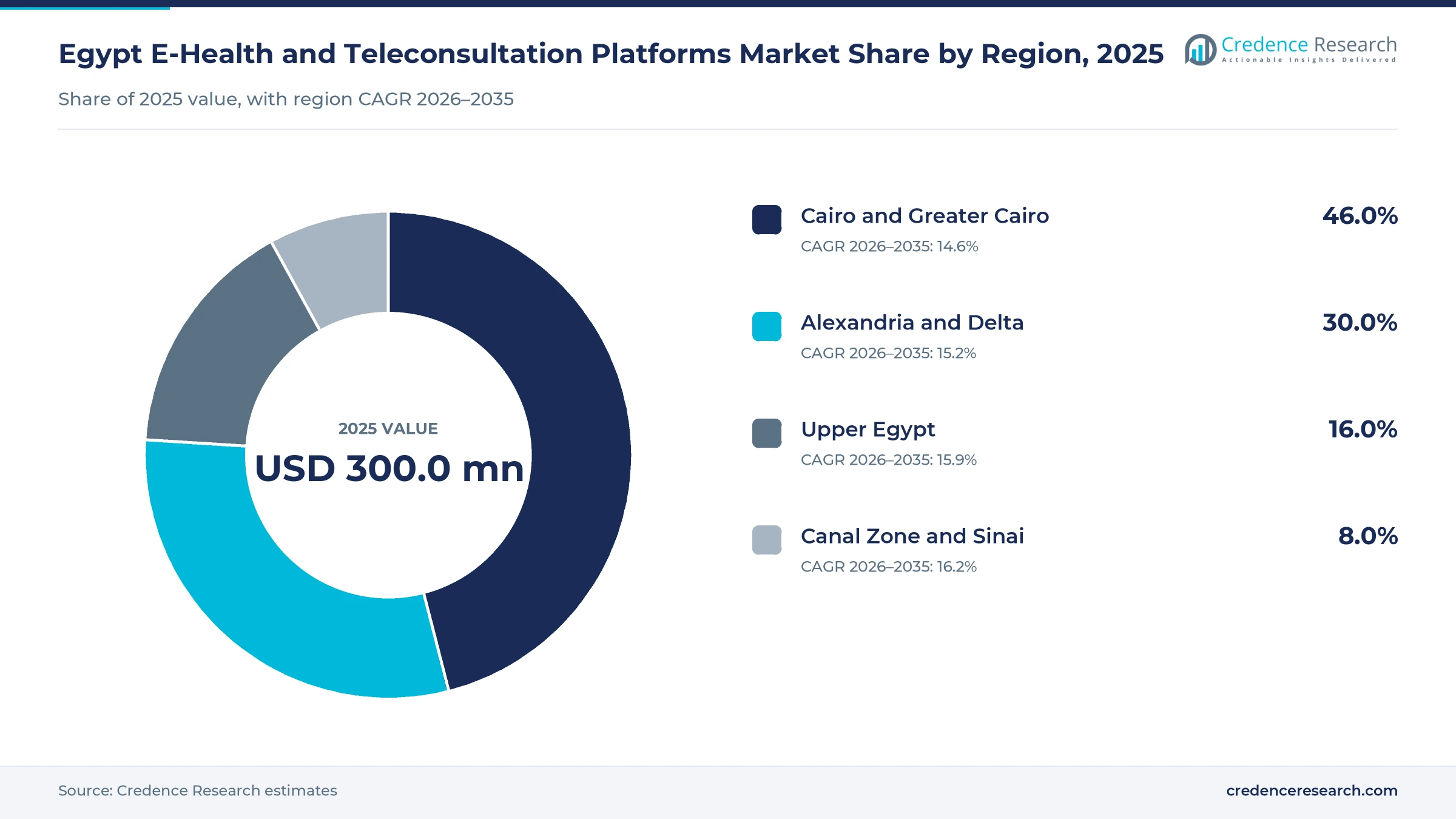
The Egypt e-health and teleconsultation platforms market was valued at USD 300.0 million in 2025 and is projected to increase from USD 345.5 million in 2026 to USD 1.23 billion by 2035, registering a CAGR of 15.16% during 2026–2035. Demand comes from households that pay for most care out of pocket, from a thin supply of doctors outside the large cities, and from a rising load of diabetes and heart disease that needs regular follow-up. Cairo and Greater Cairo held the largest regional share, 46.0% in 2025, because private clinics, insurers and the main platforms are concentrated there, while Canal Zone and Sinai is the fastest-growing region at 16.2% a year as the universal health insurance governorates digitize their hospitals. Phone and chat consultations carry the largest share of service value. The most important policy change is the National Digital Health Strategy 2025–2029, which commits the Ministry of Health and Population to unified, interoperable patient data across public facilities.
Low-cost calls and chat carry most virtual visits in Egypt
The market counts spending on video, phone and chat consultations, remote patient monitoring programs and digital care coordination tools used by Egyptian patients, providers, insurers and public programs. It covers consumer apps, portals run by hospitals and clinic groups, insurer and employer telehealth benefits, and links that connect consultations to pharmacies and diagnostic centers.
The count excludes the value of medicines sold through online pharmacies, standalone hospital information systems bought without a patient-facing service, and medical devices sold outside a monitoring program. Value sits with platforms that own the patient relationship and with the provider groups and insurers that pay for virtual care at scale.
Egypt E-Health and Teleconsultation Platforms Market Insights
- The Egypt e-health and teleconsultation platforms market rises from USD 300.0 million in 2025 to USD 1.23 billion by 2035, growing at 15.16% a year as insurers and public programs pay for virtual care.
- Cairo and Greater Cairo held 46.0% of 2025 value, while the Canal Zone and Sinai grows fastest at 16.2% a year on universal insurance digitization.
- Audio and chat consultation held 34.0% of 2025 value because Egyptian patients favor low-cost phone and messaging access over scheduled video visits.
- The Egypt Healthcare Authority inspected a virtual hospital in Ismailia on July 15, 2026, with remote intensive care, radiology and connected cardiology units.
- Competition is shifting from consumer downloads toward insurer, employer and pharmacy contracts, where Yodawy and Chefaa already link prescriptions to claims.
Chat calls lead while remote monitoring grows fastest
Why do phone and chat visits outsell video in Egypt?
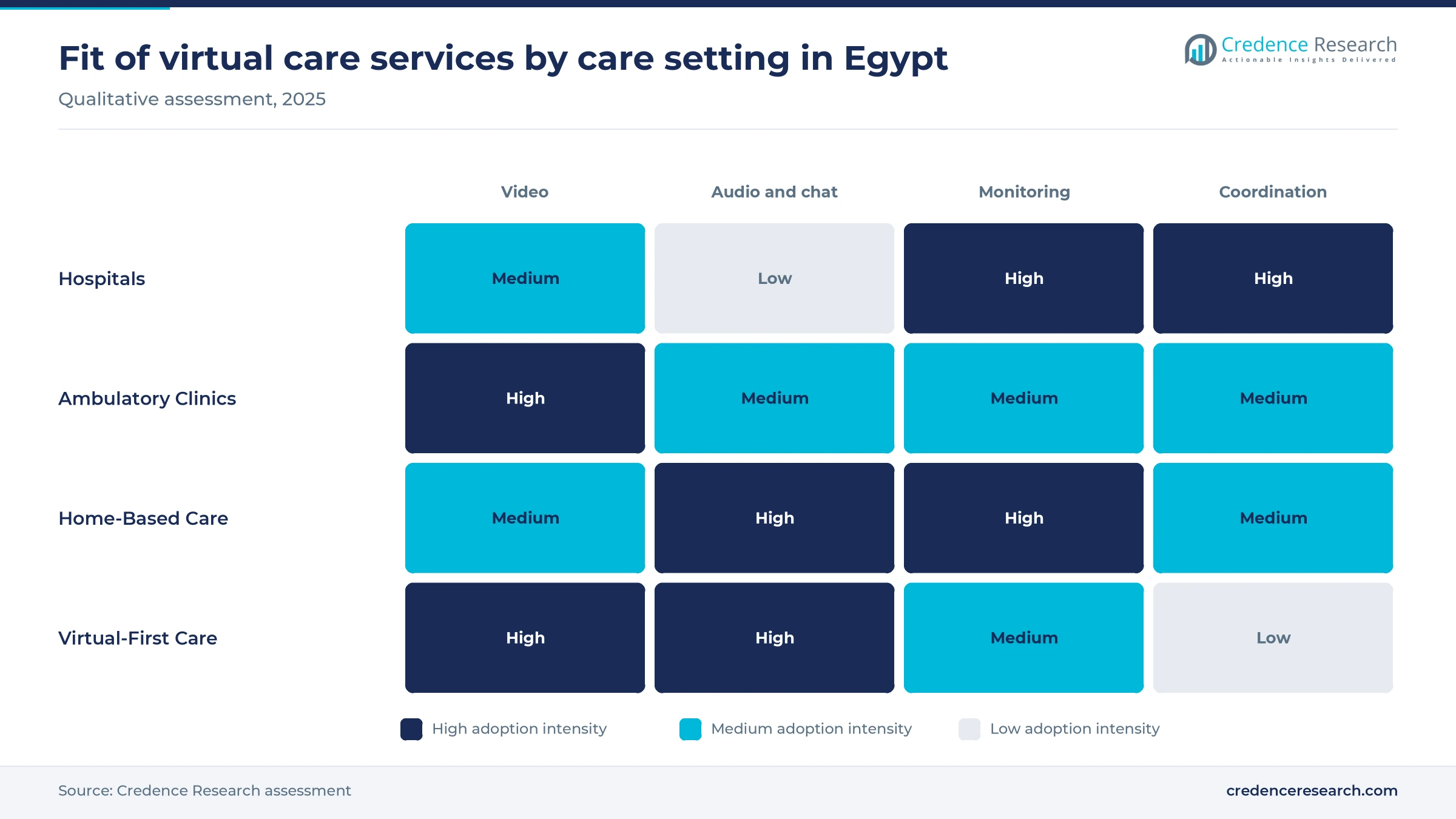
Based on service type, the market is categorized into video teleconsultation, audio and chat consultation, remote patient monitoring and digital care coordination. Audio and Chat Consultation led with 34.0% of 2025 value because patients reach doctors cheaply by phone, and Altibbi, which runs a dial-a-doc hotline in Egypt, reported 4.5 million consultations and 1,500 doctors when it raised USD 44 million in March 2022, according to Cairoscene. Remote patient monitoring grows fastest at 16.6% a year as the Ismailia virtual hospital adds 27 digitally connected cardiology units. Monitoring contracts therefore favor vendors that can supply devices and nurse review together.
Primary care leads while second opinions grow fastest
Based on application, the market is categorized into chronic disease management, primary and follow-up care, mental health and behavioral care and specialist second opinions. Primary and Follow-Up Care led with 38.0% of 2025 value because Egypt had only 6.7 doctors per 10,000 people in 2020 against a global average of 17, according to Egyptian Streets, so short virtual visits fill routine gaps. Specialist Second Opinions grow fastest at 16.3% a year as the Egypt Healthcare Authority launched a platform on Sept. 14, 2025, that links Egyptian doctors working abroad with patients in insurance governorates. Platforms with specialist rosters can price these consultations well above general practice.
Households pay most, but public programs grow fastest
Based on end user, the market is categorized into patients and caregivers, healthcare providers, health insurers and TPAs and corporate and government programs. Patients and Caregivers led with 47.0% of 2025 value because the World Health Organization estimated that more than 57% of Egyptian health spending was paid out of pocket in 2023, as cited by Human Rights Watch in January 2026. Corporate and Government Programs grow fastest at 16.6% a year as the restructured World Bank universal insurance project now sets targets for one public and one private telemedicine service provider. Vendors that pass public tenders gain a volume base that consumer apps cannot match.
Consumer apps lead while pharmacy links grow fastest
Based on distribution channel, the market is categorized into direct-to-consumer platforms, provider-embedded portals, insurer and employer channels and pharmacy and diagnostic integrations. Direct-to-Consumer Platforms led with 41.0% of 2025 value because most Egyptians already go online by phone, as the mobile data figures in the drivers show, so apps reach patients without a clinic visit. Pharmacy and Diagnostic Integrations grow fastest at 16.5% a year as Yodawy fulfils nearly 200,000 prescriptions a month through 3,000 pharmacies in 30 cities, according to The Condia. Consultations tied to refills keep chronic patients on one platform.
| Segment Group | Leading Sub-segment | Share, 2025 | Fastest-growing Sub-segment | CAGR, 2026–2035 |
|---|---|---|---|---|
| By Service Type | Audio and Chat Consultation | 34.0% | Remote Patient Monitoring | 16.6% |
| By Application | Primary and Follow-Up Care | 38.0% | Specialist Second Opinions | 16.3% |
| By End User | Patients and Caregivers | 47.0% | Corporate and Government Programs | 16.6% |
| By Distribution Channel | Direct-to-Consumer Platforms | 41.0% | Pharmacy and Diagnostic Integrations | 16.5% |
Doctors set low fees while insurers pay per member
Pricing on consumer platforms is set by each doctor, and the platform earns a booking or service fee on top. Vezeeta lists general practice teleconsultations from EGP 50 to EGP 400 and cardiology calls from EGP 30 to EGP 400, so a typical visit costs only a few U.S. dollars. Annual urban inflation of 13.9% in April 2025, according to Reuters figures cited by Egyptian Streets, pushes doctors to raise fees faster than patients can absorb. Insurer and employer contracts are priced per member and monitoring programs per patient month, which gives platforms steadier income and higher margins than single calls.
| Offer or segment | Typical price or fee | Basis |
|---|---|---|
| General practice teleconsultation | EGP 50–400 per call, median about EGP 110 | Vezeeta listing, November 2026 |
| Cardiology teleconsultation | EGP 30–400 per call, median about EGP 230 | Vezeeta listing, November 2026 |
| Insurer or employer telehealth benefit | EGP 30–80 per member per month | Credence Research estimate from listed fees and usage rates |
| Remote patient monitoring program | EGP 600–1,500 per patient per month | Credence Research estimate from device costs and nurse review time |
Request a Free Sample
Fill in your details and we'll send you a free sample report.
- Sample data tables & charts
- Research methodology
Broadband, state programs and diabetes widen virtual care
Mobile broadband now reaches most Egyptian adults
Wider mobile data access is the first condition for virtual care outside clinic hours, and Egypt now has it at national scale. Egypt counted 92.6 million mobile internet users in December 2025, 75.3% of mobile subscribers, according to the Information and Decision Support Center, a base that widens demand for app-based care. Fixed broadband subscriptions rose to about 12.7 million from 11.6 million a year earlier. Vodafone Egypt, Orange Egypt, e& Egypt and Telecom Egypt switched on 5G on June 4, 2025, after a USD 675 million license round in October 2024, according to Egyptian Streets. Stable video and device data links lift the share of consultations that can move beyond voice calls. Vendors that rely on voice today can add video and device data without waiting for new networks.
State strategy turns digital health into public policy
Egypt has moved digital health from pilot projects into formal government programs, which gives platforms public buyers and standards. Health Minister Khaled Abdel Ghaffar announced the National Digital Health Strategy 2025–2029 in Cairo in November 2025, aiming at unified, interoperable patient data across facilities. The Egyptian Drug Authority discussed its digital prescription project with Fixed Egypt and Health Flow on Oct. 29, 2025, to link doctors, pharmacists and patients on one platform. On July 13, 2026, the Ministry of Health and Population reviewed wider remote consultations and home care with Novartis and TeleMed, according to Daily News Egypt. Public programs become a second buyer next to households, which favors vendors that already meet authority standards.
Diabetes and heart disease need continuous follow-up
Chronic conditions create repeat consultations, refills and monitoring that suit virtual care better than one-off visits. The International Diabetes Federation counts 13.2 million Egyptian adults with diabetes in 2024, an age-standardized prevalence of 22.4%, and 62.0% of them are undiagnosed. Noncommunicable diseases cause 82% of all deaths in Egypt, according to the World Health Organization regional office. Diabetes-related health spending reached USD 3,104.0 million in 2024, according to the same federation, which shows money already flowing to this care. Each diagnosed patient needs glucose, blood pressure and medicine reviews several times a year. Monitored programs give platforms recurring revenue per patient, which single paid consultations cannot provide.
Doctor emigration pushes care onto virtual channels
Egypt trains doctors but loses many of them, which leaves provincial hospitals short and makes remote access to specialists more valuable. Only 38% of doctors licensed in Egypt work in the country, according to Egyptian Medical Syndicate figures cited by Egyptian Streets in May 2025, which shifts demand toward remote access. Nearly 7,000 doctors left Egypt for jobs abroad in 2023 alone, according to the head of the same syndicate. About 9,000 doctors graduate each year, and the Ministry of Health says more than 60% of them seek work abroad. Virtual consultations let one specialist in Cairo or overseas serve patients across several governorates. Specialist Second Opinions grow at 16.3% a year as this gap widens.
Hybrid clinics, AI tools and insurer channels reshape supply
Platforms shift from pure apps to hybrid clinic networks
The leading consumer platform is adding physical care sites, a sign that online booking alone does not cover costs. Upwyde Developments signed an agreement with Vezeeta to operate an integrated medical facility in the Prk Vie project in New Cairo, with outpatient clinics bookable through Vezeeta, according to Launchbase Africa in April 2026. The same publisher reports that high no-show rates pushed the move. Its listing still showed 102 cardiologists offering phone or video consultations in November 2026, at the low fees shown in the pricing table. Hybrid sites let platforms keep follow-up telehealth visits online while capturing in-person fees, so provider-embedded portals hold a stable share.
AI tools emerge inside consultations and imaging
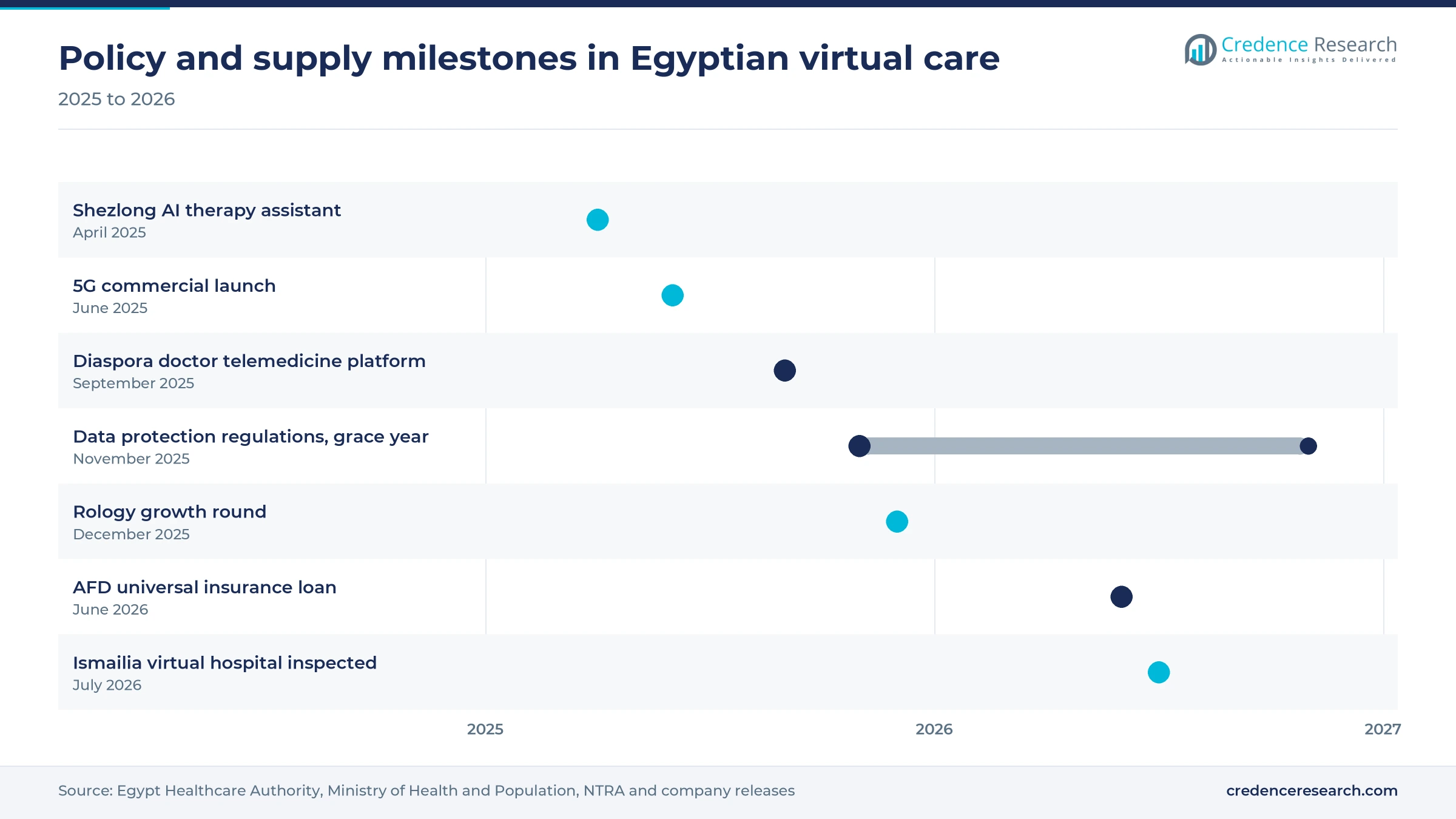
Egyptian vendors are adding artificial intelligence tools to triage, therapy and imaging, which raises the value of each virtual encounter. Shezlong launched an AI therapy assistant on April 29, 2025, that tracks emotional patterns, matches patients with therapists and supports them between sessions, according to Wamda. Rology, an Egyptian teleradiology company, closed a growth round led by the Philips Foundation on Dec. 1, 2025, and reports more than 300 hospitals in 13 countries and over 1.3 million radiology reports. The Ismailia virtual hospital noted above also includes AI-assisted triage. Vendors that combine software with clinician networks gain pricing power over single-call apps.
Opportunity in insurer and employer telehealth benefits
Private insurers offer a paying channel that removes the price ceiling set by out-of-pocket patients. Private medical insurance assets exceeded EGP 13 billion in 2025 after 15% annual growth, according to Amwal Al Ghad in November 2025, a payer base for telehealth demand. The Egypt Healthcare Authority chair also proposed a national digital platform linking insurers and providers at the same event. The Unified Insurance Law No. 195 of 2024 sets the legal base for that expansion. Yodawy already runs an e-prescription gateway with seven insurers and HMOs that issues more than 2,000 e-prescriptions a day. Platforms that bundle consultations with claims can win group contracts from employers and insurers.
Opportunity in the second universal insurance phase
The next universal health insurance phase opens five more governorates to digitally linked public care, a large tender pipeline for platforms. Phase 2 adds demand from about 12 million to 13 million beneficiaries in Minya, Matrouh, Damietta, Kafr El Sheikh and North Sinai, according to EnterpriseAM in August 2026. A cabinet statement put coverage at 5.2 million people in November 2025, and the French development agency AFD signed a EUR 150 million policy loan in June 2026. Vendors that already meet authority standards in Phase 1 can bid for the new hospitals first. Upper Egypt, where Minya joins, stands to gain the most new public volume.
Thin public budgets, data rules and weak funding slow scale
Public health budgets stay well below the legal floor
Low public spending limits how many virtual care programs the state can fund each year. Egypt allocated EGP 245 billion to health in fiscal 2025/26, equal to 1.1% of GDP and 3.6% of government spending, against a constitutional floor of 3% of GDP, according to Human Rights Watch in January 2026. Public buyers ration new digital projects across ministries and hospitals as a result. Platforms should price public contracts in phases and tie payments to measured outcomes.
Data protection rules raise compliance costs in 2026
New personal data rules add licensing and staffing costs for platforms that hold health records. Egypt issued the executive regulations of its Personal Data Protection Law under Ministerial Decision No. 816/2025 on Nov. 1, 2025, with a one-year grace period, according to law firm CMS. The rules require data protection officers and licenses priced by activity and data volume. Smaller platforms carry the heaviest relative cost, so many will partner with larger hosts.
Medicine sale rules limit consultation-to-refill models
Rules on online medicine sales restrict how far platforms can link a consultation to a delivered prescription. Vezeeta and similar platforms previously faced criminal complaints tied to the ban on online medicine sales, according to Launchbase Africa in April 2026, while the Egyptian Drug Authority is rolling out a national track-and-trace system. Integrated refill models therefore depend on licensed pharmacy partners in every governorate. Platforms that route orders through registered pharmacies avoid the legal risk.
Investor caution leaves platforms short of growth capital
Weak investor sentiment limits the money available for marketing, devices and hiring. VNV Global cut the value of its Vezeeta stake by 23.8% in the first quarter of 2026, leaving it 78.6% below cost, and Vezeeta has not announced a major equity round in several years, according to Launchbase Africa. Platforms are being pushed toward profitable services sooner than their growth plans assumed. Insurer and pharmacy contracts give the steadiest cash flows in this setting.
Greater Cairo leads as insurance governorates grow fastest
Regional shares of spending on e-health and teleconsultation platforms are Credence Research estimates based on governorate population, private clinic density and the rollout of universal health insurance. Universal insurance rollout, not population alone, explains why the smaller Canal Zone and Upper Egypt outgrow the capital through 2035.
| Region | Value, 2025 (USD million) | Share, 2025 | CAGR, 2026–2035 |
|---|---|---|---|
| Cairo and Greater Cairo | 138.0 | 46.0% | 14.6% |
| Alexandria and Delta | 90.0 | 30.0% | 15.2% |
| Upper Egypt | 48.0 | 16.0% | 15.9% |
| Canal Zone and Sinai | 24.0 | 8.0% | 16.2% |
Cairo and Greater Cairo holds the largest share of spending
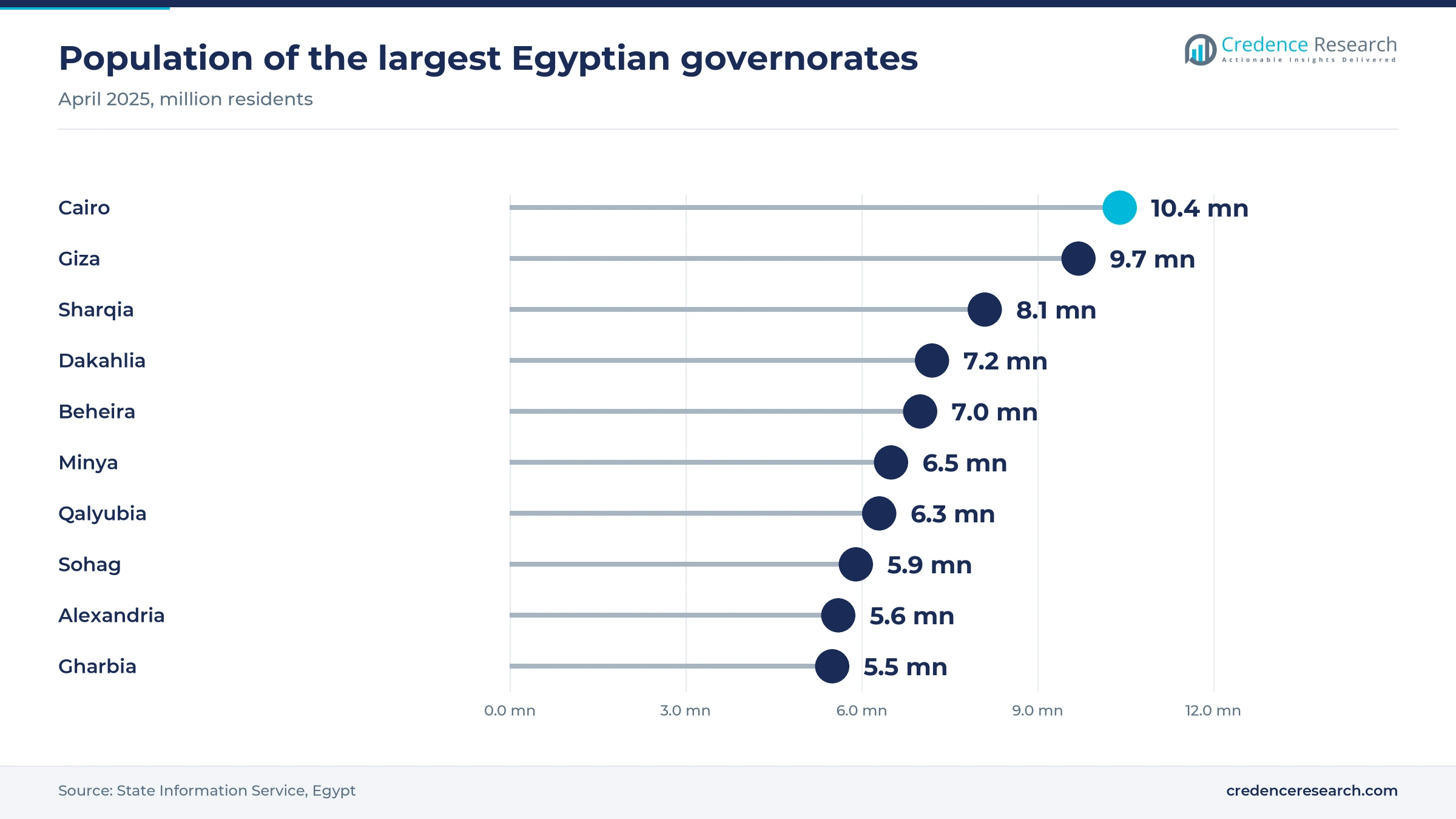
Cairo and Greater Cairo held 46.0% of 2025 value and grows at 14.6% a year. Cairo had 10.4 million residents, Giza 9.7 million and Qalyubia 6.3 million in April 2025, according to the State Information Service, and the zone concentrates private clinics, insurers and platform headquarters. The hybrid clinic model noted above starts here, in New Cairo. Growth is slower than in the insurance governorates because many urban patients already use apps, so suppliers compete mainly on specialist depth and insurer links.
Alexandria and the Delta carry a large patient base
Alexandria and Delta held 30.0% of 2025 value and grows at 15.2% a year. Sharqia had 8.1 million residents, Dakahlia 7.2 million, Beheira 7.0 million and Alexandria 5.6 million in April 2025, according to the State Information Service. Specialist access is thinner here than in the capital, so consultations with Cairo-based doctors fill gaps. Damietta and Kafr El Sheikh join universal insurance in Phase 2, which brings public contracts into the zone and supports demand for monitoring and coordination tools.
Upper Egypt gains as insurance moves south
Upper Egypt held 16.0% of 2025 value and grows at 15.9% a year. Minya had 6.5 million residents and Sohag 5.9 million in April 2025, according to the State Information Service, yet both have far fewer private specialists than the capital. Luxor and Aswan already operate under universal insurance, and Minya joins in Phase 2. Virtual specialist consultations matter most here because patients face long trips to Cairo or Assiut. Public programs and insurers will pay for most of the new volume.
The Canal Zone and Sinai grows fastest on early digitization
Canal Zone and Sinai held 8.0% of 2025 value and grows fastest at 16.2% a year. Port Said piloted universal insurance in 2019, and the World Bank reported 3,353,072 people enrolled and empanelled in Phase 1 governorates in June 2025. Ismailia hosts the virtual hospital noted above, with remote intensive care and radiology units. The zone is small in population, but its hospitals are the most digitally connected in the country, which makes it the reference market for public telemedicine tenders.
State platforms and startup rounds, 2025 to 2026
| Development | Status and market relevance |
|---|---|
| In July 2026, the Egypt Healthcare Authority inspected a virtual hospital in Ismailia with nine virtual clinics and four remote intensive care units. | Ahead of opening; sets the model for public telemedicine |
| In December 2025, Rology closed a growth round led by the Philips Foundation to expand AI-supported teleradiology. | Closed; strengthens remote imaging capacity |
| In November 2025, Egypt issued the executive regulations of its Personal Data Protection Law under Ministerial Decision No. 816/2025. | In force; compliance due within one year |
| In September 2025, the Egypt Healthcare Authority launched a telemedicine platform linking Egyptian doctors abroad with patients at home. | Live; focused on universal insurance governorates |
| In April 2025, Shezlong launched an AI therapy assistant for patient matching and support between sessions. | Rolling out; raises the value of online therapy |
Cloud platforms carry volume as device links mature
- Cloud-based telehealth platforms carry most consultation volume, with app and web booking, phone and video calls and e-prescriptions running on hosted infrastructure.
- AI-enabled clinical support is moving into triage, therapy matching and imaging reads, led by local developers in mental health and teleradiology.
- EHR and HIE integration is still early, since the World Bank reports that the provider and claims modules of the universal insurance information system have not been rolled out, and links to electronic medical records remain hospital by hospital.
- Connected device and IoT stack links glucose meters, blood pressure cuffs and cardiac monitors to remote review, a use that 5G networks and the Ismailia cardiology units support.
Need a Custom Version of This Report?
Tailor the scope, geography, or segments to your exact requirements.
- Custom geography or segment scope
- Direct access to our analyst team
Local startups compete with state telemedicine programs
Competition among Egyptian teleconsultation platforms runs on two separate tracks. Consumer platforms such as Vezeeta and Altibbi compete on doctor rosters, low call fees and app reach, while Yodawy and Chefaa compete on pharmacy networks and insurer integration for chronic refills. Shezlong leads online therapy, and Rology supplies remote radiology reads to hospitals. The second track is public, where the Egypt Healthcare Authority runs its own telemedicine services and buys systems for universal insurance hospitals. Private vendors win there by meeting authority standards rather than by marketing. Price competition on single consultations is intense, so the stronger companies are moving toward contracts with insurers, employers and hospital groups. Capital is a constraint, which favors firms with recurring revenue and partnerships with telecom operators or pharmaceutical companies.
How is the supply side organized?
Supply is split between a handful of venture-backed local platforms and state programs run by the Egypt Healthcare Authority and the Ministry of Health. Consumer booking and consultation is concentrated in a few apps, while pharmacy links, mental health and teleradiology each have one or two specialists. Entry barriers are low for a basic app but high for insurer integration, licensed pharmacy networks and public tenders, which require data compliance and hospital links. Margins sit with platforms that own payer contracts and recurring refills, not with single paid calls.
Companies active in Egyptian virtual care
| Company | Type | Role in the market |
|---|---|---|
| Vezeeta | Consumer platform | Doctor search, booking, teleconsultation and hybrid clinic sites in New Cairo |
| Altibbi | Consumer platform | Phone and chat consultations through a dial-a-doc hotline in Egypt |
| Yodawy | Pharmacy and insurer platform | E-prescription gateway and chronic refill delivery through 3,000 pharmacies |
| Chefaa | Pharmacy platform | Pharmacy benefits and treatment adherence for patients in Egypt and Saudi Arabia |
| Shezlong | Mental health platform | Online therapy with an AI assistant launched in 2025 |
| Rology | Teleradiology provider | AI-supported remote radiology reads for hospitals |
Payer contracts, not app downloads, decide the next phase
Credence Research's view is that Egyptian e-health and teleconsultation platforms will be decided by payer contracts rather than by app downloads. Consumer consultations are cheap and price competition keeps margins thin, so the growth that matters comes from universal insurance hospitals, private insurers and chronic care programs. Because Vezeeta lists most calls at a few U.S. dollars, Egyptian vendors in the wider telemedicine industry need scale and recurring revenue more than higher fees. Companies that combine a doctor network, licensed pharmacy partners and compliant data handling are best placed to win the Phase 2 tenders and group insurance contracts expected from 2027.
Values built from health spending, fees and program counts
The report uses 2025 as the base year and forecasts to 2035. Market values come from the Credence Research model, which combines public health spending, out-of-pocket shares, listed consultation fees and counts of public telemedicine programs and insured members. Segment and regional splits are Credence Research estimates based on governorate populations, insurance rollout and company disclosures. Sources include the World Bank, the World Health Organization, the International Diabetes Federation, Egyptian government statements, company releases and named news publishers. No interviews or surveys were used to build these market estimates.
Monitoring and insurer-paid care gain share to 2035
Through 2035, spending on e-health and teleconsultation platforms grows from USD 345.5 million in 2026 to USD 1.23 billion, and its mix moves away from single consumer calls toward monitored chronic care and payer-funded programs. Remote patient monitoring and corporate and government programs gain the most share as universal insurance reaches more governorates and diabetes care moves online. Cairo and Greater Cairo remains the largest zone, but the insurance governorates close part of the gap. Data protection compliance and pharmacy partnerships become standard requirements, which favors established platforms over new entrants.
Payer adoption sets the range of outcomes to 2035
The spread between cases depends mainly on who pays for virtual care. If universal insurance moves through Phase 2 on schedule and private insurers adopt a shared digital platform, paid volumes shift from households to payers and growth runs above the base case. If public budgets stay near 1.1% of GDP and currency weakness keeps fees low, platforms grow mainly through consumer calls and the market tracks the downside.
| Scenario | CAGR, 2026–2035 | Value, 2035 | What has to hold |
|---|---|---|---|
| Downside | 12.2% | USD 970.4 million | Phase 2 slips, investor funding stays scarce and household fees fail to keep pace with inflation |
| Base | 15.16% | USD 1.23 billion | Phase 2 starts in stages, insurers add telehealth benefits and pharmacy integration expands steadily |
| Upside | 17.7% | USD 1.49 billion | A national insurer platform launches, Phase 2 runs on time and monitoring programs reach most diagnosed diabetics |
Frequently Asked Questions
How big is the Egypt e-health and teleconsultation platforms market?
Which service type leads the market?
Which region holds the largest share?
What is driving demand for virtual care in Egypt?
How much does a teleconsultation cost in Egypt?
What role does universal health insurance play?
What are the main challenges for platforms?
Which companies are active in the market?
Table of Content
Chapter 1 Market Segmentation
- 1.1 Segmentation Framework
- 1.1.1 Product and Service Classification
- 1.1.2 Application and End-Use Classification
- 1.1.3 Technology and Solution Classification
- 1.1.4 Customer and Distribution Channel Classification
- 1.1.5 Geographic Segmentation
- 1.1.6 Market Segment Definitions and Boundaries
- 1.2 By Service Type
- 1.2.1 Video Teleconsultation
- 1.2.2 Audio and Chat Consultation
- 1.2.3 Remote Patient Monitoring
- 1.2.4 Digital Care Coordination
- 1.3 By Application
- 1.3.1 Chronic Disease Management
- 1.3.2 Primary and Follow-Up Care
- 1.3.3 Mental Health and Behavioral Care
- 1.3.4 Specialist Second Opinions
- 1.4 By End User
- 1.4.1 Patients and Caregivers
- 1.4.2 Healthcare Providers
- 1.4.3 Health Insurers and TPAs
- 1.4.4 Corporate and Government Programs
Chapter 2 Introduction
- 2.1 Report Objectives and Scope
- 2.2 Product Definition and Industry Terminology
- 2.3 Market Inclusions and Exclusions
- 2.4 Research Process
- 2.4.1 Primary Research and Expert Interviews
- 2.4.2 Secondary Research and Source Review
- 2.4.3 Top-Down and Bottom-Up Estimation
- 2.4.4 Data Triangulation and Verification
- 2.5 Market Size Measurement Basis
- 2.5.1 2025: USD 300.0 million → 2035: USD 1.23 billion
- 2.6 Historical and Forecast Reference Periods
- 2.6.1 Historical Period: 2018-2025
- 2.6.2 Base Year: 2025
- 2.6.3 Forecast Period: 2025-2035
- 2.7 Research Assumptions and Limitations
Chapter 3 Executive Summary
- 3.1 Market Snapshot and Key Findings
- 3.2 Base-Year Market Size, 2025
- 3.3 Forecast Market Size, 2035
- 3.4 Revenue and Volume Growth Outlook
- 3.5 Key Demand and Supply Indicators
- 3.6 Leading Market Segments
- 3.7 Fastest-Growing Market Opportunities
- 3.8 Regional Performance Highlights
- 3.9 Technology and Industry Transformation
- 3.10 Competitive Landscape Summary
- 3.11 Analyst View and Strategic Implications
Chapter 4 Egypt E-Health and Teleconsultation Platforms Market Trends and Developments
- 4.1 Historical Industry Development, 2018-2025
- 4.2 Recent Market Trends and Developments
- 4.3 Demand and Customer Behavior Trends
- 4.4 Technology and Product Innovation
- 4.5 Artificial Intelligence, Automation and Digitalization
- 4.6 Local Manufacturing and Supply Chain Realignment
- 4.7 Industry Partnerships, Mergers and Acquisitions
- 4.8 Sustainability and Circular Economy Developments
- 4.9 Government and Private Sector Investment Trends
- 4.10 Emerging Business Models and Commercialization
- 4.11 Industry Developments and Announcements
Chapter 5 Egypt E-Health and Teleconsultation Platforms Market Production, Supply and Demand Analysis
- 5.1 Demand Trend and Consumption Analysis, 2018-2025
- 5.2 Demand Forecast, 2025-2035
- 5.3 Production and Output Trend, 2018-2025
- 5.4 Production and Output Forecast, 2025-2035
- 5.5 Installed Capacity and Capacity Utilization
- 5.6 Company-Wise Production Plants and Statistics
- 5.6.1 Installed Production Capacity
- 5.6.2 Actual Production
- 5.6.3 Planned Capacity and Expansion Targets
- 5.7 Supply Chain Structure and Procurement Trends
- 5.8 Supply-Demand Gap and Bottlenecks
- 5.9 Import Dependence and Sourcing Structure
- 5.10 Contract Manufacturing and Outsourcing
- 5.11 Regional Supply and Demand Concentration
Chapter 6 Egypt E-Health and Teleconsultation Platforms Market Pricing Analysis
- 6.1 Pricing Structure and Measurement
- 6.2 Historical Pricing Trends, 2018-2025
- 6.3 Pricing Outlook, 2025-2035
- 6.4 Average Selling Price and Unit Economics
- 6.5 Pricing by Product and Market Segment
- 6.6 Geographic Pricing Differences
- 6.7 Key Input, Energy, Labor and Logistics Costs
- 6.8 Contract Pricing and Purchasing Models
- 6.9 Pricing Sensitivity and Competitive Positioning
- 6.10 Price, Margin and Profitability Implications
Chapter 7 Egypt E-Health and Teleconsultation Platforms Market Dynamics
- 7.1 Market Growth Drivers
- 7.1.1 Demand-Side Drivers
- 7.1.2 Technology and Innovation Drivers
- 7.1.3 Infrastructure and Investment Drivers
- 7.1.4 Regulatory and Policy Drivers
- 7.2 Market Restraints
- 7.2.1 Cost and Affordability Constraints
- 7.2.2 Technology and Adoption Barriers
- 7.2.3 Supply Chain and Operational Constraints
- 7.3 Market Challenges
- 7.3.1 Competitive Pressure and Margin Erosion
- 7.3.2 Skills, Infrastructure and Implementation Gaps
- 7.4 Emerging Market Opportunities
- 7.5 Market Dynamics Impact and Time-Horizon Assessment
Chapter 8 Egypt E-Health and Teleconsultation Platforms Value Chain Analysis
- 8.1 Industry Value Chain Overview
- 8.2 Upstream Suppliers and Critical Inputs
- 8.3 Technology and Component Providers
- 8.4 Manufacturing or Service Delivery
- 8.5 Distribution, Channel Partners and Integrators
- 8.6 Downstream Applications and End Users
- 8.7 Value Addition and Profit Pools
- 8.8 Vertical Integration and Outsourcing
- 8.9 Supplier Concentration and Risk
- 8.10 Supply Chain Localization and Resilience
Chapter 9 Egypt E-Health and Teleconsultation Platforms Market Regulations and Policies
- 9.1 Relevant Laws, Standards and Compliance Frameworks
- 9.2 Product, Service, Safety and Quality Requirements
- 9.3 Government Policies, Incentives and Subsidies
- 9.4 Imports, Exports and Trade Barriers
- 9.5 Public Procurement and Local Content Requirements
- 9.6 Environmental and Sustainability Compliance
- 9.7 Upcoming Policy Changes and Market Implications
Chapter 10 Egypt E-Health and Teleconsultation Platforms Market Hotspots and Opportunities
- 10.1 Market Opportunity Mapping and Growth Hotspots
- 10.2 High-Growth Applications and Customer Groups
- 10.3 Underserved Markets and White-Space Opportunities
- 10.4 Emerging Technology and Product Opportunities
- 10.5 New Capacity and Investment Hotspots
- 10.6 Market Entry and Expansion Opportunities
- 10.7 Distribution and Partnership Opportunities
- 10.8 Near-Term and Long-Term Commercial Potential
- 10.9 Opportunity Attractiveness and Execution Risks
Chapter 11 Egypt E-Health and Teleconsultation Platforms Market Outlook, 2025-2035
- 11.1 Market Size and Analysis
- 11.1.1 Revenue (Market Measurement: 2025: USD 300.0 million → 2035: USD 1.23 billion)
- 11.1.2 Market Volume and Quantity Sold
- 11.1.3 Historical Market Size, 2018-2025
- 11.1.4 Base-Year Market Size, 2025
- 11.2 Market Forecast, 2025-2035
- 11.2.1 Revenue Forecast to 2035
- 11.2.2 Volume Forecast to 2035
- 11.2.3 CAGR and Year-on-Year Growth
- 11.2.4 Incremental Revenue Opportunity
- 11.3 Forecast Assumptions and Scenario Analysis
- 11.3.1 Base-Case Forecast
- 11.3.2 Optimistic and Conservative Scenarios
- 11.3.3 Technology, Pricing and Policy Sensitivities
- 11.4 Market Attractiveness and Growth Outlook
Chapter 12 Egypt E-Health and Teleconsultation Platforms Market Segmentation and Outlook
- 12.1 Segmentation Summary and Market Shares, 2025
- 12.2 Largest and Fastest-Growing Segments
- 12.3 By Service Type - Market Size and Forecast, 2025-2035
- 12.3.1 Segment Definition and Scope
- 12.3.2 Historical Market Size, 2018-2025
- 12.3.3 Revenue Forecast, 2025-2035
- 12.3.4 Volume Forecast, 2025-2035
- 12.3.5 Base-Year Market Share, 2025
- 12.3.6 Segment CAGR and Growth Drivers
- 12.3.7 Subsegment Market Size and Forecast
- 12.3.7.1 Video Teleconsultation
- 12.3.7.2 Audio and Chat Consultation
- 12.3.7.3 Remote Patient Monitoring
- 12.3.7.4 Digital Care Coordination
- 12.3.8 Subsegment Pricing and Adoption Trends
- 12.3.9 Leading Suppliers and Competition
- 12.3.10 Regional Demand and Opportunities
- 12.4 By Application - Market Size and Forecast, 2025-2035
- 12.4.1 Segment Definition and Scope
- 12.4.2 Historical Market Size, 2018-2025
- 12.4.3 Revenue Forecast, 2025-2035
- 12.4.4 Volume Forecast, 2025-2035
- 12.4.5 Base-Year Market Share, 2025
- 12.4.6 Segment CAGR and Growth Drivers
- 12.4.7 Subsegment Market Size and Forecast
- 12.4.7.1 Chronic Disease Management
- 12.4.7.2 Primary and Follow-Up Care
- 12.4.7.3 Mental Health and Behavioral Care
- 12.4.7.4 Specialist Second Opinions
- 12.4.8 Subsegment Pricing and Adoption Trends
- 12.4.9 Leading Suppliers and Competition
- 12.4.10 Regional Demand and Opportunities
- 12.5 By End User - Market Size and Forecast, 2025-2035
- 12.5.1 Segment Definition and Scope
- 12.5.2 Historical Market Size, 2018-2025
- 12.5.3 Revenue Forecast, 2025-2035
- 12.5.4 Volume Forecast, 2025-2035
- 12.5.5 Base-Year Market Share, 2025
- 12.5.6 Segment CAGR and Growth Drivers
- 12.5.7 Subsegment Market Size and Forecast
- 12.5.7.1 Patients and Caregivers
- 12.5.7.2 Healthcare Providers
- 12.5.7.3 Health Insurers and TPAs
- 12.5.7.4 Corporate and Government Programs
- 12.5.8 Subsegment Pricing and Adoption Trends
- 12.5.9 Leading Suppliers and Competition
- 12.5.10 Regional Demand and Opportunities
- 12.6 Segment Growth Comparison
- 12.7 Segment Attractiveness and Priority Matrix
Chapter 13 Egypt E-Health and Teleconsultation Platforms End-Use and Application Market Outlook
- 13.1 End-Use Industry and Customer Demand Structure
- 13.2 Leading Applications and Customer Groups
- 13.3 End-Use Market Size, Share and Forecast
- 13.4 Major End-Use Industry Deep Dives
- 13.4.1 Customer Requirements and Use Cases
- 13.4.2 Demand and Replacement Cycles
- 13.4.3 Technical and Regulatory Considerations
- 13.4.4 Purchasing and Procurement Models
- 13.4.5 Leading Vendors and Distribution Channels
- 13.4.6 Forecast and Commercial Opportunities
- 13.5 Emerging Applications and Cross-Segment Demand
- 13.6 End-Use Industry Investment Priorities
Chapter 14 Egypt E-Health and Teleconsultation Platforms Geographic Market Outlook, 2025-2035
- 14.1 Domestic Market Distribution and Demand Clusters
- 14.2 State- or Province-Wise Market Size and Forecast, 2025-2035
- 14.3 City and Metropolitan Market Outlook
- 14.4 Industrial, Manufacturing and Commercial Clusters
- 14.5 Geographic Concentration of Key End Users
- 14.6 Local Pricing and Purchasing Differences
- 14.7 Domestic Production Facilities and Capacity Map
- 14.8 Local Infrastructure and Project Pipeline
- 14.9 State-Level Policy and Incentive Differences
- 14.10 Subnational Investment Hotspots and Opportunities
- 14.11 Distribution and Logistics Networks
- 14.12 Domestic Competitive Footprint
Chapter 15 Egypt E-Health and Teleconsultation Platforms Technology, Innovation and Sustainability Outlook
- 15.1 Technology Landscape and Maturity
- 15.2 Product, Process and Service Innovation
- 15.3 AI, Automation and Digital Tools in the Industry
- 15.4 Technology Adoption and Performance Benchmarking
- 15.5 Innovation Pipeline and R&D Investment
- 15.6 Patent and Intellectual Property Trends
- 15.7 Energy Efficiency and Resource Management
- 15.8 Sustainability, Recycling and Circularity
- 15.9 Technology Roadmap, 2025-2035
- 15.10 Risks of Obsolescence and Technology Substitution
Chapter 16 Egypt E-Health and Teleconsultation Platforms Market Key Strategic Imperatives
- 16.1 Growth and Market Entry Priorities
- 16.2 High-Return Products and Segments
- 16.3 Pricing, Profitability and Cost Optimization
- 16.4 Technology Investment and Product Differentiation
- 16.5 Supply Chain Localization and Resilience
- 16.6 Distribution and Customer Acquisition
- 16.7 Partnership, Acquisition and Capacity Strategy
- 16.8 Regional Expansion Priorities
- 16.9 Short-, Medium- and Long-Term Actions
Chapter 17 Competition Outlook
- 17.1 Industry Competition Characteristics
- 17.2 Market Structure and Concentration
- 17.3 Market Share and Competitive Positioning, 2025
- 17.4 Company-Wise Revenue and Product Benchmarking
- 17.5 Production and Service Capacity Benchmarking
- 17.6 Technology, Pricing and Differentiation
- 17.7 Regional Footprint and Distribution Strength
- 17.8 Mergers, Acquisitions and Strategic Alliances
- 17.9 New Entrants and Competitive Threats
- 17.10 Porter's Five Forces and Industry Attractiveness
- 17.11 Competitive Outlook, 2025-2035
Chapter 18 Company Profiles
- 18.1 Company Coverage and Selection Criteria
- 18.2 Vezeeta
- 18.2.1 Business Description
- 18.2.2 Company Ownership and Geographic Presence
- 18.2.3 Product and Service Portfolio
- 18.2.4 Manufacturing and Operating Footprint
- 18.2.5 Production Capacity and Expansion Plans
- 18.2.6 Financial Performance and Investment
- 18.2.7 Market Share and Competitive Position
- 18.2.8 Technology and Innovation Capabilities
- 18.2.9 Strategic Alliances or Partnerships
- 18.2.10 Recent Developments
- 18.2.11 Growth Strategy and Outlook
- 18.3 Estshara
- 18.4 Shezlong
- 18.5 Yodawy
- 18.6 Chefaa
- 18.7 Altibbi
- 18.8 CliniDo
- 18.9 Rology
- 18.10 eHealth
- 18.11 MedMisr
- 18.12 Other Relevant Market Participants
Note: Every listed company is profiled on the structure shown under the first company. The company list is preliminary and may change based on research findings, market developments, data availability and client requirements.
Chapter 19 Disclaimer
- 19.1 Research and Forecast Disclaimer
- 19.2 Data Source and Estimation Limitations
Note: The depth of individual sections depends on data availability for this market. Volume, capacity, trade and other unit-based metrics are included where applicable.

