Rising incomes and lower duties widen premium buying
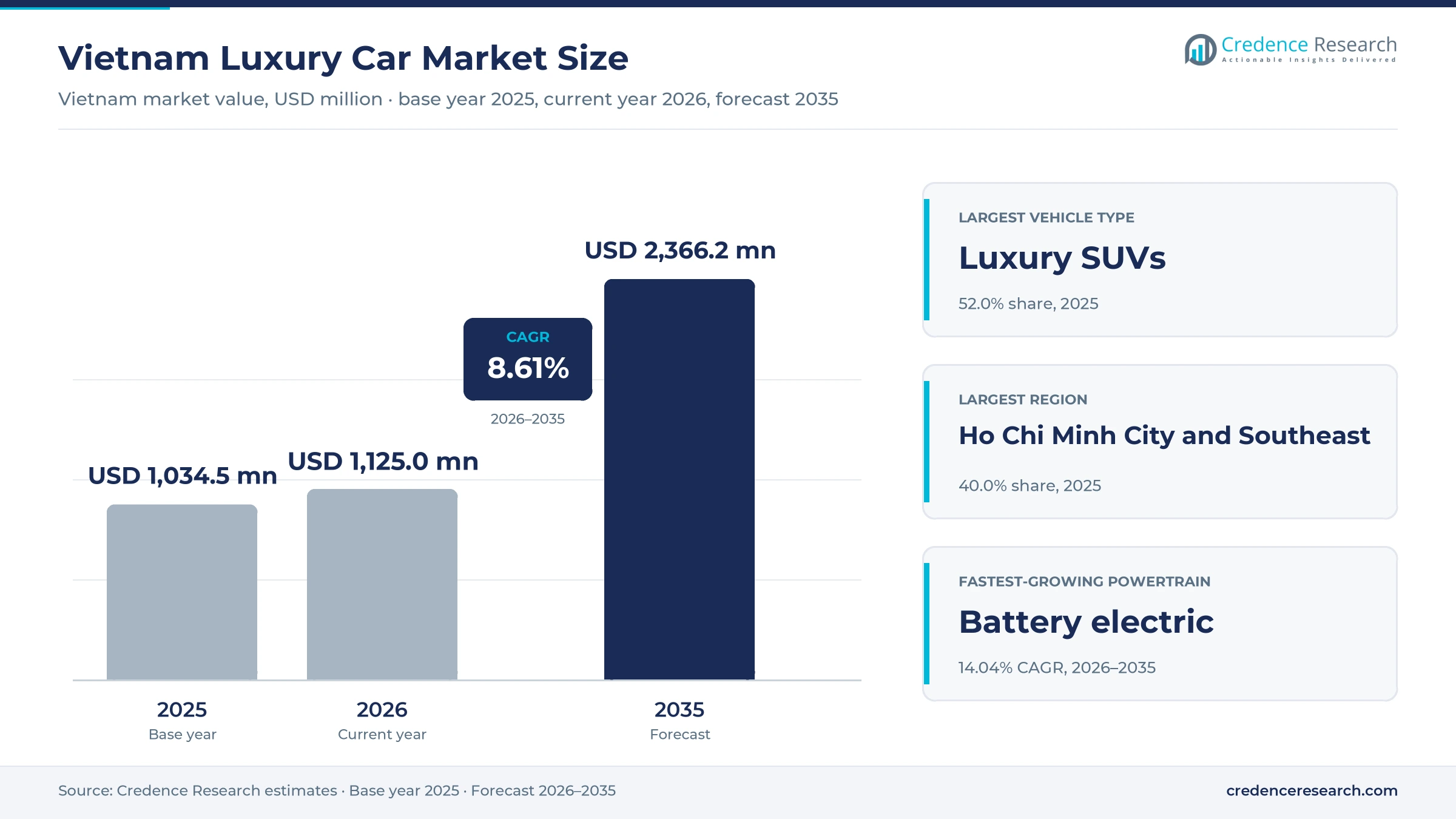
The Vietnam luxury car market was valued at USD 1.03 billion in 2025 and is projected to increase from USD 1.12 billion in 2026 to USD 2.37 billion by 2035, registering a CAGR of 8.61% during 2026–2035. Demand comes from business owners, executives and affluent families in the largest cities who buy premium SUVs and sedans as incomes rise and import duties fall. Ho Chi Minh City and Southeast held the largest regional share, 40.0% in 2025, because the enlarged city produces about one-quarter of national output after its July 2025 merger. Central Coast and Da Nang is the fastest-growing region at 9.36% a year, as dealer networks reach new provincial buyers. In turn, the government cut import duties on several passenger vehicle lines in March 2025, which lowers landed costs for imported premium models.
Which premium vehicles does the Vietnam estimate count?
The estimate measures retail value of new premium passenger vehicles sold in Vietnam, including SUVs, sedans, performance coupes and MPVs from global premium brands. It counts sales through authorized dealerships, brand-owned experience centers, corporate and fleet channels, parallel importers and online lead platforms.
The estimate excludes used vehicles, mass-market models, commercial vehicles and after-sales parts and service. The value chain runs from global manufacturers and local assemblers through importers and dealer groups to private buyers, companies and hospitality operators.
Vietnam Luxury Car Market Insights
- The Vietnam luxury car market was valued at USD 1.03 billion in 2025 and is projected to reach USD 2.37 billion by 2035, registering a CAGR of 8.61% during 2026–2035.
- Ho Chi Minh City and Southeast held a 40.0% share of 2025 value, because the enlarged city produces about 23.5% of national GDP.
- Luxury SUVs led with a 52.0% share of 2025 value, because families and executives prefer high seating, space and rough-road comfort.
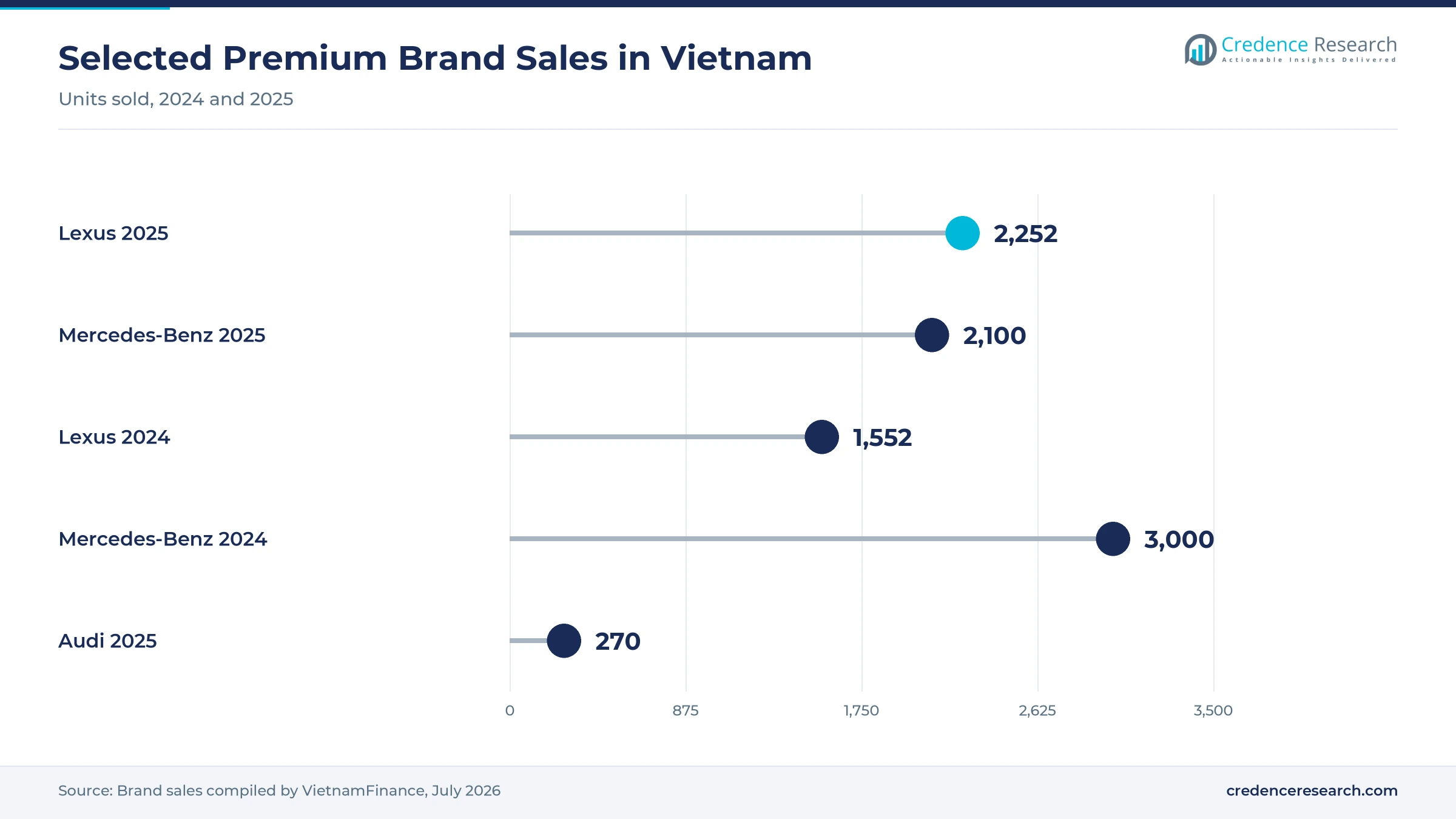
- Lexus sold 2,252 vehicles in Vietnam in 2025, up 700 units from 2024, while Mercedes-Benz sales fell for a third straight year.
- Battery electric models grow fastest at 14.04% a year during 2026–2035, as registration-fee exemptions now run through the end of 2030.
SUVs lead while electric models grow fastest
Why do premium SUVs lead vehicle value?
Based on vehicle type, the market is categorized into luxury SUVs, luxury sedans, performance coupes and luxury MPVs. Luxury SUVs led with a 52.0% share of 2025 value, because buyers want high seating, cabin space and comfort on mixed road surfaces. Luxury MPVs grow fastest at 9.49% a year, as executives and hotels choose chauffeur-driven people carriers.
How is the powertrain mix moving toward electrification?
Based on powertrain, the market is categorized into gasoline ICE, diesel ICE, hybrid, plug-in hybrid and battery electric models. Gasoline ICE led with a 74.0% share of 2025 value, because most best-selling premium sedans and SUVs still use gasoline engines. Battery Electric models grow fastest at 14.04% a year, as tax breaks and new charging points lower ownership costs.
Which buyers account for most premium purchases?
Based on customer type, the market is categorized into affluent private buyers, entrepreneurs and business owners, corporate executive fleets and chauffeur and hospitality operators. Affluent Private Buyers led with a 50.0% share of 2025 value, because rising household wealth drives personal purchases. Chauffeur and Hospitality Operators grow fastest at 9.17% a year, as hotels and resorts add VIP transport.
How do accessible and core premium tiers compare?
Based on price tier, the market is categorized into accessible luxury, core luxury, high luxury and ultra-luxury models. Core Luxury led with a 41.0% share of 2025 value, because mid-size sedans and SUVs from German and Japanese brands sell in the largest numbers. Accessible Luxury grows fastest at 9.07% a year, as first-time premium buyers enter with compact models.
| Segment Group | Leading Sub-segment | Share, 2025 | Fastest-growing Sub-segment | CAGR, 2026–2035 |
|---|---|---|---|---|
| By Vehicle Type | Luxury SUVs | 52.0% | Luxury MPVs | 9.49% |
| By Powertrain | Gasoline ICE | 74.0% | Battery Electric | 14.04% |
| By Customer Type | Affluent Private Buyers | 50.0% | Chauffeur and Hospitality Operators | 9.17% |
| By Price Tier | Core Luxury | 41.0% | Accessible Luxury | 9.07% |
Request a Free Sample
Fill in your details and we'll send you a free sample report.
- Sample data tables & charts
- Research methodology
Wealth, tariff cuts and electrification lift demand
How do affluent households and fast growth lift demand?
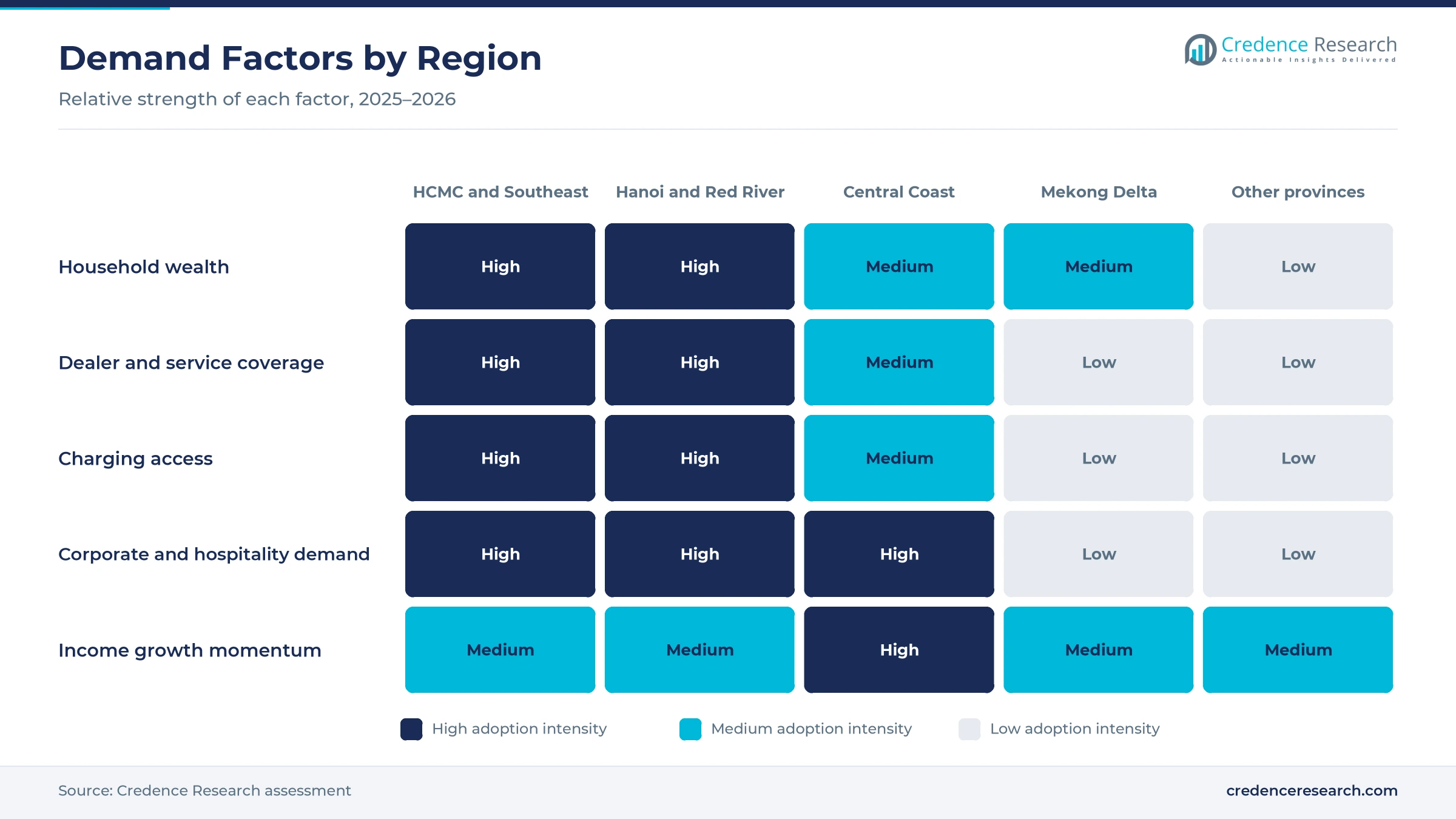
Affluent household and economic expansion drives demand, because more business owners and professionals now reach the income needed for premium vehicles. Vietnam's economy grew 8.02% in 2025, and GDP per capita reached USD 5,066, according to the World Bank. The population stood at 101.6 million in 2025, which gives the country one of the largest consumer bases in Southeast Asia. Hanoi reported GRDP per capita of VND 179.2 million, or USD 7,467, in 2025, up 10% from 2024. As a result, Ho Chi Minh City and Southeast leads regional value, because the wealthiest buyers cluster in the two largest urban regions.
Why does import-tariff normalization lower prices?
Import-tariff normalization lifts demand, because lower duties narrow the price gap between imported premium models and mass-market vehicles. The government issued Decree 73 on March 31, 2025, cutting most-favored-nation rates on some passenger vehicle lines from 64% to 50% and on certain sedans and four-wheel-drive models from 45% to 32%, according to Vietnam Briefing. Imported completely built-up vehicles reached 23,241 units in December 2025, close to the 23,826 locally assembled units, according to Viet Nam News. Members of the national automobile association sold 375,736 vehicles in 2025, up 10.5% on the year. In turn, high luxury and ultra-luxury imports become easier to price.
How do premium electrification and charging support sales?
Premium electrification and charging development drive demand, because tax breaks and new chargers make electric premium models practical for city buyers. The government extended the registration-fee exemption for battery electric vehicles through the end of 2030 under Decree 202, issued in June 2026, according to Tuoi Tre News. Mercedes-Benz brought the electric G 580 EQ to Vietnam in early April 2025, and Volvo launched the EC40 as its first all-electric model there in 2024. V-Green also reported more than 150,000 charging ports for electric cars and motorbikes nationwide in September 2025. As a result, battery electric models are the fastest-growing powertrain group through 2035.
Why does a broader brand mix widen the buyer pool?
A broader brand mix widens the buyer pool, because Japanese hybrids and locally assembled German models now compete with imported flagships at several price points. Lexus sold 2,252 vehicles in 2025, up from 1,552 in 2024, according to VietnamFinance. BMW sales grew to about 1,500 to 2,000 units a year during 2023 to 2025 after THACO took over distribution in 2018. Mercedes-Benz, by contrast, fell from about 3,000 units in 2024 to about 2,100 in 2025. In turn, accessible luxury grows fastest at 9.07% a year, as more brands offer compact premium models to first-time buyers.
Hybrid SUVs, electric flagships and chargers reshape sales
How is the shift toward hybrid SUVs changing brand rankings?
The shift toward hybrid SUVs is changing brand rankings, because buyers want lower fuel bills without depending on public chargers. Lexus, which sells many hybrid SUVs, outsold Mercedes-Benz in 2025 with 2,252 units against about 2,100. Mercedes-Benz sales declined for three consecutive years from about 3,200 units in 2023. Audi sold about 270 units in 2025, far below its record of 600 in 2013, which shows how quickly buyer preferences have moved away from traditional German sedans toward efficient hybrid models. As a result, luxury SUVs hold 52.0% of 2025 value, in line with wider premium SUV demand across Asia.
Why is the rise of electric flagships notable?
The rise of electric flagships is notable, because premium brands now use high-profile electric models to signal technology leadership. BMW introduced the i4 and iX3 in Binh Duong on July 31, 2023 through its distributor THACO. Volvo followed in 2024 with the EC40, aimed at high-income buyers comparing the Porsche Macan electric and BMW iX3. Mercedes-Benz added the G 580 EQ in April 2025 for loyal G-Class customers, which shows that even the most traditional off-road nameplate now has an electric version for Vietnamese buyers. In turn, battery electric models grow at 14.04% a year, as battery electric vehicles move from niche to mainstream premium choices.
Can provincial cities open new premium demand?
Provincial cities can open new premium demand, because income growth is spreading beyond Hanoi and Ho Chi Minh City. Urban residents made up 38.8% of the population in 2025, according to World Bank data, which leaves large room for further city growth. Hanoi grew 8.16% in 2025, while Ho Chi Minh City grew about 8.03% after merging with Binh Duong and Ba Ria-Vung Tau on July 1, 2025. As a result, Central Coast and Da Nang is the fastest-growing region, as dealers open showrooms in Da Nang and nearby provinces to serve resort operators, factory owners and professionals who previously traveled to Hanoi or Ho Chi Minh City to buy.
Is there room to grow through charging partnerships?
Charging partnerships offer room to grow, because premium electric buyers need reliable chargers near homes, offices and shops. V-Green signed an agreement with Mobile World on Sept. 15, 2025 to deploy 350 charging stations at its stores in 2025 and 1,000 more in 2026. The plan also adds 1,360 battery swap cabinets in 2025 for electric motorbikes. V-Green already reports more than 150,000 charging ports for cars and motorbikes nationwide, which gives brands a ready network to recommend to new owners. In turn, brands that offer home wallboxes and access to public EV charging stations can convert more gasoline owners.
Stock overhang, layered taxes and charging gaps weigh
How does unsold stock pressure pricing?
Unsold stock pressures pricing, because the premium segment stayed sluggish through mid-2025 and some dealers still held vehicles from 2022. As a result, Mercedes-Benz offered discounts of up to VND 250 million on AMG, Maybach and S-Class models, while Audi cut up to VND 200 million on the Q5. Discounts lift volume but erode dealer margins and residual values. Brands respond with tighter import planning, certified pre-owned programs and service packages.
Why do layered vehicle taxes limit buyers?
Layered vehicle taxes limit buyers, because import duty, special consumption tax and registration fees stack on top of each other for premium models. The National Assembly passed a new Law on Special Consumption Tax on June 14, 2025, effective Jan. 1, 2026, which keeps passenger vehicles taxable. As a result, large-engine models remain far more expensive than abroad. Brands respond with hybrid and electric options that qualify for lower taxes.
How do charging gaps slow electric adoption?
Charging gaps slow electric adoption, because many premium buyers live in apartments or provincial towns without dedicated parking or fast chargers. In turn, buyers worry about range on long highway trips between cities, especially during holidays. Brands respond with home wallbox packages, dealer charging hubs and partnerships with public networks. As a result, electric premium sales remain concentrated in Hanoi and Ho Chi Minh City.
Why do parallel imports complicate service and resale?
Parallel imports complicate service and resale, because vehicles brought in outside official channels may lack factory warranties, local software and approved parts. As a result, owners can face long repair times and lower resale prices, which damages brand reputation. Authorized dealers respond with service plans, extended warranties and genuine parts guarantees. In turn, buyers who value reliable after-sales support move toward official dealerships.
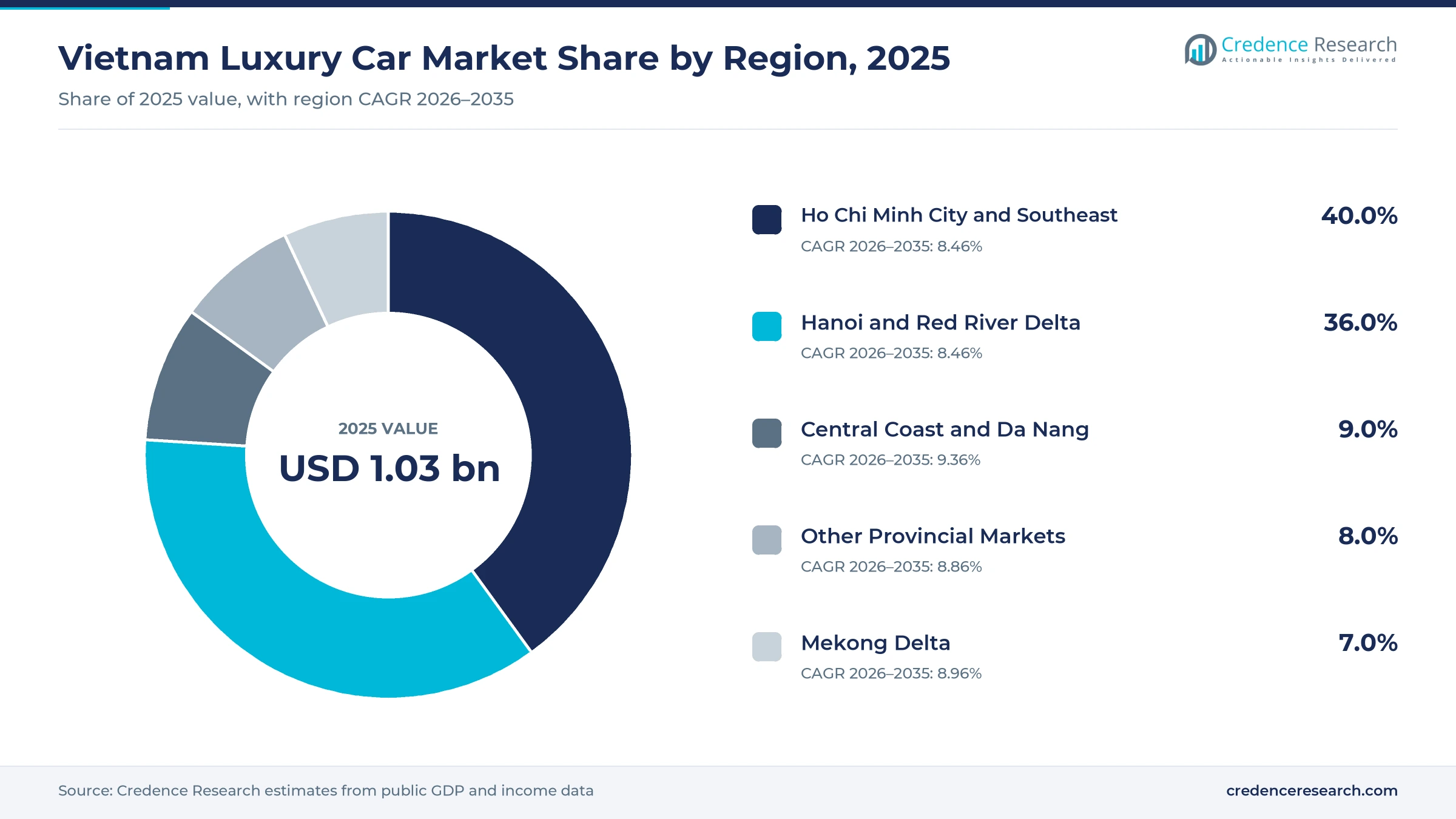
Ho Chi Minh City leads as central provinces grow fastest
| Region | Value, 2025 (USD billion) | Share, 2025 | CAGR, 2026–2035 |
|---|---|---|---|
| Ho Chi Minh City and Southeast | 0.41 | 40.0% | 8.46% |
| Hanoi and Red River Delta | 0.37 | 36.0% | 8.46% |
| Central Coast and Da Nang | 0.09 | 9.0% | 9.36% |
| Other Provincial Markets | 0.08 | 8.0% | 8.86% |
| Mekong Delta | 0.07 | 7.0% | 8.96% |
Why does Ho Chi Minh City and Southeast hold the top share?
Ho Chi Minh City and Southeast held a 40.0% share of 2025 value and grows at 8.46% a year, because the enlarged city produced about 23.5% of national GDP in 2025. Its output neared VND 3 quadrillion after the July 1, 2025 merger with Binh Duong and Ba Ria-Vung Tau. As a result, the region hosts the densest network of premium showrooms, service centers and corporate buyers in the country.
How does Hanoi and Red River Delta support premium sales?
Hanoi and Red River Delta held a 36.0% share of 2025 value and grows at 8.46% a year, because Hanoi recorded GRDP of USD 69 billion in 2025, the second largest in the country. Hanoi GRDP per capita reached USD 7,467 that year, up 10% from 2024. In turn, government officials, business owners and foreign company executives buy many premium sedans and SUVs there.
Why is Central Coast and Da Nang growing fastest?
Central Coast and Da Nang held a 9.0% share of 2025 value and grows fastest at 9.36% a year, because tourism, resorts and new industrial zones are raising incomes. BMW models are also assembled at THACO Chu Lai in Quang Nam, close to Da Nang. As a result, hospitality operators, resort groups and local entrepreneurs add premium SUVs and MPVs for guests and family use, which lifts demand in Da Nang.
How does the Mekong Delta add demand?
The Mekong Delta held a 7.0% share of 2025 value and grows at 8.96% a year, because Can Tho and nearby provinces have a growing class of agribusiness owners. In turn, dealers in Can Tho serve buyers across the delta with accessible premium SUVs.
What role do other provincial markets play?
Other provincial markets accounted for 8.0% of 2025 value and grow at 8.86% a year, because buyers in the northern uplands and Central Highlands often travel to large cities to purchase. As a result, growth depends on new satellite showrooms and digital lead platforms.
Tariff, tax and electrification milestones
| Development | Status and market relevance |
|---|---|
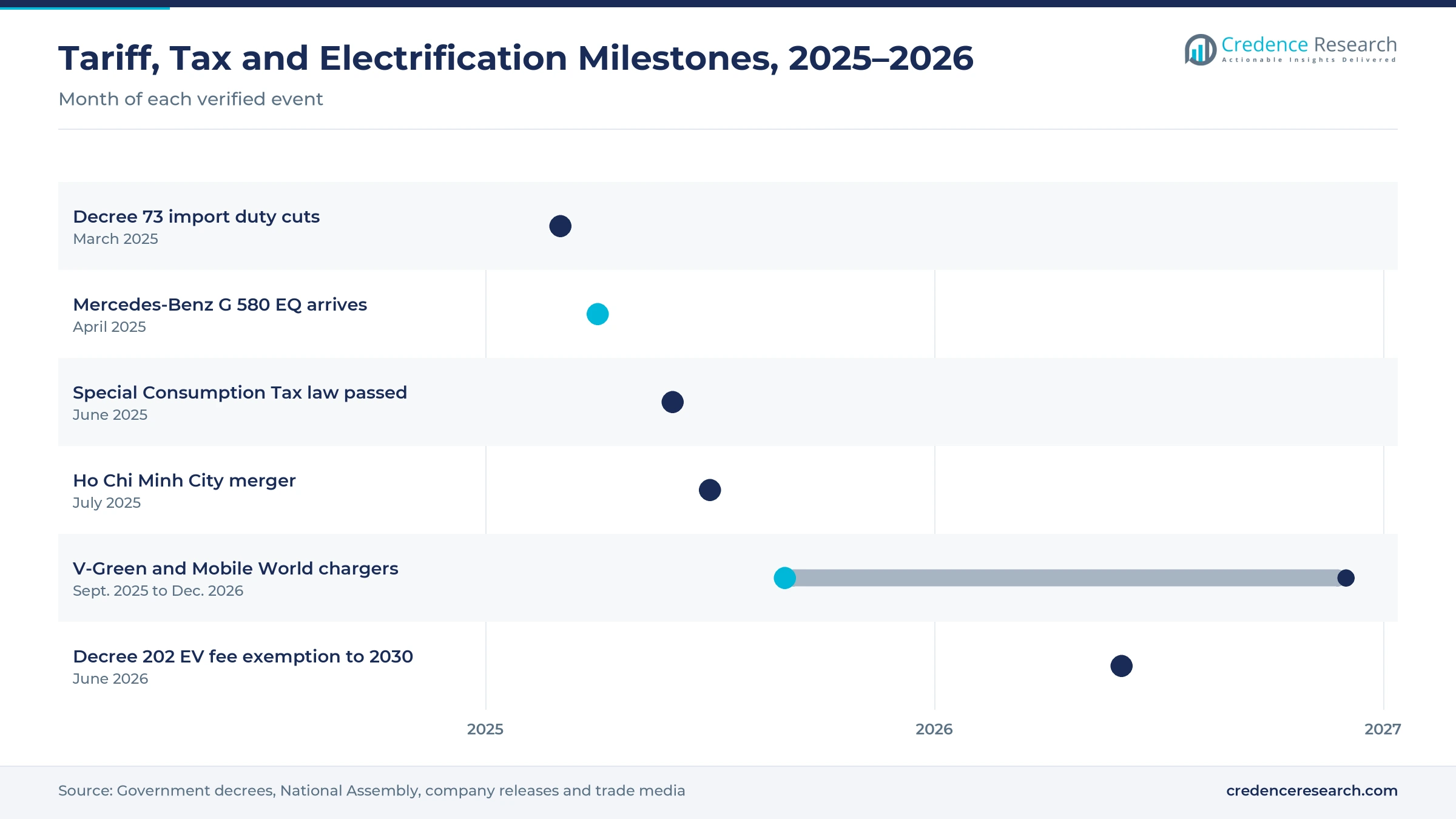
| In March 2025, the government issued Decree 73, cutting import duties on several passenger vehicle lines, including a drop from 64% to 50%. | Lowers landed costs for imported premium models |
| In April 2025, Mercedes-Benz introduced the fully electric G 580 EQ to Vietnamese buyers. | Adds an electric flagship to the premium range |
| In June 2025, the National Assembly passed Law No. 66/2025/QH15 on Special Consumption Tax, effective Jan. 1, 2026. | Resets the excise framework for passenger vehicles |
| In September 2025, V-Green signed an agreement with Mobile World to deploy 350 charging stations in 2025 and 1,000 more in 2026. | Expands public charging for electric buyers |
| In June 2026, the government issued Decree 202, extending the registration-fee exemption for battery electric vehicles through 2030. | Keeps electric ownership costs low |
Hybrid, electric and connected systems define premium models
- Self-charging hybrid systems pair gasoline engines with electric motors, which cuts fuel use in heavy city traffic without needing a charger.
- Battery electric platforms deliver quiet, fast acceleration and zero tailpipe emissions, which suits short daily trips in Hanoi and Ho Chi Minh City.
- Connected cabin systems link navigation, remote climate control and service booking to the owner's phone, which raises convenience.
- Driver assistance suites add adaptive cruise control, lane support and parking aids, which reduce fatigue on long highway trips.
Need a Custom Version of This Report?
Tailor the scope, geography, or segments to your exact requirements.
- Custom geography or segment scope
- Direct access to our analyst team
German and Japanese brands compete on range and service
Competition is led by German and Japanese premium brands, with British and Italian marques serving the high-luxury and ultra-luxury tiers. Mercedes-Benz competes through a broad dealer network led by Haxaco and models such as the C-Class, E-Class and the electric G 580 EQ. Lexus competes with hybrid SUVs and sedans, and its sales rose to 2,252 units in 2025. BMW competes through THACO, which handles distribution and local assembly at Chu Lai, and offers the electric i4 and iX3. Volvo Cars competes on safety and the electric EC40, while Audi uses price cuts on the Q5 and A6. Porsche runs Porsche Studio Hanoi, and Rolls-Royce Motor Cars sells the Ghost Series II at about VND 35 billion. Rivals compete on price, hybrid and electric choice, service quality and resale value. Because buyers expect reliable after-sales care, brands with wide service networks usually win.
Which brands lead premium vehicle sales in Vietnam?
| Company | Type | Role in the market |
|---|---|---|
| Mercedes-Benz | German premium brand | Sells through dealer groups including Haxaco and added the electric G 580 EQ in 2025 |
| Lexus | Japanese premium brand | Sold 2,252 vehicles in 2025 with a hybrid-heavy range |
| BMW | German premium brand | Distributed and assembled by THACO, with i4 and iX3 electric models |
| Volvo Cars | Swedish premium brand | Launched the electric EC40 in Vietnam in 2024 |
| Audi | German premium brand | Uses discounts on the Q5, Q7 and A6 to clear stock |
| Rolls-Royce Motor Cars | Ultra-luxury brand | Sells the V12 Ghost Series II at about VND 35 billion |
Credence Research view on premium vehicle demand
Credence Research's view is that the Vietnam luxury car market will keep growing faster than overall vehicle sales, because wealth is rising and import duties have started to fall. Luxury SUVs remain the largest value pool, while battery electric models, MPVs and accessible premium tiers add the fastest growth. Lexus hybrids and THACO-assembled BMW models show how lower ownership costs win buyers. Brands with hybrid and electric choice, wide service networks and disciplined stock planning should gain the most, while discounting and taxes keep pressure on importers.
How the national premium vehicle estimate was built
The report uses 2025 as the base year on a calendar basis, and market values come from the Credence Research model. That model combines national accounts, provincial output data, vehicle association sales, brand sales reported in the press and tax and tariff decrees. Segment splits, regional shares and regional growth rates are Credence Research estimates. Sources used are official statistics, government decrees and agency releases, trade media reports and company releases, and no interviews or surveys were used.
Electrified SUVs and wider dealer reach carry growth to 2035
The Vietnam luxury car market is expected to reach USD 2.37 billion by 2035, an 8.61% CAGR during 2026–2035, as household wealth grows and lower duties make premium models easier to afford. Growth should be strongest in battery electric models, luxury MPVs and the Central Coast, because these areas gain most from tax breaks, tourism and new dealer networks. Wider charging coverage will support electric sales, while unsold stock, layered taxes and parallel imports could slow some brands.
Frequently Asked Questions
How big is the Vietnam luxury car market?
Which vehicle type leads the Vietnam luxury car market?
Which region leads premium vehicle sales in Vietnam?
How did import duties change in 2025?
Which powertrain is growing fastest?
Which premium brand sold the most vehicles in 2025?
Who are the leading companies in the Vietnam luxury car market?
What are the main challenges for premium brands in Vietnam?
Table of Content
Chapter 1 Market Segmentation
- 1.1 Segmentation Framework
- 1.1.1 Product and Service Classification
- 1.1.2 Application and End-Use Classification
- 1.1.3 Technology and Solution Classification
- 1.1.4 Customer and Distribution Channel Classification
- 1.1.5 Geographic Segmentation
- 1.1.6 Market Segment Definitions and Boundaries
- 1.2 By Vehicle Type
- 1.2.1 Luxury SUVs
- 1.2.2 Luxury Sedans
- 1.2.3 Performance Coupes
- 1.2.4 Luxury MPVs
- 1.3 By Powertrain
- 1.3.1 Gasoline ICE
- 1.3.2 Diesel ICE
- 1.3.3 Hybrid
- 1.3.4 Plug-in Hybrid
- 1.3.5 Battery Electric
- 1.4 By Customer Type
- 1.4.1 Affluent Private Buyers
- 1.4.2 Entrepreneurs and Business Owners
- 1.4.3 Corporate Executive Fleets
- 1.4.4 Chauffeur and Hospitality Operators
- 1.5 By Price Tier
- 1.5.1 Accessible Luxury
- 1.5.2 Core Luxury
- 1.5.3 High Luxury
- 1.5.4 Ultra-Luxury
Chapter 2 Introduction
- 2.1 Report Objectives and Scope
- 2.2 Product Definition and Industry Terminology
- 2.3 Market Inclusions and Exclusions
- 2.4 Research Process
- 2.4.1 Primary Research and Expert Interviews
- 2.4.2 Secondary Research and Source Review
- 2.4.3 Top-Down and Bottom-Up Estimation
- 2.4.4 Data Triangulation and Verification
- 2.5 Market Size Measurement Basis
- 2.5.1 2025: USD 1.03 billion → 2035: USD 2.37 billion
- 2.6 Historical and Forecast Reference Periods
- 2.6.1 Historical Period: 2018-2025
- 2.6.2 Base Year: 2025
- 2.6.3 Forecast Period: 2025-2035
- 2.7 Research Assumptions and Limitations
Chapter 3 Executive Summary
- 3.1 Market Snapshot and Key Findings
- 3.2 Base-Year Market Size, 2025
- 3.3 Forecast Market Size, 2035
- 3.4 Revenue and Volume Growth Outlook
- 3.5 Key Demand and Supply Indicators
- 3.6 Leading Market Segments
- 3.7 Fastest-Growing Market Opportunities
- 3.8 Regional Performance Highlights
- 3.9 Technology and Industry Transformation
- 3.10 Competitive Landscape Summary
- 3.11 Analyst View and Strategic Implications
Chapter 4 Vietnam Luxury Car Market Trends and Developments
- 4.1 Historical Industry Development, 2018-2025
- 4.2 Recent Market Trends and Developments
- 4.3 Demand and Customer Behavior Trends
- 4.4 Technology and Product Innovation
- 4.5 Artificial Intelligence, Automation and Digitalization
- 4.6 Local Manufacturing and Supply Chain Realignment
- 4.7 Industry Partnerships, Mergers and Acquisitions
- 4.8 Sustainability and Circular Economy Developments
- 4.9 Government and Private Sector Investment Trends
- 4.10 Emerging Business Models and Commercialization
- 4.11 Industry Developments and Announcements
Chapter 5 Vietnam Luxury Car Market Production, Supply and Demand Analysis
- 5.1 Demand Trend and Consumption Analysis, 2018-2025
- 5.2 Demand Forecast, 2025-2035
- 5.3 Production and Output Trend, 2018-2025
- 5.4 Production and Output Forecast, 2025-2035
- 5.5 Installed Capacity and Capacity Utilization
- 5.6 Company-Wise Production Plants and Statistics
- 5.6.1 Installed Production Capacity
- 5.6.2 Actual Production
- 5.6.3 Planned Capacity and Expansion Targets
- 5.7 Supply Chain Structure and Procurement Trends
- 5.8 Supply-Demand Gap and Bottlenecks
- 5.9 Import Dependence and Sourcing Structure
- 5.10 Contract Manufacturing and Outsourcing
- 5.11 Regional Supply and Demand Concentration
Chapter 6 Vietnam Luxury Car Market Pricing Analysis
- 6.1 Pricing Structure and Measurement
- 6.2 Historical Pricing Trends, 2018-2025
- 6.3 Pricing Outlook, 2025-2035
- 6.4 Average Selling Price and Unit Economics
- 6.5 Pricing by Product and Market Segment
- 6.6 Geographic Pricing Differences
- 6.7 Key Input, Energy, Labor and Logistics Costs
- 6.8 Contract Pricing and Purchasing Models
- 6.9 Pricing Sensitivity and Competitive Positioning
- 6.10 Price, Margin and Profitability Implications
Chapter 7 Vietnam Luxury Car Market Dynamics
- 7.1 Market Growth Drivers
- 7.1.1 Demand-Side Drivers
- 7.1.2 Technology and Innovation Drivers
- 7.1.3 Infrastructure and Investment Drivers
- 7.1.4 Regulatory and Policy Drivers
- 7.2 Market Restraints
- 7.2.1 Cost and Affordability Constraints
- 7.2.2 Technology and Adoption Barriers
- 7.2.3 Supply Chain and Operational Constraints
- 7.3 Market Challenges
- 7.3.1 Competitive Pressure and Margin Erosion
- 7.3.2 Skills, Infrastructure and Implementation Gaps
- 7.4 Emerging Market Opportunities
- 7.5 Market Dynamics Impact and Time-Horizon Assessment
Chapter 8 Vietnam Luxury Car Value Chain Analysis
- 8.1 Industry Value Chain Overview
- 8.2 Upstream Suppliers and Critical Inputs
- 8.3 Technology and Component Providers
- 8.4 Manufacturing or Service Delivery
- 8.5 Distribution, Channel Partners and Integrators
- 8.6 Downstream Applications and End Users
- 8.7 Value Addition and Profit Pools
- 8.8 Vertical Integration and Outsourcing
- 8.9 Supplier Concentration and Risk
- 8.10 Supply Chain Localization and Resilience
Chapter 9 Vietnam Luxury Car Market Regulations and Policies
- 9.1 Relevant Laws, Standards and Compliance Frameworks
- 9.2 Product, Service, Safety and Quality Requirements
- 9.3 Government Policies, Incentives and Subsidies
- 9.4 Imports, Exports and Trade Barriers
- 9.5 Public Procurement and Local Content Requirements
- 9.6 Environmental and Sustainability Compliance
- 9.7 Upcoming Policy Changes and Market Implications
Chapter 10 Vietnam Luxury Car Market Hotspots and Opportunities
- 10.1 Market Opportunity Mapping and Growth Hotspots
- 10.2 High-Growth Applications and Customer Groups
- 10.3 Underserved Markets and White-Space Opportunities
- 10.4 Emerging Technology and Product Opportunities
- 10.5 New Capacity and Investment Hotspots
- 10.6 Market Entry and Expansion Opportunities
- 10.7 Distribution and Partnership Opportunities
- 10.8 Near-Term and Long-Term Commercial Potential
- 10.9 Opportunity Attractiveness and Execution Risks
Chapter 11 Vietnam Luxury Car Market Outlook, 2025-2035
- 11.1 Market Size and Analysis
- 11.1.1 Revenue (Market Measurement: 2025: USD 1.03 billion → 2035: USD 2.37 billion)
- 11.1.2 Market Volume and Quantity Sold
- 11.1.3 Historical Market Size, 2018-2025
- 11.1.4 Base-Year Market Size, 2025
- 11.2 Market Forecast, 2025-2035
- 11.2.1 Revenue Forecast to 2035
- 11.2.2 Volume Forecast to 2035
- 11.2.3 CAGR and Year-on-Year Growth
- 11.2.4 Incremental Revenue Opportunity
- 11.3 Forecast Assumptions and Scenario Analysis
- 11.3.1 Base-Case Forecast
- 11.3.2 Optimistic and Conservative Scenarios
- 11.3.3 Technology, Pricing and Policy Sensitivities
- 11.4 Market Attractiveness and Growth Outlook
Chapter 12 Vietnam Luxury Car Market Segmentation and Outlook
- 12.1 Segmentation Summary and Market Shares, 2025
- 12.2 Largest and Fastest-Growing Segments
- 12.3 By Vehicle Type - Market Size and Forecast, 2025-2035
- 12.3.1 Segment Definition and Scope
- 12.3.2 Historical Market Size, 2018-2025
- 12.3.3 Revenue Forecast, 2025-2035
- 12.3.4 Volume Forecast, 2025-2035
- 12.3.5 Base-Year Market Share, 2025
- 12.3.6 Segment CAGR and Growth Drivers
- 12.3.7 Subsegment Market Size and Forecast
- 12.3.7.1 Luxury SUVs
- 12.3.7.2 Luxury Sedans
- 12.3.7.3 Performance Coupes
- 12.3.7.4 Luxury MPVs
- 12.3.8 Subsegment Pricing and Adoption Trends
- 12.3.9 Leading Suppliers and Competition
- 12.3.10 Regional Demand and Opportunities
- 12.4 By Powertrain - Market Size and Forecast, 2025-2035
- 12.4.1 Segment Definition and Scope
- 12.4.2 Historical Market Size, 2018-2025
- 12.4.3 Revenue Forecast, 2025-2035
- 12.4.4 Volume Forecast, 2025-2035
- 12.4.5 Base-Year Market Share, 2025
- 12.4.6 Segment CAGR and Growth Drivers
- 12.4.7 Subsegment Market Size and Forecast
- 12.4.7.1 Gasoline ICE
- 12.4.7.2 Diesel ICE
- 12.4.7.3 Hybrid
- 12.4.7.4 Plug-in Hybrid
- 12.4.7.5 Battery Electric
- 12.4.8 Subsegment Pricing and Adoption Trends
- 12.4.9 Leading Suppliers and Competition
- 12.4.10 Regional Demand and Opportunities
- 12.5 By Customer Type - Market Size and Forecast, 2025-2035
- 12.5.1 Segment Definition and Scope
- 12.5.2 Historical Market Size, 2018-2025
- 12.5.3 Revenue Forecast, 2025-2035
- 12.5.4 Volume Forecast, 2025-2035
- 12.5.5 Base-Year Market Share, 2025
- 12.5.6 Segment CAGR and Growth Drivers
- 12.5.7 Subsegment Market Size and Forecast
- 12.5.7.1 Affluent Private Buyers
- 12.5.7.2 Entrepreneurs and Business Owners
- 12.5.7.3 Corporate Executive Fleets
- 12.5.7.4 Chauffeur and Hospitality Operators
- 12.5.8 Subsegment Pricing and Adoption Trends
- 12.5.9 Leading Suppliers and Competition
- 12.5.10 Regional Demand and Opportunities
- 12.6 By Price Tier - Market Size and Forecast, 2025-2035
- 12.6.1 Segment Definition and Scope
- 12.6.2 Historical Market Size, 2018-2025
- 12.6.3 Revenue Forecast, 2025-2035
- 12.6.4 Volume Forecast, 2025-2035
- 12.6.5 Base-Year Market Share, 2025
- 12.6.6 Segment CAGR and Growth Drivers
- 12.6.7 Subsegment Market Size and Forecast
- 12.6.7.1 Accessible Luxury
- 12.6.7.2 Core Luxury
- 12.6.7.3 High Luxury
- 12.6.7.4 Ultra-Luxury
- 12.6.8 Subsegment Pricing and Adoption Trends
- 12.6.9 Leading Suppliers and Competition
- 12.6.10 Regional Demand and Opportunities
- 12.7 Segment Growth Comparison
- 12.8 Segment Attractiveness and Priority Matrix
Chapter 13 Vietnam Luxury Car End-Use and Application Market Outlook
- 13.1 End-Use Industry and Customer Demand Structure
- 13.2 Leading Applications and Customer Groups
- 13.3 End-Use Market Size, Share and Forecast
- 13.4 Major End-Use Industry Deep Dives
- 13.4.1 Customer Requirements and Use Cases
- 13.4.2 Demand and Replacement Cycles
- 13.4.3 Technical and Regulatory Considerations
- 13.4.4 Purchasing and Procurement Models
- 13.4.5 Leading Vendors and Distribution Channels
- 13.4.6 Forecast and Commercial Opportunities
- 13.5 Emerging Applications and Cross-Segment Demand
- 13.6 End-Use Industry Investment Priorities
Chapter 14 Vietnam Luxury Car Geographic Market Outlook, 2025-2035
- 14.1 Domestic Market Distribution and Demand Clusters
- 14.2 State- or Province-Wise Market Size and Forecast, 2025-2035
- 14.3 City and Metropolitan Market Outlook
- 14.4 Industrial, Manufacturing and Commercial Clusters
- 14.5 Geographic Concentration of Key End Users
- 14.6 Local Pricing and Purchasing Differences
- 14.7 Domestic Production Facilities and Capacity Map
- 14.8 Local Infrastructure and Project Pipeline
- 14.9 State-Level Policy and Incentive Differences
- 14.10 Subnational Investment Hotspots and Opportunities
- 14.11 Distribution and Logistics Networks
- 14.12 Domestic Competitive Footprint
Chapter 15 Vietnam Luxury Car Technology, Innovation and Sustainability Outlook
- 15.1 Technology Landscape and Maturity
- 15.2 Product, Process and Service Innovation
- 15.3 AI, Automation and Digital Tools in the Industry
- 15.4 Technology Adoption and Performance Benchmarking
- 15.5 Innovation Pipeline and R&D Investment
- 15.6 Patent and Intellectual Property Trends
- 15.7 Energy Efficiency and Resource Management
- 15.8 Sustainability, Recycling and Circularity
- 15.9 Technology Roadmap, 2025-2035
- 15.10 Risks of Obsolescence and Technology Substitution
Chapter 16 Vietnam Luxury Car Market Key Strategic Imperatives
- 16.1 Growth and Market Entry Priorities
- 16.2 High-Return Products and Segments
- 16.3 Pricing, Profitability and Cost Optimization
- 16.4 Technology Investment and Product Differentiation
- 16.5 Supply Chain Localization and Resilience
- 16.6 Distribution and Customer Acquisition
- 16.7 Partnership, Acquisition and Capacity Strategy
- 16.8 Regional Expansion Priorities
- 16.9 Short-, Medium- and Long-Term Actions
Chapter 17 Competition Outlook
- 17.1 Industry Competition Characteristics
- 17.2 Market Structure and Concentration
- 17.3 Market Share and Competitive Positioning, 2025
- 17.4 Company-Wise Revenue and Product Benchmarking
- 17.5 Production and Service Capacity Benchmarking
- 17.6 Technology, Pricing and Differentiation
- 17.7 Regional Footprint and Distribution Strength
- 17.8 Mergers, Acquisitions and Strategic Alliances
- 17.9 New Entrants and Competitive Threats
- 17.10 Porter's Five Forces and Industry Attractiveness
- 17.11 Competitive Outlook, 2025-2035
Chapter 18 Company Profiles
- 18.1 Company Coverage and Selection Criteria
- 18.2 Lexus
- 18.2.1 Business Description
- 18.2.2 Company Ownership and Geographic Presence
- 18.2.3 Product and Service Portfolio
- 18.2.4 Manufacturing and Operating Footprint
- 18.2.5 Production Capacity and Expansion Plans
- 18.2.6 Financial Performance and Investment
- 18.2.7 Market Share and Competitive Position
- 18.2.8 Technology and Innovation Capabilities
- 18.2.9 Strategic Alliances or Partnerships
- 18.2.10 Recent Developments
- 18.2.11 Growth Strategy and Outlook
- 18.3 Mercedes-Benz
- 18.4 BMW
- 18.5 Volvo Cars
- 18.6 Audi
- 18.7 Porsche
- 18.8 Jaguar Land Rover
- 18.9 Maserati
- 18.10 Bentley Motors
- 18.11 Rolls-Royce Motor Cars
- 18.12 Other Relevant Market Participants
Note: Every listed company is profiled on the structure shown under the first company. The company list is preliminary and may change based on research findings, market developments, data availability and client requirements.
Chapter 19 Disclaimer
- 19.1 Research and Forecast Disclaimer
- 19.2 Data Source and Estimation Limitations
Note: The depth of individual sections depends on data availability for this market. Volume, capacity, trade and other unit-based metrics are included where applicable.