
Vietnam paint demand rests on homes, plants and furniture
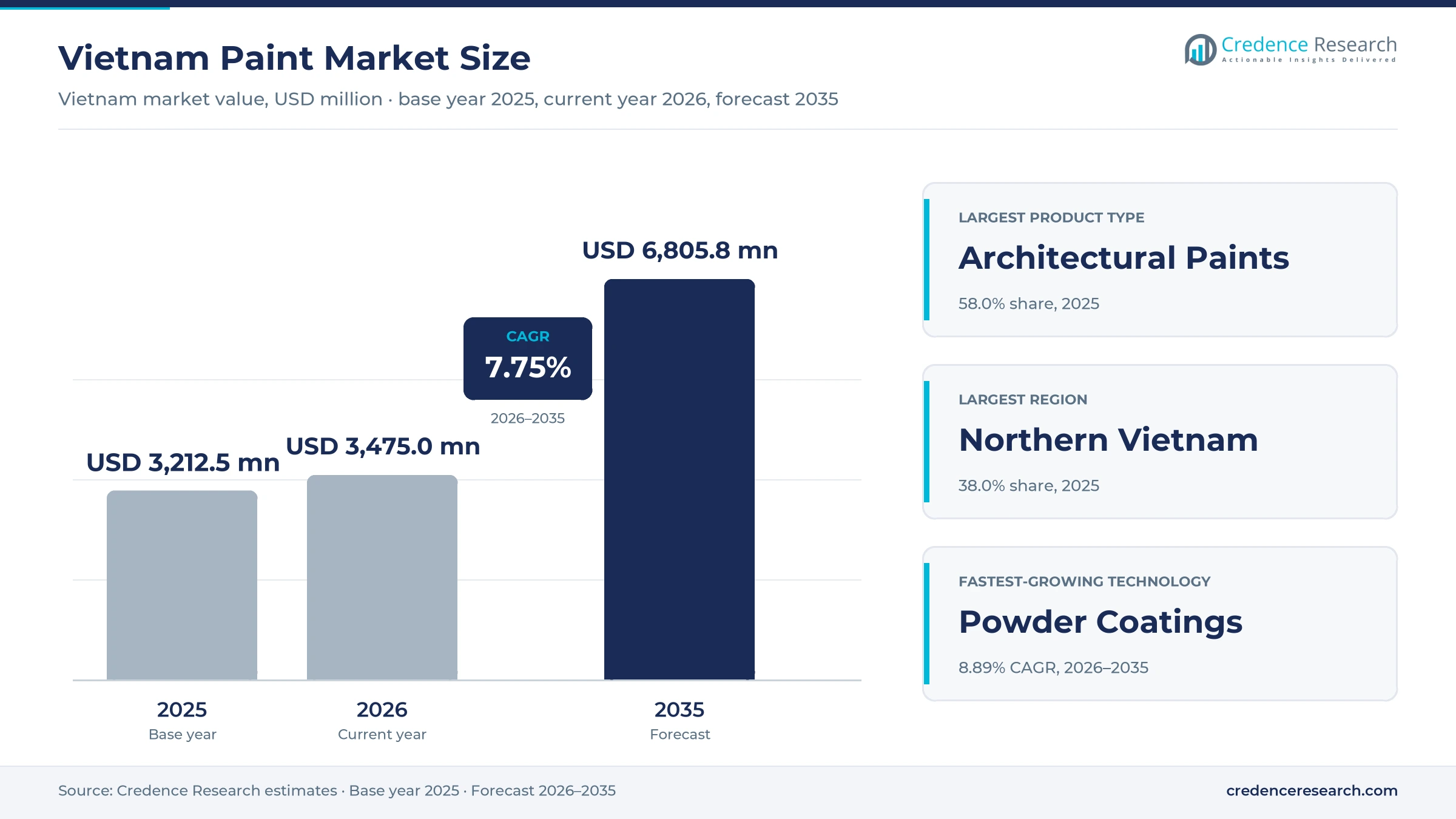
The Vietnam paint market was valued at USD 3.21 billion in 2025 and is projected to increase from USD 3.48 billion in 2026 to USD 6.81 billion by 2035, registering a CAGR of 7.75% during 2026–2035. Demand comes from new homes, apartment repainting, factory construction, metal fabrication and furniture makers that finish wood for export. Northern Vietnam held the largest regional share, 38.0% in 2025, because Hanoi, Bac Ninh and Hai Phong combine dense housing with electronics and industrial parks. Central Vietnam is the fastest-growing region at 8.14% a year, as coastal cities add resorts, apartments and logistics sites. Architectural paints led the product mix in 2025, while industrial coatings gain from foreign-invested factories. A national lead limit for paint, set to tighten to 90 parts per million, is also pushing producers toward lead-free and water-borne formulas.
Which paints and coatings does the estimate cover?
The estimate measures the value of architectural paints, industrial coatings, wood coatings and marine and protective coatings sold for use in Vietnam. It covers interior and exterior wall paints, primers, metal protection systems, powder coatings and wood finishes bought by households, contractors, property developers, manufacturers and furniture exporters. Values are stated at manufacturer selling prices and include imported products sold through local channels.
The estimate excludes printing inks, adhesives, sealants, raw resins and pigments sold as separate goods, and paint exported from Vietnam to other countries. The value chain runs from resin, pigment and solvent suppliers through local formulation plants to dealers, home improvement stores, project contractors and industrial distributors that reach final users.
Vietnam Paint Market Insights
- The Vietnam paint market was valued at USD 3.21 billion in 2025 and is projected to reach USD 6.81 billion by 2035, registering a CAGR of 7.75% during 2026–2035.
- Northern Vietnam held 38.0% of 2025 value, because Hanoi and nearby industrial provinces combine housing demand with electronics and factory projects.
- Architectural paints led with 58.0% of 2025 value, because new homes, apartments and repainting cycles create steady demand for wall paints.
- Vietnam completed 102,633 social housing units in 2025, exceeding the yearly target set by the Prime Minister by 2%, according to the Ministry of Construction.
- Nippon Paint signed agreements in October 2026 to buy decorative paints businesses in seven markets, including Vietnam, from AkzoNobel for about $1.35 billion.
Wall paints lead while industrial coatings grow fastest
Why do architectural paints lead product demand?
Based on product type, the market is categorized into architectural paints, industrial coatings, wood coatings and marine and protective coatings. Architectural Paints led with 58.0% of 2025 value, because homes, apartments and shophouses need wall paint at completion and again during repainting. Industrial Coatings grow fastest at 8.31% a year, as foreign-invested factories coat machinery, steel structures, appliances and electronic parts.
How does metal protection gain on wall surfaces?
Based on application, the market is categorized into interior surfaces, exterior facades, metal protection and wood finishing. Interior Surfaces led with 36.0% of 2025 value, because urban households repaint living spaces more often than facades. Metal Protection grows fastest at 8.20% a year, as steel frames, warehouses, bridges and equipment need anticorrosion systems in a humid, coastal climate.
Why are powder coatings gaining share?
Based on technology, the market is categorized into water-borne systems, solvent-borne systems, powder coatings and high-solids systems. Water-Borne Systems led with 52.0% of 2025 value, because most decorative wall paints in Vietnam are water-based emulsions. Powder Coatings grow fastest at 8.89% a year, as appliance, electronics and metal furniture makers adopt solvent-free lines that cut emissions and material waste.
How do dealers and project sales reach buyers?
Based on distribution channel, the market is categorized into paint dealers, home improvement retail, direct project sales and industrial distributors. Paint Dealers led with 48.0% of 2025 value, because neighborhood stores mix colors and give credit to small contractors across every province. Home Improvement Retail grows fastest at 8.49% a year, as urban buyers shop in modern stores for branded products.
| Segment Group | Leading Sub-segment | Share, 2025 | Fastest-growing Sub-segment | CAGR, 2026–2035 |
|---|---|---|---|---|
| By Product Type | Architectural Paints | 58.0% | Industrial Coatings | 8.31% |
| By Application | Interior Surfaces | 36.0% | Metal Protection | 8.20% |
| By Technology | Water-Borne Systems | 52.0% | Powder Coatings | 8.89% |
| By Distribution Channel | Paint Dealers | 48.0% | Home Improvement Retail | 8.49% |
Request a Free Sample
Fill in your details and we'll send you a free sample report.
- Sample data tables & charts
- Research methodology
Housing, factories and wood exports lift coatings use
How do construction, housing and renovation lift demand?
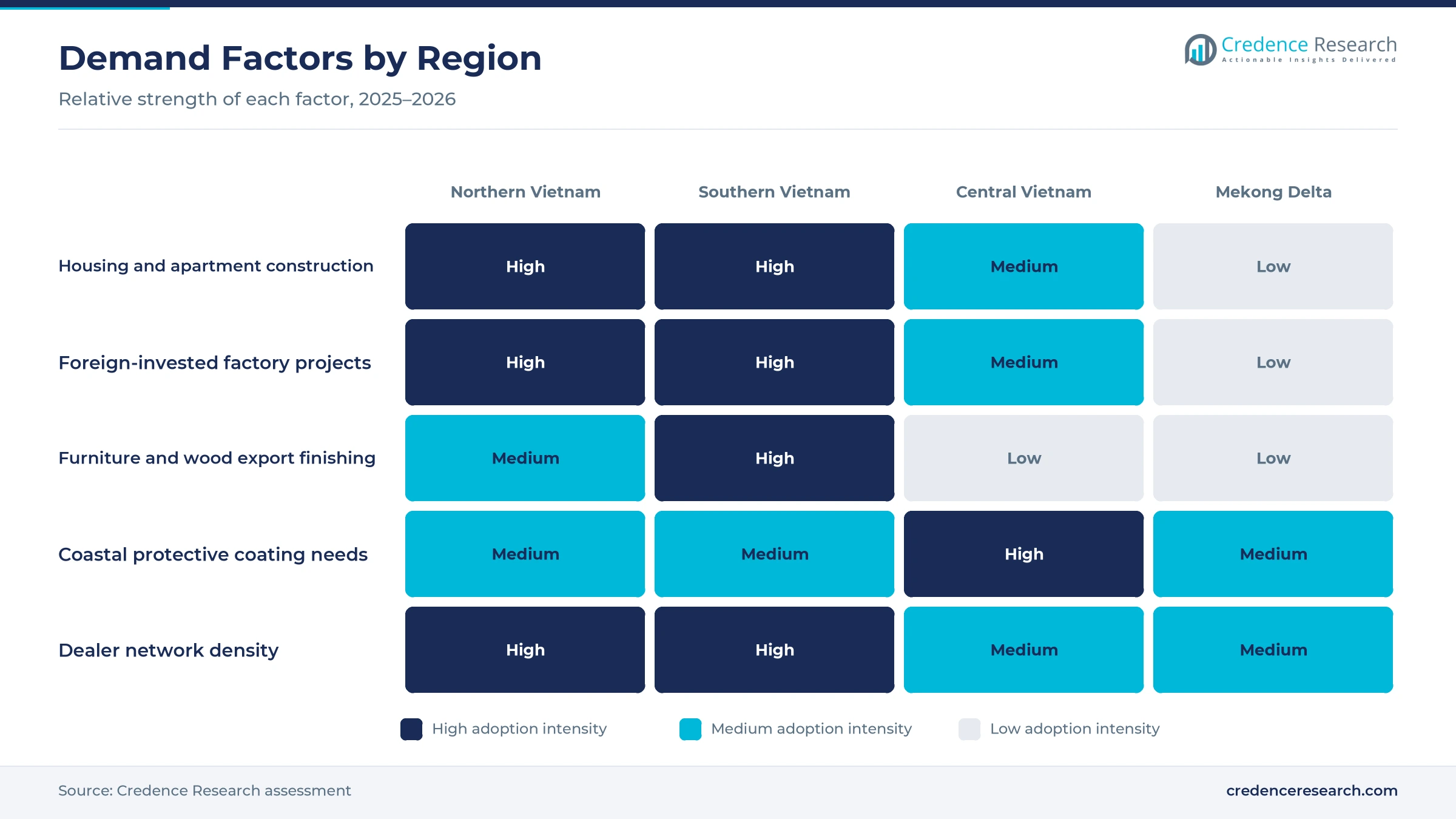
Construction, housing and renovation activity lifts demand, because every new apartment, shophouse and public building needs primers, wall paint and waterproof coatings. Vietnam completed 102,633 social housing units in 2025, about 2% above the yearly target, while 134,111 more units were under construction across 200 projects, according to VTV. The national program aims for one million social housing units between 2021 and 2030, and the 2026 plan calls for 158,723 units. Industry and construction also grew 8.95% in 2025, as GDP rose 8.02%, according to the National Statistics Office. As a result, architectural paints hold 58.0% of 2025 value, while building construction keeps repainting cycles active.
Why do manufacturing and foreign investment raise coatings use?
Manufacturing and foreign investment raise coatings use, because new factories need floor, steel and equipment coatings, and many plants coat their own products. Disbursed foreign direct investment reached about $27.6 billion in 2025, up 9% and the highest in five years, while manufacturing took 56.5% of newly registered capital. Manufacturing value added equaled 24.5% of GDP in 2025, according to World Bank data, up from 23.8% in 2019. Vietnam also licensed 4,054 new foreign-invested projects in 2025, up 20.1% from 2024. In turn, industrial coatings grow at 8.31% a year, the fastest product rate, as industrial coatings suppliers serve electronics, appliance and machinery makers.
How does furniture and wood-product export scale add volume?
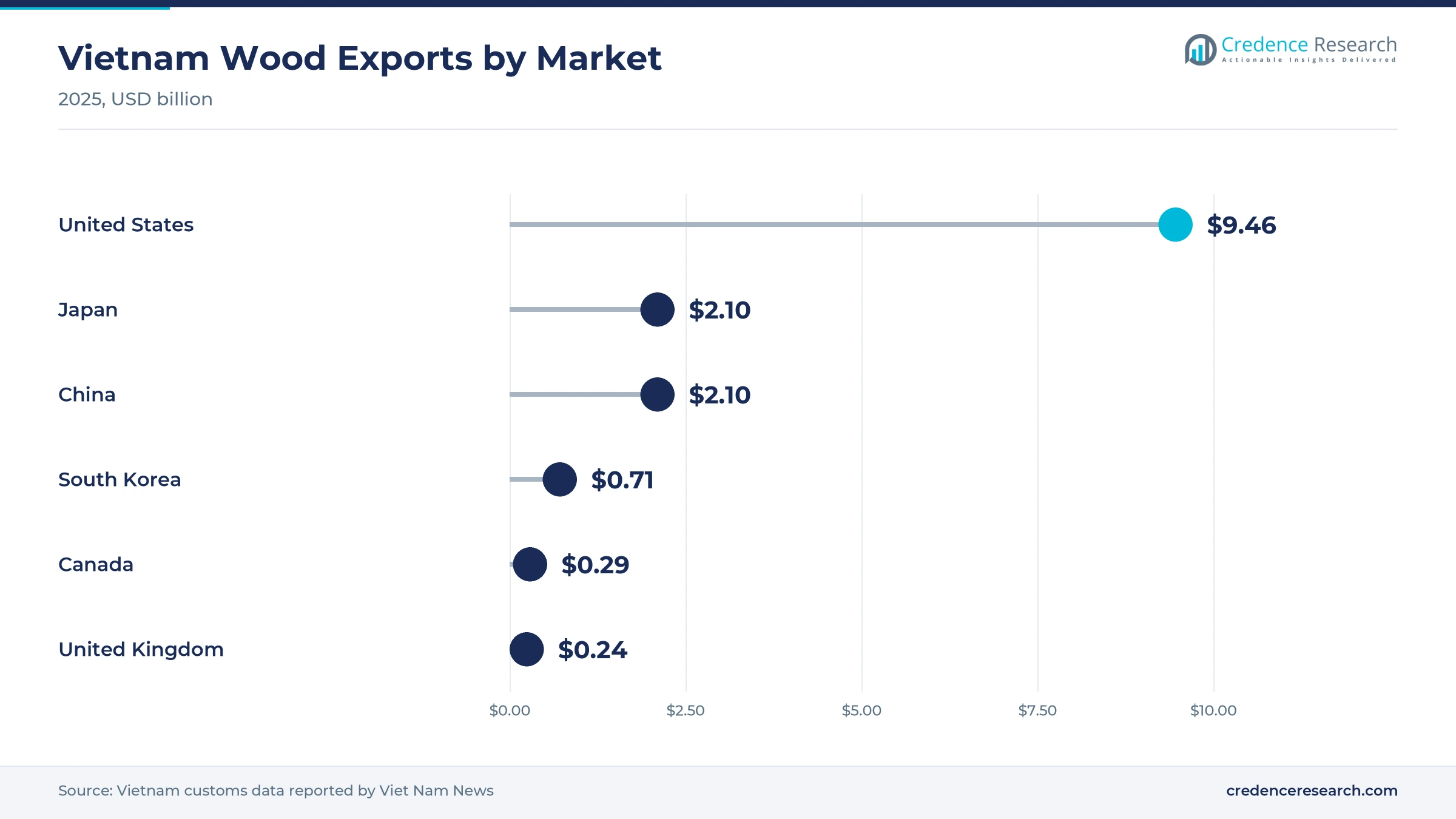
Furniture and wood-product export scale adds volume, because chairs, tables, cabinets and flooring need stains, sealers and topcoats before shipment. Wood and timber exports reached a record $17.2 billion in 2025, up nearly 6%, according to Viet Nam News. Shipments to the United States reached $9.46 billion, about 55% of the total, and Japan passed $2.1 billion for the first time, up more than 23%. Wooden furniture accounted for $9.4 billion of exports in the first 11 months of 2025. As a result, wood coatings grow faster than the market, as wooden furniture makers in Binh Duong and Dong Nai add finishing lines.
Why do rising incomes and urban living support premium paint?
Rising incomes and urban living support premium paint, because households in apartments repaint more often and choose washable, low-odor finishes. GDP per capita reached an estimated $5,026 in 2025, up from $4,700 in 2024, according to the National Statistics Office. Services also grew 8.62% in 2025, which supports shops, hotels and offices that refresh interiors. Interior surfaces hold 36.0% of 2025 value, as urban owners repaint living rooms and bedrooms between tenants. In turn, producers widen easy-clean and antibacterial ranges, and home improvement retail grows at 8.49% a year, the fastest channel rate, as buyers compare branded products in modern stores.
Powder lines, lead limits and consolidation reshape supply
How is the shift to powder and water-based lines changing plants?
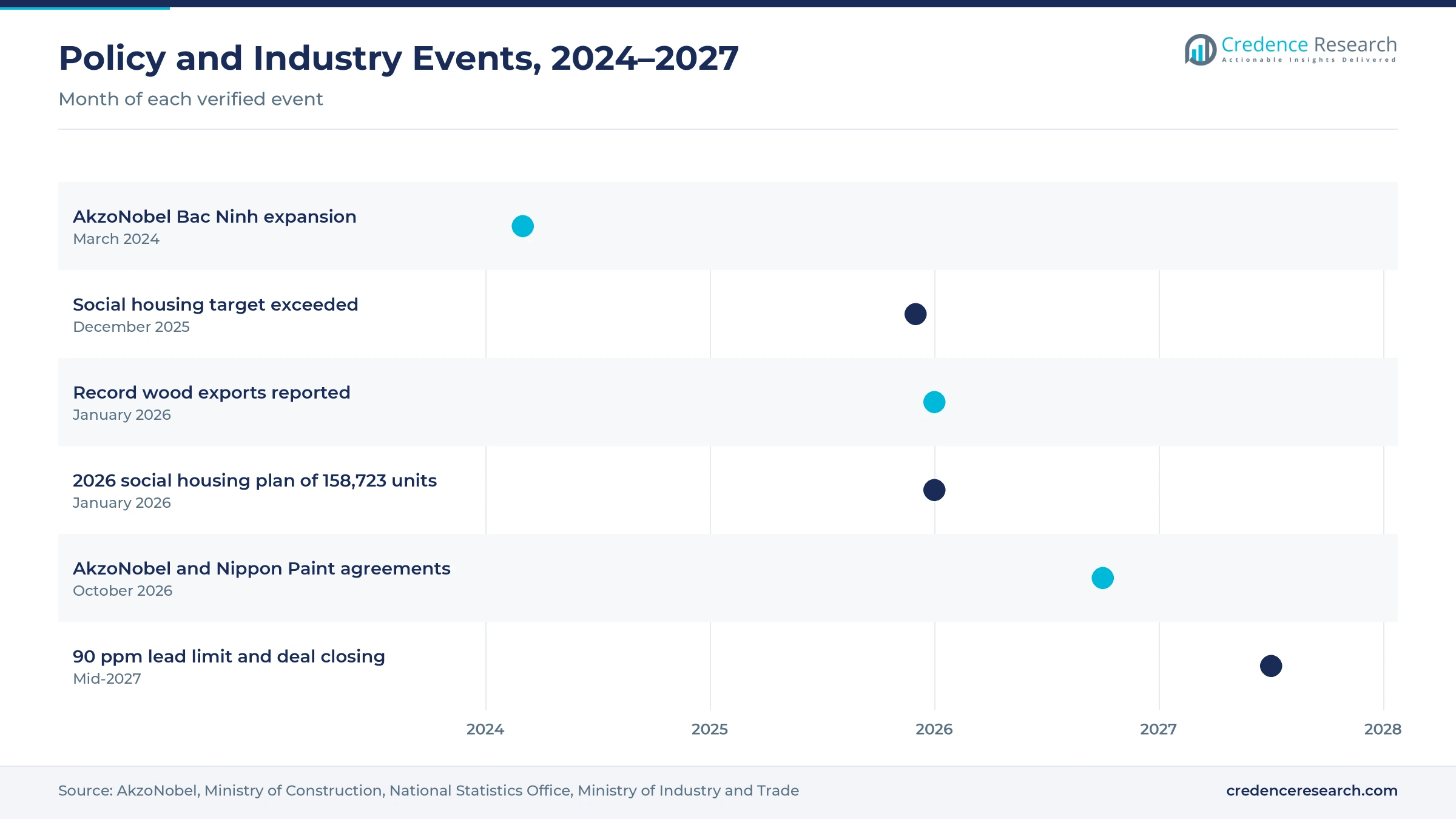
The shift to powder and water-based lines is changing plants, because electronics and appliance customers want lower emissions and tighter finish control. On March 4, 2024, AkzoNobel announced a 18.5 million euro expansion at its Bac Ninh site with five new powder coating lines and one water-based line, according to AkzoNobel. The company said the Bac Ninh multisite supports volume growth in northern Vietnam, while its Dong Nai facility serves the south. Jotun also invested in a third Vietnamese plant in Hiep Phuoc Industrial Park in Ho Chi Minh City for water-based and powder coatings. As a result, powder coatings grow at 8.89% a year, the fastest technology rate in the forecast.
Why is the rise of lead-free formulas speeding reformulation?
The rise of lead-free formulas is speeding reformulation, because a national technical regulation caps lead in paint produced, imported or sold in Vietnam. Circular 51/2020/TT-BCT, signed on Dec. 21, 2020, took effect on July 1, 2022, with a 600 parts per million limit for the first five years. The limit then falls to 90 parts per million, which covers solvent-based and water-based paints listed in its annex. The rule also applies to imported paint, so traders must test and certify products before sale. In turn, producers replace lead driers and pigments, and water-borne systems hold 52.0% of 2025 value as formulas move away from solvents and heavy metals.
Can regional consolidation open new scale for leading brands?
Regional consolidation can open new scale for leading brands, because larger owners can share color systems, resins and dealer networks across markets. AkzoNobel signed agreements on Oct. 3, 2026, to sell its decorative paints businesses in Vietnam, Indonesia, Malaysia, Thailand, Singapore, Papua New Guinea and Australia to Nippon Paint, according to PCI Magazine. The deal carries an enterprise value of about $1.35 billion, and the Vietnam share acquisition is expected to close around mid-2027. Nippon Paint has operated in Vietnam since 1994 and runs four factories in Dong Nai, Hanoi, Phu Tho and Ho Chi Minh City. As a result, paint dealers, which hold 48.0% of 2025 value, may see broader brand portfolios.
Is there room for protective coatings in ports and infrastructure?
Protective coatings have room to grow, because ports, steel bridges, power plants and warehouses in Vietnam face salt air and high humidity. Foreign investors added about $18.6 billion of new and adjusted capital to manufacturing in 2025, which brings more steel-frame factories and storage buildings. Real estate drew nearly $3.7 billion of newly registered foreign capital in 2025, or 21.2% of the total. Metal protection grows at 8.20% a year, the fastest application rate, as owners extend asset life with zinc-rich primers and epoxy systems. In turn, suppliers of protective coatings can win specification contracts with engineering firms and industrial park developers through 2035.
Input costs, tariffs and price competition weigh on makers
How do resin and pigment costs squeeze margins?
Resin and pigment costs squeeze margins, because Vietnam imports much of its titanium dioxide, acrylic resin and solvent supply. Price swings in oil and freight raise costs before producers can change dealer prices, which hurts smaller local brands most. As a result, some makers cut pack sizes or shift to economy ranges. Larger groups respond with regional buying, local resin production and formula changes that use less costly pigment.
Why do export tariffs create risk for wood coatings demand?
Export tariffs create risk for wood coatings demand, because furniture makers depend heavily on orders from the United States. Any new duty or trade investigation can delay orders, which reduces finishing volume at factories in the south. In turn, coating suppliers face slower payment and smaller batch orders from exporters. Suppliers respond by serving buyers in Japan, South Korea and Europe and by offering low-emission finishes that meet stricter buyer rules.
How does price competition affect brand positioning?
Price competition affects brand positioning, because many domestic producers sell low-cost wall paint in provincial towns and rural areas. Dealers often push products with the highest margin, which weakens brand loyalty among small contractors. As a result, multinational brands spend more on dealer rebates, tinting machines and painter training. Domestic producers respond with project sales, waterproofing ranges and faster delivery to local stores.
Why do counterfeit and substandard products hurt buyers?
Counterfeit and substandard products hurt buyers, because cheap copies of branded paint can peel, fade or contain more lead than the legal limit allows. Small contractors may buy them without checking labels or batch codes, which leads to costly repainting. In turn, trusted brands lose sales and face warranty claims. Producers respond with tamper-evident packs, QR code checks and dealer certification programs that help buyers confirm genuine products.
Northern Vietnam leads while Central Vietnam grows fastest
| Region | Value, 2025 (USD billion) | Share, 2025 | CAGR, 2026–2035 |
|---|---|---|---|
| Northern Vietnam | 1.22 | 38.0% | 7.84% |
| Southern Vietnam | 0.96 | 30.0% | 7.54% |
| Central Vietnam | 0.64 | 20.0% | 8.14% |
| Mekong Delta | 0.39 | 12.0% | 7.34% |
Why does northern Vietnam hold the largest share?
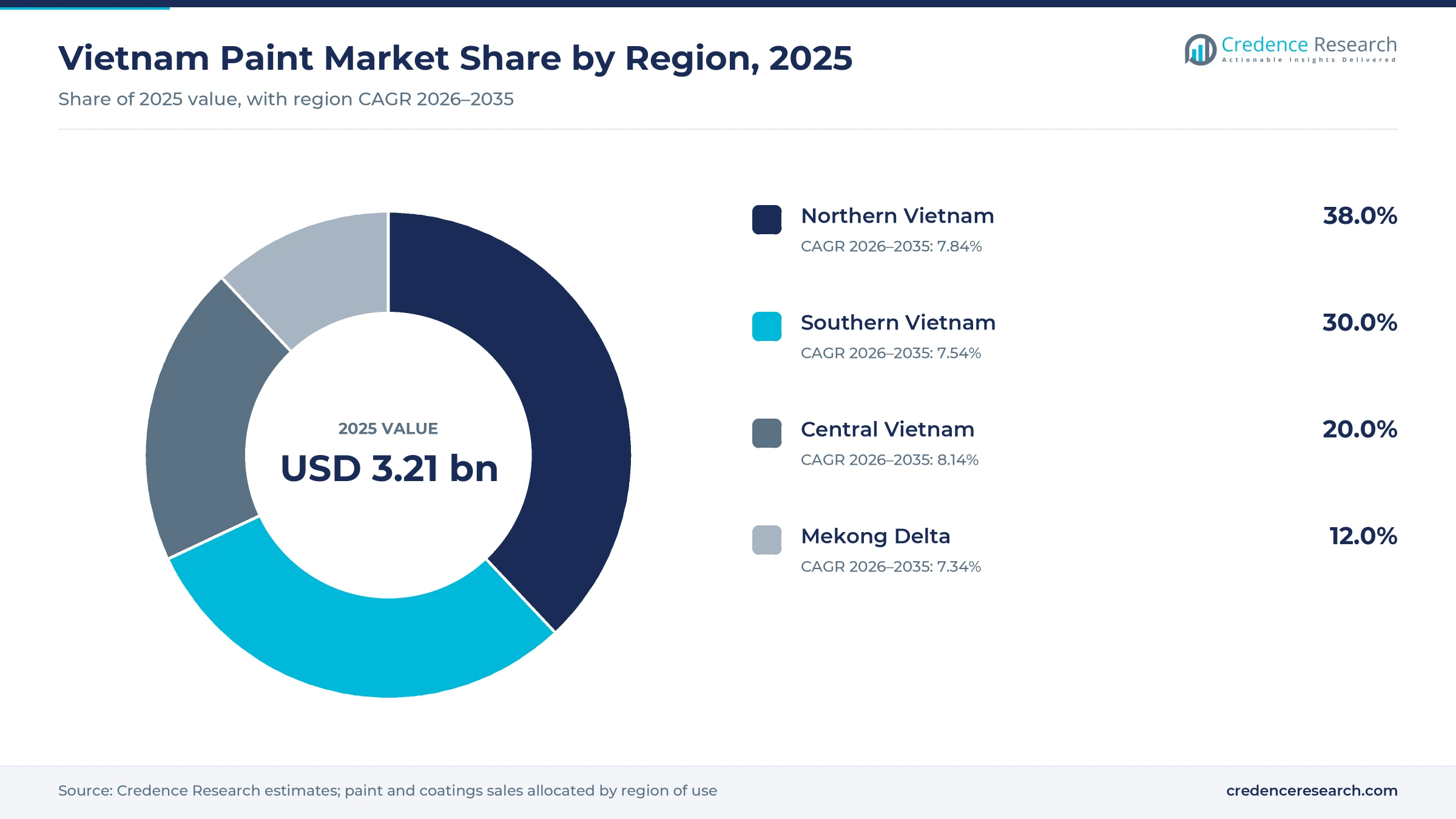
Northern Vietnam held 38.0% of 2025 value and grows at 7.84% a year, because Hanoi, Bac Ninh, Hai Phong and nearby provinces combine dense housing with large electronics and industrial parks. AkzoNobel expanded powder coating capacity in Bac Ninh in 2024 to serve volume growth in the north. As a result, industrial coatings and powder systems win a larger share of demand, while apartment projects in Hanoi keep wall paint sales high.
How does Southern Vietnam combine housing and furniture demand?
Southern Vietnam held 30.0% of 2025 value and grows at 7.54% a year, because Ho Chi Minh City, Binh Duong and Dong Nai host dense housing, paint plants and furniture factories. Many wood exporters finish chairs, tables and cabinets in the zone before shipping them abroad. However, growth is slightly slower because outlet density and price competition are already high, so brands compete on premium ranges and project sales.
Why is Central Vietnam growing fastest?
Central Vietnam held 20.0% of 2025 value and grows fastest at 8.14% a year, because Da Nang, Quang Ngai and coastal provinces add resorts, apartments, ports and industrial zones. Coastal buildings need exterior and protective coatings that resist salt air and heavy rain. As a result, dealers and project suppliers expand in the zone as tourism and logistics projects create new painting work.
What shapes paint demand in the Mekong Delta?
The Mekong Delta held 12.0% of 2025 value and grows at 7.34% a year, because the zone has a large rural population but lower building activity per household. Can Tho anchors urban demand, while provincial towns buy economy wall paint from family-run dealers. However, flooding and humid conditions raise demand for waterproofing and exterior coatings on homes, shops and public buildings.
Plant expansion and a regional deal marked 2024 to 2026
| Development | Status and market relevance |
|---|---|
| In March 2024, AkzoNobel announced a 18.5 million euro expansion at its Bac Ninh site in northern Vietnam. | Added five powder coating lines and one water-based line |
| In December 2025, the Ministry of Construction reported 102,633 social housing units completed in 2025. | Exceeded the yearly target by 2%, which supports wall paint demand |
| In January 2026, the National Statistics Office reported disbursed foreign investment of about $27.6 billion for 2025. | Marked a five-year high that supports factory coatings demand |
| In January 2026, customs data showed record wood and timber exports of $17.2 billion for 2025. | Confirmed scale for wood coatings used by furniture exporters |
| In October 2026, AkzoNobel agreed to sell its Southeast Asian decorative paints businesses to Nippon Paint. | Vietnam share acquisition expected around mid-2027, subject to approvals |
Water-borne, powder and lead-free systems change formulas
- Water-borne emulsions replace solvent-based wall paints in homes and offices, which lowers odor and volatile emissions during application.
- Powder coatings cover appliances, metal furniture and electronic housings without solvents, which cuts waste and speeds curing on factory lines.
- Lead-free driers and pigments help producers meet the national limit that falls to 90 parts per million, which protects children and painters.
- In-store tinting systems let dealers mix thousands of colors on demand, which reduces stock needs and supports premium decorative ranges.
Need a Custom Version of This Report?
Tailor the scope, geography, or segments to your exact requirements.
- Custom geography or segment scope
- Direct access to our analyst team
Global coatings groups compete with strong domestic brands
Competition is split between multinational coatings groups and strong domestic producers that dominate provincial towns. Nippon Paint has operated in Vietnam since 1994 and runs four factories in Dong Nai, Hanoi, Phu Tho and Ho Chi Minh City. AkzoNobel makes Dulux and Maxilite products in Vietnam and expanded its Bac Ninh powder coating lines in 2024. Jotun invested in a third Vietnamese plant in Hiep Phuoc Industrial Park for water-based and powder coatings. KOVA Paint Group, a domestic producer, runs plants in Vietnam and Cambodia and sells protective coatings, while Kansai-Alphanam combines a local partner with Japanese technology. 4 Oranges, TOA, KCC, PPG and Sherwin-Williams also compete in decorative, industrial or protective coatings. Rivals compete on brand, dealer reach, color systems, price tiers, technical service and project specification, while the pending AkzoNobel sale may change decorative brand ownership.
Companies profiled and their roles in this market
| Company | Type | Role in the market |
|---|---|---|
| Nippon Paint Vietnam | Multinational producer | Runs four factories in Dong Nai, Hanoi, Phu Tho and Ho Chi Minh City |
| Akzo Nobel Vietnam | Multinational producer | Expanded Bac Ninh powder and water-based lines in 2024 |
| Jotun Vietnam Co., Ltd. | Multinational producer | Invested in a Hiep Phuoc plant for water-based and powder coatings |
| KOVA Paint Group | Domestic producer | Makes decorative and protective coatings in Vietnam and Cambodia |
| Kansai-Alphanam Paint Co., Ltd. | Joint venture producer | Combines a local partner with Japanese coatings technology |
Credence Research view on Vietnamese coatings demand
Credence Research's view is that Vietnamese paint demand will grow steadily because housing programs, factory investment and furniture exports keep coating volumes rising. Architectural paints remain the base of the market, while industrial, powder and protective coatings gain share as foreign-invested plants expand. The 2026 to 2030 national target of 973,471 social housing units also gives wall paint demand a long pipeline of projects. However, raw material costs, export tariffs and price competition will keep margins tight. Producers that combine dealer reach, lead-free formulas and technical service for factories and exporters should gain share fastest through 2035.
How the Vietnamese coatings estimate was built
The report uses 2025 as the base year on a calendar basis, and market values come from the Credence Research model. That model combines construction, housing and investment data from government releases, manufacturing data from the World Bank, customs data on wood exports and company disclosures on plants and deals. Segment and regional splits are Credence Research estimates based on housing, industry and export activity by zone. Sources used are government releases, company announcements, industry news and statistical databases, and no interviews or surveys were used.
Construction and manufacturing carry coatings demand to 2035
Paint and coatings sales are expected to reach USD 6.81 billion by 2035, a 7.75% CAGR during 2026–2035, as housing, factories and furniture exports keep demand rising. Growth should stay steady through 2028 while social housing and foreign-invested plants add volume, as the national program targets 1,062,200 social housing units by 2030 to support paint demand. After that, industrial, powder and protective coatings will carry more growth as wall paint demand matures in large cities. Weaker exports or property activity would lower this outlook, while faster infrastructure spending would raise it. Producers with lead-free formulas, powder capacity and wide dealer networks are expected to gain the most from this demand.
Frequently Asked Questions
How big is the Vietnam paint market?
Which product type leads paint demand in Vietnam?
Which region leads the Vietnam paint market?
Which technology is growing fastest?
What drives paint demand in Vietnam?
How do lead rules affect paint makers in Vietnam?
Who are the leading paint companies in Vietnam?
What are the main challenges for paint producers?
Table of Content
Chapter 1 Market Segmentation
- 1.1 Segmentation Framework
- 1.1.1 Product and Service Classification
- 1.1.2 Application and End-Use Classification
- 1.1.3 Technology and Solution Classification
- 1.1.4 Customer and Distribution Channel Classification
- 1.1.5 Geographic Segmentation
- 1.1.6 Market Segment Definitions and Boundaries
- 1.2 By Product Type
- 1.2.1 Architectural Paints
- 1.2.2 Industrial Coatings
- 1.2.3 Wood Coatings
- 1.2.4 Marine and Protective Coatings
- 1.3 By Application
- 1.3.1 Interior Surfaces
- 1.3.2 Exterior Facades
- 1.3.3 Metal Protection
- 1.3.4 Wood Finishing
- 1.4 By Technology
- 1.4.1 Water-Borne Systems
- 1.4.2 Solvent-Borne Systems
- 1.4.3 Powder Coatings
- 1.4.4 High-Solids Systems
Chapter 2 Introduction
- 2.1 Report Objectives and Scope
- 2.2 Product Definition and Industry Terminology
- 2.3 Market Inclusions and Exclusions
- 2.4 Research Process
- 2.4.1 Primary Research and Expert Interviews
- 2.4.2 Secondary Research and Source Review
- 2.4.3 Top-Down and Bottom-Up Estimation
- 2.4.4 Data Triangulation and Verification
- 2.5 Market Size Measurement Basis
- 2.5.1 2025: USD 3.21 billion → 2035: USD 6.81 billion
- 2.6 Historical and Forecast Reference Periods
- 2.6.1 Historical Period: 2018-2025
- 2.6.2 Base Year: 2025
- 2.6.3 Forecast Period: 2025-2035
- 2.7 Research Assumptions and Limitations
Chapter 3 Executive Summary
- 3.1 Market Snapshot and Key Findings
- 3.2 Base-Year Market Size, 2025
- 3.3 Forecast Market Size, 2035
- 3.4 Revenue and Volume Growth Outlook
- 3.5 Key Demand and Supply Indicators
- 3.6 Leading Market Segments
- 3.7 Fastest-Growing Market Opportunities
- 3.8 Regional Performance Highlights
- 3.9 Technology and Industry Transformation
- 3.10 Competitive Landscape Summary
- 3.11 Analyst View and Strategic Implications
Chapter 4 Vietnam Paint Market Trends and Developments
- 4.1 Historical Industry Development, 2018-2025
- 4.2 Recent Market Trends and Developments
- 4.3 Demand and Customer Behavior Trends
- 4.4 Technology and Product Innovation
- 4.5 Artificial Intelligence, Automation and Digitalization
- 4.6 Local Manufacturing and Supply Chain Realignment
- 4.7 Industry Partnerships, Mergers and Acquisitions
- 4.8 Sustainability and Circular Economy Developments
- 4.9 Government and Private Sector Investment Trends
- 4.10 Emerging Business Models and Commercialization
- 4.11 Industry Developments and Announcements
Chapter 5 Vietnam Paint Market Production, Supply and Demand Analysis
- 5.1 Demand Trend and Consumption Analysis, 2018-2025
- 5.2 Demand Forecast, 2025-2035
- 5.3 Production and Output Trend, 2018-2025
- 5.4 Production and Output Forecast, 2025-2035
- 5.5 Installed Capacity and Capacity Utilization
- 5.6 Company-Wise Production Plants and Statistics
- 5.6.1 Installed Production Capacity
- 5.6.2 Actual Production
- 5.6.3 Planned Capacity and Expansion Targets
- 5.7 Supply Chain Structure and Procurement Trends
- 5.8 Supply-Demand Gap and Bottlenecks
- 5.9 Import Dependence and Sourcing Structure
- 5.10 Contract Manufacturing and Outsourcing
- 5.11 Regional Supply and Demand Concentration
Chapter 6 Vietnam Paint Market Pricing Analysis
- 6.1 Pricing Structure and Measurement
- 6.2 Historical Pricing Trends, 2018-2025
- 6.3 Pricing Outlook, 2025-2035
- 6.4 Average Selling Price and Unit Economics
- 6.5 Pricing by Product and Market Segment
- 6.6 Geographic Pricing Differences
- 6.7 Key Input, Energy, Labor and Logistics Costs
- 6.8 Contract Pricing and Purchasing Models
- 6.9 Pricing Sensitivity and Competitive Positioning
- 6.10 Price, Margin and Profitability Implications
Chapter 7 Vietnam Paint Market Dynamics
- 7.1 Market Growth Drivers
- 7.1.1 Demand-Side Drivers
- 7.1.2 Technology and Innovation Drivers
- 7.1.3 Infrastructure and Investment Drivers
- 7.1.4 Regulatory and Policy Drivers
- 7.2 Market Restraints
- 7.2.1 Cost and Affordability Constraints
- 7.2.2 Technology and Adoption Barriers
- 7.2.3 Supply Chain and Operational Constraints
- 7.3 Market Challenges
- 7.3.1 Competitive Pressure and Margin Erosion
- 7.3.2 Skills, Infrastructure and Implementation Gaps
- 7.4 Emerging Market Opportunities
- 7.5 Market Dynamics Impact and Time-Horizon Assessment
Chapter 8 Vietnam Paint Value Chain Analysis
- 8.1 Industry Value Chain Overview
- 8.2 Upstream Suppliers and Critical Inputs
- 8.3 Technology and Component Providers
- 8.4 Manufacturing or Service Delivery
- 8.5 Distribution, Channel Partners and Integrators
- 8.6 Downstream Applications and End Users
- 8.7 Value Addition and Profit Pools
- 8.8 Vertical Integration and Outsourcing
- 8.9 Supplier Concentration and Risk
- 8.10 Supply Chain Localization and Resilience
Chapter 9 Vietnam Paint Market Regulations and Policies
- 9.1 Relevant Laws, Standards and Compliance Frameworks
- 9.2 Product, Service, Safety and Quality Requirements
- 9.3 Government Policies, Incentives and Subsidies
- 9.4 Imports, Exports and Trade Barriers
- 9.5 Public Procurement and Local Content Requirements
- 9.6 Environmental and Sustainability Compliance
- 9.7 Upcoming Policy Changes and Market Implications
Chapter 10 Vietnam Paint Market Hotspots and Opportunities
- 10.1 Market Opportunity Mapping and Growth Hotspots
- 10.2 High-Growth Applications and Customer Groups
- 10.3 Underserved Markets and White-Space Opportunities
- 10.4 Emerging Technology and Product Opportunities
- 10.5 New Capacity and Investment Hotspots
- 10.6 Market Entry and Expansion Opportunities
- 10.7 Distribution and Partnership Opportunities
- 10.8 Near-Term and Long-Term Commercial Potential
- 10.9 Opportunity Attractiveness and Execution Risks
Chapter 11 Vietnam Paint Market Outlook, 2025-2035
- 11.1 Market Size and Analysis
- 11.1.1 Revenue (Market Measurement: 2025: USD 3.21 billion → 2035: USD 6.81 billion)
- 11.1.2 Market Volume and Quantity Sold
- 11.1.3 Historical Market Size, 2018-2025
- 11.1.4 Base-Year Market Size, 2025
- 11.2 Market Forecast, 2025-2035
- 11.2.1 Revenue Forecast to 2035
- 11.2.2 Volume Forecast to 2035
- 11.2.3 CAGR and Year-on-Year Growth
- 11.2.4 Incremental Revenue Opportunity
- 11.3 Forecast Assumptions and Scenario Analysis
- 11.3.1 Base-Case Forecast
- 11.3.2 Optimistic and Conservative Scenarios
- 11.3.3 Technology, Pricing and Policy Sensitivities
- 11.4 Market Attractiveness and Growth Outlook
Chapter 12 Vietnam Paint Market Segmentation and Outlook
- 12.1 Segmentation Summary and Market Shares, 2025
- 12.2 Largest and Fastest-Growing Segments
- 12.3 By Product Type - Market Size and Forecast, 2025-2035
- 12.3.1 Segment Definition and Scope
- 12.3.2 Historical Market Size, 2018-2025
- 12.3.3 Revenue Forecast, 2025-2035
- 12.3.4 Volume Forecast, 2025-2035
- 12.3.5 Base-Year Market Share, 2025
- 12.3.6 Segment CAGR and Growth Drivers
- 12.3.7 Subsegment Market Size and Forecast
- 12.3.7.1 Architectural Paints
- 12.3.7.2 Industrial Coatings
- 12.3.7.3 Wood Coatings
- 12.3.7.4 Marine and Protective Coatings
- 12.3.8 Subsegment Pricing and Adoption Trends
- 12.3.9 Leading Suppliers and Competition
- 12.3.10 Regional Demand and Opportunities
- 12.4 By Application - Market Size and Forecast, 2025-2035
- 12.4.1 Segment Definition and Scope
- 12.4.2 Historical Market Size, 2018-2025
- 12.4.3 Revenue Forecast, 2025-2035
- 12.4.4 Volume Forecast, 2025-2035
- 12.4.5 Base-Year Market Share, 2025
- 12.4.6 Segment CAGR and Growth Drivers
- 12.4.7 Subsegment Market Size and Forecast
- 12.4.7.1 Interior Surfaces
- 12.4.7.2 Exterior Facades
- 12.4.7.3 Metal Protection
- 12.4.7.4 Wood Finishing
- 12.4.8 Subsegment Pricing and Adoption Trends
- 12.4.9 Leading Suppliers and Competition
- 12.4.10 Regional Demand and Opportunities
- 12.5 By Technology - Market Size and Forecast, 2025-2035
- 12.5.1 Segment Definition and Scope
- 12.5.2 Historical Market Size, 2018-2025
- 12.5.3 Revenue Forecast, 2025-2035
- 12.5.4 Volume Forecast, 2025-2035
- 12.5.5 Base-Year Market Share, 2025
- 12.5.6 Segment CAGR and Growth Drivers
- 12.5.7 Subsegment Market Size and Forecast
- 12.5.7.1 Water-Borne Systems
- 12.5.7.2 Solvent-Borne Systems
- 12.5.7.3 Powder Coatings
- 12.5.7.4 High-Solids Systems
- 12.5.8 Subsegment Pricing and Adoption Trends
- 12.5.9 Leading Suppliers and Competition
- 12.5.10 Regional Demand and Opportunities
- 12.6 Segment Growth Comparison
- 12.7 Segment Attractiveness and Priority Matrix
Chapter 13 Vietnam Paint End-Use and Application Market Outlook
- 13.1 End-Use Industry and Customer Demand Structure
- 13.2 Leading Applications and Customer Groups
- 13.3 End-Use Market Size, Share and Forecast
- 13.4 Major End-Use Industry Deep Dives
- 13.4.1 Customer Requirements and Use Cases
- 13.4.2 Demand and Replacement Cycles
- 13.4.3 Technical and Regulatory Considerations
- 13.4.4 Purchasing and Procurement Models
- 13.4.5 Leading Vendors and Distribution Channels
- 13.4.6 Forecast and Commercial Opportunities
- 13.5 Emerging Applications and Cross-Segment Demand
- 13.6 End-Use Industry Investment Priorities
Chapter 14 Vietnam Paint Geographic Market Outlook, 2025-2035
- 14.1 Regional Market Size and Country-Level Shares, 2025
- 14.2 Country Market Size Comparison, 2025
- 14.3 Country Market Forecasts, 2025-2035
- 14.4 Subregional Industrial and Demand Clusters
- 14.5 Intra-Regional Pricing and Cost Differences
- 14.6 Cross-Border Trade and Supply Networks
- 14.7 Regional Supply and Demand Balances
- 14.8 Country Opportunity Comparison and Prioritization
Note: Every listed country is covered on the structure shown under the first country.
Chapter 15 Vietnam Paint Technology, Innovation and Sustainability Outlook
- 15.1 Technology Landscape and Maturity
- 15.2 Product, Process and Service Innovation
- 15.3 AI, Automation and Digital Tools in the Industry
- 15.4 Technology Adoption and Performance Benchmarking
- 15.5 Innovation Pipeline and R&D Investment
- 15.6 Patent and Intellectual Property Trends
- 15.7 Energy Efficiency and Resource Management
- 15.8 Sustainability, Recycling and Circularity
- 15.9 Technology Roadmap, 2025-2035
- 15.10 Risks of Obsolescence and Technology Substitution
Chapter 16 Vietnam Paint Market Key Strategic Imperatives
- 16.1 Growth and Market Entry Priorities
- 16.2 High-Return Products and Segments
- 16.3 Pricing, Profitability and Cost Optimization
- 16.4 Technology Investment and Product Differentiation
- 16.5 Supply Chain Localization and Resilience
- 16.6 Distribution and Customer Acquisition
- 16.7 Partnership, Acquisition and Capacity Strategy
- 16.8 Regional Expansion Priorities
- 16.9 Short-, Medium- and Long-Term Actions
Chapter 17 Competition Outlook
- 17.1 Industry Competition Characteristics
- 17.2 Market Structure and Concentration
- 17.3 Market Share and Competitive Positioning, 2025
- 17.4 Company-Wise Revenue and Product Benchmarking
- 17.5 Production and Service Capacity Benchmarking
- 17.6 Technology, Pricing and Differentiation
- 17.7 Regional Footprint and Distribution Strength
- 17.8 Mergers, Acquisitions and Strategic Alliances
- 17.9 New Entrants and Competitive Threats
- 17.10 Porter's Five Forces and Industry Attractiveness
- 17.11 Competitive Outlook, 2025-2035
Chapter 18 Company Profiles
- 18.1 Company Coverage and Selection Criteria
- 18.2 Akzo Nobel Vietnam
- 18.2.1 Business Description
- 18.2.2 Company Ownership and Geographic Presence
- 18.2.3 Product and Service Portfolio
- 18.2.4 Manufacturing and Operating Footprint
- 18.2.5 Production Capacity and Expansion Plans
- 18.2.6 Financial Performance and Investment
- 18.2.7 Market Share and Competitive Position
- 18.2.8 Technology and Innovation Capabilities
- 18.2.9 Strategic Alliances or Partnerships
- 18.2.10 Recent Developments
- 18.2.11 Growth Strategy and Outlook
- 18.3 Nippon Paint Vietnam
- 18.4 4 Oranges Co., Ltd.
- 18.5 Jotun Vietnam Co., Ltd.
- 18.6 KOVA Paint Group
- 18.7 TOA Paint (Vietnam) Co., Ltd.
- 18.8 Kansai-Alphanam Paint Co., Ltd.
- 18.9 KCC (Vietnam) Co., Ltd.
- 18.10 PPG Vietnam
- 18.11 Sherwin-Williams Vietnam
- 18.12 Other Relevant Market Participants
Note: Every listed company is profiled on the structure shown under the first company. The company list is preliminary and may change based on research findings, market developments, data availability and client requirements.
Chapter 19 Disclaimer
- 19.1 Research and Forecast Disclaimer
- 19.2 Data Source and Estimation Limitations
Note: The depth of individual sections depends on data availability for this market. Volume, capacity, trade and other unit-based metrics are included where applicable.

