Executive Summary & Core Metrics
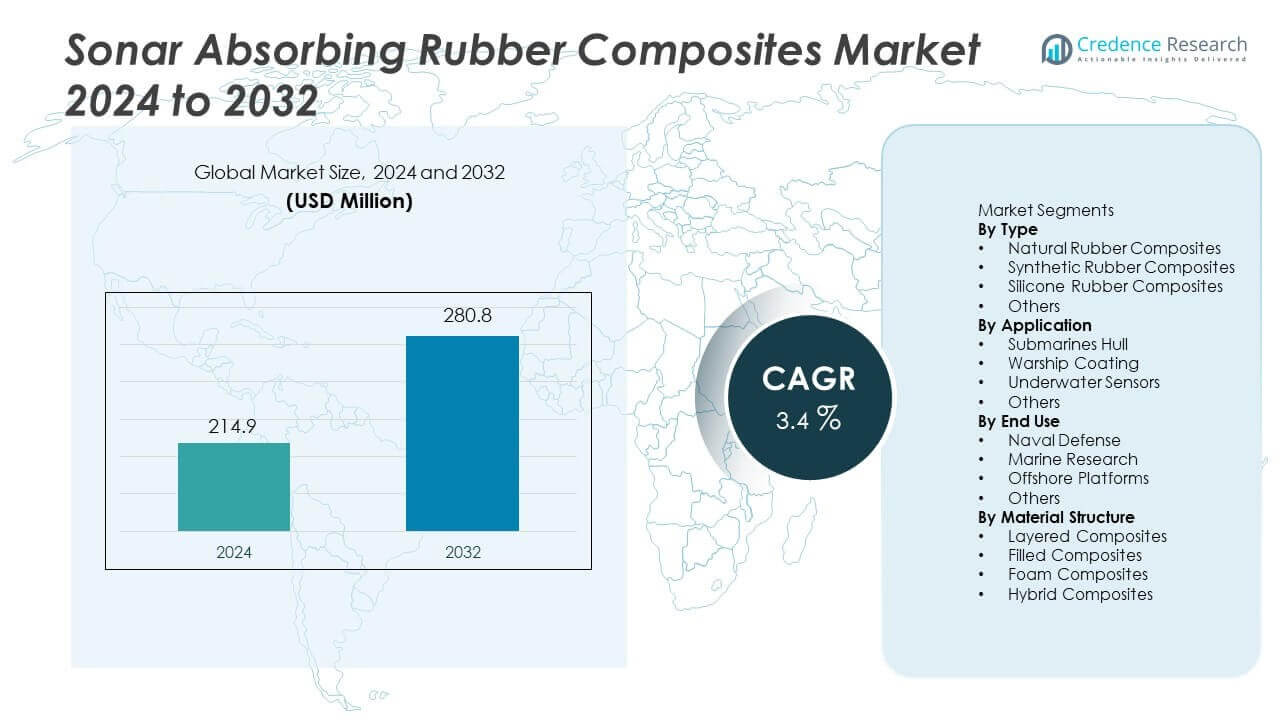
The global sonar absorbing rubber composites market was valued at USD 214.9 million in 2024 and is projected to reach USD 280.8 million by 2032, expanding at a compound annual growth rate (CAGR) of 3.4% during the forecast period, according to Credence Research. This growth reflects rising naval modernization, increasing submarine and warship procurement, growing underwater surveillance activity and demand for advanced acoustic materials used in stealth-focused marine defense platforms.
| REPORT ATTRIBUTE | DETAILS |
|---|---|
| Historical Period | 2020-2023 |
| Base Year | 2024 |
| Forecast Period | 2025-2032 |
| Sonar Absorbing Rubber Composites Market Size 2024 | USD 214.9 million |
| Sonar Absorbing Rubber Composites Market, CAGR | 3.4% |
| Sonar Absorbing Rubber Composites Market Size 2032 | USD 280.8 million |
The global sonar absorbing rubber composites market is characterized by the presence of specialty material manufacturers, advanced elastomer suppliers, defense contractors and acoustic technology providers competing on acoustic absorption, underwater durability, pressure resistance, adhesion performance and multilayer composite design. Leading players focus on synthetic rubber composites, natural rubber composites, silicone rubber composites, layered composites, filled composites and hybrid systems for submarine hulls, warship coatings, underwater sensors, offshore platforms and marine research applications. Strategic priorities across the sector include deep-water performance, advanced elastomer development, acoustic signature reduction, multi-layer material systems, defense agency collaboration and lifecycle support for naval refit programs.
Strategic Market Insights
- Market growth is primarily driven by naval modernization programs, rising demand for underwater stealth capability and growing procurement of sonar-resistant materials for submarines, warships and surveillance platforms.
- Dominant industry trends highlight development of multi-layer acoustic structures, high-frequency absorbing composites, pressure-resistant elastomers and advanced adhesion systems for demanding underwater operating environments.
- The competitive landscape is defined by leading companies investing in advanced rubber formulations, filler technologies, acoustic damping systems and lifecycle support for naval modernization and refit programs.
- According to Credence Research regional mapping, North America represents the largest market, accounting for a definitive 37% share due to strong naval procurement, submarine fleet modernization, underwater surveillance programs and high defense spending.
Sonar Absorbing Rubber Composites Market Segmentation Analysis
By Type
- Natural Rubber Composites
- Synthetic Rubber Composites
- Silicone Rubber Composites
- Others
Data compiled by Credence Research confirms that synthetic rubber composites constitute the dominant type segment, holding an estimated 42% market share. Their leadership is supported by high durability, strong sound absorption properties, mechanical stability and cost efficiency for naval structures. Defense programs prefer synthetic rubber composites because they can support long service life in harsh underwater environments, where pressure, corrosion, vibration and acoustic exposure create demanding performance conditions.
Natural rubber composites hold 28% share and remain used in medium-depth operations due to flexibility and elastic performance. Silicone rubber composites account for 20% share and are gaining adoption in advanced acoustic layers where stable thermal behavior and specialized performance characteristics are needed. Other composites capture 10% share, including hybrid blends used for customized acoustic requirements across specialized marine platforms. Growth across all types is supported by higher submarine production and rising investment in underwater stealth systems.
Trelleborg AB developed engineered polymer materials within its acoustic and anechoic signature control portfolio for naval applications. These materials are designed to reduce radiated noise and target strength when used on ships and submarines.
By Application
- Submarines Hull
- Warship Coating
- Underwater Sensors
- Others
Submarines hull dominates the application segment with an estimated 51% market share. This leadership is driven by large surface area use and strong emphasis on acoustic stealth against modern sonar systems. Naval programs integrate sonar absorbing rubber composites into submarine platforms to reduce sound reflection and improve operational concealment. Military modernization and refit programs also support replacement of older coating systems with higher absorption materials.
Warship coating holds 27% share as navies seek lower detection signatures in littoral and contested maritime zones. Underwater sensors account for 14% share, supported by use in fixed surveillance systems, underwater monitoring stations and marine research equipment. Other applications capture 8% share, including research platforms and specialized underwater structures. Rising maritime tensions, anti-submarine warfare programs and underwater surveillance investments continue to drive demand across deep-water and shallow-water environments.
Saint-Gobain supplies acoustic damping materials, including specialized rubber-based solutions for submarines and surface vessels, designed to reduce structural noise transmission and maintain durability under continuous hydrostatic pressure.
By End Use
- Naval Defense
- Marine Research
- Offshore Platforms
- Others
Naval defense holds the largest end-use position with an estimated 63% market share. This dominance is supported by continuous procurement of sonar-resistant materials for submarines, warships and underwater defense platforms. Military modernization plans are increasing replacement of older coating systems with advanced acoustic absorption grades. Naval agencies and defense contractors continue investing in stealth-focused materials that improve acoustic concealment, durability and long-term performance under underwater operating conditions.
Marine research accounts for 19% share, driven by the need to reduce acoustic interference around marine life monitoring systems, deep-sea instruments and underwater research platforms. Offshore platforms represent 11% share, supported by underwater structure protection and sensor reliability requirements. Other end uses capture 7% share, including academic and survey projects. Rising defense budgets and maritime security programs remain the primary growth engines for global demand.
Key Market Dynamics
Primary Market Drivers
Growing Naval Modernization and Stealth Requirements
Global naval forces are upgrading underwater fleets to improve stealth against advanced sonar detection. New submarine and warship programs increasingly require rubber composite materials that absorb acoustic signals and reduce reflection across broad operating conditions. Countries investing in anti-submarine warfare, maritime security and strategic deterrence are increasing procurement of advanced acoustic materials. Military modernization programs in the United States, China, India and Europe are supporting demand for durable sonar absorbing composites. Credence Research identifies naval modernization as the strongest driver for the market, especially as undersea security becomes a higher priority across major defense economies.
Rising Underwater Surveillance and Maritime Security Projects
Countries are expanding underwater surveillance systems to monitor maritime borders, protect naval routes and secure offshore assets. Fixed arrays, underwater sensor stations, autonomous systems and coastal monitoring platforms require materials that reduce acoustic disturbance and improve sensor reliability. Growth in anti-submarine tracking and coastal defense programs is stimulating investment in protective materials with low-reflection properties. Maritime security programs continue to increase demand for acoustic coatings and composite layers used on platforms deployed in both deep and shallow waters.
Increasing Production of Submarines and Next-Generation Warships
Global defense budgets continue to support submarine and warship construction programs. Many navies are replacing aging fleets with quieter underwater platforms designed for improved acoustic performance. Modern hull designs increasingly use multi-layer composites that manage vibration and reduce acoustic signatures. Investments in next-generation submarines and advanced warships are driving procurement of rubber-based acoustic materials for both new vessel construction and upgrade programs. Credence Research indicates that sustained naval fleet modernization will support steady long-term market growth.
Key Trends & Structural Opportunities
Development of High-Frequency and Multi-Layer Composite Systems
Manufacturers are investing in rubber composites that improve acoustic absorption across broader operating conditions. Multi-layer structures combine elastomers, fillers and acoustic materials to enhance reflection control and support stealth performance. New composite technologies focus on durability, deep-water pressure resistance and stronger adhesion to marine structures. These advancements support modern submarines, warships and underwater platforms designed for silent operation in contested maritime environments. Parker Hannifin has engineered acoustic management systems that can include multilayer rubber components and support meaningful noise reduction during testing.
Expanded Use in Marine Research and Offshore Structures
Marine research stations, underwater survey systems and offshore infrastructure are adopting acoustic rubber composites to reduce sound interference around sensitive equipment. Offshore platforms use these materials for underwater protection, sensor reliability and structural noise reduction. Increasing focus on underwater environmental impact is also encouraging use of noise-reducing materials in ocean research and autonomous underwater vehicles. Growing offshore energy projects create additional opportunities for acoustic protection materials across subsea systems and monitoring networks.
Lifecycle Upgrade Programs for Existing Naval Fleets
Naval refit and lifecycle upgrade programs are creating steady demand for sonar absorbing rubber composites. Older submarines and surface vessels often require replacement or enhancement of acoustic materials to maintain performance and extend service life. Defense agencies increasingly prioritize upgrades that improve stealth, durability and operational readiness without requiring full platform replacement. This trend creates opportunities for suppliers offering qualified materials, maintenance support and long-term service partnerships with naval contractors.
Industry Challenges
High Material Cost and Complex Manufacturing
Sonar absorbing rubber composites require advanced elastomer formulations, specialized fillers and multi-layer manufacturing processes. These factors increase material cost and limit adoption in regions with smaller defense budgets. Production also requires precise processing, strict quality assurance and long qualification cycles. These requirements restrict large-scale supply and make broader commercial deployment more difficult. Cost remains a major restraint, especially for developing defense programs and non-defense applications.
Limited Availability of Skilled Fabrication and Installation
Applying sonar absorbing rubber layers requires specialized fabrication, handling and naval maintenance expertise. Many regions face limited technical capability in producing, installing and maintaining acoustic rubber systems. Skilled labor shortages can increase project timelines and slow modernization programs. This challenge affects both new vessel construction and retrofit projects. Suppliers and naval contractors must support training, quality control and lifecycle maintenance to improve adoption across broader markets.
Detailed Regional Analysis
| Region | Market Share (%) | Strategic Regional Catalysts & Insights |
| North America | 37.0% | Global leader. Driven by U.S. naval modernization, large submarine fleets, acoustic stealth upgrades, underwater surveillance and anti-submarine warfare investment. |
| Europe | 29.0% | Mature defense market. Supported by naval modernization in the United Kingdom, France, Germany and Italy, along with joint defense programs and acoustic materials research. |
| Asia Pacific | 24.0% | Fastest-growing region. Driven by submarine production, maritime security tensions, defense spending and naval expansion across China, India, Japan and South Korea. |
| Latin America | 6.0% | Developing regional market. Supported by selective naval procurement, submarine modernization and coastal defense activity in Brazil, Mexico and Chile. |
| Middle East & Africa | 4.0% | Emerging territory. Driven by Gulf naval capability upgrades, offshore asset protection and selective underwater surveillance investments. |
North America leads the global sonar absorbing rubber composites market with a 37% share, according to Credence Research. The region benefits from strong naval modernization programs, large submarine fleets and sustained investment in acoustic stealth upgrades. The United States remains the primary demand center due to procurement of advanced composite coatings for new submarines and refit programs. Research institutes and naval contractors collaborate on multi-layer rubber structures designed for underwater durability. Canada supports limited but growing demand through maritime security and coastal monitoring investments. Anti-submarine warfare and strategic deterrence remain core demand drivers.
Europe accounts for 29% of the global market, driven by major naval forces in the United Kingdom, France, Germany and Italy. Countries across the region are investing in silent underwater platforms, next-generation submarines and modernization of aging fleets. European defense contractors adopt multi-frequency absorbing rubber materials to improve stealth performance in contested maritime zones. Maritime security missions across the North Atlantic and Mediterranean strengthen demand for sound absorbing coatings on vessels and underwater systems. Joint research and defense collaboration support advanced composite development for pressure resistance and long-term durability.
Asia Pacific holds 24% share and records the fastest growth. Rising naval expansion in China, India, Japan and South Korea supports strong demand for sonar absorbing rubber composites. Regional governments are increasing submarine and warship procurement to strengthen maritime presence and protect underwater territories. Geopolitical tensions and maritime security concerns are driving upgrades in stealth materials and acoustic coatings for coastal and deep-water operations. Shipyards are adopting advanced composite structures for next-generation naval platforms. Investment in underwater surveillance and autonomous systems further strengthens long-term growth.
Latin America represents 6% share, driven by moderate naval procurement and coastal defense projects in Brazil, Mexico and Chile. Submarine acquisition remains limited, but countries are implementing targeted modernization programs that include underwater material upgrades. Maritime patrol operations in coastal waters support selective use of sonar absorbing coatings on surveillance platforms. Budget constraints and procurement delays restrict broader adoption. However, modernization activity in Brazil and research into marine acoustic materials support future development opportunities.
The Middle East & Africa account for 4% share due to selective adoption of underwater composites in Gulf nations and South Africa. Investment focuses on coastal protection, offshore assets and naval surveillance, creating limited but growing use of sonar absorbing materials. Saudi Arabia, the UAE and Qatar are strengthening naval capabilities and adopting stealth features on advanced platforms. Africa records minimal adoption due to budget limitations, though South Africa maintains niche procurement. Regional growth depends on maritime security needs, offshore energy development and defense spending improvement.
Competitive Landscape & Recent Developments
The sonar absorbing rubber composites market includes major companies such as 3M Company, Trelleborg AB, Parker Hannifin Corporation, Saint-Gobain Performance Plastics, Continental AG, Honeywell International Inc., Shin-Etsu Chemical Co. Ltd., L’Garde Inc., Aeroceanics and Rubbercraft Corporation. These companies compete through multi-layer sonar absorbing rubber structures, advanced elastomers, acoustic fillers, underwater adhesion systems and performance validation for harsh marine environments.
Market leaders invest in composite technologies that reduce acoustic reflection and enhance stealth performance for submarines, warships and underwater systems. Defense contractors collaborate with naval agencies to test material configurations under deep-water and high-pressure conditions. Companies also expand supply capabilities through defense contracts, military upgrade programs and lifecycle support for refit activities. Growing demand for silent underwater platforms is pushing manufacturers to expand research pipelines and improve rubber composite performance across multiple acoustic environments.
Recent Industry Developments (2025)
- In April 2025, Geo Acoustics Ltd introduced new sonars and additional services at Ocean Business 2025, held from April 8 to April 10 at the National Oceanography Centre in Southampton.

Request a Free Sample
Fill in your details and we'll send you a free sample report.
- Sample data tables & charts
- Research methodology
Need a Custom Version of This Report?
Tailor the scope, geography, or segments to your exact requirements.
- Custom geography or segment scope
- Direct access to our analyst team
Frequently Asked Questions
What is the current and projected size of the global sonar absorbing rubber composites market?
What is the projected growth rate of the sonar absorbing rubber composites industry over the forecast period?
Which type segment holds the maximum market share within the sonar absorbing rubber composites industry?
Which application segment dominates the sonar absorbing rubber composites market?
Which end-use segment leads the sonar absorbing rubber composites market?
Which region commands the highest market share in the global sonar absorbing rubber composites space?
Table of Content
Chapter 1 Market Segmentation
- 1.1 Segmentation Framework
- 1.1.1 Product and Service Classification
- 1.1.2 Application and End-Use Classification
- 1.1.3 Technology and Solution Classification
- 1.1.4 Customer and Distribution Channel Classification
- 1.1.5 Geographic Segmentation
- 1.1.6 Market Segment Definitions and Boundaries
Chapter 2 Introduction
- 2.1 Report Objectives and Scope
- 2.2 Product Definition and Industry Terminology
- 2.3 Market Inclusions and Exclusions
- 2.4 Research Process
- 2.4.1 Primary Research and Expert Interviews
- 2.4.2 Secondary Research and Source Review
- 2.4.3 Top-Down and Bottom-Up Estimation
- 2.4.4 Data Triangulation and Verification
- 2.5 Market Size Measurement Basis
- 2.5.1 2024: USD 214.9 million → 2032: USD 280.8 million
- 2.6 Historical and Forecast Reference Periods
- 2.6.1 Base Year: 2024
- 2.6.2 Forecast Period: 2024-2032
- 2.7 Research Assumptions and Limitations
Chapter 3 Executive Summary
- 3.1 Market Snapshot and Key Findings
- 3.2 Base-Year Market Size, 2024
- 3.3 Forecast Market Size, 2032
- 3.4 Revenue and Volume Growth Outlook
- 3.5 Key Demand and Supply Indicators
- 3.6 Leading Market Segments
- 3.7 Fastest-Growing Market Opportunities
- 3.8 Regional Performance Highlights
- 3.9 Technology and Industry Transformation
- 3.10 Competitive Landscape Summary
- 3.11 Analyst View and Strategic Implications
Chapter 4 Global Sonar Absorbing Rubber Composites Market Trends and Developments
- 4.1 Historical Industry Development
- 4.2 Recent Market Trends and Developments
- 4.3 Demand and Customer Behavior Trends
- 4.4 Technology and Product Innovation
- 4.5 Artificial Intelligence, Automation and Digitalization
- 4.6 Local Manufacturing and Supply Chain Realignment
- 4.7 Industry Partnerships, Mergers and Acquisitions
- 4.8 Sustainability and Circular Economy Developments
- 4.9 Government and Private Sector Investment Trends
- 4.10 Emerging Business Models and Commercialization
- 4.11 Industry Developments and Announcements
Chapter 5 Global Sonar Absorbing Rubber Composites Market Production, Supply and Demand Analysis
- 5.1 Demand Trend and Consumption Analysis
- 5.2 Demand Forecast, 2024-2032
- 5.3 Production and Output Trend
- 5.4 Production and Output Forecast, 2024-2032
- 5.5 Installed Capacity and Capacity Utilization
- 5.6 Company-Wise Production Plants and Statistics
- 5.6.1 Installed Production Capacity
- 5.6.2 Actual Production
- 5.6.3 Planned Capacity and Expansion Targets
- 5.7 Supply Chain Structure and Procurement Trends
- 5.8 Supply-Demand Gap and Bottlenecks
- 5.9 Import Dependence and Sourcing Structure
- 5.10 Contract Manufacturing and Outsourcing
- 5.11 Regional Supply and Demand Concentration
Chapter 6 Global Sonar Absorbing Rubber Composites Market Pricing Analysis
- 6.1 Pricing Structure and Measurement
- 6.2 Historical Pricing Trends
- 6.3 Pricing Outlook, 2024-2032
- 6.4 Average Selling Price and Unit Economics
- 6.5 Pricing by Product and Market Segment
- 6.6 Geographic Pricing Differences
- 6.7 Key Input, Energy, Labor and Logistics Costs
- 6.8 Contract Pricing and Purchasing Models
- 6.9 Pricing Sensitivity and Competitive Positioning
- 6.10 Price, Margin and Profitability Implications
Chapter 7 Global Sonar Absorbing Rubber Composites Market Dynamics
- 7.1 Market Growth Drivers
- 7.1.1 Demand-Side Drivers
- 7.1.2 Technology and Innovation Drivers
- 7.1.3 Infrastructure and Investment Drivers
- 7.1.4 Regulatory and Policy Drivers
- 7.2 Market Restraints
- 7.2.1 Cost and Affordability Constraints
- 7.2.2 Technology and Adoption Barriers
- 7.2.3 Supply Chain and Operational Constraints
- 7.3 Market Challenges
- 7.3.1 Competitive Pressure and Margin Erosion
- 7.3.2 Skills, Infrastructure and Implementation Gaps
- 7.4 Emerging Market Opportunities
- 7.5 Market Dynamics Impact and Time-Horizon Assessment
Chapter 8 Global Sonar Absorbing Rubber Composites Value Chain Analysis
- 8.1 Industry Value Chain Overview
- 8.2 Upstream Suppliers and Critical Inputs
- 8.3 Technology and Component Providers
- 8.4 Manufacturing or Service Delivery
- 8.5 Distribution, Channel Partners and Integrators
- 8.6 Downstream Applications and End Users
- 8.7 Value Addition and Profit Pools
- 8.8 Vertical Integration and Outsourcing
- 8.9 Supplier Concentration and Risk
- 8.10 Supply Chain Localization and Resilience
Chapter 9 Global Sonar Absorbing Rubber Composites Market Regulations and Policies
- 9.1 Relevant Laws, Standards and Compliance Frameworks
- 9.2 Product, Service, Safety and Quality Requirements
- 9.3 Government Policies, Incentives and Subsidies
- 9.4 Imports, Exports and Trade Barriers
- 9.5 Public Procurement and Local Content Requirements
- 9.6 Environmental and Sustainability Compliance
- 9.7 Upcoming Policy Changes and Market Implications
Chapter 10 Global Sonar Absorbing Rubber Composites Market Hotspots and Opportunities
- 10.1 Market Opportunity Mapping and Growth Hotspots
- 10.2 High-Growth Applications and Customer Groups
- 10.3 Underserved Markets and White-Space Opportunities
- 10.4 Emerging Technology and Product Opportunities
- 10.5 New Capacity and Investment Hotspots
- 10.6 Market Entry and Expansion Opportunities
- 10.7 Distribution and Partnership Opportunities
- 10.8 Near-Term and Long-Term Commercial Potential
- 10.9 Opportunity Attractiveness and Execution Risks
Chapter 11 Global Sonar Absorbing Rubber Composites Market Outlook, 2024-2032
- 11.1 Market Size and Analysis
- 11.1.1 Revenue (Market Measurement: 2024: USD 214.9 million → 2032: USD 280.8 million)
- 11.1.2 Market Volume and Quantity Sold
- 11.1.3 Historical Market Size
- 11.1.4 Base-Year Market Size, 2024
- 11.2 Market Forecast, 2024-2032
- 11.2.1 Revenue Forecast to 2032
- 11.2.2 Volume Forecast to 2032
- 11.2.3 CAGR and Year-on-Year Growth
- 11.2.4 Incremental Revenue Opportunity
- 11.3 Forecast Assumptions and Scenario Analysis
- 11.3.1 Base-Case Forecast
- 11.3.2 Optimistic and Conservative Scenarios
- 11.3.3 Technology, Pricing and Policy Sensitivities
- 11.4 Market Attractiveness and Growth Outlook
Chapter 12 Global Sonar Absorbing Rubber Composites Market Segmentation and Outlook
- 12.1 Segmentation Summary and Market Shares, 2024
- 12.2 Largest and Fastest-Growing Segments
- 12.3 Segment Growth Comparison
- 12.4 Segment Attractiveness and Priority Matrix
Chapter 13 Global Sonar Absorbing Rubber Composites Geographic Market Outlook, 2024-2032
- 13.1 Regional Market Size and Share, 2024
- 13.2 Regional Market Forecast, 2024-2032
- 13.3 Regional Pricing, Production and Demand Differences
- 13.4 North America
- 13.4.1 United States
- 13.4.2 Canada
- 13.4.3 Mexico
- 13.5 Europe
- 13.5.1 Germany
- 13.5.2 France
- 13.5.3 Italy
- 13.5.4 United Kingdom
- 13.5.5 Spain
- 13.5.6 Poland
- 13.5.7 Russia
- 13.5.8 Netherlands
- 13.5.9 Belgium
- 13.5.10 Sweden
- 13.5.11 Denmark
- 13.5.12 Norway
- 13.5.13 Rest of Europe
- 13.6 Asia Pacific
- 13.6.1 China
- 13.6.2 India
- 13.6.3 Japan
- 13.6.4 South Korea
- 13.6.5 Thailand
- 13.6.6 Indonesia
- 13.6.7 Vietnam
- 13.6.8 Malaysia
- 13.6.9 Australia
- 13.6.10 Rest of Asia Pacific
- 13.7 Latin America
- 13.7.1 Brazil
- 13.7.2 Argentina
- 13.7.3 Colombia
- 13.7.4 Chile
- 13.7.5 Rest of Latin America
- 13.8 Middle East
- 13.8.1 Saudi Arabia
- 13.8.2 United Arab Emirates
- 13.8.3 Turkey
- 13.8.4 Israel
- 13.8.5 Iran
- 13.8.6 Rest of the Middle East
- 13.9 Africa
- 13.9.1 South Africa
- 13.9.2 Egypt
- 13.9.3 Nigeria
- 13.9.4 Morocco
- 13.9.5 Rest of Africa
- 13.10 Regional Investment, Policy and Supply Chain Differences
- 13.11 Regional Competitive Landscape
- 13.12 Geographic Growth Hotspots
Chapter 14 Global Sonar Absorbing Rubber Composites Technology, Innovation and Sustainability Outlook
- 14.1 Technology Landscape and Maturity
- 14.2 Product, Process and Service Innovation
- 14.3 AI, Automation and Digital Tools in the Industry
- 14.4 Technology Adoption and Performance Benchmarking
- 14.5 Innovation Pipeline and R&D Investment
- 14.6 Patent and Intellectual Property Trends
- 14.7 Energy Efficiency and Resource Management
- 14.8 Sustainability, Recycling and Circularity
- 14.9 Technology Roadmap, 2024-2032
- 14.10 Risks of Obsolescence and Technology Substitution
Chapter 15 Global Sonar Absorbing Rubber Composites Market Key Strategic Imperatives
- 15.1 Growth and Market Entry Priorities
- 15.2 High-Return Products and Segments
- 15.3 Pricing, Profitability and Cost Optimization
- 15.4 Technology Investment and Product Differentiation
- 15.5 Supply Chain Localization and Resilience
- 15.6 Distribution and Customer Acquisition
- 15.7 Partnership, Acquisition and Capacity Strategy
- 15.8 Regional Expansion Priorities
- 15.9 Short-, Medium- and Long-Term Actions
Chapter 16 Competition Outlook
- 16.1 Industry Competition Characteristics
- 16.2 Market Structure and Concentration
- 16.3 Market Share and Competitive Positioning, 2024
- 16.4 Company-Wise Revenue and Product Benchmarking
- 16.5 Production and Service Capacity Benchmarking
- 16.6 Technology, Pricing and Differentiation
- 16.7 Regional Footprint and Distribution Strength
- 16.8 Mergers, Acquisitions and Strategic Alliances
- 16.9 New Entrants and Competitive Threats
- 16.10 Porter's Five Forces and Industry Attractiveness
- 16.11 Competitive Outlook, 2024-2032
Chapter 17 Company Profiles
- 17.1 Company Coverage and Selection Criteria
- 17.2 Leading Market Participants – Standard Profile Structure
- 17.2.1 Business Description
- 17.2.2 Company Ownership and Geographic Presence
- 17.2.3 Product and Service Portfolio
- 17.2.4 Manufacturing and Operating Footprint
- 17.2.5 Production Capacity and Expansion Plans
- 17.2.6 Financial Performance and Investment
- 17.2.7 Market Share and Competitive Position
- 17.2.8 Technology and Innovation Capabilities
- 17.2.9 Strategic Alliances or Partnerships
- 17.2.10 Recent Developments
- 17.2.11 Growth Strategy and Outlook
- 17.3 Other Relevant Market Participants
Note: Every listed company is profiled on the structure shown under the first company. The company list is preliminary and may change based on research findings, market developments, data availability and client requirements.
Chapter 18 Disclaimer
- 18.1 Research and Forecast Disclaimer
- 18.2 Data Source and Estimation Limitations
Note: The depth of individual sections depends on data availability for this market. Volume, capacity, trade and other unit-based metrics are included where applicable.