
Market Overview
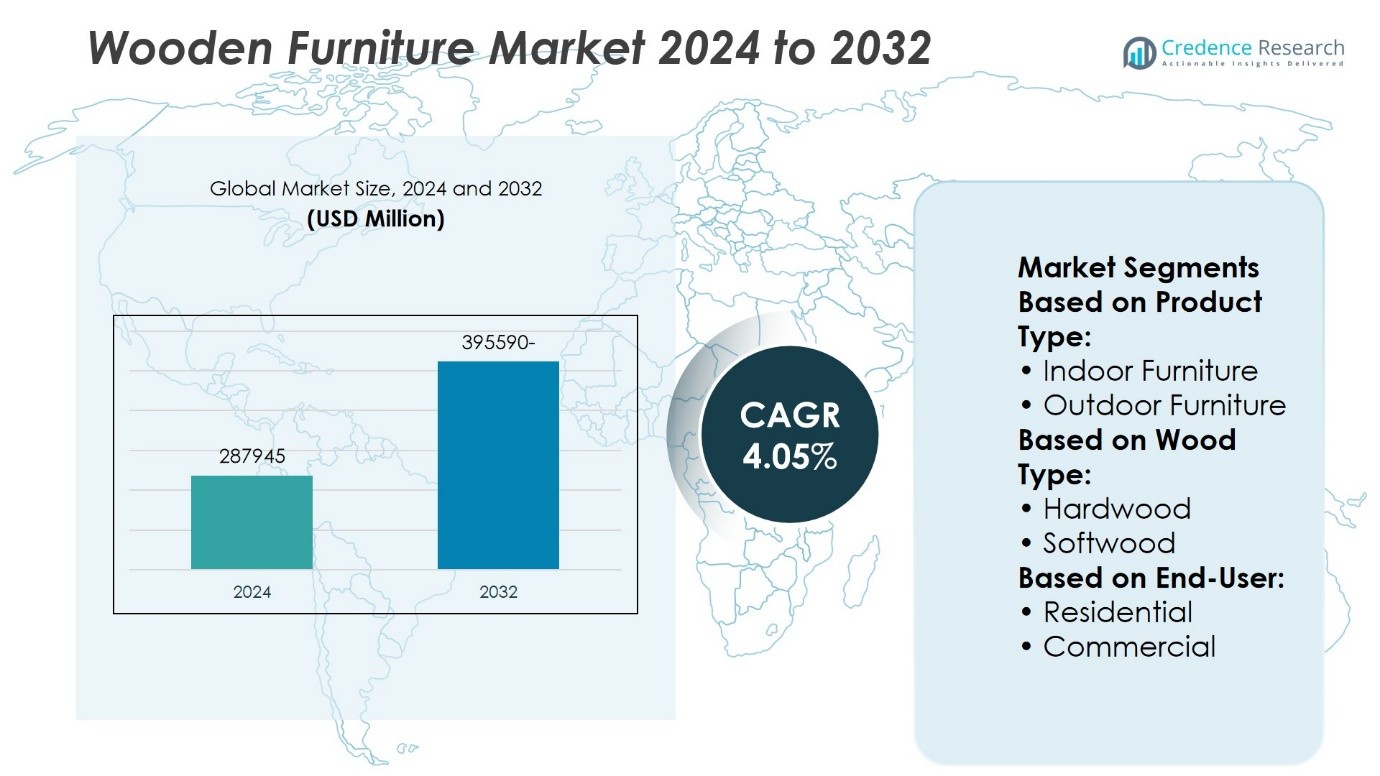
The Wooden Furniture Market was valued at 28,7945 million in 2024 and is projected to reach USD 39,5590 million by 2032, growing at a CAGR of 4.05% during the forecast period (2024–2032).
| REPORT ATTRIBUTE | DETAILS |
|---|---|
| Historical Period | 2020-2024 |
| Base Year | 2024 |
| Forecast Period | 2025-2032 |
| Wooden Furniture Market Size 2024 | USD 28,7945 Million |
| Wooden Furniture Market, CAGR | 4.05% |
| Wooden Furniture Market Size 2032 | USD 39,5590 Million |
The wooden furniture market is driven by increasing demand for sustainable and eco-friendly products, rising urbanization, and growing consumer preference for aesthetically appealing, functional furniture. Rapid expansion of e-commerce and shifting lifestyles have boosted sales of modular and space-saving designs. Consumers are increasingly seeking customizable and tech-integrated furniture that fits modern living environments. Trends such as minimalist interiors, premium wooden finishes, and hybrid home-office furniture continue to shape product innovation. Manufacturers are responding with design flexibility, sustainable sourcing, and digital tools to meet evolving expectations, positioning themselves to capture emerging opportunities across both developed and developing markets.
The wooden furniture market shows strong regional performance, with Asia-Pacific leading due to high production capacity and rising consumer demand. North America and Europe follow, driven by premium product adoption and sustainability trends. Latin America and the Middle East show steady growth from urbanization and expanding retail sectors. Key players include La-Z-Boy, Hooker Furniture, Natuzzi, Yihua Lifestyle Technology, Durian, FABRYKI MEBLI FORTE SA, HNI Corp, Haworth, Hulsta, and Global Furniture Group, each competing through design, quality, and regional strategies.
Market Insights
- The wooden furniture market was valued at over USD 28,7945 million in 2024 and is expected to grow at a CAGR of 4.05% from 2024 to 2032.
- Rising demand for eco-friendly, sustainable furniture is a major growth driver globally.
- Consumers are shifting toward modular, space-saving, and customizable wooden furniture solutions.
- The market is moderately fragmented with key players competing through design, pricing, and regional expansion.
- High raw material costs and supply chain disruptions remain key challenges for manufacturers.
- Asia-Pacific holds the largest market share, followed by North America and Europe with steady demand for premium wooden furniture.
- Growth in e-commerce and digital tools like AR for product visualization is transforming furniture retail channels.
Market Drivers
Increasing Consumer Preference for Sustainable and Eco-friendly Products
The growing global focus on sustainability has driven a shift in consumer preferences towards eco-friendly wooden furniture. People are more conscious of environmental impacts, opting for responsibly sourced wood and materials that contribute to a reduced carbon footprint. The use of sustainable practices in manufacturing wooden furniture not only supports environmental goals but also appeals to environmentally aware consumers. This demand for sustainable products is expected to continue growing, further strengthening the market.
- For instance, IKEA disclosed that its suppliers processed 13,400,000 cubic meters of round wood equivalent during FY24 operations, of which 2,140,000 cubic meters was recycled wood.
Rising Demand for Customization and Unique Designs
Consumers are increasingly looking for customized wooden furniture that aligns with their specific tastes and requirements. Furniture manufacturers are responding by offering tailored options, including various wood types, finishes, and dimensions. This demand for bespoke furniture is further supported by the rise of online platforms that allow customers to design their pieces, making customization more accessible and affordable. Such developments are expected to continue driving market growth.
- For instance, according to the U.S. Department of Commerce, custom furniture exporters shipped 870,000 units of customized furniture in 2023
Growth in Urbanization and Middle-Class Population
Urbanization plays a significant role in the expansion of the wooden furniture market. As more people move into cities and modern housing projects continue to rise, the demand for both functional and aesthetically pleasing furniture increases. This is especially noticeable in emerging economies where a growing middle class demands better living standards and higher-quality furnishings. The market is seeing a surge in demand for wooden furniture that offers both practicality and luxury, catering to diverse urban populations. Manufacturers are positioning themselves to meet these evolving needs.
Technological Advancements in Furniture Production
The adoption of new technologies in furniture production is also contributing to market expansion. Innovations such as CNC machines and 3D printing have revolutionized the way wooden furniture is designed and manufactured, allowing for greater precision and reduced waste. These advancements are making production more efficient and cost-effective, which is beneficial for both manufacturers and consumers. Companies are embracing these technologies to remain competitive in a market that increasingly values quality, craftsmanship, and sustainability. The integration of these technological solutions is enhancing the overall appeal of wooden furniture.
Market Trends
Growth of Smart and Multifunctional Wooden Furniture
The market for smart and multifunctional wooden furniture is rapidly expanding. Smart furniture, such as desks with built-in charging stations or sofas with storage compartments, meets these evolving needs. Manufacturers are adapting to this shift by integrating wireless charging, built-in speakers, and even lighting features into wooden pieces.
- For instance, IKEA had sold 140 million units of its BILLY bookcase line, with over 8.5 million of those units featuring modular components.
Demand for Minimalist and Modern Designs
Minimalist and modern furniture styles are becoming increasingly popular, especially in urban areas. These design preferences emphasize simplicity, clean lines, and functionality over ornate details. Consumers are moving away from traditional, heavy designs toward sleek, lightweight wooden furniture that complements contemporary home aesthetics.
Expansion of E-commerce and Online Furniture Shopping
E-commerce continues to shape the growth of the wooden furniture market. The convenience of online shopping, combined with the ability to compare prices and view detailed product information, appeals to an increasingly tech-savvy customer base. Companies are adapting by investing in their online presence and offering virtual tools to enhance the shopping experience.
- For instance, Pepperfry reported that 73% of its total furniture orders in 2023 were placed through its mobile and web platforms, and it deployed over 6,500 virtual reality previews daily through its “Studio Pepperfry” tool to allow customers to visualize wooden furniture in real-time room settings.
Emergence of Hybrid and Cross-Industry Collaborations
The wooden furniture market is witnessing an influx of hybrid and cross-industry collaborations. Companies are partnering with tech firms, designers, and even industries like the adventure motorcycle wheels market to create new, innovative products. These collaborations often combine the natural aesthetics of wood with other materials and technologies, resulting in unique offerings.
Market Challenges Analysis
Supply Chain Disruptions and Raw Material Costs
The wooden furniture market faces significant challenges related to supply chain disruptions and fluctuating raw material costs. The increasing demand for high-quality wood, coupled with supply chain bottlenecks, has led to rising costs for manufacturers. These challenges are compounded by the global need for sustainable sourcing, which can further limit material availability. Companies must navigate these hurdles to maintain competitive pricing while ensuring product quality. Manufacturers are exploring alternative materials and new sourcing strategies, but these efforts require time and investment.
Labor Shortages and Skilled Craftsmanship Constraints
The wooden furniture market also contends with labor shortages and a decline in skilled craftsmanship. Many manufacturers struggle to find skilled workers proficient in traditional woodcraft techniques and modern production methods. This shortage is affecting both production efficiency and the ability to meet growing demand. The adventure motorcycle wheels market, for instance, faces similar labor challenges, with both industries relying on skilled labor to ensure product quality and precision
Market Opportunities
Rising Demand in Emerging Markets and Urban Housing
The wooden furniture market holds strong growth potential in emerging economies driven by urbanization and rising disposable income. Rapid development in countries across Asia-Pacific, Latin America, and Africa is increasing the need for residential and commercial furniture. Young urban populations prefer modern, space-efficient, and affordable wooden furniture, creating steady demand. Governments in these regions are also investing in housing infrastructure, which supports long-term market expansion.
Integration of Technology and Customization in Design
The shift toward smart homes and connected living spaces presents new opportunities for innovation in wooden furniture. Consumers are increasingly interested in products that blend traditional craftsmanship with modern technology, such as built-in lighting, charging ports, or storage sensors. Furniture brands that invest in digital customization tools, augmented reality visualization, and modular construction methods can meet this demand effectively. These innovations position companies to engage tech-savvy buyers and expand their premium offerings.
Market Segmentation Analysis:
By Product Type:
Chairs and tables continue to lead in demand due to their widespread use across residential, office, and hospitality settings. Their functionality and frequent replacement cycle drive consistent sales. Beds and sofas also account for a substantial share, supported by increased spending on comfort and home décor. Cabinets, including wardrobes and kitchen units, are growing rapidly in urban areas where storage optimization is critical. Consumers increasingly favor modular, multifunctional designs to maximize small living spaces. The wooden furniture market reflects this demand by expanding product portfolios to include compact, high-utility designs that fit modern interiors.
- For instance, IKEA disclosed that its BILLY bookcase line achieved a production run exceeding 60,000,000 units since launch
By Wood Type:
Mass-produced furniture dominates due to its affordability, fast availability, and wide distribution through online and offline retail channels. It appeals to middle-income consumers and rental property owners looking for cost-effective furnishing options. In contrast, custom-made furniture is gaining traction among premium buyers seeking tailored designs and high-end materials. It offers value through personalization, craftsmanship, and aesthetic exclusivity. The wooden furniture market sees custom furniture as a key area for margin growth, with many manufacturers investing in digital tools to support design customization and consumer engagement.
By End User:
The residential segment contributes the largest revenue share, driven by rising homeownership, lifestyle upgrades, and interest in interior design. Consumers are furnishing living rooms, bedrooms, dining areas, and increasingly, home offices, following hybrid work models. The commercial segment is steadily expanding, particularly in hospitality, retail, and corporate spaces. Businesses prefer wooden furniture for its durability, aesthetic warmth, and branding potential. The wooden furniture market adapts to this demand by offering product lines tailored to hotels, restaurants, and co-working environments, ensuring functionality meets visual appeal.
Segments:
Based on Product Type:
- Indoor Furniture
- Outdoor Furniture
Based on Wood Type:
- Hardwood
- Softwood
Based on End-User:
- Residential
- Commercial
Based on the Geography:
- North America
- U.S.
- Canada
- Mexico
- Europe
- UK
- France
- Germany
- Italy
- Spain
- Russia
- Belgium
- Netherlands
- Austria
- Sweden
- Poland
- Denmark
- Switzerland
- Rest of Europe
- Asia Pacific
- China
- Japan
- South Korea
- India
- Australia
- Thailand
- Indonesia
- Vietnam
- Malaysia
- Philippines
- Taiwan
- Rest of Asia Pacific
- Latin America
- Brazil
- Argentina
- Peru
- Chile
- Colombia
- Rest of Latin America
- Middle East
- UAE
- KSA
- Israel
- Turkey
- Iran
- Rest of Middle East
- Africa
- Egypt
- Nigeria
- Algeria
- Morocco
- Rest of Africa
Regional Analysis
North America
North America contributes around 24.1% of the global wooden furniture market share. The United States leads the regional market, driven by high consumer spending on home furnishings, lifestyle-focused consumption, and a steady housing market. American consumers show a strong preference for eco-friendly and locally sourced wood products, encouraging brands to focus on sustainable forestry practices and certifications like FSC (Forest Stewardship Council). Canada follows a similar trajectory, with growing interest in modern wooden furniture that emphasizes both form and function. The region's mature retail environment and widespread adoption of digital tools have further boosted online sales channels.
Europe
Europe holds a significant 21.3% share in the wooden furniture market, with Germany, France, Italy, and the UK being the top contributors. European consumers are highly selective and often favor brands that offer durable, ethically produced furniture with contemporary aesthetics. The demand for Scandinavian-style wooden furniture remains strong, particularly in Northern and Western Europe. Regulations around timber sourcing and environmental impact are strict, pushing manufacturers toward greener practices. It supports a mature and premium-oriented market environment, where heritage brands and boutique manufacturers perform well.
Asia-Pacific
Asia-Pacific holds the largest share in the global wooden furniture market, accounting for approximately 39.5% of the total revenue in 2024. This dominance is driven by rising urbanization, expanding middle-class populations, and increasing homeownership across major economies such as China, India, Japan, and Southeast Asian nations. The region benefits from cost-effective labor and expanding e-commerce infrastructure, which allows both local and international brands to penetrate tier-2 and tier-3 cities. Consumers increasingly value furniture that combines craftsmanship with affordability, pushing brands to innovate in modular and space-saving designs suitable for smaller urban homes.
Latin America
Latin America accounts for 7.6% of the global wooden furniture market, with Brazil and Mexico leading the regional growth. The market here is driven by rising residential construction, increasing disposable income, and a growing young population entering homeownership. Local manufacturers often cater to both domestic demand and export markets, producing handcrafted wooden furniture using indigenous woods. Brazil, with its rich forest resources, has positioned itself as a key supplier, although environmental concerns around deforestation remain a challenge. Demand for locally made, rustic, and regionally inspired designs continues to grow among middle-class buyers.
Middle East & Africa (MEA)
The Middle East and Africa (MEA) represent 4.2% of the global market. The region shows steady growth due to urban development, rising income levels, and expanding hospitality infrastructure. Gulf countries such as the UAE and Saudi Arabia invest heavily in high-end wooden furniture for luxury hotels, retail, and residential projects. African nations like South Africa and Nigeria are seeing increased demand for affordable, durable furniture that suits diverse climates and lifestyles. Import reliance remains high, but local artisans and workshops are slowly gaining visibility with region-specific designs.
Key Player Analysis
- Natuzzi S.p.A.
- Hooker Furniture Corporation
- Durian
- HNI Corp
- Yihua Lifestyle Technology Co.Ltd.
- FABRYKI MEBLI FORTE SA
- Haworth
- La-Z-Boy Incorporated
- Hulsta
- Global Furniture Group
Competitive Analysis
The wooden furniture market is highly competitive, with leading players Hooker Furniture Corporation, La-Z-Boy Incorporated, Natuzzi S.p.A., Hulsta, Yihua Lifestyle Technology Co., Ltd., Durian, FABRYKI MEBLI FORTE SA. The wooden furniture market is highly competitive, with leading players focusing on design innovation, product quality, and sustainable manufacturing practices. These companies compete by offering differentiated product lines tailored to a wide range of consumer preferences in both residential and commercial segments. Asian manufacturers like Yihua Lifestyle Technology leverage cost-efficient production, robust supply chains, and strong export capabilities to capture international demand. Their strategic focus includes automated manufacturing, direct-to-consumer channels, and diversification into emerging markets. Strong branding and consistent design updates allow them to cater to evolving consumer preferences in residential and commercial sectors. As demand for sustainable and multifunctional furniture rises, leading companies leverage eco-certified materials and ergonomic designs to stay ahead. The wooden furniture market remains moderately fragmented, with these key players setting benchmarks in quality, scalability, and customer engagement.
Recent Developments
- In July 2025, La-Z-Boy unveiled its first major brand refresh in over 20 years, focusing on a holistic wooden furniture experience rooted in “quiet luxury,” modern wood finishes, and tailored comfort. This brand transformation includes new design language, company-wide store expansion, and enhanced wood product lines tailored for small spaces and modern lifestyles
- In April 2025, Ethan Allen Interiors Inc., a leading designer and manufacturer of home furnishings, completed the acquisition of Hooker Furniture Corporation, a major furniture manufacturer, for approximately USD168 million (Ethan Allen Interiors Inc. SEC Filing). This acquisition significantly increased Ethan Allen's market share and product offerings.
- In 2024, Natuzzi launched its first branded residential real estate project, the Natuzzi Harmony Residences, and also announced a major retail expansion with 43 new galleries and 25 new stores planned to open by the end of the year
Market Concentration & Characteristics
The wooden furniture market is moderately fragmented, with a mix of global, regional, and local players competing across multiple price points and product categories. It features a balance between large-scale manufacturers such as La-Z-Boy, Hooker Furniture, and Yihua Lifestyle Technology Co., Ltd., and smaller, design-focused firms catering to niche or regional demands. The market is characterized by high product differentiation, long replacement cycles, and strong consumer preference for aesthetic and durable solutions. It relies heavily on raw material availability, craftsmanship, and design innovation, making supply chain efficiency and sustainable sourcing critical success factors. Consumer demand varies widely across regions, with mature markets favoring minimalist and eco-conscious designs, while emerging economies focus on affordability and space-saving solutions. It is also increasingly influenced by digital trends, with e-commerce and augmented reality tools transforming how consumers browse and purchase furniture.
Report Coverage
The research report offers an in-depth analysis based on Product Type, Wood Type, End-User and Geography. It details leading market players, providing an overview of their business, product offerings, investments, revenue streams, and key applications. Additionally, the report includes insights into the competitive environment, SWOT analysis, current market trends, as well as the primary drivers and constraints. Furthermore, it discusses various factors that have driven market expansion in recent years. The report also explores market dynamics, regulatory scenarios, and technological advancements that are shaping the industry. It assesses the impact of external factors and global economic changes on market growth. Lastly, it provides strategic recommendations for new entrants and established companies to navigate the complexities of the market.
Future Outlook
- Demand for sustainable and eco-friendly wooden furniture will continue to grow across global markets.
- Customization and modular furniture designs will attract more consumers seeking personalized solutions.
- Urbanization and smaller living spaces will drive demand for multifunctional and compact wooden furniture.
- E-commerce platforms will play a larger role in product discovery, selection, and delivery.
- Technological integration in furniture, such as smart features, will gain more traction.
- Manufacturers will invest more in automation and digital tools to improve production efficiency.
- Emerging markets will offer significant growth opportunities due to rising disposable income.
- Premium furniture demand will rise in mature markets with a focus on aesthetics and quality.
- Brands focusing on circular economy models and recyclable materials will strengthen market presence.
- Strategic partnerships and regional expansions will remain key approaches for competitive growth.

Request a Free Sample
Fill in your details and we'll send you a free sample report.
- Sample data tables & charts
- Research methodology
Market Dynamics
Consumer Preference for Sustainable and Eco-friendly Products
Growing environmental awareness is pushing consumers to choose wooden furniture made from responsibly sourced and recycled materials, driving manufacturers to adopt sustainable practices and certifications, which in turn expands the market.
Customization and Unique Design Demand
Consumers increasingly seek furniture tailored to their tastes and space requirements, prompting manufacturers to offer customizable options and digital design tools, thereby boosting market growth through higher-value, bespoke products.
Urbanization and Expanding Middle Class
Rapid urbanization and rising disposable incomes, especially in emerging economies, are increasing demand for modern, space-efficient wooden furniture for new homes and apartments, fueling market expansion.
Technological Advancements in Production
The adoption of CNC machines, 3D printing, and digital visualization tools is making wooden furniture production more efficient, precise, and customizable, enabling manufacturers to meet evolving consumer expectations and reduce costs.
Growth of E-commerce and Digital Retail Channels
The proliferation of online furniture shopping platforms and the integration of AR/VR visualization tools are making it easier for consumers to discover, customize, and purchase wooden furniture, significantly expanding market reach and sales.
Need a Custom Version of This Report?
Tailor the scope, geography, or segments to your exact requirements.
- Custom geography or segment scope
- Direct access to our analyst team
Frequently Asked Questions
What is the current market size for wooden furniture market, and what is its projected size in 2032?
At what Compound Annual Growth Rate is the wooden furniture market projected to grow between 2025 and 2032?
Which wooden furniture market segment held the largest share in 2024?
What are the primary factors fueling the growth of the wooden furniture market?
Who are the leading companies in the wooden furniture market?
Which region commanded the largest share of the wooden furniture market in 2024?
Table of Content
Chapter 1 Market Segmentation
- 1.1 Segmentation Framework
- 1.1.1 Product and Service Classification
- 1.1.2 Application and End-Use Classification
- 1.1.3 Technology and Solution Classification
- 1.1.4 Customer and Distribution Channel Classification
- 1.1.5 Geographic Segmentation
- 1.1.6 Market Segment Definitions and Boundaries
- 1.2 By End-User
- 1.2.1 Residential
- 1.2.2 Commercial
- 1.3 By Wood Type
- 1.3.1 Hardwood
- 1.3.2 Softwood
- 1.4 By Product Type
- 1.4.1 Indoor Furniture
- 1.4.2 Outdoor Furniture
Chapter 2 Introduction
- 2.1 Report Objectives and Scope
- 2.2 Product Definition and Industry Terminology
- 2.3 Market Inclusions and Exclusions
- 2.4 Research Process
- 2.4.1 Primary Research and Expert Interviews
- 2.4.2 Secondary Research and Source Review
- 2.4.3 Top-Down and Bottom-Up Estimation
- 2.4.4 Data Triangulation and Verification
- 2.5 Market Size Measurement Basis
- 2.5.1 2024: USD 287,945 million → 2032: USD 395,590 million
- 2.6 Historical and Forecast Reference Periods
- 2.6.1 Base Year: 2024
- 2.6.2 Forecast Period: 2024-2032
- 2.7 Research Assumptions and Limitations
Chapter 3 Executive Summary
- 3.1 Market Snapshot and Key Findings
- 3.2 Base-Year Market Size, 2024
- 3.3 Forecast Market Size, 2032
- 3.4 Revenue and Volume Growth Outlook
- 3.5 Key Demand and Supply Indicators
- 3.6 Leading Market Segments
- 3.7 Fastest-Growing Market Opportunities
- 3.8 Regional Performance Highlights
- 3.9 Technology and Industry Transformation
- 3.10 Competitive Landscape Summary
- 3.11 Analyst View and Strategic Implications
Chapter 4 Global Wooden Furniture Market Trends and Developments
- 4.1 Historical Industry Development
- 4.2 Recent Market Trends and Developments
- 4.3 Demand and Customer Behavior Trends
- 4.4 Technology and Product Innovation
- 4.5 Artificial Intelligence, Automation and Digitalization
- 4.6 Local Manufacturing and Supply Chain Realignment
- 4.7 Industry Partnerships, Mergers and Acquisitions
- 4.8 Sustainability and Circular Economy Developments
- 4.9 Government and Private Sector Investment Trends
- 4.10 Emerging Business Models and Commercialization
- 4.11 Industry Developments and Announcements
Chapter 5 Global Wooden Furniture Market Production, Supply and Demand Analysis
- 5.1 Demand Trend and Consumption Analysis
- 5.2 Demand Forecast, 2024-2032
- 5.3 Production and Output Trend
- 5.4 Production and Output Forecast, 2024-2032
- 5.5 Installed Capacity and Capacity Utilization
- 5.6 Company-Wise Production Plants and Statistics
- 5.6.1 Installed Production Capacity
- 5.6.2 Actual Production
- 5.6.3 Planned Capacity and Expansion Targets
- 5.7 Supply Chain Structure and Procurement Trends
- 5.8 Supply-Demand Gap and Bottlenecks
- 5.9 Import Dependence and Sourcing Structure
- 5.10 Contract Manufacturing and Outsourcing
- 5.11 Regional Supply and Demand Concentration
Chapter 6 Global Wooden Furniture Market Pricing Analysis
- 6.1 Pricing Structure and Measurement
- 6.2 Historical Pricing Trends
- 6.3 Pricing Outlook, 2024-2032
- 6.4 Average Selling Price and Unit Economics
- 6.5 Pricing by Product and Market Segment
- 6.6 Geographic Pricing Differences
- 6.7 Key Input, Energy, Labor and Logistics Costs
- 6.8 Contract Pricing and Purchasing Models
- 6.9 Pricing Sensitivity and Competitive Positioning
- 6.10 Price, Margin and Profitability Implications
Chapter 7 Global Wooden Furniture Market Dynamics
- 7.1 Market Growth Drivers
- 7.1.1 Demand-Side Drivers
- 7.1.2 Technology and Innovation Drivers
- 7.1.3 Infrastructure and Investment Drivers
- 7.1.4 Regulatory and Policy Drivers
- 7.2 Market Restraints
- 7.2.1 Cost and Affordability Constraints
- 7.2.2 Technology and Adoption Barriers
- 7.2.3 Supply Chain and Operational Constraints
- 7.3 Market Challenges
- 7.3.1 Competitive Pressure and Margin Erosion
- 7.3.2 Skills, Infrastructure and Implementation Gaps
- 7.4 Emerging Market Opportunities
- 7.5 Market Dynamics Impact and Time-Horizon Assessment
Chapter 8 Global Wooden Furniture Value Chain Analysis
- 8.1 Industry Value Chain Overview
- 8.2 Upstream Suppliers and Critical Inputs
- 8.3 Technology and Component Providers
- 8.4 Manufacturing or Service Delivery
- 8.5 Distribution, Channel Partners and Integrators
- 8.6 Downstream Applications and End Users
- 8.7 Value Addition and Profit Pools
- 8.8 Vertical Integration and Outsourcing
- 8.9 Supplier Concentration and Risk
- 8.10 Supply Chain Localization and Resilience
Chapter 9 Global Wooden Furniture Market Regulations and Policies
- 9.1 Relevant Laws, Standards and Compliance Frameworks
- 9.2 Product, Service, Safety and Quality Requirements
- 9.3 Government Policies, Incentives and Subsidies
- 9.4 Imports, Exports and Trade Barriers
- 9.5 Public Procurement and Local Content Requirements
- 9.6 Environmental and Sustainability Compliance
- 9.7 Upcoming Policy Changes and Market Implications
Chapter 10 Global Wooden Furniture Market Hotspots and Opportunities
- 10.1 Market Opportunity Mapping and Growth Hotspots
- 10.2 High-Growth Applications and Customer Groups
- 10.3 Underserved Markets and White-Space Opportunities
- 10.4 Emerging Technology and Product Opportunities
- 10.5 New Capacity and Investment Hotspots
- 10.6 Market Entry and Expansion Opportunities
- 10.7 Distribution and Partnership Opportunities
- 10.8 Near-Term and Long-Term Commercial Potential
- 10.9 Opportunity Attractiveness and Execution Risks
Chapter 11 Global Wooden Furniture Market Outlook, 2024-2032
- 11.1 Market Size and Analysis
- 11.1.1 Revenue (Market Measurement: 2024: USD 287,945 million → 2032: USD 395,590 million)
- 11.1.2 Market Volume and Quantity Sold
- 11.1.3 Historical Market Size
- 11.1.4 Base-Year Market Size, 2024
- 11.2 Market Forecast, 2024-2032
- 11.2.1 Revenue Forecast to 2032
- 11.2.2 Volume Forecast to 2032
- 11.2.3 CAGR and Year-on-Year Growth
- 11.2.4 Incremental Revenue Opportunity
- 11.3 Forecast Assumptions and Scenario Analysis
- 11.3.1 Base-Case Forecast
- 11.3.2 Optimistic and Conservative Scenarios
- 11.3.3 Technology, Pricing and Policy Sensitivities
- 11.4 Market Attractiveness and Growth Outlook
Chapter 12 Global Wooden Furniture Market Segmentation and Outlook
- 12.1 Segmentation Summary and Market Shares, 2024
- 12.2 Largest and Fastest-Growing Segments
- 12.3 By End-User - Market Size and Forecast, 2024-2032
- 12.3.1 Segment Definition and Scope
- 12.3.2 Historical Market Size
- 12.3.3 Revenue Forecast, 2024-2032
- 12.3.4 Volume Forecast, 2024-2032
- 12.3.5 Base-Year Market Share, 2024
- 12.3.6 Segment CAGR and Growth Drivers
- 12.3.7 Subsegment Market Size and Forecast
- 12.3.7.1 Residential
- 12.3.7.2 Commercial
- 12.3.8 Subsegment Pricing and Adoption Trends
- 12.3.9 Leading Suppliers and Competition
- 12.3.10 Regional Demand and Opportunities
- 12.4 By Wood Type - Market Size and Forecast, 2024-2032
- 12.4.1 Segment Definition and Scope
- 12.4.2 Historical Market Size
- 12.4.3 Revenue Forecast, 2024-2032
- 12.4.4 Volume Forecast, 2024-2032
- 12.4.5 Base-Year Market Share, 2024
- 12.4.6 Segment CAGR and Growth Drivers
- 12.4.7 Subsegment Market Size and Forecast
- 12.4.7.1 Hardwood
- 12.4.7.2 Softwood
- 12.4.8 Subsegment Pricing and Adoption Trends
- 12.4.9 Leading Suppliers and Competition
- 12.4.10 Regional Demand and Opportunities
- 12.5 By Product Type - Market Size and Forecast, 2024-2032
- 12.5.1 Segment Definition and Scope
- 12.5.2 Historical Market Size
- 12.5.3 Revenue Forecast, 2024-2032
- 12.5.4 Volume Forecast, 2024-2032
- 12.5.5 Base-Year Market Share, 2024
- 12.5.6 Segment CAGR and Growth Drivers
- 12.5.7 Subsegment Market Size and Forecast
- 12.5.7.1 Indoor Furniture
- 12.5.7.2 Outdoor Furniture
- 12.5.8 Subsegment Pricing and Adoption Trends
- 12.5.9 Leading Suppliers and Competition
- 12.5.10 Regional Demand and Opportunities
- 12.6 Segment Growth Comparison
- 12.7 Segment Attractiveness and Priority Matrix
Chapter 13 Global Wooden Furniture End-Use and Application Market Outlook
- 13.1 End-Use Industry and Customer Demand Structure
- 13.2 Leading Applications and Customer Groups
- 13.3 End-Use Market Size, Share and Forecast
- 13.4 Major End-Use Industry Deep Dives
- 13.4.1 Customer Requirements and Use Cases
- 13.4.2 Demand and Replacement Cycles
- 13.4.3 Technical and Regulatory Considerations
- 13.4.4 Purchasing and Procurement Models
- 13.4.5 Leading Vendors and Distribution Channels
- 13.4.6 Forecast and Commercial Opportunities
- 13.5 Emerging Applications and Cross-Segment Demand
- 13.6 End-Use Industry Investment Priorities
Chapter 14 Global Wooden Furniture Geographic Market Outlook, 2024-2032
- 14.1 Regional Market Size and Share, 2024
- 14.2 Regional Market Forecast, 2024-2032
- 14.3 Regional Pricing, Production and Demand Differences
- 14.4 North America
- 14.4.1 United States
- 14.4.2 Canada
- 14.4.3 Mexico
- 14.5 Europe
- 14.5.1 Germany
- 14.5.2 France
- 14.5.3 Italy
- 14.5.4 United Kingdom
- 14.5.5 Spain
- 14.5.6 Poland
- 14.5.7 Russia
- 14.5.8 Netherlands
- 14.5.9 Belgium
- 14.5.10 Sweden
- 14.5.11 Denmark
- 14.5.12 Norway
- 14.5.13 Rest of Europe
- 14.6 Asia Pacific
- 14.6.1 China
- 14.6.2 India
- 14.6.3 Japan
- 14.6.4 South Korea
- 14.6.5 Thailand
- 14.6.6 Indonesia
- 14.6.7 Vietnam
- 14.6.8 Malaysia
- 14.6.9 Australia
- 14.6.10 Rest of Asia Pacific
- 14.7 Latin America
- 14.7.1 Brazil
- 14.7.2 Argentina
- 14.7.3 Colombia
- 14.7.4 Chile
- 14.7.5 Rest of Latin America
- 14.8 Middle East
- 14.8.1 Saudi Arabia
- 14.8.2 United Arab Emirates
- 14.8.3 Turkey
- 14.8.4 Israel
- 14.8.5 Iran
- 14.8.6 Rest of the Middle East
- 14.9 Africa
- 14.9.1 South Africa
- 14.9.2 Egypt
- 14.9.3 Nigeria
- 14.9.4 Morocco
- 14.9.5 Rest of Africa
- 14.10 Regional Investment, Policy and Supply Chain Differences
- 14.11 Regional Competitive Landscape
- 14.12 Geographic Growth Hotspots
Chapter 15 Global Wooden Furniture Technology, Innovation and Sustainability Outlook
- 15.1 Technology Landscape and Maturity
- 15.2 Product, Process and Service Innovation
- 15.3 AI, Automation and Digital Tools in the Industry
- 15.4 Technology Adoption and Performance Benchmarking
- 15.5 Innovation Pipeline and R&D Investment
- 15.6 Patent and Intellectual Property Trends
- 15.7 Energy Efficiency and Resource Management
- 15.8 Sustainability, Recycling and Circularity
- 15.9 Technology Roadmap, 2024-2032
- 15.10 Risks of Obsolescence and Technology Substitution
Chapter 16 Global Wooden Furniture Market Key Strategic Imperatives
- 16.1 Growth and Market Entry Priorities
- 16.2 High-Return Products and Segments
- 16.3 Pricing, Profitability and Cost Optimization
- 16.4 Technology Investment and Product Differentiation
- 16.5 Supply Chain Localization and Resilience
- 16.6 Distribution and Customer Acquisition
- 16.7 Partnership, Acquisition and Capacity Strategy
- 16.8 Regional Expansion Priorities
- 16.9 Short-, Medium- and Long-Term Actions
Chapter 17 Competition Outlook
- 17.1 Industry Competition Characteristics
- 17.2 Market Structure and Concentration
- 17.3 Market Share and Competitive Positioning, 2024
- 17.4 Company-Wise Revenue and Product Benchmarking
- 17.5 Production and Service Capacity Benchmarking
- 17.6 Technology, Pricing and Differentiation
- 17.7 Regional Footprint and Distribution Strength
- 17.8 Mergers, Acquisitions and Strategic Alliances
- 17.9 New Entrants and Competitive Threats
- 17.10 Porter's Five Forces and Industry Attractiveness
- 17.11 Competitive Outlook, 2024-2032
Chapter 18 Company Profiles
- 18.1 Company Coverage and Selection Criteria
- 18.2 La-Z-Boy Incorporated
- 18.2.1 Business Description
- 18.2.2 Company Ownership and Geographic Presence
- 18.2.3 Product and Service Portfolio
- 18.2.4 Manufacturing and Operating Footprint
- 18.2.5 Production Capacity and Expansion Plans
- 18.2.6 Financial Performance and Investment
- 18.2.7 Market Share and Competitive Position
- 18.2.8 Technology and Innovation Capabilities
- 18.2.9 Strategic Alliances or Partnerships
- 18.2.10 Recent Developments
- 18.2.11 Growth Strategy and Outlook
- 18.3 Hooker Furniture Corporation
- 18.4 Natuzzi S.p.A.
- 18.5 Yihua Lifestyle Technology Co., Ltd.
- 18.6 Durian
- 18.7 FABRYKI MEBLI FORTE SA
- 18.8 HNI Corp
- 18.9 Haworth
- 18.10 Hulsta
- 18.11 Global Furniture Group
- 18.12 Other Relevant Market Participants
Note: Every listed company is profiled on the structure shown under the first company. The company list is preliminary and may change based on research findings, market developments, data availability and client requirements.
Chapter 19 Disclaimer
- 19.1 Research and Forecast Disclaimer
- 19.2 Data Source and Estimation Limitations
Note: The depth of individual sections depends on data availability for this market. Volume, capacity, trade and other unit-based metrics are included where applicable.

