
Betaine makers absorb most DMAPA supply
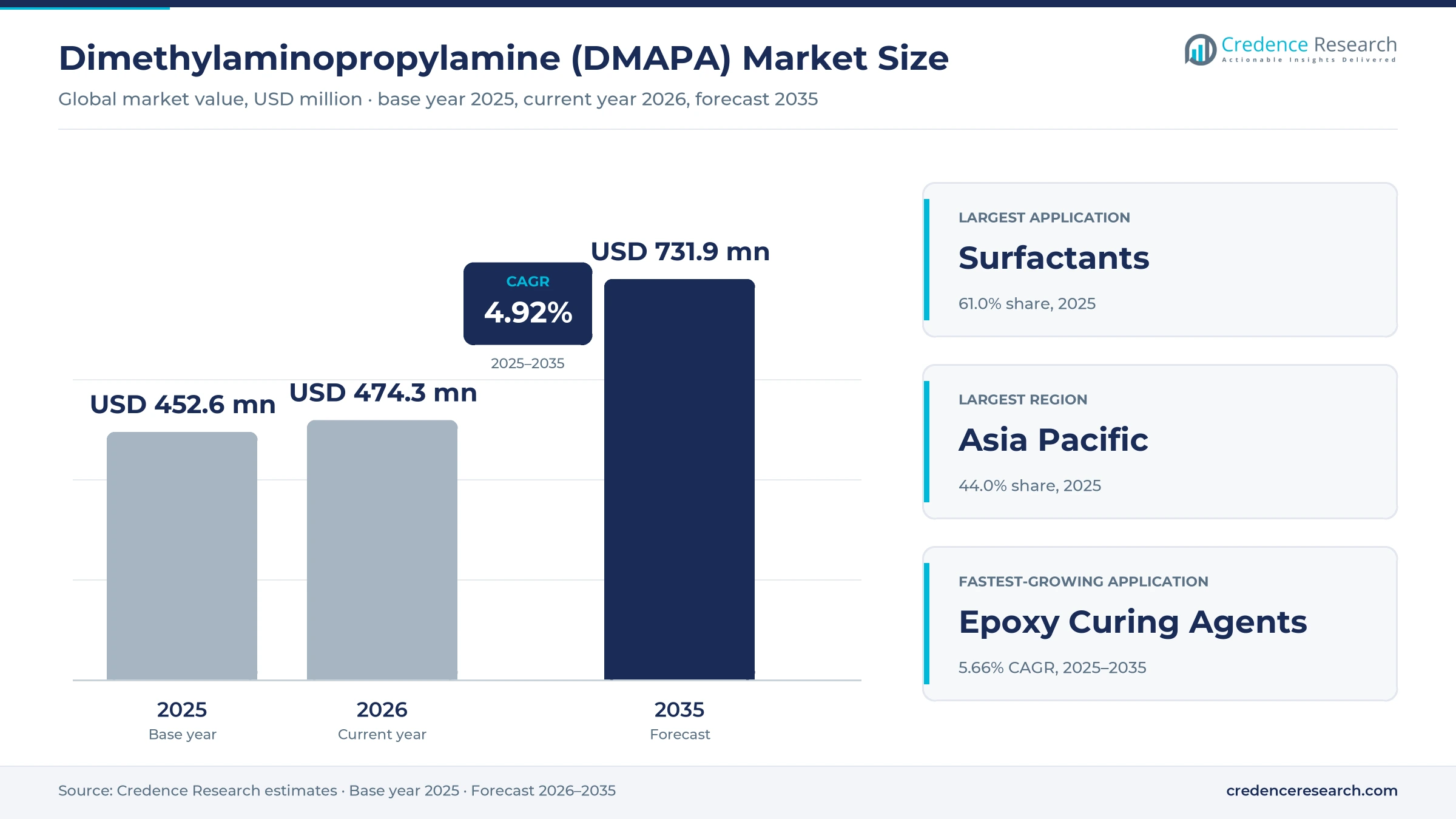
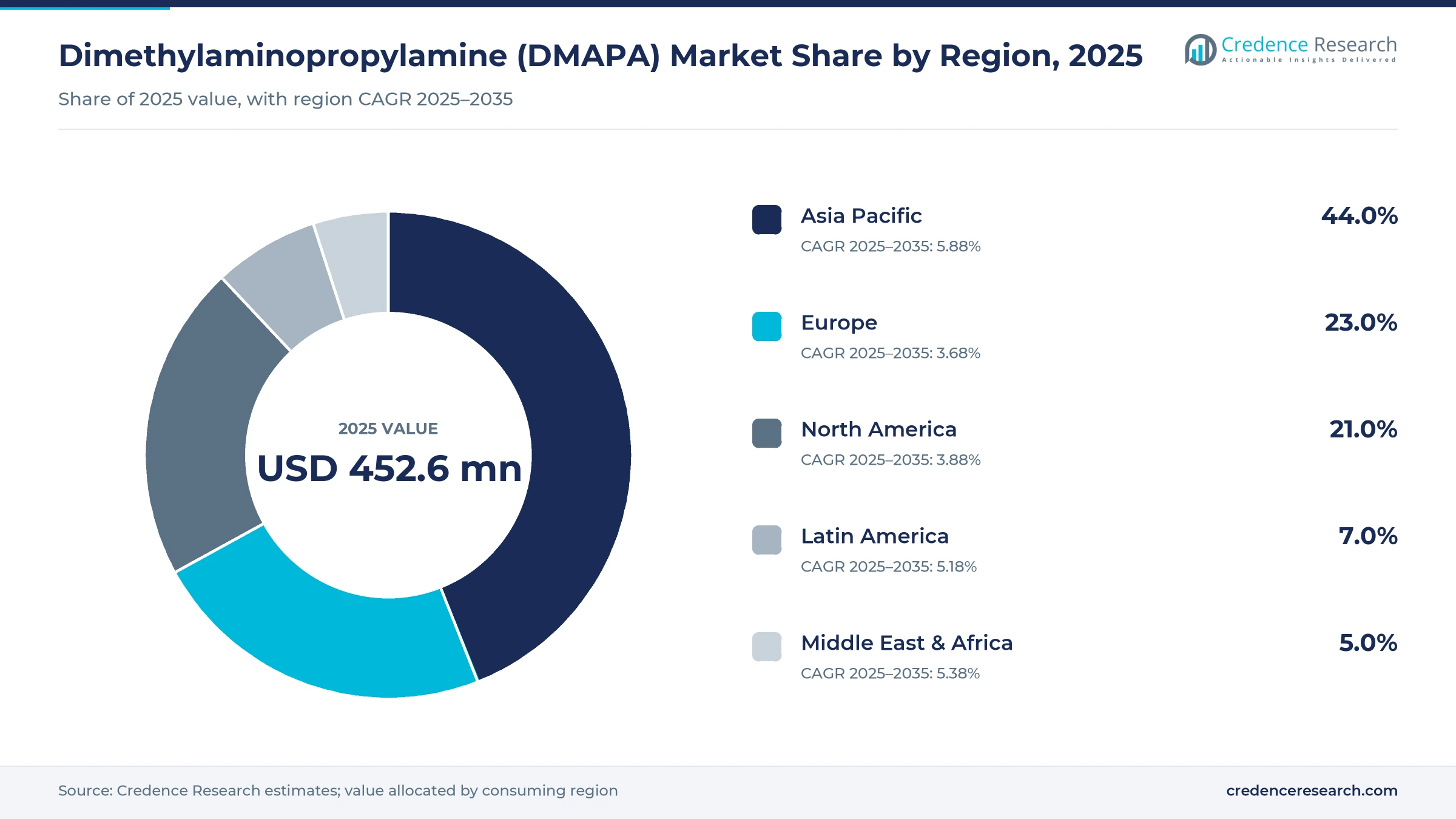
The dimethylaminopropylamine (DMAPA) market was valued at USD 452.6 million in 2025. It is expected to reach USD 474.3 million in 2026 and USD 731.9 million by 2035, expanding at a 4.92% CAGR over 2025–2035. Demand rests on mild surfactants in shampoos, body washes and dishwashing liquids, on epoxy hardeners for flooring, coatings and wind-blade composites, and on amine catalysts for polyurethane foam, with cationic water treatment polymers and agrochemical intermediates adding smaller, steady volumes. Asia Pacific held the largest regional share, 44.0% in 2025, because China hosts the largest betaine and epoxy production, and it is also the fastest-growing region at 5.88% a year. The main commercial change is capacity moving east, as BASF started up expanded DMAPA plants at its Nanjing site in July 2025, nearly doubling the site's capacity and raising its global DMAPA capacity by more than 20%.
DMAPA value adds USD 279.3 million between 2025 and 2035
From the USD 452.6 million base, the market adds USD 21.7 million from 2025 to 2026 and USD 279.3 million over 2025–2035, a 4.92% CAGR across ten compounding years.
What is DMAPA and who buys it?
DMAPA, or 3-(dimethylamino)-1-propylamine, is made by reacting dimethylamine with acrylonitrile and then hydrogenating the nitrile. Most of it becomes cocamidopropyl betaine and amine oxides, which act as mild foaming agents, and the rest goes into epoxy curing agents, polyurethane catalysts, cationic water treatment polymers, agrochemical intermediates and fuel and lubricant additives. Buyers are mostly surfactant makers and formulators, and several buy under long-term contracts to secure purity and supply.
The estimate counts merchant and captive sales of DMAPA valued at the producer's selling price. It excludes finished betaines, amine oxides and other derivatives, and related amines such as dimethylaminoethanol and diethylaminoethanol. Feedstock swings in acrylonitrile and dimethylamine therefore affect reported value as well as volume.
Dimethylaminopropylamine Market Insights
- The dimethylaminopropylamine (DMAPA) market is projected to rise from USD 474.3 million in 2026 to USD 731.9 million by 2035, a 4.92% CAGR, led by surfactant, epoxy and catalyst demand.
- Asia Pacific held 44.0% of 2025 value and is the fastest-growing region at 5.88% a year, because China hosts the largest betaine and epoxy production.
- Surfactants, mainly cocamidopropyl betaine and amine oxides, accounted for 61.0% of 2025 DMAPA value, because shampoos and dish liquids use them at vast scale.
- Epoxy curing agents are the fastest-growing application at 5.66% a year through 2035, as flooring, coatings and wind-blade composites use more amidoamine hardeners.
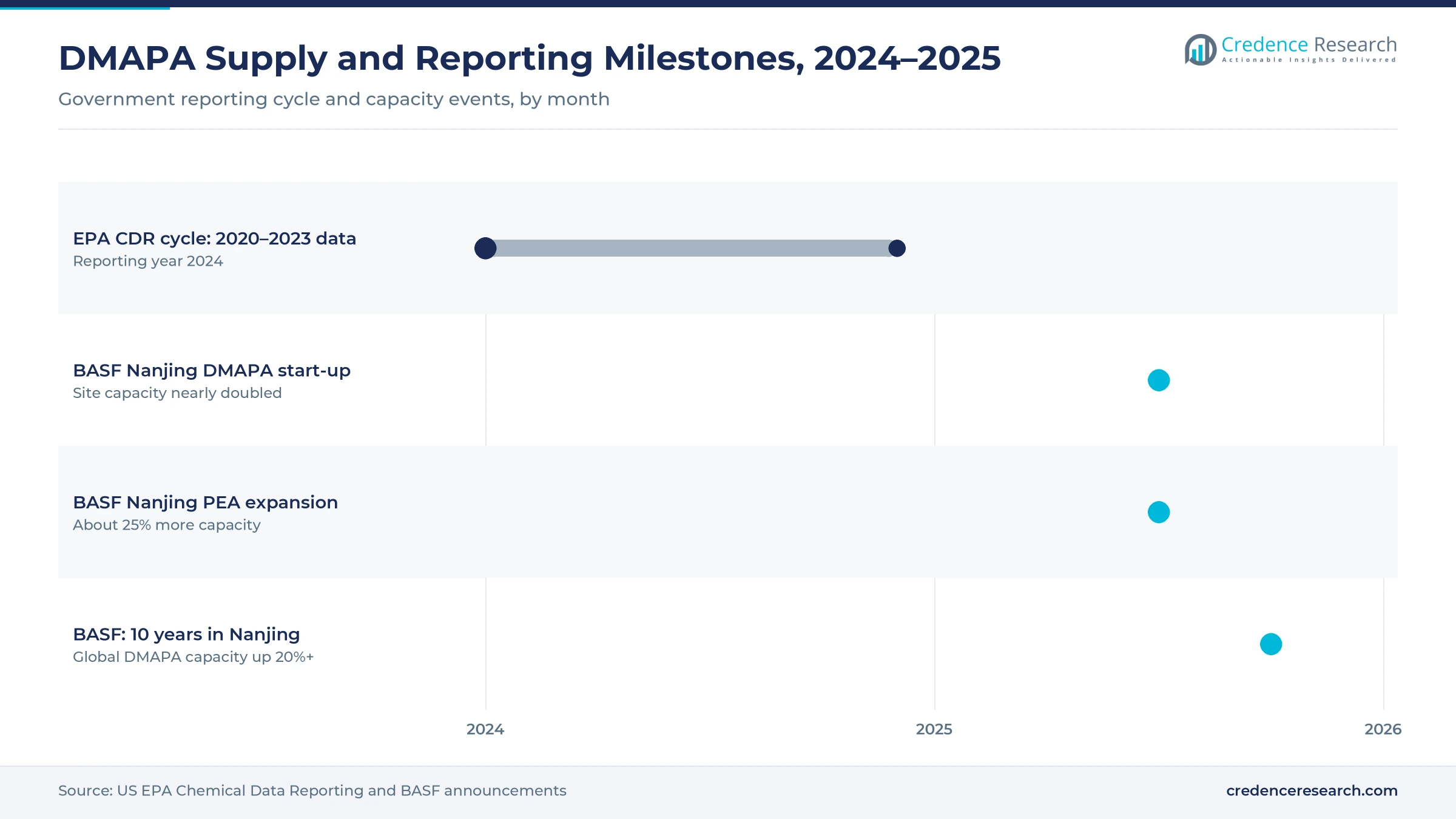
- BASF's July 2025 Nanjing start-up nearly doubled the site's DMAPA capacity and lifted its global capacity by more than 20%, moving supply closer to Asian betaine makers.
Betaines take most DMAPA while epoxy hardeners grow fastest
Surfactants lead applications while epoxy curing agents grow fastest
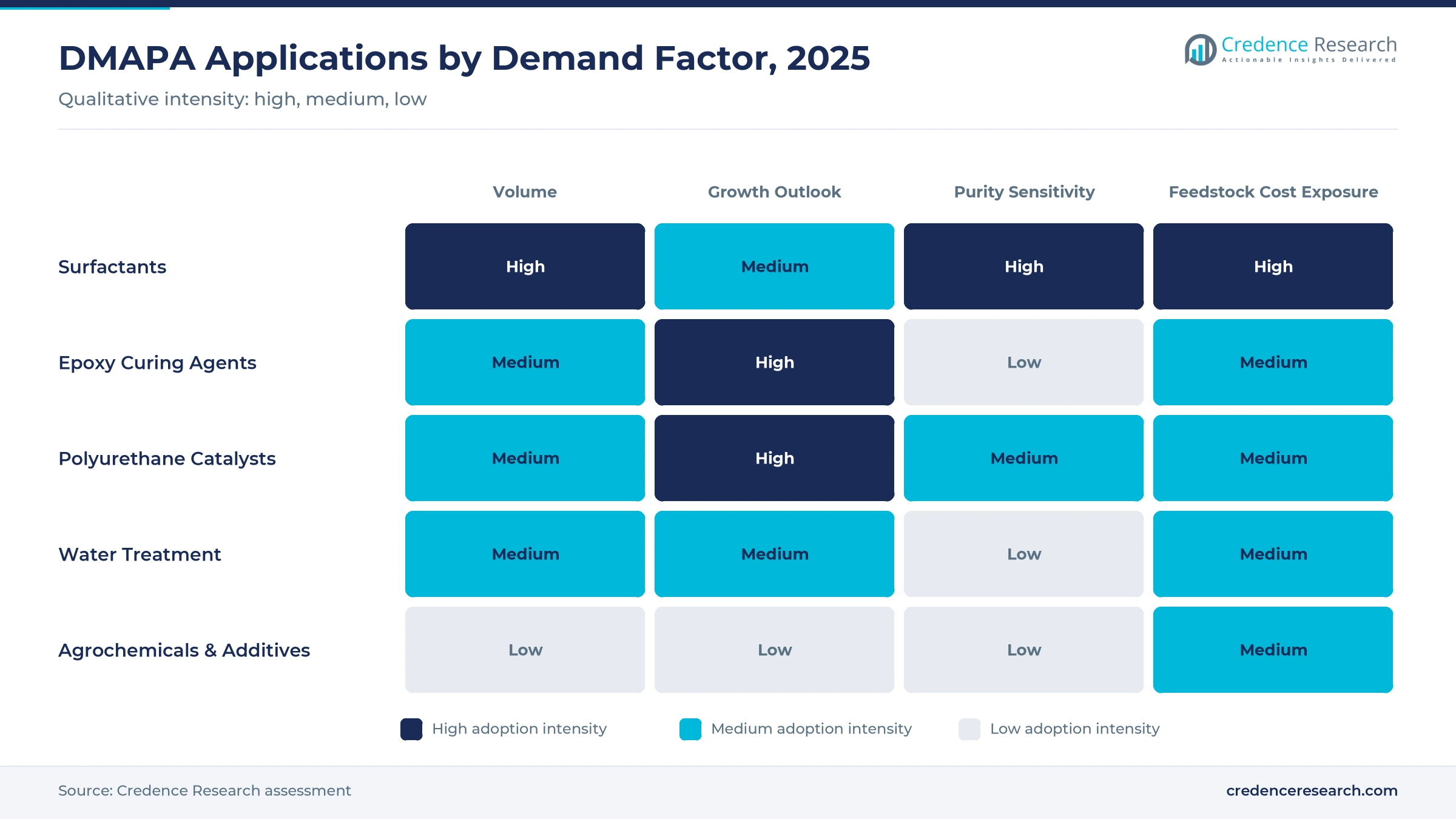
Based on application, the market is categorized into surfactants (betaines and amine oxides), epoxy curing agents, polyurethane catalysts, water treatment chemicals, agrochemical intermediates, fuel and lubricant additives, and others. Surfactants led with 61.0% of 2025 value, because cocamidopropyl betaine is the most common secondary surfactant in shampoos, body washes and hand soaps. Epoxy curing agents grow fastest at 5.66% a year, as DMAPA serves both as a fast curing agent and as a raw material for amidoamine hardeners.
Personal care leads end-use industry while coatings and composites grow fastest
Based on end-use industry, the market is categorized into personal care and cosmetics, home care and institutional cleaning, paints, coatings and composites, water treatment, agriculture and automotive and lubricants. Personal care and cosmetics led with 44.0% of 2025 value, as sulfate-free and baby-care formulas use more betaine per bottle. Paints, coatings and composites grow fastest at 5.61% a year, supported by epoxy flooring, protective coatings and wind-blade composites that need amidoamine hardeners.
| Segment Group | Leading Sub-segment | Share, 2025 | Fastest-growing Sub-segment | CAGR, 2025–2035 |
|---|---|---|---|---|
| By Application | Surfactants (Betaines & Amine Oxides) | 61.0% | Epoxy Curing Agents | 5.66% |
| By End-Use Industry | Personal Care & Cosmetics | 44.0% | Paints, Coatings & Composites | 5.61% |
Request a Free Sample
Fill in your details and we'll send you a free sample report.
- Sample data tables & charts
- Research methodology
Mild shampoos, epoxy floors and foam catalysts lift demand
Mild surfactants turn shampoo and dish liquid volumes into DMAPA demand
Cocamidopropyl betaine is made by reacting a fatty acid with DMAPA and then with sodium monochloroacetate, and brands favor it because it is mild and boosts foam. In an October 2025 release, BASF described DMAPA as an important building block for betaines used in gentle liquid soaps, shampoos and dishwashing detergents. Surfactants took 61.0% of 2025 DMAPA value, so demand tracks household spending on personal and home care. Because several surfactant makers buy under long-term contracts to secure purity and supply, steady shampoo and dish liquid sales turn into predictable DMAPA offtake through 2035.
Rising incomes and sulfate-free formulas raise betaine use per bottle
Spending on shampoos and body washes rises with income and urbanization, especially in China, India, Indonesia and Brazil. Brands are also cutting harsh sulfates, and sulfate-free formulas use more betaine per bottle, which lifts DMAPA demand faster than unit sales. The effect is strongest over the medium term in Asia Pacific and in Latin America, which held 7.0% of 2025 value and grows at 5.18% a year as personal care output rises in Brazil and Mexico.
Epoxy flooring, coatings and wind blades pull hardener demand
DMAPA-based amidoamine hardeners go into flooring, protective coatings, adhesives and wind-blade composites, and construction and wind projects in Asia and Europe add most new volume. Epoxy curing agents are therefore the fastest-growing application at 5.66% a year, and suppliers with technical service for epoxy formulators gain most. In Europe, which held 23.0% of 2025 value and grows at 3.68% a year, coatings and wind-blade composites join personal care as a main demand source, so hardener volume supports even the slowest-growing region.
Polyurethane foam and water treatment add steady industrial volume
DMAPA derivatives act as amine catalysts in flexible and rigid polyurethane foam for furniture, bedding, car seats and insulation, and low-emission catalysts that bind into the foam are gaining share as automakers and furniture makers cut volatile emissions. DMAPA is also a raw material for cationic monomers and polymers that settle solids in drinking water, wastewater and paper mills, where tighter discharge rules in China, India and the Gulf raise chemical use.
Capacity shifts to China as purity rules tighten
New DMAPA capacity increasingly clusters in China
Producers are adding capacity close to the largest betaine and epoxy users in Asia Pacific. Alongside its DMAPA start-up, BASF expanded Nanjing capacity for PEA, a related amine intermediate, by about 25%, and Chinese producers have also added lines. The shift keeps Asian prices competitive, makes China the regional price setter and leaves Western plants focused on high-purity grades and contract supply for global brands.
Purity and low-nitrosamine specifications tighten
Cosmetic regulators and brand owners are tightening limits on residual amines and nitrosamine precursors in betaines, so betaine makers are asking DMAPA suppliers for lower residuals and tighter process control. The trend favors producers with high-purity grades and strong analytical capability, and it raises the value of long-term supply contracts with global personal care groups.
Bio-attributed DMAPA for certified betaines opens an opportunity
Betaine makers increasingly pair DMAPA with certified palm and coconut fatty acids, and some producers now offer mass-balance acrylonitrile and dimethylamine routes, which could yield a partly bio-attributed DMAPA grade for brands with renewable-carbon targets. Producers already running mass-balance certification in their amine chains are best placed, though buyers will pay more only where certification is audited and accepted by brand owners.
Coatings, composites and emerging regions offer growth opportunities
Paints, coatings and composites are the fastest-growing end use at 5.61% a year, as wind-blade, flooring and insulation projects across Asia and Europe add epoxy and foam demand. The Middle East & Africa grows at 5.38% a year as Gulf and North African firms build local production. Suppliers that pair DMAPA with formulation support and regional stock can win these smaller accounts.
Feedstock swings and Chinese overcapacity weigh on DMAPA
Acrylonitrile and dimethylamine swings squeeze non-integrated producers
DMAPA is made from dimethylamine and acrylonitrile, so its cost is linked to propylene, ammonia and methanol prices. Feedstock swings pass through within months, which squeezes margins for producers without integrated supply and complicates fixed-price contracts with betaine makers. Integrated producers hold the cost advantage, while others protect margins with formula-based pricing and shorter contract terms.
Handling rules add cost for corrosive, flammable and sensitizing DMAPA
DMAPA is corrosive and flammable and is a known skin sensitizer. Its record in the U.S. National Library of Medicine's PubChem database lists these hazards along with its use in soap, cleaning compound and toilet preparation manufacturing. Strict handling, storage and transport rules add cost for every buyer, and the burden falls hardest on small formulators that buy in drums. Suppliers reduce the cost with bulk delivery, closed handling equipment and safety training for customer plants.
Contact allergy concerns limit leave-on uses
Residual DMAPA and amidoamine in cocamidopropyl betaine are linked to contact allergies, and brands respond by demanding lower residuals, which raises production cost for betaine makers. The commercial effect is a cap on growth in leave-on skin care rather than in rinse-off shampoos and washes. Betaine makers address it with extra purification steps and tighter specifications, passing part of the cost on to brand owners.
Fast Chinese additions raise overcapacity risk through 2028
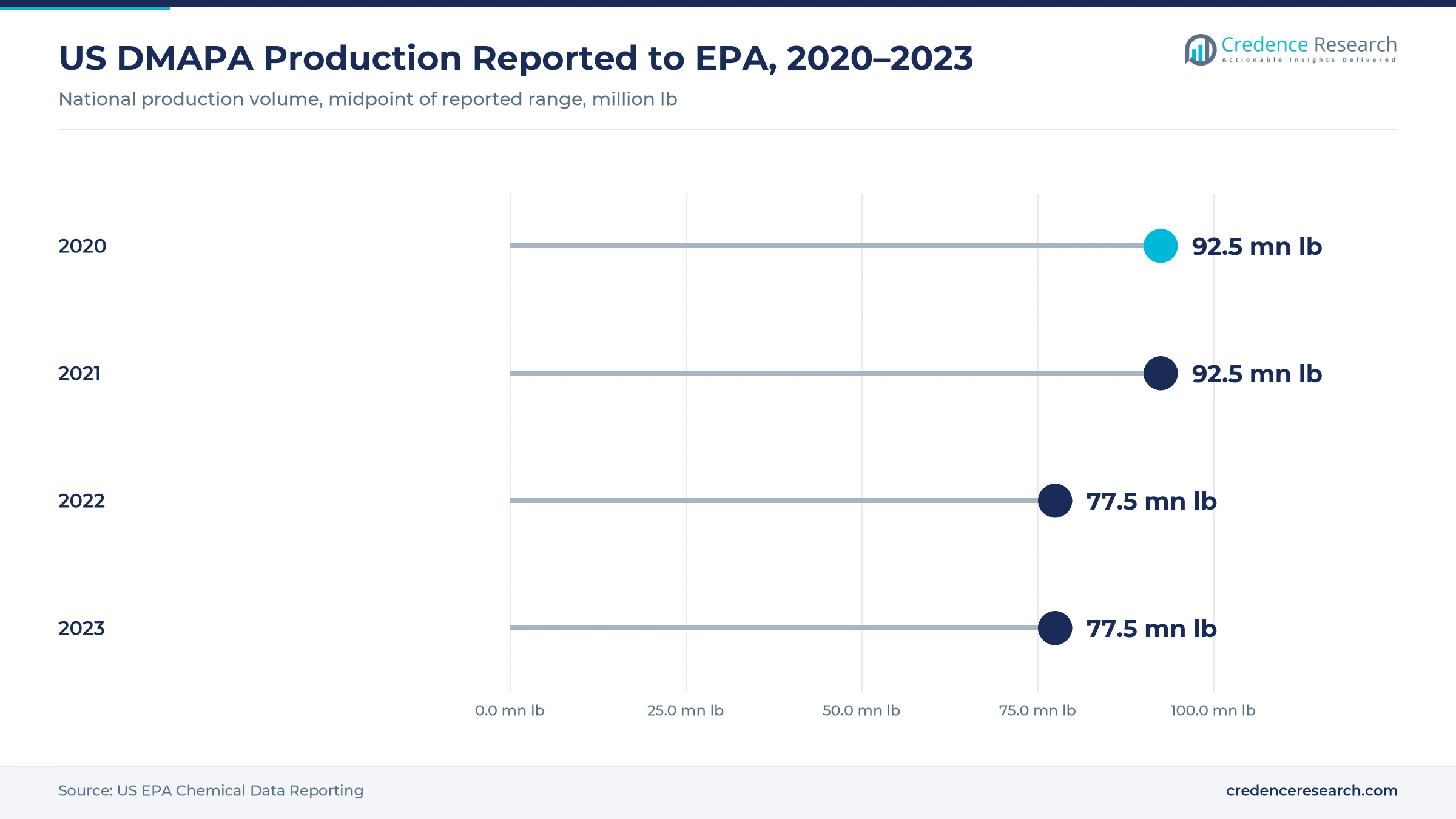
Fast capacity additions in China could outpace demand for a few years and pressure prices, and Credence Research sees this as the main risk to value growth through 2028. Western producers with higher costs are most exposed, because Chinese plants with scale set prices across Asia Pacific, and U.S. reported output already slipped from a 92.5 million lb midpoint to 77.5 million lb in recent reporting periods. The mitigation lies in high-purity grades, long-term contracts with global brands and supply-security commitments that price-led exporters cannot easily match.
Asia Pacific leads while the West buys premium grades
| Region | Share, 2025 | CAGR, 2025–2035 |
|---|---|---|
| Asia Pacific | 44.0% | 5.88% |
| Europe | 23.0% | 3.68% |
| North America | 21.0% | 3.88% |
| Latin America | 7.0% | 5.18% |
| Middle East & Africa | 5.0% | 5.38% |
Asia Pacific leads as China sets prices and hosts the largest betaine plants
Asia Pacific held 44.0% of 2025 value and is the fastest-growing region at 5.88% a year. China is the largest producer and user, with large betaine plants serving domestic and export brands. India and Southeast Asia add demand from fast-growing personal care markets, while epoxy flooring, coatings and wind-blade output lift hardener use.
Europe has strict purity rules that support high-grade demand
Europe held 23.0% of 2025 value and grows at 3.68% a year, the slowest of the five regions. Germany and Belgium host major producers, and demand comes from personal care, coatings and wind-blade composites. REACH and cosmetics rules set strict purity standards, which supports demand for high-purity, low-residual grades.
North America combines Gulf Coast production with large consumer brands
North America held 21.0% of 2025 value and grows at 3.88% a year. The United States has domestic production on the Gulf Coast and large personal and home care makers. U.S. producers report DMAPA output to the Environmental Protection Agency under its Chemical Data Reporting rule, and the midpoint of the reported production range fell from 92.5 million lb in 2020 and 2021 to 77.5 million lb in 2022 and 2023. Beyond consumer brands, coatings, foam catalysts and water treatment add industrial demand.
Latin America and Middle East & Africa expand local personal care production
Latin America held 7.0% of 2025 value and grows at 5.18% a year, led by Brazil and Mexico, where personal care output is rising. The Middle East & Africa held 5.0% and grows at 5.38% a year, as Gulf and North African firms build local cleaning and personal care production and tighter discharge rules raise water treatment chemical use.
BASF's Nanjing expansion defines DMAPA supply moves in 2025
| Development | Status and market relevance |
|---|---|
| In October 2025, BASF marked ten years of DMAPA and PEA production in Nanjing and announced that it had raised global DMAPA capacity by more than 20%. | Completed. Adds supply close to Asian betaine and epoxy users. |
| In July 2025, BASF started up its expanded DMAPA plant at the Nanjing site, nearly doubling the site's DMAPA capacity. | Operating. The largest disclosed capacity addition in the period. |
| In July 2025, as part of the same start-up, BASF expanded Nanjing capacity for PEA, a related amine intermediate, by about 25%. | Operating. Shows producers expanding amine chains together in China. |
Integration and purity control shape DMAPA production
- Synthesis route economics follow from reacting dimethylamine with acrylonitrile and hydrogenating the nitrile, so integration into both feedstocks sets cost.
- Purity control of residual amines and nitrosamine precursors requires tighter process control and analytics for cosmetic-grade product.
- Low-emission catalysts based on reactive amines that bind into polyurethane foam cut volatile emissions in car seats and furniture.
- Mass-balance feedstocks such as certified bio-attributed acrylonitrile and dimethylamine could create partly bio-attributed DMAPA grades.
- Safe handling through closed transfer systems and bulk delivery reduces exposure to a corrosive, flammable skin sensitizer.
Need a Custom Version of This Report?
Tailor the scope, geography, or segments to your exact requirements.
- Custom geography or segment scope
- Direct access to our analyst team
Integrated amine makers compete with Chinese specialists
DMAPA supply is concentrated among large amine producers that also make dimethylamine, plus a growing group of Chinese specialists. BASF runs DMAPA plants in Europe and China and expanded Nanjing in 2025, lifting its global DMAPA capacity by more than 20%. Eastman Chemical, which acquired the Belgian amine maker Taminco in 2014, makes DMAPA in the United States, and Huntsman supplies amine catalysts and curing agents built on DMAPA. Zhangjiagang Feixiang Chemical and Zhejiang Xinhua Chemical are among the larger Chinese producers. Solvay, Evonik and Kao convert DMAPA into betaines and amine oxides for personal and home care brands. Arkema and Nouryon are active in amines and derivatives, though their DMAPA roles are not confirmed. Cost and purity decide share, and no company reports DMAPA sales separately, so no ranking is given.
Companies profiled and their roles
| Company | Type | Role in the market |
|---|---|---|
| BASF | Integrated amine producer | DMAPA plants in Europe and China; Nanjing expanded in 2025 |
| Eastman Chemical | Integrated amine producer | U.S. DMAPA production; acquired Taminco in 2014 |
| Huntsman | Amine derivatives maker | Amine catalysts and curing agents built on DMAPA |
| Zhangjiagang Feixiang Chemical | Chinese producer | Sells to betaine and epoxy makers at home and abroad |
| Zhejiang Xinhua Chemical | Chinese producer | Sells to betaine and epoxy makers at home and abroad |
| Solvay | Surfactant maker | Betaines and amine oxides from DMAPA |
| Evonik | Surfactant maker | Betaines and amine oxides from DMAPA |
| Kao | Surfactant maker | Betaines and amine oxides from DMAPA |
| Arkema | Amines and derivatives | Active in amines; DMAPA role not confirmed |
| Nouryon | Amines and derivatives | Active in amines; DMAPA role not confirmed |
DMAPA is a commodity where purity and cost decide share
Credence Research's view is that DMAPA is a quiet but essential building block whose value tracks household spending on personal and home care, with epoxy hardeners and polyurethane catalysts adding faster growth. The main near-term risk is overcapacity through 2028, so buyers and investors should watch Chinese additions, acrylonitrile prices, cosmetic purity rules and epoxy demand from wind and construction.
How Credence Research sized DMAPA sales
The report uses 2025 as the base year and forecasts to 2035, with CAGR calculated over 2025–2035. Market values come from Credence Research's market model, built from producer capacity disclosures and typical operating rates and checked against betaine, epoxy hardener and catalyst production by region; segment and regional splits are Credence Research estimates. Supporting evidence comes from U.S. EPA Chemical Data Reporting data, customs statistics for traded amines, PubChem records and company releases.
Betaines anchor volume while hardeners and Asia add growth
Through 2035, as the market grows from USD 474.3 million in 2026 to USD 731.9 million, betaines and amine oxides will remain the core of DMAPA demand, while epoxy hardeners, foam catalysts and water treatment chemicals grow faster. Asia Pacific will gain share as regional personal care and coatings output expands. Purity rules and allergy concerns will push suppliers toward low-residual grades, bio-attributed feedstocks may add a premium tier, and value growth will depend on how quickly new capacity is absorbed.
Frequently Asked Questions
What was the size of the dimethylaminopropylamine market in 2025?
What is the forecast value and CAGR of the DMAPA market?
What is DMAPA used for?
Which region holds the largest share of the DMAPA market?
Which application leads the dimethylaminopropylamine market?
Who are the major companies in the DMAPA market?
How is DMAPA made?
What challenges could slow the dimethylaminopropylamine market?
Table of Content
Chapter 1 Market Segmentation
- 1.1 Segmentation Framework
- 1.1.1 Product and Service Classification
- 1.1.2 Application and End-Use Classification
- 1.1.3 Technology and Solution Classification
- 1.1.4 Customer and Distribution Channel Classification
- 1.1.5 Geographic Segmentation
- 1.1.6 Market Segment Definitions and Boundaries
- 1.2 By Application
- 1.2.1 Surfactants (Betaines & Amine Oxides)
- 1.2.2 Epoxy Curing Agents
- 1.2.3 Polyurethane Catalysts
- 1.2.4 Water Treatment Chemicals
- 1.2.5 Agrochemical Intermediates
- 1.2.6 Fuel & Lubricant Additives
- 1.2.7 Others
- 1.3 By End-Use Industry
- 1.3.1 Personal Care & Cosmetics
- 1.3.2 Home Care & Institutional Cleaning
- 1.3.3 Paints, Coatings & Composites
- 1.3.4 Water Treatment
- 1.3.5 Agriculture
- 1.3.6 Automotive & Lubricants
Chapter 2 Introduction
- 2.1 Report Objectives and Scope
- 2.2 Product Definition and Industry Terminology
- 2.3 Market Inclusions and Exclusions
- 2.4 Research Process
- 2.4.1 Primary Research and Expert Interviews
- 2.4.2 Secondary Research and Source Review
- 2.4.3 Top-Down and Bottom-Up Estimation
- 2.4.4 Data Triangulation and Verification
- 2.5 Market Size Measurement Basis
- 2.5.1 2025: USD 452.6 million → 2035: USD 731.9 million
- 2.6 Historical and Forecast Reference Periods
- 2.6.1 Historical Period: 2018-2025
- 2.6.2 Base Year: 2025
- 2.6.3 Forecast Period: 2025-2035
- 2.7 Research Assumptions and Limitations
Chapter 3 Executive Summary
- 3.1 Market Snapshot and Key Findings
- 3.2 Base-Year Market Size, 2025
- 3.3 Forecast Market Size, 2035
- 3.4 Revenue and Volume Growth Outlook
- 3.5 Key Demand and Supply Indicators
- 3.6 Leading Market Segments
- 3.7 Fastest-Growing Market Opportunities
- 3.8 Regional Performance Highlights
- 3.9 Technology and Industry Transformation
- 3.10 Competitive Landscape Summary
- 3.11 Analyst View and Strategic Implications
Chapter 4 Global Dimethylaminopropylamine Market Trends and Developments
- 4.1 Historical Industry Development, 2018-2025
- 4.2 Recent Market Trends and Developments
- 4.3 Demand and Customer Behavior Trends
- 4.4 Technology and Product Innovation
- 4.5 Artificial Intelligence, Automation and Digitalization
- 4.6 Local Manufacturing and Supply Chain Realignment
- 4.7 Industry Partnerships, Mergers and Acquisitions
- 4.8 Sustainability and Circular Economy Developments
- 4.9 Government and Private Sector Investment Trends
- 4.10 Emerging Business Models and Commercialization
- 4.11 Industry Developments and Announcements
Chapter 5 Global Dimethylaminopropylamine Market Production, Supply and Demand Analysis
- 5.1 Demand Trend and Consumption Analysis, 2018-2025
- 5.2 Demand Forecast, 2025-2035
- 5.3 Production and Output Trend, 2018-2025
- 5.4 Production and Output Forecast, 2025-2035
- 5.5 Installed Capacity and Capacity Utilization
- 5.6 Company-Wise Production Plants and Statistics
- 5.6.1 Installed Production Capacity
- 5.6.2 Actual Production
- 5.6.3 Planned Capacity and Expansion Targets
- 5.7 Supply Chain Structure and Procurement Trends
- 5.8 Supply-Demand Gap and Bottlenecks
- 5.9 Import Dependence and Sourcing Structure
- 5.10 Contract Manufacturing and Outsourcing
- 5.11 Regional Supply and Demand Concentration
Chapter 6 Global Dimethylaminopropylamine Market Pricing Analysis
- 6.1 Pricing Structure and Measurement
- 6.2 Historical Pricing Trends, 2018-2025
- 6.3 Pricing Outlook, 2025-2035
- 6.4 Average Selling Price and Unit Economics
- 6.5 Pricing by Product and Market Segment
- 6.6 Geographic Pricing Differences
- 6.7 Key Input, Energy, Labor and Logistics Costs
- 6.8 Contract Pricing and Purchasing Models
- 6.9 Pricing Sensitivity and Competitive Positioning
- 6.10 Price, Margin and Profitability Implications
Chapter 7 Global Dimethylaminopropylamine Market Dynamics
- 7.1 Market Growth Drivers
- 7.1.1 Demand-Side Drivers
- 7.1.2 Technology and Innovation Drivers
- 7.1.3 Infrastructure and Investment Drivers
- 7.1.4 Regulatory and Policy Drivers
- 7.2 Market Restraints
- 7.2.1 Cost and Affordability Constraints
- 7.2.2 Technology and Adoption Barriers
- 7.2.3 Supply Chain and Operational Constraints
- 7.3 Market Challenges
- 7.3.1 Competitive Pressure and Margin Erosion
- 7.3.2 Skills, Infrastructure and Implementation Gaps
- 7.4 Emerging Market Opportunities
- 7.5 Market Dynamics Impact and Time-Horizon Assessment
Chapter 8 Global Dimethylaminopropylamine Value Chain Analysis
- 8.1 Industry Value Chain Overview
- 8.2 Upstream Suppliers and Critical Inputs
- 8.3 Technology and Component Providers
- 8.4 Manufacturing or Service Delivery
- 8.5 Distribution, Channel Partners and Integrators
- 8.6 Downstream Applications and End Users
- 8.7 Value Addition and Profit Pools
- 8.8 Vertical Integration and Outsourcing
- 8.9 Supplier Concentration and Risk
- 8.10 Supply Chain Localization and Resilience
Chapter 9 Global Dimethylaminopropylamine Market Regulations and Policies
- 9.1 Relevant Laws, Standards and Compliance Frameworks
- 9.2 Product, Service, Safety and Quality Requirements
- 9.3 Government Policies, Incentives and Subsidies
- 9.4 Imports, Exports and Trade Barriers
- 9.5 Public Procurement and Local Content Requirements
- 9.6 Environmental and Sustainability Compliance
- 9.7 Upcoming Policy Changes and Market Implications
Chapter 10 Global Dimethylaminopropylamine Market Hotspots and Opportunities
- 10.1 Market Opportunity Mapping and Growth Hotspots
- 10.2 High-Growth Applications and Customer Groups
- 10.3 Underserved Markets and White-Space Opportunities
- 10.4 Emerging Technology and Product Opportunities
- 10.5 New Capacity and Investment Hotspots
- 10.6 Market Entry and Expansion Opportunities
- 10.7 Distribution and Partnership Opportunities
- 10.8 Near-Term and Long-Term Commercial Potential
- 10.9 Opportunity Attractiveness and Execution Risks
Chapter 11 Global Dimethylaminopropylamine Market Outlook, 2025-2035
- 11.1 Market Size and Analysis
- 11.1.1 Revenue (Market Measurement: 2025: USD 452.6 million → 2035: USD 731.9 million)
- 11.1.2 Market Volume and Quantity Sold
- 11.1.3 Historical Market Size, 2018-2025
- 11.1.4 Base-Year Market Size, 2025
- 11.2 Market Forecast, 2025-2035
- 11.2.1 Revenue Forecast to 2035
- 11.2.2 Volume Forecast to 2035
- 11.2.3 CAGR and Year-on-Year Growth
- 11.2.4 Incremental Revenue Opportunity
- 11.3 Forecast Assumptions and Scenario Analysis
- 11.3.1 Base-Case Forecast
- 11.3.2 Optimistic and Conservative Scenarios
- 11.3.3 Technology, Pricing and Policy Sensitivities
- 11.4 Market Attractiveness and Growth Outlook
Chapter 12 Global Dimethylaminopropylamine Market Segmentation and Outlook
- 12.1 Segmentation Summary and Market Shares, 2025
- 12.2 Largest and Fastest-Growing Segments
- 12.3 By Application - Market Size and Forecast, 2025-2035
- 12.3.1 Segment Definition and Scope
- 12.3.2 Historical Market Size, 2018-2025
- 12.3.3 Revenue Forecast, 2025-2035
- 12.3.4 Volume Forecast, 2025-2035
- 12.3.5 Base-Year Market Share, 2025
- 12.3.6 Segment CAGR and Growth Drivers
- 12.3.7 Subsegment Market Size and Forecast
- 12.3.7.1 Surfactants (Betaines & Amine Oxides)
- 12.3.7.2 Epoxy Curing Agents
- 12.3.7.3 Polyurethane Catalysts
- 12.3.7.4 Water Treatment Chemicals
- 12.3.7.5 Agrochemical Intermediates
- 12.3.7.6 Fuel & Lubricant Additives
- 12.3.7.7 Others
- 12.3.8 Subsegment Pricing and Adoption Trends
- 12.3.9 Leading Suppliers and Competition
- 12.3.10 Regional Demand and Opportunities
- 12.4 By End-Use Industry - Market Size and Forecast, 2025-2035
- 12.4.1 Segment Definition and Scope
- 12.4.2 Historical Market Size, 2018-2025
- 12.4.3 Revenue Forecast, 2025-2035
- 12.4.4 Volume Forecast, 2025-2035
- 12.4.5 Base-Year Market Share, 2025
- 12.4.6 Segment CAGR and Growth Drivers
- 12.4.7 Subsegment Market Size and Forecast
- 12.4.7.1 Personal Care & Cosmetics
- 12.4.7.2 Home Care & Institutional Cleaning
- 12.4.7.3 Paints, Coatings & Composites
- 12.4.7.4 Water Treatment
- 12.4.7.5 Agriculture
- 12.4.7.6 Automotive & Lubricants
- 12.4.8 Subsegment Pricing and Adoption Trends
- 12.4.9 Leading Suppliers and Competition
- 12.4.10 Regional Demand and Opportunities
- 12.5 Segment Growth Comparison
- 12.6 Segment Attractiveness and Priority Matrix
Chapter 13 Global Dimethylaminopropylamine End-Use and Application Market Outlook
- 13.1 End-Use Industry and Customer Demand Structure
- 13.2 Leading Applications and Customer Groups
- 13.3 End-Use Market Size, Share and Forecast
- 13.4 Major End-Use Industry Deep Dives
- 13.4.1 Customer Requirements and Use Cases
- 13.4.2 Demand and Replacement Cycles
- 13.4.3 Technical and Regulatory Considerations
- 13.4.4 Purchasing and Procurement Models
- 13.4.5 Leading Vendors and Distribution Channels
- 13.4.6 Forecast and Commercial Opportunities
- 13.5 Emerging Applications and Cross-Segment Demand
- 13.6 End-Use Industry Investment Priorities
Chapter 14 Global Dimethylaminopropylamine Geographic Market Outlook, 2025-2035
- 14.1 Regional Market Size and Share, 2025
- 14.2 Regional Market Forecast, 2025-2035
- 14.3 Regional Pricing, Production and Demand Differences
- 14.4 North America
- 14.4.1 United States
- 14.4.2 Canada
- 14.4.3 Mexico
- 14.5 Europe
- 14.5.1 Germany
- 14.5.2 France
- 14.5.3 Italy
- 14.5.4 United Kingdom
- 14.5.5 Spain
- 14.5.6 Poland
- 14.5.7 Russia
- 14.5.8 Netherlands
- 14.5.9 Belgium
- 14.5.10 Sweden
- 14.5.11 Denmark
- 14.5.12 Norway
- 14.5.13 Rest of Europe
- 14.6 Asia Pacific
- 14.6.1 China
- 14.6.2 India
- 14.6.3 Japan
- 14.6.4 South Korea
- 14.6.5 Thailand
- 14.6.6 Indonesia
- 14.6.7 Vietnam
- 14.6.8 Malaysia
- 14.6.9 Australia
- 14.6.10 Rest of Asia Pacific
- 14.7 Latin America
- 14.7.1 Brazil
- 14.7.2 Argentina
- 14.7.3 Colombia
- 14.7.4 Chile
- 14.7.5 Rest of Latin America
- 14.8 Middle East
- 14.8.1 Saudi Arabia
- 14.8.2 United Arab Emirates
- 14.8.3 Turkey
- 14.8.4 Israel
- 14.8.5 Iran
- 14.8.6 Rest of the Middle East
- 14.9 Africa
- 14.9.1 South Africa
- 14.9.2 Egypt
- 14.9.3 Nigeria
- 14.9.4 Morocco
- 14.9.5 Rest of Africa
- 14.10 Regional Investment, Policy and Supply Chain Differences
- 14.11 Regional Competitive Landscape
- 14.12 Geographic Growth Hotspots
Chapter 15 Global Dimethylaminopropylamine Technology, Innovation and Sustainability Outlook
- 15.1 Technology Landscape and Maturity
- 15.2 Product, Process and Service Innovation
- 15.3 AI, Automation and Digital Tools in the Industry
- 15.4 Technology Adoption and Performance Benchmarking
- 15.5 Innovation Pipeline and R&D Investment
- 15.6 Patent and Intellectual Property Trends
- 15.7 Energy Efficiency and Resource Management
- 15.8 Sustainability, Recycling and Circularity
- 15.9 Technology Roadmap, 2025-2035
- 15.10 Risks of Obsolescence and Technology Substitution
Chapter 16 Global Dimethylaminopropylamine Market Key Strategic Imperatives
- 16.1 Growth and Market Entry Priorities
- 16.2 High-Return Products and Segments
- 16.3 Pricing, Profitability and Cost Optimization
- 16.4 Technology Investment and Product Differentiation
- 16.5 Supply Chain Localization and Resilience
- 16.6 Distribution and Customer Acquisition
- 16.7 Partnership, Acquisition and Capacity Strategy
- 16.8 Regional Expansion Priorities
- 16.9 Short-, Medium- and Long-Term Actions
Chapter 17 Competition Outlook
- 17.1 Industry Competition Characteristics
- 17.2 Market Structure and Concentration
- 17.3 Market Share and Competitive Positioning, 2025
- 17.4 Company-Wise Revenue and Product Benchmarking
- 17.5 Production and Service Capacity Benchmarking
- 17.6 Technology, Pricing and Differentiation
- 17.7 Regional Footprint and Distribution Strength
- 17.8 Mergers, Acquisitions and Strategic Alliances
- 17.9 New Entrants and Competitive Threats
- 17.10 Porter's Five Forces and Industry Attractiveness
- 17.11 Competitive Outlook, 2025-2035
Chapter 18 Company Profiles
- 18.1 Company Coverage and Selection Criteria
- 18.2 BASF
- 18.2.1 Business Description
- 18.2.2 Company Ownership and Geographic Presence
- 18.2.3 Product and Service Portfolio
- 18.2.4 Manufacturing and Operating Footprint
- 18.2.5 Production Capacity and Expansion Plans
- 18.2.6 Financial Performance and Investment
- 18.2.7 Market Share and Competitive Position
- 18.2.8 Technology and Innovation Capabilities
- 18.2.9 Strategic Alliances or Partnerships
- 18.2.10 Recent Developments
- 18.2.11 Growth Strategy and Outlook
- 18.3 Eastman Chemical
- 18.4 Huntsman
- 18.5 Arkema
- 18.6 Nouryon
- 18.7 Zhangjiagang Feixiang Chemical
- 18.8 Zhejiang Xinhua Chemical
- 18.9 Solvay
- 18.10 Evonik
- 18.11 Kao
- 18.12 Other Relevant Market Participants
Note: Every listed company is profiled on the structure shown under the first company. The company list is preliminary and may change based on research findings, market developments, data availability and client requirements.
Chapter 19 Disclaimer
- 19.1 Research and Forecast Disclaimer
- 19.2 Data Source and Estimation Limitations
Note: The depth of individual sections depends on data availability for this market. Volume, capacity, trade and other unit-based metrics are included where applicable.

