
Certified buildings and privacy uses shape Vietnam demand
The Vietnam smart glass market was valued at USD 20.5 million in 2025 and is projected to increase from USD 23.1 million in 2026 to USD 82.2 million by 2035, registering a CAGR of 15.18% during 2026–2035. Demand comes from green-certified offices and apartments, hotels and hospitals that buy switchable privacy partitions, and vehicle and electronics programs that use glass components. Northern Hub held the largest regional share, 38.0% in 2025, as Hanoi recorded nearly 36,000 condominium launches that year. Central Corridor is the fastest-growing region at 15.84% a year, helped by the 1,881-hectare Da Nang Free Trade Zone. Regulation is the main commercial change, because Circular 61/2026/TT-BXD takes effect on Feb. 1, 2027 and covers offices, hotels, hospitals, schools, shopping centers and apartment buildings with floor area of 2,500 square meters and above. Energy labeling for construction glass began on Jan. 1, 2026, which gives buyers a clearer basis for comparing products.
What does smart glass include in Vietnam?
The market counts switchable and solar-responsive glazing sold in Vietnam as retrofit film, laminated panels, insulating units and integrated components. Buyers include property developers, facility owners, vehicle and device manufacturers and households, and they purchase through direct project contracts, specialist integrators, processors and dealers, or online sellers.
The count excludes ordinary float glass, tempered glass without a control function, and smart eyewear sold as finished consumer devices. The value chain runs from imported or local base glass and film through local processors such as laminators, then to aluminum-system fabricators and the installers who wire and commission each panel.
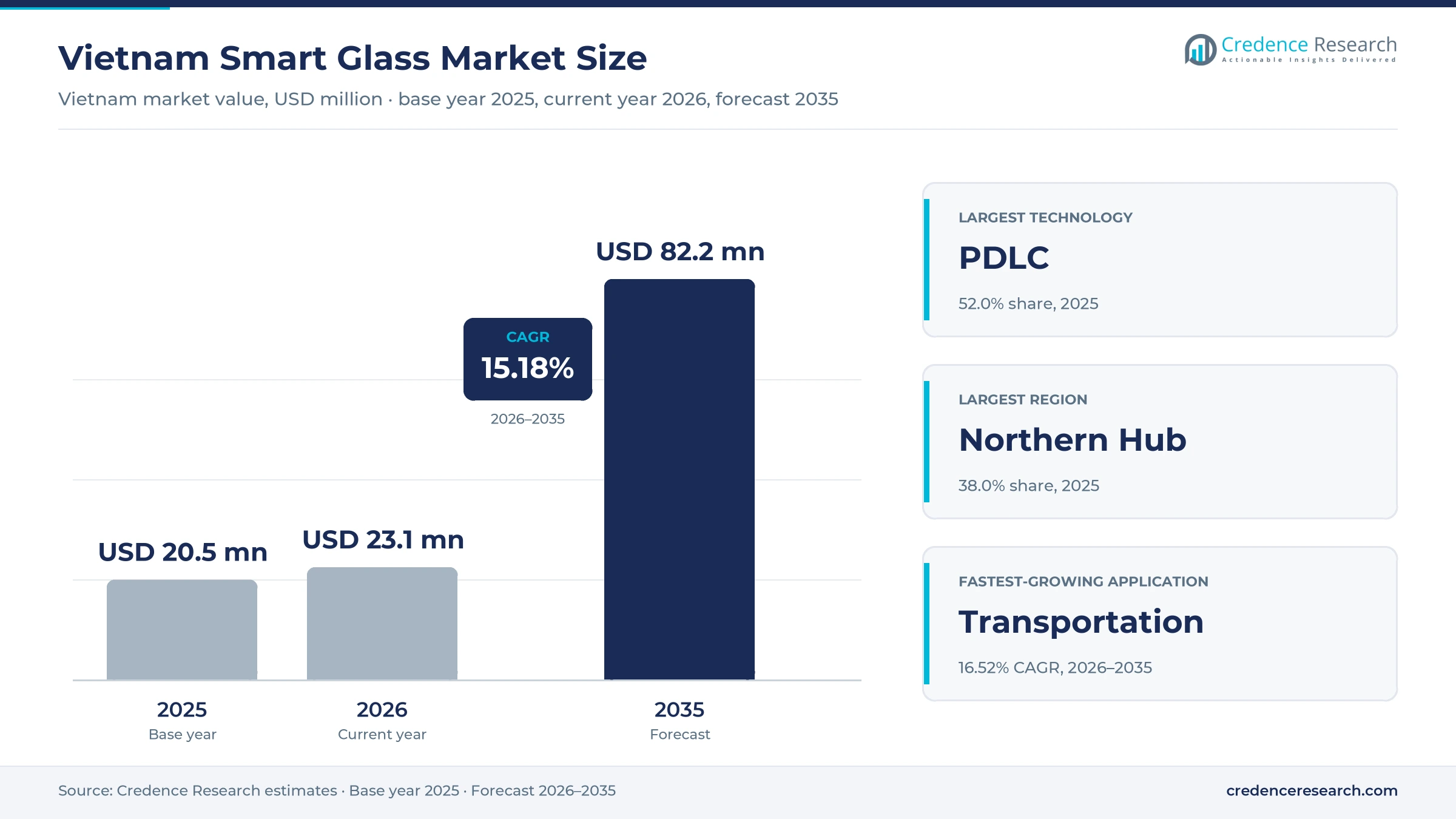
Vietnam Smart Glass Market Insights
- Vietnam smart glass revenue is projected to grow from USD 20.5 million in 2025 to USD 82.2 million by 2035, reflecting a 15.18% CAGR across building and vehicle applications.
- Northern Hub held 38.0% of market value in 2025, supported by Hanoi condominium launches and certified floor area in Bac Ninh and Hai Phong.
- Architectural use accounted for 78.0% of 2025 value, because certified buildings and office partitions form the largest specification base for controllable glazing in Vietnam.
- Circular 61/2026/TT-BXD, effective Feb. 1, 2027, replaces the 2017 energy-efficiency code and applies to many building types of 2,500 square meters and above.
- Competition is local and project-led, with Tech Glass Vietnam, Legaro and Goldsunvina selling electric glass while processors such as Thang Long Glass supply Low-E panels.
Laminated panels, architecture and PDLC lead each segment
Why do laminated panels lead product demand?
Based on product type, the market is categorized into Retrofit Smart Film, Laminated Smart Glass, Insulating Smart Glass Units and Integrated Smart Glass Components. Laminated Smart Glass led with 41.0% of 2025 value because local processors sell it as a finished panel, and Tech Glass Vietnam lists PDLC electric glass beside its insulating lines. Retrofit Smart Film grows fastest at 15.99% a year as the Ministry of Construction's Circular 61/2026/TT-BXD, reported by VnEconomy on Aug. 3, 2026, also covers renovation of larger buildings, which favors film on existing panes. Insulating units stay narrower, since VietnamFinance reported in May 2022 that energy-saving glass cost about twice clear glass.
Which applications buy the most smart glass?
Based on application, the market is categorized into Architectural, Transportation, Consumer Electronics and Solar and Power Generation. Architectural led with 78.0% of 2025 value because certification gives it the deepest specification base, with 780 certified buildings counted by IFC at the end of 2025. Transportation grows fastest at 16.52% a year as VinFast delivered 175,099 electric vehicles in Vietnam in 2025, according to Vietnam Investment Review, which enlarges the local base of models that could specify vehicle glazing. Consumer Electronics rests on assembly such as Goertek's Bac Ninh project, whose roughly 50 product lines include AR glasses, according to The Investor.
Why does PDLC hold the largest technology share?
Based on technology, the market is categorized into PDLC, Electrochromic, SPD and Passive Smart Glass. PDLC led with 52.0% of 2025 value because local suppliers built their switchable ranges around it, with Luxmage describing PDLC film for offices in a Sept. 18, 2024 note and Legaro and Tech Glass Vietnam offering PDLC glass. Electrochromic grows fastest at 16.72% a year as BM Windows set out electrochromic specifications in April 2024, citing 55% to 83% light transmission and blocking of up to 99% of ultraviolet and infrared rays. Passive Smart Glass sits beside solar-control products such as the Cool-Lite glass Saint-Gobain describes for Long Thanh airport.
| Segment Group | Leading Sub-segment | Share, 2025 | Fastest-growing Sub-segment | CAGR, 2026–2035 |
|---|---|---|---|---|
| By Product Type | Laminated Smart Glass | 41.0% | Retrofit Smart Film | 15.99% |
| By Application | Architectural | 78.0% | Transportation | 16.52% |
| By Technology | PDLC | 52.0% | Electrochromic | 16.72% |
Request a Free Sample
Fill in your details and we'll send you a free sample report.
- Sample data tables & charts
- Research methodology
Certification, launches and power costs lift glazing demand
Green-building specification expansion reaches glazing choices
Green certification is moving facade decisions earlier in design, and that change lifts demand for controllable glazing in offices and apartments. IFC counted 780 certified buildings covering 18.69 million square meters at the end of 2025, against 559 projects and 13.6 million square meters a year earlier, according to a Vietnam Electricity summary of IFC data. EDGE alone accounted for 394 of those buildings, and its residential reach shows in 51,834 certified apartment units. Viet Nam News reported in July 2026 that the count had passed 828 projects and 20.8 million square meters. As a result, developers now compare solar performance across facade options, which gives switchable and solar-control products a commercial case beyond privacy.
Urban project pipeline development sets annual glazing volume
Residential and commercial launches set the volume of glazing that can be specified each year, and the northern pipeline is the clearest source of demand. CBRE Vietnam recorded nearly 36,000 condominium launches in Hanoi during 2025, the second-highest annual total on record, and it expects about 33,000 more in 2026. Hanoi also added 21,951 units approved for sale in the first half of 2025, VietNamNet reported in August 2025. Primary apartment prices in former Ho Chi Minh City reached VND 82 million per square meter in the second quarter of 2025, according to The Investor, which leaves more room for premium specifications. The same pipeline supports commercial building construction, where meeting rooms and lobbies are natural sites for switchable partitions.
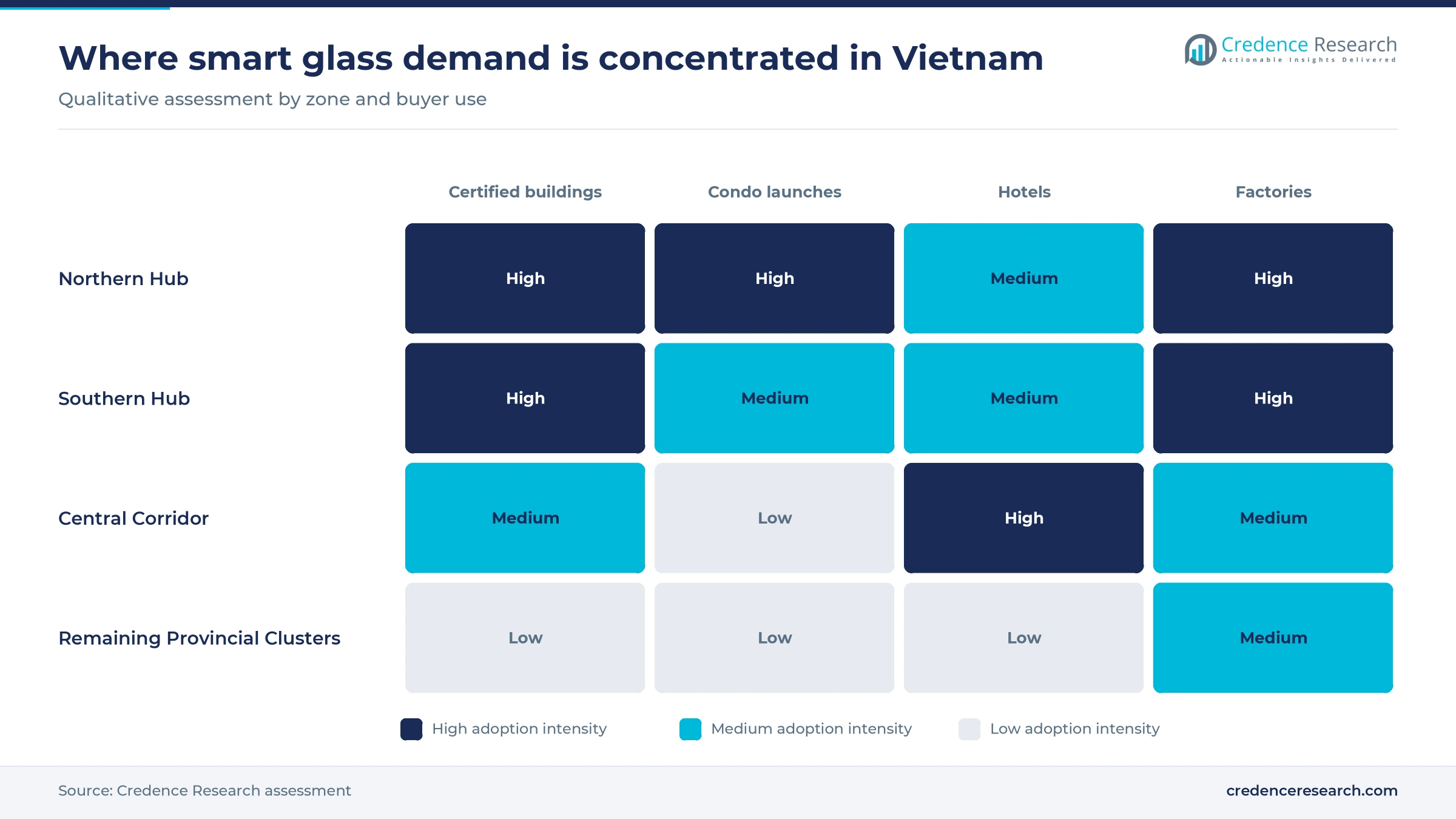
Established privacy-glazing use cases anchor early volume
Privacy remains the most proven reason buyers pay for switchable panels, because the benefit is visible on installation and needs no energy model. Luxmage, a Ho Chi Minh City supplier, named meeting rooms, management offices and reception areas as office uses in a September 2024 note. Legaro lists hospitals, hotels, meeting rooms, clean rooms and homes among its applications for electric glass. Hospitality adds volume as well, since Vietnam received 21.2 million international arrivals in 2025, according to VietNamNet in January 2026. These uses help explain why PDLC holds 52.0% of 2025 value in the technology segment. They also keep window films relevant in occupied offices, where owners want privacy without replacing the existing partition.
Higher power prices strengthen the solar-control case
Electricity cost gives building owners a second reason to treat glazing as operating equipment rather than a finish. Vietnam Electricity set the average retail price at VND 2,204.07 per kWh from May 10, 2025, a 4.8% increase that followed Decision 1279/QD-BCT of May 9, 2025. Cooling matters in that calculation, because the World Bank building energy profile for Vietnam classes the climate as extremely hot and humid and lists a maximum solar heat gain coefficient as a mandatory residential design requirement. VnEconomy reported in May 2017 that solar-control glass from Viglacera could limit up to 79% of solar heat. Saint-Gobain makes a similar case at Long Thanh airport, where it says facade and skylight glass reduces air-conditioning costs for the terminal.
Labeling rules and airport projects open new demand
Shift toward labeled envelope products in building supply
Product disclosure is becoming part of the sale, which is a shift for a category long sold on demonstrations. Energy labeling for building envelope materials, including construction glass, took effect on Jan. 1, 2026 under the amended energy-efficiency law, according to a Vietstock report of Jan. 20, 2026. At the July 16, 2026 Vietnam Sustainable Construction Forum in Hanoi, speakers named Low-E and solar-control glass among energy-efficient materials. Saint-Gobain Vietnam, meanwhile, has announced a plan to cut carbon dioxide emissions 33% by 2030. As a result, suppliers of Laminated Smart Glass and film increasingly need measured solar and light data, and panels without those figures may lose ground in certified projects.
Rise of solar-control and electrochromic ranges among processors
Local supply is broadening from privacy film toward products that also manage heat, and this emerging range changes who can bid on facades. VietnamFinance reported in May 2022 that Viglacera's Binh Duong energy-saving glass plant had a design capacity of 5 million square meters a year, with 2.3 million in phase one. Thang Long Glass now lists Low-E coated glass among its factory products, while BM Windows introduced an electrochromic product note in April 2024 that cited a service life above 100,000 hours. Electrochromic is growing at 16.72% a year from a small base as electrochromic systems move from specialist imports toward locally offered facade packages.
Airport and hospitality projects open large glazing packages
Major public and hospitality projects offer an opening for suppliers that can deliver large, documented packages. Saint-Gobain says it is equipping Long Thanh airport with 90,000 square meters of Cool-Lite laminated insulating glass on terminal facades and skylights, in a project planned to reach 100 million passengers a year by 2035. That single order is solar-control glazing rather than switchable glass, yet it shows the facade package size an energy-focused specification can reach in Vietnam, and BM Windows has also described facade work at the same airport. Hotels offer smaller but more frequent packages, because the 21.2 million international arrivals recorded in 2025 support new room supply. Suppliers that combine passive facades with switchable interior partitions can therefore bid for more of each building.
Rooftop solar targets create an opening for power-generating glazing
National power planning creates an opportunity for glass that generates electricity as well as controlling light. Decision 768/QD-TTg of April 15, 2025, summarized by KPMG Vietnam, sets a 2030 solar target of 46,459 to 73,416 megawatts and expects rooftop solar to supply about 50% of office buildings and about 50% of houses. Office towers often have limited roof area, which makes glass facades a logical extension of the same target. Architectural buyers already hold most of the segment value at 78.0% in 2025, so solar glazing can be sold to existing accounts rather than new ones. Viglacera and its partners also have ultra-clear float experience, reported by VOV, which offers a local base-glass route.
Price premiums and uneven launches restrain buyers
Price premiums limit specification in mid-market projects
Cost remains the first barrier for developers, because VietnamFinance reported in May 2022 that energy-saving glass cost about twice clear glass, and switchable panels add film and wiring on top. Pressure on sales makes that harder to absorb, since VietNamNet reported that new apartment absorption fell to 74% in the first half of 2025 from 86% a year earlier. Mid-market developers therefore tend to confine controllable panels to lobbies and show units until clearer payback data exists.
Uneven launches make southern demand hard to plan
Project timing creates a planning risk for processors and installers. CBRE Vietnam counted just 1,400 apartment launches in former Ho Chi Minh City in the first half of 2025, the lowest six-month total since 2015, according to The Investor. Southern suppliers therefore face gaps between large orders even though the city leads certified floor area. Companies with factories in both north and south, such as HT Window, can move work between regions, while single-site processors carry more idle capacity.
Float glass duties may raise base costs for processors
Trade measures add uncertainty to input costs for local laminators. The Ministry of Industry and Trade imposed provisional anti-dumping duties of 15.17% to 63.39% on clear float glass from Indonesia and Malaysia, Vietstock reported on Feb. 4, 2026. These duties protect domestic float producers, but processors that buy imported panes could pay more for base glass. Smaller smart glass fabricators may struggle to pass that increase to buyers on fixed-price contracts, so they may need to requalify domestic glass suppliers.
Transition rules and thin green finance delay adoption
The new code will not bind every project at once, which limits its near-term effect. VnEconomy reported that projects approved or submitted for appraisal before Feb. 1, 2027 may continue under QCVN 09:2017/BXD. Deputy Minister Nguyễn Văn Sinh told the July 16, 2026 forum that the transition is constrained by high investment costs, limited access to green finance and incomplete technical standards, Viet Nam News reported. As a result, some owners may defer upgrades, and suppliers need case data on running costs to shorten decisions.
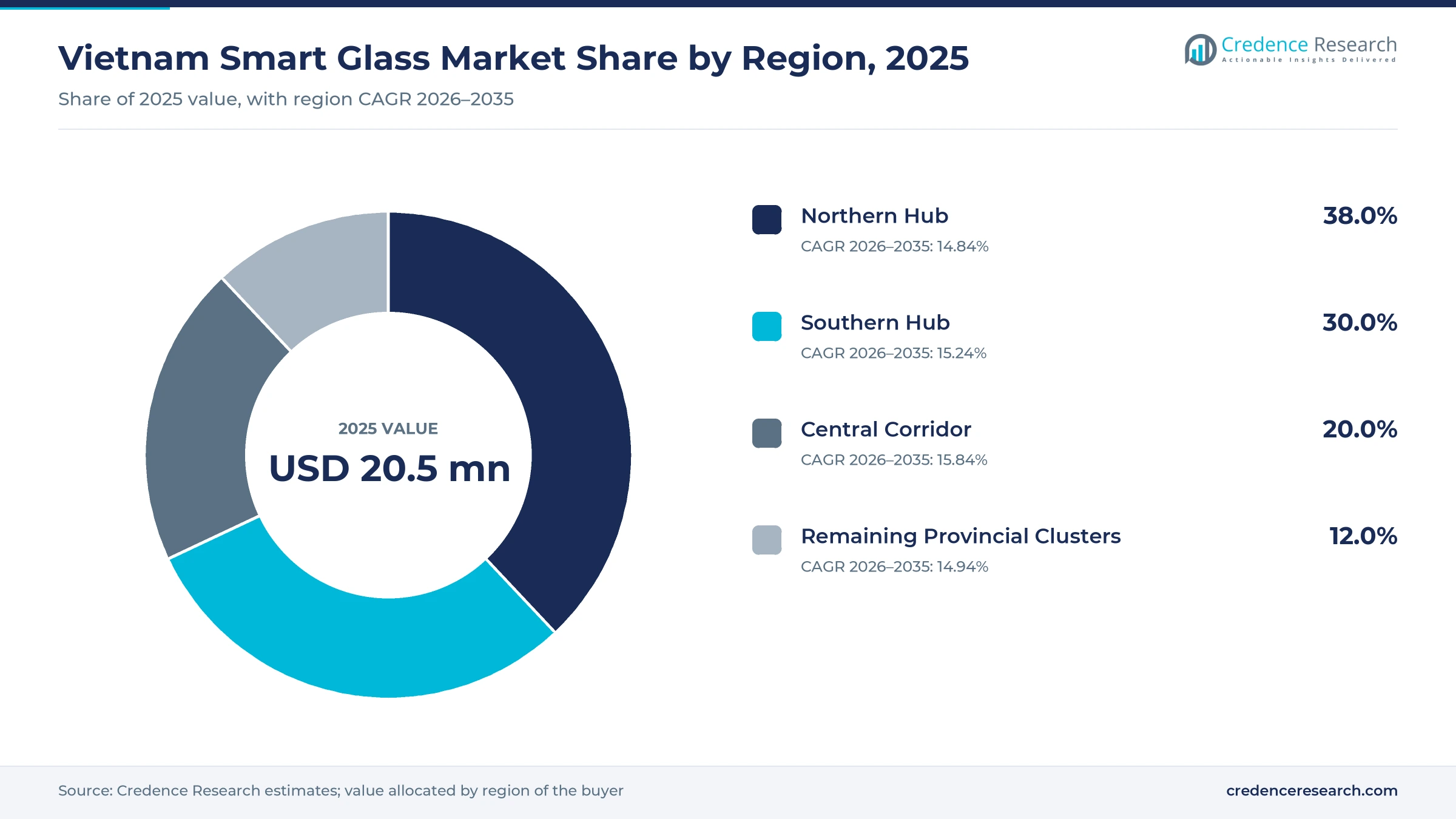
Northern Hub leads while Central Corridor grows fastest
| Region | Value, 2025 (USD million) | Share, 2025 | CAGR, 2026–2035 |
|---|---|---|---|
| Northern Hub | 7.8 | 38.0% | 14.84% |
| Southern Hub | 6.2 | 30.0% | 15.24% |
| Central Corridor | 4.1 | 20.0% | 15.84% |
| Remaining Provincial Clusters | 2.5 | 12.0% | 14.94% |
Northern Hub leads on Hanoi launches and industrial sites
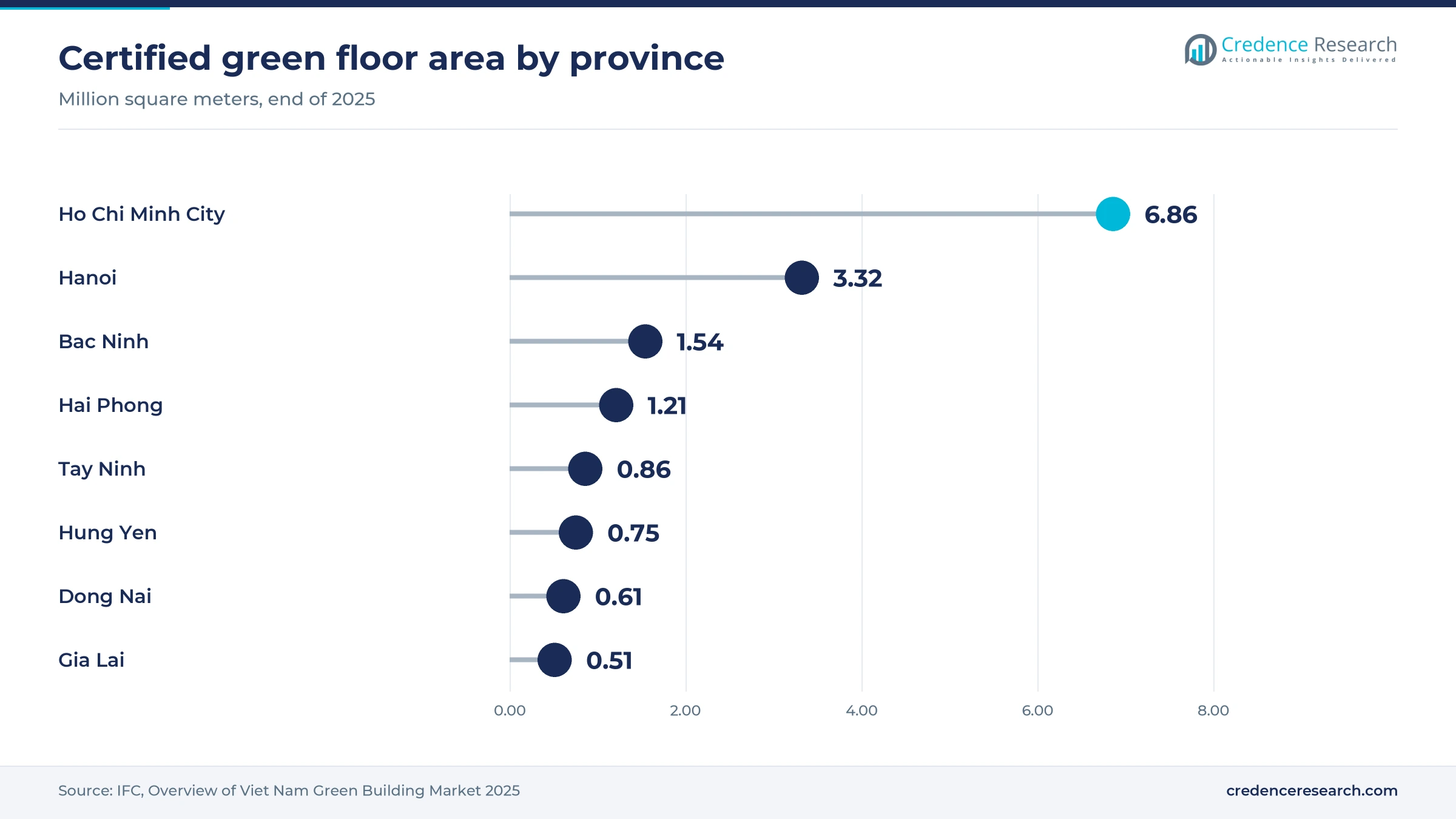
Northern Hub held 38.0% of 2025 value and grows at 14.84% a year. Hanoi drives the region with nearly 36,000 condominium launches in 2025, according to CBRE Vietnam, and IFC data show 3.32 million square meters of certified floor area in the capital. Bac Ninh adds 1.54 million and Hai Phong 1.21 million, which brings factories and offices into the demand base. Hoang Phi Glass and HT Window also run Hanoi operations, so buyers can source installation close to projects.
Southern Hub pairs certified leadership with thinner launches
Southern Hub held 30.0% of 2025 value and grows at 15.24% a year. Ho Chi Minh City ranks first nationally with 6.86 million square meters of certified floor area, according to IFC and Dong Nai adds 610,277 square meters. However, thin apartment launches in the first half of 2025 held back new-build glazing orders in the city. Retrofit work in offices therefore carries more weight here, and suppliers such as Luxmage and Legaro operate from Ho Chi Minh City.
Central Corridor grows fastest on trade and tourism projects
Central Corridor held 20.0% of 2025 value and grows at 15.84% a year, the fastest rate among the four zones. Decision 1142/QD-TTg of June 13, 2025 established the Da Nang Free Trade Zone across about 1,881 hectares, with planned manufacturing, logistics and trade services. IFC also lists Gia Lai with 514,284 square meters of certified floor area, which shows that certification has moved beyond the largest cities. Coastal hotels add demand for privacy partitions and solar-control facades.
Remaining Provincial Clusters follow industrial certification
Remaining Provincial Clusters held 12.0% of 2025 value and grow at 14.94% a year. Demand here follows factories and scattered urban projects rather than dense office districts, and IFC lists Tay Ninh with 861,471 square meters and Ninh Binh with 463,121 square meters of certified floor area. Dealers and processors usually serve these provinces from the larger hubs, which raises delivery and commissioning costs for each smaller order.
Rules, duties and plant investments reset the supply base
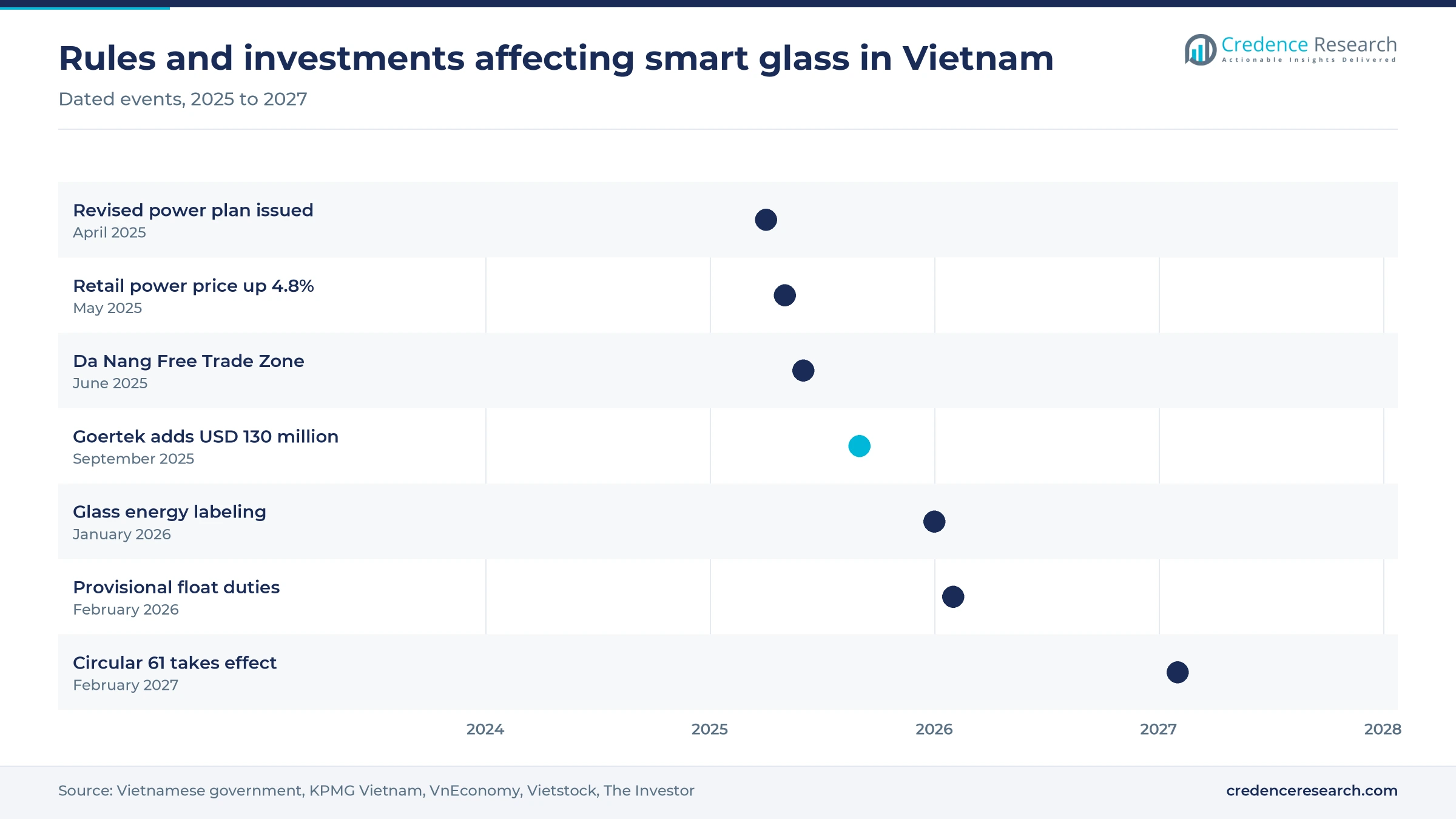
| Development | Status and market relevance |
|---|---|
| In September 2025, Goertek invested an extra USD 130 million in its Bac Ninh project, according to The Investor. | Expands a northern electronics base whose product lines include AR glasses. |
| In January 2026, energy labeling took effect for building envelope materials, including construction glass. | Gives buyers a comparable product basis for envelope purchases. |
| In February 2026, the Ministry of Industry and Trade announced provisional float glass duties of 15.17% to 63.39%. | Affects base glass sourcing for local processors and laminators. |
| In August 2026, VnEconomy reported Circular 61/2026/TT-BXD, the new energy-efficiency regulation for buildings. | Takes effect on Feb. 1, 2027 and repeals Circular 15/2017/TT-BXD. |
PDLC film meets solar-control and electrochromic options
- PDLC switches from opaque to clear when powered, which suits meeting rooms and clinics where privacy is the main purchase reason.
- Electrochromic glass tints gradually and targets facades, and BM Windows cites 55% to 83% light transmission for its product.
- SPD offers fast tint control, although none of the local suppliers reviewed for this report detailed an SPD range.
- Passive smart glass needs no wiring, and adjacent solar-control products such as Cool-Lite already fill large facades and skylights.
Need a Custom Version of This Report?
Tailor the scope, geography, or segments to your exact requirements.
- Custom geography or segment scope
- Direct access to our analyst team
Local processors and integrators compete on project delivery
Competition is local and centered on project delivery rather than proprietary film technology. Tech Glass Vietnam lists PDLC electric glass with insulating glass and national installation, while Legaro in Ho Chi Minh City sells electric glass for hospitals, hotels and meeting rooms. Goldsunvina promotes installation of electric smart glass and in-glass blinds for buildings. Thang Long Glass approaches the market as a tempered and Low-E processor, Thanh Tung Glass as a decorative laminated specialist, and Hoang Phi Glass and HT Window as aluminum-glass contractors and fabricators. Larger facade programs draw on Viglacera, Saint-Gobain and BM Windows, which brings stronger test data and larger supply capacity. Smaller integrators compete through site surveys, wiring and after-sales service, and buyers usually choose them for interior partitions.
Companies profiled and their roles in this market
| Company | Type | Role in the market |
|---|---|---|
| Tech Glass Vietnam | Processor and installer | Lists PDLC electric glass and insulating glass lines |
| Legaro | Specialist integrator | Sells PDLC electric glass from Ho Chi Minh City |
| Goldsunvina | Specialist integrator | Promotes electric smart glass and in-glass blinds |
| Thang Long Glass | Processor | Factory supply of tempered and Low-E glass |
| Thanh Tung Glass | Decorative processor | Decorative, laminated and cast glass |
| Hoang Phi Glass | Contractor | Aluminum-glass works on Hanoi buildings |
| HT Window | Fabricator | Aluminum-glass plants in Hanoi and Ho Chi Minh City |
Compliance deadlines favor suppliers with test data
Credence Research's view is that the Feb. 1, 2027 start of Circular 61/2026/TT-BXD matters more than any single product launch. Suppliers that hold measured solar and light data will gain access to certified projects, while suppliers selling only on demonstrations may stay confined to interior privacy jobs. Retrofit film deserves attention from investors because it avoids replacement of existing panes. The most uncertain estimate is the transportation share, since local vehicle programs disclose little about glazing content, so that assumption should be reviewed when model specifications become public.
How Credence Research estimated this market
The report uses 2025 as the base year and 2035 as the forecast year, with market values from the Credence Research model. Segment and regional splits are Credence Research estimates informed by public data on certified floor area, housing launches and supplier ranges. Sources include IFC, World Bank pages, Vietnamese ministries and press, company websites and project statements. No interviews or surveys were conducted for this edition of the report.
Code enforcement and retrofits shape growth to 2035
The market is forecast to reach USD 82.2 million by 2035, a 15.18% CAGR over 2026–2035, as code enforcement replaces voluntary specification. Early growth should stay concentrated in Northern Hub and in offices and apartments, while Central Corridor gains from free trade zone building and coastal hotels. Retrofit film should widen access in existing offices, and solar-control glass should keep the largest facade packages. Long-term gains depend on stable project launches, cheaper local supply and published performance data that can show building owners a clear payback.
Frequently Asked Questions
How big is the Vietnam smart glass market?
Which region leads smart glass demand in Vietnam?
Which region grows fastest?
Which technology leads the market?
What regulation matters most for smart glass buyers?
What is the largest application?
What restrains adoption in Vietnam?
Who competes in this market?
Table of Content
Chapter 1 Market Segmentation
- 1.1 Segmentation Framework
- 1.1.1 Product and Service Classification
- 1.1.2 Application and End-Use Classification
- 1.1.3 Technology and Solution Classification
- 1.1.4 Customer and Distribution Channel Classification
- 1.1.5 Geographic Segmentation
- 1.1.6 Market Segment Definitions and Boundaries
- 1.2 By Product Type
- 1.2.1 Laminated Smart Glass
- 1.2.2 Retrofit Smart Film
- 1.2.3 Insulating Smart Glass Units
- 1.2.4 Integrated Smart Glass Components
- 1.3 By Application
- 1.3.1 Architectural
- 1.3.2 Transportation
- 1.3.3 Consumer Electronics
- 1.3.4 Solar and Power Generation
- 1.4 By Technology
- 1.4.1 PDLC
- 1.4.2 Passive Smart Glass
- 1.4.3 Electrochromic
- 1.4.4 SPD
Chapter 2 Introduction
- 2.1 Report Objectives and Scope
- 2.2 Product Definition and Industry Terminology
- 2.3 Market Inclusions and Exclusions
- 2.4 Research Process
- 2.4.1 Primary Research and Expert Interviews
- 2.4.2 Secondary Research and Source Review
- 2.4.3 Top-Down and Bottom-Up Estimation
- 2.4.4 Data Triangulation and Verification
- 2.5 Market Size Measurement Basis
- 2.5.1 2025: USD 20.5 million → 2035: USD 82.2 million
- 2.6 Historical and Forecast Reference Periods
- 2.6.1 Historical Period: 2018-2025
- 2.6.2 Base Year: 2025
- 2.6.3 Forecast Period: 2025-2035
- 2.7 Research Assumptions and Limitations
Chapter 3 Executive Summary
- 3.1 Market Snapshot and Key Findings
- 3.2 Base-Year Market Size, 2025
- 3.3 Forecast Market Size, 2035
- 3.4 Revenue and Volume Growth Outlook
- 3.5 Key Demand and Supply Indicators
- 3.6 Leading Market Segments
- 3.7 Fastest-Growing Market Opportunities
- 3.8 Regional Performance Highlights
- 3.9 Technology and Industry Transformation
- 3.10 Competitive Landscape Summary
- 3.11 Analyst View and Strategic Implications
Chapter 4 Vietnam Smart Glass Market Trends and Developments
- 4.1 Historical Industry Development, 2018-2025
- 4.2 Recent Market Trends and Developments
- 4.3 Demand and Customer Behavior Trends
- 4.4 Technology and Product Innovation
- 4.5 Artificial Intelligence, Automation and Digitalization
- 4.6 Local Manufacturing and Supply Chain Realignment
- 4.7 Industry Partnerships, Mergers and Acquisitions
- 4.8 Sustainability and Circular Economy Developments
- 4.9 Government and Private Sector Investment Trends
- 4.10 Emerging Business Models and Commercialization
- 4.11 Industry Developments and Announcements
Chapter 5 Vietnam Smart Glass Market Production, Supply and Demand Analysis
- 5.1 Demand Trend and Consumption Analysis, 2018-2025
- 5.2 Demand Forecast, 2025-2035
- 5.3 Production and Output Trend, 2018-2025
- 5.4 Production and Output Forecast, 2025-2035
- 5.5 Installed Capacity and Capacity Utilization
- 5.6 Company-Wise Production Plants and Statistics
- 5.6.1 Installed Production Capacity
- 5.6.2 Actual Production
- 5.6.3 Planned Capacity and Expansion Targets
- 5.7 Supply Chain Structure and Procurement Trends
- 5.8 Supply-Demand Gap and Bottlenecks
- 5.9 Import Dependence and Sourcing Structure
- 5.10 Contract Manufacturing and Outsourcing
- 5.11 Regional Supply and Demand Concentration
Chapter 6 Vietnam Smart Glass Market Pricing Analysis
- 6.1 Pricing Structure and Measurement
- 6.2 Historical Pricing Trends, 2018-2025
- 6.3 Pricing Outlook, 2025-2035
- 6.4 Average Selling Price and Unit Economics
- 6.5 Pricing by Product and Market Segment
- 6.6 Geographic Pricing Differences
- 6.7 Key Input, Energy, Labor and Logistics Costs
- 6.8 Contract Pricing and Purchasing Models
- 6.9 Pricing Sensitivity and Competitive Positioning
- 6.10 Price, Margin and Profitability Implications
Chapter 7 Vietnam Smart Glass Market Dynamics
- 7.1 Market Growth Drivers
- 7.1.1 Demand-Side Drivers
- 7.1.2 Technology and Innovation Drivers
- 7.1.3 Infrastructure and Investment Drivers
- 7.1.4 Regulatory and Policy Drivers
- 7.2 Market Restraints
- 7.2.1 Cost and Affordability Constraints
- 7.2.2 Technology and Adoption Barriers
- 7.2.3 Supply Chain and Operational Constraints
- 7.3 Market Challenges
- 7.3.1 Competitive Pressure and Margin Erosion
- 7.3.2 Skills, Infrastructure and Implementation Gaps
- 7.4 Emerging Market Opportunities
- 7.5 Market Dynamics Impact and Time-Horizon Assessment
Chapter 8 Vietnam Smart Glass Value Chain Analysis
- 8.1 Industry Value Chain Overview
- 8.2 Upstream Suppliers and Critical Inputs
- 8.3 Technology and Component Providers
- 8.4 Manufacturing or Service Delivery
- 8.5 Distribution, Channel Partners and Integrators
- 8.6 Downstream Applications and End Users
- 8.7 Value Addition and Profit Pools
- 8.8 Vertical Integration and Outsourcing
- 8.9 Supplier Concentration and Risk
- 8.10 Supply Chain Localization and Resilience
Chapter 9 Vietnam Smart Glass Market Regulations and Policies
- 9.1 Relevant Laws, Standards and Compliance Frameworks
- 9.2 Product, Service, Safety and Quality Requirements
- 9.3 Government Policies, Incentives and Subsidies
- 9.4 Imports, Exports and Trade Barriers
- 9.5 Public Procurement and Local Content Requirements
- 9.6 Environmental and Sustainability Compliance
- 9.7 Upcoming Policy Changes and Market Implications
Chapter 10 Vietnam Smart Glass Market Hotspots and Opportunities
- 10.1 Market Opportunity Mapping and Growth Hotspots
- 10.2 High-Growth Applications and Customer Groups
- 10.3 Underserved Markets and White-Space Opportunities
- 10.4 Emerging Technology and Product Opportunities
- 10.5 New Capacity and Investment Hotspots
- 10.6 Market Entry and Expansion Opportunities
- 10.7 Distribution and Partnership Opportunities
- 10.8 Near-Term and Long-Term Commercial Potential
- 10.9 Opportunity Attractiveness and Execution Risks
Chapter 11 Vietnam Smart Glass Market Outlook, 2025-2035
- 11.1 Market Size and Analysis
- 11.1.1 Revenue (Market Measurement: 2025: USD 20.5 million → 2035: USD 82.2 million)
- 11.1.2 Market Volume and Quantity Sold
- 11.1.3 Historical Market Size, 2018-2025
- 11.1.4 Base-Year Market Size, 2025
- 11.2 Market Forecast, 2025-2035
- 11.2.1 Revenue Forecast to 2035
- 11.2.2 Volume Forecast to 2035
- 11.2.3 CAGR and Year-on-Year Growth
- 11.2.4 Incremental Revenue Opportunity
- 11.3 Forecast Assumptions and Scenario Analysis
- 11.3.1 Base-Case Forecast
- 11.3.2 Optimistic and Conservative Scenarios
- 11.3.3 Technology, Pricing and Policy Sensitivities
- 11.4 Market Attractiveness and Growth Outlook
Chapter 12 Vietnam Smart Glass Market Segmentation and Outlook
- 12.1 Segmentation Summary and Market Shares, 2025
- 12.2 Largest and Fastest-Growing Segments
- 12.3 By Product Type - Market Size and Forecast, 2025-2035
- 12.3.1 Segment Definition and Scope
- 12.3.2 Historical Market Size, 2018-2025
- 12.3.3 Revenue Forecast, 2025-2035
- 12.3.4 Volume Forecast, 2025-2035
- 12.3.5 Base-Year Market Share, 2025
- 12.3.6 Segment CAGR and Growth Drivers
- 12.3.7 Subsegment Market Size and Forecast
- 12.3.7.1 Laminated Smart Glass
- 12.3.7.2 Retrofit Smart Film
- 12.3.7.3 Insulating Smart Glass Units
- 12.3.7.4 Integrated Smart Glass Components
- 12.3.8 Subsegment Pricing and Adoption Trends
- 12.3.9 Leading Suppliers and Competition
- 12.3.10 Regional Demand and Opportunities
- 12.4 By Application - Market Size and Forecast, 2025-2035
- 12.4.1 Segment Definition and Scope
- 12.4.2 Historical Market Size, 2018-2025
- 12.4.3 Revenue Forecast, 2025-2035
- 12.4.4 Volume Forecast, 2025-2035
- 12.4.5 Base-Year Market Share, 2025
- 12.4.6 Segment CAGR and Growth Drivers
- 12.4.7 Subsegment Market Size and Forecast
- 12.4.7.1 Architectural
- 12.4.7.2 Transportation
- 12.4.7.3 Consumer Electronics
- 12.4.7.4 Solar and Power Generation
- 12.4.8 Subsegment Pricing and Adoption Trends
- 12.4.9 Leading Suppliers and Competition
- 12.4.10 Regional Demand and Opportunities
- 12.5 By Technology - Market Size and Forecast, 2025-2035
- 12.5.1 Segment Definition and Scope
- 12.5.2 Historical Market Size, 2018-2025
- 12.5.3 Revenue Forecast, 2025-2035
- 12.5.4 Volume Forecast, 2025-2035
- 12.5.5 Base-Year Market Share, 2025
- 12.5.6 Segment CAGR and Growth Drivers
- 12.5.7 Subsegment Market Size and Forecast
- 12.5.7.1 PDLC
- 12.5.7.2 Passive Smart Glass
- 12.5.7.3 Electrochromic
- 12.5.7.4 SPD
- 12.5.8 Subsegment Pricing and Adoption Trends
- 12.5.9 Leading Suppliers and Competition
- 12.5.10 Regional Demand and Opportunities
- 12.6 Segment Growth Comparison
- 12.7 Segment Attractiveness and Priority Matrix
Chapter 13 Vietnam Smart Glass End-Use and Application Market Outlook
- 13.1 End-Use Industry and Customer Demand Structure
- 13.2 Leading Applications and Customer Groups
- 13.3 End-Use Market Size, Share and Forecast
- 13.4 Major End-Use Industry Deep Dives
- 13.4.1 Customer Requirements and Use Cases
- 13.4.2 Demand and Replacement Cycles
- 13.4.3 Technical and Regulatory Considerations
- 13.4.4 Purchasing and Procurement Models
- 13.4.5 Leading Vendors and Distribution Channels
- 13.4.6 Forecast and Commercial Opportunities
- 13.5 Emerging Applications and Cross-Segment Demand
- 13.6 End-Use Industry Investment Priorities
Chapter 14 Vietnam Smart Glass Geographic Market Outlook, 2025-2035
- 14.1 Domestic Market Distribution and Demand Clusters
- 14.2 State- or Province-Wise Market Size and Forecast, 2025-2035
- 14.3 City and Metropolitan Market Outlook
- 14.4 Industrial, Manufacturing and Commercial Clusters
- 14.5 Geographic Concentration of Key End Users
- 14.6 Local Pricing and Purchasing Differences
- 14.7 Domestic Production Facilities and Capacity Map
- 14.8 Local Infrastructure and Project Pipeline
- 14.9 State-Level Policy and Incentive Differences
- 14.10 Subnational Investment Hotspots and Opportunities
- 14.11 Distribution and Logistics Networks
- 14.12 Domestic Competitive Footprint
Chapter 15 Vietnam Smart Glass Technology, Innovation and Sustainability Outlook
- 15.1 Technology Landscape and Maturity
- 15.2 Product, Process and Service Innovation
- 15.3 AI, Automation and Digital Tools in the Industry
- 15.4 Technology Adoption and Performance Benchmarking
- 15.5 Innovation Pipeline and R&D Investment
- 15.6 Patent and Intellectual Property Trends
- 15.7 Energy Efficiency and Resource Management
- 15.8 Sustainability, Recycling and Circularity
- 15.9 Technology Roadmap, 2025-2035
- 15.10 Risks of Obsolescence and Technology Substitution
Chapter 16 Vietnam Smart Glass Market Key Strategic Imperatives
- 16.1 Growth and Market Entry Priorities
- 16.2 High-Return Products and Segments
- 16.3 Pricing, Profitability and Cost Optimization
- 16.4 Technology Investment and Product Differentiation
- 16.5 Supply Chain Localization and Resilience
- 16.6 Distribution and Customer Acquisition
- 16.7 Partnership, Acquisition and Capacity Strategy
- 16.8 Regional Expansion Priorities
- 16.9 Short-, Medium- and Long-Term Actions
Chapter 17 Competition Outlook
- 17.1 Industry Competition Characteristics
- 17.2 Market Structure and Concentration
- 17.3 Market Share and Competitive Positioning, 2025
- 17.4 Company-Wise Revenue and Product Benchmarking
- 17.5 Production and Service Capacity Benchmarking
- 17.6 Technology, Pricing and Differentiation
- 17.7 Regional Footprint and Distribution Strength
- 17.8 Mergers, Acquisitions and Strategic Alliances
- 17.9 New Entrants and Competitive Threats
- 17.10 Porter's Five Forces and Industry Attractiveness
- 17.11 Competitive Outlook, 2025-2035
Chapter 18 Company Profiles
- 18.1 Company Coverage and Selection Criteria
- 18.2 Techglass Vietnam
- 18.2.1 Business Description
- 18.2.2 Company Ownership and Geographic Presence
- 18.2.3 Product and Service Portfolio
- 18.2.4 Manufacturing and Operating Footprint
- 18.2.5 Production Capacity and Expansion Plans
- 18.2.6 Financial Performance and Investment
- 18.2.7 Market Share and Competitive Position
- 18.2.8 Technology and Innovation Capabilities
- 18.2.9 Strategic Alliances or Partnerships
- 18.2.10 Recent Developments
- 18.2.11 Growth Strategy and Outlook
- 18.3 SOFI Vietnam
- 18.4 Legaro
- 18.5 Goldsunvina
- 18.6 Viet Long Glass
- 18.7 Thang Long Glass
- 18.8 Thanh Tung Glass
- 18.9 Hoang Phi Glass
- 18.10 HT Window
- 18.11 Smart Glass Vietnam Technology JSC
- 18.12 Other Relevant Market Participants
Note: Every listed company is profiled on the structure shown under the first company. The company list is preliminary and may change based on research findings, market developments, data availability and client requirements.
Chapter 19 Disclaimer
- 19.1 Research and Forecast Disclaimer
- 19.2 Data Source and Estimation Limitations
Note: The depth of individual sections depends on data availability for this market. Volume, capacity, trade and other unit-based metrics are included where applicable.

