
Vietnam sun care cosmetics moves from seasonal to daily
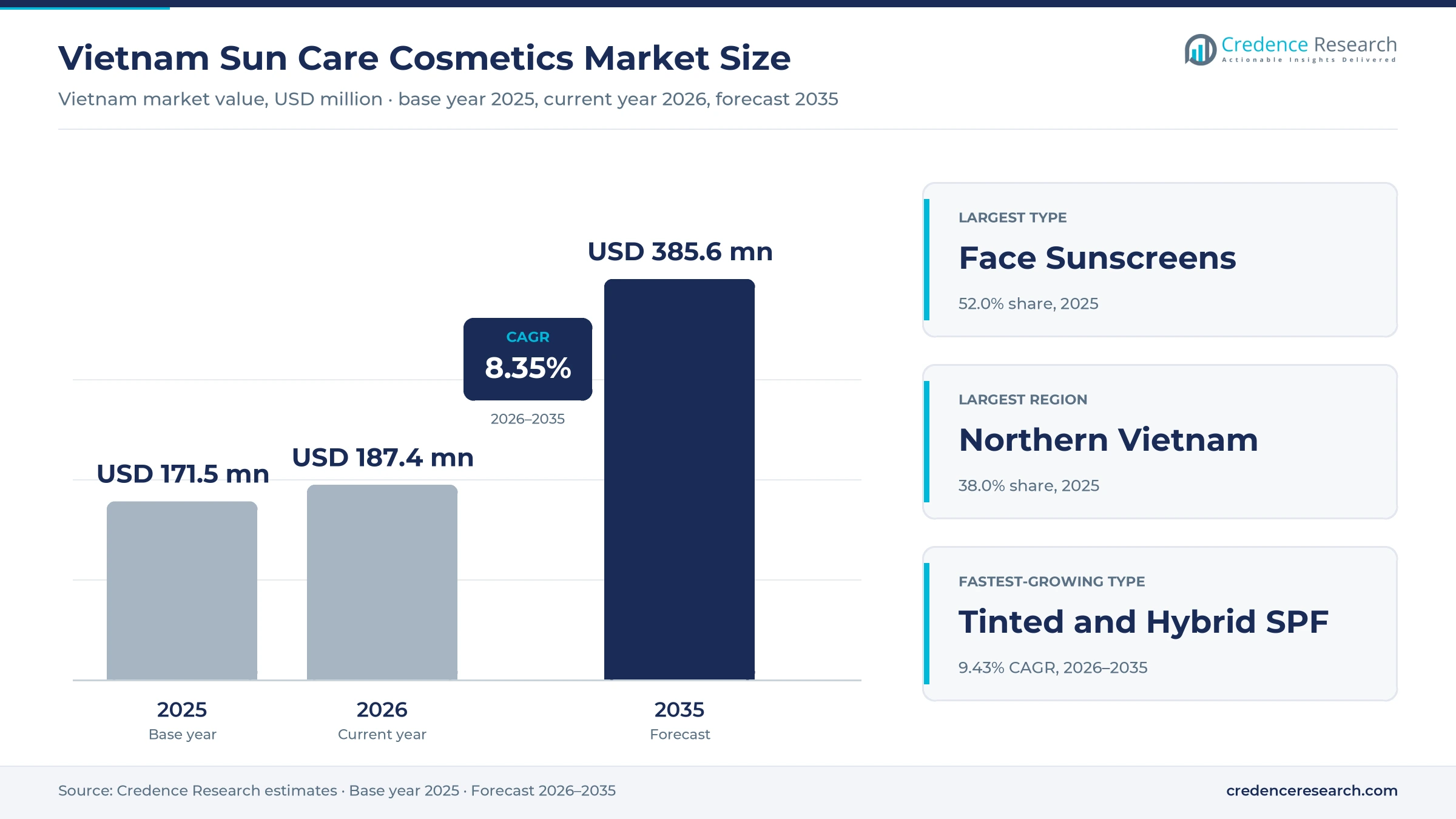
The Vietnam sun care cosmetics market was valued at USD 171.5 million in 2025 and is projected to increase from USD 187.4 million in 2026 to USD 385.6 million by 2035, registering a CAGR of 8.35% during 2026–2035. Sun care cosmetics demand comes from women who treat sunscreen as a daily skincare step, a widening group of online shoppers, and visitors to a coastline that drew record arrivals in 2025. Northern Vietnam held the largest regional share, 38.0% in 2025, because Hanoi and the Red River Delta combine dense urban retail with some of the country’s strongest income growth. Central Vietnam is the fastest-growing region at 8.84% a year as tourism spending lifts Da Nang, Hue and the coastal provinces. The Drug Administration of Vietnam also told health departments in May 2025 to increase SPF sampling, which is pushing shoppers and sellers toward verified official stores and tested formulas.
What does the sun care market in Vietnam count, and how do people buy it?
The market counts retail sales of face and body sunscreens, tinted and hybrid SPF products, and specialized items such as after-sun care, sticks and post-procedure protection. Shoppers mostly buy small tubes and bottles through e-commerce platforms, pharmacy chains and specialty beauty stores, while supermarkets and traditional outlets carry the mass brands. Most purchases sit inside a wider skincare routine, so brands compete on texture and finish as well as protection.
The estimate excludes moisturizers and foundations that carry an SPF claim as a secondary benefit, professional clinic procedures and protective clothing such as sun coats. It also excludes the value of counterfeit goods, which cannot be measured reliably. Value is counted at retail level, so importers, local filling plants, distributors and retailers all sit inside the chain that the final sale pays for.
Vietnam Sun Care Cosmetics Market Insights
- The market grows from USD 171.5 million in 2025 to USD 385.6 million by 2035, an 8.35% annual pace that more than doubles its 2026 base.
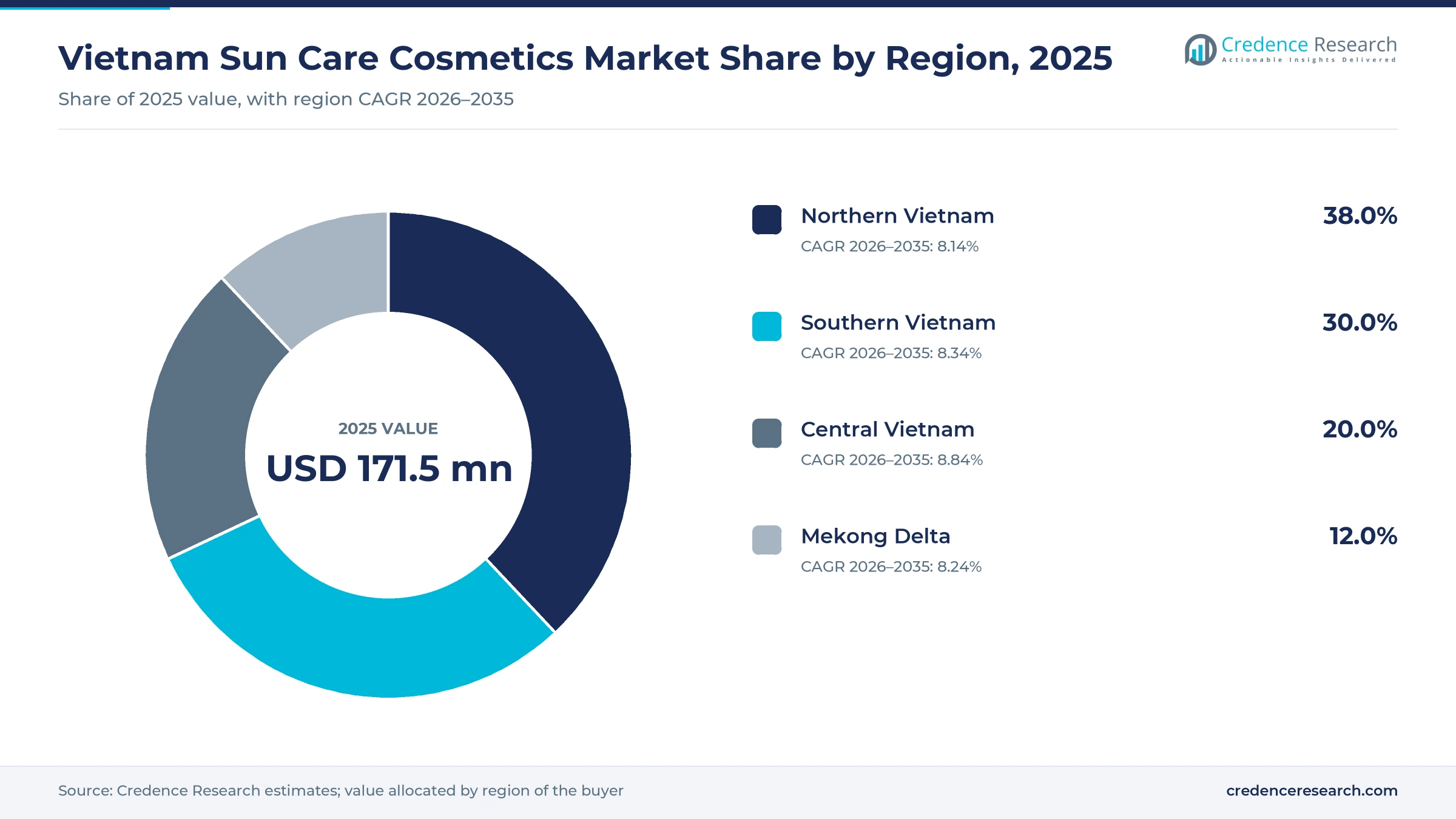
- Northern Vietnam led with 38.0% of 2025 value, ahead of Southern Vietnam at 30.0%, while Central Vietnam expands fastest at 8.84% a year.
- Face Sunscreens held 52.0% of 2025 sun care cosmetics value, because daily facial use anchors repeat purchases across the mass, masstige and premium shelves.
- SPF claims came under direct scrutiny after the Drug Administration of Vietnam sent health departments a sunscreen-specific compliance letter on May 20, 2025, and later ordered further recalls.
- Official brand stores took 64.4% of online beauty revenue in the fourth quarter of 2025, which rewards brands that can prove authenticity at higher prices.
Face SPF, mass pricing and online carts hold the value
Why do face sunscreens outsell every other format?
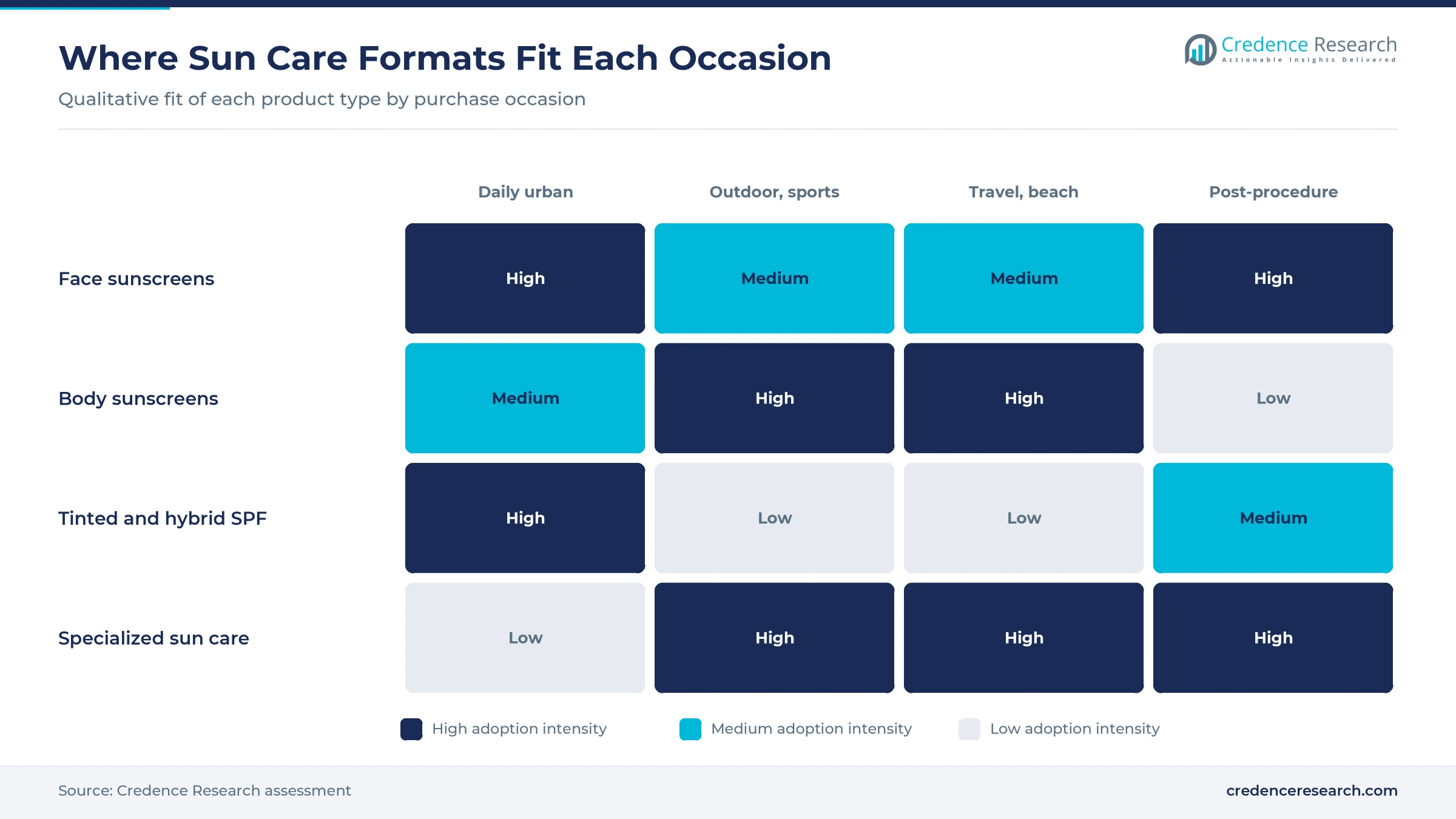
Based on product type, the market is categorized into face sunscreens, body sunscreens, tinted and hybrid SPF, and specialized sun care. Face Sunscreens led with 52.0% of 2025 value because small facial packs fit daily budgets, as Lotte Mart’s Vietnam listing of a Sunplay Skin Aqua 25 g tube at VND154,000 shows, and that small tube and bottle packaging keeps repurchase simple. Tinted and Hybrid SPF grows fastest at 9.43% a year as tone-up formulas spread, with Pharmacity listing Skin Aqua Tone Up milk and essence in 50 g bottles at VND202,000 before discounts.
How far does the mass tier still set the price anchor?
Based on price tier, the market is categorized into mass, masstige, premium and luxury and clinical. Mass led with 36.0% of 2025 value because pharmacy shelves keep entry prices low, with Pharmacity selling a 30 g Sunplay Super Block tube at VND112,000 before discounts. Premium grows fastest at 9.34% a year as shoppers trade up, since The Investor reported that average prices at official beauty stores reached VND235,000 in the fourth quarter of 2025, about 1.5 times those of other sellers. L’Oreal’s Vietnam portfolio also spans prestige beauty houses such as Lancome alongside dermocosmetic lines.
Which occasions turn a seasonal product into a routine?
Based on purchase occasion, the market is categorized into daily urban use, outdoor and sports, travel and beach, and post-procedure and dermatology. Daily Urban Use led with 58.0% of 2025 value because sunscreen already sits in many routines, and a 2018 study of 590 patients at Hanoi’s National Hospital of Dermatology found that 42.6% used it, with 75.7% of women and 13.0% of men preferring it. Post-Procedure and Dermatology grows fastest at 9.48% a year as procedure aftercare widens, with Tuoi Tre News reporting in May 2026 that experts estimated 25,000 to 35,000 complications a year from about 250,000 cosmetic surgeries, which keeps post-procedure care in public view.
Why does e-commerce both lead and grow fastest?
Based on distribution channel, the market is categorized into e-commerce, pharmacies and drugstores, specialty beauty stores and general retail. E-commerce led with 44.0% of 2025 value because beauty is a leading online category, with Viet Nam News reporting fourth-quarter 2025 sales of VND7.7 trillion on TikTok Shop and VND7.39 trillion on Shopee. E-commerce also grows fastest at 9.03% a year as platforms reach provinces that physical chains are only starting to serve. Physical reach is widening too, with Hasaki reporting 252 stores outside Ho Chi Minh City and Hanoi in early 2026, according to the Vietnam Chamber of Commerce and Industry.
| Segment Group | Leading Sub-segment | Share, 2025 | Fastest-growing Sub-segment | CAGR, 2026–2035 |
|---|---|---|---|---|
| By Product Type | Face Sunscreens | 52.0% | Tinted and Hybrid SPF | 9.43% |
| By Price Tier | Mass | 36.0% | Premium | 9.34% |
| By Purchase Occasion | Daily Urban Use | 58.0% | Post-Procedure and Dermatology | 9.48% |
| By Distribution Channel | E-commerce | 44.0% | E-commerce | 9.03% |
Request a Free Sample
Fill in your details and we'll send you a free sample report.
- Sample data tables & charts
- Research methodology
Online carts, imported filters and 21.2 million visitors
Digital beauty commerce expands the trial funnel
Online platforms lower the cost of trying a new sunscreen, which matters in a category where texture decides repurchase. The Investor reported that online beauty sales reached VND74.4 trillion ($2.83 billion) in 2025, up nearly 30% from a year earlier, and that beauty held about 14% of total e-commerce. Viet Nam News separately reported fourth-quarter sales of VND7.7 trillion on TikTok Shop, where short demonstration videos suit SPF textures and white-cast claims. VietNamNet also cited platform data showing fast-moving consumer goods growing 38% across four major marketplaces in 2025. As a result, E-commerce already holds 44.0% of sun care value in the Credence Research estimate, and new labels can reach provincial shoppers before they secure any store listing.
Imported innovation supports premiumization
Imported formulas set the reference point for texture and protection, so they pull average prices upward. The U.S. International Trade Administration reported in August 2024 that foreign brands make up more than 90% of Vietnam’s cosmetics market, led by Korean brands, with European brands at 23% and Japanese brands at 17%. Customs data compiled by The Shiv put first-half 2025 imports of perfumery, cosmetics and related preparations at $722.11 million, including $106.75 million from South Korea. Amorepacific reinforced that flow in January 2024 by launching its Aestura brand, including the Derma UV 365 line, on Shopee Vietnam and across 17 Beauty Box stores. This supply keeps Premium growing at 9.34% a year through 2035.
Daily skincare and tourism broaden usage occasions
Sun care cosmetics now have two demand bases, the resident daily routine and the visitor holiday basket. The U.S. International Trade Administration cited a 2023 survey in which 31.4% of adult consumers used sunscreen, which ranked it fourth among popular personal care products. Government data show Vietnam welcomed about 21.2 million foreign visitors in 2025, up 20.4% and a record, with 4.3 million arrivals from South Korea alone and 84.3% entering by air. Those visitors reach beach and heritage areas where packing limits make local purchase likely, and accommodation and food services revenue rose 14.6% to VND843.1 trillion. This overlap supports Central Vietnam, where coastal stays add a second buyer group, and it lifts travel and beach purchases beyond the hottest months.
Harsher heat and rising incomes make protection habitual
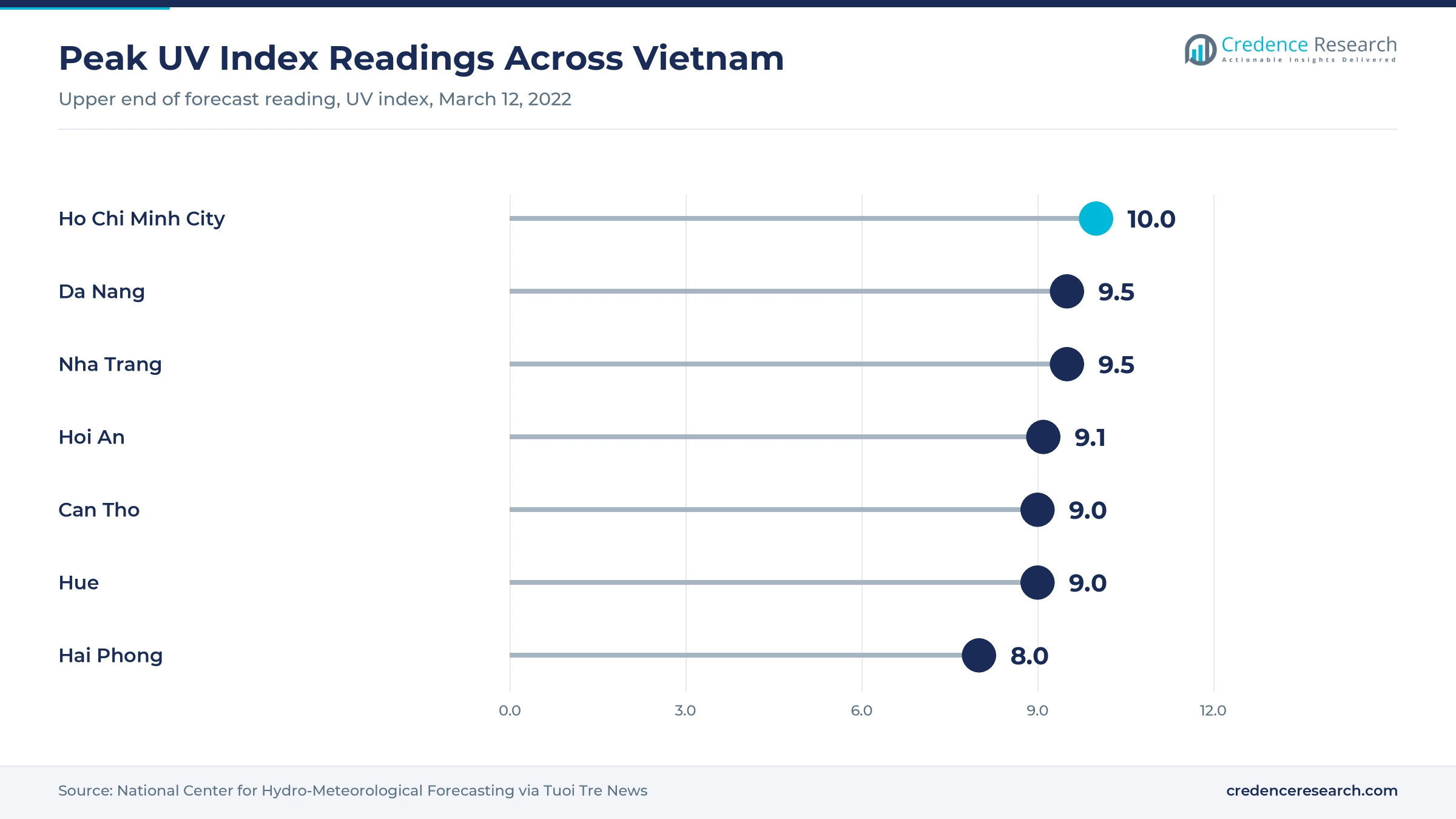
Frequent heat warnings give shoppers a visible daily reason to reapply, while higher incomes make that habit affordable. On April 7, 2026, Viet Nam News reported a National Center for Hydro-Meteorological Forecasting outlook of 37 to 39 degrees Celsius across the northwest and from Thanh Hoa to Da Nang, with some areas above 40 degrees. Earlier, in March 2022, the same agency’s readings reported by Tuoi Tre News reached a UV index of 10 in Ho Chi Minh City and 9.5 in Da Nang. VietNamNet put 2025 GDP per capita at about $5,026, up $326 from 2024. Together these facts support Daily Urban Use, which holds 58.0% of value, because consumers increasingly treat protection as routine rather than as a holiday purchase.
Verified stores and tone-up formats reset the shelf
Shift toward official stores as authenticity becomes a filter
Shoppers are moving from open marketplace listings toward official brand stores because a fake sunscreen gives no visible sign of failure. The Investor reported that official stores took 64.4% of online beauty revenue in the fourth quarter of 2025, with their revenue up 36% from a year earlier, while active beauty sellers fell 13%. Their average unit price of VND235,000 was about 1.5 times that of other sellers, which suggests buyers accept a premium for assurance. VietNamNet also cited platform data showing fourth-quarter 2025 volumes across major marketplaces down 8% as average selling prices rose 33%. As a result, smaller resellers lose reach while brands with their own storefronts gain pricing room, and that pattern favors the Premium tier.
Rise of tone-up, body and hybrid formats beyond the classic cream
Sunscreen is taking on cosmetic and whole-body roles, which widens how much product each user buys. Unilever showed the size of the body opening in 2023 when Vaseline’s sunblock lotion, promoted through live UV billboards in Hanoi and Ho Chi Minh City, posted 175% volume growth by June, according to a Mobile Marketing Association case study. Rohto-Mentholatum Vietnam has moved in the other direction with color-correcting options, as Pharmacity lists Skin Aqua Tone Up in mint green and lavender at VND202,000. Amorepacific also reported that a Derma UV365 tone-up sunscreen resonated with Vietnamese testers in its 2023 pre-marketing. Barrier-minded launches such as ceramide formulas fit this direction, which supports the 9.43% pace of Tinted and Hybrid SPF.
Opening for pharmacy chains to own sensitive-skin advice
Pharmacy chains offer an opening because they pair a large footprint with staff whom shoppers already consult on health questions. The Investor reported in July 2026 that Long Chau had 2,678 outlets in early June 2026 after a net addition of 261 in five months, and that Pharmacity had 1,118 stores with a target of 2,000 to 2,300 by 2030. An Khang also rebuilt to 416 stores by the end of May 2026. Pharmacity already runs a dedicated Sunplay brand page with 13 listings, so the shelf access exists. Brands with dermatology credentials can therefore train pharmacists on post-procedure protection, a use that the Credence Research estimate shows growing at 9.48% a year for Post-Procedure and Dermatology.
Opening for locally made SPF with audited manufacturing
Local manufacturing with audited quality is an opening because very few domestic plants can yet prove it. VietNamNet reported in April 2024 that only 35 of 965 domestic cosmetics facilities met ASEAN good manufacturing standards, while about 70% of more than 296,110 product declarations from 2015 to 2022 covered imports. Rohto-Mentholatum has already shown the local model, with two skin care factories at the Vietnam-Singapore Industrial Park in Binh Duong and total investment of $33 million when the second opened in May 2014, according to Bao Dau Tu. Thorakao also reaches over 500 supermarket points of sale, according to the Vietnam Chamber of Commerce and Industry. A domestic brand that publishes independent SPF results could therefore undercut imports on price while answering the trust question that recent recalls raised.
Fake SPF claims and rising selling costs test trust
How much damage do fake SPF claims do to category trust?
Counterfeit and mislabeled products are the largest threat because shoppers cannot test protection at home. Hanayuki Sunscreen Body tested at SPF 2.4 against a labeled SPF 50 before a May 2025 recall, and Viet Nam News reported that forensic tests on Athena sunscreen found SPF at 4.2% to 26.6% of advertised levels in July 2025. Genuine brands bear the cost through weaker confidence and higher authentication spending. Serialized packaging, official storefronts and published test results are the practical mitigation.
Will tighter rules raise compliance costs for importers?
Compliance costs are rising as regulators move from paperwork toward product checks and penalties. The Drug Administration of Vietnam sanctioned 17 businesses for VND2.87 billion between May 27 and June 2, 2026, and it revoked the registration of an SPF 80+ product whose formula differed from its dossier, VietNamNet reported. The draft decree that would replace Circular 06/2011 also moves oversight toward post-market inspection. Smaller importers face the most exposure, so complete product files and verified SPF methods become essential.
Do platform fees squeeze smaller sun care brands?
Selling costs are climbing faster than volumes, which squeezes smaller labels that depend on marketplaces. The Investor reported Shopee fees of 15% to 18% per successful order and customer acquisition costs rising at least 25% annually, while fourth-quarter 2025 beauty units fell 2% from a year earlier. Brands without pricing power therefore lose margin on every promotion. Larger bundle sizes, repeat-purchase programs and pharmacy listings help to spread those costs across more channels.
Can brands close the wide gap in male sunscreen use?
Low male use limits the addressable base because protection habits differ sharply by gender. The 2018 study at Hanoi’s National Hospital of Dermatology found that only 13.0% of men preferred sunscreen against 75.7% of women, even though men reported greater concern about skin cancer risk, at 53.2% against 25.7%. Current campaigns such as Vaseline’s 2023 program also targeted urban women first. Lighter textures, sports positioning and dermatologist messaging offer the most practical route to narrowing this gap.
Northern cities lead while Central coast grows fastest
| Region | Value, 2025 (USD million) | Share, 2025 | CAGR, 2026–2035 |
|---|---|---|---|
| Northern Vietnam | 65.2 | 38.0% | 8.14% |
| Southern Vietnam | 51.5 | 30.0% | 8.34% |
| Central Vietnam | 34.3 | 20.0% | 8.84% |
| Mekong Delta | 20.6 | 12.0% | 8.24% |
Northern Vietnam leads on income growth and dense urban retail
Northern Vietnam held 38.0% of 2025 value and grows at 8.14% a year. The National Statistics Office estimated Red River Delta growth of 9.74% in 2025, more than 36% of national growth, with Hai Phong at 11.81% and Quang Ninh at 11.89%. Beiersdorf described the region as Nivea’s strongest base in Vietnam in a January 2021 article. Forecast highs of 37 to 39 degrees Celsius in the northwest in April 2026 show why seasonal purchases now start earlier in the year.
Southern Vietnam combines year-round UV with manufacturing
Southern Vietnam held 30.0% of 2025 value and grows at 8.34% a year. Year-round exposure supports steady use, since Ho Chi Minh City recorded a UV index of up to 10 in March 2022, the highest reading in the country that day. The Southeast contributed more than 31% of national growth in 2025, with Ho Chi Minh City at 7.53%. Binh Duong also hosts Rohto-Mentholatum’s two factories, while natural skincare retailer Co Mem now has 80 stores nationally.
Central Vietnam gains most from coastal tourism
Central Vietnam held 20.0% of 2025 value and grows fastest at 8.84% a year. Coastal exposure is high, with March 2022 UV readings up to 9.5 in Da Nang and Nha Trang and 9.1 in Hoi An. Da Nang grew 9.18% in 2025 and Hue 8.5%, while national arrivals rose 20.4% to a record. Regulators are active here too, since a Lam Dong laboratory’s test of a Da Lat pharmacy sample led to the November 2025 recall of an SPF 45+ product.
Mekong Delta depends on provincial retail reach
Mekong Delta held 12.0% of 2025 value and grows at 8.24% a year. Farming and outdoor work create real exposure, and Can Tho recorded UV readings of 8.3 to 9 in March 2022. However, incomes lag the main cities, and Vinh Long was among provinces growing below 7% in 2025. Value therefore depends on affordable pack sizes and on chains moving beyond the largest cities, such as Hasaki, which targets 304 stores outside Ho Chi Minh City and Hanoi by the end of 2026.
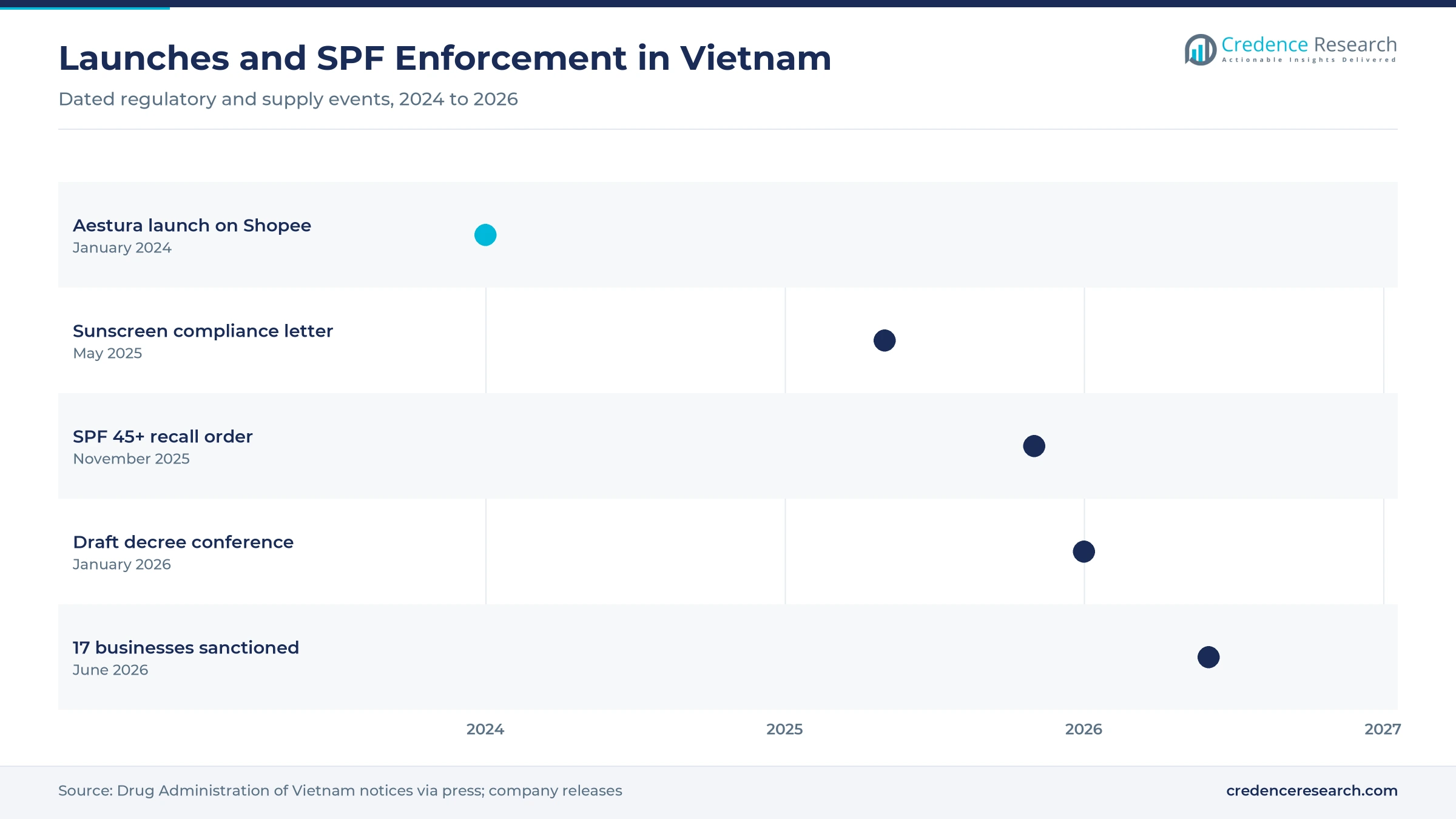
SPF enforcement and Derma launches mark 2024 to 2026
| Development | Status and market relevance |
|---|---|
| In January 2024, Amorepacific launched Aestura in Vietnam on Shopee, including its Derma UV 365 line, followed by 17 Beauty Box stores. | Launched; extends Korean derma sun care into online and specialty retail |
| In May 2025, the Drug Administration of Vietnam sent health departments letters on May 16 and May 20 demanding stricter sunscreen dossier, labeling and SPF checks. | In force; raises sampling and compliance requirements |
| In November 2025, the Drug Administration of Vietnam ordered the recall of a sunscreen labeled SPF 45+ after tests showed SPF 2. | Completed order; strengthens the case for tested products |
| In January 2026, the Ministry of Health held a Jan. 22 conference on a draft decree to replace Circular 06/2011 on cosmetics. | Under review; shifts oversight toward post-market inspection |
| In June 2026, the Drug Administration of Vietnam reported sanctions on 17 businesses totaling VND2.87 billion, including a revoked SPF 80+ registration. | Enforced; raises the cost of dossier mismatches |
Filter systems and textures decide repeat purchases
- Physical filter milks target sensitive and oily skin, as Pharmacity’s listing of a 25 g Skin Aqua Mineral Defense product at VND140,000 shows.
- Tone-correcting bases blend protection with color correction, which is how Rohto-Mentholatum positions its mint green and lavender Skin Aqua Tone Up lines.
- Absorber-free creams answer concerns about chemical filters, and Kao launched its first UV absorber-free Aqua Rich cream in Japan in February 2025.
- Validated SPF testing now carries regulatory weight, because the May 2025 sunscreen letter told testing centers to increase sampling for SPF verification.
Need a Custom Version of This Report?
Tailor the scope, geography, or segments to your exact requirements.
- Custom geography or segment scope
- Direct access to our analyst team
Global skincare houses compete with local SPF labels
Sun care cosmetics competition divides between global skincare groups with broad distribution and local labels with lower prices. L’Oreal, established in Vietnam since 2007, has brought 13 international brands including La Roche-Posay, Vichy and Garnier, which gives it presence from pharmacy to mass retail. Rohto-Mentholatum has the strongest local manufacturing story through Binh Duong and its Sunplay range, while Beiersdorf relies on a Nivea presence that began in 2004. A nationwide survey of 305 adults aged 18 to 49, whose date is not published, named Anessa as the dominant brand, followed by Sunplay, Biore and La Roche-Posay. Korean challengers such as Amorepacific enter through marketplaces and specialty chains. Japanese houses also draw on worldwide sunscreen supply, as Kao’s February 2025 launch of its first UV absorber-free Aqua Rich cream in Japan shows. Local players such as Thorakao lean on supermarket access and price. South Korea sent 4.3 million visitors in 2025, according to government data, which gives Korean labels a familiar traveling customer.
Which companies shape sun care supply in Vietnam?
| Company | Type | Role in the market |
|---|---|---|
| L'Oreal Vietnam | Global group | Dermocosmetics and mass lines including La Roche-Posay, Vichy and Garnier; more than 900 local staff |
| Rohto-Mentholatum Vietnam | Japanese-owned local manufacturer | Sunplay and Skin Aqua ranges; two skin care factories in Binh Duong |
| Shiseido Vietnam | Japanese group | Anessa, named the dominant sunscreen brand in an undated 305-person national survey |
| Beiersdorf Vietnam | Global group | Nivea since 2004 and Eucerin since 2011, with the strongest Nivea roots in the north |
| Unilever Vietnam | Global group | Vaseline sunblock body lotion launched with live UV index billboards in 2023 |
| Kao Vietnam | Japanese group | Biore, named among leading sunscreen brands in an undated 305-person national survey |
| Amorepacific Vietnam | Korean group | Aestura Derma UV 365 launched on Shopee and at Beauty Box in 2024 |
| Johnson & Johnson Vietnam | Now Kenvue Vietnam | Neutrogena distribution and marketing; independent from Johnson & Johnson since August 2023 |
| Thorakao Cosmetics | Local brand | More than 500 supermarket points of sale plus traditional outlets and agents |
Proof of SPF will separate winners from volume sellers
Credence Research’s view is that proof of protection will become the main dividing line in sun care cosmetics demand by 2030. The 2025 and 2026 recalls showed that a labeled SPF can differ sharply from tested performance, and shoppers have already started moving toward official stores. Brands that publish test results and maintain clean dossiers can therefore charge more without relying on heavy promotion. Sellers that depend only on low prices face rising platform fees and tighter inspection at the same time. The most useful investments are SPF verification, authentication on packs and pharmacist education rather than additional livestream discounts.
How the sun care estimate was built and checked
The report uses 2025 as the base year and forecasts values to 2035. Market values come from the Credence Research model, and segment and regional splits are Credence Research estimates. The size was cross-checked against adult population, reported sunscreen use and official-store unit prices, and against published online beauty sales. Evidence comes from government statistics, regulator notices, trade and customs compilations, company pages, retailer listings, a peer-reviewed hospital study and national press. No interviews or surveys were conducted for this report, and counterfeit sales are not included in the value estimate.
Daily protection keeps value compounding to 2035
Sun care cosmetics value should reach USD 385.6 million by 2035 because daily use is still far from universal and each new user tends to buy repeatedly. Growth should lean toward tinted and hybrid formats, post-procedure protection and online storefronts, while mass pack sizes keep the category accessible in provincial markets. Central Vietnam should gain share if arrivals hold near the 2025 record. The main risk is a further counterfeit scandal that weakens trust, although tighter inspection under the draft decree could limit that risk over time and reward brands with verified quality.
Frequently Asked Questions
How big is the Vietnam sun care cosmetics market?
Which region leads sun care sales in Vietnam?
Which region grows fastest?
Which product type holds the largest share?
Why are online channels so important for sunscreen?
How is Vietnam regulating sunscreen claims?
What is the biggest risk for brands in this market?
Which companies are active in the market?
Table of Content
Chapter 1 Market Segmentation
- 1.1 Segmentation Framework
- 1.1.1 Product and Service Classification
- 1.1.2 Application and End-Use Classification
- 1.1.3 Technology and Solution Classification
- 1.1.4 Customer and Distribution Channel Classification
- 1.1.5 Geographic Segmentation
- 1.1.6 Market Segment Definitions and Boundaries
- 1.2 By Product Type
- 1.2.1 Face Sunscreens
- 1.2.2 Body Sunscreens
- 1.2.3 Tinted and Hybrid SPF
- 1.2.4 Specialized Sun Care
- 1.3 By Price Tier
- 1.3.1 Mass
- 1.3.2 Masstige
- 1.3.3 Premium
- 1.3.4 Luxury and Clinical
- 1.4 By Purchase Occasion
- 1.4.1 Daily Urban Use
- 1.4.2 Outdoor and Sports
- 1.4.3 Travel and Beach
- 1.4.4 Post-Procedure and Dermatology
Chapter 2 Introduction
- 2.1 Report Objectives and Scope
- 2.2 Product Definition and Industry Terminology
- 2.3 Market Inclusions and Exclusions
- 2.4 Research Process
- 2.4.1 Primary Research and Expert Interviews
- 2.4.2 Secondary Research and Source Review
- 2.4.3 Top-Down and Bottom-Up Estimation
- 2.4.4 Data Triangulation and Verification
- 2.5 Market Size Measurement Basis
- 2.5.1 2025: USD 171.5 million → 2035: USD 385.6 million
- 2.6 Historical and Forecast Reference Periods
- 2.6.1 Historical Period: 2018-2025
- 2.6.2 Base Year: 2025
- 2.6.3 Forecast Period: 2025-2035
- 2.7 Research Assumptions and Limitations
Chapter 3 Executive Summary
- 3.1 Market Snapshot and Key Findings
- 3.2 Base-Year Market Size, 2025
- 3.3 Forecast Market Size, 2035
- 3.4 Revenue and Volume Growth Outlook
- 3.5 Key Demand and Supply Indicators
- 3.6 Leading Market Segments
- 3.7 Fastest-Growing Market Opportunities
- 3.8 Regional Performance Highlights
- 3.9 Technology and Industry Transformation
- 3.10 Competitive Landscape Summary
- 3.11 Analyst View and Strategic Implications
Chapter 4 Vietnam Sun Care Cosmetics Market Trends and Developments
- 4.1 Historical Industry Development, 2018-2025
- 4.2 Recent Market Trends and Developments
- 4.3 Demand and Customer Behavior Trends
- 4.4 Technology and Product Innovation
- 4.5 Artificial Intelligence, Automation and Digitalization
- 4.6 Local Manufacturing and Supply Chain Realignment
- 4.7 Industry Partnerships, Mergers and Acquisitions
- 4.8 Sustainability and Circular Economy Developments
- 4.9 Government and Private Sector Investment Trends
- 4.10 Emerging Business Models and Commercialization
- 4.11 Industry Developments and Announcements
Chapter 5 Vietnam Sun Care Cosmetics Market Production, Supply and Demand Analysis
- 5.1 Demand Trend and Consumption Analysis, 2018-2025
- 5.2 Demand Forecast, 2025-2035
- 5.3 Production and Output Trend, 2018-2025
- 5.4 Production and Output Forecast, 2025-2035
- 5.5 Installed Capacity and Capacity Utilization
- 5.6 Company-Wise Production Plants and Statistics
- 5.6.1 Installed Production Capacity
- 5.6.2 Actual Production
- 5.6.3 Planned Capacity and Expansion Targets
- 5.7 Supply Chain Structure and Procurement Trends
- 5.8 Supply-Demand Gap and Bottlenecks
- 5.9 Import Dependence and Sourcing Structure
- 5.10 Contract Manufacturing and Outsourcing
- 5.11 Regional Supply and Demand Concentration
Chapter 6 Vietnam Sun Care Cosmetics Market Pricing Analysis
- 6.1 Pricing Structure and Measurement
- 6.2 Historical Pricing Trends, 2018-2025
- 6.3 Pricing Outlook, 2025-2035
- 6.4 Average Selling Price and Unit Economics
- 6.5 Pricing by Product and Market Segment
- 6.6 Geographic Pricing Differences
- 6.7 Key Input, Energy, Labor and Logistics Costs
- 6.8 Contract Pricing and Purchasing Models
- 6.9 Pricing Sensitivity and Competitive Positioning
- 6.10 Price, Margin and Profitability Implications
Chapter 7 Vietnam Sun Care Cosmetics Market Dynamics
- 7.1 Market Growth Drivers
- 7.1.1 Demand-Side Drivers
- 7.1.2 Technology and Innovation Drivers
- 7.1.3 Infrastructure and Investment Drivers
- 7.1.4 Regulatory and Policy Drivers
- 7.2 Market Restraints
- 7.2.1 Cost and Affordability Constraints
- 7.2.2 Technology and Adoption Barriers
- 7.2.3 Supply Chain and Operational Constraints
- 7.3 Market Challenges
- 7.3.1 Competitive Pressure and Margin Erosion
- 7.3.2 Skills, Infrastructure and Implementation Gaps
- 7.4 Emerging Market Opportunities
- 7.5 Market Dynamics Impact and Time-Horizon Assessment
Chapter 8 Vietnam Sun Care Cosmetics Value Chain Analysis
- 8.1 Industry Value Chain Overview
- 8.2 Upstream Suppliers and Critical Inputs
- 8.3 Technology and Component Providers
- 8.4 Manufacturing or Service Delivery
- 8.5 Distribution, Channel Partners and Integrators
- 8.6 Downstream Applications and End Users
- 8.7 Value Addition and Profit Pools
- 8.8 Vertical Integration and Outsourcing
- 8.9 Supplier Concentration and Risk
- 8.10 Supply Chain Localization and Resilience
Chapter 9 Vietnam Sun Care Cosmetics Market Regulations and Policies
- 9.1 Relevant Laws, Standards and Compliance Frameworks
- 9.2 Product, Service, Safety and Quality Requirements
- 9.3 Government Policies, Incentives and Subsidies
- 9.4 Imports, Exports and Trade Barriers
- 9.5 Public Procurement and Local Content Requirements
- 9.6 Environmental and Sustainability Compliance
- 9.7 Upcoming Policy Changes and Market Implications
Chapter 10 Vietnam Sun Care Cosmetics Market Hotspots and Opportunities
- 10.1 Market Opportunity Mapping and Growth Hotspots
- 10.2 High-Growth Applications and Customer Groups
- 10.3 Underserved Markets and White-Space Opportunities
- 10.4 Emerging Technology and Product Opportunities
- 10.5 New Capacity and Investment Hotspots
- 10.6 Market Entry and Expansion Opportunities
- 10.7 Distribution and Partnership Opportunities
- 10.8 Near-Term and Long-Term Commercial Potential
- 10.9 Opportunity Attractiveness and Execution Risks
Chapter 11 Vietnam Sun Care Cosmetics Market Outlook, 2025-2035
- 11.1 Market Size and Analysis
- 11.1.1 Revenue (Market Measurement: 2025: USD 171.5 million → 2035: USD 385.6 million)
- 11.1.2 Market Volume and Quantity Sold
- 11.1.3 Historical Market Size, 2018-2025
- 11.1.4 Base-Year Market Size, 2025
- 11.2 Market Forecast, 2025-2035
- 11.2.1 Revenue Forecast to 2035
- 11.2.2 Volume Forecast to 2035
- 11.2.3 CAGR and Year-on-Year Growth
- 11.2.4 Incremental Revenue Opportunity
- 11.3 Forecast Assumptions and Scenario Analysis
- 11.3.1 Base-Case Forecast
- 11.3.2 Optimistic and Conservative Scenarios
- 11.3.3 Technology, Pricing and Policy Sensitivities
- 11.4 Market Attractiveness and Growth Outlook
Chapter 12 Vietnam Sun Care Cosmetics Market Segmentation and Outlook
- 12.1 Segmentation Summary and Market Shares, 2025
- 12.2 Largest and Fastest-Growing Segments
- 12.3 By Product Type - Market Size and Forecast, 2025-2035
- 12.3.1 Segment Definition and Scope
- 12.3.2 Historical Market Size, 2018-2025
- 12.3.3 Revenue Forecast, 2025-2035
- 12.3.4 Volume Forecast, 2025-2035
- 12.3.5 Base-Year Market Share, 2025
- 12.3.6 Segment CAGR and Growth Drivers
- 12.3.7 Subsegment Market Size and Forecast
- 12.3.7.1 Face Sunscreens
- 12.3.7.2 Body Sunscreens
- 12.3.7.3 Tinted and Hybrid SPF
- 12.3.7.4 Specialized Sun Care
- 12.3.8 Subsegment Pricing and Adoption Trends
- 12.3.9 Leading Suppliers and Competition
- 12.3.10 Regional Demand and Opportunities
- 12.4 By Price Tier - Market Size and Forecast, 2025-2035
- 12.4.1 Segment Definition and Scope
- 12.4.2 Historical Market Size, 2018-2025
- 12.4.3 Revenue Forecast, 2025-2035
- 12.4.4 Volume Forecast, 2025-2035
- 12.4.5 Base-Year Market Share, 2025
- 12.4.6 Segment CAGR and Growth Drivers
- 12.4.7 Subsegment Market Size and Forecast
- 12.4.7.1 Mass
- 12.4.7.2 Masstige
- 12.4.7.3 Premium
- 12.4.7.4 Luxury and Clinical
- 12.4.8 Subsegment Pricing and Adoption Trends
- 12.4.9 Leading Suppliers and Competition
- 12.4.10 Regional Demand and Opportunities
- 12.5 By Purchase Occasion - Market Size and Forecast, 2025-2035
- 12.5.1 Segment Definition and Scope
- 12.5.2 Historical Market Size, 2018-2025
- 12.5.3 Revenue Forecast, 2025-2035
- 12.5.4 Volume Forecast, 2025-2035
- 12.5.5 Base-Year Market Share, 2025
- 12.5.6 Segment CAGR and Growth Drivers
- 12.5.7 Subsegment Market Size and Forecast
- 12.5.7.1 Daily Urban Use
- 12.5.7.2 Outdoor and Sports
- 12.5.7.3 Travel and Beach
- 12.5.7.4 Post-Procedure and Dermatology
- 12.5.8 Subsegment Pricing and Adoption Trends
- 12.5.9 Leading Suppliers and Competition
- 12.5.10 Regional Demand and Opportunities
- 12.6 Segment Growth Comparison
- 12.7 Segment Attractiveness and Priority Matrix
Chapter 13 Vietnam Sun Care Cosmetics Geographic Market Outlook, 2025-2035
- 13.1 Domestic Market Distribution and Demand Clusters
- 13.2 State- or Province-Wise Market Size and Forecast, 2025-2035
- 13.3 City and Metropolitan Market Outlook
- 13.4 Industrial, Manufacturing and Commercial Clusters
- 13.5 Geographic Concentration of Key End Users
- 13.6 Local Pricing and Purchasing Differences
- 13.7 Domestic Production Facilities and Capacity Map
- 13.8 Local Infrastructure and Project Pipeline
- 13.9 State-Level Policy and Incentive Differences
- 13.10 Subnational Investment Hotspots and Opportunities
- 13.11 Distribution and Logistics Networks
- 13.12 Domestic Competitive Footprint
Chapter 14 Vietnam Sun Care Cosmetics Technology, Innovation and Sustainability Outlook
- 14.1 Technology Landscape and Maturity
- 14.2 Product, Process and Service Innovation
- 14.3 AI, Automation and Digital Tools in the Industry
- 14.4 Technology Adoption and Performance Benchmarking
- 14.5 Innovation Pipeline and R&D Investment
- 14.6 Patent and Intellectual Property Trends
- 14.7 Energy Efficiency and Resource Management
- 14.8 Sustainability, Recycling and Circularity
- 14.9 Technology Roadmap, 2025-2035
- 14.10 Risks of Obsolescence and Technology Substitution
Chapter 15 Vietnam Sun Care Cosmetics Market Key Strategic Imperatives
- 15.1 Growth and Market Entry Priorities
- 15.2 High-Return Products and Segments
- 15.3 Pricing, Profitability and Cost Optimization
- 15.4 Technology Investment and Product Differentiation
- 15.5 Supply Chain Localization and Resilience
- 15.6 Distribution and Customer Acquisition
- 15.7 Partnership, Acquisition and Capacity Strategy
- 15.8 Regional Expansion Priorities
- 15.9 Short-, Medium- and Long-Term Actions
Chapter 16 Competition Outlook
- 16.1 Industry Competition Characteristics
- 16.2 Market Structure and Concentration
- 16.3 Market Share and Competitive Positioning, 2025
- 16.4 Company-Wise Revenue and Product Benchmarking
- 16.5 Production and Service Capacity Benchmarking
- 16.6 Technology, Pricing and Differentiation
- 16.7 Regional Footprint and Distribution Strength
- 16.8 Mergers, Acquisitions and Strategic Alliances
- 16.9 New Entrants and Competitive Threats
- 16.10 Porter's Five Forces and Industry Attractiveness
- 16.11 Competitive Outlook, 2025-2035
Chapter 17 Company Profiles
- 17.1 Company Coverage and Selection Criteria
- 17.2 L'Oreal Vietnam
- 17.2.1 Business Description
- 17.2.2 Company Ownership and Geographic Presence
- 17.2.3 Product and Service Portfolio
- 17.2.4 Manufacturing and Operating Footprint
- 17.2.5 Production Capacity and Expansion Plans
- 17.2.6 Financial Performance and Investment
- 17.2.7 Market Share and Competitive Position
- 17.2.8 Technology and Innovation Capabilities
- 17.2.9 Strategic Alliances or Partnerships
- 17.2.10 Recent Developments
- 17.2.11 Growth Strategy and Outlook
- 17.3 Rohto-Mentholatum Vietnam
- 17.4 Shiseido Vietnam
- 17.5 Beiersdorf Vietnam
- 17.6 Unilever Vietnam
- 17.7 Kao Vietnam
- 17.8 Amorepacific Vietnam
- 17.9 LG Household & Health Care
- 17.10 Johnson & Johnson Vietnam
- 17.11 Thorakao Cosmetics
- 17.12 Other Relevant Market Participants
Note: Every listed company is profiled on the structure shown under the first company. The company list is preliminary and may change based on research findings, market developments, data availability and client requirements.
Chapter 18 Disclaimer
- 18.1 Research and Forecast Disclaimer
- 18.2 Data Source and Estimation Limitations
Note: The depth of individual sections depends on data availability for this market. Volume, capacity, trade and other unit-based metrics are included where applicable.

