
Phones and malls shape how young Brazilians buy streetwear
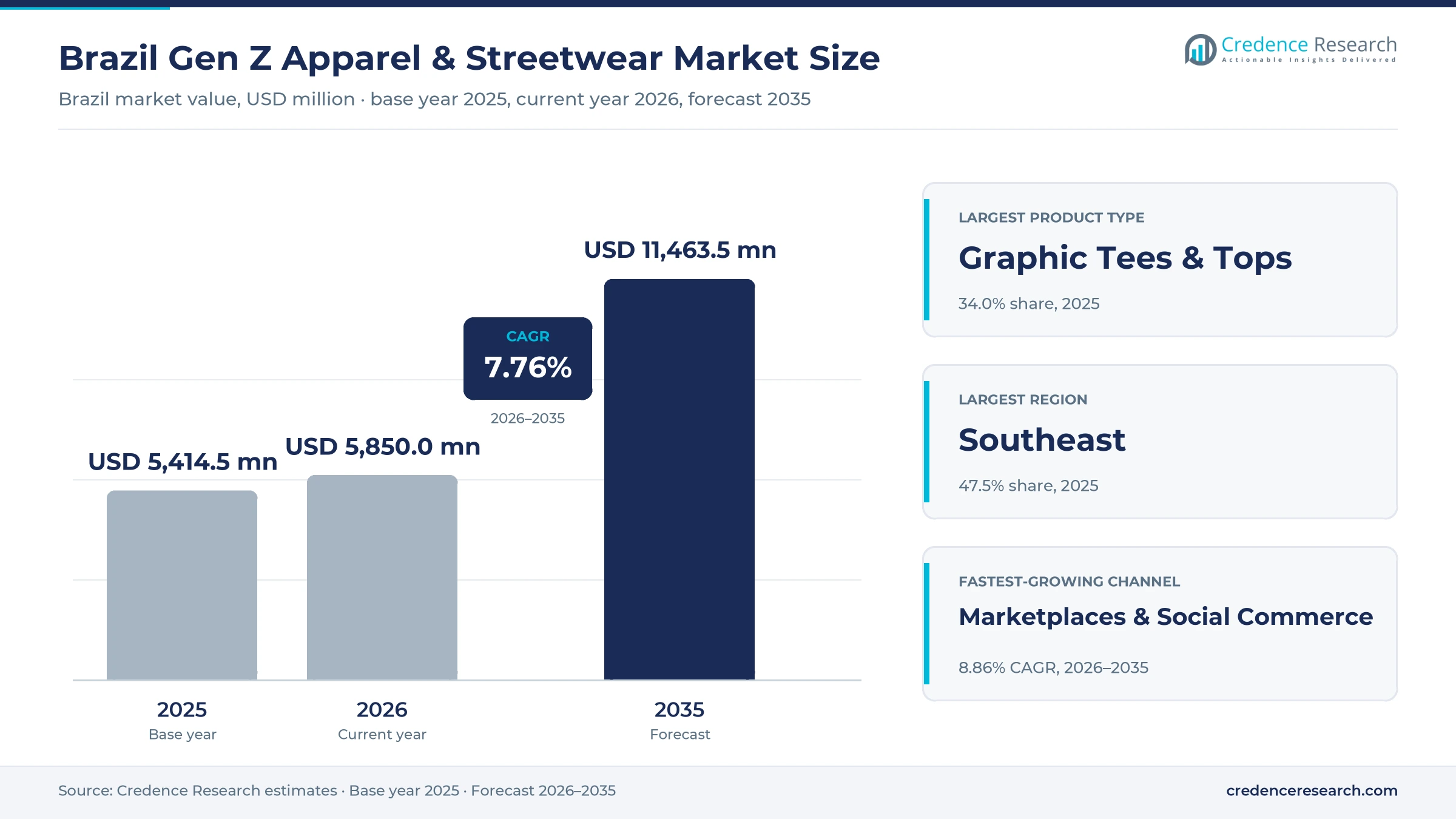
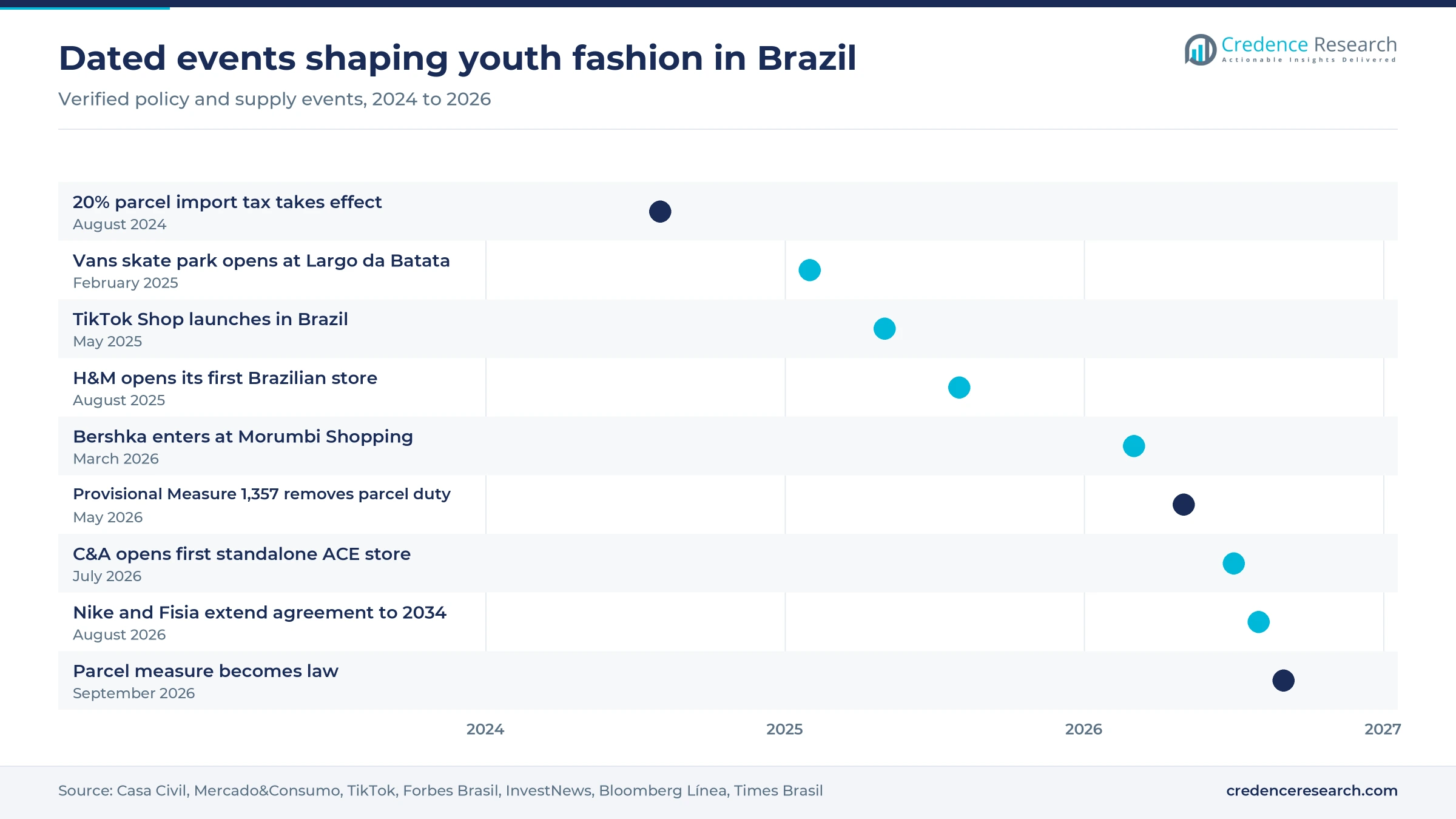
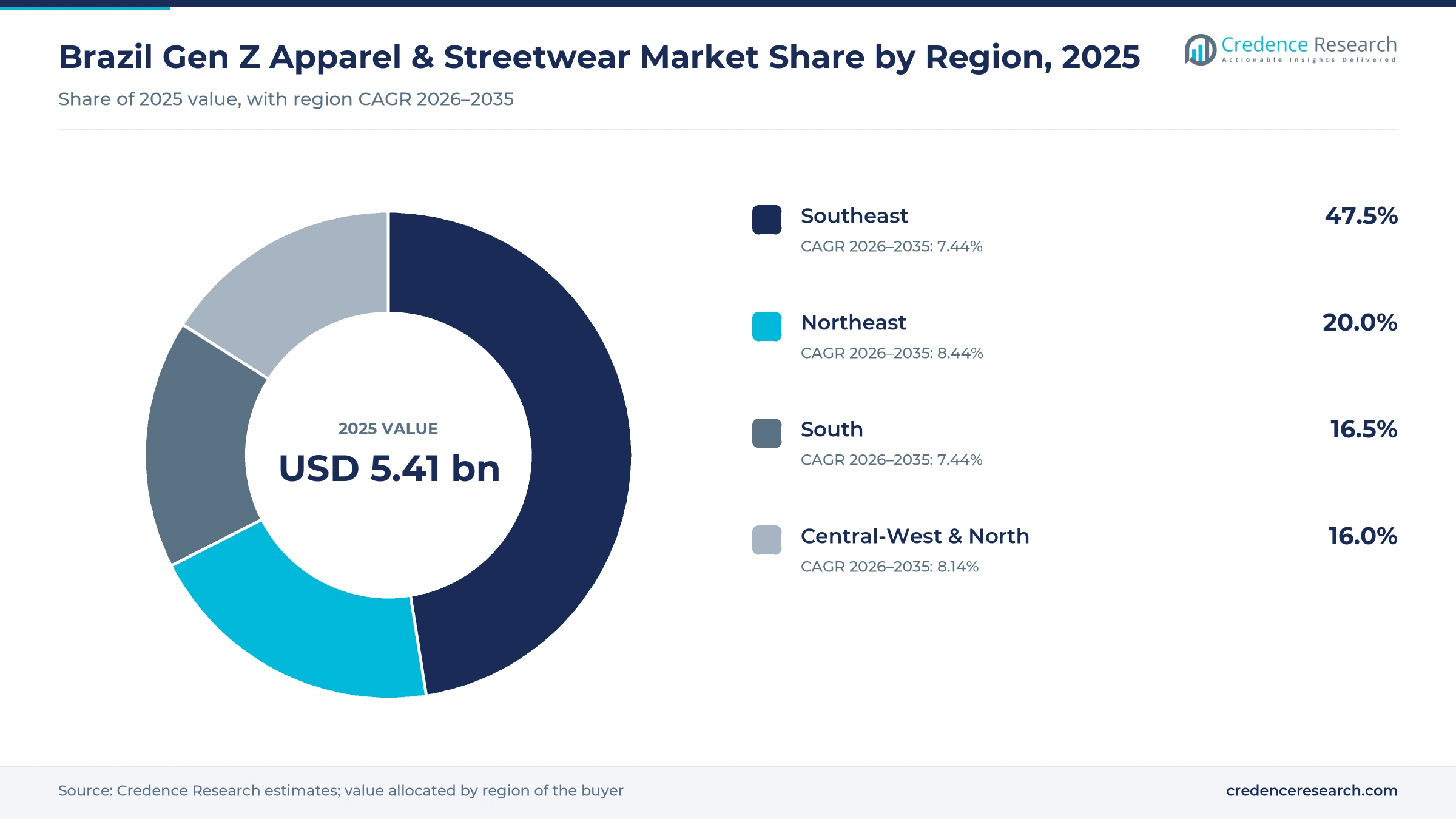
The Brazil Gen Z apparel & streetwear market was valued at USD 5.41 billion in 2025 and is projected to increase from USD 5.85 billion in 2026 to USD 11.46 billion by 2035, registering a CAGR of 7.76% during 2026–2035. Demand comes from Brazilians born after the mid-1990s who buy graphic tees, denim and sneakers through phones, marketplaces and mall stores. Southeast held the largest regional share, 47.5% in 2025, because São Paulo and Rio de Janeiro host most flagship stores and first openings by global chains. Northeast is the fastest-growing region at 8.44% a year as store networks and local garment production expand there. The main commercial change came in May 2026, when Brazil cut the federal import tax on parcels up to USD 50 to zero, and declared small shipments climbed sharply within months. Global competition has also intensified, with H&M opening its first Brazilian store in August 2025 and Bershka following in March 2026.
What does the Brazil Gen Z apparel & streetwear market include?
The Brazil Gen Z apparel & streetwear market counts retail spending by consumers of roughly 13 to 30 on graphic tops, hoodies, bottomwear, denim and streetwear footwear. These buyers purchase through brand sites, marketplaces, social platforms, mall stores, high-street stores and specialty multibrand retailers.
The scope excludes formalwear, workwear, children's clothing and spending by older consumers on the same labels. The value chain runs from domestic spinning, weaving and sewing, plus imported finished goods, through private-label chains, licensed global brands and independent labels to the end buyer.
Brazil Gen Z Apparel & Streetwear Market Insights
- The market grows from USD 5.41 billion in 2025 to USD 11.46 billion by 2035, a 7.76% CAGR built on mobile buying and wider store networks.
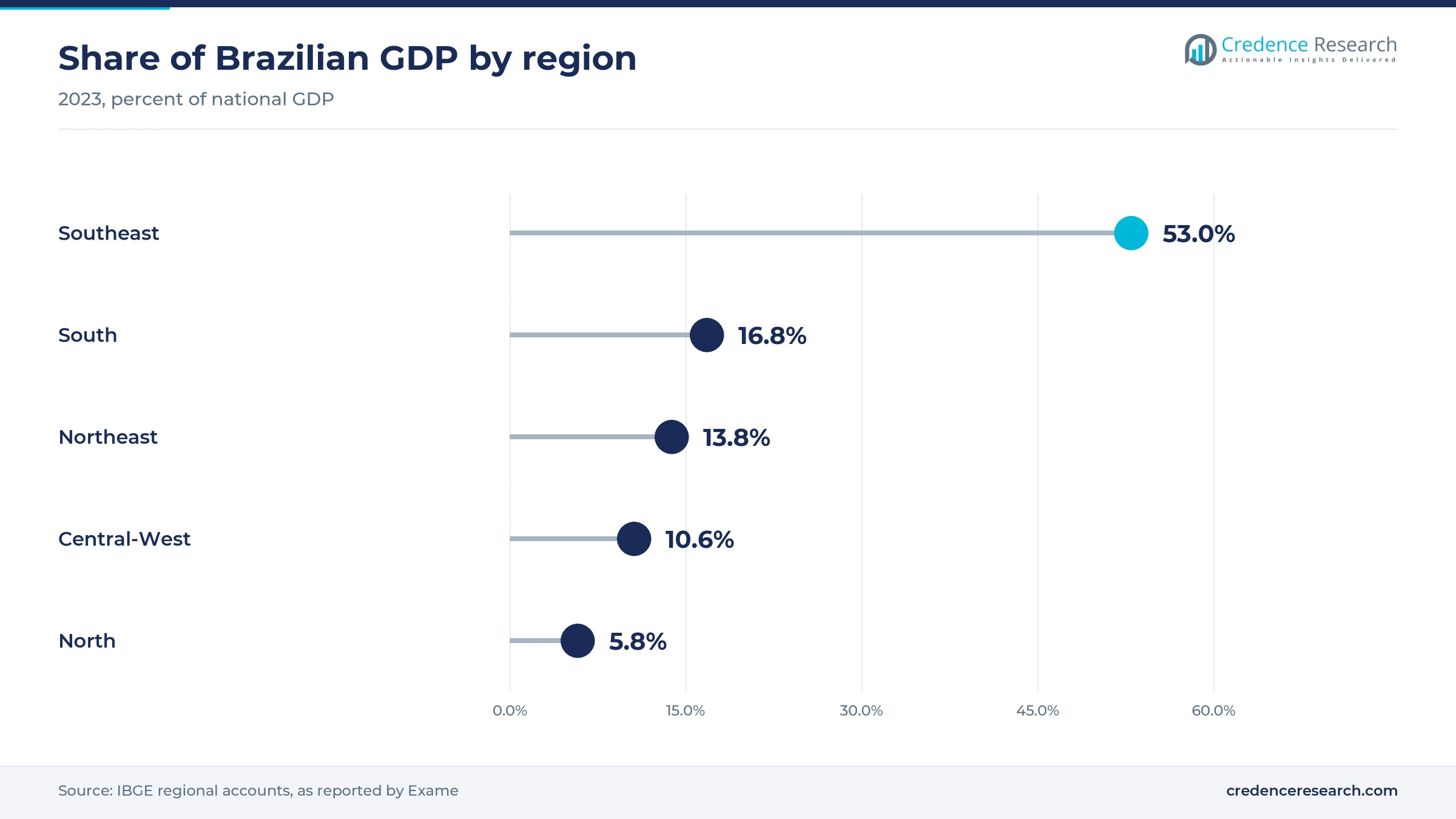
- The Southeast held 47.5% of value in 2025, supported by a 53.0% share of national GDP in IBGE regional accounts for 2023.
- Shopping Mall & High-Street Stores led channels with 41.0% of 2025 value, even as 12% of Gen Z respondents reported buying directly on social platforms.
- Brazil cut the federal import tax on parcels up to USD 50 to zero on May 12, 2026, changing price competition for domestic value brands.
- Fisia extended its Nike distribution agreement to May 31, 2034, while Renner plans up to 600 stores by 2030, signaling long-term investment by large players.
Tops, value pricing and mall stores anchor current spending
Why do graphic tees and tops lead product spending?
Based on product type, the market is categorized into graphic tees and tops, hoodies and sweatshirts, bottomwear and denim, and sneakers and streetwear footwear. Graphic Tees & Tops led with 34.0% of 2025 value because tops are the cheapest way into the look, with Bershka tops at R$129 to R$149 against many of its jeans at R$250, according to InvestNews. Sneakers & Streetwear Footwear grows fastest at 8.56% a year as brand retail for sneakers widens, with Fisia reaching 53 Nike stores in Brazil by September 2026, according to Bloomberg Línea.
How does price sensitivity shape the tier mix?
Based on price tier, the market is categorized into value, mid-market, premium and limited-edition and designer. Value led with 46.0% of 2025 value because price is the main criterion for 71% of shoppers at sustainability-focused businesses in a 2025 Sebrae study reported by Mercado&Consumo. H&M entered at R$199.99 and up, which Forbes Brasil described as slightly above local fast-fashion rivals. Limited-Edition & Designer grows fastest at 9.17% a year as scarcity sells, shown by the 100 numbered Time Brasil shirts Adidas Originals offered at its Iguatemi pop-up in June 2026.
Which young customers carry the most spending power?
Based on customer type, the market is categorized into teen students, university-age consumers, early-career adults and creators and collectors. Early-Career Adults led with 35.0% of 2025 value because paid work funds repeat purchases, and IBGE data reported by Poder360 show unemployment at ages 18 to 24 falling to a record low of 11.4% in the fourth quarter of 2025. Creators & Collectors grows fastest at 9.03% a year as selling becomes a youth activity, with 52% of online fashion store leaders aged 18 to 34 in 2025 NuvemCommerce data reported by Estado de Minas.
Why do physical stores still lead despite rapid online growth?
Based on distribution channel, the market is categorized into brand e-commerce, marketplaces and social commerce, shopping mall and high-street stores, and multibrand and specialty streetwear. Shopping Mall & High-Street Stores led with 41.0% of 2025 value because fitting and browsing still drive purchases, and Renner, Youcom, Camicado and Ashua together operated 723 units in June 2026, according to Mercado&Consumo. Marketplaces & Social Commerce grows fastest at 8.86% a year as Shopee alone drew 47% of Gen Z mentions and 12% of that group had bought directly on social platforms, according to Meio & Mensagem in February 2026.
| Segment Group | Leading Sub-segment | Share, 2025 | Fastest-growing Sub-segment | CAGR, 2026–2035 |
|---|---|---|---|---|
| By Product Type | Graphic Tees & Tops | 34.0% | Sneakers & Streetwear Footwear | 8.56% |
| By Price Tier | Value | 46.0% | Limited-Edition & Designer | 9.17% |
| By Customer Type | Early-Career Adults | 35.0% | Creators & Collectors | 9.03% |
| By Distribution Channel | Shopping Mall & High-Street Stores | 41.0% | Marketplaces & Social Commerce | 8.86% |
Request a Free Sample
Fill in your details and we'll send you a free sample report.
- Sample data tables & charts
- Research methodology
Mobile reach, creators and local factories lift demand
Digital fashion and mobile commerce widen the buyer pool
Online access now reaches almost every potential buyer, which lets digital-first labels sell far beyond the state capitals at lower cost than opening stores. According to IBGE's Pnad TIC survey published July 2, 2026, internet users reached 168.7 million in the fourth quarter of 2025, or 90.5% of people aged 10 and older. The same survey shows 52.7% of users bought goods or services online in 2025, up from 41.8% in 2022. NuvemCommerce data for 2025 show online fashion stores sold more than 10 million items, a rise of 28% from 2024. As a result, large chains are reweighting toward digital, and C&A reported site and app sales at 7.7% of merchandise sales in the second quarter of 2026.
Social media-led product discovery shapes what sells
Young buyers increasingly find products in feeds and creator videos, so a label can build demand before it opens a single store. A survey of 1,028 Gen Z respondents aged 18 to 28, reported by Meio & Mensagem on Feb. 19, 2026, ranked fashion as the group's top online purchase category at 48%. The same work found 12% had bought directly through platforms such as TikTok or Instagram. On the seller side, NuvemCommerce reports that 97% of Brazilian fashion stores use Instagram organically and 26% count TikTok among their sales channels. TikTok Shop launched in Brazil on May 8, 2025, with video, livestream and affiliate selling, and Santander estimated in Propmark that it could reach 5% to 9% of national e-commerce within three years. As a result, Marketplaces & Social Commerce grows at 8.86% a year.
Domestic fashion supply chain scale supports fast response
Brazil makes much of what it wears, which gives local chains a replenishment advantage over brands that depend on imported stock. Abit counts about 25,700 companies and 1.34 million workers in textiles and apparel, according to Times Brasil in January 2026. Riachuelo's industrial arm supplied about 37 million pieces in 2025, with about 5,100 sewing workers, and domestic production reaches 69% of the chain's total sales, according to Bloomberg Línea. In the Central-West, Goiás produces more than 60 million clothing pieces a month through about 8,000 workshops, according to O Hoje in January 2025. This base keeps Value products on shelves, and it gives national chains a practical answer to rising imports through shorter runs and quicker reorders.
Global chain entries raise mall investment and choice
International chains see young Brazilian shoppers as worth a dedicated investment, and their arrivals lift both choice and marketing around youth fashion. Bershka, the Inditex label aimed at young customers, opened its first store at Morumbi Shopping on March 18, 2026, with a Rio de Janeiro store planned, according to InvestNews. H&M opened at Iguatemi São Paulo on Aug. 23, 2025, and added a store of nearly 2,000 square meters at Shopping Anália Franco on Sept. 4, 2025, according to Forbes Brasil. Levi's plans 34 more stores to reach 130 by 2030, Forbes Brasil reported in August 2025, and the brand wants to win younger buyers. These openings reinforce Shopping Mall & High-Street Stores, which held 41.0% of 2025 value.
Circular denim and small-city stores open new ground
Shift toward circular denim and upcycled collections
Large chains have moved circular fashion from thrift-store niche into mainstream ranges, which gives young shoppers lower-impact options at familiar prices. Riachuelo reuses scraps from its Natal factory through Evotex in João Pessoa, aims to convert more than 1,200 tons of scraps, and launched denim jeans with 25% recycled fiber in September 2026, according to Mercado&Consumo. C&A has made more than 254,000 pieces in its Jeans Circular line since 2021 and targets circular principles in 50% of products by 2030, up from 37% today. Riachuelo also opened an upcycling lab in April 2026 under designer Marcelo Sommer, which extends circular work beyond denim into new product lines.
Rise of culture-led stores built around skate and music
Brands are turning stores into places to spend time, because young customers respond to culture as much as to product. Vans opened a 246-square-meter skate park inside its Largo da Batata space in São Paulo in February 2025, with lessons, competitions and exhibitions, according to Mercado&Consumo. Riachuelo's 240-square-meter Rua dos Pinheiros pop-up opened Dec. 12, 2025, with DJs, and its layout changes every 15 days as a prototype for remodeling more than 300 stores. Skateboarding gives this approach a large base, with more than 8.5 million practitioners, according to Máquina do Esporte in June 2024. In turn, Limited-Edition & Designer products gain visibility through these spaces, supporting a 9.17% growth rate.
Opportunity in smaller cities with young online shoppers
Smaller cities offer an opening because many residents already shop online yet must travel to reach a brand store. Renner told Mercado&Consumo in August 2026 that it is targeting municipalities of 100,000 to 200,000 people with leaner essential stores, within a plan for up to 600 stores by 2030. Its young-focused Youcom brand ended June 2026 with 161 stores and plans 23 to 25 openings in 2026, in cities with concentrations of young consumers. Earlier Youcom expansion also ran through Ceará, Maranhão, Rio Grande do Norte, Alagoas and Sergipe, according to Consumidor Moderno. Brands that pair compact stores with pickup can reach the Northeast and other underserved areas at relatively low cost.
Opportunity in athleisure and sport-inspired street looks
Athleisure offers a clear opening because it bridges everyday wear and higher prices that young shoppers accept for performance labels. C&A opened the first standalone store for its ACE brand at Shopping Ibirapuera in July 2026, aiming at a more premium customer in sportswear, according to Times Brasil. An executive there sized Brazilian sportswear apparel sales at about R$30 billion. Fisia, the Grupo SBF unit that distributes Nike, signed an extension to May 31, 2034, on Aug. 28, 2026, and is preparing more openings for 2027. Adidas also used its June 2026 Iguatemi pop-up to sell Originals football items with customization. These moves support spending by Early-Career Adults, who can afford sport-inspired looks at higher prices.
Zero-duty parcels and thin budgets squeeze local margins
Parcels free of federal tax undercut value brands
Removing the federal tax on small parcels has sharply lowered the landed price of imported fashion. Provisional Measure 1,357, published May 12, 2026, allowed the rate on purchases up to USD 50 to fall to zero. Declared August 2026 shipments then rose 74% to 26.5 million, according to Abit. Domestic value labels feel this first, because they compete directly on price. Brands can respond with faster local drops, exclusive designs and in-store services that parcels cannot match.
Falling local output raises sourcing and margin risk
Local factories have lost momentum, which threatens the speed advantage domestic chains depend on. IBGE data cited by Abit show apparel production down 8.2% in July 2026 from a year earlier, and 2025 clothing imports had already risen 13.1% by weight, according to Times Brasil. Smaller workshops suffer most, since they lack the volume to absorb lost orders. Abit warns of postponed investment, and buyers are likely to hedge by splitting orders across regional workshops and importers.
Stretched budgets limit trading up among young shoppers
Young buyers want more clothing, yet many households have little room to absorb price rises. In a UBS survey cited by InvestNews in March 2026, 63% of Brazilians planned to spend more on clothing over 12 months, while 71% would cut clothing and accessories if prices rose 10%. This limits premium labels and forces chains to protect entry prices. Brands can manage the risk through installment plans, smaller capsules and clearer differences between basic and limited lines.
Supply chain labor audits add cost and complexity
Brands selling to values-driven young customers must prove clean sourcing across a fragmented workshop base, and that costs money. The ABVTEX retail program has run about 60,000 supplier audits since 2010 and had approved 3,741 companies by the end of 2024, across 18 states and 633 municipalities. Independent streetwear labels without audit budgets carry the highest risk from a single failure. Shared audit programs, published supplier lists and fewer, longer supplier relationships can reduce this exposure.
Southeast leads while the Northeast gains the fastest
| Region | Value, 2025 (USD billion) | Share, 2025 | CAGR, 2026–2035 |
|---|---|---|---|
| Southeast | 2.57 | 47.5% | 7.44% |
| Northeast | 1.08 | 20.0% | 8.44% |
| South | 0.89 | 16.5% | 7.44% |
| Central-West & North | 0.87 | 16.0% | 8.14% |
Southeast leads on income and flagship stores
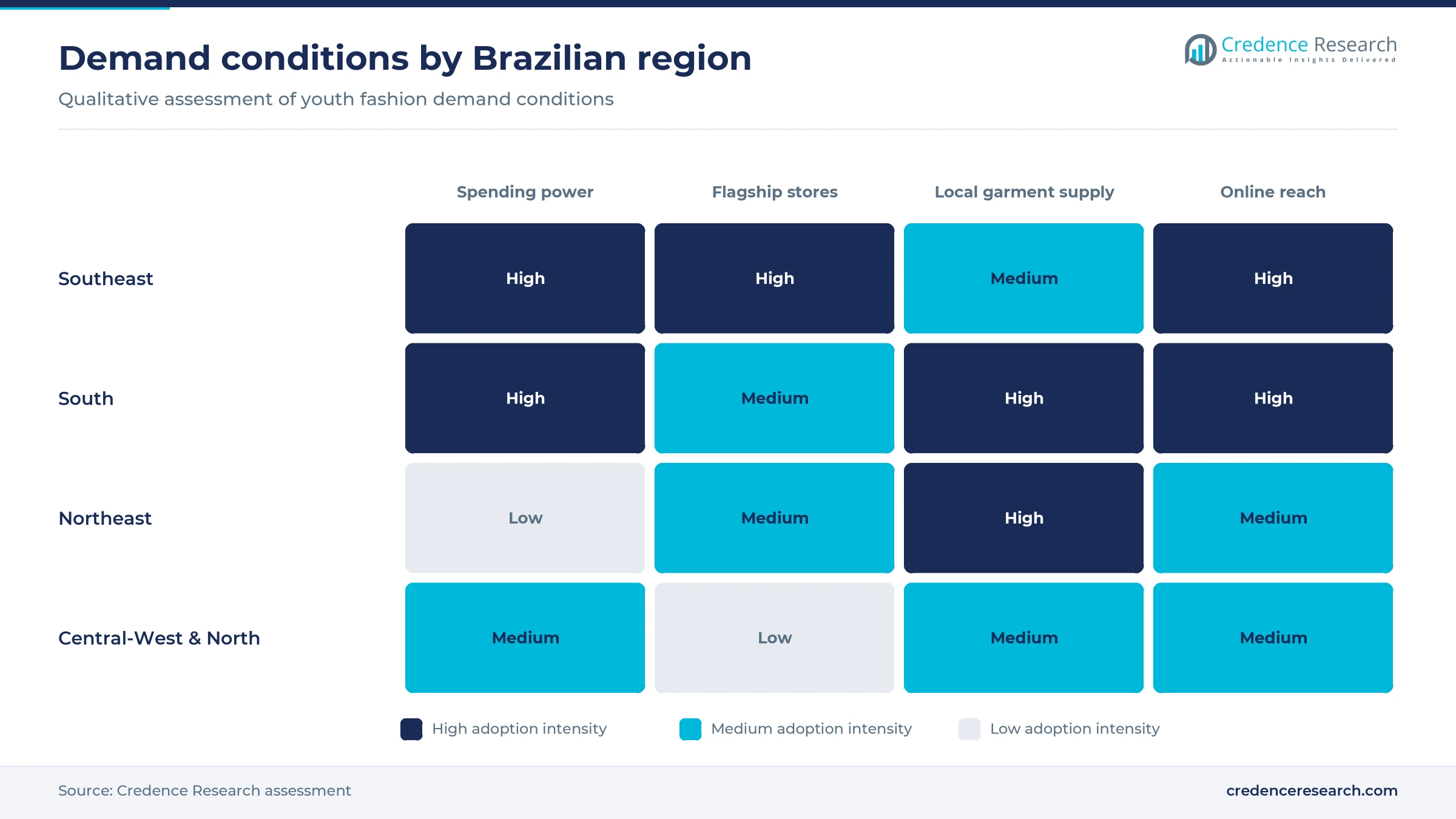
The Southeast held 47.5% of 2025 value and grows at 7.44% a year, because it combines the largest incomes with most first-store openings. IBGE regional accounts for 2023 gave the region 53.0% of national GDP, with São Paulo alone at 31.5%, according to Exame. Poder360 reported projected 2025 fashion spending of R$65.7 billion in São Paulo, R$28.8 billion in Minas Gerais and R$19 billion in Rio de Janeiro. H&M, Bershka and the Vans skate space all chose São Paulo first.
South spends more per person on fashion
The South held 16.5% of 2025 value and grows at 7.44% a year, supported by high spending per person and a strong knitwear base. Santa Catarina ranked first nationally at R$1,773.46 a person on fashion in 2025, according to Poder360. Rio Grande do Sul followed in absolute terms with a projected R$17.7 billion, according to the same Poder360 report. Youcom also promoted a flagship store at Iguatemi Porto Alegre in July 2026, according to Jornal do Comércio.
Northeast gains through stores and garment hubs
The Northeast held 20.0% of 2025 value and grows fastest at 8.44% a year, as its large young population gains stores and internet access. The region had 13.8% of national GDP in 2023, and internet use reached 88.5% in 2025, according to IBGE. Local production is also a strength, with direct apparel jobs in Pernambuco up 14.8% from 2024 to 2025, according to Movimento Econômico. Sudene, citing DataSebrae for 2022, counted about 41,792 apparel enterprises across 1,599 municipalities in its area.
Central-West and North combine wholesale and new reach
Central-West & North held 16.0% of 2025 value and grows at 8.14% a year, led by Goiás wholesale and expanding digital access. Goiânia's Região da 44 has nearly 16,000 stores and draws buyers from across Brazil, according to O Hoje in January 2025. The Central-West had the country's highest internet use at 93.6% in 2025, while the North reached 89.7%, according to IBGE. The two regions together made up 16.4% of national GDP in 2023, according to Exame.
Global chains and new tax rules reset competition
| Development | Status and market relevance |
|---|---|
| In March 2026, Bershka opened its first Brazilian store at Morumbi Shopping in São Paulo and launched national e-commerce. | Open, with a Rio de Janeiro store planned for later in 2026 |
| In May 2026, Brazil published Provisional Measure 1,357, which allowed the import tax on parcels up to USD 50 to fall to zero. | Converted into law on Sept. 10, 2026 |
| In August 2026, Fisia and Nike extended their Brazilian distribution agreement to May 31, 2034. | In force, with new Nike stores being prepared for 2027 |
| In September 2026, Riachuelo launched jeans with 25% recycled fiber from a Northeast scrap recycling hub. | Available, with a target of more than 1,200 tons of scraps |
| In July 2026, C&A opened the first standalone ACE store at Shopping Ibirapuera in São Paulo. | Open, with more stores expected in 2026 |
Video selling and digital design shorten the path to sale
- Livestream and affiliate selling lets creators earn commission by tagging products in video, and TikTok Shop has offered this in Brazil since May 8, 2025.
- Product video is used by 32.3% of Brazilian fashion stores, and another 49.6% plan to adopt it within a year, according to NuvemCommerce data reported by Estado de Minas.
- Virtual try-on remains early, with 8.5% of fashion stores using it and 51.6% planning to add it by 2026, according to the same NuvemCommerce data.
- Digital design reduces sampling waste, and Farm Rio of Azzas 2154 created 362 products digitally in 2025, or 32% of the 1,130 it developed, according to Mercado&Consumo.
Need a Custom Version of This Report?
Tailor the scope, geography, or segments to your exact requirements.
- Custom geography or segment scope
- Direct access to our analyst team
National chains defend share against global entrants
Competition splits between national private-label chains with large store bases, global sportswear brands with cultural pull, and international fast-fashion entrants. Renner and its Youcom label use store density and young-focused ranges, while Riachuelo leans on its Natal factory for speed and on frequent store refreshes for relevance. C&A is remodeling stores under its Energia concept and separating ACE as its own athleisure brand. Azzas 2154 brings basics through Hering, which runs about 700 stores, mostly franchised. Nike reaches shoppers through Fisia, while VF licensed Vans locally to Arezzo in 2019, a company now inside Azzas 2154. Inditex and H&M compete on global trend access, with Zara at 45 Brazilian stores. Cross-border marketplaces add pressure at entry prices, so the strongest local players now compete on replenishment speed, exclusive collaborations and in-store experience rather than on price alone.
National chains, licensed labels and global retailers courting young shoppers
| Company | Type | Role in the market |
|---|---|---|
| Lojas Renner S.A. | National chain | Operates Renner and the young-focused Youcom, with 161 Youcom stores in June 2026 |
| C&A Modas S.A. | National chain | Runs the Energia store concept and launched standalone ACE stores in July 2026 |
| Guararapes Confecções S.A. (Riachuelo) | Integrated chain | Industrial arm supplied about 37 million pieces in 2025 |
| Azzas 2154 S.A. | Brand group | Owns Hering, with about 700 stores, and Farm Rio |
| Nike do Brasil | Global brand | Distributed by Fisia, with 53 stores and an agreement to 2034 |
| Adidas do Brasil Ltda. | Global brand | Opened a football and Originals pop-up at Iguatemi São Paulo in June 2026 |
| Levi Strauss do Brasil | Global brand | Plans 34 more stores to reach 130 by 2030 |
| Inditex / Zara Brasil | Global retailer | Zara has 45 stores, and Bershka entered in March 2026 |
| VF / Vans Brasil | Licensed brand | Runs a 246-square-meter skate park at Largo da Batata in São Paulo |
| H&M Hennes & Mauritz AB | Global retailer | Entered Brazil in August 2025 with stores in São Paulo and online sales |
Local speed matters more than global brand reach
Credence Research's view of the Brazil Gen Z apparel & streetwear market is that the winners will be companies able to pair domestic production speed with credible youth culture, because neither alone is enough once parcels enter free of federal import tax. The evidence points to a divided market in which entry-price tops face direct import pressure, while footwear, limited releases and experience-led stores hold pricing better. The most assumption-heavy estimates are the customer and price splits, which rest on proxy data rather than direct measurement of Gen Z spending. Chains with reliable local supply and compact formats for smaller cities appear best placed through 2030.
IBGE and retailer data behind these Brazil estimates
The report uses 2025 as the base year and 2026 to 2035 as the forecast period. Market values come from the Credence Research model, and regional, segment and customer splits are Credence Research estimates derived from public data. Sources include IBGE statistics, Brazilian government releases, trade association data from Abit and ABVTEX, company announcements and named business press. No primary interviews or surveys were conducted for this report, so survey figures quoted here belong to the organizations named beside them.
Young buyers keep spending as channels fragment
The Brazil Gen Z apparel & streetwear market is projected to reach USD 11.46 billion by 2035 at a 7.76% CAGR, with growth led by footwear, limited releases and social selling rather than by basic tops. The path depends heavily on parcel tax policy, since any return of the federal duty would favor domestic value brands, while its absence keeps cross-border sellers strong. Store expansion into cities of 100,000 to 200,000 people should spread spending beyond the Southeast. Local production recovery and clear labor compliance will likely decide which national chains keep their position as Generation Alpha begins entering this buyer base.
Frequently Asked Questions
How big is the Brazil Gen Z apparel & streetwear market?
Which product type leads the market?
Which region holds the largest share?
Which region is growing fastest?
What did the May 2026 tax change do?
How important is social commerce for young buyers?
Which companies are active in this market?
What are the main risks for the market?
Table of Content
Chapter 1 Market Segmentation
- 1.1 Segmentation Framework
- 1.1.1 Product and Service Classification
- 1.1.2 Application and End-Use Classification
- 1.1.3 Technology and Solution Classification
- 1.1.4 Customer and Distribution Channel Classification
- 1.1.5 Geographic Segmentation
- 1.1.6 Market Segment Definitions and Boundaries
- 1.2 By Product Type
- 1.2.1 Graphic Tees & Tops
- 1.2.2 Hoodies & Sweatshirts
- 1.2.3 Bottomwear & Denim
- 1.2.4 Sneakers & Streetwear Footwear
- 1.3 By Price Tier
- 1.3.1 Value
- 1.3.2 Mid-Market
- 1.3.3 Premium
- 1.3.4 Limited-Edition & Designer
- 1.4 By Customer Type
- 1.4.1 Teen Students
- 1.4.2 University-Age Consumers
- 1.4.3 Early-Career Adults
- 1.4.4 Creators & Collectors
Chapter 2 Introduction
- 2.1 Report Objectives and Scope
- 2.2 Product Definition and Industry Terminology
- 2.3 Market Inclusions and Exclusions
- 2.4 Research Process
- 2.4.1 Primary Research and Expert Interviews
- 2.4.2 Secondary Research and Source Review
- 2.4.3 Top-Down and Bottom-Up Estimation
- 2.4.4 Data Triangulation and Verification
- 2.5 Market Size Measurement Basis
- 2.5.1 2025: USD 5.41 billion → 2035: USD 11.46 billion
- 2.6 Historical and Forecast Reference Periods
- 2.6.1 Historical Period: 2018-2025
- 2.6.2 Base Year: 2025
- 2.6.3 Forecast Period: 2025-2035
- 2.7 Research Assumptions and Limitations
Chapter 3 Executive Summary
- 3.1 Market Snapshot and Key Findings
- 3.2 Base-Year Market Size, 2025
- 3.3 Forecast Market Size, 2035
- 3.4 Revenue and Volume Growth Outlook
- 3.5 Key Demand and Supply Indicators
- 3.6 Leading Market Segments
- 3.7 Fastest-Growing Market Opportunities
- 3.8 Regional Performance Highlights
- 3.9 Technology and Industry Transformation
- 3.10 Competitive Landscape Summary
- 3.11 Analyst View and Strategic Implications
Chapter 4 Brazil Gen Z Apparel & Streetwear Market Trends and Developments
- 4.1 Historical Industry Development, 2018-2025
- 4.2 Recent Market Trends and Developments
- 4.3 Demand and Customer Behavior Trends
- 4.4 Technology and Product Innovation
- 4.5 Artificial Intelligence, Automation and Digitalization
- 4.6 Local Manufacturing and Supply Chain Realignment
- 4.7 Industry Partnerships, Mergers and Acquisitions
- 4.8 Sustainability and Circular Economy Developments
- 4.9 Government and Private Sector Investment Trends
- 4.10 Emerging Business Models and Commercialization
- 4.11 Industry Developments and Announcements
Chapter 5 Brazil Gen Z Apparel & Streetwear Market Production, Supply and Demand Analysis
- 5.1 Demand Trend and Consumption Analysis, 2018-2025
- 5.2 Demand Forecast, 2025-2035
- 5.3 Production and Output Trend, 2018-2025
- 5.4 Production and Output Forecast, 2025-2035
- 5.5 Installed Capacity and Capacity Utilization
- 5.6 Company-Wise Production Plants and Statistics
- 5.6.1 Installed Production Capacity
- 5.6.2 Actual Production
- 5.6.3 Planned Capacity and Expansion Targets
- 5.7 Supply Chain Structure and Procurement Trends
- 5.8 Supply-Demand Gap and Bottlenecks
- 5.9 Import Dependence and Sourcing Structure
- 5.10 Contract Manufacturing and Outsourcing
- 5.11 Regional Supply and Demand Concentration
Chapter 6 Brazil Gen Z Apparel & Streetwear Market Pricing Analysis
- 6.1 Pricing Structure and Measurement
- 6.2 Historical Pricing Trends, 2018-2025
- 6.3 Pricing Outlook, 2025-2035
- 6.4 Average Selling Price and Unit Economics
- 6.5 Pricing by Product and Market Segment
- 6.6 Geographic Pricing Differences
- 6.7 Key Input, Energy, Labor and Logistics Costs
- 6.8 Contract Pricing and Purchasing Models
- 6.9 Pricing Sensitivity and Competitive Positioning
- 6.10 Price, Margin and Profitability Implications
Chapter 7 Brazil Gen Z Apparel & Streetwear Market Dynamics
- 7.1 Market Growth Drivers
- 7.1.1 Demand-Side Drivers
- 7.1.2 Technology and Innovation Drivers
- 7.1.3 Infrastructure and Investment Drivers
- 7.1.4 Regulatory and Policy Drivers
- 7.2 Market Restraints
- 7.2.1 Cost and Affordability Constraints
- 7.2.2 Technology and Adoption Barriers
- 7.2.3 Supply Chain and Operational Constraints
- 7.3 Market Challenges
- 7.3.1 Competitive Pressure and Margin Erosion
- 7.3.2 Skills, Infrastructure and Implementation Gaps
- 7.4 Emerging Market Opportunities
- 7.5 Market Dynamics Impact and Time-Horizon Assessment
Chapter 8 Brazil Gen Z Apparel & Streetwear Value Chain Analysis
- 8.1 Industry Value Chain Overview
- 8.2 Upstream Suppliers and Critical Inputs
- 8.3 Technology and Component Providers
- 8.4 Manufacturing or Service Delivery
- 8.5 Distribution, Channel Partners and Integrators
- 8.6 Downstream Applications and End Users
- 8.7 Value Addition and Profit Pools
- 8.8 Vertical Integration and Outsourcing
- 8.9 Supplier Concentration and Risk
- 8.10 Supply Chain Localization and Resilience
Chapter 9 Brazil Gen Z Apparel & Streetwear Market Regulations and Policies
- 9.1 Relevant Laws, Standards and Compliance Frameworks
- 9.2 Product, Service, Safety and Quality Requirements
- 9.3 Government Policies, Incentives and Subsidies
- 9.4 Imports, Exports and Trade Barriers
- 9.5 Public Procurement and Local Content Requirements
- 9.6 Environmental and Sustainability Compliance
- 9.7 Upcoming Policy Changes and Market Implications
Chapter 10 Brazil Gen Z Apparel & Streetwear Market Hotspots and Opportunities
- 10.1 Market Opportunity Mapping and Growth Hotspots
- 10.2 High-Growth Applications and Customer Groups
- 10.3 Underserved Markets and White-Space Opportunities
- 10.4 Emerging Technology and Product Opportunities
- 10.5 New Capacity and Investment Hotspots
- 10.6 Market Entry and Expansion Opportunities
- 10.7 Distribution and Partnership Opportunities
- 10.8 Near-Term and Long-Term Commercial Potential
- 10.9 Opportunity Attractiveness and Execution Risks
Chapter 11 Brazil Gen Z Apparel & Streetwear Market Outlook, 2025-2035
- 11.1 Market Size and Analysis
- 11.1.1 Revenue (Market Measurement: 2025: USD 5.41 billion → 2035: USD 11.46 billion)
- 11.1.2 Market Volume and Quantity Sold
- 11.1.3 Historical Market Size, 2018-2025
- 11.1.4 Base-Year Market Size, 2025
- 11.2 Market Forecast, 2025-2035
- 11.2.1 Revenue Forecast to 2035
- 11.2.2 Volume Forecast to 2035
- 11.2.3 CAGR and Year-on-Year Growth
- 11.2.4 Incremental Revenue Opportunity
- 11.3 Forecast Assumptions and Scenario Analysis
- 11.3.1 Base-Case Forecast
- 11.3.2 Optimistic and Conservative Scenarios
- 11.3.3 Technology, Pricing and Policy Sensitivities
- 11.4 Market Attractiveness and Growth Outlook
Chapter 12 Brazil Gen Z Apparel & Streetwear Market Segmentation and Outlook
- 12.1 Segmentation Summary and Market Shares, 2025
- 12.2 Largest and Fastest-Growing Segments
- 12.3 By Product Type - Market Size and Forecast, 2025-2035
- 12.3.1 Segment Definition and Scope
- 12.3.2 Historical Market Size, 2018-2025
- 12.3.3 Revenue Forecast, 2025-2035
- 12.3.4 Volume Forecast, 2025-2035
- 12.3.5 Base-Year Market Share, 2025
- 12.3.6 Segment CAGR and Growth Drivers
- 12.3.7 Subsegment Market Size and Forecast
- 12.3.7.1 Graphic Tees & Tops
- 12.3.7.2 Hoodies & Sweatshirts
- 12.3.7.3 Bottomwear & Denim
- 12.3.7.4 Sneakers & Streetwear Footwear
- 12.3.8 Subsegment Pricing and Adoption Trends
- 12.3.9 Leading Suppliers and Competition
- 12.3.10 Regional Demand and Opportunities
- 12.4 By Price Tier - Market Size and Forecast, 2025-2035
- 12.4.1 Segment Definition and Scope
- 12.4.2 Historical Market Size, 2018-2025
- 12.4.3 Revenue Forecast, 2025-2035
- 12.4.4 Volume Forecast, 2025-2035
- 12.4.5 Base-Year Market Share, 2025
- 12.4.6 Segment CAGR and Growth Drivers
- 12.4.7 Subsegment Market Size and Forecast
- 12.4.7.1 Value
- 12.4.7.2 Mid-Market
- 12.4.7.3 Premium
- 12.4.7.4 Limited-Edition & Designer
- 12.4.8 Subsegment Pricing and Adoption Trends
- 12.4.9 Leading Suppliers and Competition
- 12.4.10 Regional Demand and Opportunities
- 12.5 By Customer Type - Market Size and Forecast, 2025-2035
- 12.5.1 Segment Definition and Scope
- 12.5.2 Historical Market Size, 2018-2025
- 12.5.3 Revenue Forecast, 2025-2035
- 12.5.4 Volume Forecast, 2025-2035
- 12.5.5 Base-Year Market Share, 2025
- 12.5.6 Segment CAGR and Growth Drivers
- 12.5.7 Subsegment Market Size and Forecast
- 12.5.7.1 Teen Students
- 12.5.7.2 University-Age Consumers
- 12.5.7.3 Early-Career Adults
- 12.5.7.4 Creators & Collectors
- 12.5.8 Subsegment Pricing and Adoption Trends
- 12.5.9 Leading Suppliers and Competition
- 12.5.10 Regional Demand and Opportunities
- 12.6 Segment Growth Comparison
- 12.7 Segment Attractiveness and Priority Matrix
Chapter 13 Brazil Gen Z Apparel & Streetwear End-Use and Application Market Outlook
- 13.1 End-Use Industry and Customer Demand Structure
- 13.2 Leading Applications and Customer Groups
- 13.3 End-Use Market Size, Share and Forecast
- 13.4 Major End-Use Industry Deep Dives
- 13.4.1 Customer Requirements and Use Cases
- 13.4.2 Demand and Replacement Cycles
- 13.4.3 Technical and Regulatory Considerations
- 13.4.4 Purchasing and Procurement Models
- 13.4.5 Leading Vendors and Distribution Channels
- 13.4.6 Forecast and Commercial Opportunities
- 13.5 Emerging Applications and Cross-Segment Demand
- 13.6 End-Use Industry Investment Priorities
Chapter 14 Brazil Gen Z Apparel & Streetwear Geographic Market Outlook, 2025-2035
- 14.1 Domestic Market Distribution and Demand Clusters
- 14.2 State- or Province-Wise Market Size and Forecast, 2025-2035
- 14.3 City and Metropolitan Market Outlook
- 14.4 Industrial, Manufacturing and Commercial Clusters
- 14.5 Geographic Concentration of Key End Users
- 14.6 Local Pricing and Purchasing Differences
- 14.7 Domestic Production Facilities and Capacity Map
- 14.8 Local Infrastructure and Project Pipeline
- 14.9 State-Level Policy and Incentive Differences
- 14.10 Subnational Investment Hotspots and Opportunities
- 14.11 Distribution and Logistics Networks
- 14.12 Domestic Competitive Footprint
Chapter 15 Brazil Gen Z Apparel & Streetwear Technology, Innovation and Sustainability Outlook
- 15.1 Technology Landscape and Maturity
- 15.2 Product, Process and Service Innovation
- 15.3 AI, Automation and Digital Tools in the Industry
- 15.4 Technology Adoption and Performance Benchmarking
- 15.5 Innovation Pipeline and R&D Investment
- 15.6 Patent and Intellectual Property Trends
- 15.7 Energy Efficiency and Resource Management
- 15.8 Sustainability, Recycling and Circularity
- 15.9 Technology Roadmap, 2025-2035
- 15.10 Risks of Obsolescence and Technology Substitution
Chapter 16 Brazil Gen Z Apparel & Streetwear Market Key Strategic Imperatives
- 16.1 Growth and Market Entry Priorities
- 16.2 High-Return Products and Segments
- 16.3 Pricing, Profitability and Cost Optimization
- 16.4 Technology Investment and Product Differentiation
- 16.5 Supply Chain Localization and Resilience
- 16.6 Distribution and Customer Acquisition
- 16.7 Partnership, Acquisition and Capacity Strategy
- 16.8 Regional Expansion Priorities
- 16.9 Short-, Medium- and Long-Term Actions
Chapter 17 Competition Outlook
- 17.1 Industry Competition Characteristics
- 17.2 Market Structure and Concentration
- 17.3 Market Share and Competitive Positioning, 2025
- 17.4 Company-Wise Revenue and Product Benchmarking
- 17.5 Production and Service Capacity Benchmarking
- 17.6 Technology, Pricing and Differentiation
- 17.7 Regional Footprint and Distribution Strength
- 17.8 Mergers, Acquisitions and Strategic Alliances
- 17.9 New Entrants and Competitive Threats
- 17.10 Porter's Five Forces and Industry Attractiveness
- 17.11 Competitive Outlook, 2025-2035
Chapter 18 Company Profiles
- 18.1 Company Coverage and Selection Criteria
- 18.2 Lojas Renner S.A.
- 18.2.1 Business Description
- 18.2.2 Company Ownership and Geographic Presence
- 18.2.3 Product and Service Portfolio
- 18.2.4 Manufacturing and Operating Footprint
- 18.2.5 Production Capacity and Expansion Plans
- 18.2.6 Financial Performance and Investment
- 18.2.7 Market Share and Competitive Position
- 18.2.8 Technology and Innovation Capabilities
- 18.2.9 Strategic Alliances or Partnerships
- 18.2.10 Recent Developments
- 18.2.11 Growth Strategy and Outlook
- 18.3 C&A Modas S.A.
- 18.4 Guararapes Confecções S.A. (Riachuelo)
- 18.5 Azzas 2154 S.A.
- 18.6 Nike do Brasil
- 18.7 Adidas do Brasil Ltda.
- 18.8 Levi Strauss do Brasil
- 18.9 Inditex / Zara Brasil
- 18.10 VF / Vans Brasil
- 18.11 H&M Hennes & Mauritz AB
- 18.12 Other Relevant Market Participants
Note: Every listed company is profiled on the structure shown under the first company. The company list is preliminary and may change based on research findings, market developments, data availability and client requirements.
Chapter 19 Disclaimer
- 19.1 Research and Forecast Disclaimer
- 19.2 Data Source and Estimation Limitations
Note: The depth of individual sections depends on data availability for this market. Volume, capacity, trade and other unit-based metrics are included where applicable.

