
| REPORT ATTRIBUTE | DETAILS |
|---|---|
| Historical Period | 2020-2023 |
| Base Year | 2024 |
| Forecast Period | 2025-2032 |
| Wearable Technology Ecosystems Market Size 2024 | USD 72,550 Million |
| Wearable Technology Ecosystems Market, CAGR | 13.38% |
| Wearable Technology Ecosystems Market Size 2032 | USD 198,120 Million |
Market Overview:
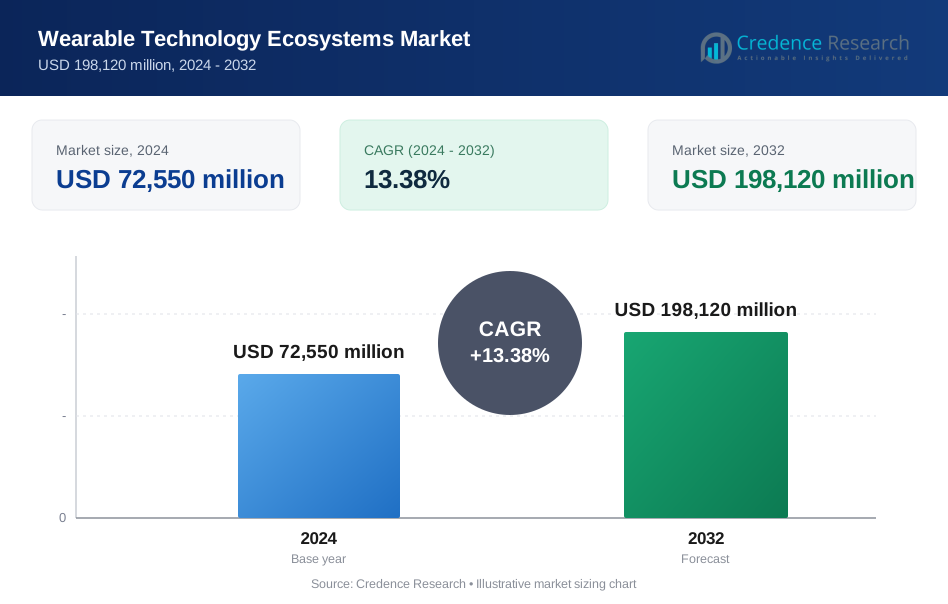
Wearable Technology Ecosystems Market size was valued at USD 72,550 million in 2024 and is anticipated to reach USD 198,120 million by 2032, at a CAGR of 13.38% during the forecast period (2024-2032).
The market is primarily driven by rising consumer awareness around health and fitness, an increasing aging population with chronic conditions, and the integration of wearable devices in corporate wellness programs. Technological advancements in IoT, AI, and machine learning have enabled wearables to offer more personalized insights, seamless data synchronization, and real-time monitoring capabilities. The shift towards remote patient monitoring and telehealth services, particularly post-pandemic, has further fueled the adoption of wearable medical devices. Moreover, innovations in material science are enabling the development of lightweight, flexible, and more ergonomic wearables that enhance user comfort and adoption rates. Strategic collaborations between tech firms and healthcare providers are accelerating the deployment of clinical-grade wearables. In addition, the gamification of health goals is increasing user motivation and retention in consumer fitness wearables.
Regionally, North America holds a dominant share in the wearable technology ecosystem market, driven by high consumer awareness, advanced digital infrastructure, and strong healthcare investment. Europe follows closely, with increasing regulatory support for digital health solutions and growing health consciousness among consumers. Meanwhile, the Asia-Pacific region is experiencing the fastest growth, fueled by a large population base, rising disposable incomes, rapid urbanization, and growing smartphone penetration. Countries such as China, India, Japan, and South Korea are emerging as key growth hubs due to strong manufacturing capabilities and growing adoption of smart technologies. Government initiatives promoting digital health and expanding 5G networks are further accelerating regional adoption. Additionally, the region is witnessing a surge in local brands entering the market with competitively priced wearable devices.
Market Insights:
- The Wearable Technology Ecosystems Market was valued at USD 72,550 million in 2024 and is projected to reach USD 198,120 million by 2032, growing at a CAGR of 13.38% during 2024–2032.
- Rising health awareness, aging populations, and corporate wellness programs are key drivers fueling demand for wearable devices.
- Integration of AI, IoT, and machine learning enhances device intelligence, enabling personalized insights and real-time health monitoring.
- Remote patient monitoring and telehealth adoption continue to grow, especially in post-pandemic healthcare systems.
- Data privacy and limited battery performance remain key challenges impacting long-term user confidence and satisfaction.
- North America leads the market with 39% revenue share in 2024, while Asia-Pacific is the fastest-growing region supported by digital expansion.
- Strategic partnerships, smart materials, and gamification features are improving user engagement and accelerating product innovation.
Market Drivers:
Rising Demand for Health and Fitness Monitoring Solutions
The Wearable Technology Ecosystem Market is experiencing strong growth due to increasing demand for health and fitness monitoring. Consumers are becoming more conscious of their physical well-being, prompting higher adoption of smartwatches, fitness bands, and heart rate monitors. These devices support users in tracking key health metrics such as heart rate, sleep quality, calories burned, and physical activity. Companies are enhancing product features with biometric sensors and health-focused applications. Wearables now assist in early detection of conditions such as arrhythmia or elevated blood pressure. This shift toward preventive healthcare is making wearables essential tools for personal wellness management.
Growth in Remote Patient Monitoring and Digital Health Services
The Wearable Technology Ecosystem Market benefits significantly from the expanding use of remote patient monitoring and digital health platforms. Healthcare providers use wearable devices to monitor patients in real-time without requiring hospital visits. This enables better chronic disease management, post-operative care, and timely interventions. Devices with ECG, SpO2, and glucose monitoring capabilities are now integrated into clinical workflows. Governments and insurers are also supporting these initiatives by incorporating wearables into telemedicine reimbursement policies. The market is seeing rapid device adoption by healthcare systems aiming to reduce costs and improve patient outcomes.
- For instance, the UK’s National Health Service (NHS) has adopted wearable health technology such as continuous glucose monitors and blood pressure trackers to enable ongoing patient monitoring outside the hospital, supporting early intervention and reducing hospital admissions.
Technological Advancements in Sensors, AI, and Connectivity
The integration of advanced technologies is driving the performance and appeal of wearable devices. The Wearable Technology Ecosystem Market is evolving due to breakthroughs in sensor accuracy, low-power electronics, and wireless connectivity. AI-powered features allow wearables to deliver personalized insights, automate data analysis, and adapt to user behavior. Cloud-based platforms and mobile apps ensure seamless data access and sharing. Enhanced Bluetooth, NFC, and 5G capabilities are improving device responsiveness and expanding use cases. These innovations help manufacturers create more intelligent, compact, and user-friendly devices that meet consumer and enterprise demands.
- For instance, Fitbit has introduced AI-powered features through Fitbit Labs, enabling personalized health insights and recommendations based on individual biometric data.
Increasing Corporate Wellness Initiatives and Lifestyle Integration
Organizations are increasingly adopting wearables to promote employee health and productivity. The Wearable Technology Ecosystem Market supports corporate wellness programs that offer fitness challenges, health tracking, and insurance incentives. Businesses view wearables as tools to lower absenteeism, reduce healthcare costs, and improve engagement. Lifestyle integration is also expanding, with wearables now offering payment options, voice control, and smart notifications. Partnerships between technology companies and insurers are making these devices more accessible. It is positioning wearables not just as health devices but as everyday essentials in both personal and professional environments.
Market Trends:
Integration of Wearable Devices with AI and IoT Platforms
The Wearable Technology Ecosystem Market is witnessing a strong trend toward the integration of artificial intelligence (AI) and Internet of Things (IoT) platforms. Devices are now capable of delivering real-time analytics, predictive health insights, and automated recommendations through advanced AI algorithms. IoT connectivity enables continuous data transfer between wearables, smartphones, and cloud platforms, creating a seamless user experience. It supports functions such as remote diagnostics, voice-enabled commands, and smart home control. Leading manufacturers are focusing on AI-powered biosensors and edge computing to enhance data processing speed and privacy. These advancements are expanding the application of wearables across healthcare, sports, and industrial settings.
- For instance, Samsung’s smartwatches utilize AI for gesture recognition, allowing users to control their devices with simple hand movements, while Meta’s Ray-Ban smart glasses combine AI-driven features with IoT connectivity for hands-free communication and media capture.
Rising Popularity of Fashion-Tech and Multi-Functional Wearables
Design innovation is playing a key role in shaping consumer preferences in the Wearable Technology Ecosystem Market. Consumers increasingly favor wearables that combine functionality with style, driving demand for sleek, lightweight, and fashionable devices. Smartwatches and smart jewelry are now seen as both health tools and fashion accessories. It reflects a shift toward lifestyle integration, where wearables blend seamlessly into daily routines. Brands are collaborating with fashion houses to create premium, design-forward wearables that appeal to broader demographics. Multi-functional features such as mobile payments, GPS navigation, and contactless authentication are further strengthening user engagement and market appeal.
- For instance, Ringly creates rings and bracelets crafted with precious stones that sync with smartphones to deliver discreet notifications, merging elegant design with practical technology for users who value both connectivity and style.
Market Challenges Analysis:
Concerns Over Data Privacy and Security Limit Consumer Confidence
The Wearable Technology Ecosystem Market faces significant challenges related to data privacy and security. Devices collect sensitive health and behavioral data, making them potential targets for cyberattacks. It raises concerns among users about how their data is stored, shared, and used by third parties. Weak encryption protocols and inconsistent compliance with global data protection regulations add complexity. Companies must invest in stronger security frameworks and transparent privacy policies to gain user trust. Regulatory scrutiny is increasing, pushing manufacturers to prioritize user consent and data governance.
- For instance, the Cassie consent management platform is used by global healthcare providers to ensure users have granular control over how their data is shared and used, building trust through transparency and secure consent management.
Limited Battery Life and High Cost Affect Long-Term Adoption
Battery performance remains a key technical challenge in the Wearable Technology Ecosystem Market. Users often express dissatisfaction with frequent charging and limited device uptime, especially in continuous monitoring applications. It affects the convenience and overall user experience. High manufacturing costs, driven by advanced sensors and compact designs, contribute to higher retail prices. This limits affordability and access, especially in price-sensitive markets. To scale adoption, companies must balance innovation with cost efficiency and invest in battery advancements that support long-term usage.
Market Opportunities:
Expansion of Healthcare Applications and Chronic Disease Management
The Wearable Technology Ecosystem Market holds strong potential in healthcare, especially for chronic disease management and early diagnosis. Devices that monitor heart rate, blood pressure, glucose levels, and oxygen saturation are gaining traction among healthcare providers. It enables real-time monitoring, timely intervention, and improved patient outcomes. Hospitals and clinics are integrating wearables into telehealth platforms to extend care beyond traditional settings. The demand for remote monitoring tools is growing across aging populations and patients with long-term conditions. This creates new opportunities for device manufacturers and digital health companies.
Emergence of Enterprise Use Cases and Industrial Applications
The industrial and enterprise sectors offer untapped growth avenues for the Wearable Technology Ecosystem Market. Smart glasses, wearable scanners, and AR-enabled devices are streamlining operations in logistics, manufacturing, and field services. It improves worker productivity, enhances safety, and enables hands-free access to real-time data. Companies are adopting wearables to support training, quality control, and predictive maintenance. The rising need for connected workforce solutions in hazardous environments is fueling adoption. This trend opens opportunities for tailored wearable solutions with industrial-grade durability and functionality.
Market Segmentation Analysis:
By Product Type
The Wearable Technology Ecosystem Market includes smartwatches, fitness trackers, smart clothing, smart eyewear, and wearable medical devices. Smartwatches lead the segment due to their multifunctionality, offering health tracking, communication, and app integration in one device. Fitness trackers remain popular for their affordability and targeted health-monitoring features. Smart eyewear and smart clothing are gaining visibility but remain niche due to higher costs and limited mainstream adoption. Wearable medical devices are expanding rapidly, driven by their role in chronic disease management and remote diagnostics. It reflects a shift toward clinically relevant and data-driven personal health tools.
By Technology
Key technologies include computing technology, sensor technology, display technology, and communication and networking. Sensor technology dominates this segment, enabling accurate tracking of biometric data such as heart rate, sleep cycles, and physical activity. Communication and networking technologies-such as Bluetooth, NFC, and 5G-enhance real-time connectivity between wearables and external devices. It ensures seamless data exchange and user interaction. Advancements in display and computing technology are making devices more responsive, power-efficient, and user-friendly.
By Application
Applications span healthcare, consumer electronics, sports and fitness, defense, and enterprise. Healthcare leads due to the growing use of wearables for continuous health monitoring, early diagnostics, and telehealth integration. Sports and fitness continue to drive consumer adoption, supported by demand for performance tracking and wellness features. Enterprise use is expanding in logistics, field operations, and employee safety. It highlights the growing versatility of wearable devices across industries and user groups.
Segmentations:
By Product Type
- Smartwatches
- Fitness Trackers
- Smart Clothing
- Smart Eyewear
- Wearable Medical Devices
By Technology
- Sensor Technology
- Display Technology
- Computing Technology
- Communication and Networking Technology
By Application
- Healthcare
- Consumer Electronics
- Sports and Fitness
- Defense
- Enterprise
By Region
- North America
- U.S.
- Canada
- Mexico
- Europe
- UK
- France
- Germany
- Italy
- Spain
- Russia
- Rest of Europe
- Asia Pacific
- China
- Japan
- South Korea
- India
- Australia
- Southeast Asia
- Rest of Asia Pacific
- Latin America
- Brazil
- Argentina
- Rest of Latin America
- Middle East
- GCC Countries
- Israel
- Turkey
- Rest of Middle East
- Africa
- South Africa
- Egypt
- Rest of Africa
Regional Analysis:
North America Leads in Technology Adoption and Healthcare Integration
North America accounted for 39% of the global revenue in the Wearable Technology Ecosystem Market in 2024, making it the leading regional market. The United States is the primary contributor, driven by widespread use of smartwatches, fitness bands, and medical wearables. Consumers in the region are highly engaged in personal health tracking and digital wellness. The region benefits from advanced infrastructure, high healthcare spending, and supportive policies for remote monitoring technologies. It also hosts many leading wearable tech companies that prioritize innovation and healthcare integration. Strong adoption in both consumer and enterprise applications continues to fuel regional leadership.
Europe Strengthens Focus on Digital Health and Consumer Wellness
Europe captured 27% of global revenue in the Wearable Technology Ecosystem Market in 2024, supported by increasing digital health initiatives and consumer interest in wellness technologies. Countries such as Germany, the United Kingdom, and France are promoting wearable adoption through national healthcare programs and regulatory incentives. It benefits from a mature healthcare ecosystem and growing acceptance of remote health monitoring tools. Wearables are increasingly being used in fitness, insurance-linked wellness plans, and employee health initiatives. European consumers also value data privacy, influencing manufacturers to maintain strict compliance with GDPR. Design innovation and demand for sustainable products are shaping market dynamics across the region.
Asia-Pacific Emerges as the Fastest-Growing Regional Market
Asia-Pacific generated 24% of global revenue in the Wearable Technology Ecosystem Market in 2024 and is projected to post the fastest growth through 2032. China, India, Japan, and South Korea are leading growth drivers, supported by expanding middle-class populations and rapid urban development. It benefits from high smartphone penetration, improving digital access, and strong manufacturing capacity. Regional brands are launching cost-effective wearables with advanced features to meet diverse consumer needs. Governments are supporting health tech adoption through digital health initiatives and smart infrastructure programs. The region presents strong potential for new entrants and global brands seeking growth in emerging markets.
Key Player Analysis:
- Garmin Ltd.
- adidas AG
- Apple Inc.
- Samsung Electronics Co., Ltd.
- Sony Corporation
- Nike, Inc.
- Xiaomi
- Google LLC
- Huawei Technologies Co., Ltd.
- Imagine Marketing Ltd.
Competitive Analysis:
The Wearable Technology Ecosystem Market is highly competitive, with key players focusing on innovation, product differentiation, and strategic partnerships. Major companies such as Apple Inc., Samsung Electronics, Fitbit (Google LLC), Garmin Ltd., Huawei Technologies, and Xiaomi Corporation dominate the landscape. It continues to evolve through frequent product launches, improved health tracking features, and integration with AI and IoT platforms. Companies invest heavily in R&D to enhance sensor accuracy, battery life, and user experience. Startups and emerging brands are entering the market with niche offerings and cost-effective solutions, intensifying price competition. Strategic acquisitions and collaborations with healthcare providers and technology firms are expanding the capabilities of wearable ecosystems. Market players aim to strengthen their presence by addressing diverse consumer needs and advancing personalized, connected experiences.
Recent Developments:
- In December 2024, Huawei launched several flagship products at its "Unfold the Classic" event in Dubai, including the HUAWEI Mate X6 foldable smartphone, nova 13 series, FreeBuds Pro 4, FreeClip Rose Gold, and MatePad 11.5 tablet.
- In April 2025, Huawei announced new strategic partnerships in the financial sector at the Global Financial EcoWeek, including collaborations with Sinosoft and SVOA for intelligent insurance in Southeast Asia, and with Netis and Compwire for intelligent O&M solutions in Latin America.
- In March 2025, Google announced a definitive agreement to acquire Wiz, a leading cloud security platform, for $32 billion. This is Google’s largest-ever acquisition and will strengthen its cloud security offerings.
Market Concentration & Characteristics:
The Wearable Technology Ecosystem Market exhibits moderate to high concentration, with a few dominant players accounting for a significant share of global revenue. It is characterized by rapid innovation cycles, short product lifespans, and continuous upgrades in functionality and design. Consumer demand for multifunctional, health-focused, and stylish devices drives intense competition. The market favors companies with strong brand recognition, advanced R&D capabilities, and integrated software-hardware ecosystems. It also includes a growing number of agile startups introducing specialized or affordable alternatives. Technological convergence with AI, IoT, and mobile platforms shapes product evolution and end-user engagement. High entry barriers, including certification standards and proprietary technologies, limit new entrant success. Brands that offer data privacy, personalized insights, and seamless cross-device experiences maintain stronger customer loyalty.
Report Coverage:
The research report offers an in-depth analysis based on Product Type, Technology, Applications and Region. It details leading market players, providing an overview of their business, product offerings, investments, revenue streams, and key applications. Additionally, the report includes insights into the competitive environment, SWOT analysis, current market trends, as well as the primary drivers and constraints. Furthermore, it discusses various factors that have driven market expansion in recent years. The report also explores market dynamics, regulatory scenarios, and technological advancements that are shaping the industry. It assesses the impact of external factors and global economic changes on market growth. Lastly, it provides strategic recommendations for new entrants and established companies to navigate the complexities of the market.
Future Outlook:
- Wearable devices will integrate AI and IoT technologies to offer real-time analytics and personalized health insights.
- The market will expand in healthcare, with wearables supporting chronic disease management and remote patient monitoring.
- Smart rings will gain momentum as compact alternatives to traditional wearables, offering discreet health and activity tracking.
- Smart glasses will advance with augmented reality features and find increasing adoption in both consumer and enterprise settings.
- The Asia-Pacific region will see rapid growth driven by rising incomes, digital infrastructure, and strong local manufacturing.
- Data privacy and cybersecurity will become core priorities, pushing companies to adopt stricter protection protocols and compliance measures.
- Smart fabrics and e-textiles will evolve to support continuous monitoring through clothing integrated with biometric sensors.
- Wearables will align with digital health platforms, enabling seamless interaction between patients, providers, and electronic health records.
- Environmental sustainability will influence product development, with brands focusing on recyclable materials and energy-efficient designs.
- Applications will diversify beyond health and fitness into education, gaming, workplace productivity, and industrial safety.
Request a Free Sample
Fill in your details and we'll send you a free sample report.
- Sample data tables & charts
- Research methodology
Need a Custom Version of This Report?
Tailor the scope, geography, or segments to your exact requirements.
- Custom geography or segment scope
- Direct access to our analyst team
Frequently Asked Questions
What is the current and projected size of the Wearable Technology Ecosystem Market?
What are the main factors driving market growth?
How is technology impacting the market?
Which region is leading the market?
Why are wearables becoming more popular among users?
Table of Content
Chapter 1. Report Introduction
- 1.1 Report Description & Purpose
- 1.1.1 Report Title & Market Definition
- 1.1.2 Unique Selling Propositions (USP) & Key Differentiators
- 1.1.3 Value Proposition for Stakeholders
- 1.2 Research Objectives
- 1.2.1 Market Sizing Objectives (Volume & Revenue) (Volume Where Applicable)
- 1.2.2 Segmentation Objectives
- 1.2.3 Competitive Intelligence Objectives
- 1.2.4 Forecast & Scenario Objectives
- 1.3 Report Scope
- 1.3.1 Wearable Technology Ecosystems Scope – Segments & Subsegments Covered
- 1.3.2 Geographic Scope – Regions & Countries Covered
- 1.3.3 Historical Period, Base Year & Forecast Period (2024; forecast to 2032)
- 1.3.4 Inclusions & Exclusions
- 1.4 Industry Classification & Applicable Codes
- 1.5 Currency, Measurement Units & Valuation Basis
- 1.6 Target Stakeholders
- 1.7 Limitations & Assumptions
Chapter 2. Executive Summary
- 2.1 Global Wearable Technology Ecosystems Market Snapshot
- 2.1.1 Market Size – Historical (2024) & Forecast (2024-2032) (2024: USD 72,550 million → 2032: USD 198,120 million)
- 2.1.2 Volume & Revenue – Global Totals (Volume Where Applicable)
- 2.1.3 Key Market Highlights – Top Five Facts
- 2.2 Wearable Technology Ecosystems Market Segmentation Snapshot
- 2.2.1 Market Split by Region – 2024 vs. 2032
- 2.3 Competitive Snapshot
- 2.3.1 Top 10 Players by Revenue Share – 2024
- 2.3.2 Top 10 Players by Volume Share – 2024 (Volume Where Applicable)
- 2.3.3 Recent Strategic Developments (18-Month Summary)
- 2.4 Key Investment Highlights & Strategic Conclusions
Chapter 3. Wearable Technology Ecosystems Market Dynamics & Industry Analysis
- 3.1 Market Overview & Context
- 3.1.1 Wearable Technology Ecosystems Market Position in the Broader Industry Value Chain
- 3.1.2 Demand Structure & Purchasing Dynamics
- 3.1.3 Market Maturity & Development Stage by Region
- 3.2 Wearable Technology Ecosystems Market Drivers
- 3.3 Wearable Technology Ecosystems Market Restraints & Challenges
- 3.4 Wearable Technology Ecosystems Market Opportunities
- 3.5 Porter's Five Forces Analysis
- 3.5.1 Threat of New Entrants
- 3.5.2 Bargaining Power of Suppliers
- 3.5.3 Bargaining Power of Buyers
- 3.5.4 Threat of Substitutes
- 3.5.5 Competitive Rivalry – Intensity Assessment
- 3.6 Wearable Technology Ecosystems Value Chain Analysis
- 3.6.1 Upstream – Key Inputs, Resources & Suppliers
- 3.6.1.1 Key Input/Resource 1
- 3.6.1.2 Key Input/Resource 2
- 3.6.1.3 Key Input/Resource 3
- 3.6.2 Midstream – Core Operations & Value Creation
- 3.6.2.1 Operating Model & Process Overview
- 3.6.2.2 Key Operating Locations & Capabilities by Company
- 3.6.3 Downstream – Market Channels & End Users
- 3.6.3.1 Direct Sales & Customer Engagement Channels
- 3.6.3.2 Indirect Sales, Intermediaries & Partner Channels
- 3.6.4 Value Chain Profitability Analysis
- 3.6.1 Upstream – Key Inputs, Resources & Suppliers
- 3.7 PESTEL Analysis
- 3.7.1 Political Factors
- 3.7.2 Economic Factors
- 3.7.3 Social Factors
- 3.7.4 Technological Factors
- 3.7.5 Environmental Factors
- 3.7.6 Legal Factors
- 3.8 Wearable Technology Ecosystems Supply Chain Analysis
- 3.8.1 Critical Input & Resource Availability Risk Assessment
- 3.8.2 Supplier & Operational Concentration Risk (Geographic Exposure)
- 3.8.3 Supply & Service Disruption Impact Analysis
- 3.9 Regulatory & Policy Landscape
Note: The regulatory and policy landscape section covers regulations based on their applicability to the market, Wearable Technology Ecosystems category, geography, and scope of the study. Only regulatory frameworks with a material impact on operations, compliance, trade, sustainability, or market access are analyzed in detail.
Chapter 4. Key Investment Pockets & Opportunity Analysis
- 4.1 Wearable Technology Ecosystems Market Attractiveness Analysis
- 4.1.1 By Region – Investment Attractiveness Matrix (Market Size × CAGR)
- 4.2 Absolute Revenue Growth Opportunity
- 4.2.1 By Region – Absolute Revenue Growth Through 2032
- 4.3 Incremental Demand Opportunity
- 4.3.1 By Region – Incremental Demand Through 2032
- 4.3.2 Segment – Incremental Demand
- 4.4 Emerging Submarket Opportunity Deep Dive (Subject to Applicability)
- 4.5 Priority Market Opportunity Scorecards
- 4.5.1 United States
- 4.5.2 Europe
- 4.5.3 Asia
- 4.5.4 Middle East & Africa
Note: Priority market opportunity scorecards reflect the geographic scope and strategic relevance of the study. Listed markets are indicative and may be adapted to the industry.
Chapter 5. Wearable Technology Ecosystems Cross-Border Trade & Market Access Analysis
- 5.1 International Trade & Cross-Border Activity Overview
- 5.1.1 Global Export Value by Country (2024)
- 5.1.2 Global Export Volume by Country (2024) (Volume Where Applicable)
- 5.1.3 Global Import Value by Country (2024)
- 5.1.4 Global Import Volume by Country (2024) (Volume Where Applicable)
- 5.1.5 Net Trade Balance by Country (2024)
- 5.2 Export Analysis – Segment
- 5.2.1 Category 1 (Applicable Classification Code)
- 5.2.2 Category 2 (Applicable Classification Code)
- 5.2.3 Category 3 (Applicable Classification Code)
- 5.2.4 Category 4 (Applicable Classification Code)
- 5.2.5 Category 5 (Applicable Classification Code)
- 5.3 Import Analysis – Segment
- 5.3.1 Category 1 (Applicable Classification Code)
- 5.3.2 Category 2 (Applicable Classification Code)
- 5.3.3 Category 3 (Applicable Classification Code)
- 5.3.4 Category 4 (Applicable Classification Code)
- 5.3.5 Category 5 (Applicable Classification Code)
- 5.4 Cross-Border Pricing & Transaction Benchmarks
- 5.4.1 Export Pricing – Segment & Country
- 5.4.2 Import Pricing – Segment & Source Country
- 5.4.3 Price Trends (2024)
- 5.5 Key Cross-Border Trade & Delivery Routes
- 5.5.1 Cross-Border Trade/Delivery Route 1
- 5.5.2 Cross-Border Trade/Delivery Route 2
- 5.5.3 Cross-Border Trade/Delivery Route 3
- 5.5.4 Cross-Border Trade/Delivery Route 4
- 5.5.5 Cross-Border Trade/Delivery Route 5
- 5.6 Trade Policy & Market Access Impact Assessment
- 5.6.1 Tariff & Non-Tariff Barriers
- 5.6.2 Regional Trade & Economic Integration Frameworks
- 5.6.3 Bilateral & Multilateral Trade Agreements
- 5.6.4 Cross-Border Operating, Licensing & Localization Requirements
Note: This chapter applies where cross-border trade or delivery is relevant to Wearable Technology Ecosystems. Goods, services, and digital offerings are assessed using applicable classifications and transaction measures. Import-export volumes, trade balances, and route analyses are included only where meaningful to the market.
Chapter 6. Competitive Landscape & Company Benchmarking
- 6.1 Wearable Technology Ecosystems Market Concentration & Structure
- 6.1.1 Herfindahl-Hirschman Index (HHI) – vs. 2024
- 6.1.2 Leading, Mid-Sized & Emerging Player Structure
- 6.1.3 Global, Regional & Local Player Dynamics
- 6.2 Wearable Technology Ecosystems Market Share Analysis – 2024
- 6.2.1 Global Revenue Share by Company
- 6.2.2 Global Volume Share by Company (Volume Where Applicable)
- 6.2.3 Regional Revenue Share
- 6.2.4 Market Share Evolution ( vs. 2024)
- 6.2.5 Company Market Share by Key Segment
- 6.2.6 Company Market Share by Customer Group
- 6.3 Operating Scale, Capacity & Infrastructure Analysis
- 6.3.1 Global Operating Scale & Supply Capacity
- 6.3.2 Resource Utilization & Operating Efficiency
- 6.3.3 Output, Service Delivery & Activity Metrics
- 6.3.4 Operating Footprint & Infrastructure Map
- 6.3.5 Planned Operational & Capacity Expansion
- 6.4 Wearable Technology Ecosystems Competitive Benchmarking Matrix
- 6.4.1 Revenue, Growth, Profitability & Operating Metric Comparison
- 6.4.2 Channel Revenue Mix
- 6.4.3 Geographic Revenue Exposure
- 6.4.4 R&D Intensity
- 6.4.5 Sustainability Maturity
- 6.5 Strategic Developments in Wearable Technology Ecosystems (Last 24 Months)
- 6.5.1 Mergers, Acquisitions & Divestments
- 6.5.2 New Products, Services & Solutions in Wearable Technology Ecosystems
- 6.5.3 Operational & Infrastructure Expansions
- 6.5.4 Strategic Alliances, Joint Ventures & Partnerships
- 6.5.5 Distribution Expansion & Market Entry
- 6.5.6 Sustainability & ESG Initiatives
- 6.6 Competitive Strategy Mapping
- 6.6.1 Leader, Challenger, Follower & Niche Classification
- 6.6.2 Pricing Strategy Comparison
- 6.6.3 Channel Strategy Matrix
Note: Strategic developments are included based on their materiality and the availability of reliable information.
Chapter 7. Global Wearable Technology Ecosystems Market – By Sales & Delivery Channel
- 7.1 Segment Overview
- 7.1.1 Volume & Revenue Split by Channel (2024 & 2032) (Volume Where Applicable)
- 7.1.2 Channel Mix Evolution (2024-2032)
Chapter 8. Regional Market Analysis – Global Overview
- 8.1 Global Regional Overview
- 8.1.1 Regional Volume Share (Volume Where Applicable)
- 8.1.2 Regional Revenue Share
- 8.1.3 Regional Volume by Region (Volume Where Applicable)
- 8.1.4 Regional Revenue by Region
- 8.1.5 Regional Forecast Through 2032
- 8.2 Cross-Regional Segment Analysis
- 8.2.1 By Sales & Delivery Channel
- 8.2.2 By Competitive Positioning & Price Tier
Chapter 9. North America Wearable Technology Ecosystems Market
- 9.1 United States
- 9.2 Canada
- 9.3 Mexico
Chapter 10. Europe Wearable Technology Ecosystems Market
- 10.1 Germany
- 10.2 France
- 10.3 Italy
- 10.4 United Kingdom
- 10.5 Spain
- 10.6 Poland
- 10.7 Russia
- 10.8 Netherlands
- 10.9 Belgium
- 10.10 Sweden
- 10.11 Denmark
- 10.12 Norway
- 10.13 Rest of Europe
Chapter 11. Asia Pacific Wearable Technology Ecosystems Market
- 11.1 China
- 11.2 India
- 11.3 Japan
- 11.4 South Korea
- 11.5 Thailand
- 11.6 Indonesia
- 11.7 Vietnam
- 11.8 Malaysia
- 11.9 Australia
- 11.10 Rest of Asia Pacific
Chapter 12. Latin America Wearable Technology Ecosystems Market
- 12.1 Brazil
- 12.2 Argentina
- 12.3 Colombia
- 12.4 Chile
- 12.5 Rest of Latin America
Chapter 13. Middle East Wearable Technology Ecosystems Market
- 13.1 Saudi Arabia
- 13.2 United Arab Emirates
- 13.3 Turkey
- 13.4 Israel
- 13.5 Iran
- 13.6 Rest of the Middle East
Chapter 14. Africa Wearable Technology Ecosystems Market
- 14.1 South Africa
- 14.2 Egypt
- 14.3 Nigeria
- 14.4 Morocco
- 14.5 Rest of Africa
Chapter 15. Wearable Technology Ecosystems Company Profiles
- 15.1 [Company 01]
- 15.1.1 Company Overview
- 15.1.2 Key Management Personnel
- 15.1.3 Products & Services Portfolio
- 15.1.4 Financial Performance
- 15.1.5 Key Market Focus & Geographic Presence
- 15.1.6 Recent Developments & Strategic Initiatives
Note: The company profile list is preliminary and may change based on research findings, market developments, data availability, and client requirements.
Chapter 16. Appendices
- Appendix A – List of Abbreviations & Acronyms
- Appendix B – Industry Classification Code Reference – Full Series
- Appendix C – Supply, Output & Operating Capacity Data Tables
- Appendix D – End-Use & Demand Base Tables
- Appendix E – Demand, Adoption & Usage Assumptions
- Appendix F – Pricing & Revenue Metric Reference Tables
- Appendix G – Company Operations & Infrastructure Database
- Appendix H – Cross-Border Trade & Activity Data Tables (Where Applicable)
- Appendix I – Regulatory Summary Tables
- Appendix J – Primary Research Participant List (Anonymized)
- Appendix K – Primary Research Questionnaire Framework
- Appendix L – Data Sources & Bibliography
- Appendix M – Market Size Divergence & Source Comparison
Chapter 17. Research Methodology
- 17.1 Research Framework & Philosophy
- 17.2 Secondary Research – Sources, Hierarchy & Data Extraction
- 17.3 Data Modeling – Bottom-Up & Top-Down Market Sizing
- 17.4 Primary Research – Stakeholder Framework, LOI & Sample Sizes
- 17.5 Forecast Methodology – Regression, Scenario & Sensitivity Analysis
- 17.6 Quality Control – Four-Layer Validation Framework
- 17.7 Limitations & Standard Assumptions
- 17.8 Disclaimer
