
Market Overview
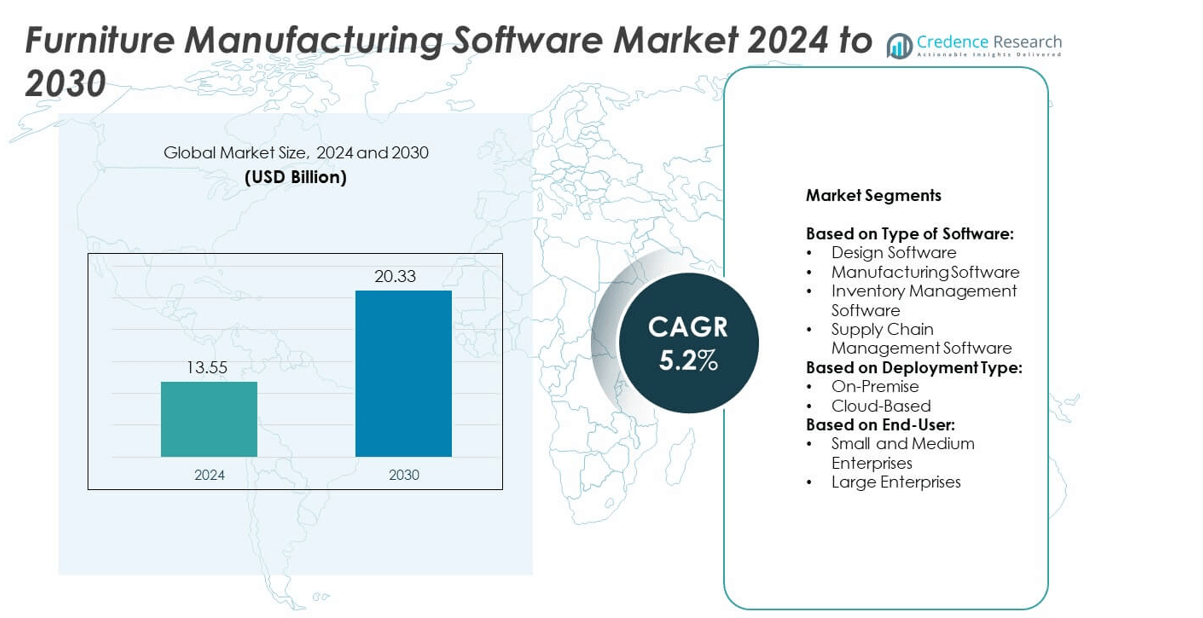
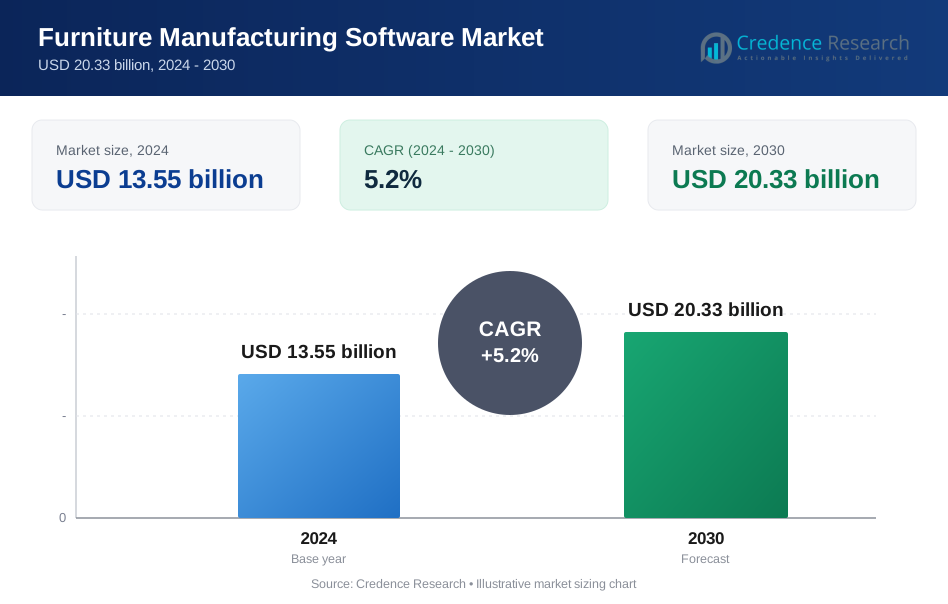
The furniture manufacturing software market size was valued at USD 13.55 billion in 2024 and is expected to reach USD 20.33 billion by 2030, growing at a CAGR of 5.2% during the forecast period.
| REPORT ATTRIBUTE | DETAILS |
|---|---|
| Historical Period | 2020-2023 |
| Base Year | 2024 |
| Forecast Period | 2025-2032 |
| Furniture Manufacturing Software Market Size 2024 | USD 13.55 billion |
| Furniture Manufacturing Software Market, CAGR | 5.2% |
| Furniture Manufacturing Software Market Size 2032 | USD 20.33 billion |
The Furniture Manufacturing Software market grows with rising demand for customized furniture and efficient production systems. Manufacturers adopt digital tools to streamline workflows, reduce waste, and improve design accuracy. Cloud-based solutions gain popularity for their scalability and remote access capabilities. Integration of AI, IoT, and automation enhances real-time monitoring and predictive maintenance. Sustainability goals drive adoption of software that tracks material usage and carbon footprint. These factors together strengthen competitiveness and support long-term growth in global manufacturing operations.
North America leads the Furniture Manufacturing Software market due to strong adoption of Industry 4.0 and advanced automation. Europe follows with demand driven by strict quality and sustainability regulations. Asia-Pacific shows fastest growth supported by rapid industrialization and rising furniture exports. Key players such as SAP, Autodesk, Microsoft, and Epicor focus on developing scalable cloud-based platforms, AI-enabled analytics, and integrated design-to-production solutions. Their strategies emphasize innovation, partnerships, and regional expansion to meet growing demand across diverse manufacturing sectors.
Market Insights
- The Furniture Manufacturing Software market was valued at USD 13.55 billion in 2024 and is projected to reach USD 20.33 billion by 2030 at a CAGR of 5.2%.
- Rising demand for customized furniture and faster production cycles drives software adoption globally.
- Trends include cloud-based deployment, AI-enabled analytics, IoT monitoring, and AR/VR integration for design visualization.
- The market is competitive with players like SAP, Autodesk, Microsoft, Trello, Epicor, Polyboard, and NetSuite investing in innovation.
- High implementation costs, integration complexity, and lack of skilled workforce remain major restraints.
- North America leads due to strong digital transformation, while Asia-Pacific shows fastest growth supported by industrialization and rising exports.
- Europe focuses on sustainability and compliance, Latin America and Middle East & Africa show gradual adoption supported by modernization initiatives.
Market Drivers
Rising Demand for Customization and Smart Manufacturing
Furniture Manufacturing Software market grows due to rising demand for personalized furniture solutions. Consumers expect tailored designs and faster delivery timelines. Manufacturers rely on software to streamline production and reduce errors. It improves coordination between design and production teams. Integration with CAD tools supports advanced modeling and visualization. Adoption enables quick configuration of designs based on customer inputs. This drives higher efficiency and better customer satisfaction.
- For instance, Premier Custom-Built uses Onshape CAD software and has developed more than 50 custom cabinet features, reducing time by 50-75 % when modeling multiple cabinets rather than one by one.
Focus on Digital Transformation and Industry 4.0 Adoption
The market expands with the ongoing shift toward digital manufacturing ecosystems. Software solutions support IoT-enabled monitoring and predictive maintenance. It helps reduce downtime and optimize machine utilization. Real-time data collection improves decision-making and inventory control. Cloud-based platforms offer scalability for small and large manufacturers. Integration with ERP systems enhances supply chain visibility. This strengthens competitiveness in global markets.
- For instance, imos AG's imos iX CAD/CAM software is used by more than 4,500 furniture producers globally. It supports the complete digital workflow from sales, design, and room-planning to CNC-machine control and the automatic flow of order-to-production data
Growing Pressure for Cost Optimization and Resource Efficiency
Manufacturers adopt software to reduce operational costs and material waste. It automates production planning and resource allocation. Advanced analytics identify inefficiencies and suggest process improvements. Real-time scheduling ensures optimal machine usage and labor management. Demand for sustainable manufacturing drives adoption of energy-saving tools. The software reduces rework and improves profitability. This supports long-term business growth.
Regulatory Compliance and Quality Assurance Requirements
The market benefits from rising focus on quality standards and compliance. Furniture producers use software to meet safety and sustainability regulations. It ensures traceability of raw materials and finished products. Automated quality checks reduce human error and improve consistency. Digital records support faster audits and certification processes. The software aligns manufacturing operations with environmental guidelines. This strengthens brand reputation and market acceptance.
Market Trends
Adoption of Cloud-Based and SaaS Solutions
Furniture Manufacturing Software market witnesses strong shift toward cloud deployment models. Companies prefer SaaS solutions for flexibility and reduced upfront costs. It allows remote access to data and collaboration across locations. Automatic updates improve security and keep systems current. Cloud platforms support scalability for growing production needs. Integration with third-party applications enhances workflow efficiency. This trend enables faster technology adoption for manufacturers.
- For instance, MBFZ toolcraft GmbH (Germany) used Visual Components simulation software to design a production line for drawers (size range 170 mm to 1450 mm) with “batch size 1” variant manufacturing.
Integration of AI, IoT, and Automation Tools
The market advances with rising use of AI-driven analytics and IoT sensors. Real-time monitoring improves production planning and predictive maintenance. It reduces downtime and improves machine performance. Automation tools streamline repetitive tasks and cut labor costs. AI-powered demand forecasting supports better inventory management. Software vendors invest in developing smarter interfaces and analytics dashboards. This trend enhances decision-making and operational precision.
- For instance, Bellmont Cabinet reduced manual label scans by 800 per shift using RFID-based operational step via Cyncly.
Emphasis on Sustainable and Eco-Friendly Manufacturing
Manufacturers focus on reducing waste and improving resource use. Furniture Manufacturing Software market supports compliance with green building standards. It tracks material usage and carbon footprint metrics. Optimized cutting patterns minimize raw material waste. Digital documentation reduces paper-based processes across facilities. Sustainability dashboards help companies report environmental performance. This trend aligns with rising demand for eco-friendly furniture solutions.
Growth of AR and VR in Design and Sales Processes
AR and VR integration transforms design and customer engagement workflows. It allows buyers to visualize furniture in real spaces before purchase. Designers use 3D modeling tools to refine concepts faster. Virtual showrooms reduce dependence on physical display areas. It improves customer confidence and reduces return rates. Integration with e-commerce platforms expands reach to online buyers. This trend creates immersive experiences that boost sales conversion.
Market Challenges Analysis
High Implementation Costs and Complexity of Integration
Furniture Manufacturing Software market faces challenges due to high initial investment requirements. Small and medium manufacturers hesitate to adopt due to limited budgets. It often demands costly customization to match specific production needs. Integration with existing ERP and CAD systems can be complex. Training employees to use new platforms requires time and resources. Slow adoption delays return on investment for many businesses. This creates barriers for rapid market penetration.
Data Security Concerns and Lack of Skilled Workforce
The market struggles with concerns over cybersecurity and data breaches. Cloud-based solutions raise questions about data privacy and control. It requires strong IT policies and regular security audits. Lack of skilled workforce limits full software utilization in many regions. Employees need technical expertise to manage digital tools effectively. Resistance to technology change also slows adoption. This challenge impacts productivity gains expected from digital transformation.
Market Opportunities
Expansion of Smart Factories and Digital Twins
Furniture Manufacturing Software market gains opportunities from rapid adoption of smart factories. Manufacturers invest in digital twins to simulate production processes. It enables predictive maintenance and better resource planning. Real-time analytics support quick decision-making and improved productivity. Integration with robotics enhances automation and reduces manual errors. Growing demand for data-driven manufacturing drives software upgrades. This creates strong potential for innovation and growth.
Rising Demand in Emerging Markets and Omnichannel Retail
Emerging economies present untapped opportunities for software vendors. Furniture manufacturers in Asia-Pacific and Latin America modernize operations to meet rising demand. It helps local companies compete with global players. Omnichannel retail expansion requires connected systems for inventory and production visibility. Software solutions support seamless coordination between online and offline channels. Growing furniture exports increase need for compliance and quality tracking. This fuels long-term adoption across developing regions.
Market Segmentation Analysis:
By Type of Software:
Design software holds a major share due to its role in creating precise 3D models and customized layouts. It supports faster prototyping and reduces design errors. Manufacturing software follows closely, enabling production scheduling, workflow automation, and machine integration. Inventory management software is crucial for controlling material usage and reducing waste. Supply chain management software ensures smooth coordination between suppliers, manufacturers, and distributors. It helps businesses maintain delivery timelines and improve customer satisfaction.
- For instance, Lista Office LO, a Swiss manufacturer of office furniture, implemented Siemens Teamcenter for product lifecycle management (PLM) and Solid Edge for computer-aided design (CAD). By utilizing Teamcenter's part family capabilities, they were able to dramatically reduce the time required for design modifications. A specific case study detailed a modification to a control unit for an adjustable-height desk which previously took two people two weeks (10 working days). After the Teamcenter implementation,
By Deployment Type:
Cloud-based solutions dominate due to their scalability and lower upfront costs. It offers remote access, making collaboration easier for distributed teams. Automatic updates and data backups improve system reliability and reduce downtime. On-premise deployment retains relevance for companies with strict data security requirements. Large manufacturers prefer hybrid models that combine flexibility and security. This segmentation highlights growing interest in digital transformation strategies.
- For instance, Silent Infotech implemented a tailored Odoo ERP solution for a US-based custom furniture manufacturer. The implementation resulted in significant operational improvements, including a 29% reduction in production lead times, not operational cost. The company also experienced a 20% decrease in production costs, a 50% increase in order-handling capacity, and a 70% improvement in customer satisfaction metrics due to reduced delivery times and stable product quality.
By End-User:
Large enterprises account for significant adoption due to complex production needs. It enables them to integrate multi-factory operations and gain real-time visibility. Advanced analytics help in resource optimization and process control. Small and medium enterprises are rapidly adopting cloud-based systems to remain competitive. User-friendly interfaces and subscription models lower entry barriers for these businesses. This encourages wider adoption across emerging markets and supports overall industry growth.
Segments:
Based on Type of Software:
- Design Software
- Manufacturing Software
- Inventory Management Software
- Supply Chain Management Software
Based on Deployment Type:
- On-Premise
- Cloud-Based
Based on End-User:
- Small and Medium Enterprises
- Large Enterprises
Based on the Geography:
- North America
- U.S.
- Canada
- Mexico
- Europe
- UK
- France
- Germany
- Italy
- Spain
- Russia
- Belgium
- Netherlands
- Austria
- Sweden
- Poland
- Denmark
- Switzerland
- Rest of Europe
- Asia Pacific
- China
- Japan
- South Korea
- India
- Australia
- Thailand
- Indonesia
- Vietnam
- Malaysia
- Philippines
- Taiwan
- Rest of Asia Pacific
- Latin America
- Brazil
- Argentina
- Peru
- Chile
- Colombia
- Rest of Latin America
- Middle East
- UAE
- KSA
- Israel
- Turkey
- Iran
- Rest of Middle East
- Africa
- Egypt
- Nigeria
- Algeria
- Morocco
- Rest of Africa
Regional Analysis
North America
North America holds the largest share of the Furniture Manufacturing Software market with 38% in 2024. Strong adoption of Industry 4.0 technologies drives growth across the United States and Canada. Manufacturers invest heavily in automation, digital twins, and advanced analytics to boost efficiency. It supports lean production, faster product launches, and higher customization. Cloud-based platforms gain traction, enabling remote collaboration and better scalability. Rising demand for sustainable manufacturing practices also encourages adoption of software that tracks material usage and waste reduction. Presence of leading vendors and technology providers further strengthens regional market leadership.
Europe
Europe accounts for 28% of the market share, driven by stringent regulatory standards and sustainability goals. Manufacturers focus on meeting EU directives on environmental compliance and product traceability. It promotes adoption of advanced software tools for quality assurance and supply chain transparency. Demand for premium and customized furniture solutions fuels investment in design software. Industry players adopt digital platforms to improve energy efficiency and production planning. Cloud-based solutions expand in Germany, France, and the UK to support multi-site operations. The region shows strong potential for continued growth with rising investment in smart manufacturing.
Asia-Pacific
Asia-Pacific represents 22% of the Furniture Manufacturing Software market and is the fastest-growing region. Rapid industrialization and urbanization in China, India, and Southeast Asia increase furniture production capacity. It supports adoption of inventory and supply chain management solutions to meet export demand. Government initiatives encouraging smart factory setups accelerate software integration in manufacturing units. Local manufacturers shift toward cloud-based systems to reduce IT infrastructure costs. Rising disposable incomes drive demand for customized furniture, boosting design software usage. The region offers strong opportunities for vendors targeting mid-sized manufacturers with affordable solutions.
Latin America
Latin America captures 7% of the market share, supported by gradual digital transformation in the furniture sector. Brazil and Mexico lead in adopting ERP-integrated manufacturing software for efficiency improvements. It enables better control over raw material procurement and production planning. Cloud adoption grows as enterprises seek cost-effective, scalable systems. Rising urban housing demand drives investment in furniture production and technology upgrades. Regional players focus on improving competitiveness against imported products through automation. Government programs supporting industry modernization also contribute to growth.
Middle East & Africa
Middle East & Africa hold a smaller share of 5% but show steady growth potential. The UAE and Saudi Arabia invest in modern manufacturing facilities to meet domestic demand. It encourages adoption of software that improves production visibility and inventory control. Growth of the hospitality and real estate sectors boosts demand for customized furniture solutions. Cloud-based systems are gaining adoption due to lower upfront investment needs. Regional manufacturers explore partnerships with global software providers for technology transfer. Focus on diversifying economies beyond oil strengthens future demand for digital solutions in manufacturing.
Key Player Analysis
- Epicor
- Trello
- Autodesk
- SAP
- Lucidchart
- SolidWorks
- Microsoft
- Chairish
- Infor
- CADprofi
- SketchUp
- Panthera
- Polyboard
- NetSuite
- Furnishings
Competitive Analysis
The Furniture Manufacturing Software market is highly competitive with key players including SAP, Trello, Autodesk, Microsoft, SketchUp, Epicor, Polyboard, Infor, SolidWorks, NetSuite, Chairish, Panthera, Lucidchart, and CADprofi, SketchUp, Panthera, Polyboard, NetSuite, Furnishings. These companies focus on delivering comprehensive solutions that support design, production, and inventory management for furniture manufacturers. The market features a mix of enterprise-level vendors and specialized software providers catering to small and medium enterprises. It is characterized by strong investment in product innovation, with companies integrating AI, IoT, and cloud capabilities to enhance efficiency. Vendors compete by offering scalable solutions with intuitive interfaces to attract a broader customer base. Strategic partnerships with furniture producers and ERP system providers strengthen their market position. Continuous updates and feature enhancements help retain existing customers and improve user experience. Competition also drives focus on pricing flexibility, with subscription-based models gaining popularity. Regional expansion remains a priority, especially in Asia-Pacific and Latin America, where manufacturing is growing rapidly. Strong after-sales support and training services further differentiate leading vendors in this dynamic market.
Recent Developments
- In 2024, SketchUp remains a popular tool for furniture designers by providing flexible modeling, quick design reviews, and alternative solutions. It is noted for its ease of use and rich plugin ecosystem that supports high-quality renderings and graphics for 3D models.
- In 2024, Autodesk announced its AutoCAD 2025 update, which enhanced industry-specific toolsets (architecture, mechanical, electrical, MEP, etc.) and improved collaboration via shared changes syncing across users
- In 2023, Epicor released Kinetic 2023.1. It introduced elevated browser UX, automated fulfillment rules, procure-to-pay visualization, LOT trace views, and enhanced dashboards.
Report Coverage
The research report offers an in-depth analysis based on Type of Software, Deployment Type, End-User and Geography. It details leading market players, providing an overview of their business, product offerings, investments, revenue streams, and key applications. Additionally, the report includes insights into the competitive environment, SWOT analysis, current market trends, as well as the primary drivers and constraints. Furthermore, it discusses various factors that have driven market expansion in recent years. The report also explores market dynamics, regulatory scenarios, and technological advancements that are shaping the industry. It assesses the impact of external factors and global economic changes on market growth. Lastly, it provides strategic recommendations for new entrants and established companies to navigate the complexities of the market.
Future Outlook
- The market will see rising adoption of cloud-based platforms for scalable operations.
- Integration of AI and machine learning will improve production planning and forecasting.
- Demand for design software will grow with rising preference for customized furniture.
- IoT-enabled monitoring will enhance real-time visibility and predictive maintenance.
- Vendors will focus on developing user-friendly interfaces for small and medium enterprises.
- Sustainability reporting tools will gain importance for meeting regulatory requirements.
- Virtual and augmented reality will expand for customer visualization and virtual showrooms.
- Hybrid deployment models will rise to balance data security and flexibility.
- Collaboration tools will strengthen remote design and cross-location manufacturing coordination.
- Emerging markets will drive new growth opportunities through rapid industrialization and urban demand.
Request a Free Sample
Fill in your details and we'll send you a free sample report.
- Sample data tables & charts
- Research methodology
Need a Custom Version of This Report?
Tailor the scope, geography, or segments to your exact requirements.
- Custom geography or segment scope
- Direct access to our analyst team
Frequently Asked Questions
What is the current market size for Furniture Manufacturing Software market, and what is its projected size in 2030?
At what Compound Annual Growth Rate is the Furniture Manufacturing Software Market projected to grow between 2025 and 2030?
Which Furniture Manufacturing Software market segment held the largest share in 2024?
What are the primary factors fueling the growth of the Furniture Manufacturing Software market?
Who are the leading companies in the Furniture Manufacturing Software Market?
Table of Content
Chapter 1. Report Introduction
- 1.1 Report Description & Purpose
- 1.1.1 Report Title & Market Definition
- 1.1.2 Unique Selling Propositions (USP) & Key Differentiators
- 1.1.3 Value Proposition for Stakeholders
- 1.2 Research Objectives
- 1.2.1 Market Sizing Objectives (Volume & Revenue)
- 1.2.2 Segmentation Objectives
- 1.2.3 Competitive Intelligence Objectives
- 1.2.4 Forecast & Scenario Objectives
- 1.3 Report Scope
- 1.3.1 Furniture Manufacturing Software Scope – Types & Subtypes Covered
- 1.3.2 Geographic Scope – Regions & Countries Covered
- 1.3.3 Historical Period, Base Year & Forecast Period (2024; forecast to 2030)
- 1.3.4 Inclusions & Exclusions
- 1.4 HS Code & Classification Framework
- 1.5 Currency, Units & Pricing Basis
- 1.6 Target Stakeholders
- 1.7 Limitations & Assumptions
Chapter 2. Executive Summary
- 2.1 Global Furniture Manufacturing Software Market Snapshot
- 2.1.1 Market Size – Historical (2024) & Forecast (2024-2030) (2024: USD 13.55 billion → 2030: USD 20.33 billion)
- 2.1.2 Volume & Revenue – Global Totals
- 2.1.3 Key Market Highlights – Top Five Facts
- 2.2 Furniture Manufacturing Software Market Segmentation Snapshot
- 2.2.1 Market Split by Region – 2024 vs. 2030
- 2.3 Competitive Snapshot
- 2.3.1 Top 10 Players by Revenue Share – 2024
- 2.3.2 Top 10 Players by Volume Share – 2024
- 2.3.3 Recent Strategic Developments (18-Month Summary)
- 2.4 Key Investment Highlights & Strategic Conclusions
Chapter 3. Furniture Manufacturing Software Market Dynamics & Industry Analysis
- 3.1 Market Overview & Context
- 3.1.1 Furniture Manufacturing Software Market Position in the Broader Automotive Value Chain
- 3.1.2 OEM vs. Replacement Market Dynamics
- 3.1.3 Market Maturity & Development Stage by Region
- 3.2 Furniture Manufacturing Software Market Drivers
- 3.3 Furniture Manufacturing Software Market Restraints & Challenges
- 3.4 Furniture Manufacturing Software Market Opportunities
- 3.5 Porter's Five Forces Analysis
- 3.5.1 Threat of New Entrants
- 3.5.2 Bargaining Power of Suppliers
- 3.5.3 Bargaining Power of Buyers
- 3.5.4 Threat of Substitutes
- 3.5.5 Competitive Rivalry – Intensity Assessment
- 3.6 Furniture Manufacturing Software Value Chain Analysis
- 3.6.1 Upstream – Raw Material/Input Suppliers
- 3.6.1.1 Raw Material/Input 1
- 3.6.1.2 Raw Material/Input 2
- 3.6.1.3 Raw Material/Input 3
- 3.6.2 Midstream – Production/Manufacturing/Service Delivery
- 3.6.2.1 Production/Process Overview
- 3.6.2.2 Key Facility Locations & Capacity by Manufacturer
- 3.6.3 Downstream – Distribution & End Consumer
- 3.6.3.1 Primary Channel – B2B/OEM
- 3.6.3.2 Secondary Channels – Dealer, Retail, Online, Direct
- 3.6.4 Value Chain Profitability Analysis
- 3.6.1 Upstream – Raw Material/Input Suppliers
- 3.7 PESTEL Analysis
- 3.7.1 Political Factors
- 3.7.2 Economic Factors
- 3.7.3 Social Factors
- 3.7.4 Technological Factors
- 3.7.5 Environmental Factors
- 3.7.6 Legal Factors
- 3.8 Furniture Manufacturing Software Supply Chain Analysis
- 3.8.1 Raw Material/Input Supply Risk Assessment
- 3.8.2 Manufacturing Concentration Risk (Geographic Exposure)
- 3.8.3 Trade Disruption Impact Analysis
- 3.9 Regulatory & Policy Landscape
Note: The regulatory and policy landscape section covers regulations based on their applicability to the market, Furniture Manufacturing Software category, geography, and scope of the study. Only regulatory frameworks with a material impact on operations, compliance, trade, sustainability, or market access are analyzed in detail.
Chapter 4. Key Investment Pockets & Opportunity Analysis
- 4.1 Furniture Manufacturing Software Market Attractiveness Analysis
- 4.1.1 By Region – Investment Attractiveness Matrix (Volume × CAGR)
- 4.2 Absolute Revenue Growth Opportunity
- 4.2.1 By Region – Absolute USD Growth Through 2030
- 4.3 Incremental Volume Opportunity
- 4.3.1 By Region – Incremental Volume Through 2030
- 4.3.2 Segment – Incremental Volume
- 4.4 Emerging Submarket Opportunity Deep Dive (Subject to Applicability)
- 4.5 Emerging Market Opportunity Scorecards
- 4.5.1 United States
- 4.5.2 Europe
- 4.5.3 Asia
- 4.5.4 Middle East & Africa
Note: Emerging Market Opportunity Scorecards will be included based on relevance and strategic importance. Regions listed are indicative and may vary depending on data availability and market dynamics.
Chapter 5. Furniture Manufacturing Software Import-Export Analysis & Trade Flows
- 5.1 Global Trade Overview
- 5.1.1 Global Export Value by Country (2024)
- 5.1.2 Global Export Volume by Country (2024)
- 5.1.3 Global Import Value by Country (2024)
- 5.1.4 Global Import Volume by Country (2024)
- 5.1.5 Net Trade Balance by Country (2024)
- 5.2 Export Analysis – Segment
- 5.2.1 Type 1 (HS Code)
- 5.2.2 Type 2 (HS Code)
- 5.2.3 Type 3 (HS Code)
- 5.2.4 Type 4 (HS Code)
- 5.2.5 Type 5 (HS Code)
- 5.3 Import Analysis – Segment
- 5.3.1 Type 1 (HS Code)
- 5.3.2 Type 2 (HS Code)
- 5.3.3 Type 3 (HS Code)
- 5.3.4 Type 4 (HS Code)
- 5.3.5 Type 5 (HS Code)
- 5.4 Average Unit Trade Prices
- 5.4.1 Average Export Price – Segment & Country
- 5.4.2 Average Import Price – Segment & Source Country
- 5.4.3 Price Trends (2024)
- 5.5 Key Trade Route Analysis
- 5.5.1 Trade Route 1
- 5.5.2 Trade Route 2
- 5.5.3 Trade Route 3
- 5.5.4 Trade Route 4
- 5.5.5 Trade Route 5
- 5.6 Trade Policy Impact Assessment
- 5.6.1 US Anti-Dumping & Section 301 Tariffs
- 5.6.2 EU Customs Union Impact
- 5.6.3 Major Free Trade Agreements
- 5.6.4 USMCA Rules of Origin
Note: Trade policy analysis will be included only where relevant to the Furniture Manufacturing Software market.
Chapter 6. Competitive Landscape & Company Benchmarking
- 6.1 Furniture Manufacturing Software Market Concentration & Structure
- 6.1.1 Herfindahl-Hirschman Index (HHI) – vs. 2024
- 6.1.2 Tier 1, Tier 2 & Tier 3 Market Structure
- 6.1.3 Global, Regional & Local Player Dynamics
- 6.2 Furniture Manufacturing Software Market Share Analysis – 2024
- 6.2.1 Global Revenue Share by Company
- 6.2.2 Global Volume Share by Company
- 6.2.3 Regional Revenue Share
- 6.2.4 Market Share Evolution ( vs. 2024)
- 6.2.5 OEM Segment Share by Company
- 6.2.6 Replacement Segment Share by Company
- 6.3 Production/Delivery Capacity & Facility Analysis
- 6.3.1 Global Installed Capacity
- 6.3.2 Capacity Utilization Rates
- 6.3.3 Production/Output Volume
- 6.3.4 Facility Locations & Capacity Map
- 6.3.5 Planned Capacity Additions
- 6.4 Furniture Manufacturing Software Competitive Benchmarking Matrix
- 6.4.1 Revenue, Volume, CAGR & Profitability Comparison
- 6.4.2 Channel Revenue Mix
- 6.4.3 Geographic Revenue Exposure
- 6.4.4 R&D Intensity
- 6.4.5 Sustainability Maturity
- 6.5 Strategic Developments in Furniture Manufacturing Software (Last 24 Months)
- 6.5.1 Mergers, Acquisitions & Divestments
- 6.5.2 New Furniture Manufacturing Software Launches
- 6.5.3 Facility Expansions
- 6.5.4 Strategic Alliances, Joint Ventures & Partnerships
- 6.5.5 Distribution Expansion & Market Entry
- 6.5.6 Sustainability & ESG Initiatives
- 6.6 Competitive Strategy Mapping
- 6.6.1 Leader, Challenger, Follower & Niche Classification
- 6.6.2 Pricing Strategy Comparison
- 6.6.3 Channel Strategy Matrix
Note: Strategic developments are included based on their materiality and the availability of reliable information.
Chapter 7. Global Furniture Manufacturing Software Market – By Distribution Channel
- 7.1 Segment Overview
- 7.1.1 Volume & Revenue Split by Channel (2024 & 2030)
- 7.1.2 Channel Mix Evolution (2024-2030)
Chapter 8. Regional Market Analysis – Global Overview
- 8.1 Global Regional Overview
- 8.1.1 Regional Volume Share
- 8.1.2 Regional Revenue Share
- 8.1.3 Regional Volume by Region
- 8.1.4 Regional Revenue by Region
- 8.1.5 Regional Forecast Through 2030
- 8.2 Cross-Regional Segment Analysis
- 8.2.1 By Distribution Channel
- 8.2.2 By Brand/Price Tier
Chapter 9. North America Furniture Manufacturing Software Market
- 9.1 United States
- 9.2 Canada
- 9.3 Mexico
Chapter 10. Europe Furniture Manufacturing Software Market
- 10.1 Germany
- 10.2 France
- 10.3 Italy
- 10.4 United Kingdom
- 10.5 Spain
- 10.6 Poland
- 10.7 Russia
- 10.8 Netherlands
- 10.9 Belgium
- 10.10 Sweden
- 10.11 Denmark
- 10.12 Norway
- 10.13 Rest of Europe
Chapter 11. Asia Pacific Furniture Manufacturing Software Market
- 11.1 China
- 11.2 India
- 11.3 Japan
- 11.4 South Korea
- 11.5 Thailand
- 11.6 Indonesia
- 11.7 Vietnam
- 11.8 Malaysia
- 11.9 Australia
- 11.10 Rest of Asia Pacific
Chapter 12. Latin America Furniture Manufacturing Software Market
- 12.1 Brazil
- 12.2 Argentina
- 12.3 Colombia
- 12.4 Chile
- 12.5 Rest of Latin America
Chapter 13. Middle East Furniture Manufacturing Software Market
- 13.1 Saudi Arabia
- 13.2 United Arab Emirates
- 13.3 Turkey
- 13.4 Israel
- 13.5 Iran
- 13.6 Rest of the Middle East
Chapter 14. Africa Furniture Manufacturing Software Market
- 14.1 South Africa
- 14.2 Egypt
- 14.3 Nigeria
- 14.4 Morocco
- 14.5 Rest of Africa
Chapter 15. Furniture Manufacturing Software Company Profiles
- 15.1 [Company 01]
- 15.1.1 Company Overview
- 15.1.2 Key Management Personnel
- 15.1.3 Products & Services Portfolio
- 15.1.4 Financial Performance
- 15.1.5 Key Market Focus & Geographic Presence
- 15.1.6 Recent Developments & Strategic Initiatives
Note: The company profile list is preliminary and may change based on research findings, market developments, data availability, and client requirements.
Chapter 16. Appendices
- Appendix A – List of Abbreviations & Acronyms
- Appendix B – Industry Classification Code Reference – Full Series
- Appendix C – Production & Capacity Data Tables
- Appendix D – End-Use & Demand Base Tables
- Appendix E – Consumption & Replacement Rate Assumptions
- Appendix F – ASP Reference Tables
- Appendix G – Manufacturing & Facility Database
- Appendix H – Import-Export Data Tables
- Appendix I – Regulatory Summary Tables
- Appendix J – Primary Research Participant List (Anonymized)
- Appendix K – Primary Research Questionnaire Framework
- Appendix L – Data Sources & Bibliography
- Appendix M – Market Size Divergence & Source Comparison
Chapter 17. Research Methodology
- 17.1 Research Framework & Philosophy
- 17.2 Secondary Research – Sources, Hierarchy & Data Extraction
- 17.3 Data Modeling – Bottom-Up & Top-Down Market Sizing
- 17.4 Primary Research – Stakeholder Framework, LOI & Sample Sizes
- 17.5 Forecast Methodology – Regression, Scenario & Sensitivity Analysis
- 17.6 Quality Control – Four-Layer Validation Framework
- 17.7 Limitations & Standard Assumptions
- 17.8 Disclaimer
