
Southeast Asia Road Marker Posts Market Overview:
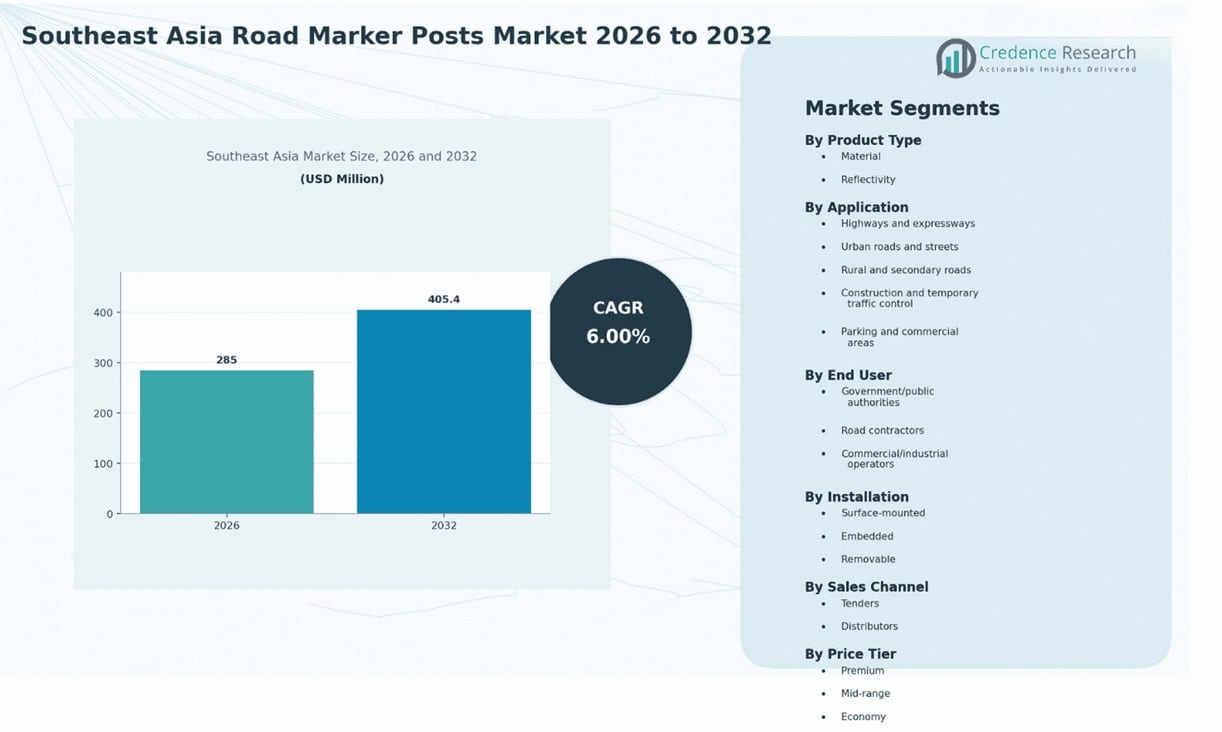
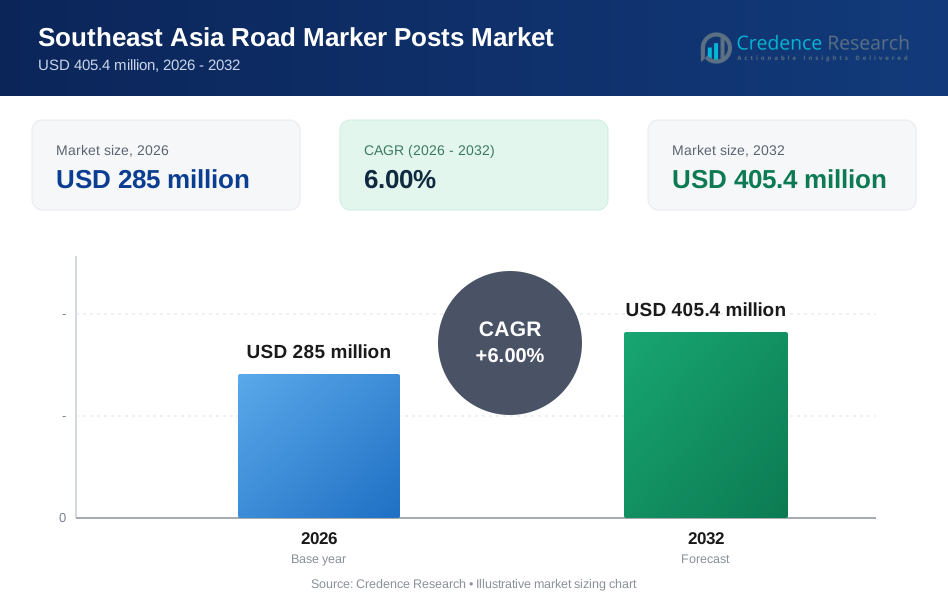
The Southeast Asia Road Marker Posts Market size was valued at USD 285 million in 2026. It is anticipated to reach USD 405.4 million by 2032, growing at a CAGR of 6.00% during the forecast period.
| REPORT ATTRIBUTE | DETAILS |
|---|---|
| Historical Period | 2021-2025 |
| Base Year | 2026 |
| Forecast Period | 2027-2032 |
| Southeast Asia Road Marker Posts Market Size 2026 | USD 285 million |
| Southeast Asia Road Marker Posts Market, CAGR | 6.00% |
| Southeast Asia Road Marker Posts Market Size 2032 | USD 405.4 million |
Southeast Asia Road Marker Posts Market Insights
- Market growth is supported by highway and road infrastructure expansion, road safety modernization, urbanization, smart city traffic management and rising adoption of modular and reflective materials.
- Product demand is shaped by material durability and reflectivity performance, as road authorities and contractors prioritize better visibility, longer service life and lower maintenance needs.
- Highways and expressways remain the leading application area, supported by toll road development, intercity connectivity projects and safety upgrades across high-speed corridors.
- Indonesia leads the Southeast Asia Road Marker Posts Market with 24% share, supported by road network expansion, toll road development, logistics corridor investment and public infrastructure spending.
Southeast Asia Road Marker Posts Market Segment Insights
By product type
By product type, material-based road marker posts held a strong position in 2026 because contractors and public authorities evaluate durability, weather resistance, impact recovery and lifecycle cost before procurement. Plastic, composite and flexible materials are gaining relevance where roads require quick deployment, reduced maintenance and better resilience against vehicle impact. Reflectivity remains a critical product attribute because marker posts must improve lane guidance, shoulder visibility and driver awareness in low-light and adverse weather conditions. Demand for reflective products is rising across highways, expressways, construction zones and rural roads. The market will favor products that combine durable materials with high-visibility reflective surfaces and simple installation.
By application
By application, highways and expressways led the Southeast Asia Road Marker Posts Market in 2026, supported by ongoing toll road construction, intercity road upgrades and high-speed corridor development. These routes require clear delineation, strong nighttime visibility and durable roadside safety systems. Urban roads and streets represent a major application area as cities modernize traffic management, improve junction safety and upgrade pedestrian-adjacent corridors. Rural and secondary roads create steady demand because governments need cost-effective safety solutions for lower-visibility and accident-prone routes. Construction and temporary traffic control also support demand for removable and surface-mounted posts. Parking and commercial areas remain smaller but relevant for traffic flow control and site safety.
By end user
By end user, government/public authorities held the strongest position in 2026 because most road marker post demand comes from public highways, municipal roads and safety improvement programs. Public agencies use tenders to procure marker posts for highway expansion, rural road upgrades and road safety modernization. Road contractors represent a major demand base because they install posts as part of new road construction, repair and traffic control projects. Commercial/industrial operators use marker posts in logistics parks, factories, ports, parking facilities and private roads. Demand across all end users is rising as safety, visibility and traffic flow become central to infrastructure quality.
By installation
By installation, surface-mounted posts held a strong position in 2026 because they offer faster installation, easier replacement and suitability for temporary or retrofit road safety projects. These posts are widely used in construction zones, urban streets, parking areas and selected highway locations. Embedded posts remain important in permanent road applications where authorities require stronger anchoring, longer service life and better stability under harsh weather or vehicle impact. Removable posts are gaining demand in temporary traffic control, work zones and flexible lane management. Installation choice depends on road type, project duration, traffic speed, maintenance access and safety specifications. Growth will favor modular systems that reduce installation time and lifecycle cost.
By sales channel
By sales channel, tenders led the market in 2026 because public road agencies, highway authorities and municipal bodies procure road marker posts through structured bidding processes. Tender-driven procurement emphasizes compliance, price competitiveness, product durability and supplier credibility. Distributors remain important because they serve road contractors, small municipalities, commercial operators and temporary traffic control providers that need faster supply and local inventory. Distributor networks also help international manufacturers reach fragmented local markets across Southeast Asia. Demand through both channels will grow as infrastructure projects increase and safety standards become more formalized. Suppliers that combine tender capability with distributor reach will gain a stronger competitive position.
By price tier
By price tier, mid-range products held a strong position in 2026 because they balance cost, durability and reflectivity for public agencies and contractors. Premium products serve highways, expressways, tunnels, bridges and high-risk corridors where performance standards are stricter and maintenance access is costly. Economy products remain relevant in rural roads, temporary control areas and price-sensitive municipal projects. Buyers increasingly assess total lifecycle cost rather than only upfront price, especially where poor visibility or frequent replacement creates safety and maintenance risks. Premium and mid-range products are expected to gain share as road safety budgets improve. Economy products will remain important where project funding remains limited.
Key market drivers
Driver Impact Summary
| Driver | Estimated % Impact on CAGR Forecast | Geographic Relevance | Impact Timeline |
| Highway and road infrastructure expansion | +2.2% | Indonesia, Thailand, Vietnam, Philippines and Malaysia | Medium term |
| Road safety modernization | +1.6% | Indonesia, Thailand, Vietnam, Philippines and Rest of Southeast Asia | Long term |
| Urbanization and smart city traffic management | +1.2% | Singapore, Malaysia, Thailand, Vietnam and Indonesia | Medium term |
| Modular/reflective material adoption | +1.2% | Indonesia, Thailand, Malaysia, Singapore and Vietnam | Long term |
Highway and road infrastructure expansion
Highway and road infrastructure expansion represents the strongest growth driver for the Southeast Asia road marker posts market, with an estimated +2.2% impact on the CAGR forecast. Governments across Indonesia, Thailand, Vietnam, the Philippines and Malaysia continue to invest in highways, expressways, bridges, bypasses and logistics corridors to improve connectivity and reduce travel time. New road construction creates direct demand for marker posts, delineators and reflective safety products during both initial installation and post-construction safety upgrades. Expansion of toll roads and freight corridors also raises demand for durable posts that can withstand high-speed traffic conditions and harsh weather. ASEAN’s land transport program identifies the ASEAN Highway Network as 23 designated national highway routes with a total length of 38,400 kilometers, reinforcing the scale of regional road connectivity that supports long-term roadside safety product demand. Contractors benefit from standardized products that simplify installation and reduce maintenance workloads. This driver will remain important through 2032 because road expansion remains central to trade, tourism, urban growth and regional logistics competitiveness.
Road safety modernization
Road safety modernization supports market growth, with an estimated +1.6% impact on the CAGR forecast. Southeast Asian countries face persistent road safety challenges linked to rising vehicle ownership, mixed traffic conditions, nighttime visibility gaps and inconsistent safety infrastructure. Road marker posts help authorities improve lane guidance, curve visibility, shoulder awareness and work-zone safety at relatively low cost. Modern reflective posts also support safer driving in rain, fog and poorly lit environments, which makes them important for rural and secondary roads. An ASEAN policy brief reported that the region’s road traffic injury mortality rate reached 17.6 deaths per 100,000 population in 2019, with Vietnam, Thailand and Malaysia accounting for 48% of ASEAN mortality from road traffic injuries, showing why visible roadside guidance remains a policy priority. Governments and contractors increasingly treat posts as part of broader safety systems that include signs, road markings, barriers and speed management. The Southeast Asia road marker posts market will benefit as safety upgrades move from isolated projects to more systematic road network improvement programs.
Urbanization and smart city traffic management
Urbanization and smart city traffic management contribute an estimated +1.2% impact on the CAGR forecast. Rapid urban growth across Southeast Asia increases traffic density, intersection complexity and demand for clearer roadside guidance. Marker posts support lane separation, pedestrian zone protection, parking control, construction management and traffic flow improvement in congested urban areas. Smart city programs also encourage better-organized road corridors, visible safety assets and modular traffic control tools that can adapt to changing mobility patterns. ASEAN’s Smart Cities Network began with 26 pilot cities, while ASEAN’s smart city framework notes that 90 million more people are expected to urbanize by 2030 and middleweight cities of 200,000 to 2 million residents are forecast to drive 40% of the region’s growth. Urban road agencies favor products that install quickly, remain visible in dense traffic and require limited maintenance. This driver will support demand across urban roads, commercial areas, parking facilities and temporary traffic control applications.
Modular and reflective material adoption
Modular and reflective material adoption supports market expansion, with an estimated +1.2% impact on the CAGR forecast. Road authorities and contractors are shifting toward posts that offer higher reflectivity, better impact recovery, improved weather resistance and easier replacement. Modular systems reduce installation time and help maintenance teams replace damaged units without major road disruption. Reflective materials improve nighttime visibility and support safer driving in wet or low-light conditions. This trend is important in tropical climates where heavy rainfall, heat and humidity can reduce the service life of low-quality products. 3M states that its Diamond Grade DG3 reflective sheeting uses full-cube prismatic technology to return almost 60% of available light to motorists, nearly twice the level of Type IV sheeting, supporting the case for higher-grade reflective materials in roadside safety assets. Suppliers that provide durable, high-visibility and easy-to-install marker posts will gain opportunities across tenders, distributor-led sales and maintenance contracts.
Key Trends and Opportunities
Growth of highway safety upgrades
Highway safety upgrades are becoming a major opportunity as governments expand toll roads, expressways and intercity corridors. High-speed roads need stronger lane delineation, curve guidance, median visibility and shoulder marking. Marker posts provide a cost-effective way to improve safety during both new construction and network maintenance. Demand is expected to grow across Indonesia, Vietnam, Thailand and the Philippines as road authorities expand transport corridors and upgrade accident-prone stretches. Contractors can benefit from products that meet visibility, impact resistance and installation standards. Suppliers with reliable tender documentation and regional distribution will capture stronger project demand.
Demand for temporary traffic control systems
Temporary traffic control systems are gaining importance as road construction, resurfacing and utility works increase across urban and highway networks. Removable and surface-mounted marker posts help contractors guide vehicles safely through work zones, lane shifts and maintenance areas. These products support faster deployment than permanent installations and reduce disruption during short-term projects. Construction and temporary traffic control applications will remain attractive because Southeast Asia continues to build and repair roads at scale. Rental, distributor and contractor channels can expand with modular products that are reusable, durable and easy to transport. This trend supports steady recurring demand beyond one-time infrastructure installation.
Reflective and weather-resistant materials gain preference
Reflective and weather-resistant materials are gaining preference because Southeast Asian roads face heavy rainfall, humidity, heat and intense vehicle exposure. Low-quality posts can fade, crack or lose visibility, raising replacement costs and weakening safety outcomes. Buyers increasingly seek products with strong reflective performance, impact resistance and longer service life. This creates opportunities for premium and mid-range suppliers that can prove durability under tropical conditions. Material innovation also supports better performance in highways, rural corridors and construction zones. Suppliers that combine reflective technology with cost-efficient manufacturing will be better positioned in public tenders and distributor networks.
Key Market Challenges
Price-sensitive public procurement
Price-sensitive public procurement remains a key challenge for the Southeast Asia Road Marker Posts Market. Public agencies often award contracts through competitive tenders that place strong emphasis on upfront cost. This can limit adoption of premium products even when they offer better durability, reflectivity and lifecycle value. Contractors may also select lower-cost products when project budgets are tight or specifications remain broad. Price pressure can affect margins for suppliers that invest in advanced materials and certified reflective surfaces. Stronger lifecycle cost analysis and clearer performance standards will help shift procurement toward higher-quality products.
Inconsistent standards and fragmented demand
Inconsistent standards and fragmented demand can slow market development. Road marker post specifications vary across countries, provinces, municipalities and project owners. Differences in installation rules, reflectivity requirements, material standards and tender documentation create complexity for suppliers operating across Southeast Asia. Fragmented local demand also makes it harder to scale production, inventory and distribution efficiently. Smaller municipalities and contractors may lack technical guidance on product selection and maintenance. Suppliers with local partners, flexible product lines and strong compliance support will manage this challenge more effectively.
Durability issues in harsh operating conditions
Durability issues in harsh operating conditions create a major challenge for product performance and buyer confidence. Southeast Asia’s roads experience heavy rain, flooding, heat, UV exposure, dust, roadside vegetation and frequent vehicle contact. Poor-quality marker posts can lose reflectivity, bend, break or detach from surfaces. Frequent replacement increases maintenance cost and can weaken road safety outcomes. Contractors and road authorities need products that retain visibility and structural performance under local conditions. Manufacturers that provide tested materials, strong anchoring systems and replacement support will gain an advantage.
Regional Analysis
Indonesia
Indonesia led the market with 24% share in 2026, supported by toll road expansion, inter-island connectivity needs, logistics corridor development and high public infrastructure demand. The country’s large geography creates demand for marker posts across highways, rural roads, urban corridors and construction sites. Road safety upgrades are important as traffic volume rises across Java, Sumatra, Kalimantan and other growth regions. Government/public authorities and road contractors represent the strongest end users because many projects move through public procurement and concession models. Indonesia is expected to retain leadership through 2032 as infrastructure investment supports both new installations and replacement demand.
Thailand
Thailand accounted for 19% share in 2026, supported by expressway projects, regional logistics corridors, tourism-linked road upgrades and urban traffic management needs. The country’s road network supports freight movement, cross-border connectivity and major metropolitan mobility, creating steady demand for delineation and reflective safety products. Highways and expressways remain the strongest application area, while urban roads and construction zones provide additional opportunities. Road contractors and public authorities continue to require products that balance cost, visibility and durability. Thailand will remain a major regional market as transport infrastructure and smart city programs support traffic safety investment.
Vietnam
Vietnam held 17% share in 2026, driven by expressway development, national road upgrades and rapid urbanization. The country’s infrastructure expansion creates strong demand for marker posts across new highways, secondary roads, bridges, construction areas and industrial corridors. Urban growth in Hanoi, Ho Chi Minh City and emerging provincial centers supports demand for traffic organization, parking control and temporary road safety products. Vietnam also offers opportunities for mid-range and economy products because contractors need scalable solutions for fast-moving road projects. Demand is expected to grow through 2032 as the country expands road capacity and improves transport connectivity.
Philippines
The Philippines accounted for 14% share in 2026, supported by national infrastructure programs, island connectivity needs, urban congestion management and road safety upgrades. The country’s archipelagic structure creates steady demand for road safety products across highways, bridges, city streets and regional roads. Construction and temporary traffic control applications are important because roadwork and urban infrastructure projects require flexible delineation systems. Public procurement remains the leading sales route, while distributors support smaller contractors and commercial operators. The Philippines will remain an attractive market as road investment, safety modernization and city traffic management continue to advance.
Malaysia
Malaysia held 12% share in 2026, supported by mature highway networks, toll road maintenance, logistics corridors and urban road safety programs. The country has relatively stronger procurement standards, which supports demand for premium and mid-range reflective products. Road marker posts are used across expressways, municipal roads, industrial zones, parking areas and temporary construction corridors. Malaysia also benefits from strong contractor capacity and distributor networks that support replacement and maintenance demand. Growth will remain steady as authorities upgrade existing roads and improve visibility in high-traffic and accident-prone zones.
Singapore
Singapore accounted for 5% share in 2026, representing a smaller but quality-focused market. The country’s dense road network, strict safety requirements and high urban infrastructure standards support demand for premium marker posts and traffic management products. Applications are concentrated in urban roads, construction and temporary traffic control, parking facilities, commercial areas and specialized infrastructure zones. Buyers prioritize product reliability, reflectivity, compliance and lifecycle performance. Market size is limited by geography, but value per installation can remain high. Singapore will continue to serve as a premium and specification-driven market in Southeast Asia.
Rest of Southeast Asia
Rest of Southeast Asia held 9% share in 2026, covering smaller and emerging markets such as Cambodia, Laos, Myanmar, Brunei and Timor-Leste. Demand is supported by rural road development, cross-border connectivity, donor-funded infrastructure and selective urban road upgrades. Market adoption remains uneven because funding availability, procurement capacity and standards differ widely across countries. Economy and mid-range products are expected to dominate, while premium products will remain limited to major corridors and externally financed projects. Distributors play an important role in supplying fragmented markets. Growth will depend on public infrastructure funding and road safety modernization programs.
Company
- 3M
- SWARCO
- Valmont Industries
- Pexco
- Avery Dennison
- Lindsay
- Geveko Markings
- Ennis-Flint
- Sherwin-Williams
- Plasticade
- Impact Recovery Systems
Southeast Asia Road Marker Posts Market Segmentations
By Product Type
- Material
- Reflectivity
By Application
- Highways and Expressways
- Urban Roads and Streets
- Rural and Secondary Roads
- Construction and Temporary Traffic Control
- Parking and Commercial Areas
By End User
- Government/Public Authorities
- Road Contractors
- Commercial/Industrial Operators
By Installation
- Surface-Mounted
- Embedded
- Removable
By Sales Channel
- Tenders
- Distributors
By Price Tier
- Premium
- Mid-Range
- Economy
Recent Developments
- In October 2023, Geveko Markings acquired PPG Traffic Solutions business in Australia and New Zealand, formerly known as Ennis-Flint Australia and New Zealand, strengthening its road marking and traffic safety portfolio in the wider Asia Pacific region.
- In May 2024, Geveko Markings sponsored the European Cyclists’ Federation Road Safety Award for the third consecutive year, reinforcing its positioning in road safety and visible traffic guidance solutions.
- In October 2024, ADB’s Southeast Asia transport portfolio identified road safety improvement projects in Cambodia, the Philippines, Thailand and Vietnam, supporting regional demand for roadside safety products and traffic delineation systems.
- In 2025, 3M continued to promote wet retroreflective pavement markings, high-performance traffic sign materials and delineation devices for highways, city streets and construction zones.
Report Coverage
The research report offers an in-depth analysis based on product type, application, end user, installation, sales channel, price tier and region. It details leading market players, providing an overview of their business positioning, product offerings, distribution strength and strategic relevance in the Southeast Asia Road Marker Posts Market. The report includes insights into the competitive environment, market trends, growth drivers, restraints and opportunities. It also examines highway expansion, road safety modernization, urbanization, smart city traffic management and modular/reflective material adoption as major factors shaping market development. The report assesses the impact of public procurement, contractor demand, regional road investment and material performance requirements on market growth. It provides strategic recommendations for manufacturers, distributors, road contractors, public authorities, commercial site operators, investors and new entrants seeking to navigate Southeast Asia’s roadside safety infrastructure market.
Report Attribute Details
| Report Attribute | Details |
| Historical Period | Not provided |
| Base Year | 2026 |
| Forecast Period | 2027–2032 |
| Market Size in 2026 | USD 285 million |
| Market Size in 2032 | USD 405.4 million |
| CAGR | 6.00% |
| Segments Covered | Product Type, Application, End User, Installation, Sales Channel, Price Tier and Region |
| Key Companies Covered | 3M, SWARCO, Valmont Industries, Pexco, Avery Dennison, Lindsay, Geveko Markings, Ennis-Flint, Sherwin-Williams, Plasticade and Impact Recovery Systems |
Future Outlook
- Demand for road marker posts will continue to rise as Southeast Asian countries expand highways, expressways and urban road networks.
- Highways and expressways will remain the leading application area due to toll road development, intercity connectivity and safety upgrade programs.
- Material and reflectivity performance will become stronger product selection criteria as buyers focus on durability and visibility.
- Government/public authorities will remain the leading end users because road safety projects depend heavily on public infrastructure budgets.
- Road contractors will generate steady demand through new construction, repair, maintenance and temporary traffic control projects.
- Surface-mounted posts will retain strong adoption because they support faster installation and replacement across retrofit and temporary applications.
- Embedded posts will remain important for permanent highways and high-speed corridors requiring stronger anchoring.
- Tenders will remain the leading sales channel, while distributors will support fragmented demand from contractors, municipalities and commercial operators.
- Indonesia will retain the largest regional share, while Thailand, Vietnam and the Philippines will support strong growth through road expansion and safety modernization.
- Competition will increase as global and regional suppliers compete on reflectivity, material durability, compliance, price and distributor coverage.
Request a Free Sample
Fill in your details and we'll send you a free sample report.
- Sample data tables & charts
- Research methodology
Need a Custom Version of This Report?
Tailor the scope, geography, or segments to your exact requirements.
- Custom geography or segment scope
- Direct access to our analyst team
Frequently Asked Questions
What is the current market size for the Southeast Asia Road Marker Posts Market and what is its projected size in 2032?
At what CAGR is the Southeast Asia Road Marker Posts Market projected to grow?
Which application segment is expected to lead the Southeast Asia Road Marker Posts Market?
Which end user segment holds the strongest position in the market?
Which sales channel leads the market?
Who are the leading companies in the Southeast Asia Road Marker Posts Market?
Which country held the largest share in 2026?
Table of Content
Chapter 1. Report Introduction
- 1.1 Report Description & Purpose
- 1.1.1 Report Title & Market Definition
- 1.1.2 Unique Selling Propositions (USP) & Key Differentiators
- 1.1.3 Value Proposition for Stakeholders
- 1.2 Research Objectives
- 1.2.1 Market Sizing Objectives (Volume & Revenue)
- 1.2.2 Segmentation Objectives
- 1.2.3 Competitive Intelligence Objectives
- 1.2.4 Forecast & Scenario Objectives
- 1.3 Report Scope
- 1.3.1 Southeast Asia Road Marker Posts Scope – Types & Subtypes Covered
- 1.3.2 Geographic Scope – Regions & Countries Covered
- 1.3.3 Historical Period, Base Year & Forecast Period (2026; forecast to 2032)
- 1.3.4 Inclusions & Exclusions
- 1.4 HS Code & Classification Framework
- 1.5 Currency, Units & Pricing Basis
- 1.6 Target Stakeholders
- 1.7 Limitations & Assumptions
Chapter 2. Executive Summary
- 2.1 Global Southeast Asia Road Marker Posts Market Snapshot
- 2.1.1 Market Size – Historical (2026) & Forecast (2026-2032) (2026: USD 285 million → 2032: USD 405.4 million)
- 2.1.2 Volume & Revenue – Global Totals
- 2.1.3 Key Market Highlights – Top Five Facts
- 2.2 Southeast Asia Road Marker Posts Market Segmentation Snapshot
- 2.2.1 Market Split by Region – 2026 vs. 2032
- 2.3 Competitive Snapshot
- 2.3.1 Top 10 Players by Revenue Share – 2026
- 2.3.2 Top 10 Players by Volume Share – 2026
- 2.3.3 Recent Strategic Developments (18-Month Summary)
- 2.4 Key Investment Highlights & Strategic Conclusions
Chapter 3. Southeast Asia Road Marker Posts Market Dynamics & Industry Analysis
- 3.1 Market Overview & Context
- 3.1.1 Southeast Asia Road Marker Posts Market Position in the Broader Automotive Value Chain
- 3.1.2 OEM vs. Replacement Market Dynamics
- 3.1.3 Market Maturity & Development Stage by Region
- 3.2 Southeast Asia Road Marker Posts Market Drivers
- 3.3 Southeast Asia Road Marker Posts Market Restraints & Challenges
- 3.4 Southeast Asia Road Marker Posts Market Opportunities
- 3.5 Porter's Five Forces Analysis
- 3.5.1 Threat of New Entrants
- 3.5.2 Bargaining Power of Suppliers
- 3.5.3 Bargaining Power of Buyers
- 3.5.4 Threat of Substitutes
- 3.5.5 Competitive Rivalry – Intensity Assessment
- 3.6 Southeast Asia Road Marker Posts Value Chain Analysis
- 3.6.1 Upstream – Raw Material/Input Suppliers
- 3.6.1.1 Raw Material/Input 1
- 3.6.1.2 Raw Material/Input 2
- 3.6.1.3 Raw Material/Input 3
- 3.6.2 Midstream – Production/Manufacturing/Service Delivery
- 3.6.2.1 Production/Process Overview
- 3.6.2.2 Key Facility Locations & Capacity by Manufacturer
- 3.6.3 Downstream – Distribution & End Consumer
- 3.6.3.1 Primary Channel – B2B/OEM
- 3.6.3.2 Secondary Channels – Dealer, Retail, Online, Direct
- 3.6.4 Value Chain Profitability Analysis
- 3.6.1 Upstream – Raw Material/Input Suppliers
- 3.7 PESTEL Analysis
- 3.7.1 Political Factors
- 3.7.2 Economic Factors
- 3.7.3 Social Factors
- 3.7.4 Technological Factors
- 3.7.5 Environmental Factors
- 3.7.6 Legal Factors
- 3.8 Southeast Asia Road Marker Posts Supply Chain Analysis
- 3.8.1 Raw Material/Input Supply Risk Assessment
- 3.8.2 Manufacturing Concentration Risk (Geographic Exposure)
- 3.8.3 Trade Disruption Impact Analysis
- 3.9 Regulatory & Policy Landscape
Note: The regulatory and policy landscape section covers regulations based on their applicability to the market, Southeast Asia Road Marker Posts category, geography, and scope of the study. Only regulatory frameworks with a material impact on operations, compliance, trade, sustainability, or market access are analyzed in detail.
Chapter 4. Key Investment Pockets & Opportunity Analysis
- 4.1 Southeast Asia Road Marker Posts Market Attractiveness Analysis
- 4.1.1 By Region – Investment Attractiveness Matrix (Volume × CAGR)
- 4.2 Absolute Revenue Growth Opportunity
- 4.2.1 By Region – Absolute USD Growth Through 2032
- 4.3 Incremental Volume Opportunity
- 4.3.1 By Region – Incremental Volume Through 2032
- 4.3.2 Segment – Incremental Volume
- 4.4 Emerging Submarket Opportunity Deep Dive (Subject to Applicability)
- 4.5 Emerging Market Opportunity Scorecards
- 4.5.1 United States
- 4.5.2 Europe
- 4.5.3 Asia
- 4.5.4 Middle East & Africa
Note: Emerging Market Opportunity Scorecards will be included based on relevance and strategic importance. Regions listed are indicative and may vary depending on data availability and market dynamics.
Chapter 5. Southeast Asia Road Marker Posts Import-Export Analysis & Trade Flows
- 5.1 Global Trade Overview
- 5.1.1 Global Export Value by Country (2026)
- 5.1.2 Global Export Volume by Country (2026)
- 5.1.3 Global Import Value by Country (2026)
- 5.1.4 Global Import Volume by Country (2026)
- 5.1.5 Net Trade Balance by Country (2026)
- 5.2 Export Analysis – Segment
- 5.2.1 Type 1 (HS Code)
- 5.2.2 Type 2 (HS Code)
- 5.2.3 Type 3 (HS Code)
- 5.2.4 Type 4 (HS Code)
- 5.2.5 Type 5 (HS Code)
- 5.3 Import Analysis – Segment
- 5.3.1 Type 1 (HS Code)
- 5.3.2 Type 2 (HS Code)
- 5.3.3 Type 3 (HS Code)
- 5.3.4 Type 4 (HS Code)
- 5.3.5 Type 5 (HS Code)
- 5.4 Average Unit Trade Prices
- 5.4.1 Average Export Price – Segment & Country
- 5.4.2 Average Import Price – Segment & Source Country
- 5.4.3 Price Trends (2026)
- 5.5 Key Trade Route Analysis
- 5.5.1 Trade Route 1
- 5.5.2 Trade Route 2
- 5.5.3 Trade Route 3
- 5.5.4 Trade Route 4
- 5.5.5 Trade Route 5
- 5.6 Trade Policy Impact Assessment
- 5.6.1 US Anti-Dumping & Section 301 Tariffs
- 5.6.2 EU Customs Union Impact
- 5.6.3 Major Free Trade Agreements
- 5.6.4 USMCA Rules of Origin
Note: Trade policy analysis will be included only where relevant to the Southeast Asia Road Marker Posts market.
Chapter 6. Competitive Landscape & Company Benchmarking
- 6.1 Southeast Asia Road Marker Posts Market Concentration & Structure
- 6.1.1 Herfindahl-Hirschman Index (HHI) – vs. 2026
- 6.1.2 Tier 1, Tier 2 & Tier 3 Market Structure
- 6.1.3 Global, Regional & Local Player Dynamics
- 6.2 Southeast Asia Road Marker Posts Market Share Analysis – 2026
- 6.2.1 Global Revenue Share by Company
- 6.2.2 Global Volume Share by Company
- 6.2.3 Regional Revenue Share
- 6.2.4 Market Share Evolution ( vs. 2026)
- 6.2.5 OEM Segment Share by Company
- 6.2.6 Replacement Segment Share by Company
- 6.3 Production/Delivery Capacity & Facility Analysis
- 6.3.1 Global Installed Capacity
- 6.3.2 Capacity Utilization Rates
- 6.3.3 Production/Output Volume
- 6.3.4 Facility Locations & Capacity Map
- 6.3.5 Planned Capacity Additions
- 6.4 Southeast Asia Road Marker Posts Competitive Benchmarking Matrix
- 6.4.1 Revenue, Volume, CAGR & Profitability Comparison
- 6.4.2 Channel Revenue Mix
- 6.4.3 Geographic Revenue Exposure
- 6.4.4 R&D Intensity
- 6.4.5 Sustainability Maturity
- 6.5 Strategic Developments in Southeast Asia Road Marker Posts (Last 24 Months)
- 6.5.1 Mergers, Acquisitions & Divestments
- 6.5.2 New Southeast Asia Road Marker Posts Launches
- 6.5.3 Facility Expansions
- 6.5.4 Strategic Alliances, Joint Ventures & Partnerships
- 6.5.5 Distribution Expansion & Market Entry
- 6.5.6 Sustainability & ESG Initiatives
- 6.6 Competitive Strategy Mapping
- 6.6.1 Leader, Challenger, Follower & Niche Classification
- 6.6.2 Pricing Strategy Comparison
- 6.6.3 Channel Strategy Matrix
Note: Strategic developments are included based on their materiality and the availability of reliable information.
Chapter 7. Global Southeast Asia Road Marker Posts Market – By Distribution Channel
- 7.1 Segment Overview
- 7.1.1 Volume & Revenue Split by Channel (2026 & 2032)
- 7.1.2 Channel Mix Evolution (2026-2032)
Chapter 8. Regional Market Analysis – Global Overview
- 8.1 Global Regional Overview
- 8.1.1 Regional Volume Share
- 8.1.2 Regional Revenue Share
- 8.1.3 Regional Volume by Region
- 8.1.4 Regional Revenue by Region
- 8.1.5 Regional Forecast Through 2032
- 8.2 Cross-Regional Segment Analysis
- 8.2.1 By Distribution Channel
- 8.2.2 By Brand/Price Tier
Chapter 9. North America Southeast Asia Road Marker Posts Market
- 9.1 United States
- 9.2 Canada
- 9.3 Mexico
Chapter 10. Europe Southeast Asia Road Marker Posts Market
- 10.1 Germany
- 10.2 France
- 10.3 Italy
- 10.4 United Kingdom
- 10.5 Spain
- 10.6 Poland
- 10.7 Russia
- 10.8 Netherlands
- 10.9 Belgium
- 10.10 Sweden
- 10.11 Denmark
- 10.12 Norway
- 10.13 Rest of Europe
Chapter 11. Asia Pacific Southeast Asia Road Marker Posts Market
- 11.1 China
- 11.2 India
- 11.3 Japan
- 11.4 South Korea
- 11.5 Thailand
- 11.6 Indonesia
- 11.7 Vietnam
- 11.8 Malaysia
- 11.9 Australia
- 11.10 Rest of Asia Pacific
Chapter 12. Latin America Southeast Asia Road Marker Posts Market
- 12.1 Brazil
- 12.2 Argentina
- 12.3 Colombia
- 12.4 Chile
- 12.5 Rest of Latin America
Chapter 13. Middle East Southeast Asia Road Marker Posts Market
- 13.1 Saudi Arabia
- 13.2 United Arab Emirates
- 13.3 Turkey
- 13.4 Israel
- 13.5 Iran
- 13.6 Rest of the Middle East
Chapter 14. Africa Southeast Asia Road Marker Posts Market
- 14.1 South Africa
- 14.2 Egypt
- 14.3 Nigeria
- 14.4 Morocco
- 14.5 Rest of Africa
Chapter 15. Southeast Asia Road Marker Posts Company Profiles
- 15.1 [Company 01]
- 15.1.1 Company Overview
- 15.1.2 Key Management Personnel
- 15.1.3 Products & Services Portfolio
- 15.1.4 Financial Performance
- 15.1.5 Key Market Focus & Geographic Presence
- 15.1.6 Recent Developments & Strategic Initiatives
Note: The company profile list is preliminary and may change based on research findings, market developments, data availability, and client requirements.
Chapter 16. Appendices
- Appendix A – List of Abbreviations & Acronyms
- Appendix B – Industry Classification Code Reference – Full Series
- Appendix C – Production & Capacity Data Tables
- Appendix D – End-Use & Demand Base Tables
- Appendix E – Consumption & Replacement Rate Assumptions
- Appendix F – ASP Reference Tables
- Appendix G – Manufacturing & Facility Database
- Appendix H – Import-Export Data Tables
- Appendix I – Regulatory Summary Tables
- Appendix J – Primary Research Participant List (Anonymized)
- Appendix K – Primary Research Questionnaire Framework
- Appendix L – Data Sources & Bibliography
- Appendix M – Market Size Divergence & Source Comparison
Chapter 17. Research Methodology
- 17.1 Research Framework & Philosophy
- 17.2 Secondary Research – Sources, Hierarchy & Data Extraction
- 17.3 Data Modeling – Bottom-Up & Top-Down Market Sizing
- 17.4 Primary Research – Stakeholder Framework, LOI & Sample Sizes
- 17.5 Forecast Methodology – Regression, Scenario & Sensitivity Analysis
- 17.6 Quality Control – Four-Layer Validation Framework
- 17.7 Limitations & Standard Assumptions
- 17.8 Disclaimer
