
Executive summary:
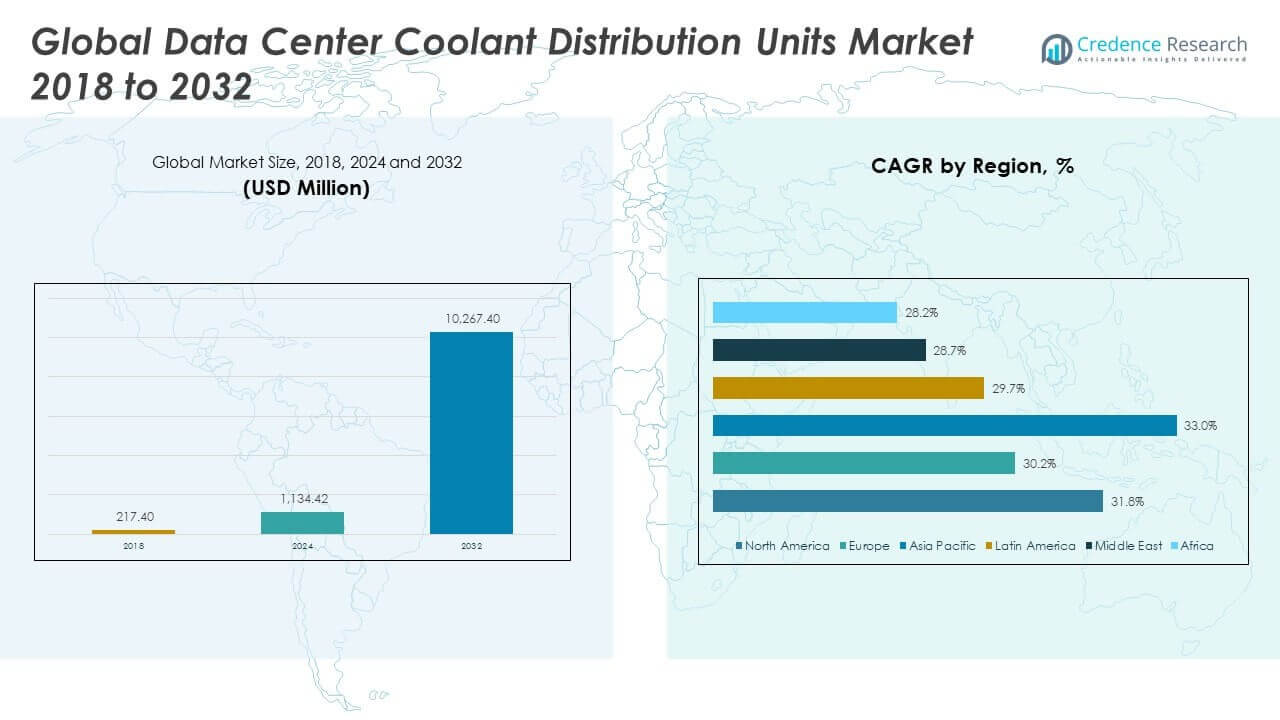
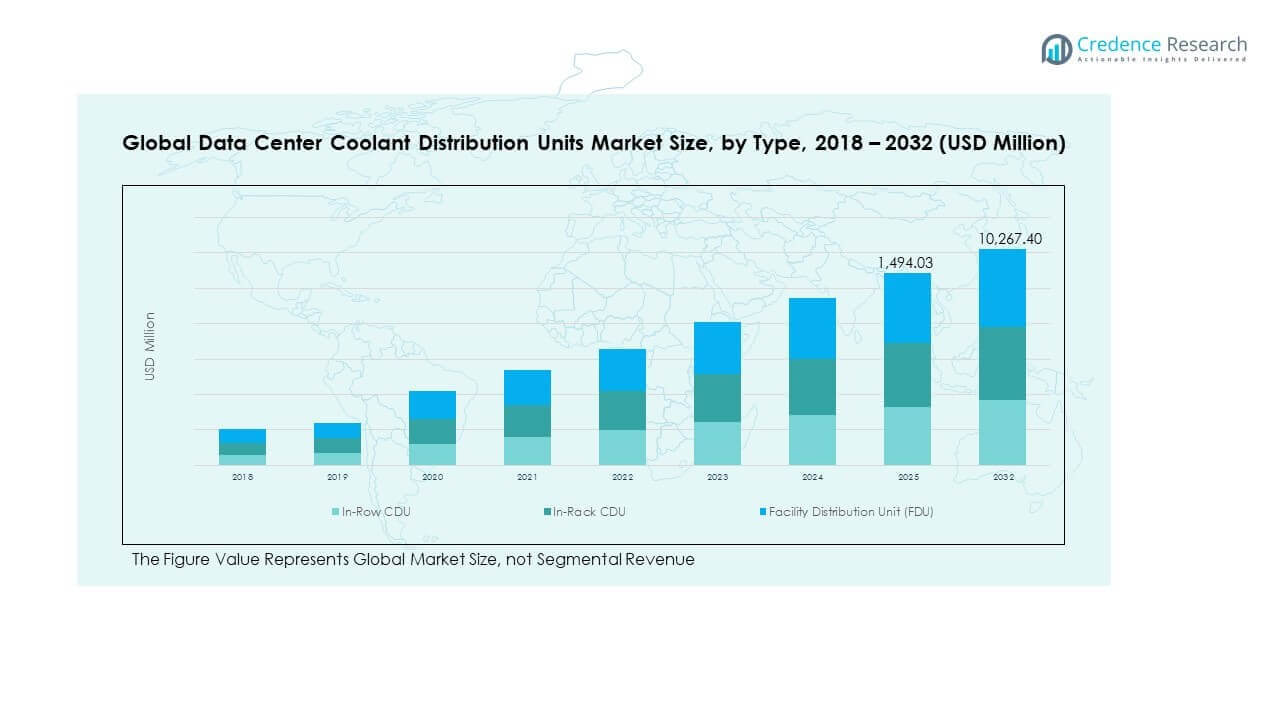
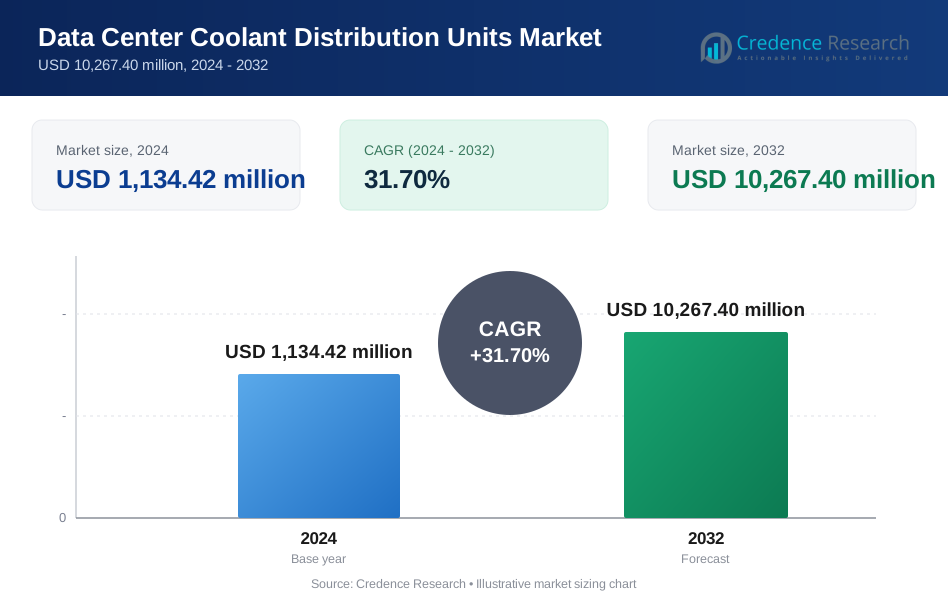
The Data Center Coolant Distribution Units Market size was valued at USD 217.40 million in 2018, increased to USD 1,134.42 million in 2024, and is anticipated to reach USD 10,267.40 million by 2032, registering a CAGR of 31.70% during the forecast period.
| REPORT ATTRIBUTE | DETAILS |
|---|---|
| Historical Period | 2020-2023 |
| Base Year | 2024 |
| Forecast Period | 2025-2032 |
| Data Center Coolant Distribution Units Market Size 2024 | USD 1,134.42 million |
| Data Center Coolant Distribution Units Market, CAGR | 31.70% |
| Data Center Coolant Distribution Units Market Size 2032 | USD 10,267.40 million |
Market growth is driven by the rising deployment of AI-driven workloads and high-density computing environments. Increasing demand for liquid-based cooling solutions enhances energy efficiency and operational reliability. Continuous innovation in direct-to-chip and immersion cooling technologies improves performance under high thermal loads. Businesses and investors recognize the strategic importance of coolant distribution systems for reducing energy costs, supporting sustainability targets, and maintaining competitiveness in data infrastructure.
North America leads the Data Center Coolant Distribution Units Market due to rapid hyperscale expansion and advanced liquid cooling adoption. Europe follows with strong regulatory support for energy-efficient data centers and growing investments in sustainable technology. The Asia-Pacific region is emerging as a high-growth hub, fueled by cloud infrastructure expansion in China, India, Japan, and Singapore, alongside rising digital transformation and green data initiatives.
Market Dynamics:
Market Drivers
Growing Demand for High-Performance and Energy-Efficient Cooling Solutions
The shift toward high-density computing and AI workloads is increasing the heat output in modern facilities. The Data Center Coolant Distribution Units Market benefits from the growing need for efficient thermal management solutions. It enables precise liquid flow control, ensuring consistent cooling performance. Operators are focusing on reducing energy consumption to meet environmental goals. Demand for systems that minimize downtime and improve reliability is expanding. Liquid cooling systems supported by CDUs help optimize temperature across racks. Integration with smart monitoring systems improves operational visibility. This evolution supports sustainable data center operations and long-term cost savings.
Adoption of Liquid Cooling Technologies in Hyperscale and Edge Facilities
The expansion of hyperscale and edge computing infrastructure is driving adoption of liquid-based cooling systems. Operators prefer CDUs for their ability to support high thermal loads efficiently. It ensures stable performance across distributed environments and maintains optimal power usage effectiveness. Rapid AI deployment requires reliable cooling infrastructure to manage heavy processing demands. The growing preference for direct-to-chip and immersion cooling methods enhances the role of CDUs. Vendors are improving unit designs for better scalability and precision control. Businesses see strategic value in deploying flexible cooling frameworks for future growth. This trend aligns with sustainability and performance optimization goals globally.
- For instance, Submer’s single-phase immersion cooling technology, adopted for Solvenz’s global data center projects in March 2024, supports 140 kW per rack and achieves a Power Usage Effectiveness (PUE) between 1.03 and 1.1, significantly outperforming the global rack-average PUE of 1.6 to 1.9 for densities of just 17 kW.
Integration of Smart and Automated Fluid Management Systems
Technological innovation is transforming how facilities manage thermal performance. The Data Center Coolant Distribution Units Market is advancing through automation and IoT integration. It allows real-time monitoring and predictive control over coolant distribution and system health. Operators use intelligent software to adjust flow rates and temperature automatically. Automation helps detect leaks early, improving safety and maintenance efficiency. Integration with AI-driven analytics supports optimized system performance. The adoption of sensors and control valves enhances efficiency across multiple load conditions. These advancements create competitive differentiation for solution providers focused on reliability and intelligence.
- For instance, in September 2025, Schneider Electric launched new reference designs alongside NVIDIA for AI data centers these designs support integrated power and liquid cooling management at densities up to 142 kW per rack, using digital control frameworks that can orchestrate both Motivair liquid cooling and power infrastructure at scale for NVIDIA GB300 NVL72-based data halls.
Strategic Investment in Sustainable and Scalable Cooling Infrastructure
Investors and enterprises are recognizing the importance of sustainable cooling systems. Companies are shifting from traditional air cooling to liquid-based systems for energy savings. It reduces carbon footprints while ensuring operational efficiency. The Data Center Coolant Distribution Units Market plays a strategic role in decarbonization initiatives. Organizations prioritize scalable designs to meet future expansion without redesigning infrastructure. The transition toward greener technologies strengthens compliance with environmental standards. Long-term cost optimization and energy regulation compliance make CDUs valuable assets. This transition supports both economic and ecological sustainability goals for data-driven industries.
Market Trends
Rise of Modular and Customizable CDU Architectures
Manufacturers are introducing modular CDU designs that fit diverse facility layouts. The flexibility of modular systems allows easy integration into existing infrastructures. It supports phased deployment and reduces capital expenses for operators. The Data Center Coolant Distribution Units Market is moving toward compact and high-efficiency modules. Customization options enable tailored capacity planning for various rack densities. Operators are prioritizing modular designs that align with sustainable building strategies. The trend supports faster deployment cycles and scalability in emerging data centers. This shift promotes greater agility and responsiveness to evolving workload demands.
Increasing Use of Smart Monitoring and Predictive Maintenance Technologies
Operators are adopting AI and sensor-based systems for proactive maintenance. Smart monitoring improves fault detection accuracy and reduces system downtime. It enhances operational transparency and enables remote diagnostics of coolant flow systems. The Data Center Coolant Distribution Units Market is integrating cloud-based analytics for real-time insights. Predictive tools forecast performance issues before critical failures occur. These systems support data-driven decision-making and enhance reliability. Integration of telemetry-based analytics allows continuous optimization of cooling networks. This trend strengthens overall efficiency and operational resilience in complex environments.
Growing Collaboration Between Equipment Manufacturers and Cloud Providers
Partnerships between hardware vendors and hyperscale operators are accelerating innovation. Collaborative research is producing CDUs that meet unique hyperscale cooling needs. It enables rapid customization for specific temperature, capacity, and redundancy requirements. The Data Center Coolant Distribution Units Market benefits from co-engineered cooling ecosystems. Joint development enhances integration with power distribution and monitoring solutions. Vendors are also focusing on open standards for interoperability. Strategic alliances are driving faster adoption of liquid cooling technologies across regions. This partnership model promotes performance optimization and standardization across global networks.
Shift Toward Environmentally Responsible Cooling Technologies
Global regulations and sustainability targets are influencing cooling technology choices. Enterprises are adopting eco-friendly refrigerants and low-emission designs. It helps reduce environmental impact while maintaining high operational efficiency. The Data Center Coolant Distribution Units Market is experiencing strong momentum toward green innovation. CDUs that support water-free or recyclable coolant systems are gaining popularity. Governments and large corporations prioritize ESG-compliant data center operations. Sustainable cooling technologies align with energy efficiency certifications such as LEED. This trend strengthens long-term resilience against environmental and regulatory challenges.
Market Challenges
High Initial Costs and Complex Integration Requirements
Implementing advanced liquid cooling systems requires substantial upfront investment. The Data Center Coolant Distribution Units Market faces barriers due to infrastructure modification costs. It demands specialized components and trained professionals for installation. Operators must ensure compatibility with existing HVAC and control systems. Integration complexity often delays deployment and increases capital expenditure. Smaller facilities may find these costs difficult to justify. Limited awareness of long-term operational benefits adds to hesitancy. These challenges hinder faster adoption in mid-scale and traditional data centers.
Concerns Related to Maintenance, Leakage, and Standardization
Reliability concerns remain critical for operators using liquid-based cooling systems. Maintenance requirements are higher due to the need for periodic fluid checks. It raises operational costs and demands skilled technical staff. The Data Center Coolant Distribution Units Market also faces issues related to leak prevention and safety standards. Lack of global standardization affects interoperability and equipment sourcing. Manufacturers are under pressure to improve durability and system compatibility. Limited supply chain maturity for specialized components adds complexity. These challenges create uncertainty for investors evaluating long-term performance stability.
Market Opportunities
Expansion of AI-Driven Data Centers and Cloud Infrastructure
The rapid deployment of AI computing infrastructure is increasing the need for efficient cooling. The Data Center Coolant Distribution Units Market will benefit from facilities adopting high-density processing. It supports next-generation GPU and CPU architectures requiring precise temperature control. AI training environments demand advanced liquid circulation systems for stability. Growth in cloud-based workloads enhances demand for scalable CDU solutions. Vendors offering integrated automation and digital twin technologies will gain advantage. This expansion creates lucrative investment avenues in smart data center ecosystems.
Rising Focus on Green Data Centers and Renewable Energy Integration
Sustainability initiatives are opening new growth prospects for advanced cooling technologies. Operators aim to achieve carbon neutrality through efficient resource utilization. It encourages the use of non-toxic coolants and recyclable system materials. The Data Center Coolant Distribution Units Market aligns with initiatives promoting water and energy conservation. Integrating renewable energy and intelligent coolant management supports efficiency goals. Governments are incentivizing sustainable infrastructure investments. These opportunities position CDUs as vital components of future eco-efficient data centers.
Market Segmentation:
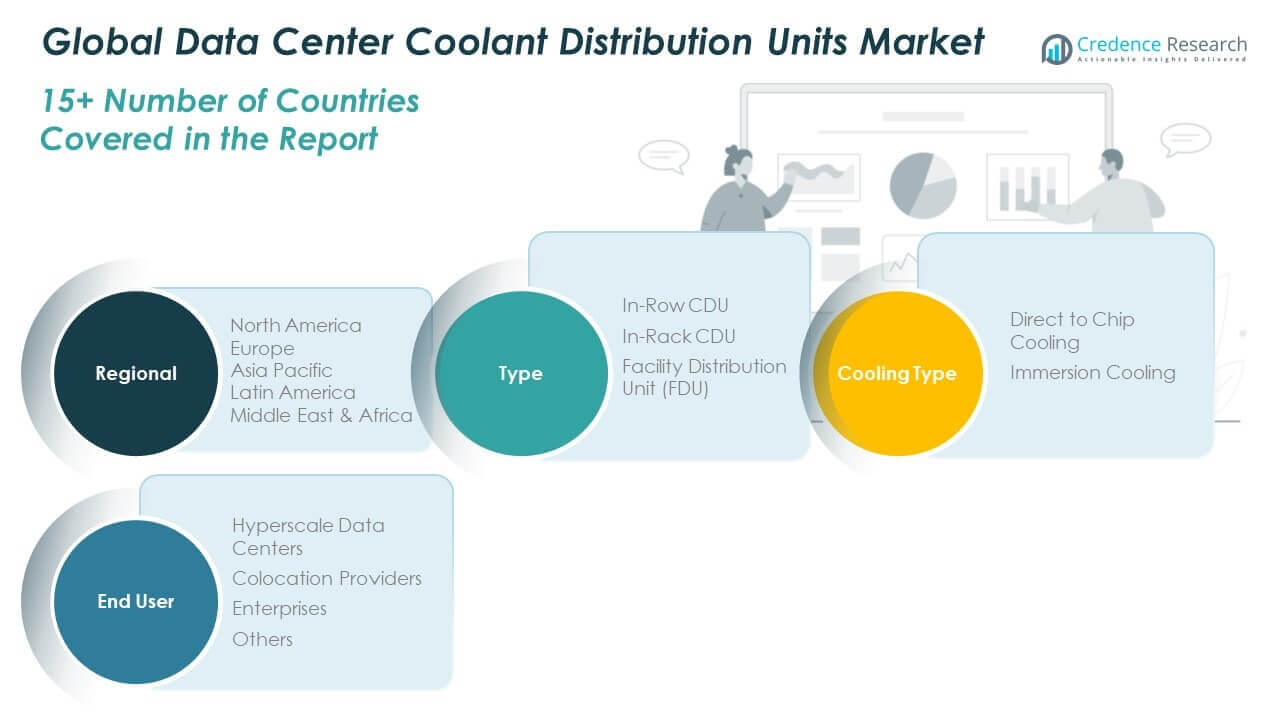
By Type
In-Row CDUs dominate the Data Center Coolant Distribution Units Market due to their energy efficiency and close-proximity design that minimizes coolant travel distance and heat loss. Their modular and scalable configuration suits both hyperscale and edge environments. In-Rack CDUs are gaining traction for compact data centers, offering rack-level precision and ease of maintenance with integrated leak detection and redundancy systems. Facility Distribution Units (FDUs) serve as centralized solutions for hyperscale operations, balancing temperature and pressure across multiple circuits while ensuring scalability and integration with Building Management Systems for enhanced control.
By Cooling Type
Direct to Chip Cooling leads the Data Center Coolant Distribution Units Market, offering superior thermal performance and energy savings by targeting processors directly, reducing fan use, and enabling greater power efficiency. It is widely adopted in AI, HPC, and cloud environments for optimized thermal management. Immersion Cooling is the fastest-growing segment, driven by high-density computing applications like crypto-mining and AI. It submerges components in dielectric fluid, enabling compact setups, lower water usage, and improved sustainability, making it a preferred solution for next-generation, eco-efficient facilities.
By End User
Hyperscale Data Centers hold the largest share of the Data Center Coolant Distribution Units Market, using liquid cooling to manage large-scale AI and cloud operations efficiently. Colocation Providers follow, driven by the need for flexible, multi-tenant solutions and sustainability compliance. Enterprises represent a steady segment, adopting CDUs for private cloud and digital transformation initiatives where reliability and energy visibility are key. Other end users, including telecom, government, and research institutions, are adopting CDUs for specialized workloads and edge computing, broadening the market’s overall reach and resilience.
Regional Insights:
North America
The North America Data Center Coolant Distribution Units Market size was valued at USD 86.38 million in 2018, reached USD 445.61 million in 2024, and is anticipated to attain USD 4,045.46 million by 2032, registering a CAGR of 31.8% during the forecast period. North America holds 35.7% of the global market share, driven by extensive hyperscale expansion and advanced liquid cooling adoption across the U.S. and Canada. The region’s mature cloud ecosystem and AI-focused data centers create strong demand for efficient thermal management. It benefits from early adoption of direct-to-chip and immersion cooling solutions. Major players invest in modular CDU deployments to enhance scalability and energy efficiency. Environmental regulations push operators toward sustainable cooling infrastructures. High R&D investment and advanced digital infrastructure support market leadership. North America remains the hub for innovation and large-scale deployment of high-performance cooling systems.
- For instance, Vertiv’s Liebert XDU450 Coolant Distribution Unit supports up to 453 kW of cooling capacity for direct-to-chip and rear-door heat exchanger It features redundant pumps, remote monitoring, and filtration systems to ensure reliability and efficiency in high-density data center environments.
Europe
The Europe Data Center Coolant Distribution Units Market size was valued at USD 42.90 million in 2018, reached USD 212.27 million in 2024, and is anticipated to reach USD 1,756.93 million by 2032, at a CAGR of 30.2% during the forecast period. Europe captures 15.5% of the global market share, supported by growing demand for sustainable and energy-efficient data centers. The region’s strong regulatory focus on carbon reduction drives rapid liquid cooling adoption. Countries such as Germany, the UK, and France lead the transition toward green computing infrastructure. It experiences rising investment in hyperscale and colocation facilities with low PUE targets. Manufacturers develop advanced CDUs integrating AI-driven thermal controls and predictive maintenance. Partnerships with cloud providers enhance deployment speed. Europe’s steady digital transformation ensures consistent market expansion across enterprise and colocation sectors.
Asia Pacific
The Asia Pacific Data Center Coolant Distribution Units Market size was valued at USD 68.53 million in 2018, reached USD 375.91 million in 2024, and is expected to reach USD 3,686.09 million by 2032, growing at a CAGR of 33.0% during the forecast period. Asia Pacific commands 32.6% of the global market share, driven by hyperscale investments and rapid digitalization in China, India, Japan, and Singapore. Cloud adoption, AI workloads, and data localization laws fuel infrastructure expansion. It benefits from government-backed green data center initiatives and industrial automation projects. Domestic manufacturers are introducing cost-effective CDUs for emerging economies. Expansion of semiconductor and AI research facilities increases demand for liquid cooling. The region’s focus on renewable integration strengthens its long-term outlook. Asia Pacific stands as the fastest-growing regional market worldwide.
Latin America
The Latin America Data Center Coolant Distribution Units Market size was valued at USD 10.29 million in 2018, reached USD 53.04 million in 2024, and is anticipated to reach USD 425.05 million by 2032, registering a CAGR of 29.7% during the forecast period. Latin America accounts for 3.8% of the global market share, supported by expanding data infrastructure in Brazil, Mexico, and Chile. The rise in cloud services and regional hyperscale investments accelerates cooling technology adoption. It benefits from growing awareness of energy efficiency and sustainability standards. Local integrators collaborate with global cooling vendors for advanced deployments. Governments promote digital transformation and smart infrastructure projects. The emergence of modular data centers drives adoption in secondary markets. Latin America’s strong potential lies in the modernization of existing data facilities.
Middle East
The Middle East Data Center Coolant Distribution Units Market size was valued at USD 5.70 million in 2018, reached USD 27.03 million in 2024, and is anticipated to reach USD 203.58 million by 2032, at a CAGR of 28.7% during the forecast period. The region contributes 2.1% of the global market share, led by data center expansion in the UAE, Saudi Arabia, and Israel. Rising investment in smart city and AI ecosystems stimulates demand for efficient cooling infrastructure. It experiences rapid adoption of liquid-based systems to combat high ambient temperatures. Colocation and government-backed facilities drive deployment of sustainable CDUs. Global companies establish regional hubs to support hyperscale growth. Green energy integration supports eco-efficient designs. The Middle East’s growing cloud infrastructure strengthens long-term market presence.
Africa
The Africa Data Center Coolant Distribution Units Market size was valued at USD 3.59 million in 2018, reached USD 20.55 million in 2024, and is anticipated to reach USD 150.29 million by 2032, registering a CAGR of 28.2% during the forecast period. Africa holds 1.9% of the global market share, with growth driven by rising internet penetration and data localization policies. It experiences infrastructure expansion in South Africa, Egypt, and Kenya. Local governments support digital economy initiatives to enhance connectivity. Cooling technology adoption grows as facilities shift toward liquid-based solutions. Vendors introduce compact CDUs tailored for limited-resource environments. International investments from hyperscale operators accelerate regional capacity building. Africa’s progress positions it as an emerging frontier for data center development.
- For instance, in 2024, Teraco began construction of its JB7 data center in Johannesburg, backed by an R8 billion syndicated loan. The facility features closed-loop chilled water and liquid cooling systems designed for high efficiency and will contribute to expanding Teraco’s Isando Campus critical IT load capacity to 110 MW.
Competitive Insights:
- Vertiv Group Corp.
- Schneider Electric SE
- CoolIT Systems Inc.
- Delta Electronics, Inc.
- nVent Electric plc
- Mitsubishi Electric Corporation
- JETCOOL Technologies Inc.
- Munters AB
- Rittal GmbH & Co. KG
- Green Revolution Cooling, Inc.
The Data Center Coolant Distribution Units Market is highly competitive, with global and regional players emphasizing efficiency, sustainability, and innovation. It features a blend of established infrastructure leaders and emerging technology firms targeting high-performance applications. Vertiv and Schneider Electric lead through integrated cooling ecosystems and strong service networks. CoolIT and JETCOOL focus on chip-level innovation and AI workload optimization. Delta and nVent strengthen presence through modular and energy-efficient designs. Mitsubishi Electric and Rittal leverage automation and precision engineering to enhance reliability. Munters and GRC gain traction with sustainable and hybrid cooling approaches. The market continues to consolidate around companies capable of delivering scalable, low-power, and intelligent liquid cooling systems for hyperscale and edge data centers.
Recent Developments:
- In September 2025, Johnson Controls launched a new 1MW Coolant Distribution Unit (CDU), with the potential for units to be deployed in configurations offering up to 10MW cooling capacity for large data centers. This launch targets facilities managing increasing heat loads from dense AI and high-performance compute servers, addressing the need for solutions that maintain operational efficiency and reliability as power densities rise.
- In September 2025, JETCOOL Technologies Inc. launched its SmartSense Coolant Distribution Unit (CDU) capable of cooling up to 300 kW per rack and over 2 MW at the row level. This liquid-to-liquid in-rack CDU provides scalable and energy-efficient cooling solutions that reduce chiller dependency, enabling precise thermal management in high-density data centers.
- In Nov 2024, Vertiv introduced two new high-capacity Coolant Distribution Units (CDUs) to its liquid cooling portfolio. These additions serve the growing requirements of AI, high-performance computing, and sustainability initiatives among major data centers. The new Vertiv CDUs are designed to support next-generation workloads by effectively managing increased thermal loads with higher efficiency, reflecting the market’s pivot toward liquid cooling systems that minimize energy use and environmental impact.
- In July 2024, CoolIT Systems Inc. introduced three new high-density coolant distribution units: AHx240, AHx180, and CHx500. These advanced liquid-to-liquid and liquid-to-air CDUs support AI, high-performance computing, and dense enterprise workloads, offering scalable, efficient cooling with production and availability at their Canadian facility.
Request a Free Sample
Fill in your details and we'll send you a free sample report.
- Sample data tables & charts
- Research methodology
Need a Custom Version of This Report?
Tailor the scope, geography, or segments to your exact requirements.
- Custom geography or segment scope
- Direct access to our analyst team
Frequently Asked Questions
What is the current market size for the Data Center Coolant Distribution Units Market, and what is its projected size in 2032?
At what Compound Annual Growth Rate is the Data Center Coolant Distribution Units Market projected to grow between 2024 and 2032?
Which Data Center Coolant Distribution Units Market segment held the largest share in 2024?
What are the primary factors fueling the growth of the Data Center Coolant Distribution Units Market?
Who are the leading companies in the Data Center Coolant Distribution Units Market?
Which region commanded the largest share of the Data Center Coolant Distribution Units Market in 2024?
Table of Content
Chapter 1. Report Introduction
- 1.1 Report Description & Purpose
- 1.1.1 Report Title & Market Definition
- 1.1.2 Unique Selling Propositions (USP) & Key Differentiators
- 1.1.3 Value Proposition for Stakeholders
- 1.2 Research Objectives
- 1.2.1 Market Sizing Objectives (Volume & Revenue)
- 1.2.2 Segmentation Objectives
- 1.2.3 Competitive Intelligence Objectives
- 1.2.4 Forecast & Scenario Objectives
- 1.3 Report Scope
- 1.3.1 Data Center Coolant Distribution Units Scope – Types & Subtypes Covered
- 1.3.2 Geographic Scope – Regions & Countries Covered
- 1.3.3 Historical Period, Base Year & Forecast Period (2024; forecast to 2032)
- 1.3.4 Inclusions & Exclusions
- 1.4 HS Code & Classification Framework
- 1.5 Currency, Units & Pricing Basis
- 1.6 Target Stakeholders
- 1.7 Limitations & Assumptions
Chapter 2. Executive Summary
- 2.1 Global Data Center Coolant Distribution Units Market Snapshot
- 2.1.1 Market Size – Historical (2024) & Forecast (2024-2032) (2024: USD 1,134.42 million → 2032: USD 10,267.40 million)
- 2.1.2 Volume & Revenue – Global Totals
- 2.1.3 Key Market Highlights – Top Five Facts
- 2.2 Data Center Coolant Distribution Units Market Segmentation Snapshot
- 2.2.1 Market Split by Region – 2024 vs. 2032
- 2.3 Competitive Snapshot
- 2.3.1 Top 10 Players by Revenue Share – 2024
- 2.3.2 Top 10 Players by Volume Share – 2024
- 2.3.3 Recent Strategic Developments (18-Month Summary)
- 2.4 Key Investment Highlights & Strategic Conclusions
Chapter 3. Data Center Coolant Distribution Units Market Dynamics & Industry Analysis
- 3.1 Market Overview & Context
- 3.1.1 Data Center Coolant Distribution Units Market Position in the Broader Automotive Value Chain
- 3.1.2 OEM vs. Replacement Market Dynamics
- 3.1.3 Market Maturity & Development Stage by Region
- 3.2 Data Center Coolant Distribution Units Market Drivers
- 3.3 Data Center Coolant Distribution Units Market Restraints & Challenges
- 3.4 Data Center Coolant Distribution Units Market Opportunities
- 3.5 Porter's Five Forces Analysis
- 3.5.1 Threat of New Entrants
- 3.5.2 Bargaining Power of Suppliers
- 3.5.3 Bargaining Power of Buyers
- 3.5.4 Threat of Substitutes
- 3.5.5 Competitive Rivalry – Intensity Assessment
- 3.6 Data Center Coolant Distribution Units Value Chain Analysis
- 3.6.1 Upstream – Raw Material/Input Suppliers
- 3.6.1.1 Raw Material/Input 1
- 3.6.1.2 Raw Material/Input 2
- 3.6.1.3 Raw Material/Input 3
- 3.6.2 Midstream – Production/Manufacturing/Service Delivery
- 3.6.2.1 Production/Process Overview
- 3.6.2.2 Key Facility Locations & Capacity by Manufacturer
- 3.6.3 Downstream – Distribution & End Consumer
- 3.6.3.1 Primary Channel – B2B/OEM
- 3.6.3.2 Secondary Channels – Dealer, Retail, Online, Direct
- 3.6.4 Value Chain Profitability Analysis
- 3.6.1 Upstream – Raw Material/Input Suppliers
- 3.7 PESTEL Analysis
- 3.7.1 Political Factors
- 3.7.2 Economic Factors
- 3.7.3 Social Factors
- 3.7.4 Technological Factors
- 3.7.5 Environmental Factors
- 3.7.6 Legal Factors
- 3.8 Data Center Coolant Distribution Units Supply Chain Analysis
- 3.8.1 Raw Material/Input Supply Risk Assessment
- 3.8.2 Manufacturing Concentration Risk (Geographic Exposure)
- 3.8.3 Trade Disruption Impact Analysis
- 3.9 Regulatory & Policy Landscape
Note: The regulatory and policy landscape section covers regulations based on their applicability to the market, Data Center Coolant Distribution Units category, geography, and scope of the study. Only regulatory frameworks with a material impact on operations, compliance, trade, sustainability, or market access are analyzed in detail.
Chapter 4. Key Investment Pockets & Opportunity Analysis
- 4.1 Data Center Coolant Distribution Units Market Attractiveness Analysis
- 4.1.1 By Region – Investment Attractiveness Matrix (Volume × CAGR)
- 4.2 Absolute Revenue Growth Opportunity
- 4.2.1 By Region – Absolute USD Growth Through 2032
- 4.3 Incremental Volume Opportunity
- 4.3.1 By Region – Incremental Volume Through 2032
- 4.3.2 Segment – Incremental Volume
- 4.4 Emerging Submarket Opportunity Deep Dive (Subject to Applicability)
- 4.5 Emerging Market Opportunity Scorecards
- 4.5.1 United States
- 4.5.2 Europe
- 4.5.3 Asia
- 4.5.4 Middle East & Africa
Note: Emerging Market Opportunity Scorecards will be included based on relevance and strategic importance. Regions listed are indicative and may vary depending on data availability and market dynamics.
Chapter 5. Data Center Coolant Distribution Units Import-Export Analysis & Trade Flows
- 5.1 Global Trade Overview
- 5.1.1 Global Export Value by Country (2024)
- 5.1.2 Global Export Volume by Country (2024)
- 5.1.3 Global Import Value by Country (2024)
- 5.1.4 Global Import Volume by Country (2024)
- 5.1.5 Net Trade Balance by Country (2024)
- 5.2 Export Analysis – Segment
- 5.2.1 Type 1 (HS Code)
- 5.2.2 Type 2 (HS Code)
- 5.2.3 Type 3 (HS Code)
- 5.2.4 Type 4 (HS Code)
- 5.2.5 Type 5 (HS Code)
- 5.3 Import Analysis – Segment
- 5.3.1 Type 1 (HS Code)
- 5.3.2 Type 2 (HS Code)
- 5.3.3 Type 3 (HS Code)
- 5.3.4 Type 4 (HS Code)
- 5.3.5 Type 5 (HS Code)
- 5.4 Average Unit Trade Prices
- 5.4.1 Average Export Price – Segment & Country
- 5.4.2 Average Import Price – Segment & Source Country
- 5.4.3 Price Trends (2024)
- 5.5 Key Trade Route Analysis
- 5.5.1 Trade Route 1
- 5.5.2 Trade Route 2
- 5.5.3 Trade Route 3
- 5.5.4 Trade Route 4
- 5.5.5 Trade Route 5
- 5.6 Trade Policy Impact Assessment
- 5.6.1 US Anti-Dumping & Section 301 Tariffs
- 5.6.2 EU Customs Union Impact
- 5.6.3 Major Free Trade Agreements
- 5.6.4 USMCA Rules of Origin
Note: Trade policy analysis will be included only where relevant to the Data Center Coolant Distribution Units market.
Chapter 6. Competitive Landscape & Company Benchmarking
- 6.1 Data Center Coolant Distribution Units Market Concentration & Structure
- 6.1.1 Herfindahl-Hirschman Index (HHI) – vs. 2024
- 6.1.2 Tier 1, Tier 2 & Tier 3 Market Structure
- 6.1.3 Global, Regional & Local Player Dynamics
- 6.2 Data Center Coolant Distribution Units Market Share Analysis – 2024
- 6.2.1 Global Revenue Share by Company
- 6.2.2 Global Volume Share by Company
- 6.2.3 Regional Revenue Share
- 6.2.4 Market Share Evolution ( vs. 2024)
- 6.2.5 OEM Segment Share by Company
- 6.2.6 Replacement Segment Share by Company
- 6.3 Production/Delivery Capacity & Facility Analysis
- 6.3.1 Global Installed Capacity
- 6.3.2 Capacity Utilization Rates
- 6.3.3 Production/Output Volume
- 6.3.4 Facility Locations & Capacity Map
- 6.3.5 Planned Capacity Additions
- 6.4 Data Center Coolant Distribution Units Competitive Benchmarking Matrix
- 6.4.1 Revenue, Volume, CAGR & Profitability Comparison
- 6.4.2 Channel Revenue Mix
- 6.4.3 Geographic Revenue Exposure
- 6.4.4 R&D Intensity
- 6.4.5 Sustainability Maturity
- 6.5 Strategic Developments in Data Center Coolant Distribution Units (Last 24 Months)
- 6.5.1 Mergers, Acquisitions & Divestments
- 6.5.2 New Data Center Coolant Distribution Units Launches
- 6.5.3 Facility Expansions
- 6.5.4 Strategic Alliances, Joint Ventures & Partnerships
- 6.5.5 Distribution Expansion & Market Entry
- 6.5.6 Sustainability & ESG Initiatives
- 6.6 Competitive Strategy Mapping
- 6.6.1 Leader, Challenger, Follower & Niche Classification
- 6.6.2 Pricing Strategy Comparison
- 6.6.3 Channel Strategy Matrix
Note: Strategic developments are included based on their materiality and the availability of reliable information.
Chapter 7. Global Data Center Coolant Distribution Units Market – By Distribution Channel
- 7.1 Segment Overview
- 7.1.1 Volume & Revenue Split by Channel (2024 & 2032)
- 7.1.2 Channel Mix Evolution (2024-2032)
Chapter 8. Regional Market Analysis – Global Overview
- 8.1 Global Regional Overview
- 8.1.1 Regional Volume Share
- 8.1.2 Regional Revenue Share
- 8.1.3 Regional Volume by Region
- 8.1.4 Regional Revenue by Region
- 8.1.5 Regional Forecast Through 2032
- 8.2 Cross-Regional Segment Analysis
- 8.2.1 By Distribution Channel
- 8.2.2 By Brand/Price Tier
Chapter 9. North America Data Center Coolant Distribution Units Market
- 9.1 United States
- 9.2 Canada
- 9.3 Mexico
Chapter 10. Europe Data Center Coolant Distribution Units Market
- 10.1 Germany
- 10.2 France
- 10.3 Italy
- 10.4 United Kingdom
- 10.5 Spain
- 10.6 Poland
- 10.7 Russia
- 10.8 Netherlands
- 10.9 Belgium
- 10.10 Sweden
- 10.11 Denmark
- 10.12 Norway
- 10.13 Rest of Europe
Chapter 11. Asia Pacific Data Center Coolant Distribution Units Market
- 11.1 China
- 11.2 India
- 11.3 Japan
- 11.4 South Korea
- 11.5 Thailand
- 11.6 Indonesia
- 11.7 Vietnam
- 11.8 Malaysia
- 11.9 Australia
- 11.10 Rest of Asia Pacific
Chapter 12. Latin America Data Center Coolant Distribution Units Market
- 12.1 Brazil
- 12.2 Argentina
- 12.3 Colombia
- 12.4 Chile
- 12.5 Rest of Latin America
Chapter 13. Middle East Data Center Coolant Distribution Units Market
- 13.1 Saudi Arabia
- 13.2 United Arab Emirates
- 13.3 Turkey
- 13.4 Israel
- 13.5 Iran
- 13.6 Rest of the Middle East
Chapter 14. Africa Data Center Coolant Distribution Units Market
- 14.1 South Africa
- 14.2 Egypt
- 14.3 Nigeria
- 14.4 Morocco
- 14.5 Rest of Africa
Chapter 15. Data Center Coolant Distribution Units Company Profiles
- 15.1 [Company 01]
- 15.1.1 Company Overview
- 15.1.2 Key Management Personnel
- 15.1.3 Products & Services Portfolio
- 15.1.4 Financial Performance
- 15.1.5 Key Market Focus & Geographic Presence
- 15.1.6 Recent Developments & Strategic Initiatives
Note: The company profile list is preliminary and may change based on research findings, market developments, data availability, and client requirements.
Chapter 16. Appendices
- Appendix A – List of Abbreviations & Acronyms
- Appendix B – Industry Classification Code Reference – Full Series
- Appendix C – Production & Capacity Data Tables
- Appendix D – End-Use & Demand Base Tables
- Appendix E – Consumption & Replacement Rate Assumptions
- Appendix F – ASP Reference Tables
- Appendix G – Manufacturing & Facility Database
- Appendix H – Import-Export Data Tables
- Appendix I – Regulatory Summary Tables
- Appendix J – Primary Research Participant List (Anonymized)
- Appendix K – Primary Research Questionnaire Framework
- Appendix L – Data Sources & Bibliography
- Appendix M – Market Size Divergence & Source Comparison
Chapter 17. Research Methodology
- 17.1 Research Framework & Philosophy
- 17.2 Secondary Research – Sources, Hierarchy & Data Extraction
- 17.3 Data Modeling – Bottom-Up & Top-Down Market Sizing
- 17.4 Primary Research – Stakeholder Framework, LOI & Sample Sizes
- 17.5 Forecast Methodology – Regression, Scenario & Sensitivity Analysis
- 17.6 Quality Control – Four-Layer Validation Framework
- 17.7 Limitations & Standard Assumptions
- 17.8 Disclaimer
